‘Welsh’ Labour – The True ‘Nasty Party’

As you know, I detest the Labour Party in general and its ‘Welsh’ branch with a special vehemence. My contempt for Labour is due primarily to the damage Labour has done to Wales over the past century, summed up in my post Why I Detest The ‘Welsh’ Labour Party.

But my contempt is also attributable to the self-serving scumbags drawn to Labour because it controls Wales and therefore has the power of patronage and funding. These creatures can end up as elected representatives or Third Sector parasites sucking billions of pounds from the Welsh public purse. Often both, for there is a constant to-ing and fro-ing between these sectors.

Inevitably, my criticisms of the Labour Party draw attacks from that quarter. One famous incident occurred  just over a year ago when the leading reporter of the Wasting Mule, a known Labour supporter, got a blogger friend to publish attacks on me which he then repeated in his rag.

You can follow this despicable episode here with the following posts: I Must Be Doing Something Right! (Jan 28, 2015); Now I KNOW I’m Doing Something Right! (Feb 3, 2015); Helping A Man In A Hole (Feb 5, 2015); OMG! I Have Offended The ‘Progressives’! (Feb 10, 2015); Where Is Franz Kafka When You Need Him? (Mar 1, 2015). In this final post I published the apology I extracted from Trinity Mirror, the owners of the Mule, published both online (shown below) and in the rag itself on February 27th.

Wales Online apology 1

Over the years, in this blog and the previous blog, I have highlighted corruption within the Third Sector by people with strong Labour Party connections, I reminded people that Naz Malik of AWEMA fame began his political career in the race relations racket by regularly attacking ‘racist Welsh nationalists’ for his Labour funders.

I have enjoyed laughing at the Labour group on Swansea council, led by a preening prat from Liverpool reliant on immature students who are also strangers to the city!

Small wonder then that I have made an enemy of ‘Welsh’ Labour, but I wouldn’t want it any other way. For I understand better than most – and better than many in Plaid Cymru – that the real obstacle to achieving a better Wales is the Labour Party. It must be smashed as the SNP has done in Scotland.

This approach inevitably results in regular attacks on me in social media and elsewhere by Labour’s defenders, but rarely as frontal and crude as the Parry-Shipton assault last year. Though some try, such as a woman I’d never heard of until she opened up on me with both barrels.

It all started when @DilysDavies tweeted me a link to an article on the Grauniad website by Michael White. White wondered why Neil Hamilton had been elected to the Assembly and mused, “What could Wales . . . have been thinking of when it elected him on Thursday? Probably of immigration and job security”. To which I responded:

Twitter 1

I urge you to note that I say “many” of UKIP’s votes come from English people who have moved to west Wales. That is, “many”, not ‘most’, and certainly not ‘all’. As far as I was concerned, that was it.

This tweet of mine prompted a response from @CwmniDB, a David Bullock, reminding me of UKIP’s support “in old coalfield seats where there’s little immigration from England”. Very true, I have written about this phenomenon more than once.

Here, for example, is my post on the 2014 Euro elections. For other posts in which I search for the answer to UKIP’s appeal in Wales just type UKIP or Ukip (I’m never sure) in the search box.
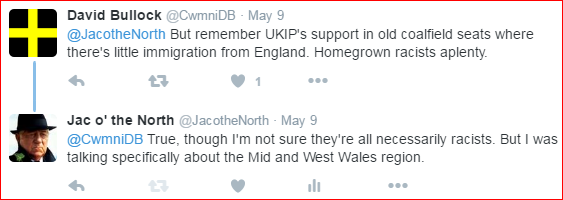
Twitter 3

The next contribution came from the person hinted at earlier, a clearly outraged @RosemaryEmery. She is a member of the Labour Party in Llanelli. She was “shocked”. (In my experience, Labour people are very easily ‘shocked’.)

Twitter 5

We exchanged a number of tweets – God! it was fun – and it became clear that what ‘shocked’ her was my use of the term immigrant to describe English people who move to Wales. (The fact that David Bullock had also used the term seemed not to bother her at all.)

I argued that anyone moving from one country to another was an immigrant to the country he or she moved to, and that this spat she had engineered depended on whether one believed that Wales and England are different countries. To which she responded, ” . . . we are all citizens of Britain and there are no border controls.”

In an attempt to explain that it’s quite possible to have different nations and countries in the same state, I used the example of Tibet . . . which is when it got a bit weird.
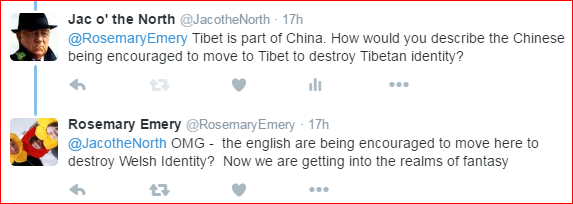
Twitter 6

Now I don’t deny that I’m partial to the odd allusion, the well-chosen analogy, but I used Tibet in order to vividly explain the suffering that can befall a minority identity in a multinational state, I was certainly not arguing that there is a valid comparison between Tibet and Wales. Rosemary Emery had other ideas, and clearly another agenda.

A few more tweets were exchanged then we were joined by @poumista, who is Gary Robert Jones, another Labour Party member from Llanelli. I was fairly sure that his handle referred to a Spanish communist party from the Civil War days, I remembered that from Homage to Catalonia. Just to be sure I asked him, you can see his response below.
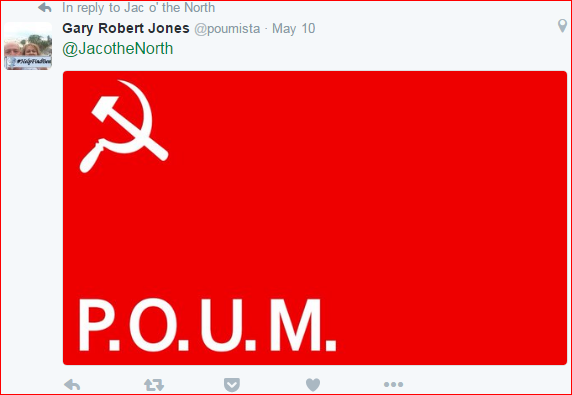
Twitter 8

How reassuring to know that the Labour Party in 2016 contains class warriors still fighting the Spanish Civil War. Jesus!

Anyway, I eventually tired of Dozy Rosie and Señor Jones and ended the illuminating exchange. After which I got a message with the rather sinister hashtag #WeWillBeWatching, which I could only interpret to mean that I was being monitored by deranged members of ‘Welsh’ Labour.

So I decided to complain to their party headquarters, confident of redress, and reassurance . . . or something. As yet, I have had no response, perhaps they’re busy with something.

Twitter 7

I wouldn’t have bothered you with Dozy Rosie and Comrade Jones were it not for the fact that this is all of a pattern. Just as with the Parry-Shipton comedy duo last year I was again accused of saying things I hadn’t said, thoughts were ascribed to me that I don’t hold, and there was always the lurking suspicion that there was someone ‘further back’ controlling these people.

And of course my exchange with the delusional duo in Llanelli came soon after the Assembly elections, during which Labour behaved so badly. Perhaps the worst example was the trade union Unison putting out lies about Plaid Cymru’s policies. I’m not surprised by that, Labour tells lies, that’s how it hangs on to power in Wales.

What did surprise me is that Plaid leader Leanne Wood is a member of Unison. For fuck’s sake, when are these people going to wake up and see Labour and its subsidiary organisations for what they really are?

Well, after the shenanigans on Wednesday, when the other parties challenged Labour’s divine right to rule by supporting Leanne Wood for First Minister, and the Labour lie machine went into overdrive, perhaps those in Plaid Cymru who had a lingering affection for ‘fellow-socialists’ will finally have woken up.

I suspect that a debilitating spell may finally have been lifted.

Carwyn vote
Photo courtesy of BBC Wales

‘Welsh’ Labour is rattled, its share of the vote is down to a third, it has no allies other than a desperate and lonely woman who has made a tragic miscalculation, and it can see the Scottish scenario approach. Wonderful!

Labour has become a sickness from which Wales has suffered for a century, a synonym for corruption and cronyism, patronage and waste. Labour in our country is a party that serves a different country. It’s time to cure Wales of Labour and make her healthy.

Last year, during my tussle with Parry and Shippo I was accused of calling Labour vermin. Yes, I did call Labour vermin. My one regret is that in using that term I was being unfair to rats and other creatures whose company I would prefer to any verminous bastard connected with the Labour Party.

UPDATE 13.05,2016: I now know a little more about Rosemary Emery and Gary Robert Jones.

Emery is of course English, possibly from Yorkshire, and her Facebook page tells us that she is a supporter of the England rugby team which, as ‘Sosban Fach’ commented, might explain why she has never stood for elected office in Llanelli.Emery England

Jones is a community councillor in Llangennech, and seems to be one of those Labourites who believes that the Welsh language is a nationalist conspiracy, and as such it must be fought tooth and nail. To this end he has been going around Llangennech stirring things up and dividing the community by arguing how divisive it would be for the council to meet the demand for Welsh language education.

Jones got involved with an online petition opposing Welsh language education. The comments make interesting reading, especially as so many of them come from people who cannot possibly be parents with children at Llangennech school. Comments come from Loughor, St Clears, Carmarthen, Swansea, even England! I hope nobody’s paying too much attention to this bigoted tripe!

Something else I found online linked to Jones is a picture of Dennis Coslett’s grave, one of a number of his photographs on the americymru website. Draw your own conclusions.

Returning to England-supporting Emery, she is, as she promised, watching me, and picked up on a tweet I put out earlier about yet another English sex offender turning up in rural Wales. Her tweet reminds us how the Labour Party operates – lies, distortions, non-sequiturs and ascribing views and opinions to opponents that they know to be wrong. (The most popular one at the moment being that Plaid Cymru is in “coalition” with Tories and UKIP.)
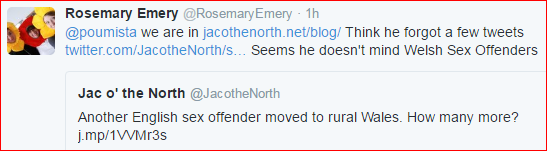
Emery sex offenders

Rather than worry about sex offenders being dumped in Wales she uses my tweet to suggest that I don’t mind Welsh sex offenders! On the one hand such tactics are obviously devious and distasteful, but they’re also silly, and on an intellectual level that would almost certainly be surpassed in the playground of Llangennech school . . . in both languages.

So there you are, two fine examples of anti-Welsh Labour. Carwyn Jones must be so proud of them. It’s sad really, because I’m old enough to remember when the Labour Party in Llanelli was Welsh, and a party of the people, led by men of the people like Jim Griffiths.

Now it’s just a refuge for bigots and chancers, dilettantes and poseurs, crooks and wankers, who regard politics as a game, with the purpose of the game being to beat the opposition and keep control of the gravy train, rather than to serve the people and improve their lives.

UPDATE TO UPDATE

As if to prove my point, Emery has just put out the tweet below. “Substitute English for Polish”, says Emery. Why not Bolivian, or Ugandan, or fucking Martian? I couldn’t have asked her to perform better, to prove me right, if I’d written it myself.

1/ She refuses to address the facts as reported by the BBC.

2/ I did not say ‘Polish’ because the man is not Polish, he’s English. (I know this is difficult for Labourites, but it’s called sticking to the facts.)

3/ Rather than address the issue of yet another English sex offender ending up by some route, with the help of some agency, in a small Welsh town, she uses it to link me with UKIP!

Emery sex offender 2

Carry on like this, Emery – and this applies equally to your dilettante-revolutionary friend – and I might conclude that you’re too stupid and / or too dishonest to bother with.

  ~ ~ ~ ~ END ~ ~ ~ ~
Assembly Elections 2016

This is the post I promised in which I shall tell you who I’m voting for on Thursday and why.

CONSTITUENCY SEAT

I live in the Dwyfor Meirionnydd constituency and my Assembly Member is Dafydd Elis Thomas, or Lord Elis Thomas if you prefer. I’ve known him for many years, and when I arrived home last Friday afternoon, there he was, large as life, talking to my missus at the front gate. When I got out of the car we had a little chat.

Now I don’t dislike Dafydd, but obviously we don’t see eye to eye on much . . . if anything. Even so, I’ve usually voted for him; but this time round I’m changing. It’s not a single utterance or deed that accounts for this decision, more a build-up of little things with nothing to maintain balance – hence my arrival at the tipping point.

Many of these little disaffections can be grouped under DET’s fondness for the Labour Party. His liking, even preference, for Labour surfaced again a week or so ago when he urged Plaid, Tory and Liberal Democrat supporters to give their second vote in the North Wales Police and Crime Commissioner election to the Labour candidate David Taylor. (Here’s a link to information on all five candidates.)

The explanation he gave at my front gate last Friday was the same he gave to the media – it was a calculated attempt to stop the UKIP candidate being elected on the second ballot.

In PCC elections, as in the Assembly elections, we get two votes, and if no candidate gets a majority first time round then the two with the most votes go into the second round, in which the second preferences of the eliminated candidates are allocated. I shall return to the PCC elections, and young Mr Taylor, later.

My Choice

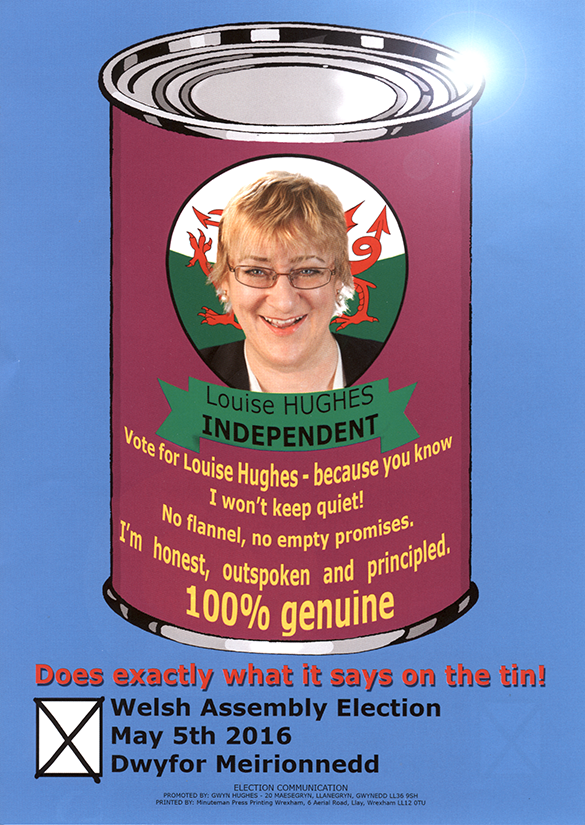
So who am I voting for? (Drum roll!) Well the answer is that my vote will go to a shy, retiring local councillor with whom I have enjoyed many a profound political discourse in the aisles of Tywyn Co-op. I’m referring to Louise Hughes, who is standing as a (genuine) Independent.

Louise Hughes
Click to enlarge

Some may condemn me for ‘wasting’ my vote and arguing that, even if elected, Louse will be unable to achieve anything down Cardiff docks. I disagree.

What we have down Cardiff docks is a branch office of the London government, run by civil servants answering to their London masters. The politicians we elect may strut and puff, but apart from being allowed ‘gimmick’ legislation every now and again, they have little real control over anything. Much of the legislation the ‘Welsh’ Government claims as its own is nothing but English legislation with ‘(Wales)’ squeezed into the name. Perhaps their only real power is being able to dish out the lolly.

Yet far too much of this funding goes to Labour’s allies in the Third Sector in blatant patronage and cronyism, or else is ‘invested’ – ‘for the good of Wales’ – in Cardiff. One of the most disappointing results of devolved politics is how AMs of all parties end up following the party line and squandering money on Third Sector spongers like these.

Click on the link I’ve provided, scroll down to the second section, and ask yourself who, apart from Jill Tatman and her gang of colons, benefits from all the money they’ve been given? Or to put it another way, would Llandovery be any poorer, any more deprived, if she and her co-conspirators had been denied public funding?

I’m voting for Louise Hughes because if she is elected, and even if she is ignored, she’ll still be speaking for those that elected her. Though take my word for it, Louise can make herself very difficult to ignore.

Finally, and perhaps decisively, there is the dishonesty in Plaid Cymru asking the voters of Dwyfor Meirionnydd to vote for a candidate who could have the Plaid Cymru whip withdrawn if re-elected, and who might be in the Labour Party a few months down the line.

THE REGIONAL LIST

An Assembly Member who has received favourable mention in this blog is William Powell, the Liberal Democrat AM for the Mid and West Wales region. (That I’ve been complimentary to any AM may surprise a number of you.)

There are two reasons for this. First, Powell turns up at Cilmeri for the annual December commemoration of the slaying of Llywelyn ap Gruffydd (Y Llyw Olaf). You could argue that as a local AM he is obliged to attend. He’s not obliged to attend at all; I believe he comes because he shares some of the sentiments of those, like me, who have been going to Cilmeri for longer than we care to remember.

Perhaps William Powell should be an example to Plaid Cymru politicians whose enthusiasm for Cilmeri tends to waver, and can perhaps even be influenced by ‘Shippo’ down at the Wasting Mule. (Which is what he, his mate Phil Parry, and their Labour cronies would like to believe.)

My second reason for choosing Powell is his response to a petition I submitted to the Assembly a few months ago, and how his response contrasted with that of the Assembly’s Petitions Committee. I dealt with it back in January, in Local Democracy Endangered, here’s a brief summary.

Petitions Committee
Click to enlarge

I submitted a petition asking the ‘Welsh’ Government to consider intervening when it became clear that a chief executive, acting alone or in concert with others, was subverting the democratic process by acting beyond his powers and / or without consulting the elected councillors.

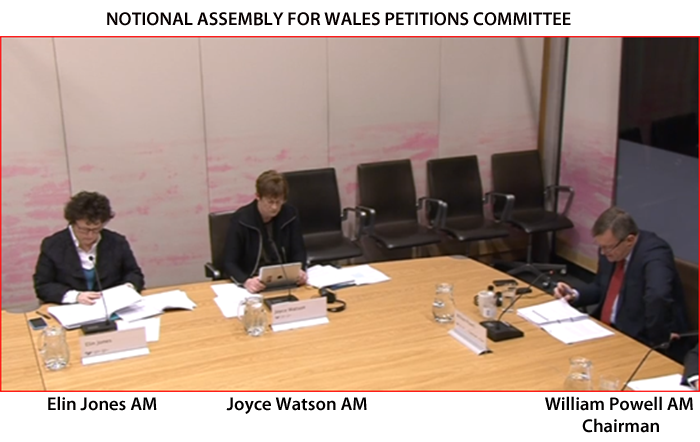
When my petition was discussed on January 19th the Petitions Committee consisted of Joyce Watson, the Labour AM for Mid and West Wales, and Elin Jones, the Plaid AM for Ceredigion. This is how I reported their ‘consideration’ of my petition:

Watson Elin Jones
Click to enlarge

I would expect no better from a Labour time-server like Watson, but against my better judgement I still thought Elin Jones might have had a contribution to make.

William Powell clearly understood what my petition was about, and tried to get a discussion going with, “It (the petition) does raise some very serious issues”. To no avail. Mesdames Watson and Jones had no intention of discussing anything that might have discomforted Mark James or embarrassed the ‘Welsh’ Government.

So for these and other reasons, and secure in the knowledge that the Liberal Democrats are very unlikely to gain more than a single list seat in Mid and West Wales, I shall be giving my second vote, my regional list vote, to the Liberal Democrats. Though had anyone other than William Powell topped the list my vote would have gone to another party, or I might not have used my second vote at all.

THE PCC ELECTION

Quite frankly, and despite what Dafydd El professes to fear, I believe the chances of UKIP winning in the second round of the North Wales PCC election are slim, and simply exposes again his Labour leanings. But even if there was a threat from UKIP I cannot see how anyone outside of Labour could possibly be attracted to David Taylor.

Taylor first came to the attention of an incredulous public as an acne-plagued hobbledehoy living somewhere near Rhuthun. This was in 2004, when he set up a website to “undermine Labour rebel Clare Short”. Note that the Daily Post account I’ve linked to tells us that 18-year-old Taylor was already secretary of the Clwyd West constituency party and also sat on Labour’s ‘Welsh’ executive.

The boy was obviously destined for greatness, and it duly arrived when he became advisor to Leighton Andrews AM in 2005. Though he soon embarrassed his party with another childish, and similarly unsavoury stunt, this time the infamous Aneurin Glyndŵr website. Around the same time he tweeted what might have been interpreted as a distasteful reference to the Hillsborough disaster.

Taylor also spent a short period as Special Advisor to Peter Hain, when the Man of Tan was briefly Governor-General, a post he lost in the 2010 general election. But Taylor seems to have stayed on in London as a ‘Senior Political Adviser’ to the Labour Party.

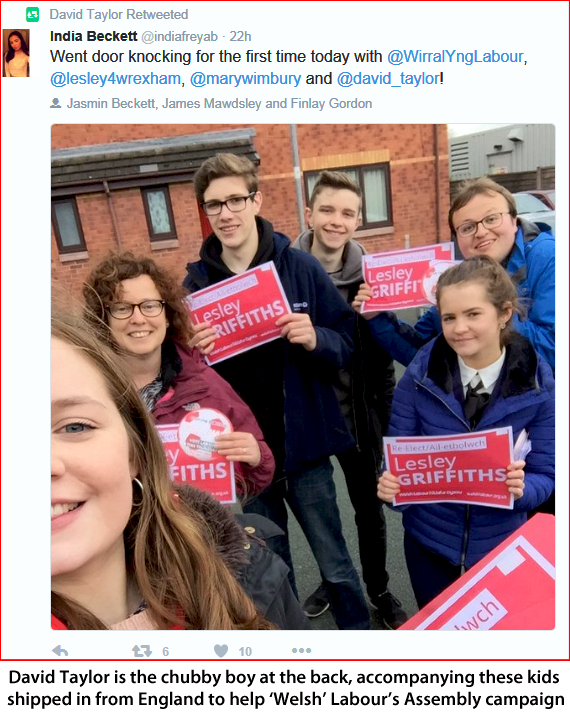
David Taylor canvassing
Click to enlarge

Since 2012, according to his Linkedin profile, he has been a director of a company called Leckwith, which has undergone a few changes of both name and address. It was originally known as Albacore Associates before morphing, in July 2012, into Westgate Strategy Ltd, before changing again, just a month later, to Leckwith Ltd. There were also physical moves from Cardiff to Newport to London. (Here’s the website.)

It’s reasonable to assume that this PR company was set up to capitalise on Taylor’s proven talent in the field of influencing people and also to exploit his contacts in the Labour Party. Though to judge by the accounts Leckwith has been slow to take off.

Taylor is also a non-executive director of Westgate Cyber Security Ltd of Newport, formerly London. This company also was incorporated in August 2012, but this is not a one-man band, for Taylor has a co-director, one David Wyn Jones, whose business background can be seen by clicking on his name under the ‘Officers’ tab. (Here’s the website.)

Having mentioned Leighton Andrews, I am indebted to ‘STaN‘ of Neath Ferret fame for reminding me that Andrews came quite late to the party, having been a leading light in the Liberal Democrats until just over a decade ago. Here’s a piece by Michael Meadowcroft lamenting Leighton Andrews’ departure. (I kid you not!)

I’ve also mentioned Peter Hain, and for information on the bête noire of the Boers, STaN‘s yer man.

David Taylor is a Labour insider of the worst kind. The type who joins the party before he starts shaving and spends the rest of his life in a cocoon, while determining what’s best for people of whose feelings and aspirations he knows nothing. He is exactly the kind of person – the professional politician – that either turns people off politics or else drives them towards more ‘colourful’ politicians.

Sorry, Dafydd, this is another wrong call. And if it was a straight fight between David Taylor and the UKIP candidate for North Wales PCC, and if I was forced to vote, then I couldn’t promise that I wouldn’t vote UKIP.

My Choice

I shall be voting for Arfon Jones as our PCC. As coppers, or ex-coppers, go, Arfon’s not bad, he was our village bobby for a while. And he’s never been afraid to speak out and question his former employer, something we encounter all too rarely.

Arfon leaflet 1
Click to enlarge

In addition, having served and lived in Gwynedd, and also having spent many years on the other side of the region, Arfon knows the north from Holyhead to Bangor-on-Dee a lot better than most.

He’s also a sociable individual, going for the occasional drink at the Saith Seren, with which he has been long involved, and following Wrexham football club home and away, while not neglecting the rugby. He’s married, with children and grandchildren, in Wales and Scotland, so I wouldn’t hesitate to describe him as a ’rounded’, mature individual of many interests . . . unlike, I fear, David Taylor.

CONCLUSION

Looking at the wider picture, my reluctance to vote for Plaid Cymru at this election (over and above my longstanding criticisms) can be summed up in one word – Labour. And I’m not referring now to Lord Elis Thomas’ as yet unconsummated attraction.

It seems very likely that Labour and Plaid will be in coalition after Thursday’s election. That’s unless Plaid’s nightmare scenario materialises in which Labour can cobble together a coalition with two or three Lib Dem AMs, and possibly even a Green.

Now my views on the Labour Party generally, and ‘Welsh’ Labour in particular, are well known. A clue may be found in the title of my post, Why I Detest The ‘Welsh’ Labour Party. I urge you to read it.

What Wales desperately needs is wealth creators, visionaries prepared to take risks and by so doing create jobs and a wealthier country. But such people are frowned on by socialist parties like Labour and Plaid Cymru, for they cannot be controlled like a publicly-funded client class masquerading as an ‘economy’.

So generous is this system now that its fame has spread; spongers and leftie bandwagon-riders flock to Wales to take advantage of ‘our’ generosity. And the funding given to alleviate Wales’ poverty, to educate and train us, to build infrastructure, achieves nothing because it is squandered on a Third Sector the greater part of which achieves nothing beyond generous salaries and pensions for the charlatans involved.

Wales needs radical change; a new national mindset. None of the parties involved in this election provide anything other than tired and discredited ideas dressed up and repackaged. Consequently it matters little what emerges after Thursday.

The Welsh people deserve better. They just need to realise it. Who’s going to make them realise it? And how?

~ ~ ~ END ~ ~ ~


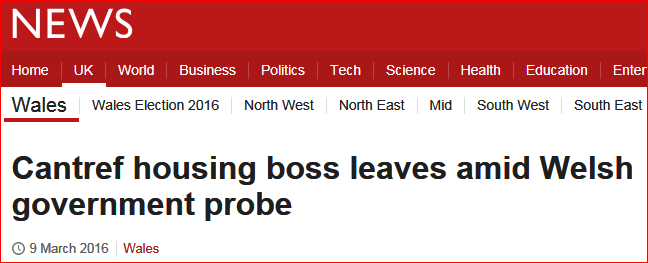
Tai Cantref: Fate Decided by Labour Cronyism

You will recall that in a few recent posts (below) I have looked at the Newcastle Emlyn-based Cantref housing association, which seems to have gone through a rocky patch of late and, following an ‘investigation’, is to be taken over by Wales and West Housing of Cardiff. A bit of digging combined with election dirty tricks has turned up some rather disturbing connections.

Social Housing Back to Council Control? Tai Cantref: Favoured Suitor Named. Housing Associations – All Change?

The investigation into Cantref was carried out by a company called Campbell Tickell, of London. So who are Campbell Tickell? They seem to be a company that has all the bases covered in the social housing and charities sector.

They are, in their own words, ” . . . an established multidisciplinary management consultancy focusing principally on housing, regeneration, charities and social care, and with a growing involvement in sports and leisure. Our services extend across: strategic and business planning; governance and regulation; performance management; procurement; asset management and development; growth and new business; regeneration and stock transfer; customer services; communications and public relations; human resources and recruitment. Alongside our central team of 18, we have a network of nearly 150 associate consultants, both generalist and specialist”. Phew!

The eponymous Campbell and Tickell are Greg Campbell and James Tickell. So who are they?

Well, Greg Campbell has a long career in social housing, local government and the Labour Party. (The three often intertwine.) And as his Linkedin profile tells us, for three years he was a full-time employee of the Labour Party.

Linkedin tells us that James Tickell has a somewhat similar career history to Campbell; that is, after attending prep school, Westminster School and Cambridge. (Sub, check if he’s the son of Sir Crispin Tickell.) And while I’ve found no direct link with the Labour Party we can be fairly certain he’s no Conservative.

James Tickell tweet

Campbell Tickell it was that recommended Cantref be gifted to Wales and West Housing. The chief executive of Wales and West is Anne Hinchey, wife of Cardiff Labour councillor Graham Hinchey. Anne Hinchey herself has worked for Cardiff city council.

If the name Anne Hinchey sounds familiar, it may be because she’s been in the news recently for ordering Plaid Cymru election placards to be removed from Wales and West properties in Cardiff (2:05). Mrs Hinchey is of course a paid-up member of the Labour Party. In fact, there seems to have been a coordinated effort by ‘Welsh’ Labour and its offshoots – especially in Cardiff – to engage in lies, vandalism, intimidation and other tactics. This is nothing new.

A few years back a Cardiff shopkeeper was threatened because he refused to promote Labour Party literature. A few miles away, during the 2011 election, a Labour MP admitted to taking down Plaid Cymru placards. Today it’s being reported that Plaid supporters in the Butetown (‘Tiger Bay’) area of Cardiff are being intimidated.

Perhaps one of the weirder incidents thus far reported (for I have no doubt there will be others) is the pub that was visited by council officials after putting up Plaid Cymru posters . . . so now they’ve put up placards!

Robin Hood pub

But as we know, this is how Labour operates. Labour, and especially its ‘Welsh’ branch, is corrupt and anti-democratic. It now begins to look as if canvassing returns in some areas are giving Labour activists the heebie jeebies, and panic is setting in.

Carwyn Ceaucescu

But enough of this visual banter, let us return to Cantref, and Wales and West, and of course, Campbell Tickell. This is how they are connected:

The Labour regime down Cardiff docks went to a Labour-supporting company in London and asked it to look into a (non-Labour) housing association in west Wales. The unsurprising outcome was that the company in London recommended that said housing association be handed over to a housing association in Cardiff run by a Labour Party member whose husband is a Labour councillor.

Perfectly normal behaviour . . . for a one-party state.

I don’t doubt that things went wrong at Cantref. But nor do I doubt that those involved in the ‘investigation’ had a vested interest in transferring its operations to Wales and West Housing.

A cynic might wonder if the decision to gift Cantref to Wales and West wasn’t taken before Campbell Tickell got involved; and that they were brought in as an expensive cosmetic exercise, given the desired result, and told to manufacture ‘justification’. But as I say, only a cynic would think that, and there’s no place for such people on this blog. Oh no.

What I will say is that this whole business stinks. And until there is an independent investigation into how best to resolve Cantref’s difficulties it must not be taken over by the Labour Party Wales and West.


COMING UP: In my next post I’ll tell you how I’m voting on May 5th, and try to explain why.


Housing Associations – All Change?

I sense that changes are taking place in our housing associations. Maybe someone, somewhere, has at last realised that pouring obscene amounts of public money into fifty or so bodies, many of them overstaffed and / or inefficient may not be the best way of meeting the need for rented accommodation.

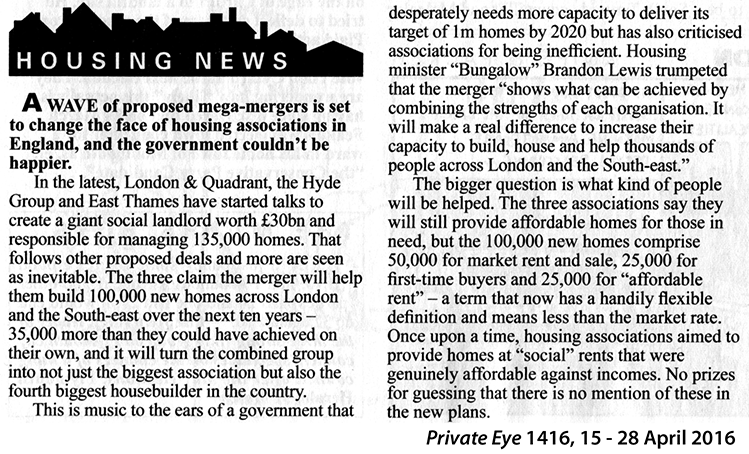
In England, the process of Registered Social Landlords merging is steaming ahead. So we can expect more mergers here because it’s basically an Englandandwales system, the main differences being of scale and the fact that concessions are made here to faux socialists over sales of social housing and other matters that might drive them to the barricades . . . or to their iPhones to put out an indignant tweet.

HA mergers England

For various reasons set out below, mergers are to be encouraged, but here in Wales they seem to be things of great mystery, perhaps because housing associations are allowed to behave like secret societies. For despite receiving hundreds of millions of pounds of public funding they are exempt from the Freedom of Information Act. This cannot be right. I defy anyone to argue that it is right.

Despite being confronted with a culture of omerta a few dogged individuals have persistently asked the awkward questions, but some of the ‘answers’ from officialdom have come direct from the Ministry of Bullshit.

CANTREF

Let us start by reminding ourselves of recent developments at this housing association in Castell Newydd Emlyn, and try to figure out what these changes might mean because, predictably, the findings of the ‘Welsh’ Government’s investigation into Cantref will remain secret. For those who missed it, here’s a link to my previous post, Tai Cantref: Favoured Suitor Named.

Cantref logo

The ‘Favoured Suitor’ is the Wales and West Housing of Cardiff. A curious choice, some may think. Much of its business is in the care home sector, not only in the south but also in towns like Brecon, Llandrindod, Newtown, reaching up to Flintshire and Denbighshire where many of its clients come from over the border.

Between 2008 and 2015 Wales and West received almost £65m in Social Housing Grant alone. (There are a number of other ‘funding streams’ for RSLs or, given the amounts involved, raging torrents.) Why is Wales and West – or any ‘Welsh’ RSL – allowed to use Welsh public funding to ease the care bill of Liverpool and other English authorities?

And I’m still waiting to learn why Wales and West was awarded £25m by the Department for Communities and Local Government in 2014 “to build 251 homes in Wales”. Social Housing is devolved, so why did Wales and West apply for funding to what is in these matters the English government? Come to that, why did the DCLG award the money?

The announcement of Cantref’s proposed connubials with Wales and West was made in this press release, in which we see the name of mystery man Kevin Taylor. He turned up in 2014 after a career spent in the hotel business in Bermuda and now – in his role as ‘Interim Chair’ – he’s deciding the fate of a Welsh housing association. So I’ll ask again: Who the hell is Kevin Taylor? And who forced him on Cantref?

The only real development since my previous post is that another press release was issued late on Friday afternoon, this one by the propaganda bureau at Carmarthenshire County Council.

Having given the matter of Cantref’s fate some thought, I have concluded that while there are almost certainly better options, if it comes to a straight fight between Carmarthenshire County Council and Wales and West Housing, then I shall support Carmarthenshire. And let’s not rule out Tai Ceredigion. Now I’d better explain my reasoning.

  • Most of Tai Cantref’s properties are in Ceredigion, ideal ‘retirement’ country that granny-farmers Wales and West would certainly exploit.
  • Carmarthenshire’s tyrannical chief executive Mark James will not last for ever. His days may already be numbered.
  • Council mergers are on the horizon, so the days of Carmarthenshire itself are also numbered.

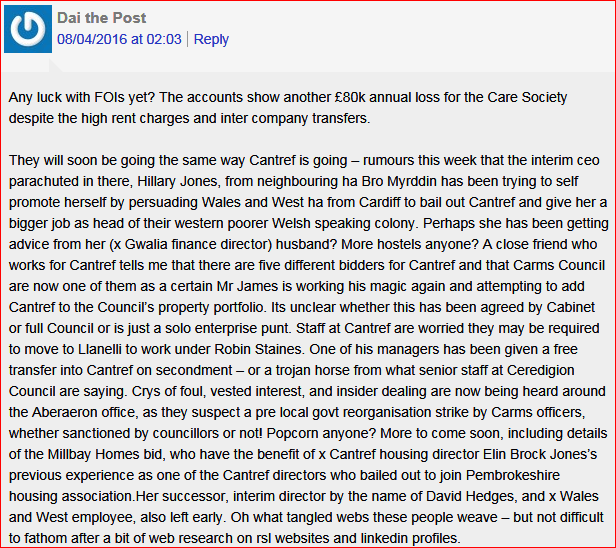
Stop Press: You will recall that in my previous post we heard – from ‘Dai the Post’ – about Hilary Jones, chief executive of the Bro Myrddin housing association, who served as interim CEO at Cantref. According to ‘Dai’, she pressed Wales and West to take over Cantref and put her in charge. And of course, ‘Dai’ also told us that Hilary’s hubby served as interim head of finance at Cantref.

Dai the Post

Another name ‘Dai’ mentioned was David Hedges. Those with good memories might recall that this man got a mention last July in this post of updates and tit-bits (scroll down). Hedges runs a ‘consultancy’ called Cyngor Da. I now learn that David Hedges has also served time recently with Cantref, presumably ‘consulting’, or rather, being consulted, or however it works. And that his time at Cantref coincided or overlapped with Hilary Jones’s.

Perhaps more importantly for the purposes of this post, I’m being told that David Hedges has also worked with Campbell Tickell, the English company called in by (London-loyal civil servants acting in the name of) the ‘Welsh’ Government to investigate Cantref.

P.S. When reading the Wales and West website I saw the name Anne Hinchey, Chief Executive, which rang a bell. She is of course married to Councillor Graham Hinchey of Cardiff Council. Yet another example of the troubling link between the Labour Party and the Third Sector.

A link that does so much damage to Welsh public life through nepotism and other forms of corruption. And in this case perhaps explains why Cantref is being gifted to a housing association in Cardiff.

RCT HOMES

In my Easter Miscellany 2016 I touched on comings and goings, and tenant unrest, at RCT Homes. A body that gained brief notoriety in the public prints when it advertised for a chief executive at a salary of £150,000 a year. Here’a report from Inside Housing dealing with the departures.

The most high profile of those departures was CEO, Andrew Lycett, who left in mysterious circumstances in November last year, but soon took up a job with the Jehu Group Ltd, a construction company “operating throughout Wales and the West”. (The ‘West’ of where?) Jehu is just the sort of company that would recruit someone with inside knowledge of how housing associations operate and public money is splashed around. Here’s a video of Lycett bragging about RCT Homes’ labour being “locally sourced” . . . but obviously not for the top jobs.

RCT Homes lost a couple of other senior staff around the same time. One was Lycett’s deputy, Malcolm Wilson, who took ‘early retirement’. Wilson is yet another Englishman who slunk over the border to take advantage of the billions of pounds in public money sloshing about Wales with neither oversight nor monitoring. Wilson is said to have been “demeaning” to Wales and the Welsh language.

The third to jump ship, or be pushed overboard, depending on how generous you feel, was Finance Director Lisa Pinney. ‘Jolly hockey sticks’ is not a phrase I employ but it’s often used to describe a certain type of female; in the case of Pinney, a board member of Hockey Wales (not ‘Welsh Hockey’, note), it seems entirely appropriate. Ms Pinney also found lucrative employment, in her case with Pobl, a recent merger between the Seren Group and Grwp Gwalia.

It really is a jobs merry-go-round, giving free rides to people who would struggle to survive in the world of real business. And we pay to keep this ‘merry-go-round’ turning.

Adrian Barber

The consultant (that word again) called in to see what was going on at RCT Homes – and no doubt paid many hundreds of pounds a day – was an Adrian Barber. It should go without saying that he’s English. What else do we know about him.

From August 2010 until April 2011 Barber was Interim Head of Housing at the London Borough of Bexley. In September 2011 he joined the PSI Consultancy (UK) Ltd. This is an outfit that provides “Interim Management” to councils and housing associations in trouble – at extortionate daily rates of course.

PSI Consultancy

He first came to Wales to join RCT Homes as Interim Housing and Repairs Director in February 2014, and was in that post until May 2015 – at consultant’s rates. In June 2015 he became RCT Homes’ Interim Director of Homes and Neighbourhoods, a post he still fills. That is, when he’s not being Interim Chief Executive as well, a position he’s held since last September. (Does he get paid two consultant’s daily fees?)

I’m told that despite holding two ‘interim’ posts at RCT Homes Barber is never available. Is he off moonlighting, being a ‘consultant’ to somebody else!

It’s easy to understand why we, the people who pay, are being denied the facts about RCT Homes, just as with Cantref. For a start, we’d be told how much has been paid out in consultants’ fees. (Because Barber may not be the only ‘consultant’ at RCT Homes.) We’d know what gross inefficiency or corruption caused the implosion. And we’d also learn how much public money had been lost. Our money.

Something obviously went very badly wrong at RCT Homes last year – and it might have been brewing for some time before that – but just as with Cantref, we are not allowed to know the facts. Nobody is to blame, public money doesn’t matter – so mind your own business!

Though information I’ve received suggests that the sackings – for that is what they were – may have been partly due to the manner in which Lycett, Wilson and Pinney administered grants from the Tower Fund, linked to Tower colliery, and Meadow Prospect, the charitable arm of RCT Homes. If you were ‘in’, then you got a grant, if not, well . . . There is also said to be an unaccounted for deficit of £10,000 in the Tower Fund.

Tower Fund

Something else that might have contributed to the threesome’s downfall was the planned housing on Penrhys, above the Rhondda valleys.

A source has written: “Various deals were made to build more houses on Penrhys with dodgy firms some that didn’t even exist. One such scheme for several millions was fronted by a local builder who said he was raising the money on his mortgage for example”. Is this for real!

After reading this I delved into my archives (they can’t touch you for it!) and lo and behold! what did I turn up from September 2012 but Penrhys: What’s Happening? Regrettably, the comments were lost when those bastards at Google pulled the plug on my earlier blog due to some other bastard complaining about something I’d written – can you believe that!

Anyway, my guess is that there’s a lot more to be unearthed about RCT Homes, so please point me in the right direction, folks.

PEMBROKESHIRE HOUSING AND MILL BAY HOMES

This content had to be removed under threat of legal action from Hugh James of Cardiff acting for Pembrokeshire Housing and Mill Bay Homes.


~ ~ ~ ~ ~

Seeing as so much Welsh public funding is being used to build social housing in Wales (or at least, being diverted to housing associations) we, the people of Wales, have every right to be assured that the money is being properly spent. Here are some observations and recommendations:

1/ RSLs should do what it says on the tin – provide social housing for those within Welsh communities who need social housing.

     They should not build student accommodation; they should not build properties for sale to ‘investors’; they should not enter into partnerships with the Probation Service and other bodies seeking to ‘relocate’ undesirables to Wales. In short, RSLs should not deviate from their raison d’être.

2/ There must be far better monitoring of RSLs by the ‘Welsh’ Government. More rigorous oversight would allow a ‘doctor’ to be sent in rather than an ‘undertaker’. 

     Though it must be a better system than the current one of importing ‘consultants’ at exorbitant fees, especially when those ‘consultants’ so often remain as ‘interim’ executives.

3/ RSLs should not be allowed to create ‘subsidiaries’ in the hope of using these to avoid legislation applying to RSLs or any other devious purpose.

4/ RSLs must be covered by the Freedom of Information Act 2000.

5/ A RSL must demonstrate need for social housing from within a community before funding is awarded or planning permission granted for new social housing within that community.

6/ No tenancies are to be awarded to anyone who has not lived in Wales for the three years prior to the application or for five years at some earlier time.

7/ The existing system of Registered Social Landlords and the provision of social housing is unsustainable for the following reasons:

a) The vast amounts of public funding they absorb, too much of which is spent on salaries, pensions and administrative costs.

b) The inefficient or non-existent monitoring and oversight by the ‘Welsh’ Government.

c) The fact that RSLs underperform, making little real impact on housing need.

8/ In the medium to longer term RSLs must either a) have their public funding withdrawn and become private companies or b) their housing stock – built with public funding – must be taken back into local authority control or some other form of public ownership.

     Given the colonial relationship between Wales and England privatised social housing companies would inevitably be swallowed up by larger English companies; consequently (and reluctantly), I prefer the public ownership option. Not least because this course is more likely to create jobs within Wales and to keep money circulating within the Welsh economy.

END

Tai Cantref: Favoured Suitor Named

Tai Cantref, the Newcastle Emlyn-based housing association has been in the news recently, but for all the wrong reasons. It has, I regret to say, found its way up Shit Creek, where it will struggle to find a berth due to all the other wrecks jostling for space.

For Shit Creek is now home port to a whole fleet of rusting hulks that have collectively ripped countless millions from the Welsh public purse in the devolution era, a period that has given us successive administrations believing that handing out billions to the Third Sector and assorted peripatetic shysters is a substitute for an economy.

Cantref 1

The troubles at Cantref did not come out of the blue, they’ve been predicted for some time. They seemed to start with a few poor business decisions, such as trying to turn the old government building at the foot of Bronglais Hill in Aber’ into student accommodation.

Though, in fairness, Cantref may have been trying to do the right thing. For here, in the Annual Report 2012 / 2013 (page 16) we read, “To build new homes, Cantref need (sic) to generate more income and rely less on Social Housing Grant. A successful new initiative to Cantref this year was the introduction of our new student accommodation. We were successful with the submission of 65 units to be part of the Welsh Government’s Revenue Grant programme”. Alternatively, Cantref was laying off one teat to start sucking on another.

The old government building though is quite impressive, as you can see . . . but then, white elephants so often are.

Cantref 2
Picture courtesy of Herald Group Newspapers

And then, when it began to be realised that Cantref was failing, it seems that a ‘What the hell!’ mentality took over and those responsible for Cantref’s demise decided to invest some of the remaining money in drowning their sorrows.

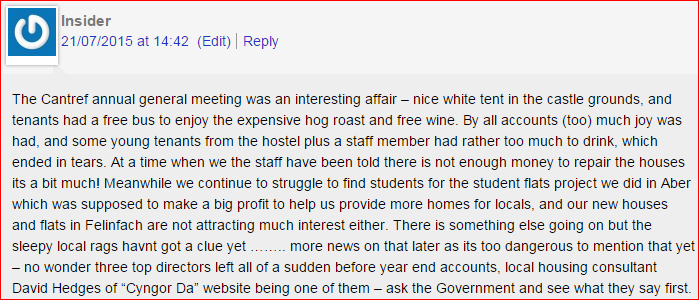
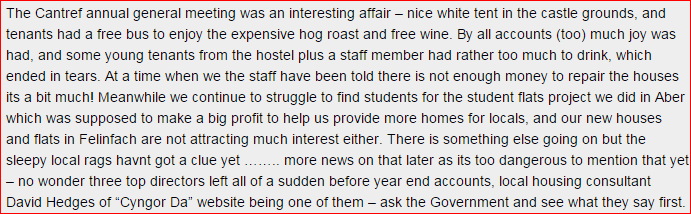
Or certainly, that’s the impression I gained from this comment to the blog last July. The ‘castle’ referred to is of course Chateau Tucker, the £15m B&B in Cardigan (paid for with public funding, of course), of which I have written many times.

Cantref Insider comment

Even though Cantref, a publicly-funded body, was subsequently investigated by persons answering to our democratically-elected representatives we, the public at large, we, whose money is used to fund these bodies, were not allowed to know what had gone wrong. And this from a Labour regime that preaches ‘openness’.

Cantref 3

Once it became known that Cantref was in trouble the vultures started circling, among them Mark James, chief executive of Carmarthenshire County Council, though how much the councillors knew of this bid is open to question. For Mr James believes in treating councillors as one would mushrooms. (Keep them in the dark and ply them regularly with shit.)

But there were others interested in taking over Cantref, as we were told by ‘Dai the Post’, in this comment from earlier this month. In particular, note Dai’s reference to “Hillary Jones, from neighbouring ha Bro Myrddin has been trying to self promote herself by persuading Wales and West ha from Cardiff to bail out Cantref and give her a bigger job as head of their western poorer Welsh speaking colony. Perhaps she has been getting advice from her (x Gwalia finance director) husband? More hostels anyone?”

Dai the Post

And so it came to pass. Today it was announced by a Cardiff PR company that the option preferred by Cantref is a ‘merger’ with Wales and West Housing of Cardiff. (Read the press release here.)

~~~

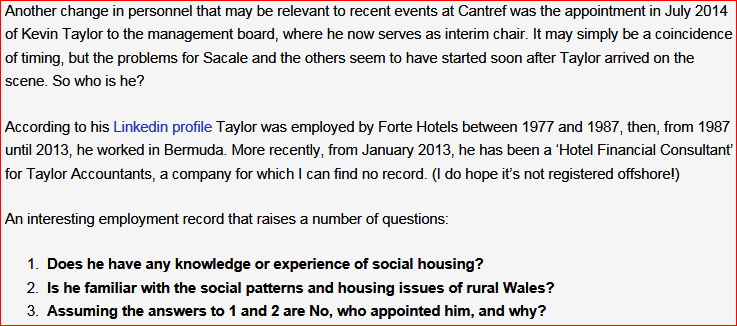
Extra! Extra! You will note in the press release that the person speaking on behalf of Cantref, and in favour of the merger with Wales and West is, “Kevin Taylor, Interim Chair”. Now I mentioned Taylor in Social Housing Back to Council Control? earlier this month, and I wondered who he is. Here’s what I wrote in that earlier post:

Cantref Kevin Taylor

I’m still wondering – Who is Kevin Taylor? Who appointed him to the chair of Cantref? (Here’s his Linkedin profile.)

~~~

Returning to Wales and West Housing, I have a number of problems with this proposal:

  • Judging by this video and other information on the website Wales and West spends a lot of our money building retirement homes for English people, which obviously increases the load on our overburdened NHS and other services. Acquiring Cantref, which operates mainly in Ceredigion, could represent something of a bonanza for a company seeking to attract English retirees.
  • There is a distinctly ‘unWelsh’ feel to Wales and West that perhaps reflects its areas of operation in the south east and the north east. (Check out the Directors to see what I’m alluding to. This is clearly a business, but not a Welsh business.) No merger should be allowed unless – at the very least – there are firm assurances that Cantref’s existing Welsh staff in Newcastle Emlyn will be retained.

This is clearly a ‘merger’ of the kind that took place between Nazi Germany and Poland, or between Communist China and Tibet . . . or between England and Wales.

That’s all for now but I shall be back next week with more on our housing associations, including RCT Homes and Pembrokeshire Housing and its ‘subsidiary’ Mill Bay Homes. And there will also certainly be more to report on Cantref and Wales and West.

UPDATE 23.04.2016: Here’s a press release put out by Mark James Carmarthenshire County Council expressing disappointment at being kicked in the nuts rejected by Kevin Taylor Cantref. I suspect this story has more twists and turns yet.


Social Housing Back to Council Control?

THE TRAVAILS OF CANTREF

Over the years I have written exhaustively on housing associations, I’ve explained the funding they receive, their staffing levels, and the fact that at a time when politicians argue our 22 local authorities must be cut to 8 or 9 those same politicians are quite content to see Wales lumbered with 50 or so housing associations, often with three or four operating in the same area, duplicating each other’s work and sometimes competing for clients and funding.

The contradiction in the differing attitudes to local authorities and housing associations is obvious, with the result that it has become increasingly difficult to defend the generosity extended to so many housing associations. But rather than openly admit that the social housing system is a very expensive shambles, it now appears that our masters have chosen to make changes to the social housing system by subterfuge.

Cantref logo

One housing association I have written about more than once is Cantref (formerly Tai Cantref), based in Newcastle Emlyn and operating mainly in Ceredigion, plus north Carmarthenshire and north Pembrokeshire, with an outpost in the Machynlleth area of north west Powys.

I haven’t been the only one training a beady eye on Cantref, others are the ever-watchful Wynne Jones, even the ‘Welsh’ Government! Though given the way the ‘Welsh’ Government cossets housing associations things must have been really bad for that lot to step in. But we aren’t allowed to know what ailed Cantref because the report will not be made public and FoI requests have been refused.

To fill in the background . . . It was known by July 2015 that Cantref was being investigated, the Cantref Board received their copy of the report in December, and early in the new year the chief executive, Lynne Sacale, and others, left. Cantref is now looking for a merger.

As is the way with such things, and just before it was publicly known that Cantref was being investigated, I received a revealing comment to this post alleging Bacchanalian excesses at Cantref’s expense in the grounds of Chateau Tucker. Read it for yourself.

Cantref piss-up

As the writer states, one reason for Cantref’s woes was undoubtedly that it had invested in student accommodation in Aberystwyth at the very time Aber’ Uni began sliding down the various league tables, with the predictable consequence of student numbers dropping.

Though it has to be asked who funded this student accommodation. Presumably the funding originated with the ‘Welsh’ Government, which then raises the question: Should money allocated to social housing have been used for student accommodation? Perhaps not, so maybe the report is being withheld to save the blushes of Carwyn and his gang.

The good ship Cantref now appears to have at its helm a Hilary Jones, of the Bro Myrddin housing association. Ms Jones’ husband (sub fill in name) is said to be a former finance director at Grwp Gwalia HA. And according to ‘Dai the Post’ in a recent comment she, ” . . . has been trying to self promote herself by persuading Wales and West HA from Cardiff to bail out Cantref and give her a bigger job as head of their western poorer Welsh speaking colony.”

You’ll note from the Gwalia website that it has recently merged with the Seren Group of Newport to form Pobl. And this site seems to tells that Charter Housing is also part of Pobl. So mergers, or takeovers, whether voluntary or enforced, are obviously in vogue.

Another change in personnel that may be relevant to recent events at Cantref was the appointment in July 2014 of Kevin Taylor to the management board, where he now serves as interim chair. It may simply be a coincidence of timing, but the problems for Sacale and the others seem to have started soon after Taylor arrived on the scene. So who is he?

According to his Linkedin profile Taylor was employed by Forte Hotels between 1977 and 1987, then, from 1987 until 2013, he worked in Bermuda. More recently, from January 2013, he has been a ‘Hotel Financial Consultant’ for Taylor Accountants, a company for which I can find no record. (I do hope it’s not registered offshore!)

An interesting employment record that raises a number of questions:

  1. Does he have any knowledge or experience of social housing?
  2. Is he familiar with the social patterns and housing issues of rural Wales?
  3. Assuming the answers to 1 and 2 are No, who appointed him, and why?

As I say, Cantref is now looking for a partner, and referring again to the comment from ‘Dai the Post’, there are said to be five suitors. One is Millbay Homes, the ‘Welsh’ Government-funded ‘subsidiary’ of Pembrokeshire Housing that builds homes for sale to ‘investors’. Another is Carmarthenshire County Council, though whether the executive board knows anything about this is open to question, and we can guarantee that the common herd of councillors is completely in the dark.

Elsewhere in his comment ‘Dai the Post’ tells us that someone answering to Robin Staines, Head of Public Protection and Housing at CCC, has been parachuted in to Cantref, possibly to prepare the ground for a takeover. ‘Dai’ further suggests that this aggressive move is viewed within Cantref as a bit of empire building ahead of local government reorganisation. I think the suspicion is correct, and we could see more such moves, all done in the shadows with the connivance of a ‘Welsh’ Government committed to ‘openness’!

pobl

Despite not having seen the WG’s report into Cantref the executive board of Carmarthenshire County Council will, on April 19th, be expected to approve in principle the council taking over Cantref. Not for the first time, chief executive Mark James will present councillors with a fait accompli. Ain’t democracy wonderful!

Another source tells me that despite what are alleged to be its failings Cantref is the largest employer in Newcastle Emlyn, it employs locals and conducts most of its business in Welsh. The fear is that if the takeover goes through then the HQ will move to Llanelli and, given the recent recruitment record of the council, it will swiftly lose its Welsh character.

The James Gang

Thinking about Carmarthenshire County Council and the record of Mark James raises the obvious question – why is he still there? After using council money to fight a private libel case, after wasting council money to fund Christian fundamentalists in building a church and a bowling alley (yes, a bowling alley!), and after turning Sir Gâr into the Welsh equivalent of North Korea, why the hell hasn’t the ‘Welsh’ Government stepped in to remove him?

Let me answer that by taking a little detour. When inexplicable things happen there is very often a simple explanation, but one that the media and our political class would rather not touch. I have recently written about the land deals conducted by the Regeneration Investment Fund for Wales that might eventually lose the public purse as much as £200m. Let’s stop beating about the bush – this is corruption, pure and simple.

Many times we see things happen in public life that are difficult to explain; contracts given without a tendering process; people being promoted above their ability; wrongdoers escaping justice. In such cases Freemasonry or other secretive groups can often be behind such corruption. Then there are the instances where outright and obvious criminals are ignored by the police. Such persons may be police informers, or relocated witnesses.

I’m not suggesting that Mark James owes his survival to any of these explanations, but I believe he does have a ‘guardian angel’. It may have been pressure from this celestial quarter that persuaded him to carry on after ‘standing down’ in 2014 rather than the council panicking when they realised the size of his severance package.

Mark James may have been put in place as chief executive of Carmarthenshire County Council, and has been maintained in that position, to oversee the anglicisation of the county.

Let me explain.

If you listen to Labour Party historians they will talk about towns or areas that are ‘iconic’ in the party’s history and development, Merthyr and the Rhondda come to mind. For those of a more patriotic bent, Carmarthenshire fills this role through Gwynfor’s 1966 by-election victory and the county delivering the votes that won the 1997 devolution referendum.

In addition, Carmarthenshire is the geographical ‘bridge’ between the rural heartland (or former heartland) of Plaid Cymru and the urban south. Add to that the fact that Carmarthenshire’s seats at Westminster and Assembly level are either held by or are vulnerable to Plaid Cymru, and the county becomes a prime target for the kind of attention I’m suggesting.

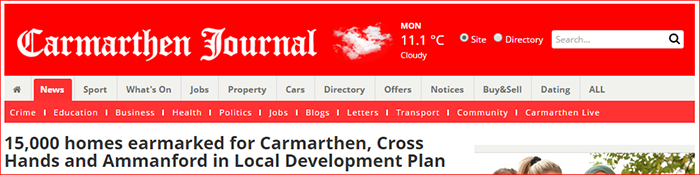
Carmarthenshire LDP

Part of this ‘attention’ is the insane and unneeded housing developments being imposed on the county . . . yet welcomed by Mark James and his circle of senior officers, almost all imported from England. Despite being born in Merthyr, Mark James has no feelings for Wales or her identity whatsoever, and is actively working to see Carmarthenshire anglicised.

That may be the reason he was directed to Wales, and why he has been allowed to keep his job when anyone else would have been forced out years ago.

But of course this does not explain the woeful impotence of Plaid Cymru in Carmarthenshire.

*

NATHAN GILL MEP

News reaches me from an anonymous source concerning our much beloved UKIP MEP Nathan Gill of Hull and Menai Bridge. You may recall that I have written of Mr Gill more than once – about a dozen times in fact – so you may care to refresh your knowledge of the great man by starting here then working back from the links provided.

In particular, I would draw your attention to this post, Nathan Gill: It Just Gets Worse, because the information I have received concerns an incident mentioned in this particular post. Mr Gill owned a church in Hull that he was hoping to develop in some way, but on November 5th 2001 it caught fire, Mr Gill was quoted in the Hull Daily Mail as saying that ” . . . some residents had seen youngsters aiming fireworks at the church”.

Though a source I had in Hull a while back described the fire as “suspicious”, and insisted that Nathan Gill’s application for planning permission had been refused.

Gill church

The information I received a couple of days ago says, “Before the fire in the grade 2 listed Hull church Gill had all the Oak paneling and benches stripped out, Brian Quilter sanded and reused them to Oak panel Lledr House and make window shutters.”.

Brian Quilter is one of Gill’s US Mormon brothers-in-law, married to Gill’s sister Melanie, and the couple lives in Lledr House, Dolwyddelan. Maybe the panelling referred to can be seen in this photo from TripAdvisor. Read more about Brian Quilter in Nathan Gill, Family Man.

Now there’s nothing wrong in what is described. Obviously Gill bought the church, planned to do whatever he planned to do, and in preparation for that – though perhaps in advance of receiving planning permission – stripped the building and let his brother-in-law have the panelling and the benches. All perfectly innocent.

Though less generous souls than what I am might suggest the possibility of foreknowledge.

*

JOHN BOY BAYLISS

I know you’ve been asking what our wandering boy has been up to lately, and the answer is, well, a bit more wandering. You will recall that last October I wrote The Case of the Disappearing Councillor in which I expressed deep concern for the whereabouts and welfare of Councillor John Boy Bayliss of the Uplands ward in Swansea. (In fact I have written quite regularly about John Boy and his friends, most of whom have now deserted him. Sob!)

At the time of writing the post just referred to, John Boy was giving his address as a property in Cambrian Place, in the city centre, a row of fine old town houses near the marina. In fact, where his friend and fellow-councillor Mitchell ‘Mitch’ Theaker had lived ere his departure to Araby. But now, I’m informed, he has moved again.

My concern for John Boy’s whereabouts last year was two-fold. After learning that he had taken a job in Bristol I was worried that the daily travelling between Swansea and Bristol might tire the poor boy. So I was almost relieved to hear that he was in fact living in Bristol, and merely using the Cambrian Place address as a letter-box. But then I thought, ‘Hang on, if he’s living in Bristol how can he remain a Labour councillor in Swansea?’

A message over the weekend directed me to updated information on John Boy’s council website bio (see below) which now has him living in Llangyfelach, still not in his Uplands ward, and as far from it as Cambrian Place.

Bayliss address

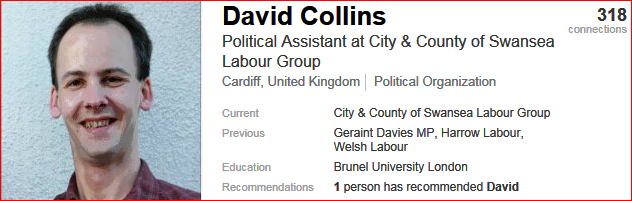
‘But still’, I generously and paternalistically thought (well you know me), ‘it might not be in his ward, but at least he’s got a place of his own now’, but then I read the message I’d received again, and it suggested that this address is in fact the residence of one David Collins. So who is David Collins? Here’s his Linkedin profile.

Collins is clearly a Labour professional who appears never to have done a real job, having studied History and Politics at Brunel from 1992 until 1997 and then starting work in January 2000 as a Researcher and Political Assistant to Ann Jones, the former Labour AM for the Vale of Clwyd. (Leaving two and a half years unaccounted for on his Linkedin profile.) He now works as a Political Assistant to the Labour group on Swansea council.

So is John Boy shacked up with Collins, or is he engaged in a nightly tussle with the cat for the rug in front of the fire? I think we should be told!

David Collins

Put both images from your mind, because further reading of the revised bio tells us that his correspondence address is “c/o Members Support Unit, Guildhall, Swansea SA1 4PE”, which suggests to me that he might not be living in Llangyfelach at all, and that this address doesn’t even serve as a letter-box.

The PR outfit John Boy works for recruited him because he is a councillor, and for no other reason. That being so they will of course give him time off to attend the important council and planning meetings, which in turn helps the Labour group on Swansea council maintain the fiction that their boy is still living in Swansea. Everybody’s a winner . . . except the people John Boy is supposed to represent.

This ‘Now you see him, now you don’t’ could be interpreted as a conspiracy on the part of the Labour Party in general, and certain individuals in particular, to maintain the deception that John Charles Bayliss still lives in Swansea and daily represents the interests of the people in the Uplands ward. If so, then perhaps the Local Government Ombudsman might be interested.

We know Councillor John Charles Bayliss does not live in Swansea. So my advice to the Labour Party in Swansea would be: Come clean, make John Boy Bayliss resign, and call a by-election in the Uplands ward.

P.S. I almost forgot to mention that John Boy is standing for the Assembly next month, he’s third on the list for Mid and West Wales, a region he knows intimately. His chances of being elected are slim, but of course Cardiff is nearer than Swansea to Bristol, so it would easier for Bayliss to commute from Bristol and turn his back on Swansea for good.

UPDATE 23:00: I am informed that David Collins no longer works for the Swansea Labour group, he has, I’m told, “been released” . . . into the wild? If so, will he be able to fend for himself, cut adrift from the Labour Party, all he’s ever known? I await reports that he has been spotted at night, scavenging in the back streets of Morriston.


Port Talbot

Yes, I know, Port Talbot isn’t the only Tata plant affected by the company’s decision to put its UK operation up for sale, but it is the biggest, and serves as useful shorthand.

Rather than giving instant remedies or exposing my ignorance by trying to discuss EU regulations on state aid, or the impact of carbon tax and business rates, let alone the statistics on Chinese steel production and exports, I shall stick to my comfort zone by considering political responses and impacts, winners and losers, and also the possible outcomes.

But first, let me indulge in a little reminiscing.

*

I grew up just around the Bay from Port Talbot steelworks and I can remember the plant in the mid-’60s when it employed 20,000 men and the wages paid earned it the soubriquet ‘Treasure Island’. Much of its steel went on to the tinplate works at Trostre in Llanelli and Velindre on the north side of Swansea (where I worked for a short while). Velindre is long gone, but Trostre has struggled on and is now in the same position as Port Talbot.

And if you’ve driven past and think the smells and the smoke of Port Talbot are bad nowadays, then you should have seen it in the ’60s and ’70s. It wasn’t just that the steelworks produced more smoke and smells back then, there were other plants nearby making their contribution.

Just up the road, on the Swansea side of the steel plant, in Baglan Bay, we had one of the largest petrochemical sites in Europe, employing another 2,500 men. A couple of miles inland there was the Llandarcy oil refinery with the same number of employees. Then there was the Tir John power station taking us up to the eastern outskirts of Swansea, where the East Side made its contribution to the shit and the smell with the never-to-be-forgotten Carbon Black plant.

Llandarcy

This spewed out such filth that it resulted in regular protests by local housewives, who couldn’t put washing on the line to dry without it being covered in a dust that also got indoors and clung to everything.

My first-hand experience of Carbon Black came through a summer job I took when at Coleg Harlech. I was employed to sweep the floors inside the plant, where the filth lay inches thick. I was provided with a brush and a rudimentary face mask . . . and that was it. I handed in my brush after a few hours and went to a nearby pub to ease my throat.

The whole area from the east side of Swansea over to Neath and down to Port Talbot was a complex of heavy industry, a nightmare for any proto-Green. And yet, if we add in Swansea docks, the ancillary jobs in transport and other fields, this triangle of smoke and smells provided tens of thousands of well paid jobs for semi-skilled and unskilled men. Most of these jobs have gone, and will never be replaced.

I had many friends and family members working at these various plants, and of course at the steelworks, and not just for the then owner, the Steel Company of Wales. For example, there was a boy I met in Penlan school with whom I became good friends (after the introductory fight); his family had come down from Kilmarnock and his father worked for British Rail in the steelworks’ marshalling yards, said to be the biggest in the world after those at the Chicago stock yards.

Then there was a friend of ours in the post-school era working in the steel works. One night he went over to Port Talbot to hear a promising young singer named Tom Jones. On the way back into Swansea, driving along the Jersey Marine in his Wolseley 1500, he was somehow thrown from his car, which then rolled over onto him. I think Keith was the first close friend I lost.

*

THE POLITICAL DIMENSION

The Conservatives

I suppose the Tories’ attitude was summed up accurately and succinctly by Paul Mason when he wrote, ‘Steel Crisis; they do not give a shit’. There are a number of reasons for this being true beyond the Tories being wedded to a blind and unthinking neoliberalism.

The future the Tories envision for the UK is of smart people doing clever things and making lots of money in clean environments with the economy topped up by sheikhs and oligarchs investing hundreds of billions in property and other deals that can be accomplished with a signature. Fundamentally, it’s a fantasy world in which people make lots of money doing very little, certainly not from producing anything other than hi tech gadgetry or financial packages that no one can understand.

There is no place in this vision for steel works and towns like Port Talbot. Such places are alien to Old Etonian politicians. Not only are they distant in terms of miles, and in considerations of social class, they are also distant in time, because they belong to the past, they have no place the glittering future I bewitched you with in the previous paragraph.

Gold cars

Of course, one of the major problems with this vision is that it’s very London-centric, extending only as far as the Home Counties in which many of the new elite will be living. Because you can bet that Sheikh Mohammed bin Slaveholder al Head-chopper is unlikely to be looking for a £30m mansion in Llanelli or Scunthorpe any time soon. Which explains attempts to placate the increasingly resentful natives north of Watford with ‘beads’ like HS2 and talk of a ‘northern powerhouse’.

On a more pragmatic, electoral level, the Tories have nothing to lose in towns like Port Talbot or any similar community in Wales, Scotland or England. You can’t lose support or seats if you haven’t got any to start with. So the truth is, as Paul Mason says, the Tories don’t give a shit.

Unconvincing expressions of concern will be heard, money will be doled out – there might even be a short-term nationalisation – but this hiccup will not be allowed to interfere with the march towards the post-industrial Bright Tomorrow, in which the sons and daughters of today’s Port Talbot steelworkers will be City traders or internet tycoons . . . or, more likely, working just up the road at the vast Amazon warehouse, on the minimum wage, with one toilet break a week.

Though it will be interesting to see how the local Tories deal with the steel crisis in the Assembly election campaign. Who will they blame?

*

The Labour Party

For Labour the steel crisis is much more complex and worrying. Not least because it was the equally laissez-faire New Labour governments that helped get us into this mess by nodding through British Steel’s merger with Koninklijke Hoogovens of the Netherlands in 1999 to form Corus, and then twiddling their thumbs when Corus was bought by Tata Steel of India in 2007.

The New Model Labour Party of Citizen Corbyn seems rather more concerned than the party led by Blair and Broon, but there’s little they can do out of power. Though in fairness to young Owen ap Dai ap Smith he didn’t wait for the fat lady to sing before putting the boot in, here he is at the start of February accusing Cameron and Osborne of kissing China’s arse!

Another scion of an anti-Welsh Labour family, the Boy Kinnock, actually took himself off to Mumbai, where the Tata board was deliberating. Quite what he hoped to achieve beyond a little self-promotion is a bit of a mystery. But then, showboating was always part of his father’s political repertoire, though I advise the young ‘un to avoid beaches with incoming tides.

Labour logo

Closer to home, our self-styled ‘Welsh Government’ can only be compared to rabbits caught in the headlights. There are a number of reasons for this. One, they have no experience of business, let alone business on this scale. Two, they simply aren’t aren’t up to the challenge intellectually. Three – and for this they are probably thankful – they don’t have the power to do anything.

That said, this announcement comes at a good time in the electoral cycle for ‘Welsh’ Labour, with Assembly elections just over a month away they can blame the ‘heartless’ Tories for everything and hope that voters don’t remember their party’s role in this tragedy.

And as usual there will be a cynical appeal to the ignorance and confusion of many Welsh voters as Labour – despite being impotent in Cardiff and in opposition in London – urges people to vote for Carwyn and the gang so that Labour can ‘save Port Talbot’.

*

Plaid Cymru

The steel crisis should be Plaid Cymru’s Christmas, Easter and St David’s Day all rolled into one. It gives them the chance to attack both major parties, English rule, and foreign ownership of Welsh assets. Thus far, I can only assume that Plaid is waiting its chance, holding its cards close to its chest . . . or maybe it doesn’t realise it has these cards.

I would suggest that rather than asking for anything absurd or impossible – such as demanding that the ‘Welsh’ Government nationalises the steel industry – Plaid Cymru should gather the evidence on the merger and the take-over that Labour allowed to go through when in power, and the Tories’ opposition to the EU raising tariffs on Chinese steel, the refusal by both parties to reduce energy costs for plants like Port Talbot, and compare those betrayals of the Welsh people with what Plaid Cymru would do if it was in power down Cardiff docks.

And stressing a betrayal of the Welsh people should be Plaid Cymru’s approach, rather than going all socialist and linking arms with Labour and the trade unions. Because unless Plaid Cymru’s voice is distinctive, and distinctively Welsh, then there’s really no point to Plaid Cymru, in this debate, or any other situation.

*

Liberal Democrats

I know I’m normally harsh on the Lib Dems, but over the years it’s been difficult not to be harsh, and at times almost impossible to take them seriously. And then, in my more mellow moments (not always induced by alcohol!) I think, ‘Weeel, maybe they’re not too bad’. ‘What brings this on?’ you ask.

To start with, there’s Kirsty Williams, the LD leader in Wales. Things have been tough in recent years for her party but she’s stuck with it and deserves a break. She’s a gutsy woman who I’m warming to.

Another LD AM who’s impressed me is William Powell. For one thing, he turns up at Cilmeri in December, where we rarely see Plaid politicians and never Labour or Conservative. (Nor UKIP, come to that!) And then there was the petition I submitted to the Assembly asking that it do something to stop chief executives taking over councils.

Petitions Committee

It was clear that Powell recognised the importance of this issue but the two committee members who ‘discussed’ my petition, Labour’s Joyce Watson and Plaid’s Elin Jones, couldn’t dump it quickly enough. Powell might get my second vote on May 5th.

But I digress.

On the specific issue of the sale of Tata’s UK operations, the Lib Dems – in the shy, retiring form of Peter Black – have called for the Notional Assembly to be recalled. Which might sound like a good idea until we remember that the Assembly is impotent, and what calls itself the ‘Welsh Government’ is nothing but a collection of buffoons. A recall would be nothing more than a pointless gesture and a platform for narcissistic buggers like Black.

In many ways the Lib Dems’ position should not be a lot different to that of Plaid Cymru – ‘A pox on both your houses!’ So I would suggest that Kirsty leads her troops forward with all guns blazing . . . hoping few will remember that her party kept the Tories in power between 2010 and 2015, during which period the problems that have brought us to this crisis were allowed to build and build.

*

The Wales Branch of the Green Party of Englandandwales

They won’t like me for saying this, but I know that the Greenies were secretly jumping for joy when they heard that all those smelly, polluting steel plants are to close. But of course they can’t admit that.

What they can do, apparently, is write stupid letters to the press, such as the one below that appeared in Friday’s Wasting Mule. The writer seems to believe that the Port Talbot steel works can be powered by wind turbines, solar panels and fairy dust.

Then again, it could have been a piss-take, for Friday was April 1st.

Green steel

I issue these rebukes with a heavy heart, fearing that I might lose some of the many friends I’ve made in the Green Party over recent years. Oh yes.

*

UKIP

If any political party is crass and insensitive enough to make cheap political capital out of tens of thousands of people losing their jobs, then of course that party is UKIP.

Not only does the steel crisis give M. Farage et Co the chance to go nuclear on ‘Europe’, it also provides the opportunity to put the boot into Conservatives and Labour, with the cherry on top being the chance to have a go at the Chinese, the Indians, and just about anybody else they can think of.

UKIP will I’m sure argue that this steel crisis thingy would never have happened if everything was still managed by those splendid chaps down the clubhouse. Better decisions are made after six or seven drinks and a few cigars – everyone knows that! Don’t laugh, a lot of people will believe them.

A few months ago UKIP was predicted to win anything up to nine seats in May’s Assembly elections then, more recently, I’ve seen polls suggesting that support is slipping. The steel crisis could put them back to where they were earlier in the year, and the Tory-supporting media transferring the blame onto the EU might even take the UKIP vote in Wales to new heights.

However you cut it, UKIP is the party with most chance of gaining in May’s elections from the steel crisis.

*

SNP

Yes, I know what you’re thinking, but bear with me.

There were a couple of steel plants in Scotland, admittedly much smaller than Port Talbot, that were saved from closure in the past few weeks thanks to decisive action by the Scottish National Party government. Here’s a report from the Guardian.

But this action didn’t please everybody. Here’s a more recent report from the Labour-supporting Daily Record (the Scottish version of the Daily Mirror) telling us that the Labour-controlled Community union is ‘questioning’ the deal.

To explain . . . there are elections in Scotland on May 5th also, and the SNP is almost guaranteed to win by a landslide. So one interpretation of this bizarre intervention by Community is that embittered Labour supporters are prepared to sabotage the Scottish steel deal for short-term political advantage.

Surely Labour wouldn’t do that?

Oh, yes, and remember, the Boy Kinnock was chaperoned on his trip to India by representatives of the same trade union. Whose interests were they looking out for – the steelworkers or the Labour Party?

*

EU Referendum

Speaking of the EU reminds us that on June 23rd we have the referendum on whether to stay in or to leave. The fate of the steel industry is bound to influence the way many people vote, especially in Wales. And seeing as Wales gives us the paradox of many Labour voters reading English Tory newspapers then prolonging the crisis can only help the Brexit cause.

Thinking more obliquely, this realisation that the steel crisis could decide a currently too-close-to-call referendum might prompt the EU into action; and if Cameron is serious about staying in the EU, then he might have to discreetly explain to his Chinese chums that – until the referendum is won – he might need to sound a little ‘hostile’, even agreeing to raise tariffs on Chinese steel imports.

When you consider all the possible ramifications you realise that, serious as the crisis in the steel industry is for those directly – or even indirectly – involved, the closure of Port Talbot and the other plants could have long-term and far-reaching implications that overshadow the loss of jobs.

In many ways Prime Minister Cameron is the one to watch, because with the EU referendum complicating things, him not wanting to be seen as a callous toff, yet having to protect the interests of his mates in the City by not offending the Chinese, the next few weeks could be interesting for those who like to watch nifty footwork.

As the Chinese themselves are reported to say, ‘May you live in interesting times’. (Though some say it’s delivered as a curse, not a blessing.)


Easter Miscellany 2016

RCT HOMES

Earlier this month Martin Shipton of the Wasting Mule and WalesOnline had a brief bout of outrage on learning that RCT Homes was advertising for a chief executive at a salary greater than that paid to the UK Prime Minister or Wales’ First Minister. Here’s the advertisement – with a London recruitment agency – that occasioned his momentary unhappiness with the colonial system.

This recruitment follows on from a number of personnel changes at RCT Homes (mentioned in the same article) that are worthy of reporting, not least the departure of Andrew Lycett, the previous chief executive. So let me hand you over to a correspondent who explains the complexities of it all. I have added links and a few comments to help you understand better who’s who and what’s what.

Now read what follows carefully and join up the dots.

“The Wasting Mule tells us that Andrew Lycett left RCT Homes for reasons that were unexplained on the grounds of “confidentiality”. A more typical corporate response to that question is that he “has found career opportunities elsewhere” which led me to investigate.

Lycett submitted his resignation from RCT Homes at the same time as Cllr Kieron Montague (Labour) announced he would step down and not seek re-election. He is Cabinet Member for Tackling Poverty, Engagement & Housing. He also sat on the RCT Homes board, on behalf of RCT council.

Lycett has actually taken up the role of Finance Director with the Jehu Group, a real estate development company, who beside being a major player at the SA1 development in Swansea, but also has expanded to the west, opening a new office in Haverfordwest, under their subsidiary Waterstone Estates.

Montague, meanwhile, has now taken up a role with Cynon Taf Housing Association, who unlike RCT Homes, has a substantial holding of vacant development land.

In a previous post (here, scroll down) you correctly pointed out the outsourcing of estates administration by a number of local authorities to PwC. A partner of PwC, Lynn Pamment, also sat on the board of RCT Homes, alongside Lycett and Montague. She will, of course, be very conversant with the issues which PwC has been required to ‘assist with’, that of, balancing the budget for Pembrokeshire and Ceredigion councils. This includes selling off land for development.

This, of course, is the very footprint that Waterstone Estates has opened an office for in Haverfordwest for. Waterstone Estates is a wholly owned subsidiary of the Jehu Group, which Lycett is now director.”

We are all familiar with the links between the Third Sector and the Labour Party, but now we see a third element become more evident, that of private businesses, which recruit people with local government and Third Sector experience to help ‘smooth the way’ with the acquisition of land, the gaining of planning approval, and of course the clamping of the sweaty paws upon the funding public.

The supplier of the information mentions the RCT Board, and so I took a peek for myself. It hasn’t been updated, so here it is before it’s changed.

kieron-montague-978729428

It’s the usual mixture of Labour time-servers, Third Sector spongers and token residents. But as we were warned just now, there’s also the PwC representative, looking after her company’s best interests. Lynn Pamment is of course one of those selfless English missionaries without whom we Welsh would be running around naked doing unspeakable things to each other and gabbling away incoherently.

Also on the Board is someone I’ve mentioned before, a regular contributor to the Letters page of the Wasting Mule, where he can be relied upon to fly the flag for Queen and Country (his country that is, not ours), Kel Palmer. And talking of flying, his bio describes him as “A former fast jet pilot in the RAF” . . . not to be confused with those slow jet pilots . . . always getting in the bloody way . . . slowing down the bombing runs. It’s a wonder regime change is ever achieved.

This I think is one to watch. Particularly the future careers of Andrew Lycett and Kieron Montague.

[With so many different people sending me stuff I seem to have lost the original e-mail containing the information used above. So will whoever sent it please get in touch to remind me who you are.]

APPRENTICE APPARATCHIKS

There’s been a lot of talk lately about the need to provide apprenticeships, with political parties trying to outdo each other in the number they’d provide if elected, but did you know that the ‘Welsh’ Government has its very own apprenticeship scheme?

I am indebted to another correspondent for drawing this to my attention. Though he’s very concerned by the fact that most of those chosen for these apprenticeships seem to be related to someone already working for Carwyn and his gang.

Which, I suppose is only to be expected. For it seems that these apprenticeships are advertised only on the ‘Welsh’ Government website. Now with the best will in the world, I doubt if many young people visit the site . . . unless advised to do so by family or friends.

Is this how it should be done? Doesn’t it risk getting nepotism a bad name?

WG Apprenticeships

And by the way, Carwyn, I wouldn’t give a job to that shifty-looking little bugger in the middle, the one fiddling with his tie. If he’s going to do Oliver Hardy impersonations he needs to put on about 150lb . . . and also develop a personality.

CHRISTOPHER MUNDAY, GOAT-TETHERER

A third supplier of information has very interesting things to tell us about Christopher Munday who, you may remember, is the genius who set up the Regeneration Investment Fund for Wales which I – in my previous post – likened unto tethering a goat and waiting for the predators to appear.

He writes . . .

“CM is typical of many public sector employees who see their advancement “up the greasy pole” by avoiding decision making and adopting the mantra of “plausible deniabilty” if anything goes wrong.

He joined Welsh Development Agency in the 1980’s having formerly been a “site finder” for a medium sized house building company. He progressed through a number of low and medium grade clerical jobs, as the WDA expanded through the 1990’s, and then became employed in a department seeking to access private sector money to add to the Agency’s budget for property development purposes.

As he had little knowledge of funding (and no knowledge of property development), his approach was to appoint  major firms of accountants to “write reports” as to how private funding might be accessed. It was quickly realised in Cardiff, that operating a large budget for the purposes of employing private sector accountants, made CM a prime target for the KPMGs, PWC, Deloittes of this world in “keeping him sweet”. He attended, for many years, the annual MIPIM property junkets in Cannes, where his time was spent networking (i.e. being entertained) by his accountancy pals.

Once these reports had been completed, at costs between tens of and hundreds of thousands of pounds, these would be “topped and tailed” by CM and subsequently presented to his line managers and, ultimately, ministers as “all his own work”. On two or three occasions the reports suggested “arms-length” initiatives, with a view to private sector organisations participating in the development of offices and factories in Wales. 

In at least one of these initiatives (called WISP) the “partner participant” was a company called Babcock and Brown. By this time WDA had been “absorbed” into the Assembly. The basis of WISP was that the Assembly would take a long lease on an office block before it was built, and the investment would be pre-sold to provide the funds to build it in the first place.

Unfortunately, after a couple of office developments, Babcock and Brown went bust, and the WISP idea terminated.  Babcock and Brown’s contact with CM was Leo Bedford(LB), and LB started up another company out of the ashes of Babcock and Brown, called Amber.

It was, therefore, of little surprise that when the RIFW (a.k.a. JESSICA) initiative was suggested to Welsh Government, CM was put in charge of running it, and (surprise, surprise again) Amber was appointed as Fund Manager. It is not clear who decided Lambert Smith Hampton (LSH) should be appointed as Property Advisers, but it is clear that Welsh Government appointed both firms (see attached press release). It is also interesting to note that when the RIFW s**t hit the fan, CM denied flatly that Welsh Government had appointed LSH, and insisted that LSH had been appointed by Amber without his knowledge (!).

I know several people who have worked, and still work with Mr Munday, and it is the case that work colleagues, AMs and Ministers largely regard him as a . . . at which point I have to intervene because it gets rather personal, and I’m down to my last couple of mill. Munday commutes to Cardiff from Wiltshire.

What are we to make of this, boys and girls? Now as you know, Jac is a simple soul, and talk of conferences in the South of France, and big numbers that I can’t get my head around, send me into a tizzy. But if half of what my informant tells us is true, then this man sounds like a complete asshole! But of course he’s an English asshole, so he’s guaranteed an important job in Wales, losing millions and millions from the Welsh public purse.

JAMES BOND COMES TO CARDIFF

The ‘Welsh’ media has gone overboard reporting the fact that Aston Martin is to build a new plant in Sant Tathan, just outside Cardiff. Now me explain this to you.

This has nothing to do with jobs; the number of jobs created is almost irrelevant for those who persuaded the ‘Welsh’ Government to bribe Aston Martin to set up on the outskirts of Cardiff. The motivation, pure and simple, is the promotion of Cardiff.

The Aston Martin plant is just another prestige project to add to the Millennium Stadium, the Millennium Centre, the Swalec Stadium, the National Ice Rink and all the other developments we’ve seen in recent years, including – don’t laugh! – the Assembly building itself. Within a very short time I guarantee we shall be hearing, ‘Cardiff – Home to Aston Martin’.

Many are already asking how much the ‘Welsh’ Government paid Aston Martin to move to the Vale, but nobody’s answering. I am indebted to @tomgallard for letting me publish this letter in which the ‘Welsh’ Government refuses to disclose how much it invested in this wonderful project that will be of benefit to the whole of Wales.

If you think I’m just an embittered old Jack, and that the ‘Welsh’ Governments’s prime consideration was jobs, just ask yourself this – would they have rolled out the red carpet with gold thread for Kia, or Dacia, even if these companies were creating 3,000 jobs? And answer that honestly.

Aston Martin Logo 1

And if you believe that employment / investment was the prime consideration, and that’s why the ‘Welsh’ Government was prepared to break the bank to get Aston Martin to Wales, then why weren’t the jobs directed to an area where they are much more needed than the Vale of Glamorgan, where I guarantee residents will soon be opposing all the disruption the Aston Martin development threatens?

Oh, and one final thing. Scroll down on the letter to Tom Gallard and see who signed it. Yes, that’s the same Christopher Munday we discussed just now. Whenever there’s Welsh public funding to be wasted, Munday’s yer man! 

P.S. Another factor worth considering is that this rush of automotive good news – Aston Martin to the Vale of Glamorgan, TVR to Ebbw Vale – comes just ahead of the Assembly elections on May 9. The Labour Party must be calculating that news like this is worth a few thousand votes, maybe saving the party a couple of seats. Very important when we remember that Labour currently holds 30 out of the 60 seats and is predicted to lose anything up to 5 of them.

 *

What we see in these examples, and in other cases I’ve highlighted over the years, is utter contempt for the democratic process and the public purse – which works to the detriment of us all. Basically, it’s, ‘Sod off! we don’t have to tell you anything’.

When RCT Homes was questioned by Martin Shipton about the £150,000 salary for its chief executive he could only tell us, “A spokeswoman for RCT Homes said the body would not be offering a comment.”

And when Andrew Lycett left RCT Homes to take up his post with real estate company the Jehu Group, the reasons for his leaving were unexplained on grounds of “confidentially”. This, remember, is a Registered Social Landlord getting large dollops of funding from the public purse.

The ‘Welsh’ Government apprenticeships are obviously aimed squarely at those in the know. Otherwise they’d be advertised properly so that everybody’d have a chance.

The RIFW scandal for which Christopher Munday is so culpable is still shrouded in mystery because so much information is being withheld and so many lies are being told.

Finally, we have the countless millions lobbed Aston Martin’s way to get another blue chip company to Cardiff. Yet we cannot be told how much because this information is – so someone at the ‘Welsh’ Government argues – “exempt from disclosure”. Is that really true?

And all this is happening in a system that prides itself on ‘openness’, focussed on a building made of glass, so that we, the people, can see what they’re up to. What a load of deceitful symbolism and absolute bollocks!

(Calm down, Jones.)

Now a compete change of subject, but another indictment of how Wales is run, and the priorities of those who run our county and our cities.

BEDD GWYROSYDD
Bedd Gwyrosydd
Feel free to use this photograph

When I was a boy, I used to catch the school bus at Brynhyfryd Square, which would then make the long haul up Llangyfelach Road, past the ‘Public Hall’ and its bust of Daniel James, before the turning left and along Heol Gwyrosydd to Penlan School.

Of course I knew the hymn Calon Lân, and I knew that the words had been written by local man Daniel James. (Bit of a hero of my mamgu!) Which was just as well, because I wasn’t going to learn things like that in Penlan School, or any school in Swansea. Trigonometry, Latin, and the history of British imperialism would stand me in much better stead for the world that awaited me.

These memories came back when I opened an e-mail and saw a photo that someone had sent with it. The photograph was taken the day after Palm Sunday, and it shows Daniel James’ sorry-looking grave in Mynyddbach cemetery. The person who sent me the photograph said he had to avoid huge Victorian headstones leaning at dangerous angles to reach the grave, and that a machete would have helped to get through the undergrowth.

Doesn’t the man who wrote perhaps our most famous hymn deserve better than this? If I was talking here about some monument to our subjugation, or a reminder of our colonialist exploitation, or some house where Nelson had enjoyed Lady Hamilton, then Cadw, or the National Trust, or some other bunch of colonialist grant-grabbers would demand a few million to ‘maintain it for the nation’. (And we know which nation.)

If you feel as I do, that Daniel James deserves to be remembered better than this, then write to somebody; Swansea council, the ‘Welsh’ Government, anybody. Send a letter or e-mail to your local paper, or the Daily Post, the Western Mail.

Because how much would it cost to maintain this grave with the dignity it merits? Less than a set of tyres on an Aston Martin. Probably less than Christopher Munday earns in a week. One per cent of what the chief executive of RCT Homes will be paid in a year. Wake up people! let’s start getting our priorities straight. Let’s start remembering who we are.

UPDATE 28.03.2016: Good News! A mystery benefactor has appeared to help with the restoration of the Gwyrosydd headstone.


An Election and a Referendum

This post examines two important votes being held in 2016; the Welsh Assembly elections on May 9th and the EU referendum on (possibly) June 23rd.

First, we shall look at the elections to our beloved and respected Assembly, wherein may already be found talent dazzling to the point of being a hazard to pilots (not that many of those intrepid aviators will be heading for the local airport) before moving on to consider the anticipated EU referendum

WELSH ASSEMBLY ELECTIONS

At present, Labour has 30 of the 60 seats, and is almost certain to lose a few, the only questions are, which ones, and to which other party or parties will those seats be lost?

To help you make comparisons I have compiled the table below, which shows each party’s percentage of the vote in 2011 compared with the percentages predicted by the latest available poll. You will note that the figures in the recent poll do not add up to 100, this is almost certainly due to respondents stating their intention to vote for the kind of minor parties that combined to give us the ‘Other’ figure in the 2011 results.

Assembly elections poll

These poll figures look credible for Labour but rather odd for the other parties due to little or no difference between the constituency votes and the regional list votes. Even so, the poll confirms that Labour will be the biggest loser and Ukip the biggest winner.

Though the level of Ukip’s support is rather surprising seeing as the party keeps choosing unknown or unattractive candidates (the one often mutating into the other) and in other ways shooting itself in both feet. It begins to look as if Ukip’s leaders could be filmed sacrificing Romanian migrants on Aberystwyth promenade, bollock naked with their nether regions painted bright green, and still not lose support.

As for the other parties, it’s very much a case of little or no change which will, after almost a year of Tory government at Westminster, be a relief to the Conservatives; an even bigger relief to the Lib Dems following their near-extermination in the last May’s UK elections; but a major disappointment to Plaid Cymru, who should be the main beneficiary of Labour and Lib Dems losing support.

Though looked at from another angle Plaid’s level of support might pleasantly surprise some. Let me explain. The Party of Wales would have us believe that it’s a radical party, offering change, improvement. Yet down in Carmarthenshire, where Plaid became the larger party in a coalition last year (after the ‘Independents’ refused to work with Labour any more), Mark James, the tyrannical and vindictive chief executive, carries on as if nothing has happened!

The other party to be disappointed by the poll findings will be the Green Party of Englandandwales. Despite claimed increases in membership, and Welsh people being spotted in the ranks, it seems that the Greens still have difficulty in attracting support. But then, this is a party so English, so frightfully middle class in its membership and support, that it makes the Tories look like a Welsh proletarian rabble.

As I’ve been predicting for some time now, after the Assembly elections we shall probably see Labour in coalition with Plaid Cymru. Though if by some some electoral miracle Labour can cobble together a coalition with Lib Dems and Greens that leaves Plaid Cymru out in the cold, then Plaid will be condemned to another five years of impotence. A period the party may struggle to survive.

Ukip will do very well. In June last year I predicted the Kippers would gain 7 seats, and in October I upped my estimate to 10. (The latest poll suggests 9.) If, as is now being predicted, the EU referendum is held in June, and that EU campaign overshadows the Assembly elections, then Ukip will be the only beneficiary because all the other parties are pro EU and will be singing the same song.

And here’s a thought to cheer you all up. If the Assembly elections are indeed dominated by the EU referendum debate then it is not inconceivable that Ukip could win seats in ‘volatile’ constituencies that in May will be five- or even six-cornered contests. Gaining a percentage of the vote in the low to middle twenties could do it.

‘Nathan Gill, AM for Ynys Môn’ has a certain ring to it, n’est pas?

Gill of course is currently an MEP, which is a handy link to the next part of this post.

THE EU REFERENDUM

THE BIG PICTURE

When I was young and idealistic, the matinee idol of the nationalist fringe, I considered myself to be quite the ‘European’. With my study of history, my admiration for Charles de Gaulle, being avowedly anti-communist, and after reading The American Challenge, I persuaded myself that a strong Europe was needed as a bulwark against both the USSR and the USA.

I still believe I was right, but the world has moved on. For a start, the Soviet Union is no more, and its demise was the cue for the USA to begin its advance in eastern Europe, first with its war on Serbia and then by gradually encircling Russia with newly signed up members of NATO. Have you ever stopped to think how weird that is?

NATO started life in 1949 as an alliance to deter the Soviet Union from invading western Europe (if indeed the USSR ever had that intention). It was a Cold War organisation, from the era of Dr Strangelove, which should have ceased to exist along with the Soviet Union and the Warsaw Pact, yet NATO has expanded since the Cold War ended. This is bizarre.

Strangelove

Unless of course you understand that the USA (and to a lesser degree, the ‘West’) must have enemies. Now this presents a problem for a country bordered only by friendly and peaceful Canada to the north and to the south by a third world state where the strongest armed forces appear to be those of the drug cartels.

Clearly this lack of a credible threat is an inconvenience to the military-industrial complex, neocons, the National Rifle Association, big corporations, news media, and politicians looking to make a name for themselves. So ‘enemies’ have to found elsewhere, which has resulted in a succession of ‘threats’ being exposed since the Second World War. These are often pantomime villains of dusky hue, with difficult to pronounce names, and living in far-off lands of which most Americans know very little. Plus of course we have the post WWII constant – USSR / Russia.

At this point many of you will be wondering why, in a section headed ‘The EU Referendum’, I’m banging on about NATO and US foreign policy. There are two principle reasons.

First, a single political unit allows the US – as we are now seeing with TTIP – to gain preferential access to the richest market on earth through influencing just a few people. The danger here should be obvious to all. Second, the EU is viewed by many US policy-makers as a sister-body or even an extension of NATO. It’s no coincidence that NATO and the EU have marched east almost hand in hand.

Let me try to explain the NATO-EU link with the table I’ve compiled below. It gives the dates that eastern European countries joined first NATO and then the European Union. And it has always been in that order (sometimes simultaneous), but never is EU membership allowed before joining NATO.

The delay in Albania’s accession to the EU can be explained by the fact that the country is a ramshackle land with large parts, especially the area bordering the Serbian province of Kosovo, controlled by people-smugglers, drug-traffickers, organ-harvesters and a motley assortment of old-fashioned vendetta-pursuing, blood-feuding bandit chiefs. Albania’s chief export is gangsters.

NATO

An exception to the NATO-followed-by-EU rule is of course Turkey, which has been a NATO member since 1952. No surprise then to learn that there have always been voices in the upper reaches of the EU arguing in favour of admitting Turkey. ‘Bridge to the Islamic world’ and other bollocks has been spouted in support of this idiocy. The truth is that the USA wants to reward its faithful ally – and currently chief Bear-baiter – so it periodically applies pressure on the EU to let Turkey join the club.

Turkey, that backward, Islamist state where the security services bomb their own people. Turkey, the country that persecutes its fifteen million Kurds and has a very ambivalent attitude towards ISIL. Turkey, that just a century ago introduced the world to the concept of holocaust with its butchering of the Armenians.

In the ongoing conflict in Syria the USA has encouraged Turkey to provoke Russia, and although the US may belatedly be trying to rein in its proxy, there remains the possibility that this dysfunctional country could start World War Three. If Russia does retaliate to Turkish provocation then we (and here I have to mean the UK), as fellow-members of NATO, are Treaty-bound to line up with Turkey.

How do you feel about going to war with Russia because Turkey has done something stupid and deliberately provocative?

THE VIEW FROM WALES

Leaving aside these wider concerns, what should be our approach to this referendum from a purely Welsh perspective?

‘Wales does well out the EU’ is a mantra trotted out by those urging us to vote to stay in. ‘Does well’ is just a euphemism for hand-outs, we export little. In other words, we get EU grants because we are so bloody poor. Which makes this ‘argument’ just another defence of begging-bowl politics, an acceptance of Wales’ poverty and deprivation.

And what has happened to the billions we’ve received in EU funding? Where are the great infrastructure projects? Where is the multi-skilled workforce we’ve trained? Where are the successful indigenous companies the funding was used to start? Nowhere to be seen, bois bach!

That’s because the greater part of this windfall has been wasted on the shysters and parasites of the Third Sector. Most of whom – unsurprisingly – seem to have Labour Party connections. 

If the UK left the EU then the UK government would have to make up the lost EU funding. If it didn’t, we’d have to go without the Third Sector. (Don’t cry!) And if the UK government didn’t make up the shortfall, then it might cause a few more people here to wake from their slumbers.

Looking further afield, the UK leaving the EU would have far more serious repercussions for England, more specifically south east England, and to be very, very specific, the City of London. Because if the UK left the EU then many of the banks, investment houses and other financial institutions would decamp for Frankfurt, Paris, Zurich, Berlin, etc.

This would result in tens of thousands of very well paid jobs being lost to London, and a few hundred thousand more would be lost in a knock-on effect. So just spare a thought for all those Lamborghini salesmen, tailors, high-class hookers, hairdressers, tattooists, coke suppliers, estate agents, jewellers, etc., etc.

eu_logo

Remove the City of London from the balance sheet and the economy of England heads south very fast. With the City of London creating less wealth the UK economy must suffer, and despite the malaise being centred on London we can be sure that – as ever – the Old Etonians will see to it that peripheral areas suffer most.

This should serve as another wake-up call to the slumberers who unquestioningly believe that London rule is best for Wales.

Another argument used is that we must vote to stay in the EU to prove how different we are to England (assuming the English vote to leave). A position that invariably cites the fact that Scotland will definitely vote to stay in. Let’s look at this argument in a bit more detail.

First, Wales is not Scotland. The obvious stated, let me add that many hundreds of thousands of Scots will vote to stay in the EU for reasons that have little or nothing to do with the EU itself. It’s all about promoting independence, hoping that England – or Englandandwales – votes for Brexit.

Should there be a vote south of the border to leave the EU, and should that decision lead to Scottish independence, then it will reverberate here no matter how Wales voted. Scottish independence will concentrate minds in Wales no matter how it comes about and will make redundant whatever views may have been held in Wales when Scottish independence was just a vague possibility.

So let me spell it out. How Wales votes in the EU referendum is almost unimportant. The vote is being hyped up in Wales by those posturers who like to regard themselves as ‘progressive’, and done in order to show how superior they are to the ‘xenophobes’ who want to leave the wonderful EU. Smug, precious, and self-deluding bollocks!

CONCLUSION

There is no party standing in the Assembly elections for which a nationalist can honestly vote. That being so, there is an argument to be made for voting for any party that might help weaken the regional socialist party that for decades now has done so much damage to the Welsh cause.

Personally, I probably won’t bother voting. There’s a temptation to toddle along to the polling station and scribble ‘None of the above’ on my ballot paper, but that’s always struck me as a bit desperate unless part of an organised campaign.

When it comes to the EU referendum I shall definitely vote to leave the EU. That’s because the EU we know today is a great disappointment for someone of my age who genuinely wanted to see a strong and democratic Europe play a leading role in the world.

Instead, we have a byzantine nightmare that I suspect no one properly understands, a monster created by bureaucrats that seems to have been subverted to serve US economic and strategic interests rather than working for the good of Europeans.

And yet, I could still be converted to a united Europe, a European army, a European diplomatic corps . . . but my Europe would need leaders of stature, not the anonymous, paper-shuffling committeemen we are cursed with today.

If only the General would come back . . .

The ‘Care’ Racket in Wales

Let me make it clear at the outset what kind of ‘care’ I’m talking about. This is not the ‘care’ that involves helping old dears out of bed, making them breakfast, and listening – yet again – to how Uncle Arthur single-handedly won the Boer War. No, this is an entirely different kind of ‘caring’, one that most people are only vaguely aware of.

In addition, this post pulls together a few threads that might otherwise be left as loose ends. For example, in my enquiries into the housing associations operating in the south west I’ve come across puzzling references to the ‘Ceredigion Care Society’ or the ‘Pembrokeshire Care Society’, as you might expect, these references provided an incentive to make further enquiries,

Then there was the reliable source who told me last year about young tearaways turning up in Cardigan, with families in tow, being placed in temporary accommodation before moving on to something more permanent, provided by housing associations or private landlords. Few if any of these arrivals seemed to have pre-existing connections to Ceredigion, or to any other part of Wales.

Finally we have the housing crisis in Aberystwyth I referred to in this recent post. No, this is not a housing shortage, this is the exact opposite: student flats built at the very time the number of students applying to Aberystwyth University went into sharp decline, coupled with houses of multiple occupation in the town – many owned by men of fraternal tendencies – standing empty or under-occupied for the same lack of bright-eyed young things thirsting for knowledge.

*

Perhaps the best way to start would be with a list of the various bodies using the ‘Care’ label that have operated in Pembrokeshire, Ceredigion and Carmarthenshire in recent decades, some now defunct and one in the process of being wound up. After the name (containing link to website) you’ll see their Charity Commission number (with link to relevant CC page); date they were formed (and, where applicable, wound up); their company number (if applicable, also with link) and the date of Incorporation; finally, a link to the most recent available accounts.

  • The Dyfed Care Society, 506768, 22.09.1977 – 09.03.2000.
  • The Carmarthen Care Society, 508420, 05.02.1979 – 25.10.2001.
  • The Pembrokeshire Care Society (1), 508848, 18.06.1979 – 16.12.1996. 

The Cardiganshire / Ceredigion operation was clearly the earliest and its original remit was:

“1. The relief of poverty, the relief of sickness and the advancement of education and training amongst: A) Persons who have suffered a legal restriction on their liberty in the community, or any penal establishment or institution B) The families and descendants of such persons described in A) above C) Persons in need, hardship or distress.

2. The advancement of public education concerning all aspects of crime prevention.”

The Dyfed, Carmarthen and original Pembrokeshire societies used almost exactly the same wording. Telling us they were linked bodies helping ex-criminals . . . of whom there must be hundreds every year returning to the mean streets and gang life of Ystrad Meurig, Marloes and Ponterwyd.

Though I’m intrigued by the use of the word “descendants”. Does this mean that you could have demanded help if your great-great-great-great-grandfather was imprisoned for stealing a loaf of bread? I also love the term “Persons who have suffered a legal restriction on their liberty”, there are just so many euphemisms for being banged up.

The Constitution for the Ceredigion Care Society seems to have been changed (24.09.1999) and under ‘Activities’ on its Charity Commission page it now says, “PROVIDES HUMAN RESOURCES PROVIDES HOUSING SUPPORT PROVIDE INCREASED HOUSING OPTIONS TO THOSE THREATENED WITH HOMELESSNESS ADVOCACY”. I don’t know whether this is just unpunctuated or an attempt at shouted stream of consciousness. Either way, this change of emphasis brings it into line with the Pembrokeshire Care Society. The concern is no longer for ex-cons but the ‘homeless’ and others it can be claimed are in need of accommodation.

As I’ve said, the Ceredigion Care Society is currently being wound up in favour of  Cymdeithas Gofal The Care Society. Though this successor body is no longer restricted to Ceredigion as it claims to be operating in Carmarthenshire, Pembrokeshire, Ceredigion and even Powys.

*

As you will have noticed above, the Pembrokeshire Care Society and Cymdeithas Gofal are also limited companies, with the trustees serving as directors. The Pembrokeshire outfit is headquartered in Haverfordwest, conveniently near to Pembrokeshire Housing. Here’s a link to the most recent Annual Return received by Companies House, listing the eight current directors. (While the Companies House form offers the option of giving Welsh as one’s nationality, all describe themselves as ‘British’.)

And here’s the latest Annual Return for Cymdeithas Gofal, based at 18 Chalybeate Street in Aberystwyth, but also owning or leasing 26 Cambrian Street (night shelter) and 21 Terrace Road. (The situation at Cymdeithas Gofal is not much better, with a distinctly English-looking board saved by what could be seen as a token Welshman in the form of Y Parchedig Cen Llwyd.)

And here are the most recent accounts. For Cymdeithas Gofal and Pembrokeshire Care Society. So what do they tell us? Let’s look at Pembrokeshire first. With charity accounts I tend to cut to the chase to see a) where the money comes from, and b) where it goes.

We see that £308,279 came from the ‘Supporting People Programme‘ administered by the ‘Welsh’ Government. It’s worth remembering that ‘vulnerable people’ as used in this context can mean “persons who have suffered a legal restriction on their liberty”, drug addicts, alcoholics, those who find themselves ‘homeless’ after being evicted from their previous home, and others you might not want as neighbours.

Update 22:48: I am indebted to Jacqui Thompson for guiding me to this report on the shambles in administering the Supporting People grant in neighbouring Carmarthenshire.

The other major source of income – accounting for £224,020 – is listed as “Advice, Pathway Letting & Bond Scheme”, which was new to me. However, I soon found Pathway Lettings . . . “Part of Pembrokeshire Care Society”!

Pathway Lettings

Seeing as this is ‘Welsh’ Government funding the next stop was obviously the website for that shower, where I found no reference to Pathway Lettings. Which was all very confusing until I scrolled further down in the accounts and found (top of page 15) a reference to ‘WG PATH’, clearly a reference to something, again linking to the ‘Welsh’ Government, but what, exactly?

PATH

Googling ‘PATH homelessness’ took me first across the Atlantic, where it is the acronym for Projects for Assistance in Transition from Homelessness, a federal programme designed to help those who are homeless and suffer severe mental issues. This seemed to fit the bill, but to confuse the picture the Pembrokeshire Care Society has in the past been known by the acronyms PASH and PATH, explained in the panel below.

Pembrokeshire Path

So what exactly is Pembrokeshire Action for The (sic) Homeless? Googling the name takes us straight to the Pembrokeshire Care Society. So despite the hype about a ‘forum’ it’s little more than another name for the Pembrokeshire Care Society.

Then it struck me that much of the funding involved here could be in the form of the “Bond Scheme” referred to, and sure enough, under the ‘Services‘ tab on the Pembrokeshire Care website I found this.

Bond certificate

And on the Pathway Lettings Home page you’ll find this, which at least acknowledges the support of the ‘Welsh’ Government.

Pembrokeshire bond scheme

All of which poses a number of questions:

  • How much homelessness is there in Pembrokeshire to justify this funding?
  • Are there figures available on homelessness in Pembrokeshire from a body independent of the Pembrokeshire Care Society?
  • Isn’t there an incentive for organisations being funded to combat homeless (or anything else) to exaggerate the scale of the problem in order to secure more funding?
  • In pursuit of that objective an obvious route to more funding is to ‘import’ homeless people from outside of Wales. Were this to be happening, what response – if any – could we expect from the ‘Welsh’ Government?
  • Why is the ‘Welsh’ Government giving funding to a “Social Lettings Agency”, Pathway Lettings, rather than to the Pembrokeshire Care Society? Is it to disguise the ultimate destination of the money? If not, why are we paying for an extra and unnecessary layer of bureaucracy? Or is the ‘Welsh’ Government funding the Pembrokeshire Care Society’s empire building?
  • Why can’t we have a body independent of the ‘Welsh’ Government and the Notional Assembly to monitor how public funding is spent in Wales?

Just one final thing that caught my eye in the Pembrokeshire Care Society accounts, under the heading ‘Designated Funds’ (page 19), was the figure of £100,000 for ‘Senior Management Succession Planning’. What the hell is that about!

Reassuring, I suppose, in that it suggests that if there’s that much money available for such a purpose then the homelessness situation in Pembrokeshire can’t be that bad.

*

Moving on now to the accounts for the ever-expanding Cymdeithas Gofal The Care Society. As with Pembrokeshire Care, we see that over half of the money received is spent on salaries and pensions, a reminder that charities like this provide good jobs for those ‘on the inside’ and those they know.

The Cymdeithas Gofal accounts were certainly easier to follow than the Pembrokeshire Care accounts, and different in many ways. For example, the Bond Scheme accounts for only a very small proportion of the income and I was initially surprised to see no reference to the Supporting People Programme that is Pembrokeshire Care’s most valuable source of income. (I also found it odd, five years after the 2011 referendum, to see Cymdeithas Gofal, despite its Welsh pretensions, still referring to the ‘Welsh Assembly Government’.)

Then I saw the entry ‘Ceredigion County Council – supporting’. I went to the council website for confirmation. So why is this funding administered on behalf of the ‘Welsh’ Government by the local authority in Ceredigion but given direct to the charity in Pembrokeshire?

Cymdeitas Gofal Incoming Resources

In fairness, Cymdeithas Gofal does raise some of its own money. Of its total income of £1,152,457 for y/e 31.03.2015, as shown in the panel below (from page 12 of the accounts) £427,898 is not in the form of direct grant funding. After the various grants, totalling £724,559, the most rewarding income stream is ‘Rents receivable’. This is, presumably, rents received for accommodation in the buildings Cymdeithas Gofal has bought, with public funding? If so, who holds the deeds on these properties, and if they aren’t in public ownership, shouldn’t they be?

Cymdeithas Gofal Incoming Total

One major source of funding we did not encounter in Pembrokeshire is the £175,408 ‘Welsh Assembly Government S180 Night Shelter Funding. (This page provides a link to further information on S180.) As I’ve mentioned above, this night shelter is at 26 Cambrian Street. Though if it’s been running since 2002 – as this clip from the Cambrian News tells us – why did the ‘Welsh’ Government need to dish out 175 grand last year, which may be more than a terraced house in the centre of Aber’ is even worth?

On the plus side, there is no six-figure sum allocated by Cymdeithas Gofal for ‘Senior Management Succession Planning’. So that’s something to be thankful for, eh?

My original thought when I approached this subject was that Cymdeithas Gofal was gradually taking over the south west, and that Pembrokeshire Care would be the next to go. But the more I’ve learnt about their relationship I now see something more  subtle and complex at work. Maybe I watch too many Mafia movies and TV series, but it looks like the rackets have been carved up in a way that satisfies both parties. (‘Yous can have construction an’ we’ll take da Teamsters. Capice?)

*

Many of these Care societies’ clients of course move on to become tenants of the local housing associations, to justify more funding for housing associations, which clears up one loose end. Then there’s the young tearaways from God knows where turning up at some kind of ‘halfway house’ in Aberteifi, a border town where both organisations operate and where Cymdeithas Gofal has a £34,000 a year ‘Young Persons Project’. Finally, the housing problem in Aberystwyth, well, just think about, those empty student flats have to be filled somehow. See how it all fits neatly together!

The growth of the Third Sector in Wales was inevitable given that the only political parties (other than the Lib Dems) that have ever been in power down Cardiff docks are statist, anti-business parties. These parties – Labour and Plaid Cymru – are devoid of ideas when it comes to creating wealth, but their imagination knows no bounds when it comes to spending money. With this hostility to ‘nasty’ business comes the inevitable impulse to help those they view as the victims of a heartless capitalist system.

This ‘Throwing money around like a drunken sailor’, as my mamgu used to say (no offence intended to partying mariners), has been brought home to us this week with two cases that saw tens of millions of pounds of public money needlessly expended or lost. The first being the land deal on the outskirts of Cardiff and the other the purchase of Cardiff airport. Though in defence of the ‘Welsh’ Government let me state that the figures involved here are peanuts compared to what has been wasted in Cardiff since the dawn of devolution.

Cymdeith Gofal Objectives

The waste of public funding we have seen in Wales since 1999 could not have happened if the sham devolution we suffer had not brought together an unholy triumvirate to work against Welsh interests.

First we have the aforementioned politicians of the Left, believing that ‘helping those in need’ (even if they’ve been dumped on you) is the right thing to do; then we have the politicians of the Right, who will oppose anything that might disadvantage England, unconcerned that their position invariably disadvantages Wales; and finally, we have civil servants answering to London but ostensibly serving as ‘advisers’ to ‘Welsh’ Government ministers. (Though it should be understood that many politicians on the Left will also adopt an anti-Welsh position, and defend it by arguing that to do otherwise would be ‘narrow’, ‘insular’, ‘nationalistic’ or ‘racist’.)

The only way to change this is to reject all of the existing parties because none of them has either the capability or the will to curb the wasting of hundreds of millions of pounds every year on professional grant-grabbers – most of whom seem to originate outside of Wales – who exaggerate or import problems in order to keep themselves in cosy, well-pensioned jobs funded entirely by the Welsh public purse.

Wales needs a political revolution to overthrow the fools who fund the shysters and those who turn a blind eye because this system damages a country for which they have no real love, a country whose integration with England they will not oppose. Our country.

Mill Bay Homes, Tai Ceredigion, Answers Needed

Last month, in Social Housing, Time to End This Lunacy, I looked at social housing provider Pembrokeshire Housing and, more specifically, its subsidiary Mill Bay Homes.

Mill Bay Homes justifies its existence by arguing that it builds and sells properties on the open market to raise funds that allow Pembrokeshire Housing to build more social housing. But we only have its word for that because being a ‘subsidiary’ organisation means that no one, certainly not those funding Pembrokeshire Housing – i.e. the ‘Welsh’ Government – will ever make enquiries into the activities of Mill Bay. A worrying phenomenon I have encountered many times before in investigating the Third Sector.

Mill Bay Help to Buy
Mill Bay Homes offers Help to Buy – Wales

Another curious feature of Mill Bay Homes mentioned in my earlier post is that it offers buyers assistance under the Help to Buy – Wales scheme while also encouraging the “Investment buyer“. Helping people buy their own home while simultaneously encouraging those who deny people their own home might be regarded as somewhat contradictory aims. And it raises the obvious question – is it the job of publicly-funded housing associations – even via ‘subsidiaries’ – to be encouraging ‘investors’ in rural areas where locals have such difficulty in finding homes?

One specific Mill Bay Homes development looked at was in Cilgerran, north Pembrokeshire. There, according to the planning application form available on the Pembrokeshire council website, Mill Bay wants to build 30 social rented housing units.

Mill Bay 1
‘BEFORE’ (Thanks to Wynne Jones)

Or at least, that’s what the planning application said when I published my original post on December 14th, but, remarkably – and here I am once again indebted to the indefatigable Wynne Jones – this planning application has since been changed. The original version can be found above, the amended version below. The latter now reads 29 open market houses and just one unit of social housing, a two-bedroom house. There is no indication of when or why the change was made. And it must be worth asking if it’s permissible to make such radical changes to a planning application already submitted?

Mill Bay 2
‘AFTER’ (Thanks to Wynne Jones)

What’s going on here? Was a genuine mistake made with the original application, and is this now being rectified? Or was the change in response to the piece I posted on December 14th? Presumably the change was made by an employee of Pembrokeshire council, but it must have been requested by someone acting for Mill Bay Homes or Pembrokeshire Housing. Again, is this allowed?

Perhaps the most disturbing possibility is that the original planning application, for 30 social housing units, was an attempt to deceive, done in the belief that planning permission would be more likely to be granted for social housing. (See Update below.)

Between April 2008 and November 2015 Pembrokeshire Housing received £27.4m of our money in Social Housing Grant (see table below). Prior to that the SHG seems to have been allocated to local authorities, and between 2000 and 2008 the county of Pembrokeshire received £31.6m. See these figures for yourself (in Excel format) here. You might also find it worthwhile reading Housing Associations – The Great Deception in which I explain that there are other methods of funding social housing.

SHG 2008 - (Nov) 2015
Feel free to use this table but please attribute source

Another curiosity unearthed by Wynne Jones is to be found in the guide to planning applications issued by Pembrokeshire council. Open the document at section 18, which reads: “Social rented – includes rented housing owned by local authorities and registered social landlords for which guideline target rents are determined through the national rent regime, set out in the ‘Guide to Social Rent Reforms’ published in March 2001. Also includes rented housing owned by other persons and provided under equivalent rental arrangements to the above, as agreed with the local authority or funded with grant from the Housing Corporation, as provided for in the Housing Act 2004.

The format of this guide seems to be dictated by the Town and Country Planning Act 1990, and appears to have been updated here and there with references to subsequent legislation applying only to Wales. Which makes it a bit of a dog’s dinner. Surely, after 17 years of devolution we should be using specifically Welsh forms? If only to avoid references such as that in section 18 to the Housing Corporation, an England-only body . . . abolished in 2008.

Mill Bay Investors
From Mill Bay Homes website

Perhaps of more significance for our enquiry is the section I’ve underlined, in which I interpret “other persons” to mean privately-owned properties used as social housing. So does this explain why Mill Bay Homes, a subsidiary of a Registered Social Landlord, is encouraging investors? Is Mill Bay offering the properties they build to investors with the guarantee that Pembrokeshire Housing will supply the tenants?

There are just so many questions to be answered about the operation of Pembrokeshire Housing and Mill Bay Homes, also other housing associations and their unaccountable subsidiaries, because they take such a huge chunk out of a total Welsh budget of only some £15bn per annum.

Another disturbing case unearthed by Wynne Jones is upstream of Cilgerran, at Cenarth. There, Tai Ceredigion put in a planning application for 15 social housing units at Maes Awmor. There was considerable opposition from those already living in an adjacent private estate on grounds of increased traffic and a belief that locals would be low on Tai Ceredigion’s allocation list.

Help to Buy
From ‘Welsh’ Government’s Help to Buy – Wales Buyers’ guide

This latter concern might be explained by looking at the plans and seeing how many of these properties are designed for those with special needs. (Click here and enlarge.) Is there really a demand for so many such properties from within this rural area? Or has Tai Ceredigion done a lucrative deal with an English local authority or some other agency that will pay well to move people to Wales? As I say, such a deal would be lucrative for Tai Ceredigion, but could only put further strain on the Welsh NHS. But maybe I’m being cynical, so let Tai Ceredigion convince us that there is a demand for these properties from within the local population.

Perhaps we should be flattered by how many agencies in England believe in the therapeutic and reforming qualities of Welsh country air. It seems that once relocated to Wales the elderly cease to wrinkle and the obese become obsessive joggers, ‘disaffected’ youngsters join the Boy Scouts and criminals transform into model citizens, drug addicts get their highs from watching Hinterland and former problem families can be seen every Sunday trooping to the Tabernacle of the Happy Clappy Outsourcing Agents for Local Authorities Ltd . . .

Then again, this belief in Welsh country air could be nothing more than cynically dumping your problems on your neighbour. But that would at least be understandable, what is neither understandable nor acceptable, is that there are those within Wales co-operating in this scam – and that they are able to use Welsh public funding to do it! 

Cenarth housing
Maes Awmor, Cenarth. The Tai Ceredigion development is planned for the land in the foreground

The latest news from Cenarth (December 14, 2015) is that six of the properties are now to be sold on the open market. But planning permission was granted for 15 social housing units. And Tai Ceredigion is a Registered Social Landlord, it cannot build houses for sale to the highest bidder. What the hell is going on?

Here are some questions for the ‘Welsh’ Government. These questions are not in any way rhetorical, I really would appreciate some answers. Because what’s been reported here, from Duffryn Teifi, is happening all over the country.

  • We can safely assume that money given to Pembrokeshire Housing to provide social rented accommodation has reached its subsidiary, Mill Bay Homes, so how does the ‘Welsh’ Government feel about public funding being used to build new properties for sale to ‘investors’?
  • Given that Mill Bay Homes on its website advertises the Help to Buy – Wales scheme and also encourages ‘investors’, what guarantees can the ‘Welsh’ Government give us that no ‘investors’ have secured Help to Buy funding? (To answer this will require a thorough, forensic and, most importantly, independent, investigation into the workings of Pembrokeshire Housing and Mill Bay Homes.)
  • With its use of terms such as “lifestyle” and “retirement” it would appear that Mill Bay Homes is targeting buyers from outside of Wales. Is the ‘Welsh’ Government comfortable with funding it has provided to Pembrokeshire Housing being used by Mill Bay Homes to further the colonisation and anglicisation of rural Wales?
  • Turning to the development at Cenarth, many of these properties have wheelchair access and are in other ways adapted for the disabled, adaptations that are expensive to design and construct. So will the ‘Welsh’ Government confirm that these properties are to meet a local demand rather than being the result of a deal or understanding struck between Tai Ceredigion and agencies outside of Wales?
  • If publicly-funded housing associations are allowed to build open market properties, placing them in direct competition with local companies not enjoying public funding, then, quite clearly, they have an unfair advantage over those local companies. Is this another example of the ‘Welsh’ Labour Party’s hostility to private business, and perhaps, more generally, the countryside?
  • Finally, how many tens of millions of pounds does the ‘Welsh’ Government estimate could be saved every year by a) reducing the number of housing associations, b) properly monitoring their spending, and c) implementing a three-year local residency rule to qualify for social housing?

UPDATE 7pm, 04.01.2016: Received the message below in a comment. I am now happy to accept that the original Cilgerran planning application was a simple slip of the pen or the cursor on the part of whoever filled in the form. Though if that is what happened, why didn’t the planning application change from 30 social housing units to 30 private dwellings, rather than to 29 private and one social? Something I did not mention in my original post is that Trevor Hopkins Associates is also involved with the Tai Ceredigion project at Cenarth.

Dear Sir,

I refer to the content posted on your web page/twitter account regarding the Planning Application we submitted on behalf of Mill Bay Homes for 30 dwellings on Land Adjacent Holly Lodge, Cilgerran. The reference to Social Housing on the Planning Form was an error on our part and this has now been corrected to open market dwellings. The modified forms are available to view on the Planning Portal.

I trust you will now update your social media/website accordingly.

Yours faithfully.

Trevor Hopkins Associates.

UPDATE 06.01.2016: Even though planning permission has not yet been granted for the Cilgerran development this sign was erected this morning. Making it look as if Pembrokeshire County Council has already agreed to grant planning permission and has also decided to disregard in advance the objections from local residents that will follow the granting of planning permission. So much for local democracy!

Mill Bay sign

Christmas in Wales, Past, Present and Future

Yes, I know, it’s Christmas, the season of goodwill to all men, but it’s only a temporary distraction from the realities of life in Wales. And that life is, quite simply, colonial.

The gullible among us believe that devolution has made things better. I’m at a loss to understand why anyone should believe that. We are poorer today – relative to other parts of this scepter’d isle – than we were in 1999. Devolution is a complete sham in which a bunch of appalling mediocrities, denizens of an outlandish building down Cardiff docks, are unwilling to admit, or too stupid to see, that their ‘advisors’ are nothing but conduits for policy directives from London.

If the directives don’t come via civil servants then we often hear about them by other means. We know that the Conservative regime wants to roll back the devolution process, just in case, at some future date, someone might decide to ignore the ‘advisors’ and use the powers gained for the benefit of Wales. So after thinking about it for a moment it was no real surprise to hear a man no one has heard of, representing a body no one knows about, suggest co-opting MPs into the ‘Welsh’ Government.

This was such an insane, anti-democratic suggestion, that it took many people by surprise. My first response was, ‘Who the fuck is Martin Warren, and what does the governance of Wales have to do with the Institute of Chartered Accountants in England and Wales?’ Then my cynical mind started turning and I realised that a professional body like this will almost certainly have ‘links’ with the Conservative and Unionist Party. What if they’re being used as a cat’s paw?

What I mean is that now the idea’s been publicly mooted, who’s to say that some time next year the Crabb won’t come out with, ‘Suggestions have been made . . . ‘ or ‘After considering proposals to include MPs . . . ‘ and use it to parachute a few Tory MPs into Carwyn’s multi-talented cabinet.

Santa complete copy

But note the organisation coming out with this bollocks, particularly note that it’s yet another Englandandwales outfit . . . the accountants have obviously taken no account of devolution. (Like hundreds of other bodies.) As we approach the seventeenth year of devolution Wales is more firmly integrated with England than ever before. And being integrated further every year, while Scotland – even without independence – pulls further away, in order to serve her own interests rather than England’s.

Next year sees the Assembly elections. Despite the lack of a Welsh media, increasing numbers of our people are finally waking up to the harsh reality that voting Labour achieves nothing. It only makes things worse. Plaid Cymru should be the major beneficiary of this new awareness (even if not to the same degree as the SNP). But if Ukip and Tories, Lib Dems and Greens benefit from this disillusionment more than – or even as much as – Plaid Cymru, then the time will have arrived to consider new means by which the nation’s interests are to be defended. 2016 must be Plaid Cymru’s last chance.

Some readers will consider my Christmas montage a little harsh, even unseasonal, but the realities don’t change because of some fat guy in a Coca Cola outfit. I shall return next year, refreshed and sobered up, loins girded, restocked with vitriol, ready to launch yet more trenchant attacks on the colonial system destroying our homeland.

In the meantime, and to prove that I’m not a complete and utter Scrooge . . .

Nadolig Llawen