Social Housing, Time to End This Lunacy

I have written many times about the national disaster that passes for a housing strategy in our rural areas, a ‘strategy’ that sees private properties built for which there is no local demand, or at prices most of us can’t afford, while in the social sector we have an allocations system that ensures just about anyone qualifies ahead of locals. Quite recently, thanks to the indefatigable Wynne Jones, I have become acquainted with yet another cause for concern, one that would boggle a mind less inured to the lunacies of devolved Wales.

This particular example comes from Pembrokeshire, and the cause for concern is Mill Bay Homes, a subsidiary of Pembrokeshire Housing. Or at least, that’s what it says on the Mill Bay Homes website, but there’s no mention of Mill Bay Homes on the Pembrokeshire Housing website. But as they share the same address in Haverfordwest we must assume they are known to each other.

If we go to this page on the Mill Bay Homes website we see that this subsidiary of the Pembrokeshire Housing Association Ltd operates no different to a private company in that it builds and sells property using the justification that it is “a business with a social purpose” because the money it makes will be invested in social housing built by the parent company.

Mill Bay Help to Buy

Elsewhere on the Mill Bay website you will see the image reproduced above, so what is the Help to Buy – Wales scheme? Quite simply, it’s the local variant of a UK-wide programme to boost the building trade by helping prospective house buyers. A buyer needs to contribute only 5% of the purchase price, the ‘Welsh’ Government will then give a shared-equity loan of 20% if the purchaser can find an acceptable mortgage lender for the remaining 75%. An excellent idea, surely?

Certainly, and it gets even better when we open the ‘Welsh’ Government’s Help to Buy publication and scroll down to page six, where, in the right-hand column, we read, “The property purchased must be your only residence. Help to Buy – Wales is not available to assist buy–to–let investors or those who will own any property other than their Help to Buy – Wales property after completing their purchase”. (My emphasis.)

Yet despite the programme’s ban on those hoping to use public funding for private investment the Mill Bay Homes website actually encourages the “Investment Buyer”. (See panel below.) How can Mill Bay Homes offer investment buyers access to a scheme that specifically bars them! No doubt Mill Bay Homes would tell us that it differentiates between investors and owner-occupiers, and that Help to Buy is only offered to the former . . . but nowhere on its website does it say this.

*

I’ve already said that Help to Buy is a UK-wide scheme overseen in Wales by the ‘Welsh’ Government, but I wasn’t sure who actually implements it, who dishes out the lucre as it were. So I made some enquiries. The money is disbursed by Help To Buy (Wales) Ltd, company number 08708403, Incorporated 28.09.2013, and based at 1 Capital Quarter, Tyndall Street, Cardiff CF10 4BZ.

Help To Buy (Wales) Ltd has share capital of £1 held by Finance Wales Plc with the Ultimate Parent Company given as “Welsh Ministers”. Welsh Ministers! Does that refer to a vestryful of nonconformist divines or those buffoons down Cardiff docks? Unfortunately, it means the latter.

The three directors of Help To Buy (Wales) Ltd are Dr David James Staziker, Mr Kevin Patrick O’Leary and Mr Michael Owen. A fourth director, Ms Siân Lloyd Jones, resigned on September 30th. They are also directors of FW Capital Ltd (07078439), and North West Loans Ltd (07397297). In addition, there is FW Development Capital (North West) GP Ltd (08355233). All share the Help To Buy address and all link back to ‘Welsh Ministers’. In fact, there are lots of companies linked to Finance Wales Plc and O’Leary, Owen and Jones seem to have been directors of most of them.

Help to Buy 1

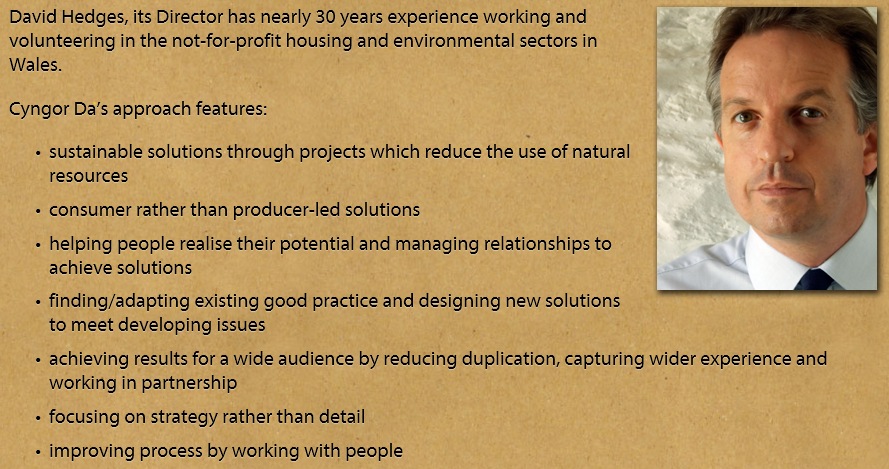
Why so many companies, and who are Staziker, O’Leary and Owen? Are they civil servants who (for the sake of public consumption) are answerable to the ‘Welsh’ Government or are they businesspeople or professionals employed by the ‘Welsh’ Government? Either way, what power do these people have to ensure that millions and millions of pounds of our money is properly spent? And if they simply dole out the money, then who does ensure that it’s properly spent?

*

I can see the Help to Buy scheme working just fine in England, and Scotland, and also in our towns and cities, though in our rural areas it risks exacerbating the problem I have discussed countless times, and that’s because anyone from anywhere can apply to the Help to Buy Scheme to purchase a new property in a Welsh town or village. No local connection is required.

This refusal on the part of the ‘Welsh’ Labour ‘Government’ in Cardiff docks to prioritise Welsh interests almost certainly explains the planning application for 30 new properties in Cilgerran, north Pembrokeshire, submitted by Mill Bay Homes Ltd. Here’s the planning application, I suggest you keep it open in another window or browser so that you can refer to it as I go along.

You will see – in Section 3 – that the application is for planning consent for 8 x 3-bed detached houses, 12 x 3-bed semi-detached houses, and 10 x 2-bed semi-detached houses. Scroll down to Section 18 and you will see that all thirty dwellings are described as “Social Rented Housing”. Which is odd seeing as this planning application was submitted by Mill Bay Housing, which only builds to sell, even inviting investors.

Something else worth remarking on is that in my experience very few detached three-bedroom houses are built for the social rental sector. Oh, and one other thing . . . Pembrokeshire Housing offers a Welsh version of its website, whereas Mill Bay Homes is strictly English only.

Cilgerran

For those who don’t know Cilgerran, it’s a pleasant, scenic village upriver from Cardigan. In 1931 94% of the population of Cilgerran parish was Welsh speaking, today it’s below 50%, for the usual reason: economic decline disguised with the kind of tourism that does little for locals but encourages their replacement with a wealthier stratum of good-lifers, retirees, fleece jacket fascists and others drawn by the area’s physical and scenic attractions, an immigrant population having no regard for the area’s cultural heritage and national identity.

Though perhaps the major question is, why has Mill Bay Homes, a company that on its own website is described as specialising “in the development and sale of homes suited to the lifestyles of customers who range from those buying for the first time through to those looking to downsize or retire” now put in a planning application for rented social housing?

It could be that the answer lies with the use of words such as “lifestyles”, “downsizing” and “retire”. For they sound very odd if these properties are being built for locals to rent, but they’re just the kind of sales pitch I’d expect to see used if the Cilgerran development is targeting buyers from over the border.

So what is the truth about this Cilgerran development and Mill Bay Homes? I think we’re entitled to answers. Maybe the ‘Welsh Ministers’ or the troika named above can assure us that the operations of Pembrokeshire Housing and Mill Bay Homes are above board, and that our generosity isn’t being abused.

Specifically: Has Mill Bay Homes helped ‘investors’ access the Help to Buy scheme? Is public money being used to build properties in Cilgerran described as social housing but intended to be sold on the open market?

*

The relationship between Pembrokeshire Housing and Mill Bay Homes is one I have expressed concerns about before. (Here’s one example.) It sees a body in receipt of large amounts of public funding set up a subsidiary that operates in a way that is either difficult to track, or else in a manner barred to the parent body. The relationship is too often opaque and offers no guarantee that public funding to the parent body is not channelled to the unregulated and unaudited (by funders) subsidiary.

This is what we appear to have with Pembrokeshire Housing and Mill Bay Homes. Even though the latter piously claims that its “earnings will be covenanted to the parent company (Pembrokeshire Housing) for the express purpose of re-investment in the social housing development programme in Pembrokeshire” we have no guarantee of that, because Mill Bay Homes does not receive direct public funding it is not audited.

This parent and subsidiary arrangement should not be allowed where the parent body is in receipt of public funding unless the subsidiaries are covered by the same regulations and checks as the parent body. Ask yourself this, ‘How did Mill Bay Homes build its first properties? Was it with money given by Pembrokeshire Housing? And was that start-up money funding that the parent company had received in ‘Welsh’ Government grants? If so, who authorised this generosity?

In the wider context we now see a social housing sector that is costing Wales hundreds of millions of pounds every year for very little return. The reasons for this unsustainable situation are clear.

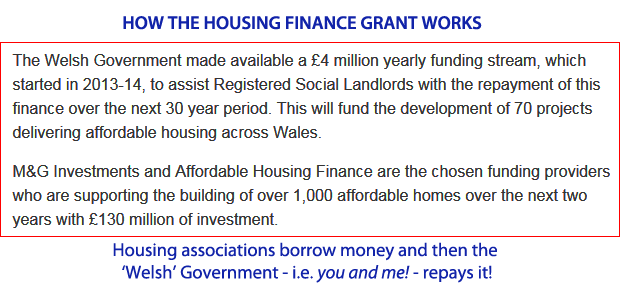
We have far too many housing associations. All paying inflated salaries and pension packages to their senior staff. Those same executives, understanding the dog-eat-dog world they inhabit, and fearful of being swallowed up by a rival, believe they must grow to survive, which inevitably results in increased levels of speculative building unrelated to local need. But don’t worry – it’s only public money! And Wales can afford it.

Round-up: Rhigos, Aberystwyth, Cardigan, Pontypridd

CHINA TO RHIGOS

Not so long ago I wrote about the Pen y Cymoedd wind farm project, and developer Vattenfall’s use of bribery to win over or silence the local populace. (Click here and scroll down to the section Vattenfall of Money.) Well now I know the route by which the turbines for Pen y Cymoedd will be arriving . . . from China. Yes, China.

Because despite what it says on the Pen y Cymoedd website about, “Siemens, our turbine supplier”, they were not made in Germany, or anywhere else in Europe. We have here a Swedish nationalised industry with a German partner importing wind turbines from China! A journey of some 10,000 nautical miles by the quickest route and taking 22 days at 20 knots. Twenty-two days of a huge ship belching smoke, spilling oil, ‘accidentally’ emptying the bilges, and all manner of things falling overboard.

Though in fairness, it is suggested that these turbines, each in three sections (plus blades and spindle), will be shipped from China to Immingham (the major container port just south of Hull) in one consignment, before being broken down into smaller cargoes for trans-shipping to Swansea. The distance from Immingham to Swansea is 606 nautical miles so if, as suggested, coastal vessels are used, each carrying the component parts of a single turbine, this adds up to a further 92,000 nautical miles (counting return trips)!

CLICK TO ENLARGE

With its turbines shipped in from China to Immingham and then shipped on to Swansea, with a total distance covered of some 102,000 nautical miles (plus 532 return lorry trips between Swansea docks and Rhigos), the Pen y Cymoedd wind farm project has the environmental credentials of a dozen coal-fired power stations, each run by a thousand spectacularly flatulent cows. Perhaps we might get a comment on this from La Bartolotti or those competing to succeed her as regional mouthpiece for the Green Party of Englandandwales.

Consider this, also . . . The European steel industry is suffering from Chinese steel being ‘dumped’ on the global market at prices with which European producers cannot compete. These Chinese-made turbines for Pen y Cymoedd will be landed in Lincolnshire, yet just a few months ago, and not far south of Immingham, it was announced that steel production will cease at Redcar with the loss of 1,700 jobs, and there are to be more redundancies at Scunthorpe. On top of which, the turbines are to be landed at Swansea docks, within sight of Port Talbot steelworks! Insult upon injury.

The turbines for Pen y Cymoedd are built in a country where environmental considerations are laughed at, then lugged across oceans, around coasts, and up steep gradients, before each of them is implanted in a concrete base the size of a football pitch in what had previously been virgin moorland. These turbines will provide no permanent jobs in Wales and the profits they generate will go to Sweden or Germany. All we shall see is the annual bribe, the pretty beads paid to the backward natives while their land is raped, again.

Let’s face it, ‘Green energy’ is a massive con. And few projects are proving to be a bigger, or a more insulting con, than Pen y Cymoedd. The turbines there will probably have to run for about 300 years just to pay off the ‘debt’ to the environment incurred by making and transporting the bloody things.

UPDATE 21:00: On Friday the 4th, a few days before posting this, I sent an e-mail to Vattenfall at Pen y Cymoedd asking where the turbines for the site were made. This afternoon I received a ‘phone call from Emily Faull of Vattenfall, a charming young lady who was able to give me a few more facts.

First, she confirmed that the turbine towers were made in China, but the blades and the spindles were made in Denmark and Germany. When I asked whether the turbines had come in through Immingham Ms Faull said no, and that on November 22nd she was at Swansea docks to see “64 sections” arrive on the good ship Amethyst from China. Though if this is the right ship, then it does not appear to have docked in Swansea on November 22nd, though at that time it was en route from Spain to the Netherlands.

Whatever, 64 sections represents 16 turbines (they come in 4 sections, not 3 as I thought), so there would still need to be another four similar voyages to bring the rest of them from China. Though Ms Faull was able to confirm that the transformers were landed at Immingham, and moved by road to Pen y Cymoedd. I’m not sure where the blades and spindles were landed, or how they reached Pen y Cymoedd if they weren’t landed at Swansea.

In a part of the conversation I had some difficulty following, Ms Faull said that it had been hoped to build the turbines at the Mabey Bridge works in Chepstow, but Mabey Bridge felt it was not worth taking on workers only to lay them off again after the Pen y Cymoedd contract was completed. There was also mention of the ‘Welsh’ Government, but what role those clowns played I have no idea.

I have sent Ms Faull another e-mail (07.12.2015) to clarify the remaining details.

UPDATE 18.12.2016: I received the reply today from Ms Faull. It reads:

“Many thanks for your email and apologies for the delay in responding.

Amesthyst landed on 22nd November and I visited the ship on 24th November. The attached photo was taken at Swansea Docks on 23rd November and 64 tower sections were on board. The remaining tower sections will also come via this route. As I said on the call Mabey Bridge were lined up for the tower manufacture, but subsequently withdrew from the bidding process.

The ship came from China and the only stops required would have been for refuelling and personnel changes.

The blades have not yet been shipped, but 192 of these will come from Denmark, with 26 coming from Canada and will again be off-loaded at Swansea Docks.

The size of the wind farm means that means that the operations and maintenance team of around 30 individuals will be based on-site and early next year the team will make a special effort to recruit skilled individuals locally.

With regards to the transformers, these were manufactured at ABB in Bad Honnef, Germany, each of which weigh in at around 125,000 kg and are around 6 metres wide and 8 metres long.”

Pen y Cymoedd, Amethyst, Swansea docks

So in addition to China, Denmark and Germany, we now have components for Pen y Cymoedd also coming from Canada. The environmental credentials of this project, never good, are now compromised beyond redemption. The jobs referred to “early next year”, for which it is hoped to recruit some locals, is not a “maintenance team” at all, this team is on site solely for the erection and installation of the turbines. Once that’s done there will probably be no jobs at Pen y Cymoedd.

The Pen y Cymoedd wind farm is all about money, it’s not about the environment, or even about the generation of electricity. The hundreds of thousands of miles taken up in transporting the components from around the world, by sea and by land, means that the project’s contribution to the environment is entirely negative even if it were to run at optimum output for centuries. Pen y Cymoedd is the most blatant ‘green energy’ rip-off I have ever encountered.

*

ABERYSTWYTH, THE NEXT RHYL?

Some of you may recall reading about five or so years ago that there was a terrible shortage of student accommodation in Aberystwyth, the poor dabs were dossing on the promenade, or else the lack of accommodation had driven them to outlandish places such as Corris where, it was rumoured, locals stared at strangers. Here’s one tale from the BBC in August 2011, and another from Aber Student Media a month later.

To answer this shortage of accommodation there seem to have been three separate responses. One was the university itself embarking on a building programme of ‘student villages’. The second response was that of investors buying up more large properties in the town for student lodgings. Third, local housing associations got in on the act – using public money, of course.

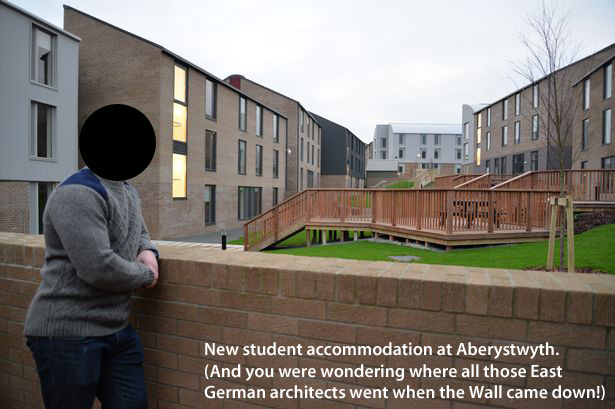
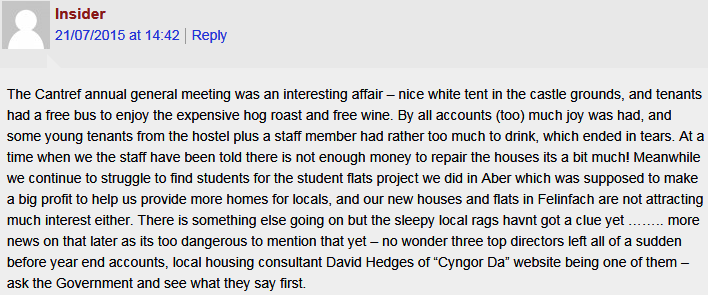
But now I hear that the bubble has burst, leaving the university with under-occupied ‘student villages’ that make 1960s East German architecture look attractive; private investors with Houses of Multiple Occupation suffering a dearth of multiple occupants; and overstretched housing associations . . . for example, the word on the street is that Tai Cantref is already docked up Shit Creek with its crew roistering in local taverns.

Aber student accommodation

What had once been attractive and easy-going Aberystwyth University, three years by the seaside for an undemanding 2:2, started slipping down the league tables a few years ago. In July 2014 the decline was being reported in the Times Higher Education Supplement and by October even the students were getting worried. The continuing decline was reported in May 2015. Inevitably, this resulted in a drop in the numbers of students applying to Aber’ – at the same time as there was more accommodation for them than ever. What to do?

I suggest one doesn’t need to be a soothsayer to predict that with so many properties now available in a Welsh seaside town, properties almost all of which are designed to house single people, it’s only a matter of time before the problems start arriving from over the border. (Thank God there’s still a railway line from Birmingham to Aberystwyth.) I’m thinking now of the drug addicts and the petty criminals, and of course those recently released from prison, because some of the bigger properties in the town will be ideal as ‘halfway houses’ and bail hostels. (See ‘Tragedy in Pontypridd’ below.)

All this results from Wales having a higher education sector that is too big, a higher education sector that has been encouraged to grow irresponsibly, with no reference to the effects of this unwarranted growth on host communities. While the universities willingly played along, adopting a ‘stack ’em high’ philosophy dictated by business models and profit margins that inevitably resulted in falling standards. Leaving Aberystwyth caught in a vicious circle, a refuge for third-rate academics and students who can’t gain admission elsewhere, with this inevitably deterring those who can read walls.

And now there may be a heavy price to pay. Which would be sad, because like most people, I’m very fond of Aberystwyth, I’ve had some good times there, drunk and sober. But if Aber’ is on its way to becoming the Rhyl of Cardigan Bay, in order to protect the investments of local big shots and housing associations, who will dare challenge this development?

*

A LETTER FROM CEREDIGION

It’s been a while since this blog visited Cardigan Castle, but Lady Tucker and friends have been busy, and the results will take the project even further from the trust’s stated objectives of preserving the place “for the benefit of the people of Cardigan and the nation”.

The main contractors, Andrew Scott Ltd, have long since departed with their loot, leaving a very long snagging list of botched jobs behind them. A professional painter and decorator who visited recently commented that it was hard to believe from the state of some of the paint and plasterwork that the site had been handed over little more than six months ago.

But the departure of Andrew Scott has not meant that building work has ceased. Tucked away behind the main house and a small cottage is an outbuilding which was renovated by Andrew Scott Ltd to serve as a garage for guests staying in the 5 star self-catering East Wing. This is now being converted into accommodation for disabled visitors, and when it is finished early next year, it will join the three B&B rooms above the usually empty restaurant, the East Wing (sleeps six) and the Gardener’s Cottage (sleeps two).

And there are more exciting developments on the drawing board.

The old stable block which was restored from its ruined state at huge expense to serve educational purposes has been ear-marked by Lady Tucker for conversion into yet more tourist accommodation. This will not come cheap, and expect building work to continue well into 2017.

Also offering exciting potential for reconversion into tourist accommodation is a small house over on the eastern fringe of the castle complex.

Converting these buildings will mean ejecting the current occupants, including a popular cynghanedd class, and the removal of the only locally based groups still using the site to be re-housed well away from the castle by mid-2016.

No longer will well-heeled paying guests have to face the awful prospect of mingling with scruffy locals speaking gibberish, and the Cadwgan Trust can get down to the serious business of marketing the place as luxury tourist accommodation and a venue for weddings and corporate jollies. Or what we locals call a posh hotel.

Paving the way for this is a Wedding Fayre on 6 December, a time of the year when all but the most self-obsessed brides and their mothers will have other things on their mind.

Cultural heritage

The cultural bit will be confined to a few events (Gilbert and Sullivan, Shakespeare, etc.) in the summer, while as a sideline, non-resident visitors willing to part with a fiver will be allowed in to gawp at the large expanse of lawn and spend a few minutes in the couple of rooms containing exhibitions of old tat. “Look Jeremy, a smashed up old 1940s typewriter which once belonged to the old girl who used to live here!”

After an injection of £12 million plus, including all the funds raised locally and countless thousands of hours of unpaid voluntary work, the people of Cardigan will find that just a year after opening, the castle will to all intents and purposes have reverted to being a private fiefdom, this time run by Lady T and her friends from Aberporth.

Spin cycle

Other recent developments include a parting of ways with Equinox, the Cardiff-based firm which tried to steer the castle through the PR catastrophes which dominated much of 2015.

PR is now being handled in-house by Sue Lewis whose portfolio of responsibilities also includes “facilities”.

When not working for Cadwgan, Sue moonlights for the dire Cambrian News, which also employs her hubby to report on local news.

Not long after it ran its notorious “Incomers are Nazis says Plaid candidate” headline, the Cambrian News was at it again with a piece which suggested that Hefin Wyn, the respected local author, journalist and prominent critic of the Cadwgan Trust, had run a campaign of harassment and “virtual persecution” against Glen Johnson, who has resigned from Cadwgan’s board and various committees more often than most of us have had hot dinners.

It subsequently turned out that the newspaper had published these very serious accusations, including a claim that Mr Johnson was having to resign to protect his family, without actually checking the facts or asking the castle’s history man for evidence to back up his claims.

The paper has refused to disclose who wrote the offending article or to hand over to IPSO, the press complaints body, what it says are e-mails citing persecution and harassment it received from Glen Johnson some weeks later.

Whoever wrote the offending article, Sue has clearly been reading a copy of “Teach Yourself PR”, including Lesson One: The Importance of Creating a Narrative because it is now being put about that she feels threatened in Cardigan, and is reluctant even to drive in from Aberporth on her own.

The narrative is that critics of Cadwgan Trust are a bunch of dangerous bigots and fanatics who, we are asked to believe, are lurking behind every lamp post and municipal litter bin between Pendre and Pwllhai in this small market town.

If it’s not the wicked Hefin Wyn and the snipers Cyfeillion Rhys ap Gruffydd have posted above Siop y Cardi, it’s the stiletto-wielding assassins of Cymdeithas y Chwiorydd and the suicide bombers of Merched y Wawr.

We’ll probably be able to read all about it soon in “Wales’ biggest selling weekly newspaper”.

*

TRAGEDY IN PONTYPRIDD

Some of you will have read accounts from the trial of two men recently convicted of murder in Pontypridd. One of the killers, and the victim, were residents at the Morning Star Inn, on Llantrisant Road. (The second killer was said to be of no fixed abode, but I suspect he too has a connection with the Morning Star.) As you might expect, I got to wondering about the Morning Star, and it’s quite a story.

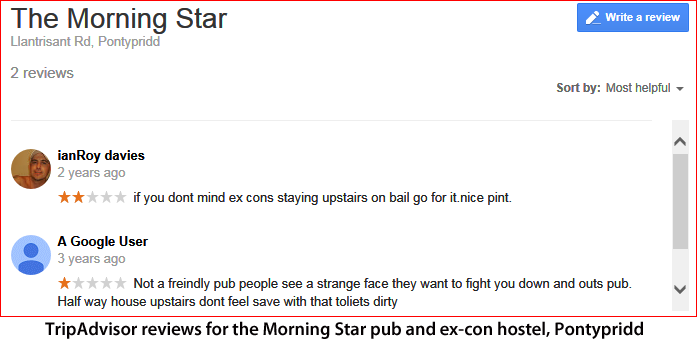
The Morning Star was, until closed after the murder on February 28th, run as both a pub and a bail hostel or halfway house for released criminals. Owned and / or run by “former Egyptian police officer Saad Taha”. Here’s a report from July 2013 of a public meeting organised so that various authorities and local politicians could hear locals voice their concerns about the Morning Star. They relate things they have witnessed first-hand only to be met with a wall of denials and evasions.

According to DePlod despite reports of knife-carrying, discarded needles and bad behaviour in and around the Morning Star “there is little evidence this came directly from the Morning Star”. Of course not, it was pure coincidence. The incredulity increased when I read that Taha wants us to believe that even though these ex-cons are living above a pub, they are not allowed to drink in the pub! I battled through this storm of bullshit and made further enquiries.

In July 2007 there was a planning application (07/1389/10) for a “raised patio / bar extension – beer garden”, and in March 2008 (08/0393/10) for a “rear balcony”. The first application was submitted in the name of a Mr D Watkins and the second in the name of Saad Taha, so is it reasonable to assume that the Morning Star was still being run as a pub in 2007 but the premises changed hands some time in late 2008 or early 2009 and was then run as both a pub and a halfway house? Both applications were withdrawn.

Next, on September 20th 2011, Taha made an application (11/1140/10) for “Conversion of existing bar areas into bedrooms (Change of use).- amended plan received 25/11/11 – reduction in total number of bedrooms from 17 to 16 – amended location plan received on 26/01/12.” With the first floor already being used to house ex-convicts it appears Taha now sought to convert the ground floor (pub) area and even the basement (cellar). This plan was very wisely turned down by RCT council.

But then, on December 14th, 2012, another application (12/1293/09) was lodged, “Application for a Lawful Development Certificate for an Existing use as a public house and hostel.” Which I take to mean that Taha was now asking for retrospective planning consent for a building already being used – without permission – as a hostel. Planning permission was refused.

I find it significant, and rather confusing, that in his rejected planning applications of September 2011 and December 2012 Taha is asking for a “change of use”. Also confusing, is that the earlier of those applications states that there are already 16 bedrooms at the Morning Star, yet according to the WalesOnline report of the July 2013 public meeting the place only has only “seven beds”. Which is right?

Morning Star reviews

So here’s the question. Seeing as retrospective planning permission for a change of use to a hostel was refused in 2011 and 2012, why was the Morning Star allowed to operate as a hostel? Everybody in the area knew what the building was being used for, including the police and the council, so was it somehow allowed to operate as a hostel without the required planning permissions? If not, then perhaps someone at RCT council can direct me to the approval for the Morning Star to be used as a halfway house for criminals.

Another teaser is, who owns the Morning Star? Having checked on the Land Registry website using the correct post code I can find nothing under Morning Star or 59 Llantrisant Road. So we can’t be sure if Taha actually owns the property (as he claims) or if he’s merely an agent for someone else. Presumably Rhondda Cynon Taf council knows who owns this place, and if it is Saad Taha, why doesn’t he register his ownership with the Land Registry? He’s had long enough.

There’s something odd about the Morning Star saga. Not least, how does a former Egyptian copper end up running a halfway house in Ponty? And what checks were done into his background? Where do his ‘clients’ come from? And who supplies them?

Anyway, undeterred by the minor inconvenience of a man being beaten to death on the premises, and before those charged with the murder had been tried, Saad Taha was again thinking of profiting from the Morning Star when, on August 26th this year, he submitted a planning application (15/1170/10) that reads, “Proposed change of use from existing public house and bedrooms to 6 no. self contained flats”. Wording that raises yet more questions.

For example, why does it describe a home for ex-cons as “bedrooms”? Or is this more evidence that no permission was ever granted for the property to be used as a hostel? Though a bigger worry for the local residents should be, who is going to live in these flats? Given the record of Saad Taha, Rhondda Cynon Taf council, and the pooh-pooh police, locals have every reason to be concerned.

Meryl Gravell & Robin Cammish, Only in Carmarthenshire

After posting my previous piece on colonialism, and using as an example the thwarted biomass plans of Welsh businessman Clive Hughes, I received some very interesting feedback naming Hughes’ nemesis as Robin Andrew Cammish. ‘Who him?’ you demand. Well, make yourself comfortable and settle back for a quite remarkable story.

Robin Cammish 1

First of all, read this Llanelli Star report from October 2012 in which Cammish explains how he got involved in the campaign against Clive Hughes’ proposed biomass power station at Coedbach, and how he became chairman of the group opposing the plan. Note that in the second paragraph it says, ” . . . the 58-year-old, who leads global purchasing and supply chain consultancy QP group”. So naturally, I checked up on the QP Group, and found that it had liabilities in excess of assets to the tune of £100,000 when it was struck off in June 2009. Which means that at the time the Llanelli Star piece was written, the QP Group had been defunct for over three years.

Or perhaps the Star meant QP Group (France) Ltd (based in Aldershot!). Or QP ES Group SA of Luxembourg. How about QP Group Sas, with an address in central Paris. Or maybe it’s QP Group Gmbh in Germany. There are even QP companies in the USA and Australia! So take your pick. In fact, Cammish has been involved with over thirty companies, some of which I shall explore below. (Note that the address given for him by Company Check is in Birmingham.)

QP companies

Maybe I’m being a little unfair to Cammish, it’s so easy to get confused when one has so many companies using the QP name (an abbreviation for quality and performance). Perhaps what he told the Star was that he ran Quality and Performance in Development Ltd (Co. No. 03391150), which seems to be the main vehicle for his business activities and currently enjoys a net worth of £944,053.

Though Quality and Performance in Development Ltd threw up another mystery. Cammish’s address is Llandyri House, between Kidwelly and Trimsaran, but the address given for his main company is Coomb Mansion, Llangynog, a truly ugly nineteenth-century ‘mansion’ that has served as an approved school and a Cheshire home for ex-servicemen. In addition to Robin Cammish the other directors of Quality and Performance in Development Ltd are his partner, Pauline Bowers, and a Craig Thomas Henry Warrington of Wokingham, in Berkshire.

Naturally, I got to wondering who owns Coomb Mansion, so here is the title document. Coomb Mansion was bought by Robin Cammish for £200,000, 06.11.2012. I wonder what plans he has for this grotesque pile? And will he get planning permission? Read on for the likely answer to the second of those questions. (You’ll note that Coomb Mansion is in Cammish’s name alone, whereas Llandyri House is in both his and Bowers’ names.)

Cammish and Warrington have collaborated elsewhere, with Summit House Close Estate Management Ltd, also in Berkshire, Co. No. 08959266, Incorporated 26.03.2014 and apparently sold on 09.10.2014. Incorporated on the same date and from the same address was Summit House Close Flat Management Ltd, Co. No. 08959172. Cammish and Warrington resigned 24.09.2014 when five new directors took over.

Though I find it strange that Warrington is named as a director for both companies but Cammish appears as QPB Ltd, Co. No. 06687464. Seeing as Warrington is a long-serving director of QPB, why is he listed separately; or should the question be, why isn’t Cammish listed under his name, rather than the company’s? QPB was Incorporated 02.09.2008 with a debt of £1.3m, presumably mortgages, paid off with the sale of the two Summit House companies.

We shall return to Robin Cammish’s many companies anon, but for the time being I want to explore how successfully this man has put himself about in his adopted community, how he has found favour with local power-brokers, and how favour and patronage has resulted in some remarkable appointments.

~~~~~~~~~~~~~~~~~~~~~~~~~

To recap . . . As the Llanelli Star told us, Cammish began to make himself known in Carmarthenshire when he got involved with the protest against Clive Hughes’ plan for a biomass plant in the Gwendraeth valley. Those protesting against this project called themselves the Coedbach Action Team.

Though there was also a company set up, Incorporated 01.08.2008, called Coedbach Action Team Ltd, Co. No. 06662006. The sole director until the company was struck off in December 2014 was Robin Cammish. This company never had any assets and existed only on paper . . . but for what purpose? Was it for legal reasons?

I strongly suggest that you scroll down in this judicial review document from September 2010 to paragraph 18, and paragraph 19, in which we read, “Mr Cammish says that the Claimant (Coedbach Action Team Ltd) does not have the resources to fund its own costs in this judicial review and to pay the costs of an opposing party if it is unsuccessful. That is at odds with a letter sent to the solicitors for the Interested Party (Developer) dated 21 July 2010 in which the Claimant’s solicitor asserted that it did have the funds to pay the costs of successful parties if the claim for judicial review failed.”

Which suggests to me that in order to secure the judicial review Cammish said he / the group had the money needed to meet any costs, but when push came to shove he / the group claimed to be skint. Draw your own conclusions.

In fact, I strongly suggest that you read the document to the end. Essentially, Cammish was told to piss off because a biomass plant at Avonmouth had nothing to do with, and would have no impact upon, a bunch of people living in Carmarthenshire. They seem to have escaped payment of costs due to having formed a private limited company, with Cammish as its sole director. But why were they fighting this project in Bristol anyway?

Kidwelly map

The biomass plant that made a star out of Cammish was planned for a location not far from Pembrey airport, and only a few miles from Ffos Las racetrack. Now keen watchers of Carmarthenshire County Council will be aware that this area is dear to the heart of Meryl Gravell, Mam to the Independent group on the council, former leader of the council, and right-hand woman to and mouthpiece for the man who runs Carmarthenshire, Mark James, the chief executive.

Which makes this the appropriate time to give some background information about this area and those entertaining grand ideas – who said ‘grandiose’? – for this part of Carmarthenshire.

UPDATE 15.12.2015: I have been directed to a film made for HTV in 2008 featuring both Clive Hughes and Robin Cammish.

Meryl Gravell – who does not appear – is quoted as saying that the area’s economic future lies with “leisure and tourism projects”, which as we know, will provide very few worthwhile jobs for locals, whereas Clive Hughes wants to create jobs for locals.

Cammish, who, it could be argued, has retired to the area, represents a type we find all over rural Wales nowadays. His rural idyll is more important than jobs for those who belong here.

It is alleged that during the filming of this programme Cammish claimed that Hughes owed £18m to his accountants. This was not broadcast.

~~~~~~~~~~~~~~~~~~~~~~~~~

Her affection for this area means that Meryl Gravell will tolerate nothing jeopardising her grand vision, be the threat a biomass power station, an opencast coal operation or a vast solar energy complex – against all of which Robin Cammish has taken up the cudgels in recent years. Only developments approved of by Meryl Gravell are welcomed, or allowed.

One such enhancement in the pipeline is Robbie Savage’s luxury hotel at Ffos Las, though earlier this year he had to apply for a planning extension, which makes many locals sceptical that it will ever be built. Then there are the executive homes in open country to further improve the Gwendraeth’s cachet. Though quite how either project will benefit locals is matter for conjecture.

Llanelli news with James story Wednesday 19th November 2014 Meryl Gravell with her new bookFor Pembrey airport, there was – and may still be – a plan to turn it into some kind of international duty-free business hub. As it was worded on the airport website until quite recently, Pembrey was “one of the few Airports in the United Kingdom that has 5000 acres of adjoining land available for joint venture with very little planning and environmental constraint”. (Unkind souls might suggest that ‘very little planning and environmental constraint’ could apply to the whole county.)

What’s certain is that by 2011 Cammish had his feet under the table with Meryl Gravell, literally, as this film shows (at 23 minutes in), where we see Cammish discussing with Meryl how Pembrey airport could be improved, and made more profitable. A carefully rehearsed bit of play-acting it may be, but it nevertheless tells us that Cammish was by this stage ‘in’ with those who dispense patronage, funding and planning consent thereabouts.

As was proven a few years later when on 06.09.2013 he was appointed a director of the Scarlets, one of the three vanity projects accepted by the Welsh Rugby Union as ‘regions’. Most people will know that the Scarlets are effectively bankrupt and largely kept afloat by Carmarthenshire County Council writing off debts and doing the Scarlets countless other favours. The most recent figure I can find gives the Scarlets a net worth of £-4,164,241.

Cammish’s appointment to the Scarlets’ Board is quite remarkable. For when we look at who has served as directors we see some great players of the past, Phil Bennett, Derek Quinnell and the late Ray Gravell, these supplemented by local worthies brought up at Stradey Park. By comparison, Cammish, the Englishman who has lived in the area for a few years, and may know nothing about rugby (certainly little about Llanelli), sticks out like a sore thumb. The only explanation is that he was appointed by the council . . . or rather, Meryl Gravell.

Cammish’s appointment to the Scarlets’ board may have been surprising, but what came next was almost unbelievable. Just a year after being imposed on the Scarlets by Meryl, he was appointed chairman of Regional Rugby Wales (RRW), since renamed Pro Rugby Wales, the body representing the Ospreys and the three vanity projects. An incredible promotion for an unknown after just one year at the Scarlets. What possible experience or understanding of Welsh rugby could he possess to qualify him for the RRW job?

UPDATE 23.12.2015: I’m hearing that Robin Cammish has today resigned as chairman of Pro Rugby Wales. Here is his e-mail of resignation.

Note that it was sent just a day after a meeting of Pro Rugby Wales at which it became clear he was being given the old heave-ho. Note in particular the reference to PRW wanting an “independent chairman”. So why wasn’t Cammish considered independent?

Whatever the answer to that, this is good news and it could mark the start of Cammish being exposed for the bullshitter he surely is. But it still leaves the concern that this man is dangerously close to the centre of power in Carmarthenshire. He must be removed.

Gentlemen,

As a follow up (sic) to the PRW Ltd board meeting on 22nd December 2015, I offer you my resignation as Chairman of Pro Rugby Wales Ltd, and I would propose to make that effective from 7 January 2016, which will enable to me complete some previously arranged meetings associated with the Welsh Rugby cost down and revenue up opportunity analysis.

I fully understand your desire to have an independent chairman of PRW Ltd , and during my short tenure as Chairman I have worked diligently and with complete integrity to ensure that I have acted objectively and impartially in all aspects of the PRW role when discharging my responsibilities and conducting myself on behalf of PRW and the Welsh regions.

It is ironic that having worked hard in the background to identify the collaborative opportunities across the 4 Welsh regions and the WRU, which if implemented, has the potential to deliver £+1million in cost down and revenue up in 2016-7, it is clear from our discussions on 22nd December that I do not have your full support as Chairman of PRW Ltd.

As I’m sure you will understand this position leaves me with no alternative but to offer you my resignation.

I am, and will remain, a very strong advocate and supporter of having 4 strong financially sustainable high performing Welsh regions, and as we discussed on the 22nd, previous management in the WRU created a set of relationships and behaviours which we described more associated with being at war. This is now changing to a much more collaborative environment, which has significant implications for the way that you lead and manage the regions affairs going forward.

Wishing you all the best for Christmas and the New Year

Regards

ROBIN CAMMISH

Chairman Cadeirydd

Pro Rugby Wales

~~~~~~~~~~~~~~~~~~~~~~~~~

What else has Cammish been up to since he first graced us with his presence? Well, for one thing, he joined forces with Julian Ruck, the Welsh-hater who was recently badly injured when hit by a car. They teamed up to run an e-literature festival in 2011 that flopped badly, some suggesting its failure was due to it being held at Ffos Las racecourse, rather than somewhere easier for visitors to reach by train and bus. But then, by 2011, Cammish was best buddies with Meryl Gravell, and Ffos Las is her baby, to be nourished with all manner of bookings. Or it could have been the combination of Ruck and Cammish that ensured local attendance was zero. Among those booked to perform at this disaster were the Three Welsh Tenors.

Read Ruck’s response to the Tenors when they asked to be paid. He came out with one anti-Welsh barb after another, ‘. . . bastions of Welsh language birdsong . . . my insistence on the reduction of Welsh language songs . . . Welsh hymns and nationalist rugby songs . . . one of them is a North Walian (sic) . . . go and sing for your money . . . rugby ditties . . . a tenner for each of you. A tenner for a tenor!’ What an odious little rucker he is, easy to understand why he’s banned from his local Spar store.

I wonder if Robin Cammish found this anti-Welsh diatribe funny, did they perhaps share a chortle or two? Whether he laughed or not, for a man trying to ingratiate himself with his new Welsh neighbours Cammish made a serious misjudgement by getting mixed up with the odious Jools. Though if you hurry you can buy some of his books through Amazon for . . . a penny! (Postage £2.80.) What am I saying! There’s no need to hurry at all, they’ll still be there in 2025.
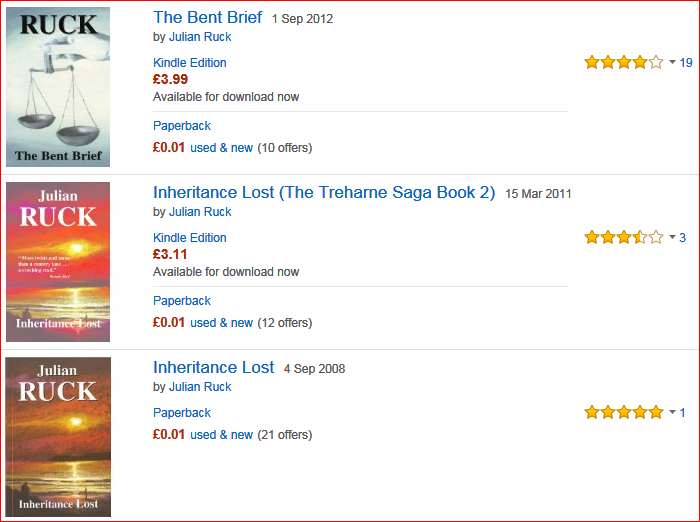
Ruck on Amazon

When he’s not consorting with yet another Labour Welsh-hater Cammish gets himself into scrapes, either through indiscretion or else an overweening desire to promote himself. Here are a couple of examples of the latter.

The first comes from 2000 and an article entitled ‘Man on a Mission’, to be found on a site called Supply Management. It’s such a shameless puff that it could only have been written by Cammish himself. As he modestly puts it when talking of how his company has grown, “The site is the second that the consultancy has occupied. The first quickly became too small, not long after Cammish set up the company as a one-man band five years ago. He quickly found that he needed to take on more consultants and since then the firm has doubled in size every nine months or so. It now has offices in four other countries – the US, France, Germany and Australia – and employs more than 100 consultants. It’s long list of clients includes Viagra-producer Pfitzer, Cable and Wireless, Cathay Pacific, Caterpillar, BT, Carlsberg and Glaxo Wellcome.” He employs more than “100 consultants”!

I hate to sound pedantic, but the name of the massive pharmaceutical company is Pfizer, not Pfitzer as Cammish spells it. You think he’d know the name of the company that is one of his “doubling in size every nine months or so” empire’s major clients.

Here’s another OTT self-encomium from the QP Group UK website. This website is current because if you click on the History tab you’ll find, “In 2014, we partnered with Procurement Academy to provide a world-class blended learning Procurement offering to the market.” Very impressive, until you remember that the QP Group Ltd, of Llanydri House, Llanydri, Kidwelly, was struck off in June 2009 with a net worth of £-100,000. So why is the website still being updated as if QP Group UK was a going concern? Is this another example of the ‘confusion’ arising from having so many companies sharing the QP element in their names?

Read the two puffs together and just look at the companies he claims to have worked for or ‘advised’, they are some of the biggest companies in the world, which is no more than we should expect from Cammish. On the QP Group UK website go to Training > Overview and scroll down to the ‘Testimonials’. Do you believe those are genuine testimonials?

As for his indiscretions, these seem to be spawned by the same devil, Ego, that takes control when he attempts to write anything about himself. He has to exaggerate his own importance, his contacts, what he knows. After the famous dialogue with Meryl at Pembrey International it is rumoured that he was describing himself as an ‘advisor’ to the council, and Mark James had to put the record straight.

Then, before a London audience, he accused Clive Hughes of using bribery to promote his biomass project. What’s more, he claimed to have been told this by “the council”. Unfortunately all this was recorded, and while Cammish himself refused to say any more, Mark James, Carmarthenshire’s chief executive, was forced to issue a statement, part of which said, “I am perturbed to hear what Mr Cammish says. I am not aware that the council has made any such comments to Mr Cammish. As you are aware, Mr Cammish does not work for the council and I am therefore not in a position to control or question what he might say.”

I find it intriguing that Mark James says, “As you are aware, Mr Cammish does not work for the council”. ‘As you are aware!’ Does this refer to the previous such statement I suggested above? Even though Robin Cammish may not have been on the county payroll, there’s no question that he was close to Meryl Gravell and, according to one well-connected source, “had the run of County Hall”.

Ironically, it was Cammish who took legal action against Hughes, alleging that the Welsh businessman had suggested Cammish’s business record was less than spotless. (Surely not!) Cammish won, but I’m told Clive Hughes is refusing to pay.

Another avenue explored, perhaps with the encouragement of La Gravell, was the Kidwelly Heritage Trust, Charity Number 1153260, formed by Robin Cammish 15.08.2011. When I read what this lot planned to do – take over the Town Hall (owned by the County Council) and turn it into ‘community space’ – it was like deja vu all over again. This piece from the Llanelli Star (August, 2013) shows the Trust members standing a respectful distance behind Cammish while in the blurb the man himself mentions what has been done in Llandovery as one of his inspirations.

What happened in Llandovery was that a bunch of English drifters saw the chance to pull in hundreds of thousands of pounds of public money (including salaries and pensions for themselves) to create ‘community space’ not for locals but for them and their friends to hang out drinking Fair Trade coffee, swapping tales of Kathmandu while listening to Joni Mitchell and planning the next organic Morris dancing festival. Scams like this are happening all over Wales. I wrote about the Llandovery racket in The Impoverishment of Wales 26.08.2014 (scroll down to ‘YMCA Wales’), and more fully in Ancestral Turf 02.09.2014.

I’m reasonably certain that this was the path Cammish intended to follow – he was certainly looking for funding – but then came the call from Parc y Scarlets, soon followed by promotion to Regional Rugby Wales. Cammish jacked in the Kidwelly Heritage Trust Ltd in April 2015. The company, No 07741052, struggles along with just two directors and £40 in the bank.

~~~~~~~~~~~~~~~~~~~~~~~~~

Let us return now to Robin Cammish the businessman. As I said earlier, he has been involved with over thirty companies. Most of these have been liquidated, struck off, dissolved, often with big debts. None more so than the company I mentioned earlier, the one referred to in the screen capture, Hacer Consulting Ltd.

In my years of blogging – and indeed in the years before I started blogging – I have made many enquiries into assorted individuals’ business dealings, some of these individuals have been absolute rogues, but never have I come across a company like Hacer, that started life in 2003 with a net worth of £-762,000, then rose to the giddy heights of a net worth of £6,521,00 in 2005, before plunging to a net worth of £-18,651.00 in 2006. Hacer was struck-off in June 2009 with a net worth of £-18,643,595. (See panel below, click to enlarge.)

Hacer Consulting Ltd

As you might expect, I paid for and downloaded the accounts for Hacer, and for the period when the company’s fortunes deteriorated by £25m, leaving the company valued at £-18.6m. You’ll find the accounts here. It seems to have been a company with no assets, a company that just shuffled shares around. I would appreciate feedback. An incomplete list of the companies he has been involved with can be found here. Check them out for yourself.

The only companies listed with Company Check as active are: Earls Removals Ltd, Pro Rugby Wales Ltd, QPB Ltd and Quality and Performance in Development Ltd. Of these, the only company that is his, and worth anything, is Quality and Performance in Development Ltd. Here are the abbreviated and unaudited accounts up to September 2014. They tell us that the ‘assets’ of Cammish’s sole viable company are made up of debts. In other words, debts that were either bought or inherited and will probably never be paid. But in the crazy world of UK business these count as ‘assets’ and can be used to misrepresent the financial health of a company

UPDATE 04.12.2015: QPB Ltd is being wound up. “First notification of strike-off action in London Gazette (Section 652)” on 12.11.2015. Which leaves Cammish with just two companies. The removals firm in Brum and Quality and Performance in Development Ltd, a company whose ‘assets’ are made up of debts unlikely to ever be paid.

Other than that, what have we learnt about Robert Cammish? I could be generous and dismiss him as a bullshitter, because he certainly is a bullshitter, but there might be more to him than that.

I don’t entirely agree with Clive Hughes that Cammish having so many failed companies to his (and his partner, Pauline Bowers’) name is in itself damning, but this pattern might suggest a ‘business’ that most people would find unpalatable.

The value of Cammish’s companies seem to consist largely of share issues and debts; nothing is produced and there is little to show in the way of assets. He advertises himself as someone who ‘advises’ other companies, he even lists blue chip multinationals like Cathay Pacific, SmithKline Beecham, you can believe that or not, but what does he really do?

When I asked someone more au fait with such matters to look into Cammish’s affairs his description of Cammish’s activities involved the use of a large, scavenging bird. Alternatively, a woman paid to disrobe in public.

~~~~~~~~~~~~~~~~~~~~~~~~~

Whatever the truth of that suggestion, I am perhaps more concerned with Cammish’s relationship with Carmarthenshire County Council. I think we have established that he came to the attention of then council leader Meryl Gravell through his opposition to Clive Hughes’ biomass project for Coedbach. Cammish then further endeared himself to Meryl by opposing other unwanted developments. Was there a quid pro quo?

What did Cammish get in return for acting as Meryl’s rottweiler when she pointed him at anything threatening to sully her vision for the Gwendraeth? I think we can assume that the appointment to the board of the Scarlets was one ‘biscuit’. Maybe Meryl even believed Cammish’s bullshit and thought he might be able to staunch the flow of money out the gates of Parc y Scarlets.

Then there’s Coomb Mansion. No sane person would have bought that Hammer House of Horror, and taken on the expense of maintenance and upkeep, without clear promises of planning permission, clearance for change of use, and who knows what else. It will be interesting to see what Cammish does with Coomb Mansion.

Then there’s the film I linked to, that excruciatingly staged ‘discussion’ between Meryl and Cammish at Pembrey International Airport. Cammish was claiming at that time to be an ‘advisor’ to the council, he is said to have “had the run of County Hall”, he was recorded in London saying that he had been told by the council that Clive Hughes was bribing people in order to facilitate his biomass project.

All this tells me that Carmarthenshire County Council, or certainly, Meryl Gravell, fell for Cammish’s shameless self-promotion and the fanciful stories of his glittering business record. Given that she is the chief executive’s representative on earth how much confidential council business has she involved Cammish in? How many council decisions has Cammish influenced? What is his relationship today with the Council?

And yet, there is something so quintessentially Carmarthenshire about this story. A smooth-talking stranger turns up, no one knows anything about him – so they accept what he tells them about himself! – and before you know it he’s got the key to County Hall, and those running the council are hanging on his every word! Sod background checks! Ignore probity! Bugger democracy!

There must come a point when even the size of Mark James’ redundancy package is no longer a deterrent to the ‘Welsh’ Government taking Carmarthenshire County Council into special measures. God knows they’ve done it with less cause in other areas.


Wales, Colony of England

Let me start by establishing what I mean by a colony. A colony is a territory or country run in the interests of another country, and for the benefit of the elite or the population in general of that other country. The colony does not need to be far away, nor do its indigenes need to be of a different pigmentation or religion, what matters is the economic and other relationships between the two countries. By which criteria Wales is most definitely a colony of England.

~~~~~~~~~~

Historically, we Welsh had to be conquered and brought under English rule a) because we resisted Anglo-Saxon / Anglo-Norman / English attempts to control the whole island of Britain and b) because we, as the original inhabitants of Britain, served to remind these invaders of our prior claim to their land as well as our own.

For centuries we suffered under a discriminatory legal system then, with the Industrial Revolution, we started to see Wales and the Welsh exploited in a more organised fashion, with the motive this time being profit rather than imperialist aggrandisement. In a modified form this system persists today, and although discrimination may no longer be on the statute book it still exists in myriad subtle forms.

~~~~~~~~~~

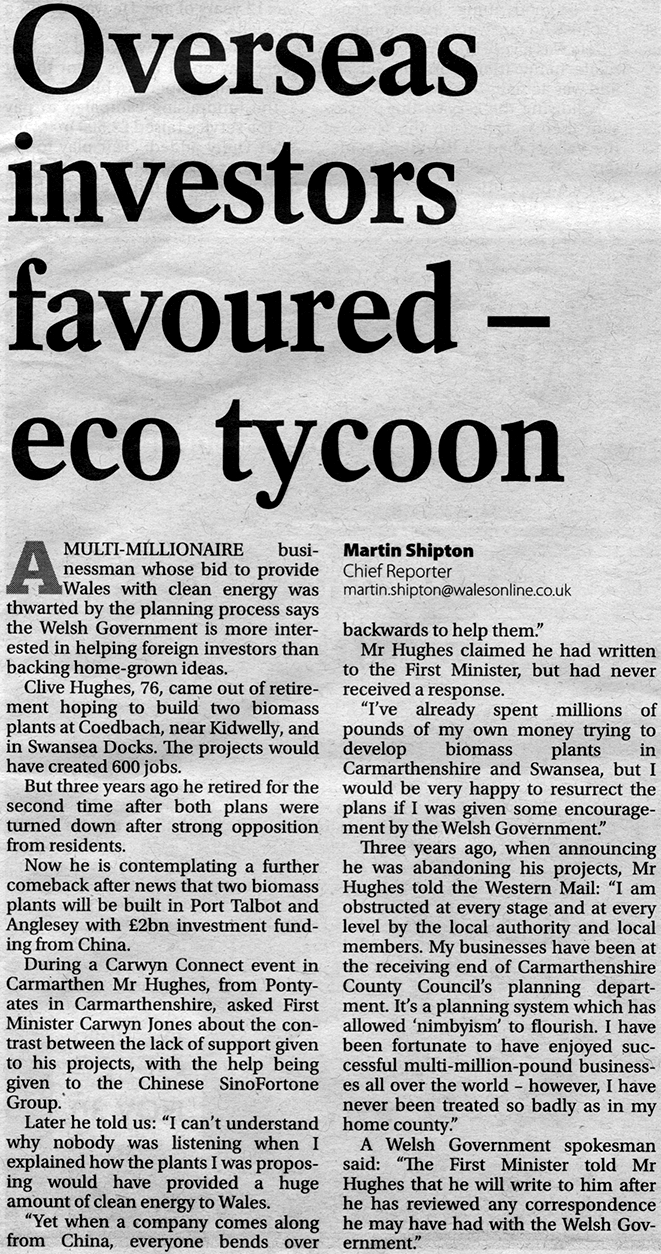
Something I was reminded of recently with the re-surfacing of a story I’d been vaguely aware of before. A Welsh businessman named Clive Hughes had planned to build two biomass plants employing hundreds of people, one near Kidwelly, the other on Swansea docks, reported in the panel on the right (click to enlarge).Biomass Swansea docks It seems that Mr Hughes had no help in his endeavours from either Mark James Carmarthenshire council or the ‘Welsh’ Government. In fact, he received no reply after writing to First Minister Carwyn Jones.

The reason this story has re-surfaced is because Clive Hughes was understandably peeved to learn that while his projects were either ignored or refused planning permission, civil servants and councils are now falling over themselves to help Chinese investors build two biomass plants, one on Ynys Môn, the other in Port Talbot, just a few miles from his planned Swansea docks site.

Something Clive Hughes was quoted as saying hints at where I’m going with this example. He said, “I have been fortunate to have enjoyed successful multi-million-pound businesses all over the world – however, I have never been treated so badly as in my home county”.

How do we explain this curious tale of Welsh agencies refusing to support indigenous enterprise while generously supporting foreign investment  – to do exactly the same thing! In a word, colonialism. (Yes, I know the report mentions nimbyism and “opposition from residents”, but believe me, it goes way beyond that.)

Clive Hughes was wasting his time appealing to Carwyn Jones, who is just a figurehead for a form of sham devolution. Wales – as I have said time and time gain – is run by civil servants, invariably masquerading as ‘advisors’ to Carwyn and his gang of deadbeats, and these civil servants take their orders from London. The wisdom for some years in London has been that it is a good thing to ‘open up’ the UK to foreign investment, particularly from China. Once you know that, then it’s easy to understand why no Welsh businessman will be allowed to queer the pitch for Chinese and other foreign investors.

A further example of the colonial economy at work is often articulated as the question, ‘Isn’t it strange how Welsh people (insert here, Terry Matthews, Chris Evans et al, or Clive Hughes) have to leave Wales to be successful?’ Er, no, there’s nothing strange about it, for two very good reasons. First, too many successful Welsh businesspeople might give us natives silly ideas about our ability to do things for ourselves. Second, any successful Welsh business is almost bound to come into competition with English companies. Both are undesirable in a colonial set up.

Of course after making his money in Canada Matthews returned to Wales and built the very successful Celtic Manor resort outside Newport. But the Celtic Manor poses no threat to the colonial arrangement. To begin with, it does not really compete with English rivals in the way that a company chasing consumers in a competitive market would. In addition, with its NATO conferences and Ryder Cup golf tournaments, the Celtic Manor helps integrate Wales with England.

Note that in the piece I’ve linked to about Matthews, Michael Moritz is described as “the richest person in Wales”, which is stretching it a bit. He was certainly born in Cardiff, but left for the USA in his early twenties, made his fortune in Silicon Valley, and never returned. He still lives in San Francisco with his family. Perhaps the most successful business based in Wales, and the only one quoted in the FTSE 100, is Admiral Insurance, started up and still owned by Henry Engelhardt . . . from Chicago. Which is fine, because it confirms that the Welsh must have outsiders to provide them with work.

Let’s end with another feature of the colonial economy, and again, something that draws bewildered comment from people who refuse to see the system controlling the economic life of Wales. I’m referring now to the phenomenon of successful Welsh companies being taken over by larger companies before they can grow too big, with this often resulting in redundancies or even closure of the now subsidiary Welsh operation. If you don’t understand why this happens then you haven’t been paying attention.

~~~~~~~~~~

The Roman system of coloniae settled army veterans and their families in conquered territories and border regions, and was employed for two main reasons. First, to keep an eye on the natives and, if necessary, confront any insurgency until the army arrived. Second, coloniae spread the use of the Latin language and Roman ways of doing things.

This example of settling people from, or loyal to, the ruling country in recently conquered territories and colonies is one that has been imitated globally down to the present day. The British have done it across the world, even to Christian European populations. There was the Irish Plantation, the ‘repopulating’ of eastern Canada after the expulsion of the Acadians (Cajuns), and the flooding of the independent republic of Transvaal with British settlers once it was realised that the land beneath the Boers’ feet contained gold and diamonds.

In more recent times, France sees a steady exodus of loyal French people to Tahiti, New Caledonia, Guadeloupe, Martinique and other specks in the ocean in the hope that these emigres will help the natives see the benefit of maintaining ties with France. While on a bigger scale, and in a much more brutal fashion, China has created all sorts of incentives for Han Chinese to settle in, with the intention of dominating, Tibet and Xinjiang.

So why be surprised that Wales has been undergoing a process of colonisation since the 1960s? A process that has taken many forms, some so bleeding obvious you wonder how they got away with it.

Take the Development Board for Rural Wales, an agency set up – so we were told – to stem the depopulation of the five central counties of Montgomeryshire, Cardiganshire, Merionethshire, Breconshire and Radnorshire. It operated by paying English companies to relocate to central Wales, with their workforces (all paid for), while spending many more millions building thousands of new houses for this influx. And while all this cash was being showered on English companies local firms could not apply for a penny of DBRW funding. As blatant a colonisation strategy as Mother England has ever deployed. But Welsh politicians, media, and others still applauded every relocation as ‘New jobs coming to —————‘.

Many countries pay companies to set up in areas needing employment, but I have never come across another case like the DBRW, where a state paid firms to transfer lock stock and barrel, plus workers, to another area. It makes no sense, until you see it for what it was – plain, unvarnished colonisation.

~~~~~~~~~~

The colony of Wales also serves as a receptacle for those who are not making a contribution to the common weal in England. Those in this category range from geriatrics to young criminals and drug addicts. To the point where in some areas of Wales – such as where I live – two-thirds of the over 65s were born in England. But, hey! looking after old people is a ‘growth industry’.

Gwynedd SW Wards merged
CLICK TO ENLARGE

If it’s not wrinklies then it’s a feckless white underclass. Some towns have been almost destroyed by this phenomenon, and none have come closer to implosion than Rhyl. This link reports a story of a woman living in Rhyl sent down after police found a dead body and a stash of heroin in her flat. An everyday story of Rhyl folk.

When it’s not drug addicts then it’s paedophiles. So many such deviants from over the border are now turning up in Wales that it just has to be organised, perhaps by the Probation Service. I have written about this problem before, one of the most notorious recent cases was a whole gang of paedophiles relocated from London to Kidwelly. Read about it and other cases. Within the past few days I have learnt of two more paedophiles who, by some unspecified route, arrived in Wales. This one in Ciliau Aeron and this one in Llanbadarn Fawr.

In the great colonialist scheme of things it really doesn’t matter whether those coming into Wales are sweet old dears straight out of an Ealing comedy or dangerous perverts, they all make their contribution to skewing Welsh statistics in a way that is unflattering to us, put a strain on an already overburdened health service, and of course, make their contribution to anglicising Wales. ‘Poor Wales’, ‘Ageing Wales’, ‘Wales’ Drugs Problem’ writes Phil Space, and intones Jamie Owen, but no one has the balls to really investigate these issues and give us the truth.

But then, in a colony, the last thing you can expect is an honest media.

~~~~~~~~~~

I can’t be absolutely certain when I first realised the media lies (maybe it was when I was first lied about), but the reporting of the Balkan wars in the 1990s was something of a watershed because that coverage was not simply a lie here and there, or some vague and ill-defined bias, it was an unwavering adherence to a propaganda line originating in the Pentagon.

Done in pursuit of a strategic objective dictating that Jugoslavia should be dismembered and Russia’s Serb allies at the core of that State be internationally isolated. To achieve this objective the fascist Croats of the Ustaše, and the gangster Albanians in the Kosovo Liberation Army, were depicted as knights in shining armour, while a blind eye was turned to foreign jihadists killing Serbs in Bosnia, leaving us to focus solely on the beastly Serbs, the only ones guilty of any atrocities.

Obviously, when dealing with ‘internal’ matters the UK media is different, but even here, the bias has long been unmistakable, and especially in television. Just about everyone has noticed the recent plethora of programmes with titles beginning ‘Great British’, in fact, it’s become so obvious that it’s something of a joke. A regular orgy of cringe-worthy ‘patriotism’, on sets bedecked with union flags, and all done in the hope of persuading Scots and other disaffected minorities that it don’t get no better than singing the worst national anthem on earth.

While on another level we see some elements of the BBC – Newsnight comes to mind – becoming almost schizophrenic in their desire to maintain their Left-liberal bias while simultaneously following the BritNat line in the hope of pandering to those in the Tory party who wish to dismantle the Beeb. Though in its coverage of the Scottish independence referendum last year all pretence at impartiality went out the window for the BBC in general, and Newsnight in particular.

Here in Wales, with its recent acquisition of the Evening Post, we have Trinity Mirror taking a stranglehold on the ‘Welsh’ print media. We can now look forward to Swansea’s daily paper, the largest selling Welsh daily, being written in Cardiff. And why not? With the political and economic life of the country being centralised on the capital like some tin-pot dictatorship it makes perfect sense.

Our self-styled ‘National Newspaper of Wales’ is now little more than a desperate amalgam of showbiz news, columnists nobody reads, sport, and a daily promotion of all things Cardiff. To the extent that a new restaurant opening, or a celebrity being spotted in the city, somehow becomes a news item that Llais Y Sais deludes itself will be of interest to people in other parts of Wales. No wonder so few people outside of the Cardiff area buy the bloody thing.

Perhaps the best way to explain how this Cardiff-obsessive system operates is by introducing that famous bullshit duet the Barry Brothers. Mark Barry runs M&G Barry Consulting and gets paid to promote the Metro system and other projects designed to further enrich Cardiff at the expense of the rest of Wales, while brother Siôn is the Business Editor for Media Wales, which of course covers the Wasting Mule. So Mark Barry’s clients tell him what they want promoted, he passes ready-made promos on to brother Siôn, who ensures that they appear in Llais y Sais as ‘news’! This is how low ‘journalism’ in Wales has sunk.

In the panel below (click to enlarge) you’ll see a piece by Siôn Barry that appeared in the Western Mail on Monday (23.11.2015). I’m using it because it brings together a couple of the points I’m making in this post. First, we have another successful Welsh company being taken over. This company is based in Swansea, but it’s left to a spokesperson for the company to tell us that.

Sion Barry Francis Estate Agents

Because the purpose of this business news report is to give a plug to “Cardiff-based business advisory firm Greenaway Scott”. Something Siôn Barry does quite regularly. Here in May 2013, March 2015, May 2015, and there may be other write-ups by Barry that I’ve missed. Puffs for this company have certainly appeared on Media Wales attributed to others. Would a law firm in any other part of Wales get so much free publicity? So how do we explain it – is Greenaway Scott a client of M&G Barry Consulting? And if so, why is Trinity Mirror allowing the Wasting Mule to be used in this way? Whatever the answer, this is not journalism.

On the television front, S4C looks to be on its last legs as the Tories consider that if its funding is withdrawn no one will complain other than those with a vested interest in so doing. There certainly won’t be any protests of the kind that brought the channel into existence.

ITV Wales continues to plod along, a curate’s egg of a channel ranging from the engaging Adrian Masters to reporters and newsreaders who look and sound as if they’d have trouble locating Aberystwyth if they were dropped on top of Constitution Hill.

While over at the Talfan Davies patrimony things get weirder and weirder. The Monday following the Paris outrages Wales Today carried a piece about Islamophobia! Over a hundred people were dead in Paris, killed by Muslim extremists, yet for BBC Wales the real horror was that some Welsh person might say something nasty to a Muslim! Rarely in a human lifetime does one encounter such a corrupted sense of values, such an absence of proportion. The interviewee, living in mortal fear of being shouted at, claimed to have previously been subjected to abuse, but this must of course have happened before the Paris massacres. She was shrouded from head to foot with just a slit for her eyes, so I suppose she could have been an actress. I began to wonder if this interview had been in the can for a while, just waiting for the next killing spree.

Something becoming more regularly noticeable on BBC Wales is the adherence to the Question Time dictum – ‘When in Wales, listen only to English opinions’. Because even when reporting on news items from the Swansea Valley and similar places with very few English residents BBC Wales will find those English residents, and interview them, ignoring locals. There is an echo here of the British media’s attitude when working abroad – find someone to interview who speaks English, even if that person knows sod all about the issue being covered.

Jason Mohammad

In other areas BBC Wales follows the ‘Great British’ line, and few do it more loyally than Jason Mohammad. His recent interview with Plaid Cymru leader Leanne Wood is a gem of its kind. But then, his ‘ethnic’ background, the fact that he speaks Welsh (but is a devoted Brit), makes ‘Jase’ an absolute treasure who will do anything for the cause. Hang on, it wasn’t him in the niqab, was it?

~~~~~~~~~~

Though if you seek an area, an industry, an activity, call it what you will, that ticks all the colonialist boxes, then look no further than tourism. Read Tourism: Creating a ‘Wales’ Without the Welsh.

It is beneficial to the UK economy because – seeing as Wales is tied to England – most of the money spent by tourists in Wales will find its way to England in the form of taxes, payments to suppliers, etc.

‘Welsh’ tourism provides thousands of business opportunities for English people thanks to their greater purchasing power coupled with the unwillingness of some Welsh to engage in the prostitution of their homeland.

Tourism attracts a few million English tourists to Wales every year, many of whom decide to settle here. And even if they don’t immediately settle, then they might buy a little place to use as a holiday home.

Nothing is anglicising Wales faster and more comprehensively than tourism and the colonisation that is its inevitable corollary and consequence. This explains why tourism is being forced on us as ‘the economic salvation of rural Wales’.

Yet we Welsh are expected to accept all this in return for a few thousand low paid, seasonal jobs, and a pat on the head accompanied by, ‘You Welsh should be so grateful that all these English people come here’.

~~~~~~~~~~

Wales in 2015 is a land being ripped apart, with a national identity under the kind of pressure it is unlikely to survive.

Our former mining valleys are now among the poorest and most wretched areas of Europe. But, due to the low property prices – among the lowest in the UK – we can predict that the Valleys will see more bail hostels and properties housing persons and groups that English communities are glad to see the back of. And the ‘Welsh’ Government – plus local politicians – will welcome this, because appearances are everything, and anything looks better than derelict houses and a rapidly declining population.

Our rural and coastal areas have been condemned to serve as recreation and retirement areas for our neighbours because, ‘There’s nothing else around here, is there?’. No of course there isn’t, not after decades of allowing the rural economy to decline, and doing nothing to bring in decent employment, for local people.

And while the Welsh population is engineered into decline, in both rural and urban areas, a new, replacement population is encouraged to move in, not least through building new homes that Welsh people either cannot afford or else will not be allocated. ‘Oh look! the population of Wales is rising – things must be good there’.

And while this social engineering goes on older forms of exploitation persist. English cities steal our water resources, but it’s justifiable we are told because these cities built the dams. Mmm, try going to Iran and claiming the oil because the original infrastructure was built by the Anglo-Persian Oil Company.

Wales is a colony of England, and we Welsh are still bottom of the pile. The only Welsh who make it – outside certain spheres such as sport and entertainment – are those who submit, or those who collaborate with the colonialist system.

You reading this can either accept this system, or you can fight it; but let no one – certainly not the professional liars in politics and the media – pretend that our relationship with England is anything other than colonial, and designed to eventually destroy Welsh identity.

END

Housing Associations – The Great Deception

REMEMBERING BUDDY HOLLY

Back in January I posted a piece, Let’s Be Honest About Housing Associations, that began in nostalgic-humorous mood before going on to make more serious points about the provision of rented accommodation. The fundamental point I tried to make was that up until about a century ago rented accommodation was provided by the private sector, employers, charities and other bodies, not by local authorities or any other social housing provider. I asked, in view of changes taking place in the housing market, whether we could now be moving back towards that situation, how it might be done, and what benefits it might offer.

In my January piece I made a number of points about the changing nature of housing provision in Wales and, especially, how the proportion of people living in the private rented sector (PRS) was growing, almost unnoticed and, certainly in Wales, unplanned. I used the table below to show the dwelling stock percentages in the four categories: local authority, registered social landlord (RSL), owner-occupier and PRS.

Houses by tenure

I am now able to follow up that January piece thanks to a regular source who has drawn my attention to a recently published report examining the advantages of giving a greater role to the PRS in the provision of social and rented housing. The report is produced by the Public Policy Institute for Wales (PPIW) and is entitled The Potential Role of the Private Rented Sector in Wales. I advise you to open the report in another window or browser in order to follow the points I shall pick up on later in this article. But before that, let’s take a fresh look at the RSL sector, using information not previously available to me.

~~~~~~~~~~

WAY OUT WEST

For much of this new information I am indebted to another contact who has looked into the workings of the RSL sector in Ceredigion, an investigation that has unearthed a number of disturbing issues, prompting him to submit important questions to the ‘Welsh’ Government. Unsurprisingly, the civil servants acting as the ‘Welsh’ Government refuse to answer his questions, so he has now taken the matter to the Public Service Ombudsman for Wales.

Alas, the PSOW is Nick Bennett, former head of Community Housing Cymru, the umbrella body for housing associations, so I have warned my contact not to expect any help from that quarter. (Bennett’s appointment was a pre-Sophie Howe illustration of how incestuous and corrupt public life is in modern Wales.)

One of the facts unearthed is something called Dowry Gap funding, paid to certain housing associations for them to use in upgrading the housing stock they’ve inherited from councils under voluntary transfer (i.e. through a vote by tenants). This funding is currently being paid to ten housing associations and in 2015 – 16 the total cost will be £43.8m. Tai Ceredigion Cyf’s ‘Dowry’ will be paid at the rate of £1.6m a year for 30 years. If this 30-year term applies to the other, larger housing associations, then the total cost will be £1.3bn.

This Dowry Gap funding seems to complement the Welsh Housing Quality Standard legislation, which demanded that all RSL properties be up to WHQS standard by 2012. This deadline – and its funding of £108m a year – has now been extended to 2020. Introduced in 2004 and running to 2020, £108m a year totals up to £1.7bn.

Adding the two we get a total figure of £3bn for ‘improvements’. Seeing as Wales has 143,790 RSL properties, this works out at almost £21,000 per property! (Is this right? Will somebody please check the figures.) That is a lot of moolah for windows and doors, especially when we accept that many of the dwellings inherited from local authorities were in good condition, certainly not needing ‘refurbishment’ to the tune of 21 grand per property.

Then there seem to be two funding streams for capital projects, i.e. new-build housing, the Social Housing Grant and the Housing Finance Grant. I knew about the first, and I submitted an FoI last year to the ‘Welsh’ Government asking how much had been dished out under the SHG. I used the answers to compile the table below (click to enlarge). It shows that the figure for the six years 2008 – 2013 is £692.5m. (The explanation for the declining amount paid out in SHG can be found below in other, newer funding streams.)

Social Housing Grant 1

But at that stage I knew little about the Housing Finance Grant. Now I know a little more.

Even though I’m a regular and consistent critic of housing associations one feature of their operations that I have always regarded as commendable is that they raise funding from banks and other commercial lenders. Which means they are not entirely reliant on the public purse. Well, that’s what I thought; the reality is very different, as I learnt from my enquiries into the Housing Finance Grant.

The system works thus: Yes, housing associations find commercial lenders prepared to give them large loans – but then the ‘Welsh’ Government – i.e. you and me! – repay those loans over 30 years to the lenders, M&G Investments and Affordable Housing Finance, the latter being funding guaranteed by the UK Department for Communities and Local Government.

(And as the DCLG website puts it, “Borrowers will need to be Registered Providers (or equivalent in the devolved administrations) and classified to the private sector”. Which suggests that housing associations are not public bodies. Or maybe they are, in which case why is a Conservative government putting so much money into public bodies in order for them to build up valuable assets . . . unless they are being fattened up for full privatisation?)

Housing Finance Grant clip

The system of repaying lenders also applies to the ‘Dowry Gap’; housing associations take out loans, paid in lump sums, and the ‘Welsh’ Government repays those loans over 30 years. This explains why Tai Ceredigion has now completed its programme of upgrading its properties but will continue to receive the ‘Dowry Gap’ funding every year. The money is repaying Tai Ceredigion’s loan, which seems to be itemised in the latest financial statement at £23m.

It is even suggested that ‘Dowry Gap’ and WHQS funding is being used – improperly – for capital projects, but financial oversight of housing associations by the ‘Welsh’ Government is so lax that there’s no way of proving or disproving this claim.

All of which means that housing associations, despite the flim-flam about ‘new ways of doing things’ are old-fashioned Statist creations, entirely dependent on the public purse, which explains why they are favourites of the anti-business parties, Labour and Plaid Cymru.

Their only assets, their only other source of income, is of course their housing stock – either inherited from local authorities or built with public funding. So, again, at no cost to them. It’s a ‘new way of doing things’ only in the sense that it’s more opaque than straightforward dollops of public funding.

Seeing as housing associations are entirely dependent on the public purse it’s worth asking, again, why they are not covered by the Freedom of Information Act? Maybe the duplicitous and very expensive way they’re funded provides the answer.

Another point, one that I have raised before – dealt with in my January post, and also here – is the scandalous amount of this public funding that our ‘Welsh’ housing associations spend over the border. In the case of Cartrefi Cymunedol Gwynedd it was the insanity of giving its total maintenance contract to English firm Lovell which, from its Cheshire base, recruited its sub-contractors exclusively from north west England.

I’m sure Tai Ceredigion uses local firms to do its work, but I still question why a firm operating on Cardigan Bay should have external auditors based in Birmingham (Mazars LLP) and internal auditors in Hampshire (TIAA Ltd). Both may have offices in Cardiff, but neither is a Welsh company. There are genuine Welsh companies closer to and even in Ceredigion that could and should be doing this work that is paid for with Welsh public funding.

Tai Ceredigion auditors

‘Welsh’ Government funding should carry the stipulation that as much as possible of that funding remains in Wales. This can only be achieved if the funding reaches genuinely Welsh firms, not outside firms with an office in Wales funnelling profits back to HQ, or those seeking to capitalise on the public funding bonanza with a hastily set up ‘Welsh branch’ that is little more than a post-box and a telephone number.

Of course, it would be easy to argue that none of this really matters because all the funding comes, in one form or another, from London. But only part of the Housing Finance Grant comes directly from London, the rest is raised commercially, and the other funding streams – Social Housing Grant, Welsh Housing Quality Standard and ‘Dowry Gap’ funding – seem to be ‘Welsh’ Government initiatives.

Which is worrying, because it gives us a situation in many parts of Wales, perhaps especially in rural areas, where housing associations are on a treadmill of growth and expansion fuelled by this funding – yet there is often little or no local demand for more social housing.

Housing associations are perhaps the ultimate manifestation of the Third Sector, the shadow world that those buffoons down Cardiff docks want us to believe is an economy, but it’s all smoke and mirrors, all underpinned by public funding. And all unnecessary. As I shall now explain by delving a little more into the Public Policy Institute for Wales report I mentioned earlier.

~~~~~~~~~~

‘THE POTENTIAL OF THE PRIVATE RENTED SECTOR IN WALES’

Before diving into the report it might be worth just pausing to see what kind of an organisation the Institute is. It was formed in January last year to “provide the Welsh Government with authoritative independent analysis and advice.” If you look through the names to be found in ‘The Team’, ‘The Board of Governors’, and the ‘Executive Group’, you get the impression that the PPIW is very much a cross-border outfit, containing – on the Board of Governors – people who know Wales such as Gerry Holtham, along with people, such as Will Hutton, who may be very clever and a Newsnight regular but know little about our country. ‘The Team‘, presumably those running the PPIW day-to-day, is disappointingly top-heavy, to the point of capsizing, with apparatchiks and people from the Third Sector.

The Executive Group “is made up of representatives from the organisations that formed part of the consortium that collaborated in the development of the PPIW”. These are ‘our’ universities (including Liverpool but not Glyndŵr!) and Victoria Winkler of ‘Welsh’ Labour’s very own think-tank, the Bevan Foundation.

The report set out to answer three questions, found below.

PPIW report aims

Some Report Findings

The PPIW report confirms that the PRS is growing in every single local authority area, though predictably, Cardiff, with its vast student population and other young singles, outstrips all other areas. In fact, the report tells us that in Cardiff, “owner occupation has actually fallen compared to renting in both absolute and proportional terms”. Table 6 shows that 22.1% of Cardiff’s dwellings are privately rented. The next highest local authority area is Ceredigion with 17.5%, and then in third place comes Denbighshire with 16.5%.

PRS changes

The figures for both Cardiff and Ceredigion are influenced by the student presence while the ‘Rhyl factor’ explains the Denbighshire figure, correlated in Table 1, which tells us that Sir Dinbych lost 870 private households between 2001 and 2011 while the same period saw an increase of 1,468 in the PRS. Other areas saw a decline in the number of private households but nowhere was the fall as dramatic as in Denbighshire.

Staying with Table 6, in percentage and absolute terms Carmarthenshire saw the highest increase in private households due mainly to the saturation housing strategy devised by the Planning Inspectorate and eagerly implemented by those running the council. The same designed-to-attract-English-buyers process can also be observed at work in Powys. (N.B. A ‘household’ can be a person living alone or a family of 10.)

Table 9 tells us that rents in the PRS are always higher than the RSL sector though this varies from area to area. In Blaenau Gwent the average social rent is £61.68 per week, or 89% of the PRS, whereas in Wrecsam, Swansea and Cardiff the percentage drops to 67%, though the average PRS rent in Wrecsam is lower than the two southern cities.

Poor PRS

Of course there is a downside to this unplanned and largely unchecked growth in the PRS, especially in decaying coastal towns like Rhyl, and areas of our cities taken over by students. That downside is the breakdown of community life and an increase in various forms of criminality and anti-social behaviour.

It could even be argued that there is a case to be made for paying compensation to long-term residents of such neighbourhoods. Compensation to be paid by the ‘Welsh’ Government or the local authority, whoever was responsible for not guarding against such decline or refusing to implement the legislation that could have prevented it.

A Better Way

Happily, the report also makes clear that there are alternatives to endlessly pumping public money into secretive, unaccountable and amateurishly run housing associations, or otherwise allowing the growth of ghettoes of cross-border criminals and misfits housed by slum landlords. To avoid these outcomes the report draws our attention to institutional investment such as pension funds to provide rented and other property, coupled with more imaginative and varied housing options.

In the Appendix the report’s authors look at three examples in the south where the ‘Welsh’ Government is in partnership with the Principality Building Society in a venture called Tai Tirion (or Tirion Group Ltd, Co. No. 08891823) to build over a thousand new homes on brownfield sites in Cardiff, Newport and the Rhondda. Though that said, there is not a lot of progress being made. Not really surprising, seeing as the ‘Welsh’ Government is involved . . .

I say that not out of malice, it’s just the way things are. Institutional investors such as pension funds are viewed with suspicion by Statist ‘Welsh’ Labour. As the report puts it – refer to ‘three questions’ panel above – “the Minister confirmed that the emphasis of the project should be concentrated mainly on (i) and (ii)”.

PRS minister response

To remind you . . . Question iii reads, ‘If the PRS is to be a long term tenure of choice, whether it is likely to be possible to interest institutional money and professional management in the market (i.e. what are the barriers to large scale investment?).’

On reading that you can almost imagine a ‘Welsh’ Labour politician or apparatchik having an involuntary evacuation of the bowels . . . “‘institutional money’! . . . ‘professional management’! . . . people who might understand business! . . . what about our friends in the Third Sector, how are they to sustain their muesli-weaving, skinny latte lifestyles? . . . oh, no, we can’t have that!

So the ‘Welsh’ Government prefers to let the private rental sector grow in a reckless and uncontrolled manner through the activities of Buy to Let ‘investors’ and people who buy dilapidated hotels in Colwyn Bay to house Scouse junkies.

~~~~~~~~~~

CONCLUSION

It is surely obvious that if housing associations are the answer, then the question must have been, ‘What is the most expensive (to the public purse) and least efficient way of delivering rented social housing?’ In the hope of disguising this monumental error we are now encumbered with secretive, unaccountable money pits.

Which would be bad enough if they were at least spending the money on housing Welsh people, but due to the Englandandwales allocation system into which our housing associations are locked a Welsh family is all too likely to discover that the Family from Hell has been given the house next door . . . ‘Hell’ in this case will be Birmingham, or Stoke-on-Trent, or Sheffield, or . . .

Consequently, there is no justification for pouring any more money into housing associations. Especially given that the Conservative government in London is almost certainly planning to do away with them. Or does the ‘Welsh’ Government think this is a devolved matter? Maybe it is, but that won’t count for anything if Westminster forces change through by cutting the block grant. And further undermines the sector with selected benefit cuts.

So my advice to the ‘Welsh’ Government is this: realise that housing associations are an expensive failure. Then, get ahead of the curve by taking control of the social rented sector nationally and looking for the kind of investors mentioned in the Public Policy Institute for Wales report, pension funds and others looking for the kinds of large-scale investments that individual housing associations and single sites cannot provide.

To take advantage of this private funding, and to save the public purse a hell of a lot of money, you, the self-styled ‘Welsh Government’, need to put aside your congenital hostility to business and real money and, for a change, prioritise the best interests of the Welsh people. It’s what you were elected to do – remember?

END

Green Party of Englandandwales, Wales Region AGM 2015

The mythical Wales Green Party is holding its Annual General Meeting on Saturday at the Angel Hotel in Cardiff between 10:30 and 17:00. I have been given sight of some important documents that shed light on both the Greens’ approach to next year’s elections to the Notional Assembly and the personalities likely to be playing prominent roles in that campaign.

I describe this party as ‘mythical’ because there is no Wales Green Party, all we have is a regional branch of the Green Party of Englandandwales. But rather than confuse you as to why I’m writing about something that doesn’t exist, let us go along with the pretence and, for the purposes of this post, pretend that there is a Wales Green Party. (Though of course there isn’t.)

Amelia Womack

Let us start with the recent meeting of the party’s Council on October 10th. Among other things it was agreed that although she is ineligible – not even being a member of the Wales Green Party – UK deputy leader Amelia Womack will be standing for the Assembly next year in the Cardiff Central constituency while also topping the list in the South Wales Central region.

So much for rule books and the party constitution. Though I’m hearing that Ms Womack’s selection has not been universally accepted, and has the potential to cause serious disruption within the party.

Though it could be argued that there is a certain logic at work here. For how can this Womack woman be a member of a party that doesn’t exist? She is deputy leader of the only Green Party in Englandandwales, and is therefore perfectly entitled to stand.

Though the likeliest winner could be whoever tops the list for the Mid and West Wales region, and the one who’s bagged this spot is Alice Hooker-Stroud. It seems Hooker-Stroud has connections with the Centre for Alternative Technology in Corris (surprise! surprise!), and busies herself with other hippy activities in the area, such as the Machynlleth Housing Coop and the Machynlleth Food Coop.

Alice Hooker-Stroud

But you have to give Hooker-Stroud credit, when it comes to self-publicity this girl is bloody good, as you’d expect from someone in her line of work, Public Relations and Communications. Her Linkedin profile is one of the fullest, most comprehensive, I’ve ever read.

Then there’s the videos . . . believe me, this girl is no shrinking violet, just Google Alice Hooker-Stroud to see what I mean. It should come as no surprise to learn that she is also standing for the leadership of the Wales Green Party, against the dynamic duo of Ashley Wakeling and Anthony Slaughter. ‘Leadership election!’ you cry, ‘what about Pippa Bartolotti?’

Ah, yes . . . I can’t keep the bad news from you any longer, boys and girls – Pippa Bartolotti is standing down! I must admit, I shed a little tear when I heard that news.

Pippa Bartolotti

Here is Pippa’s valedictory report. It tells us just a little of what she’s been up to this year, from opening the Rhwiderin (sic) “Save our Woodlands” fund-raiser to hosting the South Wales Greens summer party. (My invitation must have got lost in the post.)

But don’t do anything drastic, for the lovely Pippa will be standing for the Assembly next year in Newport West, and also topping the regional list for South Wales East. So dry those eyes and put away the tissues!

UPDATE 16.12.2015: The winner is (drum roll!) . . . Alice Hooker Stroud! You will note that in the report I’ve linked to there is no mention of Ashley Wakeling; that’s because he pulled out of the contest at the end of November and resigned from the party. Reading his resignation blog post makes it clear that he was coming under attack from Neath . . . which is where Martyn Shrewsbury is now based . . . and seeing as Shrewsbury is La Bartolotti’s faithful retainer, dare we consider that getting rid of Wakeling was her way of ensuring the successor she prefers? Note that Wakeling was accused of being rather too fond of himself . . . so to prove his accusers wrong he will now stand in the Assembly elections as an independent.

*

In case you can’t make it to the AGM on Saturday, here is a copy of the agenda, to help you follow the international media coverage I’m sure the event will generate. Having flicked through it myself, I urge you to read it, because it’s more than just an agenda, it runs to 29 pages and is also an annual report, a balance sheet, a list of officials and candidates, election results and reports, and much, much more. It is a very revealing document.

For example, it reminds us what a thoroughly English and middle class party the Green Party is with this analysis of its general election candidates in Wales.

Greens ethnic balance

Elsewhere the membership secretary boasts that membership has doubled in 2015, to a high point of 2,850 on September 6, but then has to concede that things have gone into reverse since Corbyn became Labour leader.

Though I found it encouraging to read that the Green Party supports the “greater economic independence of poor countries” . . . but not of course, Wales.

Green Poor Countries

*

Another document of which I have had sight is the Greens’ Strategy document 2015 – 2017. I can also recommend this 28-page document, it’s another fascinating read. I suppose no one should be surprised by this, but for next year’s Assembly elections the Greens will be bringing in lots of helpers from England . . . how will we manage to tell them apart from our ‘Welsh’ Greens?

Anyway, the Greens’ primary objectives for the Assembly elections next year are set out in the panel below.

Green Assembly Aims

Elsewhere in the document we are told that ‘our core demographic remains the left-of-centre “lower class professionals”, likely to work in the third sector or the creative industries’. Plus of course, layabout hippies and other wastrels infesting the Welsh countryside.

Annex 2:5 is good for a laugh. For once the Greens get something right; yes, Plaid Cymru is on a downward trend, and at present it’s still slow. But anyone who believes that Plaid Cymru is a party that wants independence hasn’t been paying attention, or doesn’t know much about Wales, both of which could apply to the Green Party.

Green Plaid Independence

Plaid Cymru also gets a mention in a discussion of election strategies and relationships with other parties.

Greens no Plaid deal

Them bloody badgers!

The final part of the document is taken up with wild hypothesising and guesswork on election outcomes. Here’s an example: ‘Some of the implications are downright weird – for example, in MWW (Mid and West Wales), if the Corbyn bubble continues to expand, we should target Plaid Cymru, but if it bursts, we should target the Lib Dems’.

Believe me, there are some really strange and highly improbable – though very entertaining – calculations in there (some even involve the Socialist Labour Party!), but I shall avoid any snide reference to smoking.

*

I have written about the Greens more than once, most recently about a year ago, with Plaid Cymru and the Green Party of Englandandwales (November 10) and More on the Green Party of Englandandwales (November 17). Reading these posts will tell you how I feel about them. The documents I’ve read this week only confirm me in my contempt.

Because those documents reminded us yet again what a thoroughly English party the Greens in Wales are. Dozens, perhaps hundreds of names are given in them, and yet I doubt if more than a handful are Welsh. Alice Hooker-Stroud clams to have attended Llanfyllin High School; maybe she did, but I guarantee she comes from a white settler family.

Alice Hooker-Stroud skype

There is something so ineffably colonialist about the Greens in Wales that I cannot think of any comparison. Not simply because they’re English, but also because of their dictatorial ‘We know best’ attitudes. I cannot think of any party, operating in any Western country, that is so divorced from the indigenous population of that country. So where should we look for an analogy – the Chinese Communist Party in Tibet?

Any Welsh person with concerns for the environment should think long and hard before voting for a party whose members regard him as a quaint and primitive native. And if Plaid Cymru suggests another deal with the Green Party of Englandandwales then that should be taken as final confirmation that Plaid has given up all hope of victory.

UPDATE 12:50: I’ve just been told that Dan Boyle has been appointed to manage the Greens’ Assembly campaign next year. Who is Dan Boyle? Well, he’s an Irish politician, from Cork. In his favour – and unlike the shower we’ve got in Wales – this guy has actually been elected. But he doesn’t know Wales any better than those who’ve appointed him. I hope he knows what he’s let himself in for.

UPDATE 20.11.2015: Predictably, I suppose, this post didn’t go down well in Green circles. To get revenge La Bartolotti revived her attack hamster, Martyn Shrewsbury. Here’s his comeback post. Shrewsbury has served this purpose before as this makes clear. Here’s another account. As these sources also remind us, Shrewsbury very nearly ended up in the slammer. Here’s one report of the case.

I’ve said it before and I’ll say it again, there are some very ugly people in the Wales Branch of the Green Party of Englandandwales. When they aren’t fighting each other like ferrets in a sack they’re up to dirty tricks against anyone exposing them for the charlatans they are. Sometimes it’s both.


Drugaid – Another Councillor Lost? – Sophie Howe – Captain Cardiff – Profound Thoughts While Lying Abed Flicking Bogies

HOOKED ON FUNDING

Drugs is big business, as this recent case reminded us, and drugs generates lots of money for people other than drug dealers. Even the UK government has acknowledged that drug dealers buy cars, houses, boats, bling, foreign holidays, etc., etc. On top of that, the so-called ‘War on Drugs’ keeps cops, lawyers and prisons in business. And as if that wasn’t enough, we then have all those who’ve found jobs ‘helping’ drug addicts.

There must now be thousands of agencies, large and small, operating locally, at Wales level, UK level, which often overlap and duplicate each other’s work and, in total, receive billions of pounds in funding from various sources. The only losers in this situation are of course the drug addicts – but ‘it’s their own fault anyway’. A strange attitude to take towards those who keep this ship afloat.

Of course, the only other blot on this landscape of economic win-win is that those involved in manufacturing, importing and distributing drugs tend to keep their assets offshore, or under granny’s mattress, and therefore pay no tax. But since when have such practices ever troubled UK politicians, of any party?

If you wanted to be utterly cynical, you could argue that there are now so many people dependent on the drugs trade that if the ‘War on Drugs’ was, by some fluke, won, then it might have a seriously detrimental effect on the UK economy.

Drugaid

I am indebted to Brychan for reminding us that among the big players in Wales in the ‘helping drug addicts’ racket is The South Wales Association For Prevention Of Addiction Ltd (Charity No 265008), more usually known as Drugaid. Its four trustees are Professor Neil Frude, Miss Sylvia Diana Scarf, Mr William George David Smith and Mrs Linda Hodgson. As well Prof Frudeas being trustees of the charity these four are also the only directors of the cash-rich Newport-based company of the same name (No 01073381).

Professor Frude appears to be a somewhat unorthodox psychologist and one-time stand-up comedian, who runs the Happiness Consultancy in Berkshire. He is also an external professor at the University of South Wales and has some connection with Cardiff University. Though his main income is said to be from his work for BUPA, which no doubt contributes greatly to Frude’s personal happiness.

Miss Sylvia Diana Scarf is a retired lady of 79, who may live in Newport, or she may live in Oxford. I’m told that she recently got an OBE for her work with the Girl Guides. (When I tried to ‘work’ with Girl Guides during my Sea Scouts days all I ever got was ‘Get lost, you dirty sod’!) Miss Scarf is also said to be ‘big’ in the Anglican Church. When I read that it made me think of John Major’s old ladies cycling to Evensong after a skinfull of warm beer. Ah!

William George David Smith seems to be a chartered accountant in Cardiff and Linda Hodgson may, or may not, live in Porth, in the Rhondda. The contact and director for Drugaid is a Caroline Phipps from God knows where but currently domiciled in Caerffili. All in all, a typical ‘Welsh’ Third Sector outfit, made up of willing locals and those who can sniff out easy money from 500 miles away.

Drugaid first saw the light of day in Cardiff, in 1972, brought into this cruel world by the Reverend Peter Keward, and christened South Wales Action to Prevent Addiction (SWAPA). Since when it seems to have moved to Newport and concentrated its activities in the central and eastern Valleys, even into prosperous Monmouthshire. And despite what the outdated ‘About Us’ page says, Drugaid is also spreading west, yea unto Pembrokeshire and Ceredigion. In fact, the organisation now covers the whole of the south, from the border to the Irish Sea . . . apart from Cardiff and Swansea Bay, perhaps having been warned off the two main cities.

In figures submitted to the Charity Commission Drugaid had income for the year ended March 30, 2014 of £2,727,668 and expenditure of £2,789,439. It had 78 employees and 30 volunteers, so we are dealing here with a sizeable operation, and it’s still growing, currently advertising to fill 8 vacancies. (Here in screen capture.)

What does Drugaid actually do?

This is the tricky bit. Drugaid seems to work with ‘partner’ bodies, these include GPs, health services, various other Third Sector bodies, and the ‘National’ Probation Service (for Englandandwales). The latest available accounts show that these ‘partners’ (excluding local health boards and councils) put £1.74m into the Drugaid pot y/e 31.03.2014, with a further £606,397 coming from our wonderful ‘Welsh’ Government. So where does it go?

Drugaid income

Well, £1.83m went on wages and salaries, then there was ‘Hire of equipment and services’ (£211,870), ‘Motor and mileage costs’ (£88,151), ‘Light and heat’ (£80,287), ‘Telephone’ (£42,249), ‘Other operating leases’ (£162,854), ‘Sundries’ (£160,807), ‘Depreciation’ (£91,902), etc., etc. Apart from ‘Needles’ (£31,949), it’s difficult to identify any direct spending on those the charity is supposed to be helping, but let’s remember, this is a major employer, pushing towards 100 employees. (The two columns show y/e 31.03.2014 on the left, 2013 on the right.)

Drugaid spending

If one wished to be unkind it would easy to dismiss Drugaid as yet another charity where almost all the funding goes on salaries and administrative costs. A grotesquely bloated organisation, currently expanding beyond its ability to cope with this expansion and, as a result, not achieving a lot. Hardly surprising perhaps for a charity overseen by a stand-up comic.

I say that because in searching the Drugaid website I could find nothing boasting of ‘outcomes’, that word so beloved of Third Sector organisations, used in describing successes, numbers of ‘clients’ helped. Then my hopes soared as I saw ‘Drugaid Annual Review‘ . . . but the last one was posted in 2011! How is anyone – funders, for example – supposed to know whether Drugaid is actually doing any good? Or is Drugaid just part of some Third Sector merry-go-round where ‘cases’ get moved on from one agency to another with each agency taking its cut?

Drugaid gobbledegook

Another indicator that all may not be well is something else I found on the website, an invitation to tender, worded thus: “Drugaid is currently reviewing the provision of Supervision to our employees.  Following feedback from staff, a review of our Supervision Policy and research into best practice in Supervision, Drugaid has decided to redefine the supervision that is offered to all staff to provide a more inclusive, productive and efficient means of providing this vital support to all who work for us.”

Oh sorry, the closing date for that tender was 20th of February 2013!!! This is getting worrying. If the website is anything to go by, Drugaid is in one hell of a mess – but remember, this is an organisation that’s still expanding! Here’s a screen capture of the 2013 invitation to tender, because I guarantee it won’t be on the website much longer.

What else do we know?

I’ve already mentioned that in addition to the charity there is also a private company, limited by guarantee, with the same directors as are trustees of the charity. The company has a net worth of £1.1m, and £1.2m in cash.

Having also mentioned the situations currently vacant, it may be worthwhile focusing on one of these, the job in Merthyr catering for veterans. This caught Brychan’s eye due to a difference in legislation between Wales and England. Here in Wales, the Homeless Persons (Priority Need) (Wales) Order 2001 specifies that anyone who finds himself / herself homeless after leaving the armed forces is categorised as a priority for social housing. The Homelessness Act 2002, which applies to England only, allows local authorities there to reject applicants on the grounds of ‘no local connection’.

Given what we already know about the operations of the Third Sector and social housing bodies, and how lax legislation allows – even encourages – the importation of ‘clients’ from England, it demands no great leap of the imagination to envision Drugaid bringing in English ex-service personnel with drugs problems. Does this go some way to account for the recent expansion, both in personnel numbers and geographical reach?

Whatever Drugaid is doing, or supposed to be doing, it doesn’t seem to do it well. Nowhere does it give figures for those it has helped, as a result there seems to be no way whatsoever of gauging its success.  The percentage of its income spent on salaries and administrative charges is ludicrous, and should be unacceptable to its funders. The website, Drugaid’s window to the world, is an absolute shambles, full of gibberish and out-of-date pages. There has been no Yearly Review posted since that for 2011. How the hell can an organisation in such a state be allowed, even encouraged, to expand?

Finally, and being guided by the latest accounts, it’s difficult to escape the conclusion that Drugaid is no more than a glorified needle exchange. As such, it does not deserve the excessive funding it receives. It is surely time for partners and funders to review their support for Drugaid.

*

NEIL WOOLLARD, ANOTHER UPLANDS COUNCILLOR GONE MISSING?

Following on the recent news of the departure from Swansea of Uplands councillor John Charles ‘John Boy’ Bayliss, which itself followed on the departure last year of his friend Pearleen Sangha, I now hear that another Labour councillor from that ward may have disappeared.Phil Tanner

The name I’m hearing is Neil Woollard, an interesting character, Woollard, for in addition to his day job, and his council work, Neil and some friends are the Rag Foundation, a popular folk ensemble. The group’s repertoire draws heavily on the songs of Gower folk singer Phil Tanner (1862 – 1950), a man whose life covered the ending of south Gower’s ‘island’ status, those centuries when it had more in common with Somerset than with north Gower. I’ve even read somewhere that Woollard is Tanner’s grandson, but to my knowledge Tanner had no children, certainly none are recorded.

What I’m hearing is that Woollard is employed by ‘a company involved with the Swansea tidal lagoon’, yet for some reason this means that he now lives in the Cardiff area. Though this might not be as odd as it sounds, for the company behind the lagoon is based in Gloucester, so maybe he’s chosen to live somewhere roughly half way between Swansea and Gloucester. But I’m only guessing. My source is however adamant that Woollard now lives somewhere in the Cardiff area.

While Woollard’s attendance record at council meetings has not taken the dramatic turn for the worse we saw with Bayliss (and why should it, for Bayliss is further away, in Bristol), there has still been a marked decline. In the period 14.05.2015 – 06.11.2015 his attendance record was 30%, but for the six-month period before that it was 60%.

So the question on Woollard is roughly the same as I asked for Bayliss.Is he still able to properly discharge his duties as councillor for the Uplands ward in Swansea? If not, then there must be a by-election, not another lengthy period – as we saw with Sangha – of the Labour Party staying schtum or, when pressed, maintaining that he’s still, ‘livin’ down by ‘ere, mun’ and that nothing has changed.

Dylan Thomas’s old neighbourhood is now an area of flats and houses of multiple occupation, with a largely transient population of students and drifters, but that is no reason for this transient and footloose lifestyle to extend to the Labour councillors elected to represent the ward.

UPDATE 19:25: I am now informed by one of my alert readers that Woollard is actually working on the proposed Cardiff tidal lagoon, as Head of Local Engagement. The Cardiff Tidal Lagoon bio blurb makes it clear why Woollard was recruited – his contacts within the Labour Party.

Neil Woollard Tidal Lagoon

Strangely, or perhaps not, there is no mention that Woollard is a Swansea councillor. What do the rules say about elected councillors canvassing other councillors, AMs and ministers on behalf of a private company? And how should people back in Swansea feel about one of their councillors working on what could be viewed as a rival project to the Swansea tidal lagoon? Serious questions here for Woollard and Labour.

*

SOPHIE HOWE, MORE LABOUR CRONYISM

Earlier this year I wrote about Sophie Howe, the Deputy Police and Crime Commissioner for South Wales. Well now her Labour cronies have given her another well-paid job, this time as Future Generations Commissioner, a flim-flam post created, it would appear, for no better reason than to pander to the Green lobby . . . and of course to create another cushy number for one of the insiderest of Labour insiders.

Howe is the daughter of a Labour councillor, who herself became a councillor at 22, she also worked as a Research / Casework Assistant for both Julie Morgan MP and Sue Essex AM, before moving up to do similar work for Julie Morgan’s husband and First Minister Rhodri Morgan, and then his successor in that post Carwyn Jones, before most recently becoming No 2 to former Labour MP Alun Michael in February 2013, after he became the PCC. She was hoping to find a safe seat for the May General Election, but failed, so this post could be viewed as a consolation prize. But I have no doubt that a safe seat will be found for her before 2020, so no one should expect her to see out the ‘seven-year term’ of this job.

Her father, Peter Howe, followed her into the office of Julie Morgan to, eventually, become office manager. A correspondent insists that Howe was a bully, a failing overlooked by his adoring daughter who was otherwise so interested in protecting women from male bullying. Though in this instance the suggested ‘trigger’ might have been jealousy, as the woman being bullied had been selected to stand for Cardiff City Council . . . whereas Peter Howe had been overlooked.

Sophie Howe

Reactions to the appointment varied. Tory leader Andrew R T Davies did his ‘Confused but Mildly Outraged of Cowbridge’ act while others were less charitable. Among them a rising star within Plaid Cymru, councillor Neil McEvoy. On a lighter note, Llanelli Plaid Cymru councillor Ruth Price made a Sharon Stone comment which unfortunately allowed Howe’s defenders to focus on this merry quip rather than on the appointment itself.

Howe’s boss, PCC Alun Michael, went into full feigned outrage mode and was quoted as saying, ‘There is no place for comments of this sort in a civilised society and it is particularly unacceptable in Wales.” What utter bollocks. A civilised society is judged by far, far more important things than an off-the-cuff remark like this. Among them, openness in public appointments. You sanctimonious little prick!

For her pains Ruth Price also took stick from her own party, including a Twitter DM from Llanelli Assembly candidate Helen Mary Jones. In fact, among Plaid’s big-wigs there seemed to be considerably more support for Sophie Howe than opposition. It even seemed to be decided by an individual’s attitudes to a Plaid coalition with Labour next year. Here’s what Plaid Cymru regional AM Jocelyn Davies tweeted almost as soon as the announcement was made public.

Jocelyn Davies tweet

Well, well, there was me thinking that this Sophie Howe appointment was about Labour cronyism corrupting the public and political life of Wales, a reminder that Wales is a one-party state, but no! – it’s a wimmin issue. And everything’s OK cos our Sophie is “a strong woman”. Is Jocelyn Davies standing again next year?

Using this rationale, perhaps it would have been acceptable for a misogynist communist to have sent Hitler a telegram in 1933, saying, ‘Good to see a strong man in charge, Mein Fuhrer‘ . . . before he was dragged off to the concentration camp.

It’s said that Sophie Howe is a lawyer, if so, she’s never used that training for anything other than political purposes. Every job she’s ever done has either been working directly for the Labour Party, or else was gained through her Labour Party connections. Consequently, there is no way of gauging this woman’s real ability because there has never been any politically impartial assessment. She should never have been appointed Future Generations Commissioner.

*

SAM WARBURTON, CAPTAIN CARDIFF

The Rugby World Cup circus has departed, the ball has gone from the castle wall, and despite all the hype and expectation, we didn’t win the bloody thing, again. Yes, I know, we had lots of injuries, and biased refs (no, sorry, that was Scotland), but what struck me was that even when it was all over the ‘Welsh’ media couldn’t stop being . . . well, the Cardiff media.

Soon after the Final final whistle two of Wales’ great rugby pundits weighed in in the Wasting Mule to tell us that Sam Warburton, the Wales captain, is the best player we’ve got, and the only one who’d make it into the World XV to take on the tourists from Mars. First, on October 29th, it was former Wales captain Gwyn Jones, and a few days later, on November 1st, it was the turn of rugby correspondent Andy Howell.

Don’t get me wrong, Sam Warburton is a fine player, it’s just that the Cardiff media is besotted with him. Sometimes it’s possible to pick up the Llais y Sais and find him on the front page, a few of the sports pages, and a couple of inside pages. It’s bizarre, because it’s quite obvious that on the field of play – and I suspect in training and elsewhere – the national team is actually led by Alun Wyn Jones and Dan Biggar. Whereas Warburton, on the field, is almost silent, and certainly no captain. So is it a ceremonial role?

This adoration of Sam Warburton does not extend beyond Wales, or perhaps beyond Cardiff. Shown by another report I picked up around the same time, sandwiched between the two I’ve quoted, this being the six-player shortlist for the Rugby World Player of the Year. Who do we see on the shortlist – Sam Warburton, surely? No, the only Welshman there is Alun Wyn Jones. Suggesting that people outside of Wales have a better perspective on Welsh rugby than many inside Wales.Dan Biggar

This corrupted view of various players’ qualities is due to the fact that the Wasting Mule, and to a lesser degree the BBC and ITV, see a great part of their role in being to promote the city of Cardiff, and anyone or anything that can in turn be used to promote Cardiff. This can not be done with Biggar or Jones because both come from Swansea, which is the worst of all possible alternatives. So it has to be wall-to-wall Warburton.

Of course it was the Welsh Rugby Union not the media that made Warburton captain, and there’s little doubt in my mind that Warburton regarding himself as British rather than Welsh makes him the perfect captain for hard-line Unionists like WRU Chairman David Pickering, for whom Wales flickers into life only on the rugby field. A kind of sporting Brigadoon.

Why Wales coach Warren Gatland falls into line with this nonsense is no great mystery. He knows Alun Wyn will sing the anthem lustily enough for both himself and Warburton, and put himself about for the full 80 minutes; he also knows that Biggar will cajole and inspire his team-mates for as long as he’s left on, so if it keeps the WRU suits and the Cardiff media happy why not play along with the charade of a figurehead captain?

*

WHERE WOULD THEY BE WITHOUT US?

Lying in bed the other morning, picking my nose and flicking bogies around the yet-dark room, I got to thinking about devolution, as you do when engaged in activity so conducive to deep, analytical thought.

It occurred to me that devolution, coupled with EU poverty funding, higher education, local government and other fields, have created in Wales tens of thousands of jobs in management roles for English administrators and others of moderate or even dubious ability who would struggle to land jobs offering anything like the same salaries and pension benefits in the private sector.

I’m thinking here of civil servants attached to the ‘Welsh’ Government and its various agencies, so many of the officers in our twenty-two local authorities, those innumerable managers in our seven health boards (plus the hospitals, clinics, centres, etc), housing associations beyond counting, third-rate academics in a higher education sector that ceased serving Welsh needs almost half a century ago, third sector organisations and other bodies too numerous to mention that have either come into existence since devolution or else have set up a ‘Welsh’ presence by transferring in staff.

Looking at it this way, devolution has been of more benefit to perhaps 30,000 members of England’s middle class than it has to 2.5 million Welsh. And most of this generosity is paid for out the Welsh public purse. But hey! that’s how colonialism operates.

Bits & Pieces 13.10.2015: Assembly 2016, Reputations, Vattenfall, Cardigan Castle

REVISED PREDICTION FOR 2016 ASSEMBLY ELECTIONS

A few months ago, in my post Vote Plaid Cymru – Get Labour I made a prediction for the outcome of the 2016 Assembly elections in which I suggested that the likeliest result would be a Labour-Plaid Cymru coalition. For a number of reasons I think it may be wise to revise my prediction.

One major change since I wrote that piece in June has been the election of Jeremy Corbyn to the leadership of the UK Labour Party. At first I thought this might help the Labour Party in Wales, seeing as it is forever banging on about being more to the left than the UK party, but now I’m not so sure. Because things are starting to get nasty up in Westminster with civil war breaking out among the Labour MPs.

If Corbyn is no longer leader come next May then Labour will be hors de combat, still licking the wounds received in a bloody civil war to remove him and his right-hand man, John McDonnell. If Corbyn is still there then of course the civil war will be ongoing. What will add to the damage is that the conflict will not be confined to the House of Commons, for a few hundred thousand people – overwhelmingly leftists – joined the Labour Party during the election campaign. Attempts to remove their reason for joining Labour will be resisted, by de-selecting MPs and in other ways defending their heroes. The party might even split. However it pans out, a party so hopelessly divided will not be an attractive proposition to the great majority of voters in Wales.

Of course, Carwyn Jones and his gang will try to stay aloof, arguing that it’s, ‘Nothing to do with us, this is all happening up in London / England’, but too many Welsh voters get news from London sources, and what they’ll see is a party tearing itself apart. This is bound to affect their perceptions of what is after all only a branch of the UK Labour Party. Worse, thousands of those new members joined in Wales, so that’s another reason ‘Welsh’ Labour can not escape collateral damage.

Let’s move on to Plaid Cymru.

To begin with, Leanne Wood is not proving to be the inspirational leader many had hoped, her appeal seems limited to elements within the party and then the rag-bag left. She is making little if any impression on those voters Plaid needs if it is to gain seats, and she’s not going down much better with those voters Plaid needs if it’s to hold on to what it’s got. WhenGwynedd SW Wards merged I listen to her all I hear is socialism in Wales, rather than anything specifically Welsh. I think she’d be happier in a Labour Party led by Corbyn than any patriot should be in a party led by her.

An example of putting socialist ideology before Welsh interests is the recent announcement by the party that if it achieved power it would abolish care charges for everyone over the age of 65. This, according to Elin Jones AM, would cost – over two terms of a Plaid Cymru government (don’t laugh!) – £226m. No it wouldn’t, it would cost a hell of a lot more! Let me explain it slowly, so that even a Plaid Cymru politician can understand.

We have a problem in our rural and coastal areas with large numbers of elderly people moving from England, or moving in middle age after taking early retirement. To the point where in south Meirionnydd, where I live, two-thirds of the over 65s were born in England. A similar situation is found in many other areas, with the result that our NHS and social services are already under strain. Consequently, any measures introduced that make Wales more attractive for the elderly than England will unleash an unprecedented spate of granny dumping, and this will cost one hell of a lot more than £226m.

But this hare-brained scheme is so typically Plaid Cymru. Always looking for a pat on the head from the English Left-Green lobby rather than prioritising – or even considering – Welsh interests.

Things are no better at a local level. You may be aware that there was a recent change in Carmarthen’s shire hall. The council has for a number of years been run by the chief executive, Mark James, who regards democracy as a dangerous and unnecessary threat to his rule. The Labour-Independent coalition fronting his dictatorship broke up in May and a new coalition was agreed between the Independent Party and Plaid Cymru.

Great hopes were raised that with Plaid Cymru as the larger party Mark James might be challenged, and there might be an outbreak of democracy in Carmarthenshire, but Plaid has kow-towed to Mark James in the most cowardly manner, and it can’t all be attributed to council leader Emlyn Dole’s barn problems. (Don’t you think Emlyn Dole could pass for the mayor of a small French town? There’s even a passing resemblance to President Hollande.)

For these and other reasons I can’t see Plaid Cymru getting more than 6 seats. And a blood-spattered Labour Party will be lucky to win 20 seats. Then, given that by May 2016 the debate over EU negotiations and the impending referendum will be getting so much news coverage, the beneficiaries of that are bound to be Ukip. So here’s my original prediction from May alongside my updated prediction. Get ready for a Tory-Ukip-Lib Dem coalition!

Prediction

*

REPUTATIONS

On Friday night last I had a Twitter exchange with someone who’s hoping to be among the new Assembly intake, an aspiring Conservative politician named Matthew Paul, the candidate for Carmarthen East & Dinefwr. If the name sounds familiar, that may be because Paul stood for the same seat in this year’s Westminster elections, when he came third with some 21% of the vote.

It all began with him responding to a tweet I put out drawing attention to yet more flat pack chalets being ponced up to the status of ‘luxury resort’, and even more strain put on the bullshit generator by claiming that 200 such chalets will bring 200 full-time jobs! As with similar projects I’ve mentioned, the only thing Welsh about the Corran Resort and Spa is its location in Laugharne. Pure coloniotourism. His response was, “And what economic activity do you want in #Laugharne? A steelworks?”

Not knowing who I was dealing with – other than someone ignorant of the parlous state of the European steel industry – I decided to humour him. We exchanged a few quips before I brought up the case of a farm called Faerdre Fach being re-named Happy Donkey Hill. He responded with, “As a matter of taste, I deplore it, but would defend their right to call it whatever they want”. Maybe he thought he was sounding noble by adapting the quote wrongly attributed to Voltaire . . . if so, it didn’t work; it just made him sound like yet another Tory willing to accept the anglicisation of Wales. Or rather, refusing to confront it, choosing to retreat behind sophistry and disingenuous arguments about ‘freedom’.

Donkey Hill

Matthew Paul is a privately educated, Oxford graduate, lawyer. Have you ever wondered why so many lawyers enter politics? It’s said that it’s because of the training they receive in marshalling their arguments and presenting a case, their ability to persuade a jury to believe what they’re saying. Which a cynic might argue is just another way of saying that lawyers are good liars, which then makes them ideal politicians.

It’s always seemed to me that in reputational terms a lawyer becoming a politician is not a lot different to ‘Honest John’ from the ‘pre-loved’ cars lot branching out into double glazing. No sensible individual completely trusts anyone selling second-hand cars or double glazing, so why are we so credulous when it comes to lawyer-politicians?

*

VATTENFALL OF MONEY

I am indebted to regular contributor Brychan for bringing to my attention a rare job opportunity in the Heads of the Valleys, one paying £300 a day. Read all about it here.

As you can see, this largesse is connected with the Pen y Cymoedd wind farm, a project being undertaken by Vattenfall, a state-owned Swedish ‘company’ which is putting up lots and lots of wind turbines for no other reason than an altruistic desire to save the planet. And because they are such altruists, and philanthropists to boot, they’re giving the run-down communities in the shadow of Pen y Cymoedd wind farm £1.8m every year ’til a’ the seas gang dry. Now Vattenfall is looking for Board Members to oversee the distribution of the bribe . . . though the Board meetings will be held in Cardiff, so more money will be leaving the Valleys.

You will also note from the link provided that recruitment of these Board Members is not being done by Vattenfall itself, for the job has been contracted out to Empower. When I found the website for ‘Empower-Support for the Voluntary Sector Ltd‘, and saw that it’s address was in the Cynon Valley, and then read Empower’s Facebook page, I got that sinking feeling that comes over me when Bafetimbi Gomis is repeatedly caught offside, or I realise that I’m dealing with the Third Sector. In this instance there was no sign of an offside French striker.

Empower etc is run by a Beverly Elizabeth Garside, a highly qualified woman who turned her back on London to move to Wales. Why? The short answer is that despite the obvious deprivation, there’s a hell of a lot of money sloshing around in the Valleys . . . you just need to know how to get your hands on it. The secret is ‘social enterprises’ and other Third Sector rackets that create jobs for Labour cronies and give civil servants something to lie about on EU questionnaires. Then, feeding on the publicly-funded Third Sector, we have companies like Empower. A case of, ‘Big fleas have little fleas . . .’.

Empower

One mystery though is why, on her Linkedin profile, Bev tells us that she has been director of Empower since January 2001, yet Companies House tells us that Empower was not Incorporated as a company until February 18th 2004. So what form did it take in the intervening three years? Perhaps it too was a sucking-directly-on-the-public-funding-teat Third Sector outfit? Whatever the answer, it’s no coincidence that Bev Garside set up Empower in 2001, the same year the EU Objective One money started flowing into the Valleys. This funding was the honey-pot that encouraged her – and so many like her – to move to Wales.

Although the Empower office is in Mountain Ash, in the heart of the deprived Valleys that give Empower its income, Bev herself chooses to live in the agreeable and prosperous little village of Bwlch, near Talybont-on-Usk. More fitting for a woman who has Common Purpose running through her like ‘Barmouth’ through a stick of rock.

P.S. Vattenfall is Swedish for waterfall, and believed to be a reference to the rate at which money pours into the Swedish State’s coffers from exploiting third world communities like the Heads of the Valleys . . . with the help of economic migrants like Beverly Elizabeth Garside.

*

CARDIGAN CASTLE

Late last Saturday night I received a Facebook message telling me that Sue ‘English!‘ Lewis had been made to step down from her post as Facilities Officer or Director at the Castle because it was proving difficult to recruit trustees while she was in place. (Fortunately I was up late on Saturday night doing my bit for the Argentine economy, again.)

This news has yet to be confirmed but I have learnt today that a £40,000 a year vacancy has been advertised at the Castle, and also that Sue ‘English!‘ Lewis is notable by her absence from the old pile. Further, I am told that Equinox, the Castle’s Cardiff PR outfit, has had enough, and refuses to represent Lady Tucker and her gang any longer.

I suspect that changes are now being implemented at the Castle, maybe these changes have been enforced, by funders, or the Charity Commission, and there may be attempts to save face by keeping the news from the baying mob. Which is why I would welcome any further information.

Cardigan Castle: The Wrong Rhys ap Gruffydd and Other News

THE LATEST IN A SERIES OF POSTS ON THE MANAGEMENT, OR MISMANAGEMENT, OF CARDIGAN CASTLE. IF YOU HAVEN’T READ THE OTHER POSTS I SUGGEST YOU START WITH ‘CARDIGAN CASTLE – READY TO FALL?’

As was the case with most Welsh castles Cardigan changed hands many times, yet of all its occupants the most widely known is undoubtedly Rhys ap Gruffydd (1132 – 1197), ‘The Lord Rhys’, ruler of Deheubarth and patron of the first recorded eisteddfod in 1176, when he invited poets and musicians from all parts of Wales and beyond.

Perhaps understandably, those now controlling the Castle have sought to use The Lord Rhys in up-front displays to disguise their lack of any real interest in the history and cultural significance of Castell Aberteifi. This was to be done by having the great man’s coat of arms stamped on assorted gewgaws, banners, plus of course the famous oversized bardic chair. And yet . . .

Since I became involved with this issue I was aware of an undercurrent, a suspicion held by more than a few that someone, somewhere, had made a monumental cock-up, with the result that the Castle was using the wrong coat of arms! Let me explain.

The Lord Rhys, as I’ve said, was the ruler of Deheubarth, and grandson of Rhys ap Tewdwr, who in turn was descended from Rhodri Mawr (820 – 878). But Rhys ap Gruffydd is a name regularly encountered among the Welsh nobility and gentry in the medieval period. One reason why, in an age of almost universal illiteracy, coats of arms were so important – they told people who you were. And why poets and genealogists had to know the lineages. However, this proliferation of Rhys ap Gruffydds can lead the modern amateur into mistakes, and this is what seems to have happened at Cardigan.

In the hope of clearing up the confusion I took the advice of Rhodri Dafis and contacted Thomas Lloyd, Wales Herald of Arms Extraordinary. I asked him quite simply to tell me the coat of arms for The Lord Rhys who held Cardigan Castle in the second half of the twelfth century. His response can be found below.Coat of arms Lord Rhys caption

“The arms of The Lord Rhys are simply: Gules, a lion rampant in a border indented Or (ie: Red, a lion rampant gold, within a jagged gold border). These are the ancestral arms of the Princes of Deheubarth, as given to Rhys ap Tewdwr.

There has been confusion with his arms and those of Sir Rhys ap Gruffudd, Sheriff of Carmarthen 1322, died 1356, but he was descended from Ednyfed Fychan, and had quite different arms with six small lions on a red background above and below a jagged silver band across the centre bearing three ravens. (My apologies for non heraldic terminology, not knowing if you know the correct lingo or not!).”

Everything at Cardigan Castle purporting to be the armorials of The Lord Rhys (ap Gruffydd) carry the three ravens . . . of the much later Sir Rhys ap Gruffydd (? – 1356), and these ravens in turn derive from Urien Rheged of the Old North. The confusion may arise because the Ednyfed Fychan (ap Cynwrig) (mentioned above by Thomas Lloyd) married Gwenllian, daughter of Yr Arglwydd Rhys, but daughters did not inherit their father’s coats of arms. Or perhaps because in the fifteenth century the line of Dinefwr was re-united with the House of Deheubarth when Thomas ap Gruffydd, married Elizabeth ferch John Gruffydd, descendant of The Lord Rhys. Their son Sir Rhys ap Thomas raised an army in support of Henry Tudor and is said to have been the man who killed Richard III at Bosworth. Though Sir Rhys’ grandson, yet another Rhys ap Gruffydd, was said to have been plotting with the Scots to make himself Prince of Wales, and executed for treason in 1531. Another route to confusion might be the fact that The Lord Rhys may have called Cardigan Castle home but he held many other castles, including Dinefwr.

Ravens display

So who might be responsible for this appalling mistake, this insult to heraldry, this marketing exercise masquerading as history?  From enquiries I have made the mistake seems to be a few years old, and the recently retired trustee Glen Johnson, who doubles as the local historian, denies any hand in the choosing of the coat of arms. The suspicion grows that certain persons who have been mentioned in this blog many times may be responsible.

Perhaps this awful mistake should serve as a salutary warning against relying on Wikipedia, where the entry for Yr Arglwydd Rhys makes the same mistake with regard to the coat of arms. The Wikipedia entry was updated as recently as Monday last week, August 24th, by someone called Dudley Miles, who lives in Finchley, London, and whose interests are Anglo-Saxon history and nature reserves!

The thing to remember about Wikipedia is that it’s a simple matter for anyone who has an account to sign into a page and make changes. If you go to the page for Rhys ap Gruffydd and look at the small tabs on the top you’ll see one that reads ‘edit’ and another ‘view history’. Click on the latter and you’ll find a number of pages listing changes; some of these are editing or removing what someone else has written and there is even talk of “vandalism”.

So when it comes to the coat of arms for Rhys ap Gruffydd, The Lord Rhys, we can either follow the ever-changing and consequently unreliable Wikipedia, or we can accept the description of the Wales Herald of Arms Extraordinary. The decision should be an easy one.

The inescapable conclusion is that the three ravens being used by Cardigan Castle are in no way connected with The Lord Rhys. They belong to the family of the later Sir Rhys ap Gruffydd.

*

Regular readers will recall the curious business of how trustee Sue ‘English!’ Lewis, acolyte to Lady Tucker, was appointed to the newly-created post of Facilities Officer very soon after losing her job as editor of the Tivy-Side Advertiser, and how the job was only advertised online, between Christmas Eve and New Year’s Day. The post was obviously created for Sue Lewis, and ‘advertised’ in the hope that no one else would notice.

Despite this plan of Baldrick-like cunning there were other applicants, one of whom – possibly others – were better qualified than Sue Lewis. This quandary was surmounted with the bizarre decision to Sue 'English!' Lewisappoint what appeared to be two Facilities Officers, Sue Lewis and Carys Ifan. Though I have heard that as the year progressed Carys Ifan became the Events Co-ordinator while Sue Lewis moved on to become Acting Director, taking over the role vacated by the recently sacked and gagging clause-bound Cris Tomos. Maybe Cris Tomos was given the elbow to resolve the absurdity of having two Facilities Officers. Who knows what goes on at Cardigan Castle.

Either way, Carys Ifan has now handed in her resignation. She joins Cris Tomos and others who have left such as Rhian Medi Jones, who was the Education Officer at the Castle until the ‘reorganisation’ towards the end of last year which removed a number of posts as the excuse to create the job for Sue ‘English!’ Lewis. It may be coincidental, but almost all those who have been eased out or made to feel unwelcome by the Gang of Four are locals, with roots in the area. (I had to be careful how I phrased that lest I gave ammunition to Phil Parry at Wales Eye, for whom sacking people for being Welsh would not be racist, but complaining about it would!)

No doubt the advertisement for the post of Facilities Officer will appear in the Belgrade Evening News next week, one night only, next to the ads for chiropody services. And of course in Cyrillic.

*

Another curious and suspect practice by the controlling clique is to approach dissidents secretly and individually to offer private meetings with Jonathan ‘Joff’ Timms who acts as secretary and front man for the Gang of Four, even though he lives over three hundred miles away in Kent. It is never promised that Lady Tucker or any member of her immediate entourage will be in attendance at these secret meetings, just Timms and perhaps one of the more ‘pliable’ trustees.

Seeing as all advances have thus far (to my knowledge) been rejected by dissidents unless Lady Tucker attends it’s difficult to know what Timms hopes to achieve by these meetings. Are they attempts to intimidate opponents? Attempts to win them over? Attempts to sow discord among the opponents of the current regime? Or a combination of all these? Maybe the set up will be ‘good cop, bad cop’, with Timms playing Mr Nasty and someone else pretending to hold him back as he polishes the brass knuckles.

As yet I have not been approached. But I am a man of principle and honour . . . consequently my silence will not come cheap.

*

The more I look at the Gang of Four + Timms the more I am reminded of those wise words spoken by Benjamin Franklin in 1776, just after he and the other Founding Fathers had signed the Declaration of Independence. He said, “Yes, we must, indeed, all hang together, or most assuredly we will all hang separately”. What he meant was that the breakaway colonists’ best hope of avoiding the noose was to stick together and see it through.

It may strike some as an odd analogy to make, but I see La Tucker and her cronies in a similar position. People are deserting them, their position becomes ever more exposed and isolated, and their only hope of survival is to stick together and brazen it out. Not least because while they remain in charge they have control of the records and other evidence of the way the Castle has been mismanaged these past few years, and its original mission subverted. Were they to be removed then those records – unless they went ‘missing’ – would become available to the new trustees.

The real concern now for those with the best interests of Cardigan Castle at heart should be that those whose job it was to independently monitor this project have either been negligent or else have fallen under Lady Tucker’s spell. To the point where the Heritage Lottery Fund, CADW and the ‘Welsh’ Government may have a vested interest in seeing the status quo maintained to avoid an even worse scandal than we see now. If so, then this is a short-sighted policy that  can only result in the failure of this £12m project.

*

September 10th sees the Annual General Meeting of the Cadwgan Building Trust that runs the Castle, and even though 80-year-old Lady Tucker is standing down (to comply with the rotation system), she is expected to be immediately re-elected by her gang. In fact, she has already been nominated for re-election by Glen Johnson who, you will recall from my previous post, stood down from his role as trustee due to online ‘persecution’. Yet here he is still involving himself, still doing the bidding of Lady Tucker, and if that wasn’t enough, he’s also allowed himself to be sweet-talked into serving as a ‘Patron’. He will also remain a guide. Some ‘resignation’ that was, Glen! Read it all here in the AGM agenda.

An outcome acceptable to the Gang has been assured by barring critics from joining, and attending the AGM. I have seen one very recent e-mail from ‘Joff’ Timms to someone who applied to become a member of the Cadwgan Trust. Timms wrote: “In the light of your well publicised criticisms of the trust, the trustees have asked Cllr —— —– and me to try to arrange to meet you to discuss ways in which you would be willing to support the trust in realising its objects. Following this meeting, Cllr —– and I would make a recommendation to the trustees about whether your application should be approved.”

In other words, ‘Submit, in advance, to the will of Lady Tucker and her cohorts or you will not be allowed to play any role in the running of Castell Aberteifi’. This way of doing things is comparable to a ruling junta in a third world country allowing ‘elections’, but restricting those elections to candidates who agree with the junta! And just in case any dissident sneaks through the screening process, there is a short and strict AGM agenda with “Any other business at the discretion of the chairman”. The chairman is presumably Timms, so if someone wants to raise an issue embarrassing to the regime he will refuse to allow it to be debated. This is what passes for democracy in Cardigan Castle – Joe Stalin would have approved!

Listen, Joff, or whatever your name is, this AGM should not be about maintaining your friend Jann Tucker and her gang in power; membership and participation should be open to everyone with the best interests of the Castle, the town and the wider area at heart. You are damaging the whole £12m project by reducing it to nothing more than a desperate struggle by you and your friends to stay in power against mounting opposition.

And who are you, anyway? You, living in Kent, with no known connections to Aberteifi; who are you to sit in judgement and decide which locals are allowed to serve their Castle? Who the hell are you to turn away people whose ancestors perhaps knew The Lord Rhys, and could have told your women friends that there are no bloody ravens in his coat of arms? Time is surely running out for you, them, and the hangers-on.

‘Welsh’ Labour and Social Enterprises – All Fall Down!

In February I posted ‘Welsh’ Labour And A Milking System Unknown To Farmers, which recently received a very interesting comment from ‘Brychan’, a regular contributor to this blog. He drew our attention to Monwel, a social enterprise in Glyn Ebwy making road signs and similar products. He also provided this link to a story that appeared last week in the South Wales Argus (Newport). It seems that no one in our ‘national’ media has yet taken up the story, which explains why most of you reading this will not have heard of Monwel.

Monwel grew out of Blaenau Gwent Council’s sign-making department. In the dystopian economic landscape of ‘Welsh’ Labour social enterprises and Third Sector rackets are viewed as commercial enterprises. However you choose to view it, Monwel, the registered company, was Incorporated on November 9th 2012, Company Number 08284345. The four directors at the time of Incorporation were David Michael Davies, Mrs Leslie Scott Barr, Mr Andrew Richards and Mrs Colleen Andrews. Mrs Barr doubles as managing director, which means, presumably, that she is involved in the day-to-day running of Monwel which, according to Company Check, has a net worth of £-53,983.

Monwell Directors

Beyond the fact that he lives in Brynmawr, I know little of David Michael Davies. Leslie Scott Barr was, ‘Brychan’ told me, “a bridal shop owner from Motherwell in Scotland”! Andrew Richards is the man who does the introduction on the video we see on the Monwel website, and appears to have been the Chairman. Mrs Colleen Andrews is presumably the same person who was a director of Tredegar-based Rainbow Community Enterprises, another Heads of the Valleys outfit, where husband Wayne is still a director.

The mission statement for Rainbow Community Enterprises is typical of the vacuous, politically correct bullshit such organisations use: “Our aim is to benefit the surrounding areas through sustainable development of community projects that foster social inclusion and community participation regardless of age, gender, sexuality, ethnicity, disability or social status, and to work in partnership with other community, voluntary and statutory organisations to further these objects”. Now that you’ve read it, do you have any better understanding of what Rainbow Community Enterprises actually does . . . apart from keeping a few Labour loyalists in what they hope will be mistaken for gainful employment? More on Rainbow later.

As the graphic tells us, within a few months of Monwel Ltd setting up Councillor Haydn Leslie Trollope joined the Board (20.05.2013). Richards and Andrews ceased to be directors on May 31st this year, while two new directors joined in February last year, these being Councillor Jennifer Morgan JP and Mr John Anthony Bennett of Worcester, an ‘expert’ in social enterprises. It’s reasonable to assume that Bennett was piped on board when the crew of the good ship Monwel began to discern Shit Creek on the horizon. Someone else who was briefly aboard (10.02.2014 – 26.09.2014) was Paul Byard, the Wales representative for the Engineering Employers Federation. It’s reasonable to assume that he too was recruited in a trouble-shooting role, and may have jumped ship as he too saw Shit Creek draw ever nearer.

The current board of Monwel is comprised of Councillors Trollope and Morgan, David Michael Davies, the ‘expert’ Bennett, and our cousin from Yr Hen Ogledd, Mrs Barr. Davies and Barr are the only directors who’ve been with Monwel from the start which, let’s remind ourselves, was less than three years ago. Although I’m sure she enjoys the bracing upland air of north Gwent Mrs Barr also experiences the atmosphere of Port Talbot, where she has, since February 2014, been a director with Dewis Housing, which specialises in helping young people in the 16 to 25 age bracket.

More interestingly, perhaps, when she isn’t running social enterprises Mrs Barr advertises her talents as a ‘spiritualist medium’. Now you know me, boys and girls, I’m not one to be judgemental, and what Mrs Barr gets up to in her spare time is her own business. I reproduce here for you Mrs Barr’s Facebook page. Though that background, surely it’s not Ebbw Vale . . . even on a bad day?

Leslie Scott Bass Spiritualist

As recently as March this year our ghost-botherer picked up three awards on behalf of her company at some do in a posh nosh joint in the Vale. To quote from the article linked to here, “Ebbw Vale-based Monwel has picked up three awards in recognition of its success in turning a loss-making public sector service into a profit-making social enterprise in the space of just over a year.” It gets better: “The road traffic sign manufacturer won the Large Social Enterprise category and shared best overall Social Enterprise 2010-2015, while managing director Leslie Barr also won the Women in Enterprise category.”

The bash in the Vale was organised by the “EU-funded South East Wales Community Economic Development programme, run by a six valleys local authorities’ consortium of Merthyr Tydfil, Bridgend, Blaenau Gwent, Caerphilly, Rhondda Cynon Taf and Torfaen”. Has anyone ever heard of this outfit? What the hell does it do . . . apart from organising bun fights awards ceremonies? In fairness, the SEWCED website does claim to have created 100 jobs . . . a figure that presumably includes the 30+ being made redundant at Monwel. Not a lot for the £6.4m SEWCED claims to have invested, but then, awards ceremonies don’t come cheap . . .

The article also informs us that Mrs Barr “ran her own bridal and evening wear and children’s clothing business” which, the Argus article goes on to tell us, gave her the “experience to help Monwel become a social enterprise away from local authority control”! Of course it did, measuring women up for wedding dresses and hiring out tuxedos and kilts is the perfect training for the intimately related activity of bashing out road signs.

More to the point, these awards were being showered on Mrs Barr and Monwel when the company was already in deep schtuck. And if Monwel was regarded as an exemplar among social enterprises, what the hell does that tell us about the rest of them? Dishing out prizes to Monwel is like awarding Best Bird in Show to John Cleese’s Norwegian Blue!

Clearly, Monwel is another for us to add to the already long list of failed social enterprises and Third Sector funding sink-holes. And it may not end there. Earlier in this post I referred to Rainbow Community Enterprises in Tredegar. This is run by Wayne Andrews, husband of recently-resigned Monwel director Colleen Andrews, who at one time was herself a director at Rainbow. According to Company Check, Rainbow’s net worth has declined from £-4,630 in 2012 to £-11,635 in 2013 to £-15,931 in 2014. This is another ‘company’ hurtling to oblivion. It came close last September, when a notification of strike-off appeared in the London Gazette, only to be discontinued a month later. The two directors (in addition to Andrews) are Ian Marc Anthony Morgan and Raymond Davies.

Rainbow Community Enterprises

Morgan appears to be a young employee with no other directorships, but Raymond Davies has been involved in a number of companies in the area, among them Graig Rhosyn Cleaning Services Ltd of Bedwas, now known as grcleaning, Company Number 06828778. His time as a director, which ended in December last year, overlapped for a few months with Colleen Andrews, who remains a director. And guess what? – yes, grcleaning is also funded by SEWCED! Despite the change of name, and the glowing report in the Argus, grcleaning is another company where liabilities exceed combined assets and cash.

Curiously, Rainbow Community Enterprises shares an address with C A Metal Recycling Ltd, which appears to be a commercial outfit with just one director – Wayne Andrews. Although the Registered Address for C A Metal Recycling Ltd is a private house in New Tredegar the company operates out of Unit 15A of the Capital Valley Eco Park in Rhymni. Rainbow’s address is Unit 15. The private address in New Tredegar, and the added ‘A’, are attempts to disguise that the two companies share premises. Further established by the fact that the telephone number given on the (one-page) Rainbow website, above, is the same number as that given for C A Metal Recycling in the extract from Google, below.

Should a social enterprise in receipt of public funding share premises with a private company, and should the owner of that private company also be a director of the social enterprise? I have never come across an arrangement like this before.

In fact, I cannot believe that those disbursing the EU funding would not have raised objections to this undesirable proximity, unless of course the funding was distributed by the local representatives of the South East Wales Community Economic Development programme, in other words, the local Labour Party machine. Googling Rainbow Community Enterprises brings up what you see in the panel below.

C A Google

Almost as an aside, one who left the board of Rainbow at the end of last year was John Michael Bungay. Despite his unusual name it’s difficult to get information on Bungay other than that he lives up on the border, in or near a village called Coedway. He was also, for eight months in 2007, director at Torino Enterprises, Company No 03754420 which, despite the name (Torino being Turin in Italian), is based in Capel Bangor, just outside Aberystwyth, and is run by Edward Phillip Owen Evans and Howard Wyn Evans. Torino is in the business of warehousing and storage units. The first notification of strike-off action for Torino appeared in the London Gazette on June 11th.

But then, according to Yell (see below) and other sources, there seems to be another Torino Enterprises in Rhymni! Not only that, but it is based in Unit 15 of the Capital Valley Eco Park, and described as a ‘property management company’. Bloody hell! it must be getting crowded in Unit 15, what with Rainbow, C A Metal Recycling and now Torino all jostling for space. Not only that but Bungay was simultaneously working for Rainbow and Torino! Who pays the rent? Or is the unit rent free, seeing as Rainbow is a social enterprise? Or maybe Rainbow owns Unit 15?

Torino Yell

It’s difficult to understand what’s going on here. Googling ‘Torino Enterprises’ brings up only the Gwent operation. Yet Companies House and Company Check both tell us that the company is registered to the address in Capel Bangor. (There was another Torino Enterprises in Wexford, Ireland, though this seems to be dissolved, with no information available.)

There is clearly a connection, if only via John Michael Bungay, between Torino Enterprises of Aberystwyth and whatever is going on under the same name in Rhymni. Despite leaving the Capel Bangor operation in 2007 was he still representing Torino Enterprises years later in Gwent? And is there a connection between the impending demise of Monwel, the striking off of Torino Enterprises, and the near-certain collapse of Rainbow in the very near future? If there’s no connection then it’s one hell of a coincidence.

I mentioned that the mysterious Mr Bungay lived up near the border, well, very fittingly his address is given as Tŷ Cudd (the secret or hidden house).

No matter where we look in this Gwent tale we find the dirty fingers of ‘Welsh’ Labour everywhere. Dishing out EU funding to ‘social enterprises’ that have Labour councillors and supporters as directors and management. These social enterprises then give each other ‘work’ in the vain hope that this sleight of hand, this shuffling money around, will be mistaken for genuine economic activity.

In truth, it is just another example of how Labour controls Wales through its dependency culture. EU funding that is supposed to be invested in real business, and infrastructure, and training, is being cynically employed to create a whole sector of Welsh life beholden to, and therefore loyal to, the Labour Party. An incestuous, unproductive and, inevitably, corrupt sector of our national life.

Updates, etc: Cardigan Castle, Organ Harvesting, Overseas Aid Programme, Housing Associations, Labour Leadership Contest

CARDIGAN CASTLE

I don’t want anyone to think I’m picking on the women running and wrecking the Cardigan Castle project (nor would I want anyone to think I plan on ignoring them!) but I couldn’t write this post without a mention of developments since my previous post. Here’s a selection.

Someone informed me that at one meeting Jonathan ‘Joff’ Timms opined that Rhys ap Gruffydd and his sons were “nothing but savages”. Which again raises the question: Who the hell is Jonathan Timms and who invited a man living in Kent, England, to get involved?

Another informant sent me a copy of a letter sent to the Carmarthen Journal about three or four years ago, which served to revive an earlier suspicion that the Castle project may be disguising an even more self-serving undertaking involving property grabbing, and that this explains the two trusts. (I would appreciate a good photograph of the Green Street properties.) Elin Jones’ remarks are worth noting.

I am indebted to a third informant for this link which suggests that the Facilities Officer vacancy – the post now filled by Sue “ENGLISH” Lewis – was advertised from December 23rd 2014 to midday on January 2nd 2015. In other words, from Christmas Eve to New Year’s Day. How the hell were they allowed to get away with this?

Rumours persist that non-Gang of Four trustees are ready to jump ship, leaving mesdames Tucker, Lewis, Davies and Jones even more exposed. Moves are also afoot to call an Emergency General Meeting.

Pembrokeshire Herald
CLICK TO ENLARGE

Equinox, the Cardiff PR firm working for the Gang of Four, has requested an urgent meeting with local critics. This panic move may have been instigated by the project’s funders becoming worried by the amount of shit now hitting the fan.

Gareth Gregory, the Heritage Lottery Fund’s man on the case, is known to be in the pockets of the Gang of Four. Or should that be ‘handbags’? Or would that be sexist? Who cares?

Here’s the ‘Rhys ap Gruffydd’ Proclamation read out at 7pm on Saturday outside the Castle main entrance, which I understand will also be read out at the Meifod Eisteddfod.

Elsewhere, the Pembrokeshire Herald and its Carmarthenshire sister-paper ran full-page pieces using much of the information I’d supplied on my blog. I only have a photo of the article as I couldn’t get a copy of the newspaper to scan for you, but I was sent a transcript, which you can read here.

Saturday night saw the Bellowhead concert at the Castle. To judge by the photograph I was sent the audience was in the age group 55 – telegram from Beti.

However successful the Gang of Four may want us to believe the Bellowhead concert was I can’t help thinking that a performance of Wagner would have been more appropriate given the situation they’re in, for Götterdämmerung is surely approaching. I’d just love to see the lot of them in horned helmets, wielding spears and shrieking, as a local mob storms the castle. Well, laff!

STOP PRESS: I am now told that during the interval, and at her insistence, Vicky Moller, Plaid Cymru list candidate in Mid and West Wales, was led to the mic by compère, Brychan Llyr (Dic Jones’ son, of Jess fame). She gave a rousing speech, saying that without the diligence and hard work of Cris Tomos (now given the elbow) the renovation would not have been possible. Brychan expressed similar sentiments. Then the control freak Gang of Four tried to prevent Brychan from introducing Bellowhead, but after much heated discussion he did, before leaving the castle grounds.

Finally, the Aberporth connection has been strengthened with information about the bizarre, oversized ‘bardic’ chair to be found at the Castle. Here’s a photo I took on my visit a couple of weeks ago of my wife sitting in it. (No, she hasn’t got a round, flat, black head,) This chair is said to have cost £12,000 but no one seems to recall any tendering process. The artist responsible is a Paul Clarke of . . . Aberporth! He has done work in Aberporth, paid for by the community council, on which body we of course find Jann Tucker. I suggest you read the comments by ‘Rhodri’ to my previous post. He also suggests that the escutcheons and armorials employed are not authentic, having little or nothing to do with Rhys ap Gruffydd, The Lord Rhys.

THIS WEEK’S COMPETITION: Find someone living in Aberporth – or just having a holiday home there – who has not gained financially from the largesse of Lady Tucker of Cardigan Castle.

*

ORGAN ‘HARVESTING’

Not a subject I’d normally write about but friends of mine in Llanelli got to thinking about the ‘Welsh’ Government’s proposal to assume that if you don’t expressly say No then you agree to have your organs whipped out and re-used ASAP after your encounter with the Grim Reaper. The leaflet they were reading gave a phone number, and this took them to a call centre in Bristol, and a helpful young Bristolian. This, remember, was for enquiries into a ‘Welsh’ Government initiative.

The big question they asked was, ‘If I agree to donate my organs, or don’t opt out of any new scheme of assumed donation, will my organs stay in Wales (cos they’ll only get homesick otherwise)?’ ‘Er, no, they can end up anywhere in Englandandwales’. ‘Hang on, you’re saying there’ll be an opt-out system in Wales running parallel with an opt-in system in England?’ ‘Um, yes’. ‘Which will mean that the vast majority of the organs taken from Welsh stiffs will end up giving new life to our English neighbours?’ ‘Yup, that’s about the size of it’.

At this point my friends thought they’d be clever and demand the Welsh language service, as the leaflet said they could. ‘I’ll get someone to ring you back’, said the HYB. After half an hour or so the call came, again from Bristol. The Welshman they spoke with said he enjoyed working in Bristol because he and the other Welsh speakers get paid more than their English colleagues because they also answer calls in English. (Which must do wonders for workplace harmony and Welsh-English relationships!)

Welsh Organ

So there you are, if you agree to donate your organs, or don’t opt out of presumed consent, your kidneys could end up keeping alive a frothing-at-the-mouth Kipper, your liver in some Daily Mail journo. This is the kind of insane situation that can only arise when certain powers are devolved within an overarching Englandandwales framework. This is the sham devolution we have in Wales, and in this instance it appears that Wales is being used by England for organ harvesting – with the co-operation of the ‘Welsh’ Government!

*

OVERSEAS AID PROGRAMME

I bet that heading surprised you! It certainly surprised me when I discovered that the poorest part of Europe, a country that has received billions in EU aid, is sending money to Africa. Let me explain.

On June 18th I posted ‘Welsh Poverty and “Welsh” Labour’s Third Sector Money Pit‘ and in that post I looked at the careers of husband and wife team Travers Merrill and Rose Mutale Nyoni Merrill. Travers was at the helm when the good ship Rhondda Life hit the rocks, while Rose’s Third Sector racket is BAWSO. Together they also run a private endeavour called ABESU, which, to quote the company’s website, is “a UK charity working in partnership with the ABESU Women’s Housing Co-operative in Zambia to self-build houses and establish sustainable livelihoods”. Nothing surprising there, seeing as Mrs Merrill is from Zambia.

Curiosity drove me to flick through the ABESU accounts, where I found that in the year ended March 31st 2014 ABESU had received £2,000 from the ‘Welsh’ Government. Not a great amount, but why is our puppet regime down Cardiff docks giving anything to an organisation that doesn’t even operate in Wales? As is my wont, I submitted an FoI on June 22nd. On July 1st I received an acknowledgement that promised an answer by July 16th. When that hadn’t arrived by July 23rd I wrote again, and my answer came the following day. You can read that letter by clicking here.

I asked the ‘Welsh’ Government to:

1. Confirm or deny that the Welsh Government gave Abesu £2,000.

2. If confirmed, please explain the reason for the Welsh Government giving £2,000 to Abesu, and from which funding ‘pot’ the money came.

3. Confirm or deny that the Welsh Government gives funding to other organisations that do not operate in Wales.

4. If confirmed, please supply a list of such organisations together with the amounts given, and from which ‘pots’ the funding is secured.

The response I got, from ‘the Office of the First Minister and Cabinet Office’ (‘Cabinet Office’ FFS!) said:

“I can confirm that a grant of £2000 was given to Abesu. This was by way of a grant from the Wales Africa Community Links project which was run by Wales Council for Voluntary Action (WCVA) and funded by the Welsh Government’s Wales for Africa programme.

I can confirm the Welsh Government does provide funding to other organisations that do not operate in Wales. However, with regard to the list of organisations and the amounts given, I have estimated that it will cost more than the appropriate limit established in the Freedom of Information and Data Protection (Appropriate Limit and Fees) Regulations 2004 to consider your request and because of this the regulations allow me to refuse to deal with it.”

The letter went on to explain why I would not have a full response, ‘over the £600 limit’, etc. A couple of sentences in this explanation caught my eye, and you may also find them interesting. They said: “The Welsh Government’s finance system contains over 14,500 companies and organisations whose address is outside of Wales. During financial year 2014/15 there was (sic) 2,331 transactions made against these companies”. Suggesting that far too much of the money spent by the ‘Welsh’ Government is leaving Wales.

Wales for Africa

Anyway, returning to the ‘Welsh’ Government’s Wales for Africa programme. With the best will in the world, it’s difficult not to see this as yet another excuse to give money to Labour’s cronies in the Third Sector. This time by sending them on African jollies to “enhance their leadership skills” and have their photographs taken with ever-so-grateful Africans. For more information just follow the link I’ve supplied, and use the drop-down menu on the right-hand side of the page.

This kind of lunacy is almost bound to happen in the system of sham devolution we know in Wales. We have a bunch of pseudo socialists (many just pseuds) behaving as if they’re running a real government. And of course, the civil servants who really run Wales, and their masters in London, are more than happy to let these self-deluding buffoons waste our money.

Message to Carwyn and the gang: Stop playing stupid games; you are not a real government, Wales is poor, so we do not have money to spare for Polly and Dominic to go showboating in Africa.

*

HOUSING ASSOCIATIONS

When it comes to events and functions, weddings and conferences Cardigan Castle may not be seeing many paying customers, but one organisation that has been there a couple of times is Cantref, the housing association and white trash importer. A comment to my post The Colonisation of Wales: Help Needed tells us that things got a bit out of hand at Cantref’s AGM when, for some reason, the tenants were bused in for a hog roast and all the booze they could drink! Read the comment for yourself.

Cantref

This munificence is surprising given that Cantref may be entering Shit Creek. (Regularly laying out a few grand on hog roasts and piss-ups don’t help!) For the comment tells us that some of the commitments Cantref has taken on, such as the student accommodation in Aberystwyth, may not be turning out as planned. Hardly surprising when we see Aberystwyth Uni slipping down the league table faster than Cardiff City. Boom! boom! (Couldn’t resist it!)

‘Insider’ also tells us that, “There is something else going on but the sleepy local rags haven’t got a clue yet . . . more news on that later as it’s too dangerous to mention that yet – no wonder three top directors left all of a sudden before year end accounts, local housing consultant David Hedges of Cyngor Da being one of them”. David Hedges is the son of the former Glamorgan cricketer Bernard Hedges, who died in February 2014. (Many is the time I saw Bernard Hedges play at St. Helen’s.) His website, particularly the bullet point ”Cyngor Da’s approach’ is unmitigated Third Sector bollocks-speak. And although the stars favoured him with a Swansea birth Dai seems to have headed into the sunset and relocated to Cardigan.

David Hedges Cyngor Da

Naturally I tried to make enquiries into Cantref’s financial health, but unless you’re prepared to pay through the nose for them there’s no way of getting the figures. The problem is the status of housing associations. If they were charities then it would be a simple matter to visit the Charity Commission website and get the latest accounts gratis. If they were companies then it would be easy to get a financial picture from any number of sites, and pay for specific documents. These would also be available – and usually cheaper – on the Companies House website.

But because housing associations are Industrial and Provident Societies, registered under the Co-operative and Community Benefit Societies and Credit Unions Act 1965 it means they are registered with, but not regulated by, the Financial Services Authority, which then means you have to apply for any document you want and the cost becomes prohibitive.

No doubt defenders of housing associations will tell us that there is usually an annual report available on their websites. Rubbish, just look at the Cantref Annual Report, it’s just flim-flam and photographs, no better than propaganda, and nothing like the audited accounts available for charities and private companies. And if that wasn’t bad enough, housing associations are not covered by the Freedom of Information Act, unlike your local council’s housing department . . . assuming your local council’s housing stock hasn’t been taken over by a secretive and acquisitive housing association.

I don’t believe that housing associations should be regarded as anything other than the private companies they are. Put quite simply, housing associations do not meet the criterion used by the FSA for Industrial & Provident Societies: “An industrial and provident society is an organisation conducting an industry, business or trade, either as a co-operative or for the benefit of the community.

It is now anomalous that they are treated the same as community organisations and private members clubs. They are – in all but name – private companies, consequently there should be no more funding from the public purse.

 *

LABOUR LEADERSHIP CONTEST

Another subject you may be surprised to find me writing about. And while I can’t deny deriving a great deal of pleasure from seeing the bruvvers and sissters poking each other in the eyes this is, I assure you, an attempt to make a more profound observation.

Last Wednesday I watched a debate on Newsnight between three Labour MPs, Mary Creagh, Emily Thornberry and Diane Abbott. It seems that Creagh and Thornberry nominated Jeremy Corbyn for the leadership, but had no intention of voting for him, and were now worried that this ‘oppositional’ candidate might win! Abbott was there, presumably, to speak up for Corbyn.

We were also treated to a film of an increasingly wild-eyed and delusional Tony Blair telling his party’s members that if their heart said Corbyn then they should get a transplant! His former ‘advisor’, John McTernan, called those MPs who nominated Corbyn “morons”. It’s worth reminding ourselves that the most recent entry on McTernan’s CV is Chief of Staff to Jim Murphy, leader of ‘Scottish’ Labour in May. The political equivalent of being Custer’s chief scout at the Little Big Horn.

Anyway, the issue seems to be that the great majority of Labour MPs think Corbyn is too Left wing, but at the time of the Newsnight broadcast polls had him as the most popular choice, certainly with trade unionists and ordinary branch members. Which has left Creagh, Thornberry, Margaret Beckett (who’s admitted to being a ‘moron’!) and others suffering from Dr Frankenstein syndrome. It was one of the most enjoyable Newsnights I’ve seen for some time.

To justify rejecting Corbyn Creagh and Thornberry used the argument that Labour would be unelectable with Corbyn in charge, and unless the party wins the next election then Labour will be unable to help the people. Persuasive . . . until they expanded on that and you realised that for them winning elections is an end in itself, and this, they believe, can only be achieved through Labour being indistinguishable from the Conservatives.

The name Emily Thornberry rang a bell with me, but I had to check before I realised that she it was who had insulted the flag of England and those who proudly wave it. She was condemned as a snob for that episode, and watching her on Newsnight I could see why. It was an almost unique experience: she spoke well, her arguments were well marshalled, and yet . . . rarely have I heard anyone be simultaneously eloquent and repulsive.

She is clearly arrogant, to the extent that she kept cutting across Kirsty Wark! (Isn’t that a hanging offence?) But it was her patronising and condescending attitude towards Diane Abbott that really clinched it. She was, and in a way one rarely sees outside of the theatre or television, looking down her nose at the MP for Hackney North and Stoke Newington.

Thornberry Abbott

The Labour Party has a massive problem on its hands with this election, for it has exposed the chasm between the unworldly professional politicians in the Westminster bubble and those ordinary party members who oppose starving the poor, who believe in pursuing tax dodgers, and who are clearly unhappy with a Labour Party that is little more than the Conservative Party by another name.

Lubbly jubbly! Vote Corbyn! A las barricadas!

Welsh Poverty And ‘Welsh’ Labour’s Third Sector Money Pit

A report just produced by the ‘Welsh’ Labour Government, Inquiry into Poverty in Wales: Poverty and Inequality tells us, among other things, that 23% of the population still lives in relative poverty, and while the situation is improving in England and Scotland there is no sign of improvement in Wales. In response, the ‘Welsh’ Government protests that it has “committed £323m to tackling poverty this year alone”. I shall return to this ‘commitment’ anon.

This latest report merely reinforces other reports, and evidence from a host of sources, telling us that our land is poor and becoming – relative to Scotland and England – poorer. For example, earlier this year the Wales TUC produced a report on the Living Wage, with its findings published on a constituency basis. It found that in Cardiff North just 11.4% of jobs pay less than the Living Wage, but in Gower the figure rises to 45%, while Dwyfor Meirionnydd gives the worst figure, at 51%. In both of these areas tourism undoubtedly plays a role in depressing wage levels.

The statistics already dealt with tie in with other findings that tell us Wales has the lowest levels of working-age employment and the highest rates of economic inactivity to be found on this island. But what can you expect? In my previous post I dealt with a non-working, benefit-dependent population being deliberately brought in to Dyffryn Teifi – and the same thing is happening all over Wales. Housing associations and others are importing from England white trash that England is more than happy to be rid of. While in the post before that I dealt with the unsustainable numbers of elderly people moving into Wales, and the inevitable effect this is having on the NHS and other services.

*

Another piece that caught my eye today concerned Rhondda Life Ltd. Plaid Cymru – for once doing something right – finally got hold of a report from December 2012 that the party claimed the ‘Welsh’ Government had refused to release. (Though much of the information was already in the public domain by 2012, soon after the funding plug was pulled.) The report made it clear that RLL was yet another disaster of the kind we have become so familiar with in Wales: Labour Party hacks and hangers-on receiving obscene amounts of public money for doomed projects in desperate efforts to be seen to be doing something, and failing miserably to achieve anything other than secure tidy salaries and good pensions for themselves.

Running the Rhondda Life show in Ferndale was Travers Merrill. An optimist, our Travers, for while RLL was hurtling, out of control towards the buffers he reassured passengers that it was merely keeping to schedule. For just three months before an auditors’ financial review found Travers Merrillliabilities of £106,555 Merrill was insisting, “RLL is solvent for the following reasons. It has detailed cash flow forecasts; robust internal accounting procedures; detailed financial records; budgetary and corporate plans; no continuing loss-making activities; excess assets over liabilities; no loan or interest defaults on payments; rigid and regular financial activity monitoring; no unpaid tax liabilities; strong governance and management.” Nice try, Trav.

Travers Merrill is married to Rose Mutale Nyoni Merrill OBE (or combinations thereof) who is CEO of BAWSO, a well-funded Third Sector outfit catering for Mrs Merrill and her friends ethnic minority women in need of help. In addition, she was involved with MEWN, another ethnic minority women’s charity based in Swansea, which has also breathed its last. Though before it took ill and expired I – impetuous fool that I am! – suggested that MEWN might reasonably be viewed as a replacement for AWEMA – as if anyone could replace Naz Malik! How much Argie plonk had I drunk when I wrote that?!

Mr and Mrs Travers Merrill are known to have strong – if almost covert – Labour connections, but what is perhaps more interesting about them is that they also have a private company. This is ABESU, which, to quote the company’s website, is “a UK charity working in partnership with the ABESU Women’s Housing Co-operative in Zambia to self-build houses and establish sustainable livelihoods”. Zambia is of course Mrs Merrill’s homeland. The latest accounts lodged with the Charity Commission, or rather, the ‘Unaudited Financial Statements’, tell us that the charity “employs no staff in the UK and the administration is provided pro bono (by whom?) with minimal office expenses”. Which is one way of putting it.

Though a few years ago I was approached by a BAWSO insider telling me that much of ABESU’s administrative and secretarial work was being done in the BAWSO office, using equipment and facilities provided for BAWSO out of public funds. Clearly not right. Though of course this explains why ABESU’s “administration is provided pro bono with minimal office expenses” – it’s because it’s provided by us, via the ‘Welsh’ Government and its funding agencies.

AWEMA Charity Commission
Click to Enlarge

But ‘Welsh’ Labour’s generosity doesn’t end there. For the Unaudited Financial Statement for the period ending March 31st 2014 tells us that the ‘Welsh’ Government gave ABESU £2,000 in that year. (Page 12 of accounts.) Confronting us with the obvious question, why is the ‘Welsh’ Government giving £2,000 to an organisation that, by its own admission. employs no staff in the UK? This has echoes of AWEMA operating, with Welsh public funding, in Kenya and Pakistan. And me, cynic that I am, I can’t help wondering – as I do with all charities – how much of the money donated ever reaches those it was given to help.

Whatever the answer, and however you look at it, the Merrills are the perfect Labour-Third Sector family; neither of them Welsh but happily spending millions of pounds of Welsh public funding on others, most of whom are not Welsh either. And with the curious and suspect overlap with a private company that may also be benefiting from our generosity. Well, we know it’s getting at least £2,000. And for those tempted to say, ‘Oh, two thousand pounds isn’t a lot’, how many other organisations are receiving Welsh public funding for projects outside of Wales?

*

Wales is a poor, post-industrial country that has never replaced the heavy industry it lost. With the inevitable result that ours is now a country with unacceptable levels of poverty, suffering a flight of the bright and an ageing population. Yet the ‘Welsh’ Government funds housing associations and others to import more poverty, while also encouraging elderly people to move to Wales! Then, due to the emasculating Left-Green mindset that has reduced Plaid Cymru to an object of ridicule, the party that should be exposing and attacking this truly wondrous strategy that both colonises and impoverishes Wales, actually applauds it! Believing, in its pathetic, socialistic distortions of reality, that Wales is somehow acting as a ‘beacon’ in ‘helping those in need’ . . . bring on the fairies!

And if that wasn’t bad enough, the money that is given to the ‘Welsh’ Government by the EU and the UK government to alleviate that deprivation is wasted on a Third Sector that is nothing more than the Labour Party funding careers for its otherwise unemployable supporters, and guaranteeing their loyalty; supporters who will then shout down opponents and commission surveys that always conclude – the ‘Welsh’ Government should give them more money! This is where the £323 million pounds will be spent this year, not on “tackling poverty” as the ‘Welsh’ Government claims, but on its Third Sector cronies, and on projects and schemes that no Welsh community would miss if they ceased tomorrow.

As I was finishing off this piece, and thinking it couldn’t get any worse, I noticed a tweet from @johnsouthwales telling of a ‘community embankment‘ built in Ammanford as part of the Communities First programme. Tell me this is not real. Tell me I’ll wake up tomorrow and realise that this country I think I live in is really just a bad dream.