The Colonisation of Wales: Help Needed

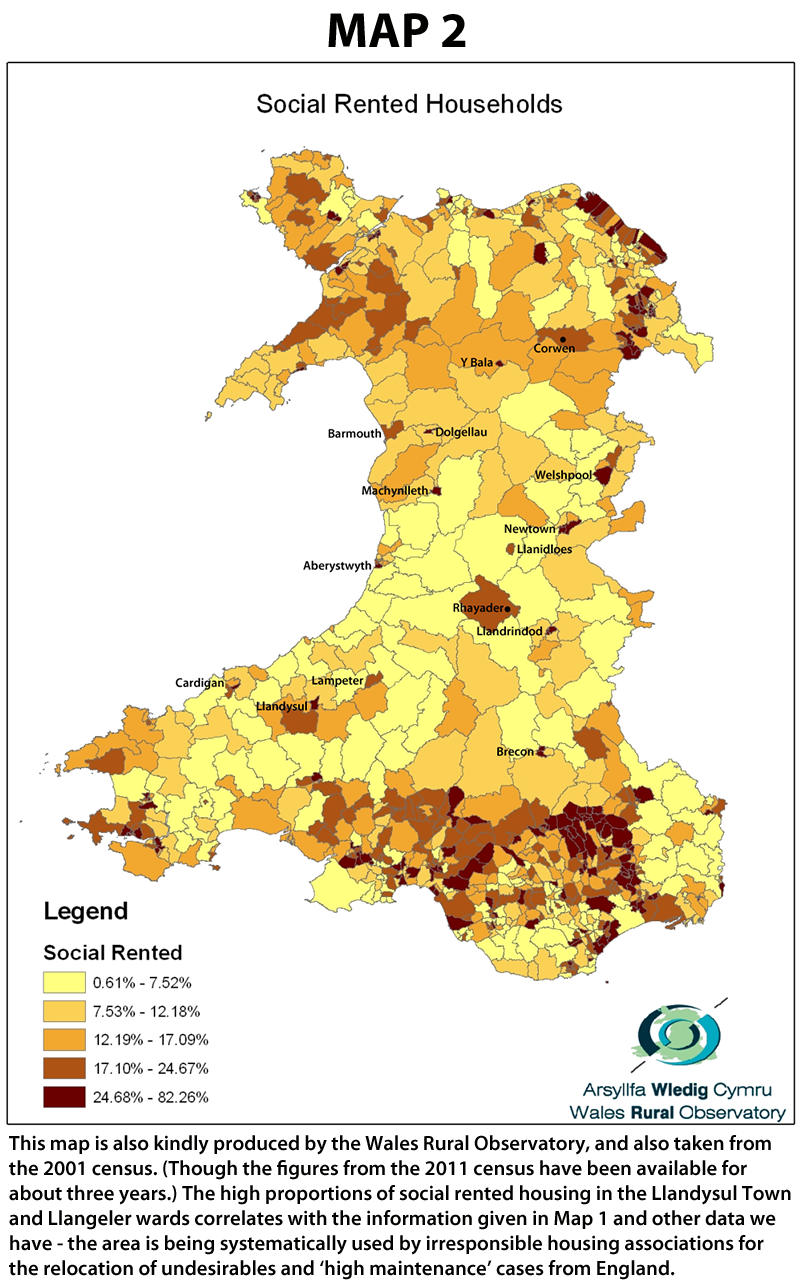
After interruptions and various distractions I’m finally pressing on with my Magnum Opus ‘The Colonisation of Wales’. One distraction has been the disturbing news received from a number of quarters about the Llandysul, Drefach and Dre-Fach Felindre area of Dyffryn Teifi. It seems that this area, straddling the boundary between Carmarthenshire and Ceredigion, is a hotspot for the importation of non-working and elderly populations, by both private landlords and Registered Social Landlords (RSLs).

Llandysul non-working
CLICK TO ENLARGE

I’m hearing of ex-council properties being turned into flats, and these then being rented to drug addicts and others brought in from over the border. I’m hearing of people who bought their council house being pestered by ‘investors’ and housing associations to sell to them. I’m hearing of an estate in Llandysul owned by Tai Ceredigion where most of the tenants, originally from Birmingham and Liverpool, are almost all of the non-working and / or long-term ‘sick’ variety. Yet Tai Ceredigion plans to extend this estate by adding 50 more houses!

Which means that Tai Ceredigion expects the rest of us to pay – through the Social Housing Grant and other ‘Welsh’ Government funding – for new properties for which there is clearly no local demand. And once they’ve arrived, then we shall be expected to pay housing benefit for those Tai Ceredigion will import to fill the 50 new properties.

Other reports talk of an influx of Londoners and Brummies into Dre-Fach Felindre. While nearby, at Waungilwen, there are bungalows for elderly and disabled people, a disproportionate number of which are now occupied by other recent arrivals from England, some of whom don’t seem too sure where they are! When canvassed for the general election one response was, “Is it Labour or Conservative round here?” So who is bringing into Wales people that can only be a burden on the NHS and other services? And do the housing associations (and private landlords) responsible pass on to the NHS and other providers part of the extra funding they get for taking in people with ‘problems’?

Another angle I’d like to explore is the possible relationship between private landlords and RSLs. Because it has been suggested to me that a relationship exists, with private landlords taking in dubious and undesirable tenants with the guarantee that such tenants will soon be re-housed by a local housing association. This system leads to certain privately-owned properties operating a revolving-door system of tenants changing every few weeks. (One advantage here being that, with such people already having an address in the area, an RSL can claim it’s housing ‘locals’.) So any info on links between private landlords and RSLs would be welcome.

Another aspect to the wider racket much-needed work being done is the re-housing of the ‘homeless’. I hear of a large terraced house in Aberteifi (Cardigan) owned by Cantref. A steady flow of ‘homeless’ individuals and families pass through this property before, presumably, being housed elsewhere by Cantref. What these people have in common is that none of them is Welsh. Nor were any of them ever homeless in Wales. So why is a Welsh housing association using our money, yours and mine, to house people who became homeless in England?

Llandysul Social Rented Housing with towns -1
CLICK TO ENLARGE

The RSLs involved in Dyffryn Teifi are, in addition to Tai Ceredigion, Cantref (formerly Tai Cantref) and, possibly, our old friends Gwalia, responsible for inflicting the Kidwelly Paedophile Gang on Wales. Given that I already have such good information on Dyffryn Teifi I plan to use it as an example of the wider problem to be found across rural and coastal Wales. A problem that makes it clear there is no shortage of social housing, in fact, in most areas there is an oversupply – so why is the ‘Welsh’ Government funding housing associations and others to build yet more properties for which there is clearly no local demand?

The only answer is that the ‘Welsh’ Government is deliberately funding, from the stretched budget of a poor country, the colonisation of that country. There can be no other explanation for what would otherwise be economic illiteracy. With one result being that Dyffryn Teifi, an area that until very recently was overwhelmingly Welsh in language and sentiment, is being rapidly anglicised.

So I appeal to everyone reading this for more information on the rented and social housing sector in Dyffryn Teifi. I want to know which housing associations are involved and which properties they own. I would also like specific addresses for the privately rented properties – particularly former council houses now converted into flats – in the hope that I can find out who owns them. I would also be interested in hearing from locals who might have experienced difficulty in securing social housing.

Finally, I appeal to those working for housing associations, in Dyffryn Teifi and elsewhere in our rural and coastal areas. You know how your employer operates, you should therefore realise that this lunacy cannot continue. Sooner or later the ‘Welsh’ Government will have to pull the funding plug on a system that sees housing associations wasting tens of millions of pounds every year bringing into Wales the kind of people that would have doors slammed in their faces if they tried to move anywhere else.

They’ve had a good run but time is running out for housing associations. So think ahead, and think of yourself; a few years from now having ‘————- Housing Association’ on your CV may not do you any favours. Write in confidence to editor@jacothenorth.net.

The Family Malik and the Lynks that Bind it to the Labour Party

I AM INDEBTED TO ‘STAN’ OF THE NEATH FERRET FOR HELP IN WRITING THIS PIECE

The name Malik will be familiar to regular readers of this blog if only because of Naz Malik, former boss of race relations charity and Labour agitprop outfit the All Wales Ethnic Minority Association (AWEMA). I have written about Naz Malik more than once, so to refresh your memorNaz Malik rugby fanies you might care to work back from this post of September 8th, 2014, published shortly after the end of Malik’s trial.

One of the major issues exposed by the AWEMA scandal was that of nepotism, though of course this is no crime. Indeed, it’s the cornerstone of the family business; but beyond that sphere the favouring of relatives will be judged on the company’s performance, and investors or shareholders will demand changes in the management if it is felt that nepotism is responsible for declining performance and falling profits. Yet in a publicly-funded body, where the money just keeps rolling in, and with no criteria by which to judge performance, it becomes almost inevitable that nepotism will flourish unchecked.

Nepotism goes some way to explaining what went wrong with AWEMA. At CEO was Naz Malik; then there was daughter Tegwen, whose salary shot up from £20,469 in January 2008 to £50,052 in August 2011 for no apparent reason; while another who worked for AWEMA was Naz Malik’s daughter-in-law Ourania Chatsiou who, along with her sister-in-law, was, bizarrely, among the creditors when the funding plug was pulled early in 2012. Though the major creditor, the ‘Welsh’ Government, recently wrote off most of the £300,000 it was still owed by AWEMA. Naz Malik’s wife, Bronwen, and son, Gwion Iqbal, were also involved with AWEMA, as ‘volunteers’.

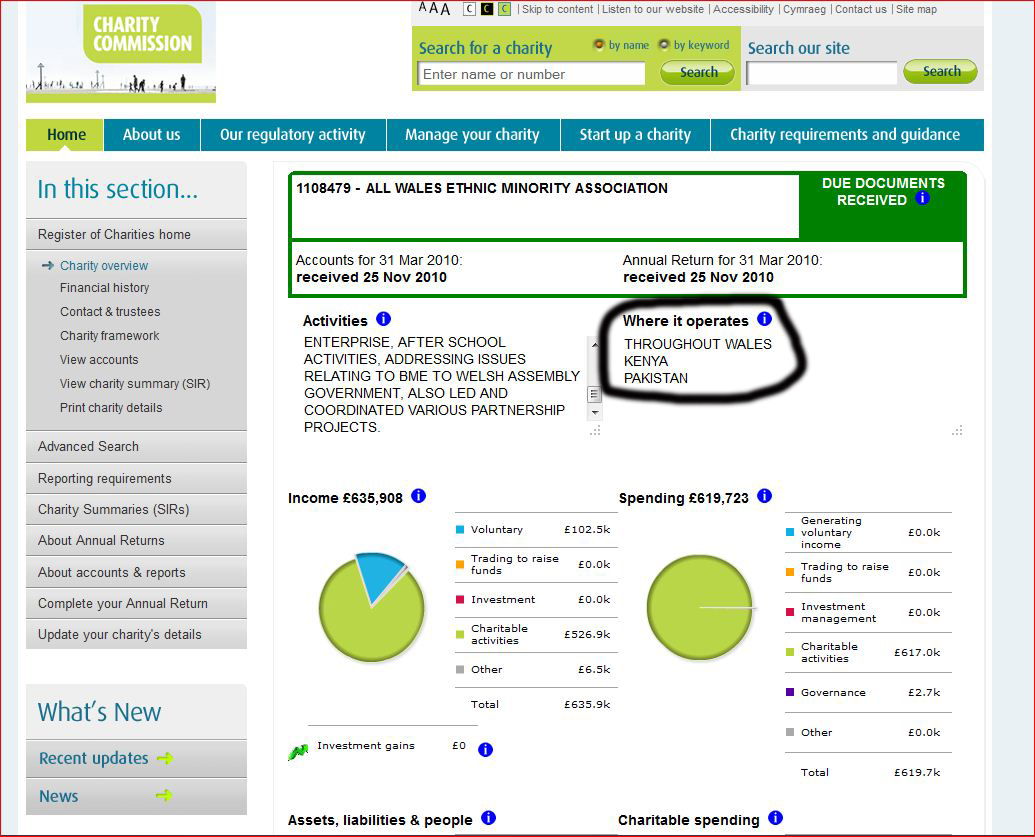
AWEMA Charity Commission
CLICK TO ENLARGE

Another thread in the AWEMA saga is the Malik family links to the Labour Party. The patriarch himself had entertained hopes of standing for the party, and could be relied on to use the public profile he’d gained from Labour-funded AWEMA to regularly attack ‘racist’ Welsh nationalists. The aforementioned scion of the House, Gwion Iqbal, stood for the party in the elections to the Notional Assembly of 2011. (There used to be a photo available on the internet of Gwion Iqbal canvassing with First Minister Carwyn Jones, but unsurprisingly it seems to have disappeared.)

Something else that always troubled me about AWEMA was the bland statement made on the Charity Commission website that, in addition to operating in Wales, AWEMA had a presence in Kenya and Pakistan! Remember, we were dealing here with EU and UK money allocated to Wales, and yet no one thought to question why AWEMA claimed to be using that money overseas. One answer of course is that Naz Malik had been born in Nairobi to parents of Pakistani, or pre-Partition Indian, heritage. As had Naz Malik’s sister, Fahro. Or rather, that explains the family’s background; while the lack of concern in official quarters can probably be explained by the Labour Party connection.

*

I first became aware of Fahro Malik when I saw a link to a charity called Lynk Reach Ltd (Charity No: 1104188) on the AWEMA website. (Lynk Reach Ltd was removed from the Charity Commission Register on January 14th this year.) Its charitable objective was “To advance the education of children and young people 0 – 25 (sic), primarily but not exclusively in London”. There was also a company called Lynk Reach Ltd (Company No: 04678217) Incorporated on the 25th of February 2003. Strangely, FaFahro Malikhro Malik seems not to have been a director of this company, though among the founders was an Anthony Malcolm Finch, a headmaster, who was Fahro Malik’s husband. Finch wrote an internet restaurant guide and died suddenly in February 2007. Someone who joined the company later was Zoe Samia Malik-Kemp. Lynk Reach Ltd is now dissolved.

A connected company was Lynk Ray Ltd (Company No: 04261595) which pre-dates Lynk Reach Ltd, having been Incorporated on July 30th 2001. The founding directors were Anthony Malcolm Finch and Fahro Malik. This company is also dissolved. Finally, we have Lynk Write Ltd, Incorporated June 19th 2003 (Company No: 04804457). The only two directors were Fahro Malik and Anthony Malcolm Finch. This company is also dissolved. The most recent mention I can find for Fahro Malik is on the London Writers’ Café website, from where the photograph comes.

Fahro Malik has escaped the notoriety of brother Naz and the Swansea branch of the clan, but still leaves behind a failed charity and dissolved companies owing money to some poor bugger. Fahro may also regret involving her other brother, Munir, with Lynk Ray Ltd as a director and company secretary from August 3rd, 2007 until the company dissolved, probably towards the end of June, 2013. That’s right, another brother, of whose existence I was unaware until it was brought to my attention by Stan of Neath Ferret. So what’s Munir’s story?

*

Munir Malik is another Labour Party stalwart, and has served a couple of non-consecutive terms as a councillor in Bexley, south east London . . . though since his brush with fame he has been deselected from his Thamesmead East ward. To explain . . .

In addition to the Labour Party, for which he also stood as a candidate in the London region Euro elections of 1999 and 2004, Munir Malik was involved with the Co-op Group, serving as a regional representative before being elevated to the National Board. His wife, Kathryn Smith, another Labour councillor in Bexley, was herself on the National Board of the Co-op Group from 1997 to 2008 and on the Board of the Co-op Bank from 2001 to 2009, where she worked with Paul Flowers, the drug-taking Methodist minister and former Co-op Bank chairman. (Also known as ‘the Crystal Methodist’.) Kathryn Smith left the Co-op Bank in 2009 to stand as Labour & Co-operative candidate for Gravesham in the 2010 General Election. A Munir Malikseat that the Tories had won in 2005 by just 654 votes became a safe Tory seat in 2010, with a majority of 9,312. Labour’s loss of votes may have been connected with Smith being done for drunk driving just days before the poll.

Misfortune continued to dog the Malik-Smith household when Munir Malik was forced to resign from the Co-operative Group Board for telling fibs about his qualifications. To be specific, when running for election to the Board he claimed to be a chartered accountant  . . . ‘Oh no he’s not!’ said the Institute of Chartered Accountants in England and Wales, ‘and only members of the ICAEW are allowed to call themselves chartered accountants’. Munir sought to explain away this little inconsistency by arguing that what he meant to say was that he had been a chartered accountant . . . until he was struck off for bankruptcy in 1991, and had simply forgotten to prefix his qualification with ‘former’. Something of a habit, apparently, for the ICAEW claimed to have previously warned him to stop claiming to be a chartered accountant. Though Malik countered with: “All my working life has been spent as a former chartered accountant”. Um, yes . . . exactly!

All so predictable, and familiar, for as this Daily Mail piece on the Malik / Flowers fiasco puts it, “Malik belongs to what one insider described as a closed group who have come to dominate the Co-op despite its democratic structure of elected boards” and later, “Former City Minister Lord Myners was appointed to assess the Co-op Group’s system of elections and appointments. He resigned last week in the face of bitter resistance from board members but plans to complete his review”. Sound familiar? Of course it does, for this is another dysfunctional and undemocratic element of the great ‘Labour Movement’, another that preaches democracy but has never seen any need to practice it, especially for its internal procedures. We could be talking here about ‘Welsh’ Labour . . . and we soon will be!

*

Piercy Lane
CLICK TO ENLARGE

So where are they now? Well, it seems that the Malik womenfolk have retreated to academia and scholarly pursuits. Fahro Malik, as she told the London Writers’ Café website, is probably researching the family’s journey from the Punjab village of Rohtas via Kenya to Wales and England. Tegwen Malik, Naz’s daughter, is carrying out research in biomimetics (don’t ask me!) at Swansea University, while Naz’s daughter-in-law, Ourania Chatsiou, is also at Swansea Uni, doing post-graduate work. Which serves to remind us, yet again, of the close links between the Labour Party and higher education in Wales, and the mutual back-scratching.

Some of you reading this may be ‘uncomfortable’ with the fact that so many of those dealt with belong to ethnic minorities. Get over it! I’m writing about the Maliks not because of their race, colour or religion but because a) they’ve done wrong, b) they all seem to have Labour Party connections, c) despite the shit they get themselves into, they seem to come up smelling of roses, which, d) allows me to expose, yet again, the squalid relationships between the Labour Party, the Third Sector, academe and other spheres of our national life.

So you mustn’t think that nepotism is confined to persons of Pakistani origin from East Africa, no, no, no, no, no. This is a Labour Party problem, something encountered wherever Labour has power and, more importantly, where Labour has control over funding. For we don’t need to leave Swansea Bay to find celebrated current examples of nepotism encouraged or condoned by ‘Welsh’ Labour where the principals are all of impeccably white and Christian backgrounds.

Let us return to Swansea University, and this time the School of Management. There, the Dean, one Nigel F. Piercy, has appointed his son Niall as Pro-Dean for Research, and his love interest, Nikala Lane, as a Reader in Marketing and Strategy. Partly as a result of this blatant nepotism, and partly by being a bit of an arsehole, Piercy has contrived to alienate just about everybody he is supposed to be working with. Yet his position seems secure.Stephen Kinnock

From the Mumbles Road campus one can look across the bay to Port Talbot where, on May 7th, the electors of the Aberavon constituency will be expected to put on their blinkers, empty their minds, and troop like zombies into the polling stations, there they will grasp the stubby brown pencil on a string and come momentarily to life when they see on the ballot paper the magic name KINNOCK. Tears of gratitude will flow as they recall how young Stephen was not parachuted in – as malcontents allege – but walked all the way from his Copenhagen home to vie for the honour of representing Aberavon (‘it is Aberavon, is it?’) and was chosen only after an open and keenly-contested selection process that lasted months.

Because, boys and girls, that’s how the Labour Party operates, and don’t let anybody tell you different. The Labour Party is, to the best interests of Wales . . . what the Ku Klux Klan is to good race relations, what Japanese cuisine is to whales, what the conquistadors were to the civilisations of Mesoamerica, what the iceberg was to the Titanic, what the driving maul is to modern rugby, what the CIA is to privacy, what Rhyl is to Welsh cultural identity, what the Sinclair C5 was to motoring, what China is to Tibet . . . In short, a disaster.

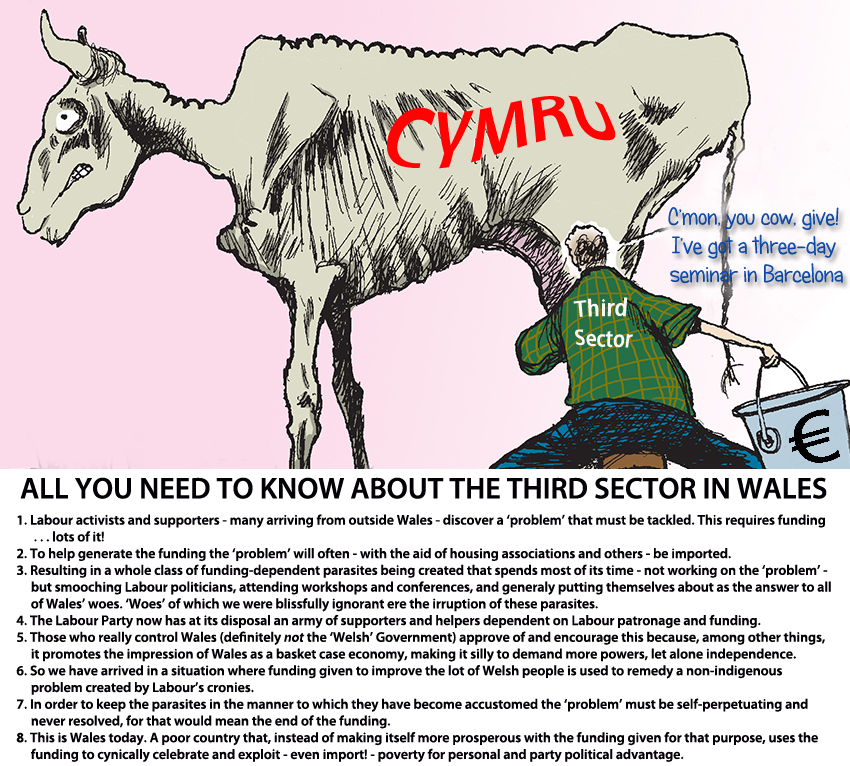
‘Welsh’ Labour And A Milking System Unknown To Farmers

Cash cow 1
CLICK TO ENLARGE

The ‘milking’ referred to is done by the Third Sector, that demi-monde wherein dwell ‘Welsh’ Labour’s kept women (and a few men), serving no purpose beyond diverting public money from better use and performing all manner of despicable acts for those who own them. Perhaps it was ever thus, but since the arrival of devolution, and the recognition by our continental cousins of our relative poverty, what had once been a cottage industry of home-grown Labour nepotism and corruption has expanded into a pseudo-economy.

A few years back I started looking into the Third Sector and its relationship with ‘Welsh’ Labour, and in that time certain features have become obvious. Chief among them, that we now have a whole sector of Welsh life dependent upon Labour Party patronage in the form of funding and preferment, which those belonging to this sector repay by promoting the Labour message and by attacking Labour’s political opponents. This client class has become the Japanese knotweed of Welsh life – invasive, destructive, of no use to anyone (other than Labour), and damaging to the wider environment. We should be rooting it out, but it won’t be done because ‘Welsh’ Labour, losing support among the native electorate, is becoming ever more dependent on this monster it has introduced.

One obvious manifestation of Labour losing support is its inability to recruit decent Welsh candidates. It was this problem that led to the recent fiasco in Swansea when the ‘local’ Labour Party was eventually taken over by people who were strangers to the city. Resulting in the embarrassment of Il Duce Phillips and the student councillors, with their sybaritic lifestyles and complete ignorance of the city they were supposed to be running. A self-inflicted wound caused by Labour offering free party membership to students in Swansea University. Yes, that’s how bad it has become for Labour. Something else illustrated by this episode is Labour’s worrying links with certain trade unions, the National Union of Students being one, but another worthy of mention is Unison.

*

Now when I were nobutalad – a long time ago I know – trade unions were taken seriously by working class men such as those among whom I grew up. They elected their union representatives, they knew them, and if there was any issue that needed to be discussed then they could have it out with them, at union meetings or even down the pub or club. It was the trade unions, more than anything else, including the Labour Party, that defended their interests. All that is gone. After countless mergers and a dramatic fall in union membership we are left with a few big unions run by professional union officials, mirroring the professional politicians, all equally divorced from real life.Dawn Bowden

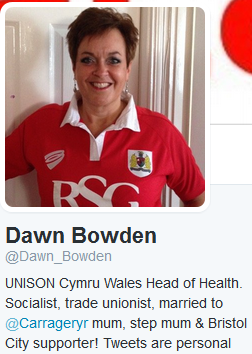
As mentioned, one such union is Unison, and one of its full-time officials is Dawn Bowden of Bristol Cardiff, who is tipped to become Labour’s candidate for Caerffili or Islwyn (depending on whether there’s a gender fix) in next year’s elections to the Notional Assembly. Quite how long she’s lived in Wales is uncertain, but she’s loyal to the Labour Party and belongs to that union which is almost ‘Welsh’ Labour by Eaglestoneanother name, so that’s her elevation assured.

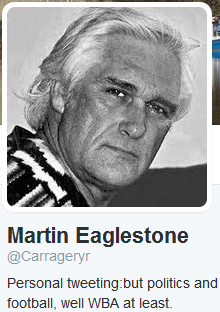
Her Twitter account says that she is married to @Carrageryr, so who might that be? Well, it’s another Labour Party star named Martin Eaglestone, perennial Labour loser in Arfon. (Eaglestone, Carrageryr, geddit?) Though in past elections he was living with his wife and five children in Y Felinheli. (I blame all these conferences they go to, and the drinking.) Eaglestone’s Linkedin profile describes him as, “Welsh Policy Officer at Labour Party – Welsh Labour”, whatever that means. He supports West Bromwich Albion while Bowden supports Brizzle City, so neither knows much about football.

I single out Unison because this seems to be the union of choice for many Labour politicians in Wales, even those, like Swansea’s student councillors, who’ve never done a day’s work in their lives. In many ways Unison operates (certainly in Wales) as an adjunct to the Labour Party rather than as a trade union in the traditional sense. Maybe Labour’s political opponents should have a new slogan – ‘Vote Labour, get Unison!’. Though the problem is also found in England, with other unions.

*

Returning to the Third Sector, in my delvings a number of things have become apparent, but one that I feel needs to be highlighted is the practice of publicly-funded bodies setting up wholly-owned subsidiaries, for reasons that are not entirely clear, or may even be of dubious probity.

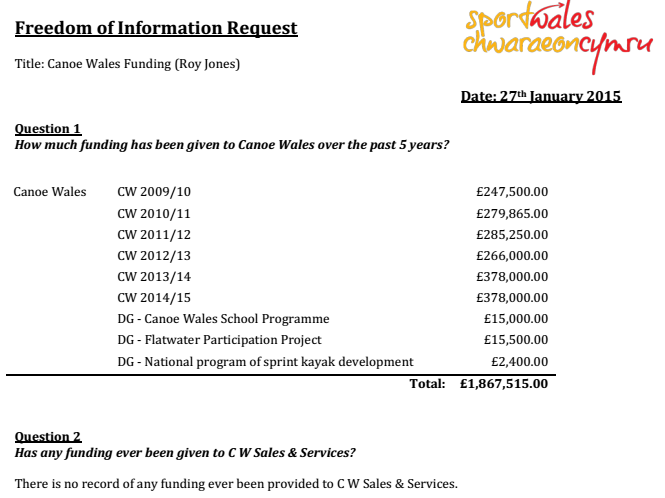
In recent posts I have looked at Canoe Wales, and the extraordinary level of funding that body receives from Sport Wales, £378,000+ in the current financial year alone (see panel below). Yet Canoe Wales has two subsidiaries, C W Sales and Services Ltd and Canoe Wales (Commercial) Ltd. The first of these subsidiaries runs the adult playground at Frongoch, near Bala, while the other is dormant. The representative of Canoe Wales that I spoke with assured me that Canoe Wales’s finances would soon start to improve, and I’m sure he’s right, for seeing as the running of the Frongoch Centre has passed to the subsidiary and Canoe Wales is so well funded it would be strange if Canoe Wales’s books didn’t begin to look healthier. The Canoe Wales representative also told me that his organisation had passed all the auditor’s checks. Which, again, I don’t doubt; but I guarantee that the Wales Audit Office does not look into subsidiaries, for the very simple reason that these do not – directly – receive any public funding.

consolidated accounts

Allowing publicly-funded bodies to form subsidiaries creates the temptation for an organisation to transfer ‘bad news’ to a subsidiary, safe in the knowledge that the WAO will not investigate the subsidiary. I’m not for one minute suggesting that this is what has recently happened with Canoe Wales, but C W Sales and Services Ltd is not in a healthy financial state. If C W Sales and Services Ltd did not exist then its indebtedness of £76,798 would be shown against Canoe Wales, and would be picked up by auditors.

That said, it could be that funders are aware of such arrangements. Staying with Canoe Wales, its accounts for year ending March 31 2013 state that “As at 1st April 2013, commercial trading activities and the operation of the White Water Centre at Canolfan Tryweryn were transferred to C W Sales and Services Limited, a wholly owned subsidiary.” Yet despite this burden being lifted Canoe Wales’ funding from Sport Sport Wales fundingWales leapt from £266,000 in 2012/13 to £378,000 in 2013/14 and 2014/15 (click to enlarge). How do we explain this unless Sport Wales is aware of, and approves the use of, a subsidiary that may be beyond the remit of the Wales Audit Office and will – as the clip above reveals – not be mentioned in future Canoe Wales accounts?

As I say, it’s a phenomenon I have observed regularly in my investigation of how public funding is dished out in Wales. Here’s another example, with a further twist. This example is Carmarthenshire Heritage Regeneration Trust / Ymddiriedolaeth Adfywio Treftadaeth Sir Gaerfyrddin, according to its website, but Ymddiriedolaeth Atgyfnerthu Treftadaeth Sir Gaerfyrddin on the websites of both the Charity Commission and Companies House. Confusing. Maybe deliberately so. Is this a laudable use of yr hen iaith or an attempt to hinder investigation into a body universally known as the Carmarthenshire Heritage Regeneration Trust?

Either way, the Trust has a subsidiary, deep in the red, called CHRT Ventures Ltd. Now for the ‘twist’ I referred to earlier. The chief executive of the Trust is Claire Deacon, and the Trust’s 2012 accounts say this:  “During the year, Ymddiriedolaeth Atgyfnerthu Treftadaeath Sir Gar (CHRT) employed the services of Ms Claire Deacon, CEO, a historic building consultant. The total expenses paid by CHRT for consultancy was £59,159 (2012: £41,873). At the year end, CHRT owed Ms Claire Deacon £9,436 (2012: £3,386). This balance is included in trade creditors”. How the hell can an employee suddenly declare herself a consultant to the body she works for and then demand more than she would have been paid in salary? The full story of Ymddiriedolaeth Atgyfnerthu Treftadaeth Sir Gaerfyrddin, and more, can be found here

Here’s another example, this one from the fleece jacket sector. The issue of public funding and subsidiaries, with the added problem of Welsh public funding seeping across the border, even extends into academe, as this post explains. And how could anyone forget Naz Malik and Awema? Let us remember that the Malik family was staunch Labour, with father and son hoping to be Labour candidates. To help their cause Naz Malik would regularly sing for his supper by proclaiming against ‘racist (Welsh) nationalists’. And what the hell is happening at the YMCA? Then there’s housing associations. We are told by the ‘Welsh’ Government that 22 local authorities is far too many, too expensive, and so there must be ‘streamlining’ – so why is that same ‘Welsh’ Government funding dozens and dozens of housing associations that compete with each and duplicate each other’s work? The answer is that housing associations are stuffed with Labour supporters (and future candidates). Read about it here.

*

There are countless other examples of Third Sector bodies, publicly-funded agencies, etc., ‘diversifying’, or setting up subsidiaries and ‘trading arms’ into which ’embarrassments’ can be diverted, beyond the scope of auditors mandated only to check the recipient body itself. Though what happens if one of these subsidiaries actually makes a profit, will the profit be declared to the funding body?

This loophole is known to those disbursing the funding and is almost certainly familiar to those entrusted with ensuring that the funding can be properly accounted for. Which raises the question, why is this loophole not closed? The suspicion must be that it’s left Eaglestone Linkedinopen in order to help hide some of the public funding being wasted by the Third Sector. Because to expose this waste would damage both the Third Sector and the Labour Party, and they need each other, their fortunes and their futures are intertwined.

We have on our hands a sick man called the ‘Welsh’ Labour Party or, if we go by Eaglestone’s Linkedin profile, “Labour Party – Welsh Labour”. (Perhaps the ‘Welsh’ Labour Party is as much a fiction as the ‘Wales Green Party’.) This party is no longer able to find decent candidates from within the nation so it has to rely on recruiting officials imported by its trade union partners and those who have swarmed here to make careers for themselves out of celebrating and exaggerating Wales’ deprivation in order to get their sweaty paws on the money that has been given to alleviate that deprivation.

The Labour Party, with all its hangers-on and cronies, is suffocating Wales. Unpatriotic, anti-initiative, increasingly dependent for its survival on people who don’t know Wales and don’t care about Wales, it can only maintain its position because there is no other party electors find more attractive. Which is why I repeat that Plaid Cymru has fifteen months (the General Election of May 2015 and the Assembly elections of May 2016) to prove that it can mount a serious challenge to Labour; if it fails, yet again, then we must have a new nationalist party, a party that puts Wales and Welsh people first, rather than one that constantly exposes its weaknesses and lack of ambition by looking to do deals with anti-Welsh parties. Fifteen months.

Canoe Wales 3: Paddling One’s Own Canoe. Not

Last month I wrote a couple of pieces about Canoe Wales and the National White Water Centre on Afon Tryweryn at Frongoch, near Bala. First here and then with the follow-up here. Unfortunately, while writing these pieces Companies House had not made the most recent accounts available to the general public. Though I was assured by the affable and helpful Mark Williamson – who phoned me after the publication of the first piece – that the latest accounts for Canoe Wales credit reportCanoe Wales would show an improvement. For he had been brought in for that very purpose. And someone was certainly needed, because Canoe Wales was shedding auditors at an alarming rate and the most recent to depart had expressed concerns as to whether CW was a viable concern.

Talking of the National White Water Centre, Mr Williamson stressed that this venue now has nothing to do with Canoe Wales; a company called C W Sales and Services Ltd runs the Centre, which seems to be little more than an outdoor playground for adults, offering rafting, quad bike off-roading, clay pigeon shooting, bungee jumping and similar activities. While Canoe Wales goes back to 1990, C W Sales and Services was Incorporated as recently as November 7, 2012 . . . and is wholly owned by Canoe Wales.

So, now that I’ve got the latest (abbreviated) accounts, what do they show? For Canoe Wales, the parent company, the picture does indeed look a little brighter . . . but only a little. Net assets, which stood at -£22,950 on March 31, 2013, had improved to -£20,313 on March 31, 2014. Perhaps the figure would have been worse had it not been for two of the directors lending Canoe Wales £55,000. Though this may be explained by not taking out money owed rather than by putting money in. (Diolch, Dewi.) The March 31, 2014 accounts for C W Sales and Services Ltd show net assets of -£76,798 (there is of course no previous figure), which means that Canoe Wales’s net assets should be read as -£97,111, though Canoe Wales chose not to do this.

consolidated accounts

As that extract from the accounts puts it, “the parent of a group”, for there is yet another ‘child’, Canoe Wales (Commercial) Ltd. This company was also formed in November 2012, and the accounts for year ending March 31, 2014 shown it as a dormant company with a share issue of £1. It, too, is wholly owned by Canoe Wales. I suppose the question has to be, why form another company in addition to Canoe Wales and C W Sales and Services Ltd; what role is envisioned for Canoe Wales (Commercial) Ltd? Canoe Wales and its two subsidiaries have their addresses as ‘Canolfan Tryweryn Frongoch’. Canoe Wales (Commercial) Ltd and C W Sales and Services Ltd each have just two directors, David William Wakeling and Andrew Jeremy Booth, both of whom are also directors of Canoe Wales.

While the reason for setting up Canoe Wales (Commercial) Ltd may be unknown, it could be that C W Sales and Services Ltd was set up to run the White Water Centre because it would be difficult to justify using Welsh public funding to subsidise an IT department from Birmingham having an alcohol-fuelled weekend of farting about in the Welsh countryside.

Which brings me to the issue of public funding, for at the time of writing the original pieces I had yet to receive a reply from Sport Wales to my Freedom of Information request. I now have those figures, see below. You will note that between 2009/10 and 2014 /15 the Sport Wales grant to Canoe Wales rose from £247,500 to £378,000. Or to put it another way, during the worst financial crisis in living memory, when Wales is experiencing cutbacks across the board, someone saw fit to increase funding to a bunch of paddlers by some 53%! How did no Welsh politician pick up on this?

Sport Wales funding

So what is the justification for this extravagance? Because we can be sure that this funding creates very few (if any) jobs for Welsh people. And why is Sport Wales putting so much money into canoeing while cutting back funding on grass-roots sport with much more Welsh participation? Especially when we know that canoeing attracts some very unsavoury colonialist types who go out of their way to seek confrontation with Welsh anglers by demanding unrestricted access to all Welsh rivers and lakes?

And here’s a question for the ‘Welsh’ Government. How can you justify bumping up, year on year, funding for an activity offering little tangible benefit to the people you claim to represent – and nothing they couldn’t do without until economic conditions improve – while cutting back on funding for food banks? What order of priorities does this exhibit? Or is it ‘window-dressing’, an attempt to hide the truth of contemporary Wales? Then there’s the funding cut to young Welsh farmers, yet another attack on our farming community . . . to clear the land for the fleece jacket invaders such as those attaching to Canoe Wales?

So many questions about canoeing in Wales. Time, surely, for our politicians to insist on answers to a few pertinent questions: 1. Which outfit is responsible for which debts, and will publicly-funded Canoe Wales pick up the tab if the Frongoch Centre – run by its subsidiary, C W Sales and Services Ltd – sinks? 2. What is the point or purpose of Canoe Wales (Commercial) Ltd? 3. Given that so much public money is involved is anyone concerned that ‘parent’ and subsidiaries are run by the same two men? 4. For an organisation in receipt of public funding on this scale to be in debt to the tune of almost £100,000 is very worrying, so who is monitoring the situation on our behalf? 5. Finally, and fundamentally, how can anyone justify giving £378,000 a year to Canoe Wales?

UPDATE 14.02.2015: Something else I should have mentioned is the sinking of a previous subsidiary, Rescue 3 (UK) Ltd, written off in the 2013 accounts for £50,000, which may or may not account for the ‘loans’. Though ‘written off investments’ in the 2013 accounts totalled £69,742, the remainder described as ‘intercompany balance’.

I Must Be Doing Something Right!

I had hoped to have a few days off after posting my previous piece but would you believe it – Wales Eye is having a pop at me again, this time helped by the Wasting Mule. It began – though I had no way of knowing it at the time – with a Twitter message from Martin Shipton on Monday about the link at the top of my sidebar, to which I replied. See the exchange for yourself below.

Shipton request combined

I thought no more of it until yesterday morning when I was alerted to the fact that there was a piece about me on the WalesOnline website, though the article was soon ‘pulled’. Fortunately it’s available here in pdf format. Despite what I’d told Fat Boy, he begins his piece thus: “The Wales Eye news website discloses that the Jac O’the North (sic) blog has been reported to South Wales Police after launching a petition”. Why write that when he knew I had not launched any petition? A few tweets Exchange with Shipton 1were exchanged yesterday, you can see them on the left where they appear in chronological order. (Click to enlarge.) A revealing phrase, “predominant language”.

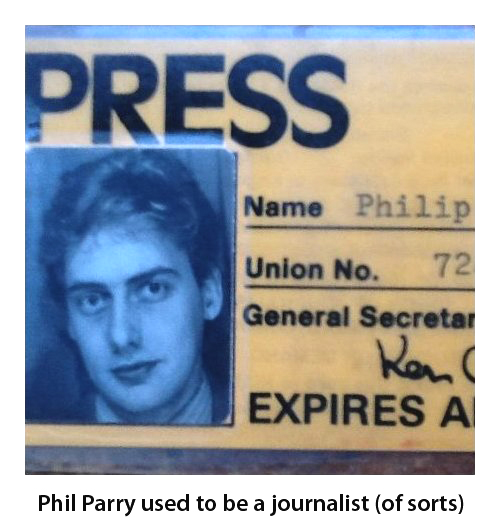
Anyway, the origin of this ‘story’ was obviously Phil Parry over at Wales Eye. Regular readers will know that I’ve had a run-in with Wales Eye over infamous bigot Jacques Protic and him (allegedly) reporting me to North Wales Police. All the relevant information and links are available in my recent post Seeking a Latter-day Waldorf T. Flywheel. I assume Parry has been kicking cats and plotting his revenge since that piece appeared on January 19th. So what exactly was Parry saying? Seeing as the Wales Eye blog hides behind a pay wall, and to save you wasting your money, the article is available here in pdf format.

                        *

The opening paragraph, which contains the essence of the ‘story’, says: “A website which urges a policy of Welsh homes only for Welsh people has been reported to the police for inciting racial hatred, Wales Eye can reveal”. It goes on to say that “an investigation was undertaken by a police constable and inspector” of South Wales Police. The rest of the piece is rehashed nonsense about Protic and old comments taken out of context. Let us focus on this first paragraph.

Obviously, seeing as it’s not my petition, my website is not “urging” anything, I merely offer visitors to my blog the chance to sign a petition I support, and which I have signed. The petition does not argue for “Welsh homes only for Welsh people”, it merely says that Welsh people should have social housing that has been paid for with Welsh public funding . . . is there an objection to that? Now, moving on to “racial hatred”. The only nation mentioned in the petition is the Welsh, so whoever is making this mischief is reading something into the petition that isn’t there.

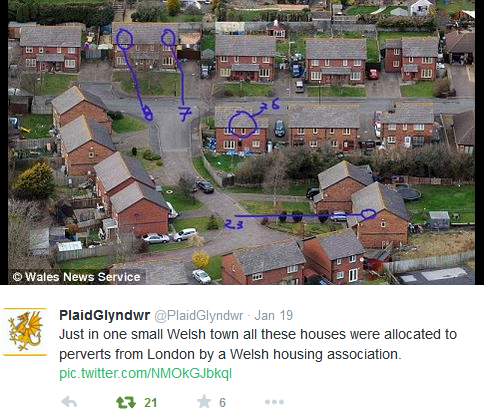
Elsewhere in the Wales Eye piece there is a graphic of some houses in Kidwelly explained by, “In another post, endorsed by the blog with a re-tweet, families from London who took houses from a Welsh housing association were called ‘perverts'”. WalesOnline says it this way: “In another Twitter posting, re-tweeted by the blog, families from London who took houses from a Welsh housing association were called “perverts”. An aerial picture singles out a number of homes and the tweet says: “Just in one small Welsh town all these houses were allocated to perverts from London by a Welsh housing association.”

Note that this, like the petition, is something else that did not originate with me. Parry is getting pretty desperate now, so here’s the truth. The case referred to is one of a paedophile gang living Dennis' Kidwelly tweetin Kidwelly that was imprisoned in 2011. Here’s a report on the case from the Daily Mail. Here’s a blog post I wrote around the same time. At the risk of frightening Parry and Shipton with facts, here they are: These people had moved – or been moved – from London; they were housed in Kidwelly by a Welsh housing association (Grwp Gwalia); they were all found guilty of paedophilia and other sexual perversions in a court of law. So what is the issue here? The caption to the picture in the tweet is 100% correct. Parry seems to take offence because the tweet calls them “perverts” – so what would he call them, the perfect neighbours? Or maybe he doesn’t like the fact that it was re-tweeted 21 times.

The reason Parry uses this case – which he obviously hasn’t researched – is because it concerns Welsh social housing being given to English people who are labelled “perverts”; which he hopes to use as an example of ‘racial hatred’ in order to confer something resembling credibility on his hysterical reaction to a perfectly reasonable petition. Trouble is, for Parry, that these people weren’t called “perverts” because they were English, they were called “perverts” because they were . . . you paying attention, Parry! Shipton! – PERVERTS.

Here’s an update on the case from last September. Note the English flag outside Colin Bately’s house – for he was a patriot! Complete with two rottweilers. Just think, Welsh housing associations are taking in people like this, knowing what they’re like, because this gang had Phil Parryconvictions before they moved to Wales.

Anyway, I don’t fancy wasting much more time on Parry and Shipton, I’ll just conclude with the final lines from Shipton’s contribution to this joint-venture into fantasy. He says: ‘”Mr Jones said: “Not my petition. I’m just promoting it for Plaid Glyndwr.” It is understood that South Wales Police will not forward the complaint about Mr Jones to the Crown Prosecution Service.’ This was obviously added after the piece had been written, otherwise he wouldn’t have started by saying I’d “launched” the petition. But it also raises other questions.

For example, seeing as Parry and his fat friend were in cahoots over this attemped smear, and the pretext was the ‘racist’ petition, why was I / my blog reported to the police when they both knew it was not my petition? Because even before my tweet to Fatso on Monday the most cursory check would have shown who actually launched the petition. Are these people really journalists!

“South Wales Police will not forward the complaint about Mr Jones to the Crown Prosecution Service”well, I am relieved; I feared I was bound for the Colonies! But will the police charge whoever made the complaint against me with wasting police time? Come to that, who did report me, for Wales Eye neglects to tell us. Now, I wonder . . .

 *

The truth is – as any perceptive reader will have guessed – these attacks on me have nothing to do with Protic or petitions, it’s an exercise in black propaganda, or to put it an another way, mud slinging. Done so that anyone Googling ‘Royston Jones’ or ‘Jac o’ the North’ in future will turn up crap like this by Parry and Tub O’Lard. And see that I have been reported to the police. Done to discredit me and, by extension, anything I write. So who’s behind it?

Well, my guess is that it can explained by what I write about. My usual targets are the Labour Party and the Third Sector, which is simply an extension of the Labour Party. It may be no coincidence that this latest attack from Wales Eye comes just days after the latest – possibly final – edition of Cambria magazine became available, which contains my article on housing associations, in which I ask why we have so many of them, and why these quasi-private companies receive so much public funding, and why so much of the money they’re given ends up over the border.

Another subject I’ve touched on recently is Canoe Wales and the National White Water Centre on Afon Tryweryn. Today I received the response from Sport Wales to an FoI I’d submitted about funding to Canoe Wales. Read it here. In a poor country where so much needs to be done, how can anyone justify wasting almost two million pounds in just five years on canoeing, an activity that has little or no Welsh involvement? (And there’s almost certainly public funding from other sources.) That’s how Wales is run today, but you aren’t supposed to know. Ask yourself, are you going to get the truth from the BBC, or ITV, or the Western Mail?

I know how corrupt this country is, and I’m beginning to understand just how much money is squandered year after year on a system of sham devolution designed to encourage colonisation and managed decline rather than make Wales a better country for those who belong here. That’s why I have enemies. Enemies so desperate to discredit me they’ll even use clowns like Parry and Shipton. What will they try next?

P.S. Don’t forget to sign the petition!

UPDATE: In the personal attack on me in his latest post Phil Parry refers back to the Jacques Protic case. I have covered most of the angles in this recent post. Parry seems to think he’s on a winner with this, and keeps bringing it up, almost showing off. What I’m saying can perhaps be explained by this extract.

Wales Eye NWP docs

The “inquiry” referred to is a North Wales Police investigation into me or my blog for nasty things it’s claimed I said about Jacques Protic. Reading the extract in the panel, a number of questions arise.

  • By what route did Phil Parry obtain internal police documents; did they come directly from the police, did they come from Protic, or from some third party?
  • As the officers involved in the “inquiry” were first named on Wales Eye on September 10th last, and North Wales Police was made aware of this in my letter received (and acknowledged) on September 17th, we must assume that NWP has no objection to the contents of confidential police documents being aired on a blog.
  • That being so, what is the relationship between Parry and the North Wales Police? Is he working for them, or are the police merely a conduit for some other agency?
  • Even if Parry has no relationship with North Wales Police, then we still need to know why NWP has allowed confidential documents, naming and embarrassing its officers, to be in the public domain for over four months.
  • I wonder what the police response would have been I’d got hold of internal police documents and splashed them on my blog?

I believe it’s time for a little honesty from those involved in this ongoing smear campaign against me.

Canoe Wales 2

By one of those delightful coincidences that brighten up our lives I was working yesterday on an update to the previous post, ‘White Water Up Shit Creek’, when I received a phone call from someone I’d mentioned in that piece. Mark Williamson and I then had a lengthy and interesting discussion. He even invited me over to the White Water Centre at Frongoch to see some of the wonderful things going on there . . . and promised not to drown me!

After giving the discussion a little thought I realised that an update would be no way to handle this development, and so I decided on a new post. Also, I decided there and then – impetuous devil that I am! – to give Mark Williamson a chance to respond to the points I had intended raising in the update. I had no idea how this was going to work out – or even if it would work out – but the promise had been made so I was prepared to give it a try. (In the end Mr Williamson decided not to take up my offer, but phoned on Friday morning to suggest a couple of changes.)

Such an offer would have been unique in the history of Jac o’ the North, and may never be repeated. So I don’t want Third Sector shysters, Labourites, white flight colons, BritNats, etc., etc., thinking that this courtesy will be extended to them, because it won’t – you are ever in my cross-hCanoeistairs.

Before proceeding there are a few things that need to be said, points that emerged from the discussion on Thursday that might help with the understanding of what follows.

1/ Mr Williamson was keen to stress again that the National White Water Centre at Frongoch is run by Canoe Wales Sales and Services Ltd not Canoe Wales . . . though Canoe Wales does have staff on site.

2/ Mr Williamson readily admitted that things had been handled badly in the past, but that this was why he’d been recruited – to clear up the mess. He assured me that an improvement in the finances would be observable in the most recent accounts, submitted towards the end of 2014 and not yet publicly available. While the accounts for year ending March 31st, 2015 would be even better.

3/ When I raised the question of why the Centre’s website is ukrafting.co.uk Mr Williamson admitted that that’s mainly what happens there, it’s used for the purposes I mentioned in the post. Though this was qualified by telling me that Canoe Wales runs lots of courses – using the Sport Wales funding – at other venues around the country. He also assured me that none of this funding finds its way to Frongoch or Canoe Wales Sales and Servicing Ltd because the Centre is separate and entirely self-financing.

*

Despite telling myself (and you) I needn’t bother, curiosity got the better of me and I did after all buy the DueDil credit report on Canoe Wales. A few points extracted from that report were to have been the substance of the update. (Incidentally, I was able to download and open the report, in pdf format, but was unable to save it. Does anyone know what a (135) error message means on Adobe Acrobat?)

  • As we have learnt since the banking crisis of 2008, credit ratings are important for countries, but credit ratings started off as a means of gauging companies’ credit worthiness. Canoe Wales’ credit rating was paddling along serenely at 97 or 98 (out of 100) until it hit choppy water in July 2013 that took its rating down to 87. By January 2014 it was down to 70 and bobbed up and down until nearly going under altogether in September 2014 when the rating sunk to 12. Canoe Wales managed to right itself and stay afloat, with the last recorded rating of 53 in October 2014.
  • A curiosity I would welcome an explanation for is that in the DueDil credit report for Canoe Wales ‘Wages & Salaries’ are £294,260 for year ending 31.03.2013 but show nothing for previous years.
  • What is the explanation for Day Smith & Hunter resigning as the Canoe Wales auditors on May 9, 2013 and Salisbury & Co resigning as auditors Canoe Wales credit reporton March 31st, 2014? Who are the auditors now?
  • Salisbury & Co were so unimpressed with the state of Canoe Wales’ finances that, according to the DueDil credit report, they were unsure whether Canoe Wales was a going concern. (See panel.) Did anyone at Sport Wales pick up on this? Is this in any way connected with the same auditors’ resignation?

*

Although Mark Williamson declined my offer of 250 words he did have a few things to say in a third phone call this morning. Unfortunately, this call caught me at an awkward moment and I wasn’t able to remember all the points on which I wanted clarification.

For example, I should have raCanoe Wales Tree Top Adventureised the point that he (Mark Williamson) has been recruited to get the finances of Canoe Wales into better shape. Which should not be difficult given the large amounts of public funding being received from Sport Wales (and possibly other sources). Another advantage – from now on – is that Rescue 3 (UK) Ltd has folded and been written off. Further income is anticipated from the profits of the Frongoch Centre, now being run by Canoe Wales Sales and Services Ltd; this from the rafting and other activities available there. These include 4 x 4 off-road driving, clay pigeon shooting, quad biking and ‘tree top adventure’ (see panel). In fact, when you take all that into account, it would be difficult for Canoe Wales not to show a profit.

Though this still leaves unresolved the status of the mysterious Canoe Wales (Commercial) Ltd. There are no accounts yet available for this company, so it might still prove a burden for Canoe Wales. Additionally, what if Canolfan Tryweryn does not make a profit, how will it survive seeing as it’s run by a separate company from Canoe Wales and unable to access Canoe Wales’ public funding? I ask this because the most recent figures available for Canoe Wales Sales and Services Ltd show current liabilities of £164,131.

Despite what the helpful Mark Williamson told me I still have difficulty regarding these three entities as separate. A difficulty due to the fact that Canoe Wales Sales and Services Ltd has just two directors, David William Wakeling and Andrew Jeremy Booth, who are also the only directors of Canoe Wales (Commercial) Ltd. Both these companies are wholly owned by Canoe Wales of which Wakeling and Booth appear to be the controlling directors. So with the best will in the world, I remain unconvinced that public funding given to Canoe Wales will not find its way to one or both of the subsidiaries. And seeing as both subsidiaries are wholly owned by Canoe Wales then the parent company is responsible for any losses these might incur, as with Rescue 3 (UK) Ltd. (Refer to previous post.)

*

Over and above these financial and structural concerns there are other, less material considerations that would probably not occur to those running these ventures, and even if they did, would be unlikely to resonate.

Everything at the White Water Centre has been made possible by the drowning of Capel Celyn and the expulsion of its people; our people. Now stag parties and other groups from England – Liverpool included – go there to have a good time, to drink and laugh, to career about the countryside on quad bikes and in 4 x 4s, to whoop and holler almost within earshot of the drowned village. Another example of tourism in Wales but not of Wales.

The whole concept of Canolfan Tryweryn is insensitive, almost vindictive and triumphalist. Perhaps not a lot different to dancing on the grave of a vanquished foe.

White Water Up Shit Creek

Some of you may recall that I recently put out a message on social media asking if anyone had any information on the National White Water Centre on Afon Tryweryn, at Frongoch, near Bala. (Two names there resonant of England’s imperialist past, Tryweryn and Frongoch.)

My reason for asking is that the Centre’s website gives neither Charity Commission number nor Company number; there is no indication of how the centre is run, for not a single individual’s name Cofiwch_Drywerynappears on the website for management, staff, trustees, or anyone else. I searched both the Companies House website and the Charity Commission website but could find nothing for the National White Water Centre. Then I noticed that the e-mail address is info@ukrafting.co.uk so I searched for ‘UK Rafting’, but I drew another blank. (Interestingly, the Centre’s website address is ukrafting.co.uk.) The only conclusion I could draw was that there is a third entity, other than UK Rafting and the National White Water Centre involved, which is nowhere named on the website.

So on Monday morning, bright and early, before driving the missus to work (car not whip), I e-mailed the Centre asking four questions:

1/ You are called the ‘National White Water Centre’. Is that the ‘Wales / Welsh National White Water Centre’, the ‘UK National White Water Centre’ or the ‘England / English National White Water Centre’?

2/ No management is listed, nor is there any mention of trustees, so how is your Centre run?

3/ Are you registered with the Charity Commission, if so, what is your number? Are you registered with Companies House, if so, what is your number?

4/ How are you funded?

Within a few hours I received a telephone call from a suspicious Scotsman named Mark Williamson who apparently works at the Centre but was phoning me from somewhere in “south Wales”. In answer to my e-mailed questions he was able to tell me that the Centre is not a charity but a commercial enterprise, run by “C W Sales and Services”. When I asked what C W stood for, he told me Canoe Wales. So the Centre, on Afon Tryweryn, would appear to be a commercial arm of Canoe Wales. Yet on the Canoe Wales website I could find no mention of the Bala Centre until I used the search facility, and this page came up. On funding. Mr Williamson was rather vague, and when it came to which nation the ‘National’ element in the name refers to, even vaguer. Saying that when the Centre opened (in 1986) it was the only one of its kind in the UK, so presumably it is the UK National White Water Centre.

*

So, by Monday afternoon, I had something to get my teeth into, C W Sales and Services. The Companies House website told me that this PLC was Incorporated 06.11.2012 and its Company Number is 08282630. On the Companies House website I also found, Canoe Wales (Incorporated 09.03.1990, Co. No. 02478971) and Canoe Wales (Commercial) Ltd (Incorporated 02.11.2012, Co. No. 08278776). All three have their registered office at ‘Canolfan Tryweryn, Frongoch, Bala, Gwynedd LL23 7NU’.

Next stop was DueDil for financial and other information that I might have to pay for on the Companies House website. First, CW Sales and Services Ltd., to which Mr Williamson had directed me. Without getting bogged down in figures, the company is not healthy with, at 30.03.2014, net current liabilities of £164,131. The current directors are David William Wakeling and Andrew Jeremy Booth, and the company is wholly owned by Canoe Wales.

Moving on to Canoe Wales itself,CW Turnover the accounts are overdue at Companies House but the most recent figures, at 31.03.2013, show net worth at £199,786, down from a high of £542,036 at 31.03.2008. (The net worth may in part be attributable to property or land as Canoe Wales has two outstanding mortgages.) The current directors are David William Wakeling, Glyn Royston Stickler, Alan John Baker, Emma Aldridge, Andrew Jeremy Booth and Paul Donovan. (More info available here.)

The most recent filed accounts confirm what Mr Williamson told me, “As at 1st April 2013, commercial trading activities and the operation of the white water centre at Canolfan Tryweryn were transferred to CW Sales and Services Ltd, a wholly owned subsidiary”. The accounts also showed that two of the directors had made loans to Canoe Wales, David Wakeling £45,000 and Emma Aldridge £10,000. “Government grants” amounted to £222,736. Despite the white water canoeing and the educational angles promoted on the website and elsewhere the accounts show that the largest source of income is “rafting”, which I suspect is little more than stag parties, supermarket middle management on beery ‘bonding’ courses, and Islamist terrorists having fun, which makes the White Water Centre at Frongoch little more than another insulting ‘Playground Wales’ tourist business. The SW of course refers to Sport Wales, public money, yours and mine. (Click on panel above to Canoe Wales adverse reportenlarge.) The DueDil pages for Canoe Wales also suggest there is an adverse credit report available. I don’t feel the need to pay the £11.99 requested to tell me that Canoe Wales is heading up Shit Creek.

Finally, Canoe Wales (Commercial) Ltd. The only directors are Wakeling and Booth and the company is 100% owned by Canoe Wales. I was unable to get financial figures as, according to DueDil, the company did not trade during year ending 31.03.2013 and the most recent accounts, for y/e 31.03.2014, are still being processed.

When looking through the information on Canoe Wales I noticed that there was another company mentioned as being part of the group. This was Rescue 3 (UK) Ltd, Registered at a Manchester address with the Company Number 04613689 and Incorporated 10.12.2002. The directors at the time the liquidators were appointed in August 2013 were Paul Eamon O’Sullivan, Philip Blain, David William Wakeling and Ashley James Charlwood. Familiar names such as Baker, Aldridge and Stickler abandoned the sinking canoe 31.03.2013. The lack of white water facilities in Manchester meant that Rescue 3 (UK) Ltd took advantage of the Frongoch Centre and other facilities in Wales. The company’s website is closed but the company almost certainly had some connection with Rescue 3 Europe. The folded company had a share issue of 50,000 £1 shares and was wholly owned by Canoe Wales, which obviously took the hit when Rescue 3 (UK) Ltd folded. Explained in the CW accounts thus (click to enlarge):

Rescue 3

Let’s recap. Canoe Wales started life in 1990 as the Welsh Canoeing Association, explained here in the Document of Incorporation. Its purpose to represent canoeists in Wales. Though I couldn’t help noticing that this first document lists among its objects: “To act as the Association governing the sport and recreation of canoeing in Wales on behalf of the British Canoe Union. How often have we read something like that? Then, at a meeting held on October 5th 1996, at the Welsh Institute of Sport in Cardiff, it was decided that henceforth the Management Council would be known as the Board of Directors with Council Members becoming Directors and all the other attendant changes. (Click here for details.) The Chairman at this meeting, also the Chairman of the Association, was a Mark Charlton. Blain was elected Vice-Chairman and Wakeling Treasurer. I suspect that the name was changed to Canoe Wales in November 2008. One question someone may be able to answer is, if the Welsh Canoeing Association wasn’t formed until 1990 who opened the White Water Centre at Frongoch in 1986?

*

What we have with Canoe Wales is a model I have encountered many times before. To begin with, there is the parent body, all fluffy and lovable, doing wonderful things with kiddies, the disabled and the disadvantaged, run by frightfully nice people with silly names and rings in assorted orifices. This set-up relies for its very existence on hefty dollops of public funding, for Wales is a wealthy country with money to spare. Problems start when those running these Third Sector outfits see themselves as entrepreneurs (a word for which there is no equivalent in Welsh, by the way), and they set up ‘trading arms’ and branch out in other ways. A good example would be the one and only Naz Malik, who was not only operating in Wales but also, as this Charity Commission page tellAWEMA Charity Commissions us (click to enlarge), in Kenya and Pakistan! Why was he allowed to operate outside of Wales with Welsh public funding? Was I the only one to notice this? But as I say, it doesn’t really matter because Wales is so wealthy.

The status of these offshoots can vary. Some will be wholly owned by the parent company, others will be free-standing private companies, with any profits going to the directors who, in a parallel dimension, are also the officials of the publicly-funded body. These private offshoots will invariably use facilities and equipment owned by the parent body and paid for out of the public purse. I was introduced to this angle a couple of years ago when told about a women’s ethnic minority charity in Cardiff, I believe the name began with the letter B. The problem was that the husband of the woman running the show had a private company doing very similar work, and they saw no problem in him using the equipment and facilities of the charity that had been bought with grants from the ‘Welsh’ Government and other sources. But they were both well connected in the Labour Party and so nothing was done about it. In fact, the husband was ‘promoted’ to run another charity in the Valleys.

The next problem encountered is entirely predictable. It invariably transpires that our Third Sector grant-grabbers are not the next Richard Branson (unless they’re replicating Beardie’s success in space tourism). This results in spin-offs hitting the rocks, with considerable sums of money having to be written off, as in the case of Resue 3 (UK) Ltd. So who covers these losses? Are they paid for out of grants to the parent body? Perhaps the bigger question is, who keeps track on behalf of the funders of where the money goes, and how it’s used, especially when the body to which the grant is given has spawned a number of offshoots that do not themselves qualify for grants? The question is partly rhetorical, because I am one hundred per cent certain that there have been many examples of funding being misused in this way. But as with Malik’s ‘Today Swansea, tomorrow the world’ approach, no one seems to care. It would be too embarrassing for those giving out the grants to have all these cases exposed.

Something else I noticed while wading through the Canoe Wales paperwork is that they’ve changed their auditors four times, or rather, the auditors have resigned. It happened in 1999, 2002, 2013 and 2014. It may be nothing, but losing two auditors in the past couple of years may suggest something more than carelessness. Were I a funder I would certainly be asking questions.

In conclusion, I suspect that Canoe Wales is breaking up on the rocks of mismanagement and over-ambition, kept afloat only with public funding (and loans from the directors!). This funding from Sport Wales is presumably given because it’s believed Canoe Wales fulfils some educational or other worthy role. But as the accounts make clear, the bulk of the punters come for the fun and games of rafting (as the website URL suggests) – so why are large amounts of Welsh public funding being used to keep open a water ride for drunken jollying that probably employs no Welsh people and lies so close to Capel Celyn? Insult piled upon insult. Canoe Wales is an expensive failure that should not receive another penny from the Welsh public purse. Pull the plug!

*

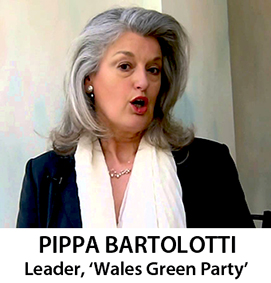
FOOTNOTE: One reason I enjoy doing posts like this is that once you start digging there’s just no telling what you’ll unearth. This case being a perfect example. For when I started digging into the background of David Wakeling, to find out what his day job was, and how he could afford to loan Canoe Wales £45,000, I discovered that he owns Toucan Systems of Abertillery, Company No 02068869, which manufactures high-spec electroPippa Bartolottinic components. Another director is Mark Williamson, the Scotsman I spoke with on the telephone. Mr Williamson is also a director of Beaufort Tenants Management Ltd of Monmouth, Company No 02847525. So was Williamson recruited into Toucan because Wakeling knew him through Canoe Wales, or vice versa?

Perhaps even more interesting was another name on Toucan’s list of previous directors (April 2001 – May 2003) – a Ms Pippa Bartolotti, self-styled leader of the equally self-styled ‘Wales Green Party’. What a small world! Some Greens suggest that Ms Bartolotti is not what she seems, that she is persona grata with the Israeli authorities and that she has been involved with companies connected with the military. Toucan is such a company. The woeful ‘protests’ she organised for the NATO summit in Newport last September did nothing to lift the cloud of suspicion hanging over that head of wild, abundant hair.

All of which raises the possibility that Canoe Wales is indeed a dead duck financially, but is being kept open for reasons that cannot be stated.

Naz Malik and Awema: The Real Charges

On August 28th at Swansea Crown Court Naz Malik, former CEO of race industry charity Awema, was found not guilty on two charges of fraudulently paying the charity’s cheques into his own account. A third charge, that he used Awema money to pay a life insurance policy, was not proceeded with.

Naz MalikThe real issue never was that Naz Malik might have had his hand in the till, consequently this misguided prosecution was, at best, a distraction, with the danger that Malik’s acquittal will be interpreted as a vindication of Awema and the system that has created so many Awemas. This would be both wrong and dangerous.

I first encountered Naz Malik back in the late 1990s before his ambitions went national. He was then running the Swansea Bay Racial Equality Council. I was struck by the fact that he regularly came out with silly statements that had little to do with racism and everything to do with politics. Specifically, he would suggest that Welsh nationalism – and presumably Plaid Cymru – was inherently racist. A little checking soon revealed that Malik was a Labour Party stalwart, and even hoped to be a candidate at either Assembly or Westminster level, as did his children. Leading me to believe there was a quid pro quo arrangement that saw the local authorities on the Bay (Swansea, Neath Port Talbot) fund Malik in return for him putting the boot into them wicked nashies.

*

As regular readers will know, I have, for many years, been a consistent critic of Malik, Awema and the system that gave birth to Awema. Unfortunately my pre-2010 posts are now lost due to Google pulling the plug on my old blog for no good reason. (So avoid Google Blogger unless you want the same fate to befall you!) Even so, I have enough information to ask the following questions.

  • After warnings in 2003 and 2007 that things were not right at Awema, why did the ‘Welsh’ Government continue funding the organisation? (In fact, there were 19 warnings from the Wales Audit Office!)
  • What justified Malik increasing his daughter Tegwen’s annual salary from £20,000 to £50,000 in the space of three years? Or rather, why did those funding Awema not ask this question at the time?
  • Did Naz Malik ever have the authority to unilaterally increase his own salary and benefits package?Awema Kenya
  • Why did no one in the ‘Welsh’ Government think it strange that they were funding a ‘Welsh’ charity that, on the Charity Commission website, claimed to also be operating in Kenya and Pakistan, using EU funding allocated to be spent within Wales?
  • Given the known problems with the Malik family’s running of Awema was it wise for Labour to have Naz Malik’s son, Gwion Iqbal Malik, as a candidate in the May 2011 Assembly elections, and for First Minister Carwyn Jones to be seen canvassing with him? (Surely this should have been vetoed?)
  • Why did no one wonder what the link might have been between Awema and Malik’s sister Fahro’s (now defunct) charity Lynk Reach Ltd? Or whether that connection was right and proper? (I’m told she was born in the same city, Nairobi, and in the same month, as Peter Hain. Funny old world!)

Well over seven million pounds of largely EU funding was squandered on Awema. As part of a wider system of Labour Party patronage that then enables local clients beholden to the party, like Naz Malik, to oversee their own systems of self-enrichment, patronage and nepotism. A veritable pyramid of corruption. So lucrative is this racket that once it became clear late in 2012 that Awema’s days were numbered a replacement sprang up, just a few streets away, in the form of Race Council Cymru.

*

I’m afraid my home town is getting a bad reputation for third sector corruption. In June this year I Mo Sykeshad to report on the charity MEWN. In more recent posts, The Impoverishment of Wales and Ancestral Turf, I have dealt with another Swansea-based charity, YMCA Wales. There had been rumours for a few years that this was a disaster waiting to happen. In fact, and with my – ahem – customary perceptiveness, I wrote about YMCA Wales in July last year in YMCA ‘Wales’: Another Trojan Horse At The Trough.

YMCA Cymru’s chief executive, Mo Sykes, went missing in July, the trustees placed the organisation in receivership, while the ‘Welsh’ Government – perhaps hoping to appear decisive for once – called on DePlod to investigate.

Yet the problem isn’t with Swansea, the fault lies with a system that if it’s not designed to attract peripatetic third sector parasites will inevitably have that effect. For the word will quickly spread in their magazines, on their websites, and through the channels of the Guardian readers’ very own freemasonry, Common Purpose, that Wales is a soft touch, money is being showered on any shyster who can deliver a persuasive spiel.

*

In the dock at Swansea Crown Court should have been ‘Welsh’ Labour, not its creature, Naz Malik. It should have been charged with squandering EU and other funding on professional grant-grabbers in order to buy support, while turning a blind eye to how that funding was used, and abused, lower down the food chain. Also in the dock – for this system could never have flourished without it – should have been the self-styled Welsh media, fearful of upsetting the Labour Party and, as a result of that cowardice, betraying the Welsh people.

The real worry is that Wales now has a system that blatantly mis-uses grant aid to fund political patronage, and that this inevitably leads to nepotism, self-enrichment, corruption of all sorts – and yet no one seems to care! This is the real problem with the third sector in Wales. In fact, this sums up the third sector in Wales. And we shall all suffer while this pernicious system endures.

Ancestral Turf

In the direct male line my great-grandfather was a David Jones of Meidrim, a small village encountered a few miles after heading north out of Sanclêr to start climbing the ridge after which you drop down into the valley of the Teifi. Young Dai went up to Swansea around 1880 and there met another recent arrival from the west, Madelaine Jones of Cei Newydd; they married and had nine children. It might have been more had Madelaine not been eleven years older than Dai. And of course, for me, growing up in Swansea, Carmarthenshire was just across the Llwchwr. Oft-times as a youth did I stand on the east bank of that mighty stream and gaze longingly over to the land of my ancestors. Well, no, I made that bit up.

I mention this to explain that I have these, and other, connections with Sir Gâr, so I feel entitled to comment on a picture emerging that tells of money being showered around to provide services that are either unneeded (known in Third Sector terminology as ‘Money for old rope’) or else for services that could be provided more efficiently by the public or the private sector (known as ‘Third-rate, Third Sector’).

Lest anyone is in any doubt about exactly what the Third Sector is, let me explain. It is called the ‘Third Sector’ because it is neither the private sector (business / private enterprise), nor is the public sector (government departments, local government, etc). It is, as the name suggests, a third way of doing things, a third option for delivering a service. There has always been a Third Sector of organisations, mainly charities, relying on donations, legacies or whatever to continue with their work. This is fine, and commendable; which of us would refuse to put our hand in our pocket for the NSPCC, RNLI, Barnardo’s, RSPCA, Oxfam, and a host of other bodies that do bloody good work.

Yet in recent decades the Third Sector has grown, and changed in other ways, due partly to government cut-backs on public spending and partly due to a policy of stripping responsibilities from local government. These imperatives have had a number of consequences. Mainly that money being thrown around by central or local government inevitably attracts shysters. While for the public, the result is that the services on which they had previously relied are now of inferior quality and often totally unreliable. There are two other factors involved in Third Sector funding that should worry anyone who sees the dangers in political patronage or wants a secular society. For many of the recipients of public – usually EU – funding have links to the Labour Party; and too many of those being funded to provide services to the vulnerable belong to fundamentalist religious outfits, such as the Towy Community Church; or else are real oddballs who shouldn’t be given a penny, and even without funding, should be warned off any involvement with those who need professional help. (I shall give an example of one these later.)

Apart from my ancestral connection, the reason I’m focusing on Sir Gâr is because it seems to be providing a perfect environment for everything that can go wrong with the Third Sector in Wales to go wrong. Helping to create that environment is a highly dysfunctional council ruled by a vindictive chief executive who, with the help of a few senior officers (plus highly-paid external lawyers) and a clutch of top councillors, has turned the county into a banana republic. As we know, a banana republic encourages all manner of skulduggery. I have written about the county in the recent past, but it’s always worth returning to Sir Gâr.

*

In my previous post I reported strange goings-on at Llandovery YMCA, after which I was directed to a couple of videos on YouTube. The first of those videos can be found below (or here on YouTube), it gives an idea of what the money is spent on in Sir Gâr. The funding in this video comes from the county’s Rural Development Plan.

The first interviewee is one Tom Duxbury, who teaches “traditional rural skills”. Duxbury is of course English. Next up are Gill Wright and Jane Ryall who run a ‘community company’ offering bunkhouse bed and breakfast. Both are, again, English. The next double act is Jill Tatman (of Llandovery YMCA, mentioned in my previous post) and Lee Mattocks, who have expanded the local YMCA into yet another ‘community enterprise’. I shouldn’t need to tell you that both are English.

In fact, Jill Tatman has done very well out of the public purse. She bought the Grade II listed building known as ‘Windermere House’ on Stone Street in Llandovery . . . and what do think happened then, children? – that’s right! it was refurbished for her using some of the £2.78m allocated to the Llandovery and Llangadog Townscape and Heritage Scheme. Nor must we forget that her little empire is housed in the old YMCA building. The YMCA had pootered along in Llandovery for many years, but then Tatman took over, and began using the good name of the YM to access lots of funding to provide her with a salary and a very, very generous pension pot (even though she’s already well past retirement age!). Her ‘partner in crime’ (figuratively speaking of course), was Mo Sykes, now missing as recent shenanigans at YMCA Wales are covered up investigated. This is one old bird who knows how to milk the system! I wonder what she did before she decided to bless us with her presence?

This next video (available here on YouTube), features Gill Wright, again, telling us about the wonders of the Llandovery Heritage Centre – Business Hub. Assisted this time by Emily Davies – who is Welsh! So Emily may be working for the funding programme. (Clock Wright’s face when Davies is speaking at 1:48: ‘Look, Hermione – I’m with a native!’) The building is a ‘community venture’, offering copying facilities and laminating machines, “meeting space” and other facilities the good folk of Llanymddyfri cannot do without. At 1:53 the video shows what perhaps we are expected to believe are two young entrepreneurs planning their next venture . . . though the one on the left looks suspiciously like Glyn Jones, a Rural Community Inclusion Development Officer, it may even be the back of Glyn’s head we see at 1:32. All in all the Heritage Centre – Business Hub is quite an impressive set-up, which has obviously cost a few quid . . . yet Wright suggests at 2:46 that the process “may have upset a few local people”; but that’s all behind her now as she looks for more funding, for yet bigger premises, in a town of less than three thousand people!

These first two videos share a few features worthy of comment. First – and believe me, for I know of what I speak – one of the keys to unlocking grant funding is to argue that you’re providing a service or facilities for the public at large, the correct button to push being ‘community’. Second, Wright and Tatman are both past retirement age. Without I hope sounding ageist – being a pensioner myself – shouldn’t this funding be better directed than by supplementing the pensions of a couple of memsahibs? Though I suppose this might explain the presence of younger ‘assistants’.

The third video – in which we see Glyn Jones playing himself – tells of the work being done by the Llandovery Job Club. (Available here on YouTube.) In addition to Glyn we shall meet a couple of other people we’ve met already. At 1:27 it’s Jill Tatman, and at 3:47 Lee Mattocks. Then at 4:40 we meet a new face in Dan Morin who, with his wife, “left London about a year ago”. At 5:24 we meet Mrs Alannah Morin who tells us they “wanted to leave London because we were tired of the rat race”. This is the sort of thing one hears from City brokers buying million pound properties on the Pembrokeshire coast . . . but one is unlikely to find such people in the local job club. So why did a black couple from London move to a small Welsh town with no job waiting for them? I can’t help thinking there’s a story here we aren’t being told.

It is obvious that what we have here is an over-generous and misdirected funding programme simply throwing money around willy-nilly. Money is being used to provide ‘facilities’ for communities that were blissfully unaware of their deprivation until the people you’ve seen in these videos sniffed out the oodles of funding on offer. Interestingly, the ‘facilities’ are run by English people, used by English people . . . with Welsh involvement limited to providing the funding.

Something I found significant was the use of the Welsh language to disguise what is really happening. Not a lot different to bilingual signage in Tesco Porthmadog to hide the fact that the staff employed in the store are overwhelmingly English. Or the Planning Inspectorate having a Welsh language version of its website. We see it everywhere: the cosmetic ‘victories’ of language campaigners bring us to the point where the Welsh language is used to deflect criticism from programmes that will destroy it. How weird is that?

What we’ve seen here is not unique to Sir Gâr, it’s happening all over Wales. Money is being squandered on unnecessary projects, given to amateurs whose only real talents are the ability to complete an application form and know what ‘buttons’ need to be pressed to access the funding. There are Welsh kids growing in some areas who think that only the English are allowed to run certain things. This is not by accident.

*

Staying in Sir Gâr, I’m now going to look at (takes deep breath) Ymddiriedolaeth Atgyfnerthu Treftadaeth Sir Gâr. In translation, and general usage, Carmarthenshire Heritage Regeneration Trust; but the official name, with both Companies House and the Charity Commission is the Welsh name. Which might make it difficult for anyone unfamiliar with the Welsh name to track CHRT Companies House front pagedown details. Perhaps another example of the Welsh language being used insincerely, to deflect criticism and deter investigation. (On the right you’ll find the front pages from both Companies House and the Charity Commission. Click to enlarge.)

For the sake of brevity I shall henceforth refer to CHRT, which is classified, by Companies House, as a private company limited by guarantee with no share capital and exempt from using ‘Ltd’. There are three curious features that (with the invaluable help of BD) I have explored and would now like to bring to your attention.

First, in addition to the company and the charity there is a third entity, CHRT Ventures Ltd, Company Number 06820763, Incorporated on February 16th 2009, which is also a private company limited by guarantee with no share capital. As for what it does, the Companies House website can only say, “Other information service activities not elsewhere classified”, which could mean just about anything, though it would appear to be a CHRT Charity Comm front pagetrading arm of the Trust, a regular enough arrangement, but it appears not to fulfil that role too well. For the most recent figures I can find, for the year ended March 31, 2013, show that CHRT Ventures Ltd had assets of £13,985 but liabilities of £37,311.

The next curiosity is Claire Deacon Linkedinthe salary arrangements of the CEO, Claire Deacon, whose Linkedin front page can be found on the left (click to enlarge). I say that because Ms Deacon has been employed by CRHT as a consultant while also employed as CEO. On page 29 of the most recent accounts (click here) we are told that, “During the year, Ymddiriedolaeth Atgyfnerthu Treftadaeath Sir Gar (CHRT) employed the services of Ms Claire Deacon, CEO, a historic building consultant. The total expenses paid by CHRT for consultancy was £59,159 (2012: £41,873). At the year end, CHRT owed Ms Claire Deacon £9,436 (2012: £3,386). This balance is included in trade creditors”. This probably explains why employees’ remunerations in 2012 amounted to £175,355, but fell to £152,117 in 2013 for the same number of staff. Yet Ms Deacon was paid considerably more in consultancy fees than the £23,238 ‘saving’ in salaries between the figures for 2012 and 2013.

Is this standard practice, that a CEO can boost his or her income by also acting as a consultant to the organisation that employs her? How is it done? Did Ms Deacon say, ‘If you want me to do this work, then you’ll jolly well have to employ me as a consultant – and that will cost you a lot more than my CEO’s salary’. But if a consultant was needed – and seeing as we are dealing here with public funding – was the opportunity advertised, put out to tender, or was it all stitched up in-house? I really would like to know how these things are done.

The third and final curiosity will be found if you look at the Charity Commission website image, where you’ll see that under ‘Where it Operates’, it says, ‘Throughout Wales’, which sounds a bit ambitious for a relatively small local charity in Sir Gâr. Or perhaps not. For if we return to the latest accounts, and go to page 5, you will find this under the heading, ‘YMCA, Merthyr Tydfil’ “This project has continued to develop with funds being secured for project development and the purchase of the building, a price having been agreed with the owner. The Trust is working closely with the Local Authority and other key funding partners including HLF (Heritage Lottery Fund) and Welsh Assembly Government. It is proposed that the purchase will proceed once key triggers have been secured, these including confirmation of offers of funding from Heritage Lottery Fund and the local Merthyr Tydfil Townscape Heritage Initiative for the first phase of works and a business plan”. Note how everything seems to be planned out without funding confirmed. Is this a tactic to pressure the funders? Anyway, why is the Carmarthenshire Heritage Regeneration Trust buying the YMCA building in Merthyr?

The suggestion made in the report I just linked to is that the building will be used as a “teaching facility with some office space available”. (Yet more ‘community’ flim-flam.) A project that Ms Deacon estimates will cost £5m. Clearly, CHRT is branching out, in more ways than one. More millions of public funding will be spent to . . . well, to do what, exactly? Given what I’ve set out here, and hundreds of other examples I could have used from across Wales, we be can be reasonably certain that few benefits will accrue to the local people. The beneficiaries of al this funding will be Claire Deacon – who might even act as her own consultant on the project! – plus more shysters like those we met in Llanymddyfri.

And once again, there is a YMCA building involved. I have heard many strange things lately about YMCA Wales and its relationship with local branches, how the latter have been taken over, exploited, even wrecked. There is a post here, which I hope will be written by someone who understands the picture far better than I.

*

Wales is the poorest country in western Europe (possibly all of Europe). Because of our poverty we qualify for large amounts of funding to relieve that poverty and the associated deprivation. But instead of using the money for the purposes for which it has been given, the civil servants who run Wales on behalf of London, and their soul-mates at a more local level, have dreamt up cunning plans to kill a number of feathered creatures with but one projectile.

By diverting funding to the likes of the grant-grabbers dealt with here those disbursing the money can claim that services and facilities previously provided by your local authority and other agencies are still there, but now provided by the likes of Gill Wright and Jill Tatman, so nothing’s really changed. If your local library’s been closed down and you can’t access a computer, don’t worry, go along to the local ‘business hub’ and put up with the whinnying of those you’ll find there. But you’ll be expected to fOlive Trust WEFOorget that the library would also have had books, and employed locals. Need a nursery school? Don’t worry! Drop little Harry into the local Pentevangelic church. When you pick him up he’ll be folding Ukip leaflets and damning ‘sodomites’.

In my opening paragraph I promised to introduce you to a real oddball, so welcome to the Olive Trust (or ‘Creoso’, as the website puts it), based in Swansea but also, apparently, operating in Carmarthenshire, and with strong Labour connections. The woman running this scam is Denise Kingsley-Acton . . . did I hear someone ask if she’s English? (As a matter of fact she is.) I had a little spat with this woman towards the end of 2012, she claimed she’d reported me to the police (a bit like WalesEye), that she’d worked for MI5, all sorts of nonsense. The woman is clearly in need of help herself, but that didn’t stop the Wales European Funding Office (WEFO) considering an application from her in 2010 for a cool one million pounds. (See right, click to enlarge.) Of its type, this is a gem, I urge you to read it. The money was to be used, predictably, “to regenerate a building for community use”.

So if you’re thinking of getting in on this racket yourself, then here’s the secret: find an old building, get a grant to buy it, then apply for other grants to turn it into a ‘community’ building. Nobody will worry if the scheme fails, for this is just an exercise in giving out money and ticking the right boxes on forms nobody will really check. Plus, failed schemes are black marks against those who gave out the funding – politicians and bureaucrats – so everyone has a vested interest in pretending that these projects all deliver. And of course, you and your little clique will rake it in.

If the assorted funding programmes continue in this way then, in a few years time, every village and small town in Wales will have three or four buildings ‘regenerated for community use’, or some other ‘facility’ that isn’t really needed. They’ll all be run by English people, for the benefit of other English people, and hundreds of millions of EU funding will have been used to subsidise the colonisation of Wales.

The Impoverishment of Wales

The more I learn about how Wales is administered the more I realise that it is not run in the interests of the Welsh. Whether it’s social housing, grant funding, top jobs, higher education, the more you dig the more it’s brought home to you that Wales is a colonial possession of England, organised along worryingly discriminatory lines. All of which makes devolution a charade, and exposes the ‘Welsh’ Government to be nothing but a sad bunch of clowns and puppets dancing to London’s tune. Those in other parties who dream of replacing Labour as ‘the Government’ would do no better.

Here are some examples to explain what I mean.

*

‘IEUAN AIR’

The contract for the daily air service from Valley on Anglesey to Cardiff is up for re-negotiation. The service is usually – though perhaps unfairly – known as ‘Ieuan Air’, after the former Plaid Cymru leader and Deputy First Minister in the Labour-Plaid Cymru coalition (2007 – 2011), who was AM for the island and a regular user of the service. The wider issue is covered here in his usual exemplary way by Owen Donovan on Oggy Bloggy Ogwr. You’ll see that Owen tells us, “The Ieuan Air 2marketing and ticket booking services are provided by Manx company, Citywing, while the air service itself is provided by Links Air, based on Humberside”, and this aspect is what I shall focus on.

First, Citywing. In fairness, Citywing offers a full Welsh language version of its website, though seeing as it operates just one route within or from Wales this might worry some, who might wonder if this company has any other business. As Citywing is registered in the Isle of Man it’s not easy to get information on the company, which seems to have been founded as recently as November 22, 2012, when MD David Buck staged a management buy-out of the company, previously known as Manx2. A name change was possibly necessitated by Manx2 being involved in a crash at Cork airport on February 10, 2011 in which five people died. It seems that Citywing merely sells seats on “flights operated under charter from Van Air Europe and Links Air“.

My knowledge of this business is minimal, but it seems that we are very much down at the bottom end of the market, a kind of sub-Ryanair operation flying to and from Blackpool, Gloucester and other less-in-demand destinations in 19-seater planes because stricter legislation may come into force if more passengers are carried. The planes involved may be owned by the Czech company Van Air Europe and leased to Links Air with Citywing flogging tickets. Who knows? There’s so much leasing and sub-leasing going on in this game I’m surprised Nathan Gill and his gang aren’t involved, especially as Links Air is based just across the Humber from Hull.

Linksair Ltd is run by Jonathan Gordon Roy Ibbotson and his wife. It is one of three companies still trading out of a large number of companies with which 51-year-old Ibbotson has been involved. Some have failed owing money, and of the three still extant one, Linksair Properties Ltd, was only formed in July, and the other, Hangar 9 Ltd has (apparently) nothing to do with aviation, being involved in property letting, with a few outstanding mortgages to its name, and may even be Roissy Aircraft Management Ltd (another of Ibbotson’s companies) after a name change. To confuse the picture further, Ibbotson has run two companies called Hangar 9 Ltd!
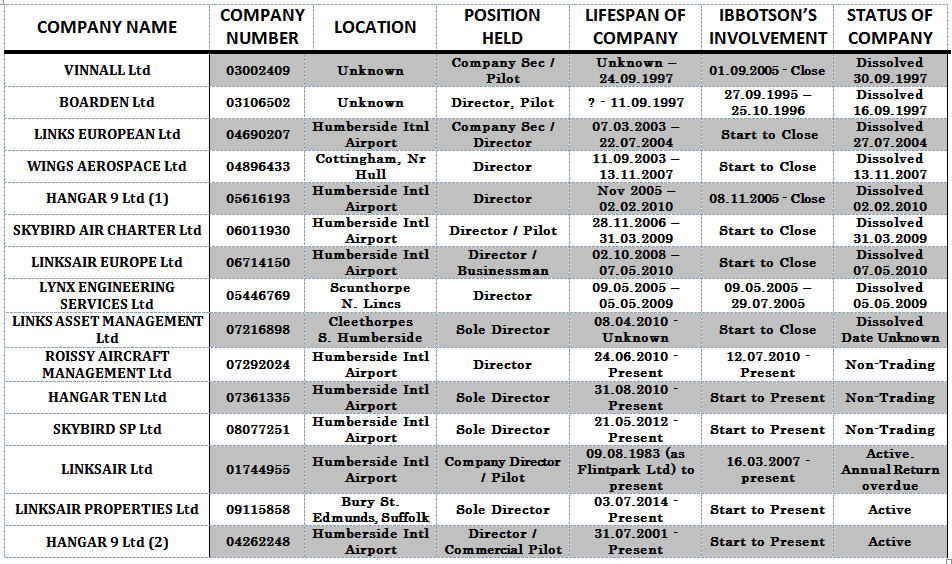
Ibbotson's companies

Ibbotson obviously has an ‘interesting’ business career, so interesting that I would be loath to hand him a penny of Welsh public funding; and was there no company in Wales that could pretend to be an airline and sell a few tickets? Whether there was or not is academic, for this Anglesey – Cardiff air service has outlived whatever usefulness it might once have had, and seeing as most of the passengers have their fares paid for out of public funds it was never a viable commercial proposition. So scrap it. And if the ‘Welsh’ Government is serious about internal communications, that fare-paying passengers will use, that will create jobs within Wales, then start backing the re-opening of the Carmarthen to Aberystwyth railway link, as the first stage in a full west coast line.

In this first example we see millions of pounds of Welsh public funding being given to English companies for a service Wales doesn’t need. This money could obviously be better spent.

UPDATE 21.10.2015: LinksAir, the company operating the Anglesey – Cardiff service, has had its safety licence revoked by the Civil Aviation Authority. The ‘Welsh’ Government insists a new operator has already been found, said to be Danish company North Flying. The service receives a subsidy from the ‘Welsh’ Government of £1.2m a year, even though passenger numbers have dropped from 14,718 in 2008-09 to just 8,406 in 2012-13.

*

CARTREFI CYMUNEDOL GWYNEDD & LOVELL

When the humour is on me I turn to a longer-term project of mine, a post examining the colonisation of rural Wales; how it’s being achieved, and what steps need to be taken to curb it. One thing that quickly became clear is how little was done at governmental level to replace the jobs lost over recent decades in agriculture (including creameries, abattoirs, etc), quarrying, forestry, utilities, nationalised industries and local government. These losses were disguised by propaganda arguing that tourism would provide jobs for everyone. This decline in the numbers of ‘real’ jobs needed by adult Welsh males resulted in the predictable reduction in the Welsh population . . . which has then been disguised by the English immigration encouraged by toLovell Reg officesurism.

Here I want to look specifically at local government, or rather, a successor body. In 2010 Gwynedd’s council housing stock was transferred to Cartrefi Cymunedol Gwynedd, and now the housing maintenance that would previously have been done by the council’s own workforce and local sub-contractors is done by a major English company called Lovell. Gwynedd is covered from Lovell’s North West and North Wales regional offices in Altrincham, Cheshire and Birkenhead, Merseyside. The south is covered from the ‘Midlands, South Wales and Southern’ regional offices in Birmingham, Cardiff and Hampshire. Which means it’s reasonable to assume that other Welsh local authorities and housing associations have become partners with Lovell. How many I wonder? I should mention that Lovell is also in the business of building new properties.

Here we are, fifteen years into devolution, and yet this major company still carves up our homeland and attaches the dismembered parts to English regions in the traditional, contemptuous manner of English business and administration. Lovell then compounds the insult by handing out its contracts to other English companies; contracts that in many cases are too big for smaller Welsh companies to apply for. In fact, when you read more abLovellout it, it looks as if the ‘partnership’ system is designed to exclude smaller firms. And when you see a photo such as the one I’ve used here (taken from the Lovell website) you can’t help wondering if there might not be a cartel of large English companies at work deliberately excluding smaller, more local companies.

Anyone can see the advantage for Cartrefi Cymunedol Gwynedd in giving out a single contract for maintaining all its properties and then letting Lovell get on with it, but this is a very short-sighted policy. I have seen Lovell and their sub-contractors at work in this village. Working four-hour days due to travelling times from their English bases – and therefore taking twice as long to do the job! Does this system make sense on any level other than the convenience of the suits at CCG: employment is lost, money leaves the area, and jobs take longer to complete than if local companies were employed!

A system so ludicrous, so indefensible, can only arouse suspicion that someone at Cartrefi Cymunedol Gwynedd, or higher up the food chain, is in receipt of certain ‘inducements’.

This example shows money raised by a ‘Welsh’ organisation – from CCG’s Welsh tenants and the ‘Welsh’ Government – given to English companies to put Welsh companies out of business and Welsh workers out of jobs. Can you imagine such a system operating anywhere else on earth!

*

YMCA WALES

This is an ongoing story, so regard what I tell you here as a ‘taster’. But first, I suggest you go back to a couple of posts I put out last year; first, YMCA ‘Wales’, Another Trojan Horse At The Trough, and then, YMCA ‘Wales’ and the Green, Green Pastures.The latest news – as of Friday last – is that the ‘Welsh’ Government has called in Plod to investigate YMCA Wales. Any investigation will almost certainly centre on the organisation’s former chief executive, Mo Sykes, who seems to have left her post in unexplained circumstances last month.

When I learnt of Ms Sykes’ departure I put out a couple of tweets, and I’m pleased to say that I had some responses. Here’s one anonymous response, as I received it:

  • Mo Sykes selling assets and cashing investments to pay off YMCAW overdrafts and debts.
  • Sykes spearheading campaign to build and sell at Penrhyndeudraeth without proper discussion at board level. (See last year’s posts.)
  • Took control of Port Talbot YMCA without board approval and proceeded to empty it’s bank account to “repay” a non existent loan to the national body.
  • Local branches of YMCA not linked to the national body in any way other than name. Receive no finance or any other support from Mo Sykes or her cronies.
  • Local branches struggling to survive whilst Sykes takes her newborn child and nanny on ‘fact finding’ mission to USA.
  • Some Trustees pleaded with charity commission to step in when militant Mo would not recognise concerns of trustees and was acting without authority. (This was two years ago, so why didn’t the ‘Welsh’ Government intervene at this stage, rather than allowing things to further deteriorate?)
  • Chairman after chairman turns blind eye to numerous attempts by group of determined trustees for transparency.
  • Many trustees resign after being shouted down by CEO and chairman Peter Landers for refusing to sign off on annual accounts moments prior to AGM commencing. (Landers is elsewhere described as ” . . . head of Newport YMCA . . . a loud, scruffy man . . . counting the days to his retirement . . . “)
  • Many whistle-blowers are crushed and humiliated by Sykes for seeking the truth. One hounded from post within YMCA and then pursued and punished through a new employer.
  • Hopefully, now, the truth will out and local branches will get the support so desperately needed from Welsh Government.

Another response was equally revealing, and disturbing:

“For 20 years the Llandovery YMCA was functioning as a small charity with less than £10,000 annual income, mainly from camping trips, bible study, after school fees and renting out the meeting room. Then in 2011 it’s annual turnover suddenly rocketed to over £100,000 with an innovative food box programme. This was an emergency relief project to stem the little known Llanymddyfri famine. Over 200 relief boxes per month (food and nappies) were distributed, and according to their annual report, which was generously supplied by the Kings Church in Newport under a scheme headlined as ‘Jesus Cares’.

The new venture was kicked off in 2011 with a grant of £44,000 from Carmarthenshire County Council and Llandovery YMCA saw a jump from zero to two staff being employed, incurring a cost Sykes-Tatmanof £23,000 in salaries. In 2012 there was a further consolidation with a cash injection of £103,000 from the Big Lottery. Only a part of this was spent on refurbishment of the premises as a tidy £25,000 cash payment was made to a trustee, Ms Jill Adeline Tatman, who, incidentally, is also on the payroll. The number of staff by the end of 2013, was four, with, by now, £50,000 going out of the payroll, and an annual pension due of exactly £3,500 annually.
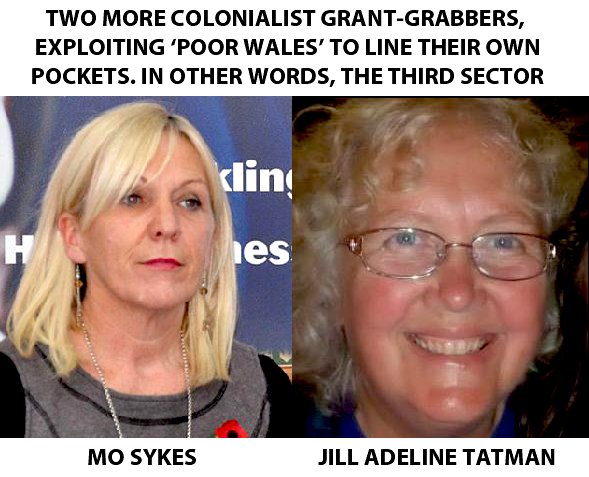
Then in 2013 it landed an additional £16,000 Rural Community Inclusion Grant thanks to the work of a projects officer, also employed by Carmarthenshire County Council. The cash really started creaming in and in 2014, Llandovery YMCA landed a further £250,000 grant from the People and Places Lottery Fund, for a “ground-breaking therapeutic and emotional support project”, but as far as I can see the only emotional support provided is to Jill Adeline Tatman laughing her way to the bank from her home, also, as it happens, done up with public funds.

Trustee, Jill Adeline Tatman, originally from Redhill, Surrey, educated at a privately run evangelical college in Derbyshire and, like Mo Sykes, is a former trustee of YMCA Wales. She’d purchased the grade II listed “Windermere House” in Stone Street, Llandovery. This property was part of the Llandovery and Llangadog Townscape and Heritage Scheme which was refurbished in 2011 with a portion of the £2.782millon townscape fund, £737k of which was grant funded from Carmarthenshire Country Council. Not only does she get public funds to line her purse, but got some cash to do up her own house.”

Tatman was a director of YMCA Wales from November 2004 to November 2005 and personal assistant to the CEO, which might explain why the missing Mo Sykes (originally from the Six Counties) is a Trustee of Llandovery YMCA. Though the Charity Commission website tells us she is also a Trustee of the Bargoed and District YMCA and the Onllwyn and District YMCA. Accounts are overdue for the latter, so if the Charity Commission is expecting them from Mo Sykes they may have quite a wait. Something is clearly very wrong with YMCA Wales, and has been for a considerable time, so I ask again, Why did it take the ‘Welsh’ Government so long to pull its finger out?

I’m getting shyster fatigue from writing about those who migrate to Wales in order to take advantage of the ‘How much do you want?’ grant culture, but here goes, again . . . Tatman, based in a small Welsh town, has recently been given £250,000 for: ” . . . a ground-breaking therapeutic and emotional support project . . . and also go towards developing new opportunities for the unemployed through education and training”. In a relatively prosperous little town of less than 3,000 people how many unemployed are there, and what qualifications does Ms Tatman have to help them? Or what help can she give that no one else is currently giving? And how many kids are there in Llandovery needing ” . . . therapeutic and emotional support scheme for young people through art”. Truth is, all she’s really done is secure salaries for herself and her cronies. Plus of course, pensions, which I’m told are very ‘imaginative’ in their structure and very rewarding in the benefits they bestow..

In conclusion, I should point out that even though YMCA Wales is based in Swansea, it’s up in the wilds of Llansamlet somewhere, not in the grand old YMCA building on the Kingsway, that edifice we’ve seen so often in recent years on our television screens. For as I’m sure you’ll remember, this lovely old building was once home to AWEMA and our old friend Naz Malik. Naz, I regret to say, is currently in the dock at Swansea Crown Court. You know, I sometimes think that the Third Sector in Wales should really apply for funding from the Arts and Entertainment pot, because some of what they serve up is better than any soap opera.

YMCA Wales is yet another example of a Third Sector funding scandal: immigrants of dubious probity subverting a respected organisation to serve their own interests by exploiting the poverty and deprivation that results from the Union with England. And this one could be big, it could make old Naz look small coal.

UPDATE SEPTEMBER 4, 2014: YMCA Wales in administration.

*

SWANSEA COUNCIL

It is with great relish and lashings of schadenfreude I report that civil war has broken out among the ruling Labour group on Swansea city council. Unfortunately, I cannot as yet tell you of any fatalities, but I live in hope. Here is a brief communique. It seems that the trenchcoat-wearing rodomontade (God I”ve longed to use that word!) who has until now directed this farce, one David Phillips, felt increasingly insecure and decided to sack a couple of cabinet members he felt did not worship him as he thought they ought. But now it appears they were not alone, and it may be Il Duce himself who is under threat! Some intriguing comments to the stoBenito Phillips, Il Duce Abertawery on the Evening Post website by ‘pjrpost’ allege wrongdoing by the council’s HR department and a cover-up by the Labour administration. This, again is a story with ‘legs’, so I urge you to keep up with it. Another kick in the plums for the Labour Party is always good news.

The reason I’m including it here is because – as regular readers will know – I’ve written about this Labour shower before, many times. (Just type ‘Swansea council’ into the search box at the top of the sidebar.) It is the worst council the city has ever known, not least because many Labour councillors, including the council leader, are strangers to Swansea; they neither know the city nor care about it. Their loyalty is to the Labour Party, and the Labour Party alone. This is the dog-in-the-manger politics we suffer nowadays that sees political parties wanting power not to exercise it on behalf of the people but to keep some other crew out of power. For serving the Labour Party in this way Swansea’s councillors are rewarded by being allowed to pursue their pet issues (using council money of course), be that obsession promoting gay rights, saving the planet, or funding the Cwmrhydyceirw Unicorn Sanctuary.

On another level, as I write this the Swans are doing rather well, having won their first two games, but of course the club’s income is somewhat limited by having such a small stadium, which also means that many fans are unlikely to ever see a live game. The stadium should have been extended when the Swans were in the Championship, certainly after the first season in the Premier League. The Liberty Stadium is owned by Swansea council, and you’ll understand why the stadium is not being expanded when I tell you that the council leader, the aforementioned David Phillips, is a Liverpool supporter; one of the council’s representatives on the stadium management committee, Nick Bradley, proudly boasts of his undying love for West Bromwich Albion; while the chief executive of Swansea council, ciggie-puffing Jack Straw (no, not that one), is a Nottingham Forest supporter. This is the sort of thing you can expect when a council is run by a rag-bag collection of drifters, political chancers, students who couldn’t find their way home and single-issue obsessives.

Though on the plus side it is rather encouraging; for it suggests that Labour can no longer find local candidates, and has to rely on English immigrants. This is Bangor and Aberystwyth writ large.

In this final example we see Wales’ second city being run by strangers loyal to a political party whose only ambition is to keep Wales subservient to England. A gang who then waste public money funding all manner of nonsense but neglect the real interests of a city they don’t understand and people with whom they cannot possibly identify.

UPDATE August 28 2014: Disillusioned party members cornered Il Duce this evening and forced his resignation without recourse to the indignity of lamp-posts. It only remains now to see what happens to the clique with which he surrounded himself; these include his wife, assorted losers, and odious, self-promoting members of Labour Yoof who need Sat Nav to find their way around the city they help run.

Many would have it that Phillips jumped before he was pushed, as – it is alleged – was the case when he left his job with HMRC (or whatever it was then called) down in Pembrokeshire.

 *

Here we have looked at some examples of colonialism and discrimination at work. The UK government gives the ‘Welsh’ Government billions of pounds, but then civil servants and others ensure that as much as possible of that money either makes its way back to England, is given to English people living in Wales, or else is spent on projects that do nothing to improve the wellbeing of Welsh people.

These examples show this evil and discriminatory system at work. A system that makes a mockery of devolution; for unless devolved powers are exercised in the interests of Welsh people then ‘devolution’ is more damaging to Welsh interests than the system we knew before.

Tommy Atkins, Still Being Exploited 100 Years On

I am indebted to D P for drawing my attention to the Owain Glyndŵr Fields Initiative. If, like me, you were unaware of OG Fieldsthis project, then this extract from the website might help: “The Owain Glyndwr Fields Initiative was established to commemorate the 600th anniversary of Owain Glyndwr, Prince of Wales, through the protection of recreational open space in his name. The initiative, which was endorsed by the National Assembly for Wales, was launched when the first field was established in the shadow of Caerphilly Castle in 2001 and has since seen 20 sites around Wales dedicated to the statesman.”

These sites have a curious geographical spread: one in Caerffili, one in Powys, one in Conwy, two in Monmouthshire, five in Gwynedd, and no less than ten in Wrecsam! Some are where you’d expect to find the great man commemorated, such as Machynlleth and Pennal, but why is there nothing in Denbighshire, at Rhuthun or Glyndyfrdwy? Out of twenty-two Welsh local authorities only six have shown any interest at all.

There’s not a lot to argue with there, unusually patriotic for those clowns down Cardiff docks, even though they only “endorsed” the initiative (so whose idea was it?). But if you look more closely at the web page, and the menu tabs above, you’ll see that the Owain Glyndŵr Fields Initiative is just a Welsh manifestation of something much bigger called Fields in Trust. And when you read the blurb on the home page you realise there’s nothing new about this at all.

*

For it says: “We were founded back in 1925 as the National Playing Fields AssociatiFiton by King George V. Our mission is the same now and (sic) as it was then: to ensure that everyone – young or old, able or disabled and wherever they live – should have access to free, local outdoor space for sport, play and recreation. These spaces are vital to building happy and healthy communities and sadly continue to be threatened by all kinds of development.

We are a national charity and operate throughout the UK to safeguard recreational spaces and campaign for better statutory protection for all kinds of outdoor sites.”

Now I’m sure that many of you will have heard of the National Playing Fields Association, and I can recall the King George V Playing Fields down on the Mumbles Road in Swansea (always referred to as ‘Ashleigh Road’), though these are hired out by the city council, and certainly aren’t free, as suggested in the Fit blurb just quoted. When I tried to find Fields in Trust on the Charity Commission website (using the charity number given, 306070) I landed with the National Playing Fields Association. Then I found, at the foot of the website, “Fields in Trust is the new operating name for the National Playing Fields Association”. So Fit is nothing more than a re-branding exercise. But what’s the point of that?

*

Charities ForumThe answers start to come when you know that Fit is part of the Charities Forum, “Founded by The Duke and Duchess of Cambridge and Prince Harry” (with the duke president of Fit). So on one level, it’s an attempt to give the impression that the junior royals have something useful to do. Which then gives the BBC and certain newspapers the opportunity to remind us how hard these royals work, and what good work they do, and to make sure we know they do it all for nothing!

When you check out some of the other pages on the website then you realise that the re-branding also has a more political nature, to serve contemporary political purposes. For one of the other initiatives, Centenary Fields, is linked with the World War One celebration of Britishness and unity. (‘You listening, Salmond!’)

Centenary Fields

For with the Scottish referendum just seven weeks away it’s no surprise to learn that in Scotland Centenary Fields is linked with Poppy Scotland. There appears to be no direct Welsh equivalent of Poppy Scotland but there is Cymru’n Cofio / Wales Wales RemembersRemembers, which looks like a spin-off from the UK commemorations. I found the Cymru’n Cofio image on the Caeau Canmlwyddiant page under the ‘Cymru’ tab. I’m giving the page name in Welsh because the Welsh pages of the Fit website are remarkable for being in Welsh only, without English translations! I suppose the tab should have read ‘Cymraeg’ instead of ‘Cymru’. Which would then mean, presumably, that the information for Wales would be another example of ‘For Wales, see England’.

*

I have no problem with remembering those men who fought and died in the Great War, it is only right that we do so. But let us also remember how unnecessary and avoidable that conflict was, and that the only victors were American capitalism and Russian communism. If we are to teach children about WWI then don’t confine it to the bravery and the stoically-endured suffering; tell them about the political folly and the military incompetence, the executions of ‘deserters’ and ‘cowards’, and all the other things that challenge the sanitised version. Because I worry that the version being pushed now is not a lot different to what Wilfred Owen warned us against in the final lines of Dulce Et Decorum Est:

My friend, you would not tell with such high zest

To children ardent for some desperate glory,

The old lie; Dulce et Decorum est

Pro patria mori.

(The phrase comes from an ode by the Roman poet Horace, and means, roughly: ‘It is noble and fitting to die for one’s country’.) Though I suppose, in fairness, there is a big problem for a country like Britain, because you can’t really tell kids the truth about war knowing you’ll need some of them to unquestioningly fight in the next Northern Ireland, Afghanistan, Iraq . . .

To finish where I started, I believe that every civilised society should have plenty of open spaces for its people, I grew up in a city blessed with wonderful parks and playing fields. But these open spaces shouldn’t be exploited to promote some silly idea that heirs to the throne have any real purpose beyond breeding and waiting their turn; nor should the innocent and wholesome role of parks and playing fields be traduced in the service of sanitised and politicised interpretation of war.

Nest of Vipers: Third Sector Tales

No insult intended to any reptiles reading this.
NO INSULT INTENDED TO ANY SNAKES OR REPTILES READING THIS ARTICLE.

Wales is a small country, and once you start delving into the darker recesses of public life you uncover organisations of which you’ve never heard, you discover avenues of questionable funding, and you see names cropping up over and over again. This interconnectedness is not healthy; especially when so many of the shadowy groups and individuals influencing political decisions in Wales have minimal knowledge of our country and serve agendas that are dismissive of or hostile towards the best interests of the Welsh nation.

Everywhere you look in the public life of Wales you find English-run organisations of limited or negligible benefit to Welsh people yet enjoying wholly disproportionate political influence and seemingly unlimited funding. In fact, the more I study how Wales is run, the clearer it becomes how badly the interests of the indigenous Welsh are served. Seventeen years on, those who voted devolution into existence are a forgotten and neglected people.

Here are some examples that should help explain what I’m condemning.

*

In my previous post I dealt with the bright young things of the Cardigan Bay Marine Wildlife Centre. Though as questions remained unanswered about the structure of the group I sent an e-mail to the parent body, the Wildlife Trust of South and West Wales (an object lesson in short, snappy names, these people). The reply, from Diana Clark, Executive Officer, began, ‘Dear Roy, I hope you are keeping well’. I don’t know the woman, so the unwarranted familiarity was mildly offensive. Recovering my composure I perused the information Ms Clark supplied. On WTSWW managementthe left you will see the management team, though I have no idea why this can’t be made available on the website. Maybe some of these names will register with readers. The chief executive seems to be yet another fairly recent arrival in our country, who also serves on PONT . . .

I know, you’ve never heard of PONT, and neither had I. The acronym stands for Pori, Natur a Threftadaeth (Grazing, Nature and Heritage), here’s a link to their website. It appears to be yet another publicly-funded environmentalist group with a fig leaf Welsh presence to disguise its real intention, which seems to be curbing ‘over-grazing’, perhaps a euphemism for farming (though Georges Monbiot’s name is not on the website). I assume PONT is still in existence, for I see ‘Copyright 2014’ at the foot of the page, but no Annual Report after 2010. If PONT is still in existence, and still receiving funding from the ‘Welsh’ Government (as shown on other Annual Reports), there should be a more recent Annual Report available.

Maybe PONT had a hand in persuading Alun Davies, recently sacked Minister for Environment and Food in the ‘Welsh’ Government to reduce funding to our farmers and transfer it to “rural development projects” back in January. In other words, to Greens, hippies and other invaders who don’t give a toss about us Welsh. Note how the department name even avoids using the words ‘agriculture’ or ‘farming’. More on Alun Davies later.

*

Returning to the Wildlife Trust of South and West Wales, the over-familiar Ms Clark also provided me with the company structure of her organisation (click on panel to enlarge). All fairly straightforward, and easy enough to understand, even for those who don’t like flowcharts. I was however drawn to the mention of Autumn Peaks down towards the bottom, and described as a ‘dormant trading company’, so I did a little investigating.WTSWW structure

The first thing I discovered was that the name given is incorrect. According to Companies House the correct name is Autumn Peak Ltd., based at ‘The Nature Centre, Fountain Road, Tondu, Bridgend’, and that it is still active with the next Returns due on November 8th this year. (The company number is 03262690.) Yet it is described in the 2013 WTSWW Accounts thus: “It (the WTSWW charity) also wholly owns a dormant subsidiary, Autumn Peaks Ltd which also operates two charities as inactive companies, Glamorgan Wildlife Trust Ltd and Wildlife Trust West Wales Ltd”.

Turning to DueDil I learned that the very forward Ms Clark became Autumn Peak’s Company Secretary on February 11th, 2008. The only other directors being Dr. Ruth Watkins and Mr Peter Gerald Hunter. There have been thirteen directors since the company was formed in 1996, by the Glamorgan Wildlife Trust Ltd, all of them now in their 60s, 70s and 80s, apart from the aforementioned Ms Clark who, at 55, is a mere slip of a gel, which may account for her flibbertigibbet attitude in dealing with business correspondence.

Of more interest were the figures provided on Autumn Peak by DueDil, which suggest that as a ‘trading company’ it was not a great success. By December 2000 it was well up Shit Creek with total liabilities of £170,000. How did a nature reserve run up debts like this? Did this ruinous adventure pave the way for the merger in April, 2002 with Wildlife Trust, West Wales Ltd? Was public funding used to resolve the situation?

DueDil WTSWW

In the flowchart you will see another company mentioned, this one still active, DWT Ltd. It was not straightforward to track down because, again, the company name is given wrongly; it is in fact DWT (Enterprises) Ltd, company number 02702793. Registered at the same Bridgend address as Autumn Peak Ltd, and incorporated on April 4th, 1992, over four years before the ill-fated Autumn Peak.

This subsidiary is described thus in the 2013 Accounts: “The Charity (the WTSWW) owns the whole of the issued ordinary share capital of DWT (Enterprises) Ltd, a company registered in Wales (Company No: 2702793). This subsidiary is used for non-primary purpose trading activities – namely the provision of holiday accommodation on nature reserves,
catering for visitors and the retailing of bought-in goods to visitors”. The company secretary is Gillian Clark.

The chart for DWT (Enterprises) Ltd suggests that it took on the debts of Autumn Peak and has limped along ever since. While not as far up Shit Creek as Autumn Peak managed to get it has definitely turned into that side stream with liabilities in excess of assets for the past four years.

DueDil WTSWW 2

The third company listed in the flowchart is ‘WTSWW Ltd’, a name that, again, will get you nowhere unless you have the full name, which is of course, The Wildlife Trust of South and West Wales Ltd. The company number is 04398959, and it’s a private company limited by guarantee and listed as a non-trading company in the business of “Botanical and zoological gardens and nature reserves activities”.

The chart for WTSWW Ltd looks pretty healthy; cash in the bank of £910,936 and net worth of over £2.5m. Though this may be a little misleading as Companies House makes reference to nine outstanding mortgages, which almost certainly accounts for the bulk of the assets. The company secretary is, again, Ms Diana Gillian Clark. In fact she is listed as company secretary for five companies; in addition to the three mentioned here, we can add The Wildlife Trust (West Wales) Ltd and The Glamorgan Wildlife Trust Ltd. She took on all five posts in January and February 2008.

DueDil WTSWW 3

The WTSWW is also a registered charity, number 1091562. And it’s there you can find the most recent set of accounts. The accounts confirm, under ‘Tangible Fixed Assets’ just under £1.5m in ‘Freehold Nature Reserves’ Among a multiplicity of other fascinating facts contained therein my eye was drawn again to the name DWT (Enterprises) Ltd (the still active trading arm), where I learnt that this company returned a trading loss of £5,035 yet spent £137,205 on staff costs! I shall repeat that for the hard of reading: This company spent over 137 grand employing staff who obviously possess as much commercial nous as your average Labour politician or, for that matter, Third Sector scrounger. In total – salaries, wages, social security and pension costs – the Wildlife Trust for South and West Wales spent £546,899 on staff. So where did it come from . . . cos it sure as hell didn’t come from the ‘trading arms’!

Donations and Gifts amounted to £106,685; Legacies came to £266,444; Fundraising brought in 72,197; and Grants £970,712. Of the latter figure (p25) the greater part comes, by one route or another, from the ‘Welsh’ Government. One grant I would like more information on is the one listed simply as ‘S106’ for exactly £100,000. Update 21.07.14: It seems that S106 refers to a community infrastructure levy paid by developers to local authorities. So which local authority gave the WTSWW £100,000? This levy is supposed to be used for community benefits – how does that apply in this case? There may be a good reason why the Trust is so vague about the details. (Diolch i AK.)

The way the Wildlife Trust of South and West Wales operates could be described thus. It persuades old dears not to leave all their money to cats homes; it begs from anyone else with money, including the ‘Welsh’ Government; but the WTSWW raises very little itself of the cash it spends on buying up parcels of Wales in order to provide further employment and recreation for its friends. Now this might be acceptable if the work done was beneficial to the Welsh people, but it’s not. Though if the ‘Welsh’ Government does deem this work to be important then, rather than throwing money at people who clearly couldn’t run a whelk stall, why don’t they do it themselves and provide employment for the people they claim to represent?

If the Wildlife Trust of South and West Wales was a private company it would have gone bankrupt long ago. But it’s not a private company, and it has a great advantage over private companies in an unending supply of funding from external sources. Which means that these hectoring and manipulative poseurs can be nonchalant with how they spend that money, which leads to trading arms that run up massive debts, or subsidising the beach bums of the Cardigan Bay Marine Wildlife Centre and other holiday camps for the English middle class.

 *

Many of you will have missed the news that Nick Bennett is the new Public Services Ombudsman for Wales. ‘Who the hell is he?’ I hear you shout. Well, for some years prior to taking on his new job he was, from July 2006, chief executive of Nick BennettCommunity Housing Cymru, the umbrella organisation for housing associations. Reading of Mr Bennett’s new appointment made me remember my only contact with him.

It came in a rather strange way, just before Christmas 2010. I had sent a letter for publication to the Wasting Mule. In it I asked Nick Bennett why Welsh housing associations were taking in criminals and other undesirables from England. The letter was not published but instead I received a remarkable e-mail from Pat English, the Mule‘s Letters Editor, which began: “Mr Jones, here are the detailed answers to your points, from Nick Bennett …”

In over forty years of writing to newspapers and other publications I have never received a response in that manner. In his lengthy reply that followed Pat English’s intro one phrase Bennett used confirmed for me that Welsh housing associations are linked to and co-operating with their English counterparts. For in among the denials and unconvincing excuses was this revelatory gem: “There are over two million people on waiting lists for social housing . . . “ ‘Over two million’ – in Wales! For this, remember, was written by the chief executive of Community Housing Cymru.

So what else do we know about Nick Bennett? Well, from November 2000 to October 2002 he was a special adviser (spad) to Mike German, one-time leader of the Liberal Democrats in the Notional Assembly. Then (on his Linkedin front page) there is a gap until April 2004, when he becomes a director of Cwmni Cyfathrebu Bute Communications Ltd, company numbeJohn Lastr 05076125. The other directors were Professor John Last and a Mr Alun Davies. The professor, originally from Liverpool, and a retired academic, is still a busy man, serving on the St. Asaph Diocesan Board of Finance and the Bodelwyddan Castle Trust. The panel (right) is taken from the Glyndŵr University website, for Professor Last is a former governor. A perfect exemplar for those who populate the upper reaches of ‘Welsh’ public life. The other director is of course, Alun Davies AM, the recently sacked Minister for Environment and Food.

Bute 2Let’s look at recent Welsh political history to see if it can offer any clues to Nick Bennett’s career. From 2000 to 2003 there was a Labour-Lib Dem coalition down Cardiff docks, in which his boss Mike German was Deputy First Minister. This would have allowed spad Bennett to put himself about, to ‘network’ and ‘touch base’ with those who mattered, especially in the Labour Party. This probably accounts for him going into business with Alun Davies. From 2003 to 2007 Labour had an overall majority, so we can be certain that his friendship with rising star Davies didn’t do him any harm when he applied for the job of Group Chief Executive at Community Housing Cymru. Coming up to date, Bennett was appointed to the post of Public Services Ombudsman in March 2014, when Alun Davies, his former business partner, was still a popular and influential minister in the ‘Welsh’ Government. Naught but coincidences, of course.

Having mentioned Bennett’s earlier business venture with Alun Davies, Bute Communications, it seems only right and fair to mention another; one that looks suspiciously like another ‘trading arm’ of a publicly-funded Third Sector body. It is called – for it still exists – ‘Community Housing Cymru – Policy and Research Ltd’. The graph suggests another great example of Third Sector ‘enterprise’. Current liabilities exactly match current assets, with net assets (i.e. book value) of £1, and a turnover of considerably less than your average whelk stall.

Community Housing Cymru 1

And now Nick Bennett is the Public Service Ombudsman for Wales. Within his jurisdiction will be all his old friends in the housing associations, who can be guaranteed to generate many complaints. Those bodies that he assured me do not import criminals, ‘problem families’ and other riff-raff from England (though he was unwilling to put it in writing in the Wasting Mule). His years spent smooching politicos will probably ensure that no one with good political connections will ever feel the wrath of his office. Welcome to the nest of vipers that is public life in Wales!

*

This is a truly amazing system, one I have written about over many years. A sphere of Welsh life run by, and for the sole benefit of, those with little business acumen and weak links to Wales (but often strong connections to the Labour Party).

Politicians – Labour, Plaid Cymru and Liberal Democrat – see nothing wrong in showering these incompetents with billions of pounds of public funding to do what could be done cheaper, more efficiently, and with more accountability, by either the private or the public sector. As an example of the amounts involved, since 1999 over one billion pounds has been given, from a single funding stream (Social Housing Grant), to housing associations.

Whereas in healthily functioning democracies commercial interests spend money lobbying politicians and trying to influence legislation for their own financial gain, this being Wales – where private enterprise and commercial activity is regarded with the greatest suspicion – the government actually funds Left wing and Green pressure groups to produce ideas to be turned into legislation that then results in further support and funding for those very same groups!

When the inevitable corruption, incompetence and financial disasters occur, the ‘Welsh’ Government’s natural reaction is to hush it up and / or pour in more money. Made easier by the absence of a national media capable of anything more demanding than regurgitating press releases, and self-justifying Third Sector reports, as ‘News’.

This is the road to national destitution, and explains why Wales is getting poorer, year on year, compared to just about every other part of Europe. Also less democratic. This system must be dismantled if Wales and the Welsh people are to prosper.