Hobby Jobs

As someone who, in his younger days, collected ‘pets’ from the ponds and waste ground of north Swansea, I have always taken an interest in wildlife, and indeed (in the phase that followed the pet collecting) wild life. Many a carefree boyhood hour was spent catching grass snakes, collecting newts, and sneaking up on lizards to attempt that perfect catch – on the body (for they detach their tails) but not so roughly as to harm them. Or it waCBMWCs summers in Port Eynon crabbing and observing the life of the shoreline and the rock pools.

So I was naturally drawn to the story of porpoises killing dolphins in Cardigan Bay. Reading it I learnt that this behaviour has been observed by volunteers at the Cardigan Bay Marine Wildlife Centre in New Quay. So – you know me – wanting to learn more about this outfit I went to the CBMWC website.

The website – entirely in English, of course – is quite open about what it does, who funds it, and who runs it. The volunteers for 2014 include Milly, “part of a big, outdoorsy family” (not them Swansea dossers again?). Lea, who “grew up in the Swiss countryside”. Abigail from Worcester who has “attended a dormouse survey training day”. (Something of which I can only dream.) Rebecca, who “spent holidays in Corwall and Wales”. Then there’s Josephine from Manchester, Gaby from Canada, Ashleigh from “the Midlands”, Sophie from Suffolk, Will from West Yorkshire, even one or two (out of 17) who may even be Welsh. Among “the CBMWC Team” (of 14) there is one who seems to be Welsh, then there’s Barry the wino, a host of ‘locals’ who’ve all moved to Wales, and young Ben, who grew up on the East African Coast. (Of course he’s not bleck, don’t be silly!) It’s all so frightfully English that they could have stepped from the pages of some Enid Blyton tale of middle class youngsters having a jolly good time in darkest Wales.

Before anyone says that these people do good work, or are no harm to anyone; and that I am a wicked old nationalist for picking on them, just remember this. The Cardigan Bay Marine Wildlife Centre and its allies among the Fleece Jacket Fascists form a lobby that – among other things – would like to extend conservation zones around our coasts, putting Welsh people out of work so that they can enjoy their hobby jobs pursue vital marine research. In fact, they would like to turn rural and coastal Wales into one big playground for them and their friends. With no Welsh involvement . . . well, other than funding.

                                               *

fleece jacketThe CBMWC is some kind of subsidiary of the Wildlife Trust of South and West Wales (WTSWW), so this was my next stop. Another packed, informative website . . . until you try to find out who actually runs the show. For while the website gives a link to the names of the Trustees I could find nothing to tell me who is responsible for the day to day running of the Trust. A major omission. Especially as the Trust receives funding from The National Lottery, the People’s Postcode Lottery, and two lots of funding from the EU, via the Wales Co-operative Centre and the Wales European Funding Office. Is it lawful for an organisation receiving EU funding to withhold from the public the names of its management? It should go without saying that the WTSWW website is also in English only.

Returning to New Quay for a moment (to where, incidentally, I can trace a paternal great-grandmother and a maternal great-great-grandfather), the CBMWC website tells us that the Centre is “funded by grants from Environment Wales (EW) and Natural Resources Wales” (NRW) (of Alun Davies fame). Environment Wales is a hotch-potch of Englandandwales fleece jacket gangs feeding at a trough topped up by the ‘Welsh’ Government, almost certainly with EU cash. But I was unable to find the dolphin watchers or their parent outfit listed among the grant recipients or the ‘Registered Project Links’. And, again, no clue given as to who runs Environment Wales. The picture was no better with Natural Resources Wales. The website contains no mention of grants, and doesn’t even offer a way of sending an e-mail or ‘phoning, for contact is limited to social media! Can it be right that a member of the public is unable to contact an organisation supported by EU funding?

                                               *

Every area of the country has groups like the CBMWC, some national, others local: in Wales, but not of Wales. Existing as exclusive ex-pat outposts of the kind the English form in Spain and elsewhere. Social, cultural and financial impositions that we had better start challenging before they become dominant; to the point where it becomes impossible to walk on a Welsh hill, or through a Welsh wood; swim off a Welsh beach, or visit some site important in our history, because it’s now owned and run by strangers – with funding provided by our government!

Appeals to the emotions aside, the real issue here is about hard cash, and how it’s used. About the waste of public funding on hobby jobs, for which the Cardigan Bay Marine Wildlife Centre merely serves as an example. The CBMWC obviously attracts the well-heeled from England and beyond, but would anyone in Penrhiwceiber or Penygroes notice if the CBMWC closed tomorrow? Of course not, but EU funding was given to improve the lives of people in communities such as these. So henceforth, if the Cardigan Bay Marine Wildlife Centre can survive on selling ice cream and fluffy dolphins, boat trips and donations, then fine, but no more public funding for it or any similar organisations.

The next round of EU funding must not be wasted on ephemeral and unnecessary projects simply because they generate good publicity; it must not be squandered on politically correct scams; it must not be spent on encouraging the Third Sector to make an industry of poverty and deprivation. Any application for funding should be asked one simple question: ‘Will there be direct and tangible benefits for Welsh people in terms of jobs, education and training, community benefits, social and cultural cohesion and other fields?’ Supporting projects that fail this test is merely funding colonisation.

Housing Associations: More From The Dark Side

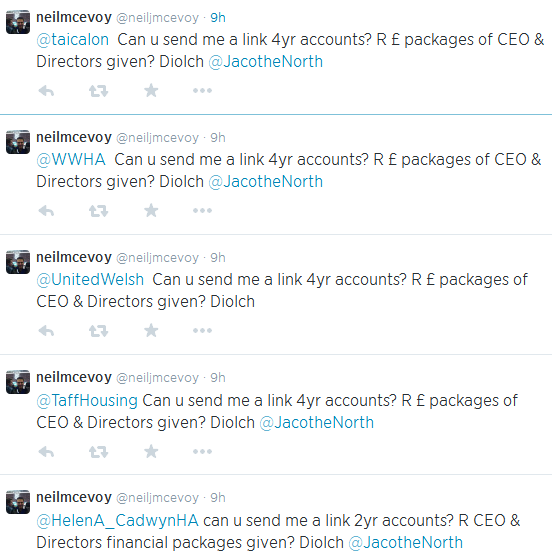
My previous post drew a number of comments and provided some interesting feedback via other media. It also inspired Councillor Neil McEvoy of Cardiff to make enquiries with housing associations in the south east. (Click panel to enlarge.) One who answered to the rattling cage was Hefina Rendle, Communications and Neil McEvoyPublic Relations Manager at Tai Calon. (Some will remember that before joining Tai Calon in January 2012 Ms Rendle was a broadcast journalist with the BBC.)

I hadn’t previously heard of Tai Calon, it doesn’t appear among the housing associations I dealt with in my previous post, those listed as being in receipt of the Social Housing Grant (see table from previous post). Tai Calon was formed in July 2010 from Blaenau Gwent’s council housing stock, and cheerfully admits to receiving £19.67 million from the ‘Welsh’ Government, with more promised – until 2041!  But if this money is not coming via the SHG, which funding stream is coughing up? Or perhaps the question should be – just how many funding streams are there for housing associations (and not just from the ‘Welsh’ Government)?

What I assume to be Tai Calon’s mission statement reads: “We have about 300 members of staff … from building trades to administrators and neighbourhood managers.  We are committed to creating as many job and work opportunities as possible.  We also aim to recruit locally as possibly.  We try to use firms and suppliers from the area, keeping as much of the income we generate within Blaenau Gwent for the benefit of everyone who lives and works in the county”. “We aim to recruit locally as possibly”! Apart from the obvious error, Blaenau Gwent is the poorest area in the poorest country in Europe, it should be mandatory to recruit locals.

I’m getting a bit ahead of myself now, so let me return to the McEvoy – Rendle dialogue. A few tweets passed between them, I chipped in, drew a Christmas cracker aporhism from Ms Rendle, and we didn’t really get anywhere. But seeing as Neil McEvoy had asked about the CEO’s salary, I made a bee-line for the ‘Meet the Executive Team‘ page on the Tai Calon website.

The Chief ExecutiveTai Calon Exec Team is Jen Barfoot, who is of course English (this being the Third Sector in Wales). In fact, of the four listed on the Executive Board (click to enlarge), three are English . . . so much for the promise of local recruitment. It often seems that the Third Sector in Wales exists for no better reason than to provide sinecures for thousands of English people who can’t cut it in the world of real business. Because wherever you look, from housing associations to health boards, from higher education to Tony Payne, the custodian of Caerffili Castle – who so clearly identifies with those who built the castle rather than with the horrid and inferior “Welshmen” beyond its walls – all you find are English third-raters clinging to the pendulous mammaries of Welsh public funding.

Tai Calon’s Board is rather more representative of the community of Blaenau Gwent, but scrolling down past Fred Davies, and Shirley, who lives in the house in which she was born in Nantyglo, we come to yet more teat tuggers. First, Debbie Green, Group Chief Executive at the Coastal Housing Group in Swansea, who “obtained a history degree from Cambridge and moved to Cardiff in 1988 to start her accountancy training with Deloittes and subsequently PWC. Since qualifying as a Chartered Accountant she has worked in finance roles connected with Lottery grant Steve Porterfunding in the Arts Council of Wales, before moving to Chwarae Teg in 2001 as Director of Finance and Resources”. There, laid out for you, is the perfect Third Sector career path. But of more interest is the man we find at the bottom of the column, Steve Porter, co-opted onto the Board. Steve tells us he “enjoys living locally with his family in the South valleys”. Condescending crap that could only be written by another English immigrant with free Welsh milk all over his face.

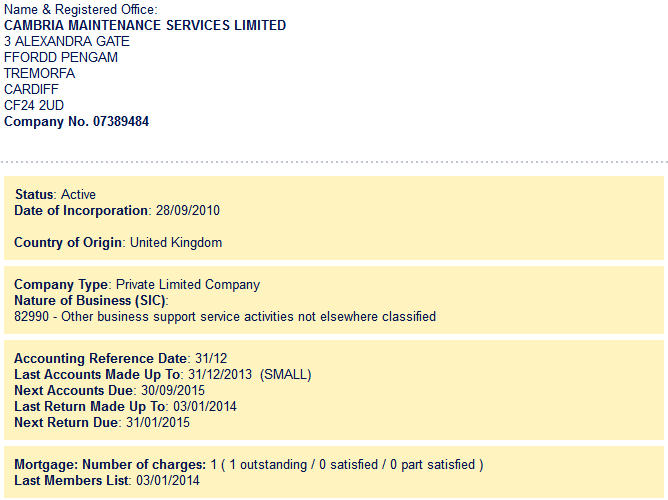
The reason I find Steve Porter interesting is that he works for that behemoth in the world of Welsh social housing, the Wales and West Housing Association Ltd which, curiously, also receives funding from the English government. Between 2008 and 2013 Wales and West received a whopping £63 million in Social Housing Grant alone from the ‘Welsh’ Government. Alarming though that is, the real reason I homed in on smiling Steve is that his Tai Calon bio credits him with setting up ‘Cambria Maintenance Services Ltd’, described as a “subsidiary building company”. Subsidiary, that is, to Wales and West.

Nothing wrong with that if Cambria had been set up to maintain Wales and West’s housing stock, that’s no more than a local authority would have done. But if that was the case, why not just call it the Maintenance Department of Wales and West? Why does Cambria need to be a fully commercial operation, registered with Companies House (Company Number 07389484)?

My concerns about Cambria Maintenance Services Ltd are encapsulated in this passage from the JobsinWales.com website (my underlining): “The company, with divisions in Cardiff and Holywell, Flintshire, has established an excellent reputation for its quality of workmanship and service to its customers. Cambria is an independent company run Cambria Maintenanceon a commercial basis and being part of the WWH Group provides it with considerable security as it doesn’t need to repeatedly tender for works and risk losing contracts”. How can Cambria be both “independent” and “part of the WWH group”.

It suggests to me that Cambria is an “independent company” that has its ‘bread and butter’ work guaranteed by publicly funded social housing; but, as a private company, it’s also free to chase the ‘jam’ of outside commercial work. Which gives Cambria the best of both worlds and an unfair advantage over competitors that must survive, without featherbedding, in the normal business environment. Is this how housing associations are supposed to operate? And it may not be confined to Cambria. For in among Wales and West’s ‘Services and Initiatives’ there’s Castell Catering, and Connect 24 Alarms.

Which raises the question of why Steve Porter was co-opted on to the Board of Tai Calon. My guess would be that if Cambria isn’t already working in Blaenau Gwent then it very soon will be. As might Wales and West, and Steve Porter himself. For in the dog-eat-dog world of housing associations Tai Calon is a chihuahua, Wales and West a pit bull. You read it here first, folks.

Cambria Maintenance Services is another example of Wales’ shadowy, almost Soviet-style ‘economy’, which promotes the illusion of a system based on competition and profitability, but at no real risk for many of those participating because they are underwritten by the State.

The social housing sector – and the Third Sector generally – is a monster sucking up funding and damaging our wider economic prospects. It is yet another example of the Labour Party pandering to the effects of poverty rather than tackling its causes. For if Wales had a stronger economy there would be more people buying their own homes and we wouldn’t need to pour such obscene sums into housing associations and their offshoots.

With such easy money to be made, so few questions asked, and with their documented experience in ‘housing’, I’m surprised that Nathan Gill and his brothers-in-law haven’t got involved in the housing association racket. It can only be a matter of time . . .

Housing Associations, Time To End The Madness

It’s taken about eight months, but I finally got the information I requested on the Social Housing Grant (SHG). Though let me make it clear that I attach no blame to the Housing and Regeneration section of the ‘Welsh’ Government or the Housing Directorate (which, despite being in Wales is, I believe, an outpost of the UK / England Department for Communities and Local Government); for both have been very helpful. It seems that in the first instance I was asking for too much information, which exceeded the obligations placed on government departments by the Freedom of Information Act, with the delay extenuated by me seSocial Housing Grantnding e-mails to someone who’d left his job but whose e-mail account was still open and accepting incoming e-mails!

As you might have guessed, I’m talking about housing associations, and more especially, how much they receive from the ‘Welsh’ Government through the SHG (click on panel to enlarge). In other words, public funding, money that could – with different priorities – be spent on other things. Between 2008 and 2013 housing associations in Wales were given £692,541,022.51. (I can give you the figure to the exact penny because that’s how it was given to me.) However you look at it, 692 million is a lot of moolah. It could have built a few hospitals, 12 Newtown bypasses, covered most the M4 upgrading, re-opened the Carmarthen-Aberystwyth railway line, or funded a lot of other projects around the country. And remember, that’s just the money received from one funding scheme over six years. There is also the funding prior to 2008 to be considered, funding from other sources, plus the loans that housing associations are allowed to negotiate. Putting it all together makes it clear that social housing is big business, and accounts for a lot of money in a small country like Wales.

Before looking more closely at some of the individual recipients of the ‘Welsh’ Government’s largesse, maybe I should give some background and explain what kind of beast we are dealing with. Anyone over the age of forty-five will remember that social housing used to be the responsibility of the local council; in other words, council houses. Housing associations were usually small organisations supplementing the work of local councils in catering for specific groups, be they disabled ex-servicemen, Jewish widows or distressed gentlefolk. Then came the hammer-blow of Right to Buy legislation (Housing Act 1980) coupled with the inability of councils to use the funding raised to build replacement dwellings. Housing associations were then encouraged into a cannibalistic feeding frenzy that left us with fewer, but bigger organisations while – in Wales at least – they were also stopped from buying existing properties. This seemed to serve a number of purposes: keeping up the stock of social housing, providing work for private builders (as opposed to councils’ own workforces) and, in rural and coastal areas of Wales, ensuring that no cottages or houses that might prove attractive to English buyers became social housing. I believe that my suspicions about the purpose and activities of housing associations began around this time.

The housing associations we see today are either the result of one merger after another of the old units, or else shiny new organisations resulting from councils selling off their housing stocks. All tend to be ‘not for profit’ Industrial and Provident Societies registered with the Financial Conduct Authority, which makes it rather more difficult, and expensive, to get information on them than if they were registered with the Charity Commission or Companies House. (Though there are usually abbreviated accounts on their websites.) In addition, they are not covered by the Freedom of Information Act, even though councils’ housing departments are! Odd, really, that it’s so difficult to get information on bodies receiving so much public funding.

                                                 *

The breakdown, by housing association, can be found below (in PNG format, click to enlarge); or here in Spreadsheet format, with links to each HA website available by clicking on the HA name in the left-hand column. I would suggest opening either file in another window to better follow what I’m going to say. Or just use it to check up on your local housing association. (Right click on the panel, then click on ‘Open link in new window’ or however your browser words it.)

Social Housing full

A quick scan reveals that Wales & West Housing Association got the largest amount in the period covered by the table, no less than £63 million. I had cause to mention Wales and West not long ago, when I learnt that it will Wales & West Housingborrow up to £25m from the UK government, through the Affordable Housing Guarantees, “to build 251 homes in Wales”. (Left, click to enlarge.) Why is the UK government loaning money to a Welsh housing association to build homes in Wales? It doesn’t make sense. The other big gainers are all familiar to me, though some of the smaller ones are eyebrow-raisers, and I always get suspicious when I see ‘Wales’ in the name of any organisation, for it often means an English outfit with a Welsh presence that may be nothing more than a post-box.

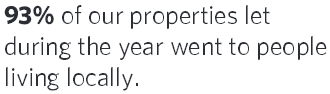
Having mentioned mergers earlier, Cymdeithas Tai Clwyd and Cymdeithas Tai Eryri have recently merged to form Grŵp Cynefin which, by happy chance, I wrote about quite recently. The episode in Tywyn tells us quite a lot about how housing associations really operate. In my experience they are devious, if not dishonest; promoting themselves as the answer to society’s ills while operating as ruthless and almost secretive commercial entities. Not only is it difficult to get informaTai Cantreftion about housing associations but what they do put out is often misleading, sometimes deliberately so. Take this sentence, highlighted on page 12 of the 2013 – 14 annual report of Cymdeithas Tai Cantref, which operates out of Castell Newydd Emlyn and covers an area from Machynlleth to just south of Fishguard, and inland as far as Llandovery. Note the use of the deliberately misleading term ‘people living locally’ in the hope that anyone reading it will think it means locals. It does not.

Go down to page 16 and you will read this: “To build new homes, Cantref need (sic) to generate more income and rely less on Social Housing Grant. A successful new initiative to Cantref this year was the introduction of our new student accommodation. We were successful with the submission of 65 units to be part of the Welsh Government’s Revenue Grant programme”. An interesting passage in a number of ways. For it identifies yet another income stream from the ‘Welsh’ Government, given as funding for what is clearly not social housing. Or to put it another way, the almost inevitable coming together of two ways in which Welsh public funding is used for the benefit of England, social housing and higher education.

                                                  *

Soon after starting on this post I bought the latest issue of our weekly rag, the Cambrian News, where I came across this story, involving an outfit to which I just introduced you, Grŵp Cynefin. This time the project is in Harlech, a place close to my heart from having spent a couple of years there, in good company, in good pubs, Cambrian News, Harlech homeswearing flares and hair over my shoulders . . . I even made it to the Coleg once or twice. (I also met the missus there, but we don’t want to spoil a happy memory, do we.) Anyway, click to enlarge and read it for yourself.

Warms the cockles of your heart, no? What callous brute could possibly object to sheltered housing for adults with learning difficulties? Well, me, for one, if there is no local demand for such housing. Because when I read that story I reminded myself that certain agencies in England would pay handsomely to relocate their clients to Wales. If that’s what will happen in Harlech then it will make this development little more than a housing association irresponsibly increasing the load on the Welsh NHS.

The problem here is obvious, it extends across the social housing sector. There is too much knee-jerk reaction on the part of politicos at all levels to requests for funding – with no thought to the bigger picture and the wider implications – when those making the requests exert emotional blackmail by pressing certain buttons. The biggest ‘button’ is social housing itself, beneath which can be found an array of secondary controls that include ‘sheltered housing for adults with learning difficulties’, ‘victims of domestic violence’, alien abductees, etc. (Go on, make up your own, I guarantee nobody will challenge it! It’s money for old rope.) All such requests for funding or planning should be answered by a simple question from our politicians: ‘Is there a demand from within the established local community for these properties?’ If no such demand exists, then funding, planning permission, and all other help should be refused.

Had this rule been followed, in tandem with a locals-only allocation policy, it would have saved lives and avoided many other tragedies, such as that which unfolded in Kidwelly not long ago, in properties owned by the Gwalia Group (£30 million raked in in the period covered). Gwalia housed Colin Batley and his paedophile gang; an appalling episode that reminds us of a darker side to social housing that the touchy-feely, politically correct, social conscience burdened hypocrites running our housing associations would rather not discuss; namely, providing accommodation for known criminals and undesirables from over the border, inflicting them on Welsh communities. Where does this leave the sanctimonious piffle about ‘being committed to serving our communities’? Yet more bollocks from housing associations.

                                                 *

The social housing sector is an unsustainable drain on the Welsh public purse. It soaks up vast amounts of money, providing more dwellings than are needed in many (usually rural) areas and often not enough in other (usually urban) areas. It is made up of semi-secret organisations that are – despite the public funding – private companies in all but name. Too often contracts are given to firms from outside the area of the contract or even from outside Wales, which results a) in a loss of income and jobs to local economies, b) projects taking longer than needed to complete, due to workers having to travel long distances, c) lives put at risk as workers pile into vans for the mad rush home around the time children are leaving school. And all this being done while operating an allocations system that prioritises those who have never set foot in Wales over native-born Welsh. A monster encouraged for 15 years by a political party that is ideologically and emotionally hostile to commercial enterprise and initiative, instead funding its cronies to run housing associations and other third sector chimerae in the hope that the faffings of these charlatans might be mistaken for an economy at work. The truth is, a well-regulated private sector could meet most of Wales’ indigenous social housing Wales needs at a fraction of the cost of housing associations. Housing associations are a drain on the Welsh economy for no discernible return – get rid of them!

Miscellany: MEWN, Oxbridge, Nathan Gill

MEWN: ANOTHER THIRD SECTOR EMBARRASSMENT FOR ‘WELSH’ LABOUR

Another Swansea-based ethnic minorities charity is being investigated by police. This one is Mewn, the Minority Ethnic Womens Network. Funded mainly by EU money dished out by the Welsh European Funding Office (WEFO) this charity is now in liquidation. As it is a charity (No. 1082587) there are a number of documents available on the Charity Commission website. Where we learn, among other things, that the most recent accounts were received on May 6, 95 days late, and that the MEWN secretary is Yvonne Jardine, a Labour councillor in Swansea. UPDATE JUNE 20: Within 24 hours of the original post I learnt that another Labour councillor, Erika Kirchner, resigned as director on May 6. Lucky Erika! Not there when the excrement came into contact with the air-circulatory appliance! Update ends. In fact, there seems to have been a rather curious relationship altogether between the Labour council in Swansea and MEWN.

For example, and I quote now from a document issued by Swansea council: “MEWN have had their Payroll run through the Council for a number of years. The arrangement is that the Council pays their staff through our Payroll system, and MEWN reimburse the Council. Therefore due to MEWN going into administration the Council is now one of the Creditors.” How common is such an arrangement? MEWN is also registered with Companies House, Number 03965481. From a ‘Welsh’ Government letter to AMs we learn that MEWN was gazetted on June 16th, but there is no word on who initiated the liquidation.

Mewn Staff CostsOne entry in the accounts that caught my eye was the piece about staff costs (panel, click to enlarge). You will see that between 2012 and 2013 staff costs increased from £129,479 to £235,570. I suppose this massive increase in workload is attributable to the Swansea race riots and the subsequent pogroms (which went largely unreported outside the city).

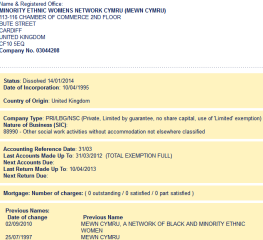
UPDATE JUNE 20: Things are becoming a little clearer, though no clearer on what exactly happened to bring about the downfall of MEWN Swansea. What I’ve now learnt is that until last year there was another outfit, based in Cardiff, called Minority Ethnic Womens Network Cymru (Mewn Cymru) which operated “throughout Wales” . . . as did, according to the Charity Commission, the Swansea-based outfit. Were they in competition?Mewn Cardiff

According to the Companies House website (click on panel to enlarge), the Cardiff crew was dissolved on January 14 this year. But it was in reasonable financial health so I assume that what happened was that someone pointed out that having two organisations with the same name, doing the same work, was a pretty obvious example of the kind of duplication for which the Third Sector is rightly condemned, and so some time last year the two merged. This would account for the increase in staff and associated costs of MEWN Swansea. Update ends.

The fate of MEWN will inevitably bring back memories of AWEMA, another Swansea-based, Labour-linked outfit in the business of milking EU funding promoting ethnic minorities. It may be worth starting the long trawl through what I’ve written on AWEMA from this post of November 2012, which mentions MEWN. I should warn you that these posts come from my old Google blog, and may be incomplete due to Google denying me access to transfer them to my new blog.

I earlier mentioned Councillor Yvonne Jardine, a Labour councillor for Morriston. Councillor Jardine is a BME activist of Afro-Caribbean origin, and yet another Labour councillor with no local roots. I have written many times about Swansea’s non-local Labour Party councillors . . . the Scouse leader (and his wife); the students; the English ex-MP Trotskyite and his Austrian wife; the West Brom fan with responsibility for the Swans’ Liberty Stadium, and many others. (Just type ‘Swansea council’ into Search at the top of the sidebar.) There will come a time in the not-too-distant future, when the veterans of the genuinely local Labour Party, Byron Owen, Robert Francis Davies et al, will have retired and Swansea Labour Party will be just a weird and dangerous collection of drifters, chancers, political opportunists, entryists, kids fresh out of college and single-issue nutters – running a city they know nothing about! My city!

I tell you, boys and girls, the Labour Party in Wales is an empty shell waiting to be cracked. It cannot find local candidates in Swansea and other areas; it relies for votes on folk memory and convincing the stupid that everything wrong with Wales is the fault of the Tories; many of its heartland seats almost went to Ukip in the recent Euro elections . . . all we need to crack the shell is a nationalist party more loyal to Wales than some laughable belief in socialist solidarity . . . or environmental agendas . . . or keeping Wales GM free . . . or sucking up to the metropolitan left-liberal-Green ‘consensus’ . . . In other words, a party nothing like Plaid Cymru.

THE OXBRIDGE CHIMERA
Huw Lewis
(No, that is not a statue of Huw Lewis at Oxford or Cambridge. That’s just how it came out in the still from the BBC clip)

I see that another non-issue has been revived by the ‘Welsh’ media and the ‘Welsh’ Labour Party (in many respects, one and the same). This time it’s the national shame of so few Welsh youngsters going to Oxford and Cambridge. Read all about it here in this load of bollocks on the BBC Wales website telling us that Paul Murphy MP and one-time Secretary of State to Wales was appointed our ‘Oxbridge Ambassador’ by the ‘Welsh’ Government. Did you know Wales has an Oxbridge ambassador? Nor me. Sad, isn’t it; really sad.

What we have here is yet another example of what Labour does so well – telling us that ‘Everything’s better in England’. (Which of course it is, with Labour running Wales.) Designed to make us see everything English as superior . . . thereby making anyone wanting to put distance between Wales and England a complete fool. In order to amplify this blatantly political message the ‘Welsh’ Government is prepared to subsidise a brain drain while ignoring 99% of Welsh youngsters. It reminds me of my schooldays, when the headmasters of certain local schools were in competition to see who could get the most pupils to Oxbridge every year, as if the rest of their charges were unimportant. God knows I’m no socialist, but there was something distasteful about that back in the ’60s, and ‘Welsh’ Labour promoting the same exclusivity today is equally distasteful. Shame on you!

Here’s an alternative strategy. Improve the higher education sector in Wales; start promoting quality rather than quantity. Treat our universities as places to educate the future of the nation rather than businesses, making loot from piling high third-rate English students and flogging degrees in Asia to anyone with the requisite folding.

NATHAN GILL MEP

Unless you’ve been asleep for the past few weeks you will be aware that our new Ukip MEP has been making the news. (Scroll down to recent posts.) This publicity has generated much interest and prompted a few people to start their own enquiries, I’m glad to say.

Kigston Care graph
Click to Enlarge

Among these is someone who was as intrigued as I was by Gill’s company, Burgill Ltd, having a planning application approved by Hull city council on May 6, 2009 when the company’s petition for liquidation was heard on November 26 the previous year, and the liquidation registered by Companies House on February 12. He suspects laws may have been broken if a) Hull city council was not informed that Burgill had been liquidated or b) if someone was still trading with a liquidated company.

Another mystery for which I would appreciate clarification is the fire on November 5, 2001 (also reported in the posts below). The fire – described by my informant as “suspicious” – was at the disused (possibly converted) Plane Street Methodist Church off Anlaby Road in west Hull. The Hull Daily Mail account describes Nathan Gill as having responsibility for the building in his capacity as “general manager of Kingston Care, based in Holderness Road, east Hull”.

There was certainly a company called Kingston Care extant at that time, but based in York, not Hull. It was in the business of providing ‘lodgings’, and seems to have been run, from their home, by a middle-aged couple named Morris with no other business involvement. Which is odd, because people with a bent for business usually have more than one company to their name; some fail, some succeed. Kingston Care had liabilities of £211,938 in September 2001 which had reduced to just £4,981.00 by August 30, 2002. An insurance pay-out, perhaps?

There cannot be two companies with the same name trading at any one time. So Nathan Gill was either working for the middle-aged couple in York, or else Kingston Care was his (or his family’s) company and the Morrises were allowing themselves to be used as a front. What’s the story?

A ‘Government’ Bereft of Ideas and Much Else Besides

Monday saw the unveiling of the Public Policy Institute for Wales (PPIW) by First Minister Carwyn Jones. Or maybe it was last May. Or was it November 2012? Perhaps it was mentioned in the Act of Incorporation of 1536. Whatever, the PPIW is a group made up mainly of academics, and expected to “give ministers fresh ideas on how to improve Wales’ public services”. These academics will be doing their day jobs in the universities at Aberystwyth, Bangor, Cardiff, Glamorgan, Liverpool and Swansea, plus the London School of Economics. The academics of Cardiff will run the show, to ensureCarwyn Jones 3 that Cardiff continues to rip off the rest of the country enjoy the benefits of its capital status.

I can see the sense in involving the LSE, but Liverpool? Is it to offer advice on the north east? Perhaps to implement the takeover of that corner of the country proposed by the Mersey Dee Alliance, and backed by civil servants and local government chiefs . . . until the plan became public? Has the ‘Welsh’ Government forgotten that there is a university now in Wrecsam? Does it matter, because the academics involved on both sides of the border will, in the main, be English.

As I’ve explained in recent posts, the ‘Welsh ‘ Government is already taking orders from London departments and their civil servants, plus agencies such as the Planning Inspectorate; then there’s the self-serving ‘advice’ from the scroungers of the Third Sector. Talking of which, I note that the Bevan Foundation is also to be involved with PPIW. Which probably explains why a few high-profile Labour politicians recently resigned as Trustees of the Foundation. Can’t have a Labour administration giving work and funding to an organisation too obviously linked to the Labour Party.

What a way to run a country! A collection of weaklings masquerading as a ‘Government’, taking orders from those they claim no longer have authority in Wales, while also seeking ‘advice’ from cronies whose only motivation is milking the public purse. Didn’t we used to have politicians of vision, who would tell civil servants: ‘Here’s my idea, you lot come up with the nuts and bolts to make it work’. Labour in Wales reveres Aneurin Bevan – was the National Health Service the idea of his civil servants, or was it his vision that he made civil servants implement?

This problem of unimaginative, weak, time-serving politicians being manipulated by those who should be serving them is not confined to the ‘Welsh’ Government. We also see it at local government level, as we were reminded today with the release of the Wales Audit Office report into curious payments in Carmarthenshire and Pembrokeshire.

Though I am not suggesting that Dr. Elizabeth Haywood, Chair of the City Regions Task and Finish Group, is a Labour crony. Yet her Report, completed in 2012, did strike me as totally superfluous, seeing as city regions were already a done deal. Decided by, among others, the Cardiff and County Club, some 20 years ago. Be that as it may, Doctor Haywood fulfilled her alloted role and dutifully confirmed the desperate need for a Cardiff city region (and wondered how Wales had survived this long without it), recommended a Swansea city region in the hope of disguising Cardiff’s takeover of the south east, and she also advised acceptance of the Mersey Dee Alliance plan for the north east – i.e. Clwyd should be swallowed up by Liverchester. So, pray tell, who is this woman given a totally pointless – but publicly funded – job? Who is She who can, with a few taps on her keyboard, recommend the dismemberment of our ancient homeland? Of course! she is none other than Mrs Peter Hain . . . though you wouldn’t know that from any reports in the Welsh media.

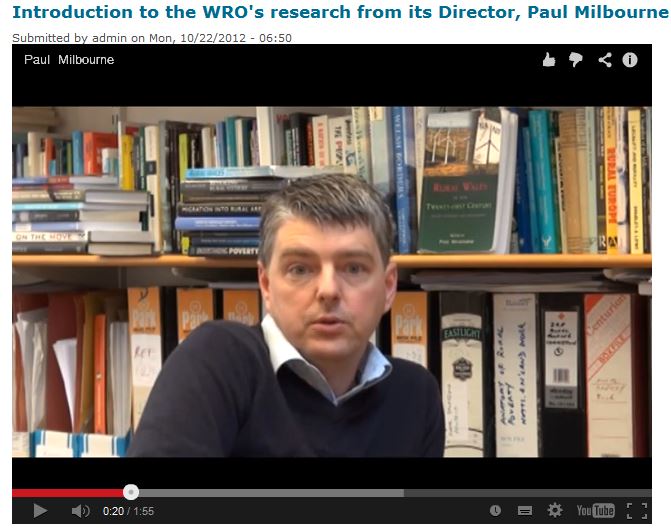
Another concern that has me pacing my bedroom all night is the future of the Wales Rural Observatory. I did a post on the WRO on September 17, 2012, on my Google Blogger site; now, sadly, demised by those lovers of free speech (and conscientious payers of tax) at Google. Fortunately, Stuart Evans (WelshnotBritish) had saved my posts, minus comments, in RSS format, which explains why you can still read it. Though the WRO website seems to have been re-written, and is now less open about the fact that the WRO is funded by the ‘Welsh’ Government to come up with original and mind-blowing findings – e.g. rural Wales has an ageing population, it’s handy to have a caPaul Milborner if you live in the countryside, etc. Another change I noticed was that the home page now carries a video by the WRO’s Director, Professor Paul Milbourne, reading from a script, and explaining what his organisation does. The video is dated October 22, 2012, just five days after my original post. I do hope it was nothing I said!

So where does the Wales Rural Observatory stand vis-a-vis the new Public Policy Institute for Wales? Will the WRO be allowed to carry on with its ground-breaking research into the more bucolic aspects of Welsh life, leaving the PPIW to focus on urban areas? Or will there be a turf war, two gangs of English academics, both funded by the ‘Welsh’ Government, fighting it out to prove which of them knows the least about our country and cares the less about us? Do we need both? Do we need either one? Should we have to suffer any?

Legislation is being forced on Wales to which this ‘Welsh’ Government is neither mother nor father. It is not even the midwife, or the nanny. It is nothing more than a slow-witted serving girl from the village, left holding the baby in the hope that people will believe it’s hers. And now this ‘serving girl’ is to be handed more ‘babies’. And she will do exactly as she is told . . . then say ‘thank you’, and probably curtsey!

This is not devolution. This is not democracy.

The Bevan Foundation 2

As I mentioned in my earlier post on this topic (here) I submitted a Freedom of Information request to the ‘Welsh’ Government asking if it had given any money to The Bevan Foundation, and if so, how much, plus subsidiary questions. My e-mail request was submitted on November 5th and I received the reply on the 27th. The request and the response can be read below.

[gview file=”https://jacothenorth.net/blog/wp-content/uploads/Dear-Mr-Jones1.pdf” width=”100%” save=”0″]

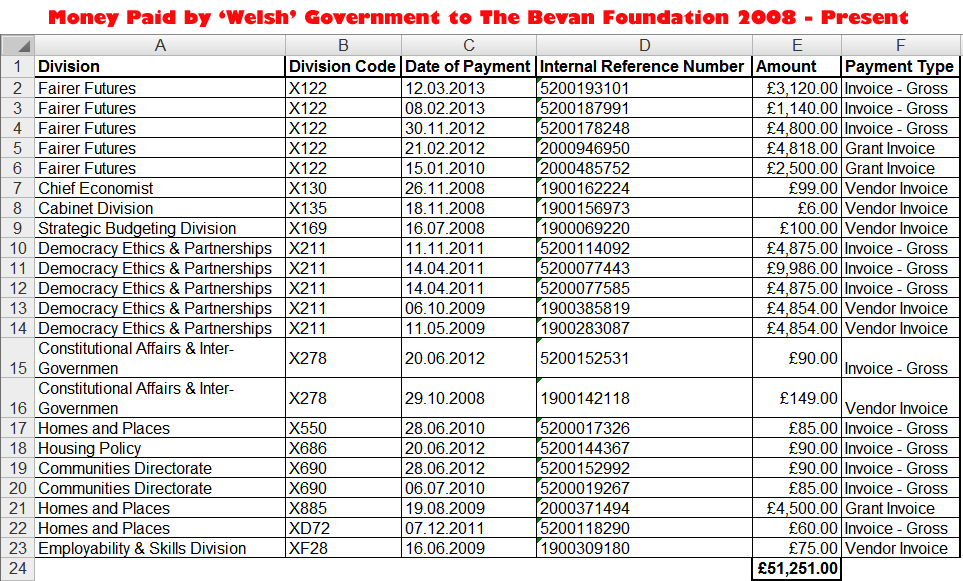
Between 2001 (the year the Foundation was formed) and 2008 the ‘Welsh’ Government handed over £20,270.50, and a further £51,251.00 from 2008 up to the present day (or whenever these figures were compiled). Making a grand total of  £71,520.50. The attachments I received were in Excel format but they may be read as PNG files on the right, click to enlarge.

You will note that the response tells me that not all the information I requested can be supplied because to collect and collate it would exceed the £600 limit set by the UK Government for processing Freedom of Information requests. If I have read this section correctly, then the information I have not been given is, 1/ who made the decisiBevan Foundation 2001 - 2008ons to allocate specific funding or work to The Bevan Foundation, and, 2/ if this was contracted work rather than grant funding, then did it follow a fair and open tendering process. Important points, I would have thought, given that we are dealing with an organisation in The Bevan Foundation inextricably linked with the Labour Party and its associated bodies.

Despite the sparsity of the information, I still believe we can draw certain conclusions. In the figures for 2001 – 2008, and in the column headed ‘System Reference’, I see ‘Fees’ cropping up regularly (though not for the larger amounts). So does this suggest work contracted to The Bevan Foundation rather than grants? By the time we come to the 2008 – Present table (using the new accounting method mentioned in the Bevan Foundation 2008 - Presentreply) we see in the ‘Payment Type’ column ‘Invoice’ against most entries. I take this to mean invoices from The Bevan Foundation to the ‘Welsh’ Government for work done on behalf of that body. So what kind of work was this?

The first one mentioned, in the ‘Division’ (of the ‘Welsh’ Government?) column, is ‘Fairer Futures’. But what does it mean? I assume it is in some way connected with the Fairer Futures Division of the ‘Welsh’ Government. (I bet you didn’t even know there was one!) Further down we see that close on thirty grand has been allocated to ‘Democracy Ethics & Partnerships’, for which I can find no information at all. Nor did the ‘Division Code’ X211 turn up anything on the ‘Welsh’ Government website. Also in the ‘Division’ column we can see, ‘Homes and Places, ‘Housing Policy’, ‘Employability & Skills Division’, ‘Chief Economist’, ‘Constutional Affairs & Inter-Government’, ‘Cabinet Division’, ‘Communities Directorate’ and ‘Strategic Budgeting Division’. So what does it all tell us? In case anyone is still in doubt . . .

In 2001 Labour politicians and activists set up a think tank to produce ‘reports’ favourable to the Labour Party. The ‘Welsh’ Government gives work to said think tank, thereby providing State-funded employment for Labour activists to produce Labour propaganda. In return for our generosity we get Reports and Surveys telling us that people without money are poor; that the world would be a better place if we were all nicer to each other; that people with somewhere to live aren’t homeless. Platitudinous bollocks we could get for nothing from an idiot savant like Forrest Gump.

Consequently, I think this is seventy-one thousand pounds wasted. Because it is used for no better purpose than to produce vacuous observations and naive wish-lists. Though this money from the ‘Welsh’ Government is not the only route by which Labour Party largesse reaches The Bevan Foundation. Because the Foundation also does ‘work’ for the Wales TUC and the Wales Co-operative Development Centre. And let us not forget the generosity of cash-strapped Blaenau Gwent council in helping the Foundation pay for a Research Officer . . . to produce yet more vacuous observations and naive wish-lists.

This is just an update to my earlier post; but if anyone reading it can see anything I’ve missed, or can ‘translate’ some of the codes used in relation to the ‘Welsh’ Government spending, then please get in touch.

Dolgellau, Dollywood, Hollywood, Bollockswood

There’s a little magazine that circulates in south Meirionnydd called Sybridion (Whispers), it comes out every couple of months. I generally pick one up in Tywyn when I get petrol. It’s basically a series of adverts fSybridion coveror small local firms which helps cover publishing costs and pay for things like ‘What’s On’ listings for village halls and other voluntary groups. I picked up the most recent issue yesterday.

Flicking through it I was drawn to a full page advertisement for something called Family Voices Ltd. (Left, click to enlarge.) Once I’d started reading the advert it quickly became clear that Family Voices is another attempt to make money out of the Family Voicescurrent fad for family history. Basically, getting people to talk to a camera – in the interests of ‘posterity’, you understand – then selling them a DVD of their talk at anything up to £895 a pop.

The puff was written by one Dominic A. Ghisays (who may live in Barmouth). He tells us that the founder and chairman of Family Voices is Arnold Matthews, “retired businessman and philanthropist who has recently made Dolgellau his new home town”. Ghisays continues by telling us that Matthews “wants to create local employment opportunities and to give something back to his new home town of Dolgellau (‘Dollywood’?) and Wales on the whole”.

I think I should tell you, Dominic, that the name ‘Dollywood’ is taken. It’s Dolly Parton’s theme park in Tennessee. Believe me, pal, you don’t wanna tangle with that ol’ gal! And why be so flippant and disrespectful about the name Dolgellau? (And “Wales on the whole”!) As if that wasn’t enough, a couple of paragraphs later, Dominic asks, “So, could Dolgellau be Wales’ answer to Hollywood?” Er, no. From what I can see you’ve got a couple of video cameras and a room in downtown Dolgellau yet you’re talking about taking on Spielberg. What are you smoking! Or is this Valleywood resurrected?

While this could all be dismissed as harmless fantasising, less funny was what I read in paragraphs three and four: “Arnold Matthews and his team are taking an ‘all inclusive’ business model approach by using local strategic alliances with local authorities, colleges, the third sector (other not for profit companies) and private companies. Recently, the company has secured an office and excellent studio space in the heart of Dolgellau, he has employed a full time local project manager and has offered a local college student studying computer science, a work experience opportunity recently”. So we have here another ‘Blanche DuBois‘ outfit, dependent on the kindness of strangers, an arrangement euphemistically – and, it must be admitted, imaginatively – described as “all inclusive”!

Undaunted, though against my better judgement, I went to the website, which you can enjoy here. On the home page I was greeted with a video by Arnold Matthews himself, who told me he was formerly head of the Family History Centre in Bedfordshire. There’s nothing in the video that is specific to Dolgellau, or to Wales; giving me the impressionFamily Voices contact that Family Voices may operate right across the land we love so dear, Englandandwales. Though rummaging around in the website did bring a few gems to light.

For example, the “local full time project manager” we read mentioned in a previous paragraph is none other than Dominic A. Ghisays himself. On the ‘Contact Us’ page we are given an address for Family Voices – ‘Hollywood Heights'(!) Dolgellau! Showing a commendable respect for their adopted homeland, its language and customs. Though it should be stressed that this is only a ‘regional’ office; the Registered Office is back in Bedfordshire, England. But as I’ve already confessed, I can’t resist a bit of digging, so off I went to the Companies House website to see what it could tell me about Family Voices Ltd.

Family Voices Companies HouseThe Company Number is 06944080. (Do your own search here.) There were some  intriguing details given. For example, before August 16th, 2011 the company was known as the ‘Open-Door’ Club Ltd. But only a year earlier – on June 22nd, 2010 – it had changed its name from ‘Rent-A-Bond Ltd’. There is a Secretary mentioned, named Derek Skinner, who lasted just one month in 2009. There is no one else listed as being connected with the company . . . other than ‘Alfred Matthews’. Though, confusingly, on Linkedin there is an Arnold Matthews listed as owner of Rent-A-Bond Ltd. (Anyone signed up to Linkedin might care to check the details.) Then, according to DueDil, it is Alfred rather than Arnold. DueDil also suggests that Family Voices Ltd is not in robust financial health. (What’s more, it tells us Alfred Matthews is 86!) Why the company name changes? Are ‘Alfred Matthews’ and Arnold Matthews the same person?

I am not suggesting that Mr. Matthews (Alfred, Arnold or both) and Mr. Ghisays are involved in anything naughty, though I do wonder how a financial services company like Rent-a-Bond Ltd mutated into a fluffy genealogy business called Family Voices. Another mystery is how those involved with Family Voices Ltd will gather and properly edit the reminiscences of elderly locals speaking a language they don’t understand.

Arnold Matthews may be nothing worse than a harmless old duffer unsure of his own name who, for whatever reason, thought it a good idea to relocate to Dolgellau. (The puff in Sybridion talks of “his new young family”!) Even so, I would be rather concerned if the council to which I pay my council tax had any financial involvement with Family Voices. And I would like to know by what route Family Voices Ltd came by the “office and excellent studio space in the heart of Dolgellau”. Are these facilities rented or leased, or were they some kind of gift?

Family Voices Ltd is a private company offering a ‘service’ that anyone with elementary IT skills could deliver. Even so, the company is free to advertise for business, but that business must be conducted on a commercial basis, without public hand-outs. Though surely this service could be provided by Coleg Meirion-Dwyfor, the local sixth form college from which (presumably) Family Voices plans to recruit a student for ‘work experience’. It would give the students practical training and open up an income stream for the college. College involvement would also mean the provision of a bilingual service. So why does anyone need Family Voices Ltd?

Miscellaneous Musings

SCOTLAND 2014

Another Labour big-hitter, former Lord Provost of Glasgow Alex Mosson, has said he’ll be voting Yes in the September 2014 referendum on Scottish independence. I think we’ll see many more such declarations between now and referendum day. I say that partly because leaving the big decisions with London is less attractive than in previous decades simply because the modern Labour Party is so little different to the Tories.

What’s more, with the reduction in the number of Scottish MPs there’ll be a consequential reduction in those MPs’ clout. The days of Scotland sending forty or fifty Labour MPs down to London to influence, if not control, Labour governments is a thing of the past. More and more Scottish Labour supporters are realising that their wishes – be it changes they want made, or services and benefits they want to retain – are more likely to met in Edinburgh than London. Yet devolving more power to Edinburgh will result in even fewer Scottish MPs – with London still retaining control over defence, macroeconomics, foreign affairs and some forms of taxation. When faced with that prospect many Labour supporters will view independence as the better option.

For as The Scotsman said in reporting Alex Mosson’s decision: ‘He (Mosson) said the historic vote next September is “not about the SNP, or Labour or any other political party”. A Yes vote would help boost Scotland’s self confidence, grow the economy and make society fairer, he claimed.’ Exactly. This debate has long past the SNP v The Rest stage. It’s about what’s best for Scotland. Between now and September 18th next year I expect many more Labour supporters to come around to the view that the best option is independence.

BEVERLEY! BEVERLEY! ARE YOU OUT THERE, BEVERLEY?

A couple of months ago someone managed to break into my blog and make a few changes, such as an image of steaming dog turds in the header. Nothing really damaging; it was as if someone was just letting me know they’d been here. I have since changed the Log In password to a load of gobbledygook that even I can’t remember.

Then, in the past couple of weeks, I’ve received a dozen or so e-mails addressed to Beverley@jacothenorth.net. All from banks, or Companies House, with one from H M Revenue and Customs. All official looking and alJacquesl with attachments. As far as I’m aware there is of course no such e-mail address. I certainly haven’t set up one. So why would anyone else take out such an address?  Odd.Jaco

But then, as I’ve said before, I am getting unwanted attention from a few sources, with others trying to impersonate me. One being ‘Jacques du Nord’, whose e-mail address is jaconorth@btinternet.com. I have sent an e-mail to that address asking why he or she is impersonating me, but of course I’ve had no reply. Another minor irritant is jaco the north, to whom anyone trying to access my old Google Blogger account is directed. But I’m philosophical about these things, they’re nothing that a bottle of Argie red can’t put into perspective.

Less easy to laugh off is news I received last week from  my host (in Dyffryn Silicon, Aberaeron). It seems my blog came under attack on November 12. Many of my host’s clients complained that their websites were slow or at a standstill, with the answer to the problem coming from his server in Texas, who had “restricted” the service “to avoid a complete collapse”. The issue was that my blog had come under sustained attack in the hope of bringing it down. My host traced the culprit’s IP address given him by the server – 62.219.8.230 – to Israel. Which I find rather disappointing, given my support for Israel.

Still, I suppose it’s better than being ignored.

POWER TO THE PLONKERS!

Politicians, political commentators, anoraks, interested bodies, and Uncle Tom Cobbleigh an’ all have been getting excited about today’s announcement of further powers being devolved from London to Cardiff. Among these powers is the ability to set business rates and er, that appears to be it, apart from powers (after a referendum) over income tax. But this would be under a ‘lockstep’ sysyem, which would mean that reducing the lowest rate of tax would have to be applied, penny for penny, in the higher tax bands. Oh yes, there was also mention of borrowing. In other words, a poor country being allowed to go further into debt. But these new powers, we are told, make Wales more like Scotland.

Let me explain why it’s all a load of bollocks. Unlike Scotland, Wales is close to all the major English conurbations bar one. That one, the Tyne-Wear conurbation, is still 150 miles from Glasgow. To a far greater degree than Scotland, Wales suffers from cross-border institutions and ‘arrangements’. Unlike Scotland, Wales lacks her own legal system, education system, financial sector, media, cultural life and other features of nationhood that have, over centuries, created an indigenous middle class which, even though many of its members might oppose independence, will always defend what is uniquely Scottish. Which is why Scots live in Scotland, and we live in Englandandwales.

Giving more power to those buffoons down Cardiff docks is bound to result in that power being misused; is bound to make Wales poorer; and is guaranteed to lock Wales even more firmly into the Englandandwales framework. Let me explain. Thanks to the socialist culture prevailing here there is an obsesssive desire to prove how more ‘caring’ we are than the English, and especially them wicked Tories, to whom we must always send ‘messages’ . . . achieved by, um, voting Labour. The more power (and sources of funding)  ‘Wales’ has, then the more freedom the aforementioned buffoons have to show the world what a bunch of altruists inhabit this little corner of Europe.

If the ‘Welsh’ Government has more power to make Wales more ‘caring’, then I can predict with certainty – based on countless examples from the past decade and a half – what will happen. Shysters will slip over the border to take advantage of the funding. The halt and the lame, the workless and the degenerate, will appear as if by magic. Englandandwales bodies will heap upon us fulsome praise for being so caring . . . then transfer their ‘clients’ and ‘service users’ to properties in Wales that our politicians have helped them buy. In short, we shall be taken advantage of. Wales will become both poorer and more English. But to even whisper that we are being exploited, or to dare question why another three busloads of ‘homeless’ ex-cons have turned up in Swansea will make us, not only ‘uncaring’, but ‘racist’.

Increasing the potential for such disaster by giving more powers to a bunch of left-leaning incompetents driven by the desire to please the Third Sector and get Brownie points off the Guardian is not only a mistake – it’s positively bloody dangerous! Which might explain why the UK government has given Carwyn Jones and his gang more rope more powers.

The Bevan Foundation

It all started with a tweet, last week, someone drawing attention to a post on the Bevan Foundation blog. This post, I think. Doesn’t really matter. As you can probably guess, the Bevan Foundation is not a site I visit regularly but, summoning up my courage (and clutching my crucifix) I ventured deep into this forbidding realm of socialist gobbledygook. Soon forgetting about the post that had drawn me hither as my attention was grabbed by other things I read.

In the ‘About Us’ section, we learn that the Bevan Foundation regards itself as an “independent think tank”, is a “company limited by guarantee” and “registered as a charity in 2004”, then: “We take our name from Aneurin Bevan, founder of the NHS and welfare state. Although he was a Labour politician, Aneurin Bevan is today remembered for his achievements to make society fairer”. Which struck me as an odd way of putting it; for it could be read: ‘Despite being a Labour politician Bevan nevertheless believed in fairness’!

(In contrast to the websites of other organisations the Bevan Foundation’s seems somewhat reluctant to give its company number, 04175018; and its charity number, 1104191. This is how it should be dERDFone.)

At the foot of the page I came across these two logos. The blue one I recognised from having used it, or something very similar, myself. It is the logo recipients of European Funding must use on their communications, websites, etc. In Wales, this money is usually doled out by the Welsh European Funding Office, set up by the ‘Welsh’ Government to disburse EU funding; though when I spoke with WEFO they denied that The Bevan Foundation had received funding from them. The other logo tells us that the Bevan Foundation has received funding from Communities 2.0, a “digital inclusion proCommunities 2ject” offering “free training and support to small enterprises”.

In what I confess was a rather cheeky attempt to get further information on funding I submitted a FoI request to The Bevan Foundation, knowing in advance it was exempted from this legislation. Even so, I received a polite reply from Victoria Winckler, Director of the Foundation, which read:

How we are funded.“Thank you for your request under the Freedom of Information Act for information about the Bevan Foundation.  The Bevan Foundation is not a public body, nor does it receive sufficient public funding for it to be considered as such, and it is therefore not covered by the Act. You will however find information about the Foundation’s income, including our audited accounts, on the Charity Commission’s website.”

According to the panel, taken from its website, The Bevan Foundation “doesn’t get funding from government or any political party”, yet the ‘Welsh’ Government logo linked to the ERDF logo suggests otherwise. And seeing as Labour has been in power since 1999 it rather undermines the claim to be getting no funding from government or any political party. (Getting the funding at one remove doesn’t change anything.) Equally untrue is the claim that The Foundation is an “independent think tank”. It was set up in 2001 by Labour politicians to counter the Institute for Welsh Affairs, which Labour thinks is too ‘Nashie’. It may have been entirely co-incidental that 2001 was also the year the European lucre started rolling into Wales.

Returning to Communities.2, this funding is distributed by another outfit with Labour links, the Wales Co-operative Centre and a few ‘partner’ organisations (one being the in-a-hole-and-still-digging corruptionCarmarthenshire County Council). So where does the Co-op get the money from? Well, that’s the ‘Welsh’ Government again. And where does the ‘Welsh’ Government get the money from? Again, from those generous people on the Continent through the European Regional Development Fund. Two logos, same money, same source.

I sent a further e-mail seeking a breakdown of the rather vague ‘Research income’ given in the documents submitted to the Charity Commission (£60,731 for the year ended 2012; £84,976 for the previous year). This elicited another polite response from Ms Winckler saying that the exact amounts were confidential, but the organisations for which the Foundation had worked could be found elsewhere in the report submitted to the Charity Commission. So I looked. (Incidentally, let me make it clear that I responded in kind. This was a brief but very civilised exchange. So there!)

If I have read and understood the report . . . the bodies for which The Bevan Foundation is doing work are, the Wales TUC and the Wales Co-operative Development Centre. Then, in the ‘Restricted Funds’ section, we learn that it received £4,875 from the ‘Welsh’ Government’s New Ideas Fund, and a further £4,015 from the ‘Welsh’ Government for an ‘Equality Festival’ held in Ebbw Vale in February 2011. (I never got an invite!) Finally, the report also tells us that in 2012/13 the Foundation will be “employing a research office” (sic) thanks to the generosity of (Labour-controlled) Blaenau Gwent County Borough Council. Oh, and the Communities 2.0 grant I mentioned earlier, well,  that amounted to a “£4,665.40 package of support by Communities 2.0 to network their computers to a central data storage facility, update their website and for google analytics training. Additionally The Bevan Foundation received 28.5hrs of ICT support and consultancy assistance”. A detailed FoI has also been submitted to the ‘Welsh’ Government asking how much money, and by what routes, has been channelled to The Bevan Foundation, but I ain’t holding my breath on that one. So what have we got? Here’s how I see it.

As the name suggests, The Bevan Foundation is an adjunct to the Labour Party. As such it should not be receiving funding from the Labour Party, the ‘Welsh’ Government, local authorities controlled by Labour, or third parties funded by the ‘Welsh’ Government.

The EU has given Wales money in the expectation that we would use it to drag ourselves out of the spiral of economic and social decline we have suffered for over thirty years. Yet after twelve years of such funding those areas that voted for devolution in 1997, the same areas that qualify for the highest level of EU funding, are poorer now than they were then. This is why . . .

Instead of using the funding to tcorruptionrain people in new skills, on infrastructure, and enterprise, the funding is squandered on schemes and projects that are politically correct rather than economically viable, often run by people who were able to smell the funding from a great distance; schemes that create employment only for those running them; schemes that rely solely on EU (and other) funding and are incapable of growth – not least because of duplication – yet a mirage of entrepreneurialism is created by the funding being broken up and re-packaged, passed on to other third sector groups; allowing grant-reliant charities, social enterprises and community groups to be presented as ‘businesses’. And with every scandal it becomes ever clearer that a disproportionate number of those benefitting from this system are Labour Party members and supporters, often using the funding to disseminate Labour Party propaganda, and other information that might be of benefit to the Labour Party.

It truth, the only real achievement of EU funding in Wales has been the underwriting and strengthening of the pre-existing system of Labour Party patronage, cronyism and nepotism. In short, corruption . . . with the added felony of money laundering. What we see today is the party of power, the party holding the purse-strings, rewarding its supporters, as happens in the Third World that Wales will soon join. Though were this happening in Korruptistan then the ‘serious’ publications in London, Newsnight, even, might take an interest . . . but, Wales? nah, who cares?

The day Thou gavest, Lord, is ended

Today marks the centenary of the Senghennydd mining disaster, the worst ever in the UK, that claimed the lives of 440 men and boys. It was commemorated with various events in Senghennydd including the unveiling of a statue remembering all who died in Welsh mining accidents. Idrisyn headstone

Many who died at Senghennydd in 1913 had travelled there from other parts of Wales, but you wouldn’t have known that from reading this morning’s Wasting Mule, which did a panel piece on someone who’d moved from West Sussex! Doesn’t the Mule realise that the whole point of a Welsh newspaper is to cover Welsh news, and other news from a Welsh angle? Senghennydd provided an opportunity for the Mule to live up to its claim to be the ‘National Newspaper of Wales’ by bringing together the various parts of the country; but no, the Mule, as ever, had to look at Wales from an English perspective.

I mention this because I was fortunate enough to take part in a little ceremony of remembrance myself on Saturday. Due to my wife and her sister being collateral descendants of Edward Jones Humphreys of Abergynolwyn who, by the time he died at Senghennydd – and by a route the ladies have yet to establish – was universally known as ‘Idrisyn’. When the local quarry closed he made his way south with his brother (wife’s taid), and their sister, who was there with her husband. (Click to enlarge image.)

The fact is that Wstatueales in the nineteenth and early twentieth centuries experienced considerable internal migration which, for whatever reason, is often neglected. Too many prefer to concentrate – a la Mule – on migration into or out of Wales. Of my eight great-grandparents four came up to Swansea from the west, Carmarthenshire and Cardiganshire, places like Meidrim and New Quay. Most of those who came to work in the local Bryneglwys quarry here in south Meirionnydd came from Montgomeryshire, Caernarfonshire or further afield.

Returning to Senghennydd, I cannot avoid saying that I am disappointed with the statue. (Click to enlarge.) Isn’t it a bit, well, unimaginative? Crass, even? And another thing, the two portrayed are obviously survivors of some tragedy or other, so how do they commemorate the dead? Don’t get me wrong, I’m not saying that a statue commemorating the dead has to be composed of corpses, but this statue looks like the kind of ‘heroic’ and inspiring public art that could be found in every shit-hole town in the Urals circa 1965. It’s almost a caricature of communist propaganda statuary. In profile, the miner holding the lamp even has a passing resemblance to Lenin!

Surely the obvious inspiration for any statue commemorating the dead of Welsh mining disasters is that iconic image of the young girl, with the baby wrapped in a traditional shawl, shielding her eyes and looking into the distance. (Click to enlarge.) For these countless disasters may have taken the lives of thousands of mother shawlmen and boys, but once dead they were – as my mamgu would say – ‘out of it’. The real suffering then was that of those who remained, the widows and orphans, so perfectly characterised by that sublime image. And, yes, it is also a memorial to the dead, for doesn’t she represent countless thousands of women and girls looking, waiting, for husbands, fathers, brothers who are never going to return?

So why did the chosen statue have to be so in-yer-face? Did those who made the decision fear that visitors would be bewildered if confronted by anything needing a little thought and reflection? Isn’t that the whole point of art? Even public art?

A lot of sincere people in Senghennydd and the surrounding area have done a wonderful job of giving us another genuinely national institution. Making us all remember an important date in Welsh history, from a time and place that now seem so distant. They should all be proud of what they’ve done. Unfortunately . . . the centre-piece, the statue-memorial, was not an inspired choice. I’m sorry, folks, it was the wrong choice.

Fleece Jacket Fascists

This year saw a heated debate that most Welsh people would have been unaware was even taking place; not surprising seeing as it was about Marine Conservation Zones in the north west. Eventually, the protests of commercial fishermen and others saw the ‘Welsh’ Government do a U-turn. These Zones had been proposed with the support of the Countryside Council for Wales, now subsumed into Natural Resources Wales, and the Marine Conservation Society. The first of those bodies is run by the ‘Welsh’ Government, while the other seems to be yet another in the unending list of Englandandwales outfits. (Remember all that talk of devolution? Do you think it will ever happen?)

At the other end of the country we have seen a remarkably similar story, with very similar groups (one, the same) opposing the plan for a motor racing circuit in Ebbw Vale: first it was The Gwent Wildlife Trust, then the Open Spaces Society got in on the act before, finally, our old friends, Natural Resources Wales piped up. I made my position on the Ebbw Vale project clear in this recent post, and I shall repeat it here. If this project can deliver real jobs to the Heads of the Valleys for Welsh people, then we must support it, and ignore the objections. But earlier this week we were told that the ‘Welsh’ Government had put the project ‘on hold’. Seeing as the Assembly is in recess this decision was almost certainly taken by civil servants. Given the background of so many top civil servants in Wales we should not be surprised to see them support protests from what are, essentially, middle class English groups. Their people.

What I now realise from these and other sources is that we have a burgeoning sector of ‘Welsh’ life that is usually alien in its composition, and often hostile to Welsh interests in its policies and attitudes. The fleece jacketmembers of this sector, found all over Wales, can be recognised by their distinctive ‘uniform’ of the fleece jacket. They can be found patrolling our National Parks and nature reserves; we may know them as ‘rangers’ or ‘guides’; they may be working for the National Trust, the RSPB, Woodland Trust, countless wildlife and archaeological trusts, etc., etc. Unless the Welsh language comes into play – as with the Snowdonia National Park – then the practice in the fleece jacket industry is to not employ locals.

How do they get away with it? Simple. In today’s carefully nurtured political and social climate, in which wicked humanity is destroying the planet, a serial killer would be forgiven if he was ‘protecting dolphins’, and Hitler himself could come back and be rehabilitated if he was saving the habitat of some rare and exquisite orchid. More practically, the fleeces always have friends in high places. One was Jane Davidson, Minister for Environment and Sustainability from 2007 to 2011. Among the policies Davidson wanted to introduce was that of opening all Welsh rivers, lakes and waterways to her canoeist friends. It is of course entirely coincidental that Jane Davidson is English, and went to a private school; as is the fact that upon leaving politics she became Director of the Wales Institute of Sustainability and a spokesperson for the Ramblers Association.

Let me end by addressing something some of you may be thinking – that I’ve gone OTT with my description of these people and, consequently, the title of this post. Well, in my defence I would ask you to ponder this. We now have in Wales an army of fleece-jacketed, dictatorial outsiders who view ‘Wales’ through the prism of the group they represent – the English middle class visitor or settler. Too many of this group regard Welsh people as a blot on ‘their’ landscape, marring ‘their’ idyll. They’re in Wales, uninvited, telling us what we can and cannot do. Much of what they do (and wish to do) is inimical to our best interests, yet they do not have a single democratic vote to justify the power they possess and the influence they exert. So what would you call them?

And I haven’t even mentioned the funding. For very often the ‘Welsh’ Government – i.e. you and me – is funding these people to work against Welsh interests so that Wales can be saved for them and their friends. What a bloody system!

The Leaving Of London 2

More information has come to light that justifies another post on the subject of encouraged population movement out of London, and indeed, from other parts of England. To begin with, after seeing the video in the previous post a number of people contacted Swansea council. This was part of the response received by one inquirer.

“The information film I believe you are referring to relates to an old scheme called LAWN (London Authority Waiting List Nominations).  A video clip about the scheme has been circulated by email in recent days and we have received a number of enquiries about this. I can confirm the scheme is no longer operating in Swansea and has not done so since early 2007 . . .

 . . . There are currently no plans for large-scale transfer of individuals and households from London waiting lists into our own housing stock and we are not engaged in dialogue with London Councils to this effect. We have contacted our Housing Association partners locally who have confirmed the same”.

Now everything said by that Swansea council representative could be completely true . . . and totally misleading. Let’s start with the first paragraph. LAWN is the official or alternative name for the ‘Out of London’ scheme dealt with in the video. As this document, Housing mobility schemes, from the House of Commons Library, tells us, the LAWN scheme was privatised in February 2004 to a company called Scout Solutions UK, who cocked-up and soon lost the contract. The LAWN project is next administered by Housing Moves, also by Housing Partners which operates much more widely and claims to have formed “partnerships” with 660 councils and housing associations across the UK, all “finding innovative answers to difficult social housing mobility HomeSwapperproblems”. I haven’t had time yet to go through all Housing Partners’ “products”. (Right.)

Let’s go back briefly to the House of Commons Library document. If you follow the highlighted passages you’ll read (Page 6, ‘General Transfers’): “The (Housing Mobility) Taskforce (2010) recommended that transfer applicants should not have to compete alongside new applicants for local authority housing”. This seems to say that a social housing tenant transferring from say, London to Swansea, gets priority treatment. Was this recommendation adopted? The document also mentioned four other agencies engaged in social housing moves: HomeSwapper, House Exchange, Abritas (which seems to be a software company, like Scout Solutions), and Locata.

But it’s not just social housing. Here’s another interesting scheme I unearthed, the HomeStart Scheme, operated by the Royal Borough of Kensington and Chelsea. This gives people the chance to move into private rented accommodation. With funding provided for train tickets to view properties, a 12-month tenancy, deposit (bond) and rent paid in advance, plus financial help with removals. So let’s say someone from Kensington and Chelsea takes out a private rent in Ceredigion, but doesn’t like it . . . no probs, cos after 12 months they’ll qualify as ‘local’ and can demand social housing! And we can be sure that K & C isn’t the only council operating this scheme.

A very similar scheme is The Fresh Start Scheme, described as “A private renting out of London scheme”. If I’ve read the leaflet put out by Hackney Council properly, then it even urges Londoners to find their own property or area. Other London councils operate this scheme.

There clearly exists a bewildering plethora of schemes to get the unemployed and unemployable, the sick and disabled, and the economically unviable out of London. And there are other schemes I haven’t mentioned! Clearly, there’s a hell of a lot of duplication here. Duplication means money wasted. In the old days you put your name down for a council house and waited your turn . . . maybe had a quiet word with a councillor or two. Now Welsh social housing providers are linked into a UK-wide network that does not serve Welsh interests

City of WestminsterFurthermore, this ‘national’ network means that anyone can apply for a property anywhere, which, on one level, is perfectly acceptable, if people wish to move voluntarily. But when it’s tied in with regional disparities in wealth and property values, and there is a strong element of legal coercion involved, then it simply provides mechanisms for the richer parts of the UK to relocate their unwanted populations onto the poorer areas.

This would be bad enough were it happening within England, but when, fourteen years into devolution, it allows England to off-load problems onto poor Wales, then it becomes unacceptable.

Here are a few other points worth remembering:

  • There have long been in existence mechanisms for relocating criminals although, as you can imagine, getting information on such schemes is almost impossible, not least because of the involvement of the Probation Service for Englandandwales. I have dealt with this problem here and here. More recently in Neighbours From Hell.
  • These moves out of London are one-way tickets, as the video used in the previous post makes clear. Spelled out again by Ealing council: “Before joining this scheme it is important that you are sure you want to move out of London. If you decide you want to come back to Ealing later on, it is unlikely the council will be able to help you.” Make no mistake! These schemes are designed to get the ‘unproductive’ out of London for keeps.
  • Another advantage of taking a private rent is that the shittier the accommodation the quicker one qualifies for social housing in an area with which one may have no links. This is both an incentive to slum landlords and encouragement for those prepared to put up with shitty conditions for a short time.
  • Also remember that anyone qualifying as ‘homeless’ immediately goes to the top of the queue. In the area where I live the favourite trick is to come into the area, rent a small, totally inadequate caravan, then demand social housing and all the accompanying benefits.
  • The schemes listed above, and the conditions in which they operate, will soon be overwhelmed when the new rules start to bite. I’m talking now of the benefit caps and ‘spare room’ legislation.

Finally, returning to the statement from Swansea council, let’s look at the second paragraph I’ve used. There are currently no plans for large-scale transfer of individuals and households from London waiting lists into our own housing stock . . . “ There may be no “large-scale transfers” planned, but there is a steady influx due to all the schemes that the council and various housing associations operating in the city have signed up to. I suspect that “large-scale” was used here to cloud the issue.

Anyway, Swansea is just one council out of twenty-two. But this statement takes no account of English local authorities buying property in Swansea, or elsewhere in Wales. Nor does it consider English councils doing deals with private landlords in Swansea, and all over Wales. And it certainly doesn’t take account of the activities of charities, such as the YMCA and Green Pastures, dealt with in two recent posts, here and here. Putting it all together, there are certainly dozens, possibly hundreds, of schemes and organisations bringing into Wales people we don’t need, don’t want, and would be better off without.

This influx of a benefit dependent population, many of whom are criminals, or have alcohol or drug ‘dependency’ and other problems, is an increasingly widespread problem in Wales that more and more people are becoming aware of. It’s now time that the ‘Welsh’ Government got to grips with an issue that is costing Wales a great deal of money we can’t afford.