I don’t know about you, but I don’t like being lied to. Obviously, when it’s your children, or grandchildren, you often suppress a smile before putting them straight. But when it’s a corporate body as powerful and influential as the British Broadcasting Corporation, then it’s an entirely different matter.
For this is a source of information beamed into just about every home on this island and still trusted by most people.
That trust is misplaced, for the BBC is now the state broadcaster, the voice of the London government and, more insidiously, the voice of Britain and a stultifying Britishness. This latter role results in the BBC misinforming people in Scotland and Wales about their homelands, and it also results in people around the world being given a deliberately distorted view of events in these countries.
Propaganda is one thing, every country and all governments put out propaganda to a greater or lesser degree, but what makes the BBC different is that we are paying for it. From April 1st the cost of a colour television licence fee is £150.50.
So we are paying to be lied to!
click to enlarge
It was this realisation, and the thought of some campaign against the propaganda machine that prompted the tweet you see above. This tweet encouraged the guest post you’re now going to read.
♦
A GUEST POST BY BRYCHAN DAVIES
Jac suggests on his twitter feed a campaign of non-payment of the television licence fee in light of the now clear editorial bias of the BBC in favour of the union, regularly demonstrated in the coverage of Scottish affairs.
click to enlarge
I have therefore taken time to look at how the television licence fee is spent, what happens in Wales, and what happens in the rest of Europe.
A two frame spreadsheet is attached.
click to enlarge
In the first frame I have divided the total BBC revenue for the television licence according to population of the countries within the union. The cost of the TV licence is the same in all countries. I have then extracted from this the services provided specifically to Wales, like the two ‘regional’ radio stations, the spend on S4C and then a population proportion for English language television broadcasts, online content, and administration, where Wales is treated as a ‘region’.
In the second frame I have listed the television licence fee payable in other countries in Europe, including countries where the licence fee has been recently abolished.
◊
WALES
You will notice that income from TV licences issued in Wales is £180m per year while spending on all services the BBC provide to Wales is £240m per year. Some would argue that this is a subsidy of £60m per year. Those who are hostile to the Welsh language would argue that this is S4C (£76m per year) but for this to be true, all Welsh speakers have four eyes and are able to consume both English and Welsh content simultaneously. Previously only £70m of S4C revenues was not funded by the BBC and directly funded from direct taxation via the Whitehall department of Media and Sport, prior to that all of S4C was funded by DCMS.
click to enlarge (but it only makes JM look bigger!)
The issue with ‘state financed’ content is that if it costs £10m to make a content series this does not change, whether 3m people consume it or 55m people consume it. Only commercially financed content has a ‘break-even’ point in terms of viewers.
◊
DEVOLUTION
Plaid Cymru argue that ‘broadcasting should be devolved’. If this happened and the full array of BBC content currently available in Wales was to be maintained, the licence fee in Wales would need to increase from £147pa to £200pa or the shortfall financed through the block grant.
◊
INDEPENDENCE
The reality is that the BBC is a unionist institution and while the population are fed a steady stream of ‘Eastenders bake a cake on Countryfile while Dancing in Coronation Street’, content which could alternatively be provided by commercial broadcasting on Sky, ITV, C4, C5, and others. What comes with the BBC, it’s USP, is a ‘unionist’ news service and content which in the last few years are broadcast as ‘Great British Bake-Offs’, an obsession with World War One documentaries and empire nostalgia dressed up as ‘lifestyle’ and ‘heritage’.
click to enlarge
◊
CONCLUSION
A true Welsh nationalist would have to ague for the abolition of the television licence fee, and that any BBC content imported and consumed from England be on the basis of commercial subscription, as applies in the Irish Republic. This would also mean that Wales only content would either be financed by…
commercial activity only
One of the effects of making BBC imports a subscription pack is that more people consume content on other commercially available transmissions. This would result in a massive increase in the value of commercial sales advertising on Welsh channels.
from a much lower Wales only licence fee
To fund the £76m for a Welsh language channel, a Wales News channel in the English language at £20m with entertainment content purchased globally, the 18m of Radio Cymru and the £20m for Radio Wales giving a £100pa Welsh licence fee.
direct government grant for this from general taxation of £134m
Radio Wales can be based in the existing facility in Swansea, Radio Cymru can be based in the existing facility in Bangor and the English language TV channel can be housed in the new S4C facility in Carmarthen giving greater capacity utilisation. The most difficult issue in any of these options is having to demolish that new building currently squatting outside Cardiff Central railway station, where a bus/tram interchange should be or selling it off to fund transition costs.
♦ end ♦
Jac adds . . .
Since the poisonings of Sergei Skripal and his daughter Yulia on March 4th the BBC has slavishly toed the official line that it was Putin what done it. The nerve agent involved was quickly identified and attributed to Putin’s henchmen. Following the attack the USA and other countries fell into line and expelled Russian diplomats. It unfolded so neatly that it looked almost choreographed.
The BBC is still telling us that, “The British government says a military-grade Novichok nerve agent of a type developed by Russia was used in the attack on Sergei Skripal and his daughter Yulia”. So who in the British Government has the expertise to identify nerve agents – David Davis, Boris Johnson, Gavin Williamson?
In matters like this the experts are to be found at Porton Down, the UK’s centre for chemical and biological warfare. On April 3rd Porton Down’s chief executive, Gary Aitkenhead, told us they could not prove that the agent used to poison the Skripals had come from Russia. (Given that Aitkenhead is Scottish maybe it’s only a matter of time before the Daily Mail attacks him for being a ‘Sturgeon stooge’.)
This announcement clearly undermined the UK government’s case against Russia. Which is almost certainly why the BBC’s main Six O’Clock News programme on April 3rd ignored it entirely, and led with the important story of a 96-year-old man going into hospital for a hip operation.
Folks, we have a serious problem on our hands. We are paying to be lied to. Either they stop lying or we must stop paying.
I’m old enough to remember the term ‘Wales and Monmouthshire’ being used, which gave us the thirteen old counties, and then there were the four county boroughs (Swansea, Cardiff, Newport and Merthyr).
This system was swept away by the Local Government Act 1972 which in 1974 gave us a two-tier system of local government, made up of eight counties, thirty-seven districts, and, if I counted them all, 43,736 councillors. It was probably the most absurd system of local government ever devised by man.
Mrs Jones would go her district council office with a query or a complaint only to be told that the issue vexing her was a matter for the county council. (And vice versa.) To further confuse us I seem to recall that responsibilities were often shared or split. Didn’t district councils collect the rubbish but counties dispose of it?
The obvious thing to have done, of course, would have been to do away with the districts leaving us with eight good-sized unitary authorities. But no, this is Wales, and other factors influenced decisions. Such as lowering the minimum population level to 60,000 so that Merthyr could be one of the new unitary authorities.
Quite obviously, twenty-two local authorities – and Powys having more councillors than New York City – is no real improvement on the two-tier system in a country of just over three million people.
The two local government reorganisations introduced in 1974 and 1996 were the work of the UK government and the Boundary Commission with considerable input from political parties and others. But now the power lies with the ‘Welsh’ Government.
For this is the age of devolution; Wales is a land of milk and honey, where lambs frolic under the planet-saving wind turbines (watered daily by the local hippies). Freed from the tyranny of labour by the introduction of AI we fly from Cardiff airport to our villas in the sun – even those from the north can reach Cardiff International in two or three hours on the new motorways and train lines that traverse the land. Students from Vladivostok and Valparaiso fight to get into the Assembly in order to see and hear for themselves our leaders, men and women globally renowned for their wisdom and their probity. Poverty is forever banished, everyone has a nice home and a new electric car or three . . . and I really must lay off the Malbec.
Back to reality. For a few years now the ‘Welsh’ Labour Government down in Corruption Bay, that monument to the late Nicholas Edwards, has toyed with the idea of yet another round of local government reorganisation. The subject seems to surface from time to time, often when Labour needs a distraction, or wants to be seen as ‘visionary’.
In the previous, two-tier system, the north had two counties, Clwyd in the east and Gwynedd in the west. In the map above you’ll see three counties mooted for any future reorganisation. But why?
I suggest that the answer lies with the Labour Party itself. Lump together Flintshire and Wrexham and you create a council that might just have a Labour majority, or certainly a council that could be run by Labour in coalition with Plaid Cymru and/or assorted Independents. (There being no less than three different Independent groups on Flintshire council!)
But add Denbighshire to the mix, where Labour currently has 13 (out of 47) councillors, and a resurrected Clwyd would be much less likely to be a Labour fiefdom. Which makes the union of Flintshire and Wrexham far more acceptable to the bruvvers.
This would leave the combined Denbighshire and Conwy with the burden of almost the whole of the north coast and its problems, ranging from the importation of criminals and assorted deadbeats into Rhyl and other towns to the granny trafficking that gives this littoral its nickname of the Costa Geriatrica.
Gwynedd and Ynys Môn is a natural unit in every way and of little interest to the Labour Party. Though in the former Gwynedd these two were joined with Conwy.
Moving south, to other areas where Labour has little chance of success (and consequently little interest), we see that the ‘Welsh’ Government has no wish to change the status quo or the status quo ante, with Powys left untouched and Dyfed reborn.
◊
THE STEAMY SOUTH
Now we move into the south, where Labour most definitely does have an interest in the new boundaries.
First, Swansea Bay, where my understanding is that Swansea and Neath Port Talbot councils have already agreed in principle to merge, thereby formalising what is happening on the ground, with Amazon’s ‘Swansea’ distribution depot and Swansea University’s new Bay Campus both in Neath Port Talbot.
Aerial photo (courtesy of Swansea University) from 2013 showing the old, Mumbles Road, campus, top star; and the yet to be built Bay Campus, lower star. Also shown: River Neath, M4, Port Talbot to the left, Swansea to the right. Click to enlarge.
Next, it’s suggested that Bridgend links up with Rhondda Cynon Taf and Merthyr. Which makes a certain sense in that they are three staunchly Labour areas covering the central valleys and approximate to the old Mid Glamorgan. Things get more complicated, and contentious, as we move east.
Cardiff and the Vale of Glamorgan comprised the county of South Glamorgan under the two-tier system, and it’s proposed to bring this back. This respect for history must be the reason for the proposal, and not the fact that the Vale is (with the help of an Independent) a Tory-run authority, with Labour holding just 14 of the 47 council seats.
Merged with more populous, and Labour voting, Cardiff, the proposed new authority would almost certainly have a Labour majority.
◊
GWENT
Moving yet further east, things get really, really complicated.
Under the two-tier system Gwent was one of the eight counties, now it’s proposed to link Newport with Caerphilly, while Monmouthshire merges with Torfaen and Blaenau Gwent. The first we can almost overlook, seeing as it brings together two Labour areas, but the second is gerrymandering on a scale that old-style Ulster Unionists would applaud.
Monmouthshire council today is Conservative run, with the party holding 25 of the council’s 43 seats. At Westminster level Monmouthshire is represented by David Davies MP, and at Welsh Assembly level the AM is fellow-Tory Nick Ramsay.
Next door we find one of the poorest areas in Europe, an area that the twenty-first century – maybe also the twentieth – seems to have passed by. Blaenau Gwent should be held up as an example to the rest of the world of how not to handle the decline of traditional industries.
For whereas in well-run countries the post-industrial era means metal-bashing and extractive industries being replaced by clean, new industries, in Blaenau Gwent it just means neglect and decline. But, God bless ’em, for after a brief flirtation with the People’s Voice, Blaenau Gwent is back to blaming the Tories for its deprivation.
Perhaps I’m wrong, so let’s hear Alun Davies – the AM for Blaenau Gwent – argue that this proposed merger of Monmouthshire with Torfaen and Blaenau Gwent is not a kick in the plums for Dai Davies, nor an act of socialist vindictiveness against wealthier neighbours.
Despite all the flim-flam from the WLGA about ‘services’, and the ‘public interest’, and worries about ‘who’s gonna feed the gondolas?’, the real objections to local government reform from this Labour-controlled group are pretty selfish, and no different to the objections to earlier council reorganisations.
If you’re a council leader who’s schemed and back-stabbed his/her way to the top then you won’t take kindly to a plan to dismember your little empire or have it taken over by someone else’s empire. (The big fish in little pools syndrome.) Something similar goes for ambitious younger councillors with dreams of making it to the top.
And even if you have no ambitions beyond turning up now and again, snoozing on the comfy benches in the centrally-heated chamber, and picking up your allowance, you will still be alarmed because mergers must mean fewer councillors.
Which leaves Wales in a dangerous place.
For just about everyone accepts that we need fewer councils. But if the debate is restricted to the ‘Welsh’ Government on the one hand and the Labour-led WLGA representing the councils on the other then party unity will be the priority rather than the public or national interest.
This would be a disaster.
The ‘Welsh’ Government must be firm and force through reorganisation, and it must also fund reorganisation. The money needed to implement the changes will soon be recouped from the savings made in having many fewer councils.
And rather than go for crudely political and frankly illogical mergers why not just revert to the eight counties we knew up until 1996 and with which many of us are still familiar?
To avoid local government reorganisation becoming an internal Labour Party matter I encourage those reading this to make your opinions known; with letters to your local ‘paper, to your AM, your MP, and also make your local councillors realise that you want fewer councils and councillors even it means them losing out.
Over recent years, at the prompting of political friends of the homelessness industry, both BBC Wales and the print media have given television series and pages of newsprint so that the countless competing and duplicating businesses in the sector can promote themselves and their ‘mission’.
To my knowledge, nothing even vaguely critical of the homelessness racket has been allowed. It’s the sort of publicity other commercial enterprises usually have to pay for.
But this free publicity is not restricted to companies in the homelessness business, it covers all bodies operating in the third sector, to the extent that the third sector has achieved the status of royalty or dead heroes in that it’s beyond criticism.
If nothing else, this exposes yet again the problems caused to Wales and Welsh public life by the incestuous little world we know as the Cardiff Bay Bubble.
We saw it with the death of Carl Sargeant and we see it again in the crucifixion of Neil McEvoy. A politician’s political or personal enemies ask a lobbying outfit to get some friend in the third sector to make a silly claim of harassment, or bullying, or bum-touching.
The victimisation process might even be initiated by the lobbyists themselves. (‘Shame on you!’ I hear.)
Then it’s a case of all girls together and another poor man-beast is brought down.
Another part of the Bay Bubble is the ‘Welsh’ media, which cannot criticise the third sector, stuffed with Labour Party members and supporters, without offending the Labour Party itself. So the third sector gets the kind of kid-glove treatment I’ve just described.
So who loses out? You and me, my friend, and the 99.9% of Wales lying outside of the Cardiff Bay Bubble.
◊
WCVA STEPS IN WITH DIRE WARNINGS
Earlier this month the Wasting Mule ran a big publicity puff and funding appeal (masquerading as a news story) for the Wales Council for Voluntary Action, in which CEO Ruth Marks told us that the “voluntary sector” is worth £1bn but she’s worried about reducing funding. Note the use of the term “voluntary sector”.
click to enlarge, or click here to view as a pdf document
Ms Marks quoted spurious figures which I’ve highlighted. For example, the figure she uses for ‘England’ almost certainly includes UK-wide bodies based in England and even international agencies such as Oxfam and Save the Children.
The only valid comparison would be England-only agencies with Wales-only agencies. Because I know damn well that in England a Tory Government, and Tory-controlled local authorities, do not throw money at the third sector in the manner of Welsh socialist politicians maintaining their system of patronage.
This reluctance to fund the third sector in England explains why so many third sector operatives have flocked to Wales since we’ve had devolution and Labour dishing out the loot.
Another interesting claim is that the third sector accounts for 10% of Welsh employment. Seeing as these jobs are almost entirely reliant on public funding they could be equated to paying benefit. Or, to be more generous, seeing as many third sector activities are ‘outsourced’ transferring from the public sector to the third sector just re-labels existing jobs.
Then again, the “voluntary sector” means unpaid work, so how can it account for 10% of Welsh employment? She must be confused, or perhaps hoping to confuse us.
After studying the third sector in Wales for many years I know there is a deliberate attempt to mislead or deceive in almost everything the third sector says and does. That’s because there’s a lot of money involved and many careers; the third sector is often a stepping stone to a political career, or it provides a nice retirement job after leaving politics.
But to enjoy these benefits you must be in the ‘club’. And membership is restricted to the Labour Party, with Plaid Cymru – in return for political support – allowed to feed off the scraps.
◊
WCVA GETS REALLY DIRE
Just nine days after the Ruth Marks piece in Llais y Sais, the WCVA was back with a full-page article written by Anna Nicholl, Director of Strategy and Sector Development.
click to enlarge, or click here to view as a pdf document
Don’t get me wrong, there’s nothing like grabbing the reader’s attention with the first few lines, just think of: “Last night I dreamt I went to Manderley again”, or “All happy families are alike, each unhappy family is unhappy in its own way”, and of course, “It is a truth universally acknowledged, that a single man in possession of a good fortune, must be in want of a wife”.
But when I read, “To my mind, the very fabric of Welsh life depends on the survival of the third sector”, the needle on the old hypocrisy meter went off the dial. While the bollocks detection equipment just blew up from some kind of power surge. (You should have seen the cat move!)
To believe Anna Nicholl, the third sector is all that saves our beloved homeland from the ravages of the Four Horsemen.
Whereas the truth is that many Welsh communities are being damaged by the criminals, addicts, problem families and others imported by many third sector bodies (and here I include housing associations). Because once you’ve found your racket, and got your funding, you need a steady supply of ‘clients’ to keep the funding flowing, and if Wales can’t provide enough ‘clients’ then you have to look elsewhere.
Earlier I wrote, “there is a deliberate attempt to mislead or deceive in almost everything the third sector says and does”. This article by Anna Nicholl proves my point. But for anyone in doubt, let me spell it out.
On the one hand we have the kind of third sector body represented by the WCVA, such as homelessness company Llamau, with its 266 employees, spending over 70% of its £10m+ annual income on salaries, and paying its CEO £80,000+. Llamau is obviously not a voluntary organisation – it is a business.
Worst of all, it is a publicly-funded business competing with too many other, publicly-funded businesses.
By comparison, Mrs Williams (Troedyrhiw) who you encounter on the High Street, and who puts a sticky badge on your chest for dropping a washer or two in her tin (I always carry some), is a volunteer, because she performs this work for nothing.
Which is not to say that the organisation Mrs Williams collects for doesn’t have paid officials higher up its food chain, but these are charities in that they rely on donations from the public – not government funding.
Another kind of voluntary group is that we see in the picture used to illustrate the Anna Nicholl article, a local group trying to improve its neighbourhood, and with groups such as this there is usually no money involved at all!
So why use a picture like that if it’s not an attempt to mislead or deceive those reading the article?
In fact, Ms Nicholl gives the game away with the wording of the caption accompanying her photo: ” . . . the vital third sector, such as voluntary organisations”. But ‘voluntary organisations’ are only a small part of the third sector, and here they’re being used as a fig leaf.
The good news might be that the WCVA realises that the kind of organisations I criticise are now beyond defending, the only hope being to confuse them in the public mind with ‘voluntary organisations’.
◊
AN ATTEMPT AT BALANCE
After reading Anna Nicholl’s deliberate confusion or conflation of voluntary groups with the avaricious money-grabbers the WCVA really represents I was moved to write to the Western Mail. So I sent my e-mail and got a quick response asking for my full address.
So we know they have my letter for publication, will they now have the balls to publish it, unedited? Just in case, here it is.
“It seems that in recent weeks the third sector has felt the need to defend itself. Presumably in an effort to help, the Western Mail ran a big piece on the 8th quoting Ruth Marks, Wales Council for Voluntary Action CEO; and then on the 16th we had a full-page article by Anna Nicholl, Director of Strategy and Sector Development at the WCVA. This later article was accompanied by a big picture of a mother and child picking up litter, as an example of the ‘voluntary groups’ the WCVA claims to represent, and on which “Welsh life depends”, according to Ms Nicholl. The picture was cute, but deliberately misleading. I have criticised the third sector over many years, principally on my blog, ‘Jac o’ the North’, but I have never criticised voluntary groups, nor charities with an obvious purpose such as the RNLI. My criticism has been reserved for what can only be described as self-serving, third sector businesses. Many of which get millions of pounds in public funding every year, with most of the money going in salaries. And a hefty chunk of that salary funding going to the CEO, who is invariably a Labour Party member or supporter, and often from outside of Wales. As if that isn’t bad enough, we have the duplication to consider. In a recent FoI response from the ‘Welsh’ Government I was told that there are 48 bodies in Wales dealing with homelessness. That’s forty-eight in a country of 3 million people. Having identified an ‘issue’ to exploit it then becomes imperative for third sector bodies to have a steady supply of ‘clients’ in order to ensure the continuation of the generous funding. To meet this need often means importing undesirables from outside of Wales. One Cardiff-based housing association is currently wreaking havoc in Lampeter with the drug dealers and others it’s housing in that hitherto peaceful town – and it has applied to Ceredigion council for permission to convert more buildings to one-bed flats in order to bring in more misfits! And remember – this is being paid for from the Welsh public purse! How can we explain this apparent idiocy? The answer lies in the fact that the third sector is, as I’ve suggested, an extension of the Labour Party. On one level, the third sector is pure cronyism in that it provides thousands of jobs for Labour supporters. On another level, the size of the third sector is used to indicate how poor Wales is, and of course it’s always someone else’s fault – so ‘Vote Labour!’ Which means that the third sector exploits and entrenches Wales’ poverty for the benefit of those working in it and for the electoral advantage of the Labour Party. If the hundreds of millions of pounds poured into the third sector every year was used to encourage entrepreneurship and invite investment Wales would be much better off, but would also be less likely to vote Labour. All of which means that the unnecessary, crony-filled and duplicating third sector bodies I’m dealing with have nothing in common whatsoever with mothers and children picking up litter in their local park.”
We all belong to some kind of network. It can be as obvious as family or friends, or else it’s neighbours, workmates, political associates, other fans of the teams you support, fellow-worshippers at your chapel or church, even the people you play darts with down the pub. And nowadays we have to include social media.
Yet when we consciously use the word I’m sure many of us think of vaguely sinister organisations such as the Freemasons.
A curious outfit, the Freemasons, forever extolling their links with the Temple of Solomon, the Knights Templar, and the intellectuals and freethinkers of the Renaissance and the French Enlightenment. Yet this brotherhood lost its way and became what we see today – a mutual benefit society.
In fact, the Masons changed from being an organisation of questioning intellectuals to one representing an unquestioning and defensive bourgeoisie linked with the Conservative and Unionist Party, and in Ireland with Unionism and the Orange Order.
Freemasonry became a buttress for a UK establishment feeling threatened by the extending franchise in Britain and ‘Fenianism’ in Ireland. Which is not to say that supporters of other political parties don’t become Masons, but at root, Freemasonry is very much a Queen and Country organisation.
Yet today’s Freemasons maintain the pretence they belong to a rebellious intellectual continuum taking in Michaelangelo and Voltaire. Obvious nonsense.
One of the great bogeymen, and therefore recruiting sergeants, for the Freemasons a century ago was the Labour Party. Labour returned the compliment by trying to copy the reach of Freemasonry by building up its own network.
As with Freemasonry when it moved beyond the esoteric Labour’s expanding network of affiliated and associated bodies attracted individuals seeking personal advancement. This has predictably resulted in corruption.
Nowhere is this corruption more obvious now than in Wales.
◊
THE OLIVE TRUST & THE KIDWELLY HUB
In the previous post we renewed our acquaintance with Denise Kingsley Acton, former Green Party candidate in Watford, proprietrix of the Olive Trust (‘Smells ‘n’ chants ‘r’ us’) who washed up in Wales (as so many like her do), struck up a curious friendship with an elderly Swansea Labour councillor, and then in 2010 applied for £1,000,000 from the Welsh European Funding Office.
click to enlarge
Last week I wrote to WEFO asking if this application had been successful. The answer I received seems very carefully worded. The underlinings are mine.
“Thanks for your email. I’ve discussed with colleagues and as far as we’re aware, the Olive Trust does not appear to have directly received EU funding. For your information, the EU funds pages of the Welsh Government shows a list of all approved project through the current programmes“.
“As far as we’re aware” be buggered! Surely they keep records, they must know!
On the assumption that she did not get her million it could be that Denise Kingsley Acton believes the grass – and perhaps the funders – may be greener in Carmarthenshire, for she is now domiciled in Kidwelly. To be exact, in a detached house on an expensive new development near Mynydd-y-Garreg.
According to 192.com Denise S Kingsley lives with the man to whom I assume she is engaged – for her Facebook page informs us she is betrothed – and a Denise S Acton! Ménage à trois? Of course not – how dare you! – but confusion is bound to result when you use different names; and when she gets married the confusion can only increase.
Kingsley-Acton has recently opined that Kidwelly is badly in need of a community building (the kind of thing she wanted a million quid for in 2010) but hasn’t she heard of ‘The Hub’? It’s all happening in the Kidwelly Community Hub . . . well, maybe not much is happening, but it provides photo opportunities galore for Labour politicians. So it serves its real purpose.
Nia Griffith MP (in paper hat), Cllr Phil Thompson (green pinnie), Barry Lee Waters AM (back row), click to enlarge
Other directors or former directors are also recent arrivals in Wales. Which makes the claim on the Facebook page that “Kidwelly Community Hub is a venture by Kidwelly people for Kidwelly people” a load of old bollocks, as we students of the third sector are wont to say.
It’s all so reminiscent of another ‘community’ venture in Carmarthenshire, this one at Llandovery. There we find another Englishwoman, Jill Tatman, who has commandeered a building – the former YMCA – then demanded and received funding to pay herself a good salary for running the show, though the YMCA has told her she can no longer use their name.
That’s because there are suspicions that hubby’s interest in the children visiting the building is not entirely innocent. Though she is said to have defended him at a recent trustees meeting by arguing that he had suffered enough for “only rubbing up against the kids”. So that’s all right then.
How many of these fucking memsahibs are there infesting our rural areas? Though some of them are not even living here, they seem to do it by remote control!
Firmly in Kidwelly, we find town and former county councillor Phil Thompson. Thompson is a barrister at law, yet his Declaration of Interests tells us he lives in social housing provided by Pobl (formerly Gwalia). Can’t a lawyer afford to buy a place of his own?
It reminds me of someone else with a very healthy income who lives in social housing, someone who writes regular letters to Llais y Sais. But then, former RAF Group Captain Kel Palmer of Mountain Ash is another Labour Party supporter, formerly involved with the doomed Communities First programme.
Many assume that social housing is for local people who can’t afford to buy a home of their own, which is how it should be, but not how it works in Wales. Well-off people can get social housing – if they’re in the Labour Party.
But then, the social housing system fails Wales in so many ways.
Not far from where Phil Thompson lives in Kidwelly his landlord Gwalia housed a gang of paedophiles brought down from London. Housing associations are bringing untold misery to Welsh communities by importing all manner of criminals, such as we see with Labour-controlled Wales and West in Lampeter.
To the point where what we have in Wales is very often anti-social housing – paid for from the Welsh public purse. How stupid must we be to tolerate this?
UPDATE 15.03.2018: I have now figured out how Mrs Nicola Herbertson of Surbiton got involved with the Kidwelly Hub. A previous director was Jonathan Michael Hobden, along with his wife, Fiona Mary. Here’s his Companies House entry and below is an extract from his Linkedin profile.
You’ll note, first, that he describes himself as a philanthropist! But more importantly, he is Director of Marketing at Hao2.eu aka 3DNovations. Now the CEO and founder of Hao2.eu Ltd is Nicola Herbertson. (There is also a Hao2.eu Foundation registered with the Charity Commission, No 1153397.)
So it would appear that Ynghyd Ltd / Kidwelly Hub is a creation of, and controlled by, a company based in London. Which reminds us yet again what a load of old bollocks is the claim on the Facebook page that, Kidwelly Community Hub is a venture by Kidwelly people for Kidwelly people”. I doubt if there’s one genuine Kidwelly local involved.
So does the Kidwelly Hub exist for the people of Kidwelly or for the benefit of Hao2.eu and ‘Welsh’ Labour?
According to the story, attributed to Iwan Lewis, “K Sharp has spread its footprint by opening a new office in Llanelli, South Wales, whilst keeping an office in Gloucester”. This is clearly a regurgitated press release, for readers of Llanelli Online should not need to be told that their town is in south Wales. (Many would prefer ‘west Wales’.)
Though if we go to the Companies House entry for K Sharp Ltd we see that on 11 January the company changed its address to Suite 2, West End Yard, West End, Llanelli, which suggests a complete move rather than opening a branch office.
click to enlarge
So what do we know about K Sharp Ltd?
Well, the website suggests it’s a company concerned with human behaviour, including, ‘Cultural and Behavioural Analytics’, and that the head honcho is Barry Kirby, assisted by his wife and two other women. Much of their work seems to be police- or defence-related.
Given K Sharp’s line of work is there any link with the Local MP, Nia Griffith, being shadow defence secretary? Or is Barry hoping to cash in on the Coffin partnership’s Wellness extravaganza?
I think we should be told why a company based in Gloucestershire, working with Gloucester University, suddenly ups sticks and moves 110 miles down the M4. Nobody makes a move like this unless there’s some advantage in it for them, so what has K Sharp Ltd been promised, and by whom?
Another mystery is that the Micro-entity accounts available on the Companies House website for K Sharp Ltd deal in peanuts, so where’s the money to run a company like this and pay four people’s salaries?
Looking at the bigger picture, is Labour perhaps fearful of electoral trends elsewhere in the county infecting Sosban and now attempting to strengthen its hold on the constituency? A project greatly helped by Plaid Cymru destroying itself in the area.
But with all the memsahibs, snake oil salesmen/saleswomen, and outright crooks now sucking on the teat of public funding, and with so few of them having true local connections, this ploy could backfire. Because people aren’t that stupid, not even lifelong Labour voters.
But whatever the future holds we can rely on Llanelli Online to bring us all the Labour Party news. It’ll be up to people like me to give you something closer to the truth.
Regular readers will know that before this incarnation of my blog – hosted by the estimable Gwilym ab Ioan – I had a blog with Google that ran for a few years until December 2012. Then it was pulled for no obvious reason, though Google suggested that I was a spammer, which was palpable nonsense.
I always suspected that someone made a complaint. (However difficult that might be to believe!)
Perhaps because, in that last month, I had a quite bitter exchange with a rather odd woman based in Swansea; her name was Denise Acton Kingsley and her hope for riches was called the Olive Trust, a weird outfit dealing in alternative therapies and treatments. Joss sticks and incantations as far as I could make out.
If you really want to, you can get something of the flavour of the exchange from reading I Will Have My Say.
Acton Kingsley was yet another of those oddball, middle class Englishwomen who have flooded into Wales since devolution was introduced. True to form she cwtched up to the Labour Party – in the form of long-serving Swansea councillor Alan Lloyd OBE, Lord Mayor 2009-10, and now Alderman – before whacking in her application for funding.
Again, sticking to the template we see across Wales, she found herself – or hoped to find – an old building and asked the Wales European Funding Office (WEFO) for a cool one million pounds to turn it into a ‘community building’. (Well, it’s a nice round figure.)
click to enlarge
As someone pointed out, ‘community’ and ‘communities’ appears 14 times in the screen grab you see above, and that’s no accident, for these are magic words which initiates know as the keys to untold wealth. Throw in ‘minority’ or ‘minorities’ and you can hit the jackpot.
I’m not sure if this application was successful. I’d like to think it was laughed off, as it should have been, but the WEFO Online site is currently offline, so I can’t check.
Anyway, after I started the new blog I forgot about Denise Acton Kingsley and her Olive Trust until someone referred me to a piece in Llanelli Online telling us she has resurfaced, across the mighty Llwchwr, in Cydweli, but with the ageing Alderman still in tow to open doors for her.
Now, it appears, she is an expert in ‘equality training’, obviously cashing in on the Equality Act 2010.
According to the Llanelli Online article by Alan Evans the “Olive Trust was set up in 2011”. But we know different, don’t we, boys and girls, because the WEFO application was submitted in July 2010.
What’s more, the Olive Trust may go back even further. Checking the Charity Commission website turned up this reference to an Olive Trust based in Gloucestershire until 2005, when it was “Removed – REGISTERED IN ERROR”.
click to enlarge
Given that this outfit was involved with “natural therapies” it’s reasonable to assume that it’s the same Olive Trust that washed up in Swansea and is now plying its dubious trade out of Kidwelly.
The new scam venture is Olive Training 180 (though the name seems to change from page to page on the website). And reading it causes me to worry for the good people of Carmarthenshire. Turning to the ‘About the CEO’ page (which doesn’t give the CEO’s name!) brings up the panel below. How can anyone claiming to be so well educated have written that first line?
click to enlarge
She also writes of “our team” . . . which is presumably her and Alan Lloyd, the latter described in the Llanelli Online piece as the Chair. The gem above says that Olive Training is the “business arm” . . . of the Olive Trust? I ask because the Olive Trust is nowhere mentioned on the website, but is the only entity mentioned in the Llanelli Online report.
But on the plus side, if you go to the ‘Store’ page you can “Ask an equality question” – for £3! Bloody hell! this is money for old rope – I can offer a service like that. I can see the questions now: ‘Dear Jac, Do you think Labour is doing a good job running Wales?’, or, ‘Dear Jac, Do you have views on the third sector in Wales?’.
I have searched and searched, but have been unable to find anything on the Charity Commission website or the Companies House website for the Olive Trust, Olive Training, Olive Training 180, etc., etc. Which suggests to me that this outfit, whatever it might be called, has no official existence.
That being so, and given that Denise Acton Kingsley is clearly lacking in the small, brightly-coloured round things we boys flicked with our thumbs along the gutters of Brynhyfryd and Manselton, I shall certainly revisit the Olive Trust if I hear that any public money has reached the unlikely pairing of Denise and Al.
◊
STAYING IN CARMARTHENSHIRE . . .
As if the Odd Couple weren’t bounty enough for Sir Gâr I hear of more charlatans third sector mentors putting in an appearance, this time we are being saved from the darker angels of our nature by Gerli Orumaa and Rosie Leach.
Now you’re looking blankly at the screen and wondering, ‘Who the f . . . . . ?’ So let me tell you.
Gerli is an Estonian, living in Swansea, and she’s the Regional Coordinator in Central South Wales for the Ethnic Minorities & Youth Support Team Wales (EYST); while Englishwoman Rosie is based in Cardiff and works for the Welsh Refugee Council (which, despite the name, is not a body helping Welsh refugees).
Unusually, perhaps, for a woman in this area of activity, Gerli has three children.
click to enlarge
Gerli Orumaa and Rosie Leach are organising a focus group in The Hub, Llanelli on Monday the 12th. I don’t know much about Orumaa beyond the fact that she’s involved in the ‘diversity’ industry and has some connection with Swansea University.
Rosie Leach on the other hand provides plenty of information in her Linkedin profile and it’s a fascinating read. She was educated at private schools in Somerset before going up to Oxford where she read Philosophy, Politics and Economics, getting a 2:1 in the Oxford degree that runs Britain.
Her first job in Wales seems to have been as an Oral History Researcher at the Centre for Alternative Technology in Corris from December 2012 to March 2014. (Though of course that would not have been local oral history.)
She went back to England before returning to do 4 months as a research assistant at Cardiff University in the early part of 2015, then back to England before flitting in again to do 4 months in 2016 as a researcher at Bangor. This was somehow fitted around a two-year stint as a Money Advice Caseworker with Advice Mid Wales. Since June 2017 she has been Refugee Week Wales Coordinator for the Welsh Refugee Council.
Theatre is obviously Rosie Leach’s ‘thing’, but her background tells us so much about modern Wales.
Here we have yet another highly-educated middle class Englishwoman involving herself with the Labour-controlled third sector (often with a university connection thrown in), which then results in her and others like her touring our land educating us in how to behave towards fellow human beings – as if we Welsh are in dire need of such lecturing! What is the real message here?
And who are the minorities?
In the case of Naz Malik of Awema fame, Rose Mutale Nyoni Merrill of Bawso, and the Board of Community Health Councils, plus various others, the minority benefitting often extends little further than their family and cronies, most of whom seem to be recent arrivals. So they tend to be self-perpetuating and very self-serving minorities.
By comparison, what of the Chinese, who work hard, keep to the law, and rarely if ever trouble the public purse? The same perhaps could be said of Jews, Sikhs, and to some extent Hindus. Which means that the minorities dominating the third sector in Wales are of African and / or Muslim background.
And why, apart from Gerli Orumaa do we see so few European minorities represented in the third sector when we have so many of them in Wales now, especially the Poles? And what of the long-established Italian community of the south – did they ever demand a constant drip-feed of public funding?
And if we’re talking of minorities, what about those areas of Wales where we Welsh are in a minority, such as the coastal strip between Mawddach and Dyfi? I belong to this minority, so can I demand my wodge? Of course not.
Because it’s not really about minorities, or about respect, or dignity; it’s all about serving ‘Welsh’ Labour’s agenda in suggesting that racism is rampant in Wales due – nudge, nudge – to ‘nationalism’.
It a publicly-funded propaganda exercise.
◊
MEANWHILE, ACROSS THE MIGHTY LLWCHWR . . .
News has also reached me concerning Beverly Garside, of whom I wrote last month in ‘Move to Wales – Plenty of funding, no questions asked’. Garside is a former animal rights activist who mixed with some pretty hairy characters before removing herself to Wales and starting a new life . . . in the sector between second and fourth.
My source, reliable thus far, now tells me that it’s all falling apart, writing, “Occupation of The Feelgood Factory, Bryncynon, by the Empower SVS/Garside empire has been terminated as of this coming weekend. Desertion by Staff or the recent exposé(s) may be the reason.”
But it’s what my source says next that really concerns me.
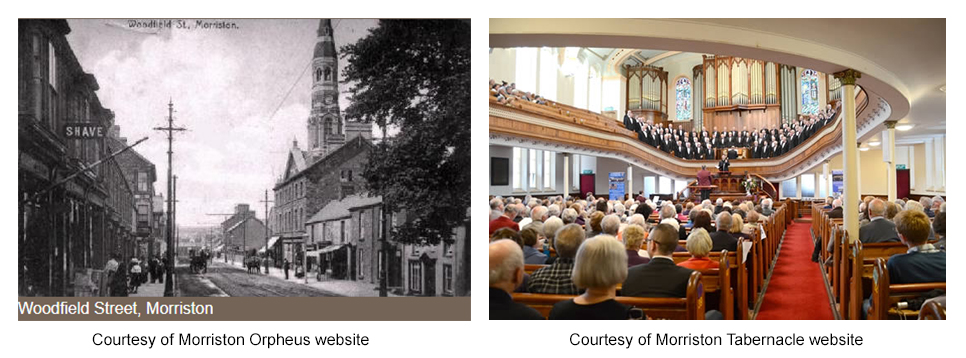
“Empower/Garside however may be seeking forgiveness for Sins past and present – rumour is that it/she has been engaged to overcome the legal problems faced by https://morristontabernacl.org/ following a period of failure to pay minimum wage. £60,000 underpayed (sic) is rumoured to be the claim. Those responsible for management of The Tabernacle are also Trustees of other Charities that receive Council and Government support and funding. The Morriston Tabernacle building itself is Grade 1 listed and has been beautifully (and expensively) restored……with funding from where? It takes dedication in all weathers to hand out Pink flip flops in Wine Street, Swansea on a Saturday night (grant funded?) It takes competence to act as a Manager and/or Trustee and to properly administer public and charity funds.”
click to enlarge
Not only does it concern me, it also confuses me.
Let’s start with Morriston Tabernacle / Tabernacl Treforys“The largest, grandest and most expensive chapel built in Wales”. My source talks of legal problems due to underpaying, presumably of staff, but Morriston Tabernacle is an unlikely rogue employer. Come to that, how many employees would it have?
The source then says that those responsible are also “Trustees of other charities”. But looking at the three charities connected with the chapel – 1116477, 1164521 and 1152614 – I can only find one trustee who is also a trustee of another charity, and that one is very small.
Then there’s the reference to “Wine Street, Swansea”. While some may be pronounce it like that, it’s in fact spelled Wind (and probably derived from wynd). Though where the hell the pink flip-flops fit I have no idea.
If there is a link between Garside and Morriston Tabernacle, then the question has to be, Who recommended this woman to Tabernacle, and why?
So, Source, please get back with clarification.
♦ end ♦
UPDATE 10.03.2018: Thanks to a phone call out of the blue I may now have made the hitherto unfathomable connection between Garside and Morriston Tabernacle.
The minister at Tabernacle is Reverend Jill Hailey Skeel Harries and she also serves as a trustee on the board of the Union of Welsh Independents, Charity number 248076. More importantly for our purposes, Reverend Harries is also involved with Carmarthenshire Domestic Abuse Services Ltd (previously Carmarthen Women’s Aid) which, as my source suggested, receives “public and charity funding”.
Given that Garside is also involved with domestic abuse, having been a director of Cyfannol Women’s Aid Ltd, of Pontypool, it’s entirely reasonable to assume that if they didn’t already know each other then contact was made through a mutual acquaintance, unless of course Garside has been recruited by the Union of Welsh Independents.
In the previous post ‘Sister Sledge’ and I tried, in our different ways, to explain the Labour Party’s links with various other bodies, from Spartist rent-a-mob-with-whistles outfits to superficially respectable social housing bodies.
Ultimately, such linkages combine to create a system not unlike those we see in one-party states, where the reach of the ruling party extends into every area of national life. Such contempt for plurality ignores the fact that Labour gets just a third of the votes in Assembly elections and it leads, as in true dictatorships, to over-confidence and even corruption.
Which might explain what I’m now going to tell you. Though if someone can satisfactorily prove to me that it’s nothing more than a genuine mistake then I shall make that clear in a subsequent post.
◊
PLAS MOROLWG
To give you the fullest understanding of the subject I think some background information would be helpful.
Plas Morolwg was a general needs family scheme owned by Bromford Carinthia, an English housing association, and built in the late 1970s. You have to wonder who gave planning permission for an English outfit to ship in dozens of people many of whom would have had special needs, with each one adding to the burden on the local health and other services.
But the importation of England’s problems still goes on, the difference today is that it’s done by ‘Welsh’ organisations using Welsh public money! Yet I have heard of no residential homes or social housing developments in England catering for Welsh people and paid for from English funds. Isn’t that strange?
Tai Cantref, based in Newcastle Emlyn, was pressured into buying Plas Morolwg by Tai Cymru, the former umbrella organisation for registered social landlords, now superseded by Community Housing Cymru. It was not a good buy.
To begin with, Plas Morolwg stood in an exposed location above the harbour/marina in Aberystwyth. It’s a nice spot when the sun’s out but otherwise at the mercy of the weather coming in off Cardigan Bay. Enough of a problem in itself, but Plas Morolwg was not very well built either, and a storm in February 2014 exposed just how bad a job the builders had done.
Almost before the wind had died down Tai Cantref slapped in a planning application on 11 February 2014 to demolish Plas Morolwg and replace it with a “mixed affordable and open market residential re-development”. (Ref No A140117.)
From @alanhalephoto, click to enlarge
As you’ve seen in the link supplied above, Outline Planning Permission was granted 7 October 2014 and Plas Morolwg was demolished in January 2015.
But more storm clouds were gathering. For some bad business decisions by Tai Cantref encouraged Bay Bubble scheming that saw this housing association brought to its knees and handed over to the Labour Party’s favourite RSL, Wales and West Housing.
This arranged marriage was formalised in September 2016. Which meant of course that Wales and West came into full possession of the now-cleared and ready-to-build-on Plas Morolwg site.
In addition to the Tai Cantref planning application to demolish and rebuild Plas Morolwg Wales and West has submitted a further application – Ref No A170922 – for a further eight “residential apartments”. (Are there non-residential apartments?)
This presumably is in addition to the Tai Cantref application of February 2014 for 64 apartments. The original Plas Morolwg complex was just 44 apartments, but the new building is two storeys higher and many believe it’s an even bigger eyesore than the original.
One thing’s for sure, the biddies on the top floor are in for exciting times when 90mph westerlies blow in from Labrador.
The next development in this saga was Ceredigion council announcing that the Bodlondeb extra care facility in Aberystwyth faced closure. This news was exploited by the Labour Party and its formed-for-the-purpose front organisation the Ceredigion People’s Assembly. (Not to be confused with the People’s Assembly of Ceredigion, or the Popular Assembly of Ceredigion.)
So a Labour-led campaign against Ceredigion’s non-Labour council eventually drove the council into the arms of the Labour-run Wales and West Housing, which may now be in a position to demand whatever it wants on the Plas Morolwg site.
◊
LATEST DEVELOPMENTS
I have been helped with this section by someone who has signed up to the new party, someone with connections in Ceredigion Council and Cantref, and this individual has some very interesting information about the Council’s final quarter Social Housing Grant programme bid to the ‘Welsh’ Government.
Submitted by Keith Davies, on 16th February 2018, I am informed that the bid spreadsheet includes the following statement: “We have included a drawdown request for the Plas Morolwg extra care scheme acquisition stage totalling £1,690,000 . . . ”
The spreadsheet shows £1,051,000 being claimed for site acquisition of Plas Morolwg in the 2017/18 Social Housing Grant development programme; with an extra £188,500 claimed from any spare moolah available in 2017/18 surplus grant round to top up the “remaining acquisition grant only”.
This seems to suggest that Wales and West is to be paid Social Housing Grant to buy a development site that they acquired when the ‘Welsh’ Government encouraged them to take over Tai Cantref. In other words, a site they already own!
But just to be sure, I went to the Land Registry website. From there I downloaded both the title and the map of the site. There seems to be little question that Wales and West owns the Plas Morolwg site and with no money owing to banks or other lenders.
But then I got to thinking, ‘Well, hang on, maybe Wales and West is buying some extra land, and that explains this “acquisition stage” payment?’ So I went to the plan on the Ceredigion Council website, the plan relating to the proposed redevelopment of the site, and compared it with the Land Registry map.
click to enlarge
They’re identical. As you can see for yourself.
The proposed development moves down the hill to minimise the impact of the two extra storeys and this will almost certainly mean that access, parking and just about everything else will be located at the rear of the building.
◊
‘THE WILD WEST SHOW’
In the days when Ceredigion council was run by men of property, planning permission was so easy to come by, and planning rules treated with such contempt, that Paul Flynn, the veteran Newport West MP, described Ceredigion council as “the Wild West Show”.
Those days of greedy landowners enriching themselves may be gone, but a new menace to open and honest local government in Ceredigion has emerged in the form of Momentum, whose followers act as foot-soldiers for a locally unelectable Labour Party and its linked organisations.
Juvenile leftists with nothing better to do are one thing, but with Wales and West Housing we are dealing with a ruthless – possibly corrupt – organisation bent on hoovering up rivals thanks to funding and political support provided by its parent body, ‘Welsh’ Labour.
So we need answers to the following questions, and these answers must come from Wales and West itself, Cyngor Ceredigion, and the ‘Welsh’ Labour Government.
First, has the Plas Morolwg development received full planning approval? Then, given the history of the site, where will the residents come from?
But perhaps most important of all – is Wales and West Housing receiving £1.69m to buy a site it already owns? If so, why? And who authorised this funding?
The time has come for opposition politicians in the Assembly to demand an investigation into social housing in Wales; we must know exactly how it’s funded, whether it meets – even exceeds – the needs of Wales, and the relationship between some housing associations – particularly Wales and West Housing – and ‘Welsh’ Labour.
♦ end ♦
UPDATE 01.03.2018: Someone sent me a ‘Welsh’ Government document called a (social housing) Programme Delivery Plan for Ceredigion. I’m not sure how readable it is, but anyway, here’s the link.
The first page lists a number of projects in the pipeline, including Plas Morolwg, but with some information redacted. The other project with information redacted is Mid Wales Housing’s Cylch Caron in Tregaron, which I understand has been scuppered by Cyngor Ceredigion getting into bed with Wales and West up on the windy heights of Plas Morolwg.
Note also on this first page that under the ‘Tenure’ heading all the other projects are listed as ‘Social’, but not Plas Morolwg, which is ‘Neutral’. This I’m told means that it will either be private housing or mixed.
And yet, as I’ve explained in the main post, Wales and West is asking for Social Housing Grant to acquire the Plas Morolwg site. Yet we know a) Wales and West already owns the site and b) the Programme Delivery Plan now tells us W&W will not be building social housing.
So what the hell is going on here?
Scroll down to the third sheet (which I suspect is a continuation of the first) and you’ll find other Wales and West projects with information redacted. In fact, there are five redactions for Wales and West, the two for Mid Wales Housing, but none for Tai Ceredigion which has the most entries on these sheets.
So why does Wales and West Housing get such preferential treatment from the ‘Welsh’ Government? I can understand the reasoning behind commercial confidentially, but when it’s only applied to Wales and West it looks very much like favouritism. Or maybe hiding something?
P.S. I’ve also seen the Pembrokeshire Programme Delivery Plan, and there Wales and West has even more redactions. They may be connected with a development called Parrog Yard in Newport. Any information will be gratefully received and treated confidentially.
While the brothers in Cardiff Bay were fighting over the ashes of Carl Sargeant and positioning to succeed Carwyn the Untrustworthy, no one noticed that another struggle was bubbling away in deepest Ceredigion.
It started around the time of the last County Council election in May 2017, with the first rumblings over proposals for a women-only shortlist, which might have seen sister Dinah Mulholland and others being considered ahead of Ceredigion’s only Labour councillor, Hag Harris, who had served in both Liberal-Independent and Plaid coalition cabinets, building up a nice pension.
The experienced Harris succeeded in seeing off these early stirrings and secured his usual seat in the election, only to be shunned by the Plaid council leader this time round and left on the back benches. The council rumours appear to be that this was due to his opinions on the closure of Bodlondeb residential home; caught in a pincer movement between his previous role as cabinet member with responsibility for social services, which damned him in the eyes of the younger, Corbynite brothers and sisters who sought to exploit the home closure for crude political advantage.
Why would this Spartist superstar be interested in a care home in Aberystwyth? (click to enlarge)
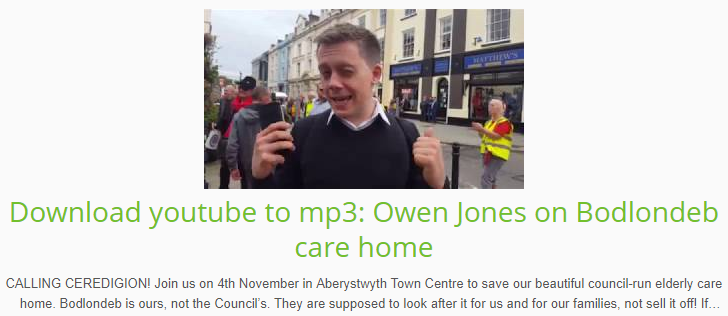
After a lengthy public campaign over the closure of Bodlondeb, which saw the brothers and sisters exultant when Chavs author Owen Jones joined them on the streets of Aberystwyth to argue for public residential homes workers to be kept in a job no matter how much money was being lost, but the home still closed.
Though not before the (under siege) Plaid Cymru council leader was forced to turn to Labour’s favourite housing association, Wales and West, and agree to them having a 60 bed extra care facility on the prime development site where once had stood Plas Morolwg. This site had been gifted to W&W by the Labour Welsh Government when local association Tai Cantref was deliberately shafted by their lenders and hung out to dry.
Outline planning permission was swiftly pushed through, as it became clearer that the fifteen-years-in-the-planning alternative extra care scheme in Tregaron was hitting the rocks. So, the future looked bright, with Wales and West Housing moving back into Ceredigion, Carmarthenshire and north Pembrokeshire, backed by certain friends within Ceredigion County Council.
Pretty soon afterwards, plans for lots of flats in Lampeter emerged as well, with proposals to demolish the old Ffynnonbedr primary school right in the middle of Hag Harris’s ward, backed with an allocation of Social Housing Grant from the Welsh Government, via the county council officer who likes to say “yes” to Wales and West.
You would think that Cllr Harris might have been pleased about this development – but no, alas, both he and other members of the Town Council were already aware of the lack of management of the existing Wales and West flats in the town, and the constant visits by the Police concerning drugs and damage to property. Could this be the Corbynista’s revenge?
Lampeter also being the place of work of the Dinah Mulholland mentioned above, where she supports the special students who, having gained their university place to do Egyptology or religious studies, with E or below A level grades, still need that extra bit of support.
Sadly, the drop in the number of students achieving even those grades has meant a surplus of student accommodation, and therefore empty private sector rented accommodation in the town, leading to an increase in second and third generation LSD hippies moving out of their caravans in Silian and into the unlicensed HMOs in the town.
The experienced Cllr Harris has at least stalled the planning consent for the Wales and West additional flats, whilst his Corbynista sisters in the Constituency Labour Party post on the Ceredigion Labour Facebook Page about Corbyn’s pledge to build 8000 new homes to take the homeless off the streets.
So, having given Wales and West a lift in Ceredigion, what next for the young revolutionaries? Well, social media is a young people’s game, and Cllr Harris and his ilk are not known to frequent those channels.
Dinah and her Aberystwyth university comrades came up with the next idea around January 2018, with the creation of a (quite sinister looking) new Facebook page called Ceredigion Tenants. As you can see, the page has a clenched fist profile picture and other leftist imagery, such as “eating the rich”. The intention is clear – to get down with the ‘tenants’ on Facebook, and encourage them to revolt!
More infantile Spartism (click to enlarge)
There have been encouraging posts about building more council housing (in a county that couldn’t look after what it already had) and what to do with rogue landlords and how tenants should form tenant unions. Plenty of promoting the posts of Shelter Cymru, most of whose senior staff are active Labour Party supporters, and make a living out of taking landlords to Court on the back of generous legal aid. All good stuff, churned out from their university-paid desks.
The Corbynistas soon latched on to a local issue with Ceredigion-based Tai Ceredigion, who had the audacity to suggest that some of their tenants should comply with the terms of their tenancy agreements, and not keep dogs or cats in flats, or accumulate weeks worth of their faeces.
How dare they! Surely it is the right of every tenant to do what they like, to allow their dog to bite the neighbours or housing association staff, and to dump cat litter over the balcony onto the one below. This local issue has nicely coincided by a new policy initiative from the Corbyn side of the party to propose legislation to give every tenant the right to keep a pet.
A browse through the newly established Ceredigion Tenants Facebook page will show dozens of posts in support of the tenants, many comments urging tenants to visit the local Shelter Cymru advice worker, and to seek legal aid to fight this great injustice of requiring them to adhere to the tenancy agreements that they signed. Petitions have been “organized” (sic) and promoted by Daren Howe, the local expert in change.org petition promotion.
◊
DAREN BRINGS MORE COBBLESTONES
Daren Howe: “Signed and shared several times, I have 3 large groups waiting to post this petition but it needs more detail and more bite, why is this happening?, who is it happening to?, what are the consequences if we don’t win etc.”
“3 large groups”! Where? Ceredigion? Chelmsford? Birmingham Central Constituency Labour Party?
Daren has now helped get the pet petition over the 2000 mark, by cross-posting to other Corbynista groups and animal rights activist networks – but with very few signatures from Ceredigion itself. Rumour has it that Daren himself has a bit of a history with a former council house he used to live in, before abandoning ship for a tenancy in Cardigan with those nice people at Wales and West.
Whilst it is clear who is behind the Ceredigion People’s Assembly from cross-postings of the pet ban petition made by members of Ceredigion Labour and from Ceredigion Tenants Facebook page, the brothers and sisters have been reluctant to be up front about it.
However, in one of the postings by the administrator of Ceredigion Tenants, Dinah Mulholland, reveals herself as one of the sisters behind the initiative:
“Ceredigion Tenants I have given your names to Jess from ITV and Sian from BBC Wales. I suggested they make contact via this Facebook page. Hope that works. Let me know if not and I follow it up. Hope you are all OK. Dinah x”
“Ceredigion People”, it says, but there may be no genuine Cardis involved! (click to enlarge)
Obviously you won’t find many genuine Ceredigion people among the vegans and the green tea-drinking university sisters such as Dinah Mulholland, Jo Eastlake and Claire Risley.
Where next, eh? Maybe their new-found sister in Cardigan, Morvenna Dorita, will mount a takeover for Cardigan Town Council?
You heard it here first, folks, the revolution started with the comrades in Ceredigion.
♦ end ♦
JAC SAYS . . .
I am indebted to ‘Sister Sledge’ for this timely reminder of how the Labour Party extends its influence in the absence of a democratic mandate by using trade unions, campaign groups, charities, third sector bodies and, increasingly in Wales, housing associations.
Not forgetting how Labour activists exploit local issues such as the closure of the Bodlondeb care home in Aberystwyth and the pets ban in social housing flats. The sort of things Labour councils do everywhere but which only draw the ire of the comrades in areas that Labour doesn’t control.
Photo Keith Morris, click to enlarge
What’s happening in Ceredigion though may take things a step further because the sudden flurry of activity among the comrades – and perhaps more particularly, the comradesses – is done not just to extend the influence of their party, for I suspect that the faux outrage over the closure of Bodlondeb and the pets ban may serve a bigger agenda.
‘Sister Sledge’ mentioned Wales and West Housing, which I’ve written about many times. This is a Cardiff-based housing association now spreading like a virus across Wales with the help of the ‘Welsh’ Labour Government. It recently built new offices in Ewloe, Flintshire.
In its desire to take over as much of Wales’ social housing as possible and perhaps become the last – or the biggest – left standing after the inevitable reorganisation takes place Wales and West tries to gobble up everything in its path.
‘Sister Sledge’ made reference to Cantref, a housing association based in Newcastle Emlyn, which was undermined by the ‘Welsh’ Labour Government and then handed on a plate to Labour-controlled Wales and West. Cantref’s former properties are now run from Cardiff, and Welsh – the working language of Cantref – is treated as an irritating irrelevancy by Wales and West.
Forget Carwyn’s million Welsh speakers by 2050, the Cantref episode shows us ‘Welsh’ Labour’s real attitudes towards the Welsh language.
A neighbour of Cantref’s now being eyed by W&W, is Tai Ceredigion . . . ‘But wait!’ you exclaim, ‘isn’t Tai Ceredigion that wicked housing association that rips fluffy kittens from children’s arms and smashes their little skulls with lump hammers (the kittens not the children)? Yes indeedy.
Are you beginning to get the picture? For those of you still having trouble, let Jac lead you by the hand . . .
Ceredigion county council had on its hands an extremely pale pachyderm in the form of Bodlondeb, a drain on the public purse that could no longer be justified. Sensing a chance to manipulate public opinion and use it to expand in Ceredigion both ‘Welsh’ Labour and Wales and West Housing swung into action.
Ceredigion People’s Assembly was set up in August 2017, the foot-soldiers were organised and had a protest march on September 16th (Glyndŵr’s Day). A further rally was organised on November 4th which was attended by the saintly Owen Jones.
From Ceredigion People’s Alliance Facebook page
Result: Ceredigion council closes Bodlondeb but the bad publicity generated by Labour front organisation, Ceredigion People’s Assembly, virtually blackmails the council into allowing Labour-controlled W&W to build a replacement facility on the Plas Morolwg site.
Emboldened by that victory, the next target is Tai Ceredigion, and we see the same foot-soldiers form another Labour front organisation, Ceredigion Tenants, whose Facebook page sprang into life on January 11, just one day after Tai Ceredigion sent its letters about pets to the tenants of the Penparcau flats.
If all goes according to plan the ‘Welsh’ Government will hand Tai Ceredigion and its assets over to Wales and West Housing, as it did with Tai Cantref. And despite being consistently rejected by the electors of Ceredigion the Labour Party will have secured for itself considerable power in the county.
This is clearly a subversion of the democratic process, but it’s only what we should expect from Jeremy Corbyn’s Labour Party.
One great irony is that because those involved with Ceredigion People’s Assembly, Ceredigion Tenants, and even the Labour Party, are English, what we see is a kind of hard left colonialism.
Which should remind us that when it comes to English colonialism in Wales there’s no real difference between hard left and extreme right, though maybe the right is more honest about what it’s doing.
I added an update to the previous post about Empower after learning more about this group, and perhaps what struck me most was the fact that despite the latest Accounts telling us (top of page 4) that “Trustees are elected from Bryncynon and its surrounding areas”, only one of the trustees lives anywhere near Bryncynon.
So I took it upon myself to make enquiries into these non-local trustees, assuming that if they’ve been recruited without knowing the area then they must bring some special talent to the venture. The four, all appointed 31.03.2017, are: Elizabeth Claire Bryan of Brackla, Bridgend; Paul Christopher Maliphant of Whitchurch, Cardiff; David Joseph Haines of Llandaff, Cardiff; and Robert Andrew Dickens of Mitchel Troy, Monmouth.
Given that these are all reliant on public funding it would be reasonable to assume that Bryan is a Labour Party member or supporter. But on the Companies House website (and elsewhere) he consistently gives his nationality as ‘Welsh’.
As Labour Party members tend to be Welsh only for the duration of a rugby international this might indicate that Bryan is not a bruvver. Someone out there must know.
Either way, Claire Bryan is a consultant.
Next up we have Paul Christopher Maliphant, whose Linkedin profile would suggest that he’s a geologist . . . ideal then for a community venture like Bryncynon Community Revival Strategy Ltd. But he is also a mentor, approved and recommended by the ‘Welsh’ Government.
Above his photo you’ll see a tab for ‘Mentor profiles’. I urge you to click on it and go through some of the bios. God Almighty! it’s frightening, with a worrying number of them having moved here in their twilight years or else they’re not living in Wales at all.
click to enlarge
These mentors are listed alphabetically – by Christian name! Which means they run from Adrian T. Barsby to Yasmin Crawford. So if you’re looking for ‘Wassisname Doyle’ you’d better know that it’s Lindsay Hugh Doyle.
Moving on, the next trustee is David Joseph Haines. Now Dai has an interesting business background . . . in shipping, which must be useful along the bustling quays and wharfs of Cwm Cynon.
The only company he’s involved with that hasn’t sunk or been scuppered is Bryncynon Community Revival Strategy Ltd itself. Quite what he brings to the party is a mystery to me.
The final non-local is Robert Andrew Dickens whose business interests seem to flit between addresses in Monmouth and Aberthaw. I guess what puts the bread on his table now is Safety Technology Ltd.
Though there are disasters in his past, too. Not least Mainline Safety Ltd, which sank with all hands – and a few creditors – off Liverpool some years ago. Merseyside being where Dickens calls home, Southport to be exact.
Bringing up the rear we have the only local trustee in John Matthews, Earth-botherer, former policeman and now bus driver who’s been in post for over ten years. I suppose they had to keep him on to have one trustee who could pronounce Bryncynon.
The ‘Welsh’ Government has obviously stepped in and appointed these new trustees (and in so doing might have broken the rules), perhaps because the Abercynon venture has relied heavily on Communities First funding and this has now come to an end.
But what has it all achieved?
We have areas across Wales like Abercynon in desperate need of help, but the only response from Cardiff Bay is, ‘OK, we’ll give you money to buy an old chapel – turn it into a cafe, crèche and community building – then we’ll send you up a few mentors, and if things are really bad we’ll chuck in a motivator, too. And then, when this pot of money runs out, we’ll look for another one. Tidy, mun’.
All this system achieves is the normalisation of deprivation and the creation of a dependency culture. For politicians it’s being seen to be doing something. For civil servants it’s a box-ticking exercise. And for the third sector it’s just milking the system.
Something in it for everybody . . . except those it’s supposedly helping.
◊
ANONYMOUS LETTERS
Regular readers will have heard me mention Wynne Jones of Cardigan. Wynne is a scourge of the third sector and the civil servants with responsibility for the third sector due to his probing questions and his meticulous record-keeping. I bet there are senior civil servants quaking at the mere mention of his name.
So wary have civil servants now become of Wynne that he is receiving letters with neither signature nor name appended, suggesting that some civil servants don’t want to put their name to the answers they’re providing. Why would that be?
And the same thing is happening to me. Here are a couple of samples. The one on the top was received by Wynne last week and the other was sent to me last month.
click to enlarge
And it’s getting even more strange now with Wynne because he is being asked to discuss things on the telephone, suggesting that some of the civil servants he’s dealing with don’t want to put anything in writing, whether signed or not.
What a situation! What does it tell us about the way Wales is run?
If you’re reading this, Carwyn (and if you’re still FM), what do you think about civil servants answering letters anonymously? I’m sure there must be a rule that says there should be a name attached.
Because when we take over, how will we know who to put on trial?
◊
USING THE MEDIA
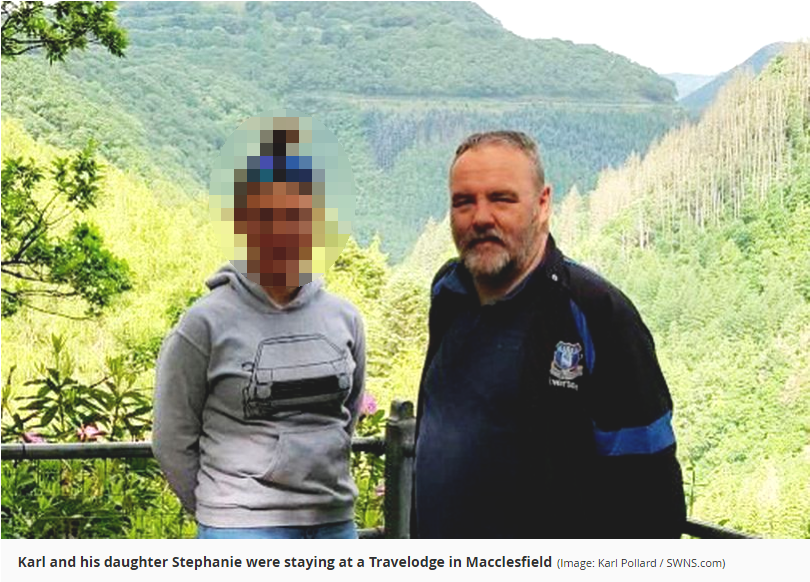
In case you missed it, there was a curious story in the media earlier this week about a man accused of being a paedophile because he stayed in a Cheshire hotel with his fourteen-year-old daughter while visiting his cancer-stricken mother. Here’s the WalesOnline report which also tells us that the man’s wife – and presumably the girl’s mother – suffers from multiple sclerosis.
The family lives in the relatively remote Carmarthenshire village of Rhydcymerau, which may be found on the B4337 between Llanybydder and Llansawel. I assumed they had recently moved to the village. A suspicion borne out by his Linkedin profile and these entries from 192.com.
This coverage, for what was little more than a misunderstanding, is quite incredible. How was it achieved?
If we look at the photograph above we see that the attribution is “Image: Karl Pollard / SWNS.com”. Which would suggest that the image belongs to Pollard and was distributed by South West News Service, an agency dealing in ‘news’ for those who prefer ‘human interest’ stories.
The Twitter feed, with tales of a hairy-chested woman and a foetus flicking a V-sign, tells us that SWNS is to news reporting what The Jeremy Kyle Show is to intellectual discourse, or am I being too harsh? Whether I am or not, I think it’s reasonable to conclude that after the incident at the Travelodge in Macclesfield Pollard went to SWNS with the story and the pictures.
What’s more, he wasn’t slow about it. The WalesOnline report is datelined 10:20 Monday the 19th and says the incident happened “last week”. The Star, Sun, Express and Mirror reports are dated Sunday the 18th.
Perhaps this explains why it has been suggested to me there may be something ‘contrived’ about the whole thing. I’m not sure about that because it wasn’t Pollard who called the police, it was staff at the hotel. But then again, he must have realised that a 46-year-old man sharing a bedroom with a 14-year-old girl is guaranteed to attract suspicion.
But it’s how Pollard responded to a misunderstanding that was soon sorted out that causes me disquiet.
Let’s look at the three most important females in Karl Pollard’s life. His mother is gravely ill with cancer, his wife is suffering from multiple sclerosis, and his 14-year-old daughter was, in Pollard’s own words, “distraught” after being questioned by police, so all three would surely have craved peace and quiet.
But no, Pollard goes chasing global exposure for a simple misunderstanding made by sincere people acting out of the best possible motives.
I can’t help thinking that the media got this story arse-backwards.
◊
MASSAGE
As you might imagine, I get a lot of strange messages, from all sorts of people and by a number of different routes. This week has been no different. Here’s one I feel able to share with you.
click to enlarge
Let me start by saying that I know nothing of ‘massage’ in the Tonypandy area (or anywhere else, come to that), nor have I been Googling for such services. So it was easy to dismiss this message as some kind of joke. But then I was drawn to the logo, which made me think the source at least might be kosher.
More than that, a pink butterfly with the body made up of a woman in a tight-fitting dress suggested to me that if it exists then the Women’s Business Club is for women, rather than the wimmin I have written about of late. So I Googled Women’s Business Club and sure enough, it is genuine.
This may have started as someone’s idea of a joke but I was very impressed with what I read on the website, consequently – and even though the heels are killing me – I have now joined and I’m looking forward immensely to the next Wonderbra Session.
Some time ago, October 2015, to be exact, I published Bits & Pieces 13.10.2015: Assembly 2016, Reputations, Vattenfall, Cardigan Castle and, almost en passant, I mentioned Empower-Support for the Voluntary Sector, of Cwm Cynon, which I likened to a case of big fleas having little fleas because Empower seems to feed on third sector and other publicly-funded bodies.
Empower SVS is owned and run by Beverly Elizabeth Garside and I wrote of her, “One mystery though is why, on her Linkedin profile, Bev tells us that she has been director of Empower since January 2001, yet Companies House tells us that Empower was not Incorporated as a company until February 18th 2004.”
I can now explain this confusion, and more, by telling you where Beverly Garside was and what she was doing in the years prior to 2004, but first I want to take a peek at Empower.
◊
EMPOWER SVS
Go to the Empower website and the ‘About Us’ page. On the right you’ll see the staff.
Bev Garside on top and below her we find Owen Davies of whom I know nothing because we are told “Full profile coming soon”. And it’s the same for Pamela Davies below him. For James Davies there is a profile, and it tells us after working in the planning departments of Swansea and RCT councils he spent eight years with Planning Aid Wales before joining Empower in April 2015.
click to enlarge
Next up is the dashing figure of polo player Ashley McMahon, ex-military and still barking commands at that fine body of men the Glamorgan Yeomanry. Ashley is the Marketing and PR Manager.
Next on the totem pole we find young Alex Railton, a Marketing Assistant, for whom Empower couldn’t even be bothered to put up “Full profile coming soon”.
These six I assume are based at or work out of Empower’s office at the Feel Good Factory, Abercynon Road, Ynysboeth.
The others, described as Associates are almost certainly not employees. Liz Tyson is based in Manchester, and her passion would appear to be animal welfare. Ashan Malik is in Bradford. Bryan Collis is in Swansea where his full-time job is with All Wales People First, yet another third sector outfit stuffed with people taking advantage of the public funding bonanza.
The final Associate is Dawn Davies (née Minifey), whose day job is Director of Communities Connected Consultancy Ltd of Bridgend, where we also encounter Bryan Collis again. Though it looks as if Bryan and the others listed are associates. Communities Connected seems to do the same type of work as Empower . . . and no doubt 37 other companies.
Why do I say that? Well, because when Communities Connected was Incorporated with Companies House 14 September 2016 there were two founding directors, Dawn Davies and Paul Stepczak. ‘Who he?’ you cry. Here’s a clue.
click to enlarge
In a previous existence young Paul was “lead cluster officer for Communities First in Glyncoch”. How know I this? From my regular reading of the Church in Wales website, which I recommend unto you all. Stepczak left Communities Connected 12 October 2017, so Dawn Davies is now alone at the helm.
Staying on Empower’s ‘About Us’ page we see, bottom left, a grouping of logos under ‘Our clients’, and an eclectic mix it is, though hardly impressive. For a start, we see Communities First again, that disastrous programme that had its plug pulled last year.
But not before it had consumed £300m of public funding and provided lots of meaningless jobs like ‘lead cluster officer’ in Glyncoch. And of course much of the Communities First funding found its way to consultants and advisors. And while I’m not for one minute suggesting that all those who worked for Communities First were Labour Party supporters, nor that the consultants and advisors were on good terms with the bruvvers, let’s say that Labour Party connections definitely helped when it came to getting your milking pail under this particular cash cow.
Another client that caught my eye was Ambassador Training Wales. As far as I can make out, this Swansea-based outfit trains guides for the tourism industry. I’m not sure what advice Empower provided but Ambassador Training Wales is teetering on the brink and about to be struck off by Companies House.
Scroll down to read the fragrant Bev herself say: “The nature of a busy consultancy means I am always on the road; I regularly drive the breadth of England and Wales and accumulate tens of thousands per miles per year. Whilst I use trains wherever I can, our work often takes us to places that cannot be easily or efficiently reached by public transport. My new Lexus Hybrid is not only more fuel efficient, which is great for my business, it also produces a third less emissions than my old car.”
The article is dated (à la mode américain) 01.26.2017. So at this time last year Bev Garside, who runs Empower SVS Ltd, was driving around in a brand new Lexus hybrid. Business must have been good because even leasing such a car wouldn’t be cheap
Before examining the business side of Empower I just want to take a wee detour offered by another of Empower’s ‘clients’, useful because it’s all part of a bigger picture. This time it’s Tyddyn Môn.
◊
TYDDYN MÔN
Its website tells us that “Tyddyn Môn was founded by the parents of adults with learning difficulties who wanted a more constructive and rewarding occupation for their sons and daughters.” And the website doesn’t tell us a great deal more than that.
The more I looked into Tyddyn Môn the more obvious it became that despite being located on an island where almost all the native-born speak Welsh the organisation itself is rather, well, unWelsh. Take as an example the highlight of the social calendar, the annual ‘Folk on the Farm Festival’. Here’s the line-up for 2018 – does anyone recognise any Welsh bands there?
click to enlarge
It’s basically a hippyfest, an English hippyfest. So who’s running Tyddyn Môn?
If we go to the Charity Commission website and type in 1072035 we see that the leading light among the trustees appears to be a Mrs Eileen Mildred Clarke, who is also a trustee of a number of other organisations, one of them being Gwasanaeth Adfocatiaeth a Chynghori Gogledd Cymru / North Wales Advice and Advocacy Association.
The Association is also a registered charity, No 1060826, and as the name suggests – and the screen capture below confirms – it covers our six northern local authorities, plus Staffordshire. Staffordshire!
click to enlarge
Why the hell is an English county that doesn’t even border Wales included there? When I see something like that it sets the old Jac antennae all a-quiver. Does anyone have an answer?
Whatever the reason, for year ending 31.03.2017 the Association received £277,939 in grants, mainly from Welsh local authorities (but nothing from Staffordshire) with £294,329 going on wages and running costs. So a rosy future beckons.
Back to Tyddyn Môn, where the Accounts for 2017 tell us the same, depressing story. Total income for year ending 31.03.2017 was £1,594,056, with £1,115,209 coming from Ynys Môn council.
Of that income £1,052,108 went on staff costs. Though, confusingly, page 18 tells us that two trustees were also paid a total of £53,101. Explained thus: “The trustees Mr J.G.P. Webster and Ms T.A. Davies are paid remuneration in relation to the work that they undertake for the Charitable Company as a support worker and housing manager. They are not paid for their posts as trustees”.
Well in that case why not include their salaries with those for the other staff? Though if they are employees why are they allowed to also be trustees?
Maybe I should explain here that the whole point of trustees is to provide oversight of a charity but with the day-to-day running left to the paid staff or volunteers. The two should be entirely separate, and with no payments made to trustees without special dispensation.
In 2016, just prior to the departures of Mrs Olwen Dennis Williams and Mr Huw Elfed Williams, three new trustee-directors were appointed on 9 April. One of them, Michael Ian Hawkes, almost immediately rose to the rank of Chair.
I suspect that Mr Hawkes may have not long moved to the area and so the other trustee-directors of Tyddyn Môn may be unaware of his glittering business career. The pinnacle of which seems to be his ongoing involvement with MHinvent, a company that has flirted with compulsory strike-off more than once and whose latest balance sheet shows liabilities of £2,296,133.
Hawkes has the largest single shareholding by far in MHinvent; hardly surprising seeing as the company seems to be named after him.
Tyddyn Môn may indeed be local to the island, but I suspect that through Mencap and other cross-border agencies connections have been formed which result in an unspecified number of Tyddyn Môn’s residents coming from outside of Wales to take advantage of the council’s generosity.
So if the council is minded to take a greater interest in Tyddyn Môn it might also benefit the island by refusing entry visas to the rag-bag collection of pony-tails lined up to wail at the Folk on the Farm Festival.
That’s the end of the digression; now it’s back to Beverly Garside and Empower SVS.
◊
EMPOWER-SUPPORT FOR THE VOLUNTARY SECTOR LTD
The first problem I encountered when making enquiries into Empower on the Companies House website was the latest set of Accounts, or rather, what passes for the Accounts, for it’s no more than an abbreviated and unaudited balance sheet.
click to enlarge
Surely these Accounts – showing a deficit of £3,573 – aren’t for a company with five or six employees on the books, with consultants to boot, and where the owner of the company “drives the breadth of England and Wales” every year in a hybrid Lexus?
What’s going on? Where’s the money stashed?
I’m not sure, but a clue might be provided by something I stumbled on, for there’s another entry on the Companies House website for Empower Support for the Voluntary Sector a slight variation on the name of the original company. Yet it is the same company because it quotes the same number, 05048133.
What’s different is that this entry tells us that Empower is a Designated Member for CJF Recruitment LLP set up 21 May 2016. So what can Companies House tell us about CJF Recruitment LLP?
CJF has three Designated Members: Matthew John Bates of Ystrad Mynach, Jane Thomas of Llanbradach and of course Empower Support for the Voluntary Sector.
I’m not quite sure how to explain this, being unfamiliar with LLPs and their operation. I know that they are partnerships and appeal to solicitors, accountants and the like, but it’s difficult to see the advantage of a LLP over a normal company in the case of CJF.
And what do the initials stand for, certainly not the names of the partners?
But we still don’t have the answer to where the money is to run the Empower company, which seems to survive on fresh air.
As an introduction to where I’m taking you next I might as well tell you that Beverly Garside is also a director of the Captive Animals’ Protection Trust, which has its correspondence address at her home.
UPDATE 15.02.2018: As I said earlier, Empower is based in the Feel Good Factory in Ynysboeth. What I didn’t realise then was that this building – formerly All Saints Church – is shared with other users. Principally Bryncynon Community Revival Strategy Ltd.
The Accounts also tell us, towards the top of page 4, “Trustees are elected from Bryncynon and its surrounding areas”. Which is as it should be. However, of the five current charity trustees / company directors one lives in Brackla, one lives in Llandaff, one in Whitchurch, one in Mitchel Troy, with just one from the local area.
But no doubt they have strong Labour Party connections to make up for their ignorance of Cwm Cynon.
◊
THE MISSING YEARS
As I noted in the 2015 mention of Garside and Empower, “Bev tells us that she has been director of Empower since January 2001, yet Companies House tells us that Empower was not Incorporated as a company until February 18th 2004”. So how do we account for the missing years?
This link will take you to a story from The Courier (Kent/Sussex) some time in 2002. Read it carefully. Bev Garside was clearly mixed up with hunt saboteurs and animal rights activists. Her co-accused in the case I’ve linked to, Gavin Medd-Hall, was jailed for eight years in January 2009 for a different but related offence.
I don’t know the outcome of the trial in Maidstone Crown Court in 2002 because there’s no longer anything available online. But we now know where Beverly Garside was and what she was up to before the founding of Empower-Support for the Voluntary Sector in February 2004.
And her involvement with animal rights activism explains her need to claim that Empower started in 2001.
I had to think long and hard before writing this piece, in fact, it caused me more soul-searching than anything else I’ve written on this blog for a number of reasons.
To begin with, I’m an animal lover myself, I would have closed down that animal concentration camp in Borth even before the two lynx were killed. And then there’s the thought that writing this piece might give pleasure to Garside’s old foes, the twats in pink, which is not something that would please me.
That said, there are bigger issues illustrated by this case, important Welsh issues.
◊
THE WILD WEST
In the case of Empower, we have a company that may not receive public funding itself, but lives off the recipients of public funding. And yet, at the end of the day, what do all the advisors, the empowerers, the enablers, the developers of communities, the consultants like Empower, contribute to the wealth of Wales?
Very little, especially when weighed against the amount of public funding consumed and the percentage of it that might as well be poured straight down the drain. (Just think Communities First.) The only thing this money does is create unsustainable jobs and a small amount of spending power. But this system that keeps Wales poor gives politicians the power of patronage.
So blatant is this system, and so well known, that it attracts shysters from outside of Wales looking for easy money that is not available elsewhere. It seems that every village and valley now has some old harridan behaving like a 19th century memsahib or else it’s a glottaly-afflicted young harpy so sharp she’s in danger of cutting herself.
If it’s not those running the third sector then it’s those they inflict on us; that’s because there aren’t enough Welsh to keep the funding flowing and so whole battalions of the decrepit, the deranged, the delinquent and the dependent are marched over the border.
And it’s not just our cities and larger towns that see these problems, for there isn’t a country town in Wales today unaffected by the trafficking of criminals, misfits and white trash by third sector agencies and housing associations.
It would be easy to describe these as misguided do-gooders, but they do no good at all, not for Wales anyway. They use Welsh public funding to make Wales more dangerous for us and our children. What special kind of national lunacy is this?
Then there are those who obviously see Wales as a bolt-hole or a wilderness into which they can disappear and not be recognised. This is how Mark Bridger, the murderer of five-year-old April Jones of Machynlleth came here, packed off by his family when he became too much trouble.
And who can forget the whole gang of satanic paedophiles relocated from London to Kidwelly. Yes, Kidwelly! Who the hell thought that was a good idea? Have our politicians ever asked for answers?
I’m not comparing Beverly Garside to Mark Bridger or the Kidwelly child rapists but it looks very much as if she also ran away to Wales. Maybe it’s time she practised a little honesty. Accounts for her company would be a good place to start.
The whole system is broken. We are told we need the third sector because Wales is poor . . . but the third sector thrives on poverty and makes us poorer . . . worsening poverty is then used to justify a bigger third sector . . . which makes us even poorer . . .
There is only one way out of this downward spiral – independence.
The National Renaissance of the 1960s put the wind up our masters for two main reasons.
First came the shock that there were numbers of Welsh people prepared to use violence and civil disobedience to achieve their political aims, with a far greater number supporting them.
Second, came the more worrying realisation that Welsh nationalism, hitherto regarded as a cultural issue confined to rural districts, was spreading into the more populous urban areas and ‘infecting’ people who spoke little or no Welsh. Perhaps there was even a danger of Pura Wallia being employed as Yeats and others had used the West of Ireland, a magical and unsullied ideal to be brought back to the rest of the land.
Something had to be done. The decision taken was to undermine the influential and inspiring Welshness of those western areas, which then ran from the outskirts of Llanelli in the south to the north coast around Abergele, with salients pushing towards the border.
What was envisioned was a form of social engineering, a kind of ‘watering down’ process, that would make life difficult for many Welsh people while simultaneously encouraging into western Wales large numbers of English.
To the point where the remaining Welsh would be outnumbered, anglicised, and this would result in the political threat they posed and the inspiration they provided being removed. Facilitated by legislation and other means; and if these could be sugar-coated, or disguised, then so much the better.
This is a strategy that Martiniquais poet and political activist Aimé Césaire so memorably described as ‘genocide by substitution‘.
from ‘Shifting Frontiers of France and Francophonie’ (click to enlarge)
Genocide by Substitution is just a more subtle means than outright clearance of killing off a culture and the identifications and loyalties that go with that culture.
◊
THE EARLY YEARS
DEVELOPMENT BOARD FOR RURAL WALES
A good place to start would be the plan in 1965 for a new town of 60,000 or more inhabitants in the Severn valley near the village of Caersws.
Historian Kenneth O. Morgan, in Rebirth of a Nation Wales 1880 – 1980, couldn’t resist linking near-universal local opposition to the plan with Welsh nationalism and racism, “Welsh nationalists and others feared that the population of this new town might be drawn largely from English overspill from the west Midlands . . . that these migrants might be black, brown or yellow in hue”.
Here we have the authentic voice of Old, South Wales, anti-Welsh Labour.
No new town was built, but nearby Newtown was expanded, with a population imported almost exclusively from outside of Wales, and this provided the template for what was now to happen across the region with the creation of the Development Board for Rural Wales.
click to enlarge
The strange thing about the DBRW was that its charter stated it could only give financial and other help to incoming employers . . . and their employees. Which meant that small Welsh companies, family firms, could find themselves being put out of business by an English company that had moved into Wales with DBRW support.
‘But surely’, you ask, ‘these companies moving in provided jobs for local people?’ Well no, because under the ‘key worker’ provisions incoming companies were encouraged to bring their entire workforce with them, with relocation costs funded by the DBRW. On top of which the DBRW provided shiny new housing.
The Development Board for Rural Wales was the most blatant colonisation programme Wales had seen since the period following the Edwardian conquest, yet few dared question its operations for fear of being branded ‘racist’ or economically illiterate. For the DBRW was bringing jobs and people to areas suffering depopulation.
It should not surprise anyone to learn that the outflow of Welsh people from the DBRW region did not abate. Giving us a perfect example of Genocide by Substitution.
The Development Board for Rural Wales was merged with the Welsh Development Agency in 1995.
One of the first consequences of the road’s upgrade was the closure of the Royal Mail’s Bangor sorting office, with work being transferred to Chester. Here we were, coming towards the end of the twentieth century, with devolution just around the corner, and Chester was reasserting its parasitic relationship with northern Wales.
For what the cheer-leaders for the A55 didn’t understand, or weren’t telling us, was that improved communications invariably result in the closure of ‘outposts’, which become redundant or expendable if their areas can now be served from further away.
Unfortunately, there was plenty of European money available for the A55 because it is a trans-national route linking Ireland with the continent. That it also opened up large areas of Wales to commuters and others from over the border was never considered.
And the spending continues. Another £250m will go into a Deeside Corridor which will help facilitate the Mersey Dee Alliance agenda by further integrating north east Wales with north west England.
LOOKING AROUND
Elsewhere in our rural areas, in the 1970s and 1980s, we saw an economy in decline. In the south west, for example, dairies and creameries closed, and milk was shipped off to England to be processed. Politicians were helpless . . . or at least, they did nothing.
And everywhere we were promised that tourism would be the economic salvation of rural Wales.
I’ve written about tourism many times and I hope I’ve made it clear that there is nothing intrinsically wrong with tourism, it can be a useful part of a diversified economy. But the tourism industry that has developed in Wales was developed to serve England, Wales happened to be conveniently near and became ever nearer with the spread of the railways and then the family car.
Even so, until fairly recently Welsh people did benefit. Many locals – my own late mother-in-law included – brought in some extra money by running a B & B. And back then local businesses such as pubs tended to be locally owned. But somewhere along the way the Welsh seem to have been squeezed out.
I remember a couple of years ago my wife and I stayed at a bed & breakfast in Abersoch, that favourite of the Cheshire Set, and the woman running the establishment told us, quite unprompted, that she was one of only two locals still running B&Bs in the village, yet there must be dozens and dozens of B&Bs in Abersoch.
Abersoch Dingy Week, organised by the Leigh and Lowton Sailing Club of Warrington. The building on the right is the clubhouse of the South Caernarvonshire (sic) Yacht Club (click to enlarge)
What we have in Wales now, masquerading as ‘the Welsh tourism industry’ is largely owned and run by strangers. The lack of decent jobs provided by tourism, coupled with its power to bring a new population into our rural and coastal areas, makes it another element in the overall strategy of Genocide by Substitution.
We have reached the point where tourists can come to certain parts of Wales, spend a week or ten days there, and not meet a Welsh person. Yet we are expected to be so proud of this ‘Welsh tourism’!
◊
THE DEVOLUTION ERA
Those expecting things to get better under devolution were probably naive, they have certainly been disappointed. It may no longer be the blunt and obvious instruments of the DBRW, the A55 and creamery and other closures that inflicts the damage, now it is the stiletto thrusts of a ‘Welsh’ Government operating against the Welsh national interest.
Did I really say, “a ‘Welsh’ Government operating against the Welsh national interest”? Yes I did, and now I shall give some examples of this behaviour, hopefully in chronological order.
Let’s start with One Wales: One Planet, of May 2009. This publication retrospectively gave approval to a number of illegal settlements and the green light to future sustainable communities. Despite grandiose pronouncements about a “sustainable nation” it was really about encouraging those seeking a certain lifestyle to move to Wales.
This was followed in July 2010 by Technical Advice Note 6Planning for Sustainable Rural Communities. (A Technical Advice Note “provides detailed planning advice”.)
TAN 6 replaced an earlier document that talked only of “Agriculture and Rural Development” but something had obviously changed, new influences were being brought to bear on the ‘Welsh’ Government that had little concern for traditional agriculture, or Welsh farming.
That building centre right, is it Lammas? (click to enlarge)
January 2012 saw former Minister for Environment, Sustainability and Housing in the ‘Welsh’ Government, Jane Davidson, join the University of Trinity St David’s Institute of Sustainable Practice, Innovation and Resource Effectiveness (INSPIRE). Among its aims is to “contribute to our communities by giving particular regard to issues of sustainable rural communities and the development of south west Wales as a low carbon region“.
Davidson, former Labour MP for Pontypridd is from England, where she was privately educated, she knew nothing of Pontypridd when she arrived and little when she left, but being AM for the town allowed her to use her position in the Labour-Plaid Cymru coalition to promote causes dear to the hearts of others like herself.
I’m thinking now of those members of the English middle classes who in times past were given to wearing indecently voluminous khaki shorts and belonged to the Ramblers Association (since re-branded Ramblers). Having been vice-president while a Minister Davidson became President of Ramblers Cymru almost as soon as she left the Assembly in May 2011. She is, predictably, also a Patron of the One Planet Council.
I took a little detour from the One Planet website after seeing the name of another Patron, Paul Taylor, and his connection with the Cwm Harry Land Trust of Newtown, Powys. Another ‘No-Welsh-Need-Apply’ organisation.
The Accounts for the Cwm Harry Land Trust Ltd are overdue at Companies House, but it’s also a charity, No 1100899, though the accounts to the Charity Commission are even further in arrears.
The Accounts for 2015 tell us that the biggest source of income was – surprise! surprise! – the ‘Welsh’ Government, and the biggest outgoing was – never! – salaries. Though another reason for Cwm Harry being in a delicate financial position may be its attempt to buy Moelyci, “a community owned farm in North Wales”, in fact, just outside Tregarth, near Bangor. (Despite being committed to Welsh heritage and culture the Welsh language version of the Moelyci website is, as ever in such cases, “under construction“.)
The falling through of the Cwm Harry deal for Moelyci is explained here. I hope the ‘Welsh’ Government is keeping a close eye on how Cwm Harry spends our money. It should go without saying that no more public funding should be wasted on Cwm Harry or Moelyci.
This digression started when I saw the name Paul Taylor on the One Planet site. Taylor is, or was, also involved with Home Presteigne, which seems to have folded. But he’s still a busy boy, for he tells us that he’s an “Independent Advisor Community Land Advisor (sic) Service Cymru”. So what’s that?
click to enlarge
At the Royal Welsh Show in late July 2013, John Griffiths, then Minister for Sport and Culture, launched the Community Land Advisory Service Cymru, part of a wider Englandandwales organisation. The Welsh operation had received a £600,000 grant from the Big Lottery’s Climate Change Programme.
CLAS Cymru is “part of a wider Community Land Advisory Service across the UK, which is managed by the Federation of City Farms and Community Gardens“ but its press release suggests a different role in Wales with,“CLAS Cymru helps new communities to navigate through the challenges associated with finding land, negotiating a lease and obtaining planning.”
Back to the main thread.
While many of the influences behind One Wales: One Planet, TAN 6 and all the offshoots may be external to Wales native Welsh politicians have also chipped in, among them Minister for Natural Resources and Food, Alun Davies, who announced in January 2014 that 15% of EU Common Agricultural Policy Funding would in future be diverted from Pillar 1 (farmers) to Pillar 2 (‘rural development projects’).
The next attack on the population indigenous to the Welsh countryside was the ‘Welsh’ Government’s decision to cancel a £360,000 grant to Wales’ Young Farmers Clubs in January 2015.
Before finishing we need to consider the Well-being of Future Generations Act 2015. To save you reading through the full document, with its bullshit piled high and overhung with impossible dreams interwoven with outright lies, here’s a quick-read Guide and an illustration from it.
The way the priorities are ordered tell you why the Well-being of Future Generations Act is another Hippies’ Charter
Hooray! Wales is going to save the Planet! Or rather, we are going to use the pretext of environmental concerns to encourage hippies and other shysters to move to Wales and become yet another piece in the jigsaw of Genocide by Substitution.
Finally, I was struck by the local branch of the UK government’s BBC mouthpiece putting out this strange article earlier this week which warned us that “rural west and north Wales are the most vulnerable to economic decline as the UK leaves the European Union”.
The example we need to follow, according to the article, is a ‘network’ currently running on Exmoor. “Helping incomers to integrate is part of the network’s ethos, according to its chairman, sheep and beef farmer David Knight. One of their initiatives is a micro-farming group for new owners of smallholdings . . .“
Despite everything that the UK and ‘Welsh’ governments have done since the 1970s to undermine the indigenous economy of rural Wales, to destroy the region’s social and cultural integrity, are they now hoping to blame its final eclipse on Brexit!
But no! for it is to be reborn, salvation lies in “incomers”, on “smallholdings”; “new communities” “obtaining planning”.
◊
CONCLUSION
I don’t wish to appear overly cynical, but when so much legislation is churned out by the ‘Welsh’ Government that is clearly designed to draw into Wales those seeking a green or eco-friendly lifestyle, then we are entitled to ask why.
Another reason for suspicion is the contradiction inherent in what is being done. For the purpose of the legislation, and the various initiatives is, we are told, to reduce Wales’ carbon footprint, but by attracting into Wales a whole new population that will keep animals, burn timber and in other ways bother the environment we can only increase Wales’ carbon footprint.
Which means that what is being done only makes sense on an Englandandwales level, which in turn means that a ‘Welsh’ Government is now legislating for Englandandwales by agreeing to take in hundreds, perhaps thousands, of hippies and others that England wants to offload.
I can see the advantage for England in this arrangement, but where’s the benefit to Wales?
On the plus side, I suppose those living in eco-villages might be an improvement on the white trash being imported by some third sector outfits and certain housing associations, or the hypochondriacs and worse attracted by free prescriptions, and the retirees taking over so many communities. And let’s not forget the white flighters and other flag-fliers.
But none of these groups will create wealth, or generate employment. If anything, they will take the Welsh economy in an opposite direction, making Wales poorer by any criteria you care to employ. While also draining the Welsh public purse.
So the motive for encouraging this multi-faceted influx cannot be economic growth or job creation.
During this same period there has been no legislation, not even a vague promise, to defend our rural areas in a way that will protect their Welsh identity. So what is the point of a ‘Welsh’ Government if it only cares for strangers and works against the interests of its own people?
What we are witnessing in the Welsh countryside, and along our coasts, is a crude attempt to remove a perceived or potential political threat posed by a people and their distinct identity, in the manner described by Aimé Césaire – Genocide by Substitution.
On Tuesday, February 6th, there will be a by-election in the Alyn and Deeside constituency following the death of sitting Assembly Member Carl Sargeant of the Labour Party.
The facts in the public domain are that on November 7th last year Sargeant took his own life four days after being forced to step down from his post of Cabinet Secretary for Communities and Children. This was linked with allegations of sexual harassment or misconduct.
The death and the circumstances surrounding it have been covered extensively, but with the ‘Welsh’ media being its usual cowardly self when honest reporting carries any risk of annoying the Labour Party. Fortunately, there are other sources who can not be intimidated by the bruvvers.
Guido Fawkes reported that Sargeant was being ‘bullied’ back in 2014 by someone in Carwyn Jones’ office, almost certainly Jo Kiernan or others working with/for her. Jo Kiernan left her post after the May 2016 Assembly elections.
Then, news of Sargeant’s sacking was leaked to a number of quarters in the media and elsewhere before he himself had met with Carwyn Jones. Again, the finger points to the First Minister’s staff.
Due to the circumstances of his death Sargeant post mortem has been turned into something of a saint, and a victim. So it may be time to put the record straight.
◊
THERE’S BULLIES AND THERE’S BULLIES
First, let’s look at the allegations of ‘bullying’.
I find it difficult to believe that Kiernan or anyone else on Carwyn Jones’s staff could physically bully a burly individual like Carl Sargeant, so what we are talking about here is almost certainly something different. I suggest that it was psychological pressure or mind games, with which an unsophisticated man like Sargeant was ill-equipped to deal.
From what I know of him he was very much Old Labour, of the Labour Club rather than the bistro, mushy peas rather than guacamole. Which makes it no surprise to learn that his home town of Connah’s Quay has a fine example of such an establishment.
Connah’s Quay Labour Club (click to enlarge)
The sort of place where the ‘made men’ of the local Labour Party hang out, to be approached by supplicants seeking advice, or a favour (or maybe asking to have somebody whacked). Where for every ideologically committed party member you will find three or four who are in the locally dominant party in order to boost their standing in the community, while bringing in a little extra money.
Ah! those Labour clubs of yore – where are they now? Gone, most of them, thank God. Which makes Connah’s Quay something of a throwback, a curiosity. And this I think accounts for Carl Sargeant’s problems with Carwyn Jones’ back-room staff who, if not New Labour, were certainly less antediluvian than the denizens of Connah’s Quay Labour Club with whom Sargeant was familiar.
No doubt what these sophisticates did qualifies as ‘bullying’ (what doesn’t nowadays?) but it might have been no more than a few clever and devious people being nasty to a man they viewed as a dinosaur. They may even have seen it as a game.
Unless of course they choose to employ the Nuremberg Defence by arguing that they were only obeying orders.
◊
THE MAN HIMSELF
From the information I’ve received I’m prepared now to say that despite what many want us to believe, Carl Sargeant was no saint.
One incident of bullying that’s been reported has Sargeant’s hand on an intern’s throat with the intern pinned to a wall and Sargeant screaming at him. The crime? – getting Sargeant’s lunch order wrong.
He is said to have been in a relationship with a woman running a very prominent women’s organisation; an organisation that received a grant not unadjacent to £400,000. When she ended the relationship Sargeant made life difficult for her.
There were other relationships, a number with civil servants, who left their jobs at some cost to the public purse.
One source told me of great mirth among Flintshire councillors when Sargeant’s wife found out about his swordsmanship and to pacify her he had to shell out on a cruise.
A youthful Carl Sargeant in 2002 with local Labour capo and long-time friend, Bernie Attridge (click to enlarge)
Less funny are persistent rumours of dodgy procurement deals that are said to have somehow benefited Sargeant’s extended family and friends. It’s even rumoured that BBC Wales was investigating these allegations until the Labour Party took out an injunction.
Most civil servants are mystified by Sargeant’s beatification, for his department had the highest absence and sickness rates, with two senior civil servants taking early retirement, again, at some cost to the public purse.
It’s even been suggested that Sargeant was stitched up because Carwyn Jones wished to clear a path for his anointed successor, Vaughan – ‘I’m black, I am’ – Gething. Though it now looks as if the timing of his own departure may no longer be in the First Minister’s hands.
And yet, despite his many failings, I am assured that the final allegations made against Carl Sargeant, those that got him sacked, and perhaps led to his suicide, were fabricated.
◊
THOSE IN THE SHADOWS
Given that Jo Kiernan was long gone from Carwyn Jones’ office when Sargeant was dismissed she was unlikely to have leaked the news . . . but may still have been involved.
For after leaving the employ of our Beloved Leader she betook herself unto Deryn Consulting, where she must have felt right at home among schemers and plotters just like herself, almost all of them with political experience and therefore a great interest in events in the Bay.
The word in the corridors and conference rooms is that the whispering campaign against Sargeant continued when Kiernan teamed up with Deryn (which might suggest that her antipathy was personal as well as – or rather than – political). He reciprocated by refusing to employ Deryn.
But Deryn wields (or used to wield) considerable political clout, and perhaps Sargeant underestimated his adversary, for few now doubt that Deryn was instrumental in his downfall, with some singling Cathy Owens out for special mention.
Guido Fawkes tells us, “Cathy Owens, head of Deryn and herself a former special adviser who was embroiled in an earlier bullying scandal, took to the BBC in the days before Carl’s death to allege sexual harassment from an unnamed politician. She pointedly did not rule out Sargeant from her unsupported allegations as part of a concerted campaign to try and humiliate and discredit him.”
If the name Deryn rings a bell it’s because it’s the same company that has been involved in trying to destroy both the reputation and the political career of Assembly Member Neil McEvoy. I wrote about it just over a week ago in Plaid Cymru and the defenestration of Neil McEvoy.
I regard Deryn as a very dangerous organisation: A danger to democracy, and a threat to people’s faith in politics. That Deryn is so influential is indicative of how in less than twenty years devolution has been corrupted.
◊
THE SON ALSO RISES
And now we face a by-election on Tuesday to elect another Assembly Member for Alyn and Deeside.
As the name suggests, the constituency straddles Afon Dyfrdwy and runs east to the border and Chester, while also running south to Llay, Gwersyllt and Coedpoeth on the outskirts of Wrecsam.
I’ve always thought of the northern section as a rather bleak and characterless area, unattractive industrial towns and dormitory communities, the western edge of the Cheshire Plain, somewhere to pass through on the way to somewhere else.
But there you go, that’s just the opinion of someone lucky enough to have been born and raised in a city of hills and beaches.
Alyn and Deeside constituency (click to enlarge)
Given the short time frame between the death and the by-election, further shortened by the Christmas and New Year holiday, plus the circumstances occasioning the by-election, Labour may have had little alternative but to choose Carl Sargeant’s son, Jack.
And it might have seemed like a wise choice.
For young Jack offers everything: ‘You want to vote Labour – vote for young Jack Sargeant’. ‘You want to give Labour a gentle kicking for the way they treated poor old Carl – vote for his son, Jack’. This is bloody clever, worthy of Baldrick. Let’s hope it gangs agley like the schemes of Blackadder’s dogsbody.
My advice to the voters of Alyn and Deeside is this. If you want to show your anger at the unnecessary death of Carl Sargeant then don’t vote for the party instrumental in his death. Don’t vote Labour.
Of course, you may believe what young Jack says about going down to Cardiff Bay and getting the truth about what happened to his father. If so, just think about that for a minute. If they were too much for Carl Sargeant then they’ll eat the boy alive. So again, Don’t vote Labour.
Think of young Jack and put his welfare first – Don’t vote Labour.
◊
THE LESSONS
I’ve mentioned Deryn and the treatment meted out to both Carl Sargeant and Neil McEvoy, so I hope you’re getting the message. Cardiff Bay – and here I include politicians, advisers, lobbyists, third sector parasites – is now a national disgrace, an embarrassment to us all.
Not only is it corrupt to its stinking core but it has cost us billions of pounds as money has been diverted to unworthy causes because those getting the money are well connected, or because they’re shagging so-and-so. Yes, there is to be an investigation into how the case was handled by Carwyn Jones, but I’m not holding my breath because ‘investigations’ down there reveal nothing.
Wales is now the poorest country in Europe, and the most corrupt. And it can all be traced back to the Labour Party and Cardiff Bay. Is there something in the air? Because even before we had devolution Cardiff Bay gave us the biggest case of corruption in Welsh history. I wrote about it here in Corruption Bay.
There have always been sound economic and other arguments for moving the Assembly out of Cardiff, preferably to somewhere more central like Aberystwyth or Llandrindod. If we did that then investment and jobs would be far more likely to be spread fairly around the country.
Not only that, but if we moved the Assembly then other investment would surely follow, such as road and rail communications. Allowing our Assembly Members to jump on a train and be home in a couple of hours.
For Cardiff Bay is detached from the city and even more isolated from the country it claims to serve. It has become a world unto itself, with its own mores, its own distorted standards, all of which are damaging Wales.
Had he not been exposed to the temptations of Sodom-in-the-Bay poor Carl Sargeant would be downing a pint this weekend in Connah’s Quay Labour Club, and the voters of Alyn and Deeside wouldn’t be voting on Tuesday.
Cardiff Bay killed Carl Sargeant.
♦ end ♦
UPDATE 08.02.2018: In one of the most bizarre election results in recent Welsh history Jack Sargeant was elected as the new Assembly Member for Alyn and Deeside. Thanks to the untimely death of his father he was able to increase Labour’s majority over that gained by his father in 2016.
We now wait to see whether he falls into line as a loyal AM to leader Carwyn Jones, or whether he keeps to his promise to get at the truth about his father’s suspension. If it’s the latter then the Labour Party in Wales, and certain semi-detached ‘helpers’ it has used, such as lobbyists and third sector bodies, could be in for a rocky spell.
In the previous post I wrote that there are women in Plaid Cymru, and Cardiff Bay, playing gender politics, by which I meant they use their gender, ‘discrimination’ and all manner of evils, to promote themselves.
This is about one of them, Helen Mary Jones, former AM for Llanelli, and one of the party’s leading lights. I now hand you over to our guest writer, who wishes to remain anonymous.
◊
*LeadHerShip is the name of a competition currently being run by Chwarae Teg, one of the women’s groups we are about to encounter.
Plaid Cymru has always prided itself on being a party of the grass roots, the ordinary rank and file members who dig into their pockets to keep the show afloat, turn up to meetings, deliver leaflets and knock on doors. They are overwhelmingly a decent bunch who care deeply about their communities and are often surprisingly well informed about events and issues further afield.
The fallout from the Neil McEvoy affair has left them feeling a mixture of bewilderment and anger. One prominent supporter was recently moved to write on social media, “Whoever is bullying and whoever the ‘angels’ are…I could not think of a worse place to work than in the Cardiff Bay political bubble. Disappointment. Yuck.”
The party’s rank and file are not the narrow-minded, bigoted, anti-Sais hambons that Labour and the Brit media like to portray, but the Plaid heartlands are a world away from the swish restaurants and watering holes of Cardiff Bay, and the Neil McEvoy affair has exposed the chasm which exists between ordinary members and some of the party’s elite who roar around in shiny Jaguars and Range Rovers and hobnob with Labour insiders, third sector fat cats and arrogant lobbyists.
One of the many threads in the McEvoy affair was a reminder that Deryn, the consultancy firm which is now home to so many Labour and Plaid “strong women”, lobbied for a firm that pulled in £113 million in government money.
Y Cynulliad was not supposed to be like this, but we are waking up to the realisation that Cardiff Bay has happily adopted many of the worst characteristics of Westminster: the limitless greed, cronyism, secrecy, backbiting and revolving doors between the world of lobbyists, third sector bosses, politicians and their army of SpAds and spin merchants.
Helen Mary Jones may no longer be an AM, but she remains an active and major player in Plaid, as the McEvoy affair reminds us, and in many ways she epitomises the gulf which exists between the grass roots and some of the party’s big beasts.
Weighing into the McEvoy row again a couple of days ago, she tweeted that this was all about “men objecting to women gaining power and influence and coming together to change things for vulnerable women like victims of abuse. Some men don’t like that. I wonder why?”
When it was pointed out to her that her powerful and influential friends at Deryn had screwed £113 million out of the public purse at a time when many charities helping the most vulnerable are facing cuts, Helen Mary fell uncharacteristically silent.
The former AM for Llanelli is certainly a prolific tweeter, and her Twitter feed gives a good insight into how she sees the world, as she tweets and retweets an avalanche of messages to her followers every day.
An analysis of her huge output over a few days shows that gender politics dominate. Roughly five times as many of her tweets fall into this category as official Plaid announcements and publicity, which come in a very distant second. Issues relating to children and young people trail in third place, with everything else that is happening in Wales and the rest of the world making up the residue. Catalonia and the Kurds merit several mentions, but you will find nothing about independence closer to home.
She is clearly keen on history, but only it seems if it’s women’s history. No doubt she would argue that this is adressing the balance after milennia of male oppression, but the result is a view of the past which is just as absurd and skewed as the idea that only men shaped the world around us.
On average, Helen Mary tweets about one “shero” from the past every day. Here’s one of them:
click to enlarge
This is a world where women are either “strong women” or victims, and all men are actual or potential rapists and abusers. But there is hope, as ‘Goody Veneer’, one of Helen Mary’s favourite Twitterati tells us:
click to enlarge
Anyone foolish enough to express even a hint of dissent will be dismissed as an “angry man” or misogynist, as only a man would disagree with Helen Mary and her friends, although quite what most of Plaid’s female grass roots supporters not following her on Twitter would make of these wilder shores of gender politics is another matter.
Perhaps they will be joining Helen Mary and other strong women in Bristol for this forthcoming event. Or perhaps not.
click to enlarge
Closer to home, Helen Mary has released a torrent of tweets to celebrate the 40th anniversary shindig of Welsh Women’s Aid, one of the plethora of women’s groups she supports. A handful of them are listed in the tweet above, but this is just the tip of the iceberg, and as Helen Mary tells us on her Twitter feed, new women’s groups and charities are springing up all the time.
As if we did not have enough of them already, some newly established women’s charities in England are also planning to set up shop here to meet what would seem to be inexhaustible demand. Not that the “Welsh” ones, such as Chwarae Teg, Welsh Women’s Aid or WEN Wales bother with the Welsh language, despite receiving hefty dollops of Welsh government dosh, so setting up shop for bodies such as Women’s Place UK should be easy enough.
The need for so many different groups and charities echoes the politics of The Life of Brian, where minute doctrinal differences and squabbles gave rise to the Judean People’s Liberation Front, the People’s Liberation Front of Judea and numerous other splinter groups.
The key difference, of course, is that the Roman Empire was not funding all of those liberation groups, but the minutiae of competing gender political dogmas help to justify all those generously remunerated chief executive and managerial posts. After all, since losing Llanelli, this is where Helen Mary has re-built her post Assembly career, first, allegedly after a brief spell claiming job seekers’ allowance, with a job as chief executive of Youth Cymru, and currently as deputy director of the Morgan Academy at Swansea University.
For those readers unfamiliar with the work of the academy, this is what it says on the tin. Warning – may contain nuts:
The Morgan Academy, named after the late Rhodri Morgan, former First Minister of Wales and Swansea University Chancellor, is a research-based think tank created to deal with the pressing ‘wicked issues’ of public policy in Wales and the wider World. Based in Swansea University, it will work across subject disciplines. As well as promoting critical thinking, it will work collaboratively to promote innovative evidence-based policy.
It is from this academic perch, with its breath-taking views of the sea, that Helen Mary now spends a lot of her time, much of it apparently on Twitter.
In addition to the recent Welsh Women’s Aid gala, Helen Mary has also been preoccupied by the sordid President’s Club Dinner in London, an event which yields more Jones tweets and retweets than you can shake a stick at. On the other hand she is completely silent on the recent spate of abandoned rape prosecutions and the CPS’s decision to conduct a major review of disclosure procedures because, presumably, the idea that women are not always victims is not in tune with the narrative.
But we have only skimmed the surface of the world according to Helen Mary. Let’s take a deep breath and take a closer look at some of the gender controversies which she is so keen to share with the world, beginning with a rare tweet written by our shero in Welsh. Well, sort of:
click to enlarge
To save anyone from reaching for Google Translate, it translates (literally) as, “Juice am this woman. I am woman here. We. Them. Us.”
You would expect nothing less from a leading figure in academe, where in the constant swirl of competing identities it is easy to confuse “ni” (us) and “nhw” (them).
And language is important. You don’t need to be an angry heterosexual man to fall foul of some of Helen Mary’s “strong women”.
Pink News, which describes itself as “the world’s most read LGBT digital media publisher”, gets a bashing for referring to a same sex couple when any fool could see from the picture that they were lesbians. In the eyes of some of Helen Mary’s friends, this betrays a sinister male agenda.
Another Helen Mary favourite, Ruth Serwotka (“Labour Left. SocialistFeminist.network”), spells it out even more clearly:
click to enlarge
Serwotka touches here (no smut intended) on a current major preoccupation of Helen Mary’s strong women because the Labour Party is apparently planning to add “certified” transgender women (a.k.a. non-natal women) to its all-women shortlists, some of whom may be in possession of a penis.
As another stalwart of Helen Mary’s Twitter feed puts it succinctly:
click to enlarge
Let Bea Campbell, another leading light, explain:
click to enlarge
Anyone suggesting that this sounds like a witch hunt risks being stoned to death.
But let’s stay with Bea for a moment, as she explains what this is all about:
click to enlarge
Note Bea’s pioneering deconstruction of the testosterone fuelled rules of punctuation.
But this is serious stuff. It seems that a mob of transgender activists recently shouted down and heckled, abused even, some women at one of those countless conferences and workshops which are such a feature of these groups, forcing those strong women to meet in secret to discuss whatever it was they were going to discuss.
This outrage may explain some of these other Helen Mary retweets:
click to enlarge
No, I don’t understand either. A beefy Scottish kilt-wearing werewolf, perhaps?
Perhaps Young Crone can shed some light on matters… :
click to enlarge
Now that we have cleared that up, let’s hear from another Helen Mary regular called Michael Conroy, who probably has a penis:
click to enlarge
If two legs were bad and four legs good on Orwell’s Animal Farm, penises are definitely not required any more in this neck of the Twitter woods:
click to enlarge
Fortunately, as another of Helen Mary’s Twitter friends reminds us, women do not have penises:
click to enlarge
But as Helen Mary reminded us a couple of days ago, vaginas are what we need to talk about:
click to enlarge
But that’s enough genitalia for one day. Let’s turn to knitting instead where Helen Mary is following the Great Pussy Hat Controversy. Pussy hats, for all those living in ignorance in the backwoods of Ceredigion, are pink woolly hats which make the wearer look a little bit like a cat (albeit a skinned cat).
The hats are a symbol of the women’s movement to some, while to others they are the work of the He-devil himself:
click to enlarge
But there we must leave the world of Helen Mary Jones.
She is now taking bookings for talks at Merched y Wawr and Cymdeithas y Chwiorydd. Or possibly not.
♦ end ♦
Jac says . . .
Where to start? I don’t want to say too much otherwise I’ll be accused again of being ‘anti women’.
I am a product of the binary, patriarchal tyranny we must all now rise up against. But what do you expect, for as an impressionable child I attended my local flea-pit and imagined that the men and boys around me all wanted to be Burt Lancaster or Robert Mitchum, with the females all wanting to be swept off their feet by these and other trench-coated screen idols.
As I grew older I learnt that some women prefer women and some men prefer men, and I was always easy with that, but Helen Mary Jones and her friends open up whole new dimensions.
For now it seems there are countless sexual or gender identities and self-identifications. Many of HMJ’s Twitter contacts seem to believe that penises and vaginas – and their removal – should be available on demand; on the NHS, I suppose – but why stop at one? Why not two or three for everybody, applied like tattoos?
If nothing else it would open up a whole new world of personal insults.
Joking aside, Helen Mary Jones is regrettably not alone in Plaid Cymru, there are others with her genital and gender fixations. Then there are those who obsess on other issues. Wales hardly enters their thinking.
While agreeing that some men would be happier as women, and some women happier as men, I also believe that anyone this obsessed with what she and others have between their legs may need help. The threat of this woman again becoming a politician, elected by people unaware of her obsessions, must be ended.
The third sector has mushroomed in Wales since devolution, with all manner of oddballs and shysters given easy access to our public money. We don’t want to add to this carnival of grotesques by Helen Mary Jones encouraging her Twitter acquaintances to Wales.