BikePark Wales

BIKE PARK WALES AKA PARC BEICIO CYMRU LTD

In the natural world parents must come before children, how could it be otherwise?

But in the world of what passes for business in Wales, by which I mean ‘private’ companies heavily reliant on public money, things can be different. Take the Merthyr Mountain Biking Centre, for example. Well, that’s the name by which everybody knows it, or else BikePark Wales, yet it’s registered with Companies House as Beic Parcio Cymru Ltd, even though there’s not a word of Welsh on the website.

I never cease to be amazed at how many third sector bodies almost entirely staffed by natives of a neighbouring country give themselves Welsh names those running the show can’t pronounce. Or, more sinisterly, bodies getting oodles of public money and known to the world by an English name register themselves with Companies House or the Charity Commission with the Welsh translation of that name. This sleight-of-name can only be done to make it difficult for public-minded citizens like what I am to help the ‘Welsh’ Government keep track on how public money is spent.

As far as I could make out when we previously looked at BikePark Wales (scroll right down) it was a company owned by two husband and wife/partner teams and a New Zealander, the venture situated on land leased from the ‘Welsh’ Government (through Natural Resources Wales). These people also seemed to have their own companies that dovetailed neatly with the publicly-funded Bike Park Wales. (A relationship from which they no doubt profited.)

Who gave BikePark Wales the authority to fine Welsh people for ‘trespassing’ on publicly-owned Welsh land? And who vets the “marshalls” (sic) recruited to their private police force?

I say ‘was’ run by these people because the whole shebang underwent a massive upheaval over the Christmas period, all starting on December 21st.

On that date three directors parted company with Beic Parcio Cymru Ltd leaving only Martin Astley and Rowan John Sorrell in place, but more significantly, on the same day the company was taken over by BikePark Holdings Ltd, which is now the parent company, even though it was only Incorporated with Companies House on 5 October 2017.

Astley and Sorrell are also directors of this new parent company along with Keith Pacey, Tom Spencer and Simon Paul Stephenson.

The Yuletide upheavals may be linked to entries on the Companies House website under the ‘Filing History’ tab. These suggest that incorrect information had originally been supplied to Companies House and perhaps when this became known (to the ‘Welsh’ Government? Companies House?) a new holding company was hastily formed.

So how does the information found on the new forms I mention differ from the information originally submitted to Companies House?

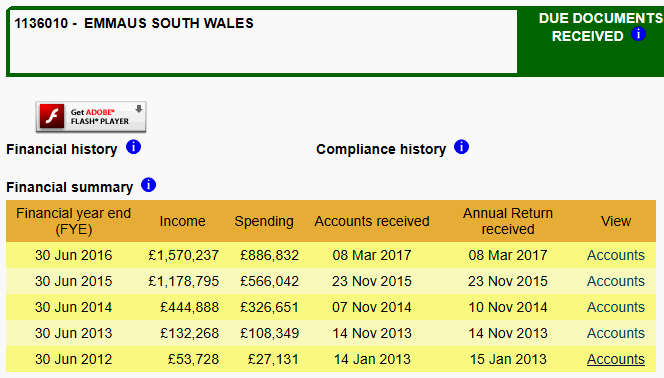
Let’s consider the older form first; this being the “Annual Return made up to 29 May 2011 with full list of shareholders”. (Found under the ‘Filing History’ tab.) The difference between the 2011 original and the 2017 “second filing” is shown in the panel below I cobbled together from the two forms.

click to enlarge

I find it difficult to believe that anyone could make a mistake over how many of just 100 shares were held by each of only four directors.

Keeping to chronological order, on 11 January 2013 there was a sizeable share issue and this explains the allocation we’ll look at next. Again, with a panel compiled from the original submission and its correction.

The original return of May 2013 was signed by Anna Walters, the correction of 23 January 2018 by Astley.

click to enlarge

The amended form sees a new shareholder, this being Back-on-Track Mountain Bike Solutions Ltd, holding 2,795 shares. So who or what is Back-on-Track? Companies House tell us it’s a company based in Pontypool, Incorporated March 2008, and its sole shareholder is Rowan Sorrell.

The two directors of this company are Sorrell and Elizabeth Alexandra Sorrell (formerly Scaife). And for a husband and wife outfit the company is in rude financial health, with total assets less current liabilities for 2017 of £494,952.

If we tot up the shares of Sorrell, Scaife-Sorrell and their company it comes mighty close to the majority shareholding in Beic Parcio Cymru Ltd shown in the document we looked at earlier. But that still leaves the question – why was Back-on-Track Mountain Bike Solutions Ltd left off the document submitted in 2011? I ask because in a small company like Parc Beicio Cymru those involved must know who the shareholders are and how many shares they hold.

Though the figures still don’t add up. The share issue of January 2013 talks of 46,536 ordinary shares being “in issue”. The first document, of May 2013 accounts for just 43,795, but with Back-on-Track added the total comes to 46,590, which of course exceeds the stated issue by 54 shares.

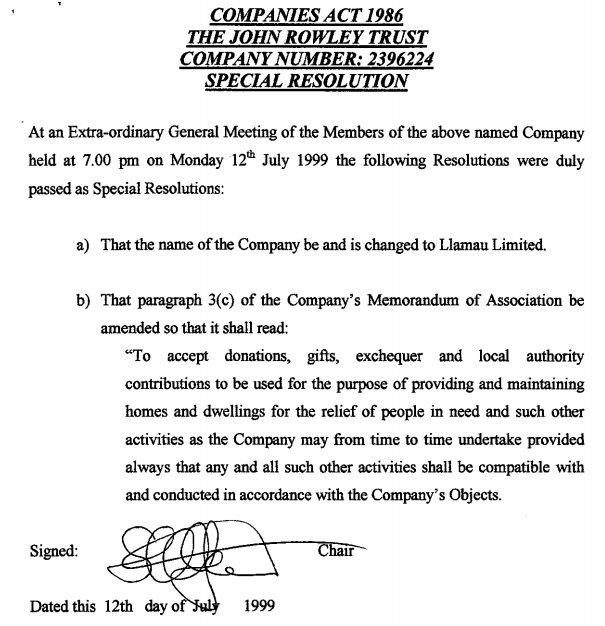
This extra 54 shares seems to be explained in a document lodged with Companies House long after the shares it refers to had been issued.

UPDATE 12.05.2018: An FoI request has now been sent to the ‘Welsh’ Government.

click to enlarge

UPDATE 16.05.2016: A response has been received from the ‘Welsh’ Government. The respondent seems unaware that Bike Park Wales no longer exists. Still, I shall now write to Natural Resources Wales.

◊

BIKEPARK HOLDINGS LTD

Now we return to the newly-hatched parent company, BikePark Holdings Ltd. Who exactly have Sorrell and Astley shacked up with? We certainly know their names: Thomas Anthony John Spencer, Simon Paul Stephenson and Keith Pacey.

If we turn to the Filing history tab of BikePark Holdings, and the ‘Written Resolution’, we see that the new parent company of Beic Parcio Cymru is linked with BCF Ventures Ltd, a company belonging to Tom Spencer and Simon Stephenson.

Companies House tells us that BCF Ventures Ltd is based in Peterborough, in eastern England, and it was Incorporated 5 October 2015. In June 2017 it filed accounts for a dormant company showing just the two shares issued, both held by Spencer.

So BCF Ventures Ltd seems to have done little or nothing before linking up with Parc Beicio Cymru Ltd to form BikePark Holdings Ltd.

Going back to and moving down the Written Resolution we see that Rowan Sorrell and Martin Astley are listed as ‘Managers’.

Which leaves just Keith Pacey, who is well known to the business world, seemingly specialising in mergers and buy-outs. Here’s his Bloomberg profile. He is non-executive chairman of Places for People Leisure, which would seem a good fit for Merthyr Bike Park.

Information courtesy of Bloomberg, click to enlarge

Pacey is clearly the director with the money in BikePark Holdings Ltd. Confirmed by going back to the Companies House website and checking through the charges (debts or obligations).

But first, let’s consider the charges against the original company, Parc Beicio Cymru Ltd. There are no fewer than seven outstanding. These charges belong to Allied Irish Bank, Welsh Ministers, Finance Wales, plus Kevin Pacey and a debenture held by former director Ian Campbell Officer who left 21 December 2017. And two months later set up Wye Mountain Biking Ltd.

The charge held by Pacey is in the form of a Guarantee and Debenture in relation to £3,787,308. The same amount appears in relation to a charge listed against BikePark Holdings Ltd.

Moving on to BikePark Holdings Ltd we see, in addition to the charge held by Pacey, one against Welsh Ministers and one against Allied Irish Bank. So clearly, the ‘Welsh’ Government knows about Beic Parcio Cymru Ltd being taken over by BikePark Holdings Ltd . . . and presumably approves.

◊

WHO? WHAT? WHY? WHEN?

Here are a few questions relating to events around Christmas time last year:

  1. Why did Beic Parcio Cymru Ltd submit two corrected documents to Companies House?
  2. Who discovered the errors in the originals?
  3. Were those ‘errors’ genuine mistakes or attempts to deceive?
  4. Why did Ian Campbell Officer part company with Beic Parcio Cymru?
  5. Why did Beic Parcio Cymru need Spencer and Stephenson, and their hitherto dormant company BCF Ventures Ltd, seeing as the financial backing needed appears to come from Pacey?
  6. What exactly is the fresh money for?
  7. Is BikePark Holdings Ltd (or anyone else) buying the site from the ‘Welsh’ Government?
  8. Is BikePark Holdings raising money to renovate or expand its Merthyr operation?
  9. How deeply in debt are Beic Parcio Cymru Ltd and BikePark Holdings Ltd, and is the Welsh public purse in danger of having to cover debts incurred by either company?
  10. Is the ‘Welsh’ Government happy with recent developments, and how does it feel about those running this valuable asset being based further and further away from Wales?

◊

‘WELSH’ TOURISM

It would be nice to think that the developments at Merthyr are an aberration, that English companies and individuals getting rich by exploiting Welsh assets is a rarity, but it’s not. Just a few miles from Merthyr as the crow flies the ‘Welsh’ Government is handing over another large tract of Welsh land to yet another bunch of spivs English company.

And this will all be done in the name of  “building the Welsh economy”.

Of course there’ll be jobs for locals . . . the kind of jobs that are always provided in colonial situations. But the money will flow east and the top jobs will go to people who’ve moved west. For us it’ll be: “Can you drive a lawnmower, Taff? . . . Can your girlfriend serve coffee? . . . Nice ass on her, bit of a go-er, is she? . . . Oi, careful, Dai – do you want the job or not?”

And things have got worse under devolution. Yes we’ve always been exploited by England, but I can remember when a boy could leave school with little in the way of skills or education and still get a well-paid job underground or in a factory, steel or tinplate works. A job that made him feel like a man among men.

Now, increasingly, all we’re offered is wiping wrinkly Saxon backsides and making our betters feel welcome in our country.

But this is how it must be under devolution run by a socialist-Unionist party. On the one hand Plaid Tlodi Cymru is incapable of creating jobs because your average Labour politician knows less about economics than he/she knows about Lithuanian poetry; and on the other hand – being control freaks – they’re terrified of a healthy economy, run by businessmen and entrepreneurs who’ll see through them, so we end with up a bloated and suffocating third sector run by Labour-supporting parasites.

And because the Wales Poverty Party is Unionist it must run Wales in the interests of England and the English. Which brings me back to the Merthyr Mountain Biking Centre, and the Afan Valley Resort, and Surf Snowdonia, and Bluestone, and all the rest.

‘Croeso!’

Has any word in any language in the whole history of the human race been so traduced and corrupted that it has lost all meaning? What should exude warmth, sincerity and hospitality is now just a robotic slogan stripped of all human emotion and often mouthed from behind a rictus smile.

click to enlarge

“Croeso, we hope you’ll like us . . . and we don’t mind if you take over our country . . . cos we’ve been conditioned to cringe like this . . . would you like me to say something in Welsh so you can laugh?”

Yeah, ‘Croeso’.

♦ end ♦

Updates 03.05.2018

AN OPEN LETTER TO ROBERT MELEN, PHOTOGRAPHER

Robert Melen,

Here is my response to the e-mails received from you, set out in my previous post.

When I received your request on April 19th to remove the image I’d used, I asked myself, ‘Why has it taken him so long to see an image posted on September 30th 2017?

I concluded that the answer lay in the fact that the article from last September and the article current when you contacted me had one thing in common – a Labour politician who appeared in both articles but did not appear on my blog between those dates.

Upon receiving your first e-mail on April 19th I straight away removed your photograph which, let me add, had always shown, ‘Image: Robert Melen’. At no time did I try to present your photograph as my own, nor did I make any profit from the use of your photograph.

I hoped that was the end of the matter, but no, you came back with a threatening letter you had copied, as with the first, from the EPUK website. In this second e-mail you demanded payment of £150.

Before giving you my decision, let me explain where I stand. I believe that western legal systems – once stripped of religious observations, divine right of kings and other nonsense – are predicated upon, among other things, common sense and a belief in natural justice.

Applying these fundamentals to copyright law means that someone is entitled to compensation if an artistic creation of theirs is stolen or used without their permission by another person, or a corporate entity, to pass off as their own, thereby profiting from that deception.

And I agree with that. But the only element that applies here is that I innocently used your image without your permission, for which I apologise. But I remind you that it was removed immediately you requested its removal and it was always clearly attributed to you.

Further, I claim ‘Fair Dealing’ exemption in that your image was used in my reporting of current events. Namely, the re-opening of the refurbished Castle Bingo and gambling emporium in Morriston. Proven by the fact that the image originally appeared in this news story on the WalesOnline website.

I am driven to conclude that your behaviour has nothing to do with outraged copyright and is instead an attack on freedom of expression, and on my right to criticise – even ridicule – the political party (and its representatives) supported by your employer, the South Wales Evening Post.

Which is why I have decided not to submit to your threats. You will not receive the £150 you demand.

Yours

Royston Jones

UPDATE 05.05.2018: Robert Melen has been in touch, we have exchanged a few e-mails, and I’m prepared to accept that this was all a misunderstanding. He seems to be a tidy boy just looking out for his young family. So if anyone has photographic work, Rob Melen‘s your man.

Those who contributed to my fighting fund have been notified and they all want their donations to be used either in support of the Argentine economy or else donated to Ein Gwlad. Requests to which I have willingly acceded.

◊

TRENCHING AND TROUGHING AT FIVE MILE LANE, BARRY

In a recent post, News Round-up 25.04.2018, I told you about a road-widening scheme at Five Mile Lane, Barry, in the Vale of Glamorgan. The road in question being the A4226.

It is alleged that work on this site has gone beyond a simple road widening and in the process has damaged an important archaeological site or sites. You can get more information on the claims from the video below.

I contacted Cadw but received nothing beyond an acknowledgement, and so I assumed that the ‘Welsh’ Government source who replied was answering for Cadw (who were cc’d into the correspondence as ‘CADW Mailbox’). The reply came from a Regional Inspector of Ancient Monuments and Archaeology (South East Wales), but I can’t be sure if this person actually works for Cadw, which is now part of the WG.

Confused? I was. Though perhaps it’s explained with my contact telling me: “Cadw lies within the Economy and Transport section of  Welsh Governments Economy, Skills and Natural Resource Group (ESNR). Our minister is Dafydd Elis Thomas.” Such familiarity! Lord Elis Thomas, surely!

Anyway, our exchange of e-mails continued and this person turned out to be most helpful.

As we knew, the road-widening scheme was ostensibly the responsibility of Vale of Glamorgan council, and I learnt that the council is being advised on archaeological matters by the Glamorgan-Gwent Archaeological Trust (GGAT), which is monitoring the site.

I was provided with a link to the VoG council website where we learn that the applicant for the required planning permission on the A4226 is, as we might have guessed, the ‘Welsh’ Government. The agents being Parsons Brinckerhoff (since re-badged WSP), which seems to be a US firm with an office in Cardiff.

Click on the Parsons Brinckerhoff Environmental Impact Assessment Scoping Report from July 2014 and scroll down to Section 6, Cultural Heritage, for fuller information than is provided in the brief summary below.

click to enlarge

In my earlier post I said that the archaeological work, on the ground, as it were, was being done by Rubicon Heritage Services (UK) Ltd, a subsidiary of Irish company Rubicon Heritage Services. The subsidiary was liquidated in March 2018, so I asked the Regional Inspector where this left the Five Mile Lane project.

I was told, “Rubicon Heritage Services (UK) Ltd was a subsidiary which was liquidated prior to the start of the project and has had no role in the work at Five Mile Lane, Barry. Rubicon Heritage Services Ltd will continue to deliver the project at Five Mile Lane”.

Which fits with the Irish parent company recently opening a branch office in Cardiff, at the Ringside Business Park. I can’t imagine this being done without Rubicon having expectations of future work in Wales.

In response to my asking what was the ‘Welsh’ Government’s and Cadw’s opinion of the work carried out at Five Mile Lane I was answered: “Dr Jonathan Berry (Cadw Senior Inspector of Ancient Monuments and Archaeology) and I visited the excavations on 18th October 2017. We were given a detailed tour around all of the excavation areas exposed at that time and had an opportunity to discuss their interpretation and observe the quality of work. While this was not a formal inspection visit Cadw did not identify any issues of concern.”

October 2017 is long before the work was done that it’s claimed has caused the damage. When I pointed this out I was told: “I have contacted the Glamorgan Gwent Archaeological Trust and obtained reassurances that archaeological work has been undertaken to the standards required by the Chartered Institute for Archaeologists and according to national legislation for the excavation of burials.” 

This e-mail also referred to “visits by independent curators” so, naturally, I asked who these are, and to whom they answer.

I was told: “The quality of the archaeological works at Five Mile Lane is monitored by two independent consultant archaeologist organisations: Cotswold Archaeology and Black Mountains Archaeology.

Rubicon Heritage, Glamorgan Gwent Archaeological Trust, Cotswold Archaeology and Black Mountain Archaeology are all Registered Organisations of the Charted (sic) Institute for Archaeologists, to whom the organisations are accountable.”

click to enlarge

Now Cotswold Archaeology is a multi-million pound business apparently headquartered in Cirencester, Gloucestershire, whereas Black Mountains Archaeology seems to be a one-man band formed in March last year. On the plus side, BMA is run by a Welshman, perhaps the first we’ve encountered in this saga.

I mention this because few things illustrate a people’s colonial status worse than having its past interpreted by strangers, especially when those strangers are representatives of the country that rules over that people.

I suggest that to understand what has happened at Five Mile Lane we need to consider the wider project, and its political importance. Explained in the Parsons Brinckerhoff document.

The widening of the A4226 is to improve access to St Athan (Aston Martin, etc?) and Cardiff Airport Enterprise Zone. Despite being nominally the responsibility of the Vale of Glamorgan council, because the ‘Welsh’ Government puts up the money it’s the Bay Bubble calling the shots. So I think we can absolve VoG of any culpability.

What’s happening at Five Mile Lane links with the obscene amounts of public money ELPiW continues to pour into Cardiff Airport, and the bribes given to Aston Martin to move to Wales. For obvious reasons nothing must be allowed to interfere with these ‘investments’ and cause political embarrassment to the ‘Welsh’ Government.

What of the other players in this tragedy?

As we’ve seen, Cadw is now a department of the ‘Welsh’ Government, overseen by loyalist-royalist Dafydd Elis Thomas. Glamorgan-Gwent Archaeological Trust gets the bulk of its funding from Cadw, so no ripples from that direction. As for Rubicon, which is actually doing the work at Five Mile Lane, it’s not going to bite the hand that feeds it, especially with a new office in Cardiff. Anticipation of further work from the ‘Welsh’ Government also keeps Cotswold Archaeology and Black Mountains Archaeology on board.

Which means that to protect the ‘Welsh’ Government’s image important archaeological sites can be trashed and the graves of our ancestors desecrated.

Par for the course in a corrupt colony run by a bunch of collaborationist shites.

◊

WHY BRECON?

I quite like Brecon, and the wife is very fond of the town, insisting that we stop there if we’re heading south on the A470. But there have been news reports recently and information emerging suggesting that there are some pretty ugly people living thereabouts.

Let’s begin with the well-publicised case of the serving soldier who was convicted of being a member of banned organisation National Action. He was not only based at Sennybridge Camp but he also seems to have settled at Llansilin.

I can’t understand why a Finn serving in the British army would want to settle in Llansilin. Come to that, why did a Finn join the British army? Another mystery is the unnamed civilian defendant described in one report as the National Action ‘regional organiser’ who was jailed for three-and-half years. Why unnamed? Which region?

A further mystery is the weapons found “at two properties in Powys occupied by Vehvilainen” . . . but apparently they had nothing to do with him?

click to enlarge

Moving down the scale of obnoxiousness we come to the Abolish the Welsh Assembly Party. The party leaders are David Bevan, born in Neath, and Jonathon Harrington, born in London but living somewhere in the Beacons.

Their backgrounds are fascinating. Dai served in the British army and was chairman of the Cardiff branch of Ukip until that lot went soft on devolution. Jon’s family moved to a farm in the Beacons when he was eight, and when he grew up he took himself off to South Africa, and Rhodesia, when Smiffy was running things. As the result of a fall on Cader Idris (for some reason spelled ‘Cadir’ in his bio) he is paraplegic.

According to Harrington’s bio, the AWAP is needed in order “to represent the views of the great but silent majority.” This must be the same silent majority that wants to name the Second Seven Crossing the Prince of Wales Bridge.

It would be easy to laugh at these people, very easy, but they stood a full slate of candidates in the 2016 Assembly elections and gained 44,286 regional votes, 4.4% of the total.

Staying in the Brecon area we return to Wales for a United Kingdom.

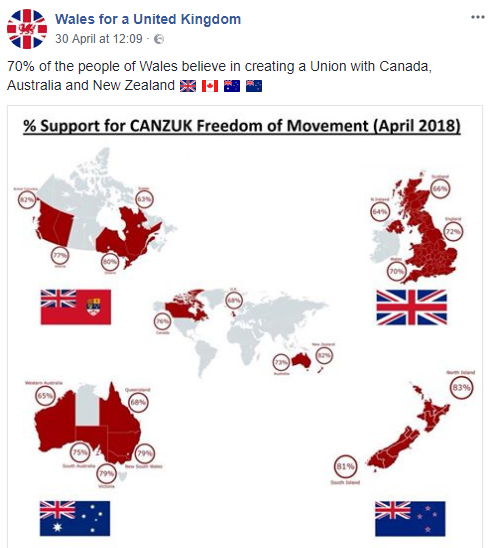
The W4aUK Facebook page tells us that 70% of the people of Wales believe in CANZUK. While in what I suspect serves as the manifesto we read, “We have multiple admin running the page day and night so please feel free to message us with any queries.”

Or possibly a lone insomniac.

click to enlarge

I must confess, I don’t recall being consulted about CANZUK. Was it restricted to that silent majority we keep hearing about? And has W4aUK thought it through? Because freedom of movement could result in all sorts turning up, demanding entry to this scepter’d isle.

Before you know it it’ll be digeridoo virtuosos on Britain’s Got Talent, big, tattooed buggers demanding to rub noses with you . . . but worst of all, there’ll be nothing to stop thousands of Frenchies moving here from Canada! What’s the point of getting out of the EU if the buggers start coming from the opposite direction?

As we established in Snippets and Updates 19.04.2018 the budding demagogue behind W4aUK is one Adam Jon Brown of Talgarth, or possibly Llanfaes. Not one to let grass grow under his feet, our Adam – or Ladam as he calls himself on his own Facebook page – to judge by the jobs he’s had in his short life.

For after studying History & Archaeology at the University of Wales he spurned oodles of ‘Welsh’ Government funding, and the chance to trash burial sites, in order to serve at the Coracle Fish Bar in Brecon. From where he seems to have moved on, via Harry Ramsden’s, to Kentucky Fried Chicken, rising from team leader to assistant under-manager.

Now he’s an internet merchandising tycoon with Bluebellsgifts Ltd. Where will it all end?

Or perhaps the question is, what has the Brecon area done to deserve Finnish racists, yearners for Rhodesia, and boy wonder BritNats? And how many of them were actually born anywhere near Brecon?

◊

THE BRITNAT LEFT AND ‘THE SHARED EXPERIENCE’

The ‘shared experience’ is one of the most powerful tools in the Unionist armoury because it gives people from different walks of life, different parts of the country, something to bind them together.

The most powerful shared experiences are of course war, especially World War One and World War Two, but even smaller conflicts such as that in the South Atlantic can fill the role. Or more recent adventures in the Middle East. The government sends soldiers and other combatants from every corner of the state, every area loses some young men, the media joins in – bingo! you have a shared experience helping to bind the state together.

Obviously, the WWII generation is nearly gone and the smaller wars don’t generate enough ‘patriotism’. Because while it was virtually impossible to argue against the necessity of going to war in 1939 ‘dodgy dossiers’ and other revelations make recent foreign military adventures easy targets for critics.

And so the state must play the shared experience card in other ways. For example, flooding our television screens  with programmes called ‘Great British Bookshelves’ and ‘Great British Bollocks’ – ‘cos we’re all British, innit!’ The point being that when you have people in Derry, Dundee, Doncaster and Dowlais watching and enjoying the same television programmes then the state’s on a winner.

And in recent years it has been made easier by the state enforcing its control. To the extent that BBC Scotland and BBC Wales have become state propaganda outlets rather than national broadcasters for Scotland and Wales. For while a British shared experience must be promoted it must inevitably be done at the expense of a shared Scottish or Welsh experience.

Royal events inevitably play their role. When Princess Wilhelmina of Troutbridge-on-the-Wold knocks out another sprog all TV programmes must be interrupted with ‘Rejoice! Superior being gives birth to yet another superior being!’

This shameless exploitation of the monarchy is why another Investiture in Caernarfon cannot be ruled out.

Pushing a shared experience is becoming more difficult, hence the increasing desperation evident in the mainstream media. The difficulty being due to fewer people getting their information from newspapers, radio or television. When did you last see a teenager holding a newspaper that he or she wasn’t taking home for parents or grandparents?

The left in Wales has always bought into the shared experience.

Which explains why the Labour Party has always been the British establishment’s secret weapon and bulwark. The party of ‘King, Country, and a 40-hour week (but only if it’s agreeable to you, sir [doffs cap])’. A sell-out party.

In Wales, the fact that the Labour Party was largely built by non-Welsh migrants to the southern coalfield resulted in the party being contemptuous of Welshness, dismissing our ancestors as gibberish-speaking savages, their leaders as bandits, and even arguing that Wales didn’t exist before the Industrial Revolution.

(You can read more in Why I Detest the Labour Party from March 2014.)

This first appeared in the Western Mail, click to enlarge

It would be nice to think, after almost two decades of devolution, that the hostility to things Welsh was evaporating from what chooses to call itself the ‘Welsh Labour Party’. But no, it’s still there, and it surfaced again on May Day, with a piece in the Wasting Mule by Nick Thomas-Symonds, the Labour MP for Torfaen.

The lengthy article trotted out the same old bigotry – Wales was nothing before the Industrial Revolution. Which also promotes the shared experience of industrialisation, far preferable to anything uniquely Welsh. Two for the price of one!

The Labour Party has betrayed Welsh people, it has betrayed the working class, and it has betrayed those communities that vote Labour. Which is exactly what it was intended to do. For a prosperous, confident Wales would be a threat to the Union, so Wales must be kept poor, and no one does that better than Labour.

We’ve had Labour on our backs for a century. Regrettably, what helps keep them there is more sincere socialists, and liberals deceiving themselves that the English Labour Party in Wales is ‘progressive’, and so they must align themselves with it against what they are told is the real enemy, in the form of the Conservatives.

Listen to me, and listen good. There is nothing ‘progressive’ about the Labour Party. It is the real enemy. The party attracts members motivated by self-interest and it operates like a Mafia, putting Labour interests above those of Wales, and defending the rackets of its colonial gravy train.

Perhaps what Wales needs at this juncture is a Welsh socialist party, one that concerns itself with Wales and Welsh interests. Because Plaid Cymru has failed in trying to satisfy everyone, and such a party could also attract the more sincere supporters of ELPiW.

For all those who need to be weaned off damaging BritNat socialism and the propaganda of the shared experience then the halfway house of a Welsh socialist party might fit the bill.

♦ end ♦


News round-up 25.04.2018

SHEEP AND GOATS

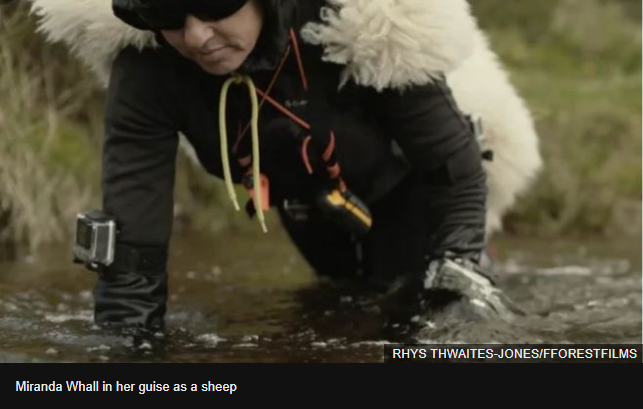
My attention was drawn last Saturday morning to a very curious story on the BBC Wales website. Telling of some woman named Miranda Whall who has been crawling around on all fours in the hills inland of Aberystwyth (apparently sober!). Read it for yourself.

Photo by Rhys Thwaites-Jones captured from the BBC Wales website, click to enlarge

My instant, and characteristically cynical, reaction, put out on Twitter, was, “Rarely does one encounter such unutterable bollocks. There must be grant funding involved somewhere”.

Sure enough, I was very soon sent evidence that this stunt had netted £25,000 from the Lottery. Was there also money from other sources?

Source unknown, click to enlarge

According to the BBC Wales report the inspiration for this stunt ground-breaking transhuman art “came to Miranda in 2015 after reading a book called The Living Mountain by Nan Shepherd, which explores life in the Scottish Cairngorms. (Are there other Cairngorms?) She said: ‘Nan Shepherd wrote about immersing herself in the mountains and opening up her imagination to rethink how we look at them’.”

Let’s be honest – which of us hasn’t felt that same urge to rush into the hills and become one with our woolly compatriots. (Not a reference to the Liberal Democrats.) Many of us do it regularly . . . and some get caught. But enough of that.

The BBC article, by Gwyneth Rees, also provided a link to a video on the Vimeo platform by the Rhys Thwaites-Jones whose photograph I’ve used above. The video is called Woolly Maggot. Which I suppose makes sense to somebody.

Further information received directed me to an article in the Daily Mail telling of someone pretending to be a goat in the Swiss Alps back in 2015. Here it is. The article tells us that being a goat was not Thomas Thwaites’ first choice: ‘I initially wanted to be an elephant, but it wasn’t going very well,’ said Thwaites. ‘I visited a shaman, and she said “you’re an idiot”. So, I decided to be a goat.’

I suggest Thwaites thanks the shaman. Trying to mix in with a herd of elephants could have ended a lot worse than scraped knees and Swiss shepherds wetting their lederhosen. The lions would definitely have targeted him as the weak one in the herd.

Thwaites was funded in this nonsense by the Wellcome Trust to the tune of £30,000 for five months. A paid holiday in the Alps is nice work if you can get it. If you class it as work, that is.

from the wellcome trust website, click to enlarge

At this point, might it be worth speculating that Rhys Thwaites-Jones is married to the sister of goat man Thomas Thwaites? And, as a consequence, that Miranda Whall’s inspiration came from the brother-in-law of the guy who made her video, rather than some crazy old bat up in the hielands.

Or is there a clique of them – a flock? a herd? – out there looking for sponsors? There certainly seems to be plenty of money out there for anybody who can come up with an idiotic and self-indulgent project that ticks the right boxes.

Personally, I’m thinking of applying for a grant to imagine myself as an Argentine wine drinker. For which I shall need to live in Argentina for a while (take in a few football games, the odd asado, tango lessons with bosomy Argie matrons) and then, to satisfy the funders, make a film of me getting pissed really getting into the role and attending a rally to demand the return of the Malvinas.

It’ll be hard, but I promise to give it my best shot.

Finally, for anyone who might have been wondering, Miranda was trying to pass herself off as a sheep during the summer months, before the rams are brought in to do their stuff. Just as well, I suppose, otherwise Miranda might have found out what it’s like to be sheep in ways she hadn’t planned.

On the plus side, it would have been far more authentic and given Rhys Thwaites-Jones a much more interesting video. The boy could have made a fortune on YouTube. (And certain websites I’m informed cater for that sort of thing.)

◊

CHAD AND BRAD MOVE TO RHYL

Regular readers will know that over many years I have questioned the practice of dumping England’s criminals and degenerates on the north coast. Rhyl being the town worst affected.

Nothing seems to change to judge by a recent report of brothers from Walsall going on a rampage in the town. Although, unusually, the BBC report I’ve linked to does say that they came from Walsall. As does this report in Birmingham Live. But the good old Daily Post has the headline “‘Dangerous’ Rhyl brothers who stabbed pop man jailed for 16 and a half years” with no mention of Walsall.

Courtesy of BBC Wales, click to enlarge

This case prompts the same old questions:

  • Who brought the Daniels brothers into Wales?
  • Were the local authority and police made aware that two dangerous little thugs had (been) moved onto their patch?
  • On the assumption that North Wales Police must know about this unending influx, does the force get payments to cover the extra work involved, and if so, where do these payments come from?
  • Why are local politicians so easy-going about a regular influx of violent people that endanger, and indeed murder and assault their constituents?
  • Why have journalists written up their reports as if these criminals were local? Or is the decision to hide the origin taken at an editorial level?

Chief Inspector Neil Harrison of North Wales Police commented on the case, “We are determined to maintain a safe North Wales and will always pursue those who bring harm to our communities.” If he’s serious then he and North Wales Police will do something to stop the dumping of scum like this in Wales.

The bottom line here is that ‘re-locating’ England’s rejects in Wales would be much less likely to happen if we had our own legal system. Because do you think Scotland accepts English criminals? The fact that Wales suffers dumping on an industrial scale is one of the reasons London refuses us a separate legal system.

Next time the issue comes up in Westminster I want Welsh MPs to remember all the people in Wales who have been killed, raped, robbed and assaulted by criminals who wouldn’t have been in our country if we had our own jurisdiction.

◊

WOODY ALLEN LOOKALIKE DEFENDS ROD LIDDLE AND FEDOR THE ‘JUGONOSTALGIC’ JOINS IN

The fall-out from Alun Cairns’ announcement that the second Severn Crossing will be officially named the Prince of Wales Bridge continues.

After Rod Liddle’s contribution in the Sunday Times we were treated to James Delingpole’s defence of Liddle in debate with my MP Liz Saville Roberts. (Delingpole is a real person and a journalist, not a character from one of the earlier series of Blackadder.)

We’re all familiar with the defence used by Liddle, Delingpole and others too numerous to name. We Welsh lack a sense of humour, we are told to ‘get a life’, and most important of all, by defending ourselves we are attacking someone else’s freedom to express themselves.

click to enlarge

Which is where I would normally agree with our detractors, for I have always opposed political correctness and the censorship that goes with it.

But those we are discussing are not really defending freedom of speech. What they are defending is the right of an extreme form of English nationalism to say whatever it likes about minorities in these islands, be they ‘minorities’ that pre-date the arrival of the English or minorities here as a result of England’s imperial past.

For no matter how measured and urbane the likes of Delingpole may appear, beneath the surface there writhes a shield-beating Beowulf trying to break out and slay the Grendels defiling their land.

This is no more than we can expect from English writers, but perhaps the most bizarre and insulting defence of Cairns’ decision came from within Wales. I’m referring now to a piece on the Wales Arts Review by Fedor Tot.

‘Who he?’ you demand. Well, Tot describes himself on his Twitter account @redrightman (which uses a picture of a fag-smoking Tito) as a “Serbian-born, Welsh-raised. Yugonostalgic. Probable Comemeunist.” Make of that what you will.

Despite prefacing his piece with, “The decision to rename the Severn Bridge as the Prince of Wales Bridge to is by all means a silly and empty one, one designed purely as a meaningless PR exercise for Tory powers in Westminster, who have no interest in Wales other than as a resource for cheap sheep jokes and the occasional seat. It is a vacuous symbol of valueless political power” he then goes on to attack those opposing this “vacuous symbol” and links them with fascists!

Tot is a Serb, and like many Serbs he suffers from motes and beams, blaming ‘nationalism’ – on the part of Croats, Slovenes, Albanians, Muslims and others – for the break-up of Jugoslavia, but is himself blind to Serbian nationalism. It’s as if the ruling or majority group in a multi-national state can never be guilty of nationalism because it seeks to hold the state together against the centrifugal forces of peripheral nationalisms.

He seems unable to grasp that those seeking to hold such states together are themselves motivated by selfish and nationalistic reasons. The difference being that Jugoslavia was cobbled together after World War One and the Serbs didn’t have enough time to confuse Serbian identity with Jugoslav identity in the way that the English have done, to the extent of Englishness and Britishness now being synonymous and interchangeable.

This explains why Tot can attack us for being nationalistic in opposing the PoW Bridge but make only passing reference to the British nationalism explicit in the naming. (Though I suppose that the confused and unproofread intro could be the work of someone else.)

Though the boy shows promise as a political commentator with this observation: “I would like to clarify for a second here: I do not consider the majority of Plaid Cymru to be a nationalist party, and neither should it consider calling itself a nationalist party, despite the common usage of the term ‘civic nationalism’. Rather what Plaid calls for is something that’s better off being called regionalism or autonomism, as it promotes economic and political independence based on the existence of a region traditionally ignored by centralised powers, a response I very much respect and agree with.”

Chwarae teg, Fedor.

It may be no coincidence that Fedor Tot’s rather silly and insulting piece appeared on the website of the Wales Arts Council, a Cardiff organisation that relies on the ‘Welsh’ Government for much of its funding. I ask you to note that fact because Fedor Tot’s piece was nothing but a reiteration of the BritNat line.

It was the nationalism of the state, be it Britain or Jugoslavia.

P.S. Fedor Tot wants me to make it clear that he is not a Serbian nationalist. Fair enough, I’m happy to do that.

But he describes himself as a Yugonostalgic, in that he yearns for the old Jugoslavia. But Jugoslavia was Serbia’s little empire, held together by the power of Serbian nationalism; as soon as they could, the other nationalities got out.

So what is he nostalgic for? Tell us, Fedor.

◊

‘NUFFIN TO SEE HERE, GUV’

If what I’m hearing is true, then a terrible crime has been perpetrated in the Vale of Glamorgan.

Earlier this year work began on a ‘road-widening’ scheme on Five Mile Lane, or the A4226. Though as the video shows, what contractors Alun Griffiths have done looks suspiciously like cleared land for housing or some other development.

This would be bad enough in itself, but the allegations made in the video are that a very important archaeological site has been destroyed and human remains treated with contempt.

The video also tells us that archaeological work was undertaken at the site by Rubicon Heritage Services. This is an Irish company run by Colm Moloney with a separate presence this side of the water in the form of Rubicon Heritage Services (UK) Ltd. This company conveniently went bust last month.

Rubicon could be a kosher outfit, on the other hand it could be the kind of company that – for a price – will find nothing to impede developers.

I urge you to watch the video and draw your own conclusions. Then, if, like me, you feel that an insult of national significance has been perpetrated I’d like you to contact the politicians who seem to have given the green light to this desecration or else may be minded to stop it and save what can be salvaged.

Given that it is our history, and people living in Wales today are descended from those who lived on this site, those whose remains were treated with contempt, this may explain why local archaeologists were not employed. Come to that, who was responsible for hiring an ‘archaeology’ company from God knows where teetering on the brink of liquidation? Or were those the attractions of Rubicon Heritage Services?

The local MP is Alun Cairns. The local AM is Jane Hutt. You’ll see in the link I’ve given to the Vale of Glamorgan council website that Ken Skates, Cabinet Secretary for Economy and Transport, is involved, here are his contact details. The Regional AMs are Gareth Bennett (Ukip), and of course, Neil McEvoy.

Make your voice heard. Demand answers as to who gave the order for a ‘road-widening’ project to exceed its planning consent and destroy a valuable Bronze Age, Iron Age, possibly Neolithic site.

◊

AND FINALLY . . .

Carwyn Jones has thrown in the towel, though I’m at a loss to understand why anyone was surprised by the announcement he made last weekend at the ‘Welsh’ Labour conference. He’s been doomed since Carl Sargeant’s suicide on November 7th and the evidence started emerging about the role of lobbyists Deryn and other parties.

The hot favourite to replace him as Labour leader and First Minister is Mark Drakeford, the Assembly Member for Cardiff West, just. For at the last Assembly election in May 2016 Drakeford was given a nasty shock by local councillor Neil McEvoy standing for Plaid Cymru.

Although he didn’t win Cardiff West Neil McEvoy made it to the Assembly as Regional Member for South Wales Central.

click to enlarge

Now whoever leads the Labour Party in Wales is expected to be a constituency (rather than a regional) AM; he or she is also expected to have a solid majority in order to be able to concentrate on being leader rather than having to worry about holding on to their seat.

But if the trend evident in 2016 is repeated in 2021 then Drakeford might not be elected. For Neil McEvoy is a man on the rise . . . or was until his own party decided to sabotage his political career. Let’s look at the chronology.

  1. By June 2017 it was widely believed that Carwyn Jones was preparing to stand down in the near future. This report lists four potential successors, but Drakeford is not among them.
  2. In September, and on vague and flimsy charges, Plaid Cymru suspends Neil McEvoy.
  3. On November 7th Carl Sargeant commits suicide and questions start to be asked about who knew what and when, and the role of employees and ex-employees of Carwyn Jones.
  4. In mid-January, and with pressure increasing on Carwyn Jones, Plaid Cymru expels Neil McEvoy from the party’s Assembly group.
  5. On March 19th, and with Carwyn Jones now clearly doomed, Neil McEvoy is expelled from Plaid Cymru for 18 months. He will never be allowed back in, but the best option is to leave him in limbo.
  6. April 21st and Carwyn Jones announces he’s standing down. Mark Drakeford is the front-runner to succeed him.

In less than a year, the threat of losing in 2021 to Neil McEvoy is removed and Drakeford emerges from obscurity to be the shoe-in successor to Carwyn Jones. Whether by accident or design the engineered downfall of Neil McEvoy parallels the emergence of his rival in Cardiff West to be the next First Minister of Wales. Funny old game, politics, innit?

“I’m the unity candidate” says the headline in this report, but Drakeford might also be the Plaid Cymru candidate.

♦ end ♦


Third Sector Bollocks

UNCRITICAL PUBLICITY

Over recent years, at the prompting of political friends of the homelessness industry, both BBC Wales and the print media have given television series and pages of newsprint so that the countless competing and duplicating businesses in the sector can promote themselves and their ‘mission’.

To my knowledge, nothing even vaguely critical of the homelessness racket has been allowed. It’s the sort of publicity other commercial enterprises usually have to pay for.

But this free publicity is not restricted to companies in the homelessness business, it covers all bodies operating in the third sector, to the extent that the third sector has achieved the status of royalty or dead heroes in that it’s beyond criticism.

If nothing else, this exposes yet again the problems caused to Wales and Welsh public life by the incestuous little world we know as the Cardiff Bay Bubble.

We saw it with the death of Carl Sargeant and we see it again in the crucifixion of Neil McEvoy. A politician’s political or personal enemies ask a lobbying outfit to get some friend in the third sector to make a silly claim of harassment, or bullying, or bum-touching.

The victimisation process might even be initiated by the lobbyists themselves. (‘Shame on you!’ I hear.)

Then it’s a case of all girls together and another poor man-beast is brought down.

Another part of the Bay Bubble is the ‘Welsh’ media, which cannot criticise the third sector, stuffed with Labour Party members and supporters, without offending the Labour Party itself. So the third sector gets the kind of kid-glove treatment I’ve just described.

So who loses out? You and me, my friend, and the 99.9% of Wales lying outside of the Cardiff Bay Bubble.

◊

WCVA STEPS IN WITH DIRE WARNINGS

Earlier this month the Wasting Mule ran a big publicity puff and funding appeal (masquerading as a news story) for the Wales Council for Voluntary Action, in which CEO Ruth Marks told us that the “voluntary sector” is worth £1bn but she’s worried about reducing funding. Note the use of the term “voluntary sector”.

click to enlarge, or click here to view as a pdf document

Ms Marks quoted spurious figures which I’ve highlighted. For example, the figure she uses for ‘England’ almost certainly includes UK-wide bodies based in England and even international agencies such as Oxfam and Save the Children.

The only valid comparison would be England-only agencies with Wales-only agencies. Because I know damn well that in England a Tory Government, and Tory-controlled local authorities, do not throw money at the third sector in the manner of Welsh socialist politicians maintaining their system of patronage.

This reluctance to fund the third sector in England explains why so many third sector operatives have flocked to Wales since we’ve had devolution and Labour dishing out the loot.

Another interesting claim is that the third sector accounts for 10% of Welsh employment. Seeing as these jobs are almost entirely reliant on public funding they could be equated to paying benefit. Or, to be more generous, seeing as many third sector activities are ‘outsourced’ transferring from the public sector to the third sector just re-labels existing jobs.

Then again, the “voluntary sector” means unpaid work, so how can it account for 10% of Welsh employment? She must be confused, or perhaps hoping to confuse us.

After studying the third sector in Wales for many years I know there is a deliberate attempt to mislead or deceive in almost everything the third sector says and does. That’s because there’s a lot of money involved and many careers; the third sector is often a stepping stone to a political career, or it provides a nice retirement job after leaving politics.

But to enjoy these benefits you must be in the ‘club’. And membership is restricted to the Labour Party, with Plaid Cymru – in return for political support – allowed to feed off the scraps.

◊

WCVA GETS REALLY DIRE

Just nine days after the Ruth Marks piece in Llais y Sais, the WCVA was back with a full-page article written by Anna Nicholl, Director of Strategy and Sector Development.

click to enlarge, or click here to view as a pdf document

Don’t get me wrong, there’s nothing like grabbing the reader’s attention with the first few lines, just think of: “Last night I dreamt I went to Manderley again”, or “All happy families are alike, each unhappy family is unhappy in its own way”, and of course, “It is a truth universally acknowledged, that a single man in possession of a good fortune, must be in want of a wife”.

But when I read, “To my mind, the very fabric of Welsh life depends on the survival of the third sector”, the needle on the old hypocrisy meter went off the dial. While the bollocks detection equipment just blew up from some kind of power surge. (You should have seen the cat move!)

Hypocrisy_meter_tsd

To believe Anna Nicholl, the third sector is all that saves our beloved homeland from the ravages of the Four Horsemen.

Whereas the truth is that many Welsh communities are being damaged by the criminals, addicts, problem families and others imported by many third sector bodies (and here I include housing associations). Because once you’ve found your racket, and got your funding, you need a steady supply of ‘clients’ to keep the funding flowing, and if Wales can’t provide enough ‘clients’ then you have to look elsewhere.

Earlier I wrote, “there is a deliberate attempt to mislead or deceive in almost everything the third sector says and does”. This article by Anna Nicholl proves my point. But for anyone in doubt, let me spell it out.

On the one hand we have the kind of third sector body represented by the WCVA, such as homelessness company Llamau, with its 266 employees, spending over 70% of its £10m+ annual income on salaries, and paying its CEO £80,000+. Llamau is obviously not a voluntary organisation – it is a business.

Worst of all, it is a publicly-funded business competing with too many other, publicly-funded businesses.

By comparison, Mrs Williams (Troedyrhiw) who you encounter on the High Street, and who puts a sticky badge on your chest for dropping a washer or two in her tin (I always carry some), is a volunteer, because she performs this work for nothing.

Which is not to say that the organisation Mrs Williams collects for doesn’t have paid officials higher up its food chain, but these are charities in that they rely on donations from the public – not government funding.

Another kind of voluntary group is that we see in the picture used to illustrate the Anna Nicholl article, a local group trying to improve its neighbourhood, and with groups such as this there is usually no money involved at all!

So why use a picture like that if it’s not an attempt to mislead or deceive those reading the article?

In fact, Ms Nicholl gives the game away with the wording of the caption accompanying her photo: ” . . . the vital third sector, such as voluntary organisations”. But ‘voluntary organisations’ are only a small part of the third sector, and here they’re being used as a fig leaf.

The good news might be that the WCVA realises that the kind of organisations I criticise are now beyond defending, the only hope being to confuse them in the public mind with ‘voluntary organisations’.

◊

AN ATTEMPT AT BALANCE

After reading Anna Nicholl’s deliberate confusion or conflation of voluntary groups with the avaricious money-grabbers the WCVA really represents I was moved to write to the Western Mail. So I sent my e-mail and got a quick response asking for my full address.

So we know they have my letter for publication, will they now have the balls to publish it, unedited? Just in case, here it is.

“It seems that in recent weeks the third sector has felt the need to defend itself. Presumably in an effort to help, the Western Mail ran a big piece on the 8th quoting Ruth Marks, Wales Council for Voluntary Action CEO; and then on the 16th we had a full-page article by Anna Nicholl, Director of Strategy and Sector Development at the WCVA.
 
This later article was accompanied by a big picture of a mother and child picking up litter, as an example of the ‘voluntary groups’ the WCVA claims to represent, and on which “Welsh life depends”, according to Ms Nicholl. The picture was cute, but deliberately misleading.
 
I have criticised the third sector over many years, principally on my blog, ‘Jac o’ the North’, but I have never criticised voluntary groups, nor charities with an obvious purpose such as the RNLI. My criticism has been reserved for what can only be described as self-serving, third sector businesses.
 
Many of which get millions of pounds in public funding every year, with most of the money going in salaries. And a hefty chunk of that salary funding going to the CEO, who is invariably a Labour Party member or supporter, and often from outside of Wales.
 
As if that isn’t bad enough, we have the duplication to consider. In a recent FoI response from the ‘Welsh’ Government I was told that there are 48 bodies in Wales dealing with homelessness. That’s forty-eight in a country of 3 million people.
 
Having identified an ‘issue’ to exploit it then becomes imperative for third sector bodies to have a steady supply of ‘clients’ in order to ensure the continuation of the generous funding. To meet this need often means importing undesirables from outside of Wales.
 
One Cardiff-based housing association is currently wreaking havoc in Lampeter with the drug dealers and others it’s housing in that hitherto peaceful town – and it has applied to Ceredigion council for permission to convert more buildings to one-bed flats in order to bring in more misfits! And remember – this is being paid for from the Welsh public purse!
 
How can we explain this apparent idiocy? The answer lies in the fact that the third sector is, as I’ve suggested, an extension of the Labour Party.
 
On one level, the third sector is pure cronyism in that it provides thousands of jobs for Labour supporters. On another level, the size of the third sector is used to indicate how poor Wales is, and of course it’s always someone else’s fault – so ‘Vote Labour!’
 
Which means that the third sector exploits and entrenches Wales’ poverty for the benefit of those working in it and for the electoral advantage of the Labour Party.
 
If the hundreds of millions of pounds poured into the third sector every year was used to encourage entrepreneurship and invite investment Wales would be much better off, but would also be less likely to vote Labour.
 
All of which means that the unnecessary, crony-filled and duplicating third sector bodies I’m dealing with have nothing in common whatsoever with mothers and children picking up litter in their local park.”

♦ end ♦

UPDATE 20.03.2018: Chwarae teg, the WM published the letter in full today.

Networks

‘DO YOU WANNA BE IN MY GANG?’

We all belong to some kind of network. It can be as obvious as family or friends, or else it’s neighbours, workmates, political associates, other fans of the teams you support, fellow-worshippers at your chapel or church, even the people you play darts with down the pub. And nowadays we have to include social media.

Yet when we consciously use the word I’m sure many of us think of vaguely sinister organisations such as the Freemasons.

A curious outfit, the Freemasons, forever extolling their links with the Temple of Solomon, the Knights Templar, and the intellectuals and freethinkers of the Renaissance and the French Enlightenment. Yet this brotherhood lost its way and became what we see today – a mutual benefit society.

In fact, the Masons changed from being an organisation of questioning intellectuals to one representing an unquestioning and defensive bourgeoisie linked with the Conservative and Unionist Party, and in Ireland with Unionism and the Orange Order.

Freemasonry became a buttress for a UK establishment feeling threatened by the extending franchise in Britain and ‘Fenianism’ in Ireland. Which is not to say that supporters of other political parties don’t become Masons, but at root, Freemasonry is very much a Queen and Country organisation.

Yet today’s Freemasons maintain the pretence they belong to a rebellious intellectual continuum taking in Michaelangelo and Voltaire. Obvious nonsense.

One of the great bogeymen, and therefore recruiting sergeants, for the Freemasons a century ago was the Labour Party. Labour returned the compliment by trying to copy the reach of Freemasonry by building up its own network.

As with Freemasonry when it moved beyond the esoteric Labour’s expanding network of affiliated and associated bodies attracted individuals seeking personal advancement. This has predictably resulted in corruption.

Nowhere is this corruption more obvious now than in Wales.

◊

THE OLIVE TRUST & THE KIDWELLY HUB

In the previous post we renewed our acquaintance with Denise Kingsley Acton, former Green Party candidate in Watford, proprietrix of the Olive Trust (‘Smells ‘n’ chants ‘r’ us’) who washed up in Wales (as so many like her do), struck up a curious friendship with an elderly Swansea Labour councillor, and then in 2010 applied for £1,000,000 from the Welsh European Funding Office.

click to enlarge

Last week I wrote to WEFO asking if this application had been successful. The answer I received seems very carefully worded. The underlinings are mine.

“Thanks for your email. I’ve discussed with colleagues and as far as we’re aware, the Olive Trust does not appear to have directly received EU funding. For your information, the EU funds pages of the Welsh Government shows a list of all approved project through the current programmes“.

“As far as we’re aware” be buggered! Surely they keep records, they must know!

On the assumption that she did not get her million it could be that Denise Kingsley Acton believes the grass – and perhaps the funders – may be greener in Carmarthenshire, for she is now domiciled in Kidwelly. To be exact, in a detached house on an expensive new development near Mynydd-y-Garreg.

According to 192.com Denise S Kingsley lives with the man to whom I assume she is engaged – for her Facebook page informs us she is betrothed – and a Denise S Acton! Ménage à trois? Of course not – how dare you! – but confusion is bound to result when you use different names; and when she gets married the confusion can only increase.

Kingsley-Acton has recently opined that Kidwelly is badly in need of a community building (the kind of thing she wanted a million quid for in 2010) but hasn’t she heard of ‘The Hub’? It’s all happening in the Kidwelly Community Hub . . . well, maybe not much is happening, but it provides photo opportunities galore for Labour politicians. So it serves its real purpose.

Nia Griffith MP (in paper hat), Cllr Phil Thompson (green pinnie), Barry Lee Waters AM (back row), click to enlarge

The curious thing about the Hub, or to give it its proper name, Ynghyd Community Interest Company is that the Companies House website tells us there are three people with the “Right to appoint and remove directors“ – Mrs Nicola Herbertson of Surbiton, Mrs Diana Sylvia Groom, now of Kidwelly but until very recently a psychotherapist in Oxfordshire, and a Mr Steve Jones.

Other directors or former directors are also recent arrivals in Wales. Which makes the claim on the Facebook page that “Kidwelly Community Hub is a venture by Kidwelly people for Kidwelly people” a load of old bollocks, as we students of the third sector are wont to say.

It’s all so reminiscent of another ‘community’ venture in Carmarthenshire, this one at Llandovery. There we find another Englishwoman, Jill Tatman, who has commandeered a building – the former YMCA – then demanded and received funding to pay herself a good salary for running the show, though the YMCA has told her she can no longer use their name.

That’s because there are suspicions that hubby’s interest in the children visiting the building is not entirely innocent. Though she is said to have defended him at a recent trustees meeting by arguing that he had suffered enough for “only rubbing up against the kids”. So that’s all right then.

How many of these fucking memsahibs are there infesting our rural areas? Though some of them are not even living here, they seem to do it by remote control!

Firmly in Kidwelly, we find town and former county councillor Phil Thompson. Thompson is a barrister at law, yet his Declaration of Interests tells us he lives in social housing provided by Pobl (formerly Gwalia). Can’t a lawyer afford to buy a place of his own?

It reminds me of someone else with a very healthy income who lives in social housing, someone who writes regular letters to Llais y Sais. But then, former RAF Group Captain Kel Palmer of Mountain Ash is another Labour Party supporter, formerly involved with the doomed Communities First programme.

Many assume that social housing is for local people who can’t afford to buy a home of their own, which is how it should be, but not how it works in Wales. Well-off people can get social housing – if they’re in the Labour Party.

But then, the social housing system fails Wales in so many ways.

Not far from where Phil Thompson lives in Kidwelly his landlord Gwalia housed a gang of paedophiles brought down from London. Housing associations are bringing untold misery to Welsh communities by importing all manner of criminals, such as we see with Labour-controlled Wales and West in Lampeter.

To the point where what we have in Wales is very often anti-social housing – paid for from the Welsh public purse. How stupid must we be to tolerate this?

UPDATE 15.03.2018: I have now figured out how Mrs Nicola Herbertson of Surbiton got involved with the Kidwelly Hub. A previous director was Jonathan Michael Hobden, along with his wife, Fiona Mary. Here’s his Companies House entry and below is an extract from his Linkedin profile.

You’ll note, first, that he describes himself as a philanthropist! But more importantly, he is Director of Marketing at Hao2.eu aka 3DNovations. Now the CEO and founder of Hao2.eu Ltd is Nicola Herbertson. (There is also a Hao2.eu Foundation registered with the Charity Commission, No 1153397.)

So it would appear that Ynghyd Ltd / Kidwelly Hub is a creation of, and controlled by, a company based in London. Which reminds us yet again what a load of old bollocks is the claim on the Facebook page that,  Kidwelly Community Hub is a venture by Kidwelly people for Kidwelly people”. I doubt if there’s one genuine Kidwelly local involved.

So does the Kidwelly Hub exist for the people of Kidwelly or for the benefit of Hao2.eu and ‘Welsh’ Labour?

◊

K SHARP

Another recent arrival in the area is a company called K Sharp Ltd, and once again we should thank Llanelli Online for bringing us the news.

According to the story, attributed to Iwan Lewis, “K Sharp has spread its footprint by opening a new office in Llanelli, South Wales, whilst keeping an office in Gloucester”. This is clearly a regurgitated press release, for readers of Llanelli Online should not need to be told that their town is in south Wales. (Many would prefer ‘west Wales’.)

Though if we go to the Companies House entry for K Sharp Ltd we see that on 11 January the company changed its address to Suite 2, West End Yard, West End, Llanelli, which suggests a complete move rather than opening a branch office.

click to enlarge

So what do we know about K Sharp Ltd?

Well, the website suggests it’s a company concerned with human behaviour, including, ‘Cultural and Behavioural Analytics’, and that the head honcho is Barry Kirby, assisted by his wife and two other women. Much of their work seems to be police- or defence-related.

click to enlarge

So who is Barry?

Until quite recently Barry was Deputy Leader of the Labour group on Gloucestershire County Council, and a general election candidate to boot, until he threw it in last October. This rupture with the Gloucestershire Labour Party and the move to Llanelli in January (or earlier) are surely connected.

So why was Llanelli Online so late with the news?

Given K Sharp’s line of work is there any link with the Local MP, Nia Griffith, being shadow defence secretary? Or is Barry hoping to cash in on the Coffin partnership’s Wellness extravaganza?

I think we should be told why a company based in Gloucestershire, working with Gloucester University, suddenly ups sticks and moves 110 miles down the M4. Nobody makes a move like this unless there’s some advantage in it for them, so what has K Sharp Ltd been promised, and by whom?

Another mystery is that the Micro-entity accounts available on the Companies House website for K Sharp Ltd deal in peanuts, so where’s the money to run a company like this and pay four people’s salaries?

Looking at the bigger picture, is Labour perhaps fearful of electoral trends elsewhere in the county infecting Sosban and now attempting to strengthen its hold on the constituency? A project greatly helped by Plaid Cymru destroying itself in the area.

But with all the memsahibs, snake oil salesmen/saleswomen, and outright crooks now sucking on the teat of public funding, and with so few of them having true local connections, this ploy could backfire. Because people aren’t that stupid, not even lifelong Labour voters.

But whatever the future holds we can rely on Llanelli Online to bring us all the Labour Party news. It’ll be up to people like me to give you something closer to the truth.

 ♦ end ♦


Shorts & Updates 22.02.2018

BRYNCYNON COMMUNITY REVIVAL STRATEGY LTD

I added an update to the previous post about Empower after learning more about this group, and perhaps what struck me most was the fact that despite the latest Accounts telling us (top of page 4) that “Trustees are elected from Bryncynon and its surrounding areas”, only one of the trustees lives anywhere near Bryncynon.

So I took it upon myself to make enquiries into these non-local trustees, assuming that if they’ve been recruited without knowing the area then they must bring some special talent to the venture. The four, all appointed 31.03.2017, are: Elizabeth Claire Bryan of Brackla, Bridgend; Paul Christopher Maliphant of Whitchurch, Cardiff; David Joseph Haines of Llandaff, Cardiff; and Robert Andrew Dickens of Mitchel Troy, Monmouth.

Ladies first. Elizabeth Claire Bryan is also a Designated Member (partner) in Coherent Light Consulting LLP. The other Designated Member is Michael Haydn Bryan, of Tonteg, Pontypridd, who I assume is her father. Bryan père is involved in a number of other bodies – Arts Factory Ltd of Ferndale, Toogoodtowaste Ltd of Porth, Citizens Advice Rhondda Cynon Taff Ltd, and Ffotogallery Wales Ltd.

Given that these are all reliant on public funding it would be reasonable to assume that Bryan is a Labour Party member or supporter. But on the Companies House website (and elsewhere) he consistently gives his nationality as ‘Welsh’.

As Labour Party members tend to be Welsh only for the duration of a rugby international this might indicate that Bryan is not a bruvver. Someone out there must know.

Either way, Claire Bryan is a consultant.

Next up we have Paul Christopher Maliphant, whose Linkedin profile would suggest that he’s a geologist . . . ideal then for a community venture like Bryncynon Community Revival Strategy Ltd. But he is also a mentor, approved and recommended by the ‘Welsh’ Government.

Above his photo you’ll see a tab for ‘Mentor profiles’. I urge you to click on it and go through some of the bios. God Almighty! it’s frightening, with a worrying number of them having moved here in their twilight years or else they’re not living in Wales at all.

click to enlarge

These mentors are listed alphabetically – by Christian name! Which means they run from Adrian T. Barsby to Yasmin Crawford. So if you’re looking for ‘Wassisname Doyle’ you’d better know that it’s Lindsay Hugh Doyle.

Moving on, the next trustee is David Joseph Haines. Now Dai has an interesting business background . . . in shipping, which must be useful along the bustling quays and wharfs of Cwm Cynon.

The only company he’s involved with that hasn’t sunk or been scuppered is Bryncynon Community Revival Strategy Ltd itself. Quite what he brings to the party is a mystery to me.

The final non-local is Robert Andrew Dickens whose business interests seem to flit between addresses in Monmouth and Aberthaw. I guess what puts the bread on his table now is Safety Technology Ltd.

Though there are disasters in his past, too. Not least Mainline Safety Ltd, which sank with all hands – and a few creditors – off Liverpool some years ago. Merseyside being where Dickens calls home, Southport to be exact.

Bringing up the rear we have the only local trustee in John Matthews, Earth-botherer, former policeman and now bus driver who’s been in post for over ten years. I suppose they had to keep him on to have one trustee who could pronounce Bryncynon.

The ‘Welsh’ Government has obviously stepped in and appointed these new trustees (and in so doing might have broken the rules), perhaps because the Abercynon venture has relied heavily on Communities First funding and this has now come to an end.

But what has it all achieved?

We have areas across Wales like Abercynon in desperate need of help, but the only response from Cardiff Bay is, ‘OK, we’ll give you money to buy an old chapel – turn it into a cafe, crèche and community building – then we’ll send you up a few mentors, and if things are really bad we’ll chuck in a motivator, too. And then, when this pot of money runs out, we’ll look for another one. Tidy, mun’.

All this system achieves is the normalisation of deprivation and the creation of a dependency culture. For politicians it’s being seen to be doing something. For civil servants it’s a box-ticking exercise. And for the third sector it’s just milking the system.

Something in it for everybody . . . except those it’s supposedly helping.

◊

ANONYMOUS LETTERS

Regular readers will have heard me mention Wynne Jones of Cardigan. Wynne is a scourge of the third sector and the civil servants with responsibility for the third sector due to his probing questions and his meticulous record-keeping. I bet there are senior civil servants quaking at the mere mention of his name.

So wary have civil servants now become of Wynne that he is receiving letters with neither signature nor name appended, suggesting that some civil servants don’t want to put their name to the answers they’re providing. Why would that be?

And the same thing is happening to me. Here are a couple of samples. The one on the top was received by Wynne last week and the other was sent to me last month.

click to enlarge

And it’s getting even more strange now with Wynne because he is being asked to discuss things on the telephone, suggesting that some of the civil servants he’s dealing with don’t want to put anything in writing, whether signed or not.

What a situation! What does it tell us about the way Wales is run?

If you’re reading this, Carwyn (and if you’re still FM), what do you think about civil servants answering letters anonymously? I’m sure there must be a rule that says there should be a name attached.

Because when we take over, how will we know who to put on trial?

◊

USING THE MEDIA

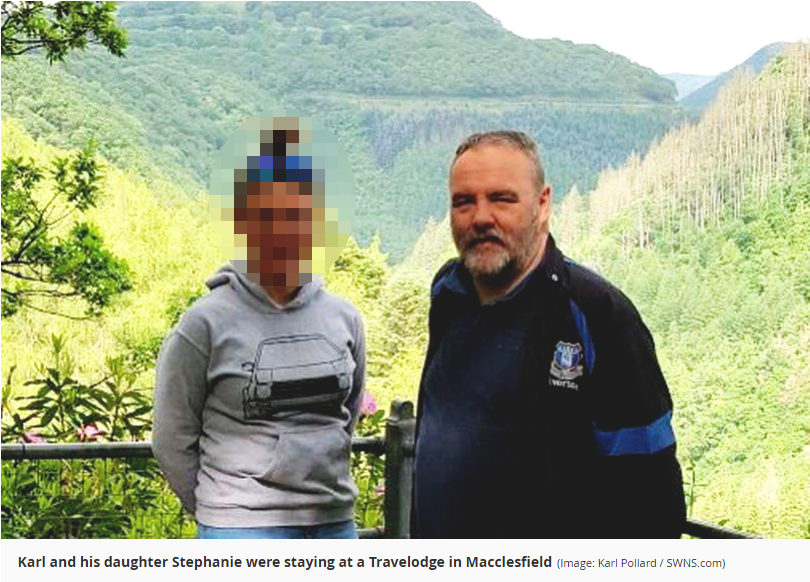
In case you missed it, there was a curious story in the media earlier this week about a man accused of being a paedophile because he stayed in a Cheshire hotel with his fourteen-year-old daughter while visiting his cancer-stricken mother. Here’s the WalesOnline report which also tells us that the man’s wife – and presumably the girl’s mother – suffers from multiple sclerosis.

The family lives in the relatively remote Carmarthenshire village of Rhydcymerau, which may be found on the B4337 between Llanybydder and Llansawel. I assumed they had recently moved to the village. A suspicion borne out by his Linkedin profile and these entries from 192.com.

click to enlarge

As I say, this story appeared in WalesOnline and its print version Llais y Sais. And though it was claimed as an Exclusive by the Daily Star it also appeared in the Independent, the Sun, the Express, Mirror and a host of other ‘papers and online sites. Nick Ferrari had a rant about it on LBC, it was reported in Australia, and even beyond the Anglosphere. Here’s a Czech report, a Flemish account, and finally, for good measure, it’s covered here in what I think is Chinese.

This coverage, for what was little more than a misunderstanding, is quite incredible. How was it achieved?

If we look at the photograph above we see that the attribution is “Image: Karl Pollard / SWNS.com”. Which would suggest that the image belongs to Pollard and was distributed by South West News Service, an agency dealing in ‘news’ for those who prefer ‘human interest’ stories.

The Twitter feed, with tales of a hairy-chested woman and a foetus flicking a V-sign, tells us that SWNS is to news reporting what The Jeremy Kyle Show is to intellectual discourse, or am I being too harsh? Whether I am or not, I think it’s reasonable to conclude that after the incident at the Travelodge in Macclesfield Pollard went to SWNS with the story and the pictures.

What’s more, he wasn’t slow about it. The WalesOnline report is datelined 10:20 Monday the 19th and says the incident happened “last week”. The Star, Sun, Express and Mirror reports are dated Sunday the 18th.

Perhaps this explains why it has been suggested to me there may be something ‘contrived’ about the whole thing. I’m not sure about that because it wasn’t Pollard who called the police, it was staff at the hotel. But then again, he must have realised that a 46-year-old man sharing a bedroom with a 14-year-old girl is guaranteed to attract suspicion.

But it’s how Pollard responded to a misunderstanding that was soon sorted out that causes me disquiet.

Let’s look at the three most important females in Karl Pollard’s life. His mother is gravely ill with cancer, his wife is suffering from multiple sclerosis, and his 14-year-old daughter was, in Pollard’s own words, “distraught” after being questioned by police, so all three would surely have craved peace and quiet.

But no, Pollard goes chasing global exposure for a simple misunderstanding made by sincere people acting out of the best possible motives.

I can’t help thinking that the media got this story arse-backwards.

◊

MASSAGE

As you might imagine, I get a lot of strange messages, from all sorts of people and by a number of different routes. This week has been no different. Here’s one I feel able to share with you.

click to enlarge

Let me start by saying that I know nothing of ‘massage’ in the Tonypandy area (or anywhere else, come to that), nor have I been Googling for such services. So it was easy to dismiss this message as some kind of joke. But then I was drawn to the logo, which made me think the source at least might be kosher.

More than that, a pink butterfly with the body made up of a woman in a tight-fitting dress suggested to me that if it exists then the Women’s Business Club is for women, rather than the wimmin I have written about of late. So I Googled Women’s Business Club and sure enough, it is genuine.

This may have started as someone’s idea of a joke but I was very impressed with what I read on the website, consequently – and even though the heels are killing me – I have now joined and I’m looking forward immensely to the next Wonderbra Session.

♦ end ♦


‘Move to Wales – Plenty of funding, no questions asked’

Some time ago, October 2015, to be exact, I published Bits & Pieces 13.10.2015: Assembly 2016, Reputations, Vattenfall, Cardigan Castle and, almost en passant, I mentioned Empower-Support for the Voluntary Sector, of Cwm Cynon, which I likened to a case of big fleas having little fleas because Empower seems to feed on third sector and other publicly-funded bodies.

Empower SVS is owned and run by  Beverly Elizabeth Garside and I wrote of her, “One mystery though is why, on her Linkedin profile, Bev tells us that she has been director of Empower since January 2001, yet Companies House tells us that Empower was not Incorporated as a company until February 18th 2004.”

I can now explain this confusion, and more, by telling you where Beverly Garside was and what she was doing in the years prior to 2004, but first I want to take a peek at Empower.

◊

EMPOWER SVS

Go to the Empower website and the ‘About Us’ page. On the right you’ll see the staff.

Bev Garside on top and below her we find Owen Davies of whom I know nothing because we are told “Full profile coming soon”. And it’s the same for Pamela Davies below him. For James Davies there is a profile, and it tells us after working in the planning departments of Swansea and RCT councils he spent eight years with Planning Aid Wales before joining Empower in April 2015.

click to enlarge

Next up is the dashing figure of polo player Ashley McMahon, ex-military and still barking commands at that fine body of men the Glamorgan Yeomanry. Ashley is the Marketing and PR Manager.

Next on the totem pole we find young Alex Railton, a Marketing Assistant, for whom Empower couldn’t even be bothered to put up “Full profile coming soon”.

These six I assume are based at or work out of Empower’s office at the Feel Good Factory, Abercynon Road, Ynysboeth.

The others, described as Associates are almost certainly not employees. Liz Tyson is based in Manchester, and her passion would appear to be animal welfare. Ashan Malik is in Bradford. Bryan Collis is in Swansea where his full-time job is with All Wales People First, yet another third sector outfit stuffed with people taking advantage of the public funding bonanza.

The final Associate is Dawn Davies (née Minifey), whose day job is Director of Communities Connected Consultancy Ltd of Bridgend, where we also encounter Bryan Collis again. Though it looks as if Bryan and the others listed are associates. Communities Connected seems to do the same type of work as Empower . . . and no doubt 37 other companies.

Why do I say that? Well, because when Communities Connected was Incorporated with Companies House 14 September 2016 there were two founding directors, Dawn Davies and Paul Stepczak. ‘Who he?’ you cry. Here’s a clue.

click to enlarge

In a previous existence young Paul was “lead cluster officer for Communities First in Glyncoch”. How know I this? From my regular reading of the Church in Wales website, which I recommend unto you all. Stepczak left Communities Connected 12 October 2017, so Dawn Davies is now alone at the helm.

Staying on Empower’s ‘About Us’ page we see, bottom left, a grouping of logos under ‘Our clients’, and an eclectic mix it is, though hardly impressive. For a start, we see Communities First again, that disastrous programme that had its plug pulled last year.

But not before it had consumed £300m of public funding and provided lots of meaningless jobs like ‘lead cluster officer’ in Glyncoch. And of course much of the Communities First funding found its way to consultants and advisors. And while I’m not for one minute suggesting that all those who worked for Communities First were Labour Party supporters, nor that the consultants and advisors were on good terms with the bruvvers, let’s say that Labour Party connections definitely helped when it came to getting your milking pail under this particular cash cow.

Another client that caught my eye was Ambassador Training Wales. As far as I can make out, this Swansea-based outfit trains guides for the tourism industry. I’m not sure what advice Empower provided but Ambassador Training Wales is teetering on the brink and about to be struck off by Companies House.

Then there’s Cynnal Cymru/Sustain Wales, though whether it’s a client is debatable because it seems to be in the same line of work as Empower. Either way, Bev Garside gets a mention under the heading, ‘A story of networking, cars and sustainability‘.

Scroll down to read the fragrant Bev herself say: “The nature of a busy consultancy means I am always on the road; I regularly drive the breadth of England and Wales and accumulate tens of thousands per miles per year.  Whilst I use trains wherever I can, our work often takes us to places that cannot be easily or efficiently reached by public transport.  My new Lexus Hybrid is not only more fuel efficient, which is great for my business, it also produces a third less emissions than my old car.”

The article is dated (à la mode américain) 01.26.2017. So at this time last year Bev Garside, who runs Empower SVS Ltd, was driving around in a brand new Lexus hybrid. Business must have been good because even leasing such a car wouldn’t be cheap

Before examining the business side of Empower I just want to take a wee detour offered by another of Empower’s ‘clients’, useful because it’s all part of a bigger picture. This time it’s Tyddyn Môn.

◊

TYDDYN MÔN

Its website tells us that “Tyddyn Môn was founded by the parents of adults with learning difficulties who wanted a more constructive and rewarding occupation for their sons and daughters.” And the website doesn’t tell us a great deal more than that.

The more I looked into Tyddyn Môn the more obvious it became that despite being located on an island where almost all the native-born speak Welsh the organisation itself is rather, well, unWelsh. Take as an example the highlight of the social calendar, the annual ‘Folk on the Farm Festival’. Here’s the line-up for 2018 – does anyone recognise any Welsh bands there?

click to enlarge

It’s basically a hippyfest, an English hippyfest. So who’s running Tyddyn Môn?

If we go to the Charity Commission website and type in 1072035 we see that the leading light among the trustees appears to be a Mrs Eileen Mildred Clarke, who is also a trustee of a number of other organisations, one of them being Gwasanaeth Adfocatiaeth a Chynghori Gogledd Cymru / North Wales Advice and Advocacy Association.

The Association is also a registered charity, No 1060826, and as the name suggests – and the screen capture below confirms – it covers our six northern local authorities, plus Staffordshire. Staffordshire!

click to enlarge

Why the hell is an English county that doesn’t even border Wales included there? When I see something like that it sets the old Jac antennae all a-quiver. Does anyone have an answer?

Whatever the reason, for year ending 31.03.2017 the Association received £277,939 in grants, mainly from Welsh local authorities (but nothing from Staffordshire) with £294,329 going on wages and running costs. So a rosy future beckons.

Back to Tyddyn Môn, where the Accounts for 2017 tell us the same, depressing story. Total income for year ending 31.03.2017 was £1,594,056, with £1,115,209 coming from Ynys Môn council.

Of that income £1,052,108 went on staff costs. Though, confusingly, page 18 tells us that two trustees were also paid a total of £53,101. Explained thus: “The trustees Mr J.G.P. Webster and Ms T.A. Davies are paid remuneration in relation to the work that they undertake for the Charitable Company as a support worker and housing manager. They are not paid for their posts as trustees”.

Well in that case why not include their salaries with those for the other staff? Though if they are employees why are they allowed to also be trustees?

Maybe I should explain here that the whole point of trustees is to provide oversight of a charity but with the day-to-day running left to the paid staff or volunteers. The two should be entirely separate, and with no payments made to trustees without special dispensation.

In 2016, just prior to the departures of Mrs Olwen Dennis Williams and Mr Huw Elfed Williams, three new trustee-directors were appointed on 9 April. One of them, Michael Ian Hawkes, almost immediately rose to the rank of Chair.

I suspect that Mr Hawkes may have not long moved to the area and so the other trustee-directors of Tyddyn Môn may be unaware of his glittering business career. The pinnacle of which seems to be his ongoing involvement with MHinvent, a company that has flirted with compulsory strike-off more than once and whose latest balance sheet shows liabilities of £2,296,133.

Hawkes has the largest single shareholding by far in MHinvent; hardly surprising seeing as the company seems to be named after him.

Tyddyn Môn may indeed be local to the island, but I suspect that through Mencap and other cross-border agencies connections have been formed which result in an unspecified number of Tyddyn Môn’s residents coming from outside of Wales to take advantage of the council’s generosity.

So if the council is minded to take a greater interest in Tyddyn Môn it might also benefit the island by refusing entry visas to the rag-bag collection of pony-tails lined up to wail at the Folk on the Farm Festival.

That’s the end of the digression; now it’s back to Beverly Garside and Empower SVS.

◊

EMPOWER-SUPPORT FOR THE VOLUNTARY SECTOR LTD

The first problem I encountered when making enquiries into Empower on the Companies House website was the latest set of Accounts, or rather, what passes for the Accounts, for it’s no more than an abbreviated and unaudited balance sheet.

click to enlarge

Surely these Accounts – showing a deficit of £3,573 – aren’t for a company with five or six employees on the books, with consultants to boot, and where the owner of the company “drives the breadth of England and Wales” every year in a hybrid Lexus?

What’s going on? Where’s the money stashed?

I’m not sure, but a clue might be provided by something I stumbled on, for there’s another entry on the Companies House website for Empower Support for the Voluntary Sector a slight variation on the name of the original company. Yet it is the same company because it quotes the same number, 05048133.

What’s different is that this entry tells us that Empower is a Designated Member for CJF Recruitment LLP set up 21 May 2016. So what can Companies House tell us about CJF Recruitment LLP?

CJF has three Designated Members: Matthew John Bates of Ystrad Mynach, Jane Thomas of Llanbradach and of course Empower Support for the Voluntary Sector.

I’m not quite sure how to explain this, being unfamiliar with LLPs and their operation. I know that they are partnerships and appeal to solicitors, accountants and the like, but it’s difficult to see the advantage of a LLP over a normal company in the case of CJF.

And what do the initials stand for, certainly not the names of the partners?

But we still don’t have the answer to where the money is to run the Empower company, which seems to survive on fresh air.

As an introduction to where I’m taking you next I might as well tell you that Beverly Garside is also a director of the Captive Animals’ Protection Trust, which has its correspondence address at her home.

UPDATE 15.02.2018: As I said earlier, Empower is based in the Feel Good Factory in Ynysboeth. What I didn’t realise then was that this building – formerly All Saints Church – is shared with other users. Principally Bryncynon Community Revival Strategy Ltd.

On page 5 of the Accounts for y/e 31.03.2017 for this charity (no 1067535), and company, we learn that :-

click to enlarge

The Accounts also tell us, towards the top of page 4, “Trustees are elected from Bryncynon and its surrounding areas”. Which is as it should be. However, of the five current charity trustees / company directors one lives in Brackla, one lives in Llandaff, one in Whitchurch, one in Mitchel Troy, with just one from the local area.

But no doubt they have strong Labour Party connections to make up for their ignorance of Cwm Cynon.

◊

THE MISSING YEARS

As I noted in the 2015 mention of Garside and Empower, “Bev tells us that she has been director of Empower since January 2001, yet Companies House tells us that Empower was not Incorporated as a company until February 18th 2004”. So how do we account for the missing years?

This link will take you to a story from The Courier (Kent/Sussex) some time in 2002. Read it carefully. Bev Garside was clearly mixed up with hunt saboteurs and animal rights activists. Her co-accused in the case I’ve linked to, Gavin Medd-Hall, was jailed for eight years in January 2009 for a different but related offence.

I don’t know the outcome of the trial in Maidstone Crown Court in 2002 because there’s no longer anything available online. But we now know where Beverly Garside was and what she was up to before the founding of Empower-Support for the Voluntary Sector in February 2004.

And her involvement with animal rights activism explains her need to claim that Empower started in 2001.

I had to think long and hard before writing this piece, in fact, it caused me more soul-searching than anything else I’ve written on this blog for a number of reasons.

To begin with, I’m an animal lover myself, I would have closed down that animal concentration camp in Borth even before the two lynx were killed. And then there’s the thought that writing this piece might give pleasure to Garside’s old foes, the twats in pink, which is not something that would please me.

That said, there are bigger issues illustrated by this case, important Welsh issues.

◊

THE WILD WEST

In the case of Empower, we have a company that may not receive public funding itself, but lives off the recipients of public funding. And yet, at the end of the day, what do all the advisors, the empowerers, the enablers, the developers of communities, the consultants like Empower, contribute to the wealth of Wales?

Very little, especially when weighed against the amount of public funding consumed and the percentage of it that might as well be poured straight down the drain. (Just think Communities First.) The only thing this money does is create unsustainable jobs and a small amount of spending power. But this system that keeps Wales poor gives politicians the power of patronage.

So blatant is this system, and so well known, that it attracts shysters from outside of Wales looking for easy money that is not available elsewhere. It seems that every village and valley now has some old harridan behaving like a 19th century memsahib or else it’s a glottaly-afflicted young harpy so sharp she’s in danger of cutting herself.

If it’s not those running the third sector then it’s those they inflict on us; that’s because there aren’t enough Welsh to keep the funding flowing and so whole battalions of the decrepit, the deranged, the delinquent and the dependent are marched over the border.

And it’s not just our cities and larger towns that see these problems, for there isn’t a country town in Wales today unaffected by the trafficking of criminals, misfits and white trash by third sector agencies and housing associations.

It would be easy to describe these as misguided do-gooders, but they do no good at all, not for Wales anyway. They use Welsh public funding to make Wales more dangerous for us and our children. What special kind of national lunacy is this?

Then there are those who obviously see Wales as a bolt-hole or a wilderness into which they can disappear and not be recognised. This is how Mark Bridger, the murderer of five-year-old April Jones of Machynlleth came here, packed off by his family when he became too much trouble.

And who can forget the whole gang of satanic paedophiles relocated from London to Kidwelly. Yes, Kidwelly! Who the hell thought that was a good idea? Have our politicians ever asked for answers?

I’m not comparing Beverly Garside to Mark Bridger or the Kidwelly child rapists but it looks very much as if she also ran away to Wales. Maybe it’s time she practised a little honesty. Accounts for her company would be a good place to start.

The whole system is broken. We are told we need the third sector because Wales is poor . . . but the third sector thrives on poverty and makes us poorer . . . worsening poverty is then used to justify a bigger third sector . . . which makes us even poorer . . .

There is only one way out of this downward spiral – independence.

♦ end ♦


‘Genocide by Substitution’

INTRODUCTION

The National Renaissance of the 1960s put the wind up our masters for two main reasons.

First came the shock that there were numbers of Welsh people prepared to use violence and civil disobedience to achieve their political aims, with a far greater number supporting them.

Second, came the more worrying realisation that Welsh nationalism, hitherto regarded as a cultural issue confined to rural districts, was spreading into the more populous urban areas and ‘infecting’ people who spoke little or no Welsh. Perhaps there was even a danger of Pura Wallia being employed as Yeats and others had used the West of Ireland, a magical and unsullied ideal to be brought back to the rest of the land.

Something had to be done. The decision taken was to undermine the influential and inspiring Welshness of those western areas, which then ran from the outskirts of Llanelli in the south to the north coast around Abergele, with salients pushing towards the border.

What was envisioned was a form of social engineering, a kind of ‘watering down’ process, that would make life difficult for many Welsh people while simultaneously encouraging into western Wales large numbers of English.

To the point where the remaining Welsh would be outnumbered, anglicised, and this would result in the political threat they posed and the inspiration they provided being removed. Facilitated by legislation and other means; and if these could be sugar-coated, or disguised, then so much the better.

This is a strategy that Martiniquais poet and political activist Aimé Césaire so memorably described as ‘genocide by substitution‘.

from ‘Shifting Frontiers of France and Francophonie’ (click to enlarge)

Genocide by Substitution is just a more subtle means than outright clearance of killing off a culture and the identifications and loyalties that go with that culture.

◊

THE EARLY YEARS

DEVELOPMENT BOARD FOR RURAL WALES

A good place to start would be the plan in 1965 for a new town of 60,000 or more inhabitants in the Severn valley near the village of Caersws.

Historian Kenneth O. Morgan, in Rebirth of a Nation Wales 1880 – 1980, couldn’t resist linking near-universal local opposition to the plan with Welsh nationalism and racism, “Welsh nationalists and others feared that the population of this new town might be drawn largely from English overspill from the west Midlands . . . that these migrants might be black, brown or yellow in hue”.

Here we have the authentic voice of Old, South Wales, anti-Welsh Labour.

No new town was built, but nearby Newtown was expanded, with a population imported almost exclusively from outside of Wales, and this provided the template for what was now to happen across the region with the creation of the Development Board for Rural Wales.

click to enlarge

The strange thing about the DBRW was that its charter stated it could only give financial and other help to incoming employers . . . and their employees. Which meant that small Welsh companies, family firms, could find themselves being put out of business by an English company that had moved into Wales with DBRW support.

‘But surely’, you ask, ‘these companies moving in provided jobs for local people?’ Well no, because under the ‘key worker’ provisions incoming companies were encouraged to bring their entire workforce with them, with relocation costs funded by the DBRW. On top of which the DBRW provided shiny new housing.

The Development Board for Rural Wales was the most blatant colonisation programme Wales had seen since the period following the Edwardian conquest, yet few dared question its operations for fear of being branded ‘racist’ or economically illiterate. For the DBRW was bringing jobs and people to areas suffering depopulation.

It should not surprise anyone to learn that the outflow of Welsh people from the DBRW region did not abate. Giving us a perfect example of Genocide by Substitution.

The Development Board for Rural Wales was merged with the Welsh Development Agency in 1995.

THE A55

Further north than the fiefdom of the DBRW economic and other development was said to be impossible without the A55 becoming a dual carriageway to Holyhead, for it was the ‘Highway of Opportunity’ (© Wyn Roberts) and would bring undreamed of wealth and opportunities.

One of the first consequences of the road’s upgrade was the closure of the Royal Mail’s Bangor sorting office, with work being transferred to Chester. Here we were, coming towards the end of the twentieth century, with devolution just around the corner, and Chester was reasserting its parasitic relationship with northern Wales.

For what the cheer-leaders for the A55 didn’t understand, or weren’t telling us, was that improved communications invariably result in the closure of ‘outposts’, which become redundant or expendable if their areas can now be served from further away.

Unfortunately, there was plenty of European money available for the A55 because it is a trans-national route linking Ireland with the continent. That it also opened up large areas of Wales to commuters and others from over the border was never considered.

And the spending continues. Another £250m will go into a Deeside Corridor which will help facilitate the Mersey Dee Alliance agenda by further integrating north east Wales with north west England.

LOOKING AROUND

Elsewhere in our rural areas, in the 1970s and 1980s, we saw an economy in decline. In the south west, for example, dairies and creameries closed, and milk was shipped off to England to be processed. Politicians were helpless . . . or at least, they did nothing.

And everywhere we were promised that tourism would be the economic salvation of rural Wales.

I’ve written about tourism many times and I hope I’ve made it clear that there is nothing intrinsically wrong with tourism, it can be a useful part of a diversified economy. But the tourism industry that has developed in Wales was developed to serve England, Wales happened to be conveniently near and became ever nearer with the spread of the railways and then the family car.

Even so, until fairly recently Welsh people did benefit. Many locals – my own late mother-in-law included – brought in some extra money by running a B & B. And back then local businesses such as pubs tended to be locally owned. But somewhere along the way the Welsh seem to have been squeezed out.

I remember a couple of years ago my wife and I stayed at a bed & breakfast in Abersoch, that favourite of the Cheshire Set, and the woman running the establishment told us, quite unprompted, that she was one of only two locals still running B&Bs in the village, yet there must be dozens and dozens of B&Bs in Abersoch.

Abersoch Dingy Week, organised by the Leigh and Lowton Sailing Club of Warrington. The building on the right is the clubhouse of the South Caernarvonshire (sic) Yacht Club (click to enlarge)

What we have in Wales now, masquerading as ‘the Welsh tourism industry’ is largely owned and run by strangers. The lack of decent jobs provided by tourism, coupled with its power to bring a new population into our rural and coastal areas, makes it another element in the overall strategy of Genocide by Substitution.

We have reached the point where tourists can come to certain parts of Wales, spend a week or ten days there, and not meet a Welsh person. Yet we are expected to be so proud of this ‘Welsh tourism’!

◊

THE DEVOLUTION ERA

Those expecting things to get better under devolution were probably naive, they have certainly been disappointed. It may no longer be the blunt and obvious instruments of the DBRW, the A55 and creamery and other closures that inflicts the damage, now it is the stiletto thrusts of a ‘Welsh’ Government operating against the Welsh national interest.

Did I really say, “a ‘Welsh’ Government operating against the Welsh national interest”? Yes I did, and now I shall give some examples of this behaviour, hopefully in chronological order.

Let’s start with One Wales: One Planet, of May 2009. This publication retrospectively gave approval to a number of illegal settlements and the green light to future sustainable communities. Despite grandiose pronouncements about a “sustainable nation” it was really about encouraging those seeking a certain lifestyle to move to Wales.

This was followed in July 2010 by Technical Advice Note 6 Planning for Sustainable Rural Communities. (A Technical Advice Note “provides detailed planning advice”.)

TAN 6 replaced an earlier document that talked only of “Agriculture and Rural Development” but something had obviously changed, new influences were being brought to bear on the ‘Welsh’ Government that had little concern for traditional agriculture, or Welsh farming.

That building centre right, is it Lammas? (click to enlarge)

January 2012 saw former Minister for Environment, Sustainability and Housing  in the ‘Welsh’ Government, Jane Davidson, join the University of Trinity St David’s Institute of Sustainable Practice, Innovation and Resource Effectiveness (INSPIRE). Among its aims is to “contribute to our communities by giving particular regard to issues of sustainable rural communities and the development of south west Wales as a low carbon region“.

Davidson, former Labour MP for Pontypridd is from England, where she was privately educated, she knew nothing of Pontypridd when she arrived and little when she left, but being AM for the town allowed her to use her position in the Labour-Plaid Cymru coalition to promote causes dear to the hearts of others like herself.

I’m thinking now of those members of the English middle classes who in times past were given to wearing indecently voluminous khaki shorts and belonged to the Ramblers Association (since re-branded Ramblers). Having been vice-president while a Minister Davidson became President of Ramblers Cymru almost as soon as she left the Assembly in May 2011. She is, predictably, also a Patron of the One Planet Council.

I took a little detour from the One Planet website after seeing the name of another Patron, Paul Taylor, and his connection with the Cwm Harry Land Trust of Newtown, Powys. Another ‘No-Welsh-Need-Apply’ organisation.

The Accounts for the Cwm Harry Land Trust Ltd are overdue at Companies House, but it’s also a charity, No 1100899, though the accounts to the Charity Commission are even further in arrears.

The Accounts for 2015 tell us that the biggest source of income was – surprise! surprise! – the ‘Welsh’ Government, and the biggest outgoing was – never! – salaries. Though another reason for Cwm Harry being in a delicate financial position may be its attempt to buy Moelyci, “a community owned farm in North Wales”, in fact, just outside Tregarth, near Bangor. (Despite being committed to Welsh heritage and culture the Welsh language version of the Moelyci website is, as ever in such cases, “under construction“.)

The falling through of the Cwm Harry deal for Moelyci is explained here. I hope the ‘Welsh’ Government is keeping a close eye on how Cwm Harry spends our money. It should go without saying that no more public funding should be wasted on Cwm Harry or Moelyci.

This digression started when I saw the name Paul Taylor on the One Planet site. Taylor is, or was, also involved with Home Presteigne, which seems to have folded. But he’s still a busy boy, for he tells us that he’s an “Independent Advisor Community Land Advisor (sic) Service Cymru”. So what’s that?

click to enlarge

At the Royal Welsh Show in late July 2013, John Griffiths, then Minister for Sport and Culture, launched the Community Land Advisory Service Cymru, part of a wider Englandandwales organisation. The Welsh operation had received a £600,000 grant from the Big Lottery’s Climate Change Programme.

CLAS Cymru is “part of a wider Community Land Advisory Service across the UK, which is managed by the Federation of City Farms and Community Gardens“ but its press release suggests a different role in Wales with,“CLAS Cymru helps new communities to navigate through the challenges associated with finding land, negotiating a lease and obtaining planning.”

Back to the main thread.

While many of the influences behind One Wales: One Planet, TAN 6 and all the offshoots may be external to Wales native Welsh politicians have also chipped in, among them Minister for Natural Resources and Food, Alun Davies, who announced in January 2014 that 15% of EU Common Agricultural Policy Funding would in future be diverted from Pillar 1 (farmers) to Pillar 2 (‘rural development projects’).

The next attack on the population indigenous to the Welsh countryside was the ‘Welsh’ Government’s decision to cancel a £360,000 grant to Wales’ Young Farmers Clubs in January 2015.

Before finishing we need to consider the Well-being of Future Generations Act 2015. To save you reading through the full document, with its bullshit piled high and overhung with impossible dreams interwoven with outright lies, here’s a quick-read Guide and an illustration from it.

The way the priorities are ordered tell you why the Well-being of Future Generations Act is another Hippies’ Charter

Hooray! Wales is going to save the Planet! Or rather, we are going to use the pretext of environmental concerns to encourage hippies and other shysters to move to Wales and become yet another piece in the jigsaw of Genocide by Substitution.

Finally, I was struck by the local branch of the UK government’s BBC mouthpiece putting out this strange article earlier this week which warned us that “rural west and north Wales are the most vulnerable to economic decline as the UK leaves the European Union”.

The example we need to follow, according to the article, is a ‘network’ currently running on Exmoor. “Helping incomers to integrate is part of the network’s ethos, according to its chairman, sheep and beef farmer David Knight. One of their initiatives is a micro-farming group for new owners of smallholdings . . .“

Despite everything that the UK and ‘Welsh’ governments have done since the 1970s to undermine the indigenous economy of rural Wales, to destroy the region’s social and cultural integrity, are they now hoping to blame its final eclipse on Brexit!

But no! for it is to be reborn, salvation lies in “incomers”, on “smallholdings”; “new communities” “obtaining planning”.

◊

CONCLUSION

I don’t wish to appear overly cynical, but when so much legislation is churned out by the ‘Welsh’ Government that is clearly designed to draw into Wales those seeking a green or eco-friendly lifestyle, then we are entitled to ask why.

Another reason for suspicion is the contradiction inherent in what is being done. For the purpose of the legislation, and the various initiatives is, we are told, to reduce Wales’ carbon footprint, but by attracting into Wales a whole new population that will keep animals, burn timber and in other ways bother the environment we can only increase Wales’ carbon footprint.

Which means that what is being done only makes sense on an Englandandwales level, which in turn means that a ‘Welsh’ Government is now legislating for Englandandwales by agreeing to take in hundreds, perhaps thousands, of hippies and others that England wants to offload.

I can see the advantage for England in this arrangement, but where’s the benefit to Wales?

On the plus side, I suppose those living in eco-villages might be an improvement on the white trash being imported by some third sector outfits and certain housing associations, or the hypochondriacs and worse attracted by free prescriptions, and the retirees taking over so many communities. And let’s not forget the white flighters and other flag-fliers.

But none of these groups will create wealth, or generate employment. If anything, they will take the Welsh economy in an opposite direction, making Wales poorer by any criteria you care to employ. While also draining the Welsh public purse.

So the motive for encouraging this multi-faceted influx cannot be economic growth or job creation.

During this same period there has been no legislation, not even a vague promise, to defend our rural areas in a way that will protect their Welsh identity. So what is the point of a ‘Welsh’ Government if it only cares for strangers and works against the interests of its own people?

What we are witnessing in the Welsh countryside, and along our coasts, is a crude attempt to remove a perceived or potential political threat posed by a people and their distinct identity, in the manner described by Aimé Césaire – Genocide by Substitution.

♦ end ♦


2018, A Few Thoughts

LET NOT FIDO AND TIDDLES DIE IN VAIN

In the year just past, and indeed over many years, people have accused me of being negative, and challenging me to come up with solutions rather than just banging on about how awful the situation is in Wales.

Well, to begin with, I defy anyone to look around Wales today and be positive. Our country is in one hell of a mess. The only people I can think of who might try to put a gloss on the situation are apologists for ‘Welsh’ Labour down in Cardiff docks and apologists for the Tory regime in Westminster.

Not forgetting of course those parasites who see Welsh deprivation as an opportunity for them to milk the public purse in order to enrich and promote themselves by building up third sector businesses. More on them later.

And with so many politicians, civil servants and others claiming to be dedicated to making things better in Wales why look to poor old Jac to come up with the answers?

I have even been accused of nihilism! For those unsure what I’m talking about, nihilism is the belief that all existing political and social structures must be destroyed in order to build something better. At its most extreme it can be the belief that existence itself is pointless. A more moderate form might be extreme cynicism or scepticism, to which I would plead guilty

In 19th century Russia Nihilism took a political form, and on this blog I have confessed a sneaking regard for Sergey Gennadiyevich Nechayev but I myself have never preached nihilism. What I have argued is that others are taking us in a direction that might engender nihilistic thoughts and if so then we should be ready to exploit the opportunities this will offer.

By way of example, if Brexit leads to the disaster many are predicting, and we are reduced to eating our domestic pets then, rather than bemoaning our luck and damning those who voted for Brexit, those of us who prioritise the interests of Wales should be ready to view the demise of Fido and Tiddles as opportunities rather than tragedies.

Of course a decline in living standards resulting from Brexit will cause our two BritLeft parties to attack the Tories in a UK-focused debate, in which they will argue that they’re ‘doing it for Wales’.

Bollocks! they’ll just be engaging in a bit of Tory-bashing. What Welsh nationalists should do is exploit the confusion to argue that this latest debacle just reminds us that the Union and devolution do not serve Wales, therefore independence is the only sensible option.

That is what I have said, and what I believe; and while it argues for escaping the British system it does not advocate destroying it, therefore I don’t regard anything I’ve written as being nihilistic. It is nothing more or less than being prepared to take advantage of a dire situation that might arise.

◊

A QUICK COMPARISON BETWEEN MONACO AND WALES

Whimsical? Have I been overdoing it on the Argie red? Possibly, but indulge me all the same.

One guaranteed objection will be that Monaco is not a ‘real country’, Well, it’s a principality, and hasn’t Lord Elis Thomas just reminded us that Wales too is a principality. But Monaco is a member of the UN, with many other powers and representations we associate with ‘real countries’, so while it may not have a national rugby team Monaco is in many ways much more of a country than Wales.

Here’s a helpful table I’ve drawn up to explain some of the differences.

click to enlarge

With eighty times Monaco’s population Wales’ Gross Domestic Product is just ten times that of Monaco. It will be argued that this too is not a valid comparison because Monaco is the playground of millionaires, a place of extravagant wealth and tax-avoiders, and as such a hell on earth to be reviled by those preferring to cherish and exploit poverty. (And God knows we have too many of those in Wales!)

And yet, being the contrarian I am, I shall make a few comparisons.

Over the years I have pointed out the insanity of encouraging elderly English people to move to Wales because of the obvious damage this influx causes to our NHS and associated services, and yet, we see that the percentage of the population over the age of 65 is much higher in Monaco than in Wales, but Monaco is infinitely more prosperous than Wales. So why is this?

Now we encounter two major differences between Wales and Monaco. First, I would bet my house that the elderly in Monaco are healthier than the elderly in Wales, for no better reason than rich people are always healthier than poor people. (And of course the climate also helps.)

Second, as this article from Pacific Prime tells us, “Foreign nationals immigrating to Monaco without employment must have full private health insurance. Proof of such cover will be needed to be granted a residency permit by the Monegasque authorities”. Monaco is not alone is demanding private health cover for elderly and sick people wanting to settle.

Rich people create jobs. Tens of thousands of people commute every day from France and Italy to jobs in Monaco. That’s in addition to the jobs done by native Monegasques (whose language is now being taught in schools).

Far from being a capitalist hell Monaco is a small principality made up of the comfortably off, the wealthy and the super-rich.

Tourism is another area in which it’s worth making a comparison. Monaco relies to a greater extent on tourism than Wales, but whereas in Monaco it’s Russian oligarchs or Saudi princes dropping a few million at roulette before roaring off in gold-plated Lambos, here it’s endless rows of ugly caravans stuffed with people determined to spend as little as possible in ‘Woiles’ before heading back to Brum in the people carrier.

But the real difference, which goes a long way to explaining why one is rich and the other is poor, is the mentality prevailing among those running these vastly different principalities.

Monaco (click to enlarge)

As we’ve seen, Monaco is welcoming, as long as you can afford the most expensive real estate on earth – where a one-bed apartment sells for $8.1m (but with much of the cheaper housing reserved for locals) – and as long as you also have private health care. Otherwise, it’s a case of, ‘Sling yer hook, matey!’ (or however that may be rendered in French or Monegasque).

By comparison, Wales is a poor country, with many of our own problems contributing to that poverty, and yet the ‘Welsh’ Government through its third sector is making Wales poorer by importing more of the problems that impoverish us.

Monaco attracts millionaires who make the place richer while Wales scours England for deadbeats to make us poorer.

The real worry is that there are too many who prefer to see Wales poor.

◊

SOME SUGGESTIONS FOR OUR POLITICIANS FOR 2018 AND BEYOND

First, realise that poverty is not a virtue to be celebrated and exploited. Poverty is a national insult to be done away with, and the surest way of doing that is by putting Welsh interests first and building a real economy.

Second, understand that a real economy is not built on a corrupt and overblown third sector, or a ‘tourism industry’ that is just a low skill, low pay, low value activity, overseen by a whoremonger ‘government’ selling us and our homeland off in some demeaning Dutch auction.

Wales needs a diversified and indigenous economy built on twenty-first century industries, as the response below to a recent tweet of mine tells us. (STEM is an acronym for science, technology, engineering and mathematics.) This is the only remedy to the poverty and deprivation we see in so many parts of our homeland.

While that should be the medium-term ambition, there are still measures that Carwyn (if he survives) and his assemblage of buffoons could be implementing in the short term.

There’s an old saying to encourage young entrepreneurs, ‘Nobody ever got rich working for somebody else’. The same applies to countries. So instead of managing Wales on behalf of England, why doesn’t the ‘Welsh’ Government try something different – like governing Wales for the benefit of us Welsh?

THINKS

1/ Thousands of cost-free jobs could be guaranteed by introducing local recruitment legislation. By which I mean insisting that local people fill the vacancies in their areas. At present, all manner of organisations import staff from outside Wales. This costs our people jobs, therefore it must end.

The excuse often used to justify this practice is that it’s ‘difficult to find local people with the training or expertise needed’. So let’s identify these skills shortages and give local people the skills needed. (Unless of course some other agenda is being served by such practices.)

2/ Next, why don’t we take the countless millions of pounds currently wasted on the third sector, which spends that money importing criminals, drug addicts, problem families, the homeless and others from England, and use that money to encourage indigenous SMEs.

3/ Our shambolic social housing system squanders tens of millions every year on housing that Wales doesn’t need because housing associations operate in an Englandandwales framework and are linked into chains that include probation companies and others. Introduce a five-year residency (in Wales) qualification for social housing and use the money saved on infrastructure projects.

4/ Instead of surrendering the northern part of our country to the Mersey Dee Alliance why not have a northern city region based on Wrecsam. Improve communications to the town and thereby ensure that more Welsh money stays in Wales.

5/ Why not a national planning presumption against properties that target retirees from England? Those being built by housing associations, with public money, could be stopped almost immediately.

The money saved here, and in our NHS, could be used to better educate our kids – as Ireland and other countries have done – because you can’t build a twenty-first century economy with a twentieth-century education system.

6/ Buy a tidy map and realise that Wales extends beyond Cardiff.

All the above ideas could be implemented quite easily and would be of immense benefit to Wales without disadvantaging or discriminating against anyone now living here. But there are too many who want to keep Wales poor.

These include those who can capitalise electorally on our poverty and deprivation (by blaming someone else), and those who can use them to build up third sector bodies providing publicly-funded jobs for them and their cronies.

Selfish and venal though they may be, those motivations are easy to understand because of that. More worrying are those – and Plaid Cymru seems to have rather too many of them – who wallow sentimentally in poverty as if it was part of our heritage. For others it brings some kind of spiritual uplift, as if poverty is the rock-strewn path to the moral high ground. (First left after the sunlit uplands of socialism.)

(Of course, when I say ‘wallow’, you have to understand that it’s always others who actually do the wallowing.)

So here’s a message for our people: Socialism is a doctrine that thrives on human misery, exploitation, oppression . . . but realises it’s better to exploit these ills than remedy them. Nowhere exemplifies this better than Wales, so wise up and stop voting for those with vested interests in keeping Wales poor.

Blwyddyn Newydd Dda


Wales: Corruption and Poverty

I apologise for this post being a bit long, over 3,000 words; but it’s in four separate and distinct parts, plus a Conclusion. So you can enjoy it one section at a time.

~~~

THE ‘BEDSIT BARON’ OF PEMBROKE DOCK

Pembroke Dock is one of those towns that most people drive past or don’t visit. I suppose if Pembroke, a mile or two inland, had grown as some had hoped, then the Dock might have played Piraeus to Pembroke’s Athens, but fate decreed otherwise.

Even so, Pembroke Dock does make the news, but usually for the wrong reasons. For it is a town in decline, having more in common with Valleys communities than with other Pembrokeshire settlements like Narberth or St David’s.

This decline should have been evident to anyone who read my recent piece Publicly-funded Poverty (under the section heading, ‘The Publicly-funded Private Sector’), where I discussed the fate of the old Coronation School.

You won’t be surprised to learn that this building made the news again last week, as the report below from the Pembrokeshire Herald tells us.

click to enlarge

It would be bad enough if this report about properties owned by that ‘Baron of the Bedsits’, Cathal McCosker, was simply reporting dumped garbage attracting rats, but we have to remember that McCosker received hundreds of thousands of pounds of public money to ‘renovate’ these properties. And he’s received hundreds of thousands more in housing benefit.

Money that many people want to see accounted for. All the while the ‘Welsh’ Government does nothing, in order to protect its European funding office (WEFO) from the scrutiny that would expose it as one of those around whom Mr McCosker danced rings, unless of course there was complicity.

Not only does McCosker make a fortune from renting properties that were, basically, given to him (with money on top), he further increases his income from those properties by acting as his own letting agent through his company e-Lettings.

That we know so much about McCosker and the manifest ‘failings’ at both county and national level is due in no small part to two blogging councillors; Jacob Williams and Mike Stoddart, the latter blogging as ‘Old Grumpy‘.

In a recent post, ‘Unknown quantities’, Stoddart dealt with data and statistics telling us that almost everyone housed by Pembrokeshire council was ‘local’. Though I’m not sure if the table below applies only to council lettings or also to those of housing associations.

Given the numbers I would guess the figures represent the ‘shared register’.

courtesy of ‘Old Grumpy’ click to enlarge

Either way, the table gives us an insight into the connection between the likes of Cathal McCosker and social housing providers (because of course the figures for ‘no local connection’ are nonsense). This link is found across Wales with private landlords great and small enjoying close working relationships with council housing departments and housing associations.

This is how it works, and how it benefits everyone . . . except of course, you and me.

If a tenant can stick it out in some grotty flat or bedsit, with drunks, paedophiles, thugs, people threatening to jump out of windows, and gets on nodding terms with the local rodent population, then after a year – and perhaps the wave of a wand – he or she is transmogrified into a ‘local’, and because they are locals in unsuitable accommodation they simultaneously soar to the top of the list for nice new social housing.

This system ensures a steady supply of tenants from outside of Wales for unscrupulous private landlords like Cathal McCosker. Some will find their own way but most are directed to places like Coronation School through many private landlords having a relationship with social services departments, probation companies and other agencies in England.

This system also guarantees a steady supply of tenants for housing associations and councils (though few councils have social housing responsibilities any longer). This is important, because with the ever-present threat of being gobbled up by a predator, or the risk of public funding being cut, housing associations like to be seen to be busy, and if this can be achieved by housing the former tenants of Cathal McCosker and hundreds like him, then so be it.

Just think about that for a minute. Or better still, think what the response might be if you tried to explain this system to someone who doesn’t know Wales.

‘So let me get this straight: you pay private landlords huge sums to bring in problem tenants from England, people that you know in advance will cost you more money by being a burden on your police forces, your health service and other facilities; then you spend yet more money buying or building social housing for these people – are you insane! Do you have money to burn?’

The only people who speak in defence of this system are those who prosper from it and those who view social housing as another tool to be used in colonising and Anglicising Wales.

A five-year residency qualification for social housing must be introduced.

We also need legislation to ensure that some scrubber from Wolverhampton who’s made herself and her kids homeless does not become a priority case for Welsh social housing, as happens now . . . all too often.

Both measures would go a long way to restoring peace to our communities and also save Wales a lot of money.

♦

LLANDOVERY YMCA

Another subject I’ve covered more than once is Llandovery YMCA, or whatever it intends calling itself now that the YMCA has told it to stop using the label.

You can catch up with earlier writings by starting with YMCA ‘Wales’, Another Trojan Horse at the Trough, then comes The Impoverishment of Wales (scroll down to YMCA Wales), followed by YMCA ‘Wales’ and the Green, Green Pastures, Ancestral Turf, which was in turn followed by News Roundup 24.03.2017 (scroll down to Llandovery YMCA), and finally YMCA England(andwales).

Until quite recently there was an organisation known as YMCA Wales run, it would appear, by a woman from Northern Ireland called Mo Sykes. In 2012 or 2013 (perhaps earlier) YMCA Wales began dealing with an English charity for the homeless known as Green Pastures, run by ‘Pastor’ Pete Cunningham.

This may have been an attempt to boost the flagging finances of YMCA Wales, for Mo Sykes is said to have been ruthless in screwing money out of local YMCA operations that often left them without funds. Whatever the money was used for it didn’t save YMCA Wales from administration in 2014, after which it was taken over by YMCA England, with the major asset, the Newgale Outdoor Education Centre in Pembrokeshire, being sold in 2015 for £507,000.

Around the same time it was being reported that Mo Sykes had left in rather a hurry. Which probably explains why her publicly available Linkedin profile goes back no further than 2014.

courtesy of ‘Third Sector’

During her time at the helm of YMCA Wales (or maybe down in the bilges scuppering the ship) Mo Sykes formed a relationship with another recent arrival with a nose for easy money, a certain Gill Tatman of Llandovery YMCA.

More information on Gill Tatman and those grouped around her can be found in videos someone with a sense of humour saw fit to upload onto YouTube. You’ll find them in the posts I’ve linked to above.

By some route Tatman had come into possession of Llandovery YMCA, which had chugged along for years but was now about to take off as a ‘hub’, open to all manner of groups, from the local marrow growers (third Wednesday of every month) to the Teifi Valley branch of the Taliban (every Friday after prayers and the ritual stoning of the smokers outside the Kings Head on the way from the mosque).

Whatever function it may have purported to serve Llandovery YMCA’s real purpose was to provide a salary and a pension for Jill Tatman, and a place where her cronies could delude themselves they were doing something useful; you know, ‘contributing’.

Click to enlarge. Though a trustee – and I speak from experience – should not be paid.

But things started to go wrong last year, and led the National (Englandandwales) Association of YMCAs to remove Llandovery from its list of registered affiliates. This may or may not have been linked to Tatman’s husband being accused of having an unhealthy interest in children.

So it may have been coincidence that around the same time Carmarthenshire County Council removed the building from its list of approved youth clubs. As one former trustee was told, the council is “not supporting any provision within the old YMCA premises”.

And yet . . . Jill Tatman is still allowed to have children on the premises. It seems there’s a loophole she exploits by running an after school club open only two hours a day.

There are always loopholes, as Mr McCosker can testify, but what really surprised me was that Llandovery YMCA’s after school club is approved and advertised by an organisation called Clybiau Plant Cymru (Kids’ Clubs).

click to enlarge

Here’s more information about Clybiau Plant Cymru, which is registered with Companies House, where its latest accounts tell us it has an income of over a million pounds a year, more than 30 employees, and its biggest funder is the ‘Welsh’ Government through its Children and Families Delivery Grant.

Seeing as Tatman’s little empire has been disowned by the YMCA, blacklisted by Carmarthenshire Council, shunned by all except the most desperate local parents, why is the ‘Welsh’ Government giving it a seal of approval through Clybiau Plant Cymru?

UPDATE 02.12.2016: I’m grateful to a source for directing me to this. The photo used is old, the kids are now adults, and they go nowhere near the ‘YMCA’. For those wondering what it’s all about, this is a scheme for Co-op customers to donate money to a favourite local charity (the wife and I give to our village hall).

click to enlarge

♦

SWANSEA TROTS

For a few years recently Swansea council had a bad dose of the Trots, in the form of Anglo-Austrian duo Bob and Uta Clay. Both now departed to pastures new, and unknown. Though given his friendship with Comrade Corbyn it was assumed by many that they were going to work for the great man.

For those seeking more information on this fascinating duo who washed up in Swansea on one tide and were gone with the next, I suggest you type ‘Bob Clay’ into the search box, whereupon you will be presented with a cornucopia of reports of Swansea Labour Party intrigue and dirty doings.

Now I hear from the city of my dreams that in the post-Clay era the Trotskyite banner has been taken up by Louise Gibbard, a Dunvant councillor. It has been unkindly suggested that not only does Gibbard share the politics of the departed Uta but also her hairdresser. (What a cad you are!)

It is further rumoured that the Trots – i.e. Momentum – are building a power base through community councils, school governors’ boards, union branches and anything else they can use ahead of an assault on reactionary and bourgeois elements within the party.

A number of MPs, AMs and councillors in the Swansea area are said to be targeted, with pride of place on Gibbard’s saddle reserved for the head of Swansea West MP Geraint Davies.

The Clays were, if only briefly, councillors for the Llansamlet ward on the east side of the river, across from Morriston, not that they knew anything about the area, its history, or its people. One of those who replaced them in Llansamlet in the May elections was Mo Sykes. Yes, the same Mo Sykes we encountered in Llandovery! Small world, innit!

But never mind her ignorance of the area, all that matters is keeping Labour in power.

Never forget that.

♦

HIRED BULLIES

Back in March 2015 the ‘Welsh’ Government passed one of its regular ‘Aren’t we wonderful’ pieces of legislation designed to please Guardian readers and assorted lobbies on the left, while doing little or nothing for Wales.

This particular legislation was called the Violence Against Women Bill. It received Royal Assent on 29 April 2015.

In the period leading up to the vote in the Cynulliad there were persistent rumours of pressure being applied by Labour Party loyalists on women’s groups that wanted changes to the legislation. It’s covered fairly well in this WalesOnline report.

An ad hoc grouping central to the allegations was the Wales Violence Against Women Action Group, made up of various charities and third sector bodies. Scroll down to the foot of the page I’ve linked to and you’ll see the organisations belonging to WVAWAG.

click to enlarge

Among them is, top left, Bawso (formerly, Black Association of Women Step Out). In the accounts for the year covering the run-up to the vote in the Assembly Bawso received close on £1.5m from the ‘Welsh’ Government, with further amounts from various Labour-controlled local authorities taking the figure close to two million pounds.

Total donations – including public funding – came to £2,765,954. Rental income was £429,710, with room hire and bank interest taking us up to a total income for the year of £3,211,182. As is always the case in the third sector, salaries and pensions accounted for over two-thirds of that with £2,113,106

Running Bawso we find Mutale Merrill, formerly Rose Mutale Nyoni a native of Zambia. Among other companies with which Nyoni-Merrill is involved are Bawso Training and Interpretive Services Ltd, the Sub-Sahara Advisory Panel (another recipient of ‘Welsh’ Government funding), Welsh Women’s Aid (a major recipient of ‘Welsh’ Government funding), Icreatefilms Ltd and Abesu Ltd.

Her husband is Travers Merrill, and if the name sounds familiar, well, wouldn’t you know it! – he has also graced these pages before. Here he is in Welsh Poverty and ‘Welsh’ Labour’s Third Sector Money Pit, just scroll down until you come to his picture.

Travers’ claim to fame is his involvement with Rhondda Life. Though he’d rather people forgot about it.

By now you’re probably asking yourself, ‘Why is Jac giving us this history lesson?’ Well, let’s start with the fact that as a reward for silencing Labour’s critics over the Violence Against Women Bill Nyoni-Merrill was rewarded by being appointed chair of the Board of Community Health Councils in Wales.

A post in which she continued to stifle anything that might embarrass those who had been so generous to her and her hubby. Perhaps most obviously by stopping the chief executive of the Board giving interviews, on the instructions, it was alleged, of a ‘Welsh’ Government minister.

Mutale Nyoni-Merrill made the news again this week in similar circumstances, to wit, stifling criticism of the ‘Welsh’ Labour Government. Coincidence?

click to enlarge

I think not. In Rose Mutale Nyoni-Merrill OBE (yes, inevitably, she has received an ‘honour’) we have a third sector operator of the first order. She came to Wales and soon realised that there was a quick way to easy money – join the Labour Party, form some third sector organisations Wales doesn’t need, and then just keep applying for public funding.

Having sold her soul to the Labour Party she was their creature, to do the party’s bidding. This meant being elevated to posts for which she might not have been qualified or suited, but that didn’t matter, for she wasn’t given these posts to serve the public interest but to serve the Labour Party. A role we know she has fulfilled on many occasions.

The report I’ve linked to above about the Community Health Councils is dated November 26. The following day Mutale Nyoni-Merrill resigned from Welsh Women’s Aid. Or was she pushed? Is she finally becoming too much of an embarrassment?

click to enlarge

I think that from Labour’s perspective she is now damaged goods. It will be interesting to see which pasture is found for her retirement.

The irony will not be lost on readers that here we have a woman who has – for public consumption – been a staunch campaigner against bullying; and yet, that’s exactly what she is, a bully! Which is why she fits so perfectly into the culture of ‘Welsh’ Labour.

I recall being told about her back in 2012 by an employee, of how public funds given to Bawso were being spent on private purchases; and how husband, Travers, with no connection to Bawso, would avail himself of that outfit’s publicly-funded equipment and facilities for his own business.

There were even more serious allegations, and names, that I had better not mention . . . yet.

♦

CONCLUSION

Wales is corrupt, we know that, and the source of the corruption is almost always the local branch of the UK Labour Party.

And it’s not just us that see it. Knowledge of the system has spread well beyond our borders. Just look at those I’ve dealt with here, all of them – McCosker, Tatman, Sykes, Mutale Nyoni, Travers Merrill – came to Wales because they heard there was easy money to be made.

Another example is provided by Llamau (currently receiving a splurge of free publicity in Llais y Sais). From 1999, once it was realised that a pliable and profligate ‘Welsh’ Labour government was in place, third sector shysters flocked to Wales, and among the first were those who took over the obscure John Rowley Trust in Barry and turned it into Llamau.

Llamau now has an annual income of more than ten million pounds, and of course, most of that goes on salaries.

click to enlarge

Where it has little political support Labour exercises influence through other agencies reliant on it for funding: higher education establishments, third sector bodies, housing associations (Wales & West being the most blatant), while in Plaid Cymru’s Gwynedd heartland Labour works through bodies such as the Citizens Advice Bureau and funding agency Mantell Gwynedd.

And all done, not for the benefit of Wales, or local communities, but to extend and entrench the power of the Labour Party.

The Wales Council for Voluntary Action – which describes itself as the “portal” to the third sector – serves as a government department in all but name, but it belongs to a political party not the state, and is answerable – as we have seen with Mutale Nyoni-Merrill – to none but that party.

This is how a one-party state operates. And like all dictatorships the economy suffers.

Wales is now burdened with a class of parasites that can influence political decision-making. This means that the third sector dreams up an endless stream of ‘schemes’, ‘projects’ and ‘initiatives’, plus new organisations, that have only one purpose – to feather-bed useless fuckers we wouldn’t miss if they were all abducted tomorrow by aliens.

To keep this parasitical class in the style to which it has become accustomed so that it may serve the political interests of the Labour Party means draining the Welsh public purse.

Which results in them getting richer while Wales gets poorer. This presents another irony, for these bastards, with their countless competing and duplicating organisations are supposed to be alleviating poverty, but they are in fact making Wales poorer!

I leave you with this thought: A more prosperous Wales is possible, but not with an overblown third sector beholden to a political party that relies on poverty and deprivation for its political support.

Time to wake up!

♦ end ♦

Publicly-funded Poverty

THE PUBLICLY-FUNDED THIRD SECTOR

HOUSING ASSOCIATIONS

In my previous post, Anti-Welsh Housing Associations, I told you about Wales & West Housing’s irresponsible behaviour in Lampeter, part of a more widespread problem of housing associations chasing the money by housing criminals, which is much more lucrative than putting roofs over the heads of locals.

Of course they argue that there’s a dreadful shortage of accommodation for ‘vulnerable’ people, and of course they’re right – England doesn’t have enough accommodation. Which is why Wales, through its housing associations and other third sector bodies, is currently taking in so many problems.

And yet, while housing associations and others receive premium payments from whoever supplied their new tenants, plus housing benefit and other goodies, there is an obvious downside.

I’m referring to the effect on formerly peaceful communities caused by the arrival of undesirables. But there’s also the extra work for the police and associated agencies. Though perhaps the biggest burden falls on the NHS and associated services, for most of those being moved to Wales by the route described will have ‘issues’ needing expensive treatment.

So while taking on these problems is good business for housing associations and others, the wider implications, and costs, for the country as a whole, more than outweigh the financial benefits accruing to the landlords. Which makes this behaviour selfish, short-sighted and socially irresponsible.

It can fairly be described as anti-social housing.

And of course it raises the question of why the ‘Welsh’ Government allows these bodies, all of which are in receipt of public funding, to behave in this manner.

But the problem isn’t confined to housing associations.

HOMELESSNESS

I have written many times about the overlapping, interweaving and competing homelessness organisations. I thought I knew most of them but someone just brought a new one to my attention. It’s called Emmaus UK and the business model centres on charity shops and workshops for the homeless.

Which means that the Emmaus model should be self-financing. Which is what Emmaus claims.

Its Welsh presence – at the moment, anyway – seems limited to Bridgend, where it appears to have started in 2011. The screen capture below is taken from the Charity Commission website, and it tells us that in 5 years the income has rocketed from £53,728 to £1,570,327. (Private companies would love to see growth like that!)

click to enlarge

When we look more closely at the accounts for the year ended 30 June 2016 we see that the biggest source of income is the ‘Welsh’ Government with a gift of £300,000, up from £200,000 the year before.

But why does a “self-supporting” organisation require any public funding? Especially as we can see it’s not needed, for despite having an income of £1,570,237 it only spent £886,832, which leaves a profit balance of £683,405.

Does Wales have no better use for that £500,000?

Apart from the Emmaus presence in Bridgend the Charity Commission website offers dozens of options for Emmaus operations in every corner of England. Curious to see how much funding these English operations get I checked out a few.

I looked at Leeds, Sheffield, Bristol and Tyneside, four major English cities/conurbations, where the problems of homelessness must be far greater than in Bridgend and Porthcawl. What I found surprised me. Emmaus in these areas operates with a third or less of the annual income of Emmaus in Bridgend – and there’s no public funding at all!

Moving north of the border, the income for Emmaus in Glasgow, where the charity has two shops, a workshop and a warehouse, was only £572,264 in 2016. So why does the Bridgend operation get so much money?

Another telling fact is that Emmaus spends twice as much per ‘companion’ in Bridgend as it does in England. Is Emmaus in Bridgend providing luxury accommodation? Or paying £25 an hour? Is the Welsh operation just inefficient? Or is public money so easy to come by in Wales that it’s being squandered?

Finally, the Emmaus UK housing unit in Bridgend was built on land provided by Valleys to Coast Housing Association. So not only is Emmaus UK receiving Welsh public funding, it also looks as if it was gifted publicly-owned land.

I began this section by saying that Emmaus was new to me, despite being familiar with many organisations claiming to be helping the homeless in Wales. As I don’t know how many there are I have submitted a FoI to the ‘Welsh’ Government. They must know how many homelessness organisations they’re funding . . . surely?

P.S. I know there are different criteria for assessing homelessness, and those ‘threatened with homelessness’, though I don’t like that second category because – rather like ‘jobs secured’ (as opposed to ‘jobs created’) – it’s open to misuse. Even so, I went the StatsWales website and checked the figures for rough sleepers.

You’ll see that the most recent figure for Bridgend tells us that the estimated number (right hand column) of rough sleepers is 10, with nary a single emergency bed. Whereas in Ceredigion there are no less than 30 emergency beds for an estimated 6 rough sleepers.

I suggest both figures tell us a lot about what really goes on in the ‘Welsh’ homelessness racket.

◊

UPDATE 13.11.2017 – PARTNERSHIP?

It’s become clear to me over the years that there is some kind of co-operation between the ‘Welsh’ Government – or rather, the civil servants who operate in its name – and the various Lottery funds. Emmaus South Wales provides another example.

If we go to the Companies House entry we find under the ‘Charges’ tab two listings, both concern ‘Land and buildings at Nant Lais, Heol y Nant, Bridgend’. I should explain that Charges usually means mortgages, loans, or other forms of indebtedness. If you see too many marked ‘Outstanding’ it can be a cause for concern.

On the Emmaus entry we find one charge with the number 0718 8459 0001 for a mortgage entered into between The Welsh Ministers, as the ‘Mortgagee’ and Emmaus South Wales as the ‘Mortgagor’. This agreement is dated 7 August 2015.

The other Charge, number 0718 8459 0002, is between Emmaus, the ‘Grant Holder’ and the Big Lottery Fund as ‘The Fund’. This is not a mortgage but a grant of £425,000. (See below.) So why is it treated as something other than a straight gift? Because it comes with certain conditions; for example, if Emmaus turns the building into a massage parlour, or flogs it off to some Russians looking for indoor growing facilities, then the grant is forfeit. This agreement is also dated 7 August 2015.

In a sense, they complement or cancel each other.

From the Big Lottery Fund website. Click to enlarge

Here’s a scenario. The ‘Welsh’ Government wants to give this property to Emmaus but fears some malcontent finding out and kicking up a fuss, so they contact the Big Lottery Fund – ‘Oh, look, we’ve got this very worthy cause looking for money to buy something from us, so we’d like you to oblige with a grant’.

Maybe it’s done some other way, but I am in no doubt that there is a well-used system for the various Lottery funds to give money to projects recommended by the ‘Welsh’ Government. The ‘worthy cause’ gets what it wants, the ‘Welsh’ Government can appear prudent with public money, while from the Lottery’s standpoint, if things go tits up, they can say, ‘Ah! but the Welsh Government recommended these people’.

Everybody’s back is covered. Everybody’s a winner!

Except perhaps those communities, and those projects, that aren’t so well connected. Those worthy causes that spend months or years building up support, preparing their bid, only to be beaten by insider dealing such as I’m suggesting in Bridgend. Which of course, just happens to be Carwyn Jones’s constituency.

And if I’m right, then in their very short time in Wales Emmaus has received over one million pounds thanks to the ‘Welsh’ Government.

◊

THE PUBLICLY-FUNDED PRIVATE SECTOR

Another net importer of criminals, paedophiles and others, plus many homeless, is of course the private rented sector – just think Rhyl! – where we find the same ugly combination of self-interest and lack of concern for the consequences of pursuing that self-interest.

A recent news item re-awakened my interest in events in Pembrokeshire. On the evening of November 7 there was a disturbance at a block of flats in Meyrick Street, Pembroke Dock, and it was reported that armed police officers had attended. The flats are in the former Coronation School.

I got to wondering who owns these flats, and so I went to the Land Registry website where I was presented with what appeared to be a long list of individual titles, and although I didn’t count them I assumed it was one for each flat.

I chose two at random, Flat 10 and Flat 31, which was unnecessary because they both have the same title number CYM402081. Why so many different entries for the same title number? Was the intention to sell off the flats individually?

Both title documents say the building was bought by Cathal Eamonn McCosker for £200,000 with money that seems to have been borrowed from Barclays Bank. But others now having a claim on the property are Alexander and Rose Russell of Swindon and Pembrokeshire County Council.

It would appear that in order to meet his obligations Mr McCosker has tried to sell the building. First, at auction on Thursday 27 April 2017 with a guide price of £1.3m. This obviously failed because it was marked “withdrawn by agent”, and then put up for auction again on 08 June 2017 with the guide price now reduced to £975,000. But as we know from the Land Registry, it is still owned by Mr McCosker and his creditors.

With Cathal Eamonn McCosker we have one of the more intriguing stories to emerge from Pembrokeshire in recent times. Despite the widespread assumption that he’s Irish, on the Companies House website he describes himself as British, and gives an address in Oxford.

So what’s the story?

Basically, McCosker stands accused of receiving funding for projects in Pembroke Dock for work that was never done. This scam may have been conducted with the connivance of senior council officials and even a councillor or two. If they weren’t in on the scam then they’re now trying to draw a veil over the whole affair in the hope of saving face.

A number of people have followed the case over the years, including two councillor-bloggers. A good start would be with Councillor Jacob Williams’ Trumped-up charges – Part 4. While another excellent source is Councillor Mike Stoddart, and his Strange business.

I believe I’m right in saying that the Woodward and Bernstein of the Kremlin on the Cleddau actually unearthed the McCosker scandal.

McCosker has appeared on this blog after he cropped up a couple of years ago in a newspaper story about the vast amounts of money being paid in housing benefit to private landlords. I wrote about it in To Those That Have Shall Be Given – Housing Benefit!

McCosker was quoted as receiving £236,834 in housing benefits for his Pembrokeshire properties, with a further £35,248 paid through his E-Lettings company, which he used for the Coronation School flats. A local journalist tells me that this money was being paid into a bank account in the Irish Republic, which raises questions about taxation.

The Coronation School seems to target young people leaving care, many from ‘away’; vulnerable, mainly uneducated young people, many of them with ‘issues’. Conditions in the old school building are said to be primitive, which if true will of course qualify the tenants for social housing.

◊

CONCLUSION

In an earlier post I referred to a system of human trafficking in Wales, a system run by selfish and unscrupulous individuals and organisations that brings into our country people needing expensive help or simply criminals and undesirables that no one else wants.

Which would be bad enough in itself, but we are paying for this. The public money of a poor country is being spent on problems that should not be ours. We are effectively paying to make our communities, like Lampeter and Pembroke Dock, less happy, less safe, and all done in order that Wales & West Housing can expand, or Cathal Eamonn McCosker can get even richer.

This system of bringing another country’s problems into Wales exposes a number of issues.

First, it tells us that we have a third sector that has become bloated due to over-feeding, and because of its size it now wields a malevolent influence on the ‘Welsh’ Government and the civil servants who actually run Wales. This influence damages other sectors that we should be encouraging . . . you know, things like real businesses, that might create real jobs, and increase Wales’ wealth . . . without wrecking Welsh communities

‘Nah, we don’t want none of that nasty prosperity round by ‘ere’.

But then there’s the issue of corruption in Welsh public life, at all levels. Who in their right mind believes it’s a good idea to give hundreds of thousands of pounds to Emmaus, a supposedly self-sufficient organisation?

And why is the investigation into the corruption centred on Cathal Eamonn McCosker stalled? Is it because too many people at both Pembrokeshire County Council and the ‘Welsh’ Government are involved? For the money used to enrich McCosker was EU funding, administered by the Welsh European Funding Office (WEFO).

While writing this I’ve been drawn to three recent posts about Carmarthenshire. The first, was by Siân Caiach, then there was the latest from Jacqui Thompson, and finally, another gem from my favourite blogger, Y Cneifiwr. They all prompt the same question – what other democracy would allow Mark Vincent James (OBE) to ruin so many lives and run Carmarthenshire County Council like a medieval barony?

It doesn’t have to be like this. But everything you see around you is part of the problem, and so can never be part of the solution. Radical change is needed. Wales will soon be offered the hope of change. Be ready!

♦ end ♦


Anti-Welsh Housing Associations

TO RECAP . . .

I have written many times about social housing in Wales, and of the many problems created by the more irresponsible housing associations. Here are just a few of the problems:

  • Unlike in Scotland, social housing providers in Wales are tied into an Englandandwales system. This results in our housing associations having to give priority treatment to people with no Welsh connections.
  • Many of those being housed by these routes will be ‘problem families’, or young tearaways, they might be drug and alcohol abusers, or they’ll be recently released from prison. These issues will inevitably place a burden on our health service and other facilities while also affecting the quality of life in many Welsh communities.
  • Wales has an ageing population. In a decade or so Wales will be the ‘oldest’ country in western Europe. This also places a strain on our NHS and other services which results in money being taken from education and other budgets. Yet many housing associations, particularly in the north, are using public funding to build housing for the elderly and the infirm brought in from outside of Wales.
  • Despite the recommendations of the Notional Assembly’s Public Accounts Committee social housing providers are still diversifying through unaccountable subsidiaries. This results, for example, in the insane situation in Pembrokeshire where The Pembrokeshire Housing Association is passing public money to its subsidiary, Mill Bay Homes for MBH to build houses for sale on the open market!
  • Many Welsh housing associations lease or rent properties from companies based in tax havens. I explored this connection in Link Holdings (Gibraltar) Ltd. Yet no one in the ‘Welsh’ Government seems to care that Welsh social housing tenants could be living in properties owned by the Mafia, or ISIS.
  • Housing associations form secretive and costly links with Third Sector and other bodies. Some of these links are of questionable legality, of dubious benefit to Wales, but always costly to the Welsh public purse.
  • And that, perhaps, is the biggest worry of all. That no one with responsibility for overseeing social housing bodies, no one who funds them with hundreds of millions of pounds of public money, seems to care how they operate. It’s left to self-evaluation and self-appraisal – box-ticking exercises which of course never find any problems. So everybody’s happy!

◊

NEWS FROM THE NORTH

A taste for what follows may be obtained from the post Bits & Pieces of September 30th. Now here’s the latest:

Paul Diggory, the Chester-based former boss of ailing North Wales Housing, is now promoting himself – something he’s very good at – as a ‘housing and social enterprise freelance‘, which fits in nicely with his role as chair of the Chartered Institute of Housing in Wales.

Diggory gives us one of the two qualifications needed to run a Welsh housing association: either be English like him and the CEOs recently appointed to Valleys to Coast, Bron Afon and Hendre; or else have good links with the Labour Party, which accounts for the appointments of both Trivallis’ new £150,000 a year CEO and the new Board chair, Tracy Myhills, previously CEO at the Welsh Ambulance Trust. (How’d you like that on your CV!)

It should go without saying that if you’re English and a member or supporter of the Labour Party then you get to take your pick of which housing association you’d like to run. Being English but supporting some other party would be acceptable, but if you’re non-Labour Welsh, forget it.

This is how a one-party state operates.

Staying in the north for a minute . . . Not so long ago Labour’s most favoured housing association, Wales & West, built a big new office building in Ewloe, Flintshire, very close to the border.

Courtesy of Google, click to enlarge

Many thought at the time that a Cardiff-based housing association might be over-extending itself with this office block, but no, for since then W&W has not only swallowed up Cantref of Castell Newydd Emlyn, and branched out into Ceredigion, but is also hovering, vulture-like, over ailing HAs across the land.

One housing association viewed as sickly and about to fall is Pennaf. The Pennaf Group is based in Llanelwy (St Asaph) and includes the Clwyd Alyn housing association and Offa, a lettings and management service. A northern source tells me that a couple of factors may be contributing to make Pennaf look a tasty dish.

First, CEO Graham Worthington – also based in Chester! – has just announced his retirement; plus, it seems that Pennaf has been tardy in bringing its 4,500 properties up to Welsh Housing Quality Standard, something it should have done by 2012.

The reason for Pennaf finding itself in this parlous position is I’m told due to spending too much time and money building care and residential homes – i.e. using Welsh public funding to bring in more retirees, so as to put extra strain on the NHS and social services that will result in education and other budgets being raided.

Only in Wales!

◊

WALES & WEST WAY OUT WEST AND WAY OUT OF LINE

I’ve just mentioned that Wales & West snaffled up Cantref of Castell Newydd Emlyn, which operated mainly in Ceredigion, but W&W is also branching out in other ways.

When the ‘Welsh’ Labour Government handed Cantref over to Wales and West part of the dowry was valuable land at Plas Morolwg in Aberystwyth, overlooking the marina and with nice views out to sea. That site is now earmarked for 60 extra care flats. It’s doubtful if Ceredigion needs this development, certainly, it’s suggested that if it goes ahead it will jeopardise Mid Wales Housing’s Cylch Caron project in Tregaron.

But things are never that simple in Ceredigion.

Ceredigion council’s leader, Ellen ap Gwynn of Plaid Cymru, is under intense pressure over the closure of the Bodlondeb care home in Aberystwyth. Motivated by nothing more than a deep and heartfelt concern for the old biddies therein Labour and Lib Dems have taken to protesting against the closure, even recruiting that one-boy rent-a-mob and self-promoting little shite, Owen Jones.

It is further suggested that certain council officials such as strategy officers and planners who – how can I put this? – whose first spoonful might not have been puréed laverbread, are bending over backwards to help an anti-Welsh organisation like Wales & West.

An unholy alliance of Plaid Cymru and Welsh-haters.

Let’s now turn our attention to Lampeter, where Wales and West is very active, and plans yet more expansion. What follows is information for which I offer thanks to someone obviously well-informed about council business.

To begin with, there are widespread concerns in Lampeter that Wales & West is failing to evict its drug-dealing tenants in Bryn Road and North Road. But things are almost certainly going to get worse, for W&W is said to be in the process of buying the old Ffynnonbedr school building in order to build yet more flats in an area of low need. So Lampeter can expect more drug addicts to arrive. Lucky Lampeter!

UPDATE 08.11.2017: A pre-planning consultation notice appeared on the door of the old Ffynnonbedr school today. The architect Geraint John of Cardiff is making the planning statement/application in the name of Hacer Developments of Swansea.

This document – at 5.5 and 5.6 – makes great play of an agreement between Ceredigion council and Cantref in the early part of 2016 and seems to suggest that Cantref is the client. But of course Cantref was taken over by Wales & West over a year ago, but I can find no mention of Wales & West. Understandable given the drug dealers and others W&W has already brought into the town.

As if that wasn’t worrying enough for the good people of Lambed, I hear from a former weekend soldier that the old Territorial Army building – also on Bryn Road – is up for sale, and word is that W&W want to buy this as well. But I bet you’d guessed that already!

I’ve mentioned that Wales & West refuses to evict its lucrative drug-dealing tenants in Lampeter, and for this it has been congratulated by fellow Labour Party members in Shelter Cymru. Mutual back-scratching among Labour-run Third Sector bodies is so prevalent and blatant that they even try to make a virtue of it.

click to enlarge

Elsewhere the tale of evictions is different. For back in Aberystwyth, mainly local 16- and 17-year-olds are being evicted from Wales & West’s Tŷ Curig hostel  . . . to make way for new ‘guests’. Most of these replacements will arrive burdened with ‘issues’, but it is these very ‘issues’ that will allow W&W to charge a hefty fee for housing them – leaving the rest of us to pick up the bill.

Before leaving Wales & West for a moment I should also point out that the new office building wasn’t restricted to Ewloe, for there’s also the new HQ in Cardiff. This too may be in anticipation of expansion, with one of the potential victims rumoured to be Cardiff Community Housing Association, where CEO Kevin Protheroe is about to retire.

◊

WHY DO I SAY ‘ANTI-WELSH’?

I try to be careful in using the right word, and that’s why I have no hesitation in describing Wales & West Housing – and others I’ll soon mention – as anti-Welsh.

Non-Welsh or un-Welsh might imply someone or something having nothing to do with Wales; it might suggest ignorance of Wales’ distinctiveness, possibly ambivalence; but by using anti-Welsh I mean awareness of the Welsh language, and other things that make Wales different, but deliberately seeking to denigrate and undermine them. This certainly applies to Wales & West, which is why I describe W&W as anti-Welsh.

Let’s start with the W&W website – it’s in English only. As is the website of another Labour-run housing association I’ve mentioned, Trivallis (formerly RCT Homes). This is no accident, for when it comes to the Welsh language most Labour Party members and supporters agree with Neil Kinnock rather than with Carwyn Jones.

Other HAs – Bro Myrddin, for example – rely on Google Translate. The CEO at Bro Myrddin is Hilary Jones, said to be an ‘ally’ of W&W, who is rumoured to be taking an interest in Hafan Cymru, reported to be in serious trouble due to its over-reliance on the Supporting People programme and EU funding.

But the point is that all Registered Social Landlords are legally required to give equal status to both languages, and also to have a Welsh language scheme in place. But the Regulation Managers employed to enforce these requirements obviously aren’t up to the job (or maybe they too missed out on the puréed laverbread).

Or does the fault lie with those above them? I ask because this recent advertisement for a Regulation Manager bizarrely and confusingly talks of “capability to work in both English and Welsh” but then says that Welsh is “not necessary“!

click to enlarge

This seems to be a case of going through the motions: ‘Look, we’ve got to say this about the Welsh language . . . but in practice it doesn’t really mean anything‘.

A concrete example of Wales and West’s contempt for the Welsh language came recently with its advertisement for a Development Officer in Newcastle Emlyn, with the advertisement in English only and no requirement to speak Welsh in an area where Welsh is widely spoken. Welsh is certainly the majority language among the native Welsh.

This advertisement is not an oversight, nor is the absence of a Welsh website. This is flaunting power. This is a bunch of Labour bigots, with the ‘Welsh’ Government behind them saying, ‘Fuck you, and your language!‘

How will this attitude contribute to Carwyn Jones’ one million Welsh speakers by 2050?

◊

IMAGE CONFLICTING WITH REALITY

We are encouraged to think of housing associations as streamlined, twenty-first century replacements for the old local authority housing departments, but doing a much better job. In fact, they have so little in common that any comparison is invalid.

To begin with, councils operate within defined geographical areas, whereas housing associations are spread all over the country competing with each other and duplicating each other’s work. Competition and duplication that places a wholly unnecessary burden on the public purse.

This has obviously been realised, and the problem is being addressed by encouraging those housing associations that are most ‘reliable’ from a Labour Party perspective – which also happen to be the least Welsh in staff and attitudes – to expand and take over the others. Which has two main results.

One, it increases Labour Party influence in areas of Wales where the party has no MPs or AMs. Two, it encourages instinctively anti-Welsh organisations to expand into areas where the Welsh language is strong. Good for the Labour Party but a disaster for the Welsh language and for Wales

Another difference is that local authority housing departments would never have struck deals with outside agencies to import someone else’s criminals, paedophiles, drug addicts, problem families, etc. The reason being that councils had that link with their patch, that commitment to their people, and of course councillors needed to be re-elected. With housing associations such considerations and restraints are absent.

For housing associations are distant bodies, answerable to nobody, and can do what they damn well like. And because there’s little profit to be made from housing decent, law-abiding locals, but lots of money available if they inflict problems on small Welsh towns like Lampeter, that’s the model they follow.

A good source of income for many ‘Welsh’ housing associations

And while there are healthy profits for Wales & West and others from importing undesirables, once here they place an inevitable burden on local health and other services, and police resources, while causing misery and disruption to Welsh communities. In a different category, but having a similar effect on the Welsh public purse, are the retirees being brought into Wales, and this is no longer confined to the Costa Geriatrica.

All of which results in the Welsh public purse, which funds W&W and the rest of them, losing out again, and again, and again. And we are the public purse, you and I. It is we who lose out in having to endure inferior facilities and strained resources.

But the model followed by Wales & West is profitable. And the profits made, coupled with ‘Welsh’ Labour backing, allow W&W to undermine and then swallow up their smaller and weaker brethren, which will include responsible social housing providers sticking to what should be the role of housing associations – providing rented housing for local people.

And some day in the not-too-distant future, when towns like Lampeter and Aberystwyth are awash with drug addicts and criminals from God knows where, and there are only a few housing associations left standing, the ‘Welsh’ Labour Party will control them all.

Allowing ‘Welsh’ Labour, through its housing associations and other Third Sector bodies, to exert a control over Wales denied it by the ballot box. We shall have arrived at the one-party state.

Endgame.

♦ end ♦