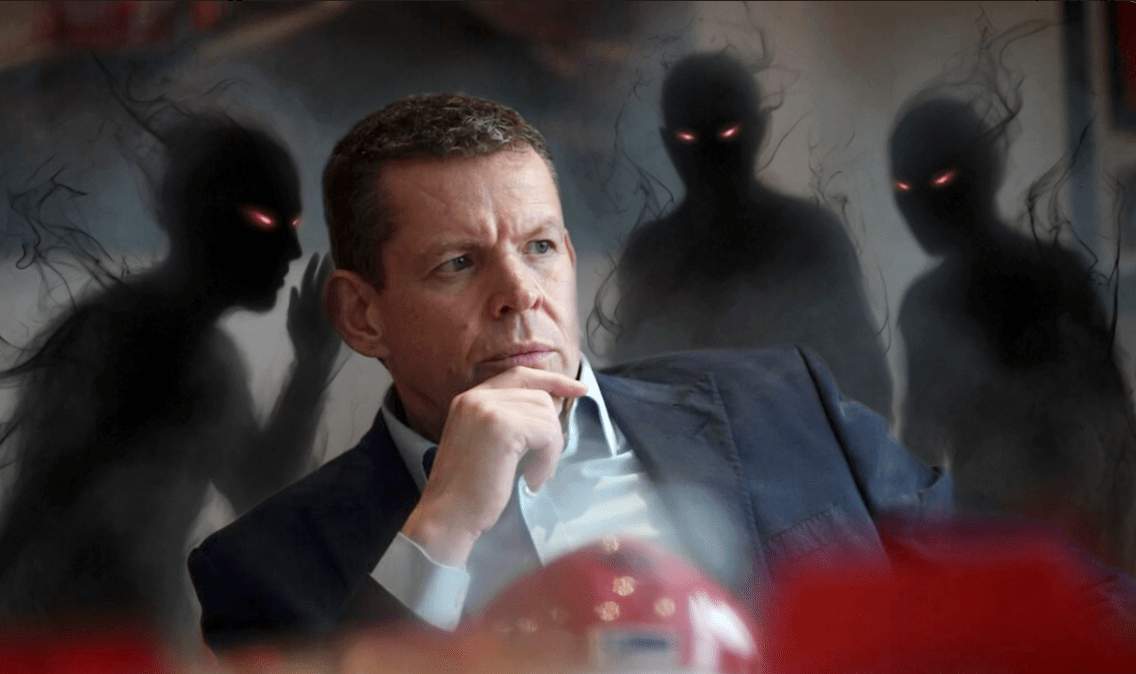
Who Ya Gonna Vote For?

Well, we’re almost there. Thank God! Because this has been the most uninspiring and negative election in the history of devolution.

Never have so many deadbeats, activists posing as ‘journalists’, party hacks, and nut-jobs, wasted their time trying to rouse a people who’ve just lost interest.

RUNNERS AND RIDERS IN HEAVY GOING

This election was doomed to be uninspiring and confusing once Labour rigged the voting system. (Almost certainly with the connivance of Plaid Cymru.) It’s a party list system that no one understands, contested in 16 vast and insane constituencies.

An affront to democracy.

I detailed the various stages of the process just over two years ago in Senedd Cymru (Electoral Candidate Lists) Bill, explaining how better and fairer voting systems were rejected in order to arrive at today’s abomination.

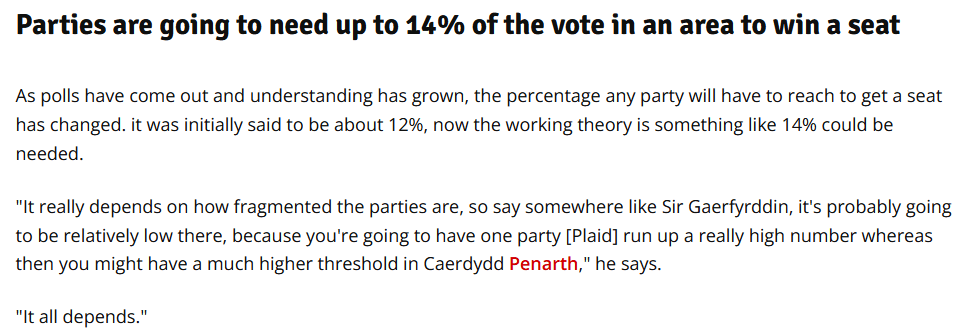
For one thing, it’s designed to make life as difficult as possible for smaller parties and independent candidates. Jac Larner of Cardiff University calculates the system imposes a threshold of 14% before a party can hope to win a seat.

Given the quality of the debate, and the paucity of credible candidates, the election has been uninspiring. But this is to be expected. If a Senedd of just 60 Members attracts only people who’d struggle to run a stall at a village fete, what hope is there of improving the quality when the numbers are increased by over 50%?

And this couples with the negativity I also referred to in the intro. The Globalist Uniparty, the self-styled ‘progressives’, Labour, Plaid Cymru, Greens, Lib Dems, have had little to say beyond – Stop Reform!

There has been nothing positive on offer. Certainly no inspiring vision for the future. But this is only to be expected. Because with the exception of the Greens these are the parties that have failed Wales for 27 years of devolution.

Adding the Greens to the mix – and a potential coalition with Plaid – only offers something worse. While the other components of the Uniparty promise more of the same, the Greens want to double down on the mistakes of the past 27 years, and force on us new ones.

It’s also been a very ‘British’ campaign in that Welsh issues have been crowded out. For the London media has tended to lump the Senedd elections in with the Scottish Parliament and English local authority elections.

Their focus has been London-centric in debating whether Starmer will survive bad results “across the UK“. Treating May 7 almost as a general election, or a vote of confidence in the Labour party in Westminster.

And yet, this neglect of Welsh issues serves the interests of some parties. Plaid Cymru, for example, can blame Labour for the mess Wales is in, while claiming a vote for them is also a vote against the most unpopular PM ever.

Ironically, this is Labour’s old election tactic of urging punters to, “Send a message to London“. Which is what many will be doing, but now it’s working against Labour.

Reform can neglect Wales to focus on the issues that figure with the mainstream media and social media; small boat migrants, net zero, anti-Semitism, high taxes, benefit payments, knife crime, etc. Giving out mixed messages about their attitude towards devolution doesn’t do them any harm either.

The Greens have the advantage of being an unknown quantity, something different. But the Greens are universally and correctly described as ‘the Watermelon Party’. Green on the outside, red on the inside. And now attracting Islamist support.

Plaid Cymru has also been dipping its toe in that toxic oasis pool for some years. Though I’m not sure Mrs Evans in Pencader will take kindly to being told she has to wear a hijab to Capel Sion or else be branded Islamophobic.

As for the Lib Dems, does anybody know what they offer? In Wales it’s that strange Jane Dodds, with the party led at UK level by Ed Davey, who backed the Post Office in persecuting postmasters when UK Postal Affairs Minister from 2010 to 2012.

In short, and Reform excepted, various forms of that curious beast, 21st century Western left-liberalism divorced from any concerns for the once-idolised working class.

Offering socialism that can only run an economy for as long as other people’s money lasts or – as we’re now learning from Minnesota and elsewhere in the USA – if it can tap in to official funding which taxpayers thought was being properly used.

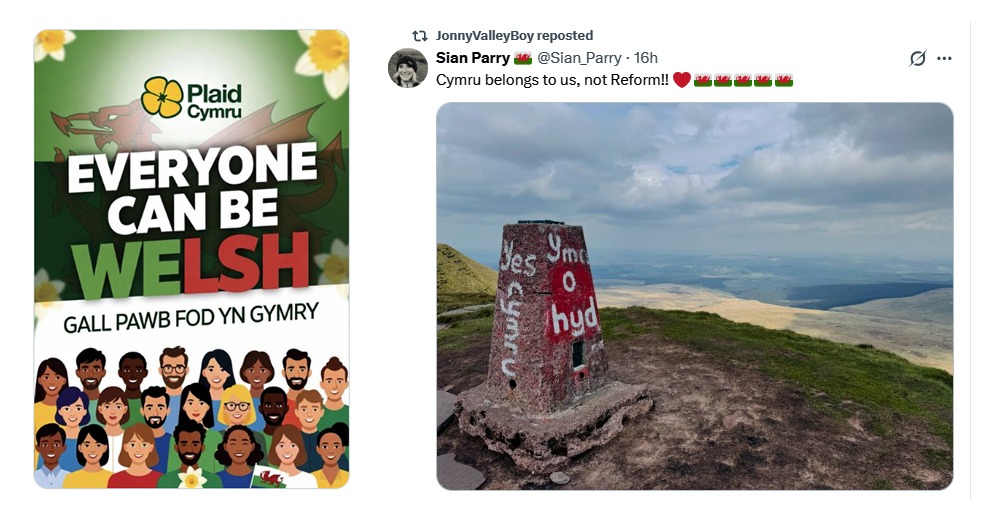
Few issues lay bare the deceit and duplicity more clearly than race. Here are a couple more things I picked up over the past week on X.

On the left we have Plaid Cymru dreaming of a multicultural Wales in which it seems white people are a minority. On the right, someone claiming that “Cymru belongs to us, not Reform“.

Now I don’t know Siân Parry, so I can’t say for sure that she’s a Plaid supporter, but she’s certainly on the political left. But what is she trying to say? Come to that, what is Plaid Cymru trying to say? Let’s attempt a synthesis.

An illegal immigrant can be Welsh; but someone who is Welsh to their core, speaks the language fluently, ceases to be Welsh – if they support Reform?

How insane, and offensive, that is. And all in the service of some transitory Woke nonsense. But too many put socialist dogma and childish obsessions above the interests of Wales.

To continue down this path Plaid risks becoming a full-blown anti-Welsh party.

For that’s the course it seems to have charted, with a Gwynedd councillor suspended for not appreciating that the false god of inclusivity is more important than the Welsh language and the community he was elected to represent.

So sod the Uniparty. And with Reform increasingly looking like controlled opposition, I’d avoid them too.

STUDENT POLITICS AND DYING BIRDS

Twenty-seven years of virtue-signalling, ineptitude, and failure have taken their inevitable toll.

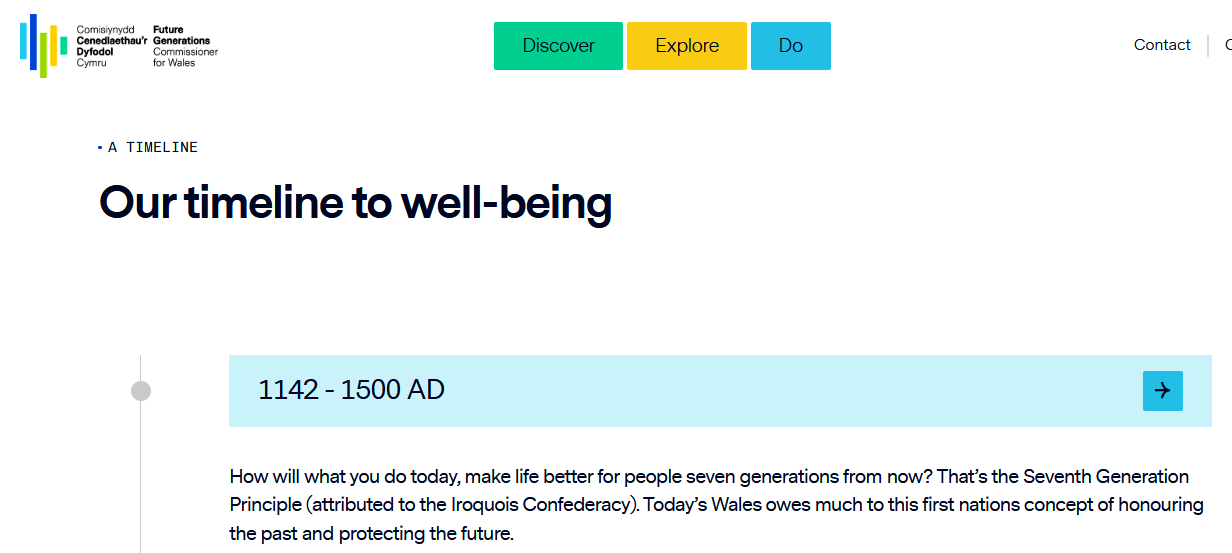
It’s an uphill task for those who’ve run devolution for 27 years to persuade people to forget about bills and hospital appointments, and instead take pride in Wales being the first country to declare a climate emergency, the first to have a Future Generations Commissioner, and to remember that Wales is working to be Anti-racist by 2030.

It’s student politics. And it’s explained very well by a young man named Owain Williams, whose one-minute video I stumbled upon last week.

When I saw “Confederacy” my heart soared!

Now student politics is all very well in its place, but the real world is not that place.

Digression alert!

There’s a little quote from Thomas Paine’s Rights of Man that was popular with the left in my younger days. Paine was responding to Edmund Burke’s Reflections on the Revolution in France, in which Burke floridly defended the Ancien Régime. (But still a great read!)

Paine condemned Burke for being more concerned with the pomp of Versailles than with the wretchedness of most French people. It was a radical responding to a conservative, telling him to ignore the ephemeral and focus on the realities.

Paine wrote: “We pity the plumage, but forget the dying bird“.

We can turn this on its head in 21st century Wales; for here it’s the radicals, the progressives, who obsess over the plumage, the ephemeral. But who ignore the dying bird, Wales.

And things won’t get better if we let Plaid Cymru take over. For Plaid, either alone or in alliance with their new wobble-headed pals in the Greens, will only push us harder and faster down Disaster Road.

But on the plus side . . . breast enlargement will be available on the NHS from fully-trained tit whisperers, all accredited by the Zack Polanski School of Woo-Woo.

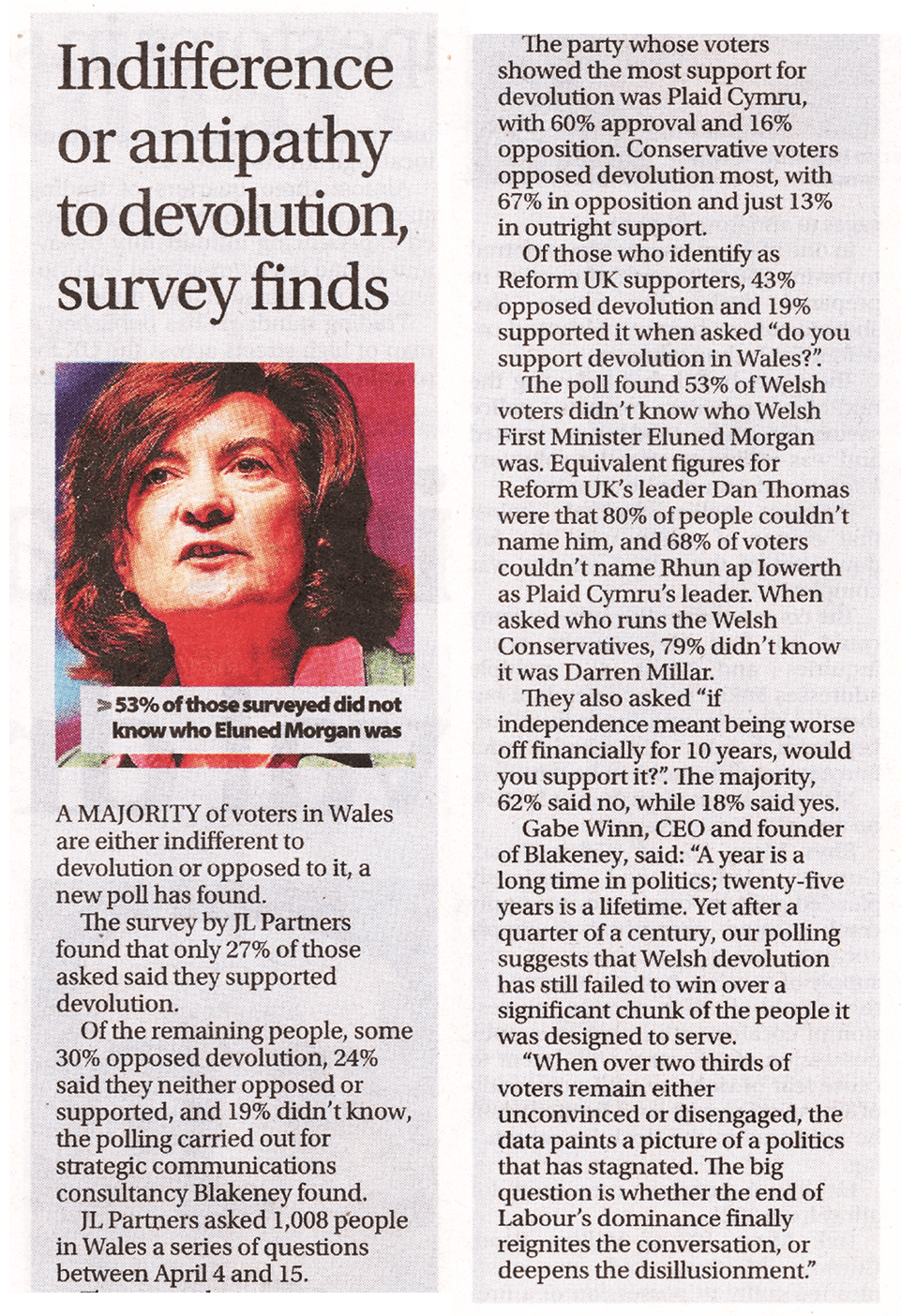
Let’s be honest, devolution has been a disaster for Wales, and so replacing one bunch of bullshitters with another won’t make a bit of difference. And people know it. This piece from last week’s Western Mail says it all.

A majority of voters in Wales are either indifferent to devolution or opposed to it . . . only 27 per cent of those asked said they supported devolution“. A majority of those polled couldn’t name the first minister.

But what do you expect after 27 years of failure that has alienated people from the whole idea of devolution, and they see no hope of improvement?

IS DEVOLUTION EVEN DEMOCRATIC?

A fundamental problem of devolution, and the main reason for being subjected to policies for which there is little public support is the hangers-on, the influencers, the pressure groups, the lobbyists, that attach themselves to the politicians, to by-pass and subvert the democratic process.

You vote for a party that promised this that and t’other but you end up suffering legislation that was never in the manifesto and on which you were never consulted.

That’s because most of the Uniparty members in the Senedd went into politics to promote their pet ishoos rather than represent the constituency for which they were elected. Many came from charities, pressure groups, and lobbying organisations.

The aptly-named ‘Swamp’.

Take Lee Waters. Ostensibly the Labour Senedd Member for Llanelli (though he actually lives in Penarth). Waters had worked for cycling charity Sustrans (renamed Walk Wheel Cycle Trust), and was instrumental in bringing in the 20mph legislation.

There was a petition opposing 20mph that raised almost 470,000 signatures – but the self-styled ‘Welsh Government’ ignored it.

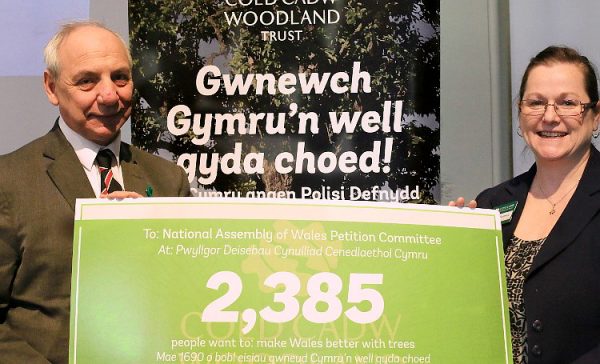
While other petitions, with little support, result in legislation – because the issue promoted lines up with the Uniparty agenda. You even get your photo took with some gurning politico in a presentation ceremony!

On the left in the image below is Mike Hedges, Labour SM for Swansea East; on the right, Natalie Buttriss, who’s represented a number of bodies trying to grab Welsh land under various ‘save the planet’/’biodiversity’ guises.

Red carpet treatment – and a chance to meet Mike Hedges! – for just 2,385 signatures!

That’s democracy, folks; the Voice of the People . . . being ignored.

Saying loud and clear that devolution is a sham. But we’re expected to believe it’s going to get better because – just like socialism – it hasn’t been properly tried yet.

Worse, there are those believing Wales could survive as an independent country with the same calibre of politicians pursuing the same policies.

This goes beyond the definition of insanity attributed to Einstein.

At present, all the lunacies we endure from Corruption Bay are funded by the block grant from Westminster. Take that away with independence, and give full powers to politicians who understand nothing about economics, but who will be determined to pursue the same Globalist-Woke agenda, and Wales will go broke within 5 years.

Then it’s into the clutches of the EU and the World Bank; allowing land and other assets to be bought up by BlackRock and the like to give the impression of economic activity, or inward investment.

Socialism has never worked as an economic model. Which explains why the only ones pushing it are either still wet behind the ears or have jobs for life on the public payroll.

CONCLUSION

Plaid Cymru believes that a few years of the party running the Senedd will win people over to the idea of independence. Thinking of Scotland. They’re wrong.

After the SNP took control in 2008 (as a minority government) it increased its popularity under the leadership of Alex Salmond. To the point where it almost won the 2014 referendum on independence.

But Salmond, in addition to being a very astute politician and a great debater, was an economist. You know, the real world economy. He persuaded many Scots, and many economists, that Scotland could be better off as an independent country.

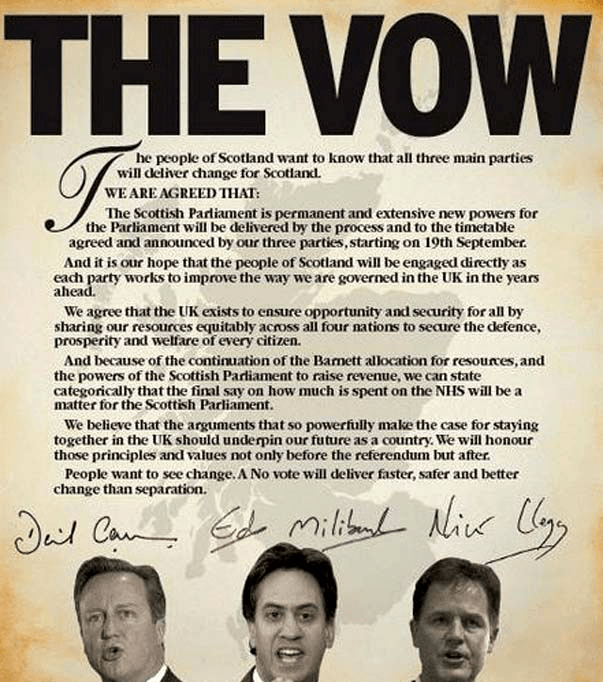
And it almost worked. I was in Scotland for the referendum, and I know that the polls just before the vote were showing a majority for Yes. The London parties panicked and came out with ‘The Vow’, promising Scotland just about everything short of independence.

That swung it and the vote was 55 – 45 against independence.

Worth noting that the Labour leader at the time was Ed Miliband. Who – like Cameron and Clegg – understood that a great part of the appeal of independence was the promise of oil and gas revenues staying in Scotland. So maybe him closing down North Sea oil and gas fields isn’t just about saving the planet.

Whatever, and to get back to Wales, Plaid Cymru knows nothing about economics; I think the last genuine economist in their ranks was Dr Phil Williams, a good old stick despite everything, but he died in 2003.

Wales has no oil and gas fields to speak of. And there’s been no attempt to develop an indigenous economy over the 27 years of devolution. Funding cronies and charities to run make-believe ‘businesses’, and allowing carpetbagger companies to exploit Wales, is a third world economy.

All Plaid Cymru offers is more of the same, with a different spin. Because while Rhun ap Iorwerth may come across as an affable sort of guy, behind the scenes, still running the show, are dark forces from Plaid’s recent past.

And if Plaid gets power, especially in a link-up of some description with the Greens, then even nastier specimens will start popping up.

Wales needs radical change, in the form of a return to the eternal verities and facing up to economic realities. The Uniparty will never be allowed to provide this. Reform gives no thought to Wales beyond getting votes to pursue a different agenda.

Here’s Owain Williams again. I don’t know his politics, but I suspect they’re not a million miles from my own.

UPDATE 04.05.2026: Well, bless me! Young Owain is the son of Rhodri ‘Billions’ Williams, former boss of S4C and various other bodies. Owain is, or was, a Labour stalwart. The doubt might be justified by the party excluding him from being selected.

The only sensible option is a party that puts Wales first and foremost. One that prioritises the economy we all need. That understands Wales needs real jobs not more gesture politics. That teaches our children to think for themselves rather than brainwashing them. That won’t wage war on the family farm. Or the family unit.

The only party that fits the bill is Gwlad. Of course, Gwlad can’t win this time round, they don’t have the strength yet. But they’ll grow and, with fair media coverage, be back stronger next time. In the meantime, I’m sure Gwlad will be fighting for Wales in council elections and other ways.

The only Welsh party willing to address people’s real world concerns is Gwlad.

♦ end ♦

© Royston Jones 2026
Buy Me A Coffee

Devolution Is Cardiff Council On Stilts

To explain the title . . . Back in the 1960s and 1970s, when there was any talk of a Welsh Parliament, Home Rule, or devolution, one of the arguments used against the idea was that such a creation would just be “Glamorgan County Council on stilts“.

The implication being that other parts of Wales would be ignored. That investment, jobs and other goodies resulting from self-government would be concentrated in that area.

In this piece I’ll try to persuade you that what we’ve seen since 1999 is even worse.

FIRST SECRETARY, FIRST MINISTER

I’m going to begin by looking at the first secretaries and first ministers we’ve had since the beginning of the devolution experiment.

The first, said to be Tony Blair’s choice, even “Blair’s poodle“, was Alun Michael. He was never very popular, either within the Labour party or the country at large, and was first secretary for just nine months, until May 2000.

A former Cardiff City councillor, he later served as Labour MP for Cardiff South and Penarth. Then Regional Assembly Member for Mid & West Wales. And PCC for South Wales.

Michael was replaced by the much more popular Rhodri Morgan. Who stayed in the first minister role until December 2009.

Cardiff-born Morgan was MP (until 2001 GE) and AM for Cardiff West from 1999.

Next came Carwyn Jones. Despite being born in Swansea, and practising law there for a number of years, he represented the Bridgend constituency. His Cardiff connection was established by being a tutor for a few years at Cardiff University.

I’ve said it many times on this blog, and I’ll say it again, Cardiff University is joined at the hip to the local Labour establishment. The School of Journalism should be renamed the School of Globalist-Left Propaganda.

Jones stood down as leader in December 2018. He now sits in the House of Lords as Baron Jones of Penybont.

He was succeeded by Mark Drakeford, a former South Glamorgan County councillor who became the Assembly Member for Cardiff West in the May 2011 elections.

Drakeford was born and raised in Carmarthenshire, but moved to Cardiff over 40 years ago. And was a lecturer at Cardiff University.

From 1985 to 1993, Drakeford represented the Pontcanna ward on South Glamorgan County Council, with fellow future Welsh Assembly members Jane Hutt and Jane Davidson as his ward colleagues.

(Jane Davidson was at the Rio Earth Summit in 1992, Labour AM for Pontypridd (1999 – 2011), and wrote the Well-being of Future Generations legislation that enforces ESG and DEI in every aspect of Welsh life.)

Drakeford stood down as first minister in March 2024. He will not stand again in May.

Then came the brief tenure of his successor Vaughan Gething. After serving as councillor for the Butetown ward on Cardiff City Council he became the Senedd Member for Cardiff South & Penarth in 2011.

Gething is also standing down.

Gething was succeeded in August 2024 by the current incumbent, and former MEP, Eluned Morgan, the Regional Member for Mid & West Wales.

Born and raised in Cardiff she sits in the House of Lords as Baroness Morgan of Ely.

So we see a Cardiff connection with all first secretaries or first ministers Wales has known in 27 years of devolution. And with five out of the six a strong connection.

Given that Cardiff makes up some twelve per cent of Wales’ population, this statistic is truly remarkable. And should be concerning.

SOME INTERESTING SENEDD MEMBERS

Beginning with Bridgend, where we find Sarah Murphy. Who was born and raised in Pontypridd then, after Reading University, worked in Seoul and London. She came back to Cardiff; held posts with the Labour party, and the University. More exactly, the School of Journalism.

Next, Cardiff Central. The patch of uber wealthy Jenny Rathbone since 2011. She’s a member of the Rathbone dynasty of Liverpool, where she was born. Her knowledge of Wales is on a par with that of a stay-at-home Eskimo. Limited to Cardiff and the area around her holiday home up in Llanfihangel Glyn Myfyr.

Hubby, John Uden, who knows as much about wind power as the heretofore mentioned Innuit knows of Wales, somehow managed to get on the ‘Welsh Advisory Board’ of Bute Energy. Which was handy, seeing as Mrs Uden sits on the Senedd’s Climate Change, Environment and Rural Affairs Committee.

She’s standing down in May. Her vacuous wittering will not be missed.

Cardiff North is where we find Julie Morgan, widow of Rhodri. Cardiff born and bred, she is a former South Glamorgan and Cardiff City councillor, and was elected to the Senedd in 2011 after losing the Westminster seat of Cardiff North in 2010.

She is also standing down.

Cardiff South & Penarth is held by former first minister, Vaughan Gething. (See above.)

Cardiff West is held by former first minister Mark Drakeford (See above.)

Cynon Valley brings up Vikki Howells, who was born and raised in the constituency, and attended Cardiff University.

The SM for Llanelli Lee Waters is definitely a member of the Corruption Bay in crowd. A former ITV Wales journalist, director of think tank IWA, then director-lobbyist for bike charity Sustrans, he’s the man responsible for the 20mph restrictions.

Despite being SM for a seat west of Swansea, he lives just outside Cardiff.

He’s standing down in May.

Now we head up to Merthyr where the local representative is Bristol City fan Dawn Bowden. Another Bay insider who worked her way up through union ranks but who knows as much about the Heads of the Valleys as the denizen of the frozen north I mentioned earlier.

But that doesn’t matter – she was promised a safe seat.

Which she’ll thankfully vacate in May.

Another carpet-bagger can be found in Pontypridd in the form of Mick Antoniw. He came to Wales to study at Cardiff University, and stayed. One of those who drove through the absurd and corrupt voting system we’ll be using in May.

Of Ukrainian descent, he’s made a number of very public trips there to deliver ‘aid’. If Wales was independent he’d want us to declare war on Russia.

Another one standing down.

A odd one now, in Julie James, SM for Swansea West. Odd, because even though she was born in Swansea, travelled around a lot in her early life, she was involved in the Gilestone farm saga before being elected to the Assembly in 2011. As a solicitor working against the then owners, which paved the way for the land to be bought by someone’s chosen buyer.

Also standing down.

Moving east to Torfaen, ‘though born in Merthyr, Lynn Neagle is definitely part of the Bay Bubble. Wife of former Labour AM Huw Lewis.

Neagle has worked for, “Shelter Cymru, Mind and the CAB. She was Carers Development Officer with Voluntary Action Cardiff and also worked as a researcher for Glenys Kinnock MEP“.

And, finally . . . Jane Hutt, who sits for the Vale of Glamorgan, is another who moved to Wales to involve herself in charities and third sector bodies: National Co-ordinator of Welsh Women’s Aid, South Glamorgan Women’s Workshop, Tenant Participation Advisory Service and Chwarae Teg (Fair Play) . . .

Thankfully, she’s also standing down.

REGIONAL SENEDD MEMBERS

Due to winning so many seats in the south and the north east Labour has just three Regional SMs. One in the North. Here are the two from the Mid & West.

One of course, is Eluned Morgan, the current first minister. (See above.)

The other is Joyce Watson. And she may be unique among Labour SMs because her official bio says: “Joyce has run several small businesses – public houses, restaurants and retail outlets – in Ceredigion, Carmarthenshire and Pembrokeshire.”

But did she own them?

But even that ray of hope is dimmed by the usual charity/third sector involvement: “Joyce managed the Wales Women’s National Coalition . . . senior member of the Wales Gender Budget Group . . . NHS Equality Reference Group”.

Watson is another jumping the sinking ship of devolved politics in May.

WHAT IT MEANS

Let’s start with a statistic. The population of Wales grew between the census years of 2001 and 2021 by 6.8%. In the same period Cardiff saw growth of 18.7%. According to some, Cardiff is now the fastest-growing city in the UK.

Most areas of Wales saw negligible growth, with some even recording a fall. Ceredigion, Blaenau Gwent and Gwynedd have declining, and ageing, populations; while Merthyr and a few other areas struggle to maintain their numbers.

Newport’s population increases steadily since charges on the Severn Bridge were abolished, which allowed buyers from England to access the cheaper housing in south east Wales and commute daily to Bristol, or even further. While in many rural areas population increase is due to retirees and good-lifers moving in.

But turning Newport into a Bristol suburb and rural areas into al fresco retirement homes is neither desirable nor sustainable.

Welsh life is increasingly focused in Cardiff, for the benefit of Cardiff. This can be explained by a number of factors. The first, quite obviously, is political power. Then there’s the third sector, charities, pressure groups, which both feed off and feed into the political system.

A political machine serviced by regiments of spads, assistants and researchers, whose loyalty can be guaranteed by the carrot of a council seat, or, for the very lucky – a seat in the Senedd.

But let’s not overlook other beneficiaries, such as those to be found among the movers and shakers of the local business community.

An example would be the Thomas brothers, of the pie and pasty dynasty. It’s universally accepted that the ‘Welsh Government’ paid way over the odds to buy Cardiff airport. But who was the vendor?

And who bought that criminally undervalued land on the outskirts of Cardiff?

In both cases the lucky boy was Stan Thomas. Hot pies all round!

If you want a fuller picture, read a couple of pieces I put out ten years ago. Pies, Planes & Property Development, and Pies, Planes & Property Development 2.

But it’s not just the Thomas brothers. There are others.

Then there’s sport. Through funding, the ‘Welsh Government’ effectively took control of the Football Association of Wales and the Welsh Rugby Union.

Which explains why, when Cardiff Rugby went bust the WRU stepped in to buy it. And why the most successful region, the Ospreys, based in Swansea, is threatened with extinction.

The last-but-one owner of Cardiff Rugby was the late Peter Thomas, Stan’s brother.

The clowns currently wrecking Welsh rugby are political appointees, and they’ve been told to prioritise the interests of Cardiff. To the detriment of Welsh rugby as a whole.

Finally, there’s the media. Based in Cardiff and little more than a mouthpiece for those I’ve described above.

And all the while, our economy and our essential services decline and decay.

WHAT MIGHT THE FUTURE HOLD?

If polls are to be believed then Plaid Cymru will emerge in May with most SMs, but not a majority. This will mean Plaid going into coalition, or having an ‘agreement’, or an ‘understanding’, most likely with Labour, possibly with the Greens.

We might even see a ‘progressive’ alliance of all the Globalist-Woke parties. It really won’t make much difference. (But what a nightmare that could be!)

Now some might think that with so much of its support being in the west and the north Plaid Cymru will adopt a different approach. And there might be a few moves away from the obsessive focus on Cardiff, but Plaid would be no real improvement.

Because Plaid wants to take Wales further than Labour on ‘ishoos’ such as Net Zero, trans ‘rights’, DEI, Gaza, ‘Islamophobia’, and decolonising Welsh cakes. And faster down the road of economic implosion and civilisational decline.

Party leader Rhun ap Iorwerth may be the Senedd Member for Ynys Môn, the seat furthest from the Bay, but he’s a former BBC journalist. He was educated at Cardiff University and he’s lived in Cardiff.

And ap Iorwerth may be a figurehead; for many believe the party is still controlled by the acolytes of a previous leader, the PoundShop Pasionaria of Penygraig.

Whatever the outcome in May in party terms, it won’t make much difference. Plaid, Greens, Labour, Tories, Lib Dems, they’re all just differently-badged elements of the Globalist Uniparty. That’s why they repeatedly tell us the upcoming election is solely about defeating Reform.

Is it?

Then again, Labour might welcome a ‘break’. Shun any co-operation, then come back untainted and refreshed in 2031. Hoping electors will have forgotten their record in the Senedd.

And who might lead the Labour comeback? If I was a betting man I’d put a few quid on Huw Thomas. If you’ve never heard of him, let me introduce him.

Huw Thomas, courtesy of Getty Images

He’s 41 years old and from Aberystwyth, he’s bilingual, and he’s been leader of Cardiff Council for nearly 10 years. In May, he’s top of the Labour list for the Caerdydd Penarth constituency.

He’s guaranteed to be elected because Cardiff is an area where Labour will do well.

UPDATE: Soon after posting this article at 9am I went to Tywyn, picked up a Western Mail, read it while having my first coffee of the day. In this article Huw Thomas gets a mighty plug.

If it comes to pass as I predict, and Labour gets back into power in 2031, under his leadership, then everything will revert to the status quo ante Plaid, with Cardiff grabbing the lion’s share of investment and jobs.

Which, to respectfully amend Lincoln’s Gettysburg Address, will mean a return to: Government of Wales, by Cardiff, for Cardiff.

♦ end ♦

© Royston Jones 2026
Buy Me A Coffee

Plaid Cymru – Party Of Nowhere

I’ve been meaning to write this, or something like it, for some time. So, with the Senedd elections roughly three months away, now seems as good a time as any.

In some ways I suppose this is an update to a piece I put out in February 2019, back when I was young, handsome, and gay: ‘Wales: nationalism ethnic and civic‘.

THE PLAID CYMRU THAT ONCE I KNEW

The party I joined in the mid-Sixties was unambiguous in its call for independence. This was based on the belief in a distinct Welsh identity, coupled with the perception that Wales didn’t get a fair deal from the UK government in London.

We believed that independence was the only way to respect and protect Welsh identity while also improving the economic and other conditions of our people.

But I also flirted with ‘fringe’ groups. Though back in the heady days of the 1960s it was possible to see Plaid Cymru as the political wing of  a wider movement that included ‘militant’ groups like Mudiad Amddiffyn Cymru and the Free Wales Army.

Maybe that’s stretching it a bit, but there was certainly ‘rubbing along’, maybe an acceptance that we were all on the same side, wanting the same thing. Here’s an image that might be seen to capture this acceptance, from Cilmeri in 1982, the 700th anniversary of the killing of Llywelyn II.

On the left of course, is Gwynfor Evans, then leader of Plaid Cymru, and former MP for Carmarthenshire. With two good mates of mine. In the centre, Peter ‘Gun’ Williams, and on the right, Gareth ap Siôn.

I often wonder what was going through Gwynfor’s mind when he found himself in such company. That bemused look is intriguing.

Happy days!

Plaid luminaries are rarely seen at such events now. Maybe like those they align with they view Llywelyn as a ‘medieval war-lord’, an ‘oppressor of the people’.

For history can cause Plaid Cymru bouts of confusion and convenient amnesia, with this applying to even modern history. As I was reminded in 2015 at the 50th anniversary of the drowning of Capel Celyn.

Plaid MPs and others were there reminding us how awful it had been: “Liverpool Corporation . . . Welsh-speaking village . . . injustice . . . something should have been done . . . blah . . . blah“.

But no mention of those, risking life and liberty, who actually tried to do something.

A TASTER FOR THE SECTION THAT FOLLOWS

I’ve taken this trip down Memory Lane as the first step in explaining how Plaid Cymru has gone from being a nationalist party with policies to improve Wales to the benefit of the Welsh into just another bunch of Globalist-Woke-left sloganistas.

EPIPHANY, AND THE NEW BELIEF SYSTEM

The year 2021 was a watershed for me, and for many, many others. To begin with, there was Covid, and the vaccines. Once the lies involved in that whole episode became clearer, I saw many things in a new light.

(And now we learn that Bill Gates, global emissary for Big Pharma [in which he’d judiciously invested], caught the pox from Russian whores he met through Jeffrey Epstein. What a role model!)

Around the same time, in Wales, my eyes were opened to another threat. I’m referring to the takeover of ‘independence movement’ YesCymru by some of the weirdest and most unhinged people I’d ever encountered. (And believe me, I’d known a few!)

I knew such creatures were ‘out there’, but until they were all gathered together in the spotlight I hadn’t appreciated how fucked up they really were.

For until then I held the views from my formative years; which meant that I still believed ‘the opposition’ was fairly rational, and though wrong, still wanted the best for Wales.

I suppose I was still thinking of the socialists I’d grown up with, even within my own family. Decent people who’d read their Marx and Lenin, with deeply held views they could rationally (if unconvincingly) defend.

But the events of 2021 made it clear there were new kids on the block. Unread, incapable of rational debate, who could only deal in insults, defamation, and even death threats. (This episode was covered extensively on this blog.)

They wanted Communism . . . to give them freedom to do whatever they wanted!

It’s difficult to explain to anyone unfamiliar with those events how ugly some of these interlopers into adult debate really are. But here’s an attempt. This stuff’s water off a duck’s back to me, but like rabid animals they could turn on anyone.

Even a youngster who’d had the temerity to like a tweet of mine!

A key to understanding – or appreciating – this change between what I’d been familiar with and the new Woke left is the differing attitudes towards the working class.

Old-style socialists eulogised the working class. The Revolution would be achieved by them, and it would be for them. To the Wokies, and certainly after Brexit, the working class was the enemy, for the proletariat is socially conservative and rejects neo or cultural Marxism.

In simple terms: level-headed people in the real world want sod all to do with Wokism.

I’ve dealt here with YesCymru because it’s Plaid Cymru in a different wig. It was almost as if Plaid Cymru was using YesCymru, and other groups, to float some of the crazier ideas they weren’t quite ready to put in their election manifestos.

Just to familiarise us with them.

Admittedly, there was a guy up on the north coast claiming to represent ‘Labour for Independence’, though I suspect Bob Lloyd (bless him!) was founder and sole member.

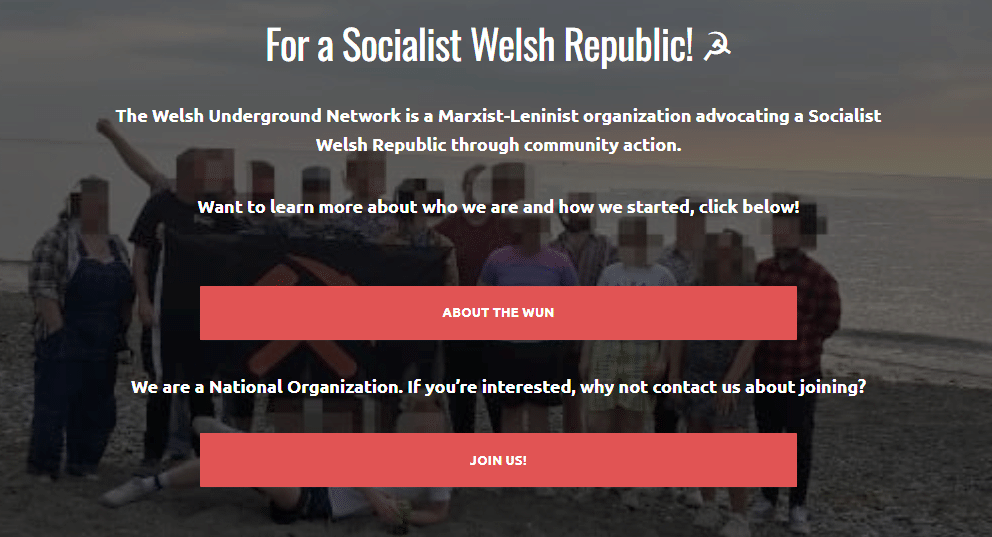
What considers itself today to be the ‘broader independence movement’, includes not only Plaid Cymru, and YesCymru, but also fruitcake gangs like Melin Drafod, the Welsh Underground Network (should an ‘underground’ group have a social media presence?), and then there was mercifully short-lived Undod.

Did I say ‘broader! (Slaps wrist.) For these people independence is only worth having if it delivers a Marxist shit-hole implementing the Globalist-Woke agenda

And the same applies to Plaid Cymru.

The lone voice of sanity is Gwlad.

A CLOSER LOOK AT PLAID CYMRU TODAY

The party that is Plaid Cymru today may be at its highest point in the polls, and predicted to win May’s Senedd elections, but I believe it’s also at a crossroads, perhaps a high-water mark it will never achieve again.

Such a bold declaration obviously requires an explanation. Let’s start with a few facts that I challenge anyone to dispute.

First, Plaid is riding high in the polls because enough voters belatedly realise that the Labour party in Wales (and beyond) is a bunch of lying, posturing, hypocritical incompetents. Many see Plaid as an acceptable alternative.

Second, there is a drive among the ‘progressive’ parties and the Globalist-run media to ‘Stop Reform!‘. As if we’re in some existential struggle with the forces of darkness. Plaid Cymru, seen as the best chance in Wales, will benefit hugely from tactical voting.

Neither of these can be considered positively voting for Plaid Cymru.

But switching from Labour to Plaid Cymru is pointless anyway. For closer inspection reveals that Plaid is very little different. On all the policies that have made Labour unpopular Plaid Cymru is in agreement, or would go further.

Let’s start with Net Zero. Plaid Cymru wants more investment in ‘renewables’ such as wind turbines. When confronted with local hostility to the exploitation of Wales and the blighting of our landscapes by foreign companies Plaid retreats to a position that argues against pylons – but still in favour of wind farms!

The only way to square this circle is to bury all the cables so we don’t have pylons. Which will incur further costs that will inevitably be passed on to commercial and domestic consumers. Result: Higher bills and even more job losses. Misery all round.

If you haven’t seen it yet, watch Plaid Cymru SM for Mid and West Wales, Cefin Campbell, and lead candidate for Carmarthenshire in the upcoming elections, get savaged at a recent public meeting organised by the CPRW. It’s painful.

On the issue of open borders and excessive immigration, party leader Rhun ap Iorwerth, has said that Wales – or maybe parts of Wales – must have more immigrants.

The justification for this position seems to be “depopulation“, and the effect this has on schools and services. But what about jobs for the parents of the kids he wants to fill rural schools?

Depopulation, in almost any area, at any time, is invariably an economic issue. Which can only be remedied in one way.

And that is to build a rural economy to retain and draw back the indigenes.

Or else disguise the problem by bringing in a new population that will not seek work, in order to massage the population figures. This has been widely practiced in rural areas for some decades.

But ap Iorwerth wasn’t thinking about the retirees and good-lifers we’ve known. He was thinking of a new population from places more exotic than Edgbaston and Esher.

So there’ll be no economic strategy for the rural areas of Wales.

Then there’s the debilitating anti-white racism, and Islamophilia.

Listen to former Plaid Senedd Member Bethan Sayed complain about too many white people on Welsh language television channel S4C. I would guess that 98% of Welsh speakers are white. But who cares about silly facts?

More recently, she’s suggested that Welsh schoolgirls should wear hijabs.

The sensible approach would be to remind new arrivals and those from other backgrounds that the obligation is on them to adapt to the country they live in, rather than to take girls from the host community back to the 7th century and a foreign culture.

Any attempt by new arrivals to impose their ways, their values, on a host community, is a form of colonialism. I would expect Plaid Cymru, of all parties, to realise that.

The modern left’s flirtation with Islam reminds me of the fable of the scorpion and the frog. But this time the scorpion will get to the other side before stinging the frog.

(Fittingly, this story may have originated in medieval Persia as the scorpion and the turtle. Fitting, because in 1979 middle class leftists cheered the return of Ayatollah Khomeini to Iran . . . then they were dealt with.)

With gender, it should go without saying that Plaid is right there, on message. Here’s another Senedd Member, Sioned Williams, imploring us to remember “transgender people whose lives were lost in acts of anti-transgender violence.”

How many are there? And how do the numbers stack up to all the school shootings and other killings carried out in the USA by unhinged individuals claiming to be trans?

The fundamental problem is that Plaid Cymru has lost the common touch, and with it its sense of what people in the real world want. It’s no longer a case of, ‘What does Wales need?‘ Now it’s, ‘What have we been persuaded to believe Wales needs?‘.

Because what’s important for Plaid is meeting with the approval of those whose opinions they care about – the campaigners, the pressure groups, the minority interests. For Plaid’s politicians, staff, activists, move in closed circles, echo chambers where their own prejudices are confirmed and their errors reinforced.

Go back and watch Cefin Campbell floundering when confronted by real people voicing genuine concerns about something that really impacts on their lives.

CONUNDRUM

Plaid Cymru has swallowed the Woke agenda, accepted the Globalist narrative, and is ready to play its part in implementing the New World Order. This means a world without borders, and of course, without nations.

The Globalist agenda to de-industrialise, destabilise, limit individual freedoms, control the food supply. Then take over completely.

Which is why the Globalists work with those who share that agenda, Neo/cultural Marxists and Islamists. Who also want to bring down the West.

Yet to its traditional supporters, Plaid Cymru pretends it still believes in Welsh identity and nationhood. While assuring its new members and activists that it wants open borders, Welsh schoolgirls in hijabs, and replacing St David’s Day with a day of mourning for ‘trans victims’.

Unless you’re a Cossack, riding two horses rarely ends well.

And the economy? Our essential services? Not important when there are gestures to be made, lobbies to be pandered to, and dangerous minorities to prioritise over your own people.

CONCLUSION

The point I hoped to make earlier about Plaid Cymru is that the party I knew was more easy-going, more welcoming. It was a broad church rooted in the real Wales.

Despite my ‘colourful’ associations in the 1960s, and a conviction in 1968 for trying to decapitate a statue, I was still accepted as a candidate more than once for local elections in the early 1970s.

But since then, and certainly in the past decade, Plaid Cymru has become a hard left party. One in which no deviation from the Globalist-Woke agenda is tolerated.

This combination of Stalinist mindset and extreme Wokism will be the hallmarks of a Plaid Cymru government in the Senedd. Which is why anybody thinking of voting for the party in May, as an improvement on Labour, and better than the other options, would be making a huge mistake.

Think again!

♦ end ♦

© Royston Jones 2026
Buy Me A Coffee

Plaid Cymru and the Welsh National Party

PLEASE APPRECIATE THAT I GET SENT MORE INFORMATION AND LEADS THAN I CAN USE. I TRY TO RESPOND TO EVERYONE WHO CONTACTS ME BUT I CANNOT POSSIBLY USE EVERY BIT OF INFORMATION I’M SENT. DIOLCH YN FAWR

This is another lengthy and rather complicated tale but it boils down to a corrupt system seeking to defend itself from a man, and now a new party, determined to expose that corruption.

PLAID CYMRU RUNS TO THE ELECTORAL COMMISSION

After being hounded out of Plaid Cymru Neil McEvoy, with other Cardiff councillors, formed the Welsh National Party, or, in Welsh, Plaid Genedlaethol Cymru. The English version was accepted by the Electoral Commission but not the Welsh language version, rejected because it was too close to the names of existing parties.

I think this decision was wrong. Firstly, the names are clearly different, and for Plaid Cymru leaders to argue that Plaid Genedlaethol Cymru was the original name of their party is disingenuous, for that name had fallen out of use when I joined Plaid Cymru in the mid-1960s. Nor is it “widely used by Welsh speakers”. Plaid Cymru is ‘Plaid Cymru’ whether you’re speaking Welsh or English.

What’s more, party logos also appear on ballot papers, further reducing the chances of confusion.

Not satisfied with a draw, Plaid Cymru has now mounted a legal challenge to the name ‘Welsh National Party’, on the following grounds:

  • Irrational to maintain the registration of the name ‘Welsh National Party’ having rejected the registration of its Welsh translation, ‘Plaid Genedlaethol Cymru’
  • Failure to consider the high likelihood that, in Wales, the Welsh translation of the name ‘Welsh National Party’ would become commonplace in the context of the official legal status of the Welsh language
  • Failure to give adequate reasons to explain why the English name ‘Welsh National Party’ would be unlikely to cause confusion, having accepted that the Welsh name would cause confusion

To address the first point: The registration of ‘Plaid Genedlaethol Cymru’ was rejected because it might be confused with a name no longer used by Plaid Cymru. But even that absurd decision may not invalidate ‘Welsh National Party’ because it’s unclear if the name in one language must be a direct translation of the name in other languages.

Click to enlarge

Second point: “In Wales”! – where else will the WNP be standing? While “would become commonplace in the context of the official legal status of the Welsh language” needs to be translated . . . into English.

Third point: The rather obvious answer is that ‘Welsh National Party’ is unlike the name of any existing political party. Making this an argument for accepting ‘Plaid Genedlaethol Cymru’ rather than for rejecting ‘Welsh National Party’.

Let us also remember that a few years ago, Plaid Cymru introduced the English language moniker, the ‘Party of Wales’. Though I can understand Plaid being miffed that it never caught on, because from Connah’s Quay to Chepstow people still say ‘Plaid Cymru’.

At the risk of labouring the point, Plaid Cymru is known by that name, and by that name only, all over Wales, and beyond, to speakers of Welsh, English, and all other languages.

Click to enlarge

Another irony is that Plaid Cymru objecting to a party with ‘National’ in its name. Ironic, because since Dafydd Elis Thomas led the party in the 1980s, and the left took over, ‘nation’, ‘national’, and ‘nationalist’ have been frowned on in Plaid Cymru circles. The party now deals with the geographical expression ‘Wales’, and the people(s) of Wales.

But I suspect there’s more to this harassment of the Welsh National Party than simply trying to sabotage a putative rival. As I’ll try to explain.

But before that, and in response to these latest developments, Gretta Marshall, chair of the Welsh National Party has issued the following statement:

“The WNP is going from strength to strength. The Welsh name put forward is Y Blaid Genedlaethol. We felt this was a sensible compromise. There is no possibility of confusion with any other party in Wales. 

Statute law is clear. Once registered, a political party cannot simply be de-registered on a whim no matter who complains. Due process exists. Cardiff Council has already confirmed in writing that our Group of councillors in the Capital is a Welsh National Party Group. 

As Party Chair, I am overseeing our action. We have written to the Electoral Commission and the Speaker Committee of the House of Commons. 

The obvious thing would have been for interested parties to at least communicate with us. That did not happen, which is unfortunate. “

PLAID CYMRU, FRIEND OF THE UNION

I have long argued that from London’s perspective Plaid Cymru is the perfect ‘nationalist’ party (irrespective of how it might describe itself). For a number of reasons.

To begin with, Plaid always struggled due to the perception of it being a ‘party for Welsh speakers’. Something I encountered again and again when canvassing in the 1960s and 1970s. Being greeted on the doorsteps of east Swansea not with hostility, but an almost apologetic, “Sorry, love, we don’t speak Welsh in this house”.

That perception was a major obstacle to the party’s progress, and unfortunately it was not entirely incorrect. Which was a shame, because I knew so many who were not hostile to the idea of devolution or even independence, but they did feel excluded by Plaid Cymru’s over-emphasis on the Welsh language.

Support for what I’m saying came in September 1997, when the working class areas of Swansea voted heavily for devolution in the referendum. This was the picture from Swansea Bay to the Heads of the Valleys, the region of the shared accent, with the highest percentages of Welsh identifiers.

This region, containing almost half our population, should have been fertile ground for any party preaching radical change with a strong Welsh flavour. It is certainly the key to success in Wales.

But Plaid Cymru’s leadership, understanding little about the southern working class, believed that to appeal to this electorate the party needed to out-Labour Labour – by being more socialist!

But voters in the south supported Labour for the same reason stockbrokers in Surrey and hedge fund managers in Hertfordshire vote Tory – naked self-interest. Of course there were socialists among the Labour voters, but most put up with the leftie dreaming just so long as Labour delivered on wages and holiday pay and lower taxes.

But in its naiveté, Plaid’s out-of-touch hierarchy saw red flags, barricades and electoral success . . . but realised nothing more than a few false dawns.

And now, things are even worse, for Plaid Cymru seems to have abandoned the practical and self-serving ‘socialism’ of the old southern working class in which I grew up for lunacies straight off California’s campuses.

There are now elements in Plaid Cymru that dream of Antifa stormtroopers patrolling the streets cracking the skulls of anyone who looks suspiciously bourgeois. And if you haven’t read the Guardian that morning then you’d better run, boy. Click to enlarge

This combination of still being perceived as a Welsh language party while now insisting that 16-year-olds can have gender reassignment surgery on demand – and branding as a fascist transphobe anyone who disagrees – has as much chance of electoral success as I have of becoming chairman of Cardiff City Supporters Club.

But if you were sitting at a desk in London wouldn’t you adore a no-threat nationalist party like Plaid Cymru? Wouldn’t you do your best to support it . . . and slap down any rival threatening to expose and replace it?

Which is why I suggest there may be more to this quibbling over party labels than meets the eye.

Away from the hair-splitting, Plaid Cymru could be in its death-throes anyway. Having failed to win in the south (or the north east), and having done no more than retain its four seats in last December’s elections (and come no better than third anywhere else), Plaid Cymru is more penned in to its heartland than ever.

A socially conservative heartland that votes Plaid Cymru for very similar reasons to die-hard Labour areas in the south vote as they do – perceived self-interest and force of habit.

But through emigration and colonisation – issues Plaid Cymru has refused to confront (especially the latter) – it’s only a matter of time before people in these areas give up on Plaid Cymru and resign themselves to the Cornwallisation of what was Y Fro Gymraeg.

But if a new party emerges – be it the Welsh National Party or Gwlad – to address the problems of lack of investment, low wages, poor infrastructure, house prices, saturation tourism, etc., etc., then such a party could both outflank Plaid Cymru in its heartland and also appeal to those urban areas Plaid Cymru has scarcely penetrated.

PLAID CYMRU, LABOUR’S LITTLE HELPER

Despite all the huffing and puffing Plaid Cymru has no chance of blowing down Labour’s house. In fact, it’s not really trying. Because in Plaid Cymru’s weltanschauung Labour, despite being the dominant party, isn’t really the opposition, let alone the enemy.

No, comrade, the enemy is always the Conservative and Unionist Party. The Tories are no more or less Unionist than Labour . . . but of course they’re a party of the right.

Grasp that and you’ll realise that Wales’ constitutional relationship with England and the state of the nation are of secondary importance to how the governing party in London is viewed through Plaid Cymru’s ideological prism. And this explains, a) why Plaid Cymru attracts leftist fringe elements, and b) why it’s forever cwtshing up to Labour.

For don’t be fooled by the sound bites and the electioneering – Plaid Cymru has no real desire to overcome ‘Welsh’ Labour, and if it did by some chance get more AMs then it would almost certainly and immediately offer a coalition deal.

LABOUR’S LITTLE HELPER 2; WHERE IT GETS PERSONAL, AND WHY

The Welsh National Party is not a one-man band, far from it, but because Neil McEvoy is involved, and because there are elements in Plaid Cymru that regard him as Beelzebub’s emissary on Earth, this personalises the attacks.

Just look at the history.

In October 2013 it was announced that the Labour administration in Cardiff docks had done a budget deal with Plaid Cymru and the Liberal Democrats.

Snouts were soon in the trough and when, in 2016, Neil McEvoy exposed some very dubious dealings the Plaid Cymru leadership turned on him. For the troughing involved Nerys Evans, a former Plaid Cymru Assembly Member who’d set up Deryn Consulting.

Now let’s move on to early 2017, when Neil McEvoy broke the scandal of Deryn getting contracts from Ofcom due to two Deryn directors serving on Ofcom’s advisory committee for Wales.

A clear case of insider advantage, even corruption. But, again, Neil McEvoy became the villain for exposing it!

And yes, it’s the same woman, Nerys Evans, who’d been involved with the Ofcom scandal. I understand that when she ceased to be an AM Plaid Cymru, as a farewell gift, presented her with a lovely moral compass.

No doubt it will turn up one day on The Antiques Roadshow. Unused.

Hinkley Point nuclear power station is in Somerset, but dumps its contaminated mud off the coast at Cardiff. As a Cardiff AM Neil McEvoy was doing his job in asking for an Environmental Impact Assessment. Plaid Cymru thought he was being ‘confrontational’.

Plaid Cymru AM Simon Thomas even called the campaigners “conspiracy theorists”. Later, when McEvoy said that Thomas should have got a more severe sentence for his child pornography offence, he made even more enemies in Plaid Cymru’s upper echelons.

And who can forget the very suspicious – possibly illegal – timber contracts. Again, Plaid Cymru criticised Neil McEvoy for being ‘aggressive’ in his insistence on straight answers.

The body involved in both cases was Natural Resources Wales, an agency of the ‘Welsh Government’. Making Plaid Cymru more concerned with saving Labour’s blushes than with serving the national interest.

Later, when Neil McEvoy criticised the decision to allow the CEO of Natural Resources Wales to retire and walk away, leadership candidate Rhun ap Iorwerth and Llywydd (Speaker) Elin Jones were said to be “furious” at his impertinence.

But Elin Jones is very close to Labour. Here’s a photo I’ve used recently showing her with Lesley Griffiths, the Minister for Environment, Energy and Rural Affairs in a Dublin bar with Griffiths’ boyfriend ‘Game Show Gary’ Haggaty earlier this year.

Click to enlarge

Few images illustrate the closeness of the Labour-Plaid Cymru relationship than a Welsh-speaking woman from a farming background sharing a glass of porter with two people intent on destroying the Welsh family farm and all it stands for.

It was inevitable that Neil McEvoy’s enemies would strike back. First, in March 2017, Labour-controlled Cardiff city council suspended him on a trumped-up charge of ‘bullying’. He was in fact standing up for a woman getting a rough deal from the council.

Eleven days later, as pay-back for exposing the Deryn-Ofcom scandal – and at Deryn’s insistence!– Plaid Cymru followed Labour’s lead and also suspended him.

This is what Vaughan Roderick, BBC Welsh Affairs Editor wrote of Plaid Cymru’s decision. A very revealing piece in a number of ways.

He tells us that, “a group of domestic violence survivors and women’s activists has written to Plaid Cymru calling for the party to review its support for Mr McEvoy”. The group was represented by Rachel Williams . . . who just happens to be a member of the Labour Party hiding behind a third sector body. (And there are hundreds of them in that disguise.)

Later we read, “fellow (Plaid Cymru) AMs complain of him (Neil McEvoy) being in a ‘continual attack mode'”. In other words, Plaid Cymru is criticising Neil McEvoy for attacking the Labour Party, the corrupt and incompetent buffoons who have run Wales into the ground.

Last September Plaid Cymru helped both Labour and Deryn by agreeing to suppress the findings into leaks connected with Carl Sargeant’s suicide.

The leaks came from Labour First Minister Carwyn Jones’ office to Deryn, where Jo Kiernan could be found. Kiernan was a former adviser to Jones. The following week it was she that Carwyn Jones phoned soon after hearing of Sargeant’s suicide. One of two calls he made to Deryn.

Click to enlarge

I covered this in Plaid Cymru -Labour’s little helper, again!

What we see at work here is the unwritten alliance between the self-styled ‘progressive’ parties Labour and Plaid Cymru, lobbyists, civil servants (answering to London), and the third sector. They mwah away in the swamp of Corruption Bay and they all have the knives out for Neil McEvoy because he knows how they operate, and worse, he threatens their cosy and corrupt relationships.

Another recent example of the alliance in operation was in November 2019, when Neil McEvoy tried to introduce a register for lobbyists, an initiative that was opposed by both Labour and Plaid Cymru. With their opposition choreographed by Deryn.

Though, strangely, in 2016 Plaid Cymru was in favour of a register of lobbyists. Google still shows the link (below), but the information has disappeared from the Plaid Cymru website. Fancy that!

Click to enlarge

Yes, Neil McEvoy brings down trouble on his own head, but he does it for the right reasons, because his ‘crime’ is – exposing corruption.

As if all that wasn’t enough to make enemies for him in Plaid Cymru and Labour there are also very important political and financial considerations.

In 2016, Neil McEvoy, standing as a Plaid Cymru candidate in the Cardiff West constituency, almost beat Mark Drakeford, the current First Minister of the so-called ‘Welsh Government’.

Click to enlarge

And the vote was most definitely for Neil McEvoy rather than for Plaid Cymru, as the results in the other Cardiff seats made clear. In next year’s elections to what is now the Welsh Parliament Neil McEvoy will be standing again in Cardiff West, and he has a very good chance of winning.

Which means that another motive for Plaid Cymru attacking him and the WNP is to protect the First Minister. For he drives the gravy train.

If Plaid Cymru had two heads it would have one stuck up its own arse and the other stuck up Labour’s.

THE NASTY PARTY

By being what it has become, Plaid Cymru obviously attracts the young idiots with their absurd ’causes’, and their black and white take on everything. But most of them will, hopefully, mature.

But Plaid also has an already mature element that should know better, but behaves irresponsibly and vindictively, egging on the young hotheads. We saw it with the horrific treatment of Dilys Davies.

One of these is Rhian Fitter, who tweets as ‘Mrs Eff’, @ichy_vagenda. She recently attacked Neil McEvoy over an incident from 1996, when he was a young teacher in Pontypool.

The facts are that returning from a school trip to France, and arriving back in Pooler after midnight, two local ne’er-do-wells tried to hijack the bus full of kids. There was a bout of fisticuffs and Neil McEvoy managed to get the two off the bus. The fight continued on the street and the hijackers’ mates turned up, which resulted in Neil McEvoy getting a bit of a kicking. This has left him with impaired hearing.

But the bus got away and the kids were safe.

Neil McEvoy told the story at a Plaid conference, but because it puts him in a favourable light there are some in Plaid Cymru who say he must be lying. Rhian Fitter being one, though why she chose to dredge it up when she did can only be guessed at.

Click to enlarge

Not only did she dredge the story up but she re-wrote it. For Neil McEvoy never claimed the incident took place in the Middle East, nor did he mention guns. Rhian Fitter knows that full well but still feels it’s OK to lie because she’s attacking Neil McEvoy.

She even organised a poll. Given her followers the outcome was predictable. Though she didn’t have it all her own way.

Click to enlarge

What I find fascinating here is that Rhian Fitter, while telling lies about Neil McEvoy, and generally traducing his reputation, accuses him of trying to discredit Plaid Cymru! Breathtaking double standards.

But of course Rhian Fitter is a ‘progressive’, a native of the sunlit uplands. She is both morally and intellectually superior to people like Neil McEvoy, and me. And as is the way with her kind, she entertains no doubts.

A few more nasty and inaccurate tweets were posted. Until eventually it dawned even on Rhian Fitter that she may have gone too far, and so she deleted some of them.

Click to enlarge

But even in ‘apologising’ she can’t resist having a Parthian shot with ‘aliens’!

I tell you this because ‘Mrs Eff’ is the mother of Rhydian Elis Fitter, Plaid Cymru’s Senior Communication Officer. I’m sure the boy learnt a lot about communicating from his esteemed mother.

I shall end this section with a salutary tale from Swansea, illustrating how vindictive Plaid Cymru can be, and where it gets them.

An old mate of mine is Ioan Richard, who served the Mawr ward on the outskirts of the city for decades, both on the old Lliw Valley district council and then the unitary Swansea city council. He was Lord Mayor 2011/12.

Ioan fell out with Plaid Cymru many years ago and stood as an independent for most of his political life. In 2004 he and other independents went into coalition with the Liberal Democrats to run the city council. Plaid Cymru, which had a chance to join the coalition, chose to sit in opposition with the bruvvers.

It is believed that the order to stick with Labour came from Plaid Cymru HQ.

In 2012 Plaid Cymru threw a lot of resources into targeting Ioan’s seat in Mawr, unsuccessfully. Dai Lloyd and his cohorts were seen daily in a semi-rural ward the party had previously neglected. Ioan won. Labour came second.

Click to enlarge

Plaid Cymru lost their five seats in Swansea, and now the party is little more than a shadow in my home city.

In 2008 in the Llansamlet ward where another old friend, Dr John Ball, had been the party’s first Swansea councillor, Plaid Cymru was even beaten by the BNP!

The parallel is in Plaid Cymru cwtshing up to Labour and attacking a man who wants better for Wales after seeing through Plaid Cymru’s hypocrisy from the inside.

CONCLUSION

Since Dafydd Wigley was deposed Plaid Cymru has just gone through the motions of being an alternative to the Labour Party. In reality, there is an agreement between the two parties to hoover up the non-Tory vote.

And they can get more votes by staying separate than by officially merging.

An agreement helped by both wanting just enough power and money from London to fund their growing networks of cronies, and also to indulge in the gesture politics and the virtue signalling they prioritise.

And London, even with a Tory government in power, will be happy to fund this corruption in order to ensure that there’s no serious threat from Wales.

Don’t you find it strange that with less than a year to go to the 2021 elections to the Welsh Parliament, and with Labour in power for over two decades, Plaid Cymru is more concerned with attacking a new party that’s hardly got off the ground?

What are we to make of this?

Next year, anyone who cares about Wales would be a fool to vote for Plaid Cymru because a vote for Plaid Cymru will be a vote for the Labour Party . . . and for Deryn . . . and for the third sector . . .  and for colonial rule. If you are determined to vote for the pond life of Cardiff Bay it would make more sense to cut out the middle man and give your vote directly to Labour.

But it doesn’t have to be like that. Because next year you will be offered alternatives to those who have betrayed us; you will be able to vote for new parties, with fresh ideas, and candidates who will put Wales and Welsh interests first.

In 2021 vote for the Welsh National Party or vote for Gwlad.

♦ end ♦


Plaid Cymru’s Fatal Attraction

Plaid Cymru’s relationship with the Green Party has ranged from what appeared to be full coalition through local understandings to what at other times appeared to be no linkage whatsoever. The prime mover of co-operation between the two parties was Cynog Dafis, who was elected as the Plaid-Green MP for Ceredigion in 1992. His majority cynog-caroline-bbcwas 3,193. But the results from neighbouring constituencies made it clear that the Green vote – had the parties stood separately – would have been far less than that majority. To the north, in Meirionnydd Nant Conwy, Bill Pritchard got just 471  votes; whereas to the south, in Carmarthen, the Greens couldn’t even find a candidate! Making it clear who was benefitting from this alliance. Not only did Plaid Cymru not need the Green vote, what this misalliance taught us was that many or most Greens refused to vote for a joint candidate. I shall explain why in a moment.

Now I hear of another local alliance forming, this time in the area that used to be covered by Lliw Valley District Council, those communities to the north and west of what might be termed Swansea ‘proper’: Clydach, Pontarddulais, Gowerton, Gorseinon, Pontardawe, etc. The threat of Underground Coal Gasification in the Burry Inlet or Loughor Estuary has aroused some local residents to voice their protests, but few of these seem to be, well . . . genuinely local. This has somehow got linked with protests against new housing planned for the area.

The flyer below (click to enlarge) was handed out at the recent Pontaddulais Show by local members of Plaid Cymru, advertising a new “coalition of individuals and organisations under the Greenspace Cymru banner”. Ok, so we know Plaid is involved, but who else is part of this ‘coalition’? Greenspace Cymru is said to have a Facebook page but I can’t find it. So let me hazard a guess that the local Plaidistas have jumped into bed with a bunch of English nimbys and a shower of Greens, again. So why am I writing about this obscure local issue? PLliw flyerartly because it’s on my old home patch, but also because it has wider ramifications.

Let’s start with the housing. This not Ceredigion or Denbighshire; few of these homes will be bought by retirees, good-lifers, or commuters to English cities. What’s proposed is just more infilling between Swansea and Llanelli. The majority of these houses will be bought by people already living in the region. That being so, for Plaid Cymru to become part of this ‘alliance’ is weird. Then there’s the gas. With oil supplies finite, the Middle East in constant turmoil, the example of falling gas prices in the USA, and wind power and other ‘green’ energy exposed as a waste of money, shale gas, or whatever you want to call it, is going to happen. I have argued that we should fight to have control of this resource devolved to Cardiff Bay, but if this proves impossible then we have to make the best of it, we must ensure that Wales, and Welsh people, get the maximum benefits.

So why do I hate the Greens? In Scotland there is a genuine Scottish Green Party, and it supports full independence. Here in Wales, we have a rag-bag collection of hippies, good-lifers and other zealots forever dictating to us, thinking they can grant themselves planning permission – even in a National Park. They don’t like to be reminded that they’re in a country other than their own. (This is why so many of them were hostile to the electoral link-up with Plaid Cymru.) Yet for some perverse reason many in Plaid Cymru still view the Greens as kindred spirits. Which often results, as we see today in Lliw Valley, in the party supposedly representing the interests of the Welsh people lining up with Greens who don’t give a damn about us Welsh, and nimbys who want to see zero development in Wales lest it interfere with their comfortable lives. The kind of Fleece Jacket Fascists I dealt with a while back.

Tilting at windmills is all very well in its place – God knows I’ve done enough of it! – but if Plaid Cymru wants to be taken seriously as a political party it should choose its friends more carefully and remember whose interests it’s supposedly serving. Going overboard for wind turbines and other renewables was a mistake. One doesn’t need to be a Mail or Telegraph reader to know they’re expensive and they don’t deliver. That mistake is starting to be remedied. Rhun ap Iorwerth’s support for Wylfa B was another step in the right direction. A further positive is Helen Mary Jones stepping down as party chair. But if Plaid Cymru is going to oppose the new homes that Welsh people need, and the jobs that building them will create; plus cheaper gas prices and the jobs extracting the gas will provide, then the party will take yet another wrong turning.