The Destruction Of The Elenydd

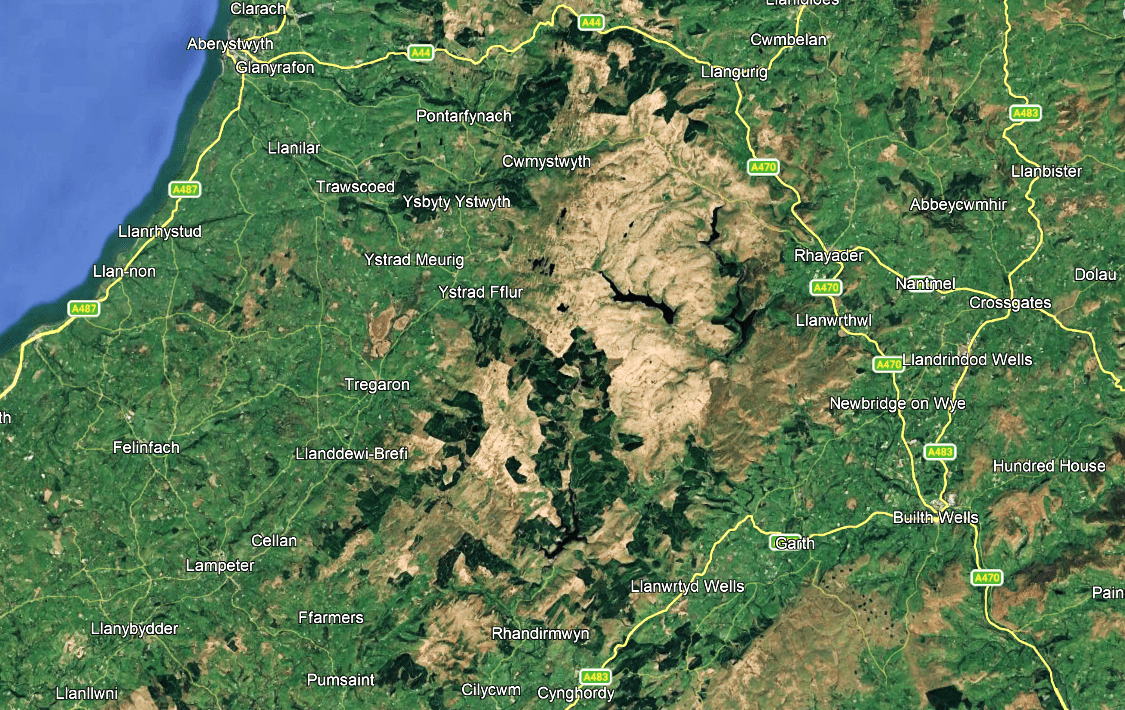
I suppose I’d better begin by explaining where we are when I talk of ‘the Elenydd’. It’s the wild, and largely unpopulated uplands shown on this Google Earth capture.
The last true wilderness in Wales. Now it’s being industrialised and destroyed by the ‘renewables’ industry, all foreign-owned companies.

With other parcels of land being bought by ‘environmental’ groups and other sheep in wolf’s clothing. (That is not an allusion to the Fabian Society.) One of these groups gives the appearance of being Welsh, the others are the usual suspects; National Trust (NT), Royal Society for the Protection of Birds (RSPB) . . .

Here’s how Google AI describes the Elenydd:

The least populated and wildest area in southern Britain . . .

The largest continuous tract of blanket mire in the Welsh uplands, designated as a Special Area of Conservation supporting rare birds like red kites, merlins, and diverse upland flora.

Clearly, we are dealing with a very special area – one that should be left to those who have cared for it for generations. But that would mean farmers and others, now viewed as the enemy by those who have elected themselves our saviours from evils as diverse as the climate crisis and the threat from the far-right.

For the two are invariably linked. Those dictating how we behave, even what we eat, in response to the ‘climate crisis’, are often the same people telling us what’s acceptable thinking in the political sphere.

Because it’s all about control. Controlling us.

FURTHER BACKGROUND

I’m going to start with a document produced by the self-styled ‘Welsh Government’ back in 2019, called Future Wales The National Plan 2040. There, in amongst this melange of hopes, dreams, incoherent ramblings and utter bullshit, on page 94, we find a map showing the areas set aside for wind farms.

They’re numbered and bounded in black. Roughly speaking, the Elenydd is north east of the area 8 panhandle and east of area 6.
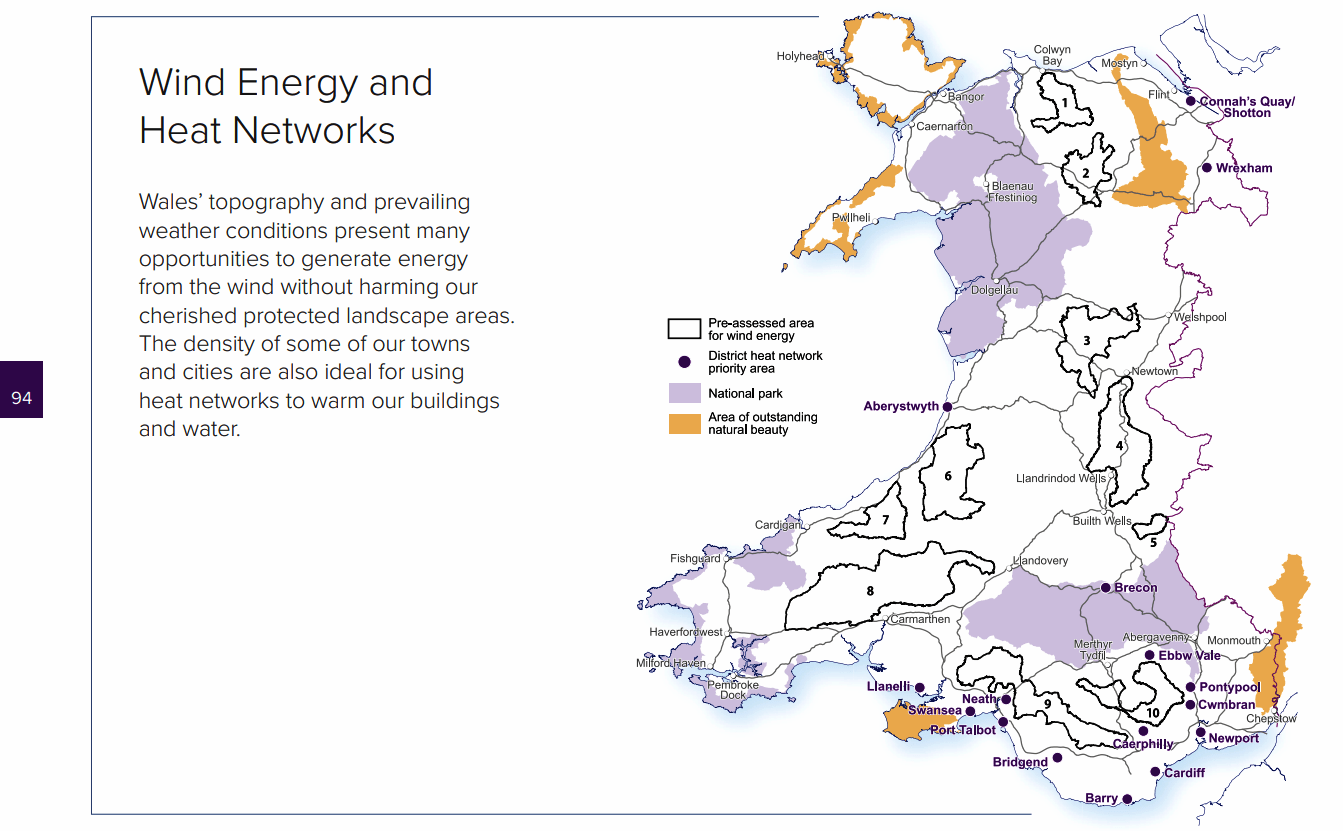
Whatever the original purpose of this map showing ‘pre-assessed’ areas, it soon proved worthless and misleading.

A fact illustrated by the map below, produced by Caru Teifi, a group protesting against the pylon runs needed to take the electricity intermittently generated by wind farms to the grid connection point south of Carmarthen.

In the south it appears that most of the turbines built (light blue), and planned (dark blue) are outside the ‘pre-assessed’ areas.
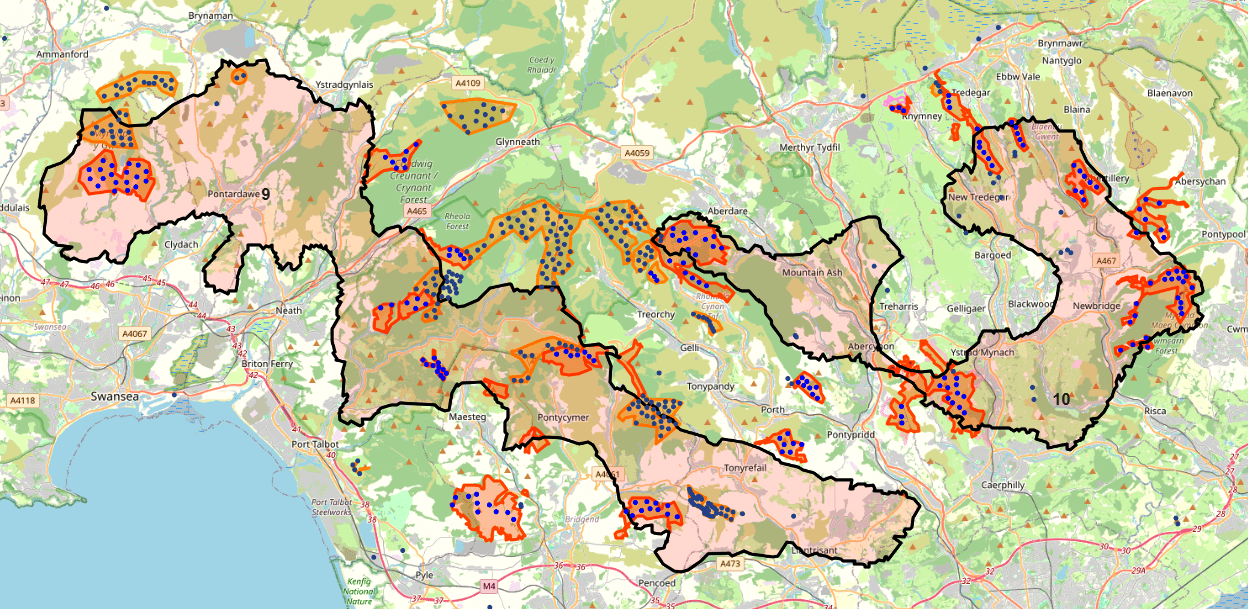
And as you’ll see in a minute. it’s the same – or worse – in the area we’re looking at.

So what was the point of the ‘pre-assessed’ areas in the 2019 National Plan if the ‘Welsh Government was simply going to allow a “near enough” approach that borders on a free-for-all?

Time now to look at the wind turbine projects on the Elenydd. The known knowns, the known unknowns, the unknown unknowns, and the unknown knowns.

WHAT’S PLANNED

We can safely identify four projects. Three we’ve known about for a few years, with another announced this year.

The first involves Scottish company Bute Energy Ltd. Their project is Lan Fawr. There was another project nearby labelled Bryn Brawd, but it seems they’ve merged. Now it’s one sooper-dooper project with 55 turbines up to 800ft in height. Labelled 1 in the image below, and in two parts.
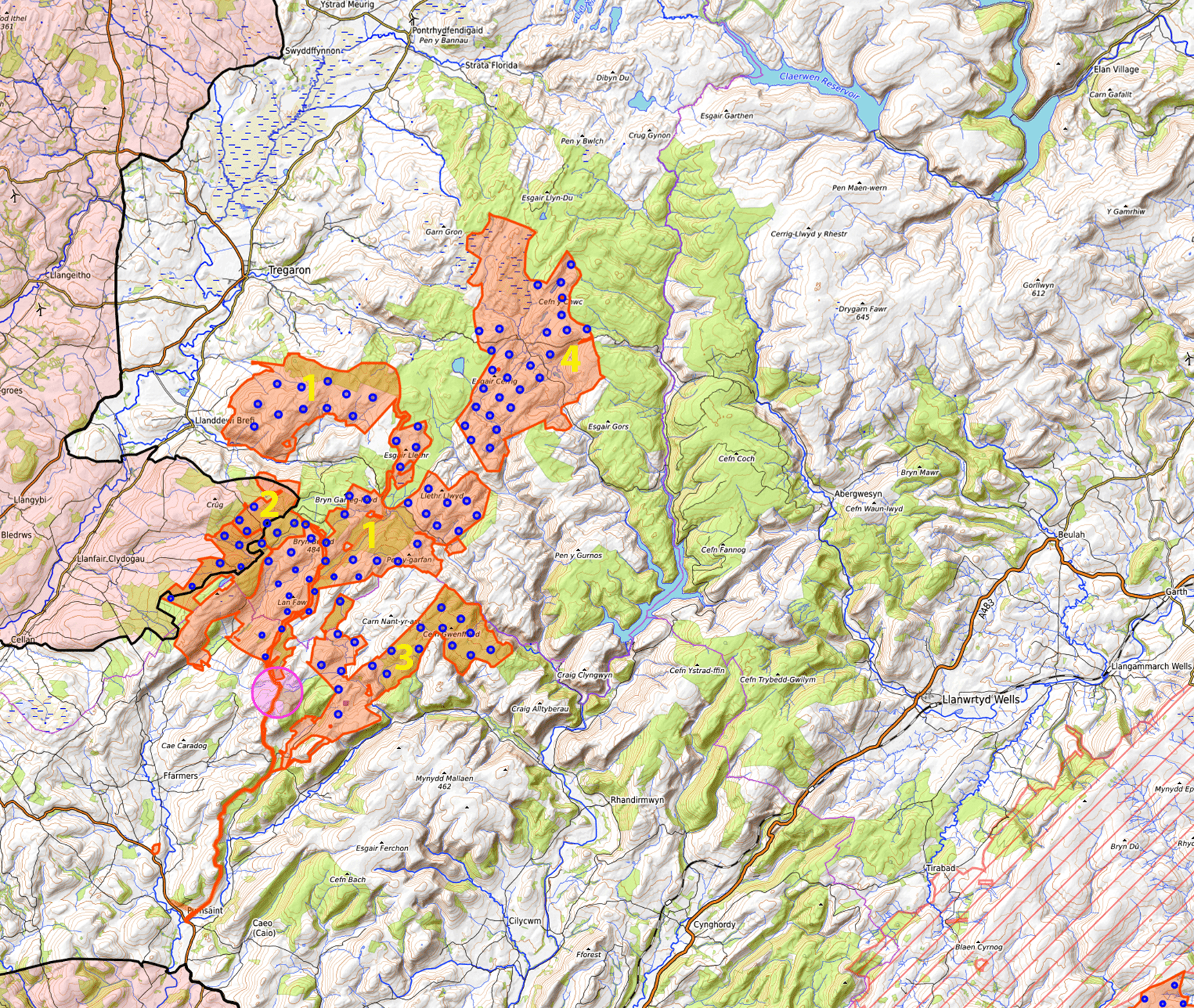
Next is Belltown Power’s Waun Maenllwyd project. Just 4 to 6 turbines. Labelled 2 in the map above. It’s suggested the Belltown project might be taken over by Bute. Alternatively – and I find this interesting – that the Foresight Group, which is behind Belltown, might take over Bute!

Number 3 is Galileo Empower UK’s Bryn Cadwgan project. Galileo has it’s UK office in Edinburgh (and an outpost in Cardiff), but is owned by investors and pension funds from just about everywhere, as far away as New Zealand.

Lastly, we take a brief look at the newest of them, EDF’s Nant y Maen. This straddles the Tregaron to Abergwesyn road. It’s definitely in the pipeline; confirmed by this ‘WG’ document. EDF is wholly owned the French Government.

Local sources insist there are other projects yet to be unveiled. Two, it’s believed.

Access to these projects is planned from the A482 at Pumsaint. Something I covered in The Road To Hell back in November 2023. Then it’s over the old Dolaucothi Estate, now owned, like far too much of Wales, by the National Trust.

After Pumsaint, it’s anyone’s guess, but I guarantee it will involve new roads, hundreds or thousands of trees felled, and massive disruption to the environment over an extended period of time.

But before reaching Pumsaint the turbine columns and blades will be transported on huge diesel smoke-belching trucks along country roads from Swansea docks.

Disruption and destruction all the way so that foreign investors can make money.

Unless, of course, you’re stupid enough to believe that this is all being done to save the planet, and Wales will somehow benefit. Are you that stupid?

‘WILL SOMEONE THINK OF THE NEWTS!’

In the intro I referred to a couple of recent purchases in the Elenydd by rewilders and others. So let’s look at them.

First, is one I covered in Land Of Our Fathers, But Not Our Children, in February. This concerned the purchase of 1195 acres by an outfit called Tir Natur.

The area bought is shown in this map by Caru Cymru I linked to earlier. It’s the dull green area below EDF’s Nant y Maen project. (I urge you to consult the Caru Teifi website maps and use the layers available to see what’s what in the area.)
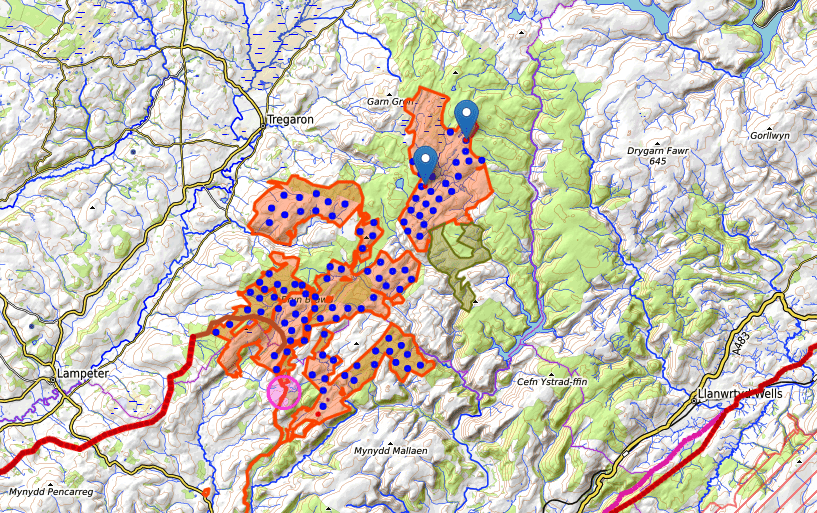
Quite a purchase, and achieved with, according to Farmers Weekly and other sources, a “philanthropic bridging loan“. Wasn’t that nice!

Earlier this month, we learnt that the RSPB had bought 96 hectares at ‘Galltybere’ or ‘Gallt-y-Bere’, which is shown on OS maps (see above) as Craig Alltyberau. This adjoins the planned Galileo Empower Bryn Cadwgan wind farm.

And whaddya know – this purchase also received a “philanthropic loan“.

I wonder where these ‘loans’ come from? Can I have one?

Now for a detour, but not really a digression. We’re going to Scotland, sticking with the RSPB – and there’s more magic money!

Down the Firth of Forth from Edinburgh, not far from North Berwick, rising from the North Sea is the volcanic plug of Bass Rock. A home to many birds, and the largest colony of Northern Gannets.

These are magnificent birds, with a wingspan of six feet or more. While searching for prey they soar or glide until folding back their wings to dive into the sea.

Not far away is the Isle of May. This is home to 50,000 puffins, plus guillemots, razorbills, and other birds.
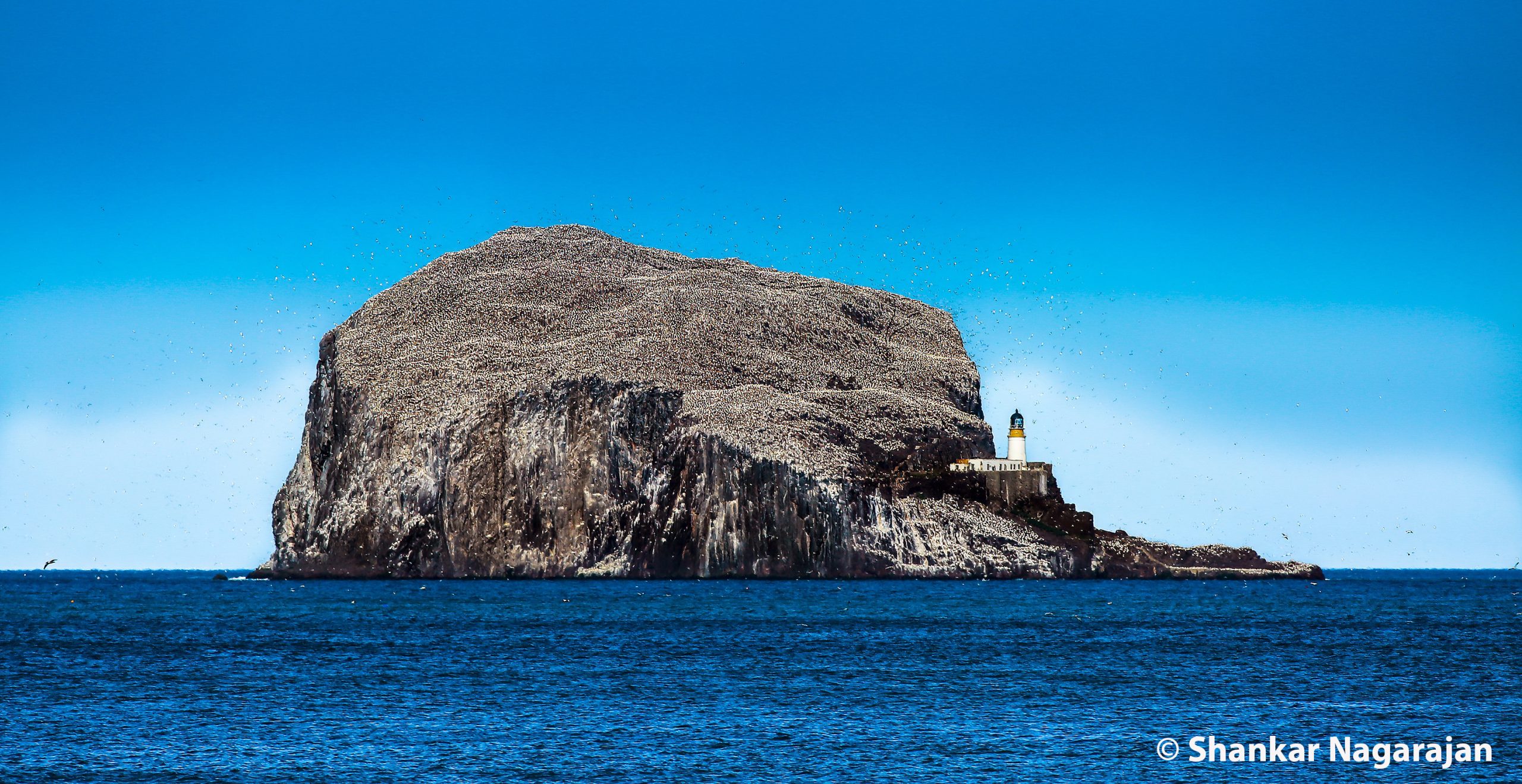
Hanging over this avian idyll is the threat of 307 wind turbines, in a project approved last year. As might be expected, RSPB Scotland objected. Stating:

Berwick Bank is a gigantic windfarm. To put it in perspective, it would take up an area four times the size of Edinburgh with more than 300 turbines – each the height of six Scott Monuments

But then something strange happened. Operating through the National Heritage Memorial Fund, the UK government made a grant of £586,000 to RSPB Scotland – to buy Bass Rock!

I can’t help thinking that what was really being bought was the RSPB’s silence.

CONCLUSION

You don’t need to be cynical to believe that when there’s billions of pounds, dollars, euros or whatever in profits to be made, certain measures will be taken to guarantee those profits. Among those ‘measures’ will be neutralising the opposition.

Unless they’re powerful and well organised, local groups can be largely disregarded, developers can even play one off against another. The same principle applies to landowners and farmers. But when it comes to groups that are well-established, with a national or even international structure, and have the ear of politicians, then a different approach is needed.

And this might explain the magic money that appears regularly in the accounts of wildlife and environmental groups. Sometimes it’s out in the open.

Aviva, the institutional investor owned by Vanguard and others, has given just shy of £40m to the Wildlife Trusts to restore Celtic Rainforests along the western edge of Britain. Much of this money will be coming to Wales. Some already has, and it’s gone to the Elenydd.

I dealt with this February, in The Latest Enviro-scam – ‘Celtic Rainforests’.

In fact, it seems most 0f Wales is a rainforest. Who knew?
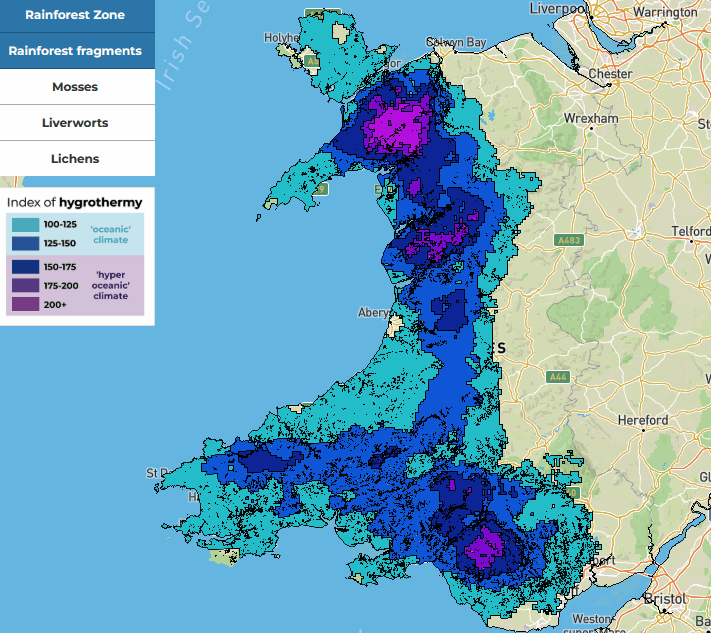
Though the Elenydd seems to be in the ‘Oceanic Climate’ zone rather than that described as ‘Hyper Oceanic Climate’.

At the risk of coming across as a cynical old bastard I’ll spell out what I think might be happening in the Elenydd. Shyster ‘developers’ want to destroy an almost pristine wilderness for profit, and have, by one route or another, given money to environmental groups to buy adjoining land.

The developers will then argue that wind turbines, and the work associated with them, pose no threat to wildlife or the environment. If they did – then surely their neighbours like Tir Natur and RSPB would be complaining. “Stands to reason, squire“.

For their part, the recipients of this largesse will tell themselves that sacrifices must be made for the greater good and the bigger picture.

For you must remember that those I’m describing have bought into the climate scam, making their position ambivalent. And rarely have I seen it more evident than in the RSPB Scotland statement I linked earlier.

We can unlock a future where Scotland’s already struggling seabirds are helped to recover, while producing the renewable energy needed to help fight climate change.  

So, for the greater good, sacrifices must be made. But that’s OK, as long as it’s the dicky birds making the sacrifice.

♦ end ♦

© Royston Jones 2026

Buy Me A Coffee

Bute Energy, Connections & Partners

This piece is in two parts. The first takes us to Ireland, the second . . . well, I’m not quite sure, maybe into a war zone.

For anyone new to the blog, or this topic, Bute Energy is a Scottish company with a Cardiff address planning a dozen or more windfarms in Wales, plus the pylon runs needed to connect them with the main grid. Also solar arrays and Battery Energy Storage Systems (BESS).

The head man is Oliver James Millican who, along with the other Bute principals, Stuart Allan George and Lawson Douglas Steele, left Millican’s father’s Parabola property company towards the end of 2017. They may still be working for Parabola.

IF YOU EVER GO ACROSS THE SEA TO IRELAND, THEN MAYBE . . .

To begin with, I recently learnt that Copenhagen Infrastructure Partners (CIP), Bute’s main funder up to this point, is now operating in Ireland. Taking advantage of Ireland’s Strategic Investment Fund.

The Ireland Strategic Investment Fund (ISIF) has committed €200m to specialist greenfield renewable energy infrastructure investor, Copenhagen Infrastructure Partners (“CIP”) latest flagship strategy, Copenhagen Infrastructure V (the “CI V”)

When I saw ‘CI V’ it rang a bell, because this is (or was?) the CIP fund behind Bute Energy. Mentioned more than once on this blog. Specifically, CI V Dragon Lender Ltd (launched 23.12.2021). Other companies with the CI V Dragon name are; CI V Dragon Topco Ltd (16.03.2023), and CI C Dragon Holdco 2 Ltd (07.12.2023).

All three are still in business, with directors I believe to be working for CIP.

There was a fourth company, CI V Dragon Holdco Ltd, formed 23.12.2021, with CIP directors. Two of whom left in November 2023, but two hung on until June 2025, when they were replaced by Oliver Millican. A liquidator was appointed in January this year. This outfit was clearly replaced by Holdco 2.

A lot of money went into the now-departed company, over £60,000,000. Which seems to have been used in payouts to Bute directors. This has been widely covered in the media; including Nation.Cymru. There are suggestions of, dare I say it – can I even spell it! – jiggery-pokery.

Here’s what Google AI says. Nation.Cymru is quoted, but the info came from this site.

Though a reporter for a London newspaper, who’s been in contact recently over Bute’s activities, tells me his ‘paper’s bean counters are not convinced Bute’s done anything illegal. Devious, maybe, but not, strictly speaking, illegal.

Whatever the answer, it seems that the money was doled out thus: Millican £47.56m, with George and Steele each getting £4.64m, and a few million going to minor players, one said to be Millican’s brother-in-law.

Much of Millican’s money was used to buy real estate in Scotland, often warehouses, and dealt with in this blog in March. Here’s a quote I used then from a Bute insider:

The real estate arm of the Windward portfolio . . . is working with multiple overseas businesses and at least one national government to house interests and commodity items relating to renewables infrastructure. There are warehouses in Wales and Scotland filled to the rafters with BESS and pylon materials – rented and landed for resale exclusively to the UK market to artificially appear to restrict overseas procurement and brand it as available when supply chains pinch in the late 2027 to early 2029 drive.

Windward is another name used by Bute companies, Windward Enterprises Ltd being the ultimate holding company for the Bute empire. Sole director and shareholder Oliver Millican.

A new director of Windward Enterprises, since June 1, is given as ‘Thomas Anthony Watson’. (Companies House was notified June 25.) A name common enough to be ignored. He is in fact, Labour peer, Baron Watson of Wyre Forest.

Last month Windward Enterprises took out a loan with private bank Brown Shipley & Co Ltd, ultimately owned by the Al Thani family, which owns and runs Qatar. This family also owns some £40bn of real estate in London, including Selfridges, Harrods, The Savoy, Claridge’s, Heathrow Airport . . .

BUT WHY THE INTEREST IN IRELAND?

With Copenhagen Infrastructure Partners investing in ‘renewables’ in Ireland I naturally got to wondering if Bute Energy is similarly involved.

In an idle moment I typed ‘Bute Energy Ireland’ into Google, and it suggested a “corporate address” down by Anna Liffey. Here to be exact: 2nd Floor, Riverview House, 21-23 City Quay, Dublin, D02 AY91.

Which turns out to be the Dublin address of SYSTRA Ireland, part of a big French company, with projects around the world.

Next, I searched for ‘Bute Energy Systra’, and turned this up:

Bute Energy is a Welsh developer spearheading over £3 billion of onshore wind projects. They collaborate with global infrastructure and consulting firm SYSTRA. SYSTRA provides lifecycle services, electrical grid/infrastructure planning, and engineering for Bute’s energy parks to speed up the transition to a low-carbon grid.

Welsh developer“! So there is a link. But why had I never heard of SYSTRA before? Next, my trembling digits tapped in ‘Welsh Government Systra’, and this came up:

SYSTRA is a prominent transport and engineering consultancy that frequently partners with the Welsh Government and Transport for Wales (TfW) to modernize public transport, boost regional connectivity, and achieve net-zero climate targets.

Then I found this on the SYSTRA website. Nice to see another Welsh company getting contracts from the transition to the wonderful Green economy.

On the Systra website I also unearthed these specific projects. A franchised bus service for Wales and an energy from waste facility on Deeside. Are there others?

Despite these contracts in Wales SYSTRA doesn’t even bother with the Bute ploy of having an office here. It seems Wales is handled from Bristol or Birmingham. Though there is of course an office in Edinburgh, which will be handy for the Bute boys. (In fact, SYSTRA’s Edinburgh address looks somehow familiar.)

AI coming up with SYSTRA’s Dublin address for Bute Energy is no real surprise. It’s pretty obvious this French company has its feet under the table with the so-called ‘Welsh Government’.

So, Bute is already linked with SYSTRA and CIP, both are now operating in Ireland, with Systra also well in with the ‘Welsh Government’. It’s therefore reasonable to assume that Bute may also be active in Ireland.

Which brings me to another reason for looking at Irish connections. I’m referring to the pylon runs from windfarms planned in central Wales (many by Bute) to Llandyfaelog, south of Carmarthen, where they connect with the main grid running from RWE’s Pembroke power station to England.

This has been covered extensively, both my blog and on the CPRW website.

While England was always the presumed destination for the electricity generated, it could just as easily go west to Ireland, thanks to the new Greenlink Interconnector at Freshwater West in Pembrokeshire.

This short (2:12 mins) news clip from RTÉ explains it.

The demand for electricity in Ireland is soaring, with some 80 AI data centers already, and more in the pipeline. Understandably, the state electricity board, EirGrid, is getting nervous.

No surprise then, that in addition to the connection from Pembrokeshire there’s another from Bodelwyddan to somewhere near Dublin, with MaresConnect. This is owned jointly by Etchea Energy, with offices in London and Dublin, and our old friends in the Foresight Group.

UPDATE: Bodelwyddan is mentioned in this announcement of an offshore developmententirely in Welsh waters“, between BP and Japanese company Jera, with a “proposed connection to the Bodelwyddan National Grid substation“.

As for Foresight, you may remember this lot attracting bad publicity in recent years for buying up Welsh farms on which to make money from planting trees to offset ’emissions’, or some such corporate bollocks.

And then there are the governmental contacts. Here’s a joint statement issued a year ago after first minister Eluned Morgan visited Dublin to meet Tánaiste Simon Harris.

Forums have enabled us to hear directly from Irish companies including ESB, Simply Blue and DP Energy, who are investing in energy projects in Wales. During the 2023 forum, ministers also visited the Morlais tidal stream energy project on Anglesey in North Wales

Last month, the new Plaid first minister, Rhun ap Iorwerth, was in Dublin.

And the links don’t end with politicos doing photo-ops. Here’s one between French giant EDF and Irish state-owned ESB. This offshore wind project’s called Gwynt Glas. The only thing Welsh about it is the name. (But that’ll be enough to please some.)

So Irish companies, with others from Scotland, England, and further afield, invest in renewable energy projects in Wales. A country that already produces more electricity than it could consume if we all drove electric Humvees and left our lights on 24/7.

But it doesn’t end there, because there’s also electricity being shipped down from Scotland. This was supposed to be taken by a lengthy pylon run from Pentir near Bangor to Swansea North, on the line from Pembroke to England.

Then again, it might not run down to Swansea at all; perhaps it – or some of it – could be sent to Ireland via the Bodelwyddan link. However you look at it, Wales is being covered in windfarms and other installations we don’t need, and criss-crossed with transmission routes going elsewhere.

Something noted by CPRW, which last month put out a press release warning that ‘Wales Must Not Become England’s Energy Corridor‘. Agreed. But I repeat, the way things are shaping up Wales is just as likely to become an energy corridor serving Ireland as well.

All the while those treacherous clowns in Corruption Bay mince around looking smug, and preparing their spare rooms for ‘refugees’ (or maybe not) – cos we is saving the planet, innit.

And anybody who objects is a climate-denying fascist. Well, I guess that’s me.

JUDGED BY THE COMPANY YOU KEEP

Another development concerning Bute worth reporting is the funding from Dutch outfit Rabobank. Here’s the Rabobank website.

There are maybe two points to make about Rabobank. First, it’s big in agriculture and food . . . and buying farmland. Second, it has a rather worrying record.

When it comes to buying farms and land Rabobank operates through the subsidiary Rabo Farm and local intermediaries. These are often corrupt local officials. Worth asking if these officials were always corrupt, or was it the prospect of Rabobank money that corrupted them?

Come to that, how did Rabobank make contact with local officials in remote parts of Poland and Roumania? Did they have intermediaries with good contacts? I mention that Latin outpost because of a scandal just over a decade ago that saw local farmers learning they no longer owned their land. Read about it by clicking on the image below.

Rabobank has strong links with top-tier Globalists the Rothschilds. Maybe the latter rely on Rabobank’s expertise in food supply and pricing to help them towards the Globalists’ wet-dream goal of controlling the food supply. And with it, us.

Rabobank is also believed to be active in that most corrupt of eastern European countries, Ukraine. But the law there states that only Ukrainian citizens and entities can own land. Up to 10,000 hectares.

What this means in practice is that those close to the Cokehead Clown of Kiev often act as intermediaries for foreign investors. This goes some way to explaining the Bugattis, Lamborghinis and Bentleys with Ukrainian plates in Monte Carlo.

Rather cruelly they’re known as the “Monaco Battalion“. Which must be a great consolation to Ukrainians dying at the front to defend their corruption.

But then, dying on the front line nowadays is reserved for little people.

But the question is, why is Bute Energy involved with Rabobank at all? The new funder may now be branching out into ‘renewables’, but the primary interest remains land, farming, and foodstuffs. Are the two connected?

By which I mean, is Rabobank’s link-up with Bute connected to Bute owning ‘Welsh’ Labour, also now buying influence in Plaid Cymru; and Rabobank realising that both these parties want to end livestock farming. Which will bring many farms onto the market.

A Powys farmer confided recently, regarding Rabobank:

From my perspective, the concern is that this extremely powerful financial institution with deep expertise in agricultural land are now also financing infrastructure that competes for that land.

Whatever the answer, Bute Energy linking up with a company with Rabobank’s record should set alarm bells ringing.

CONCLUSION

As I’ve said a few times in recent posts on the subject, I (and others) may have focused too much on Bute’s activities in Wales at the expense of the bigger picture. Which now seems to be emerging.

A picture that, first, confirms the electricity generated in Wales is for consumption somewhere else. I’d assumed that ‘somewhere else’ to be England. But that’s only part of the picture.

Electricity generated in Wales, and off our coasts, is also likely to be going to Ireland. This accounts for the interconnectors from Bodelwyddan and Freshwater West, and it might also explain the Irish companies investing here.

Will electricity generated by Irish companies in Wales be reserved for Irish consumers? I ask because while I appreciate there are interconnectors everywhere, and electricity can flow both ways, consumption in Ireland seems to be outpacing generating capacity.

Then there’s the power coming down from Scotland. It’s not for Welsh consumption. So why can’t it go directly to England and / or Ireland?

Do you remember Alexander Cordell’s book, Rape of the Fair Country, about the 19th century exploitation of Wales by Victorian industrialists? What we see today is the Globalist-Green rape of Wales . . . but without the jobs or any other tangible benefits.

It’s clear beyond doubt that Mam Cymru is being used, and abused. How much longer do we just stand by and let it happen?

♦ end ♦

© Royston Jones 2026

Buy Me A Coffee

Any, Any, Any Old Iron?

A bit of a departure, this one. And certainly not what I advertised last Saturday. Though that element does figure in this bigger picture.

Rather than focus exclusively on Bute’s windfarm plans in Wales, the infiltration of the Welsh political class (especially, but not exclusively, the Labour party), or alleged links to those who sent the tanks into Tianmen Square, I’m going to look into a possibility suggested to me by someone with a keen interest in Bute and associated companies.

In this piece, after the first section, I’m going to look into the companies named as being involved with a new venture at Port Talbot in this press release from Catapult Offshore Renewable Energy. Which seems to tie in with the ‘Celtic Freeport‘, split between Port Talbot and the Haven Waterway.

From one angle, the plan we’re going to look at seems to be, make wind turbine body parts in the electric arc furnaces promised for Port Talbot, from scrap metal, then put them together in Pembrokeshire before mooring them offshore.

That might be the assumption to make, but the press release from Catapult Offshore Renewable Energy clearly states “onshore wind turbines“.

Which might suggest confusion.

Whatever, the companies named in the Catapult press release are Tata Steel UK, RWE, Bute Energy, Hutchinson Engineering, and Ledwood. So I’ll deal with them in the order they’re mentioned.

But let’s start with Catapult itself.

OFFSHORE RENEWABLE ENERGY (ORE) CATAPULT

This outfit, the one apparently pulling it all together, looks to be an extension of Innovate UK, a government-funded body. Google AI says this:

Innovate UK provides substantial funding to ORE Catapult to drive offshore renewable energy innovation, including a recent £85.6 million capital investment for testing facilities.

Note, again: “offshore renewable energy“, yet as we’ve seen, the statement from Catapult clearly says “onshore wind turbines“.

That said, Catapult claims a presence in Pembroke Dock. In a building otherwise known as the Bridge Innovation Centre.

There’s not much more to tell about ORE Catapult, so we’ll move on.

TATA STEEL UK

Indian company Tata Steel is the owner of Port Talbot steelworks. The coal-based blast furnaces have closed and it’s promised they’ll be replaced with a £1.25 billion electric arc furnace. Due to be fully operational by the end of next year.

The project has already received £500 million in UK government funding.

Which means that Tata’s role seems fairly clear. It will produce the steel needed for the onshore and offshore wind turbines, from scrap, much of which will be sourced abroad, as will be explained in the section about Ledwood.

UPDATE 20.04.2026: This article on the feasibility of scrap metal electric arc furnaces appeared in the Western Mail, taken from The Conversation. The authors seems to argue that the supply chain for scrap steel doesn’t exist, and UK electricity prices might make the whole project unviable.

RWE

As many of you will know, RWE is a huge German company involved in ‘renewable’ energy. Let’s also remember that RWE is a big player in Wales.

RWE is the largest power producer and renewable energy generator in Wales, with more than 3GW of energy across 12 sites. Brechfa Forest West Wind Farm comprises of 28 turbines – enough to power 40,000 homes. The site has produced over 1.05TWh of energy since it was commissioned in 2018.

RWE’s Head of Onshore Development: Wales & England is Eleri Davies. She also sits on the UK government’s Onshore Wind Industry Taskforce. As we are reminded in this press release from her company:

As a member of the Government’s newly created Onshore Wind Industry Taskforce, it was incredibly valuable to show the Prime Minister and First Minister how RWE works with and for local communities, harnessing homegrown talent and supporting local communities.

UK Operational Manager for RWE is Nia Griffiths. So there’s a definite Welsh flavour to RWE. At least in senior staff. Of course the money goes back to Germany.

And it seems RWE already has a presence in Port Talbot at the Baglan Innovation Centre. While in 2022 it struck a deal with Associated British Ports, owners of Port Talbot docks, an agreement that also covers Milford Haven.

BUTE ENERGY

Bute Energy appears for obvious reasons. First, wanting to plaster rural Wales with wind turbines and pylons. Second, because this company has bought up ‘Welsh’ Labour and is not without influence within the party at UK level.

But for the purposes of this piece, I think we should concentrate on warehouses.

I touched on this subject briefly with a post back in August 2024 after receiving information from Scotland. It’s here in Parabola Bute Energy, Scottish Echoes. The Bute Boys, using the company Windward Titan Ltd, bought a huge warehouse (below) near Glasgow, then sold it three years later, for double the price paid, to the Lothian Pension Fund; essentially, Labour-run Edinburgh City Council.

Does Bute getting money from Labour-controlled pension funds sound familiar?

Further information received last month, from a different source, suggested Bute companies – often under the ‘Windward’ label – have quite a few warehouses ” . . . in Wales and Scotland filled to the rafters with BESS and pylon materials“.

These have been bought with the help of private bank Brown Shipley & Co Ltd, ultimately owned by the Al Thani family, which also owns Qatar.

I dealt with this a few weeks back in The Windward-Bute Empire, Fresh Insights.

So the question is, why would Bute need all this space, and why are some of these warehouses chock full of pylon components and other equipment for onshore wind turbine installations?

Also note, the insider who contacted me last month made no mention of the actual turbines. Neither towers nor blades. For which I might have an explanation.

HUTCHINSON ENGINEERING

This company has also appeared on this blog quite recently. In a piece I put out in January. (Skip the first section.)

I started out back then by wondering, in a post on X, why a company in Cornwall called Inyanga Marine Energy Group had received £2,000,000 from our wonderful, and now thankfully departed, ‘Welsh Government’.

The man behind Inyanga, Richard James Parkinson, has other companies named HydroWing and Sangoma. All hoping to generate power from wave energy. Explained in the earlier blog piece I’ve linked to. But there seems to be no money, apart from public funding, and little sign of activity.

Though I did find this piece in the Falmouth Packet, which introduces Hutchinson.

Inyanga Marine Energy Group, based in Penryn, has tasked Hutchinson Engineering with constructing its HydroWing tidal energy device.

The 20 MW HydroWing tidal energy array will be deployed at Morlais, off Anglesey in Wales.

Naturally, my attention then turned to Hutchinson Engineering of Cheshire. Here’s the Companies House entry. You’ll see that ownership rests with Modernuser Ltd. In turn owned by Dean Clark Drinkwater.

And here’s Dean, a fan of both Starmer and Miliband!

What’s more, Drinkwater has also been appointed to the UK Government’s Onshore Wind Industry Taskforce, chaired by ‘Mad Ed’ Miliband.

It would appear that Dean is another who’s well in with the Labour party.

LEDWOOD

Ledwood Mechanical Engineering Ltd, based in Pembroke Dock, is owned by Ledwood Protective Coatings Ltd, which is in turn owned by Nicholas David Revell, and may rely to a great extent on a loan from the ‘Welsh Government’-controlled Development Bank of Wales.

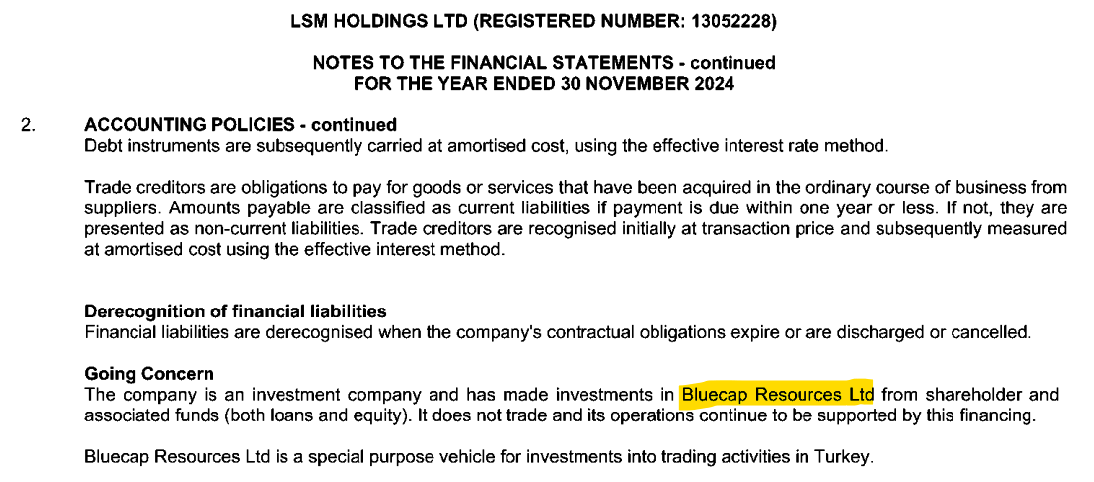
Another Revell company is Ledwood Holdings Ltd. Revell has a further company, LSM Holdings Ltd. (‘Ledwood Scrap Metals’?)

I suggest that name due to this reference in the LSM accounts, and where it leads.

Nick Revell, also gets a mention in this press release from January 2025 from the Wales Office, not ‘Welsh Government’. Again, the “Celtic Freeport” is mentioned.

Bluecap Resources Ltd, highlighted in the clip above, is based in Newport. But with its R&D in Penryn, Cornwall where, you’ve just read, we also find Inyanga, builder of wave energy machines, and beneficiary of ‘Welsh Government’ largesse.

The company is owned by:

 . . . a consortium of European shareholders from the natural resources industry, both corporate and individual, including two publicly-quoted companies . . .

(Here are the Bluecap Resources shareholders.)

Yet the website tells us very little. But if we turn to the filings with Companies House we see big share issues in recent years – all in US dollars.

Bluecap is in the business of “extraction and recovery“. That it uses US dollars suggests to me it conducts much of its business outside of the UK. A belief reinforced by the company Bluecap Poland Ltd, formerly known as Bluecap Turkey Ltd.

THE THEORY

Someone who’s given the consortium some thought has suggested to me a theory. Which, after doing some research of my own, I find both elegant and plausible.

It all hinges on the electric arc furnace at Port Talbot. On it being built, and then on that furnace using scrap material. This explains Tata Steel’s presence in the consortium.

The scrap will be provided by Ledwood-Bluecap. And will almost certainly come from outside of the UK. That’s why they’re involved.

That scrap material will be smelted at Port Talbot, a magical process to transform it into the “UK Steel” promised in the headline of the Energy-pedia article.

Next, it will be knocked into the shapes and sections desired for 250 metre tall wind turbines by Hutchinson Engineering of Cheshire, who might set up an operation in Wales, or co-operate with a locally-based company.

If my Bute source is correct about the warehouses being “filled to the rafters with BESS and pylon materials”, then Windward-Bute can supply pylons and the Battery Energy Storage Systems (BESS). This is one reason why Bute is involved.

RWE might provide the motors and other mechanisms required by the wind turbines. Then again, as a major player, RWE may be thinking ahead to replacing its clapped-out turbines, even erecting new ones.

Alternatively, the blades might come from somewhere else.

For the largest manufacturer of turbine blades in Europe is Danish company Vestas. A director of Vestas is former Danish PM Helle Thorning-Schmidt. Her alter ego is Mrs Kinnock, for she’s married to Stephen Kinnock MP, in whose Aberafan Maesteg constituency we find Port Talbot steelworks.

Furthermore, Vestas has a 25% stake in Copenhagen Infrastructure Partners (CIP), which seems to be Bute Energy’s main financial backer.

CONCLUSION

Let’s start by remembering that in the Ore Catapult press release we read that the consortium involved is “largely based in Wales“.

Yet Tata Steel is an Indian company. RWE German. Bute Energy is Scottish. Hutchinson Engineering is an English company. Ledwood and Bluecap have addresses in Newport, but source their scrap metal from God knows where.

Pushing this lot as Welsh is like describing the German army in September 1939 as Polish because it was “largely based in Poland“.

And as if that idiocy wasn’t enough, remember that almost all the electricity that’ll be generated will go to England!

If the theory is correct, or only partly correct, we can clearly see who’s going to benefit from turning scrap metal into wind turbine parts, and who’ll make money from supplying whatever else is needed.

It’ll be the same faces that have been ripping Wales off for too long.

There might be a few hundred jobs at Port Talbot, small compensation for the thousands lost. A few hauliers might get contracts. The turbines and pylons will be erected by specialist crews brought in from outside.

But let’s not forget – it might keep Kinnock Jnr in a job.

Yet we’ll have to put up with the ugly bloody turbines and pylons, and you can bet your sweet life that whatever the colour of the ‘Welsh Government’ after May 7 – we’ll be paying out plenty in public money.

All done so that demented individuals in Plaid Cymru, for whom politics is all gestures, who prefer ‘positions’ over policies that would benefit the long-suffering Welsh people, can claim that Wales is a “world leader” – in being exploited.

For God’s sake, don’t vote for these clowns!

♦ end ♦

© Royston Jones 2026

Buy Me A Coffee

The Windward-Bute Empire, Fresh Insights

I had something else planned to go out on Monday, but I’ve held it back in light of fresh information I’ve received about the activities of Bute Energy. Information that raises wider considerations.

INTRODUCTION

Let me start with an apology. I’ve been writing about Bute’s activities in Wales for seven or eight years. This meant ignoring projects elsewhere, and overlooking Bute and Windward companies that had no obvious Welsh connection.

That may have been a mistake. And in view of recent events suggesting dubious links with China, no longer tenable. Dealt with on this blog.

Apology made, one company I have mentioned, one I could never make sense of, was Storagefolk Ltd. Presumably involved in . . . warehousing?

Launched 23.09.2017 Storagefolk appears to be the oldest surviving Windward-Bute company apart from Windward Enterprises Ltd (until very recently Windward Global), the ultimate holding company, where Oliver James Millican, capo di tutti capi in the W-B world, is in sole charge.

But what’s its purpose, and how does it fit into the wider empire? Information received offers some answers. And opens up a new line of inquiry.

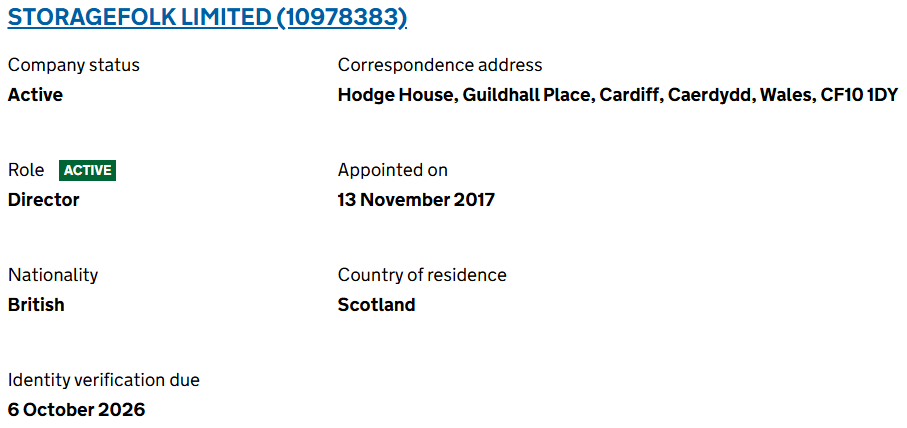
As you can see from the Companies House entry for Storagefolk the address is in Mayfair, that upmarket district of London. The sole director is Millican. But he gives his address as Hodge House in Cardiff, where we find virtually all the companies relevant to Wales. Or at least, those we know about.

Listed as ‘person with significant control‘ (PSC) is Windward Global Ltd.

Though if we go through the main CH listing for Millican’s companies we see Storagefolk using the Hodge House address. (More Millican companies are listed here, here, here, and here.)

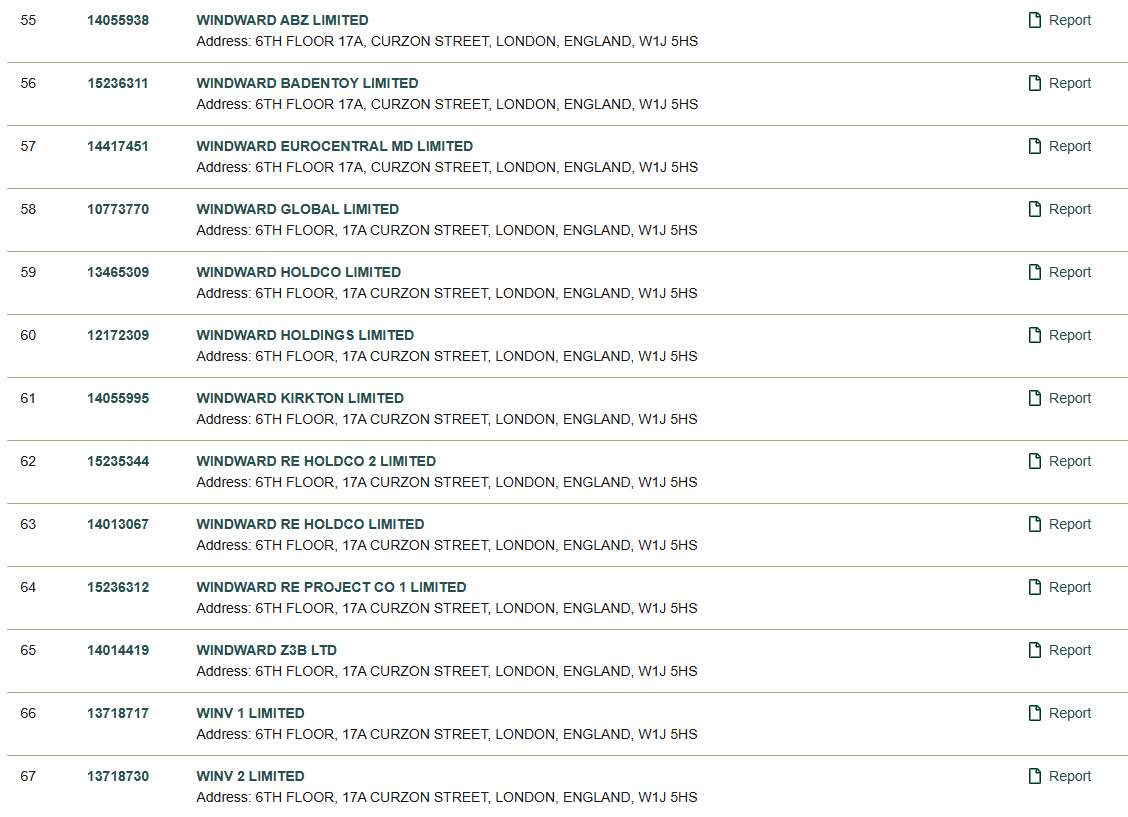
At the address in Curzon Street, hosting Storagefolk, we find Turcan Connell Company Secretaries Ltd. Scottish legal eagles with their HQ in Edinburgh. A company regularly used by Millican and his mates.

MY! WHAT A BIG WAREHOUSE YOU’VE GOT. AND SO MANY OF THEM!

Of the companies registered at that address, we’re interested in the ones shown in the panel below. Particularly those to which I’ve been directed. (Storagefolk appears on the previous page.)

Beginning with Windward Eurocentral MD Ltd. Sole director Oliver Millican. PSC is Windward RE Holdco Ltd (more on this company later). PSC for Windward RE Holdco Ltd is Windward Enterprises Ltd, the ultimate holding company mentioned earlier.

Turn to the charges and you’ll see one taken out in July 2023 and satisfied in April 2025. The lender was private bank Brown Shipley & Co Ltd. Brown Shipley is owned by Quintet Private Bank (Europe) SA of Luxembourg, which is in turn owned by Precision Capital:

Precision Capital is a Luxembourg-based holding company that represents the private interests of members of the Al-Thani family of Qatar.

The charge was against a building just to the east of Glasgow, close to the M8 that runs to Edinburgh. A property offering 127,000 square foot of space.

The next company is Windward Badentoy Ltd. Directors are Millican and TC Directors Ltd with an Edinburgh address. ‘TC’ of course is Turcan Connell again. The PSC is Windward RE Holdco 2 Ltd.

The charges, again with Brown Shipley, refer to industrial storage units such as this one, all near Aberdeen. Plus a floating charge.

The third is Windward RE Project Co 1 Ltd. Here are the players. It’s the Mayfair address with PSC again being Windward RE Holdco 2 Ltd. There are/were two outstanding charges with Brown Shipley. One a fixed and floating charge, the other refers to three properties in Aberdeen and Edinburgh.

Another company worth looking at is Windward Z3B Ltd, with the same pattern. Funding from Brown Shipley for two more storage facilities on industrial or technology parks around Aberdeen.

And there was another company, one that I wrote about in August 2024. And other warehouse not far from the M8.

It was reported on October 2, 2018 that the Titan warehouse had been bought for £6.5M by Grayling Capital. This is Grayling Capital LLP, formed just over a year earlier.

David Taylor, one of those recently questioned by police in relation to China ‘spying’, was made a partner in Grayling Capital LLP in September 2019.

I could go on, but you should get the picture. Companies in the W-B empire have, for perhaps a decade, been buying up big warehouses, often borrowing from a ’boutique’ bank owned by an oil-rich family in Qatar.

A name mentioned in connection with W-B’s activity in the Aberdeen area is IKM. Said to be a tenant of properties owned by Windward-Bute. Here’s a piece from December last year and the Aberdeen Press & Journal.

In another major milestone, IKM Testing UK today opens its third facility as it pushes ahead with plans to expand into international markets, the renewables sector and increase its UK decommissioning work.

But IKM only accounts for some of W-B’s real estate, so the question remains: Why does it need all this storage space?

PLANNING AHEAD?

First, let me clear up the purpose of Storagefolk before telling you how Windward-Bute buying up vast areas of storage space was explained to me:

(Storagefolk) is purely a negotiating shell for projects in Scotland and NE England; it is used in proposals to financiers, a distinct legal entity is then formed post-investment decision to ring fence properties and interests – and distance from the risk of course.

As for the warehouses, it seems that W-B has been importing parts and components for turbines, solar installations, and Battery Energy Storage Systems (BESS) for quite a few years.

This stockpiling is in anticipation of a crackdown on imported parts for ‘renewable’ energy projects. This seems plausible as the opposition mounts to increasing energy prices resulting from ‘Mad’ Ed Miliband’s Net Zero death-wish.

The real estate arm of the Windward portfolio . . . is working with multiple overseas businesses and at least one national government to house interests and commodity items relating to renewables infrastructure. There are warehouses in Wales and Scotland filled to the rafters with BESS and pylon materials – rented and landed for resale exclusively to the UK market to artificially appear to restrict overseas procurement and brand it as available when supply chains pinch in the late 2027 to early 2029 drive.

Is it just forward planning, or is there more to it?

As an example of ‘more to it’, can we assume these imports come from China? I’d put a few quid on it. And if I’ve picked the right nag, then this explains a few other things.

For as we’ve recently learnt, it’s impossible to escape the China connection when dealing with Windward-Bute. So I was not surprised to be told that two of the Big Three (Oliver James Millican, Stuart Allan George, and Lawson Douglas Steel) have even stated they’d sell to “interested parties from China at the right price“.

But none of these machinations would be possible without political influence, and that influence is not confined to Labour in Wales.

Let’s remember that Tom Watson, former deputy leader of the UK Labour party, now Baron Watson of Wyre Forest, is a non-executive director of Windward Energy Ltd, where he’s listed as plain old Thomas Anthony Watson.

It’s suggested this provides a good connection through Great British Energy to ‘Mad’ Ed Miliband himself, the apostle of Net Zero, de-industrialisation, and electricity consumer impoverishment.

To sum up: there is a concerted effort not only to increase expenditure and reliance on ‘renewables’, but also to remove cheaper and more reliable alternatives. This explains why the UK is closing down North Sea oil and gas . . . only to buy from Norway, which extracts from the same North Sea source.

Proving it has sod all to do with saving the planet.

This is the ugly world inhabited by Windward-Bute. It’s not limited to wind turbines despoiling landscapes, it’s about using political influence to remove competition providing more reliable and cheaper alternatives.

In Wales, this has resulted in the infiltration of the Labour party to the point where it’s hopelessly compromised. Election posters for May’s Senedd elections should read: ‘Vote for Dai Jones – your Bute Welsh Labour candidate‘.

We know W-B is also making inroads into Plaid Cymru. The Greens were always on side. But does it end there?

Maybe not.

TITBITS, THOUGHTS

In this section I’ll look at a few other items that have come my way and how they perhaps fit with what we already knew.

First, I’m told that Nigel Farage had a closed-door meeting in January with Windward Energy Ltd Chairman Steve Scrimshaw. So let’s have a statement from Reform on where it stands on ‘renewable energy’ and rising electricity prices.

More closed door negotiations preceded the decision by the Wales Pension Partnership to invest £68m (for starters?) in Windward-Bute. A source says that very influential in the ultimate decision was Cardiff Lib Dem councillor Rhys Taylor.

Taylor of course sits on the council’s Pensions Committee, but I bet you can’t guess where his day job is. Let me help . . .

So we see that Windward-Bute also has its claws into the Lib Dems.

Leaving Gwlad the only honest party left.

I’m told the investigations into Taylor and Aplin might result in a number of Senedd Members, MSPs and MPs being invited to ‘help police with their inquiries’.

Understandably, Copenhagen Infrastructure Partners (CIP), the main funders for W-B’s renewable energy projects, is said to be pissed off by the recent news and allegations of spying for China.

Which provides yet another link to ‘Welsh’ Labour. Through Helle Thorning-Schmidt, former Danish PM, her directorship of Vestas since 2019, and that company’s 25% stake in CIP.

Helle Thorning-Schmidt is the wife of Stephen Kinnock, MP for Aberavon Maesteg. He is of course the son of former Labour party leader now Baron Kinnock of Bedwellty in the County of Gwent, and the late Baroness Kinnock of Holyhead, long-time Member of the European Parliament.

Her seat on the Brussels gravy-train was taken by Derek Vaughan who, following Brexit, was given a non-job by Windward-Bute on its Welsh Advisory Board.

Kinnock the Younger’s constituency is home to Port Talbot steelworks, so recently and shamelessly allowed to die. Welcomed in certain circles because it reduces Wales’ output of some evil dreamed up by Greenhairs.

I’m going to throw out an idea that might sound outrageous, yet it’s plausible. Just think about it.

Millican, Steele and George all worked for real estate outfit Parabola, where Millican’s father Peter is head man. They all left Parabola towards the end of 2017. (Or that’s what we’re encouraged to believe.)

They had no experience in ‘renewables’; and to my knowledge they’ve still not erected a single turbine. Certainly not in Wales. But is this missing the point?

They now have sites designated, landowners signed up, planning applications submitted, politicians and others bought, financial backing for the projects arranged, and warehouses stacked to the gunwales with the wherewithal to complete the projects.

So if Windward-Bute only gets half or less of the planning consents applied for – even no planning approval at all – they could still sell up and make a massive profit. Especially if the anticipated crackdown on (recently) imported parts comes into play and the components they bought years ago rocket in price.

Maybe that was always the business model. Not actually building anything.

If nothing else, it’ll be a very lucrative fall-back position.

CONCLUSION

Windward-Bute has corrupted Welsh political and public life. And it was so predictable.

With a form of devolved government designed to fail. And with ‘progressive’ politicians too stupid and gullible to have made even a good model work.

Made worse by those same politicians seriously believing Wales alone could save a planet being destroyed by humans – and their farting cows!

Politicians believing that lobbyists and pressure groups should determine policies, and that they should be able to do so free from regulation or restraint.

Resulting in overlapping and incestuous circles in one relatively small city, circles of perhaps no more than two or three thousand people in total, damaging the lives of over three million people.

This shit-show was bound to attract the kinds of ‘developers’ we’ve seen over the past 27 years. With Windward-Bute perhaps the worst, the most pernicious example.

Windward-Bute already has the shadow of ‘China spying’ hanging over it, and the stain of buying political influence, but it doesn’t end there.

The West’s lemming-like rush over the cliff of ‘renewables’ isn’t just good news for China, on which we depend for everything from rare earth minerals to completed solar panels; it’s also welcomed in the oil-rich Gulf states because ‘renewables’ are also unreliables, and need back-up.

Some might think that a UK-based company or individuals enriching themselves from helping de-industrialise and impoverish the West is tantamount to treason.

And I would agree. For ‘renewables’ are a response to nothing but avarice.

♦ end ♦

© Royston Jones 2026

Buy Me A Coffee

Labour Apparatchiks Associated With Bute Energy Arrested In China Spy Probe

You must know what this is about. But in case you’ve been sleeping for a week . . . three men, with close ties to the ‘Welsh’ Labour party, were arrested last Wednesday “on suspicion of assisting a foreign intelligence service“. They were released on bail the following day.

WHO’S INVOLVED?

The first, is David James Taylor. Originally of Ruthin, now perhaps London. But he spent most of the intervening years working as a special advisor (spad) to a number of prominent Labour politicians.

These were Rhodri Morgan, first secretary of Wales between 2000 and 2009. Peter Hain, one-time anti-Apartheid campaigner, MP for Neath, who held a few posts in the UK government, and now sits in the House of Lords. I seem to think Taylor might also have done a stint with Morgan’s successor, Carwyn Jones.

Around a decade ago Taylor got himself involved in wind energy. More on this later.

Last year he started working for Asia House. (It’s been taken down from the website.)

Next up is Steven Jones. He has already been removed from the website of the lobbying group Camlas Cymru, for which he works in Cardiff. He definitely worked for Carwyn Jones. As this report makes clear.

Also non-personed by Camlas is the third man arrested last Wednesday, Matthew Aplin.

‘Camlas’, I suggest, might be translated into English as canal or channel.

Camlas was founded, as Positif Politics Ltd, in January 2006 by Daran Hill and his wife. But Hill was sent down in July 2023 for sharing images of child abuse.

Hill links with Taylor through a company called (after a couple of name changes) Leckwith Ltd. This was started by Taylor in November 2011 and taken over by Hill on New Year’s Day 2018. Leckwith was Dissolved just over a year after the exchange.

Was Hill killing off a possible competitor? If so, how much did he pay Taylor?

Whatever, Taylor then became a client of Hill. As I found out in a DM exchange back in August 2020. (Full version here.)

The other individual named in media reports, but not arrested, was Taylor’s wife Joani Reid, Labour MP for East Kilbride and Strathaven. The grand-daughter of Jimmy Reid. (Despite his politics, I always had time for him.)

They might have met when Reid was a councillor in Islington from 2014 to 2022.

Reid claimed no knowledge of her husband’s business activities. But why would she link the arrest to his business dealings? He was arrested on suspicion of spying.

Following Taylor’s arrest, Reid said in a statement that she is “not part of” her husband’s business activities.

So what have we got? A young MP, only elected in 2024, on the right of the Labour party, and certainly not privy to state secrets.

Of the three men, none is a nuclear scientist, or a high-ranking military officer, so I think we can rule out slipping the Chinese Communist Party important information.

Which leaves me to conclude that what they’re suspected of is commercial in nature. Unless of course, the CCP is planning to take over the ‘Welsh’ Labour party. But if the comrades in Beijing rummage in the drawers, and check down the backs of the sofas, they might find a receipt for that shower.

Whatever they paid – they wuz robbed!

Let’s proceed on the assumption that any offence committed is of a commercial or financial nature.

UPDATE: 01.04.2026: This incredible story just took another crazy turn with the suggestion that Joani Reid had ‘relationships’ with two captains of nuclear submarines. Read it for yourself.

MORE ON DAVID JAMES TAYLOR, INTRODUCING BUTE ENERGY

For perhaps ten years David James Taylor has been involved with renewable energy. More specifically wind power. His involvement is due to developers realising how useful he is through his contacts in the Labour party that’s run the Welsh parliament for 27 years, either alone or with a junior partner in the Lib Dems or Plaid Cymru.

All this is covered in the many, many pieces I’ve put out on Bute Energy.

A good place to start might be Hendy Wind Farm, not far from Llandrindod. Where nary a turbine has turned. The eponymous company was launched in May 2011 by Matthew Simon Weiner, Graham Prothero, Michael Henry Marx, and Charles Julian Barwick.

There were linked projects at Bryn Blaen, near Llangurig, and Rhoscrowther on Milford Haven waterway.

Behind it was an outfit called U+I, taken over late in 2021 by Landsec.

The original directors were joined in August by Steven John Radford who, in May 2011, had launched Njord Energy Ltd. This company is in the process of being wound up. A new Radford company launched last year is Njord Wind.

Planning permission for Hendy was refused by the local council in April 2017, and this decision was upheld by an inspector in May 2018. At the council meeting a lobbyist tried to hand a note to the councillors and she had to be ushered away.

The woman was Anna McMorrin, working for Invicta Public Affairs of Newcastle. A Labour stalwart, she became MP for Cardiff North in the general election of June 2017.

As I say, permission for this windfarm was refused; but then came a strange incident that defied – and still defies – explanation. In October 2018, Lesley Griffiths, the Energy, Planning and Rural Affairs Secretary for the self-styled ‘Welsh Government’ said she would ignore the planning inspector’s decision and allow Hendy Wind Farm to go ahead.

By this time David JamesTaylor had developed an interest in wind turbines (which may link with his failure to be elected North Wales PCC in May 2016). Taylor’s an ally and friend of Griffiths. Here he is campaigning for her.

A month before Griffiths’ bizarre decision a company was launched called Windward Generation Ltd. Later re-named Bute Energy Ltd, then RSCO 3750 Ltd, and Dissolved in September 2023.

The original directors, from Scotland, were Oliver James Millican and Lawson Douglas Steele. They were joined six days later by Radford.

Bute Energy has since spawned many companies planning windfarms, solar arrays, Battery Energy Storage Systems (BESS), and pylon runs from central Wales; one to just south of Carmarthen where it’ll meet the main grid from Pembroke running through the south and on to England, the other running north east and over the border near Oswestry.

The ultimate holding company for them all is Windward Global Ltd, formed 16 May 2017. The only shareholder is Oliver James Millican. He’s the son of Peter Millican of real estate company Parabola. Millican, Steele, and the other member of the Bute troika, Stuart Allan George, had all worked for Parabola, and all ‘left’ at the same time.

Taylor was soon involved. Becoming a partner in Grayling Capital LLP. And holding shares in Windward Energy Ltd, both in his own name and that of his company Moblake Associates Ltd. These shares seem to have been sold in July 2022.

But why was Taylor given these shares in the first place? Why was he a partner in the LLP? What was he doing for Bute?

I’ll conclude this section on Taylor by saying that in the Moblake Ltd accounts for year ending 30 April 2021 we find this entry.

There’s no explanation of where the money came from that he gave himself as a ‘loan’. Even though it’s before the sale of the Windward Energy shares I still assumed this money came from Bute, for services rendered.

Moblake soon went into liquidation.

POSITIF, CAMLAS, BUTE

In the first section I mentioned David Taylor’s link to child pornography fan Daran Hill, and Hill’s company Positif. Since renamed Camlas. And we saw that the other two men arrested with Taylor are Camlas employees.

Camlas is owned by Rhodri ab Owen. Rhodri’s brother is Senedd Member Rhys ab Owen, who sits as an Independent following a minor lapse that saw the pearl-clutchers of Plaid Cymru distance themselves.

These brothers are the sons of lifelong Plaid activist and Assembly Member the late Owen John Thomas, with whom I had a few jars back in The Good Old Days when the party prioritised Wales and Welsh interests before going far left then Woke.

Camlas seems to be another Plaid-Labour hybrid. (Like Deryn.) For as we’ve seen, and despite Plaid ownership, there’s plenty of Labour involvement. Another from that quarter worth mentioning is Naomi Williams, the partner of Labour SM Jack Sargeant, who did 14 years with Positif-Camlas and ended up as Managing Partner.

Another Camlas-Labour connection is provided by Matthew Hexter. He worked for Camlas for over three years, as a Senior Political Consultant, before becoming a Special Adviser at the Wales Office.

Bute Energy is a client of Camlas. And as I’ve established above, Taylor has a lengthy association with Bute. But Taylor’s now moved on, and since September last year he’s been Head of Programmes for Asia House in London.

I don’t know much about Asia House, but it has many contacts in China. That’s almost inevitable, with China being the largest Asian country. And there needn’t be anything suspicious about it. Except that China is a country controlled by a Communist regime with its hand in everything.

Taylor’s most recent company is Earthcott Ltd. Launched 1 September 2021. The latest accounts, to year ending 30 September 2024, show a big increase in assets and cash. And, as we saw earlier with Moblake, there’s no explanation for where it comes from.

Is this to be paid to himself as a loan that doesn’t need to be repaid?

Idly flicking through the Asia House accounts filed with Companies House, I soon came upon the capture you see below, which rang a bell. But why?

Rathbones is a major investment company, with its roots in Liverpool. Like most asset and investment companies nowadays it’s keen to make money from ‘renewable’ energy. But let me explain why I found Rathbone’s involvement interesting.

The Rathbone family still benefits handsomely from such investments. One member of the family sits in the Senedd, Jenny Rathbone, SM for Cardiff Central since 2011. As Wikipedia tells us:

Rathbone descended from the Rathbone family, with many members being notable merchants and politicians. Rathbone’s great aunt is Eleanor Rathbone, one of the first women elected as a Member of Parliament.[16][17][18] Her great grandfather was William Rathbone V, who was Lord Mayor of Liverpool.[19]

Jenny Rathbone is a big supporter of ‘Renewables’. And “sits on the Climate Change, Environment and Rural Affairs Committee“. But it don’t end there.

Her husband, or partner, John Uden, who knows bugger all about wind energy, had a sinecure created for him by Bute Energy on its ‘Welsh Advisory Board’ a few years back. Another member recruited was redundant Labour MEP Derek Vaughan.

In fact, Bute has been hoovering up people with influence in the Labour party for some years. A recent addition is Sophie Howe, former Future Generations Commissioner, who’s now a director of Bute Energy Ltd.

And it seems to have started with David James Taylor, because the boys from Edinburgh didn’t know anybody here until they recruited him.

But now, with the wind in their sails, Plaid Cymru seem to be the target. One notable recruit being 29-year-old Baroness Carmen Smith. She was selected for the Lords by the party hierarchy over the members’ choice of former MP Elfyn Llwyd.

Did Bute have a hand in that? Because Smith works for Bute.

UPDATES

Martin ‘Shippo’ Shipton, of ‘Welsh Government’-funded Nation.Cymru, had his door kicked in just after 6am last Wednesday by an “eight-strong team from the counter-terrorism division of the Metropolitan Police“. As he reports here.

To believe him this was all a misunderstanding due to a completely innocent visit he made to Hong Kong, with David James Taylor, to meet representatives of the Chinese Communist Party.

Fair enough, squire . . . except that Shippo has made his admiration for Communist China clear on a few occasions.

He sounds like a visitor to Stalin’s Russia in awe of the grain harvest.

And on Friday the Western Mail gave him a big spread. Though I was initially confused by the reference to “top Welsh journalist“.

Shipton is a biased lefty propagandist subsidised with our money. If it was up to me I’d have him ‘cuffed, dragged off to some quiet place, where he’d be encouraged to respond to the gentle persuasion of a rubber hose.

But, then, I’m a far-right bastard . . . who respects democracy, who wants to defend freedom of speech, who rejects censorship and Digital ID, who realises that Net Zero is a Globalist scam, who knows that Covid was engineered by some truly evil bastards.

Just another nobody who loves his country, and realises who its real enemies are.

And I’ve got a sense of humour!

In other news, Taylor’s wife, Joani Reid, has resigned the Labour whip.

Another property has been searched. So who is it? Well, he’s a former aide to Tom Watson, former deputy leader of the Labour party, who now sits in the House of Lords.

Watson became a director of Bute company Windward Energy Ltd in September 2024.

I could go about Labour party connections with Bute. For example, funding is said to be coming from Copenhagen Infrastructure Partners, where we find a former Danish PM, who happens to be the wife of Stephen Kinnock, Labour MP for Aberavon.

With more investment coming from the Welsh local government pension pot.

CONCLUSION

Welsh politics is corrupt. It’s a cess-pit. There could be no other way after a century of Labour party dominance and the cronyism and nepotism that goes with it.

With devolution third-rate politicos have been bossed around by spads and advisers, civil servants answering to bosses in London, and bullied by lobbysists and others. All of whom have more influence in Corruption Bay than we, the people they were elected to represent.

Which explains so much. Such as why Wales is the only country in the Western world without a register of lobbyists. Because the lobbyists didn’t want it!

In recent years, new players have added to that corruption.

Among these new players, Bute Energy is prominent. It wants to plaster rural Wales in 250-metre-tall wind turbines, cover good land with solar panels, and destroy what remains with pylons.

And Bute’s done this through buying political influence. The boys from Auld Reekie know how the game is played. And it was so easy when you’re dealing with thick-as-shit politicians, with no business sense – but stupid and gullible enough to believe that human beings are destroying the planet!

And for what? Unreliable and expensive ‘renewable’ energy. While China builds one coal-fired power station after another. While supplying us with components for wind turbines and complete solar panels.

And there is already Chinese interest in ‘renewables’ in Wales. Brenig wind farm, in the Clocaenog forest, is owned by the China General Nuclear Power Corporation of Guandong Province.

Wales & West Utilities is Chinese owned. After trawling through a labyrinth of ownership you eventually come to West Gas Networks Ltd. Check out the shareholders. Tracing back to Li Ka-shing.

It would relatively easy for China to begin a takeover of the UK energy market in Wales. There’d be little or no oversight from incompetent politicians who’d dress it all up as ‘diversity’ or ‘foreign investment’, or some such nonsense.

With the mainstream media, aided by the likes of Martin ‘China’ Shipton and Wee Willy Hayward, denouncing critics as racists and Sinophobes.

I don’t want it to look like I’m picking on Bute Energy, but it’s certainly a link between those who were pulled in. Bute, and of course the ‘Welsh’ Labour party that Bute’s so successfully infiltrated.

On top of which, people are telling me that Bute, perhaps due to mounting local opposition to its plans, is looking to sell up.

I’ll say no more. Form your own conclusions from the evidence I’ve presented.

♦ end ♦

© Royston Jones 2026

Buy Me A Coffee