A bit of a departure, this one. And certainly not what I advertised last Saturday. Though that element does figure in this bigger picture.
Rather than focus exclusively on Bute’s windfarm plans in Wales, the infiltration of the Welsh political class (especially, but not exclusively, the Labour party), or alleged links to those who sent the tanks into Tianmen Square, I’m going to look into a possibility suggested to me by someone with a keen interest in Bute and associated companies.
In this piece, after the first section, I’m going to look into the companies named as being involved with a new venture at Port Talbot in this press release from Catapult Offshore Renewable Energy. Which seems to tie in with the ‘Celtic Freeport‘, split between Port Talbot and the Haven Waterway.
From one angle, the plan we’re going to look at seems to be, make wind turbine body parts in the electric arc furnaces promised for Port Talbot, from scrap metal, then put them together in Pembrokeshire before mooring them offshore.
That might be the assumption to make, but the press release from Catapult Offshore Renewable Energy clearly states “onshore wind turbines“.
Which might suggest confusion.
Whatever, the companies named in the Catapult press release are Tata Steel UK, RWE, Bute Energy, Hutchinson Engineering, and Ledwood. So I’ll deal with them in the order they’re mentioned.
But let’s start with Catapult itself.
◊
OFFSHORE RENEWABLE ENERGY (ORE) CATAPULT
This outfit, the one apparently pulling it all together, looks to be an extension of Innovate UK, a government-funded body. Google AI says this:
Innovate UK provides substantial funding to ORE Catapult to drive offshore renewable energy innovation, including a recent £85.6 million capital investment for testing facilities.
Note, again: “offshore renewable energy“, yet as we’ve seen, the statement from Catapult clearly says “onshore wind turbines“.
There’s not much more to tell about ORE Catapult, so we’ll move on.
◊
TATA STEEL UK
Indian company Tata Steel is the owner of Port Talbot steelworks. The coal-based blast furnaces have closed and it’s promised they’ll be replaced with a £1.25 billion electric arc furnace. Due to be fully operational by the end of next year.
The project has already received £500 million in UK government funding.
Which means that Tata’s role seems fairly clear. It will produce the steel needed for the onshore and offshore wind turbines, from scrap, much of which will be sourced abroad, as will be explained in the section about Ledwood.
UPDATE 20.04.2026: This article on the feasibility of scrap metal electric arc furnaces appeared in the Western Mail, taken from The Conversation. The authors seems to argue that the supply chain for scrap steel doesn’t exist, and UK electricity prices might make the whole project unviable.
◊
RWE
As many of you will know, RWE is a huge German company involved in ‘renewable’ energy. Let’s also remember that RWE is a big player in Wales.
RWE is the largest power producer and renewable energy generator in Wales, with more than 3GW of energy across 12 sites. Brechfa Forest West Wind Farm comprises of 28 turbines – enough to power 40,000 homes. The site has produced over 1.05TWh of energy since it was commissioned in 2018.
RWE’s Head of Onshore Development: Wales & England is Eleri Davies. She also sits on the UK government’s Onshore Wind Industry Taskforce. As we are reminded in this press release from her company:
As a member of the Government’s newly created Onshore Wind Industry Taskforce, it was incredibly valuable to show the Prime Minister and First Minister how RWE works with and for local communities, harnessing homegrown talent and supporting local communities.
UK Operational Manager for RWE is Nia Griffiths. So there’s a definite Welsh flavour to RWE. At least in senior staff. Of course the money goes back to Germany.
Bute Energy appears for obvious reasons. First, wanting to plaster rural Wales with wind turbines and pylons. Second, because this company has bought up ‘Welsh’ Labour and is not without influence within the party at UK level.
But for the purposes of this piece, I think we should concentrate on warehouses.
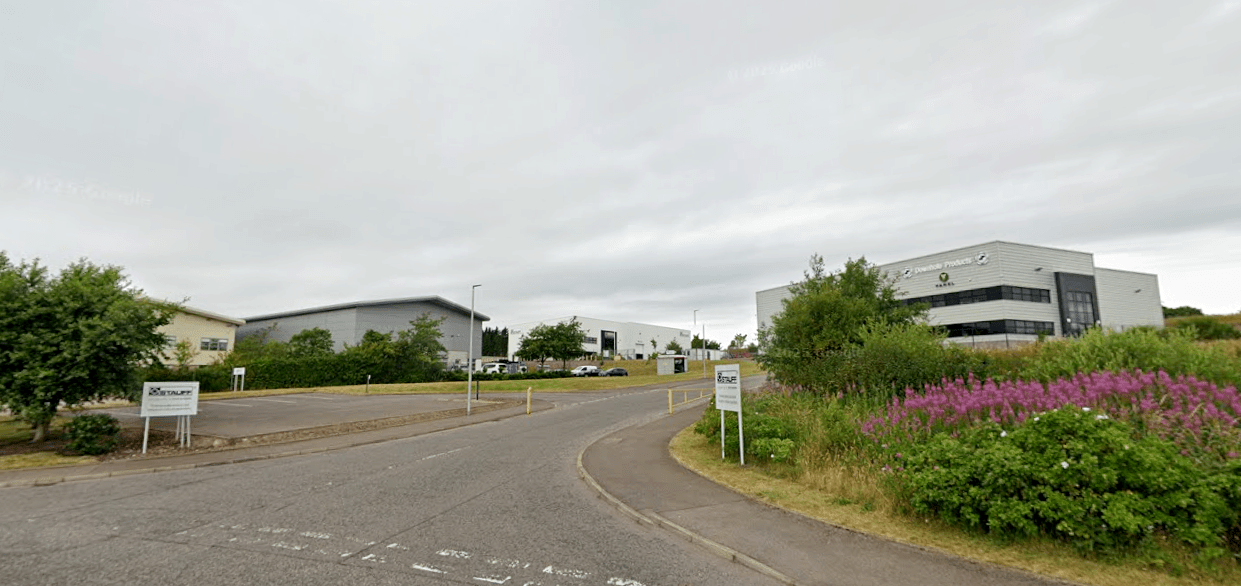
I touched on this subject briefly with a post back in August 2024 after receiving information from Scotland. It’s here in Parabola Bute Energy, Scottish Echoes. The Bute Boys, using the company Windward Titan Ltd, bought a huge warehouse (below) near Glasgow, then sold it three years later, for double the price paid, to the Lothian Pension Fund; essentially, Labour-run Edinburgh City Council.
Does Bute getting money from Labour-controlled pension funds sound familiar?
Further information received last month, from a different source, suggested Bute companies – often under the ‘Windward’ label – have quite a few warehouses ” . . . in Wales and Scotland filled to the rafters with BESS and pylon materials“.
These have been bought with the help of private bank Brown Shipley & Co Ltd, ultimately owned by the Al Thani family, which also owns Qatar.
So the question is, why would Bute need all this space, and why are some of these warehouses chock full of pylon components and other equipment for onshore wind turbine installations?
Also note, the insider who contacted me last month made no mention of the actual turbines. Neither towers nor blades. For which I might have an explanation.
◊
HUTCHINSON ENGINEERING
This company has also appeared on this blog quite recently. In a piece I put out in January. (Skip the first section.)
I started out back then by wondering, in a post on X, why a company in Cornwall called Inyanga Marine Energy Group had received £2,000,000 from our wonderful, and now thankfully departed, ‘Welsh Government’.
The man behind Inyanga, Richard James Parkinson, has other companies named HydroWing and Sangoma. All hoping to generate power from wave energy. Explained in the earlier blog piece I’ve linked to. But there seems to be no money, apart from public funding, and little sign of activity.
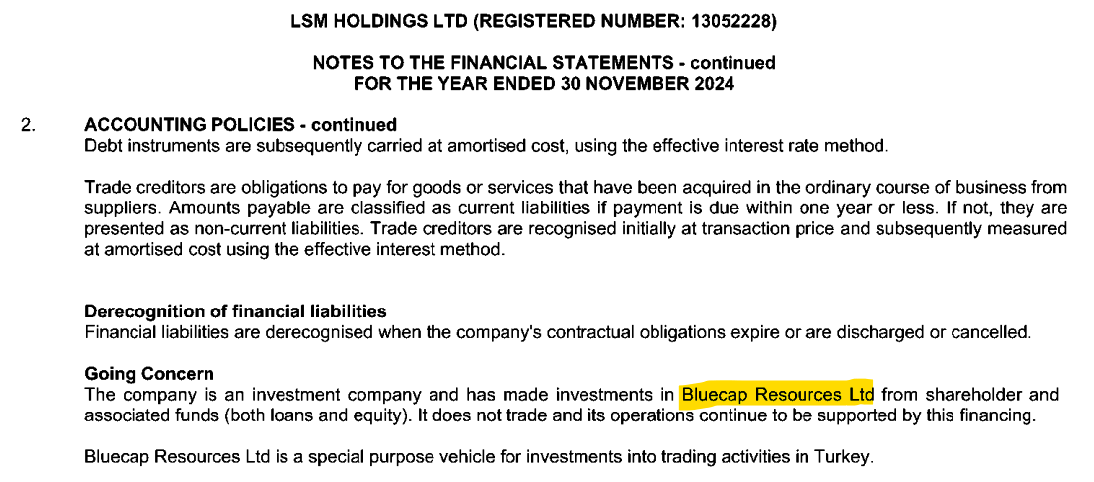
I suggest that name due to this reference in the LSM accounts, and where it leads.
Nick Revell, also gets a mention in this press release from January 2025 from the Wales Office, not ‘Welsh Government’. Again, the “Celtic Freeport” is mentioned.
Bluecap Resources Ltd, highlighted in the clip above, is based in Newport. But with its R&D in Penryn, Cornwall where, you’ve just read, we also find Inyanga, builder of wave energy machines, and beneficiary of ‘Welsh Government’ largesse.
The company is owned by:
. . . a consortium of European shareholders from the natural resources industry, both corporate and individual, including two publicly-quoted companies . . .
Yet the website tells us very little. But if we turn to the filings with Companies House we see big share issues in recent years – all in US dollars.
Bluecap is in the business of “extraction and recovery“. That it uses US dollars suggests to me it conducts much of its business outside of the UK. A belief reinforced by the company Bluecap Poland Ltd, formerly known as Bluecap Turkey Ltd.
◊
THE THEORY
Someone who’s given the consortium some thought has suggested to me a theory. Which, after doing some research of my own, I find both elegant and plausible.
It all hinges on the electric arc furnace at Port Talbot. On it being built, and then on that furnace using scrap material. This explains Tata Steel’s presence in the consortium.
The scrap will be provided by Ledwood-Bluecap. And will almost certainly come from outside of the UK. That’s why they’re involved.
That scrap material will be smelted at Port Talbot, a magical process to transform it into the “UK Steel” promised in the headline of the Energy-pedia article.
Next, it will be knocked into the shapes and sections desired for 250 metre tall wind turbines by Hutchinson Engineering of Cheshire, who might set up an operation in Wales, or co-operate with a locally-based company.
If my Bute source is correct about the warehouses being “filled to the rafters with BESS and pylon materials”, then Windward-Bute can supply pylons and the Battery Energy Storage Systems (BESS). This is one reason why Bute is involved.
RWE might provide the motors and other mechanisms required by the wind turbines. Then again, as a major player, RWE may be thinking ahead to replacing its clapped-out turbines, even erecting new ones.
Alternatively, the blades might come from somewhere else.
Let’s start by remembering that in the Ore Catapult press release we read that the consortium involved is “largely based in Wales“.
Yet Tata Steel is an Indian company. RWE German. Bute Energy is Scottish. Hutchinson Engineering is an English company. Ledwood and Bluecap have addresses in Newport, but source their scrap metal from God knows where.
Pushing this lot as Welsh is like describing the German army in September 1939 as Polish because it was “largely based in Poland“.
And as if that idiocy wasn’t enough, remember that almost all the electricity that’ll be generated will go to England!
If the theory is correct, or only partly correct, we can clearly see who’s going to benefit from turning scrap metal into wind turbine parts, and who’ll make money from supplying whatever else is needed.
It’ll be the same faces that have been ripping Wales off for too long.
There might be a few hundred jobs at Port Talbot, small compensation for the thousands lost. A few hauliers might get contracts. The turbines and pylons will be erected by specialist crews brought in from outside.
But let’s not forget – it might keep Kinnock Jnr in a job.
Yet we’ll have to put up with the ugly bloody turbines and pylons, and you can bet your sweet life that whatever the colour of the ‘Welsh Government’ after May 7 – we’ll be paying out plenty in public money.
All done so that demented individuals in Plaid Cymru, for whom politics is all gestures, who prefer ‘positions’ over policies that would benefit the long-suffering Welsh people, can claim that Wales is a “world leader” – in being exploited.
I had something else planned to go out on Monday, but I’ve held it back in light of fresh information I’ve received about the activities of Bute Energy. Information that raises wider considerations.
◊
INTRODUCTION
Let me start with an apology. I’ve been writing about Bute’s activities in Wales for seven or eight years. This meant ignoring projects elsewhere, and overlooking Bute and Windward companies that had no obvious Welsh connection.
That may have been a mistake. And in view of recent events suggesting dubious links with China, no longer tenable. Dealt with on this blog.
Apology made, one company I have mentioned, one I could never make sense of, was Storagefolk Ltd. Presumably involved in . . . warehousing?
Launched 23.09.2017 Storagefolk appears to be the oldest surviving Windward-Bute company apart from Windward Enterprises Ltd (until very recently Windward Global), the ultimate holding company, where Oliver James Millican, capo di tutti capi in the W-B world, is in sole charge.
But what’s its purpose, and how does it fit into the wider empire? Information received offers some answers. And opens up a new line of inquiry.
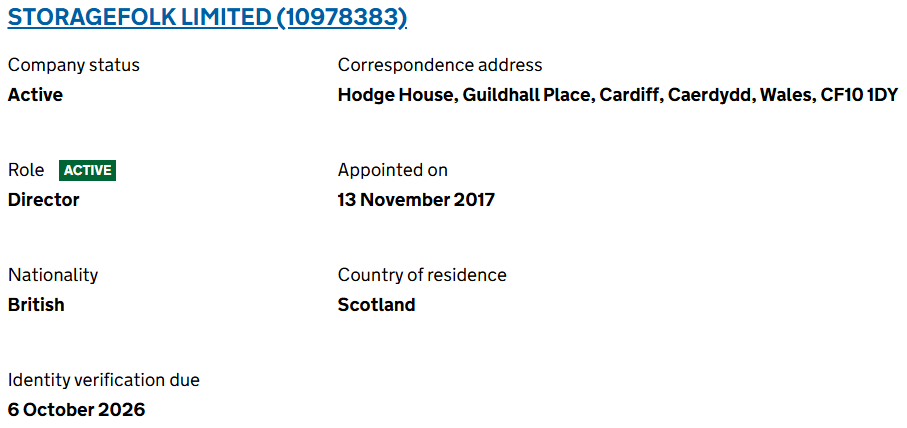
As you can see from the Companies House entry for Storagefolk the address is in Mayfair, that upmarket district of London. The sole director is Millican. But he gives his address as Hodge House in Cardiff, where we find virtually all the companies relevant to Wales. Or at least, those we know about.
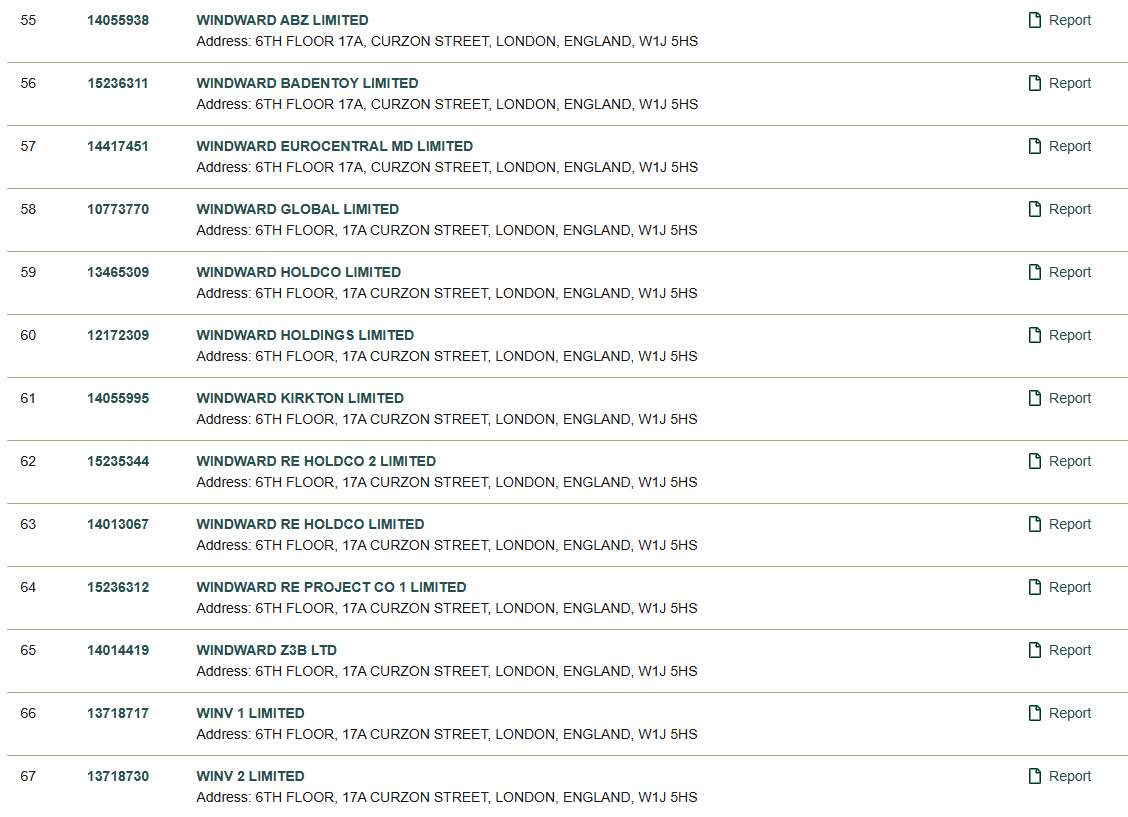
At the address in Curzon Street, hosting Storagefolk, we find Turcan Connell Company Secretaries Ltd. Scottish legal eagles with their HQ in Edinburgh. A company regularly used by Millican and his mates.
◊
MY! WHAT A BIG WAREHOUSE YOU’VE GOT. AND SO MANY OF THEM!
Of the companies registered at that address, we’re interested in the ones shown in the panel below. Particularly those to which I’ve been directed. (Storagefolk appears on the previous page.)
Precision Capital is a Luxembourg-based holding company that represents the private interests of members of the Al-Thani family of Qatar.
The charge was against a building just to the east of Glasgow, close to the M8 that runs to Edinburgh. A property offering 127,000 square foot of space.
Another company worth looking at is Windward Z3B Ltd, with the same pattern. Funding from Brown Shipley for two more storage facilities on industrial or technology parks around Aberdeen.
I could go on, but you should get the picture. Companies in the W-B empire have, for perhaps a decade, been buying up big warehouses, often borrowing from a ’boutique’ bank owned by an oil-rich family in Qatar.
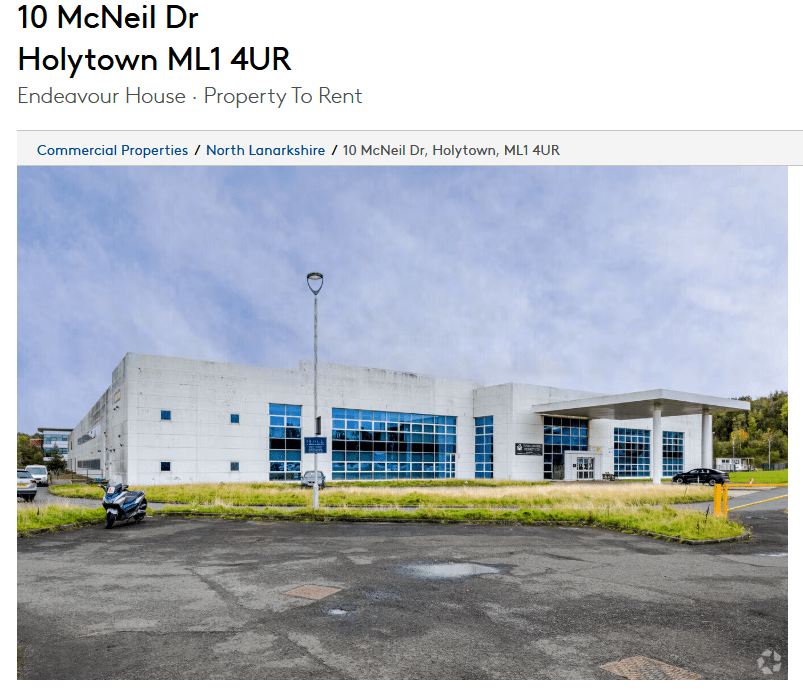
In another major milestone, IKM Testing UK today opens its third facility as it pushes ahead with plans to expand into international markets, the renewables sector and increase its UK decommissioning work.
But IKM only accounts for some of W-B’s real estate, so the question remains: Why does it need all this storage space?
◊
PLANNING AHEAD?
First, let me clear up the purpose of Storagefolk before telling you how Windward-Bute buying up vast areas of storage space was explained to me:
(Storagefolk) is purely a negotiating shell for projects in Scotland and NE England; it is used in proposals to financiers, a distinct legal entity is then formed post-investment decision to ring fence properties and interests – and distance from the risk of course.
As for the warehouses, it seems that W-B has been importing parts and components for turbines, solar installations, and Battery Energy Storage Systems (BESS) for quite a few years.
This stockpiling is in anticipation of a crackdown on imported parts for ‘renewable’ energy projects. This seems plausible as the opposition mounts to increasing energy prices resulting from ‘Mad’ Ed Miliband’s Net Zero death-wish.
The real estate arm of the Windward portfolio . . . is working with multiple overseas businesses and at least one national government to house interests and commodity items relating to renewables infrastructure. There are warehouses in Wales and Scotland filled to the rafters with BESS and pylon materials – rented and landed for resale exclusively to the UK market to artificially appear to restrict overseas procurement and brand it as available when supply chains pinch in the late 2027 to early 2029 drive.
Is it just forward planning, or is there more to it?
As an example of ‘more to it’, can we assume these imports come from China? I’d put a few quid on it. And if I’ve picked the right nag, then this explains a few other things.
For as we’ve recently learnt, it’s impossible to escape the China connection when dealing with Windward-Bute. So I was not surprised to be told that two of the Big Three (Oliver James Millican, Stuart Allan George, and Lawson Douglas Steel) have even stated they’d sell to “interested parties from China at the right price“.
But none of these machinations would be possible without political influence, and that influence is not confined to Labour in Wales.
Let’s remember that Tom Watson, former deputy leader of the UK Labour party, now Baron Watson of Wyre Forest, is a non-executive director of Windward Energy Ltd, where he’s listed as plain old Thomas Anthony Watson.
It’s suggested this provides a good connection through Great British Energy to ‘Mad’ Ed Miliband himself, the apostle of Net Zero, de-industrialisation, and electricity consumer impoverishment.
To sum up: there is a concerted effort not only to increase expenditure and reliance on ‘renewables’, but also to remove cheaper and more reliable alternatives. This explains why the UK is closing down North Sea oil and gas . . . only to buy from Norway, which extracts from the same North Sea source.
Proving it has sod all to do with saving the planet.
This is the ugly world inhabited by Windward-Bute. It’s not limited to wind turbines despoiling landscapes, it’s about using political influence to remove competition providing more reliable and cheaper alternatives.
In Wales, this has resulted in the infiltration of the Labour party to the point where it’s hopelessly compromised. Election posters for May’s Senedd elections should read: ‘Vote for Dai Jones – your Bute Welsh Labour candidate‘.
We know W-B is also making inroads into Plaid Cymru. The Greens were always on side. But does it end there?
Maybe not.
◊
TITBITS, THOUGHTS
In this section I’ll look at a few other items that have come my way and how they perhaps fit with what we already knew.
First, I’m told that Nigel Farage had a closed-door meeting in January with Windward Energy Ltd Chairman Steve Scrimshaw. So let’s have a statement from Reform on where it stands on ‘renewable energy’ and rising electricity prices.
More closed door negotiations preceded the decision by the Wales Pension Partnership to invest £68m (for starters?) in Windward-Bute. A source says that very influential in the ultimate decision was Cardiff Lib Dem councillor Rhys Taylor.
Taylor of course sits on the council’s Pensions Committee, but I bet you can’t guess where his day job is. Let me help . . .
So we see that Windward-Bute also has its claws into the Lib Dems.
I’m told the investigations into Taylor and Aplin might result in a number of Senedd Members, MSPs and MPs being invited to ‘help police with their inquiries’.
Understandably, Copenhagen Infrastructure Partners (CIP), the main funders for W-B’s renewable energy projects, is said to be pissed off by the recent news and allegations of spying for China.
Which provides yet another link to ‘Welsh’ Labour. Through Helle Thorning-Schmidt, former Danish PM, her directorship of Vestas since 2019, and that company’s 25% stake in CIP.
Her seat on the Brussels gravy-train was taken by Derek Vaughan who, following Brexit, was given a non-job by Windward-Bute on its Welsh Advisory Board.
Kinnock the Younger’s constituency is home to Port Talbot steelworks, so recently and shamelessly allowed to die. Welcomed in certain circles because it reduces Wales’ output of some evil dreamed up by Greenhairs.
∼
I’m going to throw out an idea that might sound outrageous, yet it’s plausible. Just think about it.
They had no experience in ‘renewables’; and to my knowledge they’ve still not erected a single turbine. Certainly not in Wales. But is this missing the point?
They now have sites designated, landowners signed up, planning applications submitted, politicians and others bought, financial backing for the projects arranged, and warehouses stacked to the gunwales with the wherewithal to complete the projects.
So if Windward-Bute only gets half or less of the planning consents applied for – even no planning approval at all – they could still sell up and make a massive profit. Especially if the anticipated crackdown on (recently) imported parts comes into play and the components they bought years ago rocket in price.
Maybe that was always the business model. Not actually building anything.
If nothing else, it’ll be a very lucrative fall-back position.
◊
CONCLUSION
Windward-Bute has corrupted Welsh political and public life. And it was so predictable.
With a form of devolved government designed to fail. And with ‘progressive’ politicians too stupid and gullible to have made even a good model work.
Made worse by those same politicians seriously believing Wales alone could save a planet being destroyed by humans – and their farting cows!
Politicians believing that lobbyists and pressure groups should determine policies, and that they should be able to do so free from regulation or restraint.
Resulting in overlapping and incestuous circles in one relatively small city, circles of perhaps no more than two or three thousand people in total, damaging the lives of over three million people.
This shit-show was bound to attract the kinds of ‘developers’ we’ve seen over the past 27 years. With Windward-Bute perhaps the worst, the most pernicious example.
Windward-Bute already has the shadow of ‘China spying’ hanging over it, and the stain of buying political influence, but it doesn’t end there.
The West’s lemming-like rush over the cliff of ‘renewables’ isn’t just good news for China, on which we depend for everything from rare earth minerals to completed solar panels; it’s also welcomed in the oil-rich Gulf states because ‘renewables’ are also unreliables, and need back-up.
Some might think that a UK-based company or individuals enriching themselves from helping de-industrialise and impoverish the West is tantamount to treason.
And I would agree. For ‘renewables’ are a response to nothing but avarice.
This ‘quickie’ is in response to a news item about 200m tall wind turbines planned for Mynydd Fforch-dwm, near the village of Tonmawr, east of Neath. Permission has been granted by the so-called ‘Welsh Government’ on the grounds that it’s a Development of National Significance.
The bulk of this post will be taken up with a look into the labyrinthine ownership of the company said to be behind this project, and others, before concluding with more general thoughts on ‘renewables’ in Wales.
◊
THE PROJECT
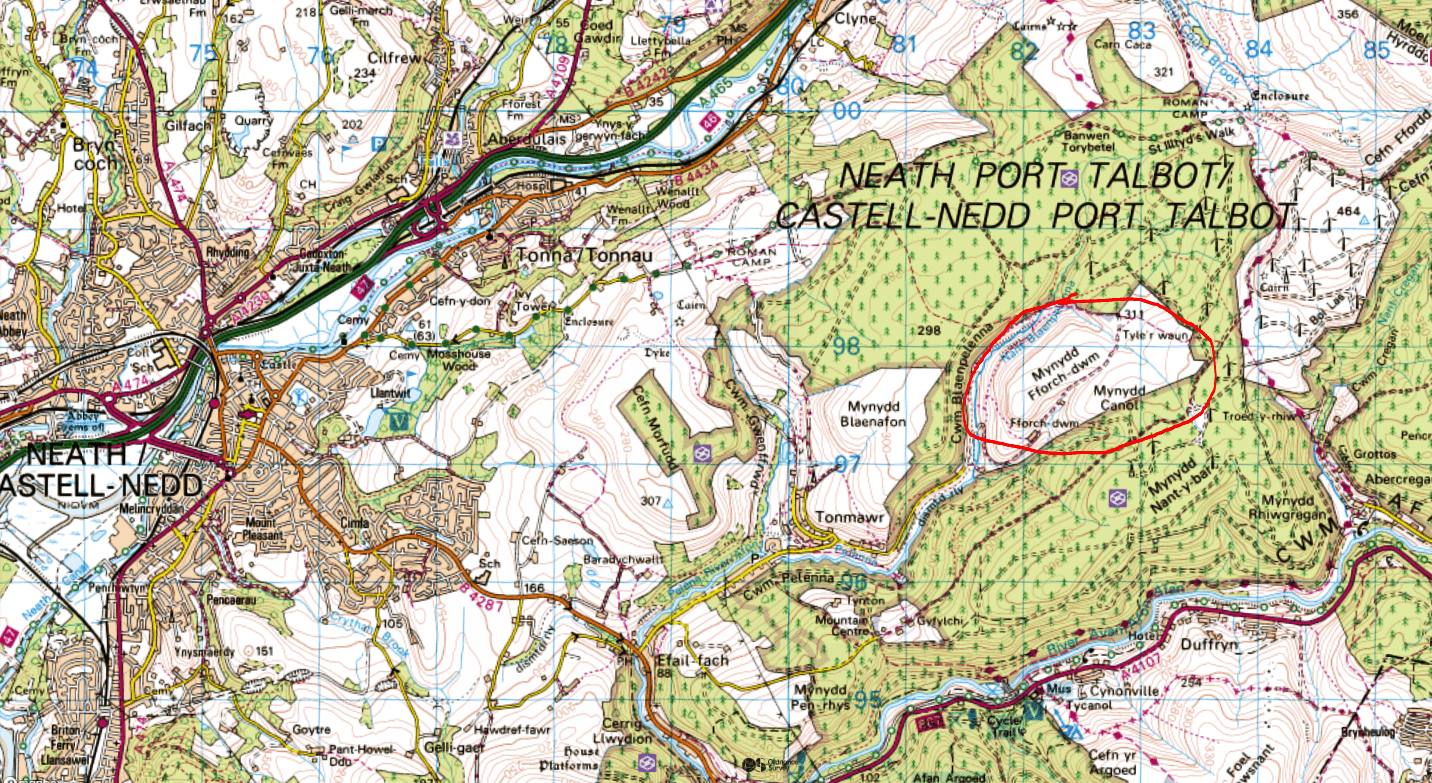
First, let’s give you an idea of the where we’re at. As I’ve said, it’s to the east of Neath, and in the map below I’ve circled Mynydd Fforch-dwm in red.
Click to open enlarged in separate tab
The additional run-off of rainwater generated by the huge concrete turbine foundations, the cable trenches, the access roads and all the other work, will run into Nant Pelenna, which joins the Afan near Pontrhydyfen, and then flows on down to Port Talbot.
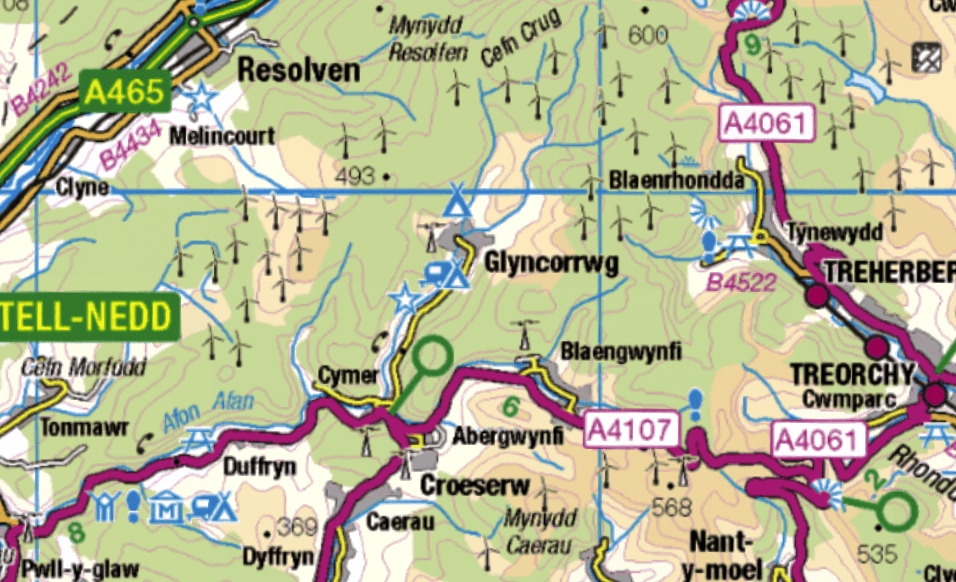
It’s an area already cursed by many turbines, with even more planned. Such as the proposal to erect even taller turbinesjust a few miles away at Y Bryn.
Click to open enlarged in separate tab
Though it’s not just the six huge wind turbines that are being promised, for this ‘energy park’ will bring even more goodies:
As well as the six large turbines . . . the site could also contain up to 10 hectares of solar photovoltaic panels mounted on frames fixed to the ground along with associated infrastructure such as battery storage facilities, electricity transformers, and access works.
The company named in the article as being behind the project is Naturalis Energy. Here’s their elementary website. Naturalis describes itself as a joint venture between Renantis and REG Windpower Ltd.
Companies House shows a Naturalis Energy Ltd based in Telford, Shropshire. But I’m taking a punt on the company we’re looking for being Naturalis Energy Developments Ltd, formed 23 September, 2019, as the timing fits with the website dated 2020.
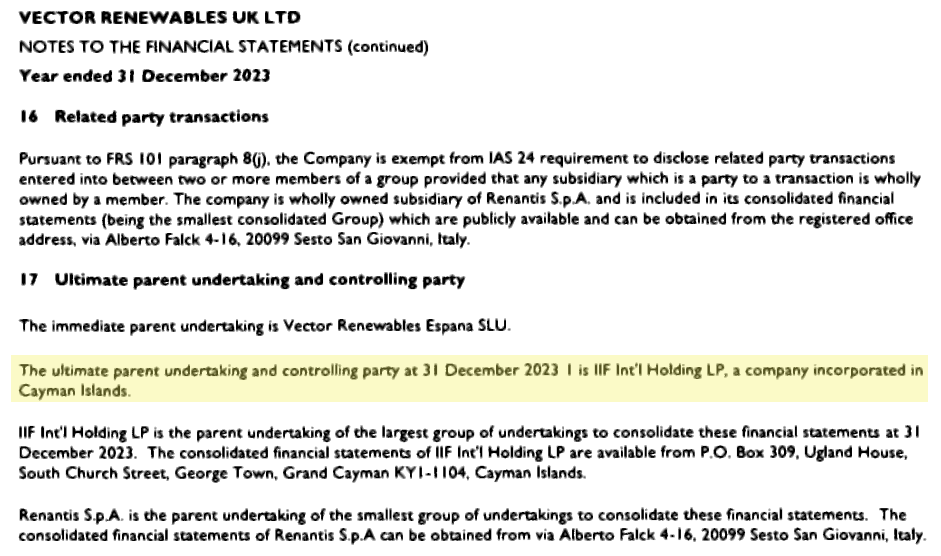
The same trio controls Vector Renewables UK Ltd at the same London address as Naturalis Energy Developments. Vector is owned by an outfit in the Caymans.
Click to open enlarged in separate tab
These three may control other companies, but they can’t be traced in a Companies House search because they aren’t listed as directors, only as ‘Persons with significant control’.
From what I can see, the expertise in ‘renewables’ for Mynydd Fforch-dwm will be supplied by REG, with the money coming from Naturalis-Renantis. So I’m going to concentrate on the second element, the funding.
But before leaving REG . . . It was a tortuous trail but I eventually established that it’s all owned by Andrew Nicholas Whalley. Who’s been involved with many companies. Quite a few with Welsh names.
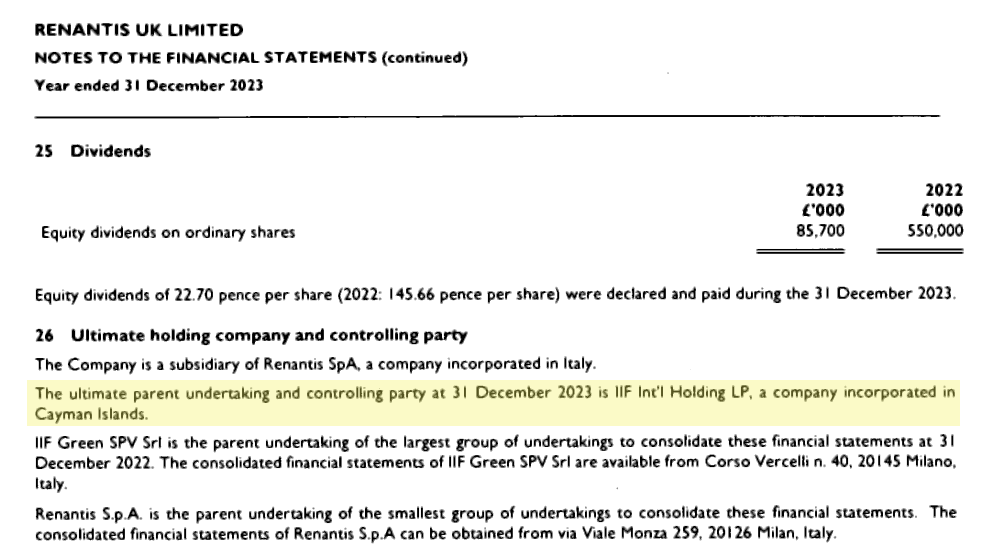
Back to Renantis UK Ltd, and the latest accounts filed with Companies House (to Dec 31, 2023) which tell us who owns this company. And whaddya know! – we’re back to the Cayman Islands, and the wording is the same as we just read for Vector.
Click to open enlarged in separate tab
Now it gets a little complicated, so let’s hope I can explain it.
Which started to make sense, and ring bells. For Falck’s been mentioned on this blog before. Back in February 2022 in ‘Bute Energy Selling Wales For Danegeld?
To explain . . . Learning of the link-up between Scottish company Parabola Bute Energy (planning some 20 ‘renewables’ projects in Wales) and Copenhagen Infrastructure Partners, I went to the CIP website looking for a reference to Parabola Bute.
I couldn’t find one, but I told readers back then what I did find.
‘Copenhagen Infrastructure 1 has invested GBP ~155m of equity for a 49% stake in Falck Renewables S.p.A.’s (Falck) operational onshore wind portfolio in Scotland and Wales.’
That was written in February 2022, the month Falck was taken over by the ‘investors’ advised by JP Morgan Chase. Whose CEO, Jamie Dimon, wants to compulsorily purchase land and property – to accommodate the wind turbines and the solar panels needed to save the planet!
Wind farms and solar arrays that – by pure chance! – will be owned by companies, hedge funds, corporations, and other entities run by men like Jamie Dimon.
Click to open enlarged in separate tab
If this dangerous nonsense had come from the studded tongue of a green-haired newt-botherer, or even a TV envirogrifter, I might laugh it off. But as the headline reminds us, Dimon is a ‘Wall Street titan’.
When I first read that I thought it was the most frightening – yet revealing – example of the Globalist corporate mentality I had ever read. And I still think that.
Maybe I should explain at this point that Copenhagen Infrastructure Partners acts as an intermediary, finding environmentally acceptable investments for investors.
CIP manages 12 funds and has to date raised approximately EUR 30 billion for investments in energy and associated infrastructure from more than 180 international institutional investors.
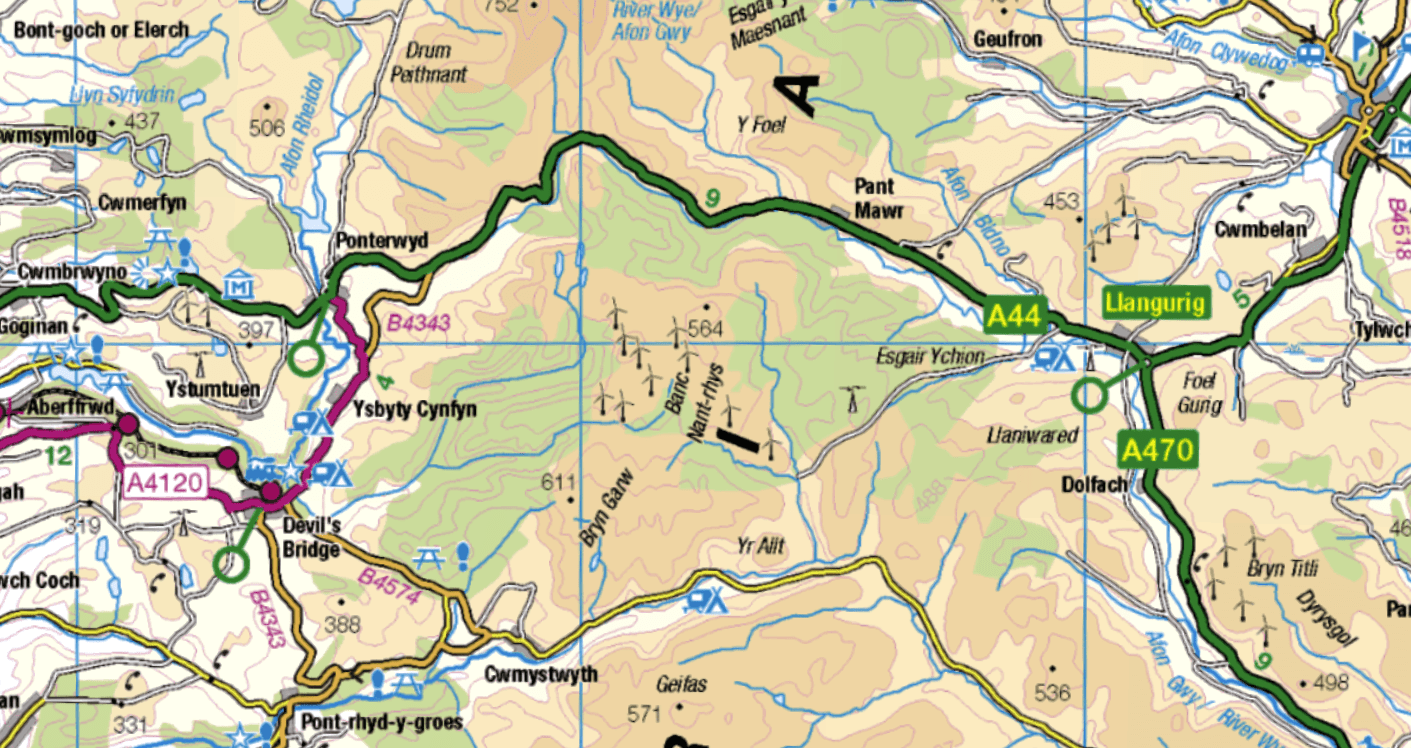
Getting back to Falck . . . I’d come across the company even before the CIP connection. For Falck owns (owned?) 20-year-old, 39-turbine Cefn Croes Wind Farm, above the A44. In its day, said to be the biggest (by output) in the UK.
Click to open enlarged in separate tab
Let’s go back to the complicated ownership details on the Renantis UK accounts. Where we read: ‘The ultimate parent company and controlling party at 31 December 2023 is IIF Int’l Holding LP, a company Incorporated in Cayman Islands‘.
A bit more searching told me that ‘IIF’ stands for International Investment Fund, which makes sense. An entity that was handling $24 billion two years ago. But it seems not everybody’s happy.
The key to knowing who’s behind the Mynydd Fforch-dwm project seems to lie in Milan. Where, in February 2022, local company Falck was taken over by ‘investors’ advised by JP Morgan Chase, using the Renantis-Naturalis label, and further obscuring their activities by operating from the Cayman Islands. It was reported at the same time that Copenhagen Infrastructure Partners had taken out a 49% shareholding in Falck’s Welsh and Scottish onshore operations.
But these entities only invest other people’s money, we still don’t know where the money for Mynydd Fforch-dwm originates. Do those clowns in Corruption Bay even care?
UPDATE: Soon after putting this piece out I was contacted by a good source with further information. In the summer of 2023 Renantis linked up with Ventient Energy, and then last year, this resulted in a new company, Nadara.
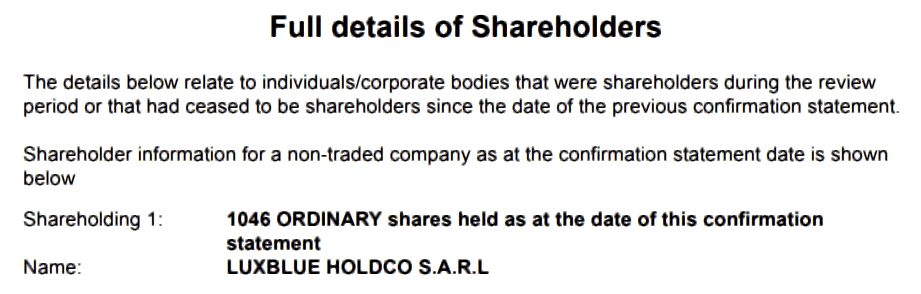
Nadara is registered in Scotland using an Edinburgh address. It brands itself as a Scottish company, even claiming its name is derived from Scottish Gaelic, though it’s owned by an outfit registered in the EU tax haven of Luxembourg in November 2023.
A name associated with LuxBlue Holdco SARL is that of Paul Farmer. He’s also involved with IIF Int’l Holding, of the Caymans, which we encountered earlier. His Linkedin profile says he’s some kind of freelance.
This may account for the clamour from politicians in Wales for the Crown Estate to be devolved here too, if only to show we’re getting some benefit from ‘renewables’.
I have no doubt that, once again, the trail leads back to the Cayman Islands. And so the question remains – where’s the money coming from?
◊
FINAL THOUGHTS (SOME RATHER PERTURBING)
When I began looking into Mynydd Fforch-dwm Energy Park I thought, from the name ‘Naturalis’, that I’d be seeing previously unknown companies, and fresh faces.
Boy! was I wrong.
Not only have we re-acquainted ourselves with loveable Jamie Dimon of JP Morgan Chase, through part of his empire operating out of a British Overseas Territory, but via the Italian connection we also bump into Copenhagen Infrastructure Partners again.
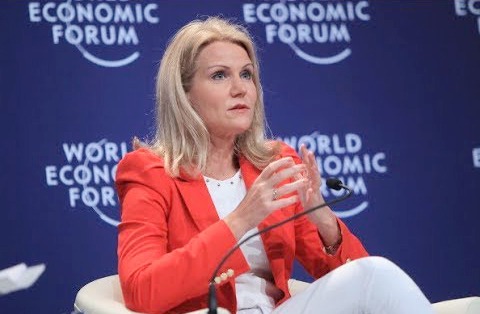
A good time to remember that a 25% stake in CIP is held by Danish turbine producer Vestas. Among Vestas directors and shareholders is former Danish PM (sometime MEP) Helle Thorning-Schmidt. Who’s married to Aberafan MP Stephen Kinnock.
(Thorning-Schmidt is also a director of the Islamic Development Bank and the Schwab Foundation for Social Entrepreneurship.)
Helle Thorning-Schmidt. Click to open enlarged in separate tab
By a remarkable coincidence, the planet-saving extravaganza planned for Mynydd Fforch-dwm is either in, or on the border of, the Aberafan constituency.
But even without that propinquity we can guarantee moolah from Mynydd Fforch-dwm making its way to Helle. (But will she share it with hubby?)
And of course that also applies to CIP’s involvement with Parabola Bute Energy.
As stated at the top, this project is justified by the ‘Welsh Government’ on the grounds that it’s a Development of National Significance. For which nation? We already produce more than enough electricity to meet Wales’s needs, so this project must be of national significance for England.
So where are the benefits to Wales?
We scar our hills, increase the risk of flooding, with foreign-built turbines and pylons owned by companies and ‘investors’ from God knows where that regularly catch fire or get blown over. They’re erected by crews brought in for the job, after which the only work is changing the oil, firing up the diesel generator to pretend the bloody things work, and collecting the dead birds and bats.
In real world terms wind turbines just mean higher electricity bills for everybody and falling property values for homes within sight and sound of the damn things.
There are no benefits to Wales whatsoever, apart from the pitiful ‘community funds’ . . . the green energy equivalent of beads and infected blankets.
Click to open enlarged in separate tab
As I wrote this, and saw so many links emerge, I wondered if it’s an attempt to forge a ‘renewables’ monopoly in Wales. For Jamie Dimon would get red carpet treatment if he visited Cardiff, as most Senedd Members would gleefully implement his demand to compulsorily purchase farmland for yet more turbines.
I hadn’t planned on putting out a post this week. But people contact me and say, ‘Have you seen this, Jac?’; and most of the time I can politely respond and let it pass. But now and again I get a clutch of reports or leads that are worth bringing together in a post like this.
It’s big, 4,500+ words, but as I always say, you can take it a section at a time.
And because it’s so big, and it’s taken so much work, don’t expect anything next week.
♦
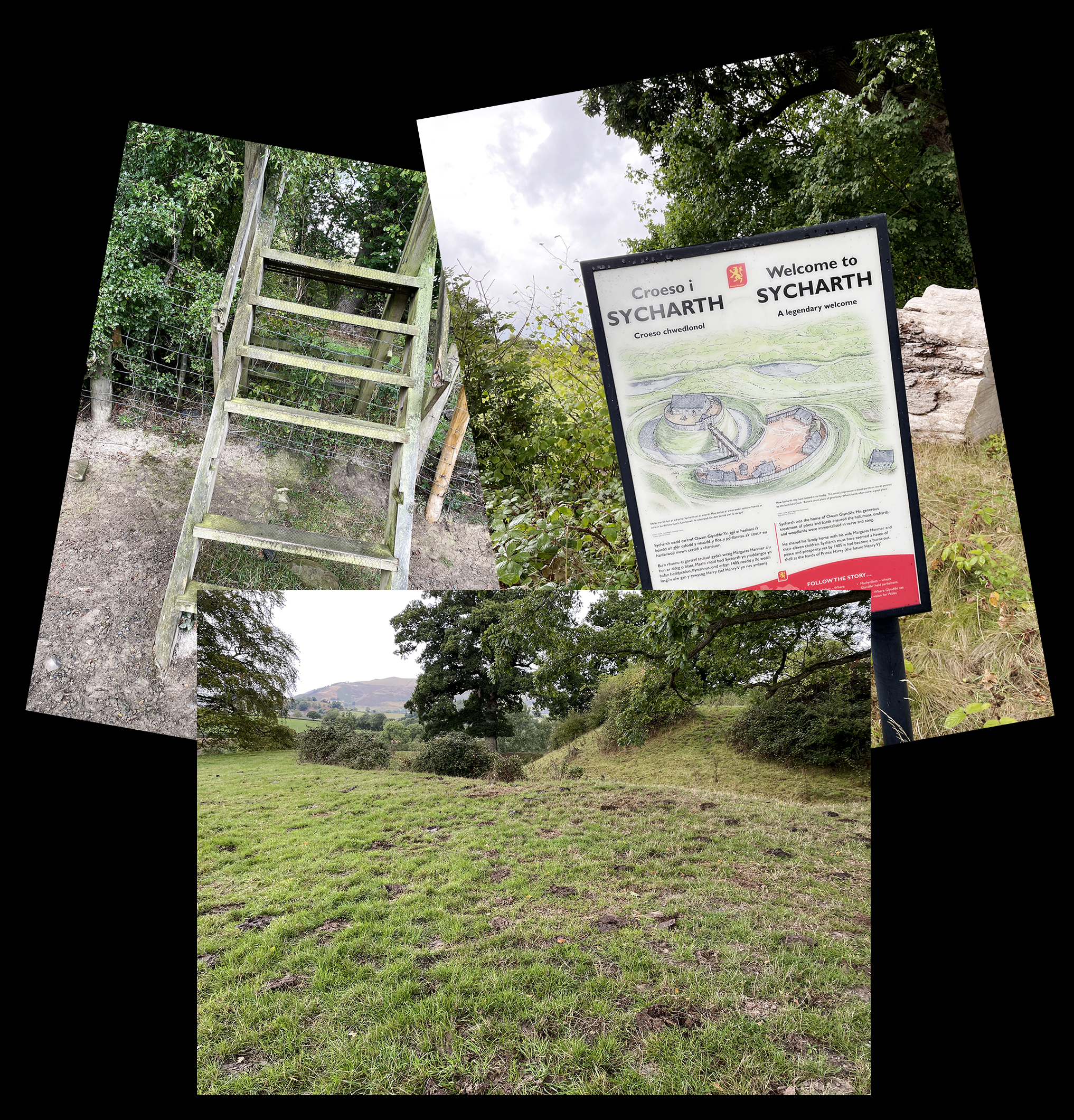
SYCHARTH UPDATE
The previous post was about my visit to Sycharth on September 16, and my disappointment with state of the site. Which prompted a reader to write to Cadw, the agency responsible for conserving our heritage.
Click to open enlarged in separate tab
Here are the points he raised with Cadw:
The stile to Sycharth is in a poor condition.
Car parking is insufficient.
The whole site is in a mess. An hour with a strimmer would do wonders.
The information board does not mention much of Cymru’s history.
Its neglect is a travesty and an insult to our past and heritage.
Utterly shameful behaviour on your part.
To which Cadw responded with this. Which tells us the site belongs to the Llangedwyn Estate. More particularly, Nicholas Watkin Williams-Wynn.
A couple of phrases from the Cadw response are worth focusing on.
‘Sycharth . . . forms part of a working tenant farm under the Llangedwyn estate with permissive public access and parking at its discretion’.
‘Cadw installed the car park (four cars max) and access works (stile?) in 2010-2011 but their maintenance is again the responsibility of the owners.’
So it’s up to the Llangedwyn Estate whether people are allowed to visit Sycharth. And could, presumably, block public access. It’s also the Estate’s responsibility to maintain car parking and access. To judge by what I saw there, the Estate is doing its best to discourage visitors.
Is this some old dynastic feud being played out in the 21st century?
So I ask again: If the so-called ‘Welsh Government’ can find £4.25m to buy Gilestone farm for an English music festival, for purposes that are yet to be explained, why can’t it find the money to buy a site of national if not international importance and maintain it adequately and respectfully?
♦
FREELOADERS IN FREEPORTS
Freeports are back in the news. And it seems Wales is getting one. Either in Holyhead or Milford Haven and Port Talbot.
Let’s start in Holyhead.
Now the Conservative MP for Ynys Môn, Virginia Crosbie, is a big supporter of freeports, and has staked her reputation on turning a run-down ferry port into a beacon of global trade that will bring into Caergybi the riches of the Orient, the gold of the Indies, and of course – Guinness from Dublin.
Here she is setting out her ambition in a mercifully short video.
Though in truth, freeports rarely live up to their billing. And often involve very murky dealings. Private Eye has been following the evolution of the Tees Freeport in north east England. And produced the report below in the issue before last. (Available here in pdf format.)
N.B. Political donations are not to be confused with bribes and backhanders; and if friends of London politicians get juicy contracts then it can only be because their firms are best able to deliver.
Click to open enlarged in separate tab
Tees-side is a heavily built-up area, with a population pushing 380,000. And after the loss of its heavy industry – particularly steel – there is a widespread perception that the area is ‘owed something’.
Holyhead, by comparison, is a small town, with not much to speak about other than the ferry port to Ireland.
Until it closed in 2009, a major local employer was the Anglesey Aluminium smelter, with its private jetty. The plant received its electricity from Wylfa nuclear power station, some 15 miles away, another major employer that is now gone.
Roughly one thousand jobs paying good wages lost, but never mind, we’ll obey those who know best and stick in a few wind turbines and wave machines – plenty of jobs and unlimited cheap energy. Not.
The vacant site was taken over by Anglesey Aluminium Metal Renewables Ltd which in January 2016 became Orthios Power (Anglesey) Ltd. The site eventually being used for a plastics-to-oil operation.
Well, the old smelter site has been bought by ferry operator Stena, and this is how a source on the island explains it . . .
‘Now of course they (Stena) can shift the dockside car parks elsewhere leaving nice waterside development plots. Just the sort of place to build a cable plant so they can load directly onto ships. The sort of cable company Virginia Crosbie MP was courting … the one owned by a Tory donor’.
He’s referring to Tratos, another local company hoping to benefit from offshore wind farms. Well, when I say ‘local’, it might be local if you were living in Italy. As the report makes clear.
From North West Wales Conservatives website. Click to open enlarged in separate tab.
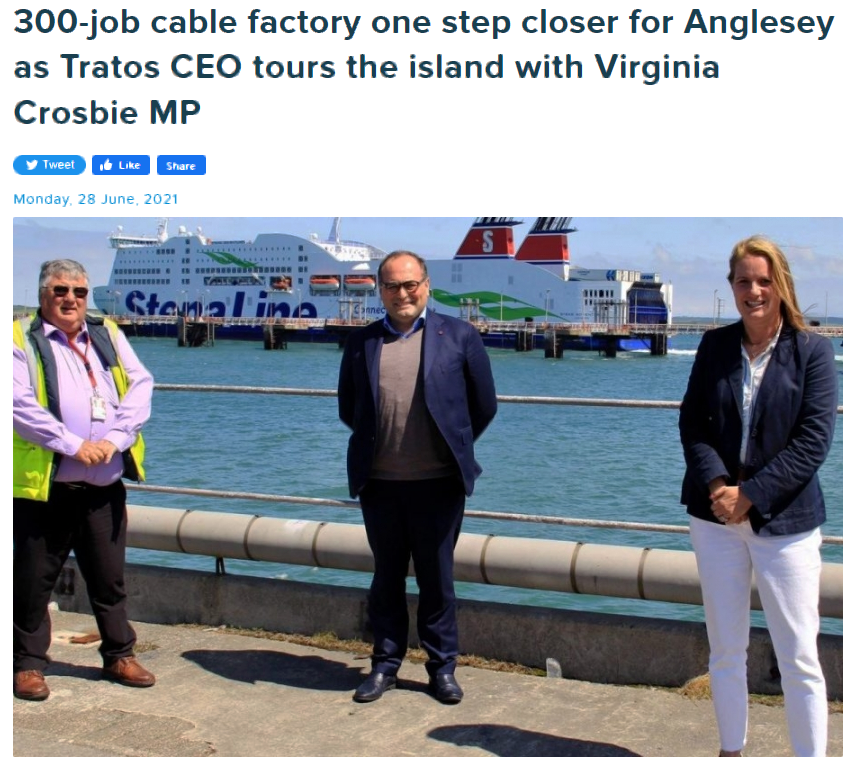
This further report will explain a bit more of what’s going. Though you may not need to read beyond the headline: ‘Holyhead could get 300 cable jobs if area gets freeport status – says firm run by Tory party donor’.
Not much more to say really. Stena is leading the Freeport bid, and now Stena is pulling out the stops to get an ‘anchor’ company located in Holyhead. As is the local MP.
To finish this piece on Holyhead I have to mention Jake Berry MP. Now Jake is MP for a constituency in north west England, but he owns a number of properties on Ynys Môn. During the Covid lockdown it was rumoured that Virginia Crosbie was living in a property owned by Berry.
In addition to his post as party chairman, new Prime Minister, Liz Truss (I know you’re all impressed!), has made Berry Minister without Portfolio. Which may not sound much, but it kind of gives him a free hand.
That appointment was announced September 7. The day before the announcement, Berry resigned from the Northern Research Group Ltd (northern English Tory MPs), where he held the controlling interest. Also from Ford Bridge Farm Ltd.
Now why would he do that?
Ford Bridge Farm is of course an English rendering of his – or his wife’s – Rhyd y Bont farm at Rhoscolyn, on Holy Island. This is the smaller island, off the main island, and where Holyhead is located. Which means that Jake would be very close should the freeport materialise. A neighbour!
Rhyd y Bont circled. Click to open enlarged in separate tab
Does Jake Berry anticipate benefitting in some way from a freeport at Holyhead? Or am I being too cynical? Cynical! Moi!
∼
By comparison, the southern rival seems far less well advanced. In fact, we could be forgiven for thinking it’s hardly off the ground. This report would suggest that it was launched as recently as last week.
Though this piece from November 2020 suggests the Port of Milford Haven has been thinking about a freeport for some time.
Milford Waterway. Click to open enlarged in separate tab
The more recent activity may be due to the fact that in May it was announced that the 45km limit (for the extent of freeport status) could be extended in Wales. This could certainly explain the southern bid combining Milford Haven with Port Talbot.
Which are 87km apart, as the fabled crow flies.
This somewhat bizarre combination is presumably justified by links between Milford Haven and Swansea Bay. As show in the image below. Which strikes me as being a wee bit desperate. For example, the Llandarcy refinery closed in 1998.
And would a freeport in Milford make the oil, gas, or electricity flow any faster?
Click to open enlarged in separate tab
My insular source believes that for all sorts of reasons the southern bid will win out. I’m not so sure. For with local boy Jake Berry working his magic behind the scenes, and his good friend Virginia Crosbie staking her political reputation on it, I would not be at all surprised to see the £26m freeport pot head up the A5 rather than down the M4.
But whichever direction the loot heads the lucky recipients will need to watch out for sharks circling – but these won’t be in the water. They’ll be arriving in Beemers and hoping to dazzle with PowerPoint presentations and insincere smiles.
And, dare I say it, ‘inducements’. There, I’ve said it.
And I say it because a freeport in either Holyhead or Milford / Port Talbot will attract grifters like the fresh laverbread stall in Swansea market draws discerning gourmets.
♦
NAILING THE VOICES?
This section is decidedly odd, and I wasn’t sure about using it, so please understand if certain details are withheld. (Especially towards the end.) But I do have the information and the relevant documents.
It started when someone got in touch, saying she had information on Gilestone, but what she offered was unconnected incidents jumbled up with snippets from hither and yon.
Tait has turned his ‘voices’ into a cottage industry. With many videos on YouTube and other platforms. That said, they don’t get many views. This one, with 40k, is probably the most popular.
Most people, including the local police, dismiss Tait as a publicity-seeking crank. No tangible evidence of human trafficking has ever been found. In fact, there is nothing beyond Tait’s recordings; and as has been pointed out, these could have been made anywhere.
Doing a quick check for Tait on the Companies House website turned up some interesting stuff. Now I’m not sure from where Tait originates, but he’s been living in Ammanford in recent years.
For these Derbyshire-based companies Tait has as co-director the gloriously monikered Carlos von Gallo. Who has his own YouTube channel, where he puts out nothing but Tait’s Ammanford ‘recordings’.
‘Von Gallo’ is listed as the sole shareholder at the two companies’ deaths, but does he really exist?
What the 14 companies I’ve given here have in common is that after a short life – in some cases very short – they all went under. There are no survivors.
Something else I found intriguing was that for almost all Tait’s companies there was an issue of a single £1 share (if it was him alone) or £2 if there was another director (Tait’s wife or ‘von Gallo’). With two notable exceptions.
I don’t wish to cast aspersions but, if I had money I couldn’t account for, then disguising it as a share capital in a company doomed to fail, might have its attractions.
In his ‘voices’ videos Tait points the finger at the nearby Sophia Nails. He further claims that the leaseholder was a Vietnamese woman named Trang Thanh Tran. She is now said to run T Nail Spa in the centre of Swansea.
Tran’s partner, or husband, Quang Lam, was the leaseholder in Ammanford and also at Heaven Nails in Llanelli. He was sent down for 5 years for belonging to a gang growing and distributing cannabis.
The Vietnamese connection may be significant because some comments to the YouTube videos claim to have heard Vietnamese being spoken by the ‘voices’.
But the problem with Tait is that even if he’s telling the truth about the voices, and the Vietnamese connection, one look at his business record tells us that he is, to put it generously, ‘unlucky’, with so many failed companies to his name.
∼
Despite Tait being so ‘unlucky’, I was still left wondering . . . and so, motivated by nothing beyond idle curiosity, I Googled ‘Sophia Nails’, the name of the Ammanford salon. What popped up was the Sophia Nail Spa in Porth, in the Rhondda.
At which point things got a bit strange.
For in February this year a company, Sophia Nail Spa Ltd, was launched. The only director is a 23-year-old Vietnamese named Thien Van Hoang.
And although the company uses 22 Hannah Street, Porth, as its correspondence address, the Certificate of Incorporation gives Hoang’s address as 31 Ridley Terrace, Sunderland.
Click to open enlarged in separate tab
At this point is might be worth suggesting a few things.
First, whoever’s running the Porth nail bar may know nothing about the company that’s using the same name.
Next, Thien Van Hoang may not even know he is named as director of Sophia Nail Spa Ltd. I have come across other examples of people being listed as company directors without their knowledge.
Finally, Thien Van Hoang may never have visited Sunderland.
But to find another Vietnamese connection is intriguing. Not least because it seems nail bars are used by Vietnamese criminals for exploiting women and girls, also for money laundering. The same gangs that are involved with cannabis. And not just in the UK.
Just type ‘Vietnamese nail bars trafficking’ into your search engine and you’ll bring up countless news reports. It’s big business.
Which may also explain Sophia’s Nail Bar at 9 Oxford Street, Mountain Ash. (Shown in image below.) Which more recently seems to have been known as New Star Nails. Which again is odd, because a company of that name folded in July 2018.
Another company listed at this block was a sporting establishment (darts, snooker, etc), on the first floor, which in July changed its name and apparently became a bar. All the old directors left and a single new director arrived, a 22-year-old woman with an unmistakably Welsh name.
I’m not saying young Welsh women shouldn’t run bars, but . . .
For a start, ingress and egress to a bar on the first floor will only be possible by a flight of stairs from the street. Would a council – even Rhondda Cynon Tâf – grant a drinks licence to a place where people would regularly fall or be pushed down the stairs?
Click to open enlarged in separate tab
On a weekend a fleet of ambulances would be needed to carry away the injured. And as we know, Wales doesn’t have a working fleet of ambulances.
Something’s not right. The old Jac nose is all a-quiver.
From countless previous cases in Wales and across Europe, Vietnamese nationals owning or running nail bars should have aroused the suspicions of both local councils and the police.
Finally, the company that owns that 20-25 block on Hannah Street in Porth is based just a mile and a half, as the crow flies, from Gilestone Farm!
I am not suggesting anything. It’s just a small world and Wales is a small country.
♦
THE OLD FOLKS AT HOME
Someone contacted me suggesting I might be interested in the latest in a series of bad news stories about care homes. And this one really is bad.
Like so many of the care homes in Wales, Pontypridd Nursing Home is run by a company based outside of Wales. In this case, RB Care Homes Ltd, of Chislehurst in Kent. The RB stands, presumably, for director Raqia Bibi.
I suspect this company has gone under. Maybe not officially, but Companies House is still waiting for accounts that should have been submitted by November 30 last year. I don’t think they’re coming.
Pontypridd Nursing Home wasn’t Ms Bibi’s first venture into care homes, nor her first foray into Wales. For she has a string of companies behind her, including you’ll notice, Wrexham Care Centre.
Where some three years ago she also made the news for the wrong reasons. You’ll see that her partner in Wrecsam was Mohanananthan Kuhananthan. With whom the story takes a bit of a twist. But be patient.
Then, you’ll remember that the news report I linked to at the top of this section said that the Pontypridd Nursing Home is run by RB Care Homes Ltd, which may be true. But that company has also been filing as dormant since it was Incorporated in February 2017.
Which means that while local authorities and others go chasing dormant companies for money those companies don’t have, the assets themselves are owned by companies they may know nothing about. It’s a popular trick.
Maybe Wrecsam and Rhondda Cynon Tâf councils, or anyone else owed money from the collapse of nursing / care homes, should consult their lawyers about refocusing any claims.
Kuhananthan has other companies. Many companies. Four under the Comfort Care Homes brand suggest operations in Wales. With, in some cases, money owed to the Development Bank of Wales. These relate to the Danygraig Nursing Home, in Newport.
What I find extraordinary is that these DBW loans were made in June, when it would have been obvious, after the most cursory of enquiries, that not only are Kuhananthan’s companies in deep trouble, but that the man himself may not be entirely above board.
UPDATE 10.10.2022:It may be worth clarifying that Kuhananthan was no longer a director of Comfort Care Homes (Danygraig) Ltd when the DBW loans were made, and Bibi had never been a director. But this company is owned by Dream Care Homes (RB) Ltd, formed in December 2021. And while they’re not shown as directors of this company either, I suspect the ‘RB’ tells us something.
Kuhananthan’s Welsh involvement doesn’t end with the examples given.
Through the company Mufulira Ltd, which Kuhananthan joined in May 2018, and was followed by Raqia Bibi in July 2021, they own Ridgeway Care Centre in Pembrokeshire, which must be worth a few bob.
The entrance to the Ridgeway Care Centre, Llawhaden, Pembrokeshire. Click to open enlarged in separate tab
In fact, the latest accounts seem to value Ridgeway at just short of two million pounds. That said, while it might be owned by Mufulira – another company in trouble – Mufulira itself is owned by Comfort Care Homes Ltd, which we know is yet another Kuhananthan and Bibi company.
Maybe Pembrokeshire County Council should also be on alert, and realise who owns Ridgeway. But then, Kuhananthan-Bibi companies appear to have no assets beyond the buildings, all of which have loans or mortgages against them.
I didn’t have the time to go any deeper, but I suggest for anyone so inclined, that Kuhananthan and Bibi are worthy of further investigation.
Before finishing this section, here’s another interesting connection.
We earlier encountered Nant-y-Gaer Ltd, which I suggested was the Kuhananthan-Bibi company actually running the home of that name in Wrecsam. (Now ‘Wrexham Care Centre’.) But there’s also a Nant-y-Gaer Hall Ltd.
When going through the details for Nant-y-Gaer Hall Ltd I noticed that Kuhananthan gave as his address 83 Dyserth Road in Rhyl. Where we find Sandy Lodge Hospital, run buy Medirose Healthcare.
I conclude that care for the elderly in Wales is an utter shambles. It’s attracting unscrupulous if not crooked operators. They’re drawn by easy money and the lack of adequate oversight.
As a start, and a show of intent, I would like the ‘Welsh Government’ and Care Inspectorate Wales to announce they will not register or deal with any care home, nursing home, or other facility, where Mohanananthan Kuhananthan and Raqia Bibi are involved.
To lighten the mood a little, though not too much . . .
I genuinely worry about the care of the elderly because I’m not getting any younger myself. Will I be properly taken care of when my kids dump me in the Uncle Joe Sunshine Home for Unrepentant Fascists and Incorrigible Transphobes?
♦
SOURCES
I had planned to have a section dealing with information I’d received from a source somewhere within the ‘Welsh Government’ detailing the nepotism and corruption all around.
And of the power wielded by those connected with housing associations, often in areas that have nothing to do with housing, and how the Wales Council for Voluntary Action is almost an arm of government.
Also some of the names I’m called in Corruption Bay. Some so bad he / she couldn’t even put them into print! Well, I was mortified. Mortified, I was!
But on reflection I feel it could be dangerous for this person if I was to go into details. So I’ll leave it there.
The information I’ve received thus far was posted anonymously to Gwlad and passed on to me. But I do wish to maintain contact.
So we need to think how this might be achieved.
♦
GLOBALISTS
In recent years it has become increasingly clear to me that much of what I report on is simply the ‘Welsh Government’ and various agencies in Wales adopting and promoting agendas dreamt up elsewhere.
‘London’, is only part of the answer. And an increasingly irrelevant part.
A few years ago I wouldn’t have been writing this, but the Covid ‘pandemic’ and the way it was seized upon by politicians and others opened my eyes, and it helped me see the bigger picture.
That bigger picture of unelected, supranational bodies imposing agendas on governments and other institutions that impact on just about everybody on Earth.
In particular, I’m referring to the World Economic Forum. Made up of politicians, bankers, and multi-billionaires like Bill Gates, George Soros and Mark Zuckerberg. This self-electing elite – like almost all previous elites in human history – believes it is made up of essentially decent people, who are obviously smarter than the rest of us, and should therefore run the world.
Klaus Schwab and the World Economic Forum. Click to open enlarged in separate tab
It reminds me of a couple of lines from Tom Paxton’s 1960s protest song, Daily News.
J. Edgar Hoover is the man of the hour All that he needs is just a little more power
Just like J Edgar Hoover all the new global elite needs is a little more power. And then a little more. And then . . .
(Never agreed with his politics but I always thought Paxton was the best – certainly the most versatile – of the 60s folk / protest singer-songwriters. Love songs, political songs, humorous songs, kids’ songs, he could do them all.)
The principal tool the new elite uses to exert control and impose its agenda is climate disaster. Just like the Nazis they realise that to impose your will you need to frighten people with an imagined or overblown ‘threat’.
For the Nazis, it was the Jews, the Communists, Versailles; but for Klaus Schwab and his gang it’s global warming – and it’s all our fault. So we must change our behaviour to make up for the damage we cause, in ways that will be decided for us.
And it’s the West that must be targeted. Partly because the West is the richest and most advanced area of the globe, and also because concepts of individual liberty are more highly developed and valued in the West than most other parts of the world.
This explains the many-fronted attack on Western civilisation by the globalists and their foot-soldiers on the Left. With their initiatives denied / defended / promoted / hidden / (depending on requirements) by their allies in Mainstream Media and Big Tech.
It also explains much of what we see in Wales: the war on farmers, the lack of spending on infrastructure, the 20mph speed limit, our hills being ravaged by wind farms.
The crises we see approaching, food shortages due to the war on farmers, power cuts thanks to a campaign against fossil fuels and increased reliance on useless ‘renewables’, no petrol or diesel to run our vehicles, being locked out of your bank account for holding the ‘wrong’ views, political unrest resulting from these problems, unnecessary lockdowns and dangerous vaccinations justified by a virus with increasingly suspect origins, even the war in the Ukraine, have all been engineered, and could all have been avoided.
Because it’s all about control. Over us. By them.
Compared to forced chipping of children, and silencing those who challenge the WEF narrative, Lee Waters stuffing the National Infrastructure Commission with cronies representing housing associations, Sustrans / Deryn (Waters is ex Sustrans himself), and the M4 corridor, is small beer.
And no less than we have come to expect from Welsh politicians.
∼
I’ll end with a little history lesson cum allegory that might explain how I see things.
Carlos Marcello was the Mafia boss of New Orleans for many years, and one of the most powerful gangsters in the USA. Then in 1960 John F Kennedy became President; he appointed his brother Bobby as Attorney-General, and Bobby went after the Mob.
Predictably, many leading figures in organised crime wanted to whack Bobby Kennedy; but Marcello sagely observed that if you cut off a dog’s tail he can still bite you, so it was better to go for the head.
Which helps explain why Marcello is strongly suspected of being implicated in JFK’s assassination in Dallas on November 22, 1963. He probably was involved, but this wasn’t a straightforward Mafia hit, and they didn’t act alone.
The point I’m making is that I’m spending too much time on a ‘tail’. And while I shall continue to report idiocy like Gilestone, in future I intend paying more attention to the ‘head’.
I’M IN SEMI-RETIREMENT AND THIS BLOG IS WINDING DOWN. I INTEND CALLING IT A DAY IN THE NEXT FEW MONTHS. POSTINGS WILL PROBABLY BE LESS FREQUENT AND I WILL NOT UNDERTAKE ANY MAJOR NEW INVESTIGATIONS. DIOLCH YN FAWR.
♦
Over the years I’ve written a number of times about wind farms, and the deception on which they’re based. Because, as an answer to global warming or as a form of electricity generation they are useless.
Their benefit, or rather, what makes them attractive, to politicians, especially, is their visibility. Everyone can see them, and they allow politicians to crow – ‘Look! Look! We’re doing our bit to save the planet’.
To further ‘prove’ how sincere they are in saving the planet governments offer big subsidies to those erecting and owning wind turbines. This attracts investors, hedge funds, and others who don’t give a toss about the environment.
Due to the fact that the wind is intermittent and unpredictable, there must be 100% back-up for wind turbines. One consequence of this is higher electricity charges for domestic consumers.
‘You can’t pay your electricity bill, Mrs Jones? Never mind, love, sit in the dark and console yourself by knowing you’re saving the planet’.
There are other problems associated with wind turbines, especially in Wales, that no one wants to talk about. One such issue is flooding.
Of which there has been an increase in recent years for English towns on the River Severn, downstream of the ever-increasing number of wind farms on the hills of Powys.
The Rhondda has also seen increased flooding since the massive Pen y Cymoedd wind farm went up. But of course it’s being blamed on ‘blocked culverts’. Doesn’t anyone wonder why the culverts are being asked to cope with extra run-off from the hills? Or are politicians just refusing to even address the question?
No, wait! It must be global warming – put up more wind turbines . . . more flooding . . . more turbines . . . self-justifying lunacy.
The reason wind turbines on our hills cause flooding is because trees are felled to make way for them, and huge areas of peat are lost because each turbine is sunk in a concrete base the size of a rugby pitch. And then there are the hard-core access roads, and the cable trenches . . .
Yet trees and peat are vital in both preventing flooding and in carbon capture.
Without admitting that it’s been causing environmental damage with wind turbines the so-called ‘Welsh Government’ recently announced a scheme to create peatland in the very area where this habitat has been lost to wind turbines.
Click to enlarge
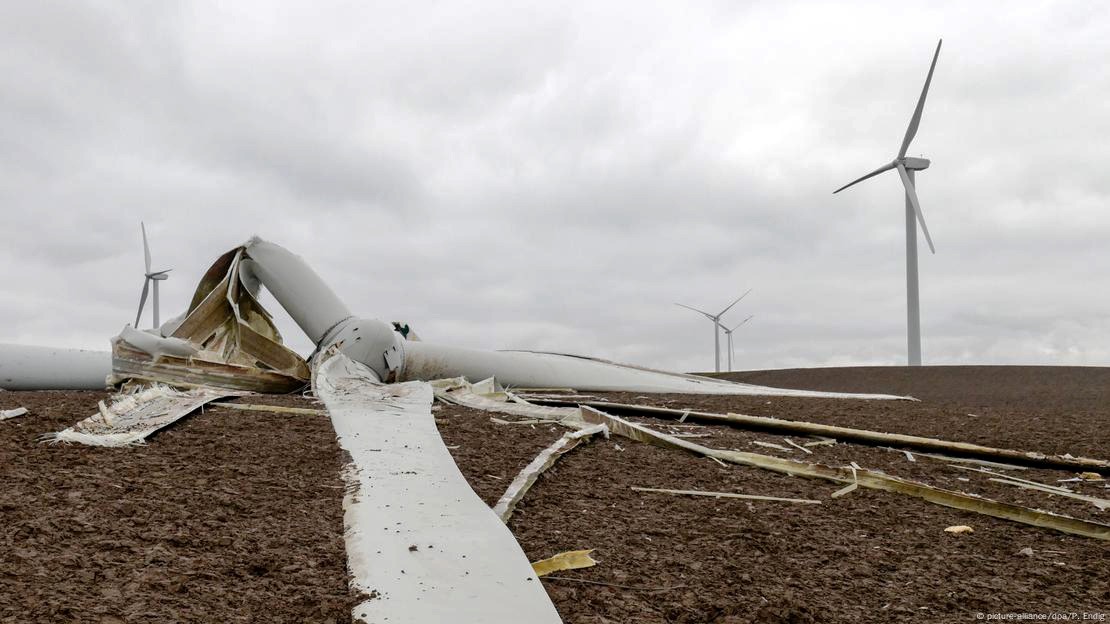
The article in the Western Mail does mention “wind farms”, but without making the obvious connection, though the image used is revealing.
When you think about it, if the environment was the real priority, then, rather than political virtue-signalling and providing guaranteed returns for foreign companies and well-connected people, the best thing to have done would have been to leave the trees and the peat well alone.
Not only has the ‘Welsh Government’ failed the environment, it has also failed us, the people of Wales. For these bird-killing monstrosities create no jobs, no turbines are built in Wales, and they’re all foreign-owned so the money leaves Wales.
Wind turbines in Wales are 19th century colonialist exploitation (but without the jobs) given a quick coat of greenwash for the 21st century.
Wales deserves better. But we’ll never get it by voting in the same clowns who encourage managed decline and then pretend to be ‘doing something’ by offering wind turbines.
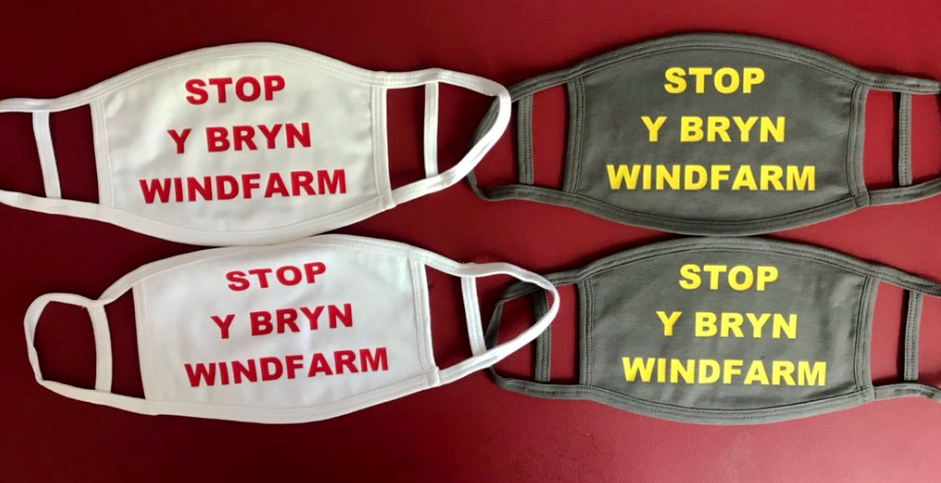
Support this campaign because we all want to help the environment but wind farms are just a money-making scam that’s gone on for far too long.
Now read what a spokesperson for the campaign has to say . . .
♦
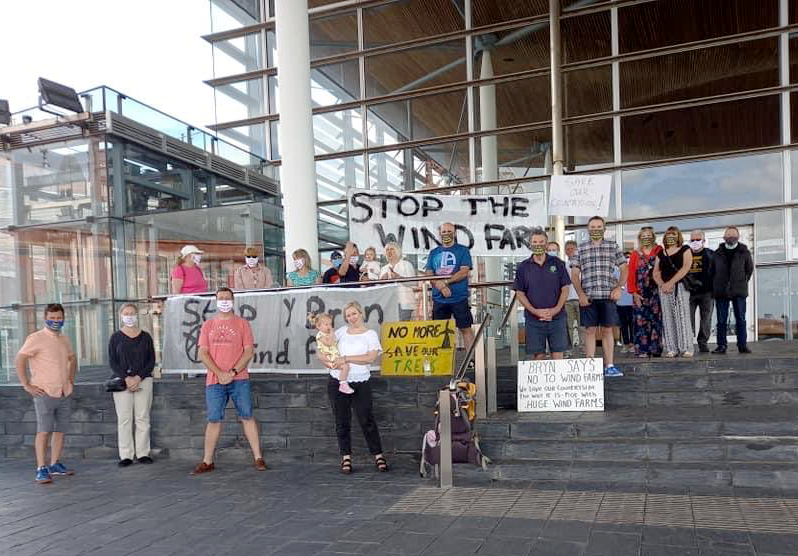
In just 4 short weeks, the ‘STOP Y Bryn Onshore Wind Farm’ Facebook Campaign group has gone from a standing start to ‘full pelt’ in the blink of an eye, leaving its originators with very little time to catch their breath, and yet in that brief but exciting period, support for the group has grown to just short of 1000 members; it has established a committee, set up a bank account, a Crowdfunding page, AND it has held its first public protest outside the Welsh Government home, Y Senedd.
The protest outside Y Senedd. Click to enlarge
If that is not enough for starters, It has also attended all five of the initial public consultation meetings set up by the proposers of the wind farm project, Coriolis Energy (wind energy developers) and ESB (Ireland’s premier energy company), where the group and its supporters have emphatically shown they are serious about fighting this proposal to the very end.
The campaign group is acting in response to a proposal that is so lacking in detail that even some Senedd members are terming it as just an ‘idea’ at this time, but with it comes the need for so many questions to be answered, and the residents of the affected villages are not happy to let this proposal go uncontested.
But where do you start with the issues brought about by a proposed development of this magnitude? It is one of the best kept secrets in amongst these small semi-rural areas of South Wales, which is an achievement in itself given that usually a mouse can fart and everyone is gossiping, and whilst residents were clapping for NHS Heroes or giving an elderly war veteran money to walk around his garden, the supposedly transparent Welsh Government by way of Natural Resources Wales were inviting tenders that would allow swathes of lush green countryside to be carved up in anticipation of 26 wind turbines to be built in situ, the size of which onshore Britain has never seen before. But secrets of this kind don’t tend to remain secrets for very long, and this one was not going to be the exception.
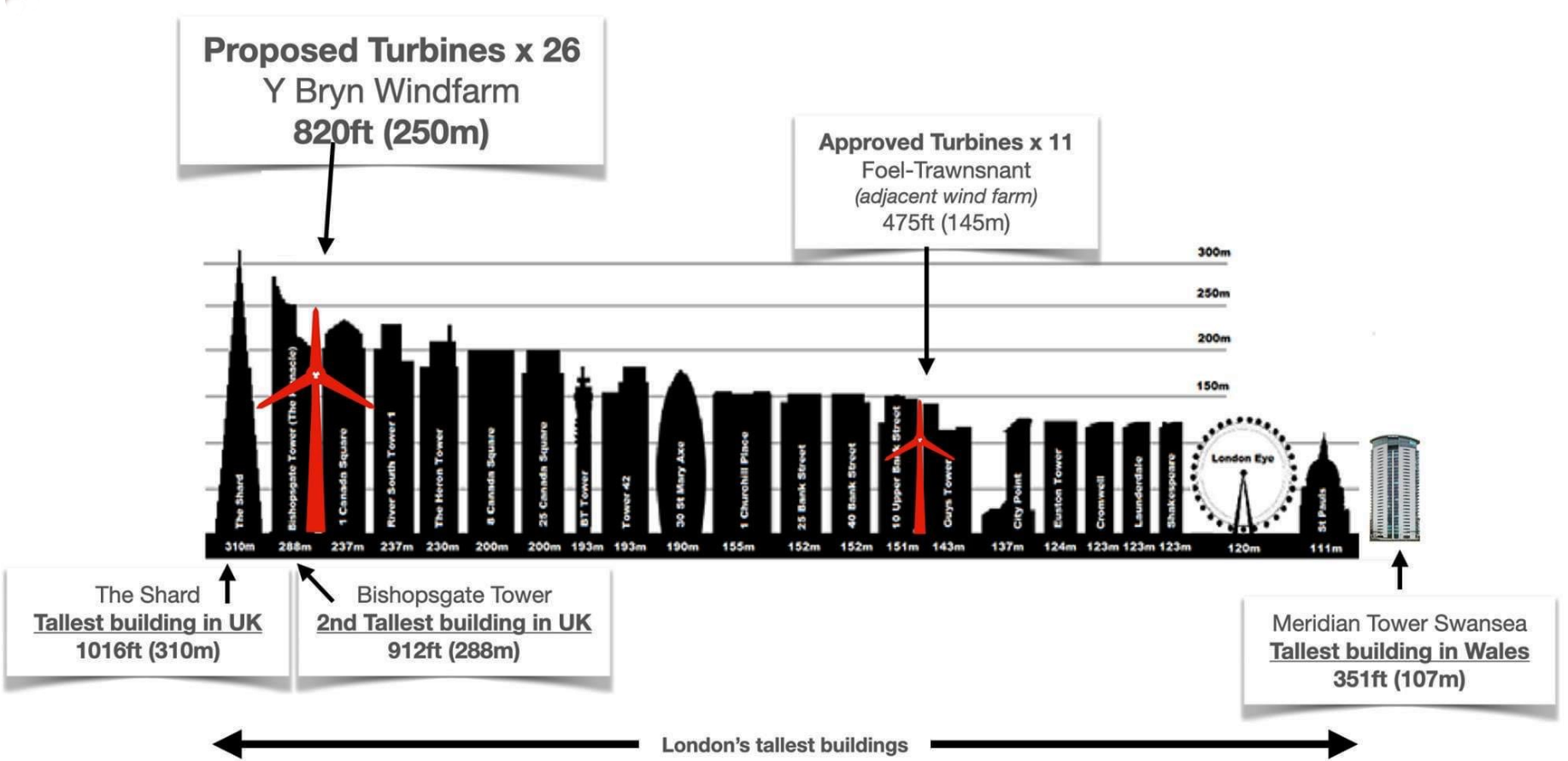
Soon after the secret was out, residents found themselves talking at 2 metre distances about the environmental destruction that was being proposed, their conversations focused on the suggestion these turbines would reach heights up to 250 meters, and that their blades would be of 80 meter lengths….but what is that in ‘old money’ and what could these structures be compared to?
The turbines planned for Y Bryn are taller than Wales’ tallest building. And remember, the Meridian Tower is at sea-level, whereas these turbines, more than twice the height, will be on hills. Click to enlarge.
The Eiffel Tower, the Shard, local electricity pylons…..it was all a guessing game because of that lacking detail everyone so desperately needed. The reality is people can’t begin to envisage how these will look on top of their beautiful, lush green hills without appropriately designed graphic images, but what they can envisage is how detrimental and destructive these colossal chunks of steel will be to the area, perched on top of land that provides habitats for some of the country’s most cherished species of animals and birds, and who’s ecology contributes so much to an environment already facing a crisis that seems to know no bounds.
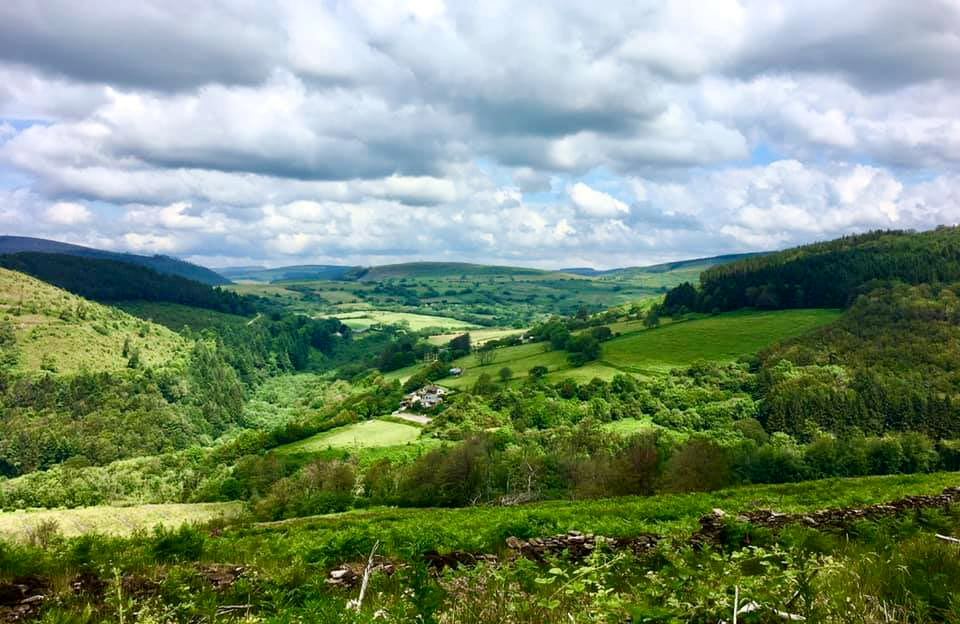
These surrounding areas have undergone a transformation in recent years, where the scars from coal mining and other heavy industrial activity have been eradicated and acceptably replaced by flora and fauna many now see as an extension to their own back gardens….except now people are envisaging morning coffee views that bring with them the hum of rotor blade activity drifting on the winds of change, and bringing with them the threats to communities and environments that mean so much more to the residents and villagers.
Many of the campaign group’s questions focus on the environmental impact of this proposal, but like so many other controversial proposals, the details are extremely vague to the extent that the credibility and the incentives of both development companies involved have to be seriously questioned.
For example, why is NRW, which is a public body, being permitted to freely auction off environmental spaces that mean so much to walkers and cyclists, not to mention the eco systems that dwell therein? Surely such activity should be overseen by Welsh Government, and surely they should be seeking authorisation from Y Senedd before putting public land up for tender?
Additionally, with the land proposed being of such historic interest, who at NRW first thought it to be an acceptable area for wind farm development? Heaven knows the importance the people of Port Talbot and Bridgend put on their green space where they are seen as byways that promote better mental and physical health and wellbeing. But, when questions regarding issues around Environmental Impacts, land suitability, sustainable long term employment opportunities, and community benefits are asked, answers are at best contradictory, if there are any answers at all.
The reality is, the Valleys and feeder regions have long been ignored by politicians and business leaders for the inward investment opportunities so desperately needed as a resolution to industry losses in sectors like coal and steel to name just two, and its the residents of those regions who have been expected to accept ‘poor relations’ subsidy programmes historically bestowed upon us by quangos like the Welsh Development Agency, which have then been passed off as ‘Tory Blue’ success stories.
Click to enlarge
Nevertheless, the people of Port Talbot and Bridgend are no longer prepared to be overlooked, and they expect their voices to be heard on this proposal. As the campaign grows and gathers momentum, its members intend to battle on through a program of constructive research and fact-finding exercises whilst it develops a strengthening network of support that delivers positive responses on a daily basis, all driven by the members who BELIEVE wholeheartedly in this fight.
Its steering committee consists of intelligent individuals who are not only aware of the ‘due process’ proposals such as this one are expected to follow, but they are also creative and resourceful to boot. These are not a trigger-happy bunch of community gun-slingers, but instead they are community-spirited residents who are steadfast in their belief that whilst the world needs answers to the Climate Emergency that has been declared globally, there’s is a real suggestion colossal wind turbines are NOT a suitable on-shore solution due to the environmental devastation they can bring, and that a more strategic approach with joined-up thinking and measured risk analysis is needed in order to find a sustainable solution.
The area as it is today. Click to enlarge
As the first round of public consultations is assessed, initial feelings are very positive, especially when the main developer Coriolis is reporting an unexpected number of written objections as well as attendance to its public meetings.
The voice that is ‘STOP Y Bryn Onshore Wind Farm‘ is being heard, and the message it is portraying is reaching far and wide into the communities that stand to be affected by the development. The live Facebook broadcasts from Y Senedd protest have impacted not only on existing campaign group members, but they have touched corners of the community that have so far remained oblivious.
‘What next?’ they hear you ask…..quite simply, they continue to do what they have done so successfully thus far, which is working strategically but stealthily, using their resources and contacts collectively, and pooling their knowledge to lead a campaign that shows grit and determination that is so inherent in the people of Wales! Are you on board?
Revelations that Stephen Kinnock and his wife Helle Thorning-Schmidt sent their elder daughter Johanna to private schools are making waves in both Denmark and Wales in a tale so tangled that even Hans Christian Andersen would have cried the Danish equivalent of “WTF?”
So if you are sitting comfortably, let’s begin at the beginning. Well, sort of.
In Denmark private schools are heavily subsidised by the state which provides up to 87.5% of their funding, leaving parents to pay relatively modest fees by UK standards.
Private education has long been a contentious issue on the left of Danish politics, with the Social Democrats as ambivalent about it as their British counterparts in the Labour Party. Senior Social Democrats who have sent their children to private schools have attracted criticism from sections of the party, but it is not party policy to abolish private education, and unsurprisingly given how many of its top brass use private schools, the party now takes the line that it is a matter of individual choice.
Kinnock and Thorning-Schmidt have two daughters, and it was long their policy to keep their children out of the public eye. Their privacy was respected by the Danish press, to the extent that when Johanna’s education became an issue, the press had no recent pictures of the family. As we shall see, that changed when Stephen Kinnock launched his campaign to become Labour’s candidate for Aberavon, and was keen to stress his family values.
Non-dom
Kinnock, now 46, has an impressive back catalogue of controversies, and in Denmark none was bigger than the row over his non-dom status, despite being married to the country’s Prime Minister and having his family home in Copenhagen.
The tax row and the investigations and official inquiries which followed it ran on for years, finally coming to an end at around the time Kinnock was seeking to become Labour’s candidate in Aberavon. For those interested, a summary of this bizarre affair can be found here.
Certainly, media interest in his tax affairs gave Kinnock invaluable experience in how to deal with the press and answer awkward questions. Not only did he escape ever having to pay a penny in tax in Denmark, but the row over his conduct and his tax avoidance did not surface as an issue when he launched his campaign to be selected in Aberavon.
What questions Kinnock did face concerned his choice of school for his daughter Johanna, and here again lack of scrutiny by the UK media and a thick coating of Teflon served the Red Prince well.
The timings of events and revelations are important in forming an understanding of how, possibly with quite a lot of luck, possibly with skillful news management, and possibly a conspiracy of silence from some in the media, Stephen Kinnock and Helle Thorning-Schmidt were able to face elections in their respective countries without their daughter’s exclusive private schooling becoming an issue.
What Johanna did next – a timeline
Johanna Kinnock begins her secondary education at a state school in Copenhagen, but moves “for private reasons” to the rather more exclusive private Ingrid Jespersens Gymnasieskole which she attends between 2010 and 2012.
Fees at the school were DKr 1,500 per month (around £165), although as we shall see, Kinnock later suffered a lapse of memory about how much the family had actually paid.
In 2012 Johanna, then aged 16, is on the move yet again, this time to Hellerup Gymnasium, a state school where she stays for just one year.
2013 – Johanna packs her bags and heads off for the exclusive Atlantic College in the Vale of Glamorgan, where fees are currently £28,600. There she completes her secondary education in 2015, a year when both of her parents fight general elections in their respective countries.
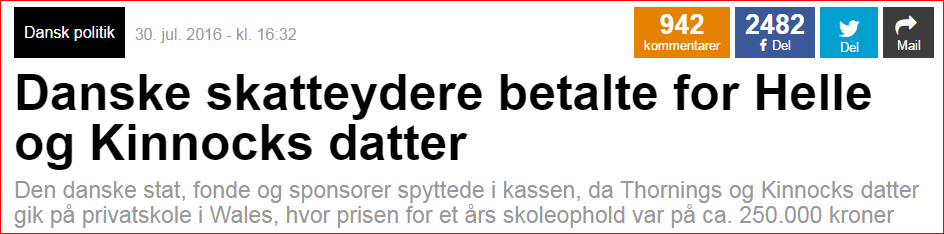
A recent article in the Danish tabloid Ekstra Bladet (see translation below) suggests that Kinnock and his wife would have paid around £12,000 a year, including a £10,000 voluntary contribution based on his wife’s income as Prime Minister. The rest was paid by the Danish taxpayer under a grant scheme set up to help parents fund the cost of education abroad, and various unspecified “funds and sponsors”.
November 2013 – Hywel Francis announces that he will stand down at the UK general election in 2015, and so the race to find his successor begins, culminating in a vote by the constituency party on 22 March 2014.
There were seven candidates, of whom the early favourites were Jeremy Miles, a lawyer from Pontarddulais (now Labour AM for Neath), and Mark Fisher, local Unison official. Miles was understood to have won the backing of six local branches of the party and have had a clear lead over Fisher.
Somehow Kinnock came through with a late run to beat Miles by a short nose (106 – 105) on March 22, after a recount. This article from Left Futures by Jon Lansman – founder of Momentum – gives one explanation for how this happened.
In the run-up to the vote, Kinnock’s opponents began asking questions about Johanna’s schooling in Denmark, apparently unaware that she was by then living and studying just a few miles away at Atlantic College.
The Western Mail first picked up on the story on 19 February:
In this article Kinnock, with breathtaking chutzpah, told Martin Shipton that Ingrid Jespersen’s Gymnasieskole had cost only around £80 a month, and he added that she had gone on to “the equivalent of a sixth form college in Denmark which is wholly state funded”, neglecting to mention that she had since gone on from Hellerup Gymnasium to the £28,600 a year Atlantic College.
The very careful wording which obfuscated Johanna’s whereabouts seems to have put the media hounds off the scent, although they quickly discovered that fees at Ingrid Jerspersens Gymnasieskole were twice the level that Kinnock had claimed.
On 1 March 2014 Kinnock was back in the Western Mail to, ahem, “clarify” matters.
The newspaper article talks about attempts by Kinnock’s political opponents to undermine his campaign, and quotes Kinnock as follows:
“This was a fast-moving story and I was very keen to clarify some of the misleading things that were being said about my daughter’s schooling as rapidly as possible.”
Note the implication that it was other people who had been saying misleading things about his daughter’s schooling, rather than Kinnock himself.
The very next day, 2 March 2014, a Danish journalist working for Ekstra Bladet quoted a conversation he had just had with Shipton of the Mail:
‘”I have spoken to people in the party, and they are not impressed by his inaccuracies. They believe that this could influence Stephen Kinnock’s chances”, says Martin Shipton who is editor of the Welsh newspaper Western Mail which has reported on Kinnock’s misinformation.’
With three weeks to go to the crucial vote in Port Talbot, nobody seems to have picked up on the fact that Johanna was not in Copenhagen at all but just down the road. Another whole year and a bit later on 8 May 2015, and another Danish tabloid, BT, produced this very illuminating report just as the dust was settling:
The newspaper notes that Kinnock and Thorning-Schmidt had always been careful to shield their daughters from the media, so much so that BT had very few pictures of the two girls in its archive. All of that changed in March 2014 when Kinnock released a family portrait taken for use in his selection campaign, and Johanna is pictured again in the report cuddling up to her mother during the count on election night (7/8 May 2015).
The newspaper comments that this sudden change of tack was a strategic choice to portray the Kinnock Thorning-Schmidts as a family which sticks together, “something which means a lot in Wales”.
BT continues by recalling that Johanna had previously been in the limelight in Denmark when it emerged that she had been sent to the fee-paying Ingrid Jespersens Gymnasieskole, echoing a scandal which broke in 2010 when it emerged that a number of senior Social Democrats had children in private schools.
(Two revealing reports on the Kinnock’s attitude to private education appeared in the Danish publication BT; the first on May 9 2010; the second 11 June 2010; both updated 19 September 2012. The headline of the first translates as, ‘The truth about Helle’s spin’, the second, ‘Helle Thorning’s husband raging against private schools’. Translations (in summary) for both articles can be found by clicking here. Many thanks to our new Danish contact for the links, and to one of the authors of this piece for the translations. Jac)
“Today Johanna attends an international high school in Wales, the UWC Atlantic College, which is close to where Stephen Kinnock is living”, the piece says in conclusion.
Clearly, some in the media knew of Johanna’s whereabouts before the UK general election and probably before Kinnock was selected as Labour candidate for Aberavon. If the arrangements at Atlantic College had been known about, it is highly unlikely that Kinnock would have been selected, and if his handling of the affair had been known about, it would hardly have been a vote winner in Port Talbot in May 2015, come to that.
Instead, Kinnock based his campaign on family values, his close connections from his time at Xynteo with captains of industry, including Tata Steel bosses, and a promise to bring jobs to the town. Promises which were to evaporate after the general election even quicker than fairy dust.
Revelations that her daughter was attending a Dkr 250,000 a year school in Wales, partly at the expense of the Danish taxpayer, would not have helped Helle Thorning-Schmidt either when she faced voters in a general election on 18 June 2015.
Fortunately no hacks bothered to follow up on BT’s heartwarming report with its tender images.
Although the Social Democrats slightly increased their share of the vote, their coalition partners fared badly, and so ended Helle’s stint at the top.
But there is a happy ending because soon after resigning Helle landed the top job at Save the Children International in London, where her predecessor was reported to be earning £234,000 a year – rather more than the Prime Minister of Denmark.
Even more remarkable was that she landed the job despite coming under fire from, erm Save the Children among others, for implementing policies as prime minister which keep refugee children separated from their parents.
And there matters would have rested had it not been for wicked old Jac o’ the North spilling the magic beans on the whole convoluted saga a year later, with post-factual Kinnock claiming to have been open about his daughter’s schooling all the way along.
Labour and the Danish Social Democrats have come a long way since the days of the Little Match Girl who would now be facing deportation or arrest for pestering passers-by when she could go and get a proper job as a consultant.
*
Danish taxpayers pay for Helle and Kinnock’s daughter
Translation of an article which appeared in Ekstra Bladet on 30 July 2016.
Danish taxpayers paid Dkr 140,000 (around £16,000) for the two years former Prime Minister Helle Thorning-Schmidt’s daughter, Johanna, attended Atlantic College in Wales from August 2013 to June 2015.
Annual school fees at the private school are £28,600 – around Dkr 250.000 – but Helle Thorning-Schmidt and her husband Stephen Kinnock did not have to pay that.
Instead, they paid between Dkr 18,000 (£2,000) and Dkr 88,000 (£10,000) a year to send their daughter Johanna to Atlantic College in Wales.
This information comes from the website of United World Colleges (UWC).
UWC sends 15-20 Danish high school pupils to one of the organisation’s 15 schools every year in Europe, Costa Rica, India, Singapore, Swaziland, USA, Hong Kong and China.
The state paid Dkr 70,000 per year
UWC’s Danish website shows that the average fee per pupil is DKr 158,000 (£18,000) per year.
The Danish state contributes Dkr 70.000 (£8,000) towards the cost, a further Dkr 70,000 is provided by funds and sponsors, while parents contribute Dkr 18,000 (£2,000) a year.
UWC Denmark depends on donations from parents in order to give a place to young people a place at a UWC school, it says on the website.
Parents paid Dkr 18,000 per year
For this reason the organisation asks parents to make an additional contribution above the minimum of Dkr 18,000 per year.
UWC has a limited number of full bursaries. If a household’s total income is less than Dkr 250,000 a year before tax, parents can apply for a full bursary. Other parents pay a compulsory family contribution of Dkr 18,000 per year, the organisation states on its website.
It is therefore clear that the Thorning-Schmidt/Kinnock family paid a minimum of Dkr 18,000 a year to send their daughter to Atlantic College in Wales.
UWC asks parents to pay additional contributions beyond the Dkr 18,000 to the organisation.
Tax deductions of Dkr 15,000 per year
If parents wish to donate more than the compulsory DKr 18,000 contribution, they may claim tax relief of up to DKr 15,000 per year. It therefore follows, the organisation says, that the more parents who donate money, the more pupils will obtain a place.
UWC therefore suggests that parents pay an additional contribution from their taxable income.
UWC suggestion to parents
UWC’s proposals are as follows:
Parents with a taxable income of between Dkr 500,000 and Dkr 750,000 should pay between Dkr 15,000 and Dkr 45,000 per year.
Parents with a taxable income of between Dkr 750,000 and Dkr 1,250,000 should pay between Dkr 45,000 and Dkr 70,000 per year.
Parents with a taxable income of more than Dkr 1,250,000 should pay Dkr 70,000 per year.
As Prime Minister Helle Thorning-Schmidt earned Dkr 1,439,443.75 (£163,500) in 2013. Depending on her final declaration, she should therefore have paid an additional Dkr 70,000 to UWC.
Kinnock on Facebook
On his Facebook page Stephen Kinnock confirms that his daughter’s place at Atlantic College was partly financed by the Danish state.
Johanna’s stay at AC was partly financed under Danish rules governing grants for students studying abroad. The majority of AC’s students and those at other United World Colleges schools are financed by a mixture of state grants and national committees in their respective countries, Stephen Kinnock writes on Facebook.
Welsh blogger
He was reacting to accusations made by the Welsh blogger Jac o’ the North on his blog that Stephen Kinnock hid the fact that his daughter Johanna went to an expensive private school from Welsh voters when he was standing for selection for the Aberavon constituency in the spring of 2014 – a constituency which has returned a Labour MP since 1922.
Jac o’ the North says that Stephen Kinnock would not have been selected if Welsh voters had known that his daughter Johanna was going to the expensive Atlantic College.
I answered questions
Stephen Kinnock confirms on his Facebook page that his and Helle Thorning-Schmidt’s daughter’s stay at Atlantic College was partly financed by the Danish taxpayer.
I was asked about and answered questions about her schooling in Denmark (where she attended the private Ingrid Jespersens School from 2010 til 2012, Ed.), Stephen Kinnock wrote, failing to elaborate whether he would have answered if Welsh journalists had asked him if Johanna had gone to an expensive private school in Wales.
*
Jac says . . .
I still have difficulty believing that when Martin Shipton of Llais y Sais interviewed Kinnock in February 2014 he was unaware that the subject of the discussion, Johanna Kinnock, was already in her second term at Atlantic College.
Given Shipton’s support for the Labour Party, and remembering that his employers Trinity Mirror also support Labour, it could well be that the news was already circulating about Johanna but – perhaps as a favour to the girl’s grandparents – Trinity Mirror arranged for Shippo to ask the wrong questions in order to ‘settle’ the allegations of her being privately educated.
But let me, for once, push aside my usual draught of vitriol and drink of the milk of human kindness, (God! I’m going some here) and give Shippo the benefit of the doubt, and more, extend that benefit to all the other journos in Wales.
It’s entirely possible none of you knew that the grand-daughter of the ultimate champagne socialists, Lord and Lady Hypocrisy, whose father was seeking election to a Welsh constituency, was being educated at a very expensive school a few miles outside Cardiff . . . but if so, what does that say about you as journalists?
Maybe you should stick to belittling Welsh identity. That seems to be all that most of you are good for.
Yes, I know, Port Talbot isn’t the only Tata plant affected by the company’s decision to put its UK operation up for sale, but it is the biggest, and serves as useful shorthand.
Rather than giving instant remedies or exposing my ignorance by trying to discuss EU regulations on state aid, or the impact of carbon tax and business rates, let alone the statistics on Chinese steel production and exports, I shall stick to my comfort zone by considering political responses and impacts, winners and losers, and also the possible outcomes.
But first, let me indulge in a little reminiscing.
*
I grew up just around the Bay from Port Talbot steelworks and I can remember the plant in the mid-’60s when it employed 20,000 men and the wages paid earned it the soubriquet ‘Treasure Island’. Much of its steel went on to the tinplate works at Trostre in Llanelli and Velindre on the north side of Swansea (where I worked for a short while). Velindre is long gone, but Trostre has struggled on and is now in the same position as Port Talbot.
And if you’ve driven past and think the smells and the smoke of Port Talbot are bad nowadays, then you should have seen it in the ’60s and ’70s. It wasn’t just that the steelworks produced more smoke and smells back then, there were other plants nearby making their contribution.
Just up the road, on the Swansea side of the steel plant, in Baglan Bay, we had one of the largest petrochemical sites in Europe, employing another 2,500 men. A couple of miles inland there was the Llandarcy oil refinery with the same number of employees. Then there was the Tir John power station taking us up to the eastern outskirts of Swansea, where the East Side made its contribution to the shit and the smell with the never-to-be-forgotten Carbon Black plant.
This spewed out such filth that it resulted in regular protests by local housewives, who couldn’t put washing on the line to dry without it being covered in a dust that also got indoors and clung to everything.
My first-hand experience of Carbon Black came through a summer job I took when at Coleg Harlech. I was employed to sweep the floors inside the plant, where the filth lay inches thick. I was provided with a brush and a rudimentary face mask . . . and that was it. I handed in my brush after a few hours and went to a nearby pub to ease my throat.
The whole area from the east side of Swansea over to Neath and down to Port Talbot was a complex of heavy industry, a nightmare for any proto-Green. And yet, if we add in Swansea docks, the ancillary jobs in transport and other fields, this triangle of smoke and smells provided tens of thousands of well paid jobs for semi-skilled and unskilled men. Most of these jobs have gone, and will never be replaced.
I had many friends and family members working at these various plants, and of course at the steelworks, and not just for the then owner, the Steel Company of Wales. For example, there was a boy I met in Penlan school with whom I became good friends (after the introductory fight); his family had come down from Kilmarnock and his father worked for British Rail in the steelworks’ marshalling yards, said to be the biggest in the world after those at the Chicago stock yards.
Then there was a friend of ours in the post-school era working in the steel works. One night he went over to Port Talbot to hear a promising young singer named Tom Jones. On the way back into Swansea, driving along the Jersey Marine in his Wolseley 1500, he was somehow thrown from his car, which then rolled over onto him. I think Keith was the first close friend I lost.
*
THE POLITICAL DIMENSION
The Conservatives
I suppose the Tories’ attitude was summed up accurately and succinctly by Paul Mason when he wrote, ‘Steel Crisis; they do not give a shit’. There are a number of reasons for this being true beyond the Tories being wedded to a blind and unthinking neoliberalism.
The future the Tories envision for the UK is of smart people doing clever things and making lots of money in clean environments with the economy topped up by sheikhs and oligarchs investing hundreds of billions in property and other deals that can be accomplished with a signature. Fundamentally, it’s a fantasy world in which people make lots of money doing very little, certainly not from producing anything other than hi tech gadgetry or financial packages that no one can understand.
There is no place in this vision for steel works and towns like Port Talbot. Such places are alien to Old Etonian politicians. Not only are they distant in terms of miles, and in considerations of social class, they are also distant in time, because they belong to the past, they have no place the glittering future I bewitched you with in the previous paragraph.
Of course, one of the major problems with this vision is that it’s very London-centric, extending only as far as the Home Counties in which many of the new elite will be living. Because you can bet that Sheikh Mohammed bin Slaveholder al Head-chopper is unlikely to be looking for a £30m mansion in Llanelli or Scunthorpe any time soon. Which explains attempts to placate the increasingly resentful natives north of Watford with ‘beads’ like HS2 and talk of a ‘northern powerhouse’.
On a more pragmatic, electoral level, the Tories have nothing to lose in towns like Port Talbot or any similar community in Wales, Scotland or England. You can’t lose support or seats if you haven’t got any to start with. So the truth is, as Paul Mason says, the Tories don’t give a shit.
Unconvincing expressions of concern will be heard, money will be doled out – there might even be a short-term nationalisation – but this hiccup will not be allowed to interfere with the march towards the post-industrial Bright Tomorrow, in which the sons and daughters of today’s Port Talbot steelworkers will be City traders or internet tycoons . . . or, more likely, working just up the road at the vast Amazon warehouse, on the minimum wage, with one toilet break a week.
Though it will be interesting to see how the local Tories deal with the steel crisis in the Assembly election campaign. Who will they blame?
*
The Labour Party
For Labour the steel crisis is much more complex and worrying. Not least because it was the equally laissez-faire New Labour governments that helped get us into this mess by nodding through British Steel’s merger with Koninklijke Hoogovens of the Netherlands in 1999 to form Corus, and then twiddling their thumbs when Corus was bought by Tata Steel of India in 2007.
The New Model Labour Party of Citizen Corbyn seems rather more concerned than the party led by Blair and Broon, but there’s little they can do out of power. Though in fairness to young Owen ap Dai ap Smith he didn’t wait for the fat lady to sing before putting the boot in, here he is at the start of February accusing Cameron and Osborne of kissing China’s arse!
Another scion of an anti-Welsh Labour family, the Boy Kinnock, actually took himself off to Mumbai, where the Tata board was deliberating. Quite what he hoped to achieve beyond a little self-promotion is a bit of a mystery. But then, showboating was always part of his father’s political repertoire, though I advise the young ‘un to avoid beaches with incoming tides.
Closer to home, our self-styled ‘Welsh Government’ can only be compared to rabbits caught in the headlights. There are a number of reasons for this. One, they have no experience of business, let alone business on this scale. Two, they simply aren’t aren’t up to the challenge intellectually. Three – and for this they are probably thankful – they don’t have the power to do anything.
That said, this announcement comes at a good time in the electoral cycle for ‘Welsh’ Labour, with Assembly elections just over a month away they can blame the ‘heartless’ Tories for everything and hope that voters don’t remember their party’s role in this tragedy.
And as usual there will be a cynical appeal to the ignorance and confusion of many Welsh voters as Labour – despite being impotent in Cardiff and in opposition in London – urges people to vote for Carwyn and the gang so that Labour can ‘save Port Talbot’.
*
Plaid Cymru
The steel crisis should be Plaid Cymru’s Christmas, Easter and St David’s Day all rolled into one. It gives them the chance to attack both major parties, English rule, and foreign ownership of Welsh assets. Thus far, I can only assume that Plaid is waiting its chance, holding its cards close to its chest . . . or maybe it doesn’t realise it has these cards.
I would suggest that rather than asking for anything absurd or impossible – such as demanding that the ‘Welsh’ Government nationalises the steel industry – Plaid Cymru should gather the evidence on the merger and the take-over that Labour allowed to go through when in power, and the Tories’ opposition to the EU raising tariffs on Chinese steel, the refusal by both parties to reduce energy costs for plants like Port Talbot, and compare those betrayals of the Welsh people with what Plaid Cymru would do if it was in power down Cardiff docks.
And stressing a betrayal of the Welsh people should be Plaid Cymru’s approach, rather than going all socialist and linking arms with Labour and the trade unions. Because unless Plaid Cymru’s voice is distinctive, and distinctively Welsh, then there’s really no point to Plaid Cymru, in this debate, or any other situation.
*
Liberal Democrats
I know I’m normally harsh on the Lib Dems, but over the years it’s been difficult not to be harsh, and at times almost impossible to take them seriously. And then, in my more mellow moments (not always induced by alcohol!) I think, ‘Weeel, maybe they’re not too bad’. ‘What brings this on?’ you ask.
To start with, there’s Kirsty Williams, the LD leader in Wales. Things have been tough in recent years for her party but she’s stuck with it and deserves a break. She’s a gutsy woman who I’m warming to.
Another LD AM who’s impressed me is William Powell. For one thing, he turns up at Cilmeri in December, where we rarely see Plaid politicians and never Labour or Conservative. (Nor UKIP, come to that!) And then there was the petition I submitted to the Assembly asking that it do something to stop chief executives taking over councils.
It was clear that Powell recognised the importance of this issue but the two committee members who ‘discussed’ my petition, Labour’s Joyce Watson and Plaid’s Elin Jones, couldn’t dump it quickly enough. Powell might get my second vote on May 5th.
But I digress.
On the specific issue of the sale of Tata’s UK operations, the Lib Dems – in the shy, retiring form of Peter Black – have called for the Notional Assembly to be recalled. Which might sound like a good idea until we remember that the Assembly is impotent, and what calls itself the ‘Welsh Government’ is nothing but a collection of buffoons. A recall would be nothing more than a pointless gesture and a platform for narcissistic buggers like Black.
In many ways the Lib Dems’ position should not be a lot different to that of Plaid Cymru – ‘A pox on both your houses!’ So I would suggest that Kirsty leads her troops forward with all guns blazing . . . hoping few will remember that her party kept the Tories in power between 2010 and 2015, during which period the problems that have brought us to this crisis were allowed to build and build.
*
The Wales Branch of the Green Party of Englandandwales
They won’t like me for saying this, but I know that the Greenies were secretly jumping for joy when they heard that all those smelly, polluting steel plants are to close. But of course they can’t admit that.
What they can do, apparently, is write stupid letters to the press, such as the one below that appeared in Friday’s Wasting Mule. The writer seems to believe that the Port Talbot steel works can be powered by wind turbines, solar panels and fairy dust.
Then again, it could have been a piss-take, for Friday was April 1st.
I issue these rebukes with a heavy heart, fearing that I might lose some of the many friends I’ve made in the Green Party over recent years. Oh yes.
*
UKIP
If any political party is crass and insensitive enough to make cheap political capital out of tens of thousands of people losing their jobs, then of course that party is UKIP.
Not only does the steel crisis give M. Farage et Co the chance to go nuclear on ‘Europe’, it also provides the opportunity to put the boot into Conservatives and Labour, with the cherry on top being the chance to have a go at the Chinese, the Indians, and just about anybody else they can think of.
UKIP will I’m sure argue that this steel crisis thingy would never have happened if everything was still managed by those splendid chaps down the clubhouse. Better decisions are made after six or seven drinks and a few cigars – everyone knows that! Don’t laugh, a lot of people will believe them.
A few months ago UKIP was predicted to win anything up to nine seats in May’s Assembly elections then, more recently, I’ve seen polls suggesting that support is slipping. The steel crisis could put them back to where they were earlier in the year, and the Tory-supporting media transferring the blame onto the EU might even take the UKIP vote in Wales to new heights.
However you cut it, UKIP is the party with most chance of gaining in May’s elections from the steel crisis.
*
SNP
Yes, I know what you’re thinking, but bear with me.
There were a couple of steel plants in Scotland, admittedly much smaller than Port Talbot, that were saved from closure in the past few weeks thanks to decisive action by the Scottish National Party government. Here’s a report from the Guardian.
But this action didn’t please everybody. Here’s a more recent report from the Labour-supporting Daily Record (the Scottish version of the Daily Mirror) telling us that the Labour-controlled Community union is ‘questioning’ the deal.
To explain . . . there are elections in Scotland on May 5th also, and the SNP is almost guaranteed to win by a landslide. So one interpretation of this bizarre intervention by Community is that embittered Labour supporters are prepared to sabotage the Scottish steel deal for short-term political advantage.
Surely Labour wouldn’t do that?
Oh, yes, and remember, the Boy Kinnock was chaperoned on his trip to India by representatives of the same trade union. Whose interests were they looking out for – the steelworkers or the Labour Party?
*
EU Referendum
Speaking of the EU reminds us that on June 23rd we have the referendum on whether to stay in or to leave. The fate of the steel industry is bound to influence the way many people vote, especially in Wales. And seeing as Wales gives us the paradox of many Labour voters reading English Tory newspapers then prolonging the crisis can only help the Brexit cause.
Thinking more obliquely, this realisation that the steel crisis could decide a currently too-close-to-call referendum might prompt the EU into action; and if Cameron is serious about staying in the EU, then he might have to discreetly explain to his Chinese chums that – until the referendum is won – he might need to sound a little ‘hostile’, even agreeing to raise tariffs on Chinese steel imports.
When you consider all the possible ramifications you realise that, serious as the crisis in the steel industry is for those directly – or even indirectly – involved, the closure of Port Talbot and the other plants could have long-term and far-reaching implications that overshadow the loss of jobs.
In many ways Prime Minister Cameron is the one to watch, because with the EU referendum complicating things, him not wanting to be seen as a callous toff, yet having to protect the interests of his mates in the City by not offending the Chinese, the next few weeks could be interesting for those who like to watch nifty footwork.
As the Chinese themselves are reported to say, ‘May you live in interesting times’. (Though some say it’s delivered as a curse, not a blessing.)

 A bit of a departure, this one. And certainly not what I advertised last Saturday. Though that element does figure in this bigger picture.