Poppies, Row on Row

PART 1: ‘THE BEAUTIFUL GAME’

This autumn has seen a succession of spats between the football associations of the ‘home’ nations and FIFA the international governing body of the game over displays of poppies, which FIFA deems to be a political symbol. These disputes reached something of a fever pitch last week when FIFA laid a number of charges against the Football Association of Wales (FAW) linked to the game against Serbia on November 12 (which I attended).

Press reports suggest that one of the charges was that fans had worn poppies in their coats! Which, if true, is insane. For not only would such a charge infringe personal liberty but also open up a vat of worms for those having to decide what qualifies as a political symbol. (At the game I wore a discreet Glyndŵr flag lapel badge.)
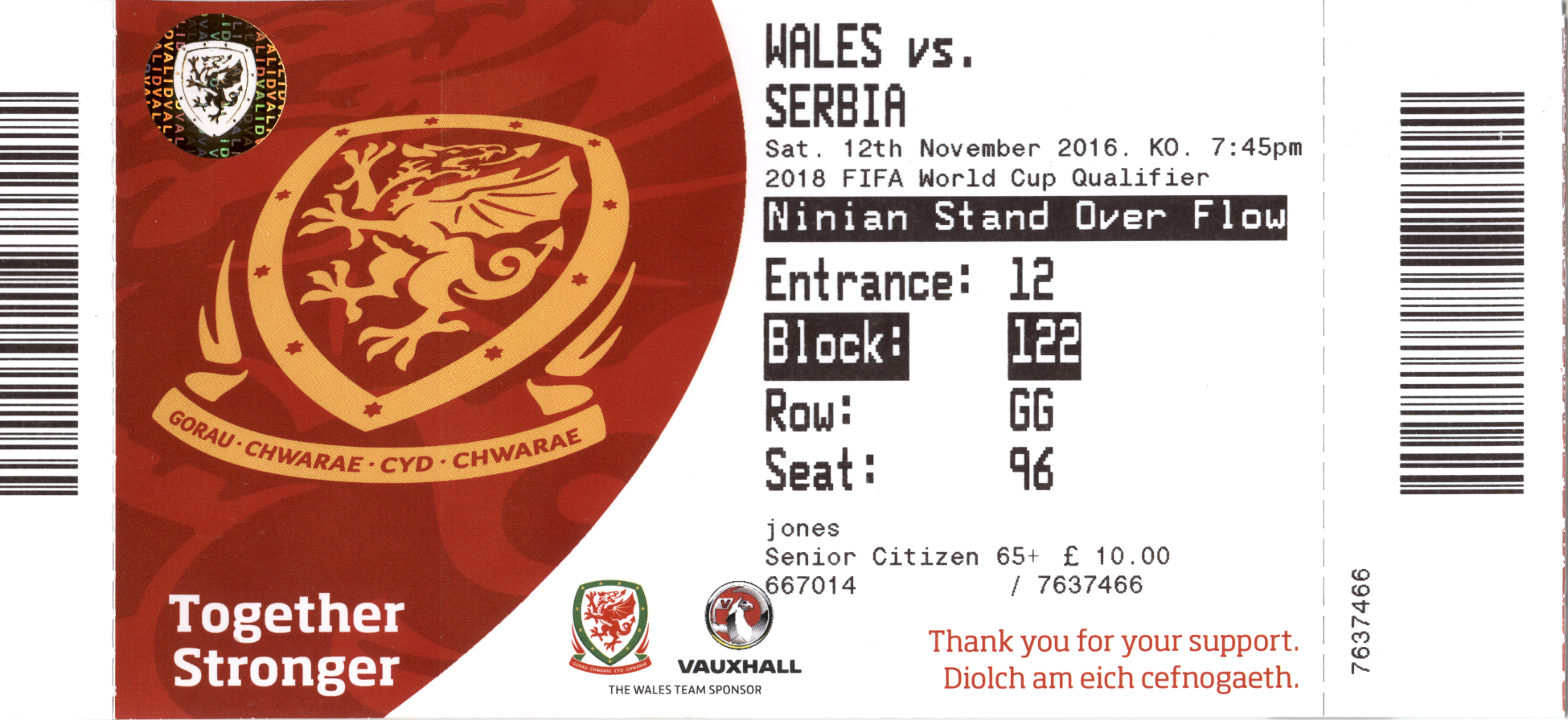
serbia-ticket

Consider Barcelona, one of the biggest clubs in the world, intertwined with Catalan identity and the independence movement. Everywhere at their stadium you will read it spelled out for you – Mes que un club (more than a club). Their big rivals are of course Real Madrid, the club of ruling Castille, the club of the monarchy, and the multi-ethnic – but definitely unified – Spanish state.

Last week Barcelona played in Glasgow against Celtic, an intense, occasionally tetchy, but nevertheless enjoyable game that saw the magnificent Celtic fans waving their Irish tricolours and singing their Irish rebel songs. Across town you’ll find arch-rivals Rangers, whose fans wave union flags and sing ditties such as The Billie Boys (‘Up to our knees in Fenian blood, etc’).

There are hundreds of other clubs in the world with an intensely partisan identity that is overtly and unmistakably political, or even ethnic. Until very recently only Basques were allowed to play for Bilboko Athletic Kluba and even though that rule now appears to have been relaxed Athletic Bilbao and the other Basque clubs retain an intensely nationalistic ethos. (Though Celtic and Rangers may be unique in that the fans are animated by the history and politics of another country.)

Come to that, what about international games, such as the one between Wales and Serbia that caused FIFA’s representative such concern? As with every competitive international game there were national flags, and national anthems – aren’t they ‘political’? Come to that, national teams, the raison d’être for FIFA, are obviously political because they represent nation-states or, in the case of Wales, a nation without a state.

Whereas on the other hand, the Serbs might argue that Serbia is a nation-state but too many Serbs are stranded outside the homeland, in Bosnia, Montenegro, Macedonia, Kosovo. And yet, Kosovo, a breakaway province of Serbia, handed over by NATO to Albanian gangsters was, in a blatantly political decision, admitted to both FIFA and the European governing body, UEFA, in May 2016. Too late to qualify for the World Cup Finals in Russia in 2018, which is just as well, because Russia doesn’t recognise Kosovo.

In other words, football at club and international level has always been political. Whether it’s the England team giving a Nazi salute in 1938, the so-called ‘Football War’ between Honduras and El Salvador in 1969, or German football fans welcoming refugees (last year). So for FIFA to try to punish Wales for individuals making the personal decision to wear a poppy is absurd. Worse, it could be dangerous; for does FIFA now wish to dictate what people wear to football matches?

Early in the second paragraph I qualified my criticism of FIFA with “if true”, partly because I find it difficult to believe that anyone would try to dictate what football fans wear, and partly because it could be that what FIFA meant by ‘fans in the stand’ was the display organised by the FAW, not far from where I was sitting with my son and grandsons. (Being aware of this stunt in advance I was praying that our section of the crowd wouldn’t be involved. Taid being thrown out could have spoilt the night even more than the late Serbian equaliser.)

This stunt was arranged by placing cards on seats which, when held up, combined to give the image of a big poppy. This was rather naughty of the FAW, and very silly. Naughty because it forced people to be part of something about which they might have had reservations, and silly because it was sticking two fingers up to FIFA, which had already warned the FAW that the players should not wear poppies on their shirts, nor should there be other displays. But then, the Sun, the Daily Mail and other good friends of Wales said it should be done, so that presumably made it OK.

faw-poppy

Now if it is this display of poppies organised by the FAW that FIFA is objecting to, and if it results in points being deducted and Wales not reaching the World Cup Finals, then I believe that the officials of the FAW will have failed us all and should consider their positions.

I say that because the duty of the FAW is to manage the game in Wales in the best interests of the member clubs, the national team and the fans, not to jeopardise the best interests of Welsh football by falling into line with the cynical and engineered poppy frenzy.

Personal freedom is one of the cornerstones of a democratic society, and must be defended. And that’s why FIFA is wrong if it charges the FAW for individual fans choosing to wear a poppy in their lapel. But considerations of personal freedom also put the FAW in the wrong for forcing individuals to be part of that poppy display.

I think we’re entitled to answers, from both FIFA and the FAW.

PART 2: “SQUEAKY BUM TIME”

Demanding that everyone, including footballers, wears a poppy for the weeks leading up to Armistice Day and Remembrance Sunday is quite recent, maybe no more than a decade old. Here’s a photo from a Scotland v England game played on Saturday November 14, 1999, the day before Remembrance Sunday. There are no poppies. There was no one-minute silence before the game.

It’s fitting that the photo comes from 1999, and was taken in the home city of Sir Alex Ferguson, the great Manchester United manager, because that year almost certainly marks the start of “squeaky bum time” (a period of nervousness and uncertainty) for those who were soon promoting the poppy and what they wanted it to stand for.

england-v-scotland-1999

Because 1999 was the year of the first elections to the Scottish Parliament and the Welsh Assembly. The SNP got 28.7% of the vote and 35 out the 129 seats in Scotland, while in Wales Plaid Cymru achieved 28.4% of the vote and 17 out of 60 seats. So even though Plaid Cymru did better than expected there was nothing for our masters to get overly concerned about in either country, yet within the establishment there were those who already feared where devolution might lead.

September 11, 2001 saw the attack on the World Trade Center in New York City, soon followed by retaliatory US and UK air strikes against Al Qaeda and Taliban targets in Afghanistan. To be followed by ground troops. January 4 2002 saw the first US soldier killed by enemy fire. The conflict dragged on.

The USA and UK invaded Iraq to remove Saddam Hussein in March 2003. All kinds of reasons were proffered to justify this aggression but none were convincing. It was regime change linked to oil, and another ‘All be home by Christmas’ intervention that dragged on, and on.

Then, in July 2005, London experienced suicide bomb attacks that killed 52 people, and carried out by British-born Islamic terrorists. These bombings were the most extreme expression of the growing anger within Muslim communities in Europe and the USA at the West’s military interventions in the Islamic world.

The May 2007 elections to the Scottish Parliament saw the SNP’s share of the vote climb to 32.9% of the vote, giving it the most votes, and with 47 seats (one more than Labour) it was now the largest party. Squeaky bum time was really upon us (or them).

By the end of 2007 it became clear that the Western world was entering a period of economic turmoil. It was equally clear that the recession had been caused by irresponsible lending by banks and mortgage institutions coupled with the imaginative trading of debts and other worthless packages. As with Afghanistan and Iraq, it was the USA and the UK leading the way, with other countries quick to blame ‘the Anglo-Saxon economic model’ of quick-buck trading having no concern for the wider economy, let alone society as a whole.

By 2010 everyone knew that the UK was up shit creek economically, with the public purse bailing out criminally irresponsible banks. The public turned against banks and the City of London. The UK was still bogged down in Afghanistan and Iraq. Al Qaeda had been overtaken by the much more ruthless ISIS, which had support from young British Muslims.

To cap it all, the Monarchy started losing what had been its 90+ per cent approval rating. I suspect this started with the death of Princess Diana in 1997, made worse by divorces and scandals, with the prospect of Charles becoming king viewed with concern in certain quarters.

So our elite consulted that well-thumbed manual, ‘Cunning Plans For When Things Go Pear Shaped”. And there, in among chapters headed, ‘Blame Somebody Else’, ‘Start A War’, ‘Scapegoat A Minority’, ‘Do A Runner With The Loot’ and ‘Pray For Divine Intervention’ they found ‘Whip Up A Frenzy Of Faux Patriotism’.

This explains why, in the mid to late noughties the largely neglected poppy saw the first drops of revivifying water and became the symbol not of sacrifice in war but of British identity and ‘pulling together’. The UK media played its role with an enthusiasm almost unknown in democratic societies.

Could it get any worse for the establishment? Yes it could, for in May 2011 the SNP took 44% (+13%) of the vote and 69 seats, giving it a clear majority in the Scottish Parliament. There would now be a referendum on Scottish independence.

Television companies responded by going into overdrive in promoting British unity. In the final year of the Labour – Lib Dem coalition in the Scottish Parliament (to May 3, 2007) there were just 25 television programmes with ‘Britain’ or ‘British’ in the title. Between January 2013 and January 2014, with the SNP in power and the independence referendum looming, the number of ‘Britain’ / ‘British’ programmes had risen to 516!

Which brings us to where we are today. To the point where the now regular autumn hysteria has reached absurd proportions. Here are a couple of examples.

On the evening of Friday November 18 I watched a televised football game (Brighton & Hove Albion v Aston Villa) and I couldn’t understand why the players had poppies on their shirts a week after Armistice Day and five days after Remembrance Sunday. Then the commentator told us it was to commemorate the last day of the Battle of the Somme!

So are we now compelled to remember every date that someone, somewhere, deems significant? And if so, where does this end? Can anyone remember any other instance of poppies being worn after Remembrance Sunday?

Nowhere is the poppy cult more slavishly followed than at the BBC. It is now obvious that from mid or late October no one is allowed to appear on any BBC programme without a poppy. (Though Evan Davis on Newsnight held out longer than most.) So terrified is the Beeb of falling foul of the Sun and the other directors of the national mood that anything that moves is liable to have a poppy pinned to it.

But this fear of manufactured British patriotism can bring its own problems, such as when someone at The One Show pinned a poppy on the Cookie Monster from Sesame Street. This outraged some for “trivialising the sacrifice of millions”, but as Dara Ó Briain suggested, it might have been satire, somebody having a pop at the poppy fascists. Here’s how the story was covered in Heatstreet, MailOnline, The Express, and the Huffington Post.
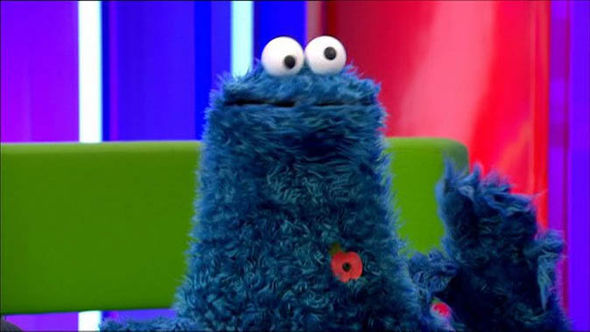
cookie-monster

As the BBC discovered with the Cookie Monster, when you’re dealing with poppy fascists it’s difficult to do the right thing. Perhaps the rule for broadcasters should be to pin a poppy on everything that breathes irrespective of whether it wants to wear one or not. Which might result in an apologist for ISIS appearing on Newsnight  or Channel 4 News wearing a poppy.

PART 3: CUNNING PLANS GANG AFT AGLEY

What I hope I’ve explained is that the past decade has seen a poppy cult engineered to engender a sense of Britishness, patriotism and unity, in order to counter threats from within and without; also to divert attention away from military blunders and other cracks in the façade of the British system that had led people to question the roles of the armed forces, the Monarchy, the City of London and other institutions.

To some extent this has worked. For example, the first referendum on Scottish independence in September 2014 was ‘won’. Then, the prince who many would like to see accede to the throne instead of his father has knocked out a few sprogs, and the ‘Ah!’ factor always works for the House of Sachsen-Coburg und Gotha.

Yet the success of this strategy is now causing problems that the Elite had not foreseen. You’ll note that I’m talking now of an ‘Elite’, so let me explain myself. Perhaps the best way is to refer back to my post EU Referendum: Why I Want OUT! where I wrote of an Elite that opposes “nation-states, national identities, local governments, languages other than English, regional tastes and peculiarities. In fact, many of the things you and I cherish.”

Those behind the relentless promotion of the poppy are linked to that global Elite. They opposed Scottish independence and they were against Brexit, for they believe in the Elite’s agenda of globalisation and mass migration as these drive down wages and help destroy the national identities that are viewed as an obstacle to globalisation.

The problem is that for most English people ‘Britishness’ and ‘Englishness’, ‘Britain’ and ‘England’, are synonyms, and the English make up almost 80% of the UK’s population. Which has meant that by clumsily promoting the poppy and British nationalism as a short-term fix for assorted problems the Elite unleashed insurgent English populism that resulted in UKIP and Brexit, and may now take us on a journey no one foresaw.

This revolt against the Elite is not confined to the UK. Donald Trump is President-elect of the USA. François Fillon is the Centre-right’s candidate against Marine le Pen, and he will fight that election on a platform that Donald Trump would approve: making friends with Putin, cracking down hard on Islamic extremists, opposing same-sex couples adopting children, etc.

When the French go to the polls in April to elect a new president it will be a choice between a weak and demoralised Left on the one side, while the alternatives are the Hard Right and the Very Hard Right. Then, between Fillon and le Pen, attitudes to the EU could be the main and defining difference.

The liberal, globalist, ‘do your own thing’ consensus we’ve lived with since the 1960s is almost dead. Accidentally killed by an Elite that over-reached itself, assisted by a Left that had been allowed to dictate the social agenda (because it complemented the ambitions of the Elite) but so detached itself from the concerns of most people that ‘liberal elite’ is now a term of abuse.

For me, it’s one of the great political ironies that an annual propaganda exercise to defend established interests favouring the EU, centrist politics, globalisation and unrestricted immigration has breathed life into forces representing their very antithesis. But so fitting.

♦ end 

Llamau, Yet More Devocolonialism

IN THE BEGINNING . . . 

Once upon a time there was an obscure little charity in Barry called the John Rowley Trust, formed in 1986, which ran a hostel for homeless young people.

But then, in May 1999, came the first elections to the National Assembly for Wales. Someone said, ‘Ah, a new source of funding – time to get organised!’ What’s more, because Plaid Cymru did so well in those first elections, they thought they saw the future, and said, ‘Let’s give our revamped organisation a Welsh name’.

And so, at an Extra-ordinary meeting of the John Rowley Trust on July 12, 1999, Llamau Ltd was born, and a few new directors appointed. (Though there was obviously some confusion about the name chosen because the document submitted to Companies House says that the new name is ‘Llaman’.)

Though Llamau’s commitment to the Welsh language is questionable, seeing as there is no Welsh version of the website, nor indeed any Welsh at all to be found on it. Clearly the ‘commitment’ extends no further than the name.

ENTER FRANCES BEECHER

In October 2000 Frances Beecher was appointed CEO, and boy! did things then take off. Ms Beecher is also a Fellow and a Trustee of the Labour-supporting Institute for Welsh Affairs, where her bio (scroll down) tells us that, “Frances steered the organisation (Llamau) through an extensive development programme from 28 staff to approx. 350 staff.”

Ms Beecher was next appointed to the board of Llamau Ltd, as secretary, on February 10, 2005. There is also the charity Llamau. As is normal practice the directors of the company also serve as trustees of the charity, with two exceptions. Frances Beecher, as an employee and a director, is not a trustee. And even though Stuart Duffin is listed on the Llamau website as Vice Chair (under Trustees) he does not appear on the Charity Commission page as a trustee, nor on the Companies House website as a director. Which I find odd.

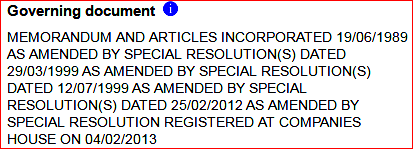
The ‘Governing document’ is the Memorandum and Articles of Association which sets out what the company is allowed to do and how it operates, a copy must be filed with Companies House. You can see that a number of changes are mentioned, but we only need to concern ourselves with the most recent.

llamau-governing-document

Let’s start with the last but one amendment. This is dated St David’s Day 2012 and was agreed at a General Meeting of the company held on February 25. It says, “3 The Company’s objects are – To promote the welfare and well being of people in need in the South Wales area, etc., etc.” Which is what we should expect.

But if we go to the amendment of roughly a year later, following another General Meeting, this one held on January 26, 2013, we read, “That the Memorandum of Association of the Company be altered by deleting paragraph 3 in its entirety and inserting the following – 3 The Company’s objects are to promote the welfare and well being of people in need in the United Kingdom, etc., etc”. 

So in the space of less than a year this hitherto insignificant outfit, once an unknown charity in Barry, has taken on a UK-wide role. Given what it does, and that Llamau operates only in Wales, the fact that it benefits people from across the United Kingdom suggests only one thing – that people from outside of Wales benefit from Llamau’s services by moving to Wales.

But even “across the United Kingdom” is misleading because Scotland and Northern Ireland have their own judicial systems, so it should read ‘England and Wales’.

ALSO INVOLVED . . . 

The Chair of the Trustees at Llamau the charity, and of course a director of the company Llamau Ltd, is Angela Mary Gascoigne; a busy woman with an interesting background.

From 24.09.1998 until 27.09.2001 she was a director at Community Housing Cymru. There then seems to be a gap – or at least I’ve found nothing – until some time in 2008 when she turns up as managing director of the Somer Housing Group in Somerset, which has since changed its name to the Curo Group (Albion) Ltd.

llamau-angela-gascoigne

The name change may have come about in response to a less than favourable report on Ms Gascoigne’s running of the Somer Housing Group.

Obviously cue to exit stage left, so in November 2011 we find Ms Gascoigne joining the ‘Wales’ Probation Service, which has since split, in 2014, into the Wales Community Rehabilitation Company and the National Probation Service which, as the Justice website tells us, ” . . . is a statutory criminal justice service that supervises high-risk offenders released into the community in England and Wales”. So it’s an Englandandwales body.

UPDATE 12.11.2016: Here’s an example of the kind ‘high-risk offender released into the community’ . . . to kill an innocent teenager. The family of the murdered youth is now planning legal action against the Wales Community Rehabilitation Company.

llamau-national-probation-service

It would appear that Angela Mary Gascoigne was still connected with the National Probation Service for Englandandwales when she joined Clean Slate Training & Employment Ltd of Bath as a non-executive director on July 1, 2013. Its website tells us, “Clean Slate Training & Employment was set up in 2006 as a social enterprise creating and supporting paid work opportunities for people facing barriers to the labour market”. Ms Gascoigne left Clean Slate on July 4, 2016.

While a director with Clean Slate Angela Gascoigne also took up a directorship, on November 11, 2013, with Sedgemoor Housing Management Services Ltd, of Bridgewater, Somerset. She was appointed secretary on January 2, 2014. This company might be the trading arm – it’s certainly a subsidiary – of SHAL Housing, an Industrial and Provident Society. She is still director and secretary of SHMS Ltd.

From reading both websites and picking up information from elsewhere it’s clear that SHMS Ltd and SHAL Housing have links with London and help relocate people from the Great Wen to the west of England.

Finally, Ms Gascoigne joined Victim Support Cymru on January 14, 2014, and is still there. Though what she does is a mystery, seeing as Victim Support Cymru is listed as a dormant company by Companies House. In fact, the last accounts filed for Victim Support Wales (as it then was) were for year ended 31.03.2006.

From this website it’s clear that Victim Support is yet another Englandandwales body. The Javed Khan referred to was chief executive of Victim Support before moving on to Barnardo’s. Prior to the change shown in the panel, dated October 30, 2013, the Trustees of Victim Support Cymru were, with the approval of “the National Charity”, free to appoint “a Chairman, Treasurer and other honorary officers from among their number”.

llamau-victim-support-memorandum

Can we conclude that this change in October 2013 to the way Victim Support is run explains Angela Mary Gascoigne’s appointment in January 2014, was it made by ‘The National Charity’ in London? But why bother? The company has been dormant for 10 years, there is no charity called Victim Support Cymru, and it doesn’t seem to exist in any other form either. Victim Support Cymru seems to be as imaginary as the ‘Wales Probation Service’.

NUMBER CRUNCHING

Time to lift the lid on Llamau’s finances. Here are the most recent accounts available on the Companies House website, for year ending 31.03.2015. The accounts for 2016 should be available soon.

Before going to the figures, let’s look at some other information found in the accounts. Turning to page 6 (numbered at top of page), the use of ‘principal’ in the first paragraph may be significant.

Page 9 is interesting with its reference to the “Young Persons Resettlement Broker Project for North and Southern Wales”. (Why not just say ‘Wales’?) More information can be found on the website under Llamau’s Resettlement Project.

The ‘Brokers’ are, for the north, Dr Kathy Hampson, and the south, Tracey Kinsey. Dr Hampson’s Linkedin profile tells us that the project is really run by the Youth Justice Board, yet another Englandandwales outfit. I can find little information on Tracey Kinsey beyond the fact that at some time previously she was Family Mediation Manager for Llamau. Though her real claim to fame may be as the Chair of the Chepstow-Corneilles Twinning Committee.

The first paragraph on page 10, particularly the bracketed section referring to “company law”, again calls into question the status of the ethereal Irishman, Stuart Duffin.

Turning to the figures, Ms Gascoigne is forced to admit that Llamau is living a hand-to-mouth existence, with no reserves whatsoever. Hardly surprising with total resources expended in 2015 of £10,997,104 (an increase of £1,217,973 on 2014) against income of £10,837,897 (an increase of just £886,155 on 2014).

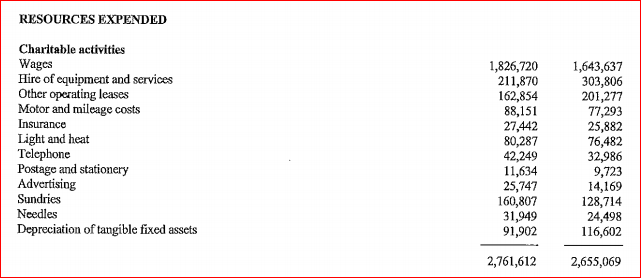
llamau-salaries

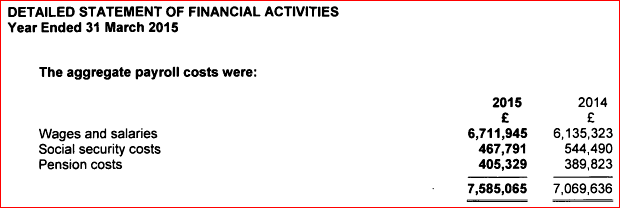
The largest component of the expenditure, is staff salaries. Staff costs (wages, pensions and social security payments) total £7,585,065. And that doesn’t take into account staff training (£111,703), travel and subsistence (£178,418), etc., etc. But then, we must remember that CEO Frances Beecher “steered the organisation through an extensive development programme from 28 staff to approx. 350 staff”. That don’t come cheap.

UPDATE 06.11.206: When writing this I neglected to consult the Transparent Wales website. Having now done so I find in the funding for Llamau a number of payments of the type ‘Current grants to private sector’, and these total £1,116,420. Private sector!

THE TROJAN HORSE THAT IS THE THIRD SECTOR

To recap, with the advent of devolution someone saw the opportunity to turn a small Barry charity into a major player in the Third Sector, and this is what happened.

But then, just short of four years ago, Llamau spread its wings to become a ‘UK’ – in reality, Englandandwales – organisation. This seems to have happened soon after lead player Angela Mary Gascoigne, a woman with feet on both sides of the Severn, got involved with the Probation Service and other elements of the judicial system.

Giving us an organisation based in Wales, largely funded from within Wales, but run in the main by people from outside Wales and serving England’s interests by rehousing young tearaways and those released from the ‘secure estate’. Making Llamau little more than an agency of the Englandandwales judicial system.

To achieve this position, agencies that previously had a modicum of Welshness and independence, such as the Probation Service and Women’s Aid have been absorbed into an Englandandwales framework.

Another example is of course Victim Support, where successive amendments to the Memorandum have exposed the increasing hold of the ‘national body’ over its Welsh outpost. As I’ve pointed out, Victim Support Cymru is registered with Companies House as a dormant company. It still has a skeletal presence with the Charities Commission that tells us it operates ‘Throughout Wales’, though when it comes to the ‘Area of benefit’ box it says:

llamau-victim-support-cymru

Don’t be surprised, for it’s how the Third Sector operates. The era of devolution and easy money has attracted all manner of shysters across the border with no commitment to Wales, they’ve come either to take over existing Welsh organisations or else to set up new ones in order to tackle ‘ishoos’ of which we were blissfully unaware ere the arrival of said shysters.

What were once separate Welsh bodies, serving Wales, are now locked into Englandandwales frameworks. This explains how undesirables and all manner of criminals appear out of the blue to occupy – and very often wreck – Welsh social housing.

I could set up an outfit tomorrow claiming to help distressed caber tossers and start milking the system. And if anyone said, ‘But, Jac, there are no distressed caber tossers in Wales’ I’d just pop up to Scotland and find some. Because that’s how the Third Sector in Wales operates – demand money to tackle fictitious ‘problems’ or else import problems that aren’t ours.

DEVOCOLONIALISM

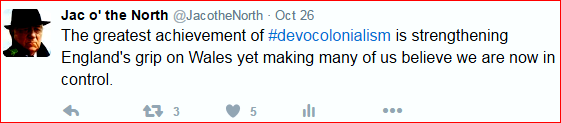
Last month I coined the term devocolonialism to explain this system we now live under. This post gives me an opportunity to expand on what I said in that tweet.

devocolonialism-tweet

We have an Assembly down in Cardiff docks, and within it a group of Labour Party deadbeats desperately hoping to be mistaken for a government. They are a joke, they and the whole apparatus of devolution is a sham, proven by the fact that no one outside of Wales – and certainly not ‘Welsh’ Labour MPs – takes devolution seriously, so why should you?

The Assembly’s powers have been restricted by Government of Wales Acts ensuring that the Assembly can never operate in the best interests of the Welsh people. All we get is ‘Welsh’ Laws that are English legislation with ‘(Wales)’ added, and civil servants answering to London acting as ‘advisers’ to this self-deluding ‘government’.

Yet all the time, while it’s hoped we are focused on those slobbering grotesques in Cardiff, behind our backs, in a hundred and one ways that our thoroughly useless media will never report, Welsh identity is being crushed, and we become strangers in our own country as Wales merges into England.

Devolution is nothing but a comfort blanket against the encroaching darkness of assimilation. And if devolution is the comfort blanket then the comforter itself, designed to make you forget your fears and nod off, is the belief that a few more Plaid Cymru AMs can improve things.

Take my word for it, there is no political solution to the problems confronting the Welsh nation.

~ ♦ ~ end ~ ♦ ~

Playground Wales

Oh, the joy! the euphoria! Didn’t you feel the surge of national pride, the collective Cymric breast heaving, positively heaving, at the joyous news? – Lonely Planet declares ‘North’ Wales to be the bestest al fresco fun fair around.

Well, obviously, it didn’t use those words (© Jac o’ the North), but that’s what it amounted to. Though the front page of Wednesday’s Wasting Mule seemed a little confused as to where exactly it was talking about (nothing new), believing that the award had gone to the whole country. Thankfully, page three made it clear that ‘North’ Wales was the recipient.

wm-lonely-planet

~~~~~~~~~~ ♦ ~~~~~~~~~~

So what exactly has ‘North’ Wales won? Well, it seems that northern Wales came fourth in the Top Regions category of the best destinations to visit in 2017. (The other categories being countries and cities.)

Northern Wales came fourth in the section subtitled “offbeat destinations demanding our attention”. Mmm, anyone who’s visited Betws y Coed or Caernarfon, Llangollen or Beddgelert, will find the use of that word ‘offbeat’ rather bizarre (and I haven’t mentioned the coastal resorts!). But, anyway, read the Lonely Planet piece for yourself.

So what are the other “offbeat destinations” with which north Wales was competing? In first place came Chocquequirao, “hidden across the deep Apurimac Valley . . . the last Inca refuge from the conquistadors”. Which makes this Andean location sound fascinating, and a worthy winner.

Second was Taranaki in New Zealand, which is certainly off the beaten track, confirmed with Lonely Planet‘s description it being a “remote location”. I shall return to the matter of tourism in New Zealand in a minute.

Then, one place ahead of ‘North’ Wales, we find the Azores. Described by Lonely Planet as the “next Iceland” and as a result we are warned, ” . . .  the secret won’t last: the Azores have seen a 31% increase in tourism over the last 12 months, so visit in the 2017 sweet spot before things really take off.” 

~~~~~~~~~~ ♦ ~~~~~~~~~~

Now I don’t know much about the Lonely Planet publication other than that it gets a lot of publicity – certainly here in Wales, for every time we get a mention it seems to merit a big news splash – but who pays it any real attention? Maybe its target audience, which I’d guess is the English middle class and its gap year offspring. (I belong to neither category.)

And that’s because, I suspect, Lonely Planet sees its role in identifying ‘offbeat destinations’ before – as seems to be the fear with the Azores – these idyllic locales are discovered by hoi polloi demanding ‘El fish and chips, Pedro – and pronto!’. Without, I hope, sounding snobbish, this is perfectly understandable.

tourism-stats
Courtesy of Visit Britain

In September, Mrs J and I took one of our regular trips to Scotland, and no matter where we went, from the Robert Burns Museum to Sweetheart Abbey to Threave (origin, tref) Castle, we met tourists from all over the world, but nowhere we went was overwhelmed in the way that parts of Wales so often are.

Of course Edinburgh can feel a bit ‘crowded’, but it’s bustling and cosmopolitan, it’s energising . . . and a hell of an improvement on being surrounded by miserable Brummies on a wet Sunday in Barmouth. These people milling around Princes Street and the Royal Mile are also spending lots of money (helped by the fact they’re not slumming it in ‘a caravan down the beach’), and when they go home they’ll tell their friends how wonderful Scotland is.

Scotland gets a better class of tourist, and certainly more overseas tourists. These even spend more per head (heid?) than overseas tourists to Wales. The figures for 2015 bear this out, for we see that while Scotland saw 2.6 million visits from overseas Wales welcomed just 970,000. In Scotland, the average spend per head was £651, compared with £422 in Wales. Giving a total overseas spend in Scotland of £1,695m against our £410m, less than a quarter of Scotland’s income.

There is of course a historic explanation for this. When railways became capable of transporting large numbers of working class people in relative comfort, and for prices they could afford, this advance placed Wales, unlike Scotland, within reach of many of England’s cities and industrial regions. Though that does not explain why we should still be providing holidays on the cheap, going for quantity rather than quality, 150 years later.

There are other, perhaps equally prosaic, explanations for Scotland attracting more overseas tourists and fewer English day-trippers than Wales. Distance being a pretty obvious one. Also, Scotland is much larger than Wales, with a greater variety of scenery. Scotland has airports with regular long haul flights to destinations around the world. Finally, Scotland has a beautiful and historic capital city.

But none of these explain the lack of ambition in the ‘Welsh’ tourism industry. Nor should they be accepted as excuses.

~~~~~~~~~~ ♦ ~~~~~~~~~~

After my Caledonian digression let me return to what I hinted at earlier when mentioning Taranaki, second among the ‘Top Regions’. A friend of mine has visited New Zealand a few times; it’s not cheap, but then, he’s a wealthy bachelor. I remember him telling me about one particular trip to the Southern Alps. He had to book in advance, prove he was healthy and insured, and as they liked the cut of his jib he was taken on a trek through the mountains lasting a few days.

The Southern Alps are protected by various National Parks and other forms of legislation to the point where the chances of a coachload of drunks turning up and making nuisances of themselves is close to zero . . . unlike on Snowdon, for example.

snowdon-tourists-caption

Returning to the Lonely Planet review of ‘North’ Wales we see that what got us noticed was zip wires, wave machines and subterranean trampolines. It seems logical to conclude that if we have more of these, and maybe a water chute running from the top of Cader Idris down to Dolgellau, or Talyllyn, we might achieve the coveted third place next year. Dare we dream of second place!

Grouped with the last refuge of the Incas, the as yet unspoilt Azores, and the majesty of the Southern Alps, a few big boys’ toys scattered about the north seem laughably incongruous, and unworthy. Especially when you read under the ‘Responsible Travel’ heading, “At Lonely Planet sustainable and responsible have always been parts of our vocabulary.” ‘Sustainable’ and ‘responsible’ are words that have never tarnished the lexicon of ‘Welsh’ tourism.

Which I suppose exposes the central contradiction of tourism – ‘Come see this awe-inspiring place . . . and by so doing, help despoil it’. Which explains why I admire the New Zealand approach that realises beautiful and irreplaceable environments and landscapes such as we find in the Southern Alps need to be protected from tourism.

If the Southern Alps had been in Wales they would by now have been extensively and thoroughly ‘developed’, suffering regular visits by twat-like politicos spouting bollocks so vacuous and inane as to make Vacuity and Inanity rise up in indignation. But on the bright side, there would be local employment – collecting garbage.

~~~~~~~~~~ ♦ ~~~~~~~~~~

When you look around Wales at the ugliness tourism has inflicted, the anglicisation it has brought, the environmental degradation, the social disruption, you have to ask what sort of people are we to have allowed this.

The answer is that we remain what we’ve been for maybe 800 years – a people with no real control over our country. Tourism is a perfect example, not only does it serve England’s interests, but ‘Welsh’ tourism is largely run by, and therefore profits, English people. Why should they give a toss about wrecking our homeland?

What’s best for England will always prevail over the best interests of us Welsh, and devolution has entrenched this system of exploitation even more firmly. I recently coined a term for this phenomenon, devocolonialism. In a future post I shall expand on what I put out recently in a tweet.

devocolonialism-tweet

I feel this needs to be done because anyone believing that devolution has achieved anything positive for Wales needs a cold shower of facts.

~~~~~~~~~~ ♦ END ♦ ~~~~~~~~~~

Swansea Labour: The Farce Continues

AND THEN THERE WERE NONE

Over the years the Swansea Labour Party has been a reliable source of (relatively) harmless amusement for the toiling masses of the Jack metropolis and beyond, and so it continues. For more tales reach me of back-stabbing and various other self-destructive practices that can only be attributed to utter desperation, possibly anomie. But before the fun starts, I have some sad news.

I have written many times of the party’s student councillors on the west side, fresh-faced yoofs straight out of Swansea Uni, who know little of the city, and don’t care to learn because they’re just using Swansea council as the first rung on the ladder of their political careers. It seems like only yesterday the Uplands ward was blessed with two of them: ‘California Girl’ Pearleen Sangha, and John, ‘John Boy’ Bayliss, while nearby Cockett ward (covering Waunarlwydd and Fforestfach) had Mitchell ‘Mitch’ Theaker.

First Sangha left, to take up a post with the party in Cardiff . . . but pretended she was still in Swansea. Next to go, towards the end of 2014, was Mitch Theaker, taking a job in the United Arab Emirates recruiting for Sheffield University’s International College. Finally, it was John Boy’s turn, though as with the others, there was confusion over exactly when he left to take up his job in Bristol, and whether he was really still serving his constituents back in Swansea. The tale is recounted here in The Case of the Disappearing Councillor

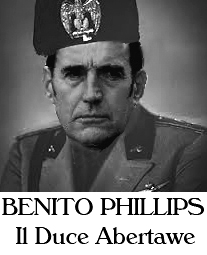
What hastened the departure of all three was probably the casting down, in August 2014, of their patron, council leader, David ‘Il Duce’ Phillips. And even though the newBenito Phillips, Il Duce Abertawe regime was glad to see them go, it still didn’t want them announcing their departures in a way, and at a time, difficult for the Labour Party. By-elections must be carefully timed and orchestrated.

So who’s been selected as the Labour candidate for the by-election caused by John Boy’s departure? Well, it’s ‘Miss Lily Summers’, a trans-sexual of uncertain background, which offers a kind of continuity, for Bayliss and Theaker spent a great deal of their time promoting LGBT causes. So sod the Uplands ward, sod Swansea, Summers will be just another Labour councillor riding a hobby horse.

Don’t get me wrong, an individual’s sexuality and preferences (within reason) don’t bother me one bit. I just object to people making a career out of the hand they were dealt, demanding that I pay them attention, accord them ‘rights’. Frankly, my dear, I don’t give a damn.

Before moving on from Swansea West I hear that the word on the street is that Julie James, the Assembly Member, was instrumental in de-selecting two of the sitting Labour councillors in Cockett, Ann Cook and Andrew Jones. They have been replaced, in time for the 2017 council elections, with a member of her staff and someone who works for Geraint Davies, the Swansea West MP.

In a show of solidarity with his ousted colleagues a third Cockett councillor, Geraint Owens, will not be seeking re-election next May.

While just a hop and a skip away, in the Penyrheol ward, David Cole, the Labour councillor was also airbrushed de-selected for defending his community against the council’s plans to build a new school on a local park. He now sits as an Independent.

UPLANDS UPDATE: While ‘Miss Lily Summers’ of Stoke on Trent (but no fixed abode in Swansea), is lined up to replace John Boy, I neglected to mention that another Uplands councillor has drifted away, this one is Neil Woollard, of whom I wrote here (scroll down). He’s gone to work on the Cardiff Bay tidal lagoon project, which may be undermining the similar scheme for Swansea. He moved from Swansea a while ago and just turns up for the odd meeting to keep getting his £13,000 allowance and avoid a by-election, cos Labour lost the by-election following Sangha’s departure.

With Bayliss and Woollard gone, the balding Summers in, I’ll now give you the other Labour hopefuls for next May. One is the sitting councillor, Nick Davies, who had hoped to inherit the Castle ward seat of Il Duce when it was believed the new regime was giving Phillips the heave-ho, but that was overturned at Labour HQ and so Davies has had to come scurrying back to Uplands. Though he may no longer live in the ward.

Then there’s James White, a retired teacher and something of an unknown quantity. On the plus side, he claims to be “a Swansea boy” and lives in the Uplands ward. (An almost unheard of combination for Labour.) The list is completed with Uzo Iwobi OBE. A Nigerian woman who now lives in Swansea, but not in the Uplands ward. In fact, she’s been asking people to show her around Uplands and ‘introduce’ her to people. Iwobi works in the Third Sector which, as we know, is just another name for ‘Welsh’ Labour.

Read about them all here.

Uplands 4

MOVING ON OVER

Even though the Uplands and Cockett wards are in the Swansea West constituency, and Penyrheol in Gower, things in that neck of the woods are otherwise fairly quiet, certainly when compared to the real action over in Swansea East. Where to start? Why not with the MP, Carolyn Harris?

I wrote a post a few months ago in which Carolyn Harris figured prominently. Read it here. But of course, since then, things have really moved on. So to bring you quickly up to date . . . On July 4th there was a Jeremy Corbyn fund-raiser in the Brangwyn Hall, and in attendance was Carolyn Harris, there to pledge her undying loyalty to Comrade Corbyn, which is no less than we’d expect from a member of his shadow cabinet.

But last Sunday, in Pontypridd, Owen Smith launched his leadership challenge to Jeremy Corbyn and there was Carolyn Harris, dementedly clapping and hollerin’! Watch the video for yourself. Can anyone identify the Valkyrie giving him the ‘Ah, poor dab!‘ look? (Or maybe she’s spotted something interesting behind his right ear.)

Smith and friends

Though perhaps Harris’ switch is understandable when we remember that there are moves to de-select her by hard left Corbyn supporters, which might also account for her surprising vote against Trident in the July 19th debate. Surprising because as she tells us on her Facebook page, “this was not my intention when I walked into the chamber”! We shall return to the hard left anon, but a little digression first.

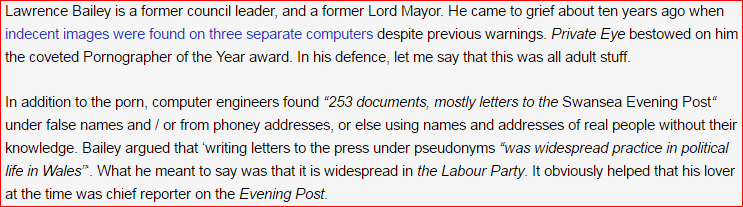
One thing that ‘Welsh’ Labour has always been very good at is keeping public money within ‘the Labour family’. Examples abound, and in the case of Carolyn Harris one of the best examples is the £1,654.00 a month paid to Whiterock Consulting for “professional services”. So who or what is Whiterock? Answer: Lawrence Bailey, and this is what I wrote about him in my earlier post on Carolyn Harris:

Lawrence Bailey

(Here’s the link to ‘indecent images’ story.)

In my previous post I gave the impression that Harris was paying Bailey for his professional services, maybe PR work, because that’s what I thought at the time. Now I learn that Bailey actually works for Carolyn Harris, and until quite recently he was based for much of the time in the constituency office on Brynhyfryd Square. (Through the mist I see schoolboys smoking Woodbines in the stinking public lavatory on ‘the Square’ as they wait for the bus to Penlan School. Ah, happy days!)

If Lawrence ‘Libido’ Bailey is an employee of Swansea East Constituency Labour Party, or its MP, why isn’t he on the books, instead of being paid through Whiterock? I think we can all hazard a guess. Though if Whiterock is a contractor or consultant, should Bailey be given the run of the constituency office, and allowed to use facilities, equipment and consumables paid for from the public purse for the MP and her staff?

FULL OF EASTERN PROMISE

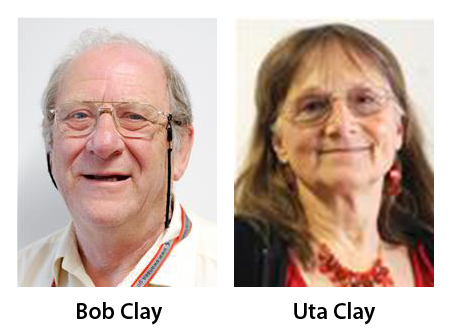
As I just hinted, the hard left is out to get Harris, and they don’t come harder or lefter than Bob Clay, former Labour MP for Sunderland North who washed up in Swansea a few years ago. His wife Uta is Austrian and both these confirmed Trots serve as councillors for the Llansamlet ward.

The Clays are actively plotting to remove Carolyn Harris. How do we know this? Because Bob Clay was considerate enough to set it out in a document in January this year. It is headed, ‘To oblige CH to retire’ and contains section headings, ‘Preferred Methodology’, ‘Preparing the Way’, ‘Scope’, and ‘End Games’. In that final section we can read, “The overriding objective is to see the back of CH. However, this would be far easier to achieve if the risk of a scandal did not occur before the Assembly elections” (in May).

I have redacted the names and signatures of two other persons who might be seen as Clay’s co-conspirators, but I prefer to view them as the dupes of an experienced and manipulative politician, a man who learnt his politics in smoke-filled rooms. (God, I miss them!)

Clays

You’ll see that the third sheet is in the form of a letter to ‘David’, who I’m told is Dave Hagendyk, yet another political professional who’s never done a real job. After leaving Cardiff University in 1999 he became a researcher for husband and wife AM team Huw Lewis and Lynne Neagle. Next, in January 2004, he became Head of Policy at ‘Welsh’ Labour. By February 2009 it was time to move on again, this time to become Political Liaison Officer (Wales) with the University and College Union. He was appointed General Secretary of ‘Welsh’ Labour in November 2010, the position he holds to this day.

It would appear from the letter that Clay bore no grudge against Hagendyk despite the latter suspending Uta Clay in 2012. Suspension or worse might now await Bob Clay, for representations have been made to London to have him thrown out of the party. Among the instigators of this move we find, unsurprisingly, Carolyn Harris. This is interesting for a number of reasons.

If, as I’m told, moves are afoot that have “gone way past Hagendyk”, what does this say about the independence of ‘Welsh’ Labour? Also, given that Clay is a Corbynista, and Harris, as we’ve seen, has lined up with Dai Smith’s boy, I suspect that who gets slung out in Swansea East depends a lot on who is leader of the UK Labour Party at the end of September, after the leadership contest.

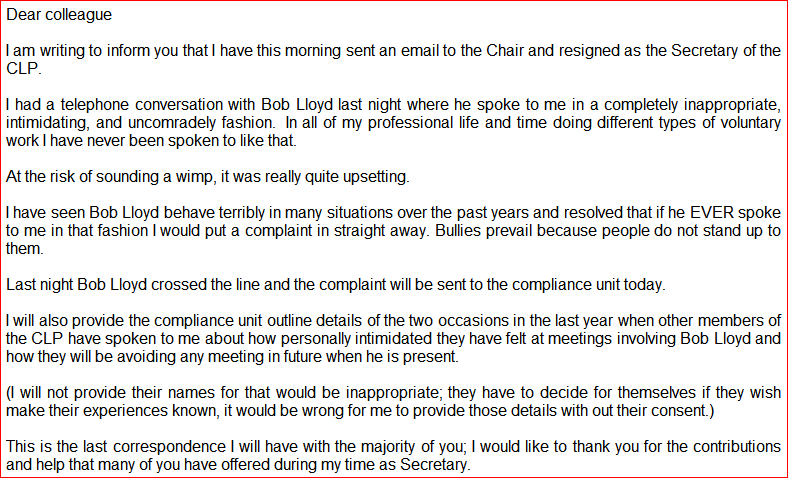
The secretary of the Swansea East Constituency Labour Party was Ryland Doyle . . . until the beginning of June, when he resigned. The e-mail in which he informed party members of his decision is quite remarkable in its honesty, and what it tells us about the Labour Party.

Ryland Doyle

Though I have to take issue with Ryland Doyle when he writes “Bullies prevail because people do not stand up to them”. Clearly, he did not stand up to the bully Bob Lloyd. So who is Bob Lloyd? In short, he is the Constituency Labour Party treasurer for Swansea East, but his influence goes beyond that.

Bob Lloyd, an ex-councillor, is one of three brothers, the others being Alan, now retired but who may have served as much as 40 years on the council, and David, who was Carolyn Harris’ agent in 2015 and now works in the constituency office. Bob Lloyd’s wife Val was AM for Swansea East from 2001 (by-election) until 2011. Alan Lloyd’s son, Clive, is currently a councillor for the St Thomas ward, (though he lives a few miles away). To describe the Lloyds as a Labour family would be an understatement. They supported Carolyn Harris in her campaign to become MP, were rewarded, and she now relies on them to protect her from those seeking to deselect her.

SWANSEA, LABOUR IN MICROCOSM 

Here ends the latest chapter in the ongoing saga of Swansea Labour Party, the gift that keeps on giving. And I hear that Swansea is in such a mess that there are some who look back longingly to the days when there was order, when the trains ran on time – and dream of restoring David ‘Il Duce’ Phillips to power. Avanti!

If you want to know what’s wrong with the Labour Party then you need look no further than Swansea, it’s all here: nepotism; bullying; back-stabbing and de-selections; selfish careerists and immature conspirators; brown envelope Old Labour, hypocritical New Labour and antediluvian hard left; not forgetting the mis-use of public funds plus dilettantes allowed to use the party to promote their pet subject . . . and all packaged up with utter contempt for the people they’re supposed to be serving.

These people are running the wonderful city of Swansea because there’s just no opposition. Things aren’t much better on the national level. When you look at ‘Welsh’ Labour you realise that a half-decent opposition party could have swept the buggers away years ago, as happened in Scotland.

We get the politicians we deserve. And because of that, ‘Welsh’ Labour is a terrible indictment of our nation. 

*

Thanks to ‘Stan’ of Neath Ferret fame, and others whose names I obviously cannot divulge, for helping me prepare this piece. Any more information on the Swansea Labour Party will be most welcome.


~ ~ ~ ~ ~ ~ ~ ~ ~ ~ END ~ ~ ~ ~ ~ ~ ~ ~ ~ ~

Assembly Elections 2016

This is the post I promised in which I shall tell you who I’m voting for on Thursday and why.

CONSTITUENCY SEAT

I live in the Dwyfor Meirionnydd constituency and my Assembly Member is Dafydd Elis Thomas, or Lord Elis Thomas if you prefer. I’ve known him for many years, and when I arrived home last Friday afternoon, there he was, large as life, talking to my missus at the front gate. When I got out of the car we had a little chat.

Now I don’t dislike Dafydd, but obviously we don’t see eye to eye on much . . . if anything. Even so, I’ve usually voted for him; but this time round I’m changing. It’s not a single utterance or deed that accounts for this decision, more a build-up of little things with nothing to maintain balance – hence my arrival at the tipping point.

Many of these little disaffections can be grouped under DET’s fondness for the Labour Party. His liking, even preference, for Labour surfaced again a week or so ago when he urged Plaid, Tory and Liberal Democrat supporters to give their second vote in the North Wales Police and Crime Commissioner election to the Labour candidate David Taylor. (Here’s a link to information on all five candidates.)

The explanation he gave at my front gate last Friday was the same he gave to the media – it was a calculated attempt to stop the UKIP candidate being elected on the second ballot.

In PCC elections, as in the Assembly elections, we get two votes, and if no candidate gets a majority first time round then the two with the most votes go into the second round, in which the second preferences of the eliminated candidates are allocated. I shall return to the PCC elections, and young Mr Taylor, later.

My Choice

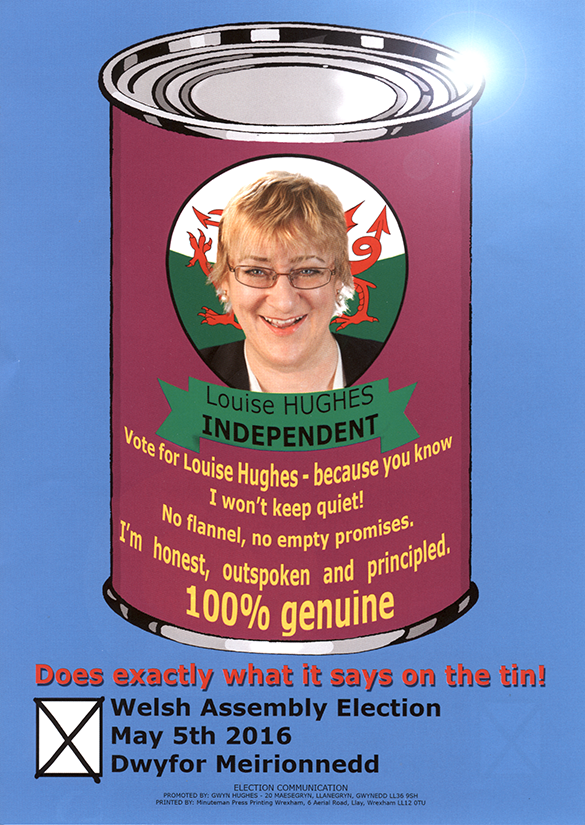
So who am I voting for? (Drum roll!) Well the answer is that my vote will go to a shy, retiring local councillor with whom I have enjoyed many a profound political discourse in the aisles of Tywyn Co-op. I’m referring to Louise Hughes, who is standing as a (genuine) Independent.

Louise Hughes
Click to enlarge

Some may condemn me for ‘wasting’ my vote and arguing that, even if elected, Louse will be unable to achieve anything down Cardiff docks. I disagree.

What we have down Cardiff docks is a branch office of the London government, run by civil servants answering to their London masters. The politicians we elect may strut and puff, but apart from being allowed ‘gimmick’ legislation every now and again, they have little real control over anything. Much of the legislation the ‘Welsh’ Government claims as its own is nothing but English legislation with ‘(Wales)’ squeezed into the name. Perhaps their only real power is being able to dish out the lolly.

Yet far too much of this funding goes to Labour’s allies in the Third Sector in blatant patronage and cronyism, or else is ‘invested’ – ‘for the good of Wales’ – in Cardiff. One of the most disappointing results of devolved politics is how AMs of all parties end up following the party line and squandering money on Third Sector spongers like these.

Click on the link I’ve provided, scroll down to the second section, and ask yourself who, apart from Jill Tatman and her gang of colons, benefits from all the money they’ve been given? Or to put it another way, would Llandovery be any poorer, any more deprived, if she and her co-conspirators had been denied public funding?

I’m voting for Louise Hughes because if she is elected, and even if she is ignored, she’ll still be speaking for those that elected her. Though take my word for it, Louise can make herself very difficult to ignore.

Finally, and perhaps decisively, there is the dishonesty in Plaid Cymru asking the voters of Dwyfor Meirionnydd to vote for a candidate who could have the Plaid Cymru whip withdrawn if re-elected, and who might be in the Labour Party a few months down the line.

THE REGIONAL LIST

An Assembly Member who has received favourable mention in this blog is William Powell, the Liberal Democrat AM for the Mid and West Wales region. (That I’ve been complimentary to any AM may surprise a number of you.)

There are two reasons for this. First, Powell turns up at Cilmeri for the annual December commemoration of the slaying of Llywelyn ap Gruffydd (Y Llyw Olaf). You could argue that as a local AM he is obliged to attend. He’s not obliged to attend at all; I believe he comes because he shares some of the sentiments of those, like me, who have been going to Cilmeri for longer than we care to remember.

Perhaps William Powell should be an example to Plaid Cymru politicians whose enthusiasm for Cilmeri tends to waver, and can perhaps even be influenced by ‘Shippo’ down at the Wasting Mule. (Which is what he, his mate Phil Parry, and their Labour cronies would like to believe.)

My second reason for choosing Powell is his response to a petition I submitted to the Assembly a few months ago, and how his response contrasted with that of the Assembly’s Petitions Committee. I dealt with it back in January, in Local Democracy Endangered, here’s a brief summary.

Petitions Committee
Click to enlarge

I submitted a petition asking the ‘Welsh’ Government to consider intervening when it became clear that a chief executive, acting alone or in concert with others, was subverting the democratic process by acting beyond his powers and / or without consulting the elected councillors.

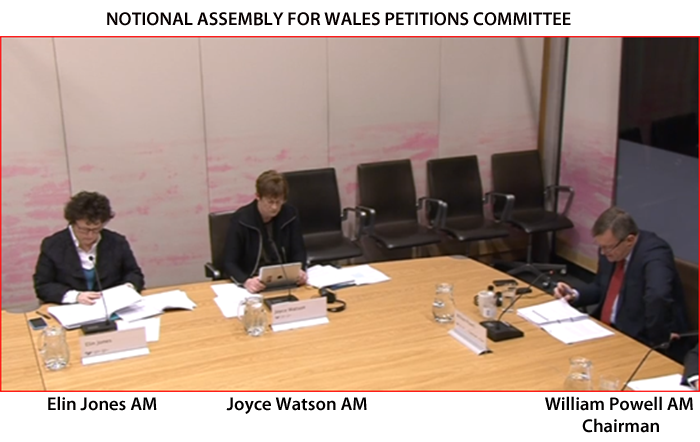
When my petition was discussed on January 19th the Petitions Committee consisted of Joyce Watson, the Labour AM for Mid and West Wales, and Elin Jones, the Plaid AM for Ceredigion. This is how I reported their ‘consideration’ of my petition:

Watson Elin Jones
Click to enlarge

I would expect no better from a Labour time-server like Watson, but against my better judgement I still thought Elin Jones might have had a contribution to make.

William Powell clearly understood what my petition was about, and tried to get a discussion going with, “It (the petition) does raise some very serious issues”. To no avail. Mesdames Watson and Jones had no intention of discussing anything that might have discomforted Mark James or embarrassed the ‘Welsh’ Government.

So for these and other reasons, and secure in the knowledge that the Liberal Democrats are very unlikely to gain more than a single list seat in Mid and West Wales, I shall be giving my second vote, my regional list vote, to the Liberal Democrats. Though had anyone other than William Powell topped the list my vote would have gone to another party, or I might not have used my second vote at all.

THE PCC ELECTION

Quite frankly, and despite what Dafydd El professes to fear, I believe the chances of UKIP winning in the second round of the North Wales PCC election are slim, and simply exposes again his Labour leanings. But even if there was a threat from UKIP I cannot see how anyone outside of Labour could possibly be attracted to David Taylor.

Taylor first came to the attention of an incredulous public as an acne-plagued hobbledehoy living somewhere near Rhuthun. This was in 2004, when he set up a website to “undermine Labour rebel Clare Short”. Note that the Daily Post account I’ve linked to tells us that 18-year-old Taylor was already secretary of the Clwyd West constituency party and also sat on Labour’s ‘Welsh’ executive.

The boy was obviously destined for greatness, and it duly arrived when he became advisor to Leighton Andrews AM in 2005. Though he soon embarrassed his party with another childish, and similarly unsavoury stunt, this time the infamous Aneurin Glyndŵr website. Around the same time he tweeted what might have been interpreted as a distasteful reference to the Hillsborough disaster.

Taylor also spent a short period as Special Advisor to Peter Hain, when the Man of Tan was briefly Governor-General, a post he lost in the 2010 general election. But Taylor seems to have stayed on in London as a ‘Senior Political Adviser’ to the Labour Party.

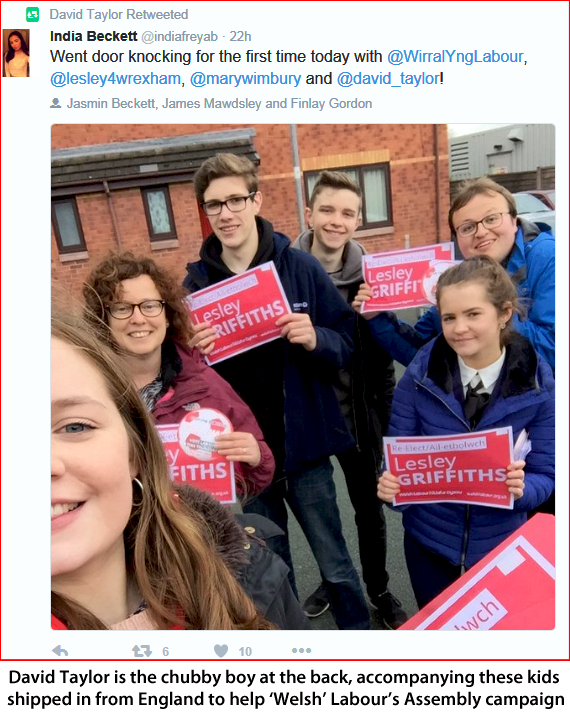
David Taylor canvassing
Click to enlarge

Since 2012, according to his Linkedin profile, he has been a director of a company called Leckwith, which has undergone a few changes of both name and address. It was originally known as Albacore Associates before morphing, in July 2012, into Westgate Strategy Ltd, before changing again, just a month later, to Leckwith Ltd. There were also physical moves from Cardiff to Newport to London. (Here’s the website.)

It’s reasonable to assume that this PR company was set up to capitalise on Taylor’s proven talent in the field of influencing people and also to exploit his contacts in the Labour Party. Though to judge by the accounts Leckwith has been slow to take off.

Taylor is also a non-executive director of Westgate Cyber Security Ltd of Newport, formerly London. This company also was incorporated in August 2012, but this is not a one-man band, for Taylor has a co-director, one David Wyn Jones, whose business background can be seen by clicking on his name under the ‘Officers’ tab. (Here’s the website.)

Having mentioned Leighton Andrews, I am indebted to ‘STaN‘ of Neath Ferret fame for reminding me that Andrews came quite late to the party, having been a leading light in the Liberal Democrats until just over a decade ago. Here’s a piece by Michael Meadowcroft lamenting Leighton Andrews’ departure. (I kid you not!)

I’ve also mentioned Peter Hain, and for information on the bête noire of the Boers, STaN‘s yer man.

David Taylor is a Labour insider of the worst kind. The type who joins the party before he starts shaving and spends the rest of his life in a cocoon, while determining what’s best for people of whose feelings and aspirations he knows nothing. He is exactly the kind of person – the professional politician – that either turns people off politics or else drives them towards more ‘colourful’ politicians.

Sorry, Dafydd, this is another wrong call. And if it was a straight fight between David Taylor and the UKIP candidate for North Wales PCC, and if I was forced to vote, then I couldn’t promise that I wouldn’t vote UKIP.

My Choice

I shall be voting for Arfon Jones as our PCC. As coppers, or ex-coppers, go, Arfon’s not bad, he was our village bobby for a while. And he’s never been afraid to speak out and question his former employer, something we encounter all too rarely.

Arfon leaflet 1
Click to enlarge

In addition, having served and lived in Gwynedd, and also having spent many years on the other side of the region, Arfon knows the north from Holyhead to Bangor-on-Dee a lot better than most.

He’s also a sociable individual, going for the occasional drink at the Saith Seren, with which he has been long involved, and following Wrexham football club home and away, while not neglecting the rugby. He’s married, with children and grandchildren, in Wales and Scotland, so I wouldn’t hesitate to describe him as a ’rounded’, mature individual of many interests . . . unlike, I fear, David Taylor.

CONCLUSION

Looking at the wider picture, my reluctance to vote for Plaid Cymru at this election (over and above my longstanding criticisms) can be summed up in one word – Labour. And I’m not referring now to Lord Elis Thomas’ as yet unconsummated attraction.

It seems very likely that Labour and Plaid will be in coalition after Thursday’s election. That’s unless Plaid’s nightmare scenario materialises in which Labour can cobble together a coalition with two or three Lib Dem AMs, and possibly even a Green.

Now my views on the Labour Party generally, and ‘Welsh’ Labour in particular, are well known. A clue may be found in the title of my post, Why I Detest The ‘Welsh’ Labour Party. I urge you to read it.

What Wales desperately needs is wealth creators, visionaries prepared to take risks and by so doing create jobs and a wealthier country. But such people are frowned on by socialist parties like Labour and Plaid Cymru, for they cannot be controlled like a publicly-funded client class masquerading as an ‘economy’.

So generous is this system now that its fame has spread; spongers and leftie bandwagon-riders flock to Wales to take advantage of ‘our’ generosity. And the funding given to alleviate Wales’ poverty, to educate and train us, to build infrastructure, achieves nothing because it is squandered on a Third Sector the greater part of which achieves nothing beyond generous salaries and pensions for the charlatans involved.

Wales needs radical change; a new national mindset. None of the parties involved in this election provide anything other than tired and discredited ideas dressed up and repackaged. Consequently it matters little what emerges after Thursday.

The Welsh people deserve better. They just need to realise it. Who’s going to make them realise it? And how?

~ ~ ~ END ~ ~ ~


An Election and a Referendum

This post examines two important votes being held in 2016; the Welsh Assembly elections on May 9th and the EU referendum on (possibly) June 23rd.

First, we shall look at the elections to our beloved and respected Assembly, wherein may already be found talent dazzling to the point of being a hazard to pilots (not that many of those intrepid aviators will be heading for the local airport) before moving on to consider the anticipated EU referendum

WELSH ASSEMBLY ELECTIONS

At present, Labour has 30 of the 60 seats, and is almost certain to lose a few, the only questions are, which ones, and to which other party or parties will those seats be lost?

To help you make comparisons I have compiled the table below, which shows each party’s percentage of the vote in 2011 compared with the percentages predicted by the latest available poll. You will note that the figures in the recent poll do not add up to 100, this is almost certainly due to respondents stating their intention to vote for the kind of minor parties that combined to give us the ‘Other’ figure in the 2011 results.

Assembly elections poll

These poll figures look credible for Labour but rather odd for the other parties due to little or no difference between the constituency votes and the regional list votes. Even so, the poll confirms that Labour will be the biggest loser and Ukip the biggest winner.

Though the level of Ukip’s support is rather surprising seeing as the party keeps choosing unknown or unattractive candidates (the one often mutating into the other) and in other ways shooting itself in both feet. It begins to look as if Ukip’s leaders could be filmed sacrificing Romanian migrants on Aberystwyth promenade, bollock naked with their nether regions painted bright green, and still not lose support.

As for the other parties, it’s very much a case of little or no change which will, after almost a year of Tory government at Westminster, be a relief to the Conservatives; an even bigger relief to the Lib Dems following their near-extermination in the last May’s UK elections; but a major disappointment to Plaid Cymru, who should be the main beneficiary of Labour and Lib Dems losing support.

Though looked at from another angle Plaid’s level of support might pleasantly surprise some. Let me explain. The Party of Wales would have us believe that it’s a radical party, offering change, improvement. Yet down in Carmarthenshire, where Plaid became the larger party in a coalition last year (after the ‘Independents’ refused to work with Labour any more), Mark James, the tyrannical and vindictive chief executive, carries on as if nothing has happened!

The other party to be disappointed by the poll findings will be the Green Party of Englandandwales. Despite claimed increases in membership, and Welsh people being spotted in the ranks, it seems that the Greens still have difficulty in attracting support. But then, this is a party so English, so frightfully middle class in its membership and support, that it makes the Tories look like a Welsh proletarian rabble.

As I’ve been predicting for some time now, after the Assembly elections we shall probably see Labour in coalition with Plaid Cymru. Though if by some some electoral miracle Labour can cobble together a coalition with Lib Dems and Greens that leaves Plaid Cymru out in the cold, then Plaid will be condemned to another five years of impotence. A period the party may struggle to survive.

Ukip will do very well. In June last year I predicted the Kippers would gain 7 seats, and in October I upped my estimate to 10. (The latest poll suggests 9.) If, as is now being predicted, the EU referendum is held in June, and that EU campaign overshadows the Assembly elections, then Ukip will be the only beneficiary because all the other parties are pro EU and will be singing the same song.

And here’s a thought to cheer you all up. If the Assembly elections are indeed dominated by the EU referendum debate then it is not inconceivable that Ukip could win seats in ‘volatile’ constituencies that in May will be five- or even six-cornered contests. Gaining a percentage of the vote in the low to middle twenties could do it.

‘Nathan Gill, AM for Ynys Môn’ has a certain ring to it, n’est pas?

Gill of course is currently an MEP, which is a handy link to the next part of this post.

THE EU REFERENDUM

THE BIG PICTURE

When I was young and idealistic, the matinee idol of the nationalist fringe, I considered myself to be quite the ‘European’. With my study of history, my admiration for Charles de Gaulle, being avowedly anti-communist, and after reading The American Challenge, I persuaded myself that a strong Europe was needed as a bulwark against both the USSR and the USA.

I still believe I was right, but the world has moved on. For a start, the Soviet Union is no more, and its demise was the cue for the USA to begin its advance in eastern Europe, first with its war on Serbia and then by gradually encircling Russia with newly signed up members of NATO. Have you ever stopped to think how weird that is?

NATO started life in 1949 as an alliance to deter the Soviet Union from invading western Europe (if indeed the USSR ever had that intention). It was a Cold War organisation, from the era of Dr Strangelove, which should have ceased to exist along with the Soviet Union and the Warsaw Pact, yet NATO has expanded since the Cold War ended. This is bizarre.

Strangelove

Unless of course you understand that the USA (and to a lesser degree, the ‘West’) must have enemies. Now this presents a problem for a country bordered only by friendly and peaceful Canada to the north and to the south by a third world state where the strongest armed forces appear to be those of the drug cartels.

Clearly this lack of a credible threat is an inconvenience to the military-industrial complex, neocons, the National Rifle Association, big corporations, news media, and politicians looking to make a name for themselves. So ‘enemies’ have to found elsewhere, which has resulted in a succession of ‘threats’ being exposed since the Second World War. These are often pantomime villains of dusky hue, with difficult to pronounce names, and living in far-off lands of which most Americans know very little. Plus of course we have the post WWII constant – USSR / Russia.

At this point many of you will be wondering why, in a section headed ‘The EU Referendum’, I’m banging on about NATO and US foreign policy. There are two principle reasons.

First, a single political unit allows the US – as we are now seeing with TTIP – to gain preferential access to the richest market on earth through influencing just a few people. The danger here should be obvious to all. Second, the EU is viewed by many US policy-makers as a sister-body or even an extension of NATO. It’s no coincidence that NATO and the EU have marched east almost hand in hand.

Let me try to explain the NATO-EU link with the table I’ve compiled below. It gives the dates that eastern European countries joined first NATO and then the European Union. And it has always been in that order (sometimes simultaneous), but never is EU membership allowed before joining NATO.

The delay in Albania’s accession to the EU can be explained by the fact that the country is a ramshackle land with large parts, especially the area bordering the Serbian province of Kosovo, controlled by people-smugglers, drug-traffickers, organ-harvesters and a motley assortment of old-fashioned vendetta-pursuing, blood-feuding bandit chiefs. Albania’s chief export is gangsters.

NATO

An exception to the NATO-followed-by-EU rule is of course Turkey, which has been a NATO member since 1952. No surprise then to learn that there have always been voices in the upper reaches of the EU arguing in favour of admitting Turkey. ‘Bridge to the Islamic world’ and other bollocks has been spouted in support of this idiocy. The truth is that the USA wants to reward its faithful ally – and currently chief Bear-baiter – so it periodically applies pressure on the EU to let Turkey join the club.

Turkey, that backward, Islamist state where the security services bomb their own people. Turkey, the country that persecutes its fifteen million Kurds and has a very ambivalent attitude towards ISIL. Turkey, that just a century ago introduced the world to the concept of holocaust with its butchering of the Armenians.

In the ongoing conflict in Syria the USA has encouraged Turkey to provoke Russia, and although the US may belatedly be trying to rein in its proxy, there remains the possibility that this dysfunctional country could start World War Three. If Russia does retaliate to Turkish provocation then we (and here I have to mean the UK), as fellow-members of NATO, are Treaty-bound to line up with Turkey.

How do you feel about going to war with Russia because Turkey has done something stupid and deliberately provocative?

THE VIEW FROM WALES

Leaving aside these wider concerns, what should be our approach to this referendum from a purely Welsh perspective?

‘Wales does well out the EU’ is a mantra trotted out by those urging us to vote to stay in. ‘Does well’ is just a euphemism for hand-outs, we export little. In other words, we get EU grants because we are so bloody poor. Which makes this ‘argument’ just another defence of begging-bowl politics, an acceptance of Wales’ poverty and deprivation.

And what has happened to the billions we’ve received in EU funding? Where are the great infrastructure projects? Where is the multi-skilled workforce we’ve trained? Where are the successful indigenous companies the funding was used to start? Nowhere to be seen, bois bach!

That’s because the greater part of this windfall has been wasted on the shysters and parasites of the Third Sector. Most of whom – unsurprisingly – seem to have Labour Party connections. 

If the UK left the EU then the UK government would have to make up the lost EU funding. If it didn’t, we’d have to go without the Third Sector. (Don’t cry!) And if the UK government didn’t make up the shortfall, then it might cause a few more people here to wake from their slumbers.

Looking further afield, the UK leaving the EU would have far more serious repercussions for England, more specifically south east England, and to be very, very specific, the City of London. Because if the UK left the EU then many of the banks, investment houses and other financial institutions would decamp for Frankfurt, Paris, Zurich, Berlin, etc.

This would result in tens of thousands of very well paid jobs being lost to London, and a few hundred thousand more would be lost in a knock-on effect. So just spare a thought for all those Lamborghini salesmen, tailors, high-class hookers, hairdressers, tattooists, coke suppliers, estate agents, jewellers, etc., etc.

eu_logo

Remove the City of London from the balance sheet and the economy of England heads south very fast. With the City of London creating less wealth the UK economy must suffer, and despite the malaise being centred on London we can be sure that – as ever – the Old Etonians will see to it that peripheral areas suffer most.

This should serve as another wake-up call to the slumberers who unquestioningly believe that London rule is best for Wales.

Another argument used is that we must vote to stay in the EU to prove how different we are to England (assuming the English vote to leave). A position that invariably cites the fact that Scotland will definitely vote to stay in. Let’s look at this argument in a bit more detail.

First, Wales is not Scotland. The obvious stated, let me add that many hundreds of thousands of Scots will vote to stay in the EU for reasons that have little or nothing to do with the EU itself. It’s all about promoting independence, hoping that England – or Englandandwales – votes for Brexit.

Should there be a vote south of the border to leave the EU, and should that decision lead to Scottish independence, then it will reverberate here no matter how Wales voted. Scottish independence will concentrate minds in Wales no matter how it comes about and will make redundant whatever views may have been held in Wales when Scottish independence was just a vague possibility.

So let me spell it out. How Wales votes in the EU referendum is almost unimportant. The vote is being hyped up in Wales by those posturers who like to regard themselves as ‘progressive’, and done in order to show how superior they are to the ‘xenophobes’ who want to leave the wonderful EU. Smug, precious, and self-deluding bollocks!

CONCLUSION

There is no party standing in the Assembly elections for which a nationalist can honestly vote. That being so, there is an argument to be made for voting for any party that might help weaken the regional socialist party that for decades now has done so much damage to the Welsh cause.

Personally, I probably won’t bother voting. There’s a temptation to toddle along to the polling station and scribble ‘None of the above’ on my ballot paper, but that’s always struck me as a bit desperate unless part of an organised campaign.

When it comes to the EU referendum I shall definitely vote to leave the EU. That’s because the EU we know today is a great disappointment for someone of my age who genuinely wanted to see a strong and democratic Europe play a leading role in the world.

Instead, we have a byzantine nightmare that I suspect no one properly understands, a monster created by bureaucrats that seems to have been subverted to serve US economic and strategic interests rather than working for the good of Europeans.

And yet, I could still be converted to a united Europe, a European army, a European diplomatic corps . . . but my Europe would need leaders of stature, not the anonymous, paper-shuffling committeemen we are cursed with today.

If only the General would come back . . .

Christmas in Wales, Past, Present and Future

Yes, I know, it’s Christmas, the season of goodwill to all men, but it’s only a temporary distraction from the realities of life in Wales. And that life is, quite simply, colonial.

The gullible among us believe that devolution has made things better. I’m at a loss to understand why anyone should believe that. We are poorer today – relative to other parts of this scepter’d isle – than we were in 1999. Devolution is a complete sham in which a bunch of appalling mediocrities, denizens of an outlandish building down Cardiff docks, are unwilling to admit, or too stupid to see, that their ‘advisors’ are nothing but conduits for policy directives from London.

If the directives don’t come via civil servants then we often hear about them by other means. We know that the Conservative regime wants to roll back the devolution process, just in case, at some future date, someone might decide to ignore the ‘advisors’ and use the powers gained for the benefit of Wales. So after thinking about it for a moment it was no real surprise to hear a man no one has heard of, representing a body no one knows about, suggest co-opting MPs into the ‘Welsh’ Government.

This was such an insane, anti-democratic suggestion, that it took many people by surprise. My first response was, ‘Who the fuck is Martin Warren, and what does the governance of Wales have to do with the Institute of Chartered Accountants in England and Wales?’ Then my cynical mind started turning and I realised that a professional body like this will almost certainly have ‘links’ with the Conservative and Unionist Party. What if they’re being used as a cat’s paw?

What I mean is that now the idea’s been publicly mooted, who’s to say that some time next year the Crabb won’t come out with, ‘Suggestions have been made . . . ‘ or ‘After considering proposals to include MPs . . . ‘ and use it to parachute a few Tory MPs into Carwyn’s multi-talented cabinet.

Santa complete copy

But note the organisation coming out with this bollocks, particularly note that it’s yet another Englandandwales outfit . . . the accountants have obviously taken no account of devolution. (Like hundreds of other bodies.) As we approach the seventeenth year of devolution Wales is more firmly integrated with England than ever before. And being integrated further every year, while Scotland – even without independence – pulls further away, in order to serve her own interests rather than England’s.

Next year sees the Assembly elections. Despite the lack of a Welsh media, increasing numbers of our people are finally waking up to the harsh reality that voting Labour achieves nothing. It only makes things worse. Plaid Cymru should be the major beneficiary of this new awareness (even if not to the same degree as the SNP). But if Ukip and Tories, Lib Dems and Greens benefit from this disillusionment more than – or even as much as – Plaid Cymru, then the time will have arrived to consider new means by which the nation’s interests are to be defended. 2016 must be Plaid Cymru’s last chance.

Some readers will consider my Christmas montage a little harsh, even unseasonal, but the realities don’t change because of some fat guy in a Coca Cola outfit. I shall return next year, refreshed and sobered up, loins girded, restocked with vitriol, ready to launch yet more trenchant attacks on the colonial system destroying our homeland.

In the meantime, and to prove that I’m not a complete and utter Scrooge . . .

Nadolig Llawen


Wales, Colony of England

Let me start by establishing what I mean by a colony. A colony is a territory or country run in the interests of another country, and for the benefit of the elite or the population in general of that other country. The colony does not need to be far away, nor do its indigenes need to be of a different pigmentation or religion, what matters is the economic and other relationships between the two countries. By which criteria Wales is most definitely a colony of England.

~~~~~~~~~~

Historically, we Welsh had to be conquered and brought under English rule a) because we resisted Anglo-Saxon / Anglo-Norman / English attempts to control the whole island of Britain and b) because we, as the original inhabitants of Britain, served to remind these invaders of our prior claim to their land as well as our own.

For centuries we suffered under a discriminatory legal system then, with the Industrial Revolution, we started to see Wales and the Welsh exploited in a more organised fashion, with the motive this time being profit rather than imperialist aggrandisement. In a modified form this system persists today, and although discrimination may no longer be on the statute book it still exists in myriad subtle forms.

~~~~~~~~~~

Something I was reminded of recently with the re-surfacing of a story I’d been vaguely aware of before. A Welsh businessman named Clive Hughes had planned to build two biomass plants employing hundreds of people, one near Kidwelly, the other on Swansea docks, reported in the panel on the right (click to enlarge).Biomass Swansea docks It seems that Mr Hughes had no help in his endeavours from either Mark James Carmarthenshire council or the ‘Welsh’ Government. In fact, he received no reply after writing to First Minister Carwyn Jones.

The reason this story has re-surfaced is because Clive Hughes was understandably peeved to learn that while his projects were either ignored or refused planning permission, civil servants and councils are now falling over themselves to help Chinese investors build two biomass plants, one on Ynys Môn, the other in Port Talbot, just a few miles from his planned Swansea docks site.

Something Clive Hughes was quoted as saying hints at where I’m going with this example. He said, “I have been fortunate to have enjoyed successful multi-million-pound businesses all over the world – however, I have never been treated so badly as in my home county”.

How do we explain this curious tale of Welsh agencies refusing to support indigenous enterprise while generously supporting foreign investment  – to do exactly the same thing! In a word, colonialism. (Yes, I know the report mentions nimbyism and “opposition from residents”, but believe me, it goes way beyond that.)

Clive Hughes was wasting his time appealing to Carwyn Jones, who is just a figurehead for a form of sham devolution. Wales – as I have said time and time gain – is run by civil servants, invariably masquerading as ‘advisors’ to Carwyn and his gang of deadbeats, and these civil servants take their orders from London. The wisdom for some years in London has been that it is a good thing to ‘open up’ the UK to foreign investment, particularly from China. Once you know that, then it’s easy to understand why no Welsh businessman will be allowed to queer the pitch for Chinese and other foreign investors.

A further example of the colonial economy at work is often articulated as the question, ‘Isn’t it strange how Welsh people (insert here, Terry Matthews, Chris Evans et al, or Clive Hughes) have to leave Wales to be successful?’ Er, no, there’s nothing strange about it, for two very good reasons. First, too many successful Welsh businesspeople might give us natives silly ideas about our ability to do things for ourselves. Second, any successful Welsh business is almost bound to come into competition with English companies. Both are undesirable in a colonial set up.

Of course after making his money in Canada Matthews returned to Wales and built the very successful Celtic Manor resort outside Newport. But the Celtic Manor poses no threat to the colonial arrangement. To begin with, it does not really compete with English rivals in the way that a company chasing consumers in a competitive market would. In addition, with its NATO conferences and Ryder Cup golf tournaments, the Celtic Manor helps integrate Wales with England.

Note that in the piece I’ve linked to about Matthews, Michael Moritz is described as “the richest person in Wales”, which is stretching it a bit. He was certainly born in Cardiff, but left for the USA in his early twenties, made his fortune in Silicon Valley, and never returned. He still lives in San Francisco with his family. Perhaps the most successful business based in Wales, and the only one quoted in the FTSE 100, is Admiral Insurance, started up and still owned by Henry Engelhardt . . . from Chicago. Which is fine, because it confirms that the Welsh must have outsiders to provide them with work.

Let’s end with another feature of the colonial economy, and again, something that draws bewildered comment from people who refuse to see the system controlling the economic life of Wales. I’m referring now to the phenomenon of successful Welsh companies being taken over by larger companies before they can grow too big, with this often resulting in redundancies or even closure of the now subsidiary Welsh operation. If you don’t understand why this happens then you haven’t been paying attention.

~~~~~~~~~~

The Roman system of coloniae settled army veterans and their families in conquered territories and border regions, and was employed for two main reasons. First, to keep an eye on the natives and, if necessary, confront any insurgency until the army arrived. Second, coloniae spread the use of the Latin language and Roman ways of doing things.

This example of settling people from, or loyal to, the ruling country in recently conquered territories and colonies is one that has been imitated globally down to the present day. The British have done it across the world, even to Christian European populations. There was the Irish Plantation, the ‘repopulating’ of eastern Canada after the expulsion of the Acadians (Cajuns), and the flooding of the independent republic of Transvaal with British settlers once it was realised that the land beneath the Boers’ feet contained gold and diamonds.

In more recent times, France sees a steady exodus of loyal French people to Tahiti, New Caledonia, Guadeloupe, Martinique and other specks in the ocean in the hope that these emigres will help the natives see the benefit of maintaining ties with France. While on a bigger scale, and in a much more brutal fashion, China has created all sorts of incentives for Han Chinese to settle in, with the intention of dominating, Tibet and Xinjiang.

So why be surprised that Wales has been undergoing a process of colonisation since the 1960s? A process that has taken many forms, some so bleeding obvious you wonder how they got away with it.

Take the Development Board for Rural Wales, an agency set up – so we were told – to stem the depopulation of the five central counties of Montgomeryshire, Cardiganshire, Merionethshire, Breconshire and Radnorshire. It operated by paying English companies to relocate to central Wales, with their workforces (all paid for), while spending many more millions building thousands of new houses for this influx. And while all this cash was being showered on English companies local firms could not apply for a penny of DBRW funding. As blatant a colonisation strategy as Mother England has ever deployed. But Welsh politicians, media, and others still applauded every relocation as ‘New jobs coming to —————‘.

Many countries pay companies to set up in areas needing employment, but I have never come across another case like the DBRW, where a state paid firms to transfer lock stock and barrel, plus workers, to another area. It makes no sense, until you see it for what it was – plain, unvarnished colonisation.

~~~~~~~~~~

The colony of Wales also serves as a receptacle for those who are not making a contribution to the common weal in England. Those in this category range from geriatrics to young criminals and drug addicts. To the point where in some areas of Wales – such as where I live – two-thirds of the over 65s were born in England. But, hey! looking after old people is a ‘growth industry’.

Gwynedd SW Wards merged
CLICK TO ENLARGE

If it’s not wrinklies then it’s a feckless white underclass. Some towns have been almost destroyed by this phenomenon, and none have come closer to implosion than Rhyl. This link reports a story of a woman living in Rhyl sent down after police found a dead body and a stash of heroin in her flat. An everyday story of Rhyl folk.

When it’s not drug addicts then it’s paedophiles. So many such deviants from over the border are now turning up in Wales that it just has to be organised, perhaps by the Probation Service. I have written about this problem before, one of the most notorious recent cases was a whole gang of paedophiles relocated from London to Kidwelly. Read about it and other cases. Within the past few days I have learnt of two more paedophiles who, by some unspecified route, arrived in Wales. This one in Ciliau Aeron and this one in Llanbadarn Fawr.

In the great colonialist scheme of things it really doesn’t matter whether those coming into Wales are sweet old dears straight out of an Ealing comedy or dangerous perverts, they all make their contribution to skewing Welsh statistics in a way that is unflattering to us, put a strain on an already overburdened health service, and of course, make their contribution to anglicising Wales. ‘Poor Wales’, ‘Ageing Wales’, ‘Wales’ Drugs Problem’ writes Phil Space, and intones Jamie Owen, but no one has the balls to really investigate these issues and give us the truth.

But then, in a colony, the last thing you can expect is an honest media.

~~~~~~~~~~

I can’t be absolutely certain when I first realised the media lies (maybe it was when I was first lied about), but the reporting of the Balkan wars in the 1990s was something of a watershed because that coverage was not simply a lie here and there, or some vague and ill-defined bias, it was an unwavering adherence to a propaganda line originating in the Pentagon.

Done in pursuit of a strategic objective dictating that Jugoslavia should be dismembered and Russia’s Serb allies at the core of that State be internationally isolated. To achieve this objective the fascist Croats of the Ustaše, and the gangster Albanians in the Kosovo Liberation Army, were depicted as knights in shining armour, while a blind eye was turned to foreign jihadists killing Serbs in Bosnia, leaving us to focus solely on the beastly Serbs, the only ones guilty of any atrocities.

Obviously, when dealing with ‘internal’ matters the UK media is different, but even here, the bias has long been unmistakable, and especially in television. Just about everyone has noticed the recent plethora of programmes with titles beginning ‘Great British’, in fact, it’s become so obvious that it’s something of a joke. A regular orgy of cringe-worthy ‘patriotism’, on sets bedecked with union flags, and all done in the hope of persuading Scots and other disaffected minorities that it don’t get no better than singing the worst national anthem on earth.

While on another level we see some elements of the BBC – Newsnight comes to mind – becoming almost schizophrenic in their desire to maintain their Left-liberal bias while simultaneously following the BritNat line in the hope of pandering to those in the Tory party who wish to dismantle the Beeb. Though in its coverage of the Scottish independence referendum last year all pretence at impartiality went out the window for the BBC in general, and Newsnight in particular.

Here in Wales, with its recent acquisition of the Evening Post, we have Trinity Mirror taking a stranglehold on the ‘Welsh’ print media. We can now look forward to Swansea’s daily paper, the largest selling Welsh daily, being written in Cardiff. And why not? With the political and economic life of the country being centralised on the capital like some tin-pot dictatorship it makes perfect sense.

Our self-styled ‘National Newspaper of Wales’ is now little more than a desperate amalgam of showbiz news, columnists nobody reads, sport, and a daily promotion of all things Cardiff. To the extent that a new restaurant opening, or a celebrity being spotted in the city, somehow becomes a news item that Llais Y Sais deludes itself will be of interest to people in other parts of Wales. No wonder so few people outside of the Cardiff area buy the bloody thing.

Perhaps the best way to explain how this Cardiff-obsessive system operates is by introducing that famous bullshit duet the Barry Brothers. Mark Barry runs M&G Barry Consulting and gets paid to promote the Metro system and other projects designed to further enrich Cardiff at the expense of the rest of Wales, while brother Siôn is the Business Editor for Media Wales, which of course covers the Wasting Mule. So Mark Barry’s clients tell him what they want promoted, he passes ready-made promos on to brother Siôn, who ensures that they appear in Llais y Sais as ‘news’! This is how low ‘journalism’ in Wales has sunk.

In the panel below (click to enlarge) you’ll see a piece by Siôn Barry that appeared in the Western Mail on Monday (23.11.2015). I’m using it because it brings together a couple of the points I’m making in this post. First, we have another successful Welsh company being taken over. This company is based in Swansea, but it’s left to a spokesperson for the company to tell us that.

Sion Barry Francis Estate Agents

Because the purpose of this business news report is to give a plug to “Cardiff-based business advisory firm Greenaway Scott”. Something Siôn Barry does quite regularly. Here in May 2013, March 2015, May 2015, and there may be other write-ups by Barry that I’ve missed. Puffs for this company have certainly appeared on Media Wales attributed to others. Would a law firm in any other part of Wales get so much free publicity? So how do we explain it – is Greenaway Scott a client of M&G Barry Consulting? And if so, why is Trinity Mirror allowing the Wasting Mule to be used in this way? Whatever the answer, this is not journalism.

On the television front, S4C looks to be on its last legs as the Tories consider that if its funding is withdrawn no one will complain other than those with a vested interest in so doing. There certainly won’t be any protests of the kind that brought the channel into existence.

ITV Wales continues to plod along, a curate’s egg of a channel ranging from the engaging Adrian Masters to reporters and newsreaders who look and sound as if they’d have trouble locating Aberystwyth if they were dropped on top of Constitution Hill.

While over at the Talfan Davies patrimony things get weirder and weirder. The Monday following the Paris outrages Wales Today carried a piece about Islamophobia! Over a hundred people were dead in Paris, killed by Muslim extremists, yet for BBC Wales the real horror was that some Welsh person might say something nasty to a Muslim! Rarely in a human lifetime does one encounter such a corrupted sense of values, such an absence of proportion. The interviewee, living in mortal fear of being shouted at, claimed to have previously been subjected to abuse, but this must of course have happened before the Paris massacres. She was shrouded from head to foot with just a slit for her eyes, so I suppose she could have been an actress. I began to wonder if this interview had been in the can for a while, just waiting for the next killing spree.

Something becoming more regularly noticeable on BBC Wales is the adherence to the Question Time dictum – ‘When in Wales, listen only to English opinions’. Because even when reporting on news items from the Swansea Valley and similar places with very few English residents BBC Wales will find those English residents, and interview them, ignoring locals. There is an echo here of the British media’s attitude when working abroad – find someone to interview who speaks English, even if that person knows sod all about the issue being covered.

Jason Mohammad

In other areas BBC Wales follows the ‘Great British’ line, and few do it more loyally than Jason Mohammad. His recent interview with Plaid Cymru leader Leanne Wood is a gem of its kind. But then, his ‘ethnic’ background, the fact that he speaks Welsh (but is a devoted Brit), makes ‘Jase’ an absolute treasure who will do anything for the cause. Hang on, it wasn’t him in the niqab, was it?

~~~~~~~~~~

Though if you seek an area, an industry, an activity, call it what you will, that ticks all the colonialist boxes, then look no further than tourism. Read Tourism: Creating a ‘Wales’ Without the Welsh.

It is beneficial to the UK economy because – seeing as Wales is tied to England – most of the money spent by tourists in Wales will find its way to England in the form of taxes, payments to suppliers, etc.

‘Welsh’ tourism provides thousands of business opportunities for English people thanks to their greater purchasing power coupled with the unwillingness of some Welsh to engage in the prostitution of their homeland.

Tourism attracts a few million English tourists to Wales every year, many of whom decide to settle here. And even if they don’t immediately settle, then they might buy a little place to use as a holiday home.

Nothing is anglicising Wales faster and more comprehensively than tourism and the colonisation that is its inevitable corollary and consequence. This explains why tourism is being forced on us as ‘the economic salvation of rural Wales’.

Yet we Welsh are expected to accept all this in return for a few thousand low paid, seasonal jobs, and a pat on the head accompanied by, ‘You Welsh should be so grateful that all these English people come here’.

~~~~~~~~~~

Wales in 2015 is a land being ripped apart, with a national identity under the kind of pressure it is unlikely to survive.

Our former mining valleys are now among the poorest and most wretched areas of Europe. But, due to the low property prices – among the lowest in the UK – we can predict that the Valleys will see more bail hostels and properties housing persons and groups that English communities are glad to see the back of. And the ‘Welsh’ Government – plus local politicians – will welcome this, because appearances are everything, and anything looks better than derelict houses and a rapidly declining population.

Our rural and coastal areas have been condemned to serve as recreation and retirement areas for our neighbours because, ‘There’s nothing else around here, is there?’. No of course there isn’t, not after decades of allowing the rural economy to decline, and doing nothing to bring in decent employment, for local people.

And while the Welsh population is engineered into decline, in both rural and urban areas, a new, replacement population is encouraged to move in, not least through building new homes that Welsh people either cannot afford or else will not be allocated. ‘Oh look! the population of Wales is rising – things must be good there’.

And while this social engineering goes on older forms of exploitation persist. English cities steal our water resources, but it’s justifiable we are told because these cities built the dams. Mmm, try going to Iran and claiming the oil because the original infrastructure was built by the Anglo-Persian Oil Company.

Wales is a colony of England, and we Welsh are still bottom of the pile. The only Welsh who make it – outside certain spheres such as sport and entertainment – are those who submit, or those who collaborate with the colonialist system.

You reading this can either accept this system, or you can fight it; but let no one – certainly not the professional liars in politics and the media – pretend that our relationship with England is anything other than colonial, and designed to eventually destroy Welsh identity.

END

Drugaid – Another Councillor Lost? – Sophie Howe – Captain Cardiff – Profound Thoughts While Lying Abed Flicking Bogies

HOOKED ON FUNDING

Drugs is big business, as this recent case reminded us, and drugs generates lots of money for people other than drug dealers. Even the UK government has acknowledged that drug dealers buy cars, houses, boats, bling, foreign holidays, etc., etc. On top of that, the so-called ‘War on Drugs’ keeps cops, lawyers and prisons in business. And as if that wasn’t enough, we then have all those who’ve found jobs ‘helping’ drug addicts.

There must now be thousands of agencies, large and small, operating locally, at Wales level, UK level, which often overlap and duplicate each other’s work and, in total, receive billions of pounds in funding from various sources. The only losers in this situation are of course the drug addicts – but ‘it’s their own fault anyway’. A strange attitude to take towards those who keep this ship afloat.

Of course, the only other blot on this landscape of economic win-win is that those involved in manufacturing, importing and distributing drugs tend to keep their assets offshore, or under granny’s mattress, and therefore pay no tax. But since when have such practices ever troubled UK politicians, of any party?

If you wanted to be utterly cynical, you could argue that there are now so many people dependent on the drugs trade that if the ‘War on Drugs’ was, by some fluke, won, then it might have a seriously detrimental effect on the UK economy.

Drugaid

I am indebted to Brychan for reminding us that among the big players in Wales in the ‘helping drug addicts’ racket is The South Wales Association For Prevention Of Addiction Ltd (Charity No 265008), more usually known as Drugaid. Its four trustees are Professor Neil Frude, Miss Sylvia Diana Scarf, Mr William George David Smith and Mrs Linda Hodgson. As well Prof Frudeas being trustees of the charity these four are also the only directors of the cash-rich Newport-based company of the same name (No 01073381).

Professor Frude appears to be a somewhat unorthodox psychologist and one-time stand-up comedian, who runs the Happiness Consultancy in Berkshire. He is also an external professor at the University of South Wales and has some connection with Cardiff University. Though his main income is said to be from his work for BUPA, which no doubt contributes greatly to Frude’s personal happiness.

Miss Sylvia Diana Scarf is a retired lady of 79, who may live in Newport, or she may live in Oxford. I’m told that she recently got an OBE for her work with the Girl Guides. (When I tried to ‘work’ with Girl Guides during my Sea Scouts days all I ever got was ‘Get lost, you dirty sod’!) Miss Scarf is also said to be ‘big’ in the Anglican Church. When I read that it made me think of John Major’s old ladies cycling to Evensong after a skinfull of warm beer. Ah!

William George David Smith seems to be a chartered accountant in Cardiff and Linda Hodgson may, or may not, live in Porth, in the Rhondda. The contact and director for Drugaid is a Caroline Phipps from God knows where but currently domiciled in Caerffili. All in all, a typical ‘Welsh’ Third Sector outfit, made up of willing locals and those who can sniff out easy money from 500 miles away.

Drugaid first saw the light of day in Cardiff, in 1972, brought into this cruel world by the Reverend Peter Keward, and christened South Wales Action to Prevent Addiction (SWAPA). Since when it seems to have moved to Newport and concentrated its activities in the central and eastern Valleys, even into prosperous Monmouthshire. And despite what the outdated ‘About Us’ page says, Drugaid is also spreading west, yea unto Pembrokeshire and Ceredigion. In fact, the organisation now covers the whole of the south, from the border to the Irish Sea . . . apart from Cardiff and Swansea Bay, perhaps having been warned off the two main cities.

In figures submitted to the Charity Commission Drugaid had income for the year ended March 30, 2014 of £2,727,668 and expenditure of £2,789,439. It had 78 employees and 30 volunteers, so we are dealing here with a sizeable operation, and it’s still growing, currently advertising to fill 8 vacancies. (Here in screen capture.)

What does Drugaid actually do?

This is the tricky bit. Drugaid seems to work with ‘partner’ bodies, these include GPs, health services, various other Third Sector bodies, and the ‘National’ Probation Service (for Englandandwales). The latest available accounts show that these ‘partners’ (excluding local health boards and councils) put £1.74m into the Drugaid pot y/e 31.03.2014, with a further £606,397 coming from our wonderful ‘Welsh’ Government. So where does it go?

Drugaid income

Well, £1.83m went on wages and salaries, then there was ‘Hire of equipment and services’ (£211,870), ‘Motor and mileage costs’ (£88,151), ‘Light and heat’ (£80,287), ‘Telephone’ (£42,249), ‘Other operating leases’ (£162,854), ‘Sundries’ (£160,807), ‘Depreciation’ (£91,902), etc., etc. Apart from ‘Needles’ (£31,949), it’s difficult to identify any direct spending on those the charity is supposed to be helping, but let’s remember, this is a major employer, pushing towards 100 employees. (The two columns show y/e 31.03.2014 on the left, 2013 on the right.)

Drugaid spending

If one wished to be unkind it would easy to dismiss Drugaid as yet another charity where almost all the funding goes on salaries and administrative costs. A grotesquely bloated organisation, currently expanding beyond its ability to cope with this expansion and, as a result, not achieving a lot. Hardly surprising perhaps for a charity overseen by a stand-up comic.

I say that because in searching the Drugaid website I could find nothing boasting of ‘outcomes’, that word so beloved of Third Sector organisations, used in describing successes, numbers of ‘clients’ helped. Then my hopes soared as I saw ‘Drugaid Annual Review‘ . . . but the last one was posted in 2011! How is anyone – funders, for example – supposed to know whether Drugaid is actually doing any good? Or is Drugaid just part of some Third Sector merry-go-round where ‘cases’ get moved on from one agency to another with each agency taking its cut?

Drugaid gobbledegook

Another indicator that all may not be well is something else I found on the website, an invitation to tender, worded thus: “Drugaid is currently reviewing the provision of Supervision to our employees.  Following feedback from staff, a review of our Supervision Policy and research into best practice in Supervision, Drugaid has decided to redefine the supervision that is offered to all staff to provide a more inclusive, productive and efficient means of providing this vital support to all who work for us.”

Oh sorry, the closing date for that tender was 20th of February 2013!!! This is getting worrying. If the website is anything to go by, Drugaid is in one hell of a mess – but remember, this is an organisation that’s still expanding! Here’s a screen capture of the 2013 invitation to tender, because I guarantee it won’t be on the website much longer.

What else do we know?

I’ve already mentioned that in addition to the charity there is also a private company, limited by guarantee, with the same directors as are trustees of the charity. The company has a net worth of £1.1m, and £1.2m in cash.

Having also mentioned the situations currently vacant, it may be worthwhile focusing on one of these, the job in Merthyr catering for veterans. This caught Brychan’s eye due to a difference in legislation between Wales and England. Here in Wales, the Homeless Persons (Priority Need) (Wales) Order 2001 specifies that anyone who finds himself / herself homeless after leaving the armed forces is categorised as a priority for social housing. The Homelessness Act 2002, which applies to England only, allows local authorities there to reject applicants on the grounds of ‘no local connection’.

Given what we already know about the operations of the Third Sector and social housing bodies, and how lax legislation allows – even encourages – the importation of ‘clients’ from England, it demands no great leap of the imagination to envision Drugaid bringing in English ex-service personnel with drugs problems. Does this go some way to account for the recent expansion, both in personnel numbers and geographical reach?

Whatever Drugaid is doing, or supposed to be doing, it doesn’t seem to do it well. Nowhere does it give figures for those it has helped, as a result there seems to be no way whatsoever of gauging its success.  The percentage of its income spent on salaries and administrative charges is ludicrous, and should be unacceptable to its funders. The website, Drugaid’s window to the world, is an absolute shambles, full of gibberish and out-of-date pages. There has been no Yearly Review posted since that for 2011. How the hell can an organisation in such a state be allowed, even encouraged, to expand?

Finally, and being guided by the latest accounts, it’s difficult to escape the conclusion that Drugaid is no more than a glorified needle exchange. As such, it does not deserve the excessive funding it receives. It is surely time for partners and funders to review their support for Drugaid.

*

NEIL WOOLLARD, ANOTHER UPLANDS COUNCILLOR GONE MISSING?

Following on the recent news of the departure from Swansea of Uplands councillor John Charles ‘John Boy’ Bayliss, which itself followed on the departure last year of his friend Pearleen Sangha, I now hear that another Labour councillor from that ward may have disappeared.Phil Tanner

The name I’m hearing is Neil Woollard, an interesting character, Woollard, for in addition to his day job, and his council work, Neil and some friends are the Rag Foundation, a popular folk ensemble. The group’s repertoire draws heavily on the songs of Gower folk singer Phil Tanner (1862 – 1950), a man whose life covered the ending of south Gower’s ‘island’ status, those centuries when it had more in common with Somerset than with north Gower. I’ve even read somewhere that Woollard is Tanner’s grandson, but to my knowledge Tanner had no children, certainly none are recorded.

What I’m hearing is that Woollard is employed by ‘a company involved with the Swansea tidal lagoon’, yet for some reason this means that he now lives in the Cardiff area. Though this might not be as odd as it sounds, for the company behind the lagoon is based in Gloucester, so maybe he’s chosen to live somewhere roughly half way between Swansea and Gloucester. But I’m only guessing. My source is however adamant that Woollard now lives somewhere in the Cardiff area.

While Woollard’s attendance record at council meetings has not taken the dramatic turn for the worse we saw with Bayliss (and why should it, for Bayliss is further away, in Bristol), there has still been a marked decline. In the period 14.05.2015 – 06.11.2015 his attendance record was 30%, but for the six-month period before that it was 60%.

So the question on Woollard is roughly the same as I asked for Bayliss.Is he still able to properly discharge his duties as councillor for the Uplands ward in Swansea? If not, then there must be a by-election, not another lengthy period – as we saw with Sangha – of the Labour Party staying schtum or, when pressed, maintaining that he’s still, ‘livin’ down by ‘ere, mun’ and that nothing has changed.

Dylan Thomas’s old neighbourhood is now an area of flats and houses of multiple occupation, with a largely transient population of students and drifters, but that is no reason for this transient and footloose lifestyle to extend to the Labour councillors elected to represent the ward.

UPDATE 19:25: I am now informed by one of my alert readers that Woollard is actually working on the proposed Cardiff tidal lagoon, as Head of Local Engagement. The Cardiff Tidal Lagoon bio blurb makes it clear why Woollard was recruited – his contacts within the Labour Party.

Neil Woollard Tidal Lagoon

Strangely, or perhaps not, there is no mention that Woollard is a Swansea councillor. What do the rules say about elected councillors canvassing other councillors, AMs and ministers on behalf of a private company? And how should people back in Swansea feel about one of their councillors working on what could be viewed as a rival project to the Swansea tidal lagoon? Serious questions here for Woollard and Labour.

*

SOPHIE HOWE, MORE LABOUR CRONYISM

Earlier this year I wrote about Sophie Howe, the Deputy Police and Crime Commissioner for South Wales. Well now her Labour cronies have given her another well-paid job, this time as Future Generations Commissioner, a flim-flam post created, it would appear, for no better reason than to pander to the Green lobby . . . and of course to create another cushy number for one of the insiderest of Labour insiders.

Howe is the daughter of a Labour councillor, who herself became a councillor at 22, she also worked as a Research / Casework Assistant for both Julie Morgan MP and Sue Essex AM, before moving up to do similar work for Julie Morgan’s husband and First Minister Rhodri Morgan, and then his successor in that post Carwyn Jones, before most recently becoming No 2 to former Labour MP Alun Michael in February 2013, after he became the PCC. She was hoping to find a safe seat for the May General Election, but failed, so this post could be viewed as a consolation prize. But I have no doubt that a safe seat will be found for her before 2020, so no one should expect her to see out the ‘seven-year term’ of this job.

Her father, Peter Howe, followed her into the office of Julie Morgan to, eventually, become office manager. A correspondent insists that Howe was a bully, a failing overlooked by his adoring daughter who was otherwise so interested in protecting women from male bullying. Though in this instance the suggested ‘trigger’ might have been jealousy, as the woman being bullied had been selected to stand for Cardiff City Council . . . whereas Peter Howe had been overlooked.

Sophie Howe

Reactions to the appointment varied. Tory leader Andrew R T Davies did his ‘Confused but Mildly Outraged of Cowbridge’ act while others were less charitable. Among them a rising star within Plaid Cymru, councillor Neil McEvoy. On a lighter note, Llanelli Plaid Cymru councillor Ruth Price made a Sharon Stone comment which unfortunately allowed Howe’s defenders to focus on this merry quip rather than on the appointment itself.

Howe’s boss, PCC Alun Michael, went into full feigned outrage mode and was quoted as saying, ‘There is no place for comments of this sort in a civilised society and it is particularly unacceptable in Wales.” What utter bollocks. A civilised society is judged by far, far more important things than an off-the-cuff remark like this. Among them, openness in public appointments. You sanctimonious little prick!

For her pains Ruth Price also took stick from her own party, including a Twitter DM from Llanelli Assembly candidate Helen Mary Jones. In fact, among Plaid’s big-wigs there seemed to be considerably more support for Sophie Howe than opposition. It even seemed to be decided by an individual’s attitudes to a Plaid coalition with Labour next year. Here’s what Plaid Cymru regional AM Jocelyn Davies tweeted almost as soon as the announcement was made public.

Jocelyn Davies tweet

Well, well, there was me thinking that this Sophie Howe appointment was about Labour cronyism corrupting the public and political life of Wales, a reminder that Wales is a one-party state, but no! – it’s a wimmin issue. And everything’s OK cos our Sophie is “a strong woman”. Is Jocelyn Davies standing again next year?

Using this rationale, perhaps it would have been acceptable for a misogynist communist to have sent Hitler a telegram in 1933, saying, ‘Good to see a strong man in charge, Mein Fuhrer‘ . . . before he was dragged off to the concentration camp.

It’s said that Sophie Howe is a lawyer, if so, she’s never used that training for anything other than political purposes. Every job she’s ever done has either been working directly for the Labour Party, or else was gained through her Labour Party connections. Consequently, there is no way of gauging this woman’s real ability because there has never been any politically impartial assessment. She should never have been appointed Future Generations Commissioner.

*

SAM WARBURTON, CAPTAIN CARDIFF

The Rugby World Cup circus has departed, the ball has gone from the castle wall, and despite all the hype and expectation, we didn’t win the bloody thing, again. Yes, I know, we had lots of injuries, and biased refs (no, sorry, that was Scotland), but what struck me was that even when it was all over the ‘Welsh’ media couldn’t stop being . . . well, the Cardiff media.

Soon after the Final final whistle two of Wales’ great rugby pundits weighed in in the Wasting Mule to tell us that Sam Warburton, the Wales captain, is the best player we’ve got, and the only one who’d make it into the World XV to take on the tourists from Mars. First, on October 29th, it was former Wales captain Gwyn Jones, and a few days later, on November 1st, it was the turn of rugby correspondent Andy Howell.

Don’t get me wrong, Sam Warburton is a fine player, it’s just that the Cardiff media is besotted with him. Sometimes it’s possible to pick up the Llais y Sais and find him on the front page, a few of the sports pages, and a couple of inside pages. It’s bizarre, because it’s quite obvious that on the field of play – and I suspect in training and elsewhere – the national team is actually led by Alun Wyn Jones and Dan Biggar. Whereas Warburton, on the field, is almost silent, and certainly no captain. So is it a ceremonial role?

This adoration of Sam Warburton does not extend beyond Wales, or perhaps beyond Cardiff. Shown by another report I picked up around the same time, sandwiched between the two I’ve quoted, this being the six-player shortlist for the Rugby World Player of the Year. Who do we see on the shortlist – Sam Warburton, surely? No, the only Welshman there is Alun Wyn Jones. Suggesting that people outside of Wales have a better perspective on Welsh rugby than many inside Wales.Dan Biggar

This corrupted view of various players’ qualities is due to the fact that the Wasting Mule, and to a lesser degree the BBC and ITV, see a great part of their role in being to promote the city of Cardiff, and anyone or anything that can in turn be used to promote Cardiff. This can not be done with Biggar or Jones because both come from Swansea, which is the worst of all possible alternatives. So it has to be wall-to-wall Warburton.

Of course it was the Welsh Rugby Union not the media that made Warburton captain, and there’s little doubt in my mind that Warburton regarding himself as British rather than Welsh makes him the perfect captain for hard-line Unionists like WRU Chairman David Pickering, for whom Wales flickers into life only on the rugby field. A kind of sporting Brigadoon.

Why Wales coach Warren Gatland falls into line with this nonsense is no great mystery. He knows Alun Wyn will sing the anthem lustily enough for both himself and Warburton, and put himself about for the full 80 minutes; he also knows that Biggar will cajole and inspire his team-mates for as long as he’s left on, so if it keeps the WRU suits and the Cardiff media happy why not play along with the charade of a figurehead captain?

*

WHERE WOULD THEY BE WITHOUT US?

Lying in bed the other morning, picking my nose and flicking bogies around the yet-dark room, I got to thinking about devolution, as you do when engaged in activity so conducive to deep, analytical thought.

It occurred to me that devolution, coupled with EU poverty funding, higher education, local government and other fields, have created in Wales tens of thousands of jobs in management roles for English administrators and others of moderate or even dubious ability who would struggle to land jobs offering anything like the same salaries and pension benefits in the private sector.

I’m thinking here of civil servants attached to the ‘Welsh’ Government and its various agencies, so many of the officers in our twenty-two local authorities, those innumerable managers in our seven health boards (plus the hospitals, clinics, centres, etc), housing associations beyond counting, third-rate academics in a higher education sector that ceased serving Welsh needs almost half a century ago, third sector organisations and other bodies too numerous to mention that have either come into existence since devolution or else have set up a ‘Welsh’ presence by transferring in staff.

Looking at it this way, devolution has been of more benefit to perhaps 30,000 members of England’s middle class than it has to 2.5 million Welsh. And most of this generosity is paid for out the Welsh public purse. But hey! that’s how colonialism operates.

Regional Parties for the National Good

This post re-visits a subject I dealt with in September 2012. (Unfortunately, the original comments and other features were lost when Google pulled the plug on my earAssembly elections maplier blog in December 2012. See sidebar) The reason I am returning to the subject is that, on the one hand, there has been no change for the better, yet on the other hand, there has been a change for the worse. Put it together and it gives a stronger case in 2015 for regional parties than when I originally mooted the idea almost three years ago.

There are a number of reasons for promoting the case for regional parties standing in the ‘Welsh’ Assembly elections of 2016. I try to deal with them in the various sections below. The map on the right will help you understand the boundaries, click on it to enlarge it.

1. SHAM DEVOLUTION

The first of those reasons is one that I dealt with back in 2012, namely that devolution is a sham. Wales is more firmly under England’s control than ever, but now it’s done through civil servants taking orders from London yet doubling as ‘advisors’ to the self-deluding ‘ministers’ of the ‘Welsh’ Government. In reality, of course, these civil servants / advisors are relaying orders. It is a charade of the kind we would have found in the old East Germany, or any country run by a regime reliant on US support.

Among the many agencies of this sham devolution I have dealt with, one that has received more attention than most, is the Planning Inspectorate. (To find the many articles I have written on the subject type ‘Planning Inspectorate’ in the Search box at the top of the sidebar.) It is this agency that facilitates the colonisation of Wales with its bullying of our local councillors (or working with alien and eager senior officers), justifying building new homes we don’t need with ludicrously inflated population ‘projections’, or reduced household (size) estimates.Thickett Planing Resource

To keep up the pretence of ‘devolution’ the Planning Inspectorate maintains an office in Cardiff, it even has a few Welsh planning inspectors, but this is all window-dressing. As we saw with the review of the Local Development Plan for Denbighshire. Two inspectors were involved in assessing the protests of the local council, which argued that the 2011 census showed the county did not need the number of new homes the Planning Inspectorate had demanded. Read about it here.

The two inspectors involved in the ‘assessment’ of March 2014 were Anthony Thickett (see panel) and Gwynedd Thomas. Within a few months Thickett was appointed chief inspector for the Wales region of the Planning Inspectorate. Poor old Gwynedd Thomas was there just to add a little local colour, in the hope of disguising that this was part of the colonisation process, and all determined in London.

It doesn’t matter how we look at, What we have in Wales is a system designed to frustrate Welsh ambitions rather than satisfy them. It is a system of devolution for the benefit of England. And this explains why the ‘Welsh’ Government can do nothing to serve Welsh interests if that might work against English interests, yet agencies like the Planning Inspectorate are daily working in England’s interests against Wales.

The ‘Welsh’ Government is, like poor Gwynedd Thomas, nothing more than a fig leaf for this colonialist reality; it’s only real power lies in being able to distribute funding handed down to it. Yet far too much of this money currently goes to Cardiff or to Labour’s cronies and hangers-on in our irredeemably corrupt Third Sector.

2. THE ‘WELSH’ LABOUR PARTY

Sham devolution of course needs willing participants in the country being flim-flammed, and this is where the ‘Welsh’ Labour Party comes into the picture. Over many, many years I have made my feelings known on this, the most corrupt political party in the Western world, but if anyone is still in any doubt as to the nature of the beast, then let them read Why I Detest the ‘Welsh’ Labour Party, The ‘Welsh’ Labour Party and its Evil Empire, Merthyr: All Aboard the ‘Welsh’ Labour Gravy Train, or more recently, ‘Welsh’ Labour and Social Enterprises – All Fall Down!.

It is the ‘Welsh’ Labour Party that, for sixteen years, has fronted the colonialist system of sham devolution I just mentioned. This explains why the only time we see the self-styled First Minister on UK-wide television is when he’s proving how loyal we Welsh are despite devolution (which for some reason, still worries many English!). Such as welcoming Bet Windsor to Wales, or spouting BritNat bollocks during last year’s Scottish independence referendum campaign. The man is an embarrassment to all right-thinking Welsh.

One feature of this sham devolution is the growth of Cardiff, due to it serving as the ‘capital’, and because so much of the colonial bureaucracy is centred there. Though this can have a damaging effect on other areas.

I travel around Wales much more than most people, and one thing that strikes me whether I’m in Llandudno, Newtown or Haverfordwest is that on any contract connected with or funded by an agency based in Cardiff, the hoardings tell me that the estate agent dealing with the sale or, in the case of a new project, the company that drew up the plans and others, will also be found in Cardiff. Suggesting to me that companies based in Cardiff have an unfair advantage when it comes to these civil servants drawing up lists of ‘approved’ estate agents, contractors, architects, and others, or else we dealing with a form of favouritism that comes close to corruption. But this Cardiff bias can take other forms.

A Puppet Regime

I am indebted to a correspondent in regular contact with the aforementioned civil servants for a recent example of the way Cardiff is favoured above other areas. Regular readers of this blog will be aware of the Housing (Wales) Act 2014. Among the provisions of the Act is a new register of private landlords. This work – and the jobs it will generate – has been allocated to Cardiff City Council, without any tendering process. Why should the richest area of Wales be gifted yet more jobs when this work could have been done by any local authority? And who made the decision?

Though an irony in this situation is that even the Conservative and Unionist Party, the party of the City and big business, has finally conceded that England has an economic imbalance, with too much of the country’s wealth and power accumulated in London and the south east. Hence the talk of investing hundreds of billions of pounds in HS2 and Northern ‘Powerhouses’. Yet here in Wales, we are replicating the system England is now seeking to remedy!

3. PLAID CYMRU

My feelings on Plaid are equally well documented. I suppose Plaid Cymru: Ninety Wasted Years, from October last year, sums it up as well as anything I’ve written, but use the Search box atop the sidebar to find other posts. Nothing has improved since I wrote that piece. In this year’s General Election Plaid Cymru again performed miserably, dealt with in Election 2015: Plaid Cymru Fails, Again.

And from all quarters comes news that that Plaid Cymru continues to be the most impotent ‘national’ party in Europe, afraid of upsetting anyone. Here’s one recent example that says it pretty well.

Followers of Welsh public life will be aware of a growing problem in local government that sees senior officers take over the running of certain councils. Nowhere has this trend been more apparent than in Carmarthenshire, where the council has for some years been run by the chief executive, Mark James, with the approval of the leaders of the parties in coalition there, Labour and ‘Independents’. But recently, after a change of leadership in the local Labour Party, there was a falling-out between the former love-birds and Independent leader Meryl Gravel began smooching Plaid Cymru, which resulted in a new coalition between the two.

With Plaid Cymru the larger of the parties, and Plaid’s Emlyn Dole named council leader in May, most people expected things to change in Carmarthenshire but that, alas, has not happened. It appears to be business as before, as this little cameo, received from a reliable source, illustrates.

The trade union Unison, ” . . . had to wait 2 months to get a meeting with Dole. There were a number of items on the agenda (employment issues and the council’s plans for publicly owned assets such as Parc Howard in Llanelli). To Unison’s surprise, waiting to greet them in Dole’s office was Mark James, although the union had asked for a private meeting with the leader. The meeting did not go well.”

Emlyn Dole’s submission to The Ultimate Authority may be connected with his little ‘difficulty’, for Plaid’s leader in the seat where Gwynfor Evans won that famous 1966 victory has been caught flouting planning regulations. But never mind, for Plaid Cymru has not forgotten its primary role – sticking up for Labour. As I reminded people in my June 28th post Vote Plaid Cymru – Get Labour’, and as Plaid itself continues to remind us.

Just last Saturday, at the commemoration of the 1911 Llanelli Riots, local Labour MP Nia Griffith was getting a bit of stick from some in the crowd for making a big noise about the Tories’ austerity measures but neglecting to inform her listeners that she had abstained when presented with the chance to show her ‘opposition’ in the House of Commons vote a few weeks ago. Who rode to her rescue? Helen Mary Jones, the Plaid candidate for Llanelli in next year’s Assembly election, and Vaughan Williams, who failed so miserably to win the seat in May this year.

Plaid Cymru is now more of an asset to England than to Wales. From England’s perspective Plaid Cymru is the perfect ‘in-our-pocket’ regional party. That’s because it can still attract the votes of many who want independence / greater devolution, or who care about Welsh cultural identity, but for all sorts of reasons Plaid Cymru will never get more than 25% of the vote, even in the most favourable circumstances, yet – in the absence of an alternative – it can still be presented as ‘the Welsh nationalist party’.

If there was any danger of Plaid Cymru collapsing, perhaps due to the emergence of that alternative national party, then it would be in our masters’ interests to keep Plaid Cymru alive. It may already be happening.

4. UKIP

Finally we come to perhaps the major difference today from the situation prevailing when I wrote the earlier piece on regional parties back in December 2012. Then there was a perception that Ukip, being primarily an anti-EU party, would do well in European elections, but only European elections.

The General Election earlier this year taught us the fallacy of that belief as we saw the Ukip vote in Wales reach 13.6%, and in so doing exceed the Plaid Cymru share of the vote. But this increase in Ukip vote has been aided by the collapse of the Liberal Democrats and a weakening of the Labour Party, which was of course almost wiped out in Scotland. To help you understand how things have changed I’ve compiled a table showing the vote shares for the major parties in Wales over the five most recent elections. (The two figures shown for 2011 represent the constituency vote and the regional vote.)

Share of vote

The Labour Party is in turmoil and, as I write this, looking likely to elect Jeremy Corbyn as leader; the Lib Dems are unlikely to recover any time soon, if ever; and Plaid Cymru seems doomed to a slow, lingering death. Few of those turning away from Labour and Lib Dems find Plaid Cymru attractive (hardly surprising seeing as long-time Plaid Cymru voters are deserting the party), and while some of those abandoning Labour, Lib Dems and Plaid will simply not vote, many will turn to the Tories or Ukip.

One thing’s for sure, Labour will definitely not have a majority after next year’s election, and may have difficulty forming a coalition with Plaid Cymru and / or Liberal Democrats. Taking us into uncharted territory, but also presenting great opportunities.

REGIONAL PARTIES

Regional parties contesting regional list seats are the only possible way to address the various problems listed above, the only way to ensure a more equitable Wales in which Labour is not completely dominant, with the added advantage of checking the advance of Ukip.

We can be sure that Ukip will view the list for the north as one its best hopes of winning Assembly seats, especially with the party’s local hetman, Nathan Gill MEP, being domiciled on Ynys Môn. So the first regional party I want to propose is for the north. Yes, I can already hear people asking, ‘What does Arfon have in common with Deeside?’ Short answer would be that across the north you will hear, ‘Everything is down south’. This will be Ukip’s message next year to northern voters. It can also be Strategic Development Plans 2the message of an alliance made up of people with roots in northern Wales, committed to serving the area, and hopefully objecting to the A55 corridor becoming a planned commuter belt. Because we can be sure Ukip won’t object! Neither will the other parties. (Click on image to enlarge.)

Another area where Ukip did well in 2014 and again this year is the Valleys. While the elected leaders in the region seem happy to surrender to Cardiff’s city state ambitions I’m sure there are many others in the Valleys who believe their towns and villages deserve better than a future as dormitory communities. This could be one message for a Valleys grouping. Another message for Labour could be, ‘Instead of using EU and other funding to help your cronies capitalise on our deprivation, use it to help us and our communities – the reason the EU gave it to us’.

The third region is obviously the Swansea Bay conurbation.

What I am suggesting is not formal political parties in the accepted sense. I am arguing for ad hoc regional groups with no ambitions beyond using their voice to demand fair shares for all, something that could perhaps be monitored by publishing regular figures for public spending and jobs created in each region. Because as I say, the only real power in this system of sham devolution is the power to divvy up the hand-outs. Which means that going down to Cardiff docks to play politics, to pretend that it’s a real parliament, is a waste of time. Focus on the money.

The suggestion of regional parties has both greater urgency and greater potential now than when I first mooted the subject because of the decline of three parties and the unattractiveness of those likely to gain from that decline. (And here I include the Greens.) I further predict that regional parties would get support from some of those who would not otherwise vote next year. And there’s guaranteed publicity in the interest that can be predicted from the local media.

To gather enough like-minded individuals in order to compile a raft of regional list candidates should be relatively easy, there’s no great expense involved, and for just nine months of work the rewards could be great. And with Welsh politics in a state of flux not seen in living memory, who knows where it might lead? And if that doesn’t persuade you, then do you really want to vote for any of the failed parties, or the unattractive alternatives I’ve dealt with here?

Sham Devolution + Puppet Regime = Assimilation

In recent years I have published many posts arguing that devolution is a sham. That’s because Wales is run by departments of the UK government in London. Decisions made by these departments are then implemented by civil servants based in Wales. These civil servants are, invariably, ‘advisers’ to  ‘Welsh Ministers’, but the true relationship is more like puppeteer and puppet.

A perfect example, and one that I have dealt with more than once, is the Planning Inspectorate. We are asked to believe that Wales has its own Planning Inspectorate, based in Cardiff, answering to the ‘Welsh’ Government. The truth is that the Planning Inspectorate, responsible for forcing Planning Inspectoratetens of thousands of unneeded new dwellings on Welsh local authorities (in order to encourage English colonisation) is part of the Department for Communities and Local Government in London, with a branch office in Cardiff. The Planning Inspectorate takes orders from London; and gives orders to Cardiff.

*

This situation of Wales being run by civil servants on behalf of the London government has been in place as long as we’ve had devolution. Usually it just rumbles along in the background, unnoticed, but recently Wales has seen two very important pieces of legislation that have exposed this system as never before.

One new law is the Housing (Wales) Act 2014. Now while this legislation plays to the gallery with tough talk on private landlords, protecting vulnerable tenants, etc., these are distractions from the real purpose of the Bill, which is to confirm beyond any lingering doubt that social housing in Wales is now part of an Englandandwales system. Which means that someone who qualifies for social housing anywhere in England can be allocated a property in Wales. A policy so insidious and damaging that housing associations, especially in rural areas, are now building and buying properties – with Welsh public funding – for which there is no local demand!

The Housing (Wales) Act contains thirty-nine references to ‘England’ By comparison, the Housing (Scotland) Bill has not one. Though absent from the Welsh Bill is any reference to the Welsh language, providing further proof that this is ‘Welsh’ legislation designed to serve England’s interests, as is so much else done by the ‘Welsh’ Government.

Such as the funding that has gone into the Deeside Industrial Park, that runs almost up to the border, providing jobs for north west England and keeping the resultant mess, noise and traffic out of leafy Cheshire. Then there’s our failing NHS, especially in the north, which the UK prime minister and local Tory politicians have capitalised on, yet only a ‘racist’ would make the obvious connection between a failing health service and many tens of thousands of elderly English people moving into the affected region.

And the impression given that Wales is doing things differently, being tougher on private landlords, is just so much flim-flam, as I discovered a couple of days ago when making enquiries about the regulation of private landlords. Here’s the link, but the screen capture below makes it clear enough that – despite the Housing (Wales) Act – England and Wales are covered by the same legislation, but not Scotland.

Private Landlords

The second piece of legislation worth highlighting is the Planning (Wales) Bill. This again was designed to bring Wales into line with England. As was made clear by the (now defunct) Infrastructure Planning Commission (IPC) in its December 2013 Newsletter. Unfortunately the link provided in the newsletter is no longer working, so I can’t offer it to you, but among the things it said was ” . . . many of the proposed reforms resonate with those introduced in England.” And later, “Again reflecting change in England . . . “.

As might be expected, in its original form, this legislation also neglected to take any account of the Welsh language. That’s because, as with the Housing (Wales) Act 2014, it is English legislation, drawn up by English civil servants, for England, who neither understand nor care about Wales, who then stick ‘(Wales)’ in the title and tell some ‘Welsh Minister’ to run with  it.

*

Those clowns down Cardiff docks masquerading as the ‘Welsh’ Government must know what’s going on, this explains why so many of them are reluctant to give interviews to explain or defend the legislation they’ve announced – they don’t understand it, and they don’t understand it because they had no input to it. But in return they are allowed – perhaps even encouraged – to introduce pet schemes for the sole purpose of giving the impression they’re in charge.Puppet regime

For who can forget the rejoicing – and the global media attention – that attended the abolition of ferret licences back in 2006. While the Zeppelin service between Penclawdd and Amlwch that took off in 2010 was universally welcomed . . . especially in Penclawdd and Amlwch. Now I hear that next year, just before the election, our ‘Welsh’ Government plans to bring in a vote-winning policy of free toothbrushes for the over 90s. Verily! our cup runneth over.

OK, so I’m taking the piss, but it’s publicity-grabbing and largely valueless legislation such as free prescriptions that the ‘Welsh’ Government is allowed to introduce as a reward for acting as puppets. These ‘giveaways’ are then used to distract us from the more weighty English legislation with ‘(Wales)’ in the name that is constantly being pushed through by civil servants of whom we know nothing.

*

To conclude . . . The post-devolution era sees a regular stream of England-only legislation in areas that have been ‘devolved’. What happens is, that after a decent interval, and in the interests of an undeclared policy of ‘harmonisation’, this England-only legislation is re-packaged with ‘(Wales)’ in the name and passes through the Assembly. To disguise what’s being done the re-packaged law may differ in a few minor details, but never in anything of substance. End result? The same laws in both countries for the convenience of the Planning Inspectorate and countless other Englandandwales organisations.

After sixteen years of devolution it is clear that Wales is not allowed to have separate legislation that is meaningfully different to England’s unless the ‘Welsh’ law actually benefits England. This is the sham of devolution, the polar opposite to what it was promised devolution would deliver, and it explains how ‘devolution’ is helping assimilate Wales into England more effectively than the Fraser Welshpre-devolution system, for now it’s easier to introduce Wales-specific laws to achieve that assimilation. With the added attraction that because these laws have ‘(Wales)’ in the name too many people are misled into believing they’re designed to serve Welsh interests.

And yet if you think about it, there should be nothing here to surprise anyone. Since the introduction of this non-devolution, implementing the ethnocidal planning policies of a non-existent ‘Welsh’ Planning Inspectorate, the Notional Assembly has been under the control of the ‘Welsh’ Labour Party. So we have a sham devolution run by a fake party, for a country that will soon exist nowhere outside of our imaginations.

Dummies, Motorways and Bloodless Genocide

If you scroll down my sidebar you’ll see that, under ‘Jac’s Reads’, one of the blogs I follow is Wales Eye, written by Daran Hill, managing director of Positif, a political lobbying firm in Cardiff docks and an integral part of the self-important but ultimately impotent Cardiff bubble. Don’t think I’m being nasty to Daran Hill, I don’t know the man; to the best of my knowledge our paths have never crossed. But today he posted a piece that made me think, ‘Why doesn’t he get it?’

The information for the piece I’m referring to had probably been fed to him by disgruntled BBC journos. It seems that Edwina Hart, the minister for Economy, Science and Transport does not give live interviews, everything must be pre-recorded. The piece on Wales Eye contained much harrumphing about ‘democracy’ and ‘accountabilty’ but none of those expressing their concerns to Hill understood the real reason for Hart not giving live interviews – the truth is, shAlun D dummye doesn’t know what she’s talking about. And she’s not the only one. Let me explain.

Back in January I posted this, about a statement made by Alun Davies, at the time Minister for Natural Resources and Food, trying to explain why he was taking money from Welsh farmers and transferring it to ‘rural development projects’, i.e. subsidising good-lifers, hippies, Greens and others Wales would be better off without. Here’s a link to the excruciating footage of a squirming, stuttering, Alun Davies telling us why he has decided to do this. (Skip past DET’s intro to 2:03.) The thing to note here is the two civil servants flanking Davies, like prison officers with the defendant in the dock, making sure chummy don’t do nuffin stupid.

After watching Davies’s performance I gave him the benefit of the doubt by thinking that he didn’t believe what he was saying, or that he may not even have understood the full implications of what he was saying, and that he was simply repeating, parrot-fashion, what someone had told him to say. The civil servants were there to make sure he didn’t succumb to a debilitating attack of conscience or patriotism that might have rendered him unuseable.

In short, he was no more than a ventriloquist’s dummy, and the same applies to other ‘ministers’ in the absurdly named ‘Welsh Government’. This is why Edwina Hart doesn’t give live interviews – it’s because she can only repeat what she’s been told to say in a recording that can be re-started when she fluffs her lines. Because, obviously, live interviews run the risk of her being asked questions she cannot answer about policies she had no part in formulating.

Edwina dummyThe piece in Wales Eye was prompted by Hart’s announcement of the Newport by-pass, welcomed by very few in Wales (none that I can see outside of Cardiff). The clue to Hart’s camera shyness is that chancellor George Osborne has been consistently urging the ‘Welsh Goverment’ to improve the M4: here on November 29, 2011; April 3, 2013; March 19, 2014 (and there have been other occasions). Make no mistake, this was a decision taken in London; but rather than have London fund it, the ‘Welsh Government’ was given new powers to get into debt! Once the details were worked out the scheme was passed on to civil servants in Wales, who then coached Hart in her delivery. Result: Wales will get at least £1bn into debt, other projects around the country will be shelved, and all to facilitate the flow of English goods into Wales. Wasn’t that good of Mr Cameron and Mr Osborne, children?

Because believe me, that’s what will happen. Improved communications mean that ‘peripheral’ areas can be served and supplied from further away. Always. Take the example of the A55 in the north. Great benefits were promised from this ‘Highway of Opportunity’ by Wyn Roberts et al, but one of the first changes to materialise was the Post Office transferring its sorting office from Bangor to Chester. And the PO was not alone. Once the M4 is improved, depots serving the south from Cardiff and Newport will start to be lost because, for example, if south Wales and the west of England can both be supplied from its Avonmouth depot then Tesco won’t keep its depot in Magor open. In a colonial economy such as Wales, where the overwhelming majority of retailers, utilities, major contractors, financial services, etc., etc., are headquartered in England, improved communications always means job losses. So we are paying £1bn for the economic benefit of England! Welcome to devolved government, ‘Welsh solutions for Welsh problems’.

The bigger problem, as I’ve hinted above, is civil servants operating in Wales but taking orders from London. I have dealt with this in countless posts, often when I write about planning and housing. I remind people that, despite a cupboard in Cardiff, the Planning Inspectorate is an executive agency of the Department for Communities and Local Government in London. The ‘Welsh Government’s own StatsWales also answers to the DCLG. The housing directorates that control social housing and other areas are also subject to the DCLG. They have a presence in Wales, and a ‘relationship’ with Welsh ministers, but it’s a ventriloquist and dummy relationship. This is why Carl Sargeant always looks out of his depth when dealing with LDPs, because just like Edwina Hart he has difficulty remembering details about policies and decisions he had no hand in determining.

It also helps explain why the EU funding has been squandered. In the south it has been wasted on professional grant-chasers, invariably English, who, instead of combating poverty and deprivation, have celebrated it, made a political and social cause of it, in order to secure funding and careers for themselves. As for those they are supposed to be helping . . . well, they’re only a bunch of losers anyway! In the west and the north the EU funding has been used to subsidise the same people who will benefit from the announcement made by Alun Davies back in January. That’s because the complete colonisation of rural Wales faces one last obstacle – too much land is still owned by the natives, farmers and the like. So fund the good-lifers and the Greens to buy land for fluffy environmental projects, protect our countryside from nasty over-grazing (i.e. farming), and let’s turn rural and coastal Wales into a land fit for the jodhpured heroes of the English middle class, escaping those frightful, multi-racial cities.

Welsh Assembly building, Cardiff

All of which makes devolution the biggest load of old bollocks in Welsh political history. We had less interference from London back in the 1950s before we had a Welsh Office or a Secretary of State than we have today, fifteen years into devolution. Because back then we were considered no threat and so we were just left to get on with things. That all changed in the 1960s, as did London’s attitude towards us. The long term policy decided upon was colonisation leading to assimilation. Devolution is just another stage in that process. We have the delusion of a ‘government’ in Cardiff, but the big decisions are taken in London. All part of the wider strategy for Wales: turn Cardiff into one of the more agreeable English provincial cities; allow the north east to merge into England’s north west; oversee the managed decline of the rest of the south (west and north of Cardiff); use rural and coastal Wales as retirement and recreation areas for England.

And that’s why Edwina Hart doesn’t give live interviews – because she’s just a ventriloquist’s dummy. But maybe no more a dummy than those who think this M4 project is good for Wales. Or those who can’t see what’s being done to this country.