Why I Detest The ‘Welsh’ Labour Party

1/ FOR DENYING US OUR HISTORY

In the nineteenth century, whether or not they had the vote, the overwhelming majority of Welsh people supported the Liberal Party. This loyalty went with them as they migrated from the rural areas to the new industrial communities of the south and the north east. Support for the Liberals might even be seen as one of the ‘pillars’ of Welsh identity, along with the Welsh language and the nonconformist chapels.

But of course our industrial areas also attracted workers from outside of Wales, especially towards the end of the nineteenth century when, as historian Gwyn Alf Williams memorably put it, the ‘human reservoir’ of rural Wales began to run dry of surplus manpower. These immigrants either found the established Welsh identity uninviting (especially if they were Catholic), or else they rejected it, for with their homeland then approaching its imperial zenith many English would have dismissed Welsh identity as inferior or ‘backward’.

Rejection of Welsh identity became a cornerstone to the growth in Wales of the Labour Party. From the outset, Labour in Wales was a non-Welsh party, in direct competition with the party most Welsh people supported. The report accessed by this link and the passage I hGower 1908ave extracted from it (below, click to enlarge) gives a good indication of the Welsh / non-Welsh split in the Swansea area in 1908. It is written by Kenneth O. Morgan the Labour historian and propagandist.

Politics was not the only area of division. Despite now being the beneficiaries of an English education system more Welsh children in 1914 knew of Glyndŵr and Twm Siôn Cati than know of them today. That’s because these and others were the heroes and legends of their people, part of a cultural inheritance that was still being orally transmitted. Because this was alien to the non-Welsh something new was needed; and so, not for the first time, or the last, we find socialists re-writing history.

In this new version, Wales before the Industrial Revolution was nothing more than a region of primitive pastoralists and exploitive landowners with, in still earlier times, warlords and feudalists making a nuisance of themselves. Depriving a nation of its history is of course an old imperialist ploy; not surprising then that few wish to remember how the Labour Party in Wales adopted the same tactic. One that was still being employed until quite recently.

With pre-industrial Wales now dismissed it only remained to re-interpret more recent history. Episodes and movements such the Scotch Cattle, Chartists, the Merthyr Rising, all needed to be integrated into the new schema. We were asked to view these as forerunners of the Labour Party of the United Kingdom of Great Britain and Ireland. Glossing over the fact that hanged Dic Penderyn spoke no English and that the Gwent Chartists who marched to their deaths in Newport called for a ‘Silurian Republic’! (This reference to the ancient Silures being a perfect example of the knowledge of history I mentioned.)

With the writing on the wall many more Welsh eventually went over to Labour. A party formed in opposition to Welshness and all its expressions now justified rejection of Welsh identity as being for our own good because, for example, speaking Welsh was ‘holding us back’. (From what, exactly, was never satisfactorily explained.)

2/ FOR DENYING WALES AN INDIGENOUS ECONOMY

Well into the twentieth century there was a political grouping called ‘Liberal-Labour’; the most famous representative of which in Wales was probably William Abraham, better known by his bardic name of ‘Mabon’, Liberal MP for the Rhondda from 1885 to 1910, the year he joined the Labour Party (four years after its founding). Despite the name, this was no combination of Liberalism and the new Labour Party; it was Liberal politicians supported by trade unions, labour not Labour.

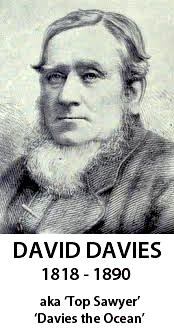
During this era the industrial south developed its own trade unions often dealing with Welsh companies and major Welsh capitalists such as David Davies, David Thomas (Viscount Rhondda), the Dillwyn Llewellyns and others. Many of these employers and most union representatives would have been Liberals, nonconformists, and Welsh David Daviesspeakers. Making it possible to argue that by the second half of the nineteenth century Wales had developed a largely indigenous economy. Yes, it depended on England and the empire to a great extent for its markets, but it was still more identifiably and distinctively Welsh than anything we have seen since. Labour was to change all that.
Labour, with its centralising tendencies and its hostility to Welsh particularisms had little truck with anything that wasn’t big and ‘national’. Welsh companies and Welsh unions were all swept away in pursuit of size and ‘unity’. (Always an important slogan for Labour, ‘unity’.) Predictable that a new party hoping one day to become the government of the UK should want its affiliated unions to be UK-wide, but in the process Welsh workers became no more than cannon fodder in a bigger struggle, used and abused by people who didn’t give a toss about them or their country.

Having encouraged the demise or the takeover of so many Welsh enterprises it was important to ensure that no new ones sprang up to replace them. So ‘Welsh’ Labour kept a tight rein on its flock and its wider patch, discouraging entrepreneurial spirit by defaming those who displayed such errant behaviour as ‘enemies of the people’. All of which served to make Wales an undefended target for English business, a captive market for English-produced goods. The perfect colony; achieved not through military conquest ordered by a bunch of toffs in a far-off land, but by local socialists who viewed native initiative as a betrayal of socialist principles. All done in defence of the centralist, English-dominated State.  

Had it not been for Labour Wales would have developed a healthy local economy along the lines of Catalunya or Scotland, looking after her own interests rather than being shackled with what we have today – an economy almost totally integrated with that of England, and in which Welsh interests are always subordinated to those of England.

3/ FOR MAINTAINING ENGLISH COLONIALISM IN WALES

Subordinating Welsh interests to those of England was justified by arguing that organising on a ‘national’ level with UK-wide trade unions, gave workers ‘more clout’. This made sense, up to a point, especially in the post-war period when so many major industries were nationalised; coal mining in 1947, road transport (British Road Services) in 1948, with other industries in the years following, including of course steel and tinplate, which saw the Steel Company of Wales (a very dangerous example) subsumed into British Steel. Few in the Labour Party considered that Welsh interests might be better served by some less centralised system. But as Bob Dylan put it, the times they were a-changing.

Labour reluctantly organised a devolution referendum in 1979 in response to the rise of various forms of Welsh consciousness over the previous twenty years. Due in no small part to most ‘Welsh’ Labour members and supporters opposing devolution the referendum was lost. It finally took more than a decade of Margaret Thatcher to make Labour realise the benefits of devolution . . . for Labour, that is, not for Wales. Control of a Welsh parliament being seen as a consolation prize for losing power in Westminster. What was best for Wales didn’t come into Labour’s thinking. And so – despite another Labour rearguard action led by those champions of the people, Lords Kinnock and Tonypandy – the devolution referendum of 1997 was won, just.

But devolution is a sham. Wales today is run by faceless civil servants answering to London and Labour’s cronies in the Third Sector, financed with misappropriated EU funding; ‘(Wales)’ is inserted in the title of English laws and passed off as legislation originating in the Notional Assembly; Welsh students are paid to leave the country, their places taken by English students; but perhaps worse, is ‘Welsh’ Labour’s consistent refusal to legislate for the benefit of Wales and then defending this by arguing that to promote Welsh interests would be a concession to ‘narrow-minded nationalism’. (By which argument, every independent country on earth pursues ‘narrow-minded nationalism’, including of course the United Kingdom of Great Britain and Northern Ireland.) Here are a couple of examples.South Shropshire

The first concerns the current First Minister, Carwyn Jones. Ten years ago he was Planning and Countryside Minister, and was asked by local authorities to consider introducing planning rules to favour local people then being excluded by the booming housing market; in fact, the example he was asked to copy was working just over the border in South Shropshire. He refused, saying that it would pose “legal problems”. So we were asked to believe that legislation already working in England could not be implemented in Wales! Obviously the interests of English holiday home owners and colonists had to take precedence, for helping the less wealthy get a home would bWatere making concessions to ‘narrow-minded nationalism’.

The second example concerns one of our greatest natural resources, water. During the premiership of Tony Blair, the Government of Wales Act (2006) was passed. Section 114 (1) (see panel, click to enlarge) makes it absolutely clear that should a Welsh Government make any moves to get a fair return for the water England takes from Wales then the UK government will intervene. This law was passed by a Labour government in London, agreed to by a Labour government in Cardiff, and the Secretary of State for Wales at the time was Peter Hain, MP for Neath. This is how ‘Welsh’ Labour serves Welsh interests – Welsh consumers paying more than English consumers for water from the same Welsh sources.

4/ FOR BEING WHAT THEY ARE

Looking at it from the other side, as it were, the Labour Party in the UK always did a great job of defusing discontent and preserving the existing order. In many respects the UK Labour Party was the best friend the capitalist and imperialist system ever had. It ensured that Britain was always spared the upheavals seen on the continent and elsewhere. Which makes Tony Blair not so much an aberration, or a betrayal of what had gone before, more the inevitable outcome.

From the perspective of the English Establishment it never really mattered whether the dominant political force in Wales was the Liberal Party, the Labour Party, the Conservative Party or the Aberdare Anarchist Collective. All that ever mattered was that that dominant political force maintained the colonial relationship between Wales and England and allowed no change in that relationship other than the most cosmetic.

Which explains why, after a century of Labour dominance, Wales (and especially those areas where Labour has been most dominant) is today the poorest country in Western Europe, possibly the whole of Europe. While Ukip may fear an influx of Roumans and Bulgars many Welsh would be better off heading in the opposite direction . . . if they had any skills to offer. Few do. Because our education system is now on a par with that of Burkina-Faso and our health service is the envy of . . . well, no one, actually. Though I’m sure the horse-drawn ambulances will soon become a tourist attraction.

Our rural areas are nothing more than retirement and recreation areas for the English. In many parts of Wales the Welsh are now in a minority. Every attempt is made to kill off the Welsh language and destroy all vestiges of Welsh identity other than the most frivolous or touristy. Few of our people can afford to buy the homes being built in our countryside and are then denied social housing in favour of English people who have never set foot in Wales. Soon  the term ‘Wales’ will have lost all meaning, and then the assimilation into England will be complete. Welcome to Tibet, UK!

Today, stripped of ideology and purpose, plus the industries and trade unions that sustained it, the principled and visionary movement that scrambled to dominance over the fallen bodies of Liberalism and nonconformism is just a freak show of dilettantes and chancers; people for whom the party is a stage, or else a means to promote their real interest, whatever that might be. While its diminishing band of followers vote Labour much as people support a very poor football team – with blind, unquestioning loyalty but no enthusiasm. While the Labour machine just goes through the motions of politics for no better reason than stopping somebody else occupying county hall, winning Cwmscwt North, or ‘running’ the Assembly.

Labour rose to pre-eminence in a country with a burgeoning economy and a prosperous and confident people; now, after a century of Labour hegemony, we are a broken and impoverished nation on the point of ceasing to exist. This is Labour’s legacy to Wales. ‘Welsh’ Labour has failed on every conceivable level. No-one should question why I detest this gang of back-stabbing, bipedal vermin.

UPDATE 27.03.2016: Here’s an interesting essay that throws further light on the emergence of the English & Irish Labour Party in Wales.

Polls and Donkeys

That nice man from ITV Wales, you know, the one who’s on Sharp End, Adrian Masters, well he tweeted yesterday that the results of a recent poll were available over on the ITV website, so I went to check on the findings. Some of them are, quite frankly, difficult to believe. Others, disturbing for the lack of engagement displayed by respondents.

One part of the survey asked people for their views on the performance of the current Labour Government down Cardiff docks. On the NHS, schools and the economy Labour’s approval rating was 24 and 25 per cent for non-Labour voters, but not much higher, only 36 – 41 per cent, among their own supporters. Perhaps more worrying from a neutral perspective was that the Don’t Know / Don’t Care / Ew Wha’? response ranged from 31 to 44 per cent!

Despite this lack of support for, or interest in, the Labour Party the YouGov poll nevertheless predicted that in the 2015 UK general election Labour will gain eight seats, five from the Conservatives, two from Plaid Cymru and one from the Liberal Democrats. Seeing as the Conservatives and Liberal Democrats are the parties of the current UK coalition government, this is not entirely surprising, but why should Plaid Cymru also suffer? The seats the poll suggests Plaid will lose are Arfon and Carmarthen East and Dinefwr.

While the Arfon prediction is difficult to fathom, but plausible, the prediction for Carmarthen East and Dinefwr seems impossible. Let us consider the facts. Plaid Cymru had a majority in 2010 of 3,481. The seat lies wholly within the county run by the most dysfunctional council in Wales. A council in which Labour is in coalition with a gang of so-called ‘Independents’, many of whom are Tories, others just in it for themselves, SI Exifplus a few flakes. Yet the council is actually run (or was until very recently) by the chief executive. The poll was conducted 10 – 12 of February, two weeks after the publication of the damning Wales Audit Office report into spectacular and expensive wrongdoing at the council. A resident of Carmarthenshire would have had to have been abducted by aliens not to have known about this report. (Though I bet even aliens would have been talking about it.) So does anyone seriously believe that Labour is going to take this seat next year?

The predictions for Plaid are questionable, but what about the Tories, tipped to lose five Welsh seats in next year’s UK general election? They can surely expect wipeout in the Welsh Assembly elections of 2016. Well, no . . . because according to respondents to YouGov Conservative support at Assembly elections is up two points to 21 per cent! With Labour, predicted to almost sweep the board in 2015 remember, down one point for the Assembly elections in 2016!

So how do we make sense of all this? We could of course be dealing with a very sophisticated electorate, able to make subtle distinctions and different judgements for different contexts. Or, we could be dealing with people who know little and care less; an increasingly apathetic electorate that has given up on politics, which for me would be a more plausible explanation for the inconsistencies.

People who no longer give enough thought to politics and politicians to hold coherent views, so they’re confused, or they revert to the comforting default position of the traditional ‘Donkey Labour’ voter: ‘Don’t understand politics? – Vote Labour!’ Because even when pressed on specific subjects for a simple Yes or No over a third could still only offer ‘Dunno’, suggesting they knew absolutely nothing about Labour’s policies and performance in Wales. Did I say ‘disengagement’? I guarantee that some of those questioned could not have known less about Hungary’s agricultural policies.

The only caveat, and it’s a big one, is that I am suspicious of opinion polls in general, and YouGov in particular. I believe that many people – shall I say, the more ‘suggestible’ among us – can be influenced by opinion polls into joining the ‘winning’ side . . . which of course means abandoning (what the polls suggest is) the ‘losing’ side. In Wales, in order to promote a certain constitutional outlook, the winning side has to be Labour for the ploy to be credible.

Then again, I could be entirely wrong, and this is an authentic and accurate vox populii. In which case, Wales is in more trouble than even I had feared.

The Trouble With Devolution . . .

A story in the Daily Telegraph has been getting attention on Twitter and elsewhere. It appears that the Treasury in London is considering giving power over stamp duty (on property purchase) to the ‘Welsh’ Government. (Though if I’ve read the article correctly, it seems that others in the Treasury are arguing against the move!) The (pro-transfer) Treasury would appear to be considering implementing a change proposed by the Silk Commission, set up to look into the devolution settlement and recommend changes it feels might be necessary or welcome.

There would be nothing surprising in the Treasury handing over such power, for it has long been suspected that the Conservative Party would be happy to transfer to Wales authority over the raising of existing taxes. Which if you think about, makes perfect sense. If we raise £100m then this same sum will be deducted from the block grant . . . with the expense of raising and administering the tax transferred to Wales. So we’ll end up out of pockTelegraph clip 2et.

Irrespective of whether there is discord at the Treasury among the unnamed, one name we do encounter in the Telegraph article is that of David Jones, Secretary of State for Wales. Doing what Tory Secretaries of State have ever done – put England’s interests first. For while he may urge caution because of the consequences ” . . . . for the whole of the UK . . . ” this – as he well knows – is disingenuous. The legislation will have no effect on Scotland, so he is thinking solely of England. More importantly, those Conservative voters with second homes in Wales.

Just remind yourself that this post of Secretary of State for Wales exists, so we have always been told, to defend Welsh interests. Increasing stamp duty on second homes would result in more properties coming within the financial reach of local buyers, so shouldn’t David Jones be supporting such a measure? Yes, but only if you fall for the old deception that a Secretary of State for Wales is ‘the voice of Wales in the Cabinet’. In reality, he, and every other Secretary of State, Conservative and Labour, has been the voice of the Cabinet in Wales. Little more than a governor-general with instructions to keep the natives in check.

Telegrap clipElsewhere in the article we were treated to another quote, this time from “a Tory source” which first reminded us that England and Wales (or Englandandwales), ” . . . in many respects form a single economic region”. Yes, we’re aware of the problem. Before going off the rails a bit with, “The border areas are highly populated . . . “. What! Travelling north from Chepstow the border is sparsely populated until one reaches Wrecsam. Which suggests that this ‘Tory source’ is probably from the north or the north east . . . perhaps David Jones again, this time incognito.

One thing I find really sad about this little tale is that the Conservative Party within Wales has made great strides to detoxify itself, to become more Welsh, and then along comes Dai Jones talking like a Tory politician of the 1980s. Such progress has been made in Wales that the party has managed to make itself unattractive to Beata ‘Britannia’ Brookes and Rod Richards, both offloaded onto Ukip. David Melding often sounds a better Welshman than many in Plaid Cymru. Then comes the reality check in the form of David Jones.David-Jones-MP-007

Though in fairness, things would be little different if the Labour Party was in power in London. For this episode only exposes, yet again, the fundamental problem with devolution. England agrees we can have devolution just as long as it doesn’t disadvantage England. Which is almost impossible. If Wales was to act in her own best interests – as does every other country – then we would be charging a fair rate for water and other exports. Were we growing a healthy economy then Welsh companies could only expand at the expense of English rivals currently taking advantage of the lack of indigenous competition.

In a nutshell . . . The problem with devolution is that the ‘Welsh’ Government only has power to decide spending priorities of the block grant given by London. Due to the prevailing socialist ethos, this results in much of this money being squandered in order that our politicians can claim the moral high ground. Though this is defended as making Wales a fairer and “more equal” country. Which I suppose has some truth, for we’re all becoming poorer.

Compounded by the fact that we have a Labour Party in control of Wales that sees a virtue in poverty! We are said to enjoy the only administration in Europe that has a Minister for Tackling Poverty. But making a virtue, or a political weapon, out of poverty is so entrenched in Labour thinking that we also have to suffer a Third Sector that exists to glorify and capitalise on poverty, and of course, by so doing provide a few thousand jobs for Labour cronies! As if that wasn’t bad enough, many in ‘Welsh’ Labour seem fearful of making Wales successful lest this excites nationalist passions!

Further exacerbated by the problem that too many policy decisions attributed to the ‘Welsh’ Government are in fact made by civil servants and ‘advisors’ of whom we know next to nothing, beyond the fact that few of them are Welsh, and many of them answer directly to London. The Planning Inspectorate, the Housing Directorate (social housing), the Wales Rural Observatory, are just a few of the bodies involved.

While on the other hand, London will never grant powers that could improve the economic standing of Wales because to do so would, in too many instances, result in England or English consumers of Welsh resources being disadvantaged, or else – as stamp duty explicitly shows – work against the interests of English people taking advantage of Wales’ relative poverty and colonial status in relation to England.

Put it all together and it exposes devolution as a chimera; a worthless sop to Welsh sentiment designed to fail on almost every practical level. Which is what we have seen since the Welsh Assembly came into being. By almost every important criterion Wales is poorer today than she was in 1999, not just in absolute terms but relative to England, Scotland, and almost every other part of Europe.

Consequently, the current model of devolution is indefensible. To persist with it can only be viewed as a collective delusion, or the worst form of national masochism.

Mummy Knows Best!

The contributions being made to the Silk Commission by our masters from London, and other recent statements, make it clear with what contempt we Welsh are regarded. Let’s start with some examples from the recent 114-page submission to the Commission by the UK Government. First, in arguing against a separate prison system for Wales the document lists four insurmountable obstacles. These are:

  • There is no male prison in North Wales
  • There is no female prison in Wales
  • There is no high security prison in Wales
  • HMP Usk and Prescoed takes prisoners from England

All true, of course. Though when I read that I thought I’d mis-read the argument; thinking these were reasons for having a separate prison system. But no, the UK Government has, in all seriousness, listed these shortcomings of its own system, this clear evidence of neglect, as justification for persisting with that system! Using that ‘argument’ no deficiencies would ever be remedied. ‘We can’t give you the power to build a road from A to B because there is no road from A to B’. As for taking prisoners from England, well . . . um . . . couldn’t this facililty just stop taking prisoners from England. Maybe take some of the Welsh prisoners in English facilities?

River Basin

Later in the document, at page 104, water is discussed, and this is what it has to say in justification of the current arrangement: This area is inevitably complex. Put at its most straightforward, this is because the border between England and Wales does not reflect the river basins or river catchments which span the boundary. The water and sewerage industries are undoubtedly one of the most complex areas in terms of the Welsh devolution settlement.”

And you thought it was simply a matter of us being ripped off! Silly Billy! It’s all to do with basins and catchment areas. You know, like with the Nile, where Egypt rules the waves all the way upstream. Or the Danube, for everybody knows that Romania controls all the water resources right back to the river’s Black Forest origins, because of the international laws relating to river basins, catchment areas, etc., etc. As the map shows, only one country is seriously disadvantaged by this basins and catchment areas bollocks. And only one benefits hugely from it. No prizes for guessing.

This section on water provides quite a few laughs, I recommend it. Possibly also something to worry about. Because if I’ve read the document properly then there is a draft Water Bill knocking about of which part of the submission, 22.29, says: This is a change from the current approach to regulation of the water sector in that it removes the powers of the Welsh Ministers to determine the size of the market which may be served by the new entrant licensees.” So here we have the Silk Commission, looking into more powers for the Assembly and the Welsh Government, yet the Wales Office can actually submit a document that makes reference to taking powers away from Wales!

Other recent gems from London included the statement made in January by Damian Green, the Minister of State for Police and Criminal Justice in Englandandwales, who said that there is “no real appetite” for devolving to Wales powers over police and criminal justice. That is, no appetite in Wales. Nonsense of course. As explained by Syniadau in this excellent post.

This reminded me of Peter Hain (so much does) and his fatuous arguments against holding a referendum on increasing the Assembly’s powers. The referendum that was held on March 3rd 2011 and won by a margin of two to one. Hain had always argued that we weren’t ready, that a referendum held too soon would be lost, and would damage the devolution process. As late as February 2011 Hain was blaming Plaid Cymru (In coalition with Labour at the time) for the referendum being held so soon, and fearing a low turnout which would invalidate the result. Hain’s thinking on the referendum even got a mention in WikiLeaks.

Allow me a wee digression before I proceed. Believe me, it is not without relevance to the subject under consideration. I recall watching some years ago a self-congratulatory bash held by the chief constables of the four Welsh forces. Some top cop was on his feet effusing about this and that. He glanced towards the chief constable of Gwent and made some insane reference to the “special conditions” of Gwent. Obviously a feeble attempt at justifying that conundrum which has foxed greater minds than his – why should Gwent have a separate police force. But it made me think . . . ‘What “special conditions”? Is Gwent an alpine state? Is the population Buddhist? Spanish speaking, perhaps?’ The scene brought home to me yet again what idiots people make of themselves when trying to justify that which either cannot be justified, or else that for which they cannot give the honest answer.

Mother England

And so it is with the intellectual quality of the arguments laid out above. They would embarrass a 12-year-old. But they are what we expect from politicians looking for excuses because they can’t give their true reasons. They all boil down to the same thing: ‘It’s in England’s interests that these powers be withheld, but we’ll try to kid you that we’re doing it for your benefit’.

When you realise that; when you understand that these bastards are lying through their finely polished teeth, you have to wonder how they view us Welsh if they expect us to believe this bollocks. They must think we’re a bunch of knuckle-dragging primitives. And then you remember your history . . . or rather, their history. For the English and their native allies have always pulled this stunt – ‘You aren’t ready to do things for yourselves. Trust us and we’ll look after you . . . and of course your resources.’ ‘Mother England’ and her ‘children’. I think it’s time we told the old slag she’s never been our mother, so stop squandering our inheritance and go stand on your own two feet.