 Let me begin by saying that I have nothing personal against Will Hayward, never met the boy. But I can’t help wondering why this graduate of Cardiff University – where else? – is accepted as an expert on a country he ‘knows’ only from brief forays out of Cardiff.
And of course he writes for the Guardian. A bit like someone from Turkmenistan who never leaves London or the circles of the metropolitan elite being accepted as an expert on England. In Turkmenistan.
But the spur for this piece is something Will put out on Sunday. In it he claimed the real immigration problem for Wales is not arrivals from overseas, but retirees from England. Though he’s keen to say:
Before we go any further we need to be very clear, this is not about blaming older people or in any way suggesting that people in other parts of the UK don’t have every right to retire wherever they like.
In a sense, he’s right, but the article falls short of giving the full picture. Partly due to ignoring certain factors operating in Wales, and also the knock-on effects in Wales of changes happening outside.
Will Hayward’s article was about people moving into Wales, and falling birthrates, so I’ll take the opportunity to fill out the picture.
◊
IMMIGRATION TO WALES
For the purposes of this piece I’ll break immigration down into a few categories.
RETIREES: Will is right in saying that Wales attracts retirees from England, with some areas getting more than others. Not for nothing was the north coast long ago dubbed the Costa Geriatrica.
But even in Conwy, the worst-affected area, only 15.8% of those moving in are retirees. (In Cardiff it’s just 2.8%.) Clearly there are other factors at play. So let’s look at them.
GOOD-LIFERS: Here I’m referring to those who’ve “moved to the country“, from English towns and cities, for a better quality of life or some such. Whether true or not, that’s often the reason given.
BUSINESS BUYERS: This category covers those who’ve bought existing businesses or moved here with capital to start their own. This trend has increased exponentially with the advent of the internet and businesses being sold online.
STUDENTS: This could be students who remain in Wales after graduating. Like Will. Or those who stay in the area around the institutions from which they did not graduate. For want of a better term, the drop-outs.
JOB TAKERS: What it says on the tin. And with the self-styled ‘Welsh Government’ insisting that 20% of its future recruits must come from minorities – with Wales’s BAME percentage at just 5 or 6% – there’ll be thousands more in future.
This anti-white discrimination has been engineered by pressure groups that profess to believe the countryside is racist, dogs should be banned, and the Welsh cake needs to be decolonised. (I’ve been thrown out of a number of caffs for demanding decolonised Welsh cakes.)
SOCIAL HOUSING TRANSFERS: Social housing providers must give priority to certain categories of applicants. This results in people with no connection to any part of Wales being allocated social housing ahead of locals.
‘WHITE FLIGHT’: Those who’ve moved from England’s increasingly ‘diverse’ and unsafe towns and cities to live in safer areas. Will and his friends might call such people racists. But they’re not. I know many of them, almost all are decent people who wanted something better for themselves and their families.
But if that rationale of racism is accepted, then it must apply to those who form their own enclaves in England’s towns and cities, to live amongst people like themselves. And in some cases create no-go areas for those outside the group.
The point to be made here is that immigration to England – legal and illegal – has a knock-on effect in Wales. To link retirees with ‘asylum seekers’ and use that to argue the latter category has no effect on Wales is wrong.
But seeing as we’re talking about people moving from England . . .
◊
FALLING BIRTHRATES AND THE HOUSING ISSUE
A linked thread in Will Hayward’s piece about retirees was the ageing population and the falling birthrate. Valid points. But again, taking them in isolation, and linking the latter with the former to the exclusion of other factors, is simplistic.
Predictably, an ageing population and a falling birthrate is used to justify overseas immigration! Now where have we heard that before?
Unless people in Wales start procreating a lot quicker, we are going to need those overseas immigrants, especially given the difficulties we currently have in attracting people to the social care profession.
A major issue, for decades, has been the inability of many local people in rural areas, young Welsh people, to buy a home in their communities. And this phenomenon is influenced by all the factors I mentioned in the previous section.
Despite this, the easy target is holiday homes. Fair enough. But if holiday homes is not the sole cause of the problem then penalising them cannot solve the problem.
In fact, focusing solely on holiday homes has more than a whiff of ‘tax the rich’ to it.
Hayward’s article spotlighted the 65+ age group. These are his ‘retirees’. But people can retire as young as 50 nowadays, certainly 55. And these are not going to move into The Fading Memories Retirement Home. They’re going to buy a place of their own.
But they’re unlikely to have children helping keep the village school open. And well-heeled early retirees are also unlikely to be looking for jobs in the “social care profession“.
With all the various pressures on local housing stocks, private and social, many young people find it difficult if not impossible to find somewhere to live. So they move out of the area. Maybe out of Wales altogether.
This is one explanation for the falling birthrate. And another reason for the lack of recruits for the “social care profession”
Even those who stay, and marry, might not have children if they have to live with parents. Those who do marry, buy a house, and even with husband and wife working in order to pay the mortgage, are less likely to have children.
The housing problems in rural Wales, as they affect young locals, could be viewed as a form of birth control. If not in intent, then certainly in effect. This obviously helps explain the falling birthrate. And closing village schools.
Which means it’s wrong to pile in on retirees in the 65+ age bracket. Poor dabs!
But these facts throw up a solution that Will Haywood and his mates will reject. Ironically, it’s one where Will’s friends line up with Reform and others.
◊
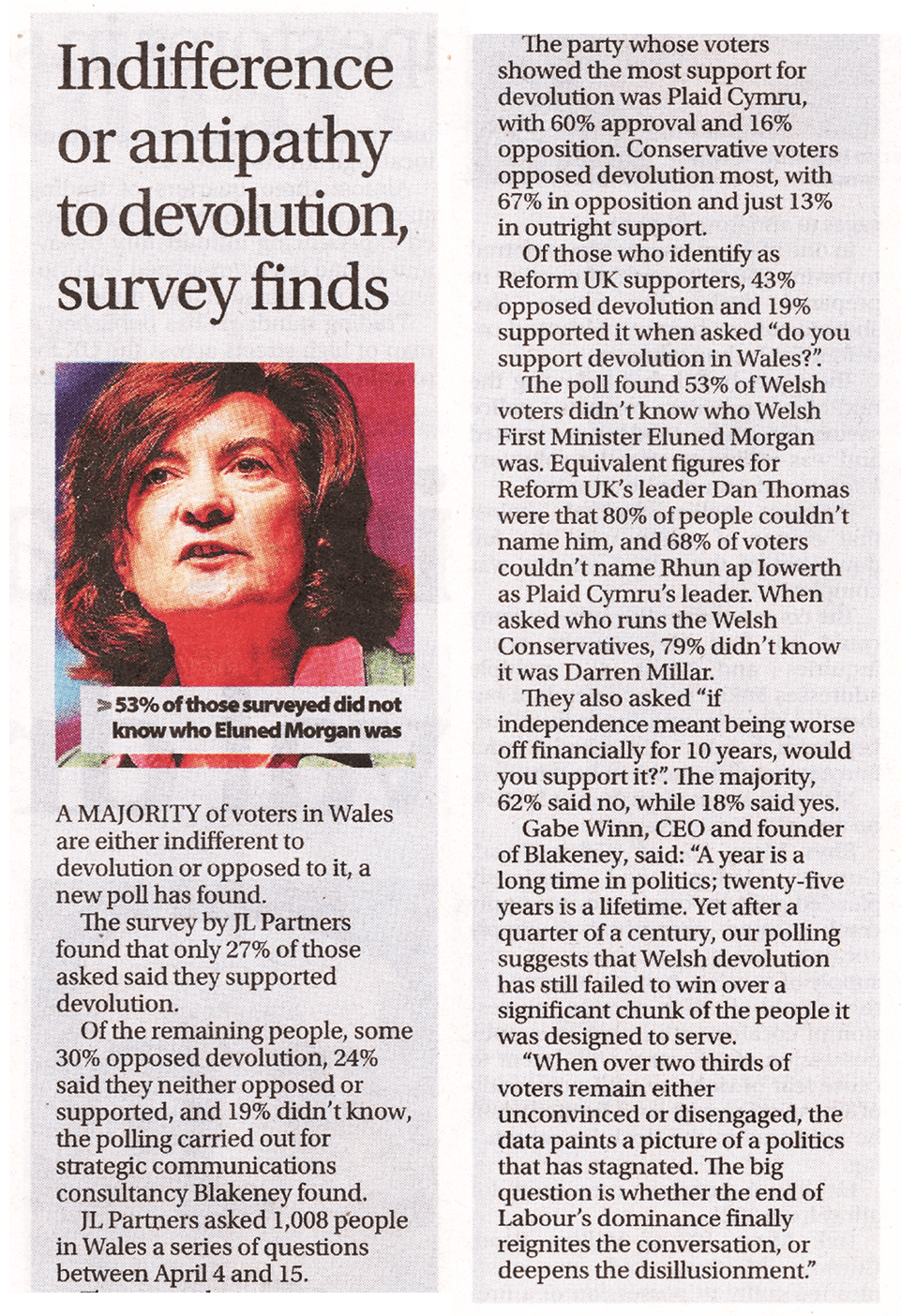
THE FAILURE OF DEVOLUTION
If Wales is to solve the problems of too many elderly retirees and a falling birthrate, then we must accept that these are parts of a multi-faceted problem affecting, but not confined to, rural Wales.
With the losers every time being the indigenous Welsh. Which then suggests we need to consider differentiating between those posing the threat, and its victims, in order to protect and promote the interests of the latter.
Which can only mean some form of preferential treatment for locals.
But those on the Unionist right will object, saying that we’re all citizens of the UK and must be treated equally.
While Will and his confreres will be uncomfortable with the idea because the bigger agenda to which they’ve aligned frowns on nations and national identity, certainly for white people. They call it ‘ethno nationalism’.
They can call it what they like. I’m Welsh, this is my country, and that’s the way it is.
For those with whom Will associates, ‘Wales’ is just a platform from which to lecture us, and an administrative unit within which they can give free rein to their pet lunacies. Like decolonised Welsh cakes.
But nationhood? Go wash your mouth out with WEF-approved carbolic!
Getting back to falling birthrates and young people leaving means we can’t ignore economic factors. Because away from the rural areas we see falling birthrates in the Valleys and Swansea Bay, where there’s little retirement from England influencing the picture. (Apart perhaps from Gower.)
The only areas with more births than deaths are Cardiff and Newport. But these are growing cities, with healthy economies, reasonable wages, affordable housing, and few retirees moving in. Though migrants from outside of Europe will also contribute to their birthrates.
We must also factor in jobs being concentrated on the south east coast, which draws in young people from other areas of the country. This of course links with the problems discussed earlier, and exposes a major failing of devolution.
The picture below provides an insight into the workings of both devolution and Corruption Bay. (Will Hayward is on the far side in the dark blue shirt.)

It was taken at a soiree organised by PR/lobbying firm Cadno. Which acts as a link between clients wanting to do business in Wales and politicians and decision-makers who can help their dreams come true.
Made easier by the fact that ‘banana republic’ Wales has no register of lobbyists.
As George Carlin used to say: “It’s one big club, and you ain’t in it“.
◊
CONCLUSION
Will Hayward may be a man born out of his time. I say that because I think Will should have been an old-style correspondent, sending amusing skits from far-flung corners of the empire back to London publications.
You think I’m being unfair? Just read this, from December 2024, when Will bravely ventured into the uncharted wastes of the Llynfi Valley. (Maesteg, to be exact.)
Here’s his profile of the local matrons:
They pounced with questions from all sides. “Where you from?”, “Who’s your mam?”, “Do you have a girlfriend?” Google, Facebook and Apple have nothing on the old women of the Llynfi valley for data harvesting.
“Who’s your mam?” FFS! (I was surprised not to read, ‘look you, indeed to goodness’.)
Rarely, in the history of journalism, has a single paragraph hosted such an epic tussle between cliche and stereotype.
Will Hayward moves in a certain ‘progressive’ milieu; he picks up tittle-tattle, or he’s fed information, which he then knocks into articles. He’s essentially a propagandist for the Corruption Bay establishment.
Which helps explain why people wonder whether he supports Labour or Plaid Cymru. The fact that so many have difficulty figuring that out reminds us the Uniparty is real, and all that matters is pushing the agenda.
This Uniparty is a political class in hock to pressure groups, many of which are extreme, and some of which are insane. Which means that this political class has for 27 years of devolution been steadily distancing itself from 95% of the Welsh population.
When he isn’t writing favourably about his friends Will Hayward’s attacking those on the other side.
The other string to his bow is reassuring the metropolitan elite, via the Guardian, that the political class in Wales is on-side. (That’s when he’s not wandering off into the bush.)
Maybe socialising with people I find repulsive gets Will Hayward ‘insights’. But he knows nothing about the real Wales.
♦ end ♦
© Royston Jones 2026