Wales, Colony of England

Let me start by establishing what I mean by a colony. A colony is a territory or country run in the interests of another country, and for the benefit of the elite or the population in general of that other country. The colony does not need to be far away, nor do its indigenes need to be of a different pigmentation or religion, what matters is the economic and other relationships between the two countries. By which criteria Wales is most definitely a colony of England.

~~~~~~~~~~

Historically, we Welsh had to be conquered and brought under English rule a) because we resisted Anglo-Saxon / Anglo-Norman / English attempts to control the whole island of Britain and b) because we, as the original inhabitants of Britain, served to remind these invaders of our prior claim to their land as well as our own.

For centuries we suffered under a discriminatory legal system then, with the Industrial Revolution, we started to see Wales and the Welsh exploited in a more organised fashion, with the motive this time being profit rather than imperialist aggrandisement. In a modified form this system persists today, and although discrimination may no longer be on the statute book it still exists in myriad subtle forms.

~~~~~~~~~~

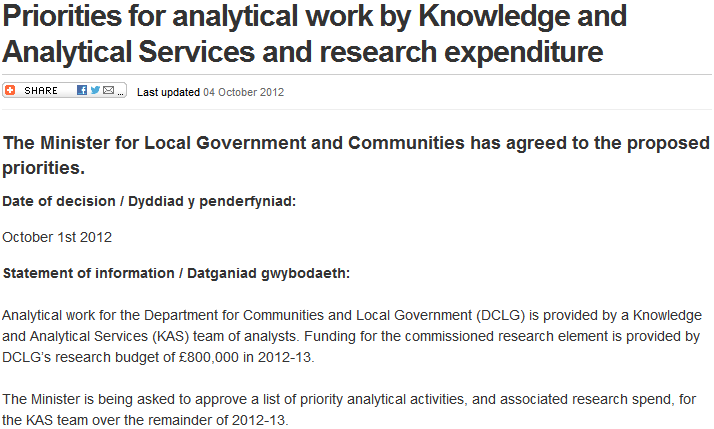
Something I was reminded of recently with the re-surfacing of a story I’d been vaguely aware of before. A Welsh businessman named Clive Hughes had planned to build two biomass plants employing hundreds of people, one near Kidwelly, the other on Swansea docks, reported in the panel on the right (click to enlarge).Biomass Swansea docks It seems that Mr Hughes had no help in his endeavours from either Mark James Carmarthenshire council or the ‘Welsh’ Government. In fact, he received no reply after writing to First Minister Carwyn Jones.
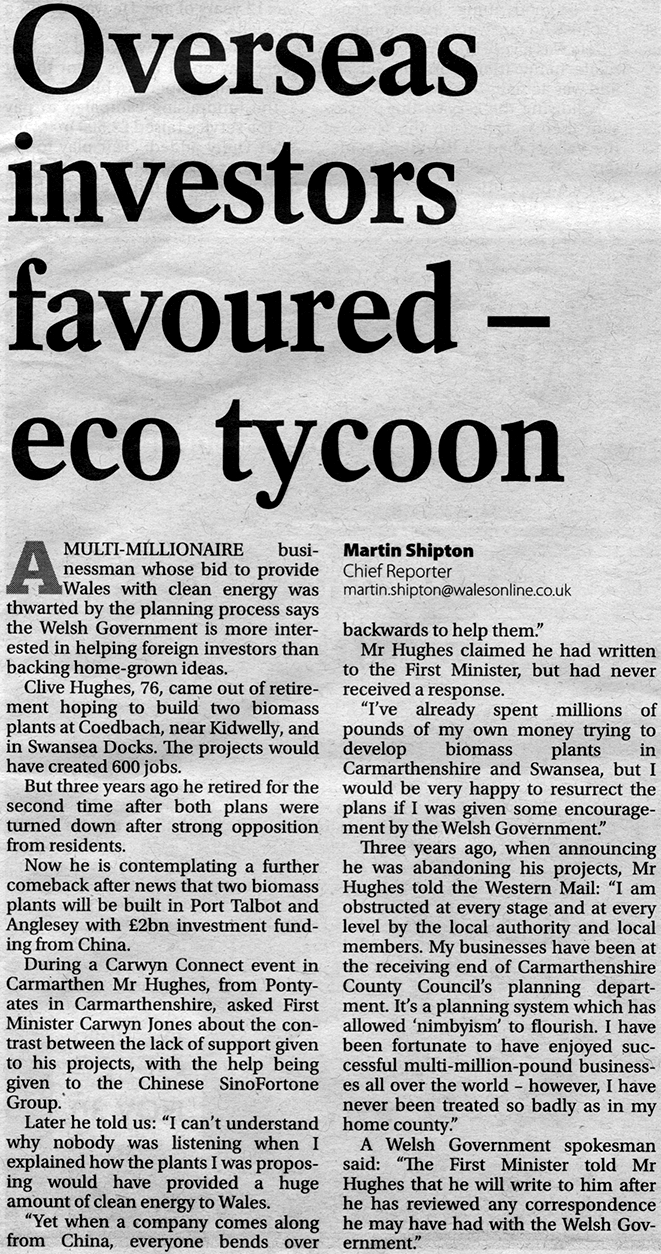
The reason this story has re-surfaced is because Clive Hughes was understandably peeved to learn that while his projects were either ignored or refused planning permission, civil servants and councils are now falling over themselves to help Chinese investors build two biomass plants, one on Ynys Môn, the other in Port Talbot, just a few miles from his planned Swansea docks site.

Something Clive Hughes was quoted as saying hints at where I’m going with this example. He said, “I have been fortunate to have enjoyed successful multi-million-pound businesses all over the world – however, I have never been treated so badly as in my home county”.

How do we explain this curious tale of Welsh agencies refusing to support indigenous enterprise while generously supporting foreign investment  – to do exactly the same thing! In a word, colonialism. (Yes, I know the report mentions nimbyism and “opposition from residents”, but believe me, it goes way beyond that.)

Clive Hughes was wasting his time appealing to Carwyn Jones, who is just a figurehead for a form of sham devolution. Wales – as I have said time and time gain – is run by civil servants, invariably masquerading as ‘advisors’ to Carwyn and his gang of deadbeats, and these civil servants take their orders from London. The wisdom for some years in London has been that it is a good thing to ‘open up’ the UK to foreign investment, particularly from China. Once you know that, then it’s easy to understand why no Welsh businessman will be allowed to queer the pitch for Chinese and other foreign investors.

A further example of the colonial economy at work is often articulated as the question, ‘Isn’t it strange how Welsh people (insert here, Terry Matthews, Chris Evans et al, or Clive Hughes) have to leave Wales to be successful?’ Er, no, there’s nothing strange about it, for two very good reasons. First, too many successful Welsh businesspeople might give us natives silly ideas about our ability to do things for ourselves. Second, any successful Welsh business is almost bound to come into competition with English companies. Both are undesirable in a colonial set up.

Of course after making his money in Canada Matthews returned to Wales and built the very successful Celtic Manor resort outside Newport. But the Celtic Manor poses no threat to the colonial arrangement. To begin with, it does not really compete with English rivals in the way that a company chasing consumers in a competitive market would. In addition, with its NATO conferences and Ryder Cup golf tournaments, the Celtic Manor helps integrate Wales with England.

Note that in the piece I’ve linked to about Matthews, Michael Moritz is described as “the richest person in Wales”, which is stretching it a bit. He was certainly born in Cardiff, but left for the USA in his early twenties, made his fortune in Silicon Valley, and never returned. He still lives in San Francisco with his family. Perhaps the most successful business based in Wales, and the only one quoted in the FTSE 100, is Admiral Insurance, started up and still owned by Henry Engelhardt . . . from Chicago. Which is fine, because it confirms that the Welsh must have outsiders to provide them with work.

Let’s end with another feature of the colonial economy, and again, something that draws bewildered comment from people who refuse to see the system controlling the economic life of Wales. I’m referring now to the phenomenon of successful Welsh companies being taken over by larger companies before they can grow too big, with this often resulting in redundancies or even closure of the now subsidiary Welsh operation. If you don’t understand why this happens then you haven’t been paying attention.

~~~~~~~~~~

The Roman system of coloniae settled army veterans and their families in conquered territories and border regions, and was employed for two main reasons. First, to keep an eye on the natives and, if necessary, confront any insurgency until the army arrived. Second, coloniae spread the use of the Latin language and Roman ways of doing things.

This example of settling people from, or loyal to, the ruling country in recently conquered territories and colonies is one that has been imitated globally down to the present day. The British have done it across the world, even to Christian European populations. There was the Irish Plantation, the ‘repopulating’ of eastern Canada after the expulsion of the Acadians (Cajuns), and the flooding of the independent republic of Transvaal with British settlers once it was realised that the land beneath the Boers’ feet contained gold and diamonds.

In more recent times, France sees a steady exodus of loyal French people to Tahiti, New Caledonia, Guadeloupe, Martinique and other specks in the ocean in the hope that these emigres will help the natives see the benefit of maintaining ties with France. While on a bigger scale, and in a much more brutal fashion, China has created all sorts of incentives for Han Chinese to settle in, with the intention of dominating, Tibet and Xinjiang.

So why be surprised that Wales has been undergoing a process of colonisation since the 1960s? A process that has taken many forms, some so bleeding obvious you wonder how they got away with it.

Take the Development Board for Rural Wales, an agency set up – so we were told – to stem the depopulation of the five central counties of Montgomeryshire, Cardiganshire, Merionethshire, Breconshire and Radnorshire. It operated by paying English companies to relocate to central Wales, with their workforces (all paid for), while spending many more millions building thousands of new houses for this influx. And while all this cash was being showered on English companies local firms could not apply for a penny of DBRW funding. As blatant a colonisation strategy as Mother England has ever deployed. But Welsh politicians, media, and others still applauded every relocation as ‘New jobs coming to —————‘.

Many countries pay companies to set up in areas needing employment, but I have never come across another case like the DBRW, where a state paid firms to transfer lock stock and barrel, plus workers, to another area. It makes no sense, until you see it for what it was – plain, unvarnished colonisation.

~~~~~~~~~~

The colony of Wales also serves as a receptacle for those who are not making a contribution to the common weal in England. Those in this category range from geriatrics to young criminals and drug addicts. To the point where in some areas of Wales – such as where I live – two-thirds of the over 65s were born in England. But, hey! looking after old people is a ‘growth industry’.

Gwynedd SW Wards merged
CLICK TO ENLARGE

If it’s not wrinklies then it’s a feckless white underclass. Some towns have been almost destroyed by this phenomenon, and none have come closer to implosion than Rhyl. This link reports a story of a woman living in Rhyl sent down after police found a dead body and a stash of heroin in her flat. An everyday story of Rhyl folk.

When it’s not drug addicts then it’s paedophiles. So many such deviants from over the border are now turning up in Wales that it just has to be organised, perhaps by the Probation Service. I have written about this problem before, one of the most notorious recent cases was a whole gang of paedophiles relocated from London to Kidwelly. Read about it and other cases. Within the past few days I have learnt of two more paedophiles who, by some unspecified route, arrived in Wales. This one in Ciliau Aeron and this one in Llanbadarn Fawr.

In the great colonialist scheme of things it really doesn’t matter whether those coming into Wales are sweet old dears straight out of an Ealing comedy or dangerous perverts, they all make their contribution to skewing Welsh statistics in a way that is unflattering to us, put a strain on an already overburdened health service, and of course, make their contribution to anglicising Wales. ‘Poor Wales’, ‘Ageing Wales’, ‘Wales’ Drugs Problem’ writes Phil Space, and intones Jamie Owen, but no one has the balls to really investigate these issues and give us the truth.

But then, in a colony, the last thing you can expect is an honest media.

~~~~~~~~~~

I can’t be absolutely certain when I first realised the media lies (maybe it was when I was first lied about), but the reporting of the Balkan wars in the 1990s was something of a watershed because that coverage was not simply a lie here and there, or some vague and ill-defined bias, it was an unwavering adherence to a propaganda line originating in the Pentagon.

Done in pursuit of a strategic objective dictating that Jugoslavia should be dismembered and Russia’s Serb allies at the core of that State be internationally isolated. To achieve this objective the fascist Croats of the Ustaše, and the gangster Albanians in the Kosovo Liberation Army, were depicted as knights in shining armour, while a blind eye was turned to foreign jihadists killing Serbs in Bosnia, leaving us to focus solely on the beastly Serbs, the only ones guilty of any atrocities.

Obviously, when dealing with ‘internal’ matters the UK media is different, but even here, the bias has long been unmistakable, and especially in television. Just about everyone has noticed the recent plethora of programmes with titles beginning ‘Great British’, in fact, it’s become so obvious that it’s something of a joke. A regular orgy of cringe-worthy ‘patriotism’, on sets bedecked with union flags, and all done in the hope of persuading Scots and other disaffected minorities that it don’t get no better than singing the worst national anthem on earth.

While on another level we see some elements of the BBC – Newsnight comes to mind – becoming almost schizophrenic in their desire to maintain their Left-liberal bias while simultaneously following the BritNat line in the hope of pandering to those in the Tory party who wish to dismantle the Beeb. Though in its coverage of the Scottish independence referendum last year all pretence at impartiality went out the window for the BBC in general, and Newsnight in particular.

Here in Wales, with its recent acquisition of the Evening Post, we have Trinity Mirror taking a stranglehold on the ‘Welsh’ print media. We can now look forward to Swansea’s daily paper, the largest selling Welsh daily, being written in Cardiff. And why not? With the political and economic life of the country being centralised on the capital like some tin-pot dictatorship it makes perfect sense.

Our self-styled ‘National Newspaper of Wales’ is now little more than a desperate amalgam of showbiz news, columnists nobody reads, sport, and a daily promotion of all things Cardiff. To the extent that a new restaurant opening, or a celebrity being spotted in the city, somehow becomes a news item that Llais Y Sais deludes itself will be of interest to people in other parts of Wales. No wonder so few people outside of the Cardiff area buy the bloody thing.

Perhaps the best way to explain how this Cardiff-obsessive system operates is by introducing that famous bullshit duet the Barry Brothers. Mark Barry runs M&G Barry Consulting and gets paid to promote the Metro system and other projects designed to further enrich Cardiff at the expense of the rest of Wales, while brother Siôn is the Business Editor for Media Wales, which of course covers the Wasting Mule. So Mark Barry’s clients tell him what they want promoted, he passes ready-made promos on to brother Siôn, who ensures that they appear in Llais y Sais as ‘news’! This is how low ‘journalism’ in Wales has sunk.

In the panel below (click to enlarge) you’ll see a piece by Siôn Barry that appeared in the Western Mail on Monday (23.11.2015). I’m using it because it brings together a couple of the points I’m making in this post. First, we have another successful Welsh company being taken over. This company is based in Swansea, but it’s left to a spokesperson for the company to tell us that.

Sion Barry Francis Estate Agents

Because the purpose of this business news report is to give a plug to “Cardiff-based business advisory firm Greenaway Scott”. Something Siôn Barry does quite regularly. Here in May 2013, March 2015, May 2015, and there may be other write-ups by Barry that I’ve missed. Puffs for this company have certainly appeared on Media Wales attributed to others. Would a law firm in any other part of Wales get so much free publicity? So how do we explain it – is Greenaway Scott a client of M&G Barry Consulting? And if so, why is Trinity Mirror allowing the Wasting Mule to be used in this way? Whatever the answer, this is not journalism.

On the television front, S4C looks to be on its last legs as the Tories consider that if its funding is withdrawn no one will complain other than those with a vested interest in so doing. There certainly won’t be any protests of the kind that brought the channel into existence.

ITV Wales continues to plod along, a curate’s egg of a channel ranging from the engaging Adrian Masters to reporters and newsreaders who look and sound as if they’d have trouble locating Aberystwyth if they were dropped on top of Constitution Hill.

While over at the Talfan Davies patrimony things get weirder and weirder. The Monday following the Paris outrages Wales Today carried a piece about Islamophobia! Over a hundred people were dead in Paris, killed by Muslim extremists, yet for BBC Wales the real horror was that some Welsh person might say something nasty to a Muslim! Rarely in a human lifetime does one encounter such a corrupted sense of values, such an absence of proportion. The interviewee, living in mortal fear of being shouted at, claimed to have previously been subjected to abuse, but this must of course have happened before the Paris massacres. She was shrouded from head to foot with just a slit for her eyes, so I suppose she could have been an actress. I began to wonder if this interview had been in the can for a while, just waiting for the next killing spree.

Something becoming more regularly noticeable on BBC Wales is the adherence to the Question Time dictum – ‘When in Wales, listen only to English opinions’. Because even when reporting on news items from the Swansea Valley and similar places with very few English residents BBC Wales will find those English residents, and interview them, ignoring locals. There is an echo here of the British media’s attitude when working abroad – find someone to interview who speaks English, even if that person knows sod all about the issue being covered.

Jason Mohammad

In other areas BBC Wales follows the ‘Great British’ line, and few do it more loyally than Jason Mohammad. His recent interview with Plaid Cymru leader Leanne Wood is a gem of its kind. But then, his ‘ethnic’ background, the fact that he speaks Welsh (but is a devoted Brit), makes ‘Jase’ an absolute treasure who will do anything for the cause. Hang on, it wasn’t him in the niqab, was it?

~~~~~~~~~~

Though if you seek an area, an industry, an activity, call it what you will, that ticks all the colonialist boxes, then look no further than tourism. Read Tourism: Creating a ‘Wales’ Without the Welsh.

It is beneficial to the UK economy because – seeing as Wales is tied to England – most of the money spent by tourists in Wales will find its way to England in the form of taxes, payments to suppliers, etc.

‘Welsh’ tourism provides thousands of business opportunities for English people thanks to their greater purchasing power coupled with the unwillingness of some Welsh to engage in the prostitution of their homeland.

Tourism attracts a few million English tourists to Wales every year, many of whom decide to settle here. And even if they don’t immediately settle, then they might buy a little place to use as a holiday home.

Nothing is anglicising Wales faster and more comprehensively than tourism and the colonisation that is its inevitable corollary and consequence. This explains why tourism is being forced on us as ‘the economic salvation of rural Wales’.

Yet we Welsh are expected to accept all this in return for a few thousand low paid, seasonal jobs, and a pat on the head accompanied by, ‘You Welsh should be so grateful that all these English people come here’.

~~~~~~~~~~

Wales in 2015 is a land being ripped apart, with a national identity under the kind of pressure it is unlikely to survive.

Our former mining valleys are now among the poorest and most wretched areas of Europe. But, due to the low property prices – among the lowest in the UK – we can predict that the Valleys will see more bail hostels and properties housing persons and groups that English communities are glad to see the back of. And the ‘Welsh’ Government – plus local politicians – will welcome this, because appearances are everything, and anything looks better than derelict houses and a rapidly declining population.

Our rural and coastal areas have been condemned to serve as recreation and retirement areas for our neighbours because, ‘There’s nothing else around here, is there?’. No of course there isn’t, not after decades of allowing the rural economy to decline, and doing nothing to bring in decent employment, for local people.

And while the Welsh population is engineered into decline, in both rural and urban areas, a new, replacement population is encouraged to move in, not least through building new homes that Welsh people either cannot afford or else will not be allocated. ‘Oh look! the population of Wales is rising – things must be good there’.

And while this social engineering goes on older forms of exploitation persist. English cities steal our water resources, but it’s justifiable we are told because these cities built the dams. Mmm, try going to Iran and claiming the oil because the original infrastructure was built by the Anglo-Persian Oil Company.

Wales is a colony of England, and we Welsh are still bottom of the pile. The only Welsh who make it – outside certain spheres such as sport and entertainment – are those who submit, or those who collaborate with the colonialist system.

You reading this can either accept this system, or you can fight it; but let no one – certainly not the professional liars in politics and the media – pretend that our relationship with England is anything other than colonial, and designed to eventually destroy Welsh identity.

END

The Case of the Disappearing Councillor

THEN THERE WAS ONE

In my previous post I mentioned that concerns are growing for the whereabouts and reputation of Labour councillor John Charles Bayliss of Swansea. Well, I’m afraid that fresh information only confirms that those fears were well founded.

To recap: John Charles Bayliss came to Swansea as a student, possibly in 2009. He and other students were recruited, in advance of the May 2012 council elections, to support the man who went on to become council leader after Labour won those elections, David ‘Il Duce‘ Phillips (of whom I have written more than once). This recruiting was perhaps done through Phillips’ wife Sybil Crouch, also a councillor, who works at Swansea university.

Among others recruited in this manner were Pearleen Sangha and Mitchell ‘Mitch’ Theaker. Another former student in this coterie of juvenile councillors was Nick Bradley. Phillips and Crouch are from Liverpool, Sangha from California, Bayliss is from Sussex, Bradley from the West Midlands, and Theaker may actually be from somewhere in Wales, though not Swansea. (Read more about them here.) So all were perfectly qualified to run a city they know sod all about. But that’s the state of the ‘Welsh’ Labour Party today, it just cannot find enough local candidates.

Phillips

After two disastrous years in charge Phillips was overthrown in a palace coup. (Here’s an example of how his clique operated.) While mooching around waiting for the job offers to pour in the former council boss tried his hand at fly-tipping before sinking into the obscurity he so richly deserved. Their leader and inspiration thrown down Phillips’ young acolytes started moving out of Swansea, leaving only John Charles Bayliss. Now fears grow that Bayliss has also departed . . . but may be trying to shield the citizenry from the welcome truth sad news.

THE BOY DONE GOOD . . .

Some unkind souls were wont to think that John Boy was nigh-on unemployable, and quite happy to subsist on his council allowances (with perhaps help from his parents) while pursuing his real passions of LGBT causes and enjoying himself. (Though, curiously, all references to his previous enthusiasm for Gay issues have been scrubbed from his Twitter account and other records. How very strange!)

But then, seemingly out of the blue, he found himself a position with flim-flam merchants a PR company called the Remarkable Group. According to the Swansea council website this new position was declared on April 30th this year and officially added to the Register of Members’ Interests on May 6th. Bayliss is now employed as an ‘Account Executive’, but we are not told which account(s) he has responsibility for.

Bayliss Remarkable

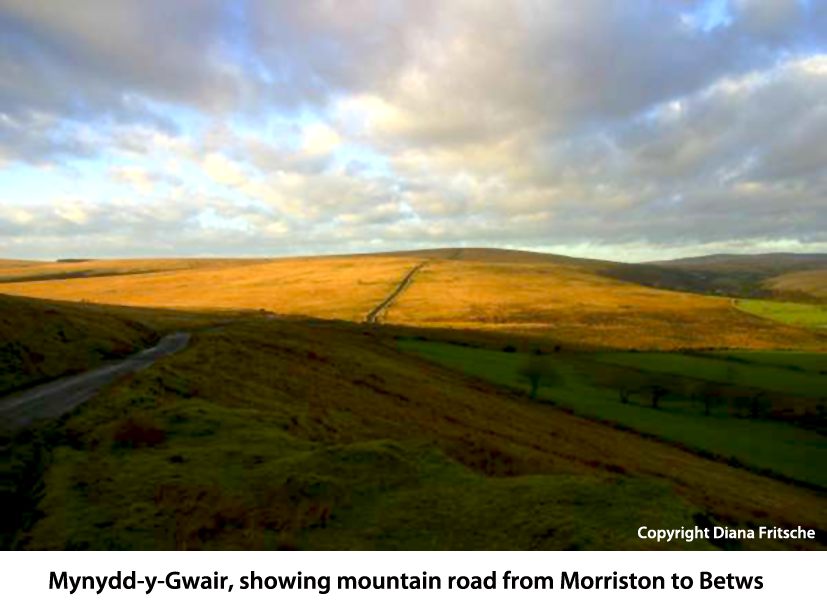
Though as I stated in my previous post, I have no doubt that Bayliss was recruited by Remarkable because he is a councillor in Swansea, and in order to ease through the currently stalled Mynydd y Gwair wind farm project for Remarkable’s client RWE Innogy.

 . . . BUT NOT IN SWANSEA

Not long after this appointment Bayliss changed his address from a flat in a house of multiple occupation in Cwmdonkin Terrace, in the Uplands ward he represents, to Cambrian Place in the Maritime Quarter (see picture below); in fact, the very pad where his friend and former council colleague, Mitch Theaker, had lived, vacated when Theaker went to work in the Gulf. But does he really live there? Because it could well be – as was suggested in an e-mail I received on Sunday – that Bayliss works in Bristol during the week and comes back to Swansea after finishing work on Friday. Then again, he might have moved to Bristol altogether and is simply using the Cambrian Place address to deceive people into thinking he still lives in Swansea.

Either way, for a fit and healthy young man with no obvious calls on his time, such as children or elderly parents, and living just a skip and a jump from the civic centre, John Charles Bayliss’s attendance record is appalling . . . or certainly it has become appalling since he got the job in Bristol working on the Mynydd y Gwair wind farm project.

A comment to the previous post by ‘Jobovitch’ tells us that, prior to his taking up employment in Bristol, Bayliss had an attendance record of close on 96%. So I checked, and he’s right. Between 09.11.2014 and 04.05.2016 John Bayliss had an attendance record of 96%, present at 24 out of 25 meetings he was expected to attend. And in the period before that it was 94%. And we find it was also 94% if we go back another six months.

Yet during the most recent six months, the period 04.05.2015 to 27.10.2015, his attendance record plummeted to 27%, to the point where his record was the worst bar just one. (Set out in this document supplied by a reader.)

Cambrian Place

This dramatic change in the attendance record of councillor John Charles Bayliss can be attributed to only one thing: his job with the Remarkable Group, that requires him to live in Bristol.

And yet, at a meeting on May 19th Bayliss was elected vice-chair of the Economy & Investment Cabinet Advisory Committee . . . even though he wasn’t there! He missed further meetings of this committee on June 17th (‘Apologies received’); July 15th (‘Absent’); August 19th (‘Absent’); but he did turn up for the Glyndŵr Day meeting, of what had now been renamed the Development Cabinet Advisory Committee, perhaps because the very first item on the agenda was that, ‘ . . . Councillor J C Bayliss be elected (again?) Vice Chair for the remainder of the Municipal Year’ (’til May 2016). As might be expected, he missed the most recent meeting on October 21st (‘Apologies received’).

Why the hell would the Labour Party in Swansea be so keen to install as vice-chair of an important committee a councillor they must know no longer lives in the city and is not going to turn up for meetings? Does the clue lie with his new employer?

CALCULATIONS

At this point some reading this might be asking, ‘Hang on, if the decision to block the Mynydd y Gwair wind farm was taken at Assembly level, where’s the advantage to the developers in recruiting a Swansea councillor?’ Well, if you read the reasons for turning down the application you’ll see that it hinged on the land lost by the commoners being replaced with acceptable grazing land. This is still being worked on, and the application will almost certainly be re-submitted.

In addition, Bayliss’s great friend and former councillor in the Uplands ward, Pearleen Sangha, is now living and working in Cardiff – for the Labour Party. We can be sure that Bayliss and Sangha, both wind energy fanatics, are in regular contact . . . and who’s to say she isn’t pushing Mynydd y Gwair to persons in or close to the ‘Welsh’ Government? Additionally, Swansea council passed the Mynydd y Gwair application in February 2013 by just three votes. Among those who voted for the application were Bayliss’s friends, Mitchell Theaker, Pearleen Sangha and Nick Bradley . . . all of whom have departed. Council leader at the time David Phillips was also a big supporter, but he’s no longer in a position to threaten, cajole or bribe Labour councillors.

It could well be that if Mynydd y Gwair came before Swansea council tomorrow it would be rejected. That would be a disaster for the developers, because in dealing with the ‘Welsh’ Government one of its strong cards is, ‘Swansea council is in favour’. But things have changed, and that’s why RWE Innogy and Remarkable need a Swansea councillor to tell them who’s for and, more importantly, who’s against – in other words, who they need to work on. This explains why Remarkable recruited John Bayliss.

Though you have to wonder why so many self-declared socialists in the Labour Party in Swansea are keen to cover bleak but lovely Mynydd y Gwair with wind turbines for the benefit of the Beaufort Estate (Prop. Duke of Beaufort). Why is that? Could it be partly personal?

Mynydd y Gwair

I ask because Mynydd y Gwair lies within Mawr, the most rural and sparsely-populated of Swansea’s wards, represented for almost thirty years by Ioan Richard of Craigcefnparc, once a Plaid Cymru councillor (on the old Lliw Valley District Council), like so many genuine nationalists Ioan gave up on Plaid Cymru long ago and has, since local government reorganization in 1996, sat as an Independent on the new City and County of Swansea council.

It would be fair to say that the Labour Party in Swansea doesn’t much like Ioan, he’s been a thorn in their flesh for years. They’ve repaid him in various ways, not least by blocking him from becoming Lord Mayor when his turn came up about a decade ago, a move supported – cheered on, even – by the four councillors Plaid Cymru then had on Swansea council, all of whom have now, thankfully, fallen by the wayside. A procedural change from party political voting to elevation on a simple calculation of seniority finally allowed Ioan to wear the chain in 2011. Ironically, perhaps, the year after next should see David ‘Il Duce‘ Phillips become Lord Mayor, but as a notorious and convicted fly-tipper he is now thankfully disqualified.

Another way Labour displayed its feelings for the councillor from Mawr was in preventing him from voting on the 2013 Mynydd y Gwair debate – an application in his own ward! It was judged that Ioan had ‘pre-determined’ the case by his opposition to the scheme and was therefore not allowed to vote. The student-councillors like Sangha and Bayliss, who had been tweeting their support for the project for months, and who were in contact with Gwenllian Elias, the PR woman for Mynydd y Gwair, were deemed to be approaching the debate with open minds and were allowed to vote!

TIME TO ACT

The situation we find today with John Bayliss is remarkably similar to the one we saw last year with Pearleen Sangha. She too took a job away from Swansea but tried to carry on as if nothing had happened. This was obviously done with the knowledge of the Labour Party – because she was working for the party! Eventually she had to admit the truth and stand down, but had it not been for external pressure then she and the Labour Party would have just carried on, to avoid a ‘messy’ by-election, which Labour lost.

But you mustn’t think that this behaviour is confined to Swansea, as a comment to the previous post from ‘Keri Tyisha’ reminded us. He told us of the 90-year-old councillor in Carmarthenshire suffering from dementia but kept on the council by repeated leaves of absence issued by the chief executive and ruler of the council, Mark James. Again, far better to maintain the pretence that a councillor is doing his or her job than risk a by-election.

Chubby Johhny

In conclusion, Swansea council’s website shows that the attendance record for Councillor John Charles Bayliss has deteriorated alarmingly, from 96% to 27%, and that this deterioration links with his recruitment by the Remarkable Group in Bristol. It is therefore reasonable to assume that Bayliss is living and working in Bristol. That being so, he cannot serve the residents of the Uplands ward in Swansea. He must therefore stand down and a by-election must be held to elect a councillor who can properly serve the ward.

For the longer term, the next reorganisation of local government must be about more than just re-drawing boundaries. It must introduce mechanisms to ensure that the narrow and selfish interests of political parties or chief executives can not be served by deceiving the public into believing that councillors who’ve died, emigrated, been banged up, or are no longer compos mentis, are still serving their community.

Swansea deserves better. Wales deserves better.Swansea your councillors

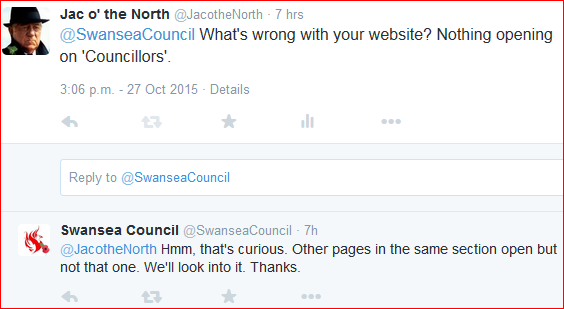
UPDATE 22:35: Shortly after posting this article, I noticed that the links I’d provided to Swansea council’s website were no longer working. (They were working this morning, that’s how I got the information.) I checked the website and found that everything was working except the section for ‘Your councillors’. I tweeted about it, and got a reply in mid afternoon, but the problem still hasn’t been fixed. Now if I was the suspicious kind . . .

UPDATE 10.11.2015: I have learnt that John C Bayliss is seeking election to the Notional Assembly via the regional list.

Tryweryn, Happy Donkey Hill, Good-Lifers

TRYWERYN (Click to enlarge photographs)

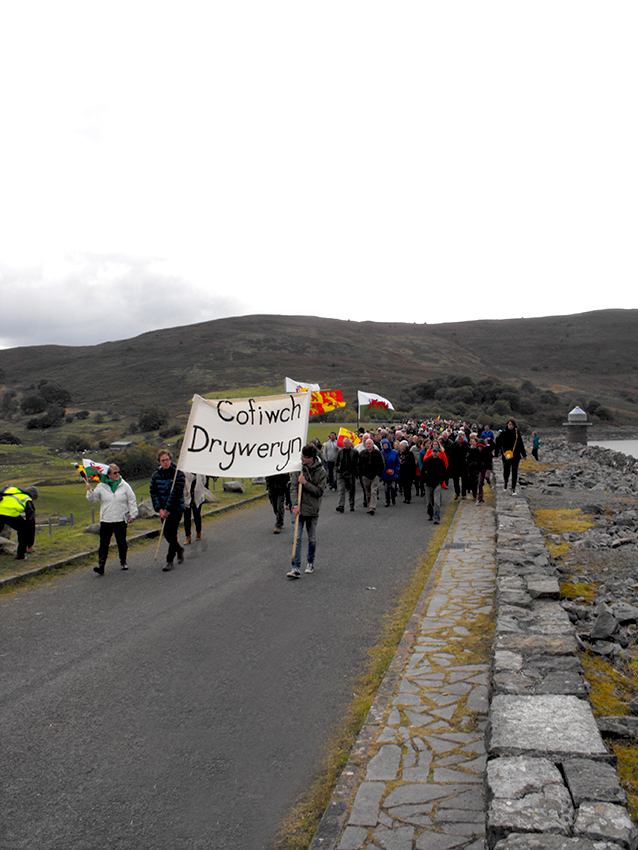
I went to the Tryweryn commemoration on Saturday. (I wouldn’t have botTryweryn 1hered, but two old friends came up, stayed with me Friday night, and so I went with them.) There was a good crowd there, but not many young people; though in fairness, I suppose an event like that was always going to attract what’s left of the Sixties generation. (God! am I that old!)

There seemed to be a great many, er, mature women there, with the uniforms and hairstyles of their age and class. Many of these had been sparky young things in mini skirts back in the 1960s, and had marched with placards held aloft before, rebelliousness spent, settling down to become Miss Pugh of Tryweryn 2Nantiestyn Juniors, and stalwart of Merched y Wawr.

So it should come as no surprise to learn that the Tryweryn commemoration was exclusively a Plaid Cymru affair, which meant that the small number of ‘militants’ that turned up was massively outnumbered, though of course some were in mufti, while other firebrands of yore – like the aforementioned ladies – have turned quite respectable. In fact, there was a rather parchus – almost bourgeois – overlay to the whole thing. I swear anybody who’d farted would have been stared down into the murky waters covering Capel Celyn.Tryweryn 3

This parchus overlay might have influenced the pervading air of elegiac nostalgia. There was a lot of hand-wringing and reminiscing, nostalgia for a lost bucolic paradise; but little to dissuade me from believing that the only reason we haven’t seen another Tryweryn is the fear – on the part of the British state – of unleashing forces more threatening to English colonialism than Plaid Cymru.

Speeches were delivered by former Plaid leader Dafydd Wigley, 60s protest siTryweryn 5nger and politician Dafydd Iwan (who also gave us a couple of songs), former and current MPs for Meirionnydd Elfyn Llwyd and Liz Saville Roberts, with it all compered, rather well, by councillor Elwyn Edwards, a native of drowned Capel Celyn.

Absent was Plaid’s current leader, Leanne Wood, up at the SNP conference in Aberdeen getting the kind of reception she can only dream of in Wales and, much more surprisingly, the man who’s been the local AM since the Assembly started, Dafydd Elis Thomas.Tryweryn 6

As I say, there was a curious atmosphere hanging over the whole event, as if no one was quite sure how to deal with celebrating what was obviously a defeat for Wales but which turned out to be one poke in the eye too many even for a defeated and complaisant people like us.

This strange and uncertain mood became even more obvious at the anti-climatic conclusion. Speeches over . . . and that was it . . . no singing of the anthem, no Yma o Hyd from Dafydd Iwan, just people milling around wondering what to do next. As it turned out, we Tryweryn 7were told to line up behind the ‘Cofiwch Dryweryn‘ banner and march back to the car park on other side of the dam.

I remarked to a local freelance photographer I knew that the crowd marching silently over the dam looked more like the type of procession one sees in Catholic countries than anything political. And I suppose it was a kind of pilgrimage, but many there were not sure exactly what they were supposed to be commemorating. Or how they were supposed to commemorate it.

*

MORE ON ‘HAPPY DONKEY HILL’

In the previous post I referred to the property known as Faerdre Fach near Llandysul being re-named Happy Donkey Hill. I have since been passed information that throws more light on the woman responsible for this insult.

It seems that the proprietrix of Happy Donkey Hill is named Kate Clamp, and she’s into ‘animal welfare’, as this report from the Northern Echo (of Newcastle) tells us. Though this 2008 article also tells us that she was forced to give up the Ramshaw Rescue Centre at Low Garth Farm because of a neck injury. Mercifully she recovered well enough to bring herself to Wales and buy Faerdre Fach, which she re-named Happy Donkey Hill.

After moving to Llandysul Kate Clamp branched out into B&B and other holiday accommodation. Not only that but she tried to advertise her new venture with this appearance on Channel 4’s Four in a Bed, a show in which B&B owners visit and assess each other’s establishments (not what you’re thinking!). In part excruciating, in part embarrassing, this example of ‘Welsh’ tourism should chill the heart of any true Welsh person.

Clearly, the multi-chinned Ms Clamp sees herself as one of those big and bubbly ‘personalities’ we are all Happy Donkey Hillexpected to cherish. Anyone who doesn’t accept this depiction is often dismissed as a ‘snob’. A less generous interpretation might be that she’s a loud and domineering woman more concerned with animals than people. With the latter being used to fund her concern for – even preference for – the former. (It may be significant that visitors to Happy Donkey Hill can bring their dogs but not their children.)

I trust that the required planning permissions have been received for all the changes she and her young partner are making to Faerdre Fach Happy Donkey Hill, and that the RSPCA is keeping check on the welfare of the assorted animals there, for Kate Clamp is a very busy woman. (And it must be worth asking, ‘How many more animal ‘refuges’ are we going to allow?) Another concern should be for public health inspectors, for I’d be concerned about so many animals in close proximity to where food is cooked and people sleep.

But at the end of the day, this is ‘Welsh’ tourism. Crude and alien. The time has surely come to curb the excesses of this exploitive and colonialist activity; for tourism, and the colonisation that comes with it, are now the biggest threats to the survival of Welsh identity, the Welsh language, and even Welsh place names, in our rural areas.

*

LEGISLATING FOR GOOD-LIFERS

Back in January last year I wrote a piece about the ‘Welsh’ Government transferring 15% of EU Common Agricultural Policy (CAP) funding from Pillar 1 to Pillar 2. (Read it here.) In other words, instead of this money going to Welsh farmers it would in future be given to ‘rural development projects’. (I think most people reading this will understand the code employed in ‘rural development projects’.) There have been many other assaults on Welsh agriculture recently. Here’s one I noticed in January this year.

On the one hand it would be easy to dismiss these attacks on farming as the behaviour of a political party whose ‘Wales’ is bounded by Llanelli, Ebbw Vale and Coedpoeth. Reasoning that, ‘Them buggers don’t vote for us so why should we do anything for them?’ But this argument doesn’t hold water because even areas that do vote Labour also get shafted. (Just think Valleys.)

One reason for these constant assaults on Welsh rural life is the advice received by the ‘Welsh’ Government in recent years from bodies such as the Wales Rural Observatory (WRO), which I wrote about back in September 2012. (I apologise for the lack of spacing, due to the formatting not transferring properly from my old Google Blogger blog.) Though since writing that piece I understand that the WRO may have had its funding pulled . . . I do hope it was something I said.

By a rather roundabout route I was recently made aware of yet more ludicrous advice being fed to the ‘Welsh’ Government, advice that, yet again, works against Welsh interests and also encourages further colonisation. I’m referring now to the ‘Planning for Sustainable Rural Communities’, set out in Technical Advice Note (TAN) 6 as ‘One Planet Development’. You will note that this was ‘prepared’ for the Planning Division of the ‘Welsh’ Government by Land Use Consultants and the Positive Development Trust. Although the address given for this lot on TAN 6 is in Bristol, their head office is in fact in London, so I presume that Bristol is the regional office for this part of Englandandwales.

I urge you to read TAN 6, especially if you want to expand your eco-babble vocabulary.

To cut a long story short, the civil servants who run the ‘Welsh’ Government’s Planning Department have accepted this guidance and imposed it on our local planning authorities. It demands that our local authorities give planning permission to projects meeting the criterion of ‘self-sufficiency’. The panel below is taken from TAN 6 and tells us that this directive does not merely apply to single properties, it can be used to build whole new ‘ecovillages’.

One Planet

The specific example I read about was in Carmarthenshire, planned for Rhiw Las, near Whitland. (Read more here.) While the source, West Wales News Review, is obviously published by environmentalists, it has some use in that it provides us with the name of Rhiw Las Ltd, Company Number, 08686077, Incorporated in September 2013. Rhiw Las Ltd has applied for what are, essentially, four new dwellings in open country, justified on the grounds that they will be self-sufficient smallholdings of the kind demanded by the One Planet legislation. (Read the planning application here.)

It was good to see Plaid Cymru (and other) councillors on Carmarthenshire council reject this application, but we can be sure of two things: 1/ The application will be allowed by the Planning Inspectorate on appeal, and 2/ No matter what the local councillors may think of it, Plaid AMs would have been falling over themselves to support this One Planet eco-bollocks.

The legislation set out in TAN 6 could result in whole new villages of hippies and other undesirables setting up anywhere in Wales. In fact, TAN 6 encourages it. All they’d need to do is form a small company, buy a bit of land (I’m sure the ‘Welsh’ Government will help) and whack in a planning application. It’s frightening to think that a government supposedly serving Welsh interests is agreeing to legislation like this. For no matter that this colonisation ploy originated in England, no matter that is was taken up and presented by the English civil servants controlling the Assembly, it still had to be agreed by those traitorous buffoons down Cardiff docks.

*

Everywhere we look in rural Wales, and along our coasts, we see the same picture – Welsh identity being swamped under a tide of colonisation. Worse, the ‘Welsh’ Government is facilitating this ethnic cleansing by legislating against the indigenous Welsh and passing laws that can only benefit strangers. Also, by encouraging activities and industries that are guaranteed to work against Welsh interests.

We Welsh today are a nation without leaders or representatives, those we have put our faith in have betrayed us time and time again. And it doesn’t matter whether you’re a monoglot socialist agitator in Dowlais or a lover of the Welsh language in Dolgellau, you have been taken for granted and betrayed, time after time!

This system will eventually turn Wales into a larger version of Cornwall, with impoverished natives being told to rejoice as wealthy outsiders buy everything – for this is ‘investment’, this is ‘progress’. Only a ‘racist’ would fight against his people being marginalised and their identity destroyed in this way.

But ‘racist’ is just another convenient lie for politicians and media, it’s just another smear; like the ‘terrorists’ who fought to free their countries from English oppression. How can these ingrates, these scoundrels, be compared to the visionaries who set up the first concentration camps, the lauded commanders who took the decision to bomb Dresden, or our noble allies in Saudi Arabia – ideal human rights watchdogs!

With devolution we Welsh are confronted with the colonial appendage of a morally bankrupt system. As such, it deserves neither our respect nor our support. So start rejecting it, treat it with the contempt it deserves. Start today!

UPDATE: As I predicted, the English Planning Inspectorate overruled Carmarthenshire County Council to give these colonists planning permission for their hippy settlement. Not only that but the Inspector decided that the council should pay the colonists’ costs in preparing their appeal. No doubt we Welsh will be paying for lots of other things for these bastards in the years ahead because the ‘self-sufficiency’ they’re always banging on about never leads to them being independent of the public purse.

Boors & Crooks; Cowards, Spooks & Idiots

BOORS: ENGLAND 25 – 28 WALES

Well done, boys. That was a truly epic game last Saturday night.

Though I must admit that I’ve been losing interest in rugby for a few years now. Maybe it’s because skills seem to have been sacrificed for bulk, ‘upper body strength’, ‘big hits’ and a litany of other cliches that don’t sound any better even if they’re spoken by Jiffy or Eddie Butler.

Or perhaps it’s the scrum, which nobody understands, and I mean nobody. Certainly not the referees, who seem to come to decisions using the tried and tested ‘Eeny, meeny, miny, moe’ system. Then there’s the rolling or driving maul, sixteen suspiciously muscular men grunting, grappling and pushing each other. Anyone finding that attractive might be in need of help.

Then there’s the way the game is organised in Wales, or rather, who organises it. Here of course I’m talking about the Welsh Rugby Union, one of the most blatantly Anglophile and Unionist bodies we’ve got (and that’s saying something!). Obvious from the feather duster badge with it’s ‘Ich Dien’ motto to the patrons, and from the refusal to use the Welsh language to the Prinz Wilhelm Cup. The last being a meaningless trophy for which Wales competes against a team that is still mainly Afrikaner, in other words, the descendants of those Boer republicans who took up arms more than once rather than be ruled by England and her royals. An insult to two nations.

And what of those who attend rugby internationals? We’ve all read of corporate ‘hospitality’ taking over, with the best seats taken up by men who couldn’t tell a flanker from a banker, and women who are there to be seen seen rather than to watch any irritating distractions on the field. Apart from these, we all know people who go to rugby internationals who wouldn’t cross the road to watch their local side. Just look at attendance figures for regional and club rugby (with Ponty’ and a few other commendable exceptions). How different to football.England fans

It may be even worse in England. The braying of Swing Low Sweet Chariot by thousands of inebriated middle-class Englishmen is one of the weirdest phenomena in sport. Or indeed in any context. I won’t try to analyse it. And what of the dressing up, as medieval knights (often slaying dragons), or 19th century colonial administrators, replete with pith helmets! Do they realise what prats they look, and what message they’re sending out about themselves, and their attitudes to others?

Perhaps they don’t care, for within the dark heart of an England rugby crowd you will find the most dangerous elements of the species; arrogant, intolerant and utterly convinced of their own superiority. Worse by far than the racists one finds at the fringes of England football crowds, because the Barbour-clad yob being carried home by his sweet chariot will too often have the power to indulge his prejudices in ways more far-reaching and pernicious than the outbursts of violence to which his working class compatriot is limited.

But I don’t want to come across as curmudgeonly at this time of officially-sanctioned national euphoria. So let me wish the boys the best of luck on Thursday against Fiji. Though if we should be knocked out, and if England should go through to the quarter-finals in our stead, don’t forget to switch your support to England. Believe me, it’s what the Welsh Rugby Union, and our political class, expects of you.

*

CROOKS: SOCIAL HOUSING

Over the past sixty years rural and coastal areas of Wales have seen many tens of thousands of new homes built that were never intended for local buyers. This may once have been more obvious in areas such as the north coast, but it is now national. Even out-of-the-way villages in Powys such as Abbey Cwm Hir are no safer from ‘developers’ (what a curious use of the word!) than Abergele or Aberystwyth. To the point where, contrary to the nonsense we are fed about a ‘rural housing shortage’, rural Wales actually has a housing surplus when the housing stock is judged against any future indigenous demand.

Moreover, the situation we find in rural parts of Flintshire and Wrecsam (currently being re-branded and marketed as ‘West Cheshire’), Denbighshire, Conwy, Gwynedd, Ynys Môn, Ceredigion, Powys, Monmouthshire (sic), Pembrokeshire and large parts of Carmarthenshire, is that locals are often priced out of a housing market distorted by external forces. Which is then cleverly used by planners and aforementioned ‘developers’, estate agents and others, as an argument to build yet more new housing . . . from which most locals are again excluded. Which presents us with the dystopian choice in which house prices can only be brought into line with local purchasing power by a) either collapsing the market through building enough houses to satisfy all demand from over the border, or b) introducing legislation to reserve a percentage of the housing stock for local buyers.

But the housing problems of rural Wales are not confined to the private sector. Regular readers of this blog will know that I have written on the subject of housing associations many times before, and for a number of reasons.

1/ It annoys me to see public money being given to what are effectively private companies for them to spend on housing for which there is often no local need, and where local need does exist the mechanisms at play in the Englandandwales social housing sector ensure that many properties in Wales – paid for out of the Welsh public purse – are allocated to applicants from England having no connection with the places to which they’ve been deported.

2/ Despite being given inordinate amounts of public funding there is no obligation on housing associations to detail how the money has been spent.

3/ Nor is it possible to find other information, because housing associations are exempt from the provisions of the Freedom of Information Act.

4/ At a time when the ‘Welsh’ Government argues for fewer and more efficient local authorities it funds dozens and dozens of housing associations. Giving us the absurd situation where an area might have ten housing associations, in competition with each other, doing the job that would once have been done – and far cheaper – by the local authority housing department.

In the hope of explaining the problem of out-of-control and unaccountable housing associations let me use a couple of examples supplied by Wynne Jones of Cardigan. I’ve never met Wynne Jones I. Eng. A.C.I.W.E.M., but he got in touch a few months back and let me see letters that have passed between him and various representatives of the ‘Welsh’ Government, local councils, and housing associations on a number of issues.

One is a development in Cardigan that has already swallowed up a great deal of funding but now seems to have hit the rocks. This is / was a project to convert a building on the High Street into 16 flats, and for which the Tai Cantref housing association has already received £782,543 in Social Housing Grant from the ‘Welsh’ Government. I’ll repeat that for the hard of reading – £782,543! As you can see, the photograph was taken on May 1st (by Wynne Jones), but little has changed since then, as the main contractor has gone into receivership. (The photo is taken from a car park behind Cardigan High Street. Click to enlarge.)

Are there local tenants lined up for these flats? If so, then they’ve got a long wait. If not, then – as is so often the case – this becomes a speculative development using Welsh public funding to house people who, as yet, have no idea they’re going to be moved to Wales.

Another example of the freedom enjoyed by housing associations is shown in the case of Tai Ceredigion at the former Meugan Centre in the town. (See picture below by Wynne Jones.) Seeing as the land in question is – it is believed – owned by the county council Mr Jones first wrote to the council on April 11th asking if planning permission had been granted a) for the demolition of the Centre and b) to allow the site to be used as a builder’s yard. He wrote again on May 6th . . . and May 26th . . . June 25th . . . July 14th (twice) . . . August 17th . . . then, finally, on August 18th he received a reply which told him that the ‘developers’ (that word again!) had now been told to apply for retrospective planning permission to use the Meugan site as a depot, but on the other matter that, “A determination decision was made on the demolition of the Centre in 2014 – planning reference A140036 – deciding that prior approval was not required for the proposed works”. (My underline.)

When Mr Jones pointed out that the planning reference A140036 was not available online, he was told that he could view a hard copy at the council’s offices in Aberaeron. He went through the advised procedure and made an appointment for 9am on August 15th . . . which was not confirmed.  After another exchange of correspondence in which he again asked to view the document, and also requested the council’s reasons for withholding it, he was told, “The request is considered to be exempt under S21 of the Freedom of Information Act since what you have asked for is reasonably accessible by other means. The information you require is available for viewing at Neuadd Cyngor Ceredigion, Penmorfa, Aberaeron.” This Kafkaesque response ignores the fact that Wynne Jones wants to see the document, and is prepared to turn up in Aberaeron at 9am, bright-eyed and bushy-tailed, but the council is refusing to co-operate.

I suspect that this document may not exist, perhaps it has not yet been written. But whether planning reference A140036 exists or not, it’s quite clear that Cyngor Ceredigion is reluctant to let Wynne Jones see it for himself. What’s also clear is that Cyngor Ceredigion allows housing associations degrees of latitude that private citizens or other companies can only dream of.

*

COWARDS: THE ‘WELSH’ MEDIA

One problem with ‘Welsh’ housing associations and the Englandandwales allocation system into which they’re currently locked is that Welsh communities get lumbered with some very unsavoury  people, partly because housing associations (and indeed private landlords) can make more money from housing those euphemistically described as ‘vulnerable’ (i.e. criminals) and those with ‘issues’ (ditto) than from housing law-abiding locals.

This allocation system – plus the workings of the Englandandwales criminal justice system – often explains why Welsh communities end up hosting criminals and dysfunctionals such as these.

A more recent case was this one. ‘Notorious convicted paedophile flees North Wales after he was outed online’ screams the Daily Post headline. Good. But the real story here, the one the DP should have looked into, was who relocated him to Nantlle? And who is responsible for dumping known and dangerous English criminals in Rhyl, Blaenau Ffestiniog, Kidwelly and countless other Welsh towns and villages? But to answer that question would expose another form of abuse, one in which Wales is taken advantage of by our mighty neighbour . . . so our ‘Welsh’ media backs off.

Yes, our wonderful ‘Welsh’ media; never asking the difficult questions but always ready to put the boot into Wales and things Welsh if the assault can be presented as a principled condemnation of ‘extremism’, ‘racism’, ‘narrow nationalism’ and anything else that doesn’t conform to the view that ‘Welshness’ is just a quaint and touristy regional oddity, little different to Englishness (except in a harmless and manageable sporting context) and always subservient to Britishness.

*

SPOOKS: CAMBRIAN NEWS

As the Welsh weekly newspaper with the largest circulation, covering an area running from north Pembrokeshire all around Cardigan Bay to Pen Llŷn, and containing constituencies and local authorities where the Welsh voice is strong, it was inevitable that the Cambrian News would be a vital cog in this permanent propaganda offensive.

The role played by the Cambrian News was first brought home to me some twenty years ago when the ‘paper carried what purported to be a letter from a survivor of the Holocaust, now living in the USA, who had visited the National Eisteddfod and been appalled because the youngsters he saw on the stage there reminded him of the Hitler Youth. The letter was typical black propaganda, designed to traduce things Welsh and thereby put Welsh people on the defensive, make them question or be less ready to defend the things they hold dear.

I recognised this letter for what it was, and in the hope of exposing the fraud I wrote to the address given for the letter writer, making sure that my own address was there on the envelope as ‘sender’. The address given for the writer was in “Upper State New York”, no zip code and, as most of you will know, Americans use the term ‘Upstate New York. My letter was returned by the US Postal Service, along with two other letters from Wales sent to the same, non-existent address.

When you know what you’re looking at, or what you’re looking for, then you can go through a rag like the Cambrian News and pick out examples of this strategy quite easily, especially when our masters wish to make a specific point. Such a case came towards the end of 2013 when Cyngor Gwynedd debated raising the council tax on holiday homes. The mere suggestion prompted a letter to the CN arguing that raising council tax on holiday homes would be ‘racist’ (that favourite allegation!), before suggesting that such a measure might lead to a resumption of arson attacks!

The debate rumbled on, I got involved, ridiculing the suggestion that anyone would be incited to burn holiday homes if those properties paid more council tax, which in turn encouraged someone to suggest that I had made the suggestion of arson attacks but, cleverly, without actually saying I’d said it.

In the post I’ve linked to there are two letters worthy of note. The first is from a ‘Pat Beaumont of Shropshire’, and the second from a ‘Stephen Smith of Sunbeach Holiday Park, Llwyngwril’. Both are gems. They are full of non-sequiturs, scaremongering, misrepresentation, and getting people to believe that raising council tax on holiday homes is little different to burning them down. I believe Cambrian News Nazisboth letters are as genuine as the one from the Holocaust survivor in ‘Upper State New York’.

This bizarre defence of holiday homes is quite easy to explain, and has nothing to do with economics. From ‘a certain perspective’ holiday homes are viewed as a weapon in the armoury being used to ‘integrate’ Wales with England. In other words, they help anglicise Wales and thereby remove the threat of nationalism. Consequently holiday homes must be defended. Simple as that.

A more recent example of how the Cambrian News is used by others as a conduit and an outlet for anti-Welsh propaganda was the attack on the Plaid Cymru candidate in Ceredigion prior to this year’s General Election. I dealt with it here. To understand this extraordinarily vicious attack you must appreciate the wider political context.

Ceredigion was held by a Liberal Democrat MP, yet after five years in coalition with the Tories the Lib Dem vote was collapsing. Also, after five years in government, the Tories themselves were expected to lose votes and seats. In Scotland, the only question was whether the SNP would have a clean sweep of MPs. Everyone expected a hung parliament, with Labour running the UK in coalition with the SNP, Plaid Cymru, SDLP and Greens. In fact, it was the English tabloids frightening their readers with the prospect of Alex Salmond in charge (despite him no longer being leader of the SNP) that won the election for the Conservatives. In that context, anything that the darker forces of the British State could use to damage the prospect of Labour-SNP-Plaid Cymru rule was worth a try. The Cambrian News played ball, as always.

*

IDIOTS

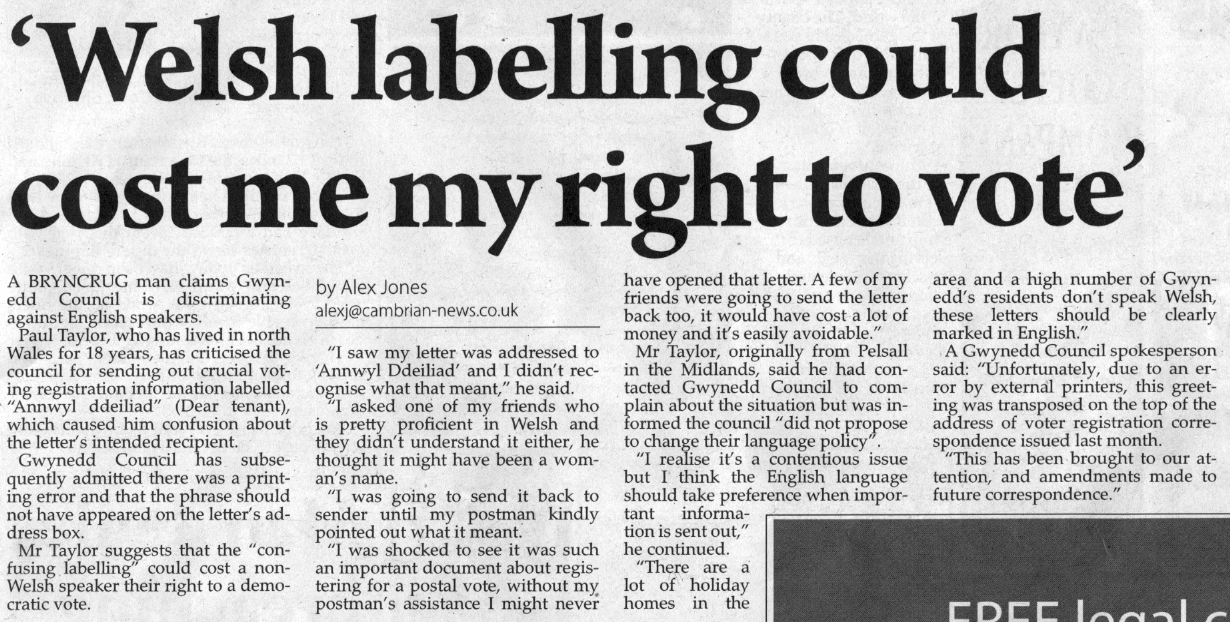
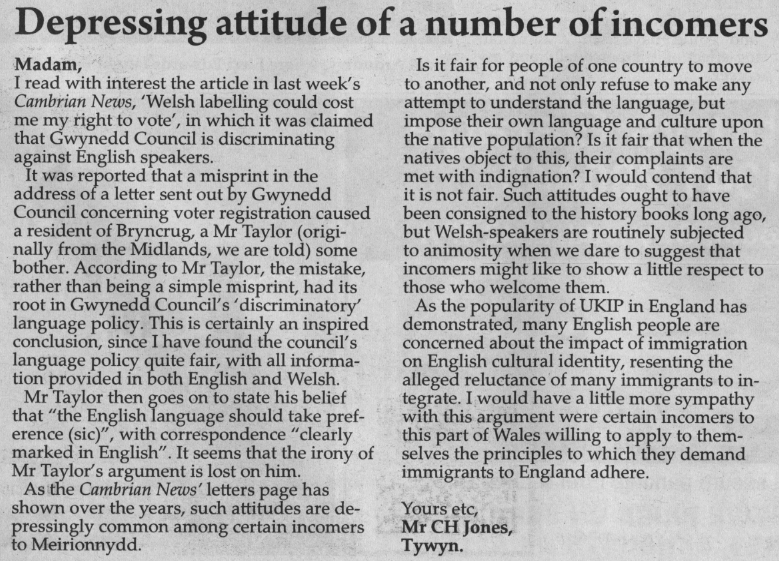
Though sometimes the Cambrian News’ desperation to push its anti Welsh – and in our local edition, anti-Plaid Cymru and anti-Gwynedd – message is sometimes almost funny. Take this story from last week’s Meirionnydd edition. (No, of course I didn’t buy it.) Some Englishman named Paul Taylor living in Bryncrug, about two miles out of Tywyn, received what everyone has received recently, the electoral registration form, but claims he got confused because the form was ‘labelled’ in Welsh. (‘Labelled’? Does he mean ‘addressed’?)

Cambrian News voting

So here we have someone who receives what is obviously a communication from the council, one being delivered to every home in the county; if it had been written in Chinese its nature and purpose would have been obvious – yet he cannot see it for what it is, and when he consults his friend – who is “pretty proficient in Welsh” – these great brains conclude that the mysterious communication is addressed to a woman called Annwyl ddeiliad! (I know her intimately.) Eventually he is told what it means. Now seeing the dastardly plot for what it is – an attempt to deny a free-born Englishman his rights, the outraged Paul Taylor contacts the Cambrian News.

I have no way of knowing whether this man is just stupid, or whether he’s a fully-fledged bigot. But any responsible newspaper would at this point have spared him embarrassment by declining the ‘story’; and any reporter worthy of the name would have laughed out loud on hearing it. But this is the Cambrian News, the spooks’ mouthpiece, and so it does what it does and publishes this unadulterated bollocks, conveying the predictable messages that, ‘ . . . shouldn’t use Welsh on official communications . . . anti-democratic . . . discriminatory . . . anti-English . . . whatever next? . . . God Save the Queen!’

Here’s some advice for Paul Taylor, who clearly gets confused by anything that’s not ‘labelled’ in English. Next time you buy a bottle of Scotch don’t hand over your cash ’til you get a translation of Glenfiddich! And avoid French restaurants . . . Italian restaurants too. And if you win the Lottery, don’t start celebrating until them Champagne labels are translated. (Bloody Frogs!) Then, when you’ve sobered up, and are looking around for a motor, don’t write the cheque until them Eyties translate the Ferrari label into English. Same with flying to they there foreign places with funny names – Rio de Janeiro? come off it!

And this place where you’re living, called Bryncrug, it’s obviously part of this massive anti-English conspiracy of which you are so clearly a victim, so demand that it be ‘re-labelled’. In fact, get in touch with the Cambrian News, they’ll probably start a campaign on your behalf.

UPDATE 01.10.2015: There was a very good letter in today’s issue of the Cambrian News responding to the bigotry and intolerance displayed last week. Had I written this letter I would also have criticised the Cambrian News‘ editorial judgement in treating such ugly views as a worthwhile news item. But as I point out in the post, this is how the Cambrian News has operated for many years.

Cardigan Castle, Equinox, Gareth Wardell, Terry Matthews

CARDIGAN CASTLE

Not a lot to report from the Gang of Five and I probably won’t do another post until I get something important to report. But if I am silent then you mustn’t think I’m ignoring Timms and the gels; no, siree, it’s because I’ve decided to approach the problem from a different angle.

Though one thing that does merit mention, something now obvious beyond any doubt, is the disturbing fact that those who have been sacked, forced out, or ‘encouraged to leave’, such as Director Cris Tomos, Eduction Officer Rhian Medi, and others, are all local and Welsh. Those taken on in this period, from Facilities Officer Sue Lewis to the caretaker and the gardener, are all English. The pattern in the employment policy of the Castle is now unmistakable – Welsh out, English in.

Of all the things going wrong at Castell Aberteifi this might be the ugliest and most reprehensible. And yet, local politicians will stay schtum, and the only criticism we’re likely to hear will be levelled against anyone complaining against this discrimination, as the Cambrian News cranks up the ‘outrage’ to direct its venom at the ‘racists’ asking for Welsh people to be treated fairly.

*

EQUINOX

On a lighter note, while visiting the website of Equinox, the Castle’s PR outfit, I was surprised to see a photo containing David Phillips, the man overthrown last year from his position of leader of Swansea council. The Equinox picture is of one of the company’s clients, the Swansea Bay City region project, though it’s at least a year old (see below), as Phillips was also given the heave-ho from the board of the city region outfit. (He’s the one in the centre, under the England flag.)

Equinox Phillips

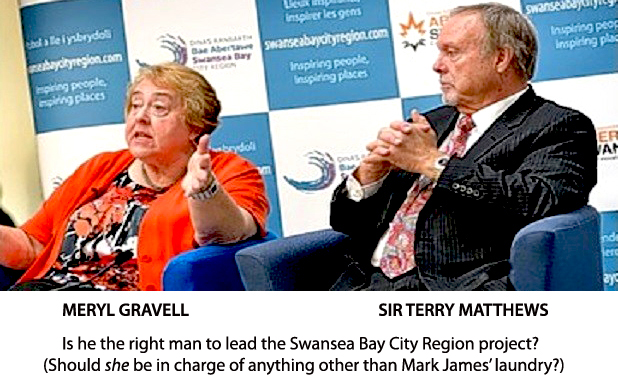
Predictably, the board has among its members the leaders of the four local authorities involved, but strangely, in the case of Carmarthenshire, and only Carmarthenshire, we find a second representative. And who might that be? Meryl Gravell of course. Can anyone offer a suggestion as to why Carmarthenshire, but not Swansea (with its greater population) or any of the other councils, should have two representatives?

Ere his downfall I regularly chronicled Phillips’ deeds and utterances on this blog (just use the Search box atop the sidebar); indeed, I even gave him a nickname. In fact, I’m almost missing him, for he provided the citizenry of Swansea with hours of harmless fun. Such as going out in public, in daylight, in a red duffle coat? I repeat, a red duffle coat. Not even the Celtic scarf could save him from the fashion police.

In the duffle coat picture I’ve linked to, and on the extreme right, we can see acolyte and protégé Councillor John Charles Bayliss, one of the students Labour had to recruit to compensate for the party’s failure to find local candidates who could write their own name without biting off the tip of their tongue. After a few years of being a professional councillor Bayliss has at last found gainful employment, as an ‘account executive’ with PR outfit the Remarkable Group.

Don’t get me wrong, I have no objection to councillors earning an honest crust away from the council chamber. Indeed, it can be viewed as a good thing, otherwise we’d be lumbered with councils made up of the retired, the unemployable and the permanently sick (as has often been the case with Labour groups). No, the problem arises over the kind of work they do, and whether they might have been employed in the hope they can swing decisions to the advantage of their employers’ clients.

Not that I am for one minute suggesting that this is why the Remarkable Group recruited Councillor Bayliss – heaven forfend! – but I cannot help noticing that among his new employer’s clients we find many companies raking in the loot from wind farms, solar complexes and other activities that usually face local opposition and often struggle to gain planning consent. And as it says on John Boy’s Linkedin profile, his employer provides, “communications support for clients across England and Wales navigating the complex planning application process”.

Bayliss Remarkable

Which is a load of old bollocks. Because the big companies that are Remarkable’s clients employ lawyers and planning experts who understand planning law better than most councillors; what they’re really looking for is an extra advantage from having ‘someone on the inside’. So, without downplaying his undoubted abilities, I think it’s reasonable to assume that John Charles Bayliss would never have landed the job with the Remarkable Group had he not been a member of the party controlling Swansea council. Moving on, but not far, in any sense . . .

*

GARETH LODWIG WARDELL

To save you scratching your head, or Googling, he was the Labour MP for the Swansea constituency of Gower from 1982 until 1997.

Wardell is the son of legendary Gwendraeth barber Jack Wardell, but he himself resisted the temptation to offer customers ‘Something for the weekend’ and took himself off to the London School of Economics before getting a gullible electorate to vote for him. Curiously, I could only find four photographs of Wardell online, and all are marked ‘Copyright Victor Patterson’, a Belfast photographer! So that’s why you’re not getting a mugshot. (Though you’re not missing much!) In fact, there’s little information of any kind about Wardell on the internet, unless you’re prepared to dig. Which I enjoy!

So what is he doing nowadays? Well, here’s an example. Swansea council’s planning committee recently considered an application for 14,970 solar panels in the Cockett Valley. The application had been made in the name of Renewable Developments (Wales) Ltd, run by one Huw Davies, a former fixer for the late Bryn Llewellyn, of Abergelli Farm, Felindre, on the outskirts of Swansea, who was a self-made multi-millionaire in haulage and small coal mines.

(Having mentioned Abergelli Farm, it’s probably worth adding that Davies is planning a 299Mw gas-fired power station there that will – it’s argued – complement the Swansea tidal lagoon. This is being promoted by Abergelli Power, which seems to be acting in concert with Millbrook Power, which is in turn a subsidiary of Watt Power Ltd of Edinburgh.)

As you might expect, the local residents objected to the solar scam scheme, partly because the Cockett Valley is a ‘green wedge’ in an increasingly built up area. Their councillor, Ann Cook, who sat on the planning committee, conscientiously represented the wishes of her constituents by objecting to the planning application. In fact, at the July 14th planning committee meeting most Labour councillors on the planning committee voted against the application.

But by the time the planning application was reconsidered on August 11th the situation had changed dramatically. The Labour councillors trooped into the meeting holding each other’s hands and all bar one voted for the solar rip-off, while Ann Cook, the local councillor, was allowed / instructed to feign sickness rather than turn up and risk losing her (and Labour’s) seat by voting in favour of something her ward was vehemently against.

At this second meeting applicant Huw Davies was allowed to address the committee. Sitting alongside him, glaring at the assembled councillors, was Gareth Wardell, even though he had no obvious connection with the application. He certainly doesn’t seem to be on the company’s books.

I’ve already mentioned the lack of photographs of Wardell, and then there’s his Wikipedia entry, which is skeletal. Though a little digging did put flesh on the bones. For example, I found this on a Bloomberg page, which lists Wardell as “Energy Advisor – Planning” to an outfit called the Camborne Energy Group Ltd. When I checked Camborne Energy on Company Check I was confronted with about a dozen companies of that name, at the same Cardiff address, and all marked “dissolved”. Though there is a company in Bridgend called Camborne Energy Investments (10) Ltd, described as “active”, but does no trading! Who starts up so many companies, to do nothing? And why?

Another company with which Wardell is, or was, linked is 3C Energy. Now this may or may not be an Irish company, it certainly had an address in Dublin. The panel below (click to enlarge) is taken from a cached version of the site because all links to 3C websites are broken. Note again, Wardell’s usefulness is made clear – his ability to get planning permission.

Wardell Advisor

As with Camborne Energy Investments Ltd, we find multiple identities for 3C Energy. The only one of which that appears to be trading, 3C Renewable Energy Investments Ltd, is based in Cardiff and has a net worth of £-86,195. At 11 Oaklands Road, Bridgend, the same address as one of the Camborne companies, we find 3C Energy Developments (1) Ltd. And you will not be surprised to learn that we find the same man mentioned as director of both, Jonathan David Townend. But since June 26th, we also find Wardell as a director. The companies Townend has been involved with deserve a post on their own, but who is he?

I have argued for many years that the ‘Welsh’ Labour Party is corrupt to its core. It’s members as venal and selfish as those of any party the bruvvers and sissters condemn. What you have just read is, perhaps, another example of that venality.

Without wishing to unduly excite his lawyers it’s pretty clear that Gareth Wardell advertises himself as a kind of gun for hire. A man who, for a price, will use his influence within the Labour Party to get planning permission for the rogues inhabiting the renewables sector, parasites feeding off the public purse who, in truth, have no more concern for the environment than I have for the well-being of the Labour Party.

What Wardell does may be legal, then again it may not. Perhaps it depends where the line is drawn between lobbying and exerting undue pressure in order to influence planning and other decisions for the material gain of those exerting the pressure. Where Wardell appears to be clever is in having few if any direct involvements with the projects for which he’s lobbying. Take the Cockett Valley solar farm, he seems to have no official or registered connection with the applicant, so why was he ‘phoning and in other ways applying pressure on Labour councillors, especially the ward councillor?

Wardell’s influence can obviously swing things in Swansea, but how far does that influence reach? Can he affect decisions made by the Notional Assembly and the ‘Welsh’ Government? Whatever the answers, this little tale, this potted biography, is an indictment of the planning system, the political system, and the ‘Welsh’ Labour Party.

*

TERRY MATTHEWS

When the unlamented David Phillips was overthrown in Swansea he also lost his role as chairman of the Swansea Bay City Region consortium, though at the time he seemed to think he could carry on with the city region role. Others clearly had different ideas. He was replaced by Sir Terry Matthews, usually described as ‘Wales’ richest man’ or ‘Wales’ most successful entrepreneur’. (‘Entrepreneur’, a word for which there is no Welsh equivalent, by the way.)

I’ve never been too sure who exactly appointed Matthews, was it the members of the consortium, or the ‘Welsh’ Government? Recent statements by Matthews only add to my confusion.

Speaking last week at a question and answer session held at Trinity St. David University’s Carmarthen campus Matthews declared that he is “in favour of Carmarthenshire branding itself as region of Cardiff to boost the area’s economy”! Carmarthenshire, remember, is to the west of Swansea, and at the nearest point is over 50 miles from Cardiff, the county council is a member of the Swansea Bay city region, yet Matthews is telling Carmarthenshire to link itself with Cardiff! Then, when asked by a student how Carmarthenshire could compete with big cities, Matthews’ response was “You can cheat”!

Terry Matthews

And Matthews has form when it comes to advising people to lie, and be “shifty”. Around the same time he told business leaders in Gwent to tell people they’re based in Cardiff. Here’s a response to that suggestion in the form of a letter published in the South Wales Guardian.

Matthews is supposed to be heading the Swansea Bay City Region project, yet seems more concerned with promoting Cardiff, which makes me even more suspicious of his appointment. For I have regularly argued that the Swansea Bay City Region was added as an afterthought in order to disguise the fact that the Cardiff City region was all that really mattered to the ‘Welsh’ Government. Which makes me suspect that it was the ‘Welsh’ Government that appointed Matthews, perhaps to ensure that the Swansea Bay City Region isn’t too successful, and doesn’t interfere with Cardiff’s ambitions. Certainly, that’s the only interpretation to draw from the man’s bizarre statements.

But, for a minute, let’s listen to Matthews, let’s take his advice ad absurdum. If what he advises for Carmarthenshire, Swansea and the Valleys is credible, then why doesn’t he suggest that Cardiff brand itself as part of Bristol, after all, Bristol is a much more attractive and famous city? Why stop there – why shouldn’t every city from Plymouth to Inverness pretend to be part of London? ‘But wait!’ I hear you cry, Cardiff’s on the up, getting a lot of positive publicity from major sporting events being held in the city, such as the 2017 Champions League final.

OK . . . let’s consider that for a minute. It is generally agreed that the greatest final of all time was in 1960, when the great Real Madrid team of Puskas, di Stefano, Ghento and the rest beat Eintracht Frankfurt 7 – 3 before 127,621 fans. That game was played at Hampden Park, Glasgow. How much did Glasgow really benefit from that in hard, economic terms? The same could be asked of more recent venues, cities such as Athens (1983), Seville (1986), Istanbul (2005), Lisbon (2014). Like Glasgow, all great cities, but I think someone’s over-egging it to suggest that a few hours of television exposure will have investors rushing, and ‘swarms’ of people wanting to settle in any city hosting a major sporting event.

Matthews gravell

Though if there is some truth in this, then Swansea is obviously getting more regular and wholly positive global exposure from the Swans playing in the Premier League. All Swans’ games are televised around the world, with massive audiences when they play one of the ‘big’ clubs. And what’s more, the name ‘Swansea’ is inescapable, it’s visible from the score to the players’ shirts. By comparison, when people view the 2017 Champions League final they’ll only be interested in the two teams, not that it’s taking place in Cardiff.

Clearly, a lot of nonsense is spouted by the Cardiff propaganda machine (otherwise known as the ‘Welsh media’) which tries to justify the disproportionate investment and expenditure in Cardiff. Yet this, as the letter-writer to the South Wales Guardian pointed out, is the real problem. It is a dangerous and anti-national strategy that risks alienating other parts of the country, and poses the very real danger that large parts, especially in the north, will identify even more strongly with coterminous areas of England.

Devolution should mean nation building, not favouring one city over all other parts of the country. It’s about time those clowns down Cardiff docks, and the civil servants who manipulate them, realised that the strategies pursued since 1999 are dividing not uniting us. (Though from the perspective of the civil servants, answering to London, maybe this is the strategy.) The areas that were poor in 1999 are relatively poorer today, compared with Cardiff, and almost all other parts of Europe.

Wales needs a strategy to bring us together; the south east, the north, the Green Desert, and of course the Swansea Bay area, where those involved in the city region project might start asking themselves whether Terry “region of Cardiff” Matthews is the right man for the job.

Swansea Bay Tidal Lagoon 2: Sharks Circling?

After my previous post, Swansea Bay Tidal Lagoon, I have been giving more thought to the subject, and doing a little digging; which has led to a disturbing possibility presenting itself. By which I mean that someone, perhaps even someone local to Swansea Bay, is trying to sabotage this project for their own selfish reasons.

Treading carefully, I have decided to present this post as a combination of incontestable facts, presented as FACT: and limited to the paragraph in bold type following, interspersed with paragraphs containing deductions, assumptions or informed guesswork, before concluding with a reasonable hypothesis extrapolated from what has gone before.

*

FACT: The past week or so has seen a number of stories in the media unfavourable to the Swansea Bay tidal lagoon project. The first appeared in The Telegraph on February 15th, written by Energy Editor, Emily Gosden, and repeated in the Western Mail and WalesOnline on February 17th, about Cornish villagers up in arms over plans to quarry granite for shipping to Swansea Bay. Ms Gosden was at it again on February 21st, attacking on another front with this report arguing that the electricity generated by the tidal lagoon would be hideously expensive. This piece used as its source a submission produced by Citizens Advice.

So we see negative attention suddenly being paid to the Swansea Bay tidal lagoon. The really damaging attack of course came from Citizens Advice.

FACT: Those familiar with recent goings-on in Wales will recall that there was a plan to throw a massive barrage across the Severn Sea from Penarth to Weston-super-Mare. The company behind this project is, or was (it may be in liquidation), Hafren Power. A number of its leading figures left, the former chief executive to form Severn Tidal Energy.

Hain Spanglefish
CLICK TO ENLARGE

FACT: The leading political backer of the Severn Barrage project was, and remains, Peter Hain, Labour MP for Neath. In fact, Hain resigned from the shadow cabinet in May 2012 to concentrate on promoting the project. In June 2013 the House of Commons Energy and Climate Change Committee killed off the barrage proposal with a very critical report. Mr Hain attributed the rejection of his project to the influence of Bristol Port, one of whose owners, David Ord, was a substantial donor to the Conservative Party.

The Spanglefish website devoted to Peter Hain (from which the panel above is extracted) suggests that Hain hopes to resurrect the barrage project when there is a Labour government in Westminster. There is of course a general election in May. The website also suggests that ‘Welsh’ Labour is backing the barrage project.

FACT: In a WalesOnline article from September 2013, linked to above, and again here, “Mr Hain said that while he was convinced the project has no future at present, he hoped it could be resurrected under a future Labour Government.” While this article, from just last month, reported, “He (Hain) remains hopeful that the stalled Severn Barrage project, potentially creating tens of thousands of jobs, could be resurrected”.

Haywod Linkedin
LINKEDIN PROFILE (Click to enlarge)

FACT: The CEO of Citizens Advice is Gillian Guy, who is also chair of the Audit Committee of the National Audit Office.

FACT: Dr Elizabeth Haywood, aka Mrs Peter Hain, and another backer of the barrage project, was on the Remuneration Committee of the Wales Audit Office from July 2011 to March 2014. Since January of this year she has had a personal interest in electricity matters by becoming a non-executive director of Scottish Power Energy Networks Holdings Ltd.

Severn barrage
THE ONCE AND FUTURE SEVERN BARRAGE?
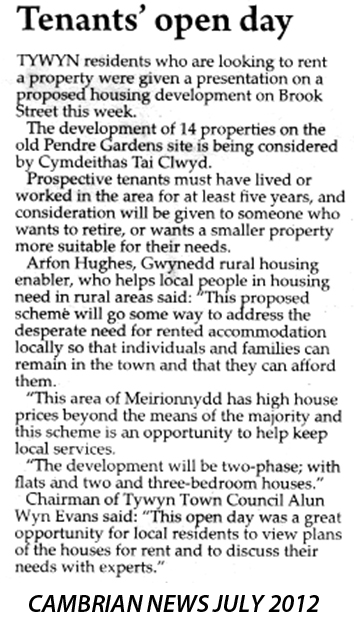
Given that the Wales Audit Office is probably no more independent of the National Audit Office in London than the ‘Welsh’ Government is of Westminster it is entirely reasonable to assume that Dr Haywood of Hafren Power and Gillian Guy of Citizens Advice are known to each other. And would be known to each other even if I’m being unduly cynical about the relationship between the two bodies. (For cynicism is not in my nature!)

FACT: Peter Hain and Elizabeth Haywood are both committed to the Severn barrage project. Additionally, Peter Hain has publicly voiced his opposition to the Swansea Bay tidal lagoon.

If the Swansea Bay tidal lagoon goes ahead, and is successful, others will be built. This will almost certainly be the final nail in the coffin of any Severn barrage, or any other major tidal barrage anywhere under the jurisdiction of the Westminster government. It seems to be a case of either / or but not both.

*

The Severn Barrage project never went away, it has been lying dormant (much like the company behind it, Hafren Power). A cynic – something I’ve already made clear (if only parenthetically), I am not – might interpret the above information thus:

There are two very good reasons for supporters of the Severn Barrage to attack the Swansea Bay tidal lagoon project at this time. First, they are hoping for a Labour victory on May 7th, so in anticipation of that, now is a good time to ‘resurrect’ their project, as has always been the intention. Further, the rival tidal lagoon project is currently at the critical stage of waiting for the Planning Inspectorate to recommend acceptance or refusal to the UK government, after which there is a further three-month period during which the UK government must say yea or nay. So why not kill two birds with one stone by trying to influence the decisions of the Planning Inspectorate and the outgoing UK government, while also reminding a Labour government-in-waiting of the economic bounty that could be lavished by a Severn barrage? And doesn’t it tie in well with all the recent talk of a Cardiff – Bristol city region (with poor old Newport as the spread in the sandwich).

Hain barrage
HAIN QUOTED IN ARTICLE (BY MARTIN SHIPTON) IN WALESONLINE JANUARY 21, 2015

The barrage is said to have, or possibly had, powerful supporters, among them, Tony Blair, Rhodri Morgan and the Notional Assembly. And of course, the Western Mail / WalesOnline, which will support anything that has Labour backing. Making this the ideal time for ‘Welsh’ Labour to clear up the confusion over whether a motion supporting the barrage was passed in the 2014 conference, as is suggested by the Peter Hain tweet below from March 29, 2014. (For some reason I’m blocked from Hain’s Twitter account!) The current briefing against the Swansea Bay tidal lagoon also provides ‘Welsh’ Labour with an opportunity to make clear its position on the project. The same opportunity naturally extends to the Labour MPs and AMs around Swansea Bay . . . though of course we already know where Peter Hain stands.

Hain Labour tweet
PETER HAIN TWEET FROM MARCH 29, 2014. (SUPPLIED BY ‘STAN’)

FACT: Peter Hain and Elizabeth Haywood obviously have considerable experience and contacts in business and politics; in addition, they have a company, Haywood Hain LLP, that specialises in ‘Media and Political Communications’.

I fear there may be more to the recent attacks on the Swansea Bay tidal lagoon project than concern for the tranquility of a Cornish village, or a commendable regard for electricity consumers being ripped off. Big money is at stake, and – speaking for our hypothetical cynic – it could be that certain persons of influence are trying to kill off a very worthwhile and beneficial project for the Swansea Bay region.

Any further information to admin@jacothenorth.net

UPDATE 26.02.2015: As predicted above, Peter Hain has used the report produced by his wife’s former colleague to rubbish the Swansea Bay tidal lagoon and promote the Lazarus Severn barrage in this piece. I know none of us think much of Llais y Sais, but does it have to be so predictably obsequious and revolting!

Swansea Bay Tidal Lagoon

My attention was drawn yesterday to a piece in the Sunday Telegraph, by Emily Gosden the Energy Editor, about the proposed Swansea Bay tidal lagoon. (Read it here.) The ST piece itself did little more than quote from a report, ‘Response to call for evidence on Swansea Bay tidal lagoon proposals’ produced by Citizens Advice and submitted to an unnamed agency, presumably a UK government department tSwansea Bay 1hat had requested submissions, possibly the Planning Inspectorate. (Read it here.) A similar piece, attributed to ‘Rupert Denholm-Hall Business Reporter’, was in this morning’s issue of Llais y Sais, and WalesOnline. (To be found here.)

According to Citizens Advice, the price guaranteed – by the UK government – for electricity generated by the Swansea Bay installation will be higher than other forms of generation and is therefore a bad deal for the consumer. In addition, alleges Citizens Advice, the process for arriving at the agreed price is unduly secretive. All damning stuff from experts in the field. For the alternative interpretation, check out the developers’ – Tidal Lagoon (Swansea Bay) plc – website here, pay particular attention to the ‘Project benefits’ section. Now I’m going to make a few contributions of my own in response to Citizens Advice.

Swansea Bay 2The Citizens Advice report is very narrow in its vision, and simplistic and superficial in its conclusions. It says, basically, ‘This is big business ripping off Joe Public when there are cheaper ways of generating electricity’. It focuses exclusively on price. So my first response would be that this price is not set in stone, so don’t get your knickers in a twist over something that hasn’t yet happened and can be changed. If this is a ploy to pressurise the UK government into hard bargaining with the developers, then fine, though my worry is that Citizens Advice may be acting in the interest of discredited forms of electricity generation such as wind and solar: expensive, unreliable, and offering none of the benefits of a tidal lagoon in Swansea Bay. Benefits that the Sunday Telegraph overlooked, but I would have expected to be highlighted by the ‘National Newspaper of Wales’.

So what are these benefits’ of which I speak? Well, to begin with, let’s us look at the alternatives. Oil supplies are finite, as is gas (unless we rely on Mr Putin, and successors who may be even more unfriendly towards the West), Swansea Bay 3many people are unhappy with nuclear energy, there is opposition to fracking, coal is being phased out, wind and solar energy are expensive and unreliable . . . which leaves us with, what? Well, there is a reliable source of energy that can – unlike wind and sunshine – be predicted years in advance and harnessed at countless points around our coasts. Swansea Bay is ideally located because it has the second highest tidal range on earth – so why not harness this power?

Then, the lagoon is going to be a big contract, providing over a thousand jobs during construction, using local suppliers, and putting a lot of money into the local economy. There will even be permanent jobs, on site, when the contract is completed. This is a direct benefit of the kind that is never provided by wind and solar ‘farms’. As this is a relatively new technology Swansea Bay could build up a wealth of expertise, both human and corporate, that could bring considerable economic benefits to an area where they would be most welcome. Benefits that need not be confined to Swansea Bay.

Swansea Bay SA1
SA1 DEVELOPMENT, EAST OF RIVER TAWE

Staying local, the lagoon fits in well with other developments on Swansea’s hitherto neglected East Side and the docklands east of the river Tawe, while further infilling the gap between Swansea and Neath Port Talbot (the most obvious of all council mergers). Not only does it complement the SA1 development (see image) but the lagoon will also reach to the new Swansea University Bay Campus, which actually lies outside the city boundary in Neath Port Talbot.

As the images also show, the lagoon will be rather more than a generating plant. It will be an amenity for local people, where they can go walking, cycling, angling, etc; the lagoon itself would provide a perfect location for water sports. (Obviously the lagoon will have to compete with all the fun-filled leisure opportunities available at power stations, open-cast sites and wind farms, but I think it will manage such competition.) And those amenities will not just be for local people, for I can see the lagoon becoming something of a ‘celebrity’, attracting visitors from a wider area, and from around the world. In fact, the Swansea Bay tidal lagoon could be viewed as a leisure and recreation facility that just happens to generate a lot of electricity as well!

Swansea Bay Campus
SWANSEA UNIVERSITY BAY CAMPUS (FOREGROUND) WITH SA1 DEVELOPMENT IN BACKGROUND

And who’s to say that the lagoon won’t become known to a wider audience who may never even visit the area. For Swansea Bay has a growing reputation as a location for movies and television series. The old Ford plant on Jersey Marine, which would overlook the lagoon, is now being used as a studio, and the steelworks in Port Talbot are an old favourite for ‘inferno’ backdrops and dramatic night skies. Then there’s Gower . . . Yes, Swansea Bay is more than Twin Town, great though that movie was.

Finally, despite what Citizens Advice would have us believe, the Swansea Bay Tidal Lagoon is not entirely a conspiracy of big business against the downtrodden masses of energy consumers. The project invited local investors, and I have family and friends back home who have put in thousands of pounds. Obviously most of the funding will come from institutional investors, but don’t overlook the Jack pound. A lot of local people, of modest means, are also backing this project.

For these reasons I tell Citizens Advice to report the whole picture, not focus on one aspect and, by so doing give a very selective and prejudicial view, that risks creating the impression that the project is being slammed in order to promote discredited hippy technology or the Severn Barrage. I’m sick and tired of Wales being ordered by Englandandwales organisations, however worthy and well-intentioned.

And to those running parent company Tidal Lagoon Power Ltd I say, having your corporate headquarters in Gloucester, with subsidiaries such as Tidal Lagoon (Swansea Bay) plc being no more than parentheses is a big mistake. The project upon which the future of your company hangs is Swansea Bay, so stop acting in a colonialist manner and get your corporate presence down there and recruit local staff!

No Business Like Show Business

I am indebted to Gruff Meredith of Sovereign Wales for forwarding me a letter he received from the ‘Welsh’ Government. (Below right, click to enlarge.) A letter signed by Carl Sargeant, ‘Minister for Housing and Regeneration’, and addressed to William Powell, the Lib Dem chairman of the Assembly Petitions Committee. It relates to a petition submitted by Gruff asking the ‘Welsh’ Government to introduce a deposit loan scheme for local first-time buyers, which would of course necessitate local occupancy regulations.Sargeant letter

There is nothing revolutionary about local occupancy schemes, such schemes already operate in, among other areas, the Peak District and North York Moors National Parks in England. (Click on images below to enlarge.) The wider problem here is of course one I’ve dealt with many times before – the difficulty Welsh people experience in buying a home in rural and coastal areas suffering from coloniotourism and the resultant colonisation.

You’ll notice that I’ve highlighted two sections. The first refers to ” . . . an under-supply of properties across the UK”. But should this be the concern of a ‘Welsh’ Minister, whose role is restricted to Wales? It can only be of relevance if Wales is tied in to an Englandandwales planning and housing system with Wales being used to help meet England’s demand for housing. Which of course it is, as I have pointed out many times. For not only is the Planning Inspectorate an agency of the Department for Communities and Local Government in London but other civil servants based in Wales answer to this and other UK government departments. We can be ‘bet-your-house-on-it’ certain that the civil servant who wrote this letter for Sargeant to sign answers to London. Which of course, makes Sargeant an expensive irrelevance . . . as are the others down Cardiff docks, all of them mouthpieces for scriptwriters up in London and their stage managers in Wales.

Peak Districy local occupancyLocal occupancy North York Moors


But you mustn’t think that this ‘make-it-as-difficult-as-possible-for-the-Welsh’ system applies only to the open or private housing market, for it also extends to social housing. This was made clear to me just before Christmas 2010 in an e-mail from Nick Bennett, then chief executive of Community Housing Cymru, who wrote: “There are over two million people on waiting lists for social housing . . . “. Not in Wales, matey! Bennett is a former business associate of recently-resigned minister, Alun Davies, and is now Public Services Ombudsman for Wales. (Click here and scroll down for more information.) This explains why housing associations – sucking up Welsh public funding in order to provide work for English companies – either build more housing than is locally needed, or else allocate properties to English undesirables while locals are left on waiting lists. (Click here and scroll down to the section, ‘Cartrtefi Cymunedol Gwynedd’.)

The second passage I’ve highlighted in the letter signed by Sargeant reads: ” . . . however I would be very keen to hear his (Gruff Meredith’s) views on housing supply and barriers to development in Wales”. What ‘barriers to development’! There are none. Is this an attempt at humour, even sarcasm?

To sum up, local occupancy clauses could easily be introduced, as they have been in many parts of England, but the ‘Welsh’ Government refuses to do so, which means that the ‘Welsh’ Government is refusing to serve the best interests of the people it is elected to represent. Though when we remember that Wales is actually run, via civil servants, from London, then this refusal to help Welsh people have homes in their own country is easily explained by ‘London’ wishing to facilitate further English colonisation.

*

The overarching issue here, and on which I have regularly written, is that no matter what those mummers down Cardiff docks may like to think of themselves, and despite the image projected to a gullible public, they are powerless, because devolution is a sham, real power still rests with London, just as it did pre-1999. There are examples a-plenty.

Having mentioned Alun Davies, let’s take a look at this video (F/F to 2:04) of a presentation he made before losing his job as ‘Minister for Agriculture’. The background is that someone in London decided to transfer 15% of EU agricultural funding allocated to Wales from Pillar 1, which goes to Welsh farmers, to Pillar 2, which will be spent on the vague and all-encompassing description of “rural development projects”. Which in practice means it will be allocated to Greens, hippies and other pushy colonists to fund ludicrous ‘projects’ that will be little more than non-jobs for those involved. Basically, the Third Sector goes rural. As I say, the sap who had to deliver London’s decision was Alun Davies. Note in the video how he is flanked by two English civil servants, there to make sure he doesn’t fluff his lines or deviate from the script, reminiscent of a Stalin show trial. This is one of the saddest cameos from the era of phoney devolution.

Or how about the M4 relief road? It seems that a carefully-orchestrated clamour arose demanding a new £1bn motorway around Newport, but how was it to be funded? Answer: the London Government would allow its provincial repertory company to borrow the money. To translate . . . the Old Etonians in London told Carwyn Jones he could borrow a billion pounds from their chums in the City of London on condition he gives out construction contracts to major donors to the Conservative Party for a project that, when completed, will faciliate the easier flow of English goods into the richest corner of Wales. In fact, on a visit to London, and in a bout of uncharacteristic extemporaneity Jones had told his scriptwriters that if he wasn’t allowed to get Wales into debt . . . well, he wouldn’t go up to Scotland to line up with the Nazi-Loyalists and others. And lo, it came to pass . . .

M4-relief-road2

The one given credit for overseeing the process and approving the £1bn ‘black’ route is Edwina Hart who, in the current line-up, plays the Minister for Economy, Science and Transport, a role for a mature and rounded character actor. Though odd, in a way, that a country with little in the way of economy, science or transport should need such a part at all. But there you are, this is showbiz not real politics. Hart is said to be reluctant to give live interviews, or to defend her decisions, but chwarae teg, that’s asking her to explain what she had no part in deciding. Making it perfectly understandable why she should choose to emulate the great Garbo. (In fact, the rest of the cast could do a lot worse than follow her example when off-stage.)

*

Having begun this piece with Carl Sargeant it’s only fair to bring down the curtain with something else he put his name to in January this year. (For those with the stomach for it, the full, three-page letter can be found here.) In this letter Sargeant, who plays the ‘heavy’ in London’s Welsh provincial repertory company, tries to explain the relationship between the ‘Welsh’ Government and the Planning Inspectorate. It is the biggest load of bollocks I’ve read, and believe me, I’ve read some bollocks in my time. Despite that, it also very revealing.

Sargeant Planning Inspectorate

Many times I have read it argued that there are two Planning Inspectorates, one serving England, one serving Wales, with the latter having its own office in Cardiff and answering to ‘Welsh Ministers’. This letter makes it clear there is but one Planning Inspectorate, though we are asked to believe that it has been “. . . empowered by Welsh Ministers to take a range of decisions on their behalf”. But how can those with no power themselves empower others? What this really says is that for the purposes of the Planning Inspectorate Wales is part of England. To disguise this, and allow the troupe of players known as the ‘Welsh Ministers’ to retain some credibility, it allows them the fig leaf of pretending it has been empowered to operate in Wales by them. I also love the second sentence in the extracted paragraph, an encomium for the Planning Inspectorate . . . “openness and impartiality” be buggered!

To disguise the ugly reality that Wales is a colony of England we have a bunch of mouthpieces masquerading as the ‘Welsh Government’. Though they have no control over planning or housing in case they interfere with the colonisation programme. Nor are they allowed to control our natural resources or our economy lest this power be used to serve Welsh interests. Though, and perhaps significantly, they are allowed freedom in those areas London is reasonably confident they will screw up – education, health – so that they can then be held up to ridicule and used to warn English voters of the dangers of the Labour Party in government.

This system cannot be improved, it can only be swept away. And the sooner the better.

Social Housing: Led up the Pendre Gardens Path

Regular followers of this blog may recall that back in 2012 (on the old Google blog, now, sadly, demised) I was able to give out some good news. Which was . . . that for properties to be built by Cymdeithas Tai Clwyd on a new development in Tywyn, “Prospective tenants must have lived and worked Tai Clwydin the area for at least five years”. I learnt this, first, from a piece in our local edition of the Cambrian News, in July (left, click to enlarge), and then it was confirmed in an e-mail I received from Tai Clwyd in September (below, ditto). These two pieces of information can only be read as saying, ‘these properties are reserved for local people’. Or, to be more specific – as Tai Clwyd was in its e-mail – a Section 106, local occupancy, restriction. (Though S106 can deal with other issues.)

Fast forward to 2014 and the word on the mean streets of Tywyn is that these properties are now to be allocated to “people from away” and “people on benefits”. In other words – welcome to Wales’ social housing allocation system: social housing either built in excess of local demand or, where there is local demand – as in Tywyn – locals being passed over in favour of people who have never been to Wales in their lives. A system I have explained more than once, and I shall do so again later in this piece.

In order to find out what has happened between the good news of 2012 and the sobering realities of colonial Wales in 2014 I decided to contact Cymdeithas Tai Clwyd . . . only to learn that it had recently merged with Cymdeithas Tai Eryri to form Grŵp Cynefin, which is “the only housing association to operate across all six north Wales counties plus north Powys”. My initial enquiries with Grŵp Cynefin (GC) drew a blank because it was denied there ever had been a S106 applying to Pendre Gardens, and therefore no guarantee could be given that locals would be offered any of the properties there. After e-mailing GC a copy of the September e-mail my query has now been passed to the Housing Manager.

In a follow-up phone call to GC I was told that it must be the fault of Cyngor Gwynedd that there was no S106. So I next checked the planning consent given by the council (because of course Tywyn is outside the Snowdonia National Park) and could find no mention of a S106. This full planning consent is dated July 23, 2012. So why did the Cambrian News run that piece telling everyone that these new dwellings were for locals only? And why was I told the same thing in September 2012 by Tai Clwyd, two months after that body had been granted the – S106-less – planning permission?

Grŵp Cynefin also referred me to Gwynedd’s Housing Options Team (GHOT), which seems to act as a link for the various social housing providers in the county while also serving as first contact for would-be tenants. The man I spoke with there was courteous and helpful, but could only point me in certain direTai Clwyd replyctions and suggest that an S106 would need to have been agreed between the council and the housing provider.

In another attempt to get answers I phoned the council’s planning department, where it took me a while to explain – or make the woman answering my call understand – that I wanted to know why something was not in an approval granted by the council. Having had my request accepted it could now be 15 days before I receive a response.

I suppose I could have waited until I got answers before writing this post, but my worry is that I’m not going to get the answers I’m after. If I had to bet on it, I’d say I’m in for a game of blame ping-pong. So I’m writing this post half-hoping it might get a better result than yet more phone calls and e-mails. Even so, the questions I would ask are these:

  1. Was it ever proposed to have a Section 106 local – 5-year residency – qualification attaching to the Pendre Gardens development?
  2. If it was, why was the proposal dropped, or the decision changed?
  3. Who authorised the change?
  4. For what reason(s) was the change made?
  5. If there was never any intention of attaching a S106 to Pendre Gardens why was everyone misled (if not lied to); why did no one from the council step in and give the correct information?

The main reason we’re in this mess is that to all intents and purposes Wales and England now operate a single, integrated social housing system. Just like one vast council, or housing association. Which means in practice that if there is a vacant property in Wales, and someone in England – anywhere in England! – has more ‘points’ than local applicants, then the English applicant could be allocated the property. Local connections count for very little. So if you are a law-abiding local, in regular employment, and have any kind of roof over your head, your chances of being allocated social housing are slim. My advice to you is start taking drugs, causing trouble and, best of all, make yourself homeless.

Of course, there will be those who argue that this is a two-way street, for Welsh people can move to England. Yeees . . . but given that England has 53 million people against our 3 million, it’s a two-way street with a bicycle travelling west to east and a 40-tonne juggernaut hurtling east to west. And I’m not just talking quantity, I’m also talking quality. For many of those being moved to Wales will be people that no self-respecting country would allow in. Here’s a selection. But bear in mind that this post I refer you to only deals with those who have made the news. The problem families, the pit bull fanciers, the casual criminals, the anti-social, the wife-beaters, the congenitally irresponsiblePendre Gardens sign, the ‘Ten-pints-and-I’m-Mike-Tyson, me’ types, the ‘breeders-for-benefit’ with their stupid, uncontrollable kids, the all-night party-holders, the fat, ugly women who think smoking ciggies keeps their weight down, these and others go unreported.

So I just cannot understand how this system that is so damaging to Wales and Welsh people has been accepted without resistance. I can only assume that housing associations are doing well out of it financially, and don’t really give a toss about the communities or the country in which they operate. Which might make sense; for Cartrefi Cymunedol Gwynedd (after taking over Gwynedd council’s housing stock) gave the maintenance contract for its properties to an English company that in turn employs sub-contractors from over the border who can only spend a short time actually working because of the distances involved travelling to and from work!

It cannot be right that someone who has never heard of Tywyn, or Tredegar, or Treaddur can qualify for social housing in these communities ahead of people who have lived there maybe all their lives. It cannot be right that Wales is used to help solve England’s housing problems. For as Gwynedd’s Common Housing Allocation Policy makes clear, “The scheme also complies with requirements of the legislation by providing priority or additional priority to: transferring tenants who will release accommodation in short supply . . . “ So if, say, Stoke-on-Trent council, or housing associations in that city, are experiencing pressure on their housing stock, then they can ask – maybe demand – that Welsh local authorities and housing associations give priority to those the Potteries would like to get rid of ‘transfer’ in order to make housing available. Some system, eh!

Change is needed. Social housing providers in Wales can no longer use the ‘Nuremburg Defence’ to implement an iniquitous system that so obviously works against Welsh interests. Social housing provision in Wales must be disentangled from that in England. A five-year residency qualification must be introduced for all social housing in Wales, with the only exceptions being genuine refugees and those who will be of benefit to Wales. Finally, those clowns down Cardiff docks need to realise that calling themselves the ‘Welsh Government’ must mean more than obeying civil servants and nodding through essentially English legislation with ‘(Wales)’ stuck in the title . . . like the Housing (Wales) Bill, and the Planning (Wales) Bill.

What The Seas Giveth . . .

Last night’s Week In Week Out on BBC 1 Wales, presented by Tim Rogers, dealt with long term problems posed by erosion or sea encroachment around our coasts, and came with the stark warning that some communities will have to be abandonded, largely because the cost involved in holding back the sea greatly outweighs the value of what is being protected. (Here is a link to the BBC iPlayer version of the programme.)OLYMPUS DIGITAL CAMERA

One of the communities visited was Fairbourne, which is, like most of the others consigned to ‘managed retreat’, a somewhat artificial settlement, built on land reclaimed for the purposes of tourism and retirement. The Fairbourne Wikipedia page says it all: the area was previously known as Morfa Henddol (morfa = fen or sea marsh) and the outcrop on which today stands the Fairbourne Hotel was known as Ynysfaig (ynys = island). Clearly, our ancestors knew this land alongside the Mawddach estuary for what it was. (And will soon be again.)

Also investigated was that sinkhole for Welsh public funding, Rhyl. There we saw a couple who, to judge by the accents, came from the Birmingham conurbation, had been flooded out of their bungalow and were now living in a trailer home. Tim Rogers asked if anything had been mentioned about flooding when they purchased their property. “No, nothing”, was the reply. Which made me think to myself, ‘If I am a shifty developer or estate agent, selling properties I know are vulnerable to flooding – and almost always to people who don’t know the area – am I going to tell these prospective buyers that their dream home might one day be under six feet of water?’ Of course not. This is clearly a case of caveat emptor.

Down here, on our stretch of the coast, Tywyn’s new sea defences worked excellently . . . though there are some in Tywyn that will never admit this as they harbour an irrational hatred for Gwynedd council and all its works, because it’s a) too Welsh and b) run by the wrong party. They would rather gripe and snipe at everything the council does, however beneficial.

Speaking of gripers and snipers, I hear that part of Aberdyfi golf course has joined Neptune’s realm. Sad though this news may be, there can be no justification for spending Welsh public money to preserve what is a private and exclusive asset. Either the club itself pays for new sea defences or else Nature must Tywyn sea defencesbe allowed to take its course (‘course’ – geddit!), leaving the Ukipistas to find another rendezvous. Further south, Borth and Aberystwyth also featured in Tim Rogers’ investigation. Now, obviously, Aberystwyth must be defended, but how strong is the case for Borth? It certainly seems that land just north of Borth – curiously enough, another golf course! – is to be surrendered.

Though the bigger picture here, especially when we remember the Towyn floods of 1990 and similar events, is that for a century and more we have allowed, even encouraged, the building of new properties on inadequately defended coastal plains and salt marsh, land on which building should never have been allowed. So why did this happen? The fundamental cause is tourism. Since the coming of the railways over 160 years ago English people have visited coastal Wales for their holidays, and this led to the growth of resorts where little or nothing had existed before the arrival of the iron horse. Many of those tourists wished to settle permanently, perhaps retire to, where they had enjoyed their holidays, so new homes were built for them . . . with the inevitable consequences.

If I owned a home in an area being ‘surrendered’ to the sea, I think I would be asking a few questions. Principally, ‘Why was planning permission granted for my property and others when the risk of flooding must have been known?’ Then, perhaps, ‘Do I have a justifiable claim for negligence or culpability against the body that granted planning permission’? (With this of course extending, particularly in the case of local authorities, to successor bodies.) For no matter what we may think of communities like Rhyl, Towyn and Fairbourne, the people suffering from flooding in such places aPuppet show, captionre innocent victims and have, to all intents and purposes, been conned into buying the properties under threat.

So, in the hope of avoiding any repetition of such miseries, can the puppet show down Cardiff docks, and our local authorities, confirm that no more building will take place in areas that might in future be susceptible to coastal flooding or erosion? (This must also apply to trailer parks and other developments.) More, will these bodies also confirm that any outstanding planning approvals for dwellings in such areas will be revoked? And will the ‘Welsh’ Government also promise us that there will henceforth be a binding national presumption against building any more communities like Towyn and Fairbourne?

Oh, yes, something else that would be very welcome would be a promise from the Planning Inspectorate that in future it will not – in order to follow its over-arching policy of attracting English settlers to Wales – overrule planning bodies that turn down applications for housing in flood-prone areas.

Fairbourne 1868UPDATE 12.03.14: I am indebted to the person who sent me a copy of this 1868 watercolour claiming to be a view across the Mawddach from Barmouth, showing where Fairbourne would eventually be built. You will note that there is nothing there apart from what looks like a temporary structure, perhaps a fisherman’s hut. Suggesting that the locals had better sense than to try to build anything permanent there. (Click to enlarge.)

Lies, Damned Lies, and English Civil Servants

To recap . . . I believe I have established in recent posts that the ‘new households’ projections used by the Planning Inspectorate to force through the recent Local Development Plans are flawed. Deeply flawed. So obviously flawed that they were almost certainly contrived to serve a darker purpose than the provision of new housing. So let us consider the origin of the figures used and, more importantly, who produced them.

First let us go to StatsWales, a very useful and well-ordered website providing – as the name suggests – statistics about Wales. You will recall that in my two most recent posts I drew attention to the mismatch between the population projections and the projected increase in the number of households. In a nutshell, the ‘households’ figure argued for new homes greatly in excess of what would be required by the number postulated by the anticipated population increase.

So let us first consider the population projections. These can be found here, with the most recent, 2012 – 2037, predictng an increase of 247,000. If we scroll down to the ‘Metadata’, then click on ‘Author’, we see that these figures were produced by the Office for National Statistics (and can be found on the ONS website). However, when we consult the household projections and select the 2008-based projections (the latest available) these predict 323,009 new households 2008 – 2033. When we scroll down as we did with population projections we read, ‘Knowledge and Analytical Services, Welsh Government’. Is this what Carl Sargeant alluded to in his November letter (see previous post) when he said, that the methodology used to work out the households projection was ” . . . based on a Welsh specific methodology which is separate to the methodology used in England”.

(There may even be a higher figure than 323,009. You will note that in the Sargeant letter it says this figure is “slightly lower” than the figure ‘his’ civil servants were originally working with. I believe the ‘lost’ figure is 331,168. This can be found in the 2008-based households projections by totalling the figures for eachAnalytical Services local authority. Though why this doesn’t tally with the national projection of 323,009 is a mystery. Maybe when you’re being ‘imaginative’ with figures such anomalies are unavoidable)

As you might guess, I just had to find out more about the Knowledge and Analytical Services. In my enquiries I found this on the ‘Welsh’ Government website. (Click panel, right, to enlarge.) Let’s go through it carefully, for it would be easy to mis-read this little announcement.

Note first, that, in the heading, it mentions the ‘Minister for Local Government and Communities’, and later on we read, “the Department for Communities and Local Government”. The same thing, surely? No. The Department for Communities and Local Government (DCLG) is in London, whereas the Minister for Local Government and Communities referred to is Carl Sargeant, down Cardiff docks. Why have a ‘Welsh’ Government department with a name so easily confused with a separate(?) department in London?

Anyway, the notice says that Carl Sargeant was ‘asked’ “to approve a list of priority analytical activities, and associated research spend, for the KAS team over the remainder of 2012-13”. Analytical activities presumably decided by, and funded by, the minister in London. In other words, a Labour Party minister in Cardiff is ordered to agree to a directive from a Tory minister in London to allow English civil servants to determine what happens in Wales. This is Carl Sargeant’s “Welsh specific methodology”! But wait! have we Carl Sargeantnot encountered this UK ministry before? Yes, indeedy! For the Planning Inspectorate itself is but an executive agency of the very same Department for Communities and Local Government.

Let us start connecting the dots. The Office for National Statistics produces population projections. However, skulking behind the original and respected imprimatur of the ONS the KAS unit then extrapolates wildly exaggerated ‘households’ projections, which are in turn taken up by the Planning Inspectorate to force through Local Development Plans that demand new housing in numbers that cannot be justified by any conceivable future local need.

To be more precise, the KAS unit and the Planning Inspectorate argue that for the ONS’ projected population increase of less than 250,000 over the next 25 years Wales will need some 330,000 new homes! (See recent posts.) Also worth noting is that KAS ‘households’ projections were produced in 2003, 2006 and 2008, so why nothing since then, especially as the ONS population projections – on which the KAS claims to base its own projections – were revised in 2010 and 2012? The answer is obvious – the 2008 ‘projections’ were concocted specifically for the Local Development Plans, to ‘justify’ some 200,000 new homes that we Welsh will not need. Making it obvious who these new homes are being built for.

Wales being controlled by unelected and anonymous English civil servants, taking their orders from London, shows up, yet again, the sham of ‘devolution’; and exposes the self-regarding buffoons of the ‘Welsh’ Government as nothing more than errand boys and mouthpieces. Worse, the refusal of these puppets to challenge the ethnocidal policies being implemented – in their name – makes them complicit in these crimes. Confirming, yet again, that the Labour Party remains the greatest enemy of Welsh nationhood.

Organ Grinders and Monkeys 2

Following on from my previous post, a few more things need to be said about the way those we elect and, perhaps more importantly, those we do not elect, plan how many new dwellings will be built in Wales in the next couple of decades.

In that previous post I wrote of Carl Sargeant, Minister for Housing and Regeneration, and his assertion that the number of households in Wales would increase by 323,009 between 2008 and 2033. The StatsWales figures quoted by Carl Sargeant predict a decrease in household size in this period from 2.27 persons to 2.02, and taking an average of 2.12 (2020), this ‘translates’ into a population increase of some 685,000. Though the most recent (2012) population projections from StatsWales predict an increase of just 247,00 between 2012 and 2037. How do we make sense of these differing figures?

Though before proceeding it’s worth remembering that there is no exact or direct correlation between the increase in the number of households (and therefore the number of dwellings needed) and the increase in population. An increase in the number ofStatsWales Projections households cannot translate exactly into an increase in population. Certain factors come into play, such as more people living on their own, smaller families, or even slum clearance programmes. But I doubt if many older properties in Wales will be demolished and I have used the household size projections provided by StatsWales so, even allowing for more of us living on our own, there seems no way to reconcile the two sets of figures.

Yet the answer lies in the fact that the ‘households’ figure is from 2008 (updated September 29, 2010) whereas the population projection I’ve used is from 2012. Also note that the population projection in 2012 shows a reduction of 116,000 from the projected increase made just two years earlier. (All explained in the panel on the right. Click to enlarge.) Now it stands to reason that if the population projections have been substantially reduced then the number of households projection also needed to be revised, yet this has not been done. With the result that, over the past two or three years, our local authorities have been ordered to plan new dwellings on the basis of discredited data. Worse, those demanding that our councils pass these Local Development Plans knew the figures used to justify those plans were unreliable.

Without, I hope, appearing too personal, I must return to Carl Sargeant for a moment. If you read his letter of November 12th last year to William Powell AM, Chair of the Petitions Committee, you will see that the ‘households’ figure he (Sargeant) had been working with seems to have been an even higher figure than the 323,009 of StatsWales! (LeftSargeant 1, click to enlarge.) But worse, he appears to admit that his officials can’t explain where the figures they’ve been using came from! Can you believe this? So where might Sargeant’s officials have got this insane, and now lost, figure they were using? Thin air is one possibility, but a much more likely source is the Planning Inspectorate, represented in Wales by Richard of Poppleton (see previous post).

To help understand the mismatch in the two sets of figures on a local level, let us look at Denbighshire, where the council is being ordered – by Planning Inspectorate officials – to build thousands of new properties for English commuters much-needed local homes, 7,500 by 2021. According to StatsWales’ 2008-based household projection the number of households in the county will increase, between 2010 and 2021, by 5,972, and this figure is, presumably, being used to justify the building programme. Yet the most recent (2011) StatsWales population projection says that the county will see growth of just 4,134 between 2010 and 2021. There is no sensible way of explaining the same body predicting, for the same area, a greater increase in new households than in total population . . . unless of course, we are dealing with a population that has yet to arrive in Wales?

What we are facing here is a blatant colonisation strategy being implemented by the Planning Inspectorate. A calculated assault on Welsh identity. It is now time for Carl Sargeant and others down Cardiff docks to stop acting as fig leaves for this racist programme – pretending these are their strategies – and to start serving Welsh interests by standing up to cross-border agencies that do not have Welsh interests at heart.

The Local Development Plans were based on what was known to be incorrect information in order to maximise the number of properties available to English buyers and tenants. This colonialist motivation should surely invalidate these LDPs. If the ‘Welsh’ Government fails to recall the discredited LDPs then this will provide further evidence of the organ grinders and monkeys nature of Welsh political and public life.