Social Housing Back to Council Control?

THE TRAVAILS OF CANTREF

Over the years I have written exhaustively on housing associations, I’ve explained the funding they receive, their staffing levels, and the fact that at a time when politicians argue our 22 local authorities must be cut to 8 or 9 those same politicians are quite content to see Wales lumbered with 50 or so housing associations, often with three or four operating in the same area, duplicating each other’s work and sometimes competing for clients and funding.

The contradiction in the differing attitudes to local authorities and housing associations is obvious, with the result that it has become increasingly difficult to defend the generosity extended to so many housing associations. But rather than openly admit that the social housing system is a very expensive shambles, it now appears that our masters have chosen to make changes to the social housing system by subterfuge.

Cantref logo

One housing association I have written about more than once is Cantref (formerly Tai Cantref), based in Newcastle Emlyn and operating mainly in Ceredigion, plus north Carmarthenshire and north Pembrokeshire, with an outpost in the Machynlleth area of north west Powys.

I haven’t been the only one training a beady eye on Cantref, others are the ever-watchful Wynne Jones, even the ‘Welsh’ Government! Though given the way the ‘Welsh’ Government cossets housing associations things must have been really bad for that lot to step in. But we aren’t allowed to know what ailed Cantref because the report will not be made public and FoI requests have been refused.

To fill in the background . . . It was known by July 2015 that Cantref was being investigated, the Cantref Board received their copy of the report in December, and early in the new year the chief executive, Lynne Sacale, and others, left. Cantref is now looking for a merger.

As is the way with such things, and just before it was publicly known that Cantref was being investigated, I received a revealing comment to this post alleging Bacchanalian excesses at Cantref’s expense in the grounds of Chateau Tucker. Read it for yourself.
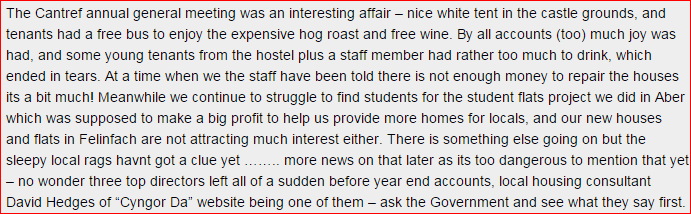
Cantref piss-up

As the writer states, one reason for Cantref’s woes was undoubtedly that it had invested in student accommodation in Aberystwyth at the very time Aber’ Uni began sliding down the various league tables, with the predictable consequence of student numbers dropping.

Though it has to be asked who funded this student accommodation. Presumably the funding originated with the ‘Welsh’ Government, which then raises the question: Should money allocated to social housing have been used for student accommodation? Perhaps not, so maybe the report is being withheld to save the blushes of Carwyn and his gang.

The good ship Cantref now appears to have at its helm a Hilary Jones, of the Bro Myrddin housing association. Ms Jones’ husband (sub fill in name) is said to be a former finance director at Grwp Gwalia HA. And according to ‘Dai the Post’ in a recent comment she, ” . . . has been trying to self promote herself by persuading Wales and West HA from Cardiff to bail out Cantref and give her a bigger job as head of their western poorer Welsh speaking colony.”

You’ll note from the Gwalia website that it has recently merged with the Seren Group of Newport to form Pobl. And this site seems to tells that Charter Housing is also part of Pobl. So mergers, or takeovers, whether voluntary or enforced, are obviously in vogue.

Another change in personnel that may be relevant to recent events at Cantref was the appointment in July 2014 of Kevin Taylor to the management board, where he now serves as interim chair. It may simply be a coincidence of timing, but the problems for Sacale and the others seem to have started soon after Taylor arrived on the scene. So who is he?

According to his Linkedin profile Taylor was employed by Forte Hotels between 1977 and 1987, then, from 1987 until 2013, he worked in Bermuda. More recently, from January 2013, he has been a ‘Hotel Financial Consultant’ for Taylor Accountants, a company for which I can find no record. (I do hope it’s not registered offshore!)

An interesting employment record that raises a number of questions:

  1. Does he have any knowledge or experience of social housing?
  2. Is he familiar with the social patterns and housing issues of rural Wales?
  3. Assuming the answers to 1 and 2 are No, who appointed him, and why?

As I say, Cantref is now looking for a partner, and referring again to the comment from ‘Dai the Post’, there are said to be five suitors. One is Millbay Homes, the ‘Welsh’ Government-funded ‘subsidiary’ of Pembrokeshire Housing that builds homes for sale to ‘investors’. Another is Carmarthenshire County Council, though whether the executive board knows anything about this is open to question, and we can guarantee that the common herd of councillors is completely in the dark.

Elsewhere in his comment ‘Dai the Post’ tells us that someone answering to Robin Staines, Head of Public Protection and Housing at CCC, has been parachuted in to Cantref, possibly to prepare the ground for a takeover. ‘Dai’ further suggests that this aggressive move is viewed within Cantref as a bit of empire building ahead of local government reorganisation. I think the suspicion is correct, and we could see more such moves, all done in the shadows with the connivance of a ‘Welsh’ Government committed to ‘openness’!

pobl

Despite not having seen the WG’s report into Cantref the executive board of Carmarthenshire County Council will, on April 19th, be expected to approve in principle the council taking over Cantref. Not for the first time, chief executive Mark James will present councillors with a fait accompli. Ain’t democracy wonderful!

Another source tells me that despite what are alleged to be its failings Cantref is the largest employer in Newcastle Emlyn, it employs locals and conducts most of its business in Welsh. The fear is that if the takeover goes through then the HQ will move to Llanelli and, given the recent recruitment record of the council, it will swiftly lose its Welsh character.

The James Gang

Thinking about Carmarthenshire County Council and the record of Mark James raises the obvious question – why is he still there? After using council money to fight a private libel case, after wasting council money to fund Christian fundamentalists in building a church and a bowling alley (yes, a bowling alley!), and after turning Sir Gâr into the Welsh equivalent of North Korea, why the hell hasn’t the ‘Welsh’ Government stepped in to remove him?

Let me answer that by taking a little detour. When inexplicable things happen there is very often a simple explanation, but one that the media and our political class would rather not touch. I have recently written about the land deals conducted by the Regeneration Investment Fund for Wales that might eventually lose the public purse as much as £200m. Let’s stop beating about the bush – this is corruption, pure and simple.

Many times we see things happen in public life that are difficult to explain; contracts given without a tendering process; people being promoted above their ability; wrongdoers escaping justice. In such cases Freemasonry or other secretive groups can often be behind such corruption. Then there are the instances where outright and obvious criminals are ignored by the police. Such persons may be police informers, or relocated witnesses.

I’m not suggesting that Mark James owes his survival to any of these explanations, but I believe he does have a ‘guardian angel’. It may have been pressure from this celestial quarter that persuaded him to carry on after ‘standing down’ in 2014 rather than the council panicking when they realised the size of his severance package.

Mark James may have been put in place as chief executive of Carmarthenshire County Council, and has been maintained in that position, to oversee the anglicisation of the county.

Let me explain.

If you listen to Labour Party historians they will talk about towns or areas that are ‘iconic’ in the party’s history and development, Merthyr and the Rhondda come to mind. For those of a more patriotic bent, Carmarthenshire fills this role through Gwynfor’s 1966 by-election victory and the county delivering the votes that won the 1997 devolution referendum.

In addition, Carmarthenshire is the geographical ‘bridge’ between the rural heartland (or former heartland) of Plaid Cymru and the urban south. Add to that the fact that Carmarthenshire’s seats at Westminster and Assembly level are either held by or are vulnerable to Plaid Cymru, and the county becomes a prime target for the kind of attention I’m suggesting.
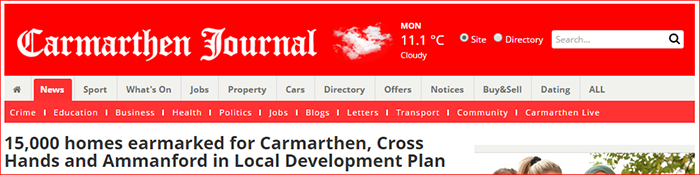
Carmarthenshire LDP

Part of this ‘attention’ is the insane and unneeded housing developments being imposed on the county . . . yet welcomed by Mark James and his circle of senior officers, almost all imported from England. Despite being born in Merthyr, Mark James has no feelings for Wales or her identity whatsoever, and is actively working to see Carmarthenshire anglicised.

That may be the reason he was directed to Wales, and why he has been allowed to keep his job when anyone else would have been forced out years ago.

But of course this does not explain the woeful impotence of Plaid Cymru in Carmarthenshire.

*

NATHAN GILL MEP

News reaches me from an anonymous source concerning our much beloved UKIP MEP Nathan Gill of Hull and Menai Bridge. You may recall that I have written of Mr Gill more than once – about a dozen times in fact – so you may care to refresh your knowledge of the great man by starting here then working back from the links provided.

In particular, I would draw your attention to this post, Nathan Gill: It Just Gets Worse, because the information I have received concerns an incident mentioned in this particular post. Mr Gill owned a church in Hull that he was hoping to develop in some way, but on November 5th 2001 it caught fire, Mr Gill was quoted in the Hull Daily Mail as saying that ” . . . some residents had seen youngsters aiming fireworks at the church”.

Though a source I had in Hull a while back described the fire as “suspicious”, and insisted that Nathan Gill’s application for planning permission had been refused.

Gill church

The information I received a couple of days ago says, “Before the fire in the grade 2 listed Hull church Gill had all the Oak paneling and benches stripped out, Brian Quilter sanded and reused them to Oak panel Lledr House and make window shutters.”.

Brian Quilter is one of Gill’s US Mormon brothers-in-law, married to Gill’s sister Melanie, and the couple lives in Lledr House, Dolwyddelan. Maybe the panelling referred to can be seen in this photo from TripAdvisor. Read more about Brian Quilter in Nathan Gill, Family Man.

Now there’s nothing wrong in what is described. Obviously Gill bought the church, planned to do whatever he planned to do, and in preparation for that – though perhaps in advance of receiving planning permission – stripped the building and let his brother-in-law have the panelling and the benches. All perfectly innocent.

Though less generous souls than what I am might suggest the possibility of foreknowledge.

*

JOHN BOY BAYLISS

I know you’ve been asking what our wandering boy has been up to lately, and the answer is, well, a bit more wandering. You will recall that last October I wrote The Case of the Disappearing Councillor in which I expressed deep concern for the whereabouts and welfare of Councillor John Boy Bayliss of the Uplands ward in Swansea. (In fact I have written quite regularly about John Boy and his friends, most of whom have now deserted him. Sob!)

At the time of writing the post just referred to, John Boy was giving his address as a property in Cambrian Place, in the city centre, a row of fine old town houses near the marina. In fact, where his friend and fellow-councillor Mitchell ‘Mitch’ Theaker had lived ere his departure to Araby. But now, I’m informed, he has moved again.

My concern for John Boy’s whereabouts last year was two-fold. After learning that he had taken a job in Bristol I was worried that the daily travelling between Swansea and Bristol might tire the poor boy. So I was almost relieved to hear that he was in fact living in Bristol, and merely using the Cambrian Place address as a letter-box. But then I thought, ‘Hang on, if he’s living in Bristol how can he remain a Labour councillor in Swansea?’

A message over the weekend directed me to updated information on John Boy’s council website bio (see below) which now has him living in Llangyfelach, still not in his Uplands ward, and as far from it as Cambrian Place.

Bayliss address

‘But still’, I generously and paternalistically thought (well you know me), ‘it might not be in his ward, but at least he’s got a place of his own now’, but then I read the message I’d received again, and it suggested that this address is in fact the residence of one David Collins. So who is David Collins? Here’s his Linkedin profile.

Collins is clearly a Labour professional who appears never to have done a real job, having studied History and Politics at Brunel from 1992 until 1997 and then starting work in January 2000 as a Researcher and Political Assistant to Ann Jones, the former Labour AM for the Vale of Clwyd. (Leaving two and a half years unaccounted for on his Linkedin profile.) He now works as a Political Assistant to the Labour group on Swansea council.

So is John Boy shacked up with Collins, or is he engaged in a nightly tussle with the cat for the rug in front of the fire? I think we should be told!
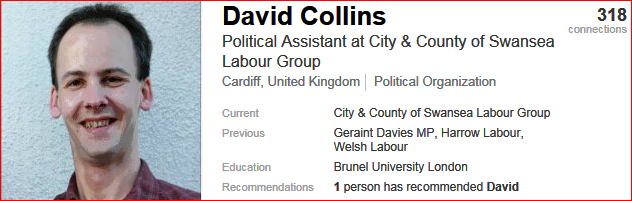
David Collins

Put both images from your mind, because further reading of the revised bio tells us that his correspondence address is “c/o Members Support Unit, Guildhall, Swansea SA1 4PE”, which suggests to me that he might not be living in Llangyfelach at all, and that this address doesn’t even serve as a letter-box.

The PR outfit John Boy works for recruited him because he is a councillor, and for no other reason. That being so they will of course give him time off to attend the important council and planning meetings, which in turn helps the Labour group on Swansea council maintain the fiction that their boy is still living in Swansea. Everybody’s a winner . . . except the people John Boy is supposed to represent.

This ‘Now you see him, now you don’t’ could be interpreted as a conspiracy on the part of the Labour Party in general, and certain individuals in particular, to maintain the deception that John Charles Bayliss still lives in Swansea and daily represents the interests of the people in the Uplands ward. If so, then perhaps the Local Government Ombudsman might be interested.

We know Councillor John Charles Bayliss does not live in Swansea. So my advice to the Labour Party in Swansea would be: Come clean, make John Boy Bayliss resign, and call a by-election in the Uplands ward.

P.S. I almost forgot to mention that John Boy is standing for the Assembly next month, he’s third on the list for Mid and West Wales, a region he knows intimately. His chances of being elected are slim, but of course Cardiff is nearer than Swansea to Bristol, so it would easier for Bayliss to commute from Bristol and turn his back on Swansea for good.

UPDATE 23:00: I am informed that David Collins no longer works for the Swansea Labour group, he has, I’m told, “been released” . . . into the wild? If so, will he be able to fend for himself, cut adrift from the Labour Party, all he’s ever known? I await reports that he has been spotted at night, scavenging in the back streets of Morriston.


Port Talbot

Yes, I know, Port Talbot isn’t the only Tata plant affected by the company’s decision to put its UK operation up for sale, but it is the biggest, and serves as useful shorthand.

Rather than giving instant remedies or exposing my ignorance by trying to discuss EU regulations on state aid, or the impact of carbon tax and business rates, let alone the statistics on Chinese steel production and exports, I shall stick to my comfort zone by considering political responses and impacts, winners and losers, and also the possible outcomes.

But first, let me indulge in a little reminiscing.

*

I grew up just around the Bay from Port Talbot steelworks and I can remember the plant in the mid-’60s when it employed 20,000 men and the wages paid earned it the soubriquet ‘Treasure Island’. Much of its steel went on to the tinplate works at Trostre in Llanelli and Velindre on the north side of Swansea (where I worked for a short while). Velindre is long gone, but Trostre has struggled on and is now in the same position as Port Talbot.

And if you’ve driven past and think the smells and the smoke of Port Talbot are bad nowadays, then you should have seen it in the ’60s and ’70s. It wasn’t just that the steelworks produced more smoke and smells back then, there were other plants nearby making their contribution.

Just up the road, on the Swansea side of the steel plant, in Baglan Bay, we had one of the largest petrochemical sites in Europe, employing another 2,500 men. A couple of miles inland there was the Llandarcy oil refinery with the same number of employees. Then there was the Tir John power station taking us up to the eastern outskirts of Swansea, where the East Side made its contribution to the shit and the smell with the never-to-be-forgotten Carbon Black plant.

Llandarcy

This spewed out such filth that it resulted in regular protests by local housewives, who couldn’t put washing on the line to dry without it being covered in a dust that also got indoors and clung to everything.

My first-hand experience of Carbon Black came through a summer job I took when at Coleg Harlech. I was employed to sweep the floors inside the plant, where the filth lay inches thick. I was provided with a brush and a rudimentary face mask . . . and that was it. I handed in my brush after a few hours and went to a nearby pub to ease my throat.

The whole area from the east side of Swansea over to Neath and down to Port Talbot was a complex of heavy industry, a nightmare for any proto-Green. And yet, if we add in Swansea docks, the ancillary jobs in transport and other fields, this triangle of smoke and smells provided tens of thousands of well paid jobs for semi-skilled and unskilled men. Most of these jobs have gone, and will never be replaced.

I had many friends and family members working at these various plants, and of course at the steelworks, and not just for the then owner, the Steel Company of Wales. For example, there was a boy I met in Penlan school with whom I became good friends (after the introductory fight); his family had come down from Kilmarnock and his father worked for British Rail in the steelworks’ marshalling yards, said to be the biggest in the world after those at the Chicago stock yards.

Then there was a friend of ours in the post-school era working in the steel works. One night he went over to Port Talbot to hear a promising young singer named Tom Jones. On the way back into Swansea, driving along the Jersey Marine in his Wolseley 1500, he was somehow thrown from his car, which then rolled over onto him. I think Keith was the first close friend I lost.

*

THE POLITICAL DIMENSION

The Conservatives

I suppose the Tories’ attitude was summed up accurately and succinctly by Paul Mason when he wrote, ‘Steel Crisis; they do not give a shit’. There are a number of reasons for this being true beyond the Tories being wedded to a blind and unthinking neoliberalism.

The future the Tories envision for the UK is of smart people doing clever things and making lots of money in clean environments with the economy topped up by sheikhs and oligarchs investing hundreds of billions in property and other deals that can be accomplished with a signature. Fundamentally, it’s a fantasy world in which people make lots of money doing very little, certainly not from producing anything other than hi tech gadgetry or financial packages that no one can understand.

There is no place in this vision for steel works and towns like Port Talbot. Such places are alien to Old Etonian politicians. Not only are they distant in terms of miles, and in considerations of social class, they are also distant in time, because they belong to the past, they have no place the glittering future I bewitched you with in the previous paragraph.

Gold cars

Of course, one of the major problems with this vision is that it’s very London-centric, extending only as far as the Home Counties in which many of the new elite will be living. Because you can bet that Sheikh Mohammed bin Slaveholder al Head-chopper is unlikely to be looking for a £30m mansion in Llanelli or Scunthorpe any time soon. Which explains attempts to placate the increasingly resentful natives north of Watford with ‘beads’ like HS2 and talk of a ‘northern powerhouse’.

On a more pragmatic, electoral level, the Tories have nothing to lose in towns like Port Talbot or any similar community in Wales, Scotland or England. You can’t lose support or seats if you haven’t got any to start with. So the truth is, as Paul Mason says, the Tories don’t give a shit.

Unconvincing expressions of concern will be heard, money will be doled out – there might even be a short-term nationalisation – but this hiccup will not be allowed to interfere with the march towards the post-industrial Bright Tomorrow, in which the sons and daughters of today’s Port Talbot steelworkers will be City traders or internet tycoons . . . or, more likely, working just up the road at the vast Amazon warehouse, on the minimum wage, with one toilet break a week.

Though it will be interesting to see how the local Tories deal with the steel crisis in the Assembly election campaign. Who will they blame?

*

The Labour Party

For Labour the steel crisis is much more complex and worrying. Not least because it was the equally laissez-faire New Labour governments that helped get us into this mess by nodding through British Steel’s merger with Koninklijke Hoogovens of the Netherlands in 1999 to form Corus, and then twiddling their thumbs when Corus was bought by Tata Steel of India in 2007.

The New Model Labour Party of Citizen Corbyn seems rather more concerned than the party led by Blair and Broon, but there’s little they can do out of power. Though in fairness to young Owen ap Dai ap Smith he didn’t wait for the fat lady to sing before putting the boot in, here he is at the start of February accusing Cameron and Osborne of kissing China’s arse!

Another scion of an anti-Welsh Labour family, the Boy Kinnock, actually took himself off to Mumbai, where the Tata board was deliberating. Quite what he hoped to achieve beyond a little self-promotion is a bit of a mystery. But then, showboating was always part of his father’s political repertoire, though I advise the young ‘un to avoid beaches with incoming tides.

Labour logo

Closer to home, our self-styled ‘Welsh Government’ can only be compared to rabbits caught in the headlights. There are a number of reasons for this. One, they have no experience of business, let alone business on this scale. Two, they simply aren’t aren’t up to the challenge intellectually. Three – and for this they are probably thankful – they don’t have the power to do anything.

That said, this announcement comes at a good time in the electoral cycle for ‘Welsh’ Labour, with Assembly elections just over a month away they can blame the ‘heartless’ Tories for everything and hope that voters don’t remember their party’s role in this tragedy.

And as usual there will be a cynical appeal to the ignorance and confusion of many Welsh voters as Labour – despite being impotent in Cardiff and in opposition in London – urges people to vote for Carwyn and the gang so that Labour can ‘save Port Talbot’.

*

Plaid Cymru

The steel crisis should be Plaid Cymru’s Christmas, Easter and St David’s Day all rolled into one. It gives them the chance to attack both major parties, English rule, and foreign ownership of Welsh assets. Thus far, I can only assume that Plaid is waiting its chance, holding its cards close to its chest . . . or maybe it doesn’t realise it has these cards.

I would suggest that rather than asking for anything absurd or impossible – such as demanding that the ‘Welsh’ Government nationalises the steel industry – Plaid Cymru should gather the evidence on the merger and the take-over that Labour allowed to go through when in power, and the Tories’ opposition to the EU raising tariffs on Chinese steel, the refusal by both parties to reduce energy costs for plants like Port Talbot, and compare those betrayals of the Welsh people with what Plaid Cymru would do if it was in power down Cardiff docks.

And stressing a betrayal of the Welsh people should be Plaid Cymru’s approach, rather than going all socialist and linking arms with Labour and the trade unions. Because unless Plaid Cymru’s voice is distinctive, and distinctively Welsh, then there’s really no point to Plaid Cymru, in this debate, or any other situation.

*

Liberal Democrats

I know I’m normally harsh on the Lib Dems, but over the years it’s been difficult not to be harsh, and at times almost impossible to take them seriously. And then, in my more mellow moments (not always induced by alcohol!) I think, ‘Weeel, maybe they’re not too bad’. ‘What brings this on?’ you ask.

To start with, there’s Kirsty Williams, the LD leader in Wales. Things have been tough in recent years for her party but she’s stuck with it and deserves a break. She’s a gutsy woman who I’m warming to.

Another LD AM who’s impressed me is William Powell. For one thing, he turns up at Cilmeri in December, where we rarely see Plaid politicians and never Labour or Conservative. (Nor UKIP, come to that!) And then there was the petition I submitted to the Assembly asking that it do something to stop chief executives taking over councils.

Petitions Committee

It was clear that Powell recognised the importance of this issue but the two committee members who ‘discussed’ my petition, Labour’s Joyce Watson and Plaid’s Elin Jones, couldn’t dump it quickly enough. Powell might get my second vote on May 5th.

But I digress.

On the specific issue of the sale of Tata’s UK operations, the Lib Dems – in the shy, retiring form of Peter Black – have called for the Notional Assembly to be recalled. Which might sound like a good idea until we remember that the Assembly is impotent, and what calls itself the ‘Welsh Government’ is nothing but a collection of buffoons. A recall would be nothing more than a pointless gesture and a platform for narcissistic buggers like Black.

In many ways the Lib Dems’ position should not be a lot different to that of Plaid Cymru – ‘A pox on both your houses!’ So I would suggest that Kirsty leads her troops forward with all guns blazing . . . hoping few will remember that her party kept the Tories in power between 2010 and 2015, during which period the problems that have brought us to this crisis were allowed to build and build.

*

The Wales Branch of the Green Party of Englandandwales

They won’t like me for saying this, but I know that the Greenies were secretly jumping for joy when they heard that all those smelly, polluting steel plants are to close. But of course they can’t admit that.

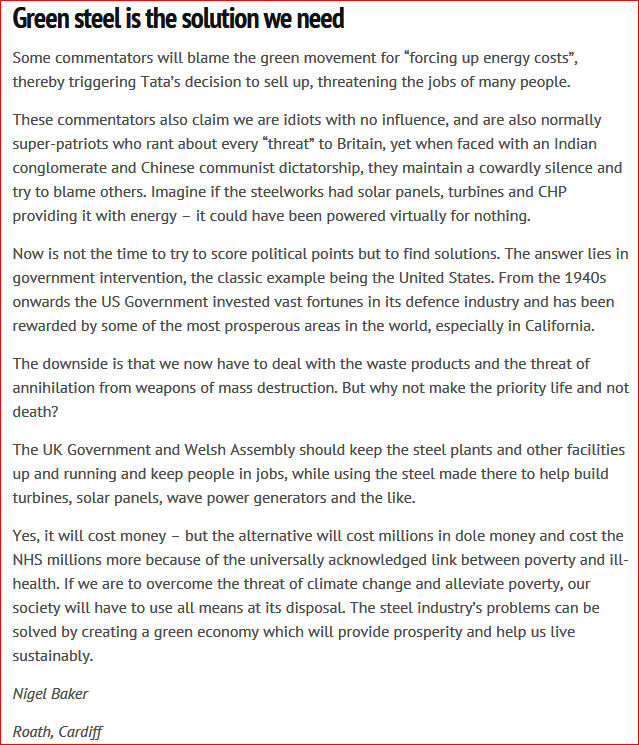
What they can do, apparently, is write stupid letters to the press, such as the one below that appeared in Friday’s Wasting Mule. The writer seems to believe that the Port Talbot steel works can be powered by wind turbines, solar panels and fairy dust.

Then again, it could have been a piss-take, for Friday was April 1st.

Green steel

I issue these rebukes with a heavy heart, fearing that I might lose some of the many friends I’ve made in the Green Party over recent years. Oh yes.

*

UKIP

If any political party is crass and insensitive enough to make cheap political capital out of tens of thousands of people losing their jobs, then of course that party is UKIP.

Not only does the steel crisis give M. Farage et Co the chance to go nuclear on ‘Europe’, it also provides the opportunity to put the boot into Conservatives and Labour, with the cherry on top being the chance to have a go at the Chinese, the Indians, and just about anybody else they can think of.

UKIP will I’m sure argue that this steel crisis thingy would never have happened if everything was still managed by those splendid chaps down the clubhouse. Better decisions are made after six or seven drinks and a few cigars – everyone knows that! Don’t laugh, a lot of people will believe them.

A few months ago UKIP was predicted to win anything up to nine seats in May’s Assembly elections then, more recently, I’ve seen polls suggesting that support is slipping. The steel crisis could put them back to where they were earlier in the year, and the Tory-supporting media transferring the blame onto the EU might even take the UKIP vote in Wales to new heights.

However you cut it, UKIP is the party with most chance of gaining in May’s elections from the steel crisis.

*

SNP

Yes, I know what you’re thinking, but bear with me.

There were a couple of steel plants in Scotland, admittedly much smaller than Port Talbot, that were saved from closure in the past few weeks thanks to decisive action by the Scottish National Party government. Here’s a report from the Guardian.

But this action didn’t please everybody. Here’s a more recent report from the Labour-supporting Daily Record (the Scottish version of the Daily Mirror) telling us that the Labour-controlled Community union is ‘questioning’ the deal.

To explain . . . there are elections in Scotland on May 5th also, and the SNP is almost guaranteed to win by a landslide. So one interpretation of this bizarre intervention by Community is that embittered Labour supporters are prepared to sabotage the Scottish steel deal for short-term political advantage.

Surely Labour wouldn’t do that?

Oh, yes, and remember, the Boy Kinnock was chaperoned on his trip to India by representatives of the same trade union. Whose interests were they looking out for – the steelworkers or the Labour Party?

*

EU Referendum

Speaking of the EU reminds us that on June 23rd we have the referendum on whether to stay in or to leave. The fate of the steel industry is bound to influence the way many people vote, especially in Wales. And seeing as Wales gives us the paradox of many Labour voters reading English Tory newspapers then prolonging the crisis can only help the Brexit cause.

Thinking more obliquely, this realisation that the steel crisis could decide a currently too-close-to-call referendum might prompt the EU into action; and if Cameron is serious about staying in the EU, then he might have to discreetly explain to his Chinese chums that – until the referendum is won – he might need to sound a little ‘hostile’, even agreeing to raise tariffs on Chinese steel imports.

When you consider all the possible ramifications you realise that, serious as the crisis in the steel industry is for those directly – or even indirectly – involved, the closure of Port Talbot and the other plants could have long-term and far-reaching implications that overshadow the loss of jobs.

In many ways Prime Minister Cameron is the one to watch, because with the EU referendum complicating things, him not wanting to be seen as a callous toff, yet having to protect the interests of his mates in the City by not offending the Chinese, the next few weeks could be interesting for those who like to watch nifty footwork.

As the Chinese themselves are reported to say, ‘May you live in interesting times’. (Though some say it’s delivered as a curse, not a blessing.)


An Election and a Referendum

This post examines two important votes being held in 2016; the Welsh Assembly elections on May 9th and the EU referendum on (possibly) June 23rd.

First, we shall look at the elections to our beloved and respected Assembly, wherein may already be found talent dazzling to the point of being a hazard to pilots (not that many of those intrepid aviators will be heading for the local airport) before moving on to consider the anticipated EU referendum

WELSH ASSEMBLY ELECTIONS

At present, Labour has 30 of the 60 seats, and is almost certain to lose a few, the only questions are, which ones, and to which other party or parties will those seats be lost?

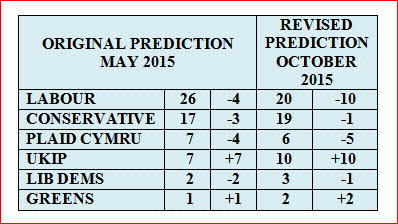
To help you make comparisons I have compiled the table below, which shows each party’s percentage of the vote in 2011 compared with the percentages predicted by the latest available poll. You will note that the figures in the recent poll do not add up to 100, this is almost certainly due to respondents stating their intention to vote for the kind of minor parties that combined to give us the ‘Other’ figure in the 2011 results.

Assembly elections poll

These poll figures look credible for Labour but rather odd for the other parties due to little or no difference between the constituency votes and the regional list votes. Even so, the poll confirms that Labour will be the biggest loser and Ukip the biggest winner.

Though the level of Ukip’s support is rather surprising seeing as the party keeps choosing unknown or unattractive candidates (the one often mutating into the other) and in other ways shooting itself in both feet. It begins to look as if Ukip’s leaders could be filmed sacrificing Romanian migrants on Aberystwyth promenade, bollock naked with their nether regions painted bright green, and still not lose support.

As for the other parties, it’s very much a case of little or no change which will, after almost a year of Tory government at Westminster, be a relief to the Conservatives; an even bigger relief to the Lib Dems following their near-extermination in the last May’s UK elections; but a major disappointment to Plaid Cymru, who should be the main beneficiary of Labour and Lib Dems losing support.

Though looked at from another angle Plaid’s level of support might pleasantly surprise some. Let me explain. The Party of Wales would have us believe that it’s a radical party, offering change, improvement. Yet down in Carmarthenshire, where Plaid became the larger party in a coalition last year (after the ‘Independents’ refused to work with Labour any more), Mark James, the tyrannical and vindictive chief executive, carries on as if nothing has happened!

The other party to be disappointed by the poll findings will be the Green Party of Englandandwales. Despite claimed increases in membership, and Welsh people being spotted in the ranks, it seems that the Greens still have difficulty in attracting support. But then, this is a party so English, so frightfully middle class in its membership and support, that it makes the Tories look like a Welsh proletarian rabble.

As I’ve been predicting for some time now, after the Assembly elections we shall probably see Labour in coalition with Plaid Cymru. Though if by some some electoral miracle Labour can cobble together a coalition with Lib Dems and Greens that leaves Plaid Cymru out in the cold, then Plaid will be condemned to another five years of impotence. A period the party may struggle to survive.

Ukip will do very well. In June last year I predicted the Kippers would gain 7 seats, and in October I upped my estimate to 10. (The latest poll suggests 9.) If, as is now being predicted, the EU referendum is held in June, and that EU campaign overshadows the Assembly elections, then Ukip will be the only beneficiary because all the other parties are pro EU and will be singing the same song.

And here’s a thought to cheer you all up. If the Assembly elections are indeed dominated by the EU referendum debate then it is not inconceivable that Ukip could win seats in ‘volatile’ constituencies that in May will be five- or even six-cornered contests. Gaining a percentage of the vote in the low to middle twenties could do it.

‘Nathan Gill, AM for Ynys Môn’ has a certain ring to it, n’est pas?

Gill of course is currently an MEP, which is a handy link to the next part of this post.

THE EU REFERENDUM

THE BIG PICTURE

When I was young and idealistic, the matinee idol of the nationalist fringe, I considered myself to be quite the ‘European’. With my study of history, my admiration for Charles de Gaulle, being avowedly anti-communist, and after reading The American Challenge, I persuaded myself that a strong Europe was needed as a bulwark against both the USSR and the USA.

I still believe I was right, but the world has moved on. For a start, the Soviet Union is no more, and its demise was the cue for the USA to begin its advance in eastern Europe, first with its war on Serbia and then by gradually encircling Russia with newly signed up members of NATO. Have you ever stopped to think how weird that is?

NATO started life in 1949 as an alliance to deter the Soviet Union from invading western Europe (if indeed the USSR ever had that intention). It was a Cold War organisation, from the era of Dr Strangelove, which should have ceased to exist along with the Soviet Union and the Warsaw Pact, yet NATO has expanded since the Cold War ended. This is bizarre.

Strangelove

Unless of course you understand that the USA (and to a lesser degree, the ‘West’) must have enemies. Now this presents a problem for a country bordered only by friendly and peaceful Canada to the north and to the south by a third world state where the strongest armed forces appear to be those of the drug cartels.

Clearly this lack of a credible threat is an inconvenience to the military-industrial complex, neocons, the National Rifle Association, big corporations, news media, and politicians looking to make a name for themselves. So ‘enemies’ have to found elsewhere, which has resulted in a succession of ‘threats’ being exposed since the Second World War. These are often pantomime villains of dusky hue, with difficult to pronounce names, and living in far-off lands of which most Americans know very little. Plus of course we have the post WWII constant – USSR / Russia.

At this point many of you will be wondering why, in a section headed ‘The EU Referendum’, I’m banging on about NATO and US foreign policy. There are two principle reasons.

First, a single political unit allows the US – as we are now seeing with TTIP – to gain preferential access to the richest market on earth through influencing just a few people. The danger here should be obvious to all. Second, the EU is viewed by many US policy-makers as a sister-body or even an extension of NATO. It’s no coincidence that NATO and the EU have marched east almost hand in hand.

Let me try to explain the NATO-EU link with the table I’ve compiled below. It gives the dates that eastern European countries joined first NATO and then the European Union. And it has always been in that order (sometimes simultaneous), but never is EU membership allowed before joining NATO.

The delay in Albania’s accession to the EU can be explained by the fact that the country is a ramshackle land with large parts, especially the area bordering the Serbian province of Kosovo, controlled by people-smugglers, drug-traffickers, organ-harvesters and a motley assortment of old-fashioned vendetta-pursuing, blood-feuding bandit chiefs. Albania’s chief export is gangsters.

NATO

An exception to the NATO-followed-by-EU rule is of course Turkey, which has been a NATO member since 1952. No surprise then to learn that there have always been voices in the upper reaches of the EU arguing in favour of admitting Turkey. ‘Bridge to the Islamic world’ and other bollocks has been spouted in support of this idiocy. The truth is that the USA wants to reward its faithful ally – and currently chief Bear-baiter – so it periodically applies pressure on the EU to let Turkey join the club.

Turkey, that backward, Islamist state where the security services bomb their own people. Turkey, the country that persecutes its fifteen million Kurds and has a very ambivalent attitude towards ISIL. Turkey, that just a century ago introduced the world to the concept of holocaust with its butchering of the Armenians.

In the ongoing conflict in Syria the USA has encouraged Turkey to provoke Russia, and although the US may belatedly be trying to rein in its proxy, there remains the possibility that this dysfunctional country could start World War Three. If Russia does retaliate to Turkish provocation then we (and here I have to mean the UK), as fellow-members of NATO, are Treaty-bound to line up with Turkey.

How do you feel about going to war with Russia because Turkey has done something stupid and deliberately provocative?

THE VIEW FROM WALES

Leaving aside these wider concerns, what should be our approach to this referendum from a purely Welsh perspective?

‘Wales does well out the EU’ is a mantra trotted out by those urging us to vote to stay in. ‘Does well’ is just a euphemism for hand-outs, we export little. In other words, we get EU grants because we are so bloody poor. Which makes this ‘argument’ just another defence of begging-bowl politics, an acceptance of Wales’ poverty and deprivation.

And what has happened to the billions we’ve received in EU funding? Where are the great infrastructure projects? Where is the multi-skilled workforce we’ve trained? Where are the successful indigenous companies the funding was used to start? Nowhere to be seen, bois bach!

That’s because the greater part of this windfall has been wasted on the shysters and parasites of the Third Sector. Most of whom – unsurprisingly – seem to have Labour Party connections. 

If the UK left the EU then the UK government would have to make up the lost EU funding. If it didn’t, we’d have to go without the Third Sector. (Don’t cry!) And if the UK government didn’t make up the shortfall, then it might cause a few more people here to wake from their slumbers.

Looking further afield, the UK leaving the EU would have far more serious repercussions for England, more specifically south east England, and to be very, very specific, the City of London. Because if the UK left the EU then many of the banks, investment houses and other financial institutions would decamp for Frankfurt, Paris, Zurich, Berlin, etc.

This would result in tens of thousands of very well paid jobs being lost to London, and a few hundred thousand more would be lost in a knock-on effect. So just spare a thought for all those Lamborghini salesmen, tailors, high-class hookers, hairdressers, tattooists, coke suppliers, estate agents, jewellers, etc., etc.

eu_logo

Remove the City of London from the balance sheet and the economy of England heads south very fast. With the City of London creating less wealth the UK economy must suffer, and despite the malaise being centred on London we can be sure that – as ever – the Old Etonians will see to it that peripheral areas suffer most.

This should serve as another wake-up call to the slumberers who unquestioningly believe that London rule is best for Wales.

Another argument used is that we must vote to stay in the EU to prove how different we are to England (assuming the English vote to leave). A position that invariably cites the fact that Scotland will definitely vote to stay in. Let’s look at this argument in a bit more detail.

First, Wales is not Scotland. The obvious stated, let me add that many hundreds of thousands of Scots will vote to stay in the EU for reasons that have little or nothing to do with the EU itself. It’s all about promoting independence, hoping that England – or Englandandwales – votes for Brexit.

Should there be a vote south of the border to leave the EU, and should that decision lead to Scottish independence, then it will reverberate here no matter how Wales voted. Scottish independence will concentrate minds in Wales no matter how it comes about and will make redundant whatever views may have been held in Wales when Scottish independence was just a vague possibility.

So let me spell it out. How Wales votes in the EU referendum is almost unimportant. The vote is being hyped up in Wales by those posturers who like to regard themselves as ‘progressive’, and done in order to show how superior they are to the ‘xenophobes’ who want to leave the wonderful EU. Smug, precious, and self-deluding bollocks!

CONCLUSION

There is no party standing in the Assembly elections for which a nationalist can honestly vote. That being so, there is an argument to be made for voting for any party that might help weaken the regional socialist party that for decades now has done so much damage to the Welsh cause.

Personally, I probably won’t bother voting. There’s a temptation to toddle along to the polling station and scribble ‘None of the above’ on my ballot paper, but that’s always struck me as a bit desperate unless part of an organised campaign.

When it comes to the EU referendum I shall definitely vote to leave the EU. That’s because the EU we know today is a great disappointment for someone of my age who genuinely wanted to see a strong and democratic Europe play a leading role in the world.

Instead, we have a byzantine nightmare that I suspect no one properly understands, a monster created by bureaucrats that seems to have been subverted to serve US economic and strategic interests rather than working for the good of Europeans.

And yet, I could still be converted to a united Europe, a European army, a European diplomatic corps . . . but my Europe would need leaders of stature, not the anonymous, paper-shuffling committeemen we are cursed with today.

If only the General would come back . . .

The ‘Care’ Racket in Wales

Let me make it clear at the outset what kind of ‘care’ I’m talking about. This is not the ‘care’ that involves helping old dears out of bed, making them breakfast, and listening – yet again – to how Uncle Arthur single-handedly won the Boer War. No, this is an entirely different kind of ‘caring’, one that most people are only vaguely aware of.

In addition, this post pulls together a few threads that might otherwise be left as loose ends. For example, in my enquiries into the housing associations operating in the south west I’ve come across puzzling references to the ‘Ceredigion Care Society’ or the ‘Pembrokeshire Care Society’, as you might expect, these references provided an incentive to make further enquiries,

Then there was the reliable source who told me last year about young tearaways turning up in Cardigan, with families in tow, being placed in temporary accommodation before moving on to something more permanent, provided by housing associations or private landlords. Few if any of these arrivals seemed to have pre-existing connections to Ceredigion, or to any other part of Wales.

Finally we have the housing crisis in Aberystwyth I referred to in this recent post. No, this is not a housing shortage, this is the exact opposite: student flats built at the very time the number of students applying to Aberystwyth University went into sharp decline, coupled with houses of multiple occupation in the town – many owned by men of fraternal tendencies – standing empty or under-occupied for the same lack of bright-eyed young things thirsting for knowledge.

*

Perhaps the best way to start would be with a list of the various bodies using the ‘Care’ label that have operated in Pembrokeshire, Ceredigion and Carmarthenshire in recent decades, some now defunct and one in the process of being wound up. After the name (containing link to website) you’ll see their Charity Commission number (with link to relevant CC page); date they were formed (and, where applicable, wound up); their company number (if applicable, also with link) and the date of Incorporation; finally, a link to the most recent available accounts.

  • The Dyfed Care Society, 506768, 22.09.1977 – 09.03.2000.
  • The Carmarthen Care Society, 508420, 05.02.1979 – 25.10.2001.
  • The Pembrokeshire Care Society (1), 508848, 18.06.1979 – 16.12.1996. 

The Cardiganshire / Ceredigion operation was clearly the earliest and its original remit was:

“1. The relief of poverty, the relief of sickness and the advancement of education and training amongst: A) Persons who have suffered a legal restriction on their liberty in the community, or any penal establishment or institution B) The families and descendants of such persons described in A) above C) Persons in need, hardship or distress.

2. The advancement of public education concerning all aspects of crime prevention.”

The Dyfed, Carmarthen and original Pembrokeshire societies used almost exactly the same wording. Telling us they were linked bodies helping ex-criminals . . . of whom there must be hundreds every year returning to the mean streets and gang life of Ystrad Meurig, Marloes and Ponterwyd.

Though I’m intrigued by the use of the word “descendants”. Does this mean that you could have demanded help if your great-great-great-great-grandfather was imprisoned for stealing a loaf of bread? I also love the term “Persons who have suffered a legal restriction on their liberty”, there are just so many euphemisms for being banged up.

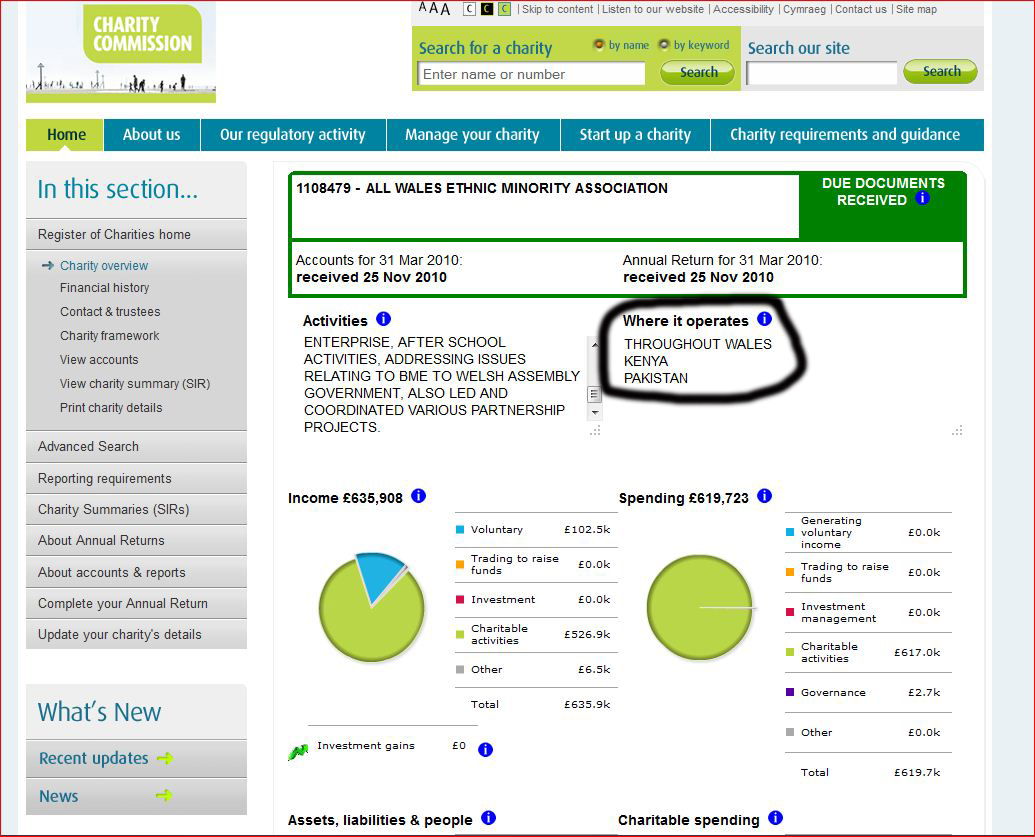
The Constitution for the Ceredigion Care Society seems to have been changed (24.09.1999) and under ‘Activities’ on its Charity Commission page it now says, “PROVIDES HUMAN RESOURCES PROVIDES HOUSING SUPPORT PROVIDE INCREASED HOUSING OPTIONS TO THOSE THREATENED WITH HOMELESSNESS ADVOCACY”. I don’t know whether this is just unpunctuated or an attempt at shouted stream of consciousness. Either way, this change of emphasis brings it into line with the Pembrokeshire Care Society. The concern is no longer for ex-cons but the ‘homeless’ and others it can be claimed are in need of accommodation.

As I’ve said, the Ceredigion Care Society is currently being wound up in favour of  Cymdeithas Gofal The Care Society. Though this successor body is no longer restricted to Ceredigion as it claims to be operating in Carmarthenshire, Pembrokeshire, Ceredigion and even Powys.

*

As you will have noticed above, the Pembrokeshire Care Society and Cymdeithas Gofal are also limited companies, with the trustees serving as directors. The Pembrokeshire outfit is headquartered in Haverfordwest, conveniently near to Pembrokeshire Housing. Here’s a link to the most recent Annual Return received by Companies House, listing the eight current directors. (While the Companies House form offers the option of giving Welsh as one’s nationality, all describe themselves as ‘British’.)

And here’s the latest Annual Return for Cymdeithas Gofal, based at 18 Chalybeate Street in Aberystwyth, but also owning or leasing 26 Cambrian Street (night shelter) and 21 Terrace Road. (The situation at Cymdeithas Gofal is not much better, with a distinctly English-looking board saved by what could be seen as a token Welshman in the form of Y Parchedig Cen Llwyd.)

And here are the most recent accounts. For Cymdeithas Gofal and Pembrokeshire Care Society. So what do they tell us? Let’s look at Pembrokeshire first. With charity accounts I tend to cut to the chase to see a) where the money comes from, and b) where it goes.

We see that £308,279 came from the ‘Supporting People Programme‘ administered by the ‘Welsh’ Government. It’s worth remembering that ‘vulnerable people’ as used in this context can mean “persons who have suffered a legal restriction on their liberty”, drug addicts, alcoholics, those who find themselves ‘homeless’ after being evicted from their previous home, and others you might not want as neighbours.

Update 22:48: I am indebted to Jacqui Thompson for guiding me to this report on the shambles in administering the Supporting People grant in neighbouring Carmarthenshire.

The other major source of income – accounting for £224,020 – is listed as “Advice, Pathway Letting & Bond Scheme”, which was new to me. However, I soon found Pathway Lettings . . . “Part of Pembrokeshire Care Society”!

Pathway Lettings

Seeing as this is ‘Welsh’ Government funding the next stop was obviously the website for that shower, where I found no reference to Pathway Lettings. Which was all very confusing until I scrolled further down in the accounts and found (top of page 15) a reference to ‘WG PATH’, clearly a reference to something, again linking to the ‘Welsh’ Government, but what, exactly?

PATH

Googling ‘PATH homelessness’ took me first across the Atlantic, where it is the acronym for Projects for Assistance in Transition from Homelessness, a federal programme designed to help those who are homeless and suffer severe mental issues. This seemed to fit the bill, but to confuse the picture the Pembrokeshire Care Society has in the past been known by the acronyms PASH and PATH, explained in the panel below.

Pembrokeshire Path

So what exactly is Pembrokeshire Action for The (sic) Homeless? Googling the name takes us straight to the Pembrokeshire Care Society. So despite the hype about a ‘forum’ it’s little more than another name for the Pembrokeshire Care Society.

Then it struck me that much of the funding involved here could be in the form of the “Bond Scheme” referred to, and sure enough, under the ‘Services‘ tab on the Pembrokeshire Care website I found this.

Bond certificate

And on the Pathway Lettings Home page you’ll find this, which at least acknowledges the support of the ‘Welsh’ Government.

Pembrokeshire bond scheme

All of which poses a number of questions:

  • How much homelessness is there in Pembrokeshire to justify this funding?
  • Are there figures available on homelessness in Pembrokeshire from a body independent of the Pembrokeshire Care Society?
  • Isn’t there an incentive for organisations being funded to combat homeless (or anything else) to exaggerate the scale of the problem in order to secure more funding?
  • In pursuit of that objective an obvious route to more funding is to ‘import’ homeless people from outside of Wales. Were this to be happening, what response – if any – could we expect from the ‘Welsh’ Government?
  • Why is the ‘Welsh’ Government giving funding to a “Social Lettings Agency”, Pathway Lettings, rather than to the Pembrokeshire Care Society? Is it to disguise the ultimate destination of the money? If not, why are we paying for an extra and unnecessary layer of bureaucracy? Or is the ‘Welsh’ Government funding the Pembrokeshire Care Society’s empire building?
  • Why can’t we have a body independent of the ‘Welsh’ Government and the Notional Assembly to monitor how public funding is spent in Wales?

Just one final thing that caught my eye in the Pembrokeshire Care Society accounts, under the heading ‘Designated Funds’ (page 19), was the figure of £100,000 for ‘Senior Management Succession Planning’. What the hell is that about!

Reassuring, I suppose, in that it suggests that if there’s that much money available for such a purpose then the homelessness situation in Pembrokeshire can’t be that bad.

*

Moving on now to the accounts for the ever-expanding Cymdeithas Gofal The Care Society. As with Pembrokeshire Care, we see that over half of the money received is spent on salaries and pensions, a reminder that charities like this provide good jobs for those ‘on the inside’ and those they know.

The Cymdeithas Gofal accounts were certainly easier to follow than the Pembrokeshire Care accounts, and different in many ways. For example, the Bond Scheme accounts for only a very small proportion of the income and I was initially surprised to see no reference to the Supporting People Programme that is Pembrokeshire Care’s most valuable source of income. (I also found it odd, five years after the 2011 referendum, to see Cymdeithas Gofal, despite its Welsh pretensions, still referring to the ‘Welsh Assembly Government’.)

Then I saw the entry ‘Ceredigion County Council – supporting’. I went to the council website for confirmation. So why is this funding administered on behalf of the ‘Welsh’ Government by the local authority in Ceredigion but given direct to the charity in Pembrokeshire?

Cymdeitas Gofal Incoming Resources

In fairness, Cymdeithas Gofal does raise some of its own money. Of its total income of £1,152,457 for y/e 31.03.2015, as shown in the panel below (from page 12 of the accounts) £427,898 is not in the form of direct grant funding. After the various grants, totalling £724,559, the most rewarding income stream is ‘Rents receivable’. This is, presumably, rents received for accommodation in the buildings Cymdeithas Gofal has bought, with public funding? If so, who holds the deeds on these properties, and if they aren’t in public ownership, shouldn’t they be?

Cymdeithas Gofal Incoming Total

One major source of funding we did not encounter in Pembrokeshire is the £175,408 ‘Welsh Assembly Government S180 Night Shelter Funding. (This page provides a link to further information on S180.) As I’ve mentioned above, this night shelter is at 26 Cambrian Street. Though if it’s been running since 2002 – as this clip from the Cambrian News tells us – why did the ‘Welsh’ Government need to dish out 175 grand last year, which may be more than a terraced house in the centre of Aber’ is even worth?

On the plus side, there is no six-figure sum allocated by Cymdeithas Gofal for ‘Senior Management Succession Planning’. So that’s something to be thankful for, eh?

My original thought when I approached this subject was that Cymdeithas Gofal was gradually taking over the south west, and that Pembrokeshire Care would be the next to go. But the more I’ve learnt about their relationship I now see something more  subtle and complex at work. Maybe I watch too many Mafia movies and TV series, but it looks like the rackets have been carved up in a way that satisfies both parties. (‘Yous can have construction an’ we’ll take da Teamsters. Capice?)

*

Many of these Care societies’ clients of course move on to become tenants of the local housing associations, to justify more funding for housing associations, which clears up one loose end. Then there’s the young tearaways from God knows where turning up at some kind of ‘halfway house’ in Aberteifi, a border town where both organisations operate and where Cymdeithas Gofal has a £34,000 a year ‘Young Persons Project’. Finally, the housing problem in Aberystwyth, well, just think about, those empty student flats have to be filled somehow. See how it all fits neatly together!

The growth of the Third Sector in Wales was inevitable given that the only political parties (other than the Lib Dems) that have ever been in power down Cardiff docks are statist, anti-business parties. These parties – Labour and Plaid Cymru – are devoid of ideas when it comes to creating wealth, but their imagination knows no bounds when it comes to spending money. With this hostility to ‘nasty’ business comes the inevitable impulse to help those they view as the victims of a heartless capitalist system.

This ‘Throwing money around like a drunken sailor’, as my mamgu used to say (no offence intended to partying mariners), has been brought home to us this week with two cases that saw tens of millions of pounds of public money needlessly expended or lost. The first being the land deal on the outskirts of Cardiff and the other the purchase of Cardiff airport. Though in defence of the ‘Welsh’ Government let me state that the figures involved here are peanuts compared to what has been wasted in Cardiff since the dawn of devolution.

Cymdeith Gofal Objectives

The waste of public funding we have seen in Wales since 1999 could not have happened if the sham devolution we suffer had not brought together an unholy triumvirate to work against Welsh interests.

First we have the aforementioned politicians of the Left, believing that ‘helping those in need’ (even if they’ve been dumped on you) is the right thing to do; then we have the politicians of the Right, who will oppose anything that might disadvantage England, unconcerned that their position invariably disadvantages Wales; and finally, we have civil servants answering to London but ostensibly serving as ‘advisers’ to ‘Welsh’ Government ministers. (Though it should be understood that many politicians on the Left will also adopt an anti-Welsh position, and defend it by arguing that to do otherwise would be ‘narrow’, ‘insular’, ‘nationalistic’ or ‘racist’.)

The only way to change this is to reject all of the existing parties because none of them has either the capability or the will to curb the wasting of hundreds of millions of pounds every year on professional grant-grabbers – most of whom seem to originate outside of Wales – who exaggerate or import problems in order to keep themselves in cosy, well-pensioned jobs funded entirely by the Welsh public purse.

Wales needs a political revolution to overthrow the fools who fund the shysters and those who turn a blind eye because this system damages a country for which they have no real love, a country whose integration with England they will not oppose. Our country.

Drugaid – Another Councillor Lost? – Sophie Howe – Captain Cardiff – Profound Thoughts While Lying Abed Flicking Bogies

HOOKED ON FUNDING

Drugs is big business, as this recent case reminded us, and drugs generates lots of money for people other than drug dealers. Even the UK government has acknowledged that drug dealers buy cars, houses, boats, bling, foreign holidays, etc., etc. On top of that, the so-called ‘War on Drugs’ keeps cops, lawyers and prisons in business. And as if that wasn’t enough, we then have all those who’ve found jobs ‘helping’ drug addicts.

There must now be thousands of agencies, large and small, operating locally, at Wales level, UK level, which often overlap and duplicate each other’s work and, in total, receive billions of pounds in funding from various sources. The only losers in this situation are of course the drug addicts – but ‘it’s their own fault anyway’. A strange attitude to take towards those who keep this ship afloat.

Of course, the only other blot on this landscape of economic win-win is that those involved in manufacturing, importing and distributing drugs tend to keep their assets offshore, or under granny’s mattress, and therefore pay no tax. But since when have such practices ever troubled UK politicians, of any party?

If you wanted to be utterly cynical, you could argue that there are now so many people dependent on the drugs trade that if the ‘War on Drugs’ was, by some fluke, won, then it might have a seriously detrimental effect on the UK economy.

Drugaid

I am indebted to Brychan for reminding us that among the big players in Wales in the ‘helping drug addicts’ racket is The South Wales Association For Prevention Of Addiction Ltd (Charity No 265008), more usually known as Drugaid. Its four trustees are Professor Neil Frude, Miss Sylvia Diana Scarf, Mr William George David Smith and Mrs Linda Hodgson. As well Prof Frudeas being trustees of the charity these four are also the only directors of the cash-rich Newport-based company of the same name (No 01073381).

Professor Frude appears to be a somewhat unorthodox psychologist and one-time stand-up comedian, who runs the Happiness Consultancy in Berkshire. He is also an external professor at the University of South Wales and has some connection with Cardiff University. Though his main income is said to be from his work for BUPA, which no doubt contributes greatly to Frude’s personal happiness.

Miss Sylvia Diana Scarf is a retired lady of 79, who may live in Newport, or she may live in Oxford. I’m told that she recently got an OBE for her work with the Girl Guides. (When I tried to ‘work’ with Girl Guides during my Sea Scouts days all I ever got was ‘Get lost, you dirty sod’!) Miss Scarf is also said to be ‘big’ in the Anglican Church. When I read that it made me think of John Major’s old ladies cycling to Evensong after a skinfull of warm beer. Ah!

William George David Smith seems to be a chartered accountant in Cardiff and Linda Hodgson may, or may not, live in Porth, in the Rhondda. The contact and director for Drugaid is a Caroline Phipps from God knows where but currently domiciled in Caerffili. All in all, a typical ‘Welsh’ Third Sector outfit, made up of willing locals and those who can sniff out easy money from 500 miles away.

Drugaid first saw the light of day in Cardiff, in 1972, brought into this cruel world by the Reverend Peter Keward, and christened South Wales Action to Prevent Addiction (SWAPA). Since when it seems to have moved to Newport and concentrated its activities in the central and eastern Valleys, even into prosperous Monmouthshire. And despite what the outdated ‘About Us’ page says, Drugaid is also spreading west, yea unto Pembrokeshire and Ceredigion. In fact, the organisation now covers the whole of the south, from the border to the Irish Sea . . . apart from Cardiff and Swansea Bay, perhaps having been warned off the two main cities.

In figures submitted to the Charity Commission Drugaid had income for the year ended March 30, 2014 of £2,727,668 and expenditure of £2,789,439. It had 78 employees and 30 volunteers, so we are dealing here with a sizeable operation, and it’s still growing, currently advertising to fill 8 vacancies. (Here in screen capture.)

What does Drugaid actually do?

This is the tricky bit. Drugaid seems to work with ‘partner’ bodies, these include GPs, health services, various other Third Sector bodies, and the ‘National’ Probation Service (for Englandandwales). The latest available accounts show that these ‘partners’ (excluding local health boards and councils) put £1.74m into the Drugaid pot y/e 31.03.2014, with a further £606,397 coming from our wonderful ‘Welsh’ Government. So where does it go?

Drugaid income

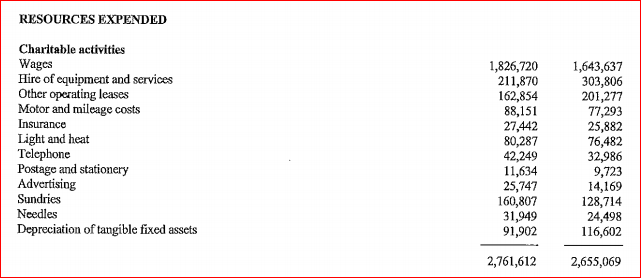
Well, £1.83m went on wages and salaries, then there was ‘Hire of equipment and services’ (£211,870), ‘Motor and mileage costs’ (£88,151), ‘Light and heat’ (£80,287), ‘Telephone’ (£42,249), ‘Other operating leases’ (£162,854), ‘Sundries’ (£160,807), ‘Depreciation’ (£91,902), etc., etc. Apart from ‘Needles’ (£31,949), it’s difficult to identify any direct spending on those the charity is supposed to be helping, but let’s remember, this is a major employer, pushing towards 100 employees. (The two columns show y/e 31.03.2014 on the left, 2013 on the right.)

Drugaid spending

If one wished to be unkind it would easy to dismiss Drugaid as yet another charity where almost all the funding goes on salaries and administrative costs. A grotesquely bloated organisation, currently expanding beyond its ability to cope with this expansion and, as a result, not achieving a lot. Hardly surprising perhaps for a charity overseen by a stand-up comic.

I say that because in searching the Drugaid website I could find nothing boasting of ‘outcomes’, that word so beloved of Third Sector organisations, used in describing successes, numbers of ‘clients’ helped. Then my hopes soared as I saw ‘Drugaid Annual Review‘ . . . but the last one was posted in 2011! How is anyone – funders, for example – supposed to know whether Drugaid is actually doing any good? Or is Drugaid just part of some Third Sector merry-go-round where ‘cases’ get moved on from one agency to another with each agency taking its cut?

Drugaid gobbledegook

Another indicator that all may not be well is something else I found on the website, an invitation to tender, worded thus: “Drugaid is currently reviewing the provision of Supervision to our employees.  Following feedback from staff, a review of our Supervision Policy and research into best practice in Supervision, Drugaid has decided to redefine the supervision that is offered to all staff to provide a more inclusive, productive and efficient means of providing this vital support to all who work for us.”

Oh sorry, the closing date for that tender was 20th of February 2013!!! This is getting worrying. If the website is anything to go by, Drugaid is in one hell of a mess – but remember, this is an organisation that’s still expanding! Here’s a screen capture of the 2013 invitation to tender, because I guarantee it won’t be on the website much longer.

What else do we know?

I’ve already mentioned that in addition to the charity there is also a private company, limited by guarantee, with the same directors as are trustees of the charity. The company has a net worth of £1.1m, and £1.2m in cash.

Having also mentioned the situations currently vacant, it may be worthwhile focusing on one of these, the job in Merthyr catering for veterans. This caught Brychan’s eye due to a difference in legislation between Wales and England. Here in Wales, the Homeless Persons (Priority Need) (Wales) Order 2001 specifies that anyone who finds himself / herself homeless after leaving the armed forces is categorised as a priority for social housing. The Homelessness Act 2002, which applies to England only, allows local authorities there to reject applicants on the grounds of ‘no local connection’.

Given what we already know about the operations of the Third Sector and social housing bodies, and how lax legislation allows – even encourages – the importation of ‘clients’ from England, it demands no great leap of the imagination to envision Drugaid bringing in English ex-service personnel with drugs problems. Does this go some way to account for the recent expansion, both in personnel numbers and geographical reach?

Whatever Drugaid is doing, or supposed to be doing, it doesn’t seem to do it well. Nowhere does it give figures for those it has helped, as a result there seems to be no way whatsoever of gauging its success.  The percentage of its income spent on salaries and administrative charges is ludicrous, and should be unacceptable to its funders. The website, Drugaid’s window to the world, is an absolute shambles, full of gibberish and out-of-date pages. There has been no Yearly Review posted since that for 2011. How the hell can an organisation in such a state be allowed, even encouraged, to expand?

Finally, and being guided by the latest accounts, it’s difficult to escape the conclusion that Drugaid is no more than a glorified needle exchange. As such, it does not deserve the excessive funding it receives. It is surely time for partners and funders to review their support for Drugaid.

*

NEIL WOOLLARD, ANOTHER UPLANDS COUNCILLOR GONE MISSING?

Following on the recent news of the departure from Swansea of Uplands councillor John Charles ‘John Boy’ Bayliss, which itself followed on the departure last year of his friend Pearleen Sangha, I now hear that another Labour councillor from that ward may have disappeared.Phil Tanner

The name I’m hearing is Neil Woollard, an interesting character, Woollard, for in addition to his day job, and his council work, Neil and some friends are the Rag Foundation, a popular folk ensemble. The group’s repertoire draws heavily on the songs of Gower folk singer Phil Tanner (1862 – 1950), a man whose life covered the ending of south Gower’s ‘island’ status, those centuries when it had more in common with Somerset than with north Gower. I’ve even read somewhere that Woollard is Tanner’s grandson, but to my knowledge Tanner had no children, certainly none are recorded.

What I’m hearing is that Woollard is employed by ‘a company involved with the Swansea tidal lagoon’, yet for some reason this means that he now lives in the Cardiff area. Though this might not be as odd as it sounds, for the company behind the lagoon is based in Gloucester, so maybe he’s chosen to live somewhere roughly half way between Swansea and Gloucester. But I’m only guessing. My source is however adamant that Woollard now lives somewhere in the Cardiff area.

While Woollard’s attendance record at council meetings has not taken the dramatic turn for the worse we saw with Bayliss (and why should it, for Bayliss is further away, in Bristol), there has still been a marked decline. In the period 14.05.2015 – 06.11.2015 his attendance record was 30%, but for the six-month period before that it was 60%.

So the question on Woollard is roughly the same as I asked for Bayliss.Is he still able to properly discharge his duties as councillor for the Uplands ward in Swansea? If not, then there must be a by-election, not another lengthy period – as we saw with Sangha – of the Labour Party staying schtum or, when pressed, maintaining that he’s still, ‘livin’ down by ‘ere, mun’ and that nothing has changed.

Dylan Thomas’s old neighbourhood is now an area of flats and houses of multiple occupation, with a largely transient population of students and drifters, but that is no reason for this transient and footloose lifestyle to extend to the Labour councillors elected to represent the ward.

UPDATE 19:25: I am now informed by one of my alert readers that Woollard is actually working on the proposed Cardiff tidal lagoon, as Head of Local Engagement. The Cardiff Tidal Lagoon bio blurb makes it clear why Woollard was recruited – his contacts within the Labour Party.

Neil Woollard Tidal Lagoon

Strangely, or perhaps not, there is no mention that Woollard is a Swansea councillor. What do the rules say about elected councillors canvassing other councillors, AMs and ministers on behalf of a private company? And how should people back in Swansea feel about one of their councillors working on what could be viewed as a rival project to the Swansea tidal lagoon? Serious questions here for Woollard and Labour.

*

SOPHIE HOWE, MORE LABOUR CRONYISM

Earlier this year I wrote about Sophie Howe, the Deputy Police and Crime Commissioner for South Wales. Well now her Labour cronies have given her another well-paid job, this time as Future Generations Commissioner, a flim-flam post created, it would appear, for no better reason than to pander to the Green lobby . . . and of course to create another cushy number for one of the insiderest of Labour insiders.

Howe is the daughter of a Labour councillor, who herself became a councillor at 22, she also worked as a Research / Casework Assistant for both Julie Morgan MP and Sue Essex AM, before moving up to do similar work for Julie Morgan’s husband and First Minister Rhodri Morgan, and then his successor in that post Carwyn Jones, before most recently becoming No 2 to former Labour MP Alun Michael in February 2013, after he became the PCC. She was hoping to find a safe seat for the May General Election, but failed, so this post could be viewed as a consolation prize. But I have no doubt that a safe seat will be found for her before 2020, so no one should expect her to see out the ‘seven-year term’ of this job.

Her father, Peter Howe, followed her into the office of Julie Morgan to, eventually, become office manager. A correspondent insists that Howe was a bully, a failing overlooked by his adoring daughter who was otherwise so interested in protecting women from male bullying. Though in this instance the suggested ‘trigger’ might have been jealousy, as the woman being bullied had been selected to stand for Cardiff City Council . . . whereas Peter Howe had been overlooked.

Sophie Howe

Reactions to the appointment varied. Tory leader Andrew R T Davies did his ‘Confused but Mildly Outraged of Cowbridge’ act while others were less charitable. Among them a rising star within Plaid Cymru, councillor Neil McEvoy. On a lighter note, Llanelli Plaid Cymru councillor Ruth Price made a Sharon Stone comment which unfortunately allowed Howe’s defenders to focus on this merry quip rather than on the appointment itself.

Howe’s boss, PCC Alun Michael, went into full feigned outrage mode and was quoted as saying, ‘There is no place for comments of this sort in a civilised society and it is particularly unacceptable in Wales.” What utter bollocks. A civilised society is judged by far, far more important things than an off-the-cuff remark like this. Among them, openness in public appointments. You sanctimonious little prick!

For her pains Ruth Price also took stick from her own party, including a Twitter DM from Llanelli Assembly candidate Helen Mary Jones. In fact, among Plaid’s big-wigs there seemed to be considerably more support for Sophie Howe than opposition. It even seemed to be decided by an individual’s attitudes to a Plaid coalition with Labour next year. Here’s what Plaid Cymru regional AM Jocelyn Davies tweeted almost as soon as the announcement was made public.

Jocelyn Davies tweet

Well, well, there was me thinking that this Sophie Howe appointment was about Labour cronyism corrupting the public and political life of Wales, a reminder that Wales is a one-party state, but no! – it’s a wimmin issue. And everything’s OK cos our Sophie is “a strong woman”. Is Jocelyn Davies standing again next year?

Using this rationale, perhaps it would have been acceptable for a misogynist communist to have sent Hitler a telegram in 1933, saying, ‘Good to see a strong man in charge, Mein Fuhrer‘ . . . before he was dragged off to the concentration camp.

It’s said that Sophie Howe is a lawyer, if so, she’s never used that training for anything other than political purposes. Every job she’s ever done has either been working directly for the Labour Party, or else was gained through her Labour Party connections. Consequently, there is no way of gauging this woman’s real ability because there has never been any politically impartial assessment. She should never have been appointed Future Generations Commissioner.

*

SAM WARBURTON, CAPTAIN CARDIFF

The Rugby World Cup circus has departed, the ball has gone from the castle wall, and despite all the hype and expectation, we didn’t win the bloody thing, again. Yes, I know, we had lots of injuries, and biased refs (no, sorry, that was Scotland), but what struck me was that even when it was all over the ‘Welsh’ media couldn’t stop being . . . well, the Cardiff media.

Soon after the Final final whistle two of Wales’ great rugby pundits weighed in in the Wasting Mule to tell us that Sam Warburton, the Wales captain, is the best player we’ve got, and the only one who’d make it into the World XV to take on the tourists from Mars. First, on October 29th, it was former Wales captain Gwyn Jones, and a few days later, on November 1st, it was the turn of rugby correspondent Andy Howell.

Don’t get me wrong, Sam Warburton is a fine player, it’s just that the Cardiff media is besotted with him. Sometimes it’s possible to pick up the Llais y Sais and find him on the front page, a few of the sports pages, and a couple of inside pages. It’s bizarre, because it’s quite obvious that on the field of play – and I suspect in training and elsewhere – the national team is actually led by Alun Wyn Jones and Dan Biggar. Whereas Warburton, on the field, is almost silent, and certainly no captain. So is it a ceremonial role?

This adoration of Sam Warburton does not extend beyond Wales, or perhaps beyond Cardiff. Shown by another report I picked up around the same time, sandwiched between the two I’ve quoted, this being the six-player shortlist for the Rugby World Player of the Year. Who do we see on the shortlist – Sam Warburton, surely? No, the only Welshman there is Alun Wyn Jones. Suggesting that people outside of Wales have a better perspective on Welsh rugby than many inside Wales.Dan Biggar

This corrupted view of various players’ qualities is due to the fact that the Wasting Mule, and to a lesser degree the BBC and ITV, see a great part of their role in being to promote the city of Cardiff, and anyone or anything that can in turn be used to promote Cardiff. This can not be done with Biggar or Jones because both come from Swansea, which is the worst of all possible alternatives. So it has to be wall-to-wall Warburton.

Of course it was the Welsh Rugby Union not the media that made Warburton captain, and there’s little doubt in my mind that Warburton regarding himself as British rather than Welsh makes him the perfect captain for hard-line Unionists like WRU Chairman David Pickering, for whom Wales flickers into life only on the rugby field. A kind of sporting Brigadoon.

Why Wales coach Warren Gatland falls into line with this nonsense is no great mystery. He knows Alun Wyn will sing the anthem lustily enough for both himself and Warburton, and put himself about for the full 80 minutes; he also knows that Biggar will cajole and inspire his team-mates for as long as he’s left on, so if it keeps the WRU suits and the Cardiff media happy why not play along with the charade of a figurehead captain?

*

WHERE WOULD THEY BE WITHOUT US?

Lying in bed the other morning, picking my nose and flicking bogies around the yet-dark room, I got to thinking about devolution, as you do when engaged in activity so conducive to deep, analytical thought.

It occurred to me that devolution, coupled with EU poverty funding, higher education, local government and other fields, have created in Wales tens of thousands of jobs in management roles for English administrators and others of moderate or even dubious ability who would struggle to land jobs offering anything like the same salaries and pension benefits in the private sector.

I’m thinking here of civil servants attached to the ‘Welsh’ Government and its various agencies, so many of the officers in our twenty-two local authorities, those innumerable managers in our seven health boards (plus the hospitals, clinics, centres, etc), housing associations beyond counting, third-rate academics in a higher education sector that ceased serving Welsh needs almost half a century ago, third sector organisations and other bodies too numerous to mention that have either come into existence since devolution or else have set up a ‘Welsh’ presence by transferring in staff.

Looking at it this way, devolution has been of more benefit to perhaps 30,000 members of England’s middle class than it has to 2.5 million Welsh. And most of this generosity is paid for out the Welsh public purse. But hey! that’s how colonialism operates.

Happy Donkey Hill 2

In the previous post I wrote about Faerdre Fach farm near Llandysul, the reason for my interest being that the owner, Kate Clamp, had re-named it Happy Donkey Hill, a reference to the donkeys and other animals housed there. That, really, was about all I wanted to say, but comments made by Mrs Clamp persuaded me to persist with this story.

As I pointed out in that earlier post, Mrs Clamp had run a similar enterprise in north east England before delighting us with her presence. This was the Ramshaw Rescue Centre at Low Garth Farm near Bishop Auckland. The report I’ve linked to, from October 2008, says that, Happy%20Donkey%20Hilldue to a neck injury, Mrs Clamp was selling Low Garth Farm, with an asking price of £895,000.

The next reference I found to the Ramshaw Rescue Centre was in this report from December 2010. In it, the Centre’s former kennel manager talks of raising money to buy and re-open the Centre, and is quoted as saying, “The rescue centre, when it was open, was good, but not brilliant – and I want to bring it back and restore and improve its image”. The implication is clear: when run by Mrs Clamp the Ramshaw Rescue Centre did not enjoy a good image.

Whatever the truth of that, we know that in late 2008 she was telling the Northern Echo that a neck injury was forcing her to give up the animal rescue centre at Low Garth Farm. Yet within months we find her in Wales, running exactly the same kind of operation, almost certainly with the same animals. We can safely conclude that her ‘injury’ was imaginary, and so there must have been another reason or reasons for her leaving Low Garth Farm.

*

To my surprise, Kate Clamp made a few comments to my earlier post. You can of course read them for yourself, but I think some of her bon mots are worth extracting to use here.

In her first comment she tells us that she has now bought an “adjoining 31 acres” and, presumably, expects to be commended. Though as I point out, all this means is that yet more of Wales is in foreign ownership. In her next comment she says that my response was, “A very insular and very Welsh response . . . funny how all the successful businesses locally are run by non-Welsh, we spent in excess of £250,000 developing a derelict farm steading and mostly due to unreliable contractors locally used English workmen”.

Kate Clamp comment 2

I asked her to explain how my response was “insular” and “Welsh”, but she did not answer. Just as well perhaps, for she obviously has a very low opinion of us Welsh, and is not shy to express that opinion – we are no good at business, we are lazy workers . . . yet Wales is beautiful and we should be glad to live here (but leave the business of running the country to people like her). This is about as close as you’ll get to hearing someone actually say: ‘Wales is a lovely country . . . pity about the Welsh’.

In her final remarks directed at me (see comments to previous post), and after informing us that, “we” still own Low Garth Farm, she writes, “I am very proud of what we have achieved both in Wales and in England, I have created 2 remarkable businesses from nothing, what is your contribution?”

*

Then, late last night, whilst sipping my Ovaltine, I received a Twitter DM. A curious message, but from a reliable source, telling me that Kate Clamp is the daughter of billionaire Michael Gooley, who made his money with off-the-beaten-track holiday company Trailfinders. Gooley is an important supporter of the Conservative Party and according to this BBC report gave the party £500,000 in the final quarter of last year, in the run-up to the General Election.

I’m not sure how my source stumbled upon this link but she was able to offer support with the tweet below, clearly from Kate Clamp to her brother Tristan Gooley, author of The Natural Navigator. (Obviously a chip off the old block.)

Tristan Gooley tweet

My source was able to direct me towards other supporting evidence, such as this forum discussing Happy Donkey Hill being featured in the Channel Four programme Four in a Bed. There I found a fascinating and revealing comment from ‘Batmanrobin’, which you can read below. (Click to enlarge.) Whoever posted this comment seems to know Kate Clamp, and makes a number of serious allegations. The reference to “Bishop” for Bishop Auckland tells me that ‘Batmanrobin’ is local to that area.

batmanandrobin

One allegation in particular caught my eye, “Donations for the (Ramshaw Rescue) centre was used for cruises and holidays”. I found this interesting because, on the one hand animal rescue centres invariably rely on grants, bequests, donations and other gifts, and are often registered charities, yet I can find nothing on the Charity Commission website for either the Ramshaw Rescue Centre or Faerdre Fach / Happy Donkey Hill. Nor could I find a registered company. Nor anything – charity or company – in the name of Kate Clamp. So how were these ventures organised, what form did they take, and how was the income accounted for and declared?

Then – as is so often the case – a comment from ‘Brychan’ pointed the way. He was able to tell us that the Ramshaw Rescue Centre is still open, and that until very recently the banking was done by a Kate Price. And it seems that at one time she was also known as Kate Wilson. After checking this myself, I’m persuaded that assorted animals are still housed at Low Garth Farm, but I’m not sure if it’s still called Ramshaw Rescue Centre. It may now be run as boarding kennels called 4 Paws Farm. Possibly both rescue centre and boarding kennels.

So now we have four surnames by which the proprietrix of Faerdre Fach has been known: Gooley, Wilson, Price and now Clamp. Are there others? No wonder it’s proving difficult to unearth any information on her. And is ‘Kate’ really her full given name, or is it Catherine / Katherine, Kathleen . . . ?

*

We’ve learnt from Kate Clamp herself that although Low Garth Farm was up for sale in late 2008 it was not sold. As she reprimanded me: “Another grossly misinformed remark about my farm in the North East of England as we still own it!! You really need to research facts before you try to belittle me dear.” So I took her advice and did some research.

First, I wondered who exactly owns Faerdre Fach, and so I went to the Land Registry website. The document I paid £3 for and downloaded told me that the farm had been bought, on February 26th 2009, for £365,000, by Michael William David Gooley CBE.

Faerdre Fach title extract

Next – you’ve guessed it! – I wondered who owned Low Garth Farm. The Land Registry document told me that this property is also registered in the name of Michael William David Gooley CBE. This goes some way to explaining why Kate Cramp didn’t sell Low Garth Farm after all – it was never hers to sell!

*

I think we know enough about Kate Gooley / Wilson / Price / Clamp to make the following assessment.

Despite her claim to be hard-working and successful, what she has was paid for by Tory-funding Daddy. Though that said, he is a real businessman, you can tell that by the fact that he keeps ownership of the properties in which she lives, and where she is allowed to play out her fantasy of being a businesswoman. The fantasies may not end there.

Lady Kate Clamp Facebook

Allegations have been made that donations made to the Ramshaw Rescue Centre were misappropriated. I have no way of knowing whether these serious allegations are true or not, but it’s strange that I can find nothing to tell me how the RRC was constituted. If it was receiving donations then it would need to be registered with the Charity Commission or some other body.

The Clamps departure from Low Garth Farm may have been somewhat hurried, and we know that the excuse given does not ring true because Kate Clamp merely transferred her activities – and perhaps her animals – to Llandysul. So what was the real reason for them moving from the north east of England to the south west of Wales in late 2008 / early 2009? Especially as her new husband Andy Clamp is local to the north east of England.

And yet, as the daughter of a very wealthy man, surely she could, had she so chosen, live the life of a retiring country lady, busying herself with ‘good works’ around the parish. But it looks as if Kate Clamp is, to put it kindly, ‘outgoing’, and loves to be the centre of attention.

Kate Clamp belongs to a restless but well-heeled segment of English society that until relatively recently could enjoy the escape of empire, and lording it over ‘darkies’. Many of them now move to France, and pride themselves on not learning a word of the ‘lingo’; or else they choose Spain, where they shout at waiters – all of whom are, conveniently, named ‘Pedro’. But too many of them end up in Wales, and with the same attitudes.

How much longer do we put up with being treated as some inferior race?

***

IN THE PIPELINE . . .

There are two subjects I’m working on for possible future posts, and I’d appreciate any information.

The first concerns the long-running plan by the Beaufort Estate to erect wind turbines on common grazing land at Mynydd y Gwair, on the northern outskirts of Swansea. Having recently been turned down the developers are appealing, and now mysterious little groups have been haunting central Swansea collecting signatures on vague petitions supporting wind energy.

The approach to passers-by seems to be, ‘Do you want your children / grandchildren to be roasted alive due to global warming? Of course you don’t – so sign our petition!’ No specific mention is made of Mynydd y Gwair but it is strongly believed that the Green extremists collecting these signatures are in the pay of the developers and that these petitions will be presented as ‘evidence’ of public support for the Mynydd y Gwair project. Any information on those who have been deviously collecting signatures in this way would be welcome. Greenpeace and Yes2Wind have been mentioned as being involved. Read here how they operate.

One of the companies involved with the developers, RWE Innogy UK, is the Remarkable Group. As we know, companies such as these like to have someone on the inside, and this explains why Remarkable recently hired Labour councillor John Charles Bayliss. Bayliss is the last of the students recruited a few years ago by a desperate Swansea Labour Party led by David ‘Il Duce’ Phillips to fill gaps in the ranks. I have written of the dear boy many times before.

Bayliss Remarkable

Bayliss is a councillor for the Uplands ward on the west side of the city, but has recently changed his address to one down in the Maritime Quarter which, by a remarkable coincidence, is the very address where his friend and fellow student-councillor Mitchell Theaker dwelt, ere he departed for sunnier climes. But some mutter that Bayliss has himself moved, to Bristol, to be nearer his work with Remarkable. So is John Charles Bayliss still living in Swansea? And if not, why does the Labour Party maintain the pretence that he does?

*

I am also seeking information on Valleys Kids. This is yet another Third Sector outfit run by Labour Party members into which the ‘Welsh’ Government has pumped millions and millions of pounds of EU funding with no discernible benefit for the communities being ‘served’.

From what I can see Valleys Kids is just a glorified but very, very well funded youth club, owning among other properties a nice place on Gower. But Valleys Kids may also have friends in high places, for rumours persist that when the Wales European Funding Office (WEFO) did a random check, and threatened to pull the funding plug, all was smoothed over by a phone call to Tony Blair!

Information on Valleys Kids please to editor@jacothenorth.net.

Bits & Pieces 13.10.2015: Assembly 2016, Reputations, Vattenfall, Cardigan Castle

REVISED PREDICTION FOR 2016 ASSEMBLY ELECTIONS

A few months ago, in my post Vote Plaid Cymru – Get Labour I made a prediction for the outcome of the 2016 Assembly elections in which I suggested that the likeliest result would be a Labour-Plaid Cymru coalition. For a number of reasons I think it may be wise to revise my prediction.

One major change since I wrote that piece in June has been the election of Jeremy Corbyn to the leadership of the UK Labour Party. At first I thought this might help the Labour Party in Wales, seeing as it is forever banging on about being more to the left than the UK party, but now I’m not so sure. Because things are starting to get nasty up in Westminster with civil war breaking out among the Labour MPs.

If Corbyn is no longer leader come next May then Labour will be hors de combat, still licking the wounds received in a bloody civil war to remove him and his right-hand man, John McDonnell. If Corbyn is still there then of course the civil war will be ongoing. What will add to the damage is that the conflict will not be confined to the House of Commons, for a few hundred thousand people – overwhelmingly leftists – joined the Labour Party during the election campaign. Attempts to remove their reason for joining Labour will be resisted, by de-selecting MPs and in other ways defending their heroes. The party might even split. However it pans out, a party so hopelessly divided will not be an attractive proposition to the great majority of voters in Wales.

Of course, Carwyn Jones and his gang will try to stay aloof, arguing that it’s, ‘Nothing to do with us, this is all happening up in London / England’, but too many Welsh voters get news from London sources, and what they’ll see is a party tearing itself apart. This is bound to affect their perceptions of what is after all only a branch of the UK Labour Party. Worse, thousands of those new members joined in Wales, so that’s another reason ‘Welsh’ Labour can not escape collateral damage.

Let’s move on to Plaid Cymru.

To begin with, Leanne Wood is not proving to be the inspirational leader many had hoped, her appeal seems limited to elements within the party and then the rag-bag left. She is making little if any impression on those voters Plaid needs if it is to gain seats, and she’s not going down much better with those voters Plaid needs if it’s to hold on to what it’s got. WhenGwynedd SW Wards merged I listen to her all I hear is socialism in Wales, rather than anything specifically Welsh. I think she’d be happier in a Labour Party led by Corbyn than any patriot should be in a party led by her.

An example of putting socialist ideology before Welsh interests is the recent announcement by the party that if it achieved power it would abolish care charges for everyone over the age of 65. This, according to Elin Jones AM, would cost – over two terms of a Plaid Cymru government (don’t laugh!) – £226m. No it wouldn’t, it would cost a hell of a lot more! Let me explain it slowly, so that even a Plaid Cymru politician can understand.

We have a problem in our rural and coastal areas with large numbers of elderly people moving from England, or moving in middle age after taking early retirement. To the point where in south Meirionnydd, where I live, two-thirds of the over 65s were born in England. A similar situation is found in many other areas, with the result that our NHS and social services are already under strain. Consequently, any measures introduced that make Wales more attractive for the elderly than England will unleash an unprecedented spate of granny dumping, and this will cost one hell of a lot more than £226m.

But this hare-brained scheme is so typically Plaid Cymru. Always looking for a pat on the head from the English Left-Green lobby rather than prioritising – or even considering – Welsh interests.

Things are no better at a local level. You may be aware that there was a recent change in Carmarthen’s shire hall. The council has for a number of years been run by the chief executive, Mark James, who regards democracy as a dangerous and unnecessary threat to his rule. The Labour-Independent coalition fronting his dictatorship broke up in May and a new coalition was agreed between the Independent Party and Plaid Cymru.

Great hopes were raised that with Plaid Cymru as the larger party Mark James might be challenged, and there might be an outbreak of democracy in Carmarthenshire, but Plaid has kow-towed to Mark James in the most cowardly manner, and it can’t all be attributed to council leader Emlyn Dole’s barn problems. (Don’t you think Emlyn Dole could pass for the mayor of a small French town? There’s even a passing resemblance to President Hollande.)

For these and other reasons I can’t see Plaid Cymru getting more than 6 seats. And a blood-spattered Labour Party will be lucky to win 20 seats. Then, given that by May 2016 the debate over EU negotiations and the impending referendum will be getting so much news coverage, the beneficiaries of that are bound to be Ukip. So here’s my original prediction from May alongside my updated prediction. Get ready for a Tory-Ukip-Lib Dem coalition!

Prediction

*

REPUTATIONS

On Friday night last I had a Twitter exchange with someone who’s hoping to be among the new Assembly intake, an aspiring Conservative politician named Matthew Paul, the candidate for Carmarthen East & Dinefwr. If the name sounds familiar, that may be because Paul stood for the same seat in this year’s Westminster elections, when he came third with some 21% of the vote.

It all began with him responding to a tweet I put out drawing attention to yet more flat pack chalets being ponced up to the status of ‘luxury resort’, and even more strain put on the bullshit generator by claiming that 200 such chalets will bring 200 full-time jobs! As with similar projects I’ve mentioned, the only thing Welsh about the Corran Resort and Spa is its location in Laugharne. Pure coloniotourism. His response was, “And what economic activity do you want in #Laugharne? A steelworks?”

Not knowing who I was dealing with – other than someone ignorant of the parlous state of the European steel industry – I decided to humour him. We exchanged a few quips before I brought up the case of a farm called Faerdre Fach being re-named Happy Donkey Hill. He responded with, “As a matter of taste, I deplore it, but would defend their right to call it whatever they want”. Maybe he thought he was sounding noble by adapting the quote wrongly attributed to Voltaire . . . if so, it didn’t work; it just made him sound like yet another Tory willing to accept the anglicisation of Wales. Or rather, refusing to confront it, choosing to retreat behind sophistry and disingenuous arguments about ‘freedom’.

Donkey Hill

Matthew Paul is a privately educated, Oxford graduate, lawyer. Have you ever wondered why so many lawyers enter politics? It’s said that it’s because of the training they receive in marshalling their arguments and presenting a case, their ability to persuade a jury to believe what they’re saying. Which a cynic might argue is just another way of saying that lawyers are good liars, which then makes them ideal politicians.

It’s always seemed to me that in reputational terms a lawyer becoming a politician is not a lot different to ‘Honest John’ from the ‘pre-loved’ cars lot branching out into double glazing. No sensible individual completely trusts anyone selling second-hand cars or double glazing, so why are we so credulous when it comes to lawyer-politicians?

*

VATTENFALL OF MONEY

I am indebted to regular contributor Brychan for bringing to my attention a rare job opportunity in the Heads of the Valleys, one paying £300 a day. Read all about it here.

As you can see, this largesse is connected with the Pen y Cymoedd wind farm, a project being undertaken by Vattenfall, a state-owned Swedish ‘company’ which is putting up lots and lots of wind turbines for no other reason than an altruistic desire to save the planet. And because they are such altruists, and philanthropists to boot, they’re giving the run-down communities in the shadow of Pen y Cymoedd wind farm £1.8m every year ’til a’ the seas gang dry. Now Vattenfall is looking for Board Members to oversee the distribution of the bribe . . . though the Board meetings will be held in Cardiff, so more money will be leaving the Valleys.

You will also note from the link provided that recruitment of these Board Members is not being done by Vattenfall itself, for the job has been contracted out to Empower. When I found the website for ‘Empower-Support for the Voluntary Sector Ltd‘, and saw that it’s address was in the Cynon Valley, and then read Empower’s Facebook page, I got that sinking feeling that comes over me when Bafetimbi Gomis is repeatedly caught offside, or I realise that I’m dealing with the Third Sector. In this instance there was no sign of an offside French striker.

Empower etc is run by a Beverly Elizabeth Garside, a highly qualified woman who turned her back on London to move to Wales. Why? The short answer is that despite the obvious deprivation, there’s a hell of a lot of money sloshing around in the Valleys . . . you just need to know how to get your hands on it. The secret is ‘social enterprises’ and other Third Sector rackets that create jobs for Labour cronies and give civil servants something to lie about on EU questionnaires. Then, feeding on the publicly-funded Third Sector, we have companies like Empower. A case of, ‘Big fleas have little fleas . . .’.

Empower

One mystery though is why, on her Linkedin profile, Bev tells us that she has been director of Empower since January 2001, yet Companies House tells us that Empower was not Incorporated as a company until February 18th 2004. So what form did it take in the intervening three years? Perhaps it too was a sucking-directly-on-the-public-funding-teat Third Sector outfit? Whatever the answer, it’s no coincidence that Bev Garside set up Empower in 2001, the same year the EU Objective One money started flowing into the Valleys. This funding was the honey-pot that encouraged her – and so many like her – to move to Wales.

Although the Empower office is in Mountain Ash, in the heart of the deprived Valleys that give Empower its income, Bev herself chooses to live in the agreeable and prosperous little village of Bwlch, near Talybont-on-Usk. More fitting for a woman who has Common Purpose running through her like ‘Barmouth’ through a stick of rock.

P.S. Vattenfall is Swedish for waterfall, and believed to be a reference to the rate at which money pours into the Swedish State’s coffers from exploiting third world communities like the Heads of the Valleys . . . with the help of economic migrants like Beverly Elizabeth Garside.

*

CARDIGAN CASTLE

Late last Saturday night I received a Facebook message telling me that Sue ‘English!‘ Lewis had been made to step down from her post as Facilities Officer or Director at the Castle because it was proving difficult to recruit trustees while she was in place. (Fortunately I was up late on Saturday night doing my bit for the Argentine economy, again.)

This news has yet to be confirmed but I have learnt today that a £40,000 a year vacancy has been advertised at the Castle, and also that Sue ‘English!‘ Lewis is notable by her absence from the old pile. Further, I am told that Equinox, the Castle’s Cardiff PR outfit, has had enough, and refuses to represent Lady Tucker and her gang any longer.

I suspect that changes are now being implemented at the Castle, maybe these changes have been enforced, by funders, or the Charity Commission, and there may be attempts to save face by keeping the news from the baying mob. Which is why I would welcome any further information.

Cardigan Castle: Facts & Figures

I’m off to Scotland tomorrow and so, as Thursday sees the AGM of the Cadwgan Building Preservation Trust aka the Gang of Four + One, I have decided to put up a few of the many and varied documents that have come my way from all manner of sources (some very surprising!). They might help you better understand how this secretive and subversive grouping operates. A little light reading while I’m away, as it were.

As I possess neither smart phone nor iPad I am almost cut off from the world of the internet when I’m away from home, and my old steam-powered computer, unless, that is, I can get to a library or an internet cafe. So please bear with me if I’m slow to approve comments. (Though I might be able to persuade someone to do it for me).

However, I have arranged for someone to post news here if anything of note happens before, during or after the AGM. As I explained it to my stand-in, “I’m thinking now of some dramatic development like Dame Tucker eloping with Gareth Gregory or Sue ‘English!‘ Lewis announcing that she’s joined the FWA.” (I wonder how the Cambrian News would report that?) That’s enough light-hearted banter.

*

The obvious document with which to start is the Articles of Incorporation. There’s not a lot here to excite any suspicion, apart perhaps, from the following:

3 Reminds us of my long-standing question as to why the Trust’s remit covers any building in and around the town of Cardigan. I could understand if it said ‘in and around the castle’, but the way it’s worded suggests that the trustees could take on other projects. A cheering thought!

5.3 Goods and Services. Has any trustee benefited from this? I see no mention of a tendering process.

More generally, I am concerned that the document has been amended. By which I mean, the document is ‘topped’ and ‘tailed’ by the date 21st of March 2000 yet the body of the document has clearly seen changes because there are references to the Charities Act 2011. (Unless of course the trustees were employing a seer back in 2000. And if so, then I hope the vacancy was better advertised than was the job created for Sue Lewis.)

If the document is being updated, as it clearly is, then surely we are entitled to know when, why, and on whose authority those changes were made. As things stand we can see that some changes have been made, but we may be unaware of others.

It would have been clearer if the original document had been kept pristine, and another, working version maintained for updates, with all updates and changes highlighted and explained. This hybrid version we now see is both unsatisfactory and misleading as it is no longer the document that was signed in March 2000 and is, therefore, of questionable status.

*

Next up is the Collaboration Agreement between the trustees and Ceredigion County Council dated October 30th 2014. This substantiates the rumours saying that by the autumn of 2014, with the project falling behind schedule and needing to go to the Heritage Lottery Fund for an extra £1.5m, the local councils – both county and town – were becoming a tad concerned with the running of the whole thing. As the owner of the Castle the county council seems to have insisted on greater involvement.

*

This ‘collaboration’ is made manifest in the minutes of the meeting of the Joint Project Management Board held on on Wednesday 26th of November 2014 . (Despite this co-operation coming about at the insistence of Ceredigion County Council three of the council’s representatives couldn’t be bothered to turn up). What caught my eye:

6.01.14 Note reference to “staff restructuring”. This is said to have been planned a long time before, but I have yet to see evidence for this. Which raises the suspicion that the ‘restructuring’ was part and parcel of the ploy to create a job for Sue Lewis.

That said, doing away with the post of Education Officer and creating the post of Facilities Officer gives us a clear indication of how the project has now been subverted into something purely and crassly commercial.

6.05.2 “Equinox has been appointed as the marketing company”. There was, presumably, a transparent tendering process before the contract was won by a company run by a friend of Gareth Gregory, the Heritage Lottery Fund’s man on the job.

*

The next document is the minutes of the December 2014 trustee meeting. I found these interesting for the following reasons:

12.03 ” . . . the meeting prior to the Full Trustee Meeting . . . “. There have been persistent rumours of the Gang of Four (+ One) holding secret and unminuted meetings, often conducted with Timms on the telephone from Kent. Is this a reference to such a meeting?

20.02 Under Any Other Business, almost as an afterthought, we find reference to the new post of Facilities Officer. This is the job referred to above, created for Sue Lewis by her friends Jann Tucker, Hedydd Jones and Sandra Davies once she ceased working for the Tivy-Side Advertiser. Which probably explains why the three I’ve just named avoid being mentioned in 20.02.

The job was advertised, online only between Christmas Eve and New Year’s Day.

*

Other documents that might interest you are the Minutes of the 2014 AGM. Note 5.01, this links with the aforementioned squeaky bum time in local council chambers regarding over-runs and appeals for more funding.

A little light is shone on this by a letter from the town council. No doubt the town council was happy to put money into a project employing local people, but the council clearly believes the trustees have a cheek coming back asking for more money after sacking five locals. Note in paragraph three the reference to the change from “project to operational phase” which the trustees use, in part, to justify the sacking. The final paragraph is a clear reference to the devious and secretive way in which Lady Tucker and her gang operate.

Here are some figures to get your teeth into from the Project Completion Programme dated December 17th 2014. And some more recent accounts where you will see, under ‘Generated Income’, ‘Car Raffle’. This refers to a car donated by B V Rees of Llandudoch, to be raffled off with all proceeds going to the project. A few weeks ago, totally out of the blue, and from a source I would not have expected, I was told that the Castle had made only very feeble attempts to sell those raffle tickets. The figure shown on this sheet is just £1007 – for a brand new car! What was the final figure?

Finally, here’s the agenda for the AGM to be held on September 10th 2015.

*

This project has not gone well. It has taken longer to complete than forecast. It has cost more than predicted. It has failed to provide either contracts for local companies or jobs for local people. There are questions as to whether contracts were properly put out to tender, and whether vacancies were properly advertised. And as if that wasn’t enough, the project has deviated wildly from its original promise of celebrating Welsh history and culture to degenerate into little more than a glorified B & B that holds ‘functions’ . . . at a cost to the public purse of twelve million pounds, and counting.

All this has been achieved by a small clique acting secretively, and by behaving in this manner they have alienated too many within the local population. A small, self-electing and self-serving clique that seems guaranteed to continue due to, among other measures, demanding that anyone wanting to join the Trust, and vote at the AGM, must swear undying loyalty to the clique before being accepted!

As ‘Joff’ Timms of Kent, the clique’s front man, put it to one recent applicant: “In the light of your well publicised criticisms of the trust, the trustees have asked Cllr —— —– and me to try to arrange to meet you to discuss ways in which you would be willing to support the trust in realising its objects. Following this meeting, Cllr —– and I would make a recommendation to the trustees about whether your application should be approved.” What next – brainwashing?

They defend this dictatorial behaviour by arguing that those who criticise the trustees want to wreck the project, when the opposite is true. For it’s quite obvious that the members of the clique are not up to the job, it is they who are wrecking the project. Those who want them removed have only the best interests of the Castle and the town at heart.

It is unlikely that the Gang of Four + One can be removed at a rigged AGM; that being so, then other routes must be pursued to save this project, and return it to its original promise.

White Water Up Shit Creek

Some of you may recall that I recently put out a message on social media asking if anyone had any information on the National White Water Centre on Afon Tryweryn, at Frongoch, near Bala. (Two names there resonant of England’s imperialist past, Tryweryn and Frongoch.)

My reason for asking is that the Centre’s website gives neither Charity Commission number nor Company number; there is no indication of how the centre is run, for not a single individual’s name Cofiwch_Drywerynappears on the website for management, staff, trustees, or anyone else. I searched both the Companies House website and the Charity Commission website but could find nothing for the National White Water Centre. Then I noticed that the e-mail address is info@ukrafting.co.uk so I searched for ‘UK Rafting’, but I drew another blank. (Interestingly, the Centre’s website address is ukrafting.co.uk.) The only conclusion I could draw was that there is a third entity, other than UK Rafting and the National White Water Centre involved, which is nowhere named on the website.

So on Monday morning, bright and early, before driving the missus to work (car not whip), I e-mailed the Centre asking four questions:

1/ You are called the ‘National White Water Centre’. Is that the ‘Wales / Welsh National White Water Centre’, the ‘UK National White Water Centre’ or the ‘England / English National White Water Centre’?

2/ No management is listed, nor is there any mention of trustees, so how is your Centre run?

3/ Are you registered with the Charity Commission, if so, what is your number? Are you registered with Companies House, if so, what is your number?

4/ How are you funded?

Within a few hours I received a telephone call from a suspicious Scotsman named Mark Williamson who apparently works at the Centre but was phoning me from somewhere in “south Wales”. In answer to my e-mailed questions he was able to tell me that the Centre is not a charity but a commercial enterprise, run by “C W Sales and Services”. When I asked what C W stood for, he told me Canoe Wales. So the Centre, on Afon Tryweryn, would appear to be a commercial arm of Canoe Wales. Yet on the Canoe Wales website I could find no mention of the Bala Centre until I used the search facility, and this page came up. On funding. Mr Williamson was rather vague, and when it came to which nation the ‘National’ element in the name refers to, even vaguer. Saying that when the Centre opened (in 1986) it was the only one of its kind in the UK, so presumably it is the UK National White Water Centre.

*

So, by Monday afternoon, I had something to get my teeth into, C W Sales and Services. The Companies House website told me that this PLC was Incorporated 06.11.2012 and its Company Number is 08282630. On the Companies House website I also found, Canoe Wales (Incorporated 09.03.1990, Co. No. 02478971) and Canoe Wales (Commercial) Ltd (Incorporated 02.11.2012, Co. No. 08278776). All three have their registered office at ‘Canolfan Tryweryn, Frongoch, Bala, Gwynedd LL23 7NU’.

Next stop was DueDil for financial and other information that I might have to pay for on the Companies House website. First, CW Sales and Services Ltd., to which Mr Williamson had directed me. Without getting bogged down in figures, the company is not healthy with, at 30.03.2014, net current liabilities of £164,131. The current directors are David William Wakeling and Andrew Jeremy Booth, and the company is wholly owned by Canoe Wales.

Moving on to Canoe Wales itself,CW Turnover the accounts are overdue at Companies House but the most recent figures, at 31.03.2013, show net worth at £199,786, down from a high of £542,036 at 31.03.2008. (The net worth may in part be attributable to property or land as Canoe Wales has two outstanding mortgages.) The current directors are David William Wakeling, Glyn Royston Stickler, Alan John Baker, Emma Aldridge, Andrew Jeremy Booth and Paul Donovan. (More info available here.)

The most recent filed accounts confirm what Mr Williamson told me, “As at 1st April 2013, commercial trading activities and the operation of the white water centre at Canolfan Tryweryn were transferred to CW Sales and Services Ltd, a wholly owned subsidiary”. The accounts also showed that two of the directors had made loans to Canoe Wales, David Wakeling £45,000 and Emma Aldridge £10,000. “Government grants” amounted to £222,736. Despite the white water canoeing and the educational angles promoted on the website and elsewhere the accounts show that the largest source of income is “rafting”, which I suspect is little more than stag parties, supermarket middle management on beery ‘bonding’ courses, and Islamist terrorists having fun, which makes the White Water Centre at Frongoch little more than another insulting ‘Playground Wales’ tourist business. The SW of course refers to Sport Wales, public money, yours and mine. (Click on panel above to Canoe Wales adverse reportenlarge.) The DueDil pages for Canoe Wales also suggest there is an adverse credit report available. I don’t feel the need to pay the £11.99 requested to tell me that Canoe Wales is heading up Shit Creek.

Finally, Canoe Wales (Commercial) Ltd. The only directors are Wakeling and Booth and the company is 100% owned by Canoe Wales. I was unable to get financial figures as, according to DueDil, the company did not trade during year ending 31.03.2013 and the most recent accounts, for y/e 31.03.2014, are still being processed.

When looking through the information on Canoe Wales I noticed that there was another company mentioned as being part of the group. This was Rescue 3 (UK) Ltd, Registered at a Manchester address with the Company Number 04613689 and Incorporated 10.12.2002. The directors at the time the liquidators were appointed in August 2013 were Paul Eamon O’Sullivan, Philip Blain, David William Wakeling and Ashley James Charlwood. Familiar names such as Baker, Aldridge and Stickler abandoned the sinking canoe 31.03.2013. The lack of white water facilities in Manchester meant that Rescue 3 (UK) Ltd took advantage of the Frongoch Centre and other facilities in Wales. The company’s website is closed but the company almost certainly had some connection with Rescue 3 Europe. The folded company had a share issue of 50,000 £1 shares and was wholly owned by Canoe Wales, which obviously took the hit when Rescue 3 (UK) Ltd folded. Explained in the CW accounts thus (click to enlarge):

Rescue 3

Let’s recap. Canoe Wales started life in 1990 as the Welsh Canoeing Association, explained here in the Document of Incorporation. Its purpose to represent canoeists in Wales. Though I couldn’t help noticing that this first document lists among its objects: “To act as the Association governing the sport and recreation of canoeing in Wales on behalf of the British Canoe Union. How often have we read something like that? Then, at a meeting held on October 5th 1996, at the Welsh Institute of Sport in Cardiff, it was decided that henceforth the Management Council would be known as the Board of Directors with Council Members becoming Directors and all the other attendant changes. (Click here for details.) The Chairman at this meeting, also the Chairman of the Association, was a Mark Charlton. Blain was elected Vice-Chairman and Wakeling Treasurer. I suspect that the name was changed to Canoe Wales in November 2008. One question someone may be able to answer is, if the Welsh Canoeing Association wasn’t formed until 1990 who opened the White Water Centre at Frongoch in 1986?

*

What we have with Canoe Wales is a model I have encountered many times before. To begin with, there is the parent body, all fluffy and lovable, doing wonderful things with kiddies, the disabled and the disadvantaged, run by frightfully nice people with silly names and rings in assorted orifices. This set-up relies for its very existence on hefty dollops of public funding, for Wales is a wealthy country with money to spare. Problems start when those running these Third Sector outfits see themselves as entrepreneurs (a word for which there is no equivalent in Welsh, by the way), and they set up ‘trading arms’ and branch out in other ways. A good example would be the one and only Naz Malik, who was not only operating in Wales but also, as this Charity Commission page tellAWEMA Charity Commissions us (click to enlarge), in Kenya and Pakistan! Why was he allowed to operate outside of Wales with Welsh public funding? Was I the only one to notice this? But as I say, it doesn’t really matter because Wales is so wealthy.

The status of these offshoots can vary. Some will be wholly owned by the parent company, others will be free-standing private companies, with any profits going to the directors who, in a parallel dimension, are also the officials of the publicly-funded body. These private offshoots will invariably use facilities and equipment owned by the parent body and paid for out of the public purse. I was introduced to this angle a couple of years ago when told about a women’s ethnic minority charity in Cardiff, I believe the name began with the letter B. The problem was that the husband of the woman running the show had a private company doing very similar work, and they saw no problem in him using the equipment and facilities of the charity that had been bought with grants from the ‘Welsh’ Government and other sources. But they were both well connected in the Labour Party and so nothing was done about it. In fact, the husband was ‘promoted’ to run another charity in the Valleys.

The next problem encountered is entirely predictable. It invariably transpires that our Third Sector grant-grabbers are not the next Richard Branson (unless they’re replicating Beardie’s success in space tourism). This results in spin-offs hitting the rocks, with considerable sums of money having to be written off, as in the case of Resue 3 (UK) Ltd. So who covers these losses? Are they paid for out of grants to the parent body? Perhaps the bigger question is, who keeps track on behalf of the funders of where the money goes, and how it’s used, especially when the body to which the grant is given has spawned a number of offshoots that do not themselves qualify for grants? The question is partly rhetorical, because I am one hundred per cent certain that there have been many examples of funding being misused in this way. But as with Malik’s ‘Today Swansea, tomorrow the world’ approach, no one seems to care. It would be too embarrassing for those giving out the grants to have all these cases exposed.

Something else I noticed while wading through the Canoe Wales paperwork is that they’ve changed their auditors four times, or rather, the auditors have resigned. It happened in 1999, 2002, 2013 and 2014. It may be nothing, but losing two auditors in the past couple of years may suggest something more than carelessness. Were I a funder I would certainly be asking questions.

In conclusion, I suspect that Canoe Wales is breaking up on the rocks of mismanagement and over-ambition, kept afloat only with public funding (and loans from the directors!). This funding from Sport Wales is presumably given because it’s believed Canoe Wales fulfils some educational or other worthy role. But as the accounts make clear, the bulk of the punters come for the fun and games of rafting (as the website URL suggests) – so why are large amounts of Welsh public funding being used to keep open a water ride for drunken jollying that probably employs no Welsh people and lies so close to Capel Celyn? Insult piled upon insult. Canoe Wales is an expensive failure that should not receive another penny from the Welsh public purse. Pull the plug!

*

FOOTNOTE: One reason I enjoy doing posts like this is that once you start digging there’s just no telling what you’ll unearth. This case being a perfect example. For when I started digging into the background of David Wakeling, to find out what his day job was, and how he could afford to loan Canoe Wales £45,000, I discovered that he owns Toucan Systems of Abertillery, Company No 02068869, which manufactures high-spec electroPippa Bartolottinic components. Another director is Mark Williamson, the Scotsman I spoke with on the telephone. Mr Williamson is also a director of Beaufort Tenants Management Ltd of Monmouth, Company No 02847525. So was Williamson recruited into Toucan because Wakeling knew him through Canoe Wales, or vice versa?

Perhaps even more interesting was another name on Toucan’s list of previous directors (April 2001 – May 2003) – a Ms Pippa Bartolotti, self-styled leader of the equally self-styled ‘Wales Green Party’. What a small world! Some Greens suggest that Ms Bartolotti is not what she seems, that she is persona grata with the Israeli authorities and that she has been involved with companies connected with the military. Toucan is such a company. The woeful ‘protests’ she organised for the NATO summit in Newport last September did nothing to lift the cloud of suspicion hanging over that head of wild, abundant hair.

All of which raises the possibility that Canoe Wales is indeed a dead duck financially, but is being kept open for reasons that cannot be stated.

EU Structural Funds: Here We Go Again?

The ‘Welsh’ Government has just announced the first allocation of the 2014 – 2020 EU structural funds. Twenty million pounds is to go towards a new £40m innovation and enterprise centre at Aberystwyth university, to be built next to IBERS (Institute of Biological Environmental and Rural Sciences).

Writing in Monday’s Wasting Mule self-styled ‘Finance and Government Business Minister’ Jane Hutt waxed lyrical about this project in an article headed ‘Vital that we make most of EU investment to transform Hutt pieceWales’. (Click on image to enlarge and click here for online version.) A headline that is insulting to the intelligence of anyone who appreciates why we – almost uniquely in Europe – are now receiving a third round of structural funds. The reason is that the ‘Welsh’ Government squandered the first two rounds of funding on projects with no chance of success or wasted it on Labour’s right-on cronies in the Third Sector, who have flocked to Wales since devolution to get their noses in the trough. Let me spell it out. The reason Wales is getting a third round of structural funds is because the ‘Welsh’ Government, ‘Welsh’ Labour, and the London-answering civil servants who run Wales, have all screwed up. And it may have been deliberate.

Let us all understand that simple fact before proceeding, because as someone once said, if we don’t learn from past mistakes then we are almost certain to repeat them. Seeing as all the mistakes with EU structural funds have occured within recent memory no one should have forgotten what went wrong. Moving on . . .

As I’ve already said, the new centre is to go up alongside the IBERS complex at Gogerddan, making it reasonable to assume a connection, so here’s another chance to link with the IBERS website. You will note that the Wasting Mule piece mentions alongside IBERS the ‘Beacon Centre of Excellence for  bio-refining’, so I also checked out their website. It was no surprise to read that this partnership between the universities at Aberystwyth, Bangor and Swansea “is backed with £10.6 million from the European Regional Development Fund through the Welsh Government”. But to do what exactly? Well, it seems that the academics and students at IBERS and Beacon experiment with crops, animal feed and the like, the idea being that some of them will come up with a good idea that can be marketed and make oodles of money. As, I say, that’s the hope. The Beacon website provides a list of companies with which it is in partnership. Let’s look at them one by one.

*

ABER INSTRUMENTS seems to be a partnership between Aberystwyth university and the Centre for Alternative Technology in Corris and sells to the brewing industry. Given the partners, Welsh involvement is predictably minimal. The company seems to be in reasonable financial health.

AGROCEUTICAL PRODUCTS is based in Glasbury on Wye, close to the border, which might raise queries about the use of EU structural funds allocated to west Wales. Its claim to fame appears to be that “Agroceutical Products’ work on the production of Galanthamine from daffodils grown in Wales was featured in the BBC’s Countryfile program which was broadcast on Sunday 24th April 2011.” Which seems to jar with what we read elsewhere on the website about the company not being formed until 2012.

AXIUM PROCESS Ltd is certainly based within the ‘Objective One’ area, in Hendy, just outside Swansea. Axium’s business is stainless steel fabrication, so it’s not immediately obvious what links it with academics in Aberystwyth specialising in biorefining. Financially, Axium appears to be up Shit Creek, with DueDil suggesting net assets of -£624,000. The major shareholder, with some 76% of the shares is Moda Systems Ltd of the same address, and with the same directors. Moda appears to be in better financial health than Axium with net assets (at June 2010) of some £200,000, but the company does not appear to trade.

CLIFFORD JONES TIMBER GROUP appears to be an established Welsh company based in Rhuthun with a net worth of over four million pounds.

COMPTON GROUP is a property development company based in Swansea which “invests in biotech research at Welsh universities”. This munificence is explained thus on the Compton website: “Compton Group’s interest in research projects is primarily financial; we look to out-license the intellectual property at an early stage . . . “. Phew! thank God for that; for one terrible minute I thought the ugly lovely town was producing philanthropists!

DTR Medical is another Swansea company, formed in 2005, this one produces medical and surgical instruments. The company is owned 100% by its managing director John Richard Salvage, of Surrey, and is part of his Medsa Group Ltd. Mr Salvage is quite the entrepreneur, though some of his ventures, such as Saifer Hygiene Ltd, are among the departed, while others struggle on through this Vale of Tears, including the Medsa Group itself which, if DueDil is correct, has liabilities of £1.5m.

FARMACEUTICAL INNOVATIONS is a new company, Incorporated July 2011, based at Llanfair P G and involved in “the clean extraction of phytochemicals from sustainable sources”. Financial health would appear to be shaky, with liabilities climbing and assets dropping. The company is run and owned (33.33% each) by Richard Douglas Henry Potterill (aged 29), Dr Kevin Wall (58) and Jennifer Helen Wall (29). The two younger partners seem to haFruiting Bodiesve no previous business experience but Kevin Wall is also a director of Ingenious Extractions Ltd and Zun Energy Ltd, the first based at an address in Holywell, Flintshire, the latter in Rhuthun.

FRUITING BODIES deals in fungus extracts and is part of the Red Pig Farm, a hippy venture located in Bethlehem, near Llangadog. A 100ml bottle of fungus extract will set you back £17,50. (Though you can get 6 bottles for £100. Click on image to enlarge.) I could find no company number for either Fruiting Bodies or Red Pig Farm, suggesting they are not registered companies. Maybe they deal in cash, or barter.

MDF RECOVERY is another very small enterprise, a two-man band by the look of it. The website is odd in that it does not divulge where the company is based, nor does it give a company number. Though the STD code given locates the company in Macclesfield, Cheshire, and I was about to leave it at that before another line of enquiry presented itself. This told me that the company is in fact registered at 36 Castle Street, Beaumaris, which is an office of the Letterbox Recruiting agency. I suspect Letterbox lives up to its name by providing a Welsh address for MDF Recovery. Financially, MDF is not a well outfit.

PENNOTEC is another company that does not provide either a postal address or a company number on its website. Pennotec is almost certainly part of the Pennog group, with which it shares a phone number and, despite the Welsh-sounding name, the ‘phone number suggests that Pennog is based in Huddersfield. Yet, here again, despite the telephone number suggesting an operation in England, the company is actually registered at a private residence in Nefyn. And once again, I must report a company with assets dipping and liabilities on the rise.

PHYTOQUEST provides the welcome opportunity for me to tell you that this is a Welsh company, with an Aberystwyth address and an Aberystwyth telephone number. In fact, the registered company address is c/o IBERS. Though when I say ‘Welsh’, I mean it’s located in Wales, for there don’t seem to be any Welsh people involved with the company. Unlike some of the other companies I’ve looked at I’m pleased to be able to report that Phytoquest is in reasonable financial health, though these things are relative. By which I mean that between May 2013 and May 2014 Phytoquest’s net worth dropped by 75.11% and its liabilities increased by 1,177% in the same period.

PLANT FIBRE TECHNOLOGY was Incorporated in 2005 but the website is still under construction! Based in Bangor the company is wholly owned by a Gary Newman, who may not be an academic, whereas the company secretary glories in the name of Dr Mary Anne Pasteur. Mr Newman is involved with a few other companies, all of them unlikely to ever trouble the Stock Exchange. Plant Fibre Technology itself leads a precarious financial existence with net assets of £88 at March 2014 and total liabilities of £11,616.

SPENCER ECA is based in Penrhiwllan near Llandysul and is definitely a growing company . . . unfortunately liabilities seem to be growing as fast, if not faster, than assets. That said, Spencer ECA seems to be one of very few of the companies on the Beacon list that actually employs people, let’s hope they’re Welsh. Spencer ECA also has a presence in Ireland, Scotland, England, Swansea and Newtown.

*

So those are the companies listed as ‘partners‘ on the Beacon website, and Beacon is linked with IBERS, the recipient of £20m of EU Structural Funds. Perhaps the kindest thing one can say about these companies is that they’re a mixed bunch. What we have in many cases is academics deluding themselves they’re entrepreneurs, but what the hell! it’s someone else’s money. And that’s a major problem nowadays, dream up any ridiculous project using the magic words ‘eco’, ‘bio’, ‘enviro’ and you can just hold out your hands and wait for the money to drop. Throw in a glossy new building and lots of publicity in the specialist press and civil servants and politicians can’t give out the money fast enough.

Though what are we to make of what appear to be English companies taking out letter-box addresses in areas of Wales qualifying for Structural Funds? That looks a bit iffy.

There is nothing wrong with universities co-operating with business, I support that, but the difference between what’s happening in Aberystwyth and what happens elsewhere is obvious. Real universities in England, Scotland and elsewhere have major corporations fighting to invest hundreds of millions of pounds, yet here in Wales there’s no queue of big companies, the money has to come in hand-outs of EU funding. Hardly surprising when we remember that Aberystwyth is a refuge for third-rate English students . . . with academics to match. Are these going to come up with world-beating ideas? No; so why waste money on them?

You will have noticed as we went through Beacon’s partners an almost total absence of Welsh involvement. So will the latest £20m create any jobs for Welsh people? No. Will it provide facilities or amenities that will benefit local communities? No. Will this money create infrastructure that will be of wider benefit than just for the university? No. Like the countless millions already wasted on Aberystwyth University this latest £20m will be squandered on academics’ playthings, hippy ventures and companies that will never employ a single Welsh person.

The first two rounds of Objective One / Structural Funds were wasted. Now, with this announcement it looks as if the third round of funding will also be wasted. This money has been given by the EU to raise living standards, to create employment, to build infrastructure, in the poorest areas of western Europe and the people living in those areas. If it is not used for that purpose then the EU should step in and withhold the funding. Seeing as we Welsh get no benefit from EU funding it would be better to go without it entirely than see it used to fund the colonisation of our country.

Hobby Jobs

As someone who, in his younger days, collected ‘pets’ from the ponds and waste ground of north Swansea, I have always taken an interest in wildlife, and indeed (in the phase that followed the pet collecting) wild life. Many a carefree boyhood hour was spent catching grass snakes, collecting newts, and sneaking up on lizards to attempt that perfect catch – on the body (for they detach their tails) but not so roughly as to harm them. Or it waCBMWCs summers in Port Eynon crabbing and observing the life of the shoreline and the rock pools.

So I was naturally drawn to the story of porpoises killing dolphins in Cardigan Bay. Reading it I learnt that this behaviour has been observed by volunteers at the Cardigan Bay Marine Wildlife Centre in New Quay. So – you know me – wanting to learn more about this outfit I went to the CBMWC website.

The website – entirely in English, of course – is quite open about what it does, who funds it, and who runs it. The volunteers for 2014 include Milly, “part of a big, outdoorsy family” (not them Swansea dossers again?). Lea, who “grew up in the Swiss countryside”. Abigail from Worcester who has “attended a dormouse survey training day”. (Something of which I can only dream.) Rebecca, who “spent holidays in Corwall and Wales”. Then there’s Josephine from Manchester, Gaby from Canada, Ashleigh from “the Midlands”, Sophie from Suffolk, Will from West Yorkshire, even one or two (out of 17) who may even be Welsh. Among “the CBMWC Team” (of 14) there is one who seems to be Welsh, then there’s Barry the wino, a host of ‘locals’ who’ve all moved to Wales, and young Ben, who grew up on the East African Coast. (Of course he’s not bleck, don’t be silly!) It’s all so frightfully English that they could have stepped from the pages of some Enid Blyton tale of middle class youngsters having a jolly good time in darkest Wales.

Before anyone says that these people do good work, or are no harm to anyone; and that I am a wicked old nationalist for picking on them, just remember this. The Cardigan Bay Marine Wildlife Centre and its allies among the Fleece Jacket Fascists form a lobby that – among other things – would like to extend conservation zones around our coasts, putting Welsh people out of work so that they can enjoy their hobby jobs pursue vital marine research. In fact, they would like to turn rural and coastal Wales into one big playground for them and their friends. With no Welsh involvement . . . well, other than funding.

                                               *

fleece jacketThe CBMWC is some kind of subsidiary of the Wildlife Trust of South and West Wales (WTSWW), so this was my next stop. Another packed, informative website . . . until you try to find out who actually runs the show. For while the website gives a link to the names of the Trustees I could find nothing to tell me who is responsible for the day to day running of the Trust. A major omission. Especially as the Trust receives funding from The National Lottery, the People’s Postcode Lottery, and two lots of funding from the EU, via the Wales Co-operative Centre and the Wales European Funding Office. Is it lawful for an organisation receiving EU funding to withhold from the public the names of its management? It should go without saying that the WTSWW website is also in English only.

Returning to New Quay for a moment (to where, incidentally, I can trace a paternal great-grandmother and a maternal great-great-grandfather), the CBMWC website tells us that the Centre is “funded by grants from Environment Wales (EW) and Natural Resources Wales” (NRW) (of Alun Davies fame). Environment Wales is a hotch-potch of Englandandwales fleece jacket gangs feeding at a trough topped up by the ‘Welsh’ Government, almost certainly with EU cash. But I was unable to find the dolphin watchers or their parent outfit listed among the grant recipients or the ‘Registered Project Links’. And, again, no clue given as to who runs Environment Wales. The picture was no better with Natural Resources Wales. The website contains no mention of grants, and doesn’t even offer a way of sending an e-mail or ‘phoning, for contact is limited to social media! Can it be right that a member of the public is unable to contact an organisation supported by EU funding?

                                               *

Every area of the country has groups like the CBMWC, some national, others local: in Wales, but not of Wales. Existing as exclusive ex-pat outposts of the kind the English form in Spain and elsewhere. Social, cultural and financial impositions that we had better start challenging before they become dominant; to the point where it becomes impossible to walk on a Welsh hill, or through a Welsh wood; swim off a Welsh beach, or visit some site important in our history, because it’s now owned and run by strangers – with funding provided by our government!

Appeals to the emotions aside, the real issue here is about hard cash, and how it’s used. About the waste of public funding on hobby jobs, for which the Cardigan Bay Marine Wildlife Centre merely serves as an example. The CBMWC obviously attracts the well-heeled from England and beyond, but would anyone in Penrhiwceiber or Penygroes notice if the CBMWC closed tomorrow? Of course not, but EU funding was given to improve the lives of people in communities such as these. So henceforth, if the Cardigan Bay Marine Wildlife Centre can survive on selling ice cream and fluffy dolphins, boat trips and donations, then fine, but no more public funding for it or any similar organisations.

The next round of EU funding must not be wasted on ephemeral and unnecessary projects simply because they generate good publicity; it must not be squandered on politically correct scams; it must not be spent on encouraging the Third Sector to make an industry of poverty and deprivation. Any application for funding should be asked one simple question: ‘Will there be direct and tangible benefits for Welsh people in terms of jobs, education and training, community benefits, social and cultural cohesion and other fields?’ Supporting projects that fail this test is merely funding colonisation.

‘Taffy Was A Welshman . . .’

This poster can be found in the corridor leading to the cafeteria at Bronglais hospital, Aberystwyth. Or at least, it was there this afternoon. It seemed worthy of a wider audience.WEA blanked

My initial thought on reading this poster was, ‘What insulting bollocks, treating us as if we’re a primitive and exotic species to be discussed at a ‘fully residential course”. After thinking about it for a few hours, I’m even more pissed off with those organising this course.

The organisers are the Workers Educational Association, a Labour Party front organisation, so nothing to be surprised at there. But what does surprise me is the source of the funding.

I have complained in many posts about the Labour Party diverting EU funding to the Third Sector, but Labour sources have always denied that party connections helped gain the funding. Or, as in the case of Naz Malik and Awema, that Labour Party membership protected wrong-doers when the funding was mis-used. What’s different here is that we have an organisation that is unquestionably linked to the Labour Party receiving EU funding.

I don’t doubt that the funding was given for ‘educational’ purposes, but to improve the skills of Welsh people so that they might get better jobs . . . or just jobs. The EU certainly didn’t hand over this money to fund a course for the titilation of those who have come to Wales to take jobs from Welsh people!! Then, again, squandering the funding, and allowing Welsh jobs to be stolen, guarantees that we’ll qualify for more funding.

Though maybe we’re all missing the point. Perhaps this funding from the EU is primarily for the use of the Labour Party, its members and hangers-on. Because that’s obviously what Labour believes.