More From Ireland Moor

The piece I put out on the 10th was quite well received, it certainly encouraged some fresh information. Which tends to put what’s happening on Ireland Moor into a wider context, and factor in fresh considerations.

At 2,600 words this is a wee bit longer than recent offerings, and maybe a bit ‘denser’, but still worth sticking with.

OWNERSHIP

In the previous piece I told of Scottish aristos the Duff Gordons, who inherited the Lewis estate at Harpton Court.

Ireland Moor is an upland grazing area to the east of Builth, around and perhaps above the pin in the map below. Bordered to the north by the A481 and the A44.
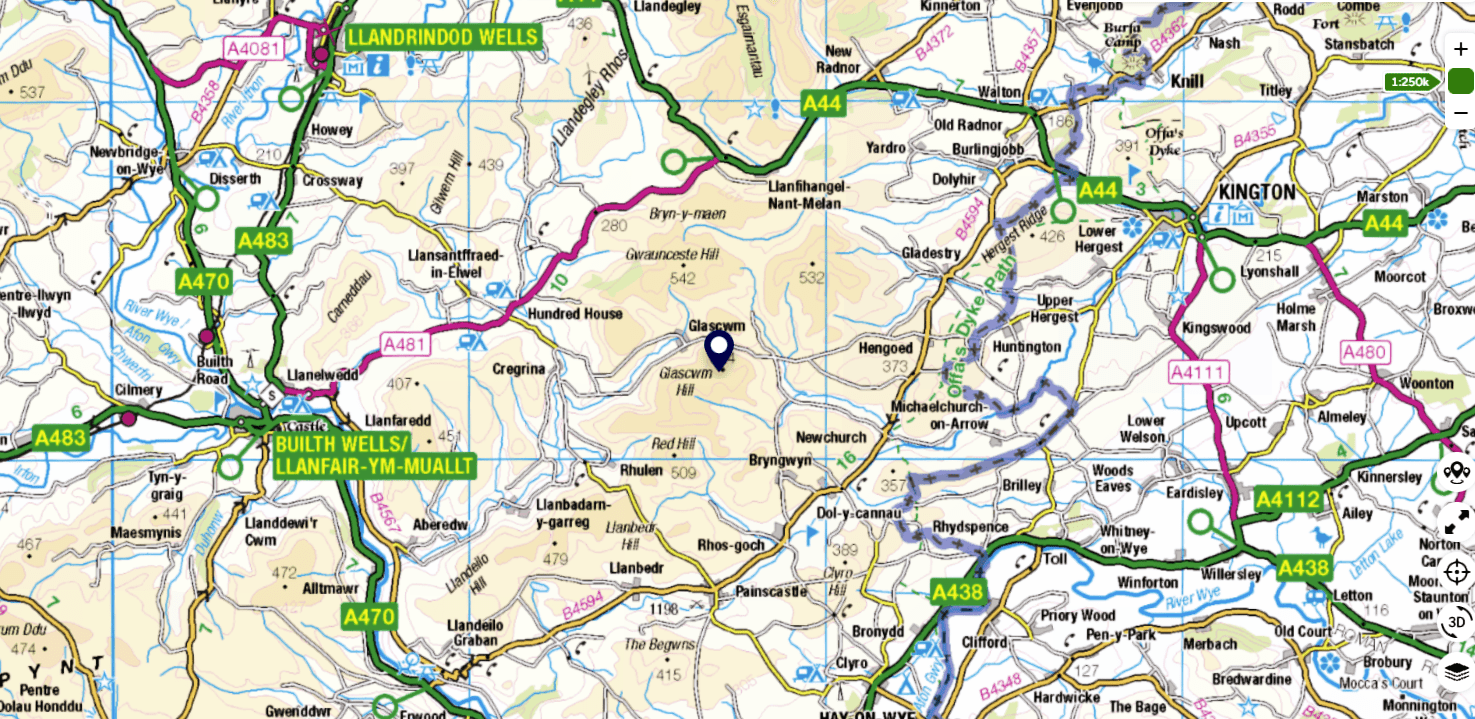
Click to open enlarged in separte tab

Let’s start in 1993, when Sir Andrew Cosmo Lewis Duff Gordon (scroll down) sold some land. Here’s a Land Registry document for title no CYM427489. There may be other titles involved. If so, they’ll likely be: WA484809, WA404806, and WA667700.

There were four buyers named in the 1993 transaction. Also, three “beneficial tenants“. More information on these can be found by clicking here.

Now we go to July 2008, and a piece from Country Life informing us regular readers that Ireland Moor was for sale. A Land Registry title document from November of that year for CYM427489 probably tells us who bought the land. (We can now assume the other titles just mentioned are involved.)

Two of the names mentioned in this sale we saw among the 1993 buyers: Edward John Francis Dashwood and Peter John Horsburgh. So in case you didn’t follow the earlier link . . .

Dashwood is descended from Hellfire Club Dashwood, who was a bit of a lad.

Dashwood was a notorious rake and prankster who had once impersonated King Charles XII of Sweden at the Russian court when Charles was Russia’s great enemy. He had also tried to seduce the Russian Tsarina Anne, and he had been banned from the Papal States, all while still in his late teens and early 20s.

On the surface, Horsburgh is a devout environmentalist and trustee of the Wye and Usk Foundation. But he’s also a director of companies under the ETF umbrella, companies that profit hugely from – net zero.

Which makes perfect sense.

Organisations set up to ‘protect’ our rivers – especially in Wales – blame farmers for any and all pollution in those rivers. Environmentalists see farting cows as an obstacle to the target of net zero. Which pressurises politicians to work against livestock farming.

Environmentalism is not really about Greta Thunberg and brainwashed kids throwing paint over old masters. That’s all a distraction. ‘Environmentalism’ is major corporations seeking investments. And near the top of their ‘Dear Santa‘ list is land to be exploited for ‘carbon capture’ greenwashing and ‘natural capital’.

This Land Registry document from June 5, 2009, confirms the November 2008 sale, but without naming the buyers. Though it does tell us the four titles were involved, reveals the sale price of £900,000, gives Ireland Moor Ltd as the owner, with a Jersey company number (103322), and an address in Bristol.

Does this suggest the November 2008 buyers are now the Jersey company?

Possibly, and the third buyer might provide the clue.

CONNECTIONS APPEAR

For this is James Warren Kent, one of the ‘beneficial tenants’ in the 1993 deal. Naturally, I got to wondering who Mr Kent is, and what he gets up to.

I found he’s the sole director of Q Branch Investments Ltd. A company in the business of “letting and operating of own or leased real estate“. Though the company is owned by Benjamin Mark Peter Whitfield. Possibly living in Switzerland.

Looking more closely at Q Branch Investments I saw three outstanding charges.

One of them with the Conon Group, up in Auld Reekie, a city we visit regularly on this blog. I would guess the two directors of this financially healthy undertaking are the elderly parents of Benjamin Whitfield.

The other two charges are held by Roger Charles Adams. And this is where it gets rather interesting. For Adams is a director of RSK Environment Ltd, operating out of an address south of the river in Glasgow. Part of the RSK Group.

A bell rang when I saw ‘RSK’, “a global leader in the delivery of sustainable solutions“.

Let’s go back to this piece I put out a week before Christmas last, and scroll down to the section ‘Globalist Land Grab?’ about the ‘Welsh Government’s Sustainable Farming Scheme. Where you can read:

Tracing the ownership of RSK ADAS eventually gets us to Los Angeles and “global alternative investment manager” the Ares Management Corporation. You may not be surprised to learn that among the largest of Ares’ shareholders we find both BlackRock and Vanguard.

Someone who got a mention was Canadian Dr Liz Lewis-Reddy. She’s worked for RSK for 7 years, and before that spent 11 years at Montgomeryshire Wildlife Trust.

Dr Lewis-Reddy was a co-author of the ‘Welsh Government’s Potential economic effects of the Sustainable Farming Scheme.

Her career seems to be another example of getting farmers off the land so that ‘alternative investment’ corporations can make fortunes from saving the planet.

So let’s recap. James Warren Kent, who is or was one of the owners of Ireland Moor, gets loans for his company from Roger Charles Adams, a man who works for a company that does contracts for both the ‘Welsh Government’ and Bute Energy. (Yes, Bute Energy.)

What’s the likelihood of that happening by chance?

But now it gets a little more complicated.

MORE ON OWNERSHIP

I’ve mentioned Ireland Moor Ltd, the company said to own the land in the LR title document of June 5, 2009.

That checks out with the Jersey filings.
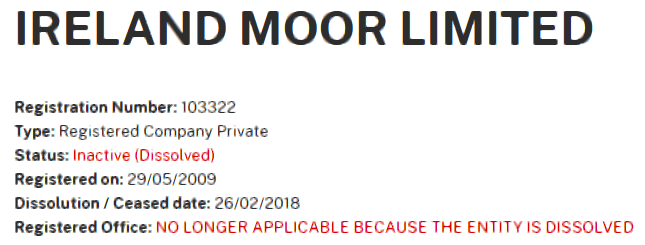
Click to open enlarged in separate tab

Here’s the Jersey Document of Incorporation for Ireland Moor Ltd, May 2009. It mentions two companies holding 45 shares each.

This ‘Persons Holding Shares’ filing for January 1, 2018, informs us that Edward Warren Filmer of Venezuela is now the sole shareholder.

Finally, here’s the winding up document for Ireland Moor Ltd dated February 23, 2018.

(Let me express my gratitude to the person who dug out, paid for, and then forwarded these and other documents to me.)

There was a problem identifying Edward Warren Filmer. But he does exist. Here he is mentioned in his father’s Will as ‘Edward Warren Filmer Cabrera’.

Which suggests his mother is from a Spanish-speaking country and her maiden name was Cabrera. Which ties in with him living in Venezuela.

This Jersey company seems to have been succeeded by Ireland Moor Conservation Ltd, run by the four sons of Sir Andrew Cosmo Lewis Duff Gordon who, you’ll recall, sold the land in 1993. (And died in April 2023.)

It seems the land was sold to the Duff Gordons in December 2015. The relevant LR titles are: WA484809 (no plan available), WA404806 (no plan available), WA667700 (with plan), and CYM427489 (with plan).

Edward Warren Filmer Cabrera remains something of a mystery man. How did he get involved? I couldn’t help notice that he shares a middle name, ‘Warren’, with the guy named in the Ireland Moor purchase in November 2008, James Warren Kent.

Could they be brothers? Cousins?

We must assume that Ireland Moor Ltd of Jersey owned the land of that name because the Duff Gordon boys bought Ireland Moor from that company.

Though I’m convinced things may not be quite as they appear when it comes to Ireland Moor. I say that because there is something on the Companies House filings that’s a real puzzle.

Go to the Land Registry title documents for which I’ve given links, above, and you’ll see a panel similar to the one below. It says the sale was concluded December 15, 2015.
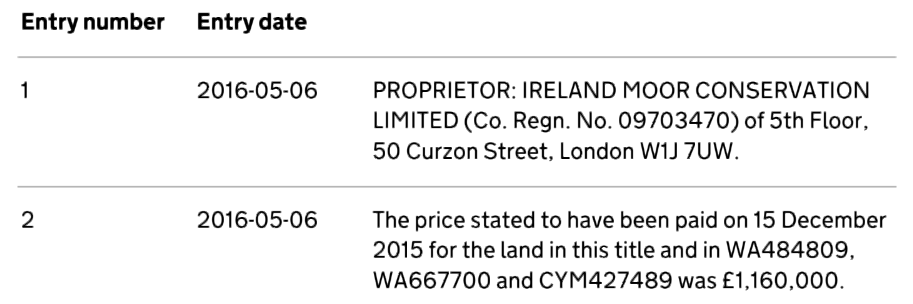
Click to open enlarged in separate tab

Which tallies with the December 2015 date given on the company’s outstanding debt with Edward Warren Filmer and Ireland Moor Ltd.
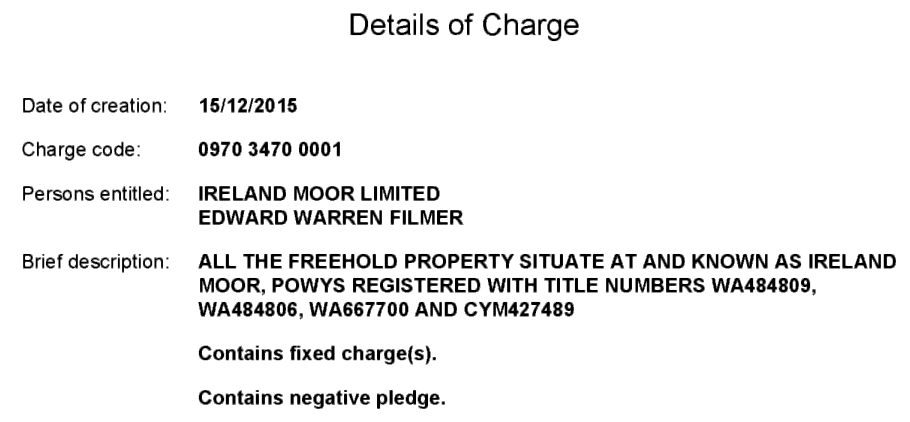
Click to open enlarged in separate tab

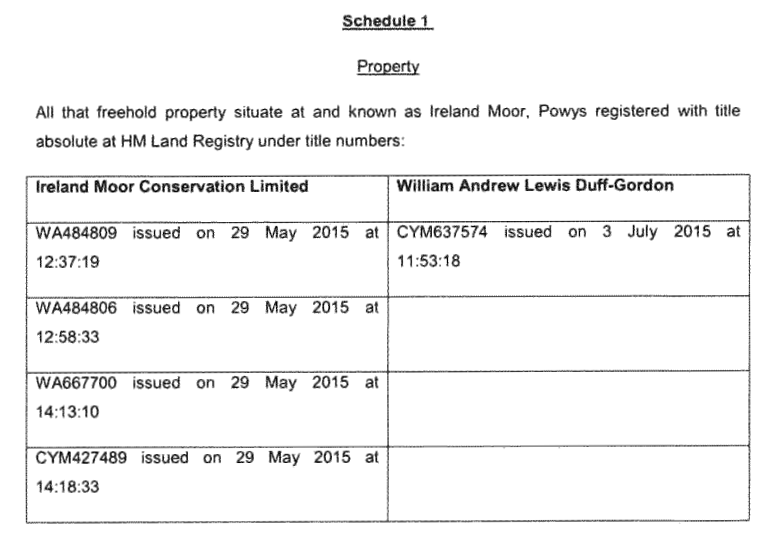
Yet if we scroll down that charge document, to page 16, we see the panel below. Which says the titles were transferred to Ireland Moor Conservation Ltd in May 2015!

That’s two months before Ireland Moor Conservation Ltd was formed!
Click to open enlarged in separate tab

I’m open to suggestions for this curiosity. But I will not accept ‘time travel’.

Whatever the answer, with Ireland Moor Ltd dissolved, then (on paper at least) the Duff Gordons owe the outstanding debt for the land to Señor Edward Warren Filmer Cabrera of Venezuela.

Whoever he might be.

THE ROOT OF ALL EVIL

The LR documents say the Duff Gordons bought Ireland Moor in December 2015, the purchase part-financed with a loan from Filmer-Ireland Moor Ltd.

This is something I’ve come across before, but usually when assets are moved between partners, or within a group of companies.

The charge dated that same month says:

Click to open enlarged in separate tab

Which suggests the Duff Gordons handed over £560,000 as a down payment.

Then they took out two further loans, in December 2016 with Lloyds Bank. Normally when I see this (and almost always when the Development Bank of Wales is involved) the newer loans are used to pay off older debts. But not, it seems, in this case.

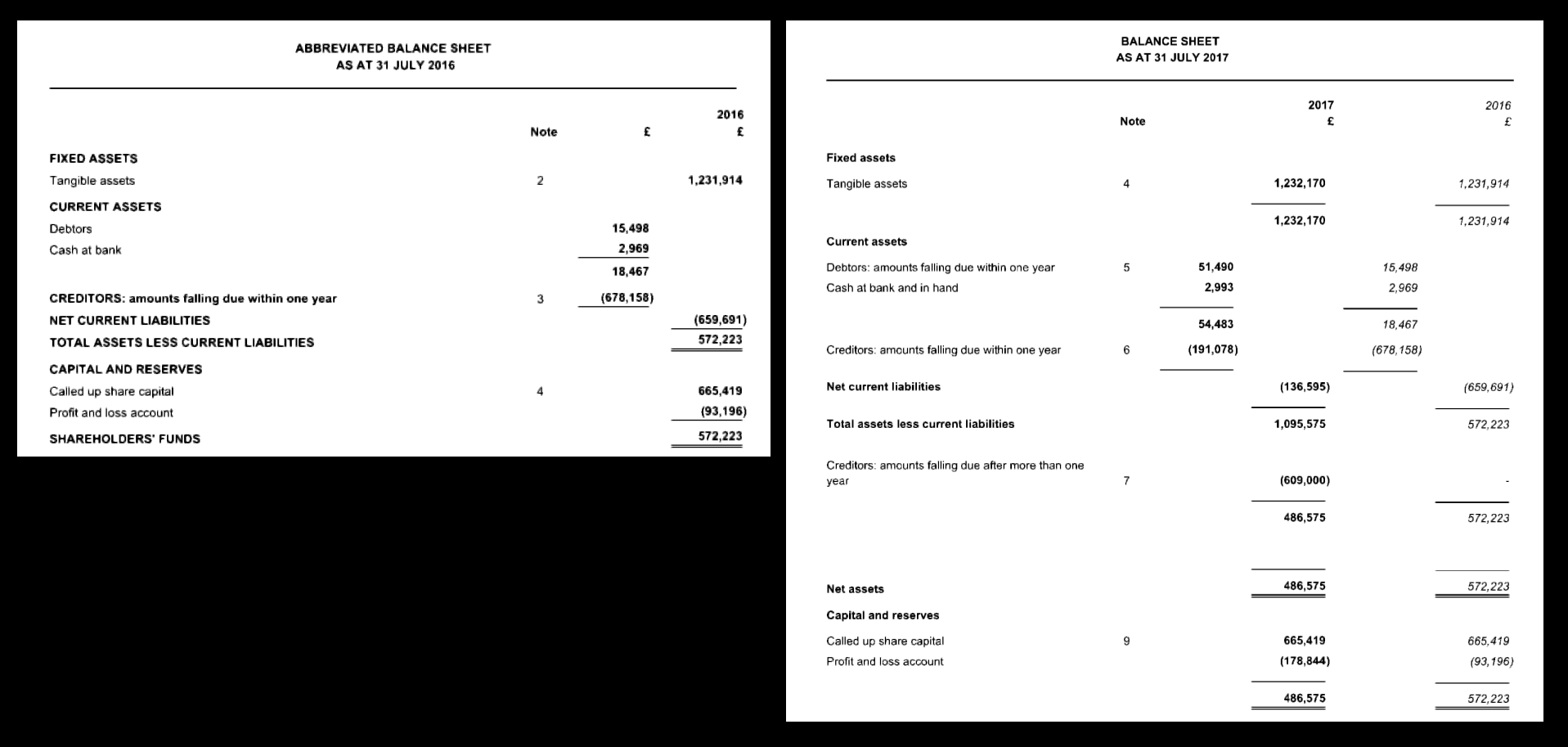
The accounts don’t help much. Below I’ve taken the ‘headlines’ from the first accounts filed by Ireland Moor Conservation Ltd.  (Actually, ‘unaudited financial statements’.)

The first ‘accounts’, to July 31, 2016, make sense. ‘Fixed assets’, £1,231,914, is obviously Ireland Moor. ‘Creditors’, at £678,158, is the debt owed to Filmer and Ireland Moor Ltd plus a few odds and ends.

But a year later, and after the loans from Lloyds Bank, the ‘accounts’ show the amount owed to ‘creditors’ down from £678,158 to £191,078.
Click to open enlarged in separate tab

This could be explained by taking on the new debt and then paying off what was owed to Filmer and Ireland Moor Ltd. But that didn’t happen. For Companies House shows the Filmer-Ireland Moor charge is still ‘outstanding’.

The most recent accounts, to July 31, 2023, are equally confusing. Despite no new charge registered, the amount owed to creditors shot up from £693,676 in 2022 to £1,287,026. Almost the whole increase explained (page 7) as “other creditors“.

With the amount in the kitty going down, down, down every year. To the point where, in the 2023 accounts, Ireland Moor Conservation Ltd is in the red.

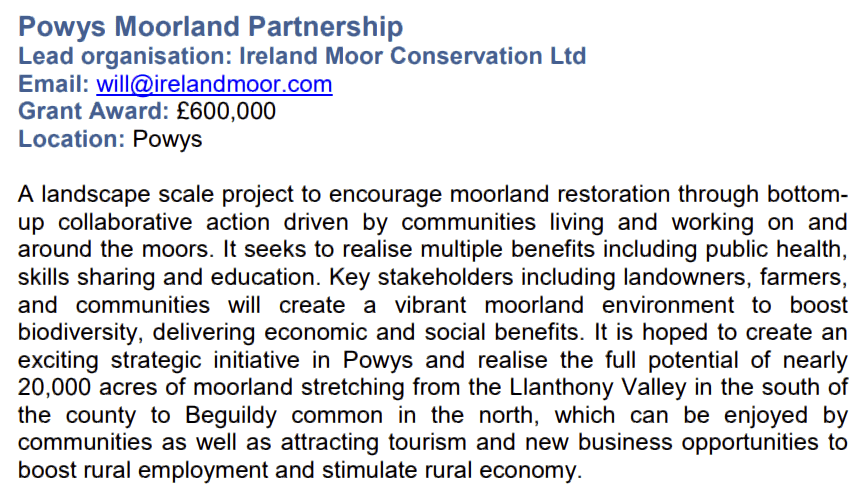
And where’s the £600,000 grant from the Powys Moorland Partnership? I can’t see that showing in the accounts.
Click to open enlarged in separate tab

Seeing as, “This project is funded from the Sustainable Management Scheme under the Welsh Government’s Rural Communities Rural Development Programme”, ‘Welsh Government’ should be insisting on ‘fuller’ accounts.

Is Ireland Moor Conservation Ltd being used for purposes other than the conservation of Ireland Moor?

SEEING AS THIS IS POWYS . . .

. . . you just know wind turbines might be involved. And that means another trip to Edinburgh, where we find those behind Bute Energy. But don’t be fooled by that – for Bute is definitely a Welsh company!

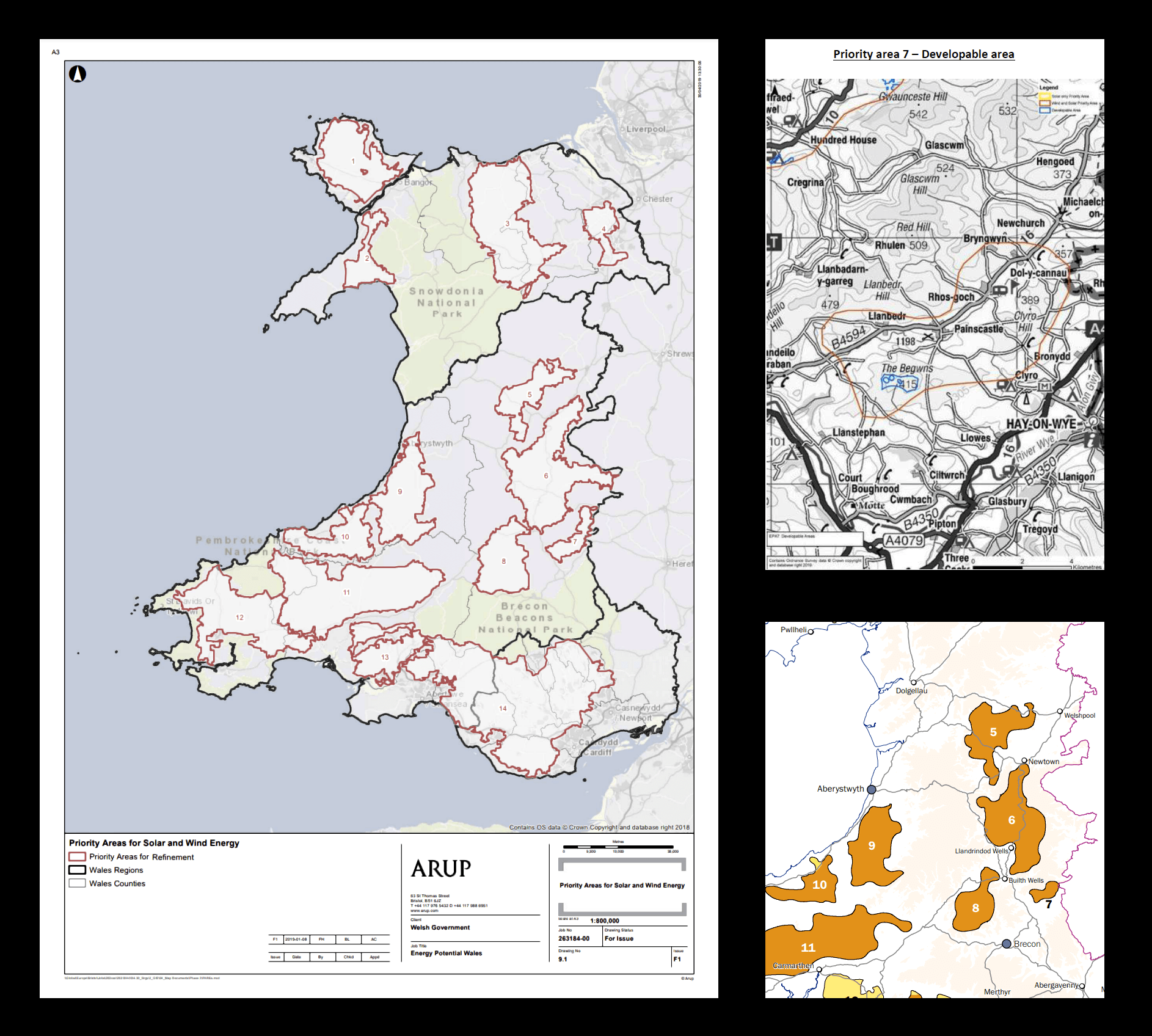
Back in 2018 or 2019 our wonderful ‘Welsh Government’ commissioned Arup’s Bristol office to identify areas that would be suitable for solar and wind energy.

The approach seems to have been, ‘Anywhere outside national parks and Areas of Outstanding Natural Beauty will be OK’. Which was a disaster, and betrayed Arup’s ignorance of Wales.

For example, Arup declared almost the whole of Ynys Môn to be perfect for wind turbines . . . until the RAF reminded them there are jets, helicopters and other craft taking off and landing every day.
Click to open enlarged in separate tab

The mess was eventually sorted by RenewableUK, whose suggestion for the area we’re interested in (top right) was used in the final version (bottom right) of ‘Future Wales The National Plan 2040‘.

That said, the ‘Welsh Government’ and corporate investors are very ‘flexible’ when it comes to the selected areas. To put it bluntly, other than NPs and AONBs (and of course, Ynys Môn), you can put up wind and solar farms anywhere.

Which is why, despite Ireland Moor being outside designated area 7, I wouldn’t rule out wind turbines appearing.

Because not far away, on Aberedw Hill (circled on the left), which is also outside the designated area, Bute Energy is planning an ‘energy park’, and has an agreement with landowner Harry Legge-Bourke.
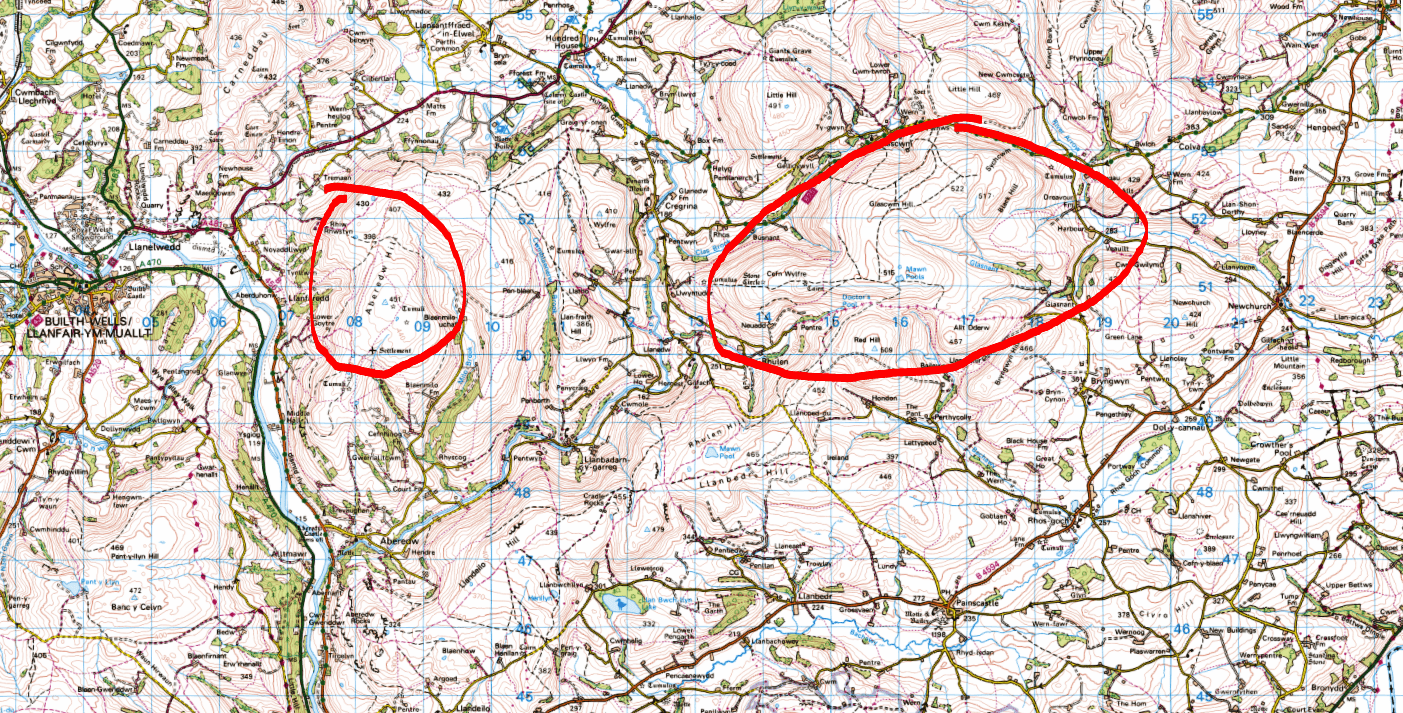
Click to open enlarged in separate tab

Reminding us that when it comes to ‘renewables’, Wales is open range; so we can definitely add wind turbines to the mix of possibilities for Ireland Moor.

The threats afflicting our countryside are very similar no matter where we look. Though more pronounced near the central border, partly due to the machinations of the wildlife trusts in Radnorshire and Montgomeryshire.

THE PERFECT STORM

Welsh livestock farming, and with it the Welsh family farm, a supporting pillar of Welsh language and culture, is under threat as never before. That threat comes in a number of guises, but all can be traced back to the Globalist ambition to control what we eat and where it comes from.

Additionally, a whole political class has been won over to the lunacy of a ‘climate crisis’, not because it’s true, but because it gives them a ’cause’, and it gives them some kind of moral authority.

A natural-born asshole gets a kick out of bossing people around. But when saving the planet, or fighting racism, is introduced, then a natural-born asshole becomes a morally superior being . . . and a bigger asshole!

Western thought has been corrupted by these caped crusaders, and all done by stealth. We elect politicians on vague, ‘something for everybody’ manifestos . . . and then the pressure groups we did not elect get to work on them.

If it’s not the pressure groups then – and certainly here in Wales – it’s the civil servants ‘advising’ our politicians. Men like Andrew Slade, who’s been a malign influence in Corruption Bay for too long.

It doesn’t matter whether Ireland Moor sees grouse shooting, wind turbines (to supply England), rewilding, greenwashing (or a combination of the four), it’s clear they will all have political backing – because they undermine farming.

And the farmers understand the threats. This is what one wrote to me:

I can’t tell how important that grazing is to hill farmers like us, we can’t afford down country grass keep, it will reduce our flocks down to a fraction, we are running on fumes as it is. And the sheep, they are old bloodlines it’s taken generations to get them hefted and thriving, I despair, and goodness knows what horrors await us in the budget, another local boy hung himself the other day, I fear there is going to be a lot more, and all the old farmers I go and visit are about in tears thinking all they have worked for and sacrificed for will be take from them and their grand-children won’t get the chance to have roots in the area where they belong, I could bloody cry.

What we see on Ireland Moor and elsewhere is plutocrats orchestrating those they fund and control against livestock farming so as to release land for corporate gain.

Their motto is, I’m told: ‘The countryside needs hedge funds not hedges.’

The ‘Welsh Government’ agrees. Politicians who’ve spent 25 years serving agendas that sound noble in the abstract but, in practice – from Port Talbot to the Powys uplands – always work against the interests of local people.

Ireland Moor is modern Wales in microcosm. Among all those you’ve read about, the ones losing out will be the ones born and raised there, who went to school in the area, who graze their animals on the moor.

For me, the lesson from Ireland Moor – and it can be applied across Wales – is this: Socialists in Corruption Bay are driving small farmers off the land so that land can be taken over by foreign corporations, landed families, and enviroshysters.

Reminding us that socialism always was a lie. The betrayal of the urban working class, and now the war on small farmers, exposes that lie to the world.

♦ end ♦

© Royston Jones 2024

Clear Water, Poisoned Debate

For decades we’ve been hearing that water is a diminishing commodity, and with an ever-expanding global population we’ll soon be fighting over water resources.

Though these predictions often came from the same people who at different times – or even simultaneously – could predict icebergs in Swansea Bay and no snow on Yr Wyddfa.

It was the usual nonsense from the usual sources.

And yet, in Wales now, water is being used as a weapon. Not by us against our village-drowning neighbours but by politicians and others, supposedly serving Wales and Welsh interests, against a section of the Welsh population.

If that necessitates twisting the facts, and taking control of certain bodies, either through funding or placement of personnel, then so be it.

This is another big one, so I’ll say what I always say: Don’t rush it, take your time, savour it, and you’ll enjoy it far more.

BULLSHIT FOR WHICH BULLS ARE BLAMELESS

It’s been accepted for many years that there might be a problem with nitrate discharges, from some dairy farms, mostly in the south west. This highly localised problem explained why Natural Resources Wales classified just 2.4% of Welsh farmland as ‘vulnerable’.

Click to open enlarged in separate tab

When asked to revisit the issue NRW produced a report in September 2016 that (on page 13) suggested, ‘Adoption of the targeted approach would mean an increase in the total area designated from 2.4% to approximately 8% which includes those areas newly identified by NRW’.

A targeted approach was obviously the sensible and fair way to go, but then the politicians got involved. One politician in particular.

The elections of May 2016 saw Lesley Griffiths re-elected for Labour in Wrecsam. Her Senedd bio then tracks her meteoric rise to voodoo doll status in farmhouses across the land. (Soon to be accompanied by Gary.)

First, she was made Cabinet Secretary for Environment and Rural Affairs. In November 2017 the job title changed to Energy, Planning and Rural Affairs. Then, 0n 13 December 2018, she was handed her baton as Minister for Environment, Energy and Rural Affairs.

Despite the facts of the matter, and the sensible proposal from NRW, just before Christmas 2017 Lesley Griffiths declared that the whole of Wales was at risk of NVZ pollution. Using this to announce an all-Wales regime.

After a year of being fed a diet of undiluted pollution La Griffiths announced in November 2018 that her mind was made up and she would introduce what she considered to be the necessary legislation.

After a slight delay due to Covid the implementation date was set for April 1, 2021.

But then things started to go awry for the so-called ‘Welsh Government’.

Despite an (unsuccessful) appeal by NFU Cymru the debate was noticeably widening as others took an interest, and could see how disproportionate to the scale of the problem Cruella de Griff’s proposals were.

For in addition to the all-Wales approach the acceptable nitrogen level in Wales was to be 170kg/ha, compared to 250kg/ha in England and Scotland. This was so obviously unfair, in a country where farmers are, on average, less affluent than their English and Scottish counterparts, that it tended to give the game away.

Because there would of course be a financial burden for farmers. Though I’m sure that those trying to put livestock farmers out of business knew exactly what they were doing

The backtracking had begun. With Plaid Cymru taking the credit. For despite being Labour’s partner in a coalition that dare not speak its name, the reaction from Plaid’s large rural vote was giving the party’s leaders serious concerns.

Click to open enlarged in separate tab

A Plaid Cymru source said their party had pushed Labour ministers to act‘.

Some cynics – not me! – might wonder what Plaid has offered in return.

The NVZ proposals couldn’t withstand scrutiny from any fair-minded observer because they had little to do with pollution. NVZ was a stick with which to beat livestock farmers, hopefully putting many out of business to release land for other purposes. Land coveted by many in the offstage chorus influencing our Lesley.

To support and legitimise this attack on livestock farming we were expected to believe that only farmers are responsible for polluting our waterways and seas.

Which meant that Dŵr Cymru (Welsh Water), the worst culprit, got a free pass. How did that come about?

All will be explained later in this piece.

THE MEMSAHIBS OF KNIGHTON AND CONSIDERATIONS OF CHICKENSHIT

This section is part digression, part lead-in.

A group that has figured on this blog a few times is a coven of Green-Left-Woke crones who’ve imposed themselves on the border town of Knighton. There are a few men associated with them, perhaps even more unhinged than their female comrades.

Catch up with them in Colonialism in microcosm, or Knighton.

They perform the full far left agenda:

Rather than doing the honest thing and just staying away altogether on Remembrance Sunday they insist on making a nuisance of themselves by placing wreaths of white poppies on the war memorial. (Dressed à la mode Michael Foot.)

Are they reprising a scene from a horror movie? Click to open enlarged in separate tab

You will not be surprised to learn that these biddies have formed a Knighton and District Refugee Support Group. Reluctance to welcome with open arms complete strangers from far-off lands will see you labelled a ‘racist’.

An epithet also hurled at those not condemning the fascists of the Israeli state.

Click to open enlarged in separate tab

The gang’s environmental credentials are on extravagant display with Sustainable Food Knighton. Which, in practice, is little more than a vendetta against a local chicken farm.

The attack is mounted on two fronts. One, it’s cruel to the chickens. Two, intensive chicken farms are a big, big source of river pollution.

Click to open enlarged in separate tab

Without being able to consult the chickens it may be impossible to address the first point. The second is more relevant to this article because it’s used over and over again by environmental Non-Governmental Organisations (eNGOs).

Especially those that allege chicken farms in Powys are severely damaging the rivers Usk and Wye.

But what are the facts?

Well, for a start, there are more, and bigger, chicken farms in Shropshire and Herefordshire, as the map below shows. So if chicken shit is a problem in Wales then it could well be coming from over the border.

Then again, it might not be a problem at all. Or, it’s a problem that’s being exaggerated.

Knighton is circled in green. Note on which side of the border the chicken farms south of the town are to found. Click to open enlarged in separate tab

For anecdotal evidence suggests there are even more chicken farms in the Severn catchment area, the Trent catchment area, etc. But there are far fewer complaints from these areas.

Which could mean that either shit from Welsh chickens is particularly toxic – in which case every one of the little buggers should be killed immediately! – or there’s a purpose behind the lying.

It’s the latter.

A suspicion reinforced by the Environment Agency recently concluding that the bigger culprit in the Wye catchment is arable farmers, who are mainly found on the England side of the border.

Confirmed by this graphic released by the Environment Agency relating to the Wye in England. Note the section I’ve highlighted in the second level. The tributaries mentioned are also in England.

Click to open enlarged in separate tab

Something also worth contributing here is that arable farmers use chicken manure as a fertiliser.

So even if chicken shit is the problem, it’s more likely to come from over the border; either directly from chicken farms or indirectly from arable farms.

And there’s yet another consideration to take into account. Certain interests are pushing us towards a meat-free diet, and in this scenario many view arable farmers as part of the solution. Which might explain them also getting a free pass.

The suspicion of an anti-livestock farming agenda being served was strengthened last month by a ‘report’ on BBC Wales about pollution on the Wye. One of the most biased pieces of television journalism I have ever seen.

Let me explain why I say that:

  • Passing references were made to sewage, but we were left in no doubt that the real culprits are farmers.
  • But only livestock farmers, with the programme focusing on one particular chicken farm.
  • There was no reference to the fact that the Wye is a cross-border river.
  • Despite being fronted by Wyre Davies the star of the show was Gail Davies-Walsh, who became CEO of Afonydd Cymru Cyf on February 22 2021, and secretary on March 11.
  • Afonydd Cymru (Rivers of Wales) serves as the umbrella body for the more local river groups.
  • Her Linkedin profile (here in pdf) tells us that until September she was Head of Natural Capital for the Wye and Usk Foundation‘. ‘Natural Capital’ seems to be code for, among other things, greenwashing. Certainly tree planting.
  •  Revealingly, Linkedin also tells us that Gail Davies-Walsh worked for Dŵr Cymru for almost 14 years, up until January 2020.
Gail Davies-Walsh. Click to open enlarged in separate tab

I wouldn’t be surprised to learn that Gail Davies-Walsh took the idea for the programme to the BBC. Which would raise more concerns about linkages, and influence.

Another who joined Afonydd Cymru recently is Harriet Alvis, (Linkedin in pdf) CEO at West Wales Rivers Trust, and co-editor of FISH, the magazine of the Institute of Fisheries Management.

More on both in a mo.

And the situation herein described is very much the same with more terrestrial eNGOs. ‘Environmentalists’ opposed to livestock farming take control of existing groups or set up new ones – and never go unfunded again!

A phenomenon reported on this blog many times. Try Enviroshysters flock to Wales for easy money, Invasion of the Enviroshysters (PG), or Back to the Land!.

TINKLING RILLS AND STREAMS OF POLLUTING CASH

Time now to turn our attention to the increasingly well-funded bodies looking after our various rivers, and we find new ones forming all the time. With the money available perhaps explaining the proliferation?

Here’s a table I’ve draw up, in pdf format (with working links) that I hope lists all the various river outfits operating in Wales. If you know one I’ve left out, then please let me know.

You’ll see that some are specific to one river while others are more general, some even claiming to be national in their scope.

Let me say at the outset, there are many genuine people involved in river trusts, boards, etc; not least, anglers, whose only concerns are for the health of our rivers, fish stocks, and other environmental matters.

But unfortunately, there are others, either looking out for themselves, or involved for a different purpose.

Go through the table I’ve linked to, particularly the ‘Comments’ section, and you’ll see substantial inputs of official funding in recent years.

Take the North Wales Rivers Trust for example. Total income in the year ending 31.03.2022 was £241,790. Of which £241,690 came in ‘Welsh Government’ grants.

From the Charity Commission entry under ‘Financial history. Click to open enlarged in separate tab

And it’s a similar story with other river bodies. Though much of the increase, instead of being shown as coming from ‘government grants’ or ‘government contracts’, is disguised as, ‘Income – charitable activities’ on the Charity Commission entry.

Such as here with the West Wales Rivers Trust. The Charity Commission graph shows income soaring from just £3,750 in y/e 31.03.2017 to £541,140 for y/e 31.03.2021.

That is one hell of a jump in just four years! One way of interpreting the big increase is the ‘Welsh Government’ – or Dŵr Cymru? – paying CEO Harriet Alvis’s salary.

Because don’t you find that strange?

A river group that has meandered happily along for 15 years suddenly needs a CEO.

Equally thought-provoking is Gail Davies-Walsh becoming CEO of Afonydd Cymru.

Making me wonder if Gail Davies-Walsh and Harriet Alvis were ‘placed’ in the West Wales Rivers Trust and Afonydd Cymru to push the ‘Welsh Government’s anti-farming campaign, and also to protect Dŵr Cymru.

For there is a certain ‘circularity’ to it all. ‘Welsh Government’ and Dŵr Cymru would no doubt explain the increase in funding by the ‘state of the rivers’, which then justifies the attack on livestock farming.

A ‘circularity’ made even more suspicious by the fact that these vast increases in funding occur at exactly the same time Lesley Griffiths was hatching the absurd and punitive NVZ legislation.

If I’m wrong then maybe someone can give another reason for our river bodies being showered with cash from 2016.

Back to the riverbank . . .

On the other side of the country the wealthy Wye and Usk Foundation’s income from government grants and contracts jumped from £404,950 in 2018 to £934,670 in 2020.

Not far away is the South East Wales Rivers Trust, which also saw its income more than double between 2017 and 2021. Explained as funding from, ‘Natural Resources Wales, Welsh Water, Merthyr Tydfil County Borough Council, Welsh Government with European Funds’.

The ‘disguised grants’ I referred to earlier was money paid to Afonydd Cymru Cyf and then distributed to the individual water groups. Afonydd Cymru’s own accounts tell us ‘Income from government grants’ jumped from zero in 2019 to £894,700 in 2020.

Afonydd Cymru may operate like the Wales Council for Voluntary Action does in relation to the third sector. That is, acting as a conduit for ‘Welsh Government’ funding in the hope of disguising the source of the funding.

But the money filtered through Afonydd Cymru is small beer compared to the £13.8m up for grabs in the Four Rivers For Life project, administered by Natural Resources Wales. (Though £4.5m actually goes towards ‘quaking bogs’.) The four rivers being the Tywi, Teifi, Cleddau and – it should go without saying – the Usk.

This might explain the recent formation of the Save the Teifi campaign. Though information is difficult to find. For example, the social media links at the foot of the website home page don’t work.

This report in the Tivy-side Advertiser in August links the group with Ffynnone-Community Resilience and mentions ‘spokespersons’, but gives no names. Is it a secret society?

The only name mentioned in the Tivy-side article is ‘Councillor John Davies’. This must be ‘John Cwmbetws’, of Bute Energy’s Welsh Advisory Board. Bute being a Scottish company that wants to build twenty or more wind farms in Wales, some with the tallest towers yet seen on land.

Well connected, is John. In Llanelwedd, Corruption Bay, and other places.

The Ffynnone group might be trying to stay anonymous, but one name has been given to me. It’s Jessica McQuade who, I’m told, not long ago moved to Llandudoch, across the Teifi estuary from Aberteifi.

Her Twitter account confirms the link with the Save the Teifi campaign.

Click to open enlarged in separate tab

What struck me was that McQuade and Harriet Alvis, the CEO at the West Wales Rivers Trust and, since last month, a director at Afonydd Cymru, are both followed by the Brecon Beacons Mega Catchment.

This is the group created by Dŵr Cymru following its link-up with the Watershed Agricultural Council in New York State, in the area that supplies New York City with water. I wrote about this group in my previous post. It’s another outfit with very little information publicly available.

But what is McQuade’s and Alvis’s connection with this Dŵr Cymru outfit? And with Dŵr Cymru itself?

Jessica McQuade’s Save the Teifi / Ffynnone group has already received ‘Welsh Government’ funding. She could be another one ‘placed’ to push the ‘Welsh Government’s anti-farming campaign / WEF’s Agenda 2030 and, of course, to shield Dŵr Cymru.

As I suggested earlier, all the money recently being splashing around, with a veritable tsunami of new funding approaching, may also explain the new groups springing up. Here are some more.

There’s the Cardiff Rivers Group, containing a few Sherman luvvies, set up in October 2020. Bay-watchers may recognise one or two of the trustees.

Then there’s the Welsh Rivers Union, which has a website, and a Twitter account from February last year, but seems to be unregistered as either a company or a charity.

Next, there’s the Wye Salmon Association, whose Twitter account started in September last year. This too seems unregistered.

Finally, and most recently, there’s Friends of the Upper Wye. Which registered as a charity in March this year.

Let me conclude this section with a tweet from Jessica McQuade who, you’ll remember, is busy with the Save the Teifi campaign since moving to north Pembrokeshire, but whose day job is with the World Wildlife Fund.

Click to open enlarged in separate tab

Now why would the WWF be interested in food? And trust me – that is human food she’s referring to.

Because, gentle reader, the WWF is no longer about saving pandas; it is a full-on, far left organisation totally committed to the anti-farming and the anti-human – ‘reduce the population’ – agenda.

And also believe me when I tell you that the WWF wields great influence with the ‘Welsh Government’, and in the Bay more generally.

‘FIRST THEY CAME FOR THE FARMERS . . . ‘

The ‘Welsh Government’ – and, indeed, the Bay establishment – has bought into the UN’s Agenda 2030 and the World Economic Forum’s Great Reset.

Both posit that burping, farting farm animals are destroying the environment; so we should switch to eating plant-based foods, insects, and gunge marketed as ‘artificial meat’.

Obviously, this will mean many fewer livestock farmers in Wales. Perhaps none. But that’s no problem, because the land vacated is already earmarked for tree planting, rewilding, conservation projects and other activities from which Welsh people will be largely excluded unless needed for window-dressing.

To facilitate this clearance programme livestock farmers must be blamed for things that are not their fault. This frees Dŵr Cymru from criticism. An objective easy to achieve given the influence the water company wields within ‘Welsh Government’.

To ensure that everyone sings from the same hymn sheet the ‘Welsh Government’, Dŵr Cymru and other official bodies are more than willing to fund assorted eNGOs which, in return, may accept ‘appointees’.

What I’m alluding to is little different to Bill Gates funding the BBC, the Guardian, New York Times, CNN and countless other media outlets around the world. He doesn’t do it in defence of the truth, he does it to ensure the media he funds will promote his and the World Economic Forum’s agenda.

‘He who pays the piper calls the tune’.

Headlines like this, frightening people into obeying the WEF agenda, don’t come cheap. Click to open enlarged in separate tab

Wales, being a poor country, and a corrupt, one-party state, with no effective political opposition, and no functioning media, is especially vulnerable to powerful forces seeking to impose an agenda.

If farmers can be defeated, and the food supply controlled by forces you will have difficulty identifying, let alone challenging, then we will have already lost. Because who controls the food supply controls the world.

It’ll be too late to complain when your car is confiscated, or when your access to your bank account is blocked because you said something on social media that somebody, somewhere, didn’t like.

So stand with the farmers, and stand up to those who threaten them. Because those who threaten the farmers also threaten you.

♦ end ♦

© Royston Jones 2022


Back to the Land!

After taking August off (and enjoying the break) I’m back to report on an event planned for later this month.

In fact, I enjoyed the break so much, and found writing this such hard going, that it might be a while before the next piece appears.

HOW IT BEGAN

A couple of weeks ago someone sent me news of a gathering to be held in the Community Centre, Knighton, on September 17, when many of us will be nursing hangovers from celebrating Glyndŵr’s Day.

Knighton Community Centre has been mentioned on this blog before, after falling into the clutches of white settler Labour activists; who now wage war on local farmers, welcome refugees to an area where they themselves are not universally welcome, and generally play latter-day left liberal colonialists.

For no longer is it Bible and bullets, now it’s saving us through a combination of uplifting sermons from the Rev Monbiot and those organic thingeys they eat at Felicity’s aerobic knife-throwing class.

Click to open enlarged in separate tab

But I digress.

To expose the dishonesty behind this event I shall go through those named as being involved before concluding with . . . well, my conclusions. What else?

CAMPAIGN FOR THE PROTECTION OF RURAL WALES (CPRW)

Let’s start with some background. The CPRW has been pootling along for almost a century as a charity, but now things are changing. Most significantly, with the formation of a company in late May this year.

Though I’m assured there’s no significance to this other than the trustees ensuring they are not personally bankrupted by legal action against the CPRW.

Which also means that, at the moment, the CPRW has two charities with the same name registered with the Charity Commission. One will soon be closed.

Click to open enlarged in separate tab

Previous CPRW presidents have included politician Megan Lloyd George and BBC broadcaster Wynford Vaughan Thomas. Clough Williams Ellis, of Portmeirion fame, was also deeply involved for many years as both chairman and president.

The current president of the CPRW is TV celeb Jules Hudson, who is believed to live in Herefordshire. Possibly Hertfordshire. But definitely not Wales. He’s famous for programmes like Escape to the Country and Countryfile.

In his favour, he has a Labrador called Iolo.

The chair of the Brecon & Radnor branch is Jonathan Halsey Luke Colchester, who has recently moved to Clyro. From where he runs his company, Courtenay Advisers Ltd.

I am informed by a very reliable source that the Brecon & Radnor branch of the CPRW is particularly hostile towards farmers.

That being so, why is the local CPRW branch organising a bash with the title ‘Welsh Food & Farming’? The answer to that question will become clear as you read on.

There are farmers, and there are farmers.

THE FERTILE CRESCENT

One of the CPRW’s recent recruits is associated with another new outfit, Friends of the Upper Wye (FUW), registered with the Charity Commission in March this year. (Though I’m assured she’s an admirable and well-intentioned lady.)

This will no doubt complement the Wye & Usk Foundation (WUF) which is about a lot more than just angling. The WUF is based in Talgarth, close to Coleg Soros.

Over the years the WUF has received millions in funding from or via the ‘Welsh Government’, much of it handed over by an official whose attitude to money might have been compared by my dear mamgu to that of an inebriated seafarer.

An amazing episode, with apparently no oversight whatsoever. It is even suggested that some favoured bodies didn’t even need to make an application – it was a case of, “Would you like some more money?”

OK, so it’s not exactly a crescent, but did I ever claim to be an artist? Click to open enlarged in separate tab

For the Fertile Crescent formed by the Usk and the Wye is something of a magnet for those seeking to save us benighted natives from ourselves. And for others with even less noble intent.

There’s yet another organisation, formed last year, in the Welsh Rivers Union (WRU), based on the Usk at Llanvihangel Gobion. This claims to be a collective of ‘citizen-funded’ community groups defending our rivers.

If it gets airborne it will be made up of the usual ‘community groups’ composed of people who were living somewhere else not so long ago.

Though as yet, it’s not registered as either a company or a charity. It may be just a website, and a Twitter account.

Oh, I almost forgot Afonydd Cymru Cyf, also based in Talgarth. Where income from government grants leapt like a returning salmon from £10,000 in 2018 to £894,704 in 2020.

Afonydd Cymru’s chair is Viscount Christopher Mills, of Kensington, who served as regional director of the Environment Agency in Wales (before the creation of Natural Resources Wales). Among the trustees is Joe Pimblett, CEO of the Severn Rivers Trust, based in Worcestershire.

When it comes to the Fertile Crescent even the Blesséd Monbiot has made a film, Rivercide (what a wit!), in which one of the supporting cast was Lesley Griffiths (sans Gary), and she reminded us that no matter what the facts may say, it’s always farmers wot we must blame.

St George thought the culprits were chickens, which appear at number 2, after humans, in his forthcoming opus, ‘Species To Be Exterminated If We Are To Save The Planet’. (Chickens have apparently deposed sheep in Monbiot’s demonography.)

Why this obsession with the Usk and the Wye? Is it because they’re close to Bristol? Or is their cross-border nature, demanding ‘co-operation’, the attraction?

Of course, there are rivers within Wales in far worse condition than the Wye and the Usk, so why are these ignored? Three reasons, perhaps.

First, these other rivers run through more populated areas with few stretches of open country attractive to those in search of a rural idyll, or intent on ‘habitat restoration’ (aka ‘rewilding’).

Second, while there may be areas meeting the criteria further west, there the Welsh language would be a consideration. And after the resistance to Summit to Sea the land-grabbers are wary of getting another bloody nose.

Third, they are entirely within Wales.

Never lose sight of the fact that for many, water quality is a stalking-horse, used against farmers so as to free up their land for other purposes. And the ‘Welsh Government’ wholeheartedly supports this agenda.

UPDATE: Here’s a recent example of pollution on the Wye that clearly has nothing to do with farmers.

LOCAL GROWERS AND FARMERS

A source informs me that the ‘local grower’ is the bloke from the organic food shop in Knighton, where you buy the knobbly carrots and the misshapen parsnips. Ach y fi!

(Though there may be others attending, more deserving of the billing.)

As for the ‘local farmers’, it seems these will both come from Herefordshire, which may be fairly local to Knighton (/Tref y Clawdd) but are not, unless we want to be irredentist about this, Welsh.

More pragmatically, whether we view Herefordshire as the ‘lost lands’ or not, the area will not be affected by any legislation or initiatives emanating from Corruption Bay.

Even so, to help give a fuller flavour of the event, I’ll tell you who they are.

One is ‘RegenBen’, of Townsend Farm, near Ross-on-Wye. Which, as the name suggests, is on the River Wye. Ben is a director of the Oxford Farming Conference, an organisation I’m told represents big landowners, yeoman farmers and the like.

(I was also told that a famous Welsh farmer went there to speak a few years ago, and has never felt more out of place.)

The makeup of the Oxford Farming Conference probably explains why a rival was set up in 2010 called the Oxford Real Farming Conference.

From what I can see the older body caters for those with inherited land while the upstart is more attractive for Greens looking to get their hands on someone else’s land. I wouldn’t be comfortable with either.

The other ‘local farmer’ is from ‘Wild by Nature’, of Lower House farm, just over the border from Llanthoney, close to Llanveynoe. (These corrupted spellings!)

Click to open enlarged in separate tab

Looking at a map I see that both of them are close to the border, but neither is particularly ‘local’ to Knighton. The first is roughly 45 miles away, the second almost 50.

I suspect that both have been invited because they are well-connected, and have diversified into ‘artisanal’ food produce and other activities.

The Rhug Estate model, if you like.

Don’t get me wrong, I’ve stopped many times at the Rhug restaurant and shop, and like some urchin from a Dickens novel gazed at goodies I can’t afford.

Rhug Estate shop. Click to open enlarged in separate tab

Though ‘farm shop’ really is a misnomer. It suggests Mrs Evans in a shed at the bottom of the farm drive selling goods cheaper by cutting out the middle man. In reality it’s a place where the price of everything is marked up.

Few locals can afford to shop there. That’s why the Rhug ‘farm shop’ is on the A5.

Even so, I’m sure a farm shop can be a nice little earner, and so I wasn’t surprised to learn that ‘Wild by Nature’ already has one. While RegenBen’s website tells us: ‘Our plans are to share the fruits of our labour by opening a farm shop’.

There are of course some excellent farm shops in Wales. One is Bargoed Farm / The Moody Cow, near Aberaeron, run by the former owners of Gilestone Farm, and visited very recently by Conservative Senedd leader Andrew R T Davies MS.

But how many farm shops can Wales support?

SOIL ASSOCIATION

The Soil Association, headquartered in Bristol, is another of those English organisations that recognises the existence of Scotland, but not Wales. We, presumably, are part of England.

Click to open enlarged in separate tab

The Soil Association is registered as both a company and a charity. And with an annual income of over £23m it is no shoestring outfit. Of course the Scottish Soil Association is registered separately in Scotland.

In addition, there is The Soil Association Land Trust ‘established to acquire and maintain farmland sustainably’. Which might be worth bearing in mind, and could explain The Soil Association’s interest in Wales, a country I’m sure it will quickly recognise if the ‘Welsh Government’ offers to buy it a farm.

NATURE FRIENDLY FARMING NETWORK

The company of that name was launched in July 2018. Though there has been quite a turnover of directors in the four years since then. Of the eight original directors, five have left, including two who were obviously Welsh.

NFFN has an impressive website, telling us of a Welsh Steering Group, with two group members serving as directors.

Here’s a page giving some responses from the Welsh Steering Group to the ‘Welsh Government’s Sustainable Farming Scheme that emerged in July.

Hilary Kehoe, the Chair, mentions the ‘changing climate’. Rhys Evans thinks the ‘devil will be in the detail’. But Hywel Morgan was ecstatic. I was not surprised to learn that Hywel is involved with the ‘Welsh Government’s Farming Connect scheme.

The Nature Friendly Farming Network is looking to hire a £29,000 a year Communications Officer. Having recently recruited a Farmer Engagement Officer on the same salary. But who’s funding these posts?

For the financial situation is not impressive. I appreciate that it’s a company limited by guarantee, but even so, I would have expected to see more than £69 in the kitty. Which is what the latest accounts (to y/e 30.06.2021) show.

Yes, NFFN has assets of £199,317, but this sum is exceeded by money owed to creditors.

On the ‘Nature Means Business‘ page we read: ‘Right now, farm businesses are facing a multitude of challenges: climate change, unpredictable weather patterns, changes to future farm payment schemes and adjusting to new consumer demands’.

To prioritise ‘climate change’ (when it’s becoming clear that climate change has been – at the very least – exaggerated), and then virtually repeat it with ‘unpredictable weather patterns’, before mentioning farm payments, is revealing.

With no mention at all of the threat from mandatory afforestation, farms being bought for greenwashing, and restrictions applied by politicians and administrations that are blatantly anti-farming.

These priorities are evident throughout the website. The image below is from the Fund Us page. And again it’s ‘climate in crisis’, ‘wildlife declining’, ‘habitats being lost’.

Click to open enlarged in separate tab

The Nature Friendly Farming Network seems to be an environmental organisation that recruits farmers. There’s nothing wrong with that, farmers care deeply about the environment that provides livelihoods for them and their families.

But it’s a question of priorities. The first of which has to be supporting farmers – who will then look after the environment

STUMP UP FOR TREES

This organisation has appeared on this blog a number of times, so I won’t dwell on it again.

Based in Abergavenny Stump up for Trees is a greenwash outfit. It’s registered as a charity, and one of the three trustees is Richard James Roderick, who farms next to Gilestone.

By ‘greenwashing’ I mean that SUFT ‘saves the planet’ by planting trees in order for companies to offset their perceived ‘carbon footprint’, which allows them to go on putting out carbon. Its major partner seems to be Utility Warehouse.

Nonsense predicated on there being a ‘climate emergency’ (there isn’t); carbon being damaging to the environment (it’s not); and replacing agricultural land with sterile, monoculture pine forests making sense (it doesn’t).

Even so, Stump up for Trees seems to be well-regarded in Corruption Bay among the connoisseurs, practitioners and dispensers of flim-flam, bullshit, propaganda and other means of deceiving poor old Dai Public.

ABATTOIR SECTOR GROUP

This is yet another organisation based in Bristol and set up as recently as 2020. Though it’s not registered as either a company or a charity because it’s an offshoot of the Sustainable Food Trust.

The ABS is dedicated to keeping smaller, rural abattoirs open, and what carnivore (bares fangs!) could argue with that?

Parent body, the Sustainable Food Trust, is an international organisation with a wider remit to support ‘sustainable farming’. By which I assume that it seeks to avoid the wrath of the swivel-eyed with a modified kind of farming that’s less damaging to Mother Earth.

Click to open enlarged in separate tab

It is, as I say, based in Bristol, and I see no mention of Wales on the website. The only Welsh connection I can find is founder Patrick Holden, an organic dairy farmer from the Lampeter area.

Holder is a founder of Sustainable Food Trust and current CEO. He was a former director of the Soil Association.

OUR FOOD

You may need to pay attention with this one. For just as with the previous section we have an organisation operating under a different label. There’s even a third label.

Let’s start with the Our Food website. Scroll down and you’ll read: A project of the Conservation Farming Trust Company Number 10823532′. Which the Companies House website confirms as the number for Conservation Farming Trust.

On the Our Food website we also read: ‘This website was built with support from Monmouthshire County Council, the Brecon Beacons National Park, and the Welsh Government. It is part of a process to build a new campaign in the region to secure 1200 acres for regenerative horticulture for local markets.’

The Our Food 1200 website confirms that the figure refers to the acreage the new organisation hopes to be given. At the time of writing 24 acres had been donated. Though, in fairness, Our Food 1200 was only launched in January. It’s registered as a Community Benefit Company.

Let’s go back to the parent organisation, Conservation Farming Trust. The registered office address is in London, and the three directors live in Ireland (1) and England (2). So no Welsh connections there.

And yet, it seems the only funding Our Food gets is from Welsh sources.

Click to open enlarged in separate tab

This funding is presumably justified because Our Food 1200 is looking for Welsh land to be donated. This looks very much like One Planet Developments rebranded. (I’m sure I read a reference to ‘OPD’ on the website.)

As with OPDs, those we’ll find on these over-sized allotments are unlikely to be local. So why are we funding it?

And is it a safe bet? I ask because a driving force behind it all seems to be Duncan Mark Fisher, who serves as both secretary and a member of Our Food 1200. Companies House suggests Fisher’s business record is ‘patchy’, to say the least.

The Conservation Farming Trust may have no connection with Wales, but Our Land, and certainly Our Land 1200, are trying to put down roots. Maybe they’re hoping someone will buy them a farm!

More planet-savers promoting climate hysteria, with the ‘Welsh Government’ and others happy to go along with this exploitative, colonialist nonsense.

LANDWORKERS’ ALLIANCE

What you’ve read thus far has been unadulterated, unsubstantiated and unconvincing bullshit (however sincere some of those promoting it), but this final section outdoes it all. For we are now with the horny-handed sons of toil, straight out of The Grapes of Wrath.

Or those who would imagine themselves so to be.

For I now direct your attention to the Landworkers’ Alliance. Scroll down and you’ll see that this crew aligns itself with the International Peasants Movement. (I’m afraid I let my membership lapse.)

When you join you get given a pitchfork and the addresses of local landlords. (Bastards!)

When Dominic and Eugenie re-imagine themselves as peasants you know you’ve gone so far down the rabbit-hole that you run the risk of being shot by an Australian farmer.

And doesn’t it count as cultural appropriation?

The Landworkers’ Alliance was formed in 2015, and has its registered address in Dorset. Here’s the Companies House entry.

The ‘accounts’ – as with all the outfits I’ve dealt with here – are vague, being little more than unaudited statements. Though I can tell you that the latest such statement (y/e 30.09.2020) gives assets at £151,507 (previous year £66,523). But with no indication of where the money came from.

It would also appear to be a Woke organisation. For which we should be thankful, because trans peasants are never far from my thoughts. (I hope it’s the same for you!)

Click to open enlarged in separate tab

The directors are resident in England and Scotland with the exceptions of Katharine Anne McEvoy and Gerald Davies Miles, both residents of Pembrokeshire. The former seems to live in Newport, with the latter to be found at Caerhys Organic Community Agriculture (COCA), near St David’s.

I feel a tear well in old Jac’s eye, for we may finally have found a genuine Welsh farmer! Though whether he’ll be in Knighton is another matter.

Looking briefly at the ‘accounts’ for COCA, or rather, the ‘statement of financial position’, we see a paltry £3,154 for y/e 31.03.2022.

I suspect that COCA is a virtue-signalling side-line, with Caerhys farm itself run as a commercial – if organic – agricultural business, including bed & breakfast.

But the irony.

We have sought for centuries to escape being peasants, in our own country; now we face an invasion of land-hungry Green-Left-Woke carrot-growing poseurs wanting to play at being peasants . . . in our country.

CONCLUSION

The sad truth is that farmers have been badly treated under devolution. And it’s happened in identifiable stages.

It began in 1999 with Labour taking control of the new Assembly. A Labour Party in which too many saw farmers as landowners, and therefore capitalists. Though anyone who can lump together a struggling Welsh hill farmer and the Duke of Westminster really does have a problem.

This encouraged others to join in. I’m thinking now of the environmentalists, the planet savers. Though all too often it was their own interests, and the interests of their cronies, that were being served, not those of the planet.

Chief among them was Jane Davidson, Minister for Environment, Sustainability and Housing from 2007 to 2011. When her Labour Party was in coalition with Plaid Cymru.

Davidson, a wealthy and privately-educated Englishwoman, was determined to impose her will on us, for the benefit of others like her, no matter what the cost. To us.

Thanks to Davidson we saw TAN 6 in July 2010, the ‘Hippies’ Charter’, which allows English drop-outs to build what they like, where they like.

Click to open enlarged in separate tab

In January 2014, Alun Davies, the Minister for Natural Resources and Food, announced that 15% of CAP funding would in future be transferred from Pillar One (i.e. farmers) to Pillar 2 (rural development projects).

‘Rural Development Projects’ means those self-serving ‘community’ schemes dreamed up by Jane Davidson’s friends that benefit no one else.

Wales was further blessed, just a year later, with the Well-being of Future Generations (Wales) Act 2015. Here you see the Act’s objectives, with my comments.

Click to open enlarged in separate tab

This legislation is another example of the Left window dressing a looted store (after inciting the looters with talk of ‘victimhood’ and ensuring the police didn’t get involved.)

Bullshit dreamed up to please enviroshysters and pressure groups. Which has achieved nothing for us Welsh. But it allows the ‘Welsh Government’ to say: ‘We were the first government in the world . . . ‘.

And that, for our politicians, is all that really matters.

More recently, we saw Lesley Griffiths (and Gary), introduce legislation to curb pollution of Welsh waterways. This problem is localised, and there are many culprits, including water companies.

But Lesley (and Gary) pretended to believe that the problem is national, and that farmers are solely to blame.

If you believe that traditional farming methods contribute to anthropogenic global warming, then the sensible approach would have been to sit down with farmers and work out a better way forward.

Instead, and from the outset, Labour politicians chose vilification, lies, confrontation, punishment.

An approach that becomes inconsistent, even sinister, when we think again about Knighton on the 17th. Where ‘Welsh Government’ representatives will be rubbing shoulders with lots of . . . well, farmers.

Clearly, the ‘Welsh Government’ has no problem with farmers as such, so perhaps the problem is only with Welsh farmers.

♦ end ♦


© Royston Jones 2022