I Must Be Doing Something Right!

I had hoped to have a few days off after posting my previous piece but would you believe it – Wales Eye is having a pop at me again, this time helped by the Wasting Mule. It began – though I had no way of knowing it at the time – with a Twitter message from Martin Shipton on Monday about the link at the top of my sidebar, to which I replied. See the exchange for yourself below.

Shipton request combined

I thought no more of it until yesterday morning when I was alerted to the fact that there was a piece about me on the WalesOnline website, though the article was soon ‘pulled’. Fortunately it’s available here in pdf format. Despite what I’d told Fat Boy, he begins his piece thus: “The Wales Eye news website discloses that the Jac O’the North (sic) blog has been reported to South Wales Police after launching a petition”. Why write that when he knew I had not launched any petition? A few tweets Exchange with Shipton 1were exchanged yesterday, you can see them on the left where they appear in chronological order. (Click to enlarge.) A revealing phrase, “predominant language”.

Anyway, the origin of this ‘story’ was obviously Phil Parry over at Wales Eye. Regular readers will know that I’ve had a run-in with Wales Eye over infamous bigot Jacques Protic and him (allegedly) reporting me to North Wales Police. All the relevant information and links are available in my recent post Seeking a Latter-day Waldorf T. Flywheel. I assume Parry has been kicking cats and plotting his revenge since that piece appeared on January 19th. So what exactly was Parry saying? Seeing as the Wales Eye blog hides behind a pay wall, and to save you wasting your money, the article is available here in pdf format.

                        *

The opening paragraph, which contains the essence of the ‘story’, says: “A website which urges a policy of Welsh homes only for Welsh people has been reported to the police for inciting racial hatred, Wales Eye can reveal”. It goes on to say that “an investigation was undertaken by a police constable and inspector” of South Wales Police. The rest of the piece is rehashed nonsense about Protic and old comments taken out of context. Let us focus on this first paragraph.

Obviously, seeing as it’s not my petition, my website is not “urging” anything, I merely offer visitors to my blog the chance to sign a petition I support, and which I have signed. The petition does not argue for “Welsh homes only for Welsh people”, it merely says that Welsh people should have social housing that has been paid for with Welsh public funding . . . is there an objection to that? Now, moving on to “racial hatred”. The only nation mentioned in the petition is the Welsh, so whoever is making this mischief is reading something into the petition that isn’t there.

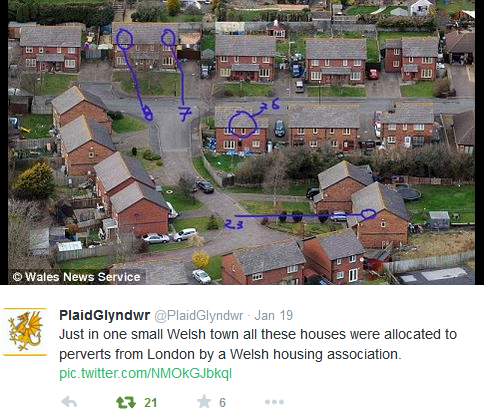
Elsewhere in the Wales Eye piece there is a graphic of some houses in Kidwelly explained by, “In another post, endorsed by the blog with a re-tweet, families from London who took houses from a Welsh housing association were called ‘perverts'”. WalesOnline says it this way: “In another Twitter posting, re-tweeted by the blog, families from London who took houses from a Welsh housing association were called “perverts”. An aerial picture singles out a number of homes and the tweet says: “Just in one small Welsh town all these houses were allocated to perverts from London by a Welsh housing association.”

Note that this, like the petition, is something else that did not originate with me. Parry is getting pretty desperate now, so here’s the truth. The case referred to is one of a paedophile gang living Dennis' Kidwelly tweetin Kidwelly that was imprisoned in 2011. Here’s a report on the case from the Daily Mail. Here’s a blog post I wrote around the same time. At the risk of frightening Parry and Shipton with facts, here they are: These people had moved – or been moved – from London; they were housed in Kidwelly by a Welsh housing association (Grwp Gwalia); they were all found guilty of paedophilia and other sexual perversions in a court of law. So what is the issue here? The caption to the picture in the tweet is 100% correct. Parry seems to take offence because the tweet calls them “perverts” – so what would he call them, the perfect neighbours? Or maybe he doesn’t like the fact that it was re-tweeted 21 times.
The reason Parry uses this case – which he obviously hasn’t researched – is because it concerns Welsh social housing being given to English people who are labelled “perverts”; which he hopes to use as an example of ‘racial hatred’ in order to confer something resembling credibility on his hysterical reaction to a perfectly reasonable petition. Trouble is, for Parry, that these people weren’t called “perverts” because they were English, they were called “perverts” because they were . . . you paying attention, Parry! Shipton! – PERVERTS.

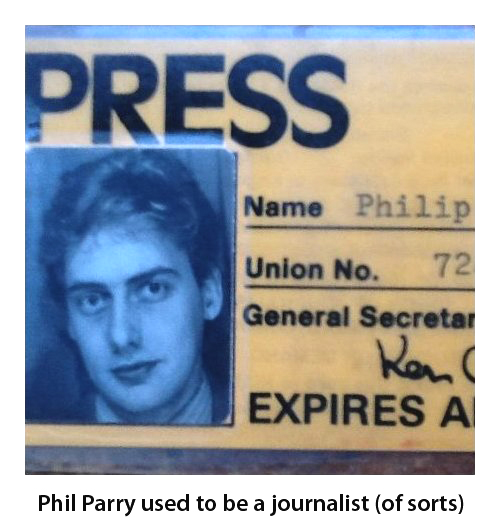
Here’s an update on the case from last September. Note the English flag outside Colin Bately’s house – for he was a patriot! Complete with two rottweilers. Just think, Welsh housing associations are taking in people like this, knowing what they’re like, because this gang had Phil Parryconvictions before they moved to Wales.
Anyway, I don’t fancy wasting much more time on Parry and Shipton, I’ll just conclude with the final lines from Shipton’s contribution to this joint-venture into fantasy. He says: ‘”Mr Jones said: “Not my petition. I’m just promoting it for Plaid Glyndwr.” It is understood that South Wales Police will not forward the complaint about Mr Jones to the Crown Prosecution Service.’ This was obviously added after the piece had been written, otherwise he wouldn’t have started by saying I’d “launched” the petition. But it also raises other questions.

For example, seeing as Parry and his fat friend were in cahoots over this attemped smear, and the pretext was the ‘racist’ petition, why was I / my blog reported to the police when they both knew it was not my petition? Because even before my tweet to Fatso on Monday the most cursory check would have shown who actually launched the petition. Are these people really journalists!

“South Wales Police will not forward the complaint about Mr Jones to the Crown Prosecution Service”well, I am relieved; I feared I was bound for the Colonies! But will the police charge whoever made the complaint against me with wasting police time? Come to that, who did report me, for Wales Eye neglects to tell us. Now, I wonder . . .

 *

The truth is – as any perceptive reader will have guessed – these attacks on me have nothing to do with Protic or petitions, it’s an exercise in black propaganda, or to put it an another way, mud slinging. Done so that anyone Googling ‘Royston Jones’ or ‘Jac o’ the North’ in future will turn up crap like this by Parry and Tub O’Lard. And see that I have been reported to the police. Done to discredit me and, by extension, anything I write. So who’s behind it?

Well, my guess is that it can explained by what I write about. My usual targets are the Labour Party and the Third Sector, which is simply an extension of the Labour Party. It may be no coincidence that this latest attack from Wales Eye comes just days after the latest – possibly final – edition of Cambria magazine became available, which contains my article on housing associations, in which I ask why we have so many of them, and why these quasi-private companies receive so much public funding, and why so much of the money they’re given ends up over the border.

Another subject I’ve touched on recently is Canoe Wales and the National White Water Centre on Afon Tryweryn. Today I received the response from Sport Wales to an FoI I’d submitted about funding to Canoe Wales. Read it here. In a poor country where so much needs to be done, how can anyone justify wasting almost two million pounds in just five years on canoeing, an activity that has little or no Welsh involvement? (And there’s almost certainly public funding from other sources.) That’s how Wales is run today, but you aren’t supposed to know. Ask yourself, are you going to get the truth from the BBC, or ITV, or the Western Mail?

I know how corrupt this country is, and I’m beginning to understand just how much money is squandered year after year on a system of sham devolution designed to encourage colonisation and managed decline rather than make Wales a better country for those who belong here. That’s why I have enemies. Enemies so desperate to discredit me they’ll even use clowns like Parry and Shipton. What will they try next?

P.S. Don’t forget to sign the petition!

UPDATE: In the personal attack on me in his latest post Phil Parry refers back to the Jacques Protic case. I have covered most of the angles in this recent post. Parry seems to think he’s on a winner with this, and keeps bringing it up, almost showing off. What I’m saying can perhaps be explained by this extract.

Wales Eye NWP docs

The “inquiry” referred to is a North Wales Police investigation into me or my blog for nasty things it’s claimed I said about Jacques Protic. Reading the extract in the panel, a number of questions arise.

  • By what route did Phil Parry obtain internal police documents; did they come directly from the police, did they come from Protic, or from some third party?
  • As the officers involved in the “inquiry” were first named on Wales Eye on September 10th last, and North Wales Police was made aware of this in my letter received (and acknowledged) on September 17th, we must assume that NWP has no objection to the contents of confidential police documents being aired on a blog.
  • That being so, what is the relationship between Parry and the North Wales Police? Is he working for them, or are the police merely a conduit for some other agency?
  • Even if Parry has no relationship with North Wales Police, then we still need to know why NWP has allowed confidential documents, naming and embarrassing its officers, to be in the public domain for over four months.
  • I wonder what the police response would have been I’d got hold of internal police documents and splashed them on my blog?

I believe it’s time for a little honesty from those involved in this ongoing smear campaign against me.

The Destructive Power of Tourism

A few days ago I was directed to a piece on the MailOnline website about Barcelona or, more specifically, tourism in Barcelona or, to be really, really specific, high volume and damaging tourism. The problem is that “uncontrolled tourism” is attracting too many low-spending tourists who are turning Barcelona into a ‘theme park’ and making locals feel like strangers in their own city. To give some idea of the perceived problem, in 1993 the city attracted 2.5 million visitors but by 2012 that figure had quadrupled to 10 million. Going to YouTube turned up other videos on a similar theme. One about the Lake District, this one about Snowdonia. And there are others.

Does all this sound familiar – hordes of cheapo tourists over-running a place and making the locals feel like strangers? Of course it does, because it’s what happens in Wales. Though the citizens of Barcelona should be thankful that their city isn’t being bought up by these visitors, looking for holiday homes, a lifestyle change, or somewhere to retire to. Nor is it destroying the Catalan language and identity. And I guarantee that most of the businesses taking the tourists’ money are run by natives of Barcelona. (Though the pickpockets mentioned almost certainly come from further east.)

Wales tourism stats
Click to Enlarge

The traditional reason that Wales is a low-spend destination for tourists is because tourism in Wales was developed for the convenience of England, not for the benefit of Wales. Which has meant that in practice, we – or those who run tourism here – target English tourists saving their major outlay for holidays abroad, encouraging them to use Wales for weekend breaks and secondary holidays. Then, because these English tourists don’t spend much, we must have them in damaging and unsustainable numbers. This recent news story even rejoiced in the fact that Wales is “affordable” / cheap, without apparently realising that ‘cheap’ is also a derogatory term.

Though the story in WalesOnline is rather confusing. It claims a record 9.93m tourists spending a record £1.7bn in 2013. Yet the figures on the ‘Welsh’ Government website, for 2012 (see panel), claim 10.45m tourists (from the UK and overseas) spending £2,44bn. Presumably the article refers only to tourists from within the UK, though this is not stated.

Numerate readers (of whom I have many) will have worked out that this means in 2012 UK visitors spent on average £165 (up to £171 in 2013), whereas overseas visitors spent on average £405. So why aren’t we doing more to attract overseas visitors, of whom we’d need fewer? Well, in addition to the explanation given above, tourism in Wales also has a political purpose, in that it anglicises Wales; partly by smothering areas in English tourists for months on end and partly by encouraging English tourists to make a permanent move to Wales. And don’t overlook the financial benefits . . . to England. Money spent in Wales by English tourists will eventually make its way back to London, unlike money spent abroad.

(The panel from the ‘Welsh’ Government website also quotes “around 100 million day visits” earning “over £3bn”. I have ignored these figures mainly because we are expected to believe that these are all day trips made from outside Wales; they are not. The most popular pay-to-enter ‘tourist attraction’ in Wales is Swansea Leisure Centre. Most visitors come from within a 15 mile radius. Your next shopping trip or day out in Wrecsam, Llandudno, Aberystwyth, Brecon or Carmarthen may count as a ‘day trip’. So you will understand why I treat such figures with caution, if not contempt. The (nicely rounded) figures for day trips get wild guesswork a bad name, but are, regrettably, what we expect with tourism ‘statistics’.)

The table I’ve compiled (and I hope it’s clear) gives some figures for the tourism industries in Ireland, Scotland and Wales for one year. (Click to enlarge.) The figures for Ireland and Scotland were fairly easy to come by, but not so with the figures for Wales. The ‘Welsh’ Government website is difficult to negotiate, full of guff and propaganda on tourism but low on facts. So I went to StatsWales, the ‘Welsh’ Government’s specialist group for statistics – actually part of an English government department – but the most recent figures available there are for 2010. (A regular failure with StatsWales.)

Tourism table
Click to Enlarge

A few observations from the table. As an example of how little Wales really earns from tourism note that visitors from the Six Counties to the Republic spent £225 per head, even though many would have been staying with friends and family, or making just a short trip (e.g. Derry to Donegal). Compare this to UK visitors to Wales, who spent just £165. UK visitors to Scotland spent £227 per head. In addition, Scotland made over one billion pounds more than Wales from overseas tourists. Spend per head can be equated with the profit margin, which means that when other considerations – cultural damage, traffic congestion, environmental degradation, etc  – are factored in to the equation then tourism in Wales is a loss-making, bargain basement business. To tourism what the Reliant Robin is to automotive technology. Nothing to be proud of.

Furthermore, reReliant Robinmember that Ireland and Scotland are some four times the size of Wales and both see a ‘spread’ of tourists across the land, whereas most of those who come to Wales head for the west and the north, and stick fairly close to the coast. This, inevitably, results in the kind of overcrowding and unsustainabilty being complained of in Barcelona.

Given the damning facts why is ‘Welsh’ tourism trumpeted as a great success story that cannot be improved on? Why are we constantly reminded that our rural and coastal areas were wastelands ere the arrival of English tourists, and without them to wastelands they will return? In a word, we’ve been brainwashed. We can either continue accepting this ludicrous – and, frankly, racist – propaganda or we can start arguing for a tourism industry for the twenty-first century rather than the nineteenth, one that serves Wales and Welsh people.

Fundamentally, and for benefits across the board, we need to attract more overseas visitors and fewer low-spend tourists from England. To do that we must ditch the defeatist argument that says Scotland and Ireland have a higher international profile. Because even though this may be true today, there are successful tourism destinations now that were unknown a few decades ago. It comes down to promotion, and priorities.

The first priority is for the soi-disant ‘Welsh’ Government to start living up to its name, by putting Welsh interests first. A phased move from caravans to serviced accommodation would be a start. Tourism taxes – especially at ‘hot spots’ – would be another step in the right direction. The second priority must be minimising the influence of the tourism operators who currently control long-term and strategic planning. Few of these are Welsh and consequently have little regard for the damage being inflicted. Too many are driven by self-interest and believe there can never be too many tourists. That’s the major problem with tourism – if you allow it to be run by such people then you end up with the problems of Barcelona, or Venice, or Prague, or Wales. Restraining influences are needed.

Housing in Carmarthenshire

There was a piece in today’s WalesOnline by Graham Henry telling us that Wales needs a few hundred thousand more dwellings than are currently planned. I don’t know who fed him the story, but I suspect the Wales-based statisticians of the Knowledge and Analytical Services, who answer to the Department for Communities and Local Government (DCLG) in London. I say that because anyone doing serious journalism on housing projections and Local Development Plans would be bound to mention the Planning Inspectorate. Not mentioning this executive agency of the DCLG is rather like discussing the current upheavals in Welsh rugby and ignoring the role of the Welsh Rugby Union.

What is perhaps worse is that this omission allowed the article to be read as if Welsh local authorities are solely responsible for deciding how many new homes will be built. They are not. That power rests with the Planning Inspectorate, which does not hesitate to regularly insist that councils increase the number of new homes to be planned for. Councils accept these diktats because they simply cannot afford to challenge them, with the Planning Inspectorate backed financially by the UK government.Household projections Carmarthenshire

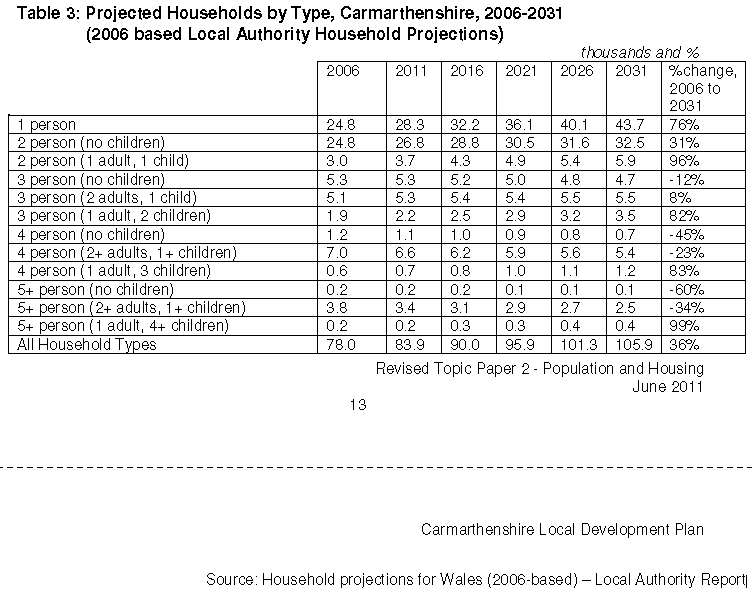
As the WalesOnline article focused on Carmarthenshire let’s look at the county’s Local Development Plan (of October 2013). Go to section 5.4.7 and we learn that the council anticipates an increase in population from 175,063 in 2008 to 192,740 in 2021, and a projected increase in households in the same period (5.4.8) of 15,197. (The 2011 census gave Carmarthenshire’s population at 181,227.) That the number of new households is not much smaller than the projected population increase is due partly to new families forming, partly to in-migration but mainly to projected smaller household size. In fact, before I started investigating housing and planning in Wales I hadn’t appreciated the importance of the household size figure. Yet it’s difficult to make sense of LDPs and other demands for housing without understanding the relationship between population growth and household size. Put simply, a household means a dwelling. If the projected population increase for an area was 20,000, and average household size was four persons, then a council would need to plan for the building of roughly half the homes needed if the household size was only two persons. Smaller households = more dwellings.

The table above right (click to enlarge) is taken from a June 2011 document, Population and Housing – Revised Topic Paper 2, used to inform the Carmarthenshire LDP. It tells us that the statisticians predict massive increases in the following types of households: single people, couples, and single parents with children. The figures come from, Household Projections for Wales (2006-based), which sees household size in the county drop from 2.25 in 2006 to 2.04 in 2021. Though seeing as this Topic Paper was produced in 2011 it’s strange that it used the 2006 figures rather than those for 2008, which predict a slightly higher average in 2021. It should be pointed out here that the Office for National Statistics has “sourced out” household projections to the Department for Communities and Local Government in London. This being the department to which the Knowledge and Analytical Services (KAS) answers.

Living at homeSo how reliable are these household size projections? Not very. The 2011 census tells us there were in Carmarthenshire 78,800 households of one or more persons. If we divide this into the population figure of 181,227 it gives us a household average size of 2.30. Obviously this is not exact, but even so, it is higher than the KAS estimate for 2011 0f 2.17. Other information suggests that, far from falling, household size may actually be rising. For example, this recent report tells us that an increasing number of young adults are living at home with a parent or parents, and that this trend was observable before the economic downturn. (See panel, left.) Then, the UK government plans to cut housing benefit for under 25s rather than reduce universal pensioner benefits. Both measures are bound to increase household size. And, as a consequence, reduce the need for new housing.

No one reading this must think that I’m talking only of private, open market, dwellings, for these projections also apply to social housing, which is covered in the Housing (Wales) Bill (see recent posts). This legislation, handed down by the Department for Communities and Local Government in London, will ‘harmonise’ the provision of social housing in Wales and England. In other weopposebedroomtaxwords, anyone qualifying for social housing in England will automatically qualify for social housing in Wales. Which, when added to the UK government’s welfare reforms (such as the ‘bedroom tax’), might explain the Carmarthenshire household projections in the table above . . . if Carmarthenshire is being prepared for an influx of single mothers and others from the Great Wen.

Before concluding I must return to private housing in order to bring to your attention the remarkable transformation that occurs between statisticians’ projections and housebuilders’ planning applications. As we have seen, statisticians argue for ever smaller household size, due to more and more people living alone and an increasing number of childless – usually retired – couples. One team of academics employed by the ‘Welsh’ Government (or someone) told us that, “Of the projected net increase of 269,000 households between 2006 and 2026, 66 per cent are one-person households and 21 per cent one-parent families. ‘Couple’ households contribute 16 per cent of the total increase in households”. (Numerate readers will have noted that these three categories alone add up to 103 per cent!) Which should result in the vast majority of properties built being one- and two-bedroom dwellings – but they’re not. The latest figures available, July – September 2013, tell us that 62.6% of completed dwellings in Wales were three- and four-bedroom houses!

Clearly, a deception is being practised. On the one hand, the UK government and its Wales-based statisticians predict – against increasing evidence – smaller households in order to bump up the number of new properties needed. But then, the Planning Inspectorate, working with housebuilders and others, takes the ‘new dwellings needed’ figures, transforms them into much larger dwellings, and forces Local Development Plans on our councils. We are being made to build social housing to meet an English demand, and also private housing, from Carmarthenshire to Denbighshire, to accommodate a wealthier English influx. All part of a wider strategy of colonisation.

The Local Development Plans for Carmarthenshire and other local authorities were rushed through before the underpinning ‘statistics’ could be invalidated by: a) the consequences of the economic crisis that began in 2008 and b) the 2011 census. Almost as if the Planning Inspectorate and the statisticians knew they had only a short ‘window’ in which to force their plans on our local authorities. Now that we have more reliable statistics the Local Development Plans thus far adopted are invalidated. They must be revised. From now on we must plan for Welsh need and Welsh need only.