Devolution Is Cardiff Council On Stilts

To explain the title . . . Back in the 1960s and 1970s, when there was any talk of a Welsh Parliament, Home Rule, or devolution, one of the arguments used against the idea was that such a creation would just be “Glamorgan County Council on stilts“.

The implication being that other parts of Wales would be ignored. That investment, jobs and other goodies resulting from self-government would be concentrated in that area.

In this piece I’ll try to persuade you that what we’ve seen since 1999 is even worse.

FIRST SECRETARY, FIRST MINISTER

I’m going to begin by looking at the first secretaries and first ministers we’ve had since the beginning of the devolution experiment.

The first, said to be Tony Blair’s choice, even “Blair’s poodle“, was Alun Michael. He was never very popular, either within the Labour party or the country at large, and was first secretary for just nine months, until May 2000.

A former Cardiff City councillor, he later served as Labour MP for Cardiff South and Penarth. Then Regional Assembly Member for Mid & West Wales. And PCC for South Wales.

Michael was replaced by the much more popular Rhodri Morgan. Who stayed in the first minister role until December 2009.

Cardiff-born Morgan was MP (until 2001 GE) and AM for Cardiff West from 1999.

Next came Carwyn Jones. Despite being born in Swansea, and practising law there for a number of years, he represented the Bridgend constituency. His Cardiff connection was established by being a tutor for a few years at Cardiff University.

I’ve said it many times on this blog, and I’ll say it again, Cardiff University is joined at the hip to the local Labour establishment. The School of Journalism should be renamed the School of Globalist-Left Propaganda.

Jones stood down as leader in December 2018. He now sits in the House of Lords as Baron Jones of Penybont.

He was succeeded by Mark Drakeford, a former South Glamorgan County councillor who became the Assembly Member for Cardiff West in the May 2011 elections.

Drakeford was born and raised in Carmarthenshire, but moved to Cardiff over 40 years ago. And was a lecturer at Cardiff University.

From 1985 to 1993, Drakeford represented the Pontcanna ward on South Glamorgan County Council, with fellow future Welsh Assembly members Jane Hutt and Jane Davidson as his ward colleagues.

(Jane Davidson was at the Rio Earth Summit in 1992, Labour AM for Pontypridd (1999 – 2011), and wrote the Well-being of Future Generations legislation that enforces ESG and DEI in every aspect of Welsh life.)

Drakeford stood down as first minister in March 2024. He will not stand again in May.

Then came the brief tenure of his successor Vaughan Gething. After serving as councillor for the Butetown ward on Cardiff City Council he became the Senedd Member for Cardiff South & Penarth in 2011.

Gething is also standing down.

Gething was succeeded in August 2024 by the current incumbent, and former MEP, Eluned Morgan, the Regional Member for Mid & West Wales.

Born and raised in Cardiff she sits in the House of Lords as Baroness Morgan of Ely.

So we see a Cardiff connection with all first secretaries or first ministers Wales has known in 27 years of devolution. And with five out of the six a strong connection.

Given that Cardiff makes up some twelve per cent of Wales’ population, this statistic is truly remarkable. And should be concerning.

SOME INTERESTING SENEDD MEMBERS

Beginning with Bridgend, where we find Sarah Murphy. Who was born and raised in Pontypridd then, after Reading University, worked in Seoul and London. She came back to Cardiff; held posts with the Labour party, and the University. More exactly, the School of Journalism.

Next, Cardiff Central. The patch of uber wealthy Jenny Rathbone since 2011. She’s a member of the Rathbone dynasty of Liverpool, where she was born. Her knowledge of Wales is on a par with that of a stay-at-home Eskimo. Limited to Cardiff and the area around her holiday home up in Llanfihangel Glyn Myfyr.

Hubby, John Uden, who knows as much about wind power as the heretofore mentioned Innuit knows of Wales, somehow managed to get on the ‘Welsh Advisory Board’ of Bute Energy. Which was handy, seeing as Mrs Uden sits on the Senedd’s Climate Change, Environment and Rural Affairs Committee.

She’s standing down in May. Her vacuous wittering will not be missed.

Cardiff North is where we find Julie Morgan, widow of Rhodri. Cardiff born and bred, she is a former South Glamorgan and Cardiff City councillor, and was elected to the Senedd in 2011 after losing the Westminster seat of Cardiff North in 2010.

She is also standing down.

Cardiff South & Penarth is held by former first minister, Vaughan Gething. (See above.)

Cardiff West is held by former first minister Mark Drakeford (See above.)

Cynon Valley brings up Vikki Howells, who was born and raised in the constituency, and attended Cardiff University.

The SM for Llanelli Lee Waters is definitely a member of the Corruption Bay in crowd. A former ITV Wales journalist, director of think tank IWA, then director-lobbyist for bike charity Sustrans, he’s the man responsible for the 20mph restrictions.

Despite being SM for a seat west of Swansea, he lives just outside Cardiff.

He’s standing down in May.

Now we head up to Merthyr where the local representative is Bristol City fan Dawn Bowden. Another Bay insider who worked her way up through union ranks but who knows as much about the Heads of the Valleys as the denizen of the frozen north I mentioned earlier.

But that doesn’t matter – she was promised a safe seat.

Which she’ll thankfully vacate in May.

Another carpet-bagger can be found in Pontypridd in the form of Mick Antoniw. He came to Wales to study at Cardiff University, and stayed. One of those who drove through the absurd and corrupt voting system we’ll be using in May.

Of Ukrainian descent, he’s made a number of very public trips there to deliver ‘aid’. If Wales was independent he’d want us to declare war on Russia.

Another one standing down.

A odd one now, in Julie James, SM for Swansea West. Odd, because even though she was born in Swansea, travelled around a lot in her early life, she was involved in the Gilestone farm saga before being elected to the Assembly in 2011. As a solicitor working against the then owners, which paved the way for the land to be bought by someone’s chosen buyer.

Also standing down.

Moving east to Torfaen, ‘though born in Merthyr, Lynn Neagle is definitely part of the Bay Bubble. Wife of former Labour AM Huw Lewis.

Neagle has worked for, “Shelter Cymru, Mind and the CAB. She was Carers Development Officer with Voluntary Action Cardiff and also worked as a researcher for Glenys Kinnock MEP“.

And, finally . . . Jane Hutt, who sits for the Vale of Glamorgan, is another who moved to Wales to involve herself in charities and third sector bodies: National Co-ordinator of Welsh Women’s Aid, South Glamorgan Women’s Workshop, Tenant Participation Advisory Service and Chwarae Teg (Fair Play) . . .

Thankfully, she’s also standing down.

REGIONAL SENEDD MEMBERS

Due to winning so many seats in the south and the north east Labour has just three Regional SMs. One in the North. Here are the two from the Mid & West.

One of course, is Eluned Morgan, the current first minister. (See above.)

The other is Joyce Watson. And she may be unique among Labour SMs because her official bio says: “Joyce has run several small businesses – public houses, restaurants and retail outlets – in Ceredigion, Carmarthenshire and Pembrokeshire.”

But did she own them?

But even that ray of hope is dimmed by the usual charity/third sector involvement: “Joyce managed the Wales Women’s National Coalition . . . senior member of the Wales Gender Budget Group . . . NHS Equality Reference Group”.

Watson is another jumping the sinking ship of devolved politics in May.

WHAT IT MEANS

Let’s start with a statistic. The population of Wales grew between the census years of 2001 and 2021 by 6.8%. In the same period Cardiff saw growth of 18.7%. According to some, Cardiff is now the fastest-growing city in the UK.

Most areas of Wales saw negligible growth, with some even recording a fall. Ceredigion, Blaenau Gwent and Gwynedd have declining, and ageing, populations; while Merthyr and a few other areas struggle to maintain their numbers.

Newport’s population increases steadily since charges on the Severn Bridge were abolished, which allowed buyers from England to access the cheaper housing in south east Wales and commute daily to Bristol, or even further. While in many rural areas population increase is due to retirees and good-lifers moving in.

But turning Newport into a Bristol suburb and rural areas into al fresco retirement homes is neither desirable nor sustainable.

Welsh life is increasingly focused in Cardiff, for the benefit of Cardiff. This can be explained by a number of factors. The first, quite obviously, is political power. Then there’s the third sector, charities, pressure groups, which both feed off and feed into the political system.

A political machine serviced by regiments of spads, assistants and researchers, whose loyalty can be guaranteed by the carrot of a council seat, or, for the very lucky – a seat in the Senedd.

But let’s not overlook other beneficiaries, such as those to be found among the movers and shakers of the local business community.

An example would be the Thomas brothers, of the pie and pasty dynasty. It’s universally accepted that the ‘Welsh Government’ paid way over the odds to buy Cardiff airport. But who was the vendor?

And who bought that criminally undervalued land on the outskirts of Cardiff?

In both cases the lucky boy was Stan Thomas. Hot pies all round!

If you want a fuller picture, read a couple of pieces I put out ten years ago. Pies, Planes & Property Development, and Pies, Planes & Property Development 2.

But it’s not just the Thomas brothers. There are others.

Then there’s sport. Through funding, the ‘Welsh Government’ effectively took control of the Football Association of Wales and the Welsh Rugby Union.

Which explains why, when Cardiff Rugby went bust the WRU stepped in to buy it. And why the most successful region, the Ospreys, based in Swansea, is threatened with extinction.

The last-but-one owner of Cardiff Rugby was the late Peter Thomas, Stan’s brother.

The clowns currently wrecking Welsh rugby are political appointees, and they’ve been told to prioritise the interests of Cardiff. To the detriment of Welsh rugby as a whole.

Finally, there’s the media. Based in Cardiff and little more than a mouthpiece for those I’ve described above.

And all the while, our economy and our essential services decline and decay.

WHAT MIGHT THE FUTURE HOLD?

If polls are to be believed then Plaid Cymru will emerge in May with most SMs, but not a majority. This will mean Plaid going into coalition, or having an ‘agreement’, or an ‘understanding’, most likely with Labour, possibly with the Greens.

We might even see a ‘progressive’ alliance of all the Globalist-Woke parties. It really won’t make much difference. (But what a nightmare that could be!)

Now some might think that with so much of its support being in the west and the north Plaid Cymru will adopt a different approach. And there might be a few moves away from the obsessive focus on Cardiff, but Plaid would be no real improvement.

Because Plaid wants to take Wales further than Labour on ‘ishoos’ such as Net Zero, trans ‘rights’, DEI, Gaza, ‘Islamophobia’, and decolonising Welsh cakes. And faster down the road of economic implosion and civilisational decline.

Party leader Rhun ap Iorwerth may be the Senedd Member for Ynys Môn, the seat furthest from the Bay, but he’s a former BBC journalist. He was educated at Cardiff University and he’s lived in Cardiff.

And ap Iorwerth may be a figurehead; for many believe the party is still controlled by the acolytes of a previous leader, the PoundShop Pasionaria of Penygraig.

Whatever the outcome in May in party terms, it won’t make much difference. Plaid, Greens, Labour, Tories, Lib Dems, they’re all just differently-badged elements of the Globalist Uniparty. That’s why they repeatedly tell us the upcoming election is solely about defeating Reform.

Is it?

Then again, Labour might welcome a ‘break’. Shun any co-operation, then come back untainted and refreshed in 2031. Hoping electors will have forgotten their record in the Senedd.

And who might lead the Labour comeback? If I was a betting man I’d put a few quid on Huw Thomas. If you’ve never heard of him, let me introduce him.

Huw Thomas, courtesy of Getty Images

He’s 41 years old and from Aberystwyth, he’s bilingual, and he’s been leader of Cardiff Council for nearly 10 years. In May, he’s top of the Labour list for the Caerdydd Penarth constituency.

He’s guaranteed to be elected because Cardiff is an area where Labour will do well.

UPDATE: Soon after posting this article at 9am I went to Tywyn, picked up a Western Mail, read it while having my first coffee of the day. In this article Huw Thomas gets a mighty plug.

If it comes to pass as I predict, and Labour gets back into power in 2031, under his leadership, then everything will revert to the status quo ante Plaid, with Cardiff grabbing the lion’s share of investment and jobs.

Which, to respectfully amend Lincoln’s Gettysburg Address, will mean a return to: Government of Wales, by Cardiff, for Cardiff.

♦ end ♦

© Royston Jones 2026

Buy Me A Coffee

Pot Pourri 12.12.2018

As you can see, this is another big one. But it’s made up of five separate reports: Hendy wind farm, recent events in Swansea and Llanelli which may – or may not – be linked, the Bodnant Welsh Food Centre, the redevelopment of the Tower opencast site, and finally, the leadership election in a non-existent political party.

So you can either make yourself a panad, settle down and go through the lot in one go. Alternatively, you can take them one at a time. The choice is yours.

Unless something big crops up this might be my last posting until 2019. If that’s how it turns out, then . . .

HENDY WIND FARM: WHO GAVE THE WORD? WHEN? WHY?

A few weeks ago, in Corruption in the Wind, I looked at three wind farms: Bryn Blaen, near Llangurig; Rhoscrowther, near Milford Haven; and Hendy, near Crossgates. All being promoted by the same property company. 

Hendy wind farm merits another visit.

You’ll recall that Hendy was refused planning permission by Powys County Council and this decision was upheld by a planning inspector in May this year. But then, in late October, Lesley Griffiths, Energy, Planning and Rural Affairs Secretary for the management team in Cardiff docks, said that she would over-rule the planning inspector’s decision and allow Hendy to proceed.

The landscape to be desecrated by Hendy wind farm, click to enlarge

In the earlier piece I argued that what triggered the change of heart over Hendy was the High Court decision in September to finally put a stop to the Rhoscrowther project on the Milford Haven Waterway.

Prior to that High Court decision the developers had Bryn Blaen in the bag, were hopeful of getting Rhoscrowther, and were probably resigned to writing off Hendy, taking the view that two out of three ain’t that bad. But once Rhoscrowther was lost they were down to one out of three – they had to have Hendy.

Here’s the sequence of events leading to where we are at present.

The Construction Environmental Management Plan we encountered in the bullet points above should have been produced before work started, but in the case of Hendy it’s dated November 19, six weeks after on-site work started. 

The more I think about it, the more I believe there’s only one way to explain the panicky happenings at Hendy.

The decision to allow the Hendy wind farm was taken in London after approaches by the developers following the Rhoscrowther decision. (For despite the Planning Inspectorate having a desk in Cardiff it answers to the Department for Communities and Local Government in London.)

A political decision taken in London was passed to the Planning Inspectorate and only belatedly relayed to Lesley Griffiths when someone remembered about devolution. (Further proof that what masquerades as the ‘Welsh Government’ is just London’s management team in Wales.)

Worth mentioning may be that the landowner at Hendy is Sir Robert John Green-Price 5th Bt. It’s reasonable to assume that Sandhurst-educated Sir Robert has influential friends. It’s equally reasonable to assume that the developers, Marcus Owen Shepherd, Matthew Simon Weiner and Richard Upton, also ‘know people’.

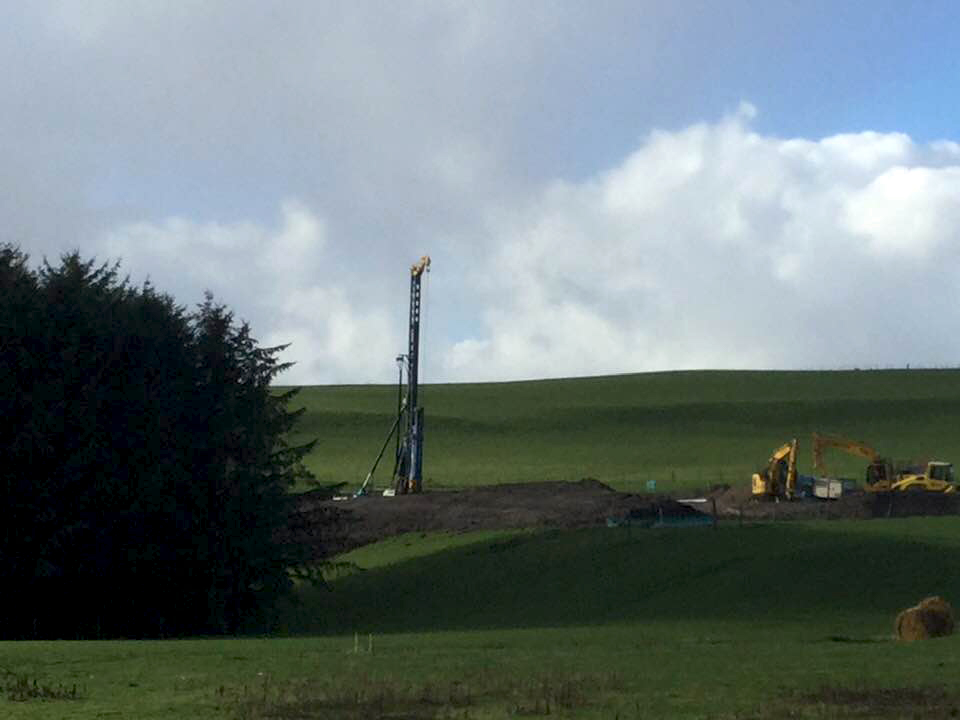
Last week the developers were pile-driving at the source of the Edw, a Special Area of Conservation. All being done in the name of ‘conservation’ and ‘the environment’. The Edw runs south to join the Wye at Aberedw.

Pile-driving in an SAC at the source of the Edw, click to enlarge

Where, last Sunday, a day after the Cilmeri commemoration, people remembered a hero who may have been betrayed. How fitting that they should gather at Aberedw, by a river being polluted by modern invaders assisted by today’s traitors.

TIDAL LAGOON PUTTING WIND UP WIND FARMERS?

One of the more interesting schemes promoted in Wales in recent years was the Swansea Bay tidal lagoon. It eventually failed because the UK government refused to support it.

Yet it had a great deal of backing from people who pointed out that the electricity generated by the Swansea lagoon, a relatively small prototype, was bound to be expensive, but the possibilities of tidal power are immense and larger lagoons would be cheaper all round. For one thing tides, unlike wind, are entirely predictable and therefore reliable.

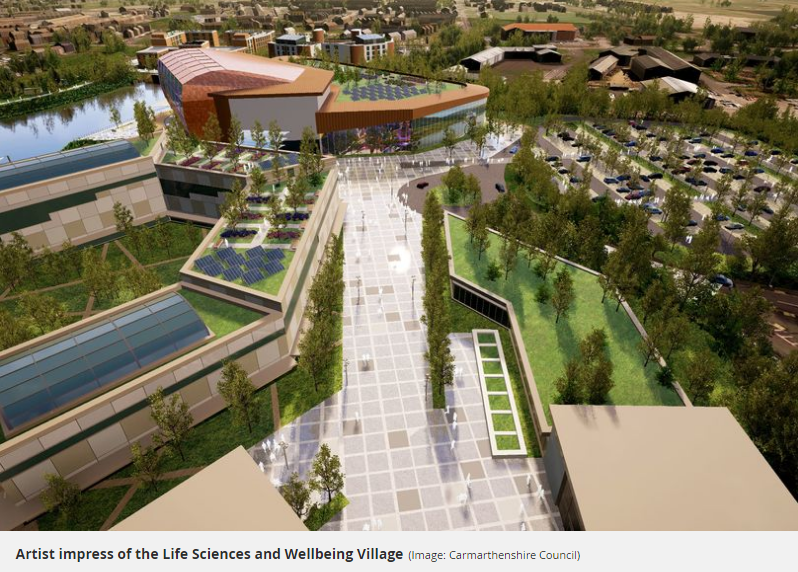
Not far away from the proposed tidal lagoon we saw one of the more extravagant schemes mooted in recent years in the £225m Wellness Village in Llanelli’s Delta swamp, being promoted chiefly by Carmarthenshire chief executive Mark James and Swansea academic Marc Clement, the latter a Turk by birth.

click to enlarge

This project was to be part-funded from the £1.3bn Swansea Bay city deal.

Clement and a few other senior academics in Swansea, including the vice-chancellor, were recently suspended and it was generally agreed that this was somehow connected with the Wellness Village, certainly Clement was connected. Though no Llanelli connection could be established for vice-chancellor Richard B Davies or the other two, unnamed, persons who were suspended.

It was no surprise then that following the Swansea suspensions the Wellness Village seemed to get poorly. Within a very short time the infection spread and now a review has been ordered of the whole city region deal.

But why should the London government suddenly be so concerned about doings in south west Wales?

I’ve been giving this matter some thought, and here’s what I think.

Just a few miles from Swansea Bay lies Mynydd y Gwair, on the northern outskirts of the city. This was an area of wild and unspoilt upland . . . until fat grants were introduced for wind turbines.

Then the owner of Mynydd y Gwair, the Beaufort Estate (Prop. Duke of Beaufort), decided it could make millions by covering this beautiful area with ugly, useless, bird-killing wind turbines. This is the same Beaufort Estate that ten years ago charged the city council £280,000 to put a footbridge over the Tawe near the Liberty Stadium.

click to enlarge

Beaufort and his ilk are descended from medieval robber barons, and they still know how to extract money from the rest of us.

It’s the same across this island. In Scotland the descendants of the Parcel of Rogues and assorted foreign landowners are minting it with wind turbines; while in England it’s a similar story, with former PM David Cameron’s father-in-law among those raking it in.

And linked with them are the property men and experts who will do all the dirty work, and reap their own rewards, those we see behind the Hendy wind farm.

And so there must be a possibility that the UK government is ‘reviewing’ the Swansea Bay city deal because Swansea council is threatening to resurrect the tidal lagoon, for that might be disastrous for the wind farmers who are so close to the Tory party, and in many instances, fund it.

‘But, Jac, what about the suspensions at Swansea University and the Wellness Village?’

The Wellness Village was up Shit Creek anyway, no private money was going to appear. It has simply been written off early before any more public money is wasted. As for the suspensions, the Wellness Village might have been a useful distraction.

Put the Wellness Village to one side and remember that the university is also heavily involved with Tidal Lagoon Mk II. It was the university that commissioned the recent report – on behalf of the Swansea Bay City Region – into reviving the barrage project.

Then look at the plan. Swansea University’s new Bay Campus is at the eastern landfall of the proposed lagoon. Students would have fought to get into a university with its own private beach which also overlooked a ground-breaking tidal lagoon offering many recreational facilities.

click to enlarge

But as I say, a revived Swansea tidal lagoon might be bad news for those behind Hendy wind farm, and for Lord Beaufort, also for the repackaged Parcel of Rogues, and of course for Sam Cam’s daddy.

We may need to look no further to explain the UK government’s decision to ‘review’ the Swansea Bay city deal.

BODNANT WELSH FOOD CENTRE

Another recent business failure was the collapse of the Bodnant Welsh Food Centre in Dyffryn Conwy. Though it now looks as though it has been saved by local teacake tycoon Richard Reynolds (who I’m sure is no relation to Rikki Reynolds of Weep for Wales notoriety).

In all the excitement too many have neglected to ask the basic questions about Bodnant, such as: Who’s calling the shots? Why was a grant of £6.5m made? Should that money have been allocated? Was the money used well? Why did Bodnant Food Centre collapse? What happens now?

The first thing to explain – and this is fundamental to understanding the bigger picture – is that the Bodnant Welsh Food Centre, opened in 2012 by Charles Windsor, is part of the Bodnant Estate, run by The Hon Michael Duncan McLaren QC, educated at Eton and Cambridge.

Michael McLaren’s father was the third Baron Aberconway, but this son has not succeeded to the title because he’s trumped by an older half-brother, Henry Charles McLaren, from his father’s first marriage (though there may be a dispute over entitlement).

Bodnant Estate, click to enlarge

You won’t find Bodnant Welsh Food Centre on the Companies House website because it trades as Furnace Farm Ltd, and this company was Incorporated with Companies House 20 October 2005. Furnace Farm is where we find the venture that received the £6.5m grant, but this is little more than a fancy shop selling overpriced food. 

For as a source put it to me: Dry home cured bacon for sale at £23/kg, yet both butchers at Llanrwst, some four miles away, were selling at £7.55/kg! Both butchers from known local sources!!”

Maybe at this point I should explain that despite not having succeeded to the title, Michael McLaren owns the whole shooting match, for in this document (page 5), the financial statement for year ending 31.01.2013, we read, “The company (Furnace Farm Ltd) entered into transactions with the Bodnant Estate which is owned by The Hon Michael McLaren”.

In addition to the Bodnant Estate and the Welsh Food Centre we have of course the well-known Bodnant Garden, owned by the National Trust but run by Michael McLaren as if he owns it. Then there’s Bodnant Garden Nursery Ltd, a private company with directors Michael McLaren, his wife Caroline, his mother, Lady Aberconwy, and Brian Eric Alcock.

The McLarens have three children: Angus John Melville, Iona Ann Mariel and Hamish Charles Duncan. Nice to see our Welsh aristocracy keeping with those names that resonate through our history.

Alcock’s background is in furniture, in north west England, with a previous directorship in Malbry Furniture (Sales) Ltd (wound up in May 1992), then Burford House Furniture Ltd (dissolved in August 2013).

So how did Alcock, with his IKEA-rivalling career in furniture, get involved with Michael McLaren in Bodnant Garden Nursery Ltd?

The other company in the family group is Bodnant Joinery Ltd, directors Michael and Caroline McLaren.

Giving us a number of interlinked enterprises on the Bodnant Estate, and all of them controlled by The Hon Michael McLaren QC. Invariably, with such an arrangement, there will be trading and lending between the different entities.

For example, that document I linked to earlier tells us that by January 2013 Furnace Farm Ltd owed Michael McLaren £4,969,122. By 31.01.2014 it’s up to £5,997,109. On 31.01.2015 it’s down a little to £5,862,901. A year later there is no specific mention of McLaren but the amount owed to all creditors has increased from £6,804,203 in 2015 to £7,921,963. By 2017 the figure is up to £8,981,591.

In that final financial statement we are also told that Furnace Farm Ltd lost before tax £1,497,444, up from £1,088,324 the previous year.

Just as well the company had a grant of £6.5m.

The problem with assessing how the grant was spent is that Furnace Farm Ltd is much more than just The Welsh Food Centre. For it also includes accommodation, at the farmhouse. In fact, the Estate offers plenty of accommodation.

And let’s not forget the National Beekeeping Centre of Wales.

To complicate the picture further, when I went to the Welsh European Funding Office (WEFO) website I could find nothing for either Furnace Farm Ltd or Bodnant Welsh Food Centre.

So eventually I telephoned WEFO, and I was surprised to learn that the name of the project was in fact the Centre of Excellence for Welsh Food, a name I have not seen used.(But I am only too familiar with this practice for making it difficult to make enquiries.) Here are the details

So the question becomes – on what was the £6,444,107 spent? And after going back to WEFO I was told that, “Furnace Farm Ltd received funding of £237,032 from the Processing and Marketing Grant scheme . . . enabled the company to erect a new bespoke building complex . . . “.

So that’s £6,681,139, and counting?

The document I’ve linked to reads: “Centre of Excellence for Welsh Food The adaptation of abandoned farm buildings for economic use . . . 5 minutes from the A55 . . . private investor is providing 50% of the costs . . . project aims to create a retail outlet for local products, catering facilities for innovation with local food and a culinary school.”

Bodnant Welsh Food Centre, image courtesy of Business Leader, click to enlarge

The mention of “abandoned farm buildings” being adapted “for economic use” may refer to the farmhouse I mentioned earlier, now being used as a holiday let, rather than having anything to do with food excellence.

The latest update tells us that the new owner of the food centre, who plans to re-open on February 1st, and is said to be leasing the buildings from the McLarens, told the Daily Post: “It (Bodnant Welsh Food Centre) has been poorly run and we want to bring it back to what it was . . . with genuine authentic local produce in the shop . . . We can’t get away with charging a premium for something you can pick up in the supermarket.”

How very true. But then, if civil servants and/or politicians want to give someone millions of pounds to spend on property he already owns, then whether a retail outlet succeeds or not may be of little consequence in the bigger scheme of things.

The big question for me is: Why did anyone think it was a good use of EU funding to give millions of pounds to a wealthy aristocrat to open a London-prices shop in the Conwy Valley, especially as such funding was not supposed to be given for retail purposes?

And what guarantees do we have that such ‘misjudgements’ will never occur again?

THE LEFT BETRAYS WALES, AGAIN

This is another little tale that gets rather complicated, so let me set the scene with some background information. (Sorry, no music.)

You’ll recall that in December 1994, under threat of closure, Tower Colliery at Hirwaun was bought out by its miners under the leadership of Tyrone O’Sullivan. This made them mine-owners but paradoxically they also became deities in the socialist pantheon.

Tower Colliery was worked until it became uneconomic and closed in January 2008. What is less well known is that following the closure there was a period of opencast mining in the area.

This explains the formation of Tower Newco Ltd which soon changed its name to Tower Regeneration Ltd, a company dedicated to, “Open cast coal working” and “Development of building projects”. The second of those presumably following the ensuing clean-up operations.

Opencast mining began in May 2012, and if it hasn’t already ended, it is scheduled to end this month.

At its birth, Tower Newco Ltd had a single director named on the Certificate of Incorporation, a Kevin Dougan, of Durham. He was soon joined by others including O’Sullivan and also by Ian Anthony Charles Parkin, another businessman from north east England.

If we turn to the Tower Regeneration website, and scroll down to the bottom we find a link to a company called Hargreaves. It’s no surprise to learn that Hargreaves Services plc is also based in Durham, and among its directors we find Kevin James Stewart Dougan.

Almost immediately it was set up Tower Regeneration Ltd took out a loan with Forward Sound Ltd, of Durham, a company that had been set up less than a year before Tower Regeneration. In fact, it’s difficult to escape the conclusion that Forward Sound was set up specifically to capitalise on the Tower opencast project.

click to enlarge

Why the strong Durham connection? Well, on a practical level it was a coal-mining area, but on the emotional plane Durham to the bruvvers means the annual Miners’ Gala; it conjures up images of comradely solidarity, fluttering banners and fiery speeches.

On 1 December 2017 the ubiquitous Dougan ceased to be a director at Hargreaves Services, Tower Regeneration, and Forward Sound, but rejoined Tower Regeneration the very next day . . . though Companies House wasn’t notified until 27 April this year!

So from the outset, the Tower opencast and regeneration project has been funded and controlled by English interests. And now they’re lining up to get their hands on the money available for ‘restoration’ work. And we are talking many millions of pounds here.

And as might be expected, the English Labour Party in Wales is eager to play its allotted role in short-changing Wales, again.

It seems that the prettying up is to be done by The Land Restoration Trust, which is both a charity (No 1138337) and a company, though for some reason, on its website it’s called The Land Trust. Its headquarters are in Warrington and it specialises in “open space for community benefit”, much of that open space seems to be reclaimed industrial land, especially in former coalfields.

The Land Restoration Trust was set up by the Coalfields and Joint Ventures Division of the now defunct English Partnerships, “the national regeneration agency for England”, which was succeeded in December 2008 by the Homes and Communities Agency, since re-named Homes England.

Clearly the Land Restoration Trust is an England-only body. Though the website has pages for Scotland and Wales both read: “We currently do not manage any sites in (Scotland/Wales) although we are working hard to do so. If you would like discuss any potential opportunities please contact our Business Development team.”

Despite having no sites in Wales Alison Whitehead, described as ‘Development Manager’, enjoys visiting sites in Wales! But then, Alison, as her Linkedin profile tells us, was ‘Development Manager for North of England and North Wales’.

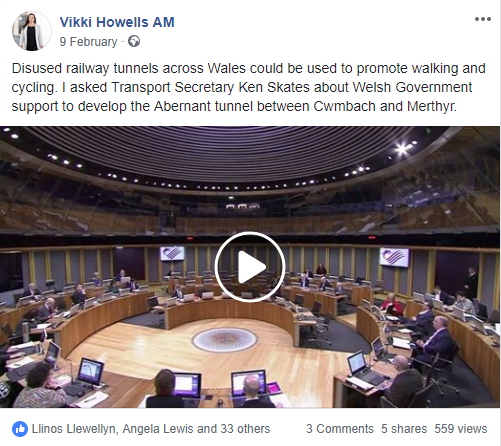
On 31 January 2018 a reception was held for the ‘Land Trust’ at the Senedd. It was hosted by Vikki Howells the Labour AM for Cynon Valley. Here’s the report from the Land Restoration Trust website.

And below you’ll see what Howells put out on Facebook the following day. Note that she mentions “ownership and management options”. In fact, it had already been decided behind the scenes, and years ago, making the Senedd reception no more than a PR exercise.

click to enlarge

Vikki Howells is involved for no better reason than she’s the local AM, having been elected in 2016 because she was the donkey with the red rosette. Does she really understand what’s gone on at Tower and who owns what?

Though if Ms Howells was so keen to inform the Cynon Valley public then she should have explained why her administration has abrogated its responsibilities and rolled back devolution. And also explained why the profits from developing this local site will be leaving Wales.

The Tower opencast operation didn’t last for much more than six years, it employed few, and when repayment of loans, leasing and hiring are taken into account, it wasn’t that profitable, certainly not for Tower. The big beneficiary appears to have been Hargreaves Surface Mining Ltd, renamed Hargreaves Land Ltd in June 2018.

(It should go without saying that Kevin James Stewart Dougan ceased to be a director of Hargreaves Land on 1 December 2017. What is the significance of that date?)

Hargreaves Surface Mining was set up in October 2011, just before opencast mining began at Tower. The timing is no coincidence. Hargreaves Surface Mining Ltd joined a host of new companies that had been created in north east England to make big bucks out of a mining operation in Wales.

An operation that put little money into the local economy but enriched strangers. It also served the purpose of being the necessary precursor to the second stage of the project that will inherit a large tract of land together with millions of pounds to landscape and redevelop it.

Who knows what will be done on the old Tower opencast site. Housing? A leisure resort such as we see not far away in the Afan Valley? One thing I predict with certainty – as with the opencast site, the profits will leave Wales.

Vikki Howells seems to envision the development at Tower linking with the Rhondda Tunnel . . . owned by Highways England!

click to enlarge

Or maybe it’ll be more wind turbines, for while they generate little or no electricity they certainly produce massive incomes for those who operate them, and the landowners involved. 

It’s difficult to believe that all this is happening after twenty years of devolution. But as I’ve argued many times, devolution is a sham, a façade; and behind that façade Wales is being ripped off and inexorably assimilated into England.

This assimilation along with the exploitation we see at Hendy and Mynydd y Gwair, Bodnant and Tower, is being facilitated by socialists, and the Labour Party, doing what they always do – selling Wales down the river.

GREEN PARTY OF ENGLANDANDWALES

Earlier this year members of the self-styled ‘Wales Green Party’ voted against becoming a Wales Green Party, choosing to remain part of the Green Party of Englandandwales and calling themselves The Green Party in Wales. Whereupon the party ‘leader’ defected to Plaid Cymru.

The confusion that resulted may be reflected in the fact that the party website seems to have been abandoned, with nothing posted since 10 July.

click to enlarge

Yet despite all the recent tribulations this Green Party of England in Wales is currently holding a leadership election. Yes, that’s a leadership contest to a non-existent party! Among those standing is Anthony Slaughter.

So who is he? Well, it should go without saying that he’s not Welsh. He lives in Penarth and seems to have a high regard for himself, adopting that tone of moral and intellectual superiority that so endears the Greens to me.

click to enlarge

And he spreads his talents wide, for when he’s not saving the planet he’s up in London demanding something called A People’s Vote, supporting the Stansted 15, and arguing for 20 mph speed limits. Sainthood can’t be far away.

But being a Green he’s probably a practising pagan. (Or am I thinking, vegan?)

Obviously there’s no such thing as the Wales Green Party, but then, there’s no such thing as the Welsh Labour Party either, it’s just a label, there’s nothing registered with the Electoral Commission. 

So maybe the Greens take their lead from the Labour Party, because they often seem close, almost as if the Greens are the idealistic younger relative indulged by the more staid Labour Party. 

And the closeness isn’t confined to the Greens, it seems to extend to the environmentalist movement as a whole, maybe it’s something to do with the self-absorbed regarding themselves as ‘progressive’

This perhaps explains why public money was recently spent on foot massage by the Future Generations Commissioner, that very close friend of the late Carl Sargeant.

click to enlarge

But it’s not just Labour that likes to cwtch up to those who think that the examples of Hendy and Mynydd y Gwair should be replicated on every pristine landscape in Wales. Who believe that carving up the countryside to lay thousands of tons of concrete is good environmental practice.

I mentioned that Slaughter, the would-be leader of the non-existent party, lives in Penarth. Where I’m told certain Plaidistas – the names Clubb and Wilton were mentioned – have been keen to do electoral deals with these Wales-rejecting colonialists.

But then, nothing surprises me any more, whether it’s the Greens, Plaid Cymru, or the Labour Party. They all pursue their own agendas, driven by narrow ideology and trapped within dogmas, rather than pragmatically promoting what’s best for the Welsh people.

That’s why they’ve failed us, and that’s why time is running out for all of them.

end ♦