Who Ya Gonna Vote For?

Well, we’re almost there. Thank God! Because this has been the most uninspiring and negative election in the history of devolution.

Never have so many deadbeats, activists posing as ‘journalists’, party hacks, and nut-jobs, wasted their time trying to rouse a people who’ve just lost interest.

RUNNERS AND RIDERS IN HEAVY GOING

This election was doomed to be uninspiring and confusing once Labour rigged the voting system. (Almost certainly with the connivance of Plaid Cymru.) It’s a party list system that no one understands, contested in 16 vast and insane constituencies.

An affront to democracy.

I detailed the various stages of the process just over two years ago in Senedd Cymru (Electoral Candidate Lists) Bill, explaining how better and fairer voting systems were rejected in order to arrive at today’s abomination.

For one thing, it’s designed to make life as difficult as possible for smaller parties and independent candidates. Jac Larner of Cardiff University calculates the system imposes a threshold of 14% before a party can hope to win a seat.
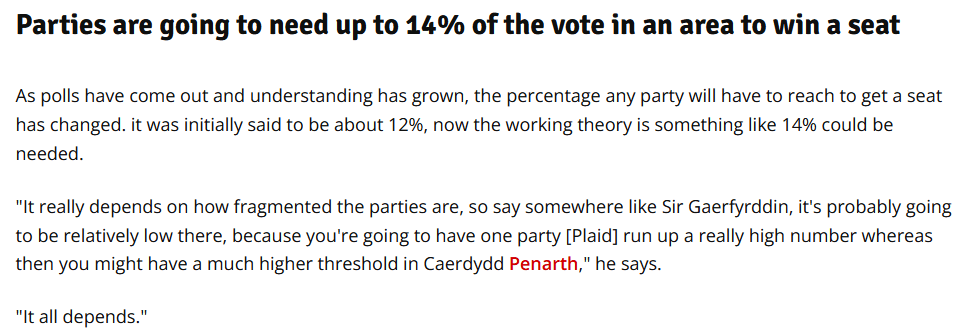
Given the quality of the debate, and the paucity of credible candidates, the election has been uninspiring. But this is to be expected. If a Senedd of just 60 Members attracts only people who’d struggle to run a stall at a village fete, what hope is there of improving the quality when the numbers are increased by over 50%?

And this couples with the negativity I also referred to in the intro. The Globalist Uniparty, the self-styled ‘progressives’, Labour, Plaid Cymru, Greens, Lib Dems, have had little to say beyond – Stop Reform!

There has been nothing positive on offer. Certainly no inspiring vision for the future. But this is only to be expected. Because with the exception of the Greens these are the parties that have failed Wales for 27 years of devolution.

Adding the Greens to the mix – and a potential coalition with Plaid – only offers something worse. While the other components of the Uniparty promise more of the same, the Greens want to double down on the mistakes of the past 27 years, and force on us new ones.

It’s also been a very ‘British’ campaign in that Welsh issues have been crowded out. For the London media has tended to lump the Senedd elections in with the Scottish Parliament and English local authority elections.

Their focus has been London-centric in debating whether Starmer will survive bad results “across the UK“. Treating May 7 almost as a general election, or a vote of confidence in the Labour party in Westminster.

And yet, this neglect of Welsh issues serves the interests of some parties. Plaid Cymru, for example, can blame Labour for the mess Wales is in, while claiming a vote for them is also a vote against the most unpopular PM ever.

Ironically, this is Labour’s old election tactic of urging punters to, “Send a message to London“. Which is what many will be doing, but now it’s working against Labour.

Reform can neglect Wales to focus on the issues that figure with the mainstream media and social media; small boat migrants, net zero, anti-Semitism, high taxes, benefit payments, knife crime, etc. Giving out mixed messages about their attitude towards devolution doesn’t do them any harm either.

The Greens have the advantage of being an unknown quantity, something different. But the Greens are universally and correctly described as ‘the Watermelon Party’. Green on the outside, red on the inside. And now attracting Islamist support.

Plaid Cymru has also been dipping its toe in that toxic oasis pool for some years. Though I’m not sure Mrs Evans in Pencader will take kindly to being told she has to wear a hijab to Capel Sion or else be branded Islamophobic.

As for the Lib Dems, does anybody know what they offer? In Wales it’s that strange Jane Dodds, with the party led at UK level by Ed Davey, who backed the Post Office in persecuting postmasters when UK Postal Affairs Minister from 2010 to 2012.

In short, and Reform excepted, various forms of that curious beast, 21st century Western left-liberalism divorced from any concerns for the once-idolised working class.

Offering socialism that can only run an economy for as long as other people’s money lasts or – as we’re now learning from Minnesota and elsewhere in the USA – if it can tap in to official funding which taxpayers thought was being properly used.

Few issues lay bare the deceit and duplicity more clearly than race. Here are a couple more things I picked up over the past week on X.
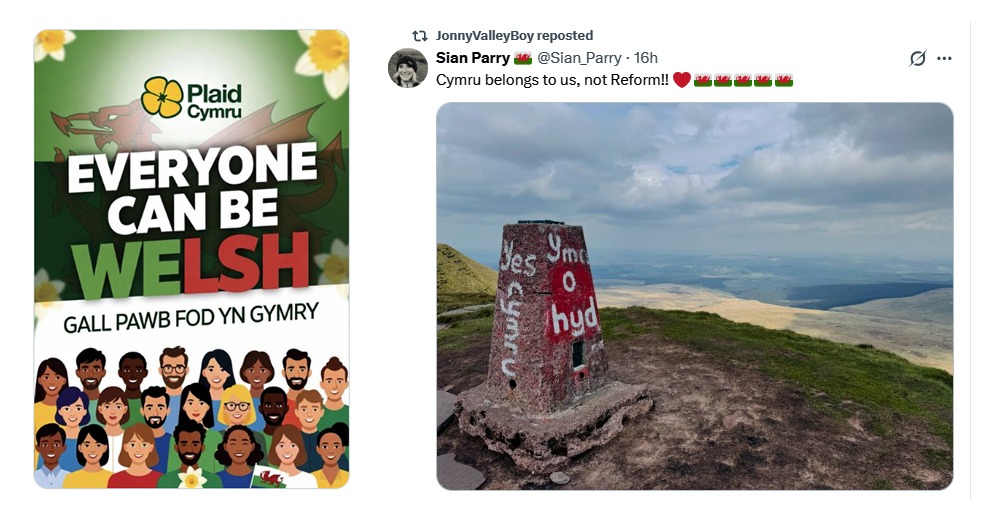
On the left we have Plaid Cymru dreaming of a multicultural Wales in which it seems white people are a minority. On the right, someone claiming that “Cymru belongs to us, not Reform“.

Now I don’t know Siân Parry, so I can’t say for sure that she’s a Plaid supporter, but she’s certainly on the political left. But what is she trying to say? Come to that, what is Plaid Cymru trying to say? Let’s attempt a synthesis.

An illegal immigrant can be Welsh; but someone who is Welsh to their core, speaks the language fluently, ceases to be Welsh – if they support Reform?

How insane, and offensive, that is. And all in the service of some transitory Woke nonsense. But too many put socialist dogma and childish obsessions above the interests of Wales.

To continue down this path Plaid risks becoming a full-blown anti-Welsh party.

For that’s the course it seems to have charted, with a Gwynedd councillor suspended for not appreciating that the false god of inclusivity is more important than the Welsh language and the community he was elected to represent.

So sod the Uniparty. And with Reform increasingly looking like controlled opposition, I’d avoid them too.

STUDENT POLITICS AND DYING BIRDS

Twenty-seven years of virtue-signalling, ineptitude, and failure have taken their inevitable toll.

It’s an uphill task for those who’ve run devolution for 27 years to persuade people to forget about bills and hospital appointments, and instead take pride in Wales being the first country to declare a climate emergency, the first to have a Future Generations Commissioner, and to remember that Wales is working to be Anti-racist by 2030.

It’s student politics. And it’s explained very well by a young man named Owain Williams, whose one-minute video I stumbled upon last week.
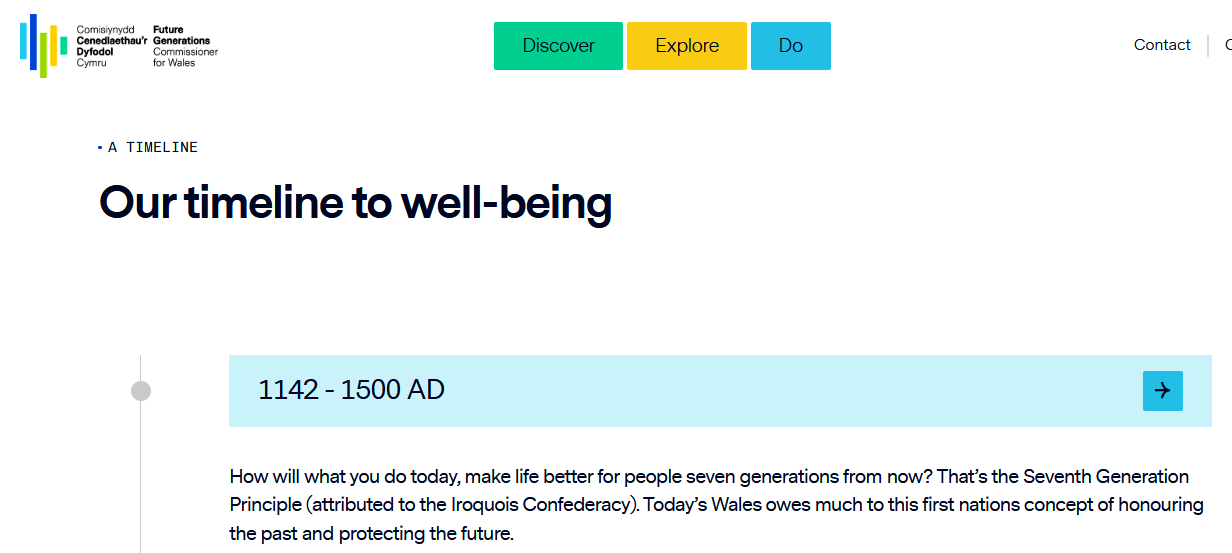
When I saw “Confederacy” my heart soared!

Now student politics is all very well in its place, but the real world is not that place.

Digression alert!

There’s a little quote from Thomas Paine’s Rights of Man that was popular with the left in my younger days. Paine was responding to Edmund Burke’s Reflections on the Revolution in France, in which Burke floridly defended the Ancien Régime. (But still a great read!)

Paine condemned Burke for being more concerned with the pomp of Versailles than with the wretchedness of most French people. It was a radical responding to a conservative, telling him to ignore the ephemeral and focus on the realities.

Paine wrote: “We pity the plumage, but forget the dying bird“.

We can turn this on its head in 21st century Wales; for here it’s the radicals, the progressives, who obsess over the plumage, the ephemeral. But who ignore the dying bird, Wales.

And things won’t get better if we let Plaid Cymru take over. For Plaid, either alone or in alliance with their new wobble-headed pals in the Greens, will only push us harder and faster down Disaster Road.

But on the plus side . . . breast enlargement will be available on the NHS from fully-trained tit whisperers, all accredited by the Zack Polanski School of Woo-Woo.

Let’s be honest, devolution has been a disaster for Wales, and so replacing one bunch of bullshitters with another won’t make a bit of difference. And people know it. This piece from last week’s Western Mail says it all.
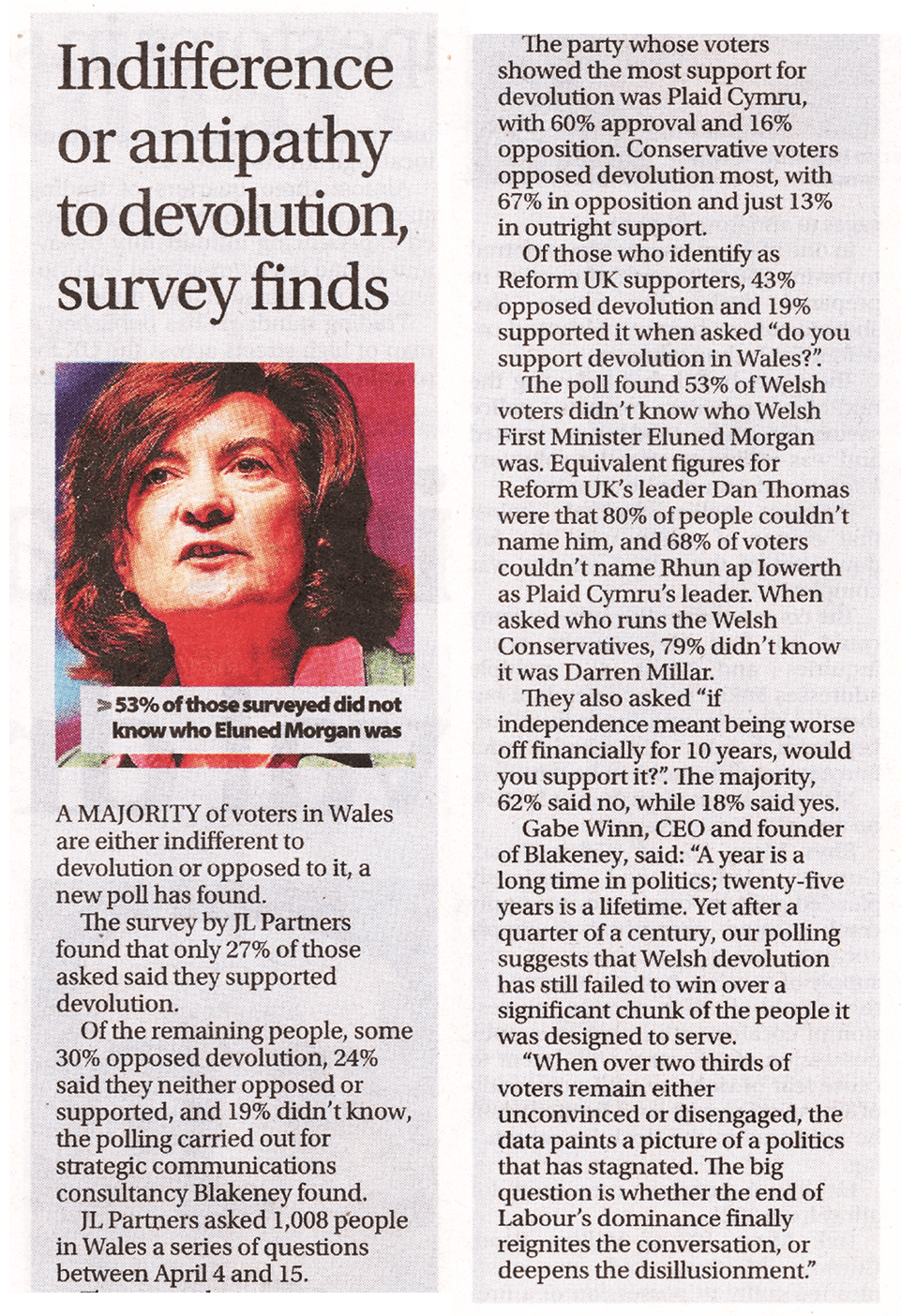
A majority of voters in Wales are either indifferent to devolution or opposed to it . . . only 27 per cent of those asked said they supported devolution“. A majority of those polled couldn’t name the first minister.

But what do you expect after 27 years of failure that has alienated people from the whole idea of devolution, and they see no hope of improvement?

IS DEVOLUTION EVEN DEMOCRATIC?

A fundamental problem of devolution, and the main reason for being subjected to policies for which there is little public support is the hangers-on, the influencers, the pressure groups, the lobbyists, that attach themselves to the politicians, to by-pass and subvert the democratic process.

You vote for a party that promised this that and t’other but you end up suffering legislation that was never in the manifesto and on which you were never consulted.

That’s because most of the Uniparty members in the Senedd went into politics to promote their pet ishoos rather than represent the constituency for which they were elected. Many came from charities, pressure groups, and lobbying organisations.

The aptly-named ‘Swamp’.

Take Lee Waters. Ostensibly the Labour Senedd Member for Llanelli (though he actually lives in Penarth). Waters had worked for cycling charity Sustrans (renamed Walk Wheel Cycle Trust), and was instrumental in bringing in the 20mph legislation.

There was a petition opposing 20mph that raised almost 470,000 signatures – but the self-styled ‘Welsh Government’ ignored it.

While other petitions, with little support, result in legislation – because the issue promoted lines up with the Uniparty agenda. You even get your photo took with some gurning politico in a presentation ceremony!

On the left in the image below is Mike Hedges, Labour SM for Swansea East; on the right, Natalie Buttriss, who’s represented a number of bodies trying to grab Welsh land under various ‘save the planet’/’biodiversity’ guises.
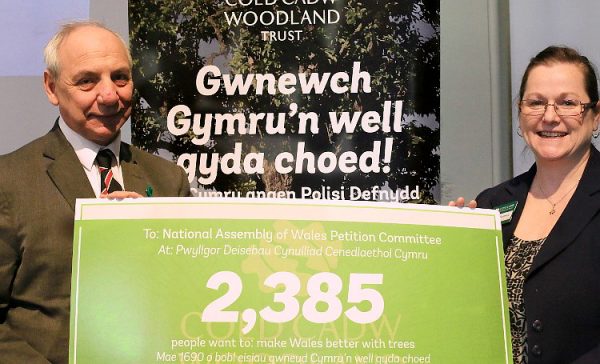
Red carpet treatment – and a chance to meet Mike Hedges! – for just 2,385 signatures!

That’s democracy, folks; the Voice of the People . . . being ignored.

Saying loud and clear that devolution is a sham. But we’re expected to believe it’s going to get better because – just like socialism – it hasn’t been properly tried yet.

Worse, there are those believing Wales could survive as an independent country with the same calibre of politicians pursuing the same policies.

This goes beyond the definition of insanity attributed to Einstein.

At present, all the lunacies we endure from Corruption Bay are funded by the block grant from Westminster. Take that away with independence, and give full powers to politicians who understand nothing about economics, but who will be determined to pursue the same Globalist-Woke agenda, and Wales will go broke within 5 years.

Then it’s into the clutches of the EU and the World Bank; allowing land and other assets to be bought up by BlackRock and the like to give the impression of economic activity, or inward investment.

Socialism has never worked as an economic model. Which explains why the only ones pushing it are either still wet behind the ears or have jobs for life on the public payroll.

CONCLUSION

Plaid Cymru believes that a few years of the party running the Senedd will win people over to the idea of independence. Thinking of Scotland. They’re wrong.

After the SNP took control in 2008 (as a minority government) it increased its popularity under the leadership of Alex Salmond. To the point where it almost won the 2014 referendum on independence.

But Salmond, in addition to being a very astute politician and a great debater, was an economist. You know, the real world economy. He persuaded many Scots, and many economists, that Scotland could be better off as an independent country.

And it almost worked. I was in Scotland for the referendum, and I know that the polls just before the vote were showing a majority for Yes. The London parties panicked and came out with ‘The Vow’, promising Scotland just about everything short of independence.
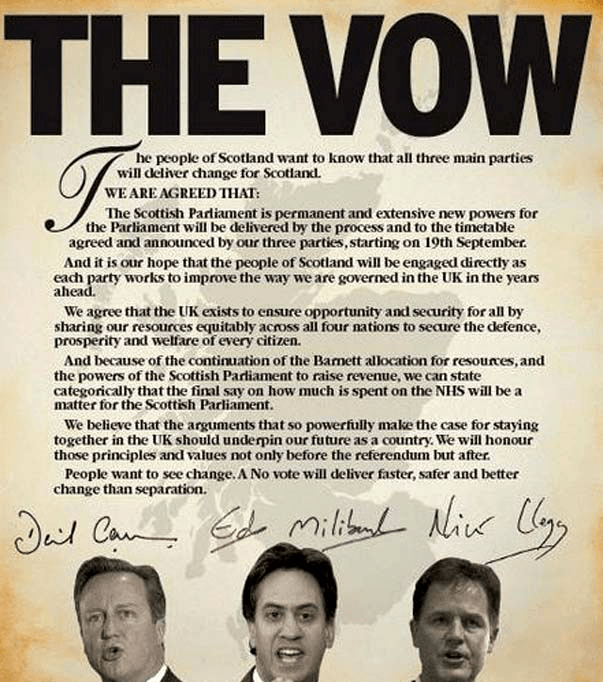
That swung it and the vote was 55 – 45 against independence.

Worth noting that the Labour leader at the time was Ed Miliband. Who – like Cameron and Clegg – understood that a great part of the appeal of independence was the promise of oil and gas revenues staying in Scotland. So maybe him closing down North Sea oil and gas fields isn’t just about saving the planet.

Whatever, and to get back to Wales, Plaid Cymru knows nothing about economics; I think the last genuine economist in their ranks was Dr Phil Williams, a good old stick despite everything, but he died in 2003.

Wales has no oil and gas fields to speak of. And there’s been no attempt to develop an indigenous economy over the 27 years of devolution. Funding cronies and charities to run make-believe ‘businesses’, and allowing carpetbagger companies to exploit Wales, is a third world economy.

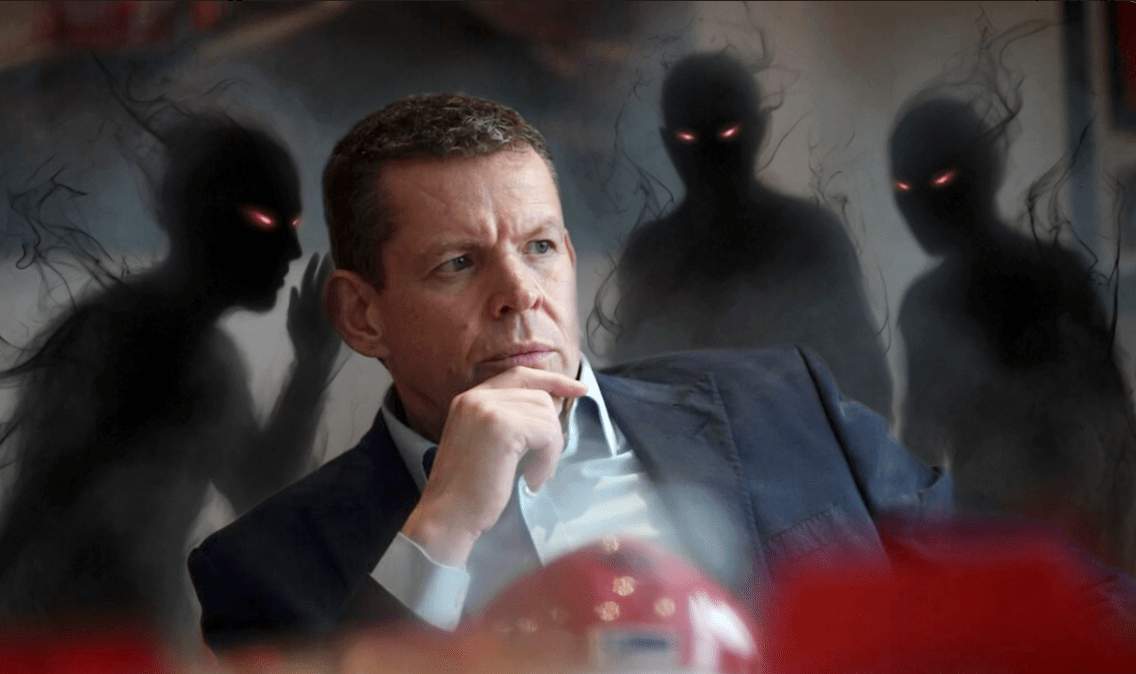
All Plaid Cymru offers is more of the same, with a different spin. Because while Rhun ap Iorwerth may come across as an affable sort of guy, behind the scenes, still running the show, are dark forces from Plaid’s recent past.

And if Plaid gets power, especially in a link-up of some description with the Greens, then even nastier specimens will start popping up.
Wales needs radical change, in the form of a return to the eternal verities and facing up to economic realities. The Uniparty will never be allowed to provide this. Reform gives no thought to Wales beyond getting votes to pursue a different agenda.

Here’s Owain Williams again. I don’t know his politics, but I suspect they’re not a million miles from my own.

UPDATE 04.05.2026: Well, bless me! Young Owain is the son of Rhodri ‘Billions’ Williams, former boss of S4C and various other bodies. Owain is, or was, a Labour stalwart. The doubt might be justified by the party excluding him from being selected.

The only sensible option is a party that puts Wales first and foremost. One that prioritises the economy we all need. That understands Wales needs real jobs not more gesture politics. That teaches our children to think for themselves rather than brainwashing them. That won’t wage war on the family farm. Or the family unit.

The only party that fits the bill is Gwlad. Of course, Gwlad can’t win this time round, they don’t have the strength yet. But they’ll grow and, with fair media coverage, be back stronger next time. In the meantime, I’m sure Gwlad will be fighting for Wales in council elections and other ways.

The only Welsh party willing to address people’s real world concerns is Gwlad.

♦ end ♦

© Royston Jones 2026

Buy Me A Coffee

Carry On Brexiting

Seeing as no one knows what kind of Brexit the UK government wants, and because so much of what you’re reading and hearing on the subject is either biased or just ill-informed, it falls upon Uncle Jac to shed a little light on the matter. Because there are implications in Brexit for the unity of the UK, and these are already being addressed with covert strategies that may be reported in the mainstream media but are not identified for what they really are.

To make the best sense of what follows you must understand that the whole debate has moved beyond Brexit to the point where it is now about two unions, the EU and the UK, and also the future of the Conservative and Unionist Party. Not to be outdone the Labour Party is also confused, but there we also find other issues at play.

BREXIT AND THE MAIN POLITICAL PARTIES

The EU referendum was held on June 23, 2016. For a number of reasons I voted to leave. Explained here in EU Referendum: Why I Want OUT! with my celebratory thoughts contained in Brexit, Wexit: Things Can Only Get Better!

The overall UK vote was 51.89% Leave to 48.11% Remain. In Wales 52.53% voted Leave. By comparison, Scotland voted 62% for Remain.

Since then, from the UK government, it’s been a revolving stage of pantomime, tub-thumping jingoism, farce, soap opera and slapstick, but now, as the end approaches, things are beginning to take a darker turn.

But before getting to the creepy bits let’s consider where we are with the main UK political parties.

EU membership has been a divisive issue within the Conservative Party for half a century or more. In the hope of settling things prime minister David Cameron announced in February 2016 that there would be a referendum. He also stated that he would be campaigning to stay. When he lost, he resigned.

Since the referendum it has been almost impossible to separate what passes for ‘negotiations’ with the EU from the ongoing civil war within the Conservative Party, with the internecine fighting being a prelude to the inevitable leadership contest.

We’ve now reached the stage where it seems to be the incumbent Theresa May versus Boris Johnson. ‘Bonking Boris’, reviled by ‘progressives’ and opposed by many in his own party. Yet Tories of a more pragmatic bent may see him as a winner.

Not least because Boris Johnson has achieved that priceless political status of being universally recognised by his first name. How many politicians today can say that?

And don’t forget that Johnson was elected mayor of multiracial London in 2008, beating Comrade Livingstone, and increasing his share of the vote in getting re-elected in 2012, again by beating Livingstone. There will be a number in the Conservative Party who’ll see a lesson there for a future tussle with Comrade Corbyn.

At the time of writing this the elite against whom I and many others voted in June 2016 is pushing for a People’s Vote on the “final Brexit deal”. Having lost the vote in 2016 they’re hoping for a re-run and a different result . . . but believe me, it’s got sod all to do with ‘the People’.

If that headgear is compulsory then this campaign is doomed (click to enlarge)

The English Labour Party in Wales is generally supportive of this initiative because by and large our MPs and AMs want to remain in the EU. But their leader is proving more cautious, for Jeremy Corbyn seems to understand better than his Wales-based representatives why Labour voters in the post-industrial areas and the lower socio-economic brackets voted for Brexit.

Corbyn is reluctant to further alienate this white working class, and so, sure of the loyalty of his Momentum base, and believing that his ethnic minority and middle class voters have nowhere else to go, he seems to have concluded that the best option is to keep ’em guessing.

Others in Labour are less reticent about speaking out against Brexit and in favour of a second referendum. Here in Wales Labour politicos have reminded us how much money we’ve received from the EU, which doesn’t really help their cause because too much of that money has been frittered away by successive Labour management teams in Cardiff docks with no discernible benefits accruing to the areas in need.

But what the hell! – we’ve got the biggest third sector money can buy.

Carwyn Jones however is now prepared to articulate a possibility that others would rather leave unsaid. Laid out in a Times article on Monday headlined, “Brexit, handled badly, contains the seeds of the UK’s own destruction”. This article was a trailer for a speech Jones gave to the Institute for Government.

He’s not alone in seeing the possibility of Brexit breaking the UK apart – it’s one of the reasons I voted for Brexit – but I’m sure he takes the side of his Tory masters and will do his best to maintain the Union. Why change the habit of a lifetime?

But Carwyn’s masters are not blind to the danger either, and are implementing measures to counter the threat, certainly in Scotland and Wales. Northern Ireland is, as ever, different.

IRELAND

Without knowing anything about the Flight of the Earls, the Plantation, Partition, or even the Troubles, most people are vaguely aware that the politics of ‘Ulster’ or the Six Counties is dominated by whether this part of Ireland should remain in the United Kingdom or whether it should join the rest of the island.

(Though this does not apply to Karen Bradley, Secretary of State for Northern Ireland, who seems to have imagined a homogeneous population made up of individuals who take a pin into the polling booth.)

As things stand, those wishing to stay part of the UK remain in a majority, but a majority being whittled away year on year by demographic trends. So that by 2030 there will probably be a Catholic majority and a referendum on reunification could choose a united Ireland.

Brexit has added a new ingredient to the mix and might accelerate reunification.

Because the prospect of a ‘hard’ border after the UK exits the EU will not only be bad for business, it also raises fears of a return to violence. This has resulted in a number of people hitherto opposed to a united Ireland prepared to consider that option in order to stay in the EU. And let’s not forget that Northern Ireland voted by 56% to 44% to Remain. The only party pushing a Leave vote was the Democratic Unionist Party, predictably following the BritNat line.

The border as it used to be . . . . and might be again? (Click to enlarge)

Yet one of the alternatives, that of somehow keeping the Six Counties within the UK and the EU by having the customs border somewhere in the Irish Sea, has Mrs May’s DUP allies shouting ‘No Surrender!’ and strapping on their Lambeg drums.

The other option seems to involve no change in the constitutional status of Northern Ireland and a ‘soft’ or invisible border, with customs checks carried out by technology that doesn’t exist, or possibly by leprechauns.

The question of whether there should be a united Ireland could of course be resolved with a referendum, allowed for in the Good Friday (or Belfast) Agreement (Schedule 1,2). But the power to call such a vote rests with the Secretary of State. As we’ve seen, at the moment that is Karen Bradley, who thinks people in the Bogside don Orange sashes when the humour is on them.

So we’re in the absurd position of the Secretary of State having the authority to call a referendum , ” . . . if at any time it appears likely to him that a majority of those voting would express a wish that Northern Ireland should cease to be part of the United Kingdom and form part of a united Ireland.” Which, when you consider it, is a very good reason for the British government NOT to call a referendum.

The political situation is further complicated by the fact that the Northern Ireland Assembly collapsed in January 2017 and seems unlikely to get back on its feet any time soon.

There is little the British state can do to influence things in Northern Ireland for a number of reasons: 1/ the Republic’s government keeps a close eye on events; 2/ Ireland is now crucial for the EU because it will soon be a land border; 3/ there’s the interest from the USA, for no American politician can ignore the Catholic Irish-American vote.

And as I’ve suggested, the UK establishment is resigned to losing Northern Ireland in 10 or 20 years time anyway due to ‘the revenge of the cradle’, so the worst Brexit can do is hurry up that process. While never having to deal again with Northern Ireland politicians is a prospect most civil servants welcome.

SCOTLAND

In Scotland, things are very different.

The 2014 Scottish independence referendum gave the UK establishment one hell of a fright and may only have been won at the last minute by the intervention of senior politicians promising everything short of independence in The Vow. Though Brexit is causing a rethink for the man behind it.

The Scots voting to Remain coupled with the growing prospect of a ‘hard’ Brexit is increasing support for Scottish independence. This has prompted the UK state go on the offensive. It’s worth focusing on two, ongoing elements of this attack.

First there’s the crude and unambivalent ‘Britification’ campaign, most visible in the packaging of Scottish goods with the Union flag. In the image below we see whisky and, even weirder, that quintessentially Scottish delicacy, haggis, branded as ‘British’!

But the alternative name for whisky is Scotch. Can you imagine anyone going into a bar and saying, ‘Give me a large British, barman’? Which might get the response, ‘A large British what, sir?’ As for haggis, branding it with the Union Jack is liable to lose sales because people might think it’s counterfeit, something like Albanian ‘champagne’.

click to enlarge

In the main it seems to be the supermarkets at fault rather than the manufacturers, for I’ve read that Lidl and Aldi, the German chains, have stuck with Scottish branding.

I can imagine a meeting deep in the bowels of Whitehall between representatives of the main supermarket chains and high-ranking civil servants to discuss ‘promoting a sense of shared Britishness in these difficult times’, and perhaps achieving the objective without even mentioning Scotland.

(But I warn them now, if they come to put a Union Jack on my laverbread they will have to pry it from my cold, dead hands.)

The other point of attack has been the allegations against Alex Salmond former leader of the Scottish National Party and former Scottish first minister. Let me say that I don’t know whether these allegations are true or not, but the motivation behind them is crystal clear.

I first understood what it was all about watching Newsnight soon after the story broke. It had been broken by the Daily Record, the Scottish version of the Daily Mirror, and therefore the mouthpiece of the Labour Party, once dominant in Scottish politics but now languishing in third place as the Unionist vote coalesces behind the Tories.

The assistant editor responsible was a cocky Ulsterman named David Clegg, and without knowing his background I would hazard a guess that he has never voted for Sinn Féin. He was positively bouncing at being interviewed over his ‘scoop’ . . . and then something rather strange happened – he kept talking about Nicola Sturgeon, Salmond’s successor in both positions!

The light bulb flashed above the old Jac noggin, I took a sip of Malbec and nodded sagely.

And so it came to pass that where there had been unity of purpose in a political party determined to achieve Scottish independence, now they were at each other’s throats! Or at least, that’s what newspapers were reporting. And desperately hoping that the Scottish public would believe it.

click to enlarge

What we see in Scotland suggests that secret polling has confirmed the British government’s worst fears – the Brexit cock-up has created a majority for independence.

Added to the blatant BritNat bias the BBC in Scotland has exhibited for some years we now have government-controlled newspapers in a constituent part of a democracy. Were this happening anywhere else it would be reported, and condemned . . . by the very media outlets that have so readily submitted to government control.

What absolute hypocrites!

WALES

Here in Wales the Britification campaign has been less obvious and offensive, partly because we have less indigenous produce to be plastered with Union Jacks, due in large part to the unwritten rule that says any successful Welsh company is only allowed to reach a certain size before being taken over by an English rival.

That said, the campaign has taken other forms, two examples will suffice to explain what I mean.

To begin with, early last year that most colonialist of ‘Welsh’ organisations, Cadw, announced that there was to be a ring of steel erected near Flint castle to celebrate the 2017 Year of Legends, one of the regular, tiresome, and often insulting tourism marketing ploys.

Ring of Steel is an obvious reference to the castles built by Edward I to encircle Gwynedd and subjugate its inhabitants. Cadw knew this. The proposed structure was soon dubbed ‘The Anus of the North’, an epithet that then seemed to transfer to Ken Skates, the hapless minister for culture or some such in England’s Cardiff management team.

click to enlarge

After a public outcry, political opposition, and a petition that attracted 10,000 signatures in a matter of days, this squalid and deliberate attempt to celebrate English conquest was dropped.

But then came the renaming of the Second Severn Crossing as the Prince of Wales Bridge. Again, this was widely opposed, with little support from within Wales, but it went ahead in a secret ceremony.

The renaming idea is attributed to Alun Cairns, the oleaginous Secretary of State for Severnside, but I’m not so sure. I believe the idea came from the same source as the ‘request’ for supermarkets to smother Scottish produce under the Union Jack. Cairns was only too happy to oblige.

Alun ‘Tippy-toes’ Cairns is now one of the most ridiculed and reviled politicians in Welsh political history, even more so than some of his predecessors such John Redwood; for while we expected no better from them, Welsh-speaking Cairns is viewed as a turncoat.

Having mentioned Severnside, the renaming of the bridge and the removal of the tolls will begin what we are asked to welcome as the great property bonanza in the south east. In practice, no bridge tolls and cheaper property prices on the Welsh side of the bridge will encourage a population movement into Wales.

Replicating what we see in the north as commuters from Manchester and Merseyside are guided away from exclusive communities in Cheshire into the commuter communities planned for the A55 corridor.

Maybe we should now add Gwent to this map (click to enlarge)

These machinations on the part of the UK state, coupled with the cowardice and incompetence of the English Labour Party in Wales has predictably resulted in a reaction.

In the past couple of years we’ve seen the emergence and growth of YesCymru, the launch of new party Ein Gwlad, and the realisation within Plaid Cymru that a hard left party obsessing over issues that mean nothing to 99% of the Welsh population is going nowhere.

There can no longer be any doubt that there is a Britification agenda operating in Scotland and Wales. Because the BritNats driving the Brexit process are awake to the fact that if they win they risk the Union. More moderate elements can also see the risk to the Union and even though they might oppose Brexit they have little alternative but to join in the Britification offensive.

Yet Boris Johnson, Jacob Rees-Mogg and the rest must push ahead because their political reputations and their places in history are now tied up with Brexit. They cannot afford to fail. If they succeed, they know it will be easy to use the rallying-call of ‘Save the Union’ to reunite the Conservative Party, and leave the other parties no alternative but to fall into line.

The real worry is that the Britification and dirty tricks we’ve seen so far in Scotland and Wales could be nothing compared to what we might experience after the Brexit shit hits the fan.

♦ end ♦