Bute Energy And Others, A Round-up

I haven’t devoted a full piece to Bute Energy and the rest since August last year. Which is somewhat remiss, seeing as the plans are ongoing and causing great concern to communities across the land.

That said, maybe this offering is directed more at the general reader than those who follow Bute’s activities closely, or are involved with a particular campaign group, of which there are perhaps too many. (More on this later.)

Though I’ve had a gutsful of Bute and the other eco-scammers who’ve taken up more space on this blog than the diamond geezers and career criminals.

Yet they’re lauded in the media, have politicians in their back pocket, and the red carpet is rolled out for these exploitative interlopers.

INTRO, RECAP

After a visit to the cellar, dusting off a few files, I think I’ve found my first reference to Bute. It was back in November 2018. In the piece, Corruption in the wind?

Though Bute first appeared via a connection with someone I’d already written about.

This pathfinder was Steven Radford. He was fronting for a major player named U + I in three wind farm projects: Bryn Blaen, near Llangurig; Rhoscrowther, down on the Haven; and Hendy, a few miles from Llandrindod.

U + I was soon taken over by Landsec; big shareholders in Landsec are BlackRock, Vanguard, Legal & General, Jupiter Asset Management.

In that November 2018 piece I wrote:

In September Radford branched out again with Bute Energy Ltd . . . in the electricity business, the production, transmission, distribution and trade of electricity to be exact.

What I didn’t know at the time was that the boys of Bute had all come from property company Parabola. And that the lead director of Bute, Oliver James Millican, is the son of Parabola boss, Peter John Millican.

The other Bute principals we’ve come to know are: Lawson Douglas Steele and Stuart Allan George. Barry Woods was a fourth departure from Parabola in November 2017. But Woods parted company with the others in September 2019.

Another name that crops up is John Reilly. Like those just named (apart from Millican) he has a company named Windward’ followed by his initials. I can’t be sure if Reilly worked for Parabola, but he is now Project Manager for Bute. Like the others, he lives in Scotland.

These ‘personal’ companies all saw a massive boost in their values recently.

Click to open enlarged in separate tab

These figures might be accounted for by a payout from Grayling Capital LLP, which dissolved around that time. For Millican, Steele and George were Designated Members, and Reilly a Member. Another Member had been SuperSpAd and ‘Welsh’ Labour insider David James Taylor. (Mentioned a few times on this site.)

UPDATE: More plausibly, the windfall is explained here.

But that only throws up another question – where did the money come from that went into Grayling Capital?

Whatever the answer, that’s a lot of money for a group that has yet to put up a single turbine. Ask yourself, how does that ten grand for your village hall from a developer’s ‘community fund’ compare to sums like these?

Taylor also did well for himself. The clip below is from the accounts of Taylor’s company Moblake Ltd. A liquidator was appointed in April 2022 and Taylor rode off into the sunset with the 600k in his saddlebags.

Click to open enlarged in separate tab

The ultimate holding company for all the Bute entities is Windward Global Ltd. The sole director is Millican Jnr. The company was formed in May 2017 as DMWSL 864 Ltd and changed its name six months later, at the exact same time we are expected to believe the boss’s son and his mates turned their backs on Parabola.

Somehow, the Parabola-Bute crew made contact with Radford. Who joined Bute Energy Ltd in September 2018, less than a week after Oliver Millican. (The company changed its name to RSCO 3750 Ltd and folded in September 2023.)

How was this contact made? Why did Parabola turn its attention to wind turbines? And to Wales?

PARABOLA-BUTE DISCOVERS WALES

But how did they ‘discover’ Wales? Were there introductions? To answer these questions I’ll begin with something substantive before flying a kite.

In the first piece, of November 2018, you’d have read a section – ‘Mystery Woman’ – in which I identified Anna McMorrin as a lobbyist for Hendy wind farm. She was then a Labour insider shacked up with a minister in the ‘Welsh Government’, and she went on to become the MP for Cardiff North in the June 2017 general election.

Seventeen months after McMorrin’s performance before Powys councillors, Steven Radford of Hendy wind farm teamed up with Parabola-Bute.

This pattern of Labour party involvement (ahem!) has been repeated in subsequent years. Most recently with Sophie Howe, former Future Generations Commissioner for Wales, who became a director of the new Bute Energy Ltd last month. (It switched names with RSCO 3750 Ltd.)

Labour party troughing is covered in many other posts on this site.

So we have the Labour party helping windfarm developers, but that doesn’t establish a connection for Radford with Millican and his pals. Yet people I’ve spoken with recently are convinced the key lies with Radford and Hendy Wind Farm Ltd.

And what a story of political corruption that was; done to help a project meet an OFGEN funding deadline, with one hurriedly erected turbine – that has never turned!

But even if Hendy is the key, that still doesn’t explain how Radford and the Bute gang met each other.

Here’s one possibility . . .

McMorrin was working for a company, Invicta Public Affairs, with branches in Glasgow and London, but its registered office is on the Gallowgate, not far from St James’ Park in Newcastle-upon-Tyne.

Parabola, despite having offices in Edinburgh and London, began life in Newcastle and still maintains a presence in a building it redeveloped near the Central Station.

I admit the Geordie connection is tenuous; yet while the Labour party link to both Radford and Bute is established, there is still no evidence it was the comrades who brought them together.

Though the Labour party is now so enmeshed with Parabola-Bute it might soon be difficult to disentangle them. What with individual party members involved and then the council pension fund investment. (Controlled by BlackRock.)

Plaid Cymru is also getting in on the climate scam. Sorry! that should read: saving the planet for future generations. In the form of an obscure Plaid loyalist from Ynys Môn named Carmen Smith.

After dabbling in student politics, working for politicos and leftist groups, Smith was given a made-up job with Bute in October 2023 – Advisor on Youth Governance! Her employer is named as Windward Global, the ultimate holding company for the Bute empire.

Next, she made it to the House of Lords when Plaid needed to replace retiring Lord Wigley. The election process was rigged in order to ignore members’ choice of former MP Elfyn Llwyd.

These shenanigans now give Bute a presence in the House of Lords.

KLINGON AND A POSSIBLE RESTORATION TRAGEDY

As is often the case with planning permission – and perhaps especially in Wales – what is originally given consent is often very different to what is eventually built. ‘Changes’ and ‘modifications’ are made, which may or may not go through the planning process.

In the case of Bute Energy these now include, “bigger blades, higher substations, to cracking on before approval of any restoration plans. The local authorities, who told PEDW they have no resources to oversee any planning conditions, appear to be rubber stamping things“.

Never was rubber stamping more obvious than with this amendment submitted by Bute to Caerphilly council regarding Twyn Hywel wind farm. Fortunately, the council accepts correspondence in English, Welsh, and Klingon.

Click to open enlarged in separate tab

For it was indeed accepted.

In the quote I used just now you’ll have seen a reference to “restoration plans“. So let me explain what this is about.

After certain opencast mines came to the end of their working lives in southern Wales it was expected that the companies involved would – as promised – restore the sites to something close to their original state.

But, alas, when the time came for the restoration to begin – the companies involved had relocated to offshore tax havens.

In 2010, a company called Celtic Energy sold its opencast coalmines – with its restoration liabilities – for £1 apiece to a series of shell companies it had set up in the British Virgin Islands. Then the senior executives walked away with millions.

To avoid something similar happening with windfarms a number of people have submitted FoI requests to the ‘Welsh Government’ about site restoration, but I’ve yet to see a response that satisfies anyone.

UPDATE 02.10.2025: Here’s an example that I’ve just received from a reader. Natural Resources Wales says they can’t tell how much they demand for wind farm site restoration, because “this information is commercially sensitive“.

It’s now being suggested that wind turbines in Wales have an operational lifespan of 50 years. Below is a clip from Google AI, and here’s a link to a piece in Solar Power Portal which says, “Manmoel Wind will have an operational life span of 50 years“.

Click to open enlarged in separate tab

Obviously, no turbine lasts 50 years. A turbine is lucky to make 20, or 25. So people who’ve seen that 50 year figure assume the turbines will be replaced at some stage.

Yet the extended lifespan claim appears again in this response from Bute to a question from a concerned local resident:

Click to open enlarged in separate tab

Quite frankly, I believe that ten years from now few new (or replacement) turbines will be going up. People are no longer listening to the Swedish doom goblin and her Globalist masters. Reality is kicking in.

So the question remains: with the bubble soon to burst, why are turbines going up today, or tomorrow, being given operational lifespans of 40 or 50 years?

Could it be because developers have an arrangement with politicians and planners that restoration of a site begins when the agreed operational lifespan is up? Even if the turbines had long ago stopped working. Or had even been removed?

My belief is that restoration costs should be paid up front, before a single turbine is erected, and the money ring-fenced so politicians can’t get their grubby paws on it. Furthermore, the restoration costs must not be limited to the visual. There must be enough money deposited to pay for the removal and disposal of the vast concrete bases in which every turbine stands.

Questions need to be asked about this extended operational lifespan. And whether it will be linked with site restoration.

UPDATE 12.10.2025: I should add that being ‘imaginative’ with a project’s lifespan might encourage hesitant investors. And it will be used by politicians spouting ‘future generations’ bollocks to grant planning permission.

THE PYLON RUNS

Clearly, the hundreds of wind turbines planned for remote upland areas of Wales are a long way from the eventual consumers in England. For that’s where it’s going. (Ignore bullshit like, “powering seven million Welsh homes“.)

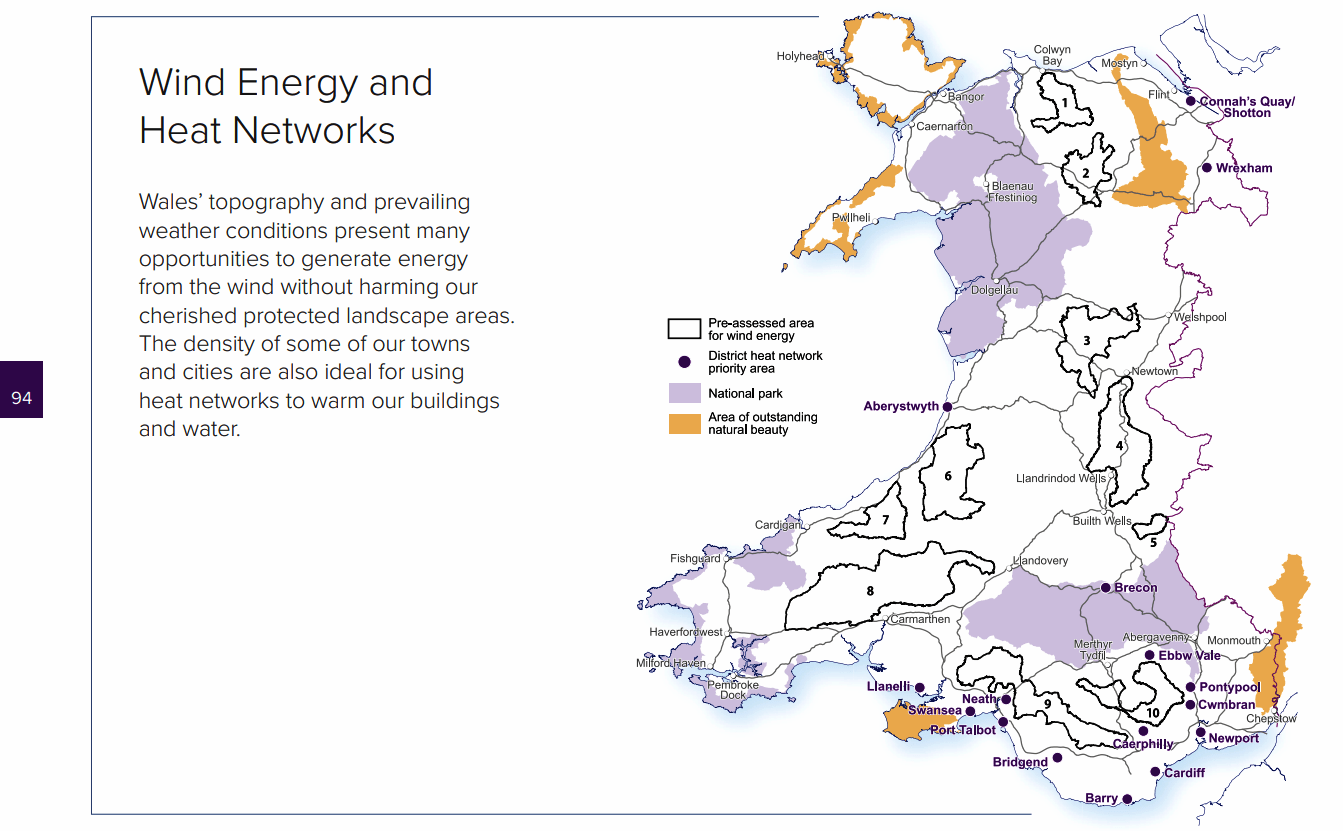
Below you’ll see two maps that I hope will help explain the position.

On the left is a map produced by the ‘Welsh Government’ in its Future Wales The National Plan 2040 (update), showing the designated areas for wind power. On the right, a map produced by CPRW (here), adding areas for solar power and associated infrastructure including pylon routes.

Click to open enlarged in separate tab

Because, clearly, there will be a need for pylons and overhead power lines to run from the windfarms to where they can connect with the grid. Though in environmentally sensitive (or politically favoured) sections the cabling might be underground.

In the southern half of the country this means a run from around Aberedw, east of Llandrindod, down to Builth, and then down Dyffryn Tywi to Llandyfaelog, south of Carmarthen. The other southern line runs from the wild country east of Lampeter – projects I covered in this piece – following the Teifi before branching off south from somewhere near Llandysul.

In the northern section, the run starts near Llangurig, then runs north before turning north east to its destination at Lower Frankton in Shropshire. Though for some reason we were originally told it ended in ‘Chirk’.

Perhaps we were supposed to think it would supply Wrecsam and Deeside.

This simple map of the grid in Wales will also help as it shows most of the turbines planned are going up in areas a long way from that grid.

Click to open enlarged in separate tab

Most electricity in Wales is generated by Pembroke power station in the far south west. The line then runs east, supplying much of the urban south, before taking power over the border.

The loop in the north is, I suspect, accounted for by the decommissioned nuclear power stations at Wylfa and Trawsfynydd.

Let’s conclude this section by focusing on an area just mentioned, Twm Siôn Cati country. There’s a very active group opposing the three projects we’ve heard about (there may be more to come), and there was a public meeting last month.

Here’s a report from the Western Mail. Here in pdf format.

Click to open enlarged in separate tab

The meeting was held in Pumsaint because, as I explained in the piece I linked to earlier, the blades and turbines will need to be transported from Pumsaint up country, and over the 2,500 acres of the National Trust’s Dolaucothi estate.

For some reason the NT is coy about giving out information about its involvement with wind farm developers.

To add to the air of mystery, I’m informed that prior to the Pumsaint meeting local Plaid worthies met with Bute representatives at the Falcondale Hotel, just a mile or so north east of Lampeter. Is this true?

If so, what did they discuss? More peerages?

ODDS AND ENDS

I’ve been writing about wind farms for so long, and more keep appearing, that I was almost on the point of giving up. But like I say, as truth dawns, and the costs mount, the bubble will eventually burst.

So I’ll stick with it, and give a few random thoughts. First, something that’s been a stone in my shoe for a while. Maybe someone out there can help.

It’s a company called Storagefolk Ltd. The sole director is Oliver Millican, and ownership traces back to super holding company Windward Global, where all the shares are owned by Millican.

Now, this company was formed September 2017; it seems to do nothing, yet it’s kept alive, so I must assume there’s a reason for its existence. But what?

Answers on a postcard . . .

Returning to electricity transmission . . . in a belated attempt to salvage its reputation the self-styled ‘Welsh Government’ set up Trydan Gwyrdd Cymru. Which, to date, has achieved virtually nothing beyond virtue signalling.

And of course, costing us money.

Those clowns in Corruption Bay had over two decades to ensure that, if we had no alternative but to participate, that at least Wales benefitted from this climate scam. But they did nothing beyond pimping Wales out to any green con artists who slunk into view.

Bute has also set up a distribution company, Green Gen Cymru (GGC). Which is planning the pylon runs we looked at earlier. Though this is a joint venture with Copenhagen Infrastructure Partners, a major funder for Bute.

Click to open enlarged in separate tab

The GCC chairman is Bleddyn Phillips, former chairman of London Welsh Rugby Club, who worked in Russia when his wife, Dame Anne Pringle, was ambassador.

For many year Phillips was Global Head of Oil and Gas for multinational lawyers Clifford Chance LLP. These are not the kind of lawyers you go to if Plod arrests you for hurty words on X. We are talking big, big money here. Billions.

Consequently, Phillips must know many wealthy investors in the energy field from his globetrotting days. I wonder if any of them are interested in Green Gen Cymru?

CONCLUSION

I don’t wish to name groups or individuals, but I believe the fight against these various – but linked – plans is too fragmented. A certain level of unity is needed. Or at the very least, co-operation.

Yet it must also be kept local.

By which I mean, involve local people, farmers and others with a stake in the country. At all costs avoid creating the impression that the only people opposing wind turbines and pylons are well-heeled nimbys who’ve moved into the area.

Selfish buggers who are now, “denying locals thousands of well-paid jobs“.

Because that’s the kind of lie those opposing you – politicians and ‘developers’ – will use to divide and discredit you.

And finally, don’t trust political parties that support Net Zero, wind farms and all the rest. Politicians with constituencies or council areas threatened by the projects of Bute and others are in trouble, and they know it.

So they’re trying to ride two horses. But only succeeding in coming across as more two-faced than usual. It is not a pretty sight.

Say, “Thank you very much for your kind offer of advice and assistance” – then help them through the door. Whether you open the door is entirely up to you.

♦ end ♦

© Royston Jones 2025

The Road To Hell

The previous post got considerable attention and it also unlocked fascinating new information. And that explains this follow-up. Which I hope will result in further revelations.

WHERE ARE WE?

In the previous post I dealt with the Bryn Cadwgan wind farm planned by Galileo Green Energy. This is a Swiss company that set up a UK operation a few years ago to cash in on the Welsh wind turbine rip-off.

Different rules in England mean that complaints from local communities must be listened to which, in practical terms, means that no onshore wind farms get built. This sees Wales and Scotland increasingly used to supply electricity to England from a source the English don’t want.

Even to the extent of electricity from wind farms off Scotland’s west coast coming by undersea cable to Bangor, then down to Swansea, where it can connect with the main transmission lines from Pembroke power station to England.

Here in Wales, every project of 10MW or above is classed as a Development of National Significance (DNS), which means locals, and their elected representatives on local councils, will always be over-ruled by politicians in Corruption Bay who’ve declared war on a people they regard as racist, climate-denying, car-driving, transphobes.

It’s succinctly explained here. The chronology is intriguing.

In addition to the Galileo proposal I also knew that Bute Energy, a Scottish firm that rents a cupboard in Cardiff to fool us into thinking it’s Welsh, had a plan for an installation they were calling Blaencothi. Though details were scarce.

But true to form, Bute has again recruited a local to proselytise on its behalf. This one is Cilycwm community councillor Jamie Pickup. We can no doubt expect Pickup to be speaking up for all three projects.

But the third project, Waun Maenllwyd Wind Hub, being pushed by Belltown Power of Bristol, was a bit of a surprise. Possibly because it had previously been known as ‘Bryn Brawd’, and I’d perhaps assumed it had fallen though because I’d heard no more of it by that name.

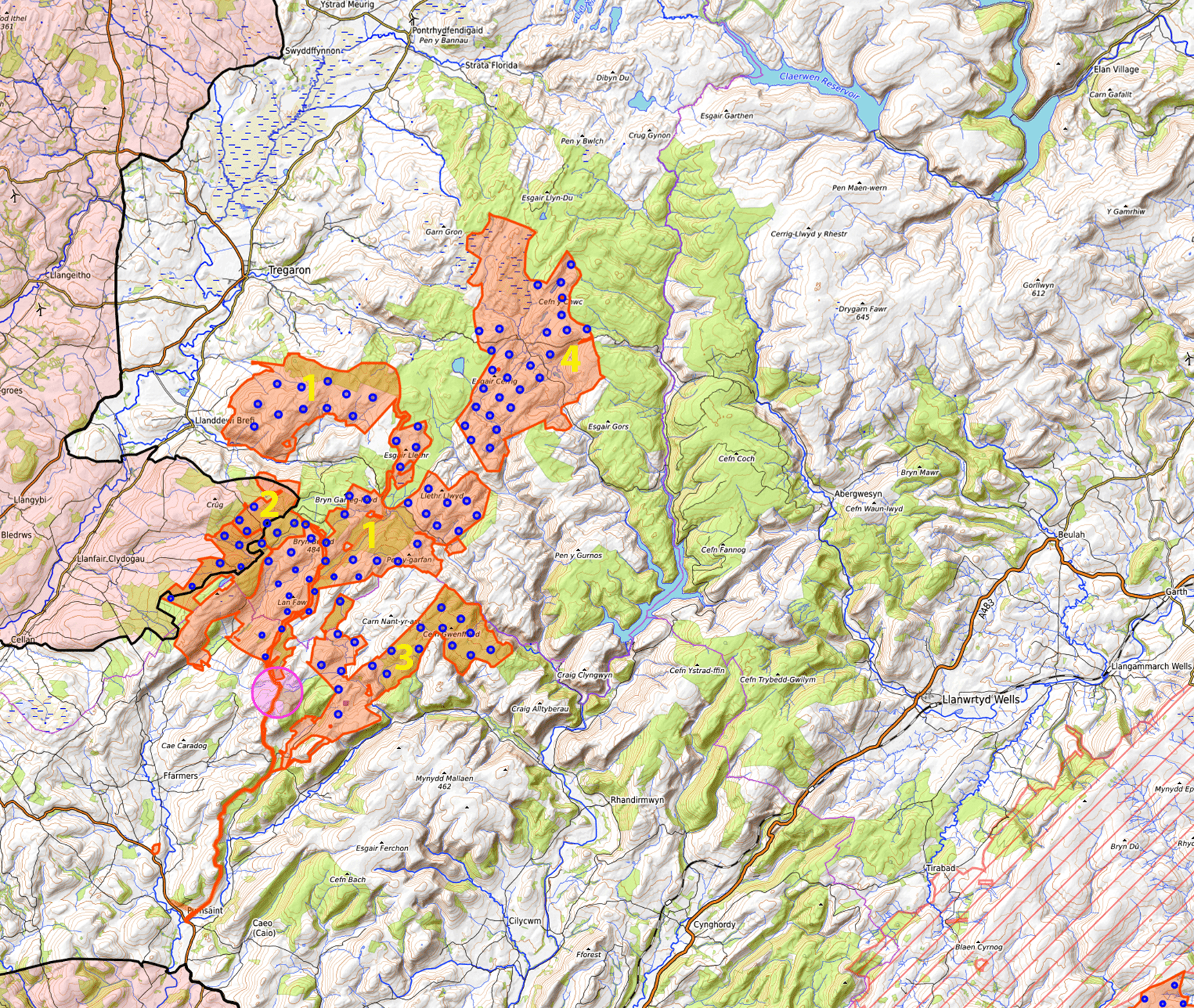
Anyway . . . since putting out last week’s piece I have been told that the companies behind these three projects are combining to share a route to the plateau that forms the southern end of the Cambrian Mountains of central Wales.

In fact, the route is described here on the Belltown website (scroll down):

The proposed access route to the site for abnormal indivisible loads (such as blades, hub, nacelle and tower sections) will be from the port of origin (which is likely to be Swansea) via the M4, A48 and A40. Loads would turn off the public highway at Pumsaint and travel north for approximately 14km on a combination of existing commercial forestry tracks and new tracks to reach the wind farm location. No significant traffic flows will be associated with the operational phase of the site.

Who could argue with that? A motorway and nice wide trunk roads all the way. Problem is, the route as given is sort of incomplete. Let me explain.

As written, deliveries will turn off the A40 at Pumsaint . . . but the A40 goes nowhere near Pumsaint. Which makes what Belltown says misleading, if not dishonest. And if they could get this so wrong, what else might they have got wrong?

The truth is that after leaving Llandeilo the huge low loaders will turn onto the B4302 and head for Talyllychau (Talley). Then on to Crugybar and the Bridgend Inn (where I sank a few pints in the good old days), where they’ll join the A482 to reach Pumsaint.

Using my bestest crayons I’ve conjured up this map that might explain it better.

Click to open enlarged in separate tab

For those of you unfamiliar with this road, take my word for it, it will struggle to accommodate massive low loaders carrying huge turbine blades and tower sections.

Below is a capture from Google Maps showing the B4302 just after leaving Talyllychau on its way to Crugybar. Those hedgerows will have to go. And so will many other trees and hedgerows on the 13 miles from the A40 to Pumsaint.

Click to open enlarged in separate tab

Now we’re going to move on to Stage 2 of the environmental vandalism associated with these projects. The section that involves the National Trust (NT) and the ‘Welsh Government’.

UPDATE: I should have mentioned that Belltown is closely linked with the Foresight Group. And if that name rings a bell it’s because Foresight has been buying up farms in this area for carbon offsetting.

With the Foresight reputation damaged locally Belltown may be fronting for Foresight. Questions need to be asked. And answers demanded.

UPDATE 10.11.2023: It was learnt last night that Belltown will be taking the A482 from Llanwrda to Pumsaint. Galileo will take the Talyllychau route suggested above. No information yet on the Bute route, but it doesn’t really matter. Because there will now be two roads suffering expensive damage.

DON’T TRUST THE NATIONAL TRUST

Once the huge low loaders reach Pumsaint, or just outside the village, they’ll take a right turn onto National Trust property.

Click to open enlarged in separate tab

This is the Dolaucothi estate, home to the famous ‘Roman’ gold mines, once owned by the Johnes family, who also owned the Hafod estate, to the north. Hafod fell into the clutches of the National Trust last year. With a 99-year lease and £700,000 gift from the ‘Welsh Government’.

In other words, the ‘Welsh Government’ paid an organisation worth billions £700,000 to take over a prime Welsh estate.

Despite the excuse given by Corruption Bay for this generosity it might have been due to the involvement of Dawn Bowden MS. As Deputy Minister for Arts and Sport the Hafod deal should have had nothing to do with her. But Tourism’ has since been added to her portfolio. Fancy that!

Response from ‘Welsh Government’ to FoI request. Click to open enlarged in separate tab

I wrote about it in this post, scroll to the section ‘Bristol Fashion’. And then in this post, in the section, ‘”Welsh Government” funds National Trust’.

It’s instructive to consider the organisation of the National Trust in Wales, and what happened at Hafod. Not least because it might provide clues as to why the NT would be a willing party to this planned environmental disaster.

It was early June last year when we learnt that the Trust was taking over the Hafod estate. Which seems to be owned by the ‘Welsh Government’ through Natural Resources Wales, and had until then been run by the Hafod Trust.

Just three months earlier, in March, Lhosa Daly of Bristol, had taken on the role of NT’s Acting Director for Wales, and was appointed to the post officially in September. I mention Bristol because that’s where she lives.

If we look at her career background we see that in the past seven or eight years Daly’s been chair of the Bristol branch of the Institute of directors, vice chair of the Bristol Law Centre, and she is still a business ambassador for the Western Gateway.

These positions would have brought her into contact with the glitterati of Bristol’s business community. Including, perhaps, the directors of Belltown Power, the company planning to desecrate our country with Waun Maenllwyd Wind Hub.

With Belltown, Bute and Galileo hoping to reach the site by traversing land owned or managed by Lhosa Daly’s National Trust and the ‘Welsh Government’.

The mystery of Dawn Bowden representing the ‘Welsh Government’ last year, despite it being beyond her responsibilities, could be accounted for by her also being from Bristol. She and Daly might have already known each other.

And if that’s too fanciful an explanation for you, then try this: Bowden should have known Lhosa Daly through her being Deputy Minister for Arts since May 2021 and Daly being an advisor to the Arts Council of Wales since April 2019.

Come to that, how did Bristol-based Daly get that gig with the Arts Council of Wales?

FINAL THOUGHTS

I’m told deals have been done with farmers and other landowners along the route between Llandeilo and Pumsaint to cut corners, destroy hedges, and in places widen the B4302, and even perhaps the A482.

This will cost a considerable amount of money. So who’ll pay for it? Will it be the ‘developers’? The county council? The so-called ‘Welsh Government’? Or will there be a whip-round in the Dolaucothi Arms?

And then there’s the question of how the National Trust squares being a conservation body with the damage it’s helping inflict on the Welsh landscape by these wind farms. What would NT members say, if they knew?

Not just in the road ‘improvements’ I’ve just described, but also on the 14km journey to the sites after the low loaders turn off the A482. And then the on-site destruction.

Click to open enlarged in separate tab

There’ll be the vast concrete bases to support these huge turbines, the access roads, the deep trenches for the cables. How many trees will be felled? How much peat bog damaged? And let’s not forget the pylons.

I ask about the trees because I’m told new populations of red squirrels and pine martens are establishing themselves. Will they adapt to climbing pylons and turbines?

I suggest that even if they stick around they’ll be so traumatised by what’s being done to their habitat they might stop breeding.

As if that wasn’t enough, someone then tells me . . .

We also have two breeding maternity colonies of soprano pipistrelle bats on my land, they will love the sonic signature of wind turbines of course.

Don’t worry – once the poor little buggers are disorientated enough the blades will finish them off pretty quickly. (If they’re turning!)

Them and the kites, and other birds. And insects by the million.

Nothing here really surprises me, because I’ve always regarded the National Trust as a very commercial organisation and, in Wales, rather colonialist. Lhosa Daly playing the memsahib is entirely in keeping.

Not only that, but there’s something of the vulture about the NT in Wales, picking up land and estates as old Welsh families die out. Or more recently, acquiring property from the ‘Welsh Government’ or Natural Resources Wales.

For example, Daly is also a director of a National Trust company called Porthdinlleyn Harbour Company (The). This relates to Porthdinllaen at Morfa Nefyn.

Porthdinllaen once belonged to the Jones-Parry (Madryn) family. Sir Love Jones-Parry MP, was very supportive of the Patagonia settlement. Which explains why a town over there is called Puerto Madryn; and is twinned with Nefyn, I believe.

Another example of this sad phenomenon is located not far from me, a place I love to visit. I’m directing you now to Llynnoedd Cregennan.

Llynnoedd Cregennan. Click to open enlarged in separate tab

Major C L Wynne-Jones lost both his sons in WWII, so in 1959 he handed over this 285-hectare estate to the National Trust.

As I hope I’ve made clear, I’m not surprised by the National Trust’s behaviour with these wind farms, and the damage they’ll cause . . . what really pisses me off is that the National Trust is still operating in Wales.

Devolution should have brought Wales a new organisation to replace the colonialist parasite that is the National Trust. We should by now have a Welsh body conserving our heritage and our history, safeguarding our landscapes.

But to set up such a body would have required political leaders with vision and courage, rather than the grubby, ishoo-of-the-month puppets Wales is cursed with.

♦ end ♦

© Royston Jones 2023

A Change Of Tack?

The title is a nautical reference to wind, and a change of direction, which I’m entitled to use cos I was in the Sea Scouts. Right! And what I’m alluding to will, I hope, become clear before the end.

TWM SIÔN CATI

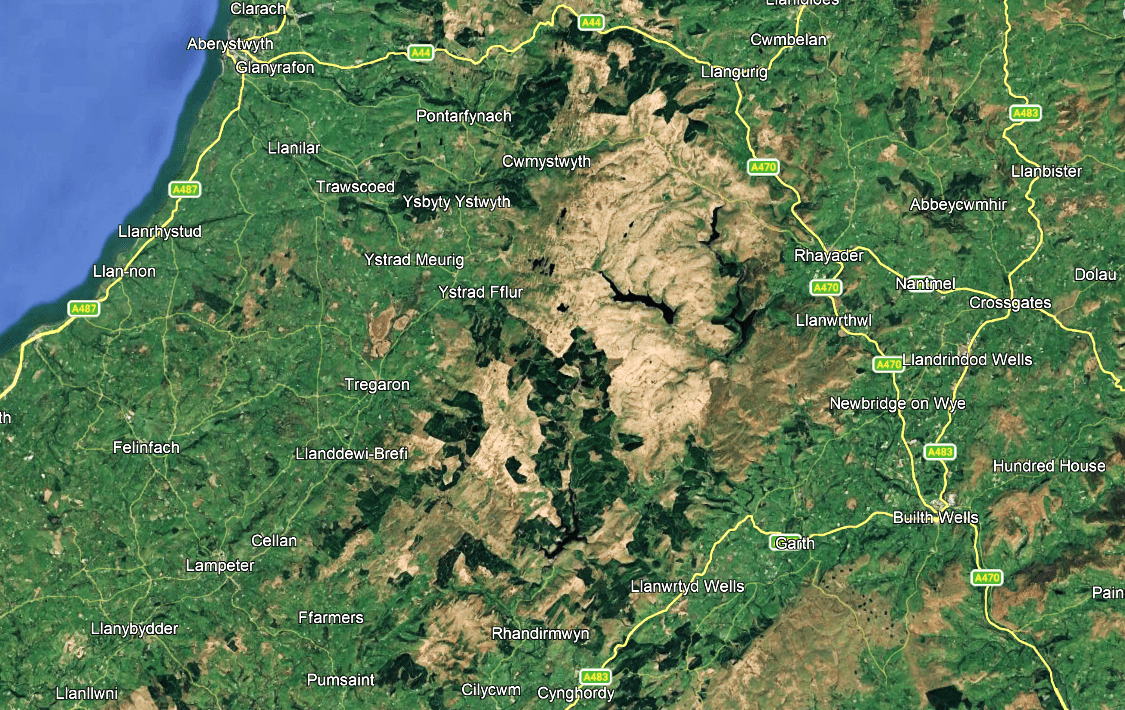
We start in the wild and beautiful uplands between Lampeter and Llanwrtyd, once home to Thomas Jones, known to us all as Twm Siôn Cati, or Twm Shôn Catti.

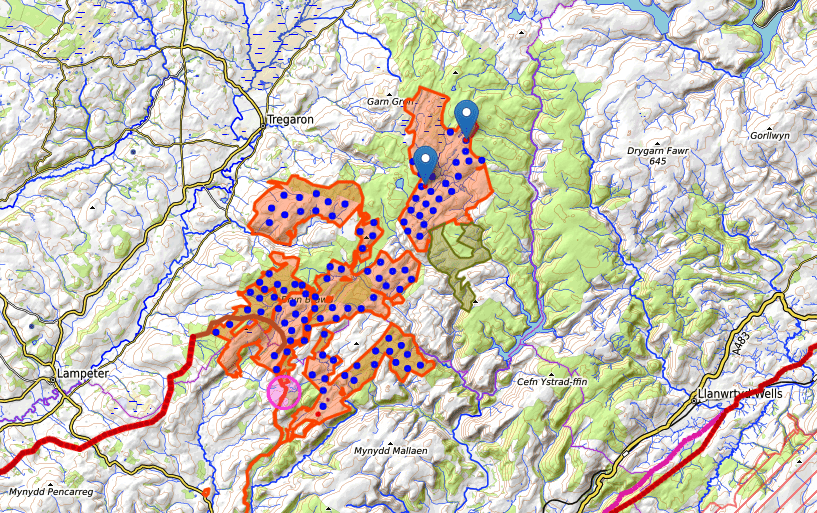
In the centre of the map I have pinpointed Bryn Cadwgan; Twm’s cave is to the west, and to the south east we see Ystradffin, where Twm took a fancy to the widowed heiress, Joan, and eventually married her.

Click to open enlarged in separate tab

Last year I wrote about a plan for wind turbines at nearby Bryn Brawd, which you can see to the north west of the pin. It was in this post, just scroll down to the section ‘Local benefits (well, local to somewhere)’.

A company mentioned in that piece, Awel Newydd Cyf, recently issued 43,659,462 shares. Which suggests there may be something in the wind. (Geddit?)

But I wouldn’t get carried away by the company’s Welsh name, for it’s ultimately owned by Elm Trading Ltd, which has being issuing shares like they’re going out of fashion.

The Elm Trading website tells that a number of its assets are in Wales.

We’re switching our attention to Bryn Cadwgan because another wind farm is planned there, and it should go without saying that the plan comes from yet another gang of foreign investors.

So who is it this time?

GALILEO GREEN ENERGY

This company launched in early 2020, and is headquartered in Zurich, Switzerland. Set up with . . .

. . . an initial investment of £190m from its four institutional long-term investors,

These ‘investors’ are all from Australia and New Zealand.

Since then Galileo Green Energy UK seems to have divided into a Scottish operation, now based at 7 – 9 North St. David Street in Edinburgh; and a Welsh operation at C12 Cathedral Road in Cardiff.

Click to open enlarged in separate tab

Galileo Green Energy Wales was set up in April 2021, and was originally known as GGE Machynlleth Ltd (until 4 June 2021). Why ‘Machynlleth’ should appear in the name is a mystery, seeing as the original address was in Bristol, and the first directors lived in Italy (2), France, and Ireland.

Was the original plan to bless the Dyfi valley with yet another wind farm?

All 10,000 shares for Galileo Green Energy Wales are held by GGE Nordics Ltd, who can now be found at the North St. David Street address. But until January this year was up on the fourth floor of 115 George Street in Edinburgh.

The majority shareholder in GGE Nordics is Empower Renewables Ltd, also of 7 – 9 North St. David Street. When we look at Empower’s UK registration we see that apart from a Dane (who lives in Killarney) all the directors are Irish, with control exercised by Diarmuid Anthony Twomey of Castleknock, Dublin.

Twomey is also a director of Galileo Green Energy Wales Ltd.

At the risk of getting distracted or bogged down . . . another company using the fourth floor at 115 George Street as an address is Vistra Ltd.

Click to open enlarged in separate tab

I only mention this because Vistra’s main UK office seems to be at 10 Temple Back in Bristol. Which is where Galileo Green Energy Wales started out.

Finally, we need to look at Galileo Energy UK Ltd, formed 18 February 2022, and originally known as Galileo Green Energy Management Services UK Ltd. This company is wholly owned by Galileo Green Energy Gmbh of Zurich.

I bet like me you’re excited by all the Welsh involvement in these projects!

MYNYDD TY-TALWYN ENERGY PARK

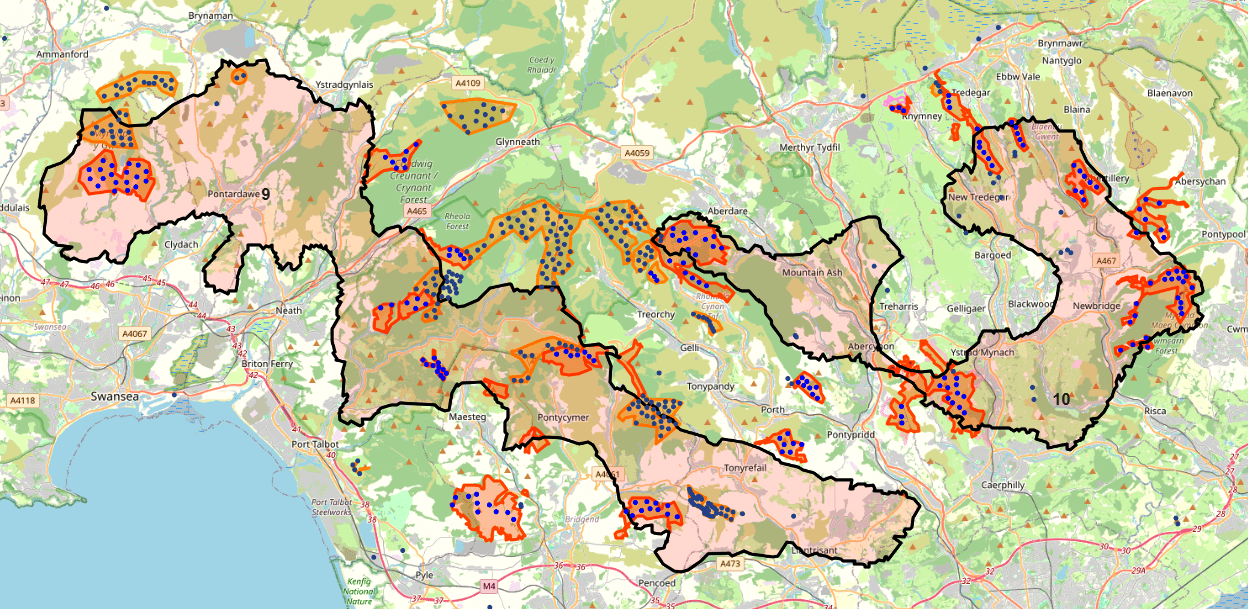
So where are we now?“, you’re wondering. Well, Mynydd Ty-talwyn, or Mynydd Ty Talwyn, is just to the north west of Bridgend. Outlined in red on the map.

Click to open enlarged in separate tab

Other than Bryn Cadwgan it’s the only Welsh site I’m aware of. Though the website tells us (scroll down to the ‘About Galileo’ section): ”

Mynydd Ty-talwyn Energy Park is one of a pipeline of our new renewable energy projects in development across Wales.

So where are the others?

Never mind that for now, because I want to concentrate on a worrying claim and a serious untruth, on the Mynydd Ty-talwyn website; and I also want to highlight a major drawback with Bryn Cadwgan.

Click to open enlarged in separate tab

Under ‘Specifications’ ‘Wind’ we read,

Approximately 64,643 tonnes of carbon dioxide emissions saved per annum.

We don’t normally see this calculation given, so why do we see it here? One possibility must be that the calculation has been made for the purposes of carbon offsetting.

Just as medieval evil-doers would pay the Church to be forgiven their sins, and carry on sinning, carbon offsetting is a twenty-first century version of the scam.

Immediately below we read, “Up to 50-year lifetime“. If that’s the projected lifespan of the Mynydd Ty-talwyn Energy Park then Galileo must plan to replace the turbines at least once. For few turbines last 20 years.

On the other hand, if Galileo is saying that the turbines they hope to erect at Mynydd Ty-talwyn will last 50 years, then that statement is an outright lie.

Another issue is that Mynydd Ty-talwyn is home to a . . .

 Cluster of nationally important medieval house platforms and settlement remains.

The reference comes from a report of March 2021 to Bridgend CBC of scoping work carried out in relation to the application for nearby Y Bryn Energy Park.

And they’re shown clearly on the OS map for the area. Though just one is shown on the map supplied by Galileo (above) there are at least three around Mynydd Ty-talwyn.

Click to open enlarged in separate tab

We saw Irish control of Empower Renewables Ltd up at North St. David Street, Edinburgh, and Coriolis Energy, the company behind Y Bryn, is also Irish. The other company involved at Y Bryn is ESB UK, the UK face of a further Irish company.

Mynydd Ty-talwyn is not far off the beaten track, but even so, there will be environmental damage caused hauling huge turbine blades and towers to a relatively unspoilt area.

And let’s not forget the vast concrete bases for each turbine, and the access roads gouged out of the earth, the trenches for cables . . . and then there’ll be the pylons . . .

We can take it for granted that the blades and towers will not be manufactured locally, which will probably see them shipped into Swansea docks and then taken along the M4, before the final four or five miles of their journey to the site.

But the problems that’ll be encountered there are nothing compared to what will need to be overcome at Bryn Cadwgan. From Swansea docks the loads can take the M4 west, and then perhaps the A483 up past Llandovery, but then what?

Once you leave the A483 and head for Rhandirmwyn, and the closer you get to Bryn Cadwgan, the more you’ll realise that you’re really out in the sticks.

How many wind turbines can you get in the back of a farm pickup truck? Click to open enlarged in separate tab

To reach the site itself, new roads will have to be laid. The environmental damage caused will be immeasurable . . . unless of course those clever people at Galileo can get their calculators out again.

WHO’S WHO AT GALILEO

Let’s start by going back to the main Galileo website. In particular, to the ‘Our People‘ section where, yet again, we see a complete absence of Welsh involvement. Whereas in Scotland, those involved all seem to be Scottish.

Let’s look first at Rob Paul and Joe Winton, both described as ‘Development Manager’. These two are also directors and shareholders of One Wind Renewables Ltd of Truro, a dormant company.

We find these two, along with Simon Edward Coles, at a number of renewables companies. They’ve been knocking around the sector since they were callow youths, and both seem to have started out with Ecotricity.

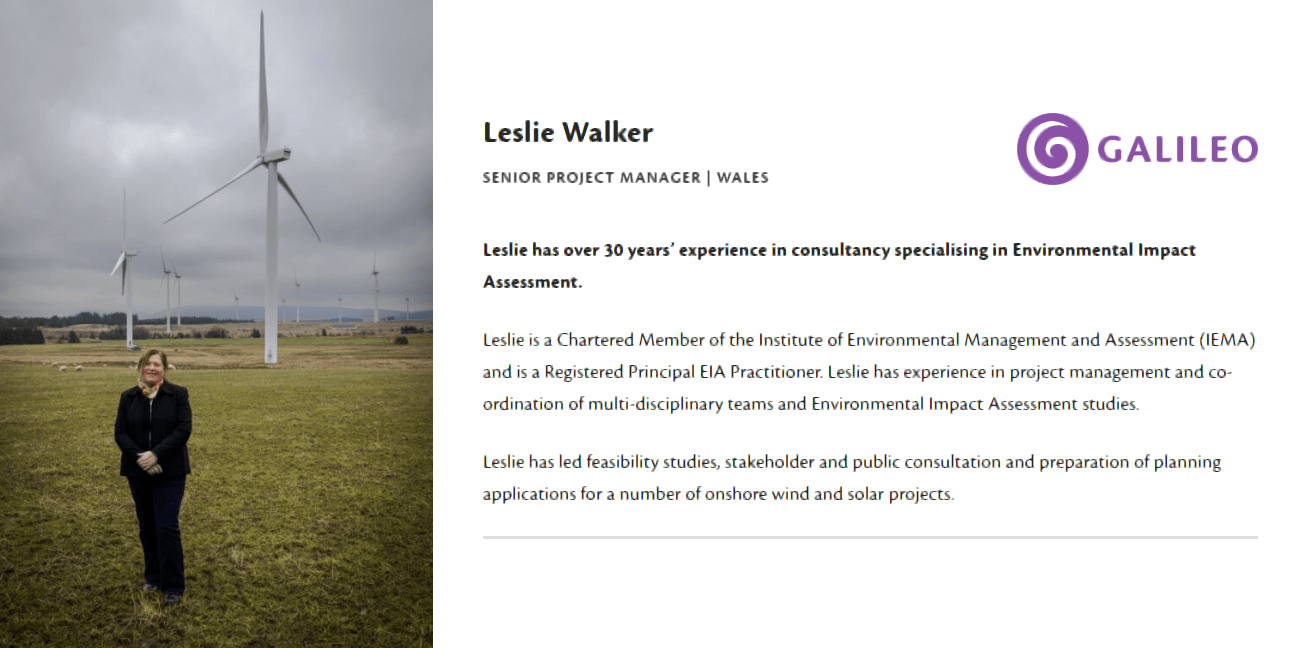
Next we turn to Leslie Walker, Senior Project Manager. Very interesting, Ms Walker. Here’s her Linkedin page to give you a clue as to where we’re going. (Scroll down to her ‘Interests’.)

Click to open enlarged in separate tab

On that Linkedin page you’ll see that she works for Dutch company Arcadis Consulting. And has done for over 30 years.

I’d never heard of Arcadis, maybe I should have, because it gets a lot of work in Wales. Much of it from the so-called ‘Welsh Government’.

Here’s an example. A report from just last month about Arcadis working with US company Tetra Tech for the ‘Welsh Government’ on a new bridge at the Prince of Wales dock in Swansea. No mention of Swansea council involvement.

But Cardiff council is mentioned in this piece about Arcadis helping the council develop an electric vehicle strategy. (In conjunction with the local fire brigade?)

Let’s step back to 2017 and find Arcadis working for the ‘Welsh Government’ on strategic transport connections for Dinas Powys.

And talking of transport . . . From November 2020 we have this final scoping report from Arcadis on the Integrated Sustainability Appraisal of the Wales Transport Strategy.

There’s a transport strategy!

Arcadis and the ‘Welsh Government’ are ‘close’. As this piece makes clear.

Click to open enlarged in separate tab

I’m not for one minute suggesting that Leslie Walker is not good at what she does, but if I was in the position of Galileo, hoping to get approval for major contracts in Wales, I’d be looking for somebody who knew their way around the Bay.

And recruiting Walker might be less controversial than taking on Matt Enoch who, after 13 years as Project Manager and then Project Director with the ‘Welsh Government’, joined Arcadis in October 2019 as Project Director.

Click to open enlarged in separate tab

I could go higher up the food chain to people like Ingmar Wilhelm, CEO at Galileo Green Energy, but it wouldn’t tell us much more than we already know. We’re dealing with foreign individuals, foreign companies, foreign money.

Our contribution is our country – and most of us don’t even know we’re making it.

FINAL THOUGHTS

Earlier I mentioned that GGE Nordics Ltd, which owns Galileo Green Energy Wales, had been based at 115 George Street, in Edinburgh’s New Town. When I wrote it, I thought to myself, “Jones, that address rings a bell“.

And sure enough, it’s an address I’ve seen in connection with Bute Energy. More specifically, with Copenhagen Infrastructure Partners (CIP), which is investing in Bute’s Welsh projects. I wrote about here.

115 George Street, Edinburgh. Click to open enlarged in separate tab

Bute is a Scottish company that’s appeared on this blog many times. It has insane plans to turn our country into a vast open-air electricity generator for England. And like Galileo, Bute employs people familiar with the denizens of the Swamp.

The connection between Bute and Galileo seems to be by association, via CIP. Then again, the link could be Vistra, with companies using it as their address. Which might explain the original Bristol address for Galileo Green Energy Wales.

Food for thought.

We may have missed the public meetings for Mynydd Ty-talwyn, but those for Bryn Cadwgan are being held next week; Llanddewi Brefi on Wednesday, and Pumsaint on Thursday.

Click to open enlarged in separate tab

I suggest that people turn up to these meetings and demand answers to all sorts of questions. Here’s what I might ask . . .

  • How much environmental damage will be done transporting the turbines to and and erecting them at Bryn Cadwgan?
  • Where are Galileo’s other Welsh projects?
  • How many local jobs will be provided at Bryn Cadwgan?
  • Is Galileo claiming that wind turbines last for 50 years?
  • How much of Galileo’s business model is carbon offset ‘greenwashing’?
  • Is there any connection between Galileo Green Energy and Bute Energy?

And finally, always remember! wind turbines are not built to save the planet. They’re built to make a few people a lot of money, and to make our lives more difficult through an increasingly expensive and unreliable electricity supply.

♦ end ♦

© Royston Jones 2023