Any, Any, Any Old Iron?

A bit of a departure, this one. And certainly not what I advertised last Saturday. Though that element does figure in this bigger picture.

Rather than focus exclusively on Bute’s windfarm plans in Wales, the infiltration of the Welsh political class (especially, but not exclusively, the Labour party), or alleged links to those who sent the tanks into Tianmen Square, I’m going to look into a possibility suggested to me by someone with a keen interest in Bute and associated companies.

In this piece, after the first section, I’m going to look into the companies named as being involved with a new venture at Port Talbot in this press release from Catapult Offshore Renewable Energy. Which seems to tie in with the ‘Celtic Freeport‘, split between Port Talbot and the Haven Waterway.

From one angle, the plan we’re going to look at seems to be, make wind turbine body parts in the electric arc furnaces promised for Port Talbot, from scrap metal, then put them together in Pembrokeshire before mooring them offshore.

That might be the assumption to make, but the press release from Catapult Offshore Renewable Energy clearly states “onshore wind turbines“.

Which might suggest confusion.

Whatever, the companies named in the Catapult press release are Tata Steel UK, RWE, Bute Energy, Hutchinson Engineering, and Ledwood. So I’ll deal with them in the order they’re mentioned.

But let’s start with Catapult itself.

OFFSHORE RENEWABLE ENERGY (ORE) CATAPULT

This outfit, the one apparently pulling it all together, looks to be an extension of Innovate UK, a government-funded body. Google AI says this:

Innovate UK provides substantial funding to ORE Catapult to drive offshore renewable energy innovation, including a recent £85.6 million capital investment for testing facilities.

Note, again: “offshore renewable energy“, yet as we’ve seen, the statement from Catapult clearly says “onshore wind turbines“.

That said, Catapult claims a presence in Pembroke Dock. In a building otherwise known as the Bridge Innovation Centre.

There’s not much more to tell about ORE Catapult, so we’ll move on.

TATA STEEL UK

Indian company Tata Steel is the owner of Port Talbot steelworks. The coal-based blast furnaces have closed and it’s promised they’ll be replaced with a £1.25 billion electric arc furnace. Due to be fully operational by the end of next year.

The project has already received £500 million in UK government funding.

Which means that Tata’s role seems fairly clear. It will produce the steel needed for the onshore and offshore wind turbines, from scrap, much of which will be sourced abroad, as will be explained in the section about Ledwood.

RWE

As many of you will know, RWE is a huge German company involved in ‘renewable’ energy. Let’s also remember that RWE is a big player in Wales.

RWE is the largest power producer and renewable energy generator in Wales, with more than 3GW of energy across 12 sites. Brechfa Forest West Wind Farm comprises of 28 turbines – enough to power 40,000 homes. The site has produced over 1.05TWh of energy since it was commissioned in 2018.

RWE’s Head of Onshore Development: Wales & England is Eleri Davies. She also sits on the UK government’s Onshore Wind Industry Taskforce. As we are reminded in this press release from her company:

As a member of the Government’s newly created Onshore Wind Industry Taskforce, it was incredibly valuable to show the Prime Minister and First Minister how RWE works with and for local communities, harnessing homegrown talent and supporting local communities.

UK Operational Manager for RWE is Nia Griffiths. So there’s a definite Welsh flavour to RWE. At least in senior staff. Of course the money goes back to Germany.

And it seems RWE already has a presence in Port Talbot at the Baglan Innovation Centre. While in 2022 it struck a deal with Associated British Ports, owners of Port Talbot docks, an agreement that also covers Milford Haven.

BUTE ENERGY

Bute Energy appears for obvious reasons. First, wanting to plaster rural Wales with wind turbines and pylons. Second, because this company has bought up ‘Welsh’ Labour and is not without influence within the party at UK level.

But for the purposes of this piece, I think we should concentrate on warehouses.

I touched on this subject briefly with a post back in August 2024 after receiving information from Scotland. It’s here in Parabola Bute Energy, Scottish Echoes. The Bute Boys, using the company Windward Titan Ltd, bought a huge warehouse (below) near Glasgow, then sold it three years later, for double the price paid, to the Lothian Pension Fund; essentially, Labour-run Edinburgh City Council.

Does Bute getting money from Labour-controlled pension funds sound familiar?
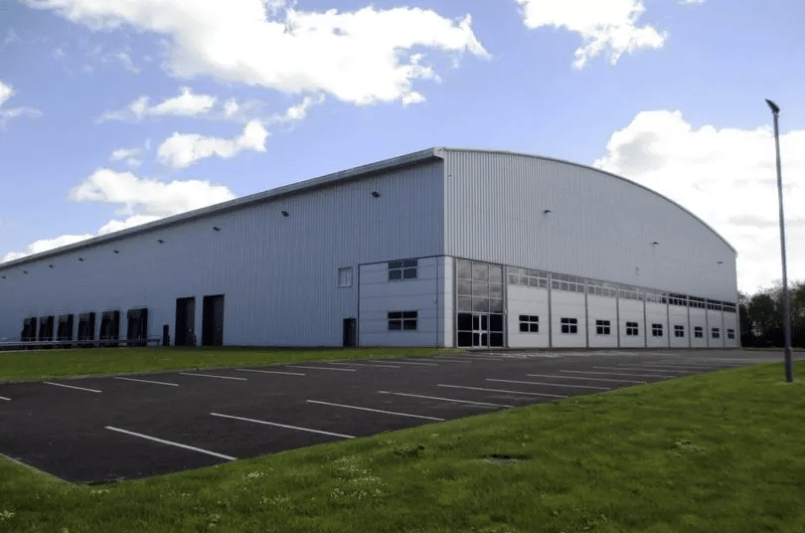
Further information received last month, from a different source, suggested Bute companies – often under the ‘Windward’ label – have quite a few warehouses ” . . . in Wales and Scotland filled to the rafters with BESS and pylon materials“.

These have been bought with the help of private bank Brown Shipley & Co Ltd, ultimately owned by the Al Thani family, which also owns Qatar.

I dealt with this a few weeks back in The Windward-Bute Empire, Fresh Insights.

So the question is, why would Bute need all this space, and why are some of these warehouses chock full of pylon components and other equipment for onshore wind turbine installations?

Also note, the insider who contacted me last month made no mention of the actual turbines. Neither towers nor blades. For which I might have an explanation.

HUTCHINSON ENGINEERING

This company has also appeared on this blog quite recently. In a piece I put out in January. (Skip the first section.)

I started out back then by wondering, in a post on X, why a company in Cornwall called Inyanga Marine Energy Group had received £2,000,000 from our wonderful, and now thankfully departed, ‘Welsh Government’.

The man behind Inyanga, Richard James Parkinson, has other companies named HydroWing and Sangoma. All hoping to generate power from wave energy. Explained in the earlier blog piece I’ve linked to. But there seems to be no money, apart from public funding, and little sign of activity.

Though I did find this piece in the Falmouth Packet, which introduces Hutchinson.

Inyanga Marine Energy Group, based in Penryn, has tasked Hutchinson Engineering with constructing its HydroWing tidal energy device.

The 20 MW HydroWing tidal energy array will be deployed at Morlais, off Anglesey in Wales.

Naturally, my attention then turned to Hutchinson Engineering of Cheshire. Here’s the Companies House entry. You’ll see that ownership rests with Modernuser Ltd. In turn owned by Dean Clark Drinkwater.

And here’s Dean, a fan of both Starmer and Miliband!

What’s more, Drinkwater has also been appointed to the UK Government’s Onshore Wind Industry Taskforce, chaired by ‘Mad Ed’ Miliband.

It would appear that Dean is another who’s well in with the Labour party.

LEDWOOD

Ledwood Mechanical Engineering Ltd, based in Pembroke Dock, is owned by Ledwood Protective Coatings Ltd, which is in turn owned by Nicholas David Revell, and may rely to a great extent on a loan from the ‘Welsh Government’-controlled Development Bank of Wales.

Another Revell company is Ledwood Holdings Ltd. Revell has a further company, LSM Holdings Ltd. (‘Ledwood Scrap Metals’?)

I suggest that name due to this reference in the LSM accounts, and where it leads.
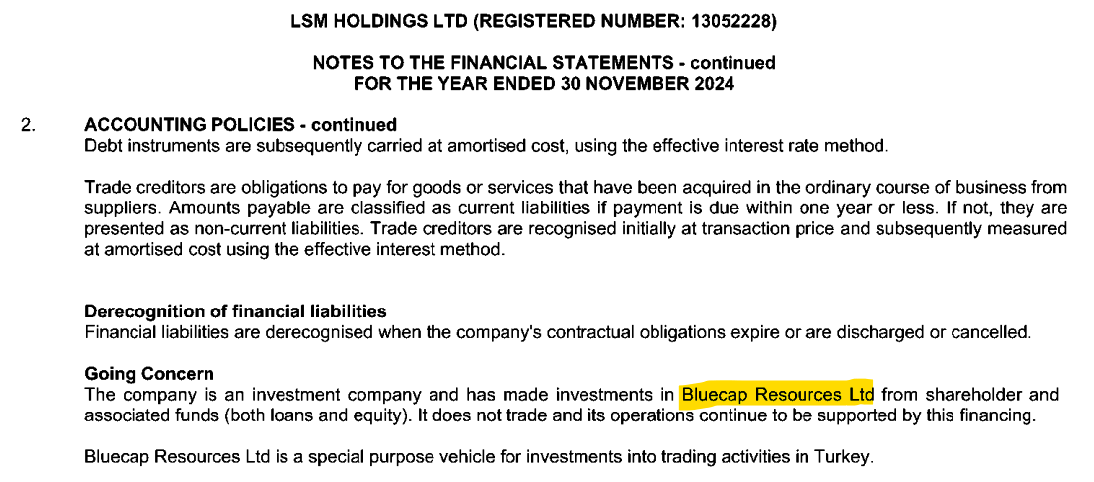
Nick Revell, also gets a mention in this press release from January 2025 from the Wales Office, not ‘Welsh Government’. Again, the “Celtic Freeport” is mentioned.

Bluecap Resources Ltd, highlighted in the clip above, is based in Newport. But with its R&D in Penryn, Cornwall where, you’ve just read, we also find Inyanga, builder of wave energy machines, and beneficiary of ‘Welsh Government’ largesse.

The company is owned by:

 . . . a consortium of European shareholders from the natural resources industry, both corporate and individual, including two publicly-quoted companies . . .

(Here are the Bluecap Resources shareholders.)

Yet the website tells us very little. But if we turn to the filings with Companies House we see big share issues in recent years – all in US dollars.

Bluecap is in the business of “extraction and recovery“. That it uses US dollars suggests to me it conducts much of its business outside of the UK. A belief reinforced by the company Bluecap Poland Ltd, formerly known as Bluecap Turkey Ltd.

THE THEORY

Someone who’s given the consortium some thought has suggested to me a theory. Which, after doing some research of my own, I find both elegant and plausible.

It all hinges on the electric arc furnace at Port Talbot. On it being built, and then on that furnace using scrap material. This explains Tata Steel’s presence in the consortium.

The scrap will be provided by Ledwood-Bluecap. And will almost certainly come from outside of the UK. That’s why they’re involved.

That scrap material will be smelted at Port Talbot, a magical process to transform it into the “UK Steel” promised in the headline of the Energy-pedia article.

Next, it will be knocked into the shapes and sections desired for 250 metre tall wind turbines by Hutchinson Engineering of Cheshire, who might set up an operation in Wales, or co-operate with a locally-based company.

If my Bute source is correct about the warehouses being “filled to the rafters with BESS and pylon materials”, then Windward-Bute can supply pylons and the Battery Energy Storage Systems (BESS). This is one reason why Bute is involved.

RWE might provide the motors and other mechanisms required by the wind turbines. Then again, as a major player, RWE may be thinking ahead to replacing its clapped-out turbines, even erecting new ones.

Alternatively, the blades might come from somewhere else.

For the largest manufacturer of turbine blades in Europe is Danish company Vestas. A director of Vestas is former Danish PM Helle Thorning-Schmidt. Her alter ego is Mrs Kinnock, for she’s married to Stephen Kinnock MP, in whose Aberafan Maesteg constituency we find Port Talbot steelworks.

Furthermore, Vestas has a 25% stake in Copenhagen Infrastructure Partners (CIP), which seems to be Bute Energy’s main financial backer.

CONCLUSION

Let’s start by remembering that in the Ore Catapult press release we read that the consortium involved is “largely based in Wales“.

Yet Tata Steel is an Indian company. RWE German. Bute Energy is Scottish. Hutchinson Engineering is an English company. Ledwood and Bluecap have addresses in Newport, but source their scrap metal from God knows where.

Pushing this lot as Welsh is like describing the German army in September 1939 as Polish because it was “largely based in Poland“.

And as if that idiocy wasn’t enough, remember that almost all the electricity that’ll be generated will go to England!

If the theory is correct, or only partly correct, we can clearly see who’s going to benefit from turning scrap metal into wind turbine parts, and who’ll make money from supplying whatever else is needed.

It’ll be the same faces that have been ripping Wales off for too long.

There might be a few hundred jobs at Port Talbot, small compensation for the thousands lost. A few hauliers might get contracts. The turbines and pylons will be erected by specialist crews brought in from outside.

But let’s not forget – it might keep Kinnock Jnr in a job.

Yet we’ll have to put up with the ugly bloody turbines and pylons, and you can bet your sweet life that whatever the colour of the ‘Welsh Government’ after May 7 – we’ll be paying out plenty in public money.

All done so that demented individuals in Plaid Cymru, for whom politics is all gestures, who prefer ‘positions’ over policies that would benefit the long-suffering Welsh people, can claim that Wales is a “world leader” – in being exploited.

For God’s sake, don’t vote for these clowns!

♦ end ♦

© Royston Jones 2026

Buy Me A Coffee

Parabola Bute Energy, Scottish Echoes

This piece has been prompted by information received from Scotland, which may clear up a lingering mystery, while also telling us more about the operations of those involved with Parabola Bute Energy.

I use that name because I’m convinced that Bute Energy, which wants to build some 20 wind farms in Wales, plus other installations, also mile after mile of pylons, is little more than a venture into the renewables sector by property group Parabola.

I say that because the ultimate holding company for all Bute companies is Windward Global Ltd. This company is controlled by Oliver James Millican. He is the son of Peter John Millican, who runs Parabola.

The son worked for the father at Parabola, as did the other Bute principals (though some have since left Bute). They all ‘departed’ Parabola late in 2017 or early in 2018.

But to avoid confusion, I’ll stick to the name you’ve become familiar with.

NEWS FROM THE NORTH

I’ve written a lot about ‘Bute Energy’, in its various incarnations, but always from a Welsh perspective. And despite consistently identifying it as a Scottish company, I’ve never really looked into what Bute’s owners might have got up to in Scotland.

So let’s put that right. Starting with a warehouse, a very big warehouse, over 122,000 sq ft; it’s to the east of Glasgow, not far off the M8, which runs to Edinburgh.

Click to open enlarged in separate tab

It was reported on October 2, 2018 that the Titan warehouse had been bought for £6.5M by Grayling Capital. This is Grayling Capital LLP, formed just over a year earlier.

If we turn to the Members of this LLP, we see the names of Oliver James Millican, Stuart Allan George, and Lawson Douglas Steele. These are the names we’ve become familiar with as they keep turning up as directors of the Bute companies in Wales.

At the bottom of the list we see David James Taylor, a Labour insider in Wales whose name has cropped up a few times in the Bute saga.

The warehouse had been used by Lidl, but the company decided to move out to a purpose-built warehouse of their own. So Grayling looked around for a buyer. They didn’t find one, but the Covid pandemic did provide a tenant, in the form of the Scottish government. Or rather, the Scottish NHS.

The lease runs to 31 January 2031, at £766,094 per annum. Which was a good bit of business for Grayling, but it got better. For in March 2021 the warehouse was sold for £14.326m to the Lothian Pension Fund. Ultimately owned by the City of Edinburgh Council.

Though I ask myself, why did Lothian Pension Fund pay £14.3m for a property it must have known sold for half that price just over two years earlier? Did the Auditor General get involved?

Grayling Capital LLP is now liquidated.

In the report I just linked to you’ll see the sale worded thus:

The Lothian Pension Fund has acquired a prime logistics warehouse at Eurocentral in North Lanarkshire from Windward Titan.

Windward Titan was a vehicle set up specifically for the warehouse deal in Scotland, and that explains why it hasn’t been mentioned on this blog. Though ‘Windward’ should certainly be familiar to regular readers. It crops up with a number of other companies.

Windward Titan is now dissolved.

The directors were of course Millican, Steele, and George. Control was exercised by Windward Enterprises Ltd, which is now – since St David’s Day this year – known as Windward Energy Ltd. Which is in turn owned by the company mentioned above as the ultimate holding company, Windward Global Ltd.

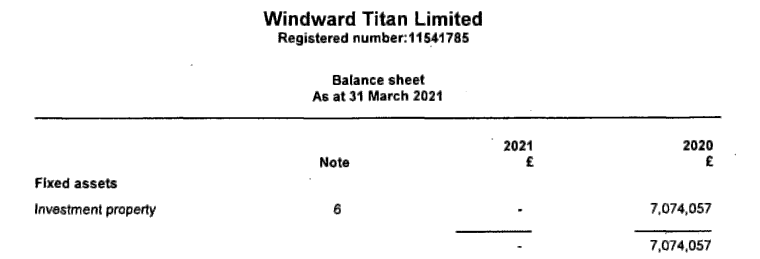
Here’s the warehouse disappearing from the Windward Titan balance sheet.

Click to open enlarged in separate tab

You’ll see that the warehouse was valued at just over £7 million. It sold for £14.3 million. And on top of that there’s the income of £766,000 a year from the Scottish NHS until 2031. Did that lease transfer to the new owner?

What’s more, a Scottish source tells me that the value of the warehouse was increased because as part of the lease the Scottish government agreed to undertake improvements costing £2.75m.

Bizarrely, this work meant that the warehouse could not be used at the height of the pandemic – which was the reason for taking out the lease in the first place!

Click to open enlarged in separate tab

One reason I find this story from Scotland so interesting is that it seems to presage what we’ve seen in Wales. More on this later.

Another reason is that those involved in the warehouse deal are now in Wales posing as planet savers, but they are first and foremost property speculators.

Never, ever, forget that.

WHO FILLED THEIR BOOTS, AND HOW?

Windward Titan was started with a single £1 share and there was never any money in the kitty, just the value of the warehouse. The only cash money appeared at the end, from the parent company, to settle up with the liquidators.

So to follow the money we need to turn to Grayling Capital LLP.

A LLP is a Limited Liability Partnership, popular with solicitors, accountants, and other professionals working as a partnership. When used in a more commercial context it can disguise ‘opaque’ dealings.

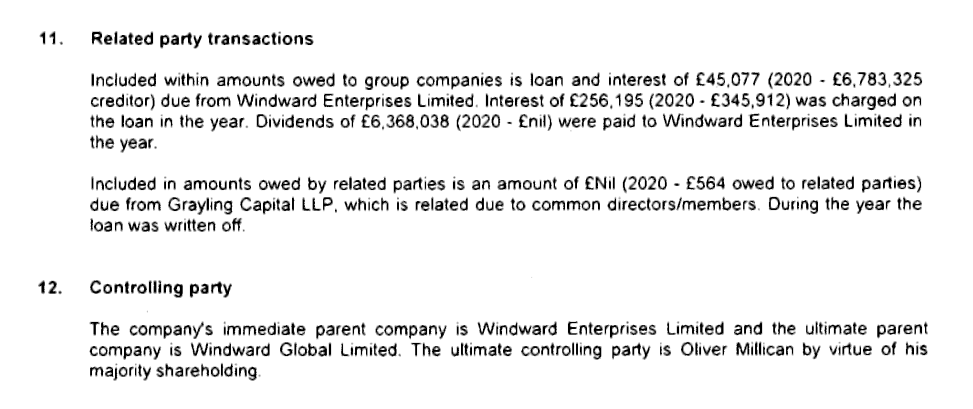
What you see below is from the final page of Windward Titan’s financial statement for year ending 31.03.2020.

Click to open enlarged in separate tab

It tells that the Titan warehouse was bought by Windward Titan with a loan from parent company Windward Enterprises Ltd. And it also confirms that everything is ultimately owned by Windward Global Ltd and Oliver James Millican.

To return to Labour insider David James Taylor. Who’d been Spad to Peter Hain MP and Welsh first ministers Rhodri Morgan and Carwyn Jones. More specifically, to the money given to his company Moblake Ltd (originally Moblake Wind Ventures Ltd).

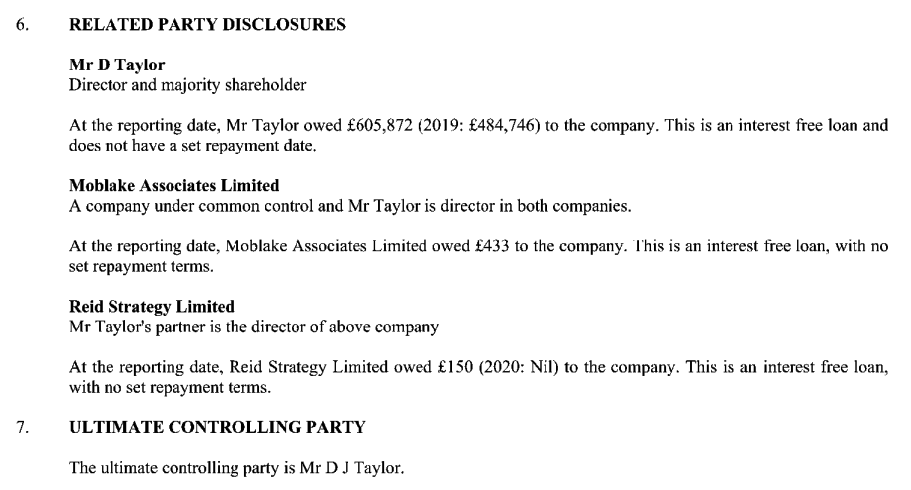
From Moblake Ltd financial statement for y/e 31.03.2021. Click to open enlarged in separate tab

There were two possible sources for the ‘interest free loan’ of £605,872 Taylor made to himself. Both linked to Bute.

One was his shares in Windward Energy Ltd (formerly Windward Enterprises Ltd), but he held these shares until July 22, 2022. Whereas the mysterious £600,000+ had been and gone from Moblake at least a year earlier.

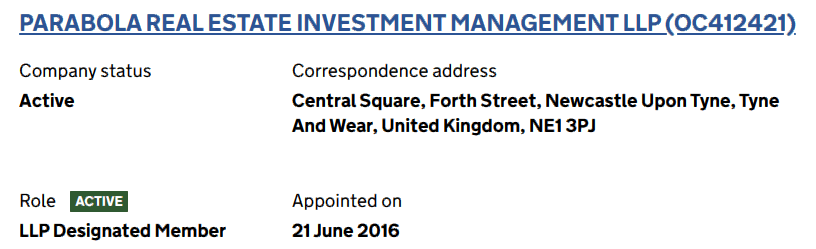
The answer would seem to be Taylor being a Member of Grayling Capital LLP. He ceased being a Member September 13, 2021, which ties in with the sale of the Titan warehouse in March of that year to the Lothian Pension Fund.

The question then becomes . . . why was Taylor, living either in Wales or London, involved with a Scottish company doing business in Scotland?

I think the answer may lie in the timing. Taylor joined Grayling Capital in September 2019, a year after the Bute boys seem to have found their way to Wales. They hired him to open doors in Corruption Bay and elsewhere.

So let’s look at what happened. And how I think it was done.

BUTE COMES TO WALES

Now we’re going to look at how a clearly Scottish company manoeuvred itself into such a dominant position in Wales. But it could only have been done with the help of the Labour party.

On this blog, I first mentioned Bute Energy in November 2018, in Corruption in the wind?. But only tangentially. For I was really writing about a guy named Radford, who wanted to build three wind farms; two in Powys, the other in Pembrokeshire.

One of his projects, Hendy, near Llandrindod, was turned down by a planning inspector, but that decision was surprisingly overturned by Lesley Griffiths, who was at the time Energy, Planning and Rural Affairs Secretary in Corruption Bay.

To do that was strange enough. But it stank even more when it became clear that Griffiths did it just in time for the developer to erect a single turbine (never connected to the grid), in order to meet the Ofgem payment deadline on January 31, 2019.

Those involved even seemed to know about Griffiths’ decision in advance, to the extent of jumping the gun.

Here’s a recent update on Hendy from the CPRW.

Why did Lesley Griffiths give permission for a wind farm that was never going to be built? The answer is a 10-letter word beginning with ‘c’.

As I say, the guy involved was Steven John Radford, of Hendy Wind Farm Ltd. But he was only fronting for a big company called U+I.

The reason Bute got a mention was, and here I quote from that November 2018 piece:

In September Radford branched out again with Bute Energy Ltd, joining six days after its two founding directors.

Those two directors were Millican and Steele, who we’ve already met. Radford may have been their introduction to Wales. (Bute Energy Ltd was re-named RSCO 3750 Ltd in March 2020.)

Or maybe the key lies with whoever introduced them to each other. So let’s fit a few things into that time-frame.

Radford was already planning wind farms, and lobbying for him was Invicta Public Affairs of Newcastle. Invicta’s representative in Wales since October 2016 had been Labour Spad Anna McMorrin, now MP for Cardiff North.

The Bute Boys linked up with Radford, and Taylor might have taken over McMorrin’s role providing a link between developers and Labour party. A different Scottish source told me last year that Taylor has now been replaced by Sophie Howe, the former Future Generations Commissioner.

Here’s a table I drew up of some essential facts, with links. You might find it useful.

Among those who get a mention in the table are the four below. Vaughan is a former Labour MEP, and Uden is the husband of Labour MS Jenny Rathbone. For some reason you won’t find the panel below on the Bute website any longer.

Click to open enlarged in separate tab

And even though McMorrin never seemed to work for Bute before becoming an MP in June 2017, she nevertheless declared £3,000 received from Bute earlier this year.

Throughout this story I’ve been struck by how often Newcastle crops up. It’s the city where Parabola began life. ‘Bute’ companies have used Newcastle addresses. And Invicta, the lobbyist we encountered with Anna McMorrin, is also based there.

And there are a number of Parabola outfits using a Newcastle address.

Click to open enlarged in separate tab

But Invicta also has an office in Edinburgh, the city where we usually find Millican Jr, Steele, and George.

Something else worth remembering is that Lesley Griffiths and David Taylor know each other. They’re from the same area, here’s a photo of Taylor canvassing for Griffiths. Both had been involved in the Carl Sargeant tragedy.

What we looked at earlier in Scotland seems to be repeated to some degree with what we’ve seen in Wales.

On the one hand, we saw Millican and his mates do a lucrative deal with the Scottish Government. Here, Bute Energy has been adopted by the so-called ‘Welsh Government’.

In Scotland, a local government pension fund stepped in to buy Titan Warehouse for perhaps double what it was worth. Here there’s been a big investment from the Wales Pension Partnership. With some councils unhappy with the decision.

Is this all coincidence?

WHAT NEXT?

Something worth remembering about Bute is that for all the companies, and all the wind farm projects, Bute has never erected a single bloody turbine. Perhaps because those involved are property speculators.

Which is why some people – and I’ve been one of them – think that Bute is not here to actually build wind farms. Maybe they’re just here to get exclusivity agreements with landowners and planning permissions.

Then sell up, making massive profits, without having done much other than smooch Labour politicians and sponsor Cwmscwt Annual Ferret Show.

But because there are now so many wind farm projects planned in Wales it can only be a matter of time before we see developers fighting turf wars. Maybe it’s started.

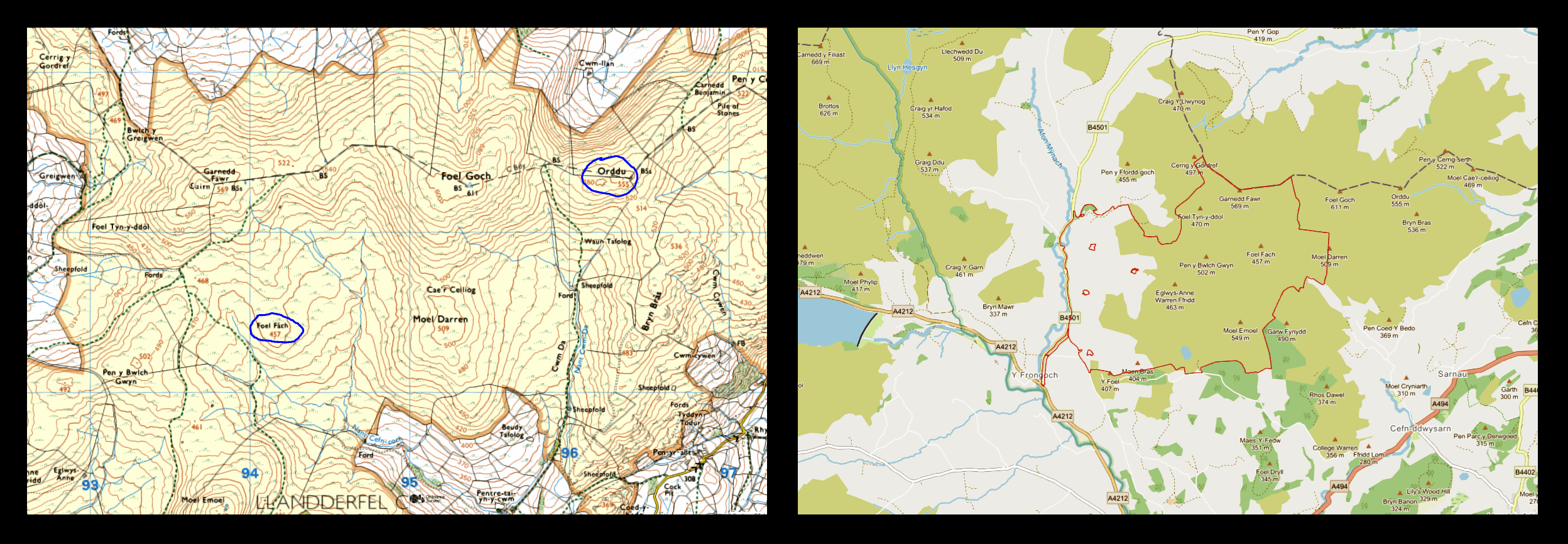
Take the case of Foel Fach and Orddu, just north of Bala.

Foel Fach Wind Farm Ltd, the company, was set up May 31, 2022. Head honcho is David Charles Murray. Orddu is a Bute project, the company formed a year later.

Murray got a mention on this blog back in October 2020 in, ‘Poor Wales: magnet for property spivs, fraudsters, and enviroshysters‘. I mentioned him due to his connection with the project between Port Talbot and Maesteg known as Y Bryn.

But Murray has been involved with many wind farm projects, and his main vehicle seems to be Coriolis Energy Ltd. It has a very basic website, and here’s the Companies House filing. Coriolis Energy is owned by Coriolis Energy Developments LLP. But again, that’s David Charles Murray.

Y Bryn Wind Farm Ltd shares a Berkshire address with Coriolis.

When we look at who’s behind Foel Fach, we see again Coriolis Energy Developments LLP and David Charles Murray.

Click to open enlarged in separate tab

The map on the left shows the relative positions of the Foel Fach and Orddu summits. The map on the right gives the outline of the Foel Fach wind farm.

But this is where it gets a bit messy.

For a start, I can’t find a map for Orddu, so where will it end and Foel Fach begin? Are they contiguous? Do they overlap? Or are they two names for what will be one big site?

We’ve always been told there must be a ‘buffer zone’ between wind farms and National Parks. But Foel Fach runs right up to the Eryri boundary on the B4501. Who allowed this?

Incidentally, the ‘lake’ to the left on that map is the Tryweryn reservoir covering Capel Celyn. And Foel Fach wind farm will also overlook Frongoch, where Irish prisoners were interned after 1916.

And finally . . . I believe David Charles Murray of Coriolis is Scottish. Many of his other projects have been in Scotland. So are he and the Bute boys acquainted?

Wind farm developments in Wales are out of control, it’s a free-for-all. Planning permission guaranteed; no matter how ugly, inappropriate, or damaging the project. Wales already has too many wind farms (and too many pylons), we don’t need any more.

And because it appears we’re in this mess due to questionable links between wind farm developers and the Labour party, a thorough and impartial examination of such links is surely the best way to proceed.

Being the transparent and co-operative organisation it is, and with nothing to hide, I’m sure the Labour party will agree.

♦ end ♦

© Royston Jones 2024