Looking Ahead To Senedd Elections

In this piece I shall look towards the May 7 Senedd elections. Rather than delve into party manifestos, or expose the peccadillos of individual candidates, I’m adopting a broad brush approach.

Impressions and perhaps even informed generalisations. Digressions guaranteed, but not without a touch of whimsy and a few doses of ironic humour.

This offering is a bit longer than normal, but as it’s broken up into sections, one for each party, you can nibble a bit at a time. Like your Easter eggs!

‘WELSH’ LABOUR

I’m starting with Labour, if only because this party has been running the show since devolution began in 1999. The name’s partly in quotes because there’s no such thing as a separate Labour party in Wales, it’s just a branch of the Islington-controlled gang we’ve know since Blair, Brown, Mandelson and a few others sat down to create New Labour.

This was the plan to broaden the party’s appeal beyond the traditional working class support. A strategy that ultimately led to the alienation of much of the working class. Labour in Wales managed to maintain the pretence longer than most party branches, but has now been found out.

But Labour, run by the Fabian Society, never really cared much for the working class, they were simply the means to power. The post-industrial age, Brexit and other factors, has seen Labour turn on the indigenous lower orders with a vengeance. Even to the extent of offering euthanasia.

For culling the poor, the sick, the disabled, the hopeless, was always Fabian Society policy. Find half an hour to watch this video.

LABOUR’S FIRST MINISTERS 1999 – 2026

One of the saddest features of this deception was seeing traditional, even generational Labour voters, in some of the most deprived communities in Wales, taken for granted by a party that had abandoned them and their communities.

A case of: Vote Labour – and we’ll keep kicking you in the nuts!

But chickens come home to roost.

And that’s why Labour finds itself facing humiliation thanks to an electoral system it conjured up believing this system would guarantee a permanent Labour-Plaid love-in, with the comrades always on top.

It says a lot for Labour’s foresight, and arrogance, that they couldn’t factor into their calculations the possibility of defeat. I described the system, and how it came about over two years ago, in Labour And Plaid Cymru Plot To Destroy Welsh Democracy.

But here we are, with Labour at 11% or 12% in the polls and fighting with the even more unhinged Greens for third place behind Plaid Cymru and Reform.

Because the problem for Labour is that having abandoned the working class it now relies for much of its support on racial and religious minorities (of which Wales has few), brainwashed students and ex-students, middle class liberals (another small group in Wales), third sector and other chisellers who’ve done well from Labour cronyism and patronage (a sizeable group regrettably), and the far left.

But many even in those groups are deserting Labour for Plaid Cymru and the Greens.

NOW LISTEN, STARMER, HERE ARE YOUR ORDERS

And if that wasn’t bad enough, there’s Starmer and his clueless, lying crew of Globalist puppets. Who’ve betrayed those who voted for them, and torn up their own manifesto, in order to serve those who came over to give them their orders soon after the 2024 election. (See above.)

A meeting of minds. For Gates’ plan to reduce the human population is pure Fabianism. And Starmer, like all previous Labour PMs, is a staunch Fabian.

Problems compounded in Wales by the growing perception that Labour has been bought by Bute Energy and other foreign companies (perhaps even the Chinese Communist party) wanting to exploit Wales in the name of ‘saving’ a planet in no real danger.

PLAID CYMRU

This party will obviously be the main beneficiary from the collapse of the Labour vote.

And so Plaid is now doing what it always does when an election approaches – pretending there’s a gulf between them and Labour. But Plaid and Labour have been in bed too often and for too long for that deception to work.

Plaid Cymru might benefit from voters wanting to rebuke Labour without changing the general direction of devolved politics. Making Plaid the soft option for mildly disgruntled Labour supporters.

But they should be careful what they wish for. Especially those unhappy over Labour’s obsession with Net Zero, DEI, gender politics, Gaza, Trump, and all the other ishoos that often alienate left-leaning but socially conservative voters.

I say that because Plaid Cymru seems to have gone further down the fact-free rabbit-hole of Wokery than Labour. On a host of issues. And there’s no longer any attempt to hide it.

Here’s Plaid’s leader in the House of Commons (and my MP), Liz Saville Roberts, in London on March 28. At a march that brought together the far left, Islamists, environmentalists, and others.

Of course it was billed as a march against hate. The problem most people had in accepting that claim was the marchers chanting about killing Jews, threatening opponents of the murderous theocracy in Iran, condemning anyone who thinks men can’t have babies, and dancing dementedly in attempts to fight the climate crisis.

In fact, so much hate was generated by this gathering that a big profit was waiting for anyone who could have bottled it and sold it to a third world dictator.

Which perhaps brings us to Plaid’s real problem – a form of schizophrenia.

We have a party in recent times appealing to the radical left, while trying to hang on to its traditional, more socially conservative rural core vote. This is a difficult balancing act. But then, Labour got away with a similar deception after abandoning its traditional working class voters, so maybe Plaid will be lucky.

Because it takes a while for many voters to catch up with the new reality and ditch old habits. At least, that’s what Plaid Cymru is hoping.

REFORM

Reform UK is next because in all recent polls it comes in second behind Plaid Cymru. Which seems to surprise many people, who want to believe this strand of politics is new to Wales, even an unwanted import.

The truth is that Farage’s earlier creations – UKIP, Brexit party – have been around for a few decades, and have performed well in Welsh elections, particularly the last two elections to the EU parliament. Here’s a table I drew up a few years back for a piece on the blog that should prove my point.

You’ll see that in 2014, with the Brexit referendum two years in the future, UKIP came a very close second to Labour. And in 2019 the Brexit party, combined with UKIP hold-outs, won comfortably with almost 36% of the vote.

This final EU election, after the 2016 referendum, might be seen as a victory lap for the Brexit party, yet the fact remains they won it very comfortably. But then, Wales voted Leave. Though parties on the left want to ignore this, talking of “alignment“, even re-joining. With no mention of consulting the people, let alone a referendum.

As I hinted earlier, the problem for leftist parties is that most people in Wales, as elsewhere, are socially conservative. They want policies the left is either unable or unwilling to deliver. But which Reform promises.

This goes some way to explaining why a ramshackle and often incoherent group like Reform is riding high in the polls. Topping polls in England, second in Wales.

There are identifiable groups from where Reform can expect support. First, former Labour voters awake now to the nature of modern Labour. Then, disaffected Tories, wondering what happened to their party. And the sizeable percentage of the population pissed off with establishment politicians prepared to give Reform a go. Finally, those who reject all manifestations of Welshness, from devolution to bilingual road signs.

But I see two clouds on the horizon for Reform. Perhaps only one of which will damage the party in May’s elections.

I’m referring to the reported parachuting in to Welsh seats of ex-Tories and others from outside the constituency in which they’re standing, even from outside of Wales. As this newspaper report from earlier this week illustrates.

Other fractures also seem to be appearing.

And yet, the factors just mentioned are less likely to count thanks to the absurd voting system; which means candidates 4, 5 and 6 on the party list could drop out with no effect on the outcome. And because it’s a party list system many voters won’t even know who the candidates are anyway! (Explained below.)

Perhaps a bigger threat, in the longer term, and on the UK level, is Rupert Lowe and his fledgling party Restore Britain, only launched in February. This very recent poll puts a party most people have never heard of on 8%. And I think I know why.

Farage is smooth, glib, a bit of a lad with the pint and the ciggie, and yet . . . I’ve never been able to shake the impression of the spiv. I keep waiting for him to roll up his sleeve to show us all the watches he’s flogging.

Whereas Lowe comes across as ‘serious’; what’s more, it’s that “Don’t fuck with me” kind of seriousness. Which many people respect. And I don’t see an armful of watches.

In the short term, and the context of the Senedd, I suppose we must accept the polls and prepare for Reform to come second.

Meaning four years of pantomime, with leftist luvvies clutching their pearls as they theatrically exit the chamber singing Kumbaya if a Reform MS questions net zero, or wants to end the £3,000,000 a year funding for the Dowlais branch of Hezbollah.

GREENS

There was a time when the Greens were regarded as harmless eccentrics. Perhaps another incarnation of the brown bread and sandals wing of the Liberal party from the 1960s. (For younger readers . . . Look it up yourselves, you lazy little sods!).

But how they’ve changed!

From what I can see the modern Greens have little interest in the environment; now they seem to have positioned themselves somewhere to the left of Pol Pot. (Though I’m sure PP was a better dancer than ‘Zack Polanski’.)

Everything about the Greens in 2026 is false and/or dangerous.

Starting with party leader, ‘Zack Polanski‘, whose real name is David Paulden. Not so long ago he was a hypnotist, claiming he could enlarge women’s breasts. Did women pay him for this?

Some may think I’m being unfair, pointing out that he’s the UK leader, and we have our own leader in Wales, in Anthony Slaughter. Which is nonsense, because we don’t have a Welsh Green party.

When Green party members in Wales had the chance to form a separate Welsh party in 2018, they chose to stay as the Green Party of Englandandwales. Because most Green Party members in Wales are not Welsh. They tend to be good-lifers and others for whom Wales is nothing more than a nice place to live.

Recently the Greens have been pandering to Muslims, just like other parties of the left. To the extent that Polanski’s deputy is Mothin Ali, who recently attended a rally supporting the murderous theocracy in Iran – with critics labelled “Islamophobic.

But try to make sense of it. Polanski is Jewish, and gay. Has he ever sat down with Ali to discuss his deputy’s religion and its attitude to both Jews and homosexuals? And does Ali have any interest in environmental matters?

It’s insane; Polanski’s relatives have said they’d leave the UK if he became PM.

The real worry should be the Islamic block vote transferring to the Greens because Labour is finished, if only in the short term. If so, then this is worrying; because on both the Welsh level, after May 7, and the UK level after the next general election, the Greens could be power-brokers.

So who in their right minds will vote in the Senedd elections for a party led by a former hypnotitist and his Islamist sidekick?

Just imagine if the Greens hold the balance of power in the Senedd, and the word comes down from Green Party HQ – “Tell Gareth Wyn Jones them sheepdogs gotta go“.

CONSERVATIVE

What to say? Conservative politicians at every level have kept such low profiles in recent years they’ve become almost invisible. To the point where some might wonder if the party is still in existence.

In Wales, those who haven’t been kicked out of the party seem to have joined Reform. But nobody’s really noticed!

I mean, can you name the Tory leader in the Senedd? (It’s Darren Millar.)

And yet, despite the party’s near-invisibility the Conservative vote seems to be holding up. Certainly better in percentage terms than the Labour vote. Though I suppose it could be argued that Labour had more votes to lose.

Another way of looking at it might be to say that the Tories should have benefitted more from the collapse in the Labour vote. But it hasn’t. Possibly because so few people know what the Tories stand for nowadays. What is the message?

At this point – seeing as I have so little to say about the Tories! – it might be worth entertaining you with an opinion poll published in Nation.Cymru on April 1.

The accompanying article was written by Martin Shipton, who so recently had a wake-up call when an “eight-strong team from the counter-terrorism division of the Metropolitan Police“ kicked his front door down at 6am.

The survey sample was so small that I’m not sure it can be trusted; but seeing as it was commissioned by N.C, funded with ‘Welsh Government’ (i.e. our) money, I shall pick through the bones.

We see that the Tory vote is around 9/10%, which is not bad for a party that’s almost invisible. While some of the other ‘findings’ defy belief.

Though not the finding that among younger voters Plaid is very popular, and the Greens lead in the under 12 age bracket.

Though one of the more intriguing figures was this:

For people aged 35 to 54, Reform leads with 35%, ahead of Plaid Cymru on 21%, Labour on 16%, Greens 13%, the Conservatives and Lib Dems both on 6%, and others on 2%.

This is where we find those who are working, struggling to pay mortgages or rent, wondering if they can afford to light and heat their homes, bringing up children. Reminding us of what I’ve argued elsewhere – those living in the real world want real world solutions to real world problems.

Though I’m sure Martin ‘China’ Shipton and his ilk would dismiss this 35% as racists, climate deniers, etc., etc.

But this section was supposed to be about the Conservative and Unionist party, and I’m ignoring them. Yes.

I may have had a sneaking regard for their economic and social policies at one time. But that was forfeited when Boris Johnson flew to Kiev in April 2022, to ensure the little clown didn’t sign a peace deal that would have jeopardised their Globalist masters’ money-laundering operation.

LIBERAL DEMOCRATS

If I had little to say about the Conservatives I have even less to say for the Liberal Democrats. They’re almost an irrelevance. A poll in this week’s Cambrian News suggests they won’t win a single seat on May 7.
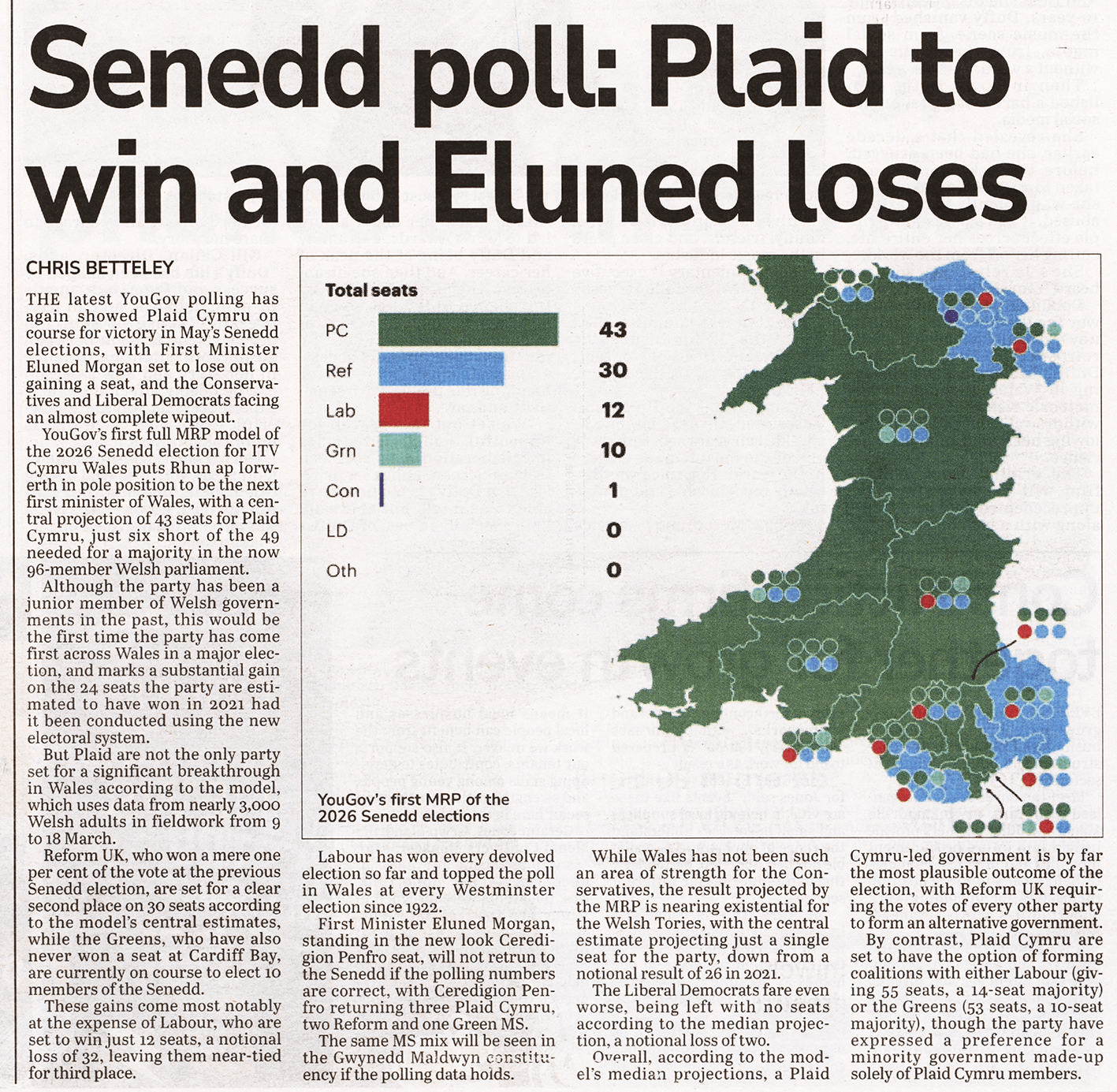
Though I have to say that’s a strange poll, also predicting the Tories will win just one seat. I’m sure it’s wrong. Certainly at variance with the poll I quoted in the previous section.

The fact is that the Liberal party started going downhill after Lloyd George, in the 1920s, which of course coincided with the rise of the Labour party. Though my paternal grandparents were still voting Liberal into the 1950s, because they saw it as the party of the chapel, the ‘Welsh’ party.

The party we know today came about following a merger in 1988 between the Liberals and the Social Democratic Party, formed by four who’d split from Labour a few years earlier. “The Gang of Four“; David Owen, Roy Jenkins, Shirley Williams and Bill Rodgers, were among the smuggest buggers you could ever wish to meet.

NICE TIE, WOY

I was once thrown out of a meeting addressed by ‘Woy’ in the Brangwyn Hall in Swansea, when he was still in Labour. Back in the late ’60s. The great man was on stage telling us that he too was Welsh; so a young Jac, in a flush of patriotic fervour (possibly influenced by beer), jumped up shouting “You’re no Welshman“.

I was then assailed by an old crow sitting behind me, who laid into me with her umbrella. A signal for the heavies to move in: “We knows ew, ew’re a trouble-maker, ew are“. And so young Jac, scarred for life by a gamp bought at Swansea market, was forcibly ejected.

Happy days!

What do the Lib Dems stand for nowadays? Your guess is as good as mine. But they’re ‘progressive’; so If Plaid needs an ally for its popular front against the far-right, Trump, climate deniers, Putin, transphobes, and other demons torturing the Globalist-Woke-left imagination, the Lib Dems will be only too glad to help.

GWLAD

I’ve saved the best ’til last. As you probably know, I had a hand in launching this party, and I’m very proud of that. But why?

Basically because I’m a Welshman, and I’ve always wanted the best for my people, and for me that meant independence. It still does. Yet I’d hoped devolution would at least improve things. But it’s been a total failure. And it’s easy to see why. In fact, I’ve explained why in my assessments of the other parties.

Every successful country needs a functioning, indigenous economy that encourages and rewards hard work, innovation, the entrepreneurial spirit. And thereby creates well-paid jobs. But for 27 years devolution has been ruined by politicians and their hangers-on who did little but make gestures and squander money in slavishly serving agendas that divide us and make us poorer.

By comparison, those running Gwlad include people who’ve started their own companies, given people jobs, and hope, and have worked all over the world. I can’t stress this enough – they come from the real world.

By which I mean they are not professional politicians.

Not like those who did politics in uni, went to work in PR, for a pressure group, or for a politician; then got elected to the Senedd thinking that running a country is nothing more than mixing with others from the same background, having debates informed by ignorance, and choosing to die on hills far away that should have no resonance in Wales.

This political clique, this Corruption Bay bubble, regards the rest of us with contempt. The ‘progressive’ parties want us to believe that about Reform. But they’re no different, not even Plaid Cymru!

Question open borders, or challenge discrimination against the indigenous Welsh, and this makes Wales “the racist capital of the UK“, says a Plaid Cymru candidate.

To believe Elin Hywel we Welsh are an evil people that needs re-educating.

But we’re not. We’re good people ruled by clowns who’ve lied to us and lied about us for too long. So on May 7 vote for candidates who don’t belong to this isolated and self-elevated political class that looks down on the rest of us.

CONCLUSION

The system being used in this election is complicated and corrupt, unlikely to be used again in any country wanting to be considered a democracy.

To start with, ‘we’ shall be electing 96 Senedd Members instead of 60 previously; in 16 huge constituencies, lumping together areas with nothing in common. For example, Swansea docks is in the same constituency as Llandrindod Wells.

Each elector will have one vote. Which means you’ll be expected to blindly vote for a party, while leaving the selection of candidates, and the order in which they’re ranked, to the party machines.

A system designed to benefit Labour and Plaid Cymru, also intended to make it very difficult for small parties and independent candidates to get elected. An affront to democracy.

And it could have been worse, for Labour was hoping to get away with not even naming candidates!

So as you walk to the polling station on May 7 remember 27 years of devolution under Labour, aided by Plaid Cymru or Lib Dems.

Remember net zero (15-minute cities and 20mph): running the NHS into the ground (while ‘decolonising’ midwifery); Covid (Drakeford believing it all and getting drunk on the power it gave him); covering the land with foreign-built wind turbines (also foreign owned and involving massive political corruption); waging war on farmers (to save the planet); welcoming the closure of Port Talbot steelworks (carbon, innit); promoting transgenderism (with the ‘Welsh Government’ being Stonewall’s biggest funder); using a film of 12-year-old girls to welcome migrants; brainwashing kids from shit-hole estates and abandoned post-industrial communities about their white privilege; and a host of other insulting imbecilities, from wanting Welsh schoolgirls to wear hijabs, to ‘decolonising’ the evil Welsh cake.

It would be masochistic to vote for Labour, Plaid Cymru, or Greens. You know what kind of dangerous nonsense bordering on evil you’ll get from them. Tories and Lib Dems are an irrelevance. And don’t vote Reform unless you’re so desperate to avoid the known failures that you’re ready to take a leap in the dark. (Or buy a knocked-off watch.)

When you reach the polling station, say to yourself, “Enough! Wales needs a fresh start, a new direction“. Then take the pencil in your hand and put a cross next to the Gwlad candidate’s name.

♦ end ♦

© Royston Jones 2026

Buy Me A Coffee

Welsh independence: Why? For whom?

I’M IN SEMI-RETIREMENT AND THIS BLOG IS WINDING DOWN. I INTEND CALLING IT A DAY SOON AFTER THIS YEAR’S SENEDD ELECTIONS. POSTINGS WILL NOW BE LESS FREQUENT AND I WILL PROBABLY NOT UNDERTAKE ANY MAJOR NEW INVESTIIGATIONS. DIOLCH YN FAWR.

I had planned a piece on May’s Senedd elections (or whenever they’re held). But then I realised there are a couple of factors still playing out that will impact mightily on that election. I mean Coronavirus and the effects of Brexit.

So, I’ve put that planned piece on the back burner. There’ll be plenty of time to return to it when the picture has become a little clearer.

Instead, I shall deal with another issue that will certainly impact on the election and more widely on Welsh public and political life in the years ahead. Though to refer to it as a mere ‘issue’ fails to do it justice.

IN MY BEGINNING

I got involved in the nationalist movement in the mid-1960s. Driven by patriotism, a lifelong love of history, and a growing interest in politics that soon made me realise my country was not being treated fairly.

I’m not sure there was a single ‘trigger’, but Tryweryn certainly influenced my conversion. If I had any doubts, then Aberfan ended them.

From a long time ago. Click to enlarge.

I wanted independence to improve the lives of the people I cared about: my family, my neighbours, my community, and my nation. I wanted independence to protect my country from neglect or exploitation, and to defend what made us Welsh.

My Wales had no bogeymen, no minorities against which retribution was sought, and there was no irredentist dimension. My nationalism was, and remains, purely defensive; the only people who need fear it are the enemies of my country and my people.

If what I’ve written strikes anyone as ‘blood and soil’ nationalism then that really is your problem, not mine.

I cannot think of any reason for wanting independence other than to serve the best interests of the greatest possible number of Welsh people.

THE LEFT AND THE INDEPENDENCE MOVEMENT

On December 19 Yes Cymru put out what seemed at the time to be a harmless enough tweet welcoming Conservatives into the ranks. The tweet ended with a recognition of the “compatibility” of conservatism and independence.

This tweet outraged the hard left and the woke (increasingly difficult to tell apart) and within an hour it was taken down.

A generous interpretation might be that those who demanded its removal don’t know the difference between Conservative and conservative. For I’m a lifelong believer in Welsh independence who is a conservative, but not a Conservative.

A less charitable, and more worrying, interpretation would be that for some in the new independence movement neither Conservatives nor conservatives are welcome. This they seem to justify by arguing that Wales is a ‘socialist country’, with a ‘radical tradition’.

But how true is that?

The claim that Wales is a socialist country is premised on the fact that the Labour Party and Plaid Cymru together usually get a majority of the votes cast in elections.

Though in the December 2019 Westminster elections Labour gained 40.9% while Plaid Cymru got only 9.9%. Giving a combined total of just 50.8%.

In the most recent elections to the National Assembly (as was) in 2016, the combined percentage of the constituency vote was 55.2%. For the regional lists, the ‘socialist’ total was 52.3%.

But these figures are misleading because how many of those who vote for Plaid Cymru and Labour are really socialists?

I live in Plaid Cymru’s safest seat, Dwyfor Meirionnydd, but few of the Plaid supporters I know could be described as socialists. Most are cultural nationalists and / or social conservatives. It’s a similar picture throughout Plaid Cymru’s western heartland.

Turning to Labour; yes, the vote looks impressive, but to assume that all Labour voters are socialists is nonsense.

The average Labour voter supports the party because he or she believes Labour will raise wages and benefits. The closest this constituency comes to socialism is on specific issues such as the NHS. But again, self-interest dominates.

So, what of Wales’ claimed ‘radical tradition’?

Since the Second World War radicalism – in the sense of challenging the role of the English monarchy and the legitimacy of the British state in Wales – has come exclusively from nationalists.

In the same period Wales has seen strikes, perhaps most memorably the two miners’ strikes, but again, these were about protecting jobs and communities, they were not a fight for socialist ideology.

Socialists are understandably reluctant to concede any of this because it undermines their claim to a monopoly on radicalism. Also because the rise of nationalism in the 1960s had the effect of turning many in the Labour Party into simpering royalists or tub-thumping Unionists. Something that embarrasses many on the left.

The fact is that socialism in the UK was, at a very early stage, broken and domesticated as the Labour Party, and brought into the constitutional fold. Thereby allowing the UK to avoid the political upheavals seen elsewhere in Europe.

Yet many on the left of the independence movement can make common cause with ‘socialists’ who are diehard Unionists, while rejecting those who sincerely believe in independence because they’re not socialists. 

The only interpretation is that socialism is more important for these people than Welsh independence, with the independence movement being just another vehicle for their socialism.

As for the alleged radical tradition, yes it’s there, though sporadic and localised. In the 19th century, the Merthyr Rising, Chartists, Rebecca, Ceffyl Pren, Scotch Cattle, Tithe Wars, were all rooted in an outraged sense of social justice; defending family and community but owing absolutely nothing to Marxist dogma.

What’s happened since is that socialists have tried to re-write history by adopting movements and causes that were never at all socialist.

But even if Wales was a socialist country that would still not be reason enough to exclude others from what should be an ideology-free independence movement.

“DOCTRINES FASHIONED TO THE VARYING HOUR” *

What Labour cleverly did in the twentieth century was to capitalise on the legitimate demands of working class people and promote those demands with more vigour than the Liberal Party.

Which explains why the Labour Party displaced the Liberal Party a century ago as the main opposition to the Conservatives.

But once Labour started going beyond demands for higher wages, better working conditions, etc., into the abstract and the esoteric, promoting socialism for socialism’s sake, then it always lost support.

As we enter the third decade of the twenty-first century the rupture between ideological socialists and the working class is almost complete. To the point where today’s left liberal elite positively despises the white working class.

It’s been summed up brilliantly by trade unionist and lifelong Labour member, Paul Embery, in his new book Despised: Why the Modern Left Loathes the Working Class. As he points out, there are elements of the contemporary left that detest working class values of family, community, tradition and patriotism.

This contemptuous attitude has now reached Wales; it has infected Labour and Plaid Cymru; it has spread to Yes Cymru, and it’s threatening the independence movement.

(Though in fairness, Labour has been far cleverer than Plaid Cymru in keeping the single-issue fanatics, the anti-Semites and other undesirables at bay.)

This new, woke left exercises influence wholly disproportionate to its numbers. As we saw with the removal of that Yes Cymru tweet.

This is done by taking a Manichean position in which they are right and those who disagree with them are not just mistaken, or wrong, but positively evil.

Perfectly exemplified by Leanne Wood and others in Plaid Cymru.

Ask how Antifa rioting and burning shops in Portland, Oregon on a nightly basis promotes anything other than violence and you’ll be met with, ‘Antifa stands for anti-fascist, so only fascists question Antifa’.

Of course! But that still leaves unanswered the question of how burning shops and attacking innocent bystanders and police is fighting fascism.

Here’s another tweet concerning Yes Cymru exposing this attitude. Thomas Wynne Lewis argued that Yes Cymru must appeal to “people on all sides of the political compass”, Luke Williams pretended to agree – then accused Yes Cymru of having “platformed fascists”!

I’m sure this never happened, but as I’ve just said, in the black and white world of the woke left those who contradict them, point out their errors, are, ipso facto ‘fascists’, ‘racists’, ‘transphobes’, etc., etc. End of debate.

This intolerance in defence of ‘toleration’, this refusal to accept alternative views in defence of ‘diversity’, this ‘no platforming’ in defence of ‘freedom of expression’, is now causing problems in the independence movement.

I’ll conclude this section with another tweet, or rather a retweet, this one from a doyen of the wokies, Aled Gwyn Williams. Williams is a member of both Plaid Cymru and Yes Cymru. (As is Teifi.)

“You’re never innocent if you’re a Tory”, the image tells us. Who could argue, for those two in their wingback armchairs are surely the Fred and Rose West of Acacia Avenue.

Remember, folks – these lunatics walk among us!

Let’s push the boat out and imagine Andrew R T Davies, former leader of the Assembly Tories undergoing a genuine conversion to Welsh independence. Despite this being a coup for the movement, and likely to encourage others to support independence, he would be rejected by those we’ve met here.

He would be damned by people who are simply using the independence movement to promote whichever fleetingly popular lunacies torment them.

* ‘The Deserted Village’, Oliver Goldsmith

‘WHY DO WE WANT IT!’

There are a number of factors explaining the increase in support for independence, unfortunately, many of them are tangential, exploitative, or simply wrong.

To begin with, there’s Brexit, and the belief that an independent Wales would join, or re-join, the EU. A belief strengthened by Plaid Cymru recently saying – without apparently consulting anyone, or checking the referendum result – that an independent Wales would become a member of the European Union.

No mention was made of a fresh referendum.

Yet another example of leftist elitist arrogance, echo chamber decision making, and out of step with the wishes of the people.

Recently exposed with an interesting poll on Twitter, not least for the fact that 2,214 people voted. And because there was a majority for ‘Full Independence’ over ‘Independence within the EU’.

If that vote can be achieved on Twitter, where ‘certain views’ tend to dominate, then in the real world the majority would be even greater.

Others are now considering independence because of the present Conservative government in London. Disliking BoJo and the gang is perfectly understandable, but hardly a good enough reason to want Welsh independence.

What happens if Labour wins the next election? Would that mean that an unequal and exploitative Union becomes acceptable again?

A third element increasing support for independence emerges from the foliage in the form of the planet-savers. I don’t wish to be dismissive; I’m quite fond of planet Earth myself, but too many of those I’m thinking of – just like the wokies – see an independent Wales as a blank canvas, with them monopolising the crayons.

This explains the Green Party of Englandandwales recently announcing its support for independence. Yet this party has so little respect for Wales that not long ago it voted against setting up a genuine Wales Green Party.

To explain this dichotomy we need to remember the canvas and crayons I just mentioned. Even under devolution the Greens, in various forms, have found it far too easy to dictate what passes for ‘Welsh Government’ policy.

Just think of One Planet Developments, Future Generations legislation, funding taken from farmers and given to ‘rewilders’ and other charlatans, etc., etc. And a fat lot of good it’s done.

Western Mail 09.01.2021. Click to enlarge

The Greens have decided to support independence because they believe they can easily persuade the government of an independent Wales to implement their polices, without the need for any democratic mandate, and thereby use Wales as a platform from which the rest of the world can better see their virtue signalling.

The benefits of these policies to the Welsh people would be zero because as Angela Womak, deputy leader of the Green Party of Englandandwales, put it:

Image Nation.Cymru

Wales “tackling the ecological and climate emergencies”, is unadulterated bollocks. To suggest that a tiny country can make any significant difference is laughable.

Whether it’s Brexit, Boris Johnson, or environmental concerns, these alone – even collectively – are the wrong reasons for wanting independence.

DEVOLUTION IS DEAD

The battle-lines are being drawn between those who want to abolish the Senedd and assimilate Wales into England, and those of us wanting Wales to be independent.

There will be few speaking up for devolution because it has failed. Wales is a worse place in 2021 than she was in 1999 partly because successive administrations have pandered to vociferous minorities rather than address the needs of the great majority of the nation.

The upcoming contest over Wales’ future could be a close call, and that’s why anyone supporting independence, from any background, and of any political orientation, should be welcomed. None should be excluded.

But those joining simply to promote their pet issue, and then seeking to exclude those who don’t agree with them that it’s the most important thing in the world, need to be taken aside and spoken to.

For these will alienate more people than they will ever attract.

Those taking an interest in independence need to be assured that the direction of ideological travel for an independent Wales, the spending and other priorities, will be decided by the Welsh people, in democratic elections, after independence is achieved.

It will be a blank canvass, and we’ll all have a chance with the crayons.

For my part, I still want independence to improve the lives of the people I care about: my family, my neighbours, my community, and my nation. I want independence to protect Wales from neglect or exploitation, and to defend what makes us Welsh.

I see no reason to change. I never have, and I never will.

♦ end ♦


Llangennech; ‘Welsh’ Labour, Plaid Cymru

I’ve been away. No, not in the pokey, or on holiday, but hors de combat due to a malfunctioning computer, one that had served me well for many a year but finally gave up the ghost. After first buying myself a dud – hoping I could replace my old one on the cheap! – I eventually splashed out on a tidy machine that might accompany me to that stage of life where I can walk around in slippers all day, dishevelled and with a vacant look on my face. (‘So what’s new, Jac?’)

While I’ve been away things have turned quite nasty in Llangennech over the language controversy at the local infants school. Or rather, the nasties behind the opposition to Welsh language education were exposed for pallying up to the English Defence League and for inviting down Neil Hamilton the Ukip AM (and of course his wife-minder).

The day the Hamiltons came a-visiting. Fourth from the left is Neil Hamilton, on his right we find Michaela Beddows, and in the pink-ish trousers, we have Christine Hamilton.

Seeing as many of those opposing Welsh medium education are either Labour Party members, activists, or candidates in the May council elections the Ukip revelations didn’t do the bruvvers any favours. Action was belatedly taken after Plaid Cymru MP Jonathan Edwards wrote an open letter to UK Labour leader Jeremy Corbyn. Had he not taken this course we would probably still be waiting for the deadbeats in Cardiff to act.

Inevitably, the Labour Party hit back, using the Wasting Mule and, more surprisingly, Private Eye. The former a regular and willing accomplice against ‘them nationalists’, the latter almost certainly misinformed. The outrage that followed the disgraceful Wasting Mule piece resulted in an apology the very next day, and I’m sure someone will put the Eye straight as well.

The day following the apology, Saturday the 25th, there was another article, this one making it clear there was no connection between the school dispute and incidents of tyre slashing in the village, as the original WM article had alleged. Though that original piece had been written by a woman who is said to have ‘a problem’ with the Welsh language. Which I suppose makes her an ideal Education Editor.

While I would love to have written up the daily revelations and developments from Llangennech and beyond I know I couldn’t have done it better than Cneifiwr, who has kept us informed of every twist and turn. I suggest you start with Jacques, Jacqueline & Neil on February the 11th and bring yourself up to date from there. Also worthy of mention is Caru Cymru, which may be a new blog, it’s certainly new to me.

Instead, I shall try to look beyond Llangennech in the hope of putting events there into a wider perspective . . . with a few digressions along the way. (Humour me!)

Before moving on, it’s worth linking to this essay by Dr Huw L Williams, which makes it clear that Labour’s hostility to the Welsh language is not currently confined to Llangennech. He suspects that Labour in Cardiff fears that Welsh medium education is less likely to provide voters for the party, and this explains the reluctance to meet the demand for Welsh medium education. Or, to put it another way, kids from bog-standard schools taught by unmotivated teachers are more likely to vote Labour.

Stripped of its various interpretations and grotesque characters Llangennech reaffirms what I have always known about the Labour Party in Wales. Anyone in any doubt about my feelings could do a lot worse than read Why I Detest The ‘Welsh’ Labour Party, which I penned in March 2014.

As I argue there, to understand ‘Welsh’ Labour we need to go back a century or more, perhaps as far back as the 1880s or 1890s. Those decades when – to quote Gwyn Alf Williams – the ‘human reservoir’ of rural Wales could no longer meet the manpower demands of the industrial south, which resulted in Wales experiencing a great influx of workers from England and elsewhere, especially Ireland.

Up to this point the great majority of Welsh people, both those who remained in the rural areas and those who had left for the industrial belts, supported the Liberal Party, and this persisted into the twentieth century, but the Liberal Party was linked with the nonconformist chapels, which in turn tied in with the Welsh language. To further complicate matters there was Cymru Fydd, which pushed for some sort of Home Rule for Wales. All of which tended to make the Liberal Party unattractive to recent arrivals.

This hostility to the ‘Welsh’ Liberal Party was perfectly articulated by Alderman Robert Bird of Cardiff at the 1896 AGM of the South Wales Liberal Federation when he declared “You will find, from Swansea to Newport, a cosmopolitan population who will not submit to the domination of Welsh ideas!”. Bird of course was English, and though a prominent nonconformist he opposed his own party’s policy of Disestablishment. I often think of the arrogance implicit in Bird’s statement, and of my eight Welsh-speaking great-grandparents living in and around Swansea, and the thousands upon thousands like them who did not belong to any “cosmopolitan population”, being more closely linked with their relatives in Cardiganshire and Carmarthenshire.

Alderman Bird strikes me as yet another of those we’ve suffered throughout our history; people who know nothing about us, who don’t have our interests at heart, yet tell us what’s best for Wales.

Courtesy of National Library of Wales

The Labour Party found many converts among the English, the Irish and others simply because these found the Liberal Party to be ‘too Welsh’. Though this was never a black and white issue, many Welsh went over to Labour early on, and immigrants – though many fewer – took up the Liberal cause. For example, many of the Irish in southern Wales originally supported the pro-Home Rule Liberal Party before switching to Labour. Explained in this essay by socialist academic Dr Daryl Leeworthy.

(For some unfathomable reason I’m blocked from his Twitter account. Can you believe that! Infamy! Infamy! etc.)

From its early days this Labour Party of Englandandwales exhibited certain attitudes towards all things Welsh. At its worst it seemed that we Welsh were regarded no differently to other ‘primitives’ around the empire who had to be saved from themselves through stern paternalism. In our case, the best medicine was the English language, for many in the Labour Party agreed with the authors of the Blue Books who in 1847 had decreed that the Welsh language led us into all sorts of immorality while also impeding our educational and economic advancement.

As time passed it became convenient to pretend that almost all Welsh workers had embraced the Labour Party from the outset, but this was not true, as I recall from my own childhood. My paternal grandparents lived in Landore, and my grandfather, who’d worked at the Mannesmann tube works, was a deacon in Siloh Newydd. My grandmother’s working class credentials were equally impeccable. They supported the Liberal Party.

(‘The Mannesmann’ figured prominently in the lore of the Lower Swansea Valley when I was growing up. While working on the Evening Post Dylan Thomas covered boxing matches at the Mannesmann Hall. The plant ended its days owned by Stewarts & Lloyds.)

This was the 1950s, remember, and my grandparents’ rejection of the Labour Party was not unusual, even in a working class community like Landore. I concede that their adherence to the Liberals owed much to their age, their religious beliefs and the fact that they spoke Welsh. But that only tells us that there would have been many more like my mamgu and tadcu forty and fifty years earlier.

And I suspect that their parents might have agreed with Cymru Fydd rather than with Alderman Bird, their bollocks-spouting and self-appointed ‘representative’.

However it came about the decline of the Liberal Party and the unquestioned hegemony Labour achieved over the Welsh working class gave us the party we know today.

A ‘hybrid’ party still containing the twin strands of its early days: those who reject almost everything Welsh other than harmless, apolitical diversions such as sport, and the ‘Welsh’ element, which believes that Wales and Welshness extend beyond the rugby field.

This fault line has always resulted in ‘tensions’, but devolution, even the discussion of devolution, exposed the divide vividly. The campaign ahead of the devolution referendum in September 1997 brought out some of the worst anti-Welsh aspects of the Labour Party.

Neil Kinnock was particularly offensive, which may be understood, given his background, but his hysterical vilification of things Welsh was almost matched by his wife, who comes from a totally different, and Welsh, background. (A reminder of how the Labour Party can corrupt.) What we also see in Neil Kinnock is the ‘package’ I’ve referred to in other posts.

I think I first used the term after a visit to Pembrokeshire where I’d encountering the new county flag. When I made enquiries into its origin I saw a name with which I was familiar, a man who had campaigned against devolution, in 1979 and 1997, who had argued to ‘Bring Back Pembrokeshire!’ (because Dyfed was too Welsh) and had then helped devise a county flag to avoid flying the Ddraig Goch.

Show me someone who’s hostile to the Welsh language and I’ll show you someone who is probably opposed to devolution and almost anything likely to distinguish Wales from England – even if it will benefit Wales. In the 1979 devolution debate Neil Kinnock trotted out ridiculous stories of schoolchildren in Ynys Môn wetting themselves because they were unable to ask in Welsh to go to the toilet, coupling his contempt for the Welsh language with his opposition to devolution.

Alderman Bird was another. As a nonconformist and a Liberal he should have welcomed the Disestablishment of the Anglican Church in Wales. In rural areas poor, Liberal-supporting people were being forced to pay tithes to a church they did not attend in order to support clergymen who didn’t speak their language. And being evicted from their farms when they refused to pay the tithe. Yet Bird opposed Disestablishment, probably because he viewed it as being ‘a Welsh thing’.

A great-grandfather of my wife, a John Jones, was arrested for his part in the Llangwm riot of 1887. John was related by some convoluted route to Sir Pryce Pryce-Jones, the Newtown mail order pioneer. (We really should know more about Pryce from Llanllwchaiarn but, as he was a successful Welsh businessman who brought prosperity to his area, it serves the interests of both our colonial masters and our native leftists to ignore him.)

Courtesy of Casgliad y Werin

And so it is today in Llangennech. A gang of shouty, anti-Welsh bullies with strong links to the ‘Welsh’ Labour Party is opposing the teaching of Welsh – and don’t fall for the bullshit about ‘choice’, there are many English medium schools within easy travelling distance. Llangennech is on the outskirts of Llanelli, a large town.

For many people the most remarkable aspect of this saga is that people belonging to what many believe is still a socialist party should be so ready to mix with Ukip, and be quite open about it. Some of those opposed to Welsh language education in Llangennech have even flirted with elements further to the right. How do we explain this? I believe that as with most irrational fixations hatred for things Welsh clouds the judgement.

To understand that just follow the rantings of Jacques Protic, or someone like K Clements of Llangyfelach, who writes regularly to newspapers bemoaning the fact that we are starving and dying because of the billions spent on the Welsh language; his hatred for things Welsh is coupled with an intolerant Britishness usually confined to the extreme Right, Ibrox Park, and the Six Counties. Here he is, in a letter to the Evening Post, demanding that Ryan Giggs and Craig Bellamy be summarily executed for not singing GSTQ.

Another ‘hybrid’ party is of course Plaid Cymru. The dividing line here is between the nationalist/culturalist wing and the Green-socialists, with the latter in the ascendant for the past thirty years, to the detriment of the party, of Wales and of Welsh nationhood.

The reason Wales has suffered is because these eco-friendly leftists seem to have great difficulty focusing on Wales and Welsh issues. They’re forever trying to save the planet or else getting agitated over some issue far away over which they cannot possibly have any influence. Recent examples would the election of President Trump and the decision of the Welsh people to leave the European Union.

Many of this persuasion view their party as a regional outrider for ‘progressive’ forces elsewhere in Britain and beyond. Exemplified by this tweet by Leanne Wood I picked up on a few days ago. She’s responding to a tweet by Jeremy Corbyn, rebuking him by saying that they should “build alliances needed to defeat Tories”.

The realities are that Plaid Cymru has just three MPs in a 650-member House of Commons, so the chances of Plaid being an influential part of any anti-Tory coalition are slim. What’s worse is that here in Wales it’s not the Conservative Party that rules the roost but Labour; through its councillors, and its Third Sector, and the overpaid shysters to be found everywhere from academe to housing associations, all of them part of a system that has had almost a century to embed itself into, and corrupt, Welsh public life.

Yet Ms Wood and her ilk can blind themselves to all of this, for they view the Labour Party as fellow-socialists. Comrades in the crusade to cleanse Wales of initiative, pride and corrupting prosperity. For only through the begging bowl shall we attain the socialist nirvana of freedom from material possessions.

And of course, if we can’t afford to drive cars, or heat our homes, then Wales will be doing more than its share to save the planet, and that will please Plaid’s friends in the Green Party and the wider ‘environmental’ movement. They’ve got it all worked out!

Yes, I know, Plaid Cymru did eventually get involved in the Llangennech dispute, but they could hardly avoid it any longer seeing as the party had been targeted by the anti-Welsh crew, but even then Plaid waited until those clowns had shot themselves in the foot by inviting down the Hamiltons.

During my wee break I got to thinking about Llangennech and associated matters. I concluded that this is not really about language, or education; nor is it ideological or party political. To put it bluntly, this is a conflict of identities, a struggle that pits Welsh identity against an increasingly aggressive and intolerant English or British nationalism. (There is no meaningful distinction.)

These attacks on us and our identity come from both Left and Right, and indeed from those who otherwise regard themselves as liberal. As this recent tweet from Huw Edwards to Robert Peston reminds us. Which is why I say that ideology and party politics have no place in what must from now on be a national struggle fought on all fronts.

If we lose this struggle, then we lose our Wales; what will remain will be nothing but a hollowed-out geographical area called ‘Wales’, containing a couple of English provincial cities, a few other towns, post-industrial regions offering cheap housing for agencies relocating the rejects of England, and rural parts serving as recreation and retirement areas. In fact, this is the path Wales is already following.

But of course we’ll still have the ‘national’ rugby team, with the feathers on the shirt, so everything will be just fine.

Plaid Cymru, with its split personality, conflicting loyalties, and failure to focus on what matters, will not win this fight. Plaid Cymru won’t even join the fray for fear of upsetting the ‘liberals’ Huw Edwards talks of, and others with whom Plaid’s leadership has over the years become far too pally. Something new is needed.

This ‘something’ can only be effective if it is broad-based, national, free of ideology, and prepared to defend Wales, Welshness and Welsh interests against all threats. The first step must be trying to counter the pernicious influence of the BBC, ITV and the print media.

Which is why in future this blog may spend less time exposing lying politicians (of whom there are just too many) or crooks milking the public purse (ditto) to concentrate on the national picture and promote a nationalist message.

Stay tuned!

♦ end ♦