Devolution Is Cardiff Council On Stilts

To explain the title . . . Back in the 1960s and 1970s, when there was any talk of a Welsh Parliament, Home Rule, or devolution, one of the arguments used against the idea was that such a creation would just be “Glamorgan County Council on stilts“.

The implication being that other parts of Wales would be ignored. That investment, jobs and other goodies resulting from self-government would be concentrated in that area.

In this piece I’ll try to persuade you that what we’ve seen since 1999 is even worse.

FIRST SECRETARY, FIRST MINISTER

I’m going to begin by looking at the first secretaries and first ministers we’ve had since the beginning of the devolution experiment.

The first, said to be Tony Blair’s choice, even “Blair’s poodle“, was Alun Michael. He was never very popular, either within the Labour party or the country at large, and was first secretary for just nine months, until May 2000.

A former Cardiff City councillor, he later served as Labour MP for Cardiff South and Penarth. Then Regional Assembly Member for Mid & West Wales. And PCC for South Wales.

Michael was replaced by the much more popular Rhodri Morgan. Who stayed in the first minister role until December 2009.

Cardiff-born Morgan was MP (until 2001 GE) and AM for Cardiff West from 1999.

Next came Carwyn Jones. Despite being born in Swansea, and practising law there for a number of years, he represented the Bridgend constituency. His Cardiff connection was established by being a tutor for a few years at Cardiff University.

I’ve said it many times on this blog, and I’ll say it again, Cardiff University is joined at the hip to the local Labour establishment. The School of Journalism should be renamed the School of Globalist-Left Propaganda.

Jones stood down as leader in December 2018. He now sits in the House of Lords as Baron Jones of Penybont.

He was succeeded by Mark Drakeford, a former South Glamorgan County councillor who became the Assembly Member for Cardiff West in the May 2011 elections.

Drakeford was born and raised in Carmarthenshire, but moved to Cardiff over 40 years ago. And was a lecturer at Cardiff University.

From 1985 to 1993, Drakeford represented the Pontcanna ward on South Glamorgan County Council, with fellow future Welsh Assembly members Jane Hutt and Jane Davidson as his ward colleagues.

(Jane Davidson was at the Rio Earth Summit in 1992, Labour AM for Pontypridd (1999 – 2011), and wrote the Well-being of Future Generations legislation that enforces ESG and DEI in every aspect of Welsh life.)

Drakeford stood down as first minister in March 2024. He will not stand again in May.

Then came the brief tenure of his successor Vaughan Gething. After serving as councillor for the Butetown ward on Cardiff City Council he became the Senedd Member for Cardiff South & Penarth in 2011.

Gething is also standing down.

Gething was succeeded in August 2024 by the current incumbent, and former MEP, Eluned Morgan, the Regional Member for Mid & West Wales.

Born and raised in Cardiff she sits in the House of Lords as Baroness Morgan of Ely.

So we see a Cardiff connection with all first secretaries or first ministers Wales has known in 27 years of devolution. And with five out of the six a strong connection.

Given that Cardiff makes up some twelve per cent of Wales’ population, this statistic is truly remarkable. And should be concerning.

SOME INTERESTING SENEDD MEMBERS

Beginning with Bridgend, where we find Sarah Murphy. Who was born and raised in Pontypridd then, after Reading University, worked in Seoul and London. She came back to Cardiff; held posts with the Labour party, and the University. More exactly, the School of Journalism.

Next, Cardiff Central. The patch of uber wealthy Jenny Rathbone since 2011. She’s a member of the Rathbone dynasty of Liverpool, where she was born. Her knowledge of Wales is on a par with that of a stay-at-home Eskimo. Limited to Cardiff and the area around her holiday home up in Llanfihangel Glyn Myfyr.

Hubby, John Uden, who knows as much about wind power as the heretofore mentioned Innuit knows of Wales, somehow managed to get on the ‘Welsh Advisory Board’ of Bute Energy. Which was handy, seeing as Mrs Uden sits on the Senedd’s Climate Change, Environment and Rural Affairs Committee.

She’s standing down in May. Her vacuous wittering will not be missed.

Cardiff North is where we find Julie Morgan, widow of Rhodri. Cardiff born and bred, she is a former South Glamorgan and Cardiff City councillor, and was elected to the Senedd in 2011 after losing the Westminster seat of Cardiff North in 2010.

She is also standing down.

Cardiff South & Penarth is held by former first minister, Vaughan Gething. (See above.)

Cardiff West is held by former first minister Mark Drakeford (See above.)

Cynon Valley brings up Vikki Howells, who was born and raised in the constituency, and attended Cardiff University.

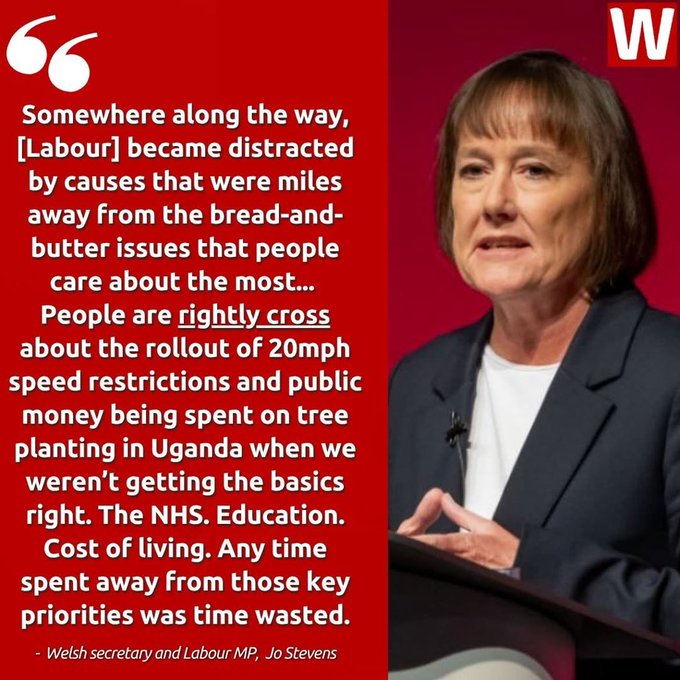
The SM for Llanelli Lee Waters is definitely a member of the Corruption Bay in crowd. A former ITV Wales journalist, director of think tank IWA, then director-lobbyist for bike charity Sustrans, he’s the man responsible for the 20mph restrictions.

Despite being SM for a seat west of Swansea, he lives just outside Cardiff.

He’s standing down in May.

Now we head up to Merthyr where the local representative is Bristol City fan Dawn Bowden. Another Bay insider who worked her way up through union ranks but who knows as much about the Heads of the Valleys as the denizen of the frozen north I mentioned earlier.

But that doesn’t matter – she was promised a safe seat.

Which she’ll thankfully vacate in May.

Another carpet-bagger can be found in Pontypridd in the form of Mick Antoniw. He came to Wales to study at Cardiff University, and stayed. One of those who drove through the absurd and corrupt voting system we’ll be using in May.

Of Ukrainian descent, he’s made a number of very public trips there to deliver ‘aid’. If Wales was independent he’d want us to declare war on Russia.

Another one standing down.

A odd one now, in Julie James, SM for Swansea West. Odd, because even though she was born in Swansea, travelled around a lot in her early life, she was involved in the Gilestone farm saga before being elected to the Assembly in 2011. As a solicitor working against the then owners, which paved the way for the land to be bought by someone’s chosen buyer.

Also standing down.

Moving east to Torfaen, ‘though born in Merthyr, Lynn Neagle is definitely part of the Bay Bubble. Wife of former Labour AM Huw Lewis.

Neagle has worked for, “Shelter Cymru, Mind and the CAB. She was Carers Development Officer with Voluntary Action Cardiff and also worked as a researcher for Glenys Kinnock MEP“.

And, finally . . . Jane Hutt, who sits for the Vale of Glamorgan, is another who moved to Wales to involve herself in charities and third sector bodies: National Co-ordinator of Welsh Women’s Aid, South Glamorgan Women’s Workshop, Tenant Participation Advisory Service and Chwarae Teg (Fair Play) . . .

Thankfully, she’s also standing down.

REGIONAL SENEDD MEMBERS

Due to winning so many seats in the south and the north east Labour has just three Regional SMs. One in the North. Here are the two from the Mid & West.

One of course, is Eluned Morgan, the current first minister. (See above.)

The other is Joyce Watson. And she may be unique among Labour SMs because her official bio says: “Joyce has run several small businesses – public houses, restaurants and retail outlets – in Ceredigion, Carmarthenshire and Pembrokeshire.”

But did she own them?

But even that ray of hope is dimmed by the usual charity/third sector involvement: “Joyce managed the Wales Women’s National Coalition . . . senior member of the Wales Gender Budget Group . . . NHS Equality Reference Group”.

Watson is another jumping the sinking ship of devolved politics in May.

WHAT IT MEANS

Let’s start with a statistic. The population of Wales grew between the census years of 2001 and 2021 by 6.8%. In the same period Cardiff saw growth of 18.7%. According to some, Cardiff is now the fastest-growing city in the UK.

Most areas of Wales saw negligible growth, with some even recording a fall. Ceredigion, Blaenau Gwent and Gwynedd have declining, and ageing, populations; while Merthyr and a few other areas struggle to maintain their numbers.

Newport’s population increases steadily since charges on the Severn Bridge were abolished, which allowed buyers from England to access the cheaper housing in south east Wales and commute daily to Bristol, or even further. While in many rural areas population increase is due to retirees and good-lifers moving in.

But turning Newport into a Bristol suburb and rural areas into al fresco retirement homes is neither desirable nor sustainable.

Welsh life is increasingly focused in Cardiff, for the benefit of Cardiff. This can be explained by a number of factors. The first, quite obviously, is political power. Then there’s the third sector, charities, pressure groups, which both feed off and feed into the political system.

A political machine serviced by regiments of spads, assistants and researchers, whose loyalty can be guaranteed by the carrot of a council seat, or, for the very lucky – a seat in the Senedd.

But let’s not overlook other beneficiaries, such as those to be found among the movers and shakers of the local business community.

An example would be the Thomas brothers, of the pie and pasty dynasty. It’s universally accepted that the ‘Welsh Government’ paid way over the odds to buy Cardiff airport. But who was the vendor?

And who bought that criminally undervalued land on the outskirts of Cardiff?

In both cases the lucky boy was Stan Thomas. Hot pies all round!

If you want a fuller picture, read a couple of pieces I put out ten years ago. Pies, Planes & Property Development, and Pies, Planes & Property Development 2.

But it’s not just the Thomas brothers. There are others.

Then there’s sport. Through funding, the ‘Welsh Government’ effectively took control of the Football Association of Wales and the Welsh Rugby Union.

Which explains why, when Cardiff Rugby went bust the WRU stepped in to buy it. And why the most successful region, the Ospreys, based in Swansea, is threatened with extinction.

The last-but-one owner of Cardiff Rugby was the late Peter Thomas, Stan’s brother.

The clowns currently wrecking Welsh rugby are political appointees, and they’ve been told to prioritise the interests of Cardiff. To the detriment of Welsh rugby as a whole.

Finally, there’s the media. Based in Cardiff and little more than a mouthpiece for those I’ve described above.

And all the while, our economy and our essential services decline and decay.

WHAT MIGHT THE FUTURE HOLD?

If polls are to be believed then Plaid Cymru will emerge in May with most SMs, but not a majority. This will mean Plaid going into coalition, or having an ‘agreement’, or an ‘understanding’, most likely with Labour, possibly with the Greens.

We might even see a ‘progressive’ alliance of all the Globalist-Woke parties. It really won’t make much difference. (But what a nightmare that could be!)

Now some might think that with so much of its support being in the west and the north Plaid Cymru will adopt a different approach. And there might be a few moves away from the obsessive focus on Cardiff, but Plaid would be no real improvement.

Because Plaid wants to take Wales further than Labour on ‘ishoos’ such as Net Zero, trans ‘rights’, DEI, Gaza, ‘Islamophobia’, and decolonising Welsh cakes. And faster down the road of economic implosion and civilisational decline.

Party leader Rhun ap Iorwerth may be the Senedd Member for Ynys Môn, the seat furthest from the Bay, but he’s a former BBC journalist. He was educated at Cardiff University and he’s lived in Cardiff.

And ap Iorwerth may be a figurehead; for many believe the party is still controlled by the acolytes of a previous leader, the PoundShop Pasionaria of Penygraig.

Whatever the outcome in May in party terms, it won’t make much difference. Plaid, Greens, Labour, Tories, Lib Dems, they’re all just differently-badged elements of the Globalist Uniparty. That’s why they repeatedly tell us the upcoming election is solely about defeating Reform.

Is it?

Then again, Labour might welcome a ‘break’. Shun any co-operation, then come back untainted and refreshed in 2031. Hoping electors will have forgotten their record in the Senedd.

And who might lead the Labour comeback? If I was a betting man I’d put a few quid on Huw Thomas. If you’ve never heard of him, let me introduce him.

Huw Thomas, courtesy of Getty Images

He’s 41 years old and from Aberystwyth, he’s bilingual, and he’s been leader of Cardiff Council for nearly 10 years. In May, he’s top of the Labour list for the Caerdydd Penarth constituency.

He’s guaranteed to be elected because Cardiff is an area where Labour will do well.

UPDATE: Soon after posting this article at 9am I went to Tywyn, picked up a Western Mail, read it while having my first coffee of the day. In this article Huw Thomas gets a mighty plug.

If it comes to pass as I predict, and Labour gets back into power in 2031, under his leadership, then everything will revert to the status quo ante Plaid, with Cardiff grabbing the lion’s share of investment and jobs.

Which, to respectfully amend Lincoln’s Gettysburg Address, will mean a return to: Government of Wales, by Cardiff, for Cardiff.

♦ end ♦

© Royston Jones 2026

Buy Me A Coffee

Whisper It In The Tramshed

This is another of those pieces I wish I didn’t have to write. Another sorry tale of political bias and incompetence, and the wasting of large amounts of public money.

WHISPER AND LABOUR

Our tale begins with two announcements.

The first came from the self-styled ‘Welsh Government’ last Friday. Informing us a “Wales-based” company, that televised the Paris Paralympics for Channel 4, had been awarded £800,000.

We were further informed,, “Whisper began its operations in Wales in 2018” and was then, “Named Business of the Year at the Cardiff Business Awards in 2022“.

Click to open enlarged in separate tab

Which is odd. For Whisper Films Cymru Ltd wasn’t launched until September 2. Just over a week ago! So how could it cover the Paris Paralympics, which began a week before it was formed, and how could it have been so busy in Wales since 2018?

The answer is of course that it’s been operating under a different name. For if we turn to the Companies House website entry for Whisper Films Cymru, and the Certificate of Incorporation, we see that it’s owned by the parent company.

Click to open enlarged in separate tab

Whisper Films Cymru Ltd is just the local label for a company of the same name based in Kingston-upon-Thames (down the lane).

Then on Monday I read Cardiff Capital Region was investing a further £1.5m. Making it £2.3m over one weekend. (Since the fall of Monmouthshire, all the councils in that region are now controlled by Labour.)

So let’s see who’s running this “Wales-based” company, Whisper Films Cymru Ltd.

The three directors are: Allan Handley, of the parent company, Whisper. Sunil Ramanbhai Patel, CEO and co-founder. And, to give a little Welsh flavour, Carys Owens.

Carys Owens is the wife of recently-retired captain of the national rugby team, Ken Owens. Which probably explains why Ken has been seen in dodgy company of late.

Click to open enlarged in separte tab

Gething’s already gone and Starmer’s the most unpopular prime minister since Pitt the Positively Infantile. Keep it up, Ken.

On a more serious note . . . Ken Owens’ involvement might be linked to the ‘Welsh Government’ taking over the Welsh Rugby Union last year. I explained this in ‘Taking Control, Of Everything‘.

Is Ken being lined up for a WRU job?

So what more can I tell you about Whisper Films?

We know it’s been operating in Wales for some years without feeling the need to adopt a Welsh persona, but now that it’s gone legit there are 23 Whisper Cymru staff listed on its website.

Among them, and listed as another co-founder, is Jake Humphrey, formerly of BT Sport. He seems to be a fan of Keir Starmer.

Whisper Films Cymru Ltd is owned by Whisper Films Ltd, but we can follow the trail back to Sony Pictures Television Production UK Ltd, owned by Columbia Pictures Corporation Ltd, with everything ultimately owned by the Sony Group Corporation.

Should you be minded to write, here’s the head office address, 1-7-1 Konan, Minato-Ku, Tokyo 108-0075, Japan.

WHISPER IN THE TRAMSHED

You may not be surprised to learn that the newly-minted Whisper Cymru is based in The Tramshed, so generously funded and in other ways favoured by the Labour party.

I gave the low-down at the end of May with, ‘The Tramshed, The Loans, The Leases, The Lord’; and a few days later, ‘The Tramshed, The Loans, The Leases, The Lord 2‘.

What I established in those pieces was that, like the shop in League of Gentlemen, The Tramshed is, ‘A Labour shop for Labour people’. Outsiders are not welcome.

Click to open enlarged in separate tab

But why is Whisper officially taking on a Welsh identity at this moment? One answer is obviously to get its hands on the £2.3m funding you’ve just read about. And I’m sure there’ll be more.

For I can almost smell a loan from the Development Bank of Wales. Which would have been difficult if not impossible to arrange if Whisper had remained a company registered solely in England.

I also believe it links to the July 4 election. Because if you go back to Monday’s press release about the Capital Region investment you’ll see Dame Nia Griffith MP, of the Wales Office, mentioned.

But why is she involved? Isn’t this a Welsh company getting Welsh funding?

Click to open enlarged in separate tab

Maybe the explanation is that Whisper Films is favoured by those who recently came to power in London. Which might mean that this deal couldn’t have been done before Comrade Starmer got his feet under the No 10 desk.

Was Labour’s Cardiff branch instructed to help Whisper?

Handley and Patel have another company at the Tramshed, CBC Broadcast Centre Ltd, launched in March. Though until last month it was known as Furnace Broadcast Centre Ltd. (Is that Furnace, Llanelli, or the one just north of Aberystwyth?)

Control again rests with Whisper in Richmond. Understandable, for both directors live in England. It’s worth dwelling on CBC for a minute because when you see who’s involved with this outfit other things start to make sense.

Which is a cue to look at recent developments at the Tramshed, including the opening of this facility last month.

No matter how it’s dressed up, and despite being funded from within Wales, this looks like a facility for Whisper, Channel 4, CBC, and other English companies. Such as Timeline Television of London:

Timeline TV . . . will operate the space following the conclusion of The Paralympics.

I’m not disputing that Wales will get a few jobs, some training, and Cardiff will get a lot of plugs, but looking at the bigger picture, Wales loses out. Certainly if you believe that Wales extends beyond Cardiff.

It’s all very well dressing up Whisper Cymru as ‘ground-breaking’, and the new facilities at the Tramshed as ‘exciting’, but in truth, there’s nothing new here at all.

It’s just more companies from outside Wales being gifted expensive facilities and showered with public money. All done to create a few jobs and give the impression of an indigenous media sector.

Little more than the branch factory / inward investment strategy updated for the digital age. Which, by a curious twist, brings us back to Sony!

Something else that brings us up to date is Labour-controlled councils investing pension funds and similar money in companies where Labour insiders are well looked after. The Bute Energy model repeating itself.

THE SLOW DEATH OF YR EGIN

In answer to the constant claims that devolution was resulting in everything being located in Cardiff, S4C decided to build a new HQ in Carmarthen, known as Yr Egin.

Though the obvious location was Aberystwyth. Partly for its centrality, and partly because it was the most popular choice among S4C employees. It was even reported that many staff were refusing to leave Cardiff for Carmarthen.

But for reasons that were never quite clear, Carmarthen was chosen. Though good road and rail links to Cardiff and London were mentioned.

This is important because if we look at the Whisper Facebook page, we see that at the start of 2019 it tells the world that Whisper’s new home is Yr Egin. Suggesting it might have been this facility that drew Whisper to Wales in the first place.

Click to open enlarged in separate tab

Is Whisper still at Yr Egin? It may have a presence, but my guess would be that Whisper is firmly ensconced at The Tramshed. That’s certainly the address used for both Whisper and CBC.

The point of Yr Egin was to take direct and spin-off jobs to places away from Cardiff. To spread the jam. Which is why Yr Egin is a failure. Yes, it’s being used, but not for its intended role.

But we’ve been here before. When S4C was established we were told the Caernarfon area would see a cluster of independent TV companies, providing hundreds of well-paid posts. Those jobs the Cofis were promised went to Cardiff.

It was the same with devolution. The people of Cardiff voted against, the movers and shakers were even more firmly opposed, but once it happened, then the Assembly had to go to Cardiff.

More than that, it had to go to the Bay, to benefit Nick Edwards and his pals in Associated British Ports. To boost their Cardiff Bay Development Corporation. In need of a boost after failing to land either an opera house or the new rugby stadium.

It was this episode that saw me coin the term Corruption Bay.

Finally, and on the political level, the new development in the Tramshed sees a socialist regime in Wales help Channel 4, whose news programmes are often compared to Romanian state television under Ceausescu.

A perfect fit!

As I’ve said, there was always resistance from within Cardiff to Yr Egin. And it went beyond staff being reluctant to move.

To begin with, the city stood to lose hundreds of skilled, 21st century jobs. Jobs that brought Cardiff a lot of money and considerable prestige.

Then, working on the assumption that Yr Egin would be full of ‘Nashies’, the Cardiff comrades could have justified The Tramshed, if only to themselves, on political grounds.

So Cardiff council set about developing The Tramshed. Using both its own money and ‘Welsh Government’ money.

Of course, WG was also supporting Yr Egin. Backing both horses in a two-horse race really is a mug’s bet.

CONCLUSION

We are now told we need 36 more Senedd Members in Corruption Bay to make Wales a better place. Bollocks! Here’s my suggestion.

Keep to 60 SMs, but move the Senedd to Aberystwyth, or Machynlleth, Llandrindod or even Llanrhaeadr-ym-Mochnant. No fancy new building, put the buggers in a barn or a village hall. Any member of a pressure group or third sector body sighted within three miles is to be shot, and fed to the hogs. Then provide the SMs with electric bikes and oilskins to get back and forth to their constituencies.

I guarantee that a few years of such an arrangement will do more good, for more parts of Wales, than having 36 more Senedd Members living it up at our expense in the corrupt capital of a corrupt country, heading down the tubes at a rate of knots.

♦ end ♦ 

© Royston Jones 2024

Labour: A Beast on its Last Legs?

I have decided to re-visit the May 7th General Election partly because I haven’t posted anything for over a week and partly because much has been said since I published my earlier analysis on the 11th.

A recent example would be what was said by Kim Howells, former MP for Pontypridd, on BBC Radio Wales’ Sunday Supplement programme on May 24th, arguing that Labour didn’t do as badly in Wales as in England because ” . . . people have greater trust in Carwyn Jones and the Welsh Assembly Government . . . “. Which is a strange thing to say. Not Kim Howellsleast because this was a UK General Election, in which Carwyn Jones and his team were sidelined. Even when we had the televised debate of Welsh party leaders Labour was represented by Owen Smith MP not Carwyn Jones AM.

Yet we are expected to believe that when Dai and Sharon Public went to vote each thought, ‘Yes, I know Miliband is a twonk, and the party is run by a metropolitan elite that doesn’t give a toss about people like me, but I shall still vote Labour because I am so impressed with Carl Sargeant, and Lesley Griffiths . . . and then there’s that Theodore Huckle – what a wonderful Counsel General! This argument is – as we political commentators are wont to say – a load of old bollocks.

Though if Howells is right, then it’s a hell of a put-down for the aforementioned Owen Smith and his parliamentary colleagues. And not without irony. For it means that Welsh Labour MPs escaped paying the price for their blind obedience to the metropolitan elite because of the “trust” people have in an Assembly many of them resent as a challenge to their position, an institution many of them do not wish to see attain any further powers.

Though if Howells really believes what he said maybe this chimes with a regularly repeated theory that says Labour in Wales has avoided the fate of its Caledonian comrades because it adapted better to devolution, with part of that adaptation being the development of a kind of ‘nationalism with a small n’ that puts some distance between the Labour Party in Wales and its bosses in London. The “clear red water” suggested by former First Minister Rhodri Morgan. Which if true, only reminds us again of the irony, even hypocrisy, attaching to the attitudes of Labour MPs from Wales.

Something else Kim Howells said was, “If we ever want to be back in government again, we need to win southern England”. This no doubt is the argument we’ve heard over and over since May 7th that says Labour must appeal to the ‘aspirational’. Yet Labour appealing to the aspirational / southern England puts it in direct competition with the Conservative Party, so where does that leave Labour’s traditional heartlands and supporters? And how does a Labour Party winning over voters in the Home Counties with promises of cuts in public services, and the privatisation of the NHS, win back Glasgow and Dundee? Come to that, what would such a party have to say to most Welsh voters? It can’t be done. It’s a circle that cannot be squared.

This is the nightmare scenario for Labour, the day of reckoning that was postponed by the razzmatazz and flim-flam of the Blair era. For almost a century, Labour relied on a unionised working class with a few idealists and romantics from further up the social ladder to smooth over the rough edges. A support base that rapidly declined in the closing decades of the twentieth century. What remains of the unionised working class is no longer umbilicaly tied to the party. The children and grandchildren of those long-gone miners, steelworkers, dockers, etc, either still vote Labour out of habit or, increasingly, don’t vote at all, or else are quite happy to give their votes to other parties.

The only obvious replacement for this lost support appears to be immigrants to the UK. But this is a poisoned chalice. For being supported by immigrants (and doing well in inner cities) allows the Tory media to accuse Labour of being ‘soft on immigration’ and of favouring ‘benefit scroungers’. And there just aren’t enough immigrants, nor a large enough ethnic minority population, for Labour to emulate the Democratic Party in the USA. (The dream of many Labourites.)

If Labour follows the advice that tells it to appeal to the aspirational and to woo southern England then it can kEluned Morganiss Scotland good-bye for ever, and it will haemorrhage support in traditional heartlands south of the border. In this scenario, Labour’s only hope of future success is to replace the Conservative Party by, effectively, becoming more Conservative than the Conservatives. But why should anyone who normally votes Tory consider voting Labour (with its history) even if it promises to deport all foreigners, sterilise the poor, and abolish all taxation?

Let’s go back to former communist and NUM official Kim Howells. He believes the party is in the “deepest crisis” he can remember. He went on, “If the Labour party doesn’t come up with fresh thinking, with some radical analysis of what’s going on in society and what people need out of society, it could well dwindle to a very small number of MPs.” Ed Miliband was “dull”, Labour’s next leader would need to be “much more radical” (while appealing to southern England?) Asked for her views, former MEP Baroness Eluned Morgan ‘admitted the party needed a “thorough rethink”‘ and went on to say that ‘the party needed to readdress the way it approached politics and the way it makes contact with society if it was to move forward successfully’.

Another giving evidence at the open and ongoing inquest was Gerald Holtham – ‘Who he?’, you cry . . . well Holtham is an economist, and regarded by many as one of Labour’s cleverest supporters. Just a few days before Howells and Morgan made their contributions Holtham weighed in with his analysis. It was full of dire warnings about relying on the “tribal” or “sentimental” vote, demanding that the party think hard “about real problems”, warning the party against a “sterile debate”, and then reassuring us that the public is not stupid. This presumably is the same public that we find in areas like Merthyr, Blaenau Gwent, Swansea East and other constituencies; the same public that has voted Labour for three or four generations and is now tempted to take a punt on Ukip. How could anyone possibly think such people are stupid!

Did you ever read such vacuous nonsense in your life? So many words that say nothing? That’s because Howells, Morgan and Holtham are lost, they don’t have a clue! They all have opinions on where Labour went wrong – expressed in cliches and sound bites – but no one has an answer to where Labour goes from here. When you realise what a mess the Labour party is in, you begin to understand why it was almost wiped out in Scotland. But you also begin to realise that it was only saved from worse results in Wales by Plaid Cymru‘s refusal to connect with Welsh voters.

Personally, I suspect that all three are looking to avoid being honest about the Labour Party’s lucky escape on May 7th, though Holtham goes some way towards acknowledging the troubling reality with his remarks about “tribal” and “sentimental” voters. For the way I see it, the Labour Party in Wales is like an old wildebeest, still managing to stay on its legs, and from a distance even looking healthy, but in truth surviving only because there is no predator around to finish it off. Scavengers have had a nip here and there, but ‘Welsh’ LGerald Holthamabour survives because there is no local cousin of the SNP lion to finish it off.

To repeat, Labour’s traditional support is gone and it can never be replaced. Tailoring the party’s message for different audiences – which is what Labour does – is doomed to fail in this age of 24-hour news coverage and social media. By comparison, the Conservative Party can put out the same message from Land’s End to John O’ Groats. (And the SNP the same message from the border to the Northern Isles.)

Here in Wales the Labour Party is in for more disappointment next May in the Assembly elections . . . despite the allure of Carwyn Jones and his cabinet of all the talents. Though the cracks will probably be papered over, and the inevitable delayed, through the “tribal” vote referred to by Holtham. Because with a Tory government in Westminster many of our unstupid Welsh electors will be persuaded to ignore everything wrong with Wales and ‘send a message to London’, again.

So don’t knock it, Holtham. Labour’s “tribal” vote is all that keeps Owen Smith and his gang in the comfort to which they have become so accustomed, and is the guarantee that your party stays top dog down Cardiff docks. Without it, the shadows encroach.