
The Destruction Of The Elenydd

I suppose I’d better begin by explaining where we are when I talk of ‘the Elenydd’. It’s the wild, and largely unpopulated uplands shown on this Google Earth capture.
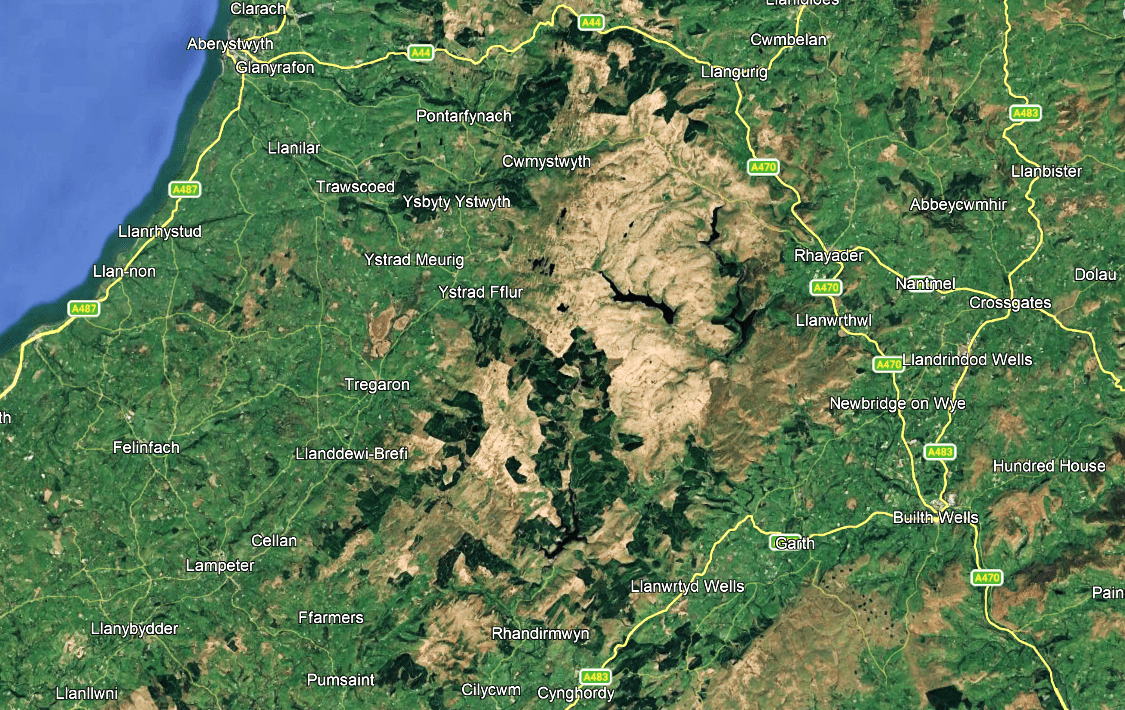
The last true wilderness in Wales. Now it’s being industrialised and destroyed by the ‘renewables’ industry, all foreign-owned companies.

With other parcels of land being bought by ‘environmental’ groups and other sheep in wolf’s clothing. (That is not an allusion to the Fabian Society.) One of these groups gives the appearance of being Welsh, the others are the usual suspects; National Trust (NT), Royal Society for the Protection of Birds (RSPB) . . .

Here’s how Google AI describes the Elenydd:

The least populated and wildest area in southern Britain . . .

The largest continuous tract of blanket mire in the Welsh uplands, designated as a Special Area of Conservation supporting rare birds like red kites, merlins, and diverse upland flora.

Clearly, we are dealing with a very special area – one that should be left to those who have cared for it for generations. But that would mean farmers and others, now viewed as the enemy by those who have elected themselves our saviours from evils as diverse as the climate crisis and the threat from the far-right.

For the two are invariably linked. Those dictating how we behave, even what we eat, in response to the ‘climate crisis’, are often the same people telling us what’s acceptable thinking in the political sphere.

Because it’s all about control. Controlling us.

FURTHER BACKGROUND

I’m going to start with a document produced by the self-styled ‘Welsh Government’ back in 2019, called Future Wales The National Plan 2040. There, in amongst this melange of hopes, dreams, incoherent ramblings and utter bullshit, on page 94, we find a map showing the areas set aside for wind farms.

They’re numbered and bounded in black. Roughly speaking, the Elenydd is north east of the area 8 panhandle and east of area 6.
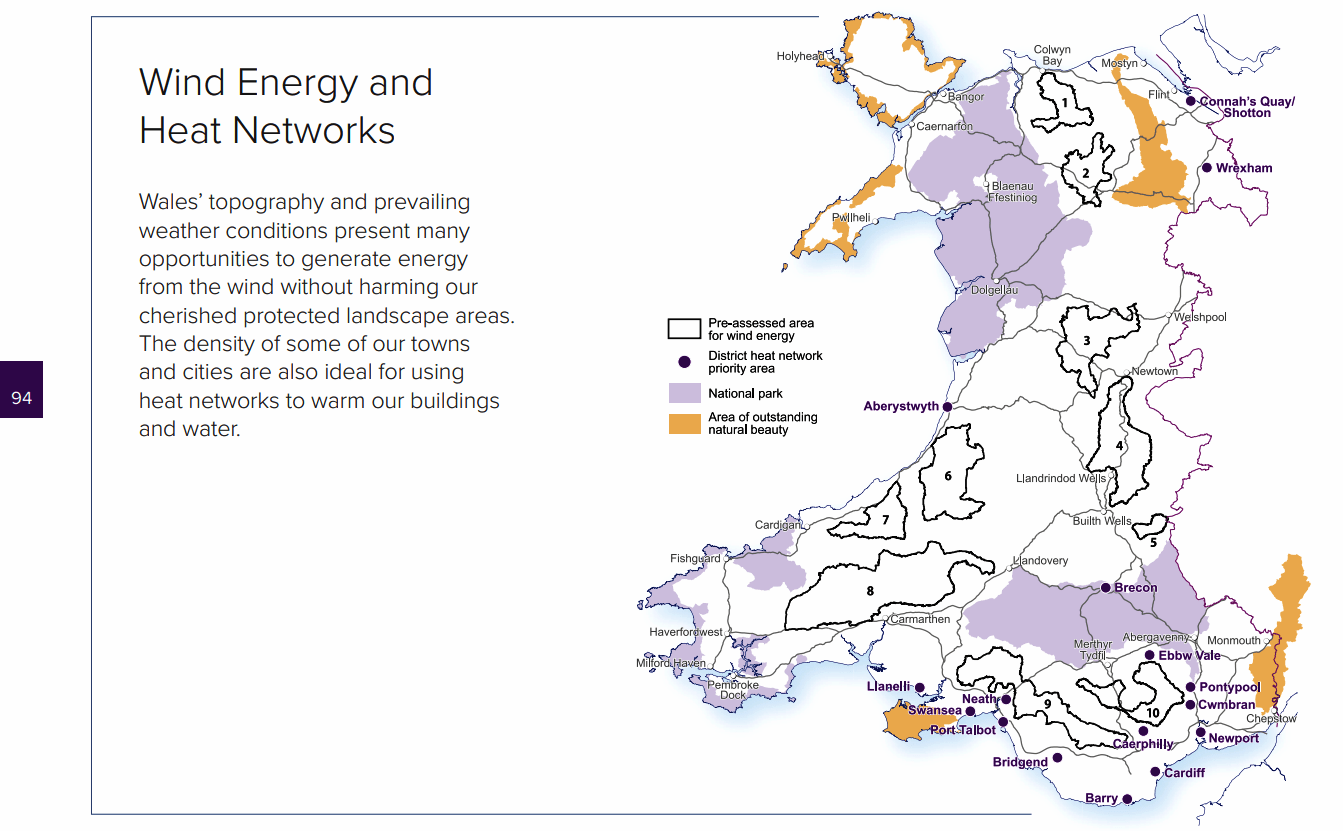
Whatever the original purpose of this map showing ‘pre-assessed’ areas, it soon proved worthless and misleading.

A fact illustrated by the map below, produced by Caru Teifi, a group protesting against the pylon runs needed to take the electricity intermittently generated by wind farms to the grid connection point south of Carmarthen.

In the south it appears that most of the turbines built (light blue), and planned (dark blue) are outside the ‘pre-assessed’ areas.
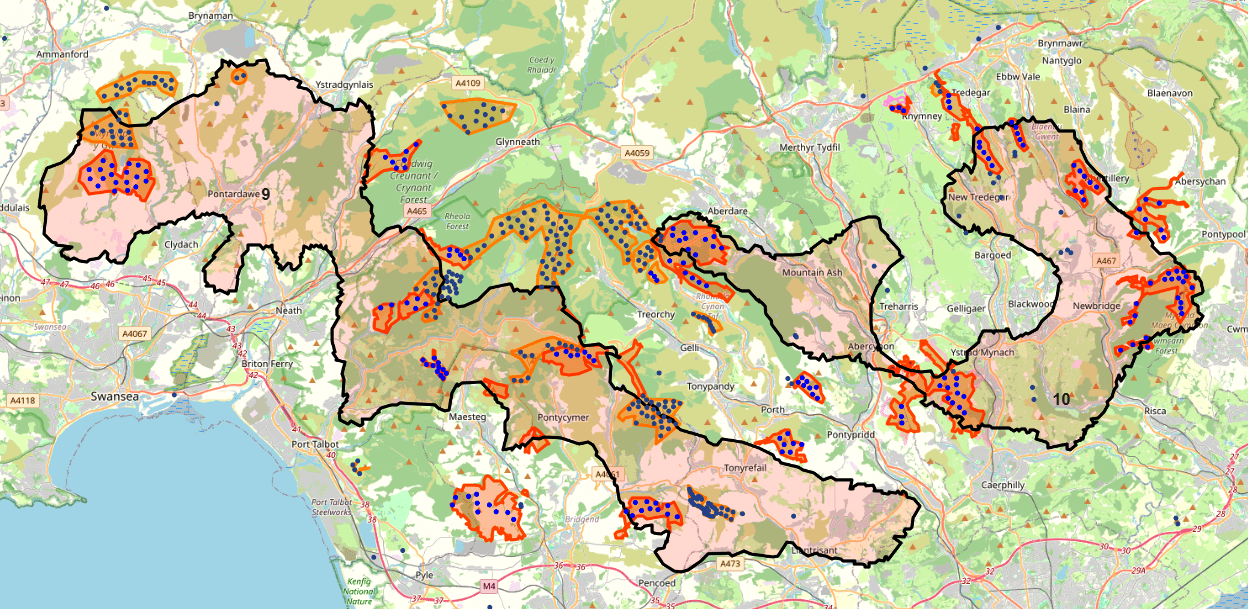
And as you’ll see in a minute. it’s the same – or worse – in the area we’re looking at.

So what was the point of the ‘pre-assessed’ areas in the 2019 National Plan if the ‘Welsh Government was simply going to allow a “near enough” approach that borders on a free-for-all?

Time now to look at the wind turbine projects on the Elenydd. The known knowns, the known unknowns, the unknown unknowns, and the unknown knowns.

WHAT’S PLANNED

We can safely identify four projects. Three we’ve known about for a few years, with another announced this year.

The first involves Scottish company Bute Energy Ltd. Their project is Lan Fawr. There was another project nearby labelled Bryn Brawd, but it seems they’ve merged. Now it’s one sooper-dooper project with 55 turbines up to 800ft in height. Labelled 1 in the image below, and in two parts.
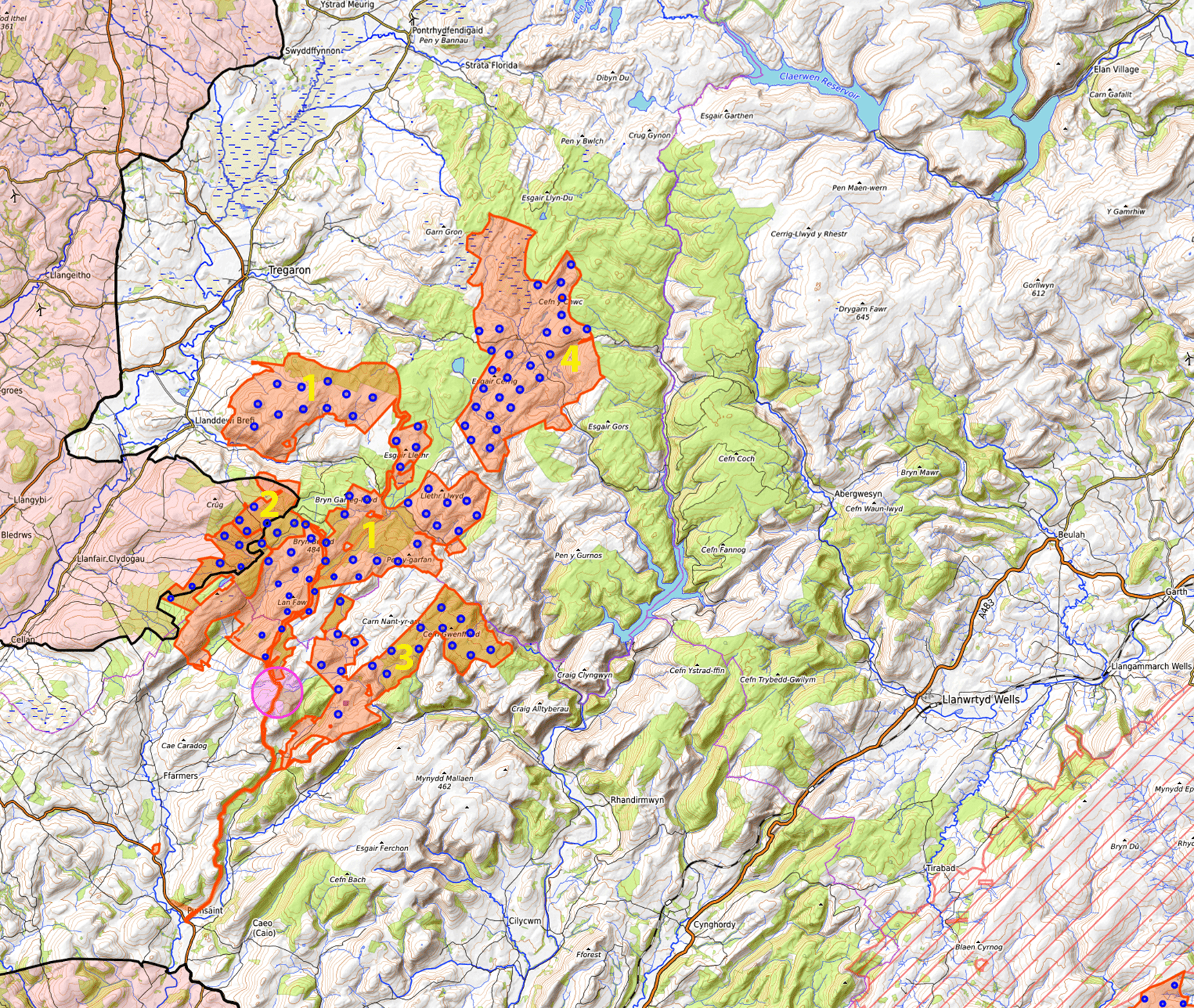
Next is Belltown Power’s Waun Maenllwyd project. Just 4 to 6 turbines. Labelled 2 in the map above. It’s suggested the Belltown project might be taken over by Bute. Alternatively – and I find this interesting – that the Foresight Group, which is behind Belltown, might take over Bute!

Number 3 is Galileo Empower UK’s Bryn Cadwgan project. Galileo has it’s UK office in Edinburgh (and an outpost in Cardiff), but is owned by investors and pension funds from just about everywhere, as far away as New Zealand.

Lastly, we take a brief look at the newest of them, EDF’s Nant y Maen. This straddles the Tregaron to Abergwesyn road. It’s definitely in the pipeline; confirmed by this ‘WG’ document. EDF is wholly owned the French Government.

Local sources insist there are other projects yet to be unveiled. Two, it’s believed.

Access to these projects is planned from the A482 at Pumsaint. Something I covered in The Road To Hell back in November 2023. Then it’s over the old Dolaucothi Estate, now owned, like far too much of Wales, by the National Trust.

After Pumsaint, it’s anyone’s guess, but I guarantee it will involve new roads, hundreds or thousands of trees felled, and massive disruption to the environment over an extended period of time.

But before reaching Pumsaint the turbine columns and blades will be transported on huge diesel smoke-belching trucks along country roads from Swansea docks.

Disruption and destruction all the way so that foreign investors can make money.

Unless, of course, you’re stupid enough to believe that this is all being done to save the planet, and Wales will somehow benefit. Are you that stupid?

‘WILL SOMEONE THINK OF THE NEWTS!’

In the intro I referred to a couple of recent purchases in the Elenydd by rewilders and others. So let’s look at them.

First, is one I covered in Land Of Our Fathers, But Not Our Children, in February. This concerned the purchase of 1195 acres by an outfit called Tir Natur.

The area bought is shown in this map by Caru Cymru I linked to earlier. It’s the dull green area below EDF’s Nant y Maen project. (I urge you to consult the Caru Teifi website maps and use the layers available to see what’s what in the area.)
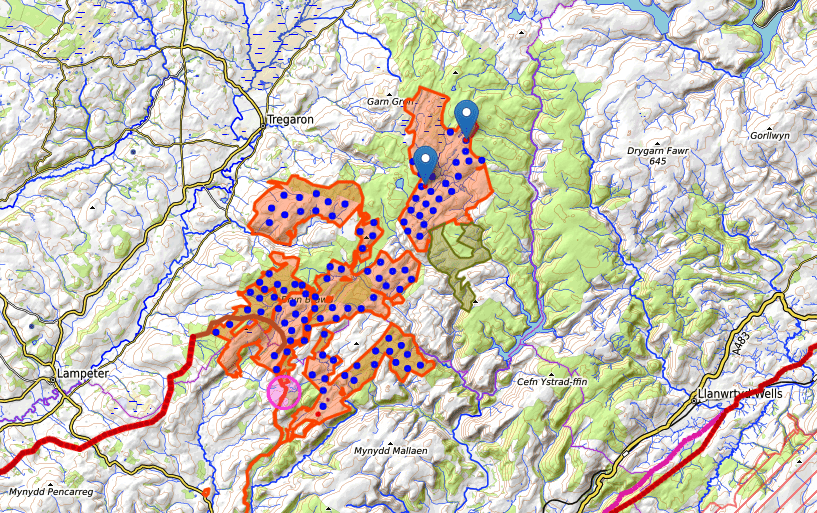
Quite a purchase, and achieved with, according to Farmers Weekly and other sources, a “philanthropic bridging loan“. Wasn’t that nice!

Earlier this month, we learnt that the RSPB had bought 96 hectares at ‘Galltybere’ or ‘Gallt-y-Bere’, which is shown on OS maps (see above) as Craig Alltyberau. This adjoins the planned Galileo Empower Bryn Cadwgan wind farm.

And whaddya know – this purchase also received a “philanthropic loan“.

I wonder where these ‘loans’ come from? Can I have one?

Now for a detour, but not really a digression. We’re going to Scotland, sticking with the RSPB – and there’s more magic money!

Down the Firth of Forth from Edinburgh, not far from North Berwick, rising from the North Sea is the volcanic plug of Bass Rock. A home to many birds, and the largest colony of Northern Gannets.

These are magnificent birds, with a wingspan of six feet or more. While searching for prey they soar or glide until folding back their wings to dive into the sea.

Not far away is the Isle of May. This is home to 50,000 puffins, plus guillemots, razorbills, and other birds.
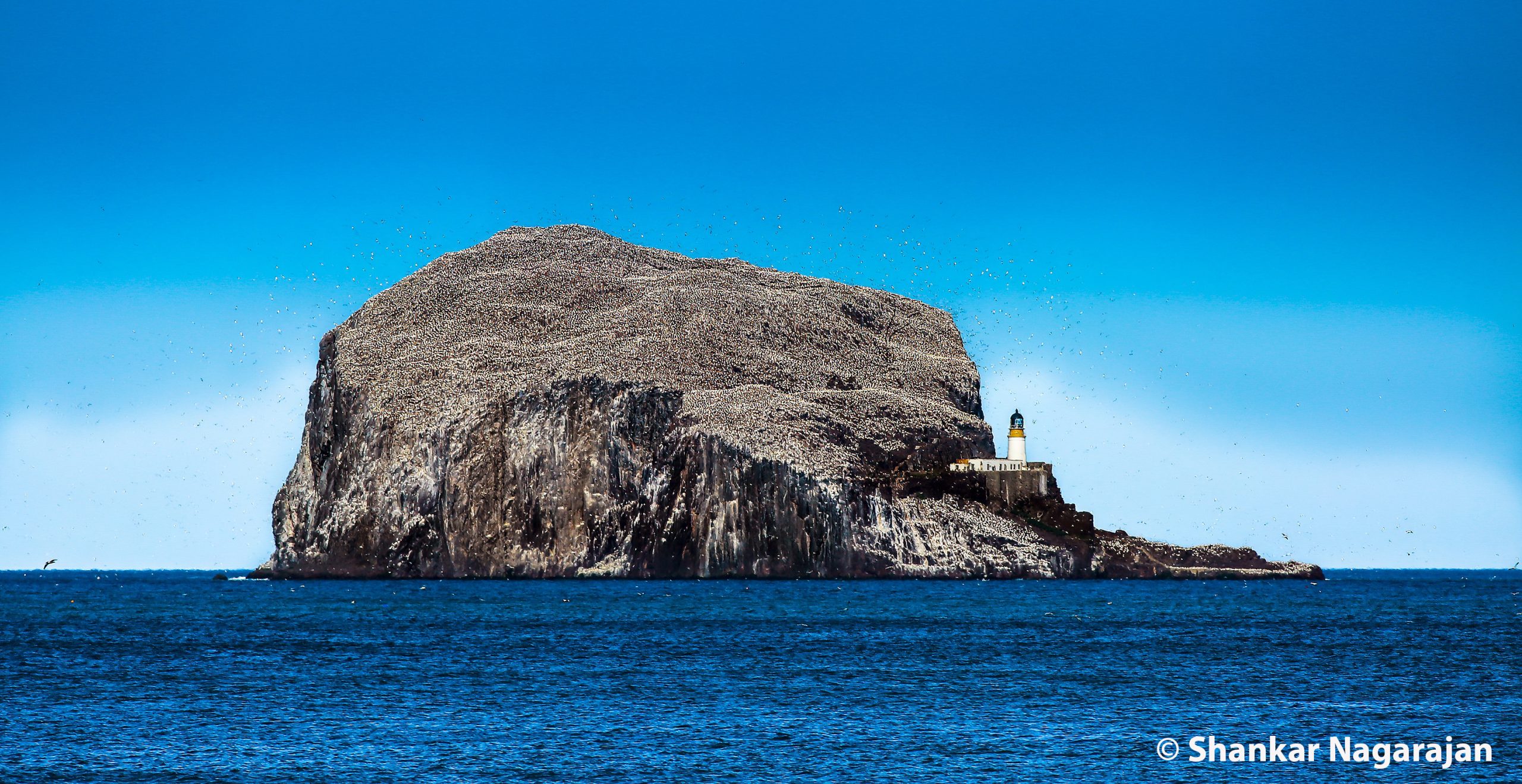
Hanging over this avian idyll is the threat of 307 wind turbines, in a project approved last year. As might be expected, RSPB Scotland objected. Stating:

Berwick Bank is a gigantic windfarm. To put it in perspective, it would take up an area four times the size of Edinburgh with more than 300 turbines – each the height of six Scott Monuments

But then something strange happened. Operating through the National Heritage Memorial Fund, the UK government made a grant of £586,000 to RSPB Scotland – to buy Bass Rock!

I can’t help thinking that what was really being bought was the RSPB’s silence.

CONCLUSION

You don’t need to be cynical to believe that when there’s billions of pounds, dollars, euros or whatever in profits to be made, certain measures will be taken to guarantee those profits. Among those ‘measures’ will be neutralising the opposition.

Unless they’re powerful and well organised, local groups can be largely disregarded, developers can even play one off against another. The same principle applies to landowners and farmers. But when it comes to groups that are well-established, with a national or even international structure, and have the ear of politicians, then a different approach is needed.

And this might explain the magic money that appears regularly in the accounts of wildlife and environmental groups. Sometimes it’s out in the open.

Aviva, the institutional investor owned by Vanguard and others, has given just shy of £40m to the Wildlife Trusts to restore Celtic Rainforests along the western edge of Britain. Much of this money will be coming to Wales. Some already has, and it’s gone to the Elenydd.

I dealt with this February, in The Latest Enviro-scam – ‘Celtic Rainforests’.

In fact, it seems most 0f Wales is a rainforest. Who knew?
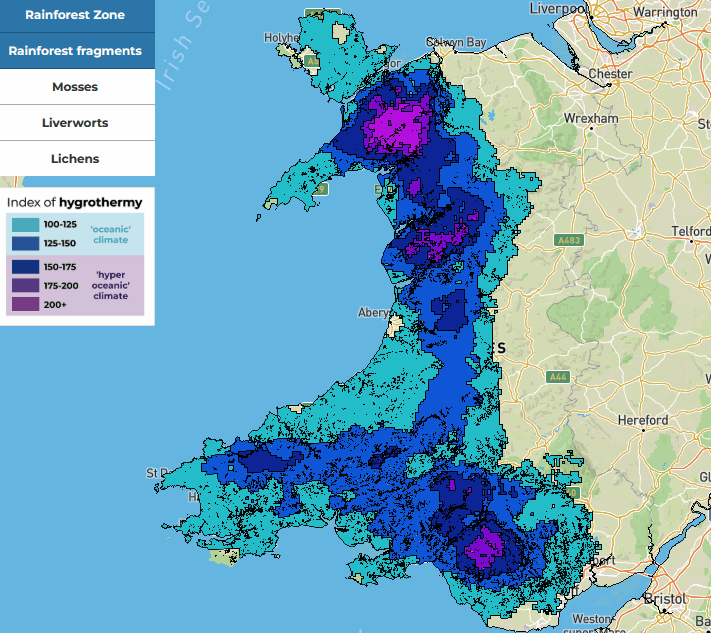
Though the Elenydd seems to be in the ‘Oceanic Climate’ zone rather than that described as ‘Hyper Oceanic Climate’.

At the risk of coming across as a cynical old bastard I’ll spell out what I think might be happening in the Elenydd. Shyster ‘developers’ want to destroy an almost pristine wilderness for profit, and have, by one route or another, given money to environmental groups to buy adjoining land.

The developers will then argue that wind turbines, and the work associated with them, pose no threat to wildlife or the environment. If they did – then surely their neighbours like Tir Natur and RSPB would be complaining. “Stands to reason, squire“.

For their part, the recipients of this largesse will tell themselves that sacrifices must be made for the greater good and the bigger picture.

For you must remember that those I’m describing have bought into the climate scam, making their position ambivalent. And rarely have I seen it more evident than in the RSPB Scotland statement I linked earlier.

We can unlock a future where Scotland’s already struggling seabirds are helped to recover, while producing the renewable energy needed to help fight climate change.  

So, for the greater good, sacrifices must be made. But that’s OK, as long as it’s the dicky birds making the sacrifice.

♦ end ♦

© Royston Jones 2026

Buy Me A Coffee

Bute Energy, Connections & Partners

This piece is in two parts. The first takes us to Ireland, the second . . . well, I’m not quite sure, maybe into a war zone.

For anyone new to the blog, or this topic, Bute Energy is a Scottish company with a Cardiff address planning a dozen or more windfarms in Wales, plus the pylon runs needed to connect them with the main grid. Also solar arrays and Battery Energy Storage Systems (BESS).

The head man is Oliver James Millican who, along with the other Bute principals, Stuart Allan George and Lawson Douglas Steele, left Millican’s father’s Parabola property company towards the end of 2017. They may still be working for Parabola.

IF YOU EVER GO ACROSS THE SEA TO IRELAND, THEN MAYBE . . .

To begin with, I recently learnt that Copenhagen Infrastructure Partners (CIP), Bute’s main funder up to this point, is now operating in Ireland. Taking advantage of Ireland’s Strategic Investment Fund.

The Ireland Strategic Investment Fund (ISIF) has committed €200m to specialist greenfield renewable energy infrastructure investor, Copenhagen Infrastructure Partners (“CIP”) latest flagship strategy, Copenhagen Infrastructure V (the “CI V”)

When I saw ‘CI V’ it rang a bell, because this is (or was?) the CIP fund behind Bute Energy. Mentioned more than once on this blog. Specifically, CI V Dragon Lender Ltd (launched 23.12.2021). Other companies with the CI V Dragon name are; CI V Dragon Topco Ltd (16.03.2023), and CI C Dragon Holdco 2 Ltd (07.12.2023).

All three are still in business, with directors I believe to be working for CIP.

There was a fourth company, CI V Dragon Holdco Ltd, formed 23.12.2021, with CIP directors. Two of whom left in November 2023, but two hung on until June 2025, when they were replaced by Oliver Millican. A liquidator was appointed in January this year. This outfit was clearly replaced by Holdco 2.

A lot of money went into the now-departed company, over £60,000,000. Which seems to have been used in payouts to Bute directors. This has been widely covered in the media; including Nation.Cymru. There are suggestions of, dare I say it – can I even spell it! – jiggery-pokery.

Here’s what Google AI says. Nation.Cymru is quoted, but the info came from this site.

Though a reporter for a London newspaper, who’s been in contact recently over Bute’s activities, tells me his ‘paper’s bean counters are not convinced Bute’s done anything illegal. Devious, maybe, but not, strictly speaking, illegal.

Whatever the answer, it seems that the money was doled out thus: Millican £47.56m, with George and Steele each getting £4.64m, and a few million going to minor players, one said to be Millican’s brother-in-law.

Much of Millican’s money was used to buy real estate in Scotland, often warehouses, and dealt with in this blog in March. Here’s a quote I used then from a Bute insider:

The real estate arm of the Windward portfolio . . . is working with multiple overseas businesses and at least one national government to house interests and commodity items relating to renewables infrastructure. There are warehouses in Wales and Scotland filled to the rafters with BESS and pylon materials – rented and landed for resale exclusively to the UK market to artificially appear to restrict overseas procurement and brand it as available when supply chains pinch in the late 2027 to early 2029 drive.

Windward is another name used by Bute companies, Windward Enterprises Ltd being the ultimate holding company for the Bute empire. Sole director and shareholder Oliver Millican.

A new director of Windward Enterprises, since June 1, is given as ‘Thomas Anthony Watson’. (Companies House was notified June 25.) A name common enough to be ignored. He is in fact, Labour peer, Baron Watson of Wyre Forest.

Last month Windward Enterprises took out a loan with private bank Brown Shipley & Co Ltd, ultimately owned by the Al Thani family, which owns and runs Qatar. This family also owns some £40bn of real estate in London, including Selfridges, Harrods, The Savoy, Claridge’s, Heathrow Airport . . .

BUT WHY THE INTEREST IN IRELAND?

With Copenhagen Infrastructure Partners investing in ‘renewables’ in Ireland I naturally got to wondering if Bute Energy is similarly involved.

In an idle moment I typed ‘Bute Energy Ireland’ into Google, and it suggested a “corporate address” down by Anna Liffey. Here to be exact: 2nd Floor, Riverview House, 21-23 City Quay, Dublin, D02 AY91.

Which turns out to be the Dublin address of SYSTRA Ireland, part of a big French company, with projects around the world.

Next, I searched for ‘Bute Energy Systra’, and turned this up:

Bute Energy is a Welsh developer spearheading over £3 billion of onshore wind projects. They collaborate with global infrastructure and consulting firm SYSTRA. SYSTRA provides lifecycle services, electrical grid/infrastructure planning, and engineering for Bute’s energy parks to speed up the transition to a low-carbon grid.

Welsh developer“! So there is a link. But why had I never heard of SYSTRA before? Next, my trembling digits tapped in ‘Welsh Government Systra’, and this came up:

SYSTRA is a prominent transport and engineering consultancy that frequently partners with the Welsh Government and Transport for Wales (TfW) to modernize public transport, boost regional connectivity, and achieve net-zero climate targets.

Then I found this on the SYSTRA website. Nice to see another Welsh company getting contracts from the transition to the wonderful Green economy.

On the Systra website I also unearthed these specific projects. A franchised bus service for Wales and an energy from waste facility on Deeside. Are there others?

Despite these contracts in Wales SYSTRA doesn’t even bother with the Bute ploy of having an office here. It seems Wales is handled from Bristol or Birmingham. Though there is of course an office in Edinburgh, which will be handy for the Bute boys. (In fact, SYSTRA’s Edinburgh address looks somehow familiar.)

AI coming up with SYSTRA’s Dublin address for Bute Energy is no real surprise. It’s pretty obvious this French company has its feet under the table with the so-called ‘Welsh Government’.

So, Bute is already linked with SYSTRA and CIP, both are now operating in Ireland, with Systra also well in with the ‘Welsh Government’. It’s therefore reasonable to assume that Bute may also be active in Ireland.

Which brings me to another reason for looking at Irish connections. I’m referring to the pylon runs from windfarms planned in central Wales (many by Bute) to Llandyfaelog, south of Carmarthen, where they connect with the main grid running from RWE’s Pembroke power station to England.

This has been covered extensively, both my blog and on the CPRW website.

While England was always the presumed destination for the electricity generated, it could just as easily go west to Ireland, thanks to the new Greenlink Interconnector at Freshwater West in Pembrokeshire.

This short (2:12 mins) news clip from RTÉ explains it.

The demand for electricity in Ireland is soaring, with some 80 AI data centers already, and more in the pipeline. Understandably, the state electricity board, EirGrid, is getting nervous.

No surprise then, that in addition to the connection from Pembrokeshire there’s another from Bodelwyddan to somewhere near Dublin, with MaresConnect. This is owned jointly by Etchea Energy, with offices in London and Dublin, and our old friends in the Foresight Group.

UPDATE: Bodelwyddan is mentioned in this announcement of an offshore developmententirely in Welsh waters“, between BP and Japanese company Jera, with a “proposed connection to the Bodelwyddan National Grid substation“.

As for Foresight, you may remember this lot attracting bad publicity in recent years for buying up Welsh farms on which to make money from planting trees to offset ’emissions’, or some such corporate bollocks.

And then there are the governmental contacts. Here’s a joint statement issued a year ago after first minister Eluned Morgan visited Dublin to meet Tánaiste Simon Harris.

Forums have enabled us to hear directly from Irish companies including ESB, Simply Blue and DP Energy, who are investing in energy projects in Wales. During the 2023 forum, ministers also visited the Morlais tidal stream energy project on Anglesey in North Wales

Last month, the new Plaid first minister, Rhun ap Iorwerth, was in Dublin.

And the links don’t end with politicos doing photo-ops. Here’s one between French giant EDF and Irish state-owned ESB. This offshore wind project’s called Gwynt Glas. The only thing Welsh about it is the name. (But that’ll be enough to please some.)

So Irish companies, with others from Scotland, England, and further afield, invest in renewable energy projects in Wales. A country that already produces more electricity than it could consume if we all drove electric Humvees and left our lights on 24/7.

But it doesn’t end there, because there’s also electricity being shipped down from Scotland. This was supposed to be taken by a lengthy pylon run from Pentir near Bangor to Swansea North, on the line from Pembroke to England.

Then again, it might not run down to Swansea at all; perhaps it – or some of it – could be sent to Ireland via the Bodelwyddan link. However you look at it, Wales is being covered in windfarms and other installations we don’t need, and criss-crossed with transmission routes going elsewhere.

Something noted by CPRW, which last month put out a press release warning that ‘Wales Must Not Become England’s Energy Corridor‘. Agreed. But I repeat, the way things are shaping up Wales is just as likely to become an energy corridor serving Ireland as well.

All the while those treacherous clowns in Corruption Bay mince around looking smug, and preparing their spare rooms for ‘refugees’ (or maybe not) – cos we is saving the planet, innit.

And anybody who objects is a climate-denying fascist. Well, I guess that’s me.

JUDGED BY THE COMPANY YOU KEEP

Another development concerning Bute worth reporting is the funding from Dutch outfit Rabobank. Here’s the Rabobank website.

There are maybe two points to make about Rabobank. First, it’s big in agriculture and food . . . and buying farmland. Second, it has a rather worrying record.

When it comes to buying farms and land Rabobank operates through the subsidiary Rabo Farm and local intermediaries. These are often corrupt local officials. Worth asking if these officials were always corrupt, or was it the prospect of Rabobank money that corrupted them?

Come to that, how did Rabobank make contact with local officials in remote parts of Poland and Roumania? Did they have intermediaries with good contacts? I mention that Latin outpost because of a scandal just over a decade ago that saw local farmers learning they no longer owned their land. Read about it by clicking on the image below.

Rabobank has strong links with top-tier Globalists the Rothschilds. Maybe the latter rely on Rabobank’s expertise in food supply and pricing to help them towards the Globalists’ wet-dream goal of controlling the food supply. And with it, us.

Rabobank is also believed to be active in that most corrupt of eastern European countries, Ukraine. But the law there states that only Ukrainian citizens and entities can own land. Up to 10,000 hectares.

What this means in practice is that those close to the Cokehead Clown of Kiev often act as intermediaries for foreign investors. This goes some way to explaining the Bugattis, Lamborghinis and Bentleys with Ukrainian plates in Monte Carlo.

Rather cruelly they’re known as the “Monaco Battalion“. Which must be a great consolation to Ukrainians dying at the front to defend their corruption.

But then, dying on the front line nowadays is reserved for little people.

But the question is, why is Bute Energy involved with Rabobank at all? The new funder may now be branching out into ‘renewables’, but the primary interest remains land, farming, and foodstuffs. Are the two connected?

By which I mean, is Rabobank’s link-up with Bute connected to Bute owning ‘Welsh’ Labour, also now buying influence in Plaid Cymru; and Rabobank realising that both these parties want to end livestock farming. Which will bring many farms onto the market.

A Powys farmer confided recently, regarding Rabobank:

From my perspective, the concern is that this extremely powerful financial institution with deep expertise in agricultural land are now also financing infrastructure that competes for that land.

Whatever the answer, Bute Energy linking up with a company with Rabobank’s record should set alarm bells ringing.

CONCLUSION

As I’ve said a few times in recent posts on the subject, I (and others) may have focused too much on Bute’s activities in Wales at the expense of the bigger picture. Which now seems to be emerging.

A picture that, first, confirms the electricity generated in Wales is for consumption somewhere else. I’d assumed that ‘somewhere else’ to be England. But that’s only part of the picture.

Electricity generated in Wales, and off our coasts, is also likely to be going to Ireland. This accounts for the interconnectors from Bodelwyddan and Freshwater West, and it might also explain the Irish companies investing here.

Will electricity generated by Irish companies in Wales be reserved for Irish consumers? I ask because while I appreciate there are interconnectors everywhere, and electricity can flow both ways, consumption in Ireland seems to be outpacing generating capacity.

Then there’s the power coming down from Scotland. It’s not for Welsh consumption. So why can’t it go directly to England and / or Ireland?

Do you remember Alexander Cordell’s book, Rape of the Fair Country, about the 19th century exploitation of Wales by Victorian industrialists? What we see today is the Globalist-Green rape of Wales . . . but without the jobs or any other tangible benefits.

It’s clear beyond doubt that Mam Cymru is being used, and abused. How much longer do we just stand by and let it happen?

♦ end ♦

© Royston Jones 2026

Buy Me A Coffee