Regional Parties for the National Good

This post re-visits a subject I dealt with in September 2012. (Unfortunately, the original comments and other features were lost when Google pulled the plug on my earAssembly elections maplier blog in December 2012. See sidebar) The reason I am returning to the subject is that, on the one hand, there has been no change for the better, yet on the other hand, there has been a change for the worse. Put it together and it gives a stronger case in 2015 for regional parties than when I originally mooted the idea almost three years ago.
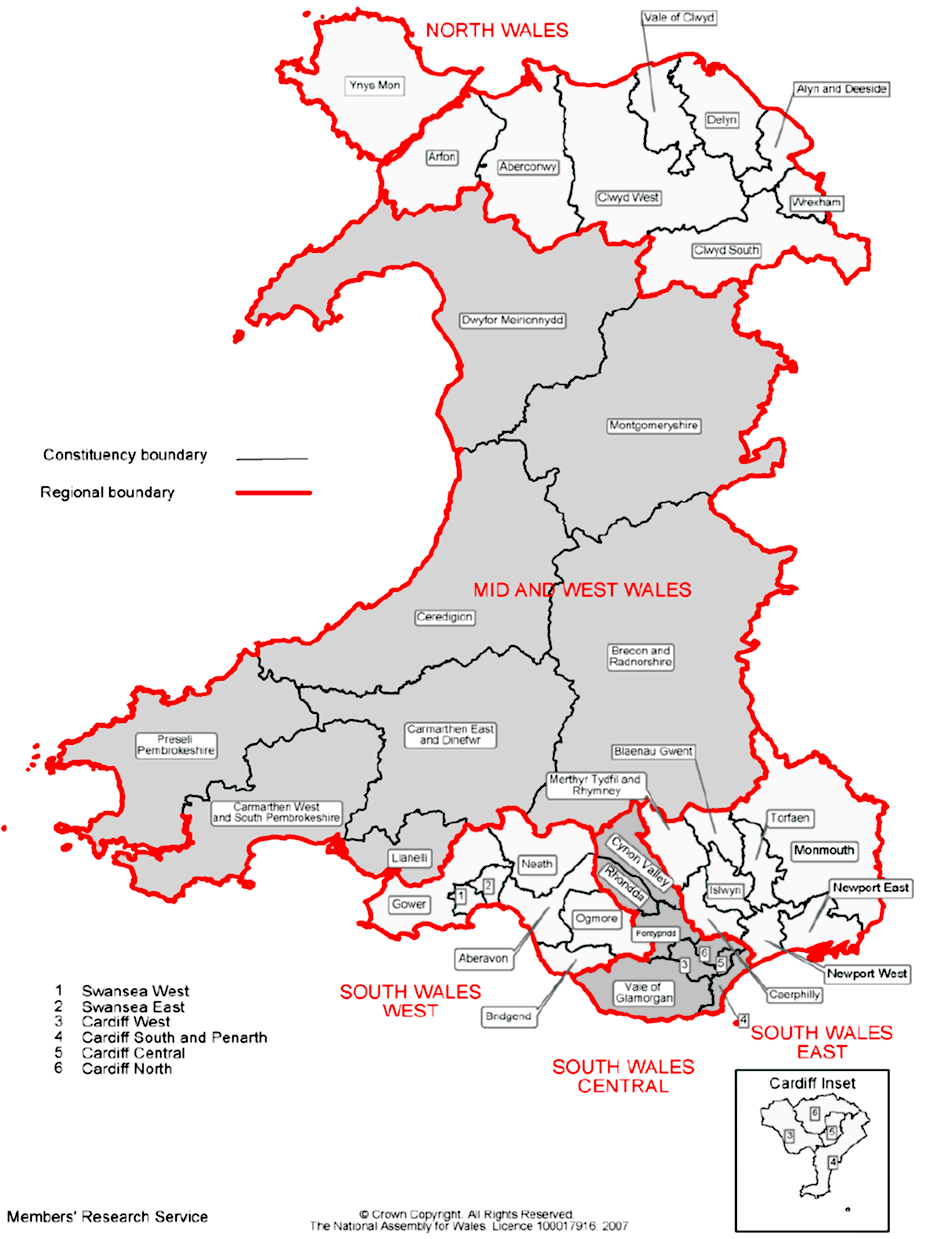
There are a number of reasons for promoting the case for regional parties standing in the ‘Welsh’ Assembly elections of 2016. I try to deal with them in the various sections below. The map on the right will help you understand the boundaries, click on it to enlarge it.

1. SHAM DEVOLUTION

The first of those reasons is one that I dealt with back in 2012, namely that devolution is a sham. Wales is more firmly under England’s control than ever, but now it’s done through civil servants taking orders from London yet doubling as ‘advisors’ to the self-deluding ‘ministers’ of the ‘Welsh’ Government. In reality, of course, these civil servants / advisors are relaying orders. It is a charade of the kind we would have found in the old East Germany, or any country run by a regime reliant on US support.

Among the many agencies of this sham devolution I have dealt with, one that has received more attention than most, is the Planning Inspectorate. (To find the many articles I have written on the subject type ‘Planning Inspectorate’ in the Search box at the top of the sidebar.) It is this agency that facilitates the colonisation of Wales with its bullying of our local councillors (or working with alien and eager senior officers), justifying building new homes we don’t need with ludicrously inflated population ‘projections’, or reduced household (size) estimates.Thickett Planing Resource

To keep up the pretence of ‘devolution’ the Planning Inspectorate maintains an office in Cardiff, it even has a few Welsh planning inspectors, but this is all window-dressing. As we saw with the review of the Local Development Plan for Denbighshire. Two inspectors were involved in assessing the protests of the local council, which argued that the 2011 census showed the county did not need the number of new homes the Planning Inspectorate had demanded. Read about it here.

The two inspectors involved in the ‘assessment’ of March 2014 were Anthony Thickett (see panel) and Gwynedd Thomas. Within a few months Thickett was appointed chief inspector for the Wales region of the Planning Inspectorate. Poor old Gwynedd Thomas was there just to add a little local colour, in the hope of disguising that this was part of the colonisation process, and all determined in London.

It doesn’t matter how we look at, What we have in Wales is a system designed to frustrate Welsh ambitions rather than satisfy them. It is a system of devolution for the benefit of England. And this explains why the ‘Welsh’ Government can do nothing to serve Welsh interests if that might work against English interests, yet agencies like the Planning Inspectorate are daily working in England’s interests against Wales.

The ‘Welsh’ Government is, like poor Gwynedd Thomas, nothing more than a fig leaf for this colonialist reality; it’s only real power lies in being able to distribute funding handed down to it. Yet far too much of this money currently goes to Cardiff or to Labour’s cronies and hangers-on in our irredeemably corrupt Third Sector.

2. THE ‘WELSH’ LABOUR PARTY

Sham devolution of course needs willing participants in the country being flim-flammed, and this is where the ‘Welsh’ Labour Party comes into the picture. Over many, many years I have made my feelings known on this, the most corrupt political party in the Western world, but if anyone is still in any doubt as to the nature of the beast, then let them read Why I Detest the ‘Welsh’ Labour Party, The ‘Welsh’ Labour Party and its Evil Empire, Merthyr: All Aboard the ‘Welsh’ Labour Gravy Train, or more recently, ‘Welsh’ Labour and Social Enterprises – All Fall Down!.

It is the ‘Welsh’ Labour Party that, for sixteen years, has fronted the colonialist system of sham devolution I just mentioned. This explains why the only time we see the self-styled First Minister on UK-wide television is when he’s proving how loyal we Welsh are despite devolution (which for some reason, still worries many English!). Such as welcoming Bet Windsor to Wales, or spouting BritNat bollocks during last year’s Scottish independence referendum campaign. The man is an embarrassment to all right-thinking Welsh.

One feature of this sham devolution is the growth of Cardiff, due to it serving as the ‘capital’, and because so much of the colonial bureaucracy is centred there. Though this can have a damaging effect on other areas.

I travel around Wales much more than most people, and one thing that strikes me whether I’m in Llandudno, Newtown or Haverfordwest is that on any contract connected with or funded by an agency based in Cardiff, the hoardings tell me that the estate agent dealing with the sale or, in the case of a new project, the company that drew up the plans and others, will also be found in Cardiff. Suggesting to me that companies based in Cardiff have an unfair advantage when it comes to these civil servants drawing up lists of ‘approved’ estate agents, contractors, architects, and others, or else we dealing with a form of favouritism that comes close to corruption. But this Cardiff bias can take other forms.

A Puppet Regime

I am indebted to a correspondent in regular contact with the aforementioned civil servants for a recent example of the way Cardiff is favoured above other areas. Regular readers of this blog will be aware of the Housing (Wales) Act 2014. Among the provisions of the Act is a new register of private landlords. This work – and the jobs it will generate – has been allocated to Cardiff City Council, without any tendering process. Why should the richest area of Wales be gifted yet more jobs when this work could have been done by any local authority? And who made the decision?

Though an irony in this situation is that even the Conservative and Unionist Party, the party of the City and big business, has finally conceded that England has an economic imbalance, with too much of the country’s wealth and power accumulated in London and the south east. Hence the talk of investing hundreds of billions of pounds in HS2 and Northern ‘Powerhouses’. Yet here in Wales, we are replicating the system England is now seeking to remedy!

3. PLAID CYMRU

My feelings on Plaid are equally well documented. I suppose Plaid Cymru: Ninety Wasted Years, from October last year, sums it up as well as anything I’ve written, but use the Search box atop the sidebar to find other posts. Nothing has improved since I wrote that piece. In this year’s General Election Plaid Cymru again performed miserably, dealt with in Election 2015: Plaid Cymru Fails, Again.

And from all quarters comes news that that Plaid Cymru continues to be the most impotent ‘national’ party in Europe, afraid of upsetting anyone. Here’s one recent example that says it pretty well.

Followers of Welsh public life will be aware of a growing problem in local government that sees senior officers take over the running of certain councils. Nowhere has this trend been more apparent than in Carmarthenshire, where the council has for some years been run by the chief executive, Mark James, with the approval of the leaders of the parties in coalition there, Labour and ‘Independents’. But recently, after a change of leadership in the local Labour Party, there was a falling-out between the former love-birds and Independent leader Meryl Gravel began smooching Plaid Cymru, which resulted in a new coalition between the two.

With Plaid Cymru the larger of the parties, and Plaid’s Emlyn Dole named council leader in May, most people expected things to change in Carmarthenshire but that, alas, has not happened. It appears to be business as before, as this little cameo, received from a reliable source, illustrates.

The trade union Unison, ” . . . had to wait 2 months to get a meeting with Dole. There were a number of items on the agenda (employment issues and the council’s plans for publicly owned assets such as Parc Howard in Llanelli). To Unison’s surprise, waiting to greet them in Dole’s office was Mark James, although the union had asked for a private meeting with the leader. The meeting did not go well.”

Emlyn Dole’s submission to The Ultimate Authority may be connected with his little ‘difficulty’, for Plaid’s leader in the seat where Gwynfor Evans won that famous 1966 victory has been caught flouting planning regulations. But never mind, for Plaid Cymru has not forgotten its primary role – sticking up for Labour. As I reminded people in my June 28th post Vote Plaid Cymru – Get Labour’, and as Plaid itself continues to remind us.

Just last Saturday, at the commemoration of the 1911 Llanelli Riots, local Labour MP Nia Griffith was getting a bit of stick from some in the crowd for making a big noise about the Tories’ austerity measures but neglecting to inform her listeners that she had abstained when presented with the chance to show her ‘opposition’ in the House of Commons vote a few weeks ago. Who rode to her rescue? Helen Mary Jones, the Plaid candidate for Llanelli in next year’s Assembly election, and Vaughan Williams, who failed so miserably to win the seat in May this year.

Plaid Cymru is now more of an asset to England than to Wales. From England’s perspective Plaid Cymru is the perfect ‘in-our-pocket’ regional party. That’s because it can still attract the votes of many who want independence / greater devolution, or who care about Welsh cultural identity, but for all sorts of reasons Plaid Cymru will never get more than 25% of the vote, even in the most favourable circumstances, yet – in the absence of an alternative – it can still be presented as ‘the Welsh nationalist party’.

If there was any danger of Plaid Cymru collapsing, perhaps due to the emergence of that alternative national party, then it would be in our masters’ interests to keep Plaid Cymru alive. It may already be happening.

4. UKIP

Finally we come to perhaps the major difference today from the situation prevailing when I wrote the earlier piece on regional parties back in December 2012. Then there was a perception that Ukip, being primarily an anti-EU party, would do well in European elections, but only European elections.

The General Election earlier this year taught us the fallacy of that belief as we saw the Ukip vote in Wales reach 13.6%, and in so doing exceed the Plaid Cymru share of the vote. But this increase in Ukip vote has been aided by the collapse of the Liberal Democrats and a weakening of the Labour Party, which was of course almost wiped out in Scotland. To help you understand how things have changed I’ve compiled a table showing the vote shares for the major parties in Wales over the five most recent elections. (The two figures shown for 2011 represent the constituency vote and the regional vote.)

Share of vote

The Labour Party is in turmoil and, as I write this, looking likely to elect Jeremy Corbyn as leader; the Lib Dems are unlikely to recover any time soon, if ever; and Plaid Cymru seems doomed to a slow, lingering death. Few of those turning away from Labour and Lib Dems find Plaid Cymru attractive (hardly surprising seeing as long-time Plaid Cymru voters are deserting the party), and while some of those abandoning Labour, Lib Dems and Plaid will simply not vote, many will turn to the Tories or Ukip.

One thing’s for sure, Labour will definitely not have a majority after next year’s election, and may have difficulty forming a coalition with Plaid Cymru and / or Liberal Democrats. Taking us into uncharted territory, but also presenting great opportunities.

REGIONAL PARTIES

Regional parties contesting regional list seats are the only possible way to address the various problems listed above, the only way to ensure a more equitable Wales in which Labour is not completely dominant, with the added advantage of checking the advance of Ukip.

We can be sure that Ukip will view the list for the north as one its best hopes of winning Assembly seats, especially with the party’s local hetman, Nathan Gill MEP, being domiciled on Ynys Môn. So the first regional party I want to propose is for the north. Yes, I can already hear people asking, ‘What does Arfon have in common with Deeside?’ Short answer would be that across the north you will hear, ‘Everything is down south’. This will be Ukip’s message next year to northern voters. It can also be Strategic Development Plans 2the message of an alliance made up of people with roots in northern Wales, committed to serving the area, and hopefully objecting to the A55 corridor becoming a planned commuter belt. Because we can be sure Ukip won’t object! Neither will the other parties. (Click on image to enlarge.)

Another area where Ukip did well in 2014 and again this year is the Valleys. While the elected leaders in the region seem happy to surrender to Cardiff’s city state ambitions I’m sure there are many others in the Valleys who believe their towns and villages deserve better than a future as dormitory communities. This could be one message for a Valleys grouping. Another message for Labour could be, ‘Instead of using EU and other funding to help your cronies capitalise on our deprivation, use it to help us and our communities – the reason the EU gave it to us’.

The third region is obviously the Swansea Bay conurbation.

What I am suggesting is not formal political parties in the accepted sense. I am arguing for ad hoc regional groups with no ambitions beyond using their voice to demand fair shares for all, something that could perhaps be monitored by publishing regular figures for public spending and jobs created in each region. Because as I say, the only real power in this system of sham devolution is the power to divvy up the hand-outs. Which means that going down to Cardiff docks to play politics, to pretend that it’s a real parliament, is a waste of time. Focus on the money.

The suggestion of regional parties has both greater urgency and greater potential now than when I first mooted the subject because of the decline of three parties and the unattractiveness of those likely to gain from that decline. (And here I include the Greens.) I further predict that regional parties would get support from some of those who would not otherwise vote next year. And there’s guaranteed publicity in the interest that can be predicted from the local media.

To gather enough like-minded individuals in order to compile a raft of regional list candidates should be relatively easy, there’s no great expense involved, and for just nine months of work the rewards could be great. And with Welsh politics in a state of flux not seen in living memory, who knows where it might lead? And if that doesn’t persuade you, then do you really want to vote for any of the failed parties, or the unattractive alternatives I’ve dealt with here?

‘Vote Plaid Cymru – Get Labour’

Leanne Wood, leader of Plaid Cymru, has announced that her party will not go into coalition with the Conservatives after next May’s elections to the Notional Assembly. (Read all about it!) From where I’m sitting, this would appear to condemn Plaid Cymru to either impotence or a pact with Labour. Not an attractive choice, Leanne Woodbut then, when you play student politics with a nation’s future, and duck the real issues, you deserve no third option. Though the nation of course deserves a lot better than Plaid Cymru.

If my judgement strikes some as a little harsh, then that’s because, as a nationalist, I have little time for Plaid Cymru. But before dismissing my opinion out of hand let us examine the possibilities for next May’s elections. A good way to start is by reminding ourselves of the results from the Assembly election in 2011 and the two polls since then, the Euro elections of May 2014 and the UK general election of May 2015.

In 2011, Labour gained 30 seats, half of the total, and chose not to go into coalition with another party. They’ve never really come unstuck. Plaid Cymru came third, with less than half of Labour’s vote in both constituencies and regions, and well behind the Conservatives. The Liberal Democrats averaged over 9% of the total, while Ukip, who contested only the regional lists, gained a paltry 4.6% of the votes cast.Assembly election 2011

By the European elections of 2014 Ukip had transformed itself into a major force in the politics of Englandandwales (but not Scotland), and was now the second party in Wales, just .6 of a percentage point behind Labour. All the other parties bar the Greens lost ground.

Just seven weeks ago we saw Ukip fall back somewhat, and drop from its second place in 2014 to third, but it still got more votes than Plaid Cymru. In fact, Ukip came second to Labour in a number of Valleys’ seats which, when taken with the increase in the Tory vote, tells us there was a move to the right which, as I suggested in my blog post Election 2015: Plaid Cymru Fails, Again, might have marked the death of the ‘socialist Wales’ myth. From these recent results it’s reasonable to predict that Labour, with just 30 seats in 2011 and its share of the votEuro election 2014e dropping since then, will not win 30 seats in 2016.

The major changes since 2011 are, quite obviously, the rise of Ukip, then there’s the increase in the Tory vote, and finally the near-demise of the Liberal Democrats. Next year Ukip could, if the heavenly bodies align aright, win a seat or two; though if that doesn’t pan out, and given that the party might get 15 – 20% of the regional vote, then it could pick up 5 – 8 seats.

Labour has in previous Assembly elections gained less than other parties from the regional lists, just two seats in 2011, because it wins so many constituency seats, so the bigger threat to Labour may come at the constituency level. With Labour losing Gower and the Vale of Clwyd to the Conservatives last month, and the Lib Dems losing Brecon & Radnor to the same opponents, there must be a possibility that these resuGE2015lts will be repeated next year. If so, then it would establish the Tories as the second largest party by some margin. This seems predictable because the number of Plaid Cymru AMs is bound to fall, partly because other than Llanelli  it’s impossible to see a seat Plaid could gain (though maybe not if Siân Caiach stands again), and Plaid is bound to lose out to Ukip in the regional allocation. Though if the Lib Dems do lose Brecon & Radnor then that makes it more likely they will be compensated with a couple of regional seats.

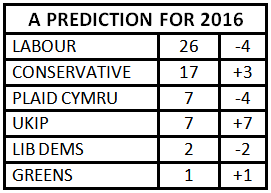
Looking at the bigger picture it would not be unreasonable to predict the following result for next year’s Assembly elections: Labour 26 seats (-4), Conservative 17 (+3), Ukip 7 (+7), Plaid Cymru 7 (-4), Lib Dems 2 (-2), Greens 1 (+1). Which would mean that to cobble together an administration Labour would need to go into coalition with Plaid Cymru, which is almost certainly what influenced Ms Wood’s rejection of a deal with the Tories. But this is so short-sighted.

Being a native of the Rhondda Ms Wood must know that throughout the Valleys (and indeed the south) there are tens and tens of thousands of people looking for a Prediction 2016viable alternative to Labour, that’s why they turned out last month and last year to vote Tory and Ukip in Caerffili, Merthyr, Blaenau Gwent and Islwyn, and in the process pushed Plaid Cymru down to fourth place. So why should anyone who doesn’t want Labour in power vote for the party that will keep Labour in power?

There may be another, even less charitable way of looking at this. Over the years I have consistently argued that the Labour Party relies on deprivation in Wales – and blaming the Tories for that deprivation – to keep people voting Labour. This means that Labour has no incentive to make Wales a wealthier country, and this then explains the obscene amounts of public funding wasted on Labour’s cronies in the Third Sector, so that they can make an industry out of deprivation and present their parasitism as a form of economic activity.

Could it be that Plaid Cymru, most definitely a begging bowl party, has taken this reasoning a step further? Have those at the highest, policy-making levels of the party calculated that if a poor Wales votes Labour, then a poorer Wales might swing towards Plaid Cymru? Don’t dismiss the suggestion out of hand; just ask yourself, what other hope has Plaid Cymru got of ever becoming a successful party? Well, of course, there is one, obvious route; Plaid could be a Welsh party, focusing on Welsh issues, from a Welsh perspective. But that option was rejected in favour of a slow, lingering death – for both nation and party – decades ago.

Last month I loaned Plaid Cymru my vote because I persuaded myself that doing so was a way of giving a proxy vote to the SNP, a party I respect greatly for confronting the Labour monster head-on, and slaying it. Compare that to what we now hear from Plaid Cymru – ‘A vote for us is a vote for Labour’. How do we explain the difference?begging bowl 1

I can’t help thinking that one explanation for ruling out any pact with the Tories may be Ms Wood’s desire to play to a foreign gallery. I’m thinking now of those Left-Green ‘progressive elements’ Plaid so assiduously courted a few months ago. If so, then it’s another reminder of how divorced from Wales and Welsh issues Plaid Cymru has become. By comparison, the Scottish National Party does not fashion its policies to appeal to audiences in Islington, or the offices of the Guardian newspaper . . . and certainly not Labour HQ!

But if Plaid Cymru wants to talk about poverty, then okay. Let’s talk about the poverty of ambition in the party that has the nerve to call itself The Party of Wales. While the SNP is leading the Scottish people to independence, Plaid Cymru’s ambition extends no further than begging a few more crumbs from England’s table and propping up Carwyn Jones and his gang of deadbeats. Almost fifty years after Gwynfor Evans won Carmarthen Plaid Cymru’s ambition today extends no further than acting as a crutch for the party of George Thomas and Neil Kinnock in a system of sham devolution. Now that’s poverty! And total failure.

Welsh NHS: Let’s Have Some Honesty

Yesterday the ‘Welsh’ Government announced that is has taken the troubled Betsi CadwaladrGwynedd SW Wards merged University Health Board into special measures. (The Tawel Fan scandal being the last straw.) Today we learnt that the chief executive, Trevor Purt, has been suspended. And yet . . . despite everything that has been said and written about the health service in Wales generally, and the northern part of the country in particular, there are a couple of issues, or contributing factors, that no one is willing to address. To explain what I’m referring to, I can do no better than quote a recently elected Tory MP, James Davies, now representing the Vale of Clwyd.

This is what the Daily Post had to say about him a month before the election, and here’s Dr Davies’ maiden speech in the House of Commons on June 2nd. The same two themes crop up in both pieces and also figured prominently in his election campaign; one is his concern over the state of the NHS in Wales and the second is the decline of Rhyl. The first of those he blames on the Labour regime down Cardiff docks, which is the easy way out and no more than we should expect from a Tory politician on the Costa Geriatrica. As for Rhyl, well, he doesn’t actually blame anyone, he just seems to believe, rather vaguely that, well, something should be done. Among his suggestions is a new Sun Centre. Of course, that’ll solve all the problems.

Being a GP, Dr Davies must be aware that one of the major reasons for the poor standard of health and other services in his area is the demands placed on those services by a) large numbers of elderly people moving into Wales and b) the white trash, problem families, drug addicts and other substance abusers, plus all manner of criminals, being dumped in the towns along our northern coast. Rhyl being the worst example. Dr Davies knows all this but he cannot say it because, as an England-worshipping Welsh UnionisAge, where bornt he is psychologically and emotionally incapable of viewing England as anything other than a paradise inhabited by superior beings with which Wales enjoys a one-sided relationship, with everything good that we enjoy emanating from England, and everything wrong with Wales our own fault. This is the Unionist mind-set (of both right and left), though it’s sad to see this self-loathing displayed in a seemingly intelligent man of just 35 years.

Which leaves James Davies in the position of wanting to discuss, and demand remedies for, problems for which he cannot admit major contributory causes. The Vale of Clwyd constituency is located in Denbighshire, where only 42.7% of the 65+ age group was born in Wales, yet we are asked to believe that the obvious influx of elderly people from outside of Wales has no impact whatsoever on the performance of the NHS locally. (In my area, less than one third of the 50+ age group is Welsh born! See map and table.) I’d hate to think that this inability to link cause and effect is indicative of how he works as a doctor. ‘Yes, Mr Smith, you’ve definitely got cirrhosis of the liver, but we’ll ignore your three bottles of whisky a day’. Much of Davies’ support would have come from elderly English voters angry at the standard of the local health service, but of course oblivious to the fact that their moving to Wales in such numbers contributes to the declining health service they’re complaining about. Nor can Doc Davies be honest about the reasons for the state of the NHS because he’s after the votes of those causing the problem! It’s altogether fitting that this flight from reality is taking place so close to where Alice in Wonderland was written.age, place of birth

But it’s not just James Davies who is unable to face the truth. It’s all the other politicians, and the media. With the latter doing its already tarnished reputation no good by tip-toeing around the elephant in the room. All terrified of speaking the truth for fear of making the front page of the Daily Mail or some other rag and being vilified as ‘racist’ or, what is much worse, ‘anti-English’. And fearing said rag going into overdrive with ‘ . . . veterans of Dunkirk . . . “the few” . . . Welsh all supported Hitler anyway . . . We’ll Meet Again . . . have to ask in Welsh to go to the toilet . . . fucking immigrants . . . fucking Jocks . . . good bloke, that Farage . . . blahdeblahdeblahdebritnatbollocks’.

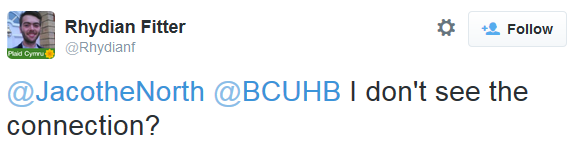
Last night I put out a few tweets on this subject which were well received, being favourited and retweeted. The one discordant voice belonged to a Plaidista named Rhydian Fitter, who seemed unable to make the connection between tens of thousands of elderly English people moving to our rural and coastal areas and deteriorating heath provision. “I don’t see the connection”, protested young Fitter. Of course not. As a loyal member of Plaid Cymru you must follow the party line that pretends the colonisation of Wales is notRhydian Fitter happening (and, er, if it is, then it’s a good thing), a line that is little different to that of Dr James Davies, and is also the line enforced by the Daily Mail. Let us hope and pray for Plaid Cymru’s demise to begin next May. Plaid Cymru has had nothing to say to Welsh people – as Welsh people – for over thirty years, you can’t run on empty for ever. If I thought it would help put Plaid out of its misery, I’d even consider voting Ukip . . . despite Nathan Gill.

To conclude, and here I make no apologies for repeating myself. People living in other parts of the country, particularly the south, may be tempted to think that the problem dealt with here is restricted to the rural north and west, because English people don’t retire to Merthyr or Newport. Don’t kid yourself! The ‘Welsh’ Government has a fixed amount to spend on the NHS and other services, when so much of that has to be diverted to the areas suffering the strain of the geriatric influx, or the dumping of undesirables, then clearly, there will be less to spend in Merthyr and Newport, Swansea and Cardiff. We are all paying for the refusal – of all concerned – to acknowledge one of the major factors contributing to the crisis overwhelming the Welsh NHS.

Labour: A Beast on its Last Legs?

I have decided to re-visit the May 7th General Election partly because I haven’t posted anything for over a week and partly because much has been said since I published my earlier analysis on the 11th.

A recent example would be what was said by Kim Howells, former MP for Pontypridd, on BBC Radio Wales’ Sunday Supplement programme on May 24th, arguing that Labour didn’t do as badly in Wales as in England because ” . . . people have greater trust in Carwyn Jones and the Welsh Assembly Government . . . “. Which is a strange thing to say. Not Kim Howellsleast because this was a UK General Election, in which Carwyn Jones and his team were sidelined. Even when we had the televised debate of Welsh party leaders Labour was represented by Owen Smith MP not Carwyn Jones AM.

Yet we are expected to believe that when Dai and Sharon Public went to vote each thought, ‘Yes, I know Miliband is a twonk, and the party is run by a metropolitan elite that doesn’t give a toss about people like me, but I shall still vote Labour because I am so impressed with Carl Sargeant, and Lesley Griffiths . . . and then there’s that Theodore Huckle – what a wonderful Counsel General! This argument is – as we political commentators are wont to say – a load of old bollocks.

Though if Howells is right, then it’s a hell of a put-down for the aforementioned Owen Smith and his parliamentary colleagues. And not without irony. For it means that Welsh Labour MPs escaped paying the price for their blind obedience to the metropolitan elite because of the “trust” people have in an Assembly many of them resent as a challenge to their position, an institution many of them do not wish to see attain any further powers.

Though if Howells really believes what he said maybe this chimes with a regularly repeated theory that says Labour in Wales has avoided the fate of its Caledonian comrades because it adapted better to devolution, with part of that adaptation being the development of a kind of ‘nationalism with a small n’ that puts some distance between the Labour Party in Wales and its bosses in London. The “clear red water” suggested by former First Minister Rhodri Morgan. Which if true, only reminds us again of the irony, even hypocrisy, attaching to the attitudes of Labour MPs from Wales.

Something else Kim Howells said was, “If we ever want to be back in government again, we need to win southern England”. This no doubt is the argument we’ve heard over and over since May 7th that says Labour must appeal to the ‘aspirational’. Yet Labour appealing to the aspirational / southern England puts it in direct competition with the Conservative Party, so where does that leave Labour’s traditional heartlands and supporters? And how does a Labour Party winning over voters in the Home Counties with promises of cuts in public services, and the privatisation of the NHS, win back Glasgow and Dundee? Come to that, what would such a party have to say to most Welsh voters? It can’t be done. It’s a circle that cannot be squared.

This is the nightmare scenario for Labour, the day of reckoning that was postponed by the razzmatazz and flim-flam of the Blair era. For almost a century, Labour relied on a unionised working class with a few idealists and romantics from further up the social ladder to smooth over the rough edges. A support base that rapidly declined in the closing decades of the twentieth century. What remains of the unionised working class is no longer umbilicaly tied to the party. The children and grandchildren of those long-gone miners, steelworkers, dockers, etc, either still vote Labour out of habit or, increasingly, don’t vote at all, or else are quite happy to give their votes to other parties.

The only obvious replacement for this lost support appears to be immigrants to the UK. But this is a poisoned chalice. For being supported by immigrants (and doing well in inner cities) allows the Tory media to accuse Labour of being ‘soft on immigration’ and of favouring ‘benefit scroungers’. And there just aren’t enough immigrants, nor a large enough ethnic minority population, for Labour to emulate the Democratic Party in the USA. (The dream of many Labourites.)

If Labour follows the advice that tells it to appeal to the aspirational and to woo southern England then it can kEluned Morganiss Scotland good-bye for ever, and it will haemorrhage support in traditional heartlands south of the border. In this scenario, Labour’s only hope of future success is to replace the Conservative Party by, effectively, becoming more Conservative than the Conservatives. But why should anyone who normally votes Tory consider voting Labour (with its history) even if it promises to deport all foreigners, sterilise the poor, and abolish all taxation?

Let’s go back to former communist and NUM official Kim Howells. He believes the party is in the “deepest crisis” he can remember. He went on, “If the Labour party doesn’t come up with fresh thinking, with some radical analysis of what’s going on in society and what people need out of society, it could well dwindle to a very small number of MPs.” Ed Miliband was “dull”, Labour’s next leader would need to be “much more radical” (while appealing to southern England?) Asked for her views, former MEP Baroness Eluned Morgan ‘admitted the party needed a “thorough rethink”‘ and went on to say that ‘the party needed to readdress the way it approached politics and the way it makes contact with society if it was to move forward successfully’.

Another giving evidence at the open and ongoing inquest was Gerald Holtham – ‘Who he?’, you cry . . . well Holtham is an economist, and regarded by many as one of Labour’s cleverest supporters. Just a few days before Howells and Morgan made their contributions Holtham weighed in with his analysis. It was full of dire warnings about relying on the “tribal” or “sentimental” vote, demanding that the party think hard “about real problems”, warning the party against a “sterile debate”, and then reassuring us that the public is not stupid. This presumably is the same public that we find in areas like Merthyr, Blaenau Gwent, Swansea East and other constituencies; the same public that has voted Labour for three or four generations and is now tempted to take a punt on Ukip. How could anyone possibly think such people are stupid!

Did you ever read such vacuous nonsense in your life? So many words that say nothing? That’s because Howells, Morgan and Holtham are lost, they don’t have a clue! They all have opinions on where Labour went wrong – expressed in cliches and sound bites – but no one has an answer to where Labour goes from here. When you realise what a mess the Labour party is in, you begin to understand why it was almost wiped out in Scotland. But you also begin to realise that it was only saved from worse results in Wales by Plaid Cymru‘s refusal to connect with Welsh voters.

Personally, I suspect that all three are looking to avoid being honest about the Labour Party’s lucky escape on May 7th, though Holtham goes some way towards acknowledging the troubling reality with his remarks about “tribal” and “sentimental” voters. For the way I see it, the Labour Party in Wales is like an old wildebeest, still managing to stay on its legs, and from a distance even looking healthy, but in truth surviving only because there is no predator around to finish it off. Scavengers have had a nip here and there, but ‘Welsh’ LGerald Holthamabour survives because there is no local cousin of the SNP lion to finish it off.

To repeat, Labour’s traditional support is gone and it can never be replaced. Tailoring the party’s message for different audiences – which is what Labour does – is doomed to fail in this age of 24-hour news coverage and social media. By comparison, the Conservative Party can put out the same message from Land’s End to John O’ Groats. (And the SNP the same message from the border to the Northern Isles.)

Here in Wales the Labour Party is in for more disappointment next May in the Assembly elections . . . despite the allure of Carwyn Jones and his cabinet of all the talents. Though the cracks will probably be papered over, and the inevitable delayed, through the “tribal” vote referred to by Holtham. Because with a Tory government in Westminster many of our unstupid Welsh electors will be persuaded to ignore everything wrong with Wales and ‘send a message to London’, again.

So don’t knock it, Holtham. Labour’s “tribal” vote is all that keeps Owen Smith and his gang in the comfort to which they have become so accustomed, and is the guarantee that your party stays top dog down Cardiff docks. Without it, the shadows encroach.

Election 2015: Plaid Cymru Fails, Again

What an incredible election it was, with the Scottish National Party winning 56 out of Scotland’s 59 seats! Without doubt the most amazing election I have watched unfold in some fifty years of following politics. Though partly because of that SNP landslide – plus the collapse of the Liberal Democrats and a swing to the Tories – we now have a Conservative and Unionist PPlaid Cymru 1arty government in London. But as the incoming government has only one MP in Scotland the SNP is already arguing it has no legitimacy to rule Scotland, so we appear to be heading for the constitutional crisis I predicted in my previous post.

Success for the national party was not replicated here in Wales, even with Plaid Cymru’s much more modest ambitions, for it hoped to hold on to its three seats (Arfon, Dwyfor Meirionnydd and Carmarthen East & Dinefwr) and gain anything up to three other seats (Llanelli, Ceredigion and Ynys Môn). In the event, everything stayed the same, and while Ynys Môn went to a recount the results in Llanelli and Ceredigion showed how unrealistic hopes in those areas were. This despite Plaid’s leader Leanne Wood getting more exposure on television, both in Wales and at UK level than any previous leader. But there’s nothing surprising in Plaid Cymru’s failure, for it’s a party that has worked itself into a position from which it just can’t win.

To begin with, Plaid Cymru has refused to challenge the strategy that is turning large parts of Wales into retirement and recreation areas for England – the strategy that (together with anti-Plaid tactical voting) has probably made Ceredigion now unwinnable at Westminster level – because to do so will bring down upon the party condemnation in the English (and ‘Welsh’) Plaid Cymru 2media. In the hope of justifying this wilful neglect of Welsh interests Plaid has to pretend that it can win the support of many of the immigrants, after all, they are now living in Wales so surely they want the best for Wales? No. They remain English, with some becoming more English after moving to Wales. And as Plaid’s candidate in Ceredigion told us, among them are out-and-out racists who see us Welsh as just another inferior people to be ridiculed and shouted at.

The corollary to this desperate desire to be liked (by people who are never going to like us anyway), is that Plaid Cymru has ignored the Welsh people in the areas being colonised. Plaid is now so concerned with avoiding any discussion of white flight, with not offending anyone except Ukip (work that out!), with getting pats on the head from Guardian readers, and with being courted by ‘progressive’ elements, within and without Wales, that it has abandoned it’s raison d’être of defending Welsh interests.

In our urban areas we see the managed decline of the Valleys and the region’s close-on one million people, now offered no better future than becoming dormitory communities for Cardiff. Yet despite a century of decline under Westminster rule, a century of Labour MPs, a century of Labour-controlled local authorities, and a Labour-controlled Notional Assembly for tPlaid Cymru 3he sixteen years of its existence, people in Blaenau Gwent still elected a Labour MP, and those who wanted an alternative to Labour found Ukip and the Tories more attractive than Plaid Cymru! It was the same in Merthyr Tydfil & Rhymney, where Ukip got twice the Plaid vote!

Can we explain this vote for Ukip by the presence of predatory hordes of Poles and Romanians in the Heads of the Valleys taking all the jobs? Or is it attributable to the retired English middle classes, sipping their whisky and sodas up at Dowlais golf club while ranting against Johnny Foreigner? Face it, if Plaid Cymru cannot appeal to voters in areas where just about everyone is Welsh-identifying then where, outside of the shrinking redoubts of the Welsh language, does it have any chance?

This is an incredible and self-destructive position for any political party to have worked itself into. To take for granted your rural heartlands, that are being overrun before your eyes (and in the process, destroying Welsh as a community language) yet, paradoxically, still manage to be rejected by most voters outside those heartlands because they view you as a party oPlaid Cymru 4nly concerned with the Welsh language! This is a party with no future.

Something else we learnt from this election (and the EU election last year) is that the myth of ‘Socialist Wales’ is dead. Wales may have been ‘socialist’ when most of us worked in heavy industry, but this should now be seen as the passing phase it was, with our fathers as victims of circumstance motivated by self-interest rather than ideological socialists. And now ‘Socialist Wales’ is gone. The only socialists left belong to 57 fringe groups . . . and Plaid Cymru. The Labour Party is no longer socialist, so why is Plaid Cymru still flogging this long-expired equine? The clarion call of socialism was rejected by those who voted Labour, and rejected even more emphatically by those who voted Tory and Ukip.

Let us look at one result from last Thursday in an area with which I am familiar. Admittedly the Gower constituency contains Mumbles and the eponymous peninsula, which are relatively affluent areas, but the bulk of the seat’s population is to be found in former industrial suburbs to the west and north of Swansea, towns and villages such as Waunarlwydd, Gowerton, Penclawdd, Gorseinon, Clydach, Pontarddulais. I’ve worked in Waunarlwydd, Gowerton and Clydach; I have sunk many a pint in Penclawdd, Gorseinon and ‘Y Bont’. That these thoroughly Welsh communities would be represented by a Tory MP would have been unthinkable thirty years ago. But it’s happened, because the world has moved on . . . but not Plaid Cymru.Plaid Cymru 5

How do we explain this self-destructive streak? I believe that at the core of Plaid Cymru there is an influential grouping that has beguiled others into rejecting what it chooses to term ‘narrow nationalism’, and persuaded the party to pursue a more ‘inclusive’ and ‘progressive’ agenda. Am I wrong? Just ask yourself, why was doing a deal with the Greens such a major issue in the run-up to the election? I read more about that than I did of any hopes and ambitions Plaid has for Wales. But a confident national party shouldn’t have to worry about the votes of a few thousand lifestyle migrants and hippies, very few of whom would vote for Plaid even if there was a joint candidate in their constituency. (An unsettling truth we first learnt from Mel Witherden, the Green-Plaid candidate for Monmouth back in 1992.)

Clearly, what ‘narrow nationalism’ means is focusing on Welsh issues, something that gives Plaid Cymru nightmares after the kicking given to Ieuan Wyn Jones by Glenys Kinnock on Question Time some years ago over l’affaire Seimon Glyn, Gwilym ab Ioan et al. But Plaid Cymru only operates in Wales, so not to focus on specifically Welsh issues is perverse. Attempts then have to be made to disguise this bizarre strategy by desperately trying to put a ‘Welsh interpretation’ on issues or concerns that emanate from outside of Wales. Hugging Nicola Sturgeon and the Green woman is great television, being ‘anti-austerity’ is a good slogan, but at the end of the day it’s just idle posturing. Being ‘anti-austerity’ is attractive to Plaid because it’s a cross-border issue allowing it to line up with other ‘progressives’ while avoiding Welsh issues. (I hate that fucking word, and the smug, self-satisfied superiority it conveys. ‘Ooo, look at me, Plaid Question markI’m “progressive”, but you’re not’. Maybe those who find the word so attractive should be reminded that it was much-loved by Joe Stalin.)

If I’m wrong about these machinations then someone needs to explain how a political party whose raison d’être is Wales and Welshness consistently refuses to defend Welsh interests. I ask because it doesn’t matter how many Mike Parkers the party attracts the vast majority of English people in Wales – ‘progressive’ or not – are never, ever going to vote for Plaid Cymru. The party’s votes will only ever come from Welsh people, and until the party acknowledges this inescapable truth, and becomes brave enough to speak out for Welsh people, and to take the flak that an anti-colonialist programme will draw, then Plaid Cymru will remain as popular as a pork butcher in Jerusalem.

Thoughts on Election Day 2015

I have, reluctantly, voted for Plaid Cymru. I did so because I want to show my support for the Scottish National Party and its mission to destroy this increasingly ugly construct called the Union. A ‘Union’ that was never anything other than England’s mini-empire in these islands but which, in recent decades, has corrupted further into a fiefdom of the City of London that now treats large parts of England herself as backward provinces to be ruled over by those who know best.

I made this decision because even though my views on Plaid Cymru have not changed since writing Plaid Cymru: Ninety Wasted Years this election is all about Scotland and maintaining the Union. Why else would we be hearing of the possibility of a Conservative-Labour coalition? Why else would the tabloids be running front pages in their Scottish editions that simper, ‘WE LOVE YOU, PLEASE STAY!’ while their editions south of the border pander to English nationalism with ‘FUCK OFF YOU SCOTCH BASTARDS!!!!’ (Maybe I exaggerate slightly.)

The reasoning that led me to vote Plaid today was summed up in a tweet I put out earlier, and the sentence with which I ended that tweet can be explained thus. Plaid Cymru contains many ‘pragmatists’, and others whose loyalty to Wales I question. These people will lose sight of the bigger picture to accept a few more crumbs, and at the back of their minds will be the possibility of again serving as Labour’s little helper after next year’s Assembly elections. If crumbs and coalitions come into play then it could transpire that Plaid Cymru will do the dirty on the SNP.

Plaid tweet

Why do I say that this election is all about Scotland? Well, to begin with, tell me what’s happening anywhere else that isn’t influenced by what’s happening in Scotland. Or just ask yourself, why is Labour unlikely to win a majority? It’s because of the seats it’s predicted to lose in Scotland to the SNP. Why are we even talking of a Conservative-Labour coalition of National Unity? it’s because of the threat posed to ‘national’ unity by the SNP. And of course the fact that these traditional enemies are contemplating coalition tells us that there are no longer any ideological differences between them, preserving the Union is the only game in town.

After being in Scotland last September for the independence referendum I wrote a few posts on Scotland, and in Beginning of the End on September 23rd, I wrote, “Scottish independence is guaranteed within a decade, and it probably won’t need a referendum“. Nothing has happened since to make me change my mind. We are entering the most turbulent period in the constitutional history of the United Kingdom since the partition of Ireland in 1920. The next few years will witness the slow, possibly messy, unravelling of the Union, and it will come about because of what is happening in Scotland . . . and the reaction to it in England, and not just from the politicians.

I am confident that five years from now we Welsh will be living under a very different constitutional settlement. How different that settlement is will depend on many factors, not least how Plaid Cymru plays its hand. To lose sight of the bigger picture, or to suffer a loss of nerve, would be catastrophic. Yes, to some extent Plaid Cymru must ride the SNP’s coat-tails, but the next few years will offer the chance of establishing a system in Wales that finally serves Welsh interests.

To throw all that away for crumbs and coalitions, and not to hold out for the bigger prize – as I fear Plaid Cymru will do – tells our masters that we Welsh, as ever, will settle for less, and they will treat us accordingly. So my message to Plaid Cymru is . . .

STICK WITH THE SNP! BREAK THE UNION!

UPDATE 08.05.2015: The election results from Scotland, with the SNP winning 56 out of 59 seats, means that constitutional change is now inevitable. The problem for us is that the abysmal failure of Plaid Cymru might mean that many in London will conclude that Wales is ‘safe’. The best hope may be that the new Tory government makes an issue of ‘reforming how the UK is run’ (including ‘English votes for English laws’) to avoid being seen as capitulating to the SNP.

Mike Parker and Huw ‘Tipp-Ex’ Thomas in Full Agreement

Thus far, this has been a stultifying election campaign enlivened only by the glorious promise of the SNP destroying the Labour Party in Scotland and then regaining Scotland’s independence. Here in Wales independence is a dream shared by only a few, so we are reduced to taking solace in sideshows and distractions, with explains why I’m reporting here on the two curious incidents, or the two-act farce, in Ceredigion.

First there was the disgraceful smear against Plaid candidate Mike Parker mounted (or fronted) by the Cambrian News, a rag with a long-standing policy of publishing anonymous or fake anti-Welsh letters and, in my area, serving as a mouthpiece for lodge and golf club to rail against ‘the council’ (code for Plaid Cymru) ‘neglecting’ south Meirionnydd. Complaints from men who argue for smaller local authorities on the groundCambrian News Naziss that these would be more ‘democratic’ when what they really want are councils run by . . . well, men like them, handing out planning permissions willy-nilly to each other’s friends and families.

I have no wish to deal with the Cambrian News at any length, so let me try to explain it briefly for anyone unfamiliar with the tale. Mike Parker, the Plaid Cymru candidate in Ceredigion, is an Englishman who, some fifteen years ago, wrote a book in which he said that a number of the English who move to Wales are white flight racists. This suggestion would encourage much head-nodding among the Cambrian News‘ readership so, in order to damage Parker, the story had to be spiced up to the point where the headline screamed: ‘Incomers are ‘Nazis’, says would-be MP’. Clearly implying that Mike Parker is an intolerant, if not unhinged, individual who believes that all English people moving to Wales are followers of Adolf Hitler.

The fact that Mike Parker never even used the term ‘Nazi’ was irrelevant. The use of it by the Cambrian News and others has been justified on the grounds that ‘this is what Parker meant’, or, ‘there can be no other interpretation of Parker’s reference to “Final Solution crackpots”‘. Both wrong. First, attacking someone for what they have written is one thing, but once people start guessing what writers meant, then accusers are on very shaky legal ground. Second, if you read what Mike Parker wrote in Planet in 2001, especially his comparison of rural Wales with those western states of the USA that attract anti-federal government militias, it becomes obvious that the full sentence “To some extent, rural Wales has become the British equivalent of the American mountains (that are) inhabited by a sprinkling of paranoid conspiracy theorists, gun-toting Final Solution crackpots and anti-government obsessives” can only be referring to the USA. (My parenthesis.) Mike Parker is definitely not saying that rural Wales contains small armies of English nutters living in encampments and stockades. Which fatally undermines the excuse given for the use of ‘Nazis’.

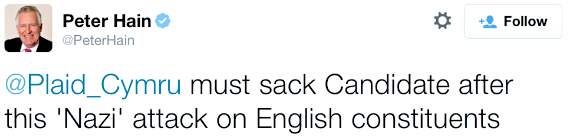
The chorus of outrage and condemnation inevitably contained Labour voices. Among them was the dulcet tenor of Peter ‘the Great’ Hain, who repeated the word ‘Nazi’. Alistair Campbell, Tony Blair’s propaganda chief also joined in, before recanting. One contribution came from Parker’s Labour rival, Huw Thomas, a councillor in Cardiff but originally from Ceredigion. Young Huw was outraged by the alleged anti-English sentiment expressed by Parker (himself English, remember!). He fulminated, “These outrageous and deeply offensiveHain Parker tweet remarks are exactly the sort of poisonous rhetoric you’d expect from Ukip, not a party that claims to be progressive and left wing. There should be no place in our politics or our society for such divisive and hateful language. As a Cardi to my core, I’m proud that Wales and Ceredigion have a history of welcoming people from across this island and across the world. These comments are totally at odds with the Ceredigion I know and love.”All good stuff, though I’d recommend that Huw Thomas downplays the “Cardi to my core” bit, Labour’s supporters in Aber Uni and elsewhere might not like being reminded that their candidate is one of the natives.

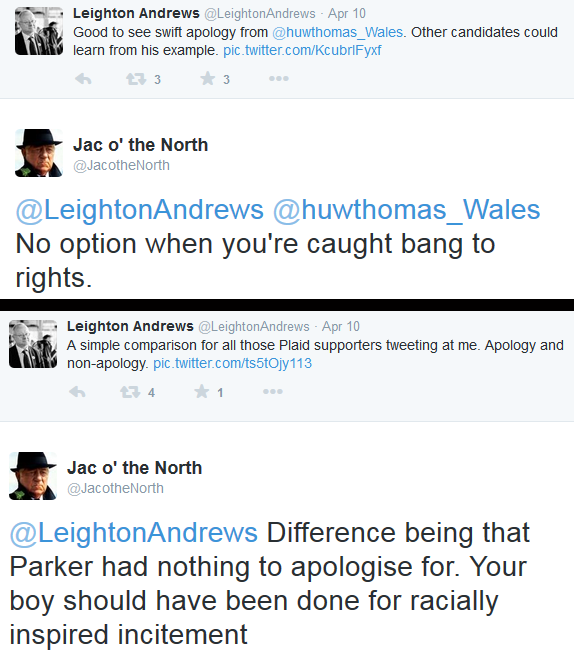
While all this was going on that Greek bloke Hu Bris must have been lurking close by, hand cupped to his shell-like because, within days, it was Labour’s turn to squirm as the election in Ceredigion took a bizarre twist with revelations about the saintly and ‘welcoming’ Huw Thomas. It came to light that Huw had, during the 2006 World Cup, been much vexed by the proliferation in Ceredigion of cars flaunting England flags. His answer to the problem, aired on a Welsh language website, was to use Tipp-Ex correcting fluid to mimic “bird poo”! (Yes, I know, very weird.) Thomas was forced to admit his silliness, but rather than leave it at that Labour luminaries rallied around, trying to turn this minor disaster in an unwinnable seat into a national triumph, arguing that this was how aAndrews Tipp-Exn apology should be made – in contrast to the unashamedly unapologetic Mike Parker! The Labour Assembly Member for the Rhondda, Leighton Andrews, made himself look really stupid with a couple of tweets to which I couldn’t resist replying. (Click to enlarge.) Now I’m blocked from Porky’s Twitter account as well. These Labour politicos are so sensitive!

What a to-do, eh, boys and girls! So have we learnt anything from all this thud and blunder? Well, if nothing else, the Cambrian News has told us what a disgusting, anti-Welsh rag it is, and why it should be boycotted. BBC Wales, whose newsreaders can’t be bothered to properly pronounce Welsh place names, reminded us that, just like the Secretary of State for Wales, it is the voice of London in Wales. But for me, the real lesson is that when we clear away the party politicking, the posturing and the propaganda it becomes obvious that Parker and Thomas were in fact dealing with the same problem, and agreeing. That this important fact will be ignored by the ‘Welsh’ media tells us all we need to know about its colonial nature.

Mike Parker was saying that there are some very ugly specimens among the English in rural Wales, racists, bigots, and “Little Englanders”. Talking of the England flags that so irked him, Huw Thomas wrote, “It truly shows the degree our society has been infiltrated by incomers who are not ready to integrate. Very often, from what I see, some flying English flags are young people, who have been brought up in Wales, but who are loyal to England”. Elsewhere Thomas refers to such people as “chavs” and “casual racists”. Both men are talking about the influx into rural Wales of people for whom Wales is just a western extension of England, some enlarged Cornwall with even ‘funnier’ names.

What’s more, the English colon isn’t a demon conjured up by Parker and Thomas, for he’s introduced himself to others, as this account by Martin Shipton in the Western Mail makes clear, ‘Like Mr Parker, I was once approached in a pub in rural Wales by an Englishman whose opening conversational gambit was: “Isn’t it great here without any f****** P****?”’ And if you’re the type of English person who is intolerant of other identities, then Welsh is just another non-English identity. The mistake that’s been made – especially by the professional ‘anti-fascists’ of the Left – has been to focus on Nick Griffin and other high-profile individuals – but they were never the problem! (Here’s Shipton’s piece on the Thomas revelation.)

So Mike Parker and Huw Thomas were both talking honestly of English colonisation. That taboo subject that will draw accusations of ‘racism’ against anyone who dares raise it. Making it almost a contemporary Welsh version of The Emperor’s New Clothes . . . but in this version the small boy who blurts out the truth gets run through with a pike. The fact that ‘racism’ has been used so consistently and over such a long period should make it obvious that those behind this tactic will not be found in the offices of local weekly rags, or at BBC ‘Wales’. This denial of rational debate is UK State policy, as is English colonisation itself.

Ignored Constituencies and Zombie Parties

Many people will hate me for saying this, but political parties of the Right are invariably more honest, and therefore more ‘comfortable’, with their supporters than parties of the Left. The reason for this is that they appeal to perfectly natural human sentiments such as patriotism, family, Mom’s apple pie, or even baser impulses such as prejudice and greed. Whereas parties of the Left pretend – even delude themselves – that their voters are motivated solely by the desire for a nicer, fairer world, where the sun shines all day and we’re all nice to each other, when the truth is that those who vote for them are motivated by the same self-interest as the most venal, cigar-smoking capitalist.

Or am I exaggerating? Well, consider this: Throughout history there has been opposition to organised religion, monarchy, the military, landowners, the aristocracy, industrialists, the bourgeoise, etc., not because of any deep moral or philosophical objections but simply because malcontents believed such institutions and groups disadvantaged them. What I suppose could be described as a combination of envy and greed, which some would argue is the true basis of socialism.

Occasionally this resentment flared up in events such as England’s Peasants’ Revolt of 1381 which, despite the best efforts of historians in subsequent centuries to portray it as such, was not a mass movement with a coherent ideology and long term plans for a better society . . . it was simply a spontaneous rising of people motivated by anger and envy. In subsequent centuries, such episodes of unrest played into the hands of radical groups and political parties using these waves of popular discontent for their own ends. France would certainly have seen disturbances towards the end of the eighteenth century, but these would not have amounted to the French Revolution had there not been clever and ruthless men on hand to exploit the public mood and reshape France.Decembrists

In the following century Russia knew her movements for liberalisation, all of which failed. Some were glorious failures, none more so than that of the young officers who made up the Decembrists. Others were almost farcical. I particularly enjoyed reading many years ago of the Narodniki of the 1860s and ’70s and their ‘Going to the People’, which meant moving to the countryside in order to educate the peasants and help them in their struggles against the kulaks and other oppressors. The conservative peasants were so terrified by these young idealists that they couldn’t hand them in to the tsarist authorities quick enough.

The problem in nineteenth-century Russia and elsewhere was that the radical intellectuals of the aristocracy and the middle-class might eulogise and idealise the peasants and the workers but they had absolutely nothing in common with them, which usually resulted in suspicion and hostility from those they were trying to help. Little changed when Lenin and his gang came to power. There was a massive disconnect between the underdogs and those who saw it as their mission to help make the world a better place, either for, or at least in the name of, said underdogs.

By comparison, those defending privilege and the established order almost always belonged to the class whose interests they defended. More than that, they also appealed to the aspirational, those with a foot or two on the ladder. And never forget that those who defended the status quo also had an audience among the poor, perhaps those of a religious bent, or others who saw the rabble-rousers as harbingers of chaos.

Within my lifetime, in the USA, I can recall the Democrats cobbling together ‘rainbow alliances’ of disparate groups that had nothing in common other than not being Republican, while, on the other hand, the GOP represented an almost homogenous interest of the prosperous, the relatively satisfied, the patriotic, the religious and others who were reasonably happy with America the way it was. Both may have involved a degree of consensus but one didn’t need to be a great psephologist to predict which was the more likely to fall apart.

*

This gulf between the underprivileged and those who sought to speak for them has, at its best, been a kind of distant paternalism; at its worst, it has resulted in oppressive systems operated by fanatics in the name of those they very often despised. This has something to do with the fact that radical and anti-establishment parties can never entirely trust their constituencies. External enemies threatening war, or a rise in their living standards, could send the ‘oppressed masses’ flocking to the opposition. By comparison, the Right has always been able to trust its supporters.

Which meant that while the Right represented a coherent ideological continuum, from the richest in the land to the poorest patriot or the widow crossing herself before a picture of the tsar, the self-appointed saviours of the downtrodden always struggled to find common ground with those they spoke for. As the Narodniki and others found this can be very frustrating, tFarage bogeymeno the point where educated and motivated radicals look at those they’re trying to help, and ask, ‘Is it worth it?’ . . . before pulling themselves together and remembering that these drunken, slobbering, superstitious oaves are their hope of power.

This gulf was almost unbridgeable in tsarist Russia, and it’s still there in today’s Western democracies. With a small number of exceptions the modern UK Labour Party is made up of middle-class people and professional politicians, that is, those who studied politics in university then went on to become political assistants – perhaps doubling up as councillors – before making the logical step up to becoming an MP. How do these really feel about beer-swilling, Sun-reading, Reality-TV-obsessed Labour supporters who think Jim Davidson is a great comedian? The truth is that many Labour politicians would sympathise with the Narodniki who came to loathe the peasants who handed them in to the police.

But ‘Ah!’, you say, ‘what about those Old Etonians running the UK government, aren’t they out of touch?’. Out of touch with whom? Certainly not with their friends and relatives in the City, nor with the great English middle class, nor with those lower down the pecking order who feel it’s perfectly natural to be ruled by toffs. Consequently there is no great disconnect between Cameron, Osborne et al and those who support them.

Yet this disconnect on the Left goes a long way to explaining Labour’s fear and loathing for Ukip, and Nigel Farage in particular. The rise of Ukip has exposed another fundamental truth I touched on earlier – many people vote Labour out of pure self-interest, believing that Labour in government will raise wages and benefits, lower taxes and do all manner of things to benefit them. Altruism and a better world have nothing to do with it. As I said in a recent post. ” . . . your average working class, Labour-voting, tabloid-reader is very often a conservative and even a racist. Not a violent, Hitler-worshipping nutter, but a person who undemonstratively shares almost all the prejudices of the far Right. The identikit Ukip voter (as the May Euro-elections showed). We all know them. We work with them, we talk with them down the pub.”

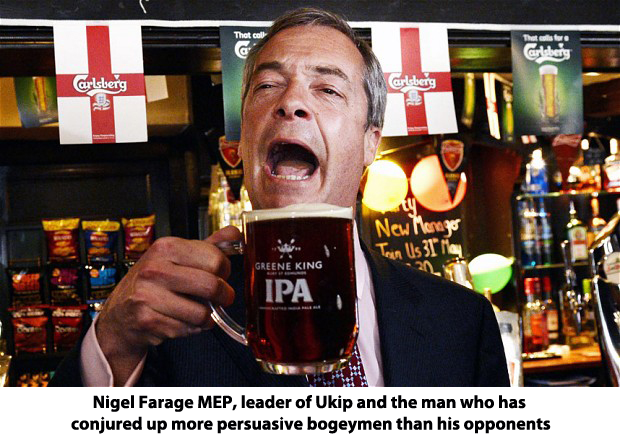
What Labour – and socialists in general – will not admit is that Ukip has out-bogeymanned them. Whereas Labour has traditionally scapegoated capitalism, the banks, international finance, etc., Ukip has come along and said ‘No, no, the real problem, the reason you’re having a hard time, is “Europe” and immigrants’. What makes it worse for Labour is that during the Blair – Brown ( – Mandelson) years Labour got as close to big business and international finance as the Tories, so the traditional bogeymen can no longer be attacked.

*

Due to the reckless behaviour of these traditional but now inviolate bogeymen the Western world has just gone through – or may still be experiencing – the worst Recession since the Wall Street Crash of 1929, the UK has a national debt of 1.4 trillion pounds, the Chancellor’s autumn statement last week will lead to public service cuts on a ‘colossal scale‘. . . so where are the massive protest marches behind the banners of socialism? One answer lies in the preceding paragraph. In addition to believing in Ukip’s ‘bogeymen’ we alse see an illustration of what I said in my opening paragraph: “parties of the Right pander to perfectly natural human sentiments such as prejudice and greed”, and gain the rewards.

What of Wales? Surely here, in this fastness of fraternity, this citadel of comradeship, this bastion of brotherhood, this . . . (ah, bugger it!). Surely here socialism still courses through the veins of our people, the Internationale still rings out at the end of ballet performances in the local Institute? Well . . . no. The truth is that in the most recent elections in May Ukip, with 27.6% of the vote, came damn close to beating Labour, on 28.1%. But of course Labour isn’t the only socialist party in Wales, we also have Plaid Cymru (15.3%), which is probably more socialist than Labour, and still moving Left. I don’t wish to be too cruel, but from where I’m sitting, becoming more ardently socialist in 2014 is the political equivalent of buying Confederate Bonds in 1865, or seeking a title in 1788 France.

Having turned its back on the Welsh people and given up almost all hope of success Plaid Cymru is now desperately looking for allies among other ‘progressive’ elements’. (Don’t you just love the labels these Lefties attach to themselves!) This of course is in addition to its long-standing policy of not jeopardising any future coaltion by being too hard on Labour. The ones being courted most assiduously, and unwisely, at the moment are the Greens.

This I have dealt with in a number of recent posts, Plaid Cymru and the Green Party of Englandandwales and More on the Green Party of Englandandwales. From reading assorted blogs and other sources I have picked up on references to a proposed eco-socialist alliance which seems to be welcomed by Plaid Cymru luminaries going out of their way to assure English Greens in Wales that Plaid has nothing to do with nationalism (scroll down to comments). Which must raise the question: What is Plaid Cymru for if not for defending and representing Welsh nationhood, this being my understanding of nationalism? I can see why such an anti-colonialist stance might offend those of a colon disposition, but not why Plaid Cymu candidates should have to pander to such susceptibilities.

I have asked it before and I make no apology for asking it again “How can a Welsh political party be in existence for ninety years without realising that its greatest – perhaps its only – selling point is its Welshness? Blame England! – play on Welsh grievances! – stir the passiChyba Bartolottions! – reap the rewards! Better to do that and fail than be a bunch of mealy-mouthed compromisers satisfied with crumbs.”

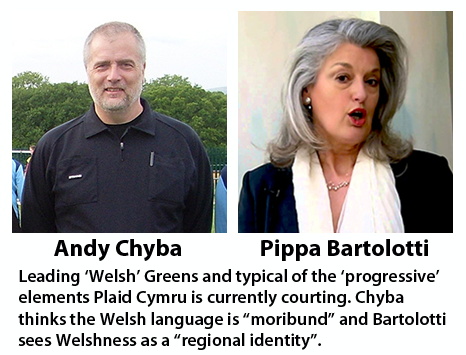
But, no, Plaid Cymru has refused to be a truly Welsh party for fear of alienating those ‘progressive elements’ with which it is so keen to form alliances. People like Pippa Bartolotti of the Green Party of Englandandwales who regards Welshness as a “regional identity”, she of the checquered past and the recent anti-Nato fiasco in Newport. Or maybe the spotlight will fall on Andy Chyba, who believes the Welsh language is “moribund”. The more one looks at some of these people Plaid Cymru wants to get into bed with the more one can see that they may indeed be progressive in their attitudes to logging in the Amazon and similar issues, but when it comes to Wales and Welshness their attitudes are most definitely nineteenth century and Rule Britannia.

As things stand, Plaid Cymru is of more use to the British system than it is to the Welsh people. All it does is fill the space that should be taken up by a nationalist party. Plaid Cymru mistakes being ignored (due to its impotence) as evidence of its ‘respectability’ (of paramount importance to a certain Welsh mind-set). Plaid Cymru’s taken-for-granted heartlands are being lost due to the colonisation Plaid Cymru is afraid to speak out about; the party has never connected with the anglophone Welsh; yet now it believes it can increase its appeal by linking up with colonialist-minded Greens and other oddballs! This goes beyond wishful thinking, this is self-deluding bollocks.

I hope that Plaid Cymru and its ‘progressive’ allies fail to get a single MP next year and suffer badly in the Assembly elections of 2016 because that’s what they deserve. More importantly, it’s what Wales deserves. Plaid Cymru today is little more than a ‘zombie’ party; not quite dead, but incapable of making any meaningful contribution to the life of Wales. Only when it becomes obvious to everyone that Plaid Cymru is finally dead can Wales start making any real progress.

More On The Green Party Of Englandandwales

This time last week I didn’t know a lot about the Green Party, its leading personalities and its internal workings, this week I know a little more; enough to know that Plaid Cymru would be making a big mistake to go into any form of electoral pact with the Green Party.

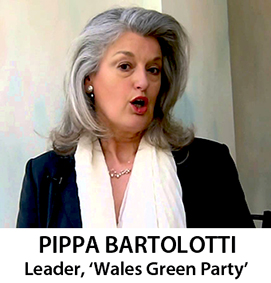
Let’s start by trying to establish exactly what we are dealing with: is there a separate Wales Green Party (as we are being asked to believe), or do we have just a regional branch of the Green Party of Englandandwales? I believe the answer is definitely the latter. And even if there were a separate body, note how it calls itself the ‘Wales Green Party’, not the Welsh Green Party. Compare that with the Scottish Green Party, which is completely independent of the GPE. This is more than just semantics, for the Scottish Green Party is composed overwhelmingly of Scottish people and supports Scottish independence, but what we have in Wales is mainly English people belonging to an essentially English party.

The evidence for the status of the local Green structure comes from the ‘Wales Green Party’ itself. The party’s candidate in the Uplands by-election in Swansea is Ashley Wakeling (or possibly Ŵakeling) and he made the comment below to my previous post. Now if there is a separate Wales Green Party how the hell is it supposed to operate without a leader? On the other hand, it makes perfect sense if there is no separate Wales Green Party.

Wakeling 'no leader'

The leadership contest referred to, between current leader Pippa Bartolotti and challenger Andy Chyba, will be dealt with later; although I found it odd, and contradictory, that Wakeling should argue that the Greens in Wales need no leader and yet in the same paragraph call for the re-opening of nominatiions!

What became obvious with the many comments made to my previous post is that the ‘Wales Green Party’, perhaps the environmentalist movement more generally, is in a constant state of conflict, riven with personality cults, rival camps and back-biting on a scale I thought had departed with New Labour. Far from being the kind of tension and conflict admired by Harry Lime, from which great things emerge, this appears to be just a bunch of political no-hopers slagging each other off and hampering what little chance there ever was of Green politics having an impact on Wales. I say ‘appears to be’ for there may be more to this than meets the eye.quorate

To bring you up to date, here’s the Green Dragon website report on the Wales Green Party Conference 2014, held last Saturday in Merthyr. I’m referring you to the Green Dragon site because at the time of writing this the official Wales Green Party website hadn’t caught up with its own AGM. According to former Green Anne Greagsby ‘Green Dragon’ is Martyn Shrewsbury of Swansea. Ms Greagsby also alleges that the AGM was not quorate. Another complaining about Green Dragon and the general running of the Green Party in Wales is respected environmentalist Max Wallis. And from other quarters I hear of censorship, stitched-up elections and other practices that suggest the Greens are after the ‘tankie’ vote.

But let us turn to the rivetting leadership contest between Pippa Bartolotti and Andy Chyba. Who are they? Well, it should go without saying that both have come to us from England, though Ms Bartolotti obviously has an Italian surname and claims a Jewish grandfather; whereas Chyba’s ancestry is uncertain.

*

Pippa Bartolotti is on record as dismissing the Welsh language as belonging to a “regional identity”, before reminding us that there are far more important things to worry about . . . perhaps finding a decent coiffeur. As regards the status of the so-called Wales Green Party she tends toBartolotti 20,000 members give the game away with this entry from her ‘News’ section (click to enlarge). The ‘We’ quite obviously refers to the Green Party of Englandandwales.

As for “the young man from Cardiff”, I have no idea what she had planned for him, I can only hope that he enjoyed it and has now recovered. In fact, the siren-like and Jaguar-driving Ms Bartolotti may have a thing about young men, for in another entry she admits to chatting up a young man on a train! (This spoof website may be of interest.)

The problem many GreenPippa Bartolottis have with Ms Bartolotti is her somewhat ‘hazy’ background, with periods in the security business and years unaccounted for. There may also be a more general question over her honesty. For example, she has claimed to have started companies – Encrypta Electronics being one – yet it was her ex-husband and his father who started both Encrypta (1985) and Enigma (1986). Encrypta had links with the Atomic Weapons Research Establishment at Aldermaston, and one of its sub-contractors was AB Connectors of Abercynon, which might explain why in 1997 she was recruited on a part-time basis by the Welsh Development Agency. In 2004 she is said to have represented Encrypta at a security conference in Las Vegas. Among those present was a Lt. Col. Oliver North of Iran-Contra fame.

But, then, for no apparent reason, she gave up the life of business to go on a world tour . . . though where exactly she went, who she met, and what she did, is another source of mystery. According to the Swansea Action for Palestine website Ms Bartolotti lived in Israel for 7 years, which might make sense, given her Jewish grandfather. Though elsewhere she claims to have spent time in India, Cuba and other places which would have made it impossible for her to have spent all seven of her years away in Israel. But anyway, let’s stick with Israel. Here’s a link to a bizarre bit of film showing her making a fuss at Tel Aviv airport, it’s connected with this escapade. Though some ask why Bartolotti was the only one out a group of 40 people allowed through unmolested by Israeli customs, and whether realising her isolation made her cause the scene.

Let’s end on a lighter note. Here’s a link to Come Dine with Me starring the irrepressible Ms Bartolotti. (To view this gem you may need a 4oD player installed.) Shalom!

*

Now we turn to Andy Chyba, who was to have been the Green’s lead candidate in Wales for the May European elections. Then he withdrew and urged Greens to support Plaid Cymru! Despite this support for Plaid Cymru Chyba regards Welsh as a “moribundChyba resigns language” and in his resignation piece repeats that he has “no time for the Welsh language”!Andy Chyba

I urge you to read Chyba’s resignation piece, for in it he also admits that he does not want to see an ‘autonomous’ Green party in Wales (as exists in Scotland and Northern Ireland) while conceding that the current set-up of the GPE in Wales is never going to take off. It all sounds very confused, or confusing.

These thoughts were in my mind when I received a Facebook message today from someone offering more information on Chyba. (Addressed to ‘Mr North’!) Suggesting, specifically, that Chyba has a background in the military or the police, and may be operating as a spy. Whether or not there is any truth in these allegations, I still find it intriguing that Chyba’s Wikipedia page was pulled last Friday, when my previous post was receiving so many hits and comments from Greens.

*

So we have two contenders for the leadership of something calling itself the Green Party of Wales that is in reality nothing but a regional branch of the Green Party of Englandandwales and both are accused of being tools of the security services. With the accusations against Chyba being perhaps nothing more than retaliation on the part of Bartolotti’s supporters for the aspersions cast against their gal. Should we give these allegations any credence? I think so. Let us consider the bigger picture, from a different perspective.

As I have remarked in a number of recent posts, in the eyes of an increasing number of people Westminster politics is discredited, with voters looking for alternatives to the Conservatives, Labour and the Liberal Democrats. In Scotland there is an obvious alternative to the Westminster bawbags in the form of the SNP, which threatens to wipe out Labour, the only party that can maintain the Union. South of the border many in England (and quite a few in Wales) are turning to Ukip. The publicity achieved by the SNP and Ukip can sometimes make us overlook the Greens, who already have one MP and could have a couple more after next year’s General Election.

Alex Salmond has said that he may stand for Westminster next year, and he has already posited the scenario in which the SNP and its allies hold the balance of power. So who will be the SNP’s allies? Well, Plaid Cymru, obviously, but also the Greens. Which makes the Greens of increasing interest to the security services. And how better to gain entry to the higher councils of a party with perhaps 20,000 members than by controlling the leadership election of a ramshackle branch with just a few hundred members, many of whom – as a result of carefully engineered schisms – are disbarred or discouraged from voting? It’s what I’d do if I was a spook. Always go for the weakest link to provide the entry point.

Green Party status

Plaid Cymru would be mad to go into any electoral pact with the Green Party of Englandandwales, either nationally or on a constituency by constituency basis. There is nothing in such a pact for Plaid Cymru because the Greens have nothing to offer, and when views like Bartolotti’s and Chyba’s on the Welsh language become known they can only lose Plaid Cymru votes. Worse, if some of the allegations levelled are correct, then there may be more to Bartolotti and / or Chyba than meets the eye. Even if both are ‘clean’, there is still the worry that there are those who realise the Green brand is not selling in Wales, and now view Plaid Cymru as the best stall from which to promote their wares. Plaid activists should think long and hard about accepting this trojan horse, and don’t leave the decision to your ‘leaders’. They’ve already let you down too often.

Plaid Cymru and the Green Party of Englandandwales

As I informed you in MBrig Oubridge 1ay, I have broken with the habit of a lifetime and stopped voting for Plaid Cymru, a party I ceased to believe in decades ago. One of the reasons for my losing faith in Plaid Cymru was its infatuation with the Green Party, and its desire to cover Wales with wind turbines (a position from which it has now retreated). So, as you might guess, among the parties I shall definitely not be voting for in future is the Green Party of Englandandwales. I’m dealing with this subject now because there is talk of another electoral pact between Plaid Cymru and the Greens.

Plaid began to get seriously enamoured of the Earth-botherers back in the late 1980s, which was almost certainly connected with the fact that at the June 1989 European elections the Green Party (formerly known as the Ecology Party) gained 99,546 votes in Wales, 11.1% of the total votes cast, and a massive increase of 10.9% on the party’s performance in 1984. In fact, the Green’s total vote was not far behind Plaid Cymru’s 115,062. Someone in Plaid Cymru who could do big sums calculated that if the two numbers were combined then the result would be, well . . . a big number. That’s my take on it, but Cynog Dafis would have us beleve that the links between Plaid Cymru and the environmental lobby go back further, as he explains in Plaid Cymru and the Greens: Flash in the Pan or a Lesson for the Future? which I advise you to read, as I shall refer to it later, and also because I get a mention! (Did I really say that!)

*

The first test of this love-in came at the 1991 Monmouth by-election following the death of Sir John Stradling Thomas when Mel Witherden stood as a Plaid / Green candidate. He came fifth, with 277 votes, behind the Monster Raving Loony Party. Admittedly, Monmouth is not ferile ground for Plaid, but the Plaid candidate at the 1987 General Election got 363 votes. (There was no Green candidate in 1987.) In the 1992 general election Witherden stood again, this time winning 431 votes, an improvement of sorts. Though the real significance of Monmouth was what the candidate said some time later. In essence, Witherden confessed that many Greens refused to vote for a joint candidate because, quite frankly, they were anti-Welsh, and displayed crude, colonialist attitudes. Which was no more than many nationalists suspected, and for which some of us had clear evidence. Damning proof of Green attitudes from a Green Party member.

The sort of attitudes Cynog Dafis was to learn about the hard way. In the paper linked to above he talks of meeting leading Greens from Arfon and Meirion, John Nicholson and Chris Busby, who were outraged that community councils in Gwynedd conducted their business in Welsh (which presumaChrisBusbybly prevented them from taking over the meetings), and that their kids were being taught Welsh in schools. Dafis says, “I tried to respond, rather lamely, and through rational defence rather than counter-attack, but I came from the meeting feeling quite shaken”. Rarely does one come across a passage from a leading Plaidista that so perfectly sums up Plaid Cymru’s fundamental weakness when confronted with naked racism and colonialism. In such circumstances “rational defence” will get you nowhere. When faced with colonialist bigotry like that the only response must be: ‘You don’t like Wales the way it is? – then fuck off home!’

(Following the Fukishima nuclear accident in 2011 Busby sought to capitalise by selling his anti-radiation pills online and suggested that the Japanese government was deliberately spreading cancer throughout the country in order to hide or disguise the ‘clusters’! He has a number of companies selling £25 reports, his self-published books and assorted medicinal products that experts believe do nothing except enrich Chris Busby.)

*

Despite this insight into the Green colonialist mindset Cynog Dafis stood at the 1992 General Election on a Green-Plaid ticket in Ceredigion and Pembroke North. He gained the seat from the sitting Liberal Democrat MP Geraint Howells with a majority of 3,193. To a number of nationalists at the time, myself included, Howells was a good old stick, a Welshman of the old school, and preferable to Dafis, especially if the latter was going to dance to some hippy tune for the duration of the parliament. Though there remains some dispute as to whether Dafis was ever a joint Plaid-Green candidate, certainly, the official record lists him for posterity as a Plaid Cymru candidate, and some grouplets within the Green Party insist he was never formally adopted. Whatever the truth of his position, Plaid’s leadership, Dafis to the fore, had convinced itself that the party needed Green votes to win Ceredigion, and perhaps other seats.

So were the Green votes influential, even decisive? Well, let’s look at the neighbouring constituencies where no deal was struck to see if they can point us towards an answer. To the south, in the Pembroke constituency, the Green candidate got 484 votes, or 0.8% of the vote. To the east, in Brecon & Radnor, the Green candidate limped in last with 393 votes, or 0.9% of the vote. Moving north, into Meirionnydd Nant Conwy, there the Greens – in the form of Busby’s mate, Bill Pritchard – were ecstatic over their 471 votes and 1.8%.  Though in Carmarthen the Greens couldn’t even find a candidate. The flash-in-the-pan nature of the Green Party’s 1989 Euro election result was betrayed at the first ‘serious’ election, which also told us that Plaid Cymru would have comfortably won Ceredigion and Pembroke North without any pact or agreement with the Greens.

After which it was all downhill, and to cut a long story short . . . in July 1995 the inevitable, yet amicable, parting of the ways came, and here’s an extract from the statement announcing the divorce, taken from Dafis’ document: “‘a bridge was built between the indigenous people of Wales and those who had moved here to live’ for progressive and enlightened purposes”. (I bet you want to read that again!) So condemning Welsh community councillors for speaking their own language is progressive and enlightened! Now if I’d made up that statement in an attempt at ridicule or sarcasm I would be rightly criticised, but a Plaid Cymru luminary who bent over backwards to accommodate a bunch of arrogant, dictatorial and often racist immigrants can write such bollocks without any sense of irony. But that’s all in the past, and I’m not a man to bear a grudge (yes, that is sarcasm) so what of today’s saviours of the planet?

*

One worth noting, for the wrong reasons – though I assure you I have no evidence that he sells pills of any description – is that five-letters-a-day (to the editor) man, John Childs, who has opinions on just about everything. I mention him because he has imposed himself on the Treboeth neighbourhood in Swansea, an area close to my heart, and indeed close to where I was raised. I recall my father telling me that, pre-war, once you’d left Brynhyfryd Square and started walking up Llangyfelach Road into Treboeth you automatically switched from English to Welsh. Treboeth was the home patch of Daniel James (‘Gwyrosydd’) writer of Calon Lân. Also where Dewi ‘Pws’ Morris has his roots, and I understand Cynog Dafis himself was born there. Nowadays the name Treboeth is seen in newspapers and other publications on a daily basis when people read the opinionated and offensive drivel of an English environmentalist.

Another who feels Swansea cannot do without him is young Ashley Wakeling (or Ŵakeling?), who is contesting the upcoming by-election in the Uplands ward. ‘So who is he?’ I hear you ask. Young Mr Wakeling is a student, and last year he was the Green candidate back home in Maidstone. Here we have a young Green who knows nothing about the city he’s just moved to, but clearly believes that such ignorance is no obstacle to him standing for election to the body running that city. It’s incredible. I sincerely believe that no one should be allowed to stand for election tMatt Cookeo any local authority until they have lived in the area for a minimum of five years. Why should we demand that taxi drivers have more local knowledge than those getting paid to run a city? Another candidate recently announced was Matt Cooke in Torfaen.

Then we have the much more mature – at 27 – Chris Were, alleged to be deputy leader of the Wales Green Party’, though how one can hold any position in an organisation that doesn’t exist is beyond my ken. Were may be 27 but he prefers to behave like a 12-year-old, as his mocking of Wales testifies. (And the silly boy can’t even spell ‘innit’!) Were was a Green candidate in this year’s memorable European elections, in which the Greens achieved 33,275 votes, or 4.5% of the total, proving yet gain what a blip that 1989 result was that set Plaid Cymru hearts all a-flutter. Ah! those European elections of May 2014, memorable because I sincerely believe that the Ukip MEP elected, a Mr Nathan LeeChristopher Were Gill, will provide hours of enjoyment in the years ahead for those of you in possession of the gift of schadenfreude. (A gift that I, alas, have been denied.)

Finally, and much closer to home, I had a run-in not so long ago with an environmentalist living just up the road. It all started with a couple of letters to the local weekly rag on the subject of raising council tax on holiday homes; one headed, ‘Second home owners keep Gwynedd economy alive’, the other arguing that it would be ‘racist’ to increase council tax, before introducng the spectre of arson. Naturally, I responded, then the following week there was a reply that concluded with a reference to “the burning of second homes by Nationalist extremists”. The two letters mentioning arson are almost certainly phoney, and the second cleverly distorts what I actually said. The exchange can be found here.

The debate rumbled on a bit, and provoked a letter from Andrew Currie, the environmentalist who lives just up the road from me. According to Currie, I had missed the point that, “coastal towns and villages came into being because of tourism in Victorian times”. In other words, there was really nothing here until English tourists ‘discovered’ Wales. This is a reminder that the most virulent and outspoken bigotry doesn’t always come from the usual suspects, because what Currie is exposing here is the traditional ‘justification’ for colonialism – ‘They couldn’t manage without us’. The full exchange can be found in this post.

*

I can only assume that whoever is gently blowing on the embers of an extinguished love is prompted not by renewed passion but by the very pragmatic consideration that with Assembly elections due in 2016, and Plaid defending a majority of just 1,777 in Ceredigion, the 1,514 votes won by Chris Simpson, the Green candidate in 2011, could be critical for Plaid’s chances of retaining the seat. It might also be worth pointing out that while this figure of 1,514 might look impressive, it should be borne in mind that Simpson was the only constituency candidate the Greens fielded in 2011, so the party concentrated almost all its resources on Ceredigion. A more meaningful assessment of Green support would be that in the (second preference) regional list section they got just 32,649 across the whole of Wales, roughly ten thousand votes ahead of the Socialist Labour Party and the BNP.

This is a party that can deliver, at most, thirty to forty thousand votes across the whole country – and that’s if all Greens are prepared to vote for joint candidates, which of course they aren’t. And not only will joint Green-Plaid candidates alienate most Green supporters, they’ll also piss off quite a few Plaid voters – and there are many more of the latter. A further consideration could be explained as follows. The Greens are an English party attracting English votes, therefore, as few of these votes will transfer to a joint candidate in the event of a pact, it makes more sense to have a Green candidate in Ceredigion, grabbing a thousand or two votes, rather than see those English Green votes transfer to a party that could beat Plaid Cymru.

Crude, electoral considerations aside, the bigger question has to be, why would Plaid Cymru – or any self-respecting party, come to that – want an electoral pact with the Green Party of Englandandwales? A party that refuses to recognise Wales as a country. A party that has members and activists who are positively racist in their attitudes to anything Welsh. A party whose luminaries see Wales as a backward territory ripe for ‘improvement’ by superior beings like them, with we Welsh viewed – at best – as obstructive primitives to be shouted down and brushed aside. Whichever way we look at it, a pact with the Greens could be very damaging to Plaid Cymru, and should call into question the political nous or motives of anyone promoting such a deal.

Plaid Cymru: Ninety Wasted Years

Former First Minister Rhodri Morgan is getting increasingly crabby in his twilight years. In his Wasting Mule column following the Scottish independence referendum he suggested that Alex Salmond, leader of the Scottish National Party, failed the Richard Nixon ‘Would you buy a second-hand car off this guy?‘ test. A strange way of trying to put down a man widely respected across the political spectrum, both inside Scotland and without. A man regarded as a politician of intellect, ability and commitment to his cause. But then, reading what I’ve just written, and thinking back to the lazy and superficial Rhodri Morgan, a man renowned for soundbites and little else, it was probably just jealousy.

Last Saturday Mr Lightweight was at it again, this time laying into Saunders Lewis, president of Plaid Cymru from 1926, a year after the party’s creation, until 1938. His specific point was that Saunders Lewis made a big mistake in supporting Franco in the Spanish Civil War (1936 – 1939) because had he supported the Republican side – which backed Basque and Catalan self-government – that stance would have resonated beRhodri Morgantter with Welsh people and resulted in increased support for Plaid Cymru, and of course he’s right . . . if one adopts a simplistic interpretation of events coupled with a deliberate mis-reading of history and the benefit of looking back from 2014.

Despite receiving aid and military support from both Mussolini and Hitler Franco was never a fascist himself. He certainly didn’t involve Spain in World War Two. (Although Falangist volunteers did fight on the Eastern Front.) I’ve always viewed Franco as a political animal of a variety we’re unfamiliar with in northern or Protestant Europe, by which I mean an authoritarian, Catholic reactionary. For while the Spanish Civil War may have been an ideological struggle to idealists of Right and Left in other countries, within Spain – certainly from the Nationalist side – the struggle was to maintain Catholic Spain from internal enemies. Due to it having been so ‘politicised’ we tend to forget that this was a war in which religion and the role of the church played a big part. When churches were being torched, nuns raped and priests butchered, it should have surprised no one then – or now – that a convert to Catholicism like Saunders Lewis supported Franco and followed the Vatican line.

As for why ‘Plaid Cymru’ didn’t challenge Saunders Lewis on his position vis-a-vis the Spanish Civil war, as Morgan asks, well the answer seems to have come in a reader’s letter in today’s Wasting Mule. In it, Hywel Davies of Morriston in Swansea says, “As to the claim of the tacit support of Plaid membership for Lewis, Saunders Lewis himself stressed that it was exactly the lack of such support that impelled his resignation as party president in 1938”.

It’s really scraping the barrel for a senior Labour figure to try to smear a political party and a wider movement as fascistic (despite protesting that he’s not doing that) just because of Saunders Lewis’ religious beliefs. Equally deplorable is Morgan reminding us that Lewis once said something favourable about Hitler. Wow! Just about everybody said something favourable about Hitler and Mussolini at some time in the 1930s; whether it was complimenting Hitler for getting Germans back to work or praising Mussolini for making the trains run on time. Far more sinister and self-deluding were those from Morgan’s own political background who travelled to the Soviet Union and came back believing that Stalin was the saviour of mankind, at the very time of show trials and engineered famine!

*

Though Rhodri Morgan’s spiteful little diatribe did serve to make me think about Plaid Cymru, and Saunders Lewis, whose real failing was that he was out of touch with twentieth century Wales. For his ‘Wales’ was restricted to the rural, Welsh-speaking west and the north that my great-grandparents had left a generation or two earlier. Which makes me suspect that someone else he admired – another devout Catholic and dweller in Never-Never land – was Eamon de Valera, who also dreamed of a bucolic Celtic paradise unsullied by anything English . . . such as cities, and industry . . .

And yet, this paradise to which Lewis wanted us all to return was overwhelmingly Protestant, and not just Protestant in the easy-going way of the Anglican church (a body known to my paternal grandmother as ‘them English Catholics’), but a forbidding realm of Saunders Lewisdisputatious sects for whom stained glass windows came close to idolatry and enjoyment of almost any sort could be highly suspect. (A world where, as Gwyn Thomas put it, ‘The only concession to gaiety was a striped shroud’.) Yet to these severe and self-denying country-folk Saunders Lewis, the English-born former army officer and academic who had converted to the smells and bells of Catholicism, was offering himself as the Messiah! There was more chance of Joe Stalin being invited for a few friendly beers down a Nazi bierkeller!

Which is why Rhodri Morgan was wrong to suggest that the political map of Wales would look entirely different today if Saunders Lewis had backed the other side in the Spanish Civil War. Plaid Cymru’s fortunes as a political party, and the refusal of most Welsh to accept the party, go well beyond the position of one man on a short war in a foreign country a long time ago. I say that because I believe Lewis had nothing to offer the urban and industrial areas with their anglophone majorities, and his aloofness and Catholicism meant that few heeded him even in the areas he hoped to speak for. Yet this is typical of Plaid Cymru, for the party has always been out of step with, if not alien to, the majority of Welsh people, due to its refusal to accept the reality of the Wales in which it found itself. Apart, that is, from a few, brief moments, when the party seemed to ‘connect’ . . . before hurriedly and fearfully ‘disconnecting’ again.

*

I joined Plaid Cymru in the mid-1960s, an exciting and turbulent time in Wales; bombs were going off, there were regular protests on the language and other issues with many being imprisoned, we had the tragedy of Aberfan and provocations such as Tryweryn and the Investiture, all of which combined to excite passions and lead many of us to believe that our country was being exploited and our people neglected. Plaid Cymru inevitably benefitted from this bitterness; first, with Gwynfor Evans’ by-election victory in Carmarthen in 1966, and then running Labour close in the by-elections at Rhondda West in 1967 and Caerphilly in 1968.

One strong memory I have of that period is how people could comfortably belong to a number of different organisations; a situation that allowed a card-carrying member of Plaid Cymru to don a combat jacket and forage cap on Friday night and head for the hills with the Free Wales Army. Obviously Gwynfor Evans and mostCayo of the party’s hierarchy disapproved of violence (which Gwynfor regularly attributed to MI5), but at a lower level there was a more ambivalent attitude. In this kaleidoscope, Plaid Cymru was merely the political wing of a much wider movement, a genuinely national movement. I suppose a comparison could be made with the Labour Movement of the time, where many Labour Party members, and certainly trade union officials, also belonged to the Communist Party, and other extreme Left wing groups.

Plaid Cymru’s 1960s momentum was maintained in the General Election of 1970 that saw the party, for the first time, field candidates in all seats and win 11.5% of the vote, though Carmarthen was lost. In the February election of 1974 Plaid won two seats – Caernarfon and Meirionnydd – then held those two and re-gained Carmarthen in the October election of the same year. Other seats – Ynys Môn and Ceredigion – were won in the late ’80s and early ’90s, but the share of the vote slipped, as Plaid retreated into its rural strongholds. Carmarthen was lost again in the 1979 general election but perhaps worse was the shattering defeat for devolution in the referendum of that year. A defeat ensured by a Labour Party campaigning against its own initiative and giving us a first good view of the odious Neil Kinnock and his venomous spouse.

The late 1970s and 1980s also saw Plaid Cymru change, in a number of ways. The party moved perceptibly to the Left. As if that wasn’t bad enough, it also started ‘reaching out’ to minority groups (no, no, not the Welsh) such as Gays, hippies, ban the bomb types and others. I remember one Plaid conference at which Dafydd Elis Thomas, then party leader, became quite emotional over his new best friend, Brig Oubridge, and whoever or whatever he represented. So who was Brig Oubridge? Well, he was an English hippy who, like so many others, had invited himself into Wales, squatted on some land near Llandeilo – ‘Tipi Valley’ – and then demanded to be given legal rights! Read about him here. These are the sort of people Plaid Cymru’s leadership wanted to co-operate with. It’s not a lot different today.

*

Despite this ‘reaching out’ to the non-Welsh Plaid Cymru still managed to be dismissed as ‘the language party’, and this perception – carefully promoted by opponents – has lost the party votes among the anglophone Welsh. But Plaid’s concern for the language is often little more than arguing over legislative minutiae, as if such nit-picking will save the language. It won’t, and Plaid Cymru knows that.

Making the situation in Plaid’s ‘stronghold’ areas today bizarre. On the one hand the indigenous, Welsh-speaking population can see its linguistic and cultural heritage being destroyed by tourism, colonisation, discrimination in employment and other areas . . . so they vote Plaid Cymru Brig Oubridgeas a means of showing they’re still here – ‘Yma o hyd’ – and in the desperate hope that Plaid Cymru will do something to protect what remains of the Fro Gymraeg (the Welsh-speaking areas). But Plaid Cymru has its head so far up the arse of the English Left, the Third Sector, and the Green Men that it won’t do anything to save the Fro. This is a situation that cannot endure. The destruction of the Fro can only result in the collapse of the Plaid vote, and this might come about quite suddenly if enough Plaid voters realise how they’ve been betrayed, or if a genuinely Welsh party was to appear.

But even while Plaid’s heartland areas endure, to be taken seriously as a national party Plaid Cymru needs the ‘breakthrough in the south’. (God! I’ve been hearing that for 50 years.) But of course it’s never happened. Yes, Plaid might have come close in the late 1960s and early 1970s, when it was still a nationalist party, but as I’ve explained, it was carefully steered away towards ‘rainbow alliances’, socialism, and a betrayal of the Welsh people. The only other time Plaid came close to the ‘breakthrough’ was in the first Assembly elections of 1999, and what happened then? – there was a coup against the most charismatic, most popular, and most successful leader the party ever had. On both occasions when Plaid might have pushed on to seriously challenge Labour’s hegemony in Wales it chose instead to make itself less electable. Yet people still wonder why I believe Plaid Cymru was compromised at the very highest levels in the late 1970s or the early 1980s!

To achieve this ‘breakthrough in the south’ Plaid’s leadership believed the party had to be socialist, more socialist than the Labour Party. Which tells me that Plaid Cymru is either deliberately sabotaging its own electoral chances, or that Plaid’s leadership fails to grasp a fundamental truth, which is, the great majority of Welsh who vote Labour do so out of nothing more than habit or self-interest, sometimes both. They do it because parents / grandparents voted Labour, or because they believe that Labour in power in London will ‘look after them’ better than the Tories. But the important thing to understand here is that socialism has nothing to do with it. Which makes any attempt to be more socialist than Labour an exercise in futility.

Plaid Cymru seems unable to accept that there are very few socialists left in Wales, very few indeed among the indigenous working class. In fact, your average working class, Labour-voting, tabloid-reader is very often a conservative and even a racist. Not a violent, Hitler-worshipping nutter, but a person who undemonstratively shares almost all the prejudices of the far Right. The identikit Ukip voter (as the May Euro-elections showed). We all know them. We work with them, we talk with them down the pub.

*

We live in interesting times. Never in my lifetime have ‘London’ parties and Westminster politics been held in such contempt. Scotland is on the brink of independence. A new party is on the rise. Welsh people are beginning to realise that Britain is one of the most corrupt and unequal countries in the western world. This state of flux should provide the perfect opportunity for a radical Welsh party, untainted by corruption, ineptitude and the ‘sameness’ of professional politicians, to make massive inroads into Labour’s Welsh vote . . . but instead, it looks as if the beneficiary will be Ukip, an English nationalist party! What a verdict on 90 years of Plaid Cymru!

A party that started out as a movement to defend Welsh language and culture, and to restore the language to the whole of Wales, has totally failed in that ambition. Within a generation what remains of the Fro Gymraeg will be but a memory. Then came the socialist phase, standing shoulder to shoulder with ‘oppressed minorities’ and seeking to tap into the great socialist tradition of Wales . . . which has achieved absolutely nothing. How can a Welsh political party be in existence for ninety years without realising that its greatest – perhaps its only – selling point is its Welshness? Blame England! – play on Welsh grievances! – stir the passions! – reap the rewards! BGwynfor DET Dafydd Wetter to do that and fail than be a bunch of mealy-mouthed compromisers satisfied with crumbs.

The Scottish National Party enjoys its position of strength, not because it ‘reached out’ to colonising Greens (Scotland has its own pro-independence Green Party), not because it indulged itself in sixth form ‘socialism’, not because it snuggled up to Labour and certainly not because it tried to out-Labour Labour; no, the SNP’s strength is the result of confronting the Labour Party and the British system head-on with a message of hope for the Scottish people. This is why Glasgow voted Yes last month. All Plaid Cymru does is agonise over the nuts and bolts of devolution and whine about the Barnett Formula, (basically, just asking for a bigger begging bowl). Plaid Cymru is a defeatist party; it is a collaborationist party.

The 2016 Assembly elections must be Plaid Cymru’s last chance to make the oft-heralded ‘breakthrough’. It deserves no more chances; ninety years is long enough. As things stand, Plaid Cymru’s greatest ‘achievement’ is taking up the space that should be filled by a genuine nationalist party. If Plaid Cymru fails again in 2016, but tries to carry on as if nothing has happened, then it will only strengthen my belief that the party has been compromised. If that happens, then a new party, a nationalist party, must be created. Wales can’t afford any more ‘blocking’. Time is short.

Free at Last!

I didn’t vote in the European elections yesterday. In fact, this was the first time ever that I failed to vote in an election. Previously, I had always voted Plaid Cymru at Assembly, Westminster and European elections (there’s rarely a Plaid candidate for local elections). I got a bit twitchy as the ten o’clock deadline approached, but after a good night’s sleep I felt much better, like I’d finally rid myself of a bad habit. So why did I do it?

                                              *

To begin with – and aTribans readers of this blog will know – I don’t really support Plaid Cymru, I haven’t supported the party for decades. I don’t believe in Plaid Cymru, it’s policies, its leaders, its anything. Which means that since I lost faith in the party I have been voting Plaid Cymru for the wrong reasons: 1/ Because there is no real alternative and 2/ Because I hoped that my vote, and the votes of others like me, would help Plaid Cymru to be viewed – in England – as ‘the voice of Welsh nationalism’ and might therefore get Wales a better deal. But the first reason is totally negative and the second is nonsense, because anyone who studies Plaid Cymru for ten minutes knows that far from being a threat to the constitutional status quo it is actually one of its pillars.

So why did I make the decision at this time? In a word, or if you prefer, an acronym, Ukip. The rise and rise of the United Kingdom Independence Party posed a threat to Plaid Cymru’s European seat and this resulted in social media being alive with desperate pleas to ‘vote Plaid to stop Ukip / Tories / Labour getting a second seat which, again, is a very negative reason for voting for any party, and no better than Labour’s message at every election: ‘(Ignore our appalling record and) send a message to London by voting Labour’. In addition, I was being told that Liberal Democrats I’d never heard of, and equally unknown Greens, were heeding this call and being collectively described as “progressive elements”. Jesus! “progressive elements”; now there’s a truly chilling phrase, from the same Stalinist lexicon as ‘freedom-loving peoples’, ‘enemy of the people’ and all the other phrases earlier generations came to love. Knowing I’d be on the same side as these ‘progressive elements’ was another reason to finally break with Plaid. (Those unfamiliar with my views on Liberal Democrats and Greens should either scroll down to Wales Euro Election 2014: Runners and Riders or click on the link.)

                                               *

I’m writing this before the Euro results are declared, I can do this because the actual result is irrelevant to my decision, and to my feelings towards Plaid Cymru. Which can be summed up quite simply – Plaid Cymru is a complete and utter failure. It first lost its way a few decades ago when it turned its back on Welsh issues to adopt some flavour-of-the-month left-liberalism. (This happened around the same time as I have always believed the party was compromised.) The death-knell was rung when it decided that discussion of our survival as a nation was a taboo subject following the mauling received by Councillor Seimon Glyn in the English media, and the humiliation dished out to party leader Ieuan Wyn Jones by Glenys Kinnock on Question Time. (Here’s a report.) Which means that the colonisation of WalPlaid logoes, and our inevitable assimilation into England, is off the agenda . . . of a ‘national’ party!
On the purely political front, Plaid Cymru has now reached a ‘plateau’ on the lower slopes of electoral success from which it is incapable of advancing and will, before long, and inevitably, start sliding back. At the European level, this ‘plateau’ means 1 seat or no seat (of four); at Westminster level; 2 – 5 seats (of 40); and in the Assembly 8 – 18 AMs (of 60). The reason for the inevitability of Plaid’s demise lies in the fact that its support is concentrated in those areas – largely Welsh speaking – targetted for social engineering. The English immigrants to these areas won’t vote Plaid, and the diminishing percentage of Welsh in these areas’ populations will soon realise that Plaid has failed them. Couple these painful realities with the ‘breakthrough in the south’ never materialising and it should become obvious to all that time is running out for Plaid Cymru.

                                               *

Over almost fifty years of political activism of one kind or another I have heard all sorts of theories, been made all kinds of offers, and been involved in some pretty weird shit myself, but the more I think about the abject failure of Plaid Cymru the more I remember something I heard that, with hindsight, and looking at the state of Wales and Welsh politics, makes sense, of a kind.

The suggestion was that it might have been better for Wales if Plaid Cymru had never been formed. Because then, Labour would have taken on the mantle of Wales’ defender and been able to do a much better job without accusations of being ‘nationalist’. (I am of course talking here of the Welsh Labour Party of S. O. Davies, Cledwyn Hughes, James Griffiths, Gwilym Prys Davies, Elystan Morgan et al.) Also because it has widespread support across the country and could form a government in London. But as things stand today, Labour – and especially at Westminster level – often takes up positions inimical to Wales’ best interests almost to spite Plaid Cymru and to avoid being seen – or accused of – ‘making concessions to nationalism’. While Plaid, stuck on its ‘plateau’, will never achieve its objectives yet blocks the emergence of a genuine nationalist party. The worst of all possible worlds.

                                               *

The real irony is that Labour’s vote in the south, the vote Plaid needs to become the biggest party in Wales, has never been solid. In many cases it is a vote Labour gains due solely to the absence of an attractive alternative of the kind the SNP is, but Plaid Cymru is not. Earlier this year I posted a piece on an opinion poll that showed most people, even Labour voters, were dissatisfied with Labour’s running of Wales – yet most of them still intended to vote Labour. Today I read that Ukip is set to become the second party in the Heads of the Valleys region, because Welsh working class men find Ukip more attractive than Plaid Cymru. Clearly, much of Labour’s sDragon union jackouthern vote is there for the taking . . . but not by a party with all the appeal of Sinn Féin on the Shankill Road!

Plaid Cymru should now do the honest thing. It should admit that it has been a miserable failure. Concede that it will never become a national party. Then it should apologise for wasting everybody’s time for the past ninety years and promise to disband so that a genuinely national party can arise.

But no. Instead, Plaid Cymru plans to enter into a formal coalition with the Green Party of Englandandwales. With a single stroke of tactical genius Plaid’s leaders not only prove me wrong but guarantee my future support. Where do I join? (Hope I don’t get trampled in the rush.)