Shorts & Updates for St. David’s Day

I’m off to Swansea this weekend, treating myself and the wife to a wee break. (Well, actually, the wife’s paying for the hotel.) I shall visit relatives and friends and go watch the Swans playing Norwich (son’s treating me!). So it will be at least a week until I put up my next post.

In the meantime, enjoy these tit-bits from hither and yon and have a good St. David’s Day. I might pop over to Wrecsam for the parade there, or maybe down to Aber’.

*

DAWN BOWDEN AM?

Some of you will know by now that Dawn Bowden has been selected as the Labour Party candidate for Merthyr and Rhymni in May’s Assembly elections. If you haven’t heard – and even if you have – you’re probably wondering who the hell she is.

Around this time last year I also got to wondering, because I was told that she’d Dawn Bowden 3been promised a place in the Assembly, and although the seats suggested were Islwyn and Caerffili, my source was adamant that her elevation would be stitched up with a women-only shortlist. This prompted me to make enquires, resulting in a mention for Ms Bowden in my post ‘Welsh’ Labour And A Milking System Unknown To Farmers. And lo! it came to pass . . .

On the right you’ll see two screen-captured Twitter profiles for Ms Bowden, the ‘Before’ image taken at around 19:30 on Saturday, the ‘After’ around 00:30 on Sunday. (Thanks to ‘S’ for tipping me off.) There are significant changes in the second profile.

First, the reference to loving the unions is gone. Second, she has changed out of the Brizzle City shirt – a dead giveaway for her origins. Third, she is no longer a socialist. (Rhodri Morgan’s ‘clear red water’ seems to be flowing the other way at the moment.) Fourth, she has removed the reference to @Carrageryr, aka Martin Eaglestone, her current beau and another Labour insider. Gone with the reference to Eaglestone is the mention of being step-mother to his children by an earlier wife in Gwynedd. (Or at least I assumed they were his.)

The new profile was obviously put up in a hurry; such a hurry that she couldn’t tell us the full title of her job with UNISON or even get the spelling right for the party she represents. Maybe the champagne had gone to her head. No doubt everything has been put right by now.

Dawn Bowden is obviously a Labour loyalist first and foremost, knowing little about Wales, and even less about Merthyr. Just another Labourite on the make who’s come through the system of Unions and Third Sector, the kind of woman who’s always banging on about ‘the people’ but rarely gets to meet them because she lives in a Labour cocoon where she only mixes with her own kind.

Her success in Merthyr came about because the sitting AM, Huw Lewis, surprised quite a few people last month by suddenly announcing he was standing down. I won’t go into the reasons for this decision, suffice to say that they are of a delicate and intimate nature, the kind of messy personal relationships of which Ms Bowden and Martin Eaglestone have experience.

The other two women on the Merthyr and Rhymni shortlist were Carol Estebanez, who is also from that magic land, ‘Away’, and also helps prop up a ‘Welsh’ Labour Party having serious problems finding Welsh candidates of any quality; and then there was Anna McMorrin, who worked as an advisor to the dickheads down Cardiff docks and who is / was having an affair with Alun Davies AM former Natural Resources Minister.

The decision to impose an all-women shortlist in order to guarantee Ms Bowden her promised seat did not go down well with the bruvvers in Merthyr. Misogynists almost to a man who see La Bowden as the beginning of the end, for not only do the long shadows of council merger creep ever closer, but in the distance can be heard the heavy tread of the Westminster executioner coming to take an axe to the Merthyr constituency.

There’s nothing here to surprise anyone who knows how the Labour Party operates in Wales, but I still have three questions:

1/ Is ‘Welsh’ Labour now an official branch of UNISON?

2/ How much of the donkey vote will turn out for this latest parachutist?

3/ Will the Merthyr bruvvers – and, indeed, the disgruntled local sissters – canvass for Dawn Bowden?

*

OXBRIDGE AND THE WELSH CRINGE

The aforementioned Huw Lewis is still the ‘Welsh’ Government’s Education Minister, and something (else) that causes him sleepless nights is the fact that so few of us aspire to Oxford and Cambridge universities. To listen to him and others who talk through their back heads the Welsh education system should be geared to getting as many as possible of our young people to Oxbridge.

So I was intrigued to see this item on the BBC website by Gareth Jones, a producer with BBC Wales, talking about the Oxbridge ‘success’ rate of his old school in Swansea, Olchfa Comprehensive. Though what I found most interesting, and disturbing, was that hardly any of those who went from Olchfa to Oxford and Cambridge returned to Wales.

Olchfa

And yet, this is how it must be in a colonial relationship. Wealth gravitates to the centre, where power and influence is also concentrated. The peripheries provide raw materials and manpower, holiday destinations and other benefits for the centre. This is how it was in Rome and every empire since.

Which means that Huw Lewis and all the other cringers, all those desperate to show ‘our English friends’ that we’re (almost) as good as them, want us to pay for our brightest and best to leave Wales and never return – and we are expected to be ever so grateful! This, remember, is ‘the Welsh Government’.

Here’s a better suggestion, Lewis . . . Why don’t you and your half-wit, forelock-tugging colleagues try to shake off your inferiority complex and start putting Welsh interests first. And to give you a clue where to start, subsidising a brain drain does not serve the Welsh national interest.

And if you aren’t serving the Welsh national interest then you really have no right to call yourselves ‘the Welsh Government’.

*

TOURISM PAYING ITS WAY

Regular readers will know that I have firm views on tourism in Wales. Basically, I believe that it is a colonialist activity from which few Welsh people benefit, and that it is also destroying Welsh identity. In fact, from a patriotic perspective, I see nothing to be said in favour of the tourism Wales suffers today.

This unregulated and destructive ‘industry’ is doing irreparable harm to our homeland. Just look at the photograph below showing hordes of tourists swarming up to the summit of Snowdon, having been brought up almost all the way by the vile little train. Shouldn’t we be treating our beauty spots and our iconic mountains with more respect? Perhaps we would, but of course we Welsh have no control over the tourism ravaging our country.

Snowdon tourists

In Italy they do things better. With tourism taxes in various locations that suffer from too many gawpers and clickers. The latest moves are to limit the numbers of visitors to the Cinque Terre area. And as the article I’ve linked to tells us, big cruise liners are now banned from the Venice lagoon.

Elsewhere, in Italy and other countries, tourists are expected to put money into the public purse, not just the pockets of those taking the tourists’ money, who may be foreign companies or individuals from outside the country. The article I used tells us that such economic pragmatism is not limited to Italy, for “Bhutan doesn’t limit its number of tourists, but it does force them – through package tours – to spend $250 a day in high season ($200 in low), which apparently funds education, healthcare and so on.”

Here in Wales, when the subject of a tourist tax was mentioned last year, a spokesman for the industry was quite receptive to the idea – “providing the cash raised was ploughed back into the sector”. Er, no.

Wales has a problem with tourism. We have too much of it causing too much damage and bringing too few benefits to Welsh people and Welsh communities. So let’s tax tourism, thereby reducing the unmanageable numbers, and invest the money raised in those areas suffering the worst.

One way of using this income would be to help young locals buy homes in areas where tourism, and the resultant irruption of good-lifers and retirees, has priced them out of the property market. But it would be insane to ‘invest’ the money raised from tourism to encourage more tourism!

Of course the argument usually employed against a tourism tax is the same one used against raising council tax on holiday homes, which is that such measures would reduce the numbers of tourists coming from England.

I have given this argument a great deal of thought. It has caused me many a sleepless night. But for the life of me, I don’t get it. Because from where I’m sitting, Welsh people and Welsh communities seeing financial and other benefits from fewer tourists is a win-win situation.

*

 IS ‘WELLNESS’ A SYNONYM FOR PRIVATE HEALTH CARE?

Those of you lucky enough to live in James-shire, the entertainment capital of Wales, may already be aware of the goodies coming your way in the very vague form of the Wellness village, or the Wellness centre, planned for Delta Lakes in Llanelli. I say ‘very vague’ because even if you are aware of it, I guarantee you don’t know who’s involved and what it’s all about.
Meryl
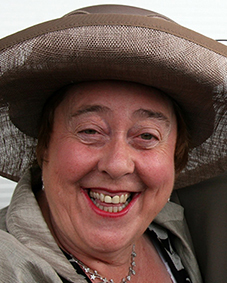
MERYL GRAVELL

There are so many interlinking and overlapping organisations involved with this project that I shall not attempt to list them, let alone guess at how they might be connected. Instead, I refer you to a piece that appeared on the Abertawe Bro Morgannwg University Health Board website in December 2015, and this article from last week’s Llanelli Herald which quotes the one and only Meryl Gravell, Mark James’ plenipotentiary extraordinary to us mere mortals.

If I was cynical (and I thank God I’m not!) I might suggest that what’s happening is this: The leisure centre is being demolished and a new one built; but to get as much lolly as possible bells and whistles are being added in order to promote the project as a ‘Wellness Centre’ incorporating a health centre, a hotel and conference centre, facilities for various ‘therapies’, etc.

Which could result in some poor bugger struggling down there with a bad back, going through the wrong door and finding himself confronted by a Siberian shaman; or perhaps getting legless with a bunch of middle managers down for a conference.

And if I wanted to be really, really cynical I might wonder who is involved in this project that isn’t among the many bodies named. For even the most trusting soul might have his or her suspicions raised by this document on South Llanelli, adopted by Carmarthenshire County Council in December 2014, which has this to say of Delta Lakes (on page 25): “Other related uses (eg healthcare /service sector – social and/or private health care) may also be considered appropriate”.

“Private health care”! Can we hypothesise that the undisclosed ‘partners’ in this project might be private health care providers? Though let me say that I have no objection in principle to private health care. Who can possibly object as long as such companies build hospitals and other health facilities using money provided by investors, banks, and those subscribing to private health care schemes?

But this is Wales and, more importantly, Carmarthenshire, so there must be a possibility that a company providing private health care has been wooed to Delta Lakes with the promise of spanking new facilities funded with public money, sixty million pounds of it.

And this being Wales it will also be trumpeted as a great coup that BUPA or Spire has chosen to ‘invest’ in Llanelli and Carmarthenshire. The massive investment from the public purse that underpins and explains this ‘coup’ will of course be downplayed if not excised entirely from the hyperbolic narrative.

So I suggest that instead of trying to confuse the public, those behind this project explain it better, and give us the names of all the ‘partners’. If only to allay the suspicions many hold.

Because Carmarthenshire in recent years has seen too many projects pushed through in secret. Loans have been made (and lost), and planning permission has been granted, on a nod and a wink. Small wonder that some ask if backhanders might explain this curious methodology.

And seeing as this Delta Lakes project – whatever it is – has the enthusiastic support of Mark James and Meryl Gravell we’re also entitled to ask if the council’s favourite business adviser, Robin Cammish, is involved.

*

A LITTLE HOME IN THE WEST – RENTED FROM AN ‘INVESTOR’?

I like a man who can’t be fobbed of with flim-flam and bullshit, and one such man is regular correspondent Wynne Jones down in Cardigan. Not only is Wynne alert to flim-flam but he’s also very well organised, knowing what questions to ask and to whom they should be directed.

Not so long ago, after receiving information from Wynne, I wrote about Pembrokeshire Housing and its subsidiary Mill Bay Homes, first in Social Housing, Time to End This Lunacy (December 14), and then with Mill Bay Homes, Tai Ceredigion, Answers Needed (January 03).

To briefly explain, Pembrokeshire Housing is a publicly-funded – £27m since 2008 in Social Housing Grant alone – housing association or Registered Social Landlord (RSL). Mill Bay Homes, a ‘subsidiary’ of Pembrokeshire Housing builds and sells properties on the open market, with the money made from this activity going to the parent company for it to invest in more units of social housing . . . or at least, that’s the theory.

But as Wynne found out in a recent reply from Helga Warren, Head of Housing Funding for the ‘Welsh’ Government, Pembrokeshire Housing has yet to see a penny of the money Mill Bay Homes has made from five private developments! Admitted in the extract below, taken from a larger document (click to enlarge).

Wynne Jones Helga Warren

As I mentioned in my earlier posts, Mill Bay Homes advertises its properties as ideal investments for Buy-to-let landlords. Some reading this might think it odd for the subsidiary of a publicly-funded RSL to be encouraging such activity, I certainly think there’s something not right here.

Especially when we realise that Mill Bay Homes also administers the ‘Welsh’ Government’s Help to Buy – Cymru scheme, intended to help people, presumably young people, buy their first new home. Inevitably, Wynne and I wondered if ‘investors’ had been allowed to avail themselves of the Help to Buy scheme.

Ms Warren came to the rescue with this assurance: “Help to Buy is operated by Help to Buy (Wales) Ltd. They carry out extensive checks on behalf of Welsh Government as part of the affordability calculations for any potential buyer. As part of this assessment customers are advised that buy-to-let investments are strictly prohibited under the scheme. Scheme documentation clearly indicates that any fraudulent application for Help to Buy (Wales) assistance could be liable to criminal prosecution. Any fraudulent claims uncovered as part of our monitoring and governance arrangements, will always require immediate repayment of the shared equity loan assistance”.

Read it carefully. There is ‘advice’, there is ‘documentation’, but there seem to be no real checks. As things stand, someone from outside of Wales could buy a new property from Mill Bay Homes, taking advantage of the Help to Buy – Wales scheme, and use it as a holiday home – because nobody is checking. It is a system yelling to be abused.

But even this is only part of the much wider problem we have with housing associations, which in Wales have received, since 2008, close on £800m in Social Housing Grant alone. Then there’s Dowry Gap funding projected to cost £1.3bn and Welsh Quality Housing Standard funding of an estimated £1.7bn. Finally, there’s the Housing Finance Grant totalling £120m.

These are huge amounts of money in a poor country like Wales, so surely the ‘Welsh’ Government insists on every penny being accounted for . . . umm, no. The ‘Welsh’ Government dishes out the cash and seems to say something along the lines of, ‘If you get a chance, you might want to send in a report telling us how you’ve spent the money. No need for any nonsense like differentiating capital from revenue, or explaining where the money’s actually gone, all we need is good news to use as propaganda and to justify us giving you the money in the first place’.

There is no official oversight or monitoring. Housing associations regulate themselves. No one in the ‘Welsh’ Government seems to give a damn as to whether or not billions of pounds of public funding are being properly spent.

Keep up the good work, Wynne.

*

‘EVERYTHING MUST GO’ SAYS CYNGOR CEREDIGION PwC 

Someone else with whom I’m in contact down west tells me of a curious partnership that has developed between Cyngor Ceredigion and PricewaterhouseCoopers LLP (PwC). It seems the council has retained bean-counters PwC to identify areas where cuts can be made – for a fee of 16% of identified savings.

And as in neighbouring Carmarthenshire, openness and telling the public what you’re doing in their name comes very low down on the list of priorities, with things being stitched up at private meetings.

Though this report from the ‘Nazis’ Cambrian News is able to tell us that by late January the council had already paid PwC £963,630. If my maths is up to it, this must mean savings already of over £6m. (And this must be delicate or even dangerous work, because it looks as if the reporters need to use pseudonyms.)

When you come to think about it, it’s a bloody strange system. This company is paid by cuts it identifies. So let’s say Ceredigion spends £100m a year on education, PwC could argue that, ‘The little buggers have all got iPads and smart phones nowadays – let them get their education from Google and Wikipedia‘, and make themselves a quick £16m! I could do that!

Then again, maybe there’s a simple explanation for it all.

Cuts have been forced on our local authorities by the Labour regime in Cardiff docks, and every time cuts are announced rural – i.e. non-Labour – councils take the hit, with Labour-voting councils being protected from the worst.

Now it just so happens that PwC is a major donor to the Labour Party. This article from the Guardian (12.11.2014) explains that Labour received £600,000 of advice from PwC on forming its tax policies – from a company that specialises in tax avoidance schemes. This article from the New Statesman (19.02.2015) tells us that, apart from trade unions, PwC is Labour’s biggest donor.

Ceredigion PwC
I was surprised to find no mention of Ceredigion on the PwC website

As we all know, few individuals and no companies give large sums of money to a political party without expecting something in return. I guarantee that PricewaterhouseCoopers LLP is no exception.

Can’t you just imagine the phone call from London to Cardiff: ‘Listen now, Carwell, PwC have been very generous to the party, so we’d like you to put some business their way, some out-of-way place where nobody’ll ask too many question. Got that?

Though that still might not explain why a non-Labour authority would agree to go along with this lunacy, so maybe the responsibility lies within Ceredigion. Can you help?

                                             ———————————————————————

Of course, none of our local authorities would need to cut services if the ‘Welsh’ Government wasn’t so profligate with it’s meagre resources; especially with the funding it showers on housing associations and the Third Sector, money that the ‘Welsh Government loses all interest in once it’s been handed over.

*

Dydd Gŵyl Dewi Hapus / Happy St. David’s Day


‘Vote Plaid Cymru – Get Labour’

Leanne Wood, leader of Plaid Cymru, has announced that her party will not go into coalition with the Conservatives after next May’s elections to the Notional Assembly. (Read all about it!) From where I’m sitting, this would appear to condemn Plaid Cymru to either impotence or a pact with Labour. Not an attractive choice, Leanne Woodbut then, when you play student politics with a nation’s future, and duck the real issues, you deserve no third option. Though the nation of course deserves a lot better than Plaid Cymru.

If my judgement strikes some as a little harsh, then that’s because, as a nationalist, I have little time for Plaid Cymru. But before dismissing my opinion out of hand let us examine the possibilities for next May’s elections. A good way to start is by reminding ourselves of the results from the Assembly election in 2011 and the two polls since then, the Euro elections of May 2014 and the UK general election of May 2015.

In 2011, Labour gained 30 seats, half of the total, and chose not to go into coalition with another party. They’ve never really come unstuck. Plaid Cymru came third, with less than half of Labour’s vote in both constituencies and regions, and well behind the Conservatives. The Liberal Democrats averaged over 9% of the total, while Ukip, who contested only the regional lists, gained a paltry 4.6% of the votes cast.Assembly election 2011

By the European elections of 2014 Ukip had transformed itself into a major force in the politics of Englandandwales (but not Scotland), and was now the second party in Wales, just .6 of a percentage point behind Labour. All the other parties bar the Greens lost ground.

Just seven weeks ago we saw Ukip fall back somewhat, and drop from its second place in 2014 to third, but it still got more votes than Plaid Cymru. In fact, Ukip came second to Labour in a number of Valleys’ seats which, when taken with the increase in the Tory vote, tells us there was a move to the right which, as I suggested in my blog post Election 2015: Plaid Cymru Fails, Again, might have marked the death of the ‘socialist Wales’ myth. From these recent results it’s reasonable to predict that Labour, with just 30 seats in 2011 and its share of the votEuro election 2014e dropping since then, will not win 30 seats in 2016.

The major changes since 2011 are, quite obviously, the rise of Ukip, then there’s the increase in the Tory vote, and finally the near-demise of the Liberal Democrats. Next year Ukip could, if the heavenly bodies align aright, win a seat or two; though if that doesn’t pan out, and given that the party might get 15 – 20% of the regional vote, then it could pick up 5 – 8 seats.

Labour has in previous Assembly elections gained less than other parties from the regional lists, just two seats in 2011, because it wins so many constituency seats, so the bigger threat to Labour may come at the constituency level. With Labour losing Gower and the Vale of Clwyd to the Conservatives last month, and the Lib Dems losing Brecon & Radnor to the same opponents, there must be a possibility that these resuGE2015lts will be repeated next year. If so, then it would establish the Tories as the second largest party by some margin. This seems predictable because the number of Plaid Cymru AMs is bound to fall, partly because other than Llanelli  it’s impossible to see a seat Plaid could gain (though maybe not if Siân Caiach stands again), and Plaid is bound to lose out to Ukip in the regional allocation. Though if the Lib Dems do lose Brecon & Radnor then that makes it more likely they will be compensated with a couple of regional seats.

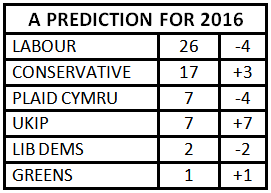
Looking at the bigger picture it would not be unreasonable to predict the following result for next year’s Assembly elections: Labour 26 seats (-4), Conservative 17 (+3), Ukip 7 (+7), Plaid Cymru 7 (-4), Lib Dems 2 (-2), Greens 1 (+1). Which would mean that to cobble together an administration Labour would need to go into coalition with Plaid Cymru, which is almost certainly what influenced Ms Wood’s rejection of a deal with the Tories. But this is so short-sighted.

Being a native of the Rhondda Ms Wood must know that throughout the Valleys (and indeed the south) there are tens and tens of thousands of people looking for a Prediction 2016viable alternative to Labour, that’s why they turned out last month and last year to vote Tory and Ukip in Caerffili, Merthyr, Blaenau Gwent and Islwyn, and in the process pushed Plaid Cymru down to fourth place. So why should anyone who doesn’t want Labour in power vote for the party that will keep Labour in power?

There may be another, even less charitable way of looking at this. Over the years I have consistently argued that the Labour Party relies on deprivation in Wales – and blaming the Tories for that deprivation – to keep people voting Labour. This means that Labour has no incentive to make Wales a wealthier country, and this then explains the obscene amounts of public funding wasted on Labour’s cronies in the Third Sector, so that they can make an industry out of deprivation and present their parasitism as a form of economic activity.

Could it be that Plaid Cymru, most definitely a begging bowl party, has taken this reasoning a step further? Have those at the highest, policy-making levels of the party calculated that if a poor Wales votes Labour, then a poorer Wales might swing towards Plaid Cymru? Don’t dismiss the suggestion out of hand; just ask yourself, what other hope has Plaid Cymru got of ever becoming a successful party? Well, of course, there is one, obvious route; Plaid could be a Welsh party, focusing on Welsh issues, from a Welsh perspective. But that option was rejected in favour of a slow, lingering death – for both nation and party – decades ago.

Last month I loaned Plaid Cymru my vote because I persuaded myself that doing so was a way of giving a proxy vote to the SNP, a party I respect greatly for confronting the Labour monster head-on, and slaying it. Compare that to what we now hear from Plaid Cymru – ‘A vote for us is a vote for Labour’. How do we explain the difference?begging bowl 1

I can’t help thinking that one explanation for ruling out any pact with the Tories may be Ms Wood’s desire to play to a foreign gallery. I’m thinking now of those Left-Green ‘progressive elements’ Plaid so assiduously courted a few months ago. If so, then it’s another reminder of how divorced from Wales and Welsh issues Plaid Cymru has become. By comparison, the Scottish National Party does not fashion its policies to appeal to audiences in Islington, or the offices of the Guardian newspaper . . . and certainly not Labour HQ!

But if Plaid Cymru wants to talk about poverty, then okay. Let’s talk about the poverty of ambition in the party that has the nerve to call itself The Party of Wales. While the SNP is leading the Scottish people to independence, Plaid Cymru’s ambition extends no further than begging a few more crumbs from England’s table and propping up Carwyn Jones and his gang of deadbeats. Almost fifty years after Gwynfor Evans won Carmarthen Plaid Cymru’s ambition today extends no further than acting as a crutch for the party of George Thomas and Neil Kinnock in a system of sham devolution. Now that’s poverty! And total failure.

Welsh Poverty And ‘Welsh’ Labour’s Third Sector Money Pit

A report just produced by the ‘Welsh’ Labour Government, Inquiry into Poverty in Wales: Poverty and Inequality tells us, among other things, that 23% of the population still lives in relative poverty, and while the situation is improving in England and Scotland there is no sign of improvement in Wales. In response, the ‘Welsh’ Government protests that it has “committed £323m to tackling poverty this year alone”. I shall return to this ‘commitment’ anon.

This latest report merely reinforces other reports, and evidence from a host of sources, telling us that our land is poor and becoming – relative to Scotland and England – poorer. For example, earlier this year the Wales TUC produced a report on the Living Wage, with its findings published on a constituency basis. It found that in Cardiff North just 11.4% of jobs pay less than the Living Wage, but in Gower the figure rises to 45%, while Dwyfor Meirionnydd gives the worst figure, at 51%. In both of these areas tourism undoubtedly plays a role in depressing wage levels.

The statistics already dealt with tie in with other findings that tell us Wales has the lowest levels of working-age employment and the highest rates of economic inactivity to be found on this island. But what can you expect? In my previous post I dealt with a non-working, benefit-dependent population being deliberately brought in to Dyffryn Teifi – and the same thing is happening all over Wales. Housing associations and others are importing from England white trash that England is more than happy to be rid of. While in the post before that I dealt with the unsustainable numbers of elderly people moving into Wales, and the inevitable effect this is having on the NHS and other services.

*

Another piece that caught my eye today concerned Rhondda Life Ltd. Plaid Cymru – for once doing something right – finally got hold of a report from December 2012 that the party claimed the ‘Welsh’ Government had refused to release. (Though much of the information was already in the public domain by 2012, soon after the funding plug was pulled.) The report made it clear that RLL was yet another disaster of the kind we have become so familiar with in Wales: Labour Party hacks and hangers-on receiving obscene amounts of public money for doomed projects in desperate efforts to be seen to be doing something, and failing miserably to achieve anything other than secure tidy salaries and good pensions for themselves.

Running the Rhondda Life show in Ferndale was Travers Merrill. An optimist, our Travers, for while RLL was hurtling, out of control towards the buffers he reassured passengers that it was merely keeping to schedule. For just three months before an auditors’ financial review found Travers Merrillliabilities of £106,555 Merrill was insisting, “RLL is solvent for the following reasons. It has detailed cash flow forecasts; robust internal accounting procedures; detailed financial records; budgetary and corporate plans; no continuing loss-making activities; excess assets over liabilities; no loan or interest defaults on payments; rigid and regular financial activity monitoring; no unpaid tax liabilities; strong governance and management.” Nice try, Trav.

Travers Merrill is married to Rose Mutale Nyoni Merrill OBE (or combinations thereof) who is CEO of BAWSO, a well-funded Third Sector outfit catering for Mrs Merrill and her friends ethnic minority women in need of help. In addition, she was involved with MEWN, another ethnic minority women’s charity based in Swansea, which has also breathed its last. Though before it took ill and expired I – impetuous fool that I am! – suggested that MEWN might reasonably be viewed as a replacement for AWEMA – as if anyone could replace Naz Malik! How much Argie plonk had I drunk when I wrote that?!

Mr and Mrs Travers Merrill are known to have strong – if almost covert – Labour connections, but what is perhaps more interesting about them is that they also have a private company. This is ABESU, which, to quote the company’s website, is “a UK charity working in partnership with the ABESU Women’s Housing Co-operative in Zambia to self-build houses and establish sustainable livelihoods”. Zambia is of course Mrs Merrill’s homeland. The latest accounts lodged with the Charity Commission, or rather, the ‘Unaudited Financial Statements’, tell us that the charity “employs no staff in the UK and the administration is provided pro bono (by whom?) with minimal office expenses”. Which is one way of putting it.

Though a few years ago I was approached by a BAWSO insider telling me that much of ABESU’s administrative and secretarial work was being done in the BAWSO office, using equipment and facilities provided for BAWSO out of public funds. Clearly not right. Though of course this explains why ABESU’s “administration is provided pro bono with minimal office expenses” – it’s because it’s provided by us, via the ‘Welsh’ Government and its funding agencies.

AWEMA Charity Commission
Click to Enlarge

But ‘Welsh’ Labour’s generosity doesn’t end there. For the Unaudited Financial Statement for the period ending March 31st 2014 tells us that the ‘Welsh’ Government gave ABESU £2,000 in that year. (Page 12 of accounts.) Confronting us with the obvious question, why is the ‘Welsh’ Government giving £2,000 to an organisation that, by its own admission. employs no staff in the UK? This has echoes of AWEMA operating, with Welsh public funding, in Kenya and Pakistan. And me, cynic that I am, I can’t help wondering – as I do with all charities – how much of the money donated ever reaches those it was given to help.

Whatever the answer, and however you look at it, the Merrills are the perfect Labour-Third Sector family; neither of them Welsh but happily spending millions of pounds of Welsh public funding on others, most of whom are not Welsh either. And with the curious and suspect overlap with a private company that may also be benefiting from our generosity. Well, we know it’s getting at least £2,000. And for those tempted to say, ‘Oh, two thousand pounds isn’t a lot’, how many other organisations are receiving Welsh public funding for projects outside of Wales?

*

Wales is a poor, post-industrial country that has never replaced the heavy industry it lost. With the inevitable result that ours is now a country with unacceptable levels of poverty, suffering a flight of the bright and an ageing population. Yet the ‘Welsh’ Government funds housing associations and others to import more poverty, while also encouraging elderly people to move to Wales! Then, due to the emasculating Left-Green mindset that has reduced Plaid Cymru to an object of ridicule, the party that should be exposing and attacking this truly wondrous strategy that both colonises and impoverishes Wales, actually applauds it! Believing, in its pathetic, socialistic distortions of reality, that Wales is somehow acting as a ‘beacon’ in ‘helping those in need’ . . . bring on the fairies!

And if that wasn’t bad enough, the money that is given to the ‘Welsh’ Government by the EU and the UK government to alleviate that deprivation is wasted on a Third Sector that is nothing more than the Labour Party funding careers for its otherwise unemployable supporters, and guaranteeing their loyalty; supporters who will then shout down opponents and commission surveys that always conclude – the ‘Welsh’ Government should give them more money! This is where the £323 million pounds will be spent this year, not on “tackling poverty” as the ‘Welsh’ Government claims, but on its Third Sector cronies, and on projects and schemes that no Welsh community would miss if they ceased tomorrow.

As I was finishing off this piece, and thinking it couldn’t get any worse, I noticed a tweet from @johnsouthwales telling of a ‘community embankment‘ built in Ammanford as part of the Communities First programme. Tell me this is not real. Tell me I’ll wake up tomorrow and realise that this country I think I live in is really just a bad dream.

The Family Malik and the Lynks that Bind it to the Labour Party

I AM INDEBTED TO ‘STAN’ OF THE NEATH FERRET FOR HELP IN WRITING THIS PIECE

The name Malik will be familiar to regular readers of this blog if only because of Naz Malik, former boss of race relations charity and Labour agitprop outfit the All Wales Ethnic Minority Association (AWEMA). I have written about Naz Malik more than once, so to refresh your memorNaz Malik rugby fanies you might care to work back from this post of September 8th, 2014, published shortly after the end of Malik’s trial.

One of the major issues exposed by the AWEMA scandal was that of nepotism, though of course this is no crime. Indeed, it’s the cornerstone of the family business; but beyond that sphere the favouring of relatives will be judged on the company’s performance, and investors or shareholders will demand changes in the management if it is felt that nepotism is responsible for declining performance and falling profits. Yet in a publicly-funded body, where the money just keeps rolling in, and with no criteria by which to judge performance, it becomes almost inevitable that nepotism will flourish unchecked.

Nepotism goes some way to explaining what went wrong with AWEMA. At CEO was Naz Malik; then there was daughter Tegwen, whose salary shot up from £20,469 in January 2008 to £50,052 in August 2011 for no apparent reason; while another who worked for AWEMA was Naz Malik’s daughter-in-law Ourania Chatsiou who, along with her sister-in-law, was, bizarrely, among the creditors when the funding plug was pulled early in 2012. Though the major creditor, the ‘Welsh’ Government, recently wrote off most of the £300,000 it was still owed by AWEMA. Naz Malik’s wife, Bronwen, and son, Gwion Iqbal, were also involved with AWEMA, as ‘volunteers’.

AWEMA Charity Commission
CLICK TO ENLARGE

Another thread in the AWEMA saga is the Malik family links to the Labour Party. The patriarch himself had entertained hopes of standing for the party, and could be relied on to use the public profile he’d gained from Labour-funded AWEMA to regularly attack ‘racist’ Welsh nationalists. The aforementioned scion of the House, Gwion Iqbal, stood for the party in the elections to the Notional Assembly of 2011. (There used to be a photo available on the internet of Gwion Iqbal canvassing with First Minister Carwyn Jones, but unsurprisingly it seems to have disappeared.)

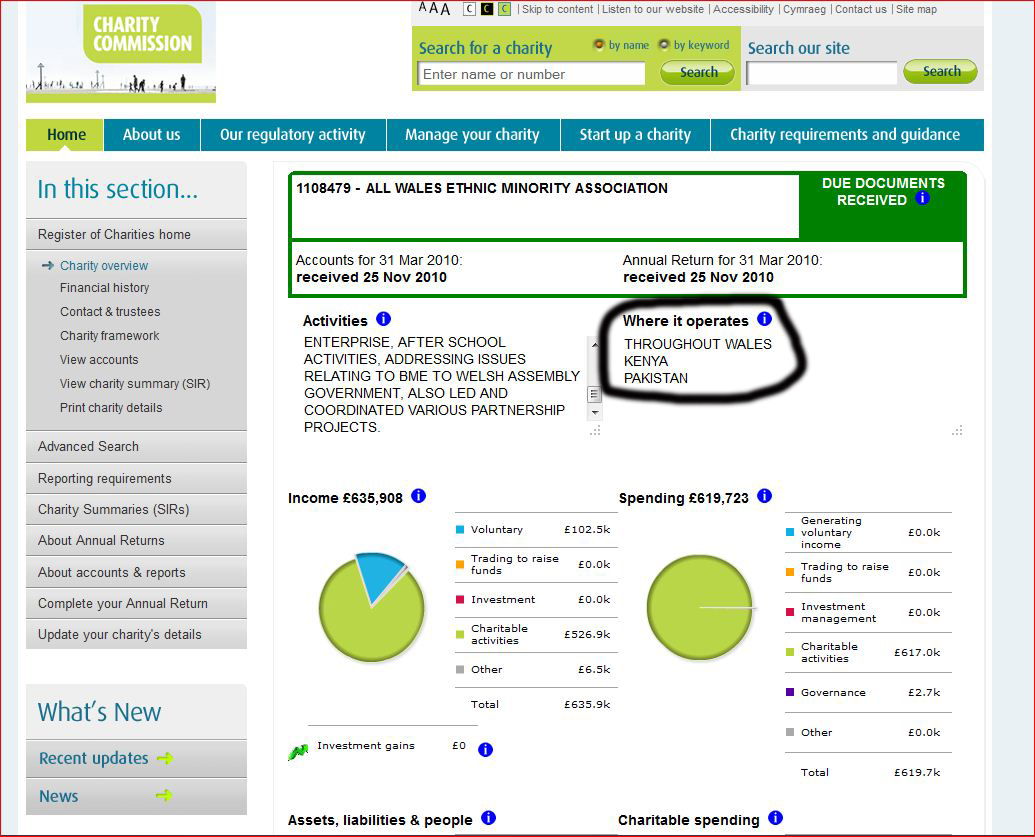
Something else that always troubled me about AWEMA was the bland statement made on the Charity Commission website that, in addition to operating in Wales, AWEMA had a presence in Kenya and Pakistan! Remember, we were dealing here with EU and UK money allocated to Wales, and yet no one thought to question why AWEMA claimed to be using that money overseas. One answer of course is that Naz Malik had been born in Nairobi to parents of Pakistani, or pre-Partition Indian, heritage. As had Naz Malik’s sister, Fahro. Or rather, that explains the family’s background; while the lack of concern in official quarters can probably be explained by the Labour Party connection.

*

I first became aware of Fahro Malik when I saw a link to a charity called Lynk Reach Ltd (Charity No: 1104188) on the AWEMA website. (Lynk Reach Ltd was removed from the Charity Commission Register on January 14th this year.) Its charitable objective was “To advance the education of children and young people 0 – 25 (sic), primarily but not exclusively in London”. There was also a company called Lynk Reach Ltd (Company No: 04678217) Incorporated on the 25th of February 2003. Strangely, FaFahro Malikhro Malik seems not to have been a director of this company, though among the founders was an Anthony Malcolm Finch, a headmaster, who was Fahro Malik’s husband. Finch wrote an internet restaurant guide and died suddenly in February 2007. Someone who joined the company later was Zoe Samia Malik-Kemp. Lynk Reach Ltd is now dissolved.

A connected company was Lynk Ray Ltd (Company No: 04261595) which pre-dates Lynk Reach Ltd, having been Incorporated on July 30th 2001. The founding directors were Anthony Malcolm Finch and Fahro Malik. This company is also dissolved. Finally, we have Lynk Write Ltd, Incorporated June 19th 2003 (Company No: 04804457). The only two directors were Fahro Malik and Anthony Malcolm Finch. This company is also dissolved. The most recent mention I can find for Fahro Malik is on the London Writers’ Café website, from where the photograph comes.

Fahro Malik has escaped the notoriety of brother Naz and the Swansea branch of the clan, but still leaves behind a failed charity and dissolved companies owing money to some poor bugger. Fahro may also regret involving her other brother, Munir, with Lynk Ray Ltd as a director and company secretary from August 3rd, 2007 until the company dissolved, probably towards the end of June, 2013. That’s right, another brother, of whose existence I was unaware until it was brought to my attention by Stan of Neath Ferret. So what’s Munir’s story?

*

Munir Malik is another Labour Party stalwart, and has served a couple of non-consecutive terms as a councillor in Bexley, south east London . . . though since his brush with fame he has been deselected from his Thamesmead East ward. To explain . . .

In addition to the Labour Party, for which he also stood as a candidate in the London region Euro elections of 1999 and 2004, Munir Malik was involved with the Co-op Group, serving as a regional representative before being elevated to the National Board. His wife, Kathryn Smith, another Labour councillor in Bexley, was herself on the National Board of the Co-op Group from 1997 to 2008 and on the Board of the Co-op Bank from 2001 to 2009, where she worked with Paul Flowers, the drug-taking Methodist minister and former Co-op Bank chairman. (Also known as ‘the Crystal Methodist’.) Kathryn Smith left the Co-op Bank in 2009 to stand as Labour & Co-operative candidate for Gravesham in the 2010 General Election. A Munir Malikseat that the Tories had won in 2005 by just 654 votes became a safe Tory seat in 2010, with a majority of 9,312. Labour’s loss of votes may have been connected with Smith being done for drunk driving just days before the poll.

Misfortune continued to dog the Malik-Smith household when Munir Malik was forced to resign from the Co-operative Group Board for telling fibs about his qualifications. To be specific, when running for election to the Board he claimed to be a chartered accountant  . . . ‘Oh no he’s not!’ said the Institute of Chartered Accountants in England and Wales, ‘and only members of the ICAEW are allowed to call themselves chartered accountants’. Munir sought to explain away this little inconsistency by arguing that what he meant to say was that he had been a chartered accountant . . . until he was struck off for bankruptcy in 1991, and had simply forgotten to prefix his qualification with ‘former’. Something of a habit, apparently, for the ICAEW claimed to have previously warned him to stop claiming to be a chartered accountant. Though Malik countered with: “All my working life has been spent as a former chartered accountant”. Um, yes . . . exactly!

All so predictable, and familiar, for as this Daily Mail piece on the Malik / Flowers fiasco puts it, “Malik belongs to what one insider described as a closed group who have come to dominate the Co-op despite its democratic structure of elected boards” and later, “Former City Minister Lord Myners was appointed to assess the Co-op Group’s system of elections and appointments. He resigned last week in the face of bitter resistance from board members but plans to complete his review”. Sound familiar? Of course it does, for this is another dysfunctional and undemocratic element of the great ‘Labour Movement’, another that preaches democracy but has never seen any need to practice it, especially for its internal procedures. We could be talking here about ‘Welsh’ Labour . . . and we soon will be!

*

Piercy Lane
CLICK TO ENLARGE

So where are they now? Well, it seems that the Malik womenfolk have retreated to academia and scholarly pursuits. Fahro Malik, as she told the London Writers’ Café website, is probably researching the family’s journey from the Punjab village of Rohtas via Kenya to Wales and England. Tegwen Malik, Naz’s daughter, is carrying out research in biomimetics (don’t ask me!) at Swansea University, while Naz’s daughter-in-law, Ourania Chatsiou, is also at Swansea Uni, doing post-graduate work. Which serves to remind us, yet again, of the close links between the Labour Party and higher education in Wales, and the mutual back-scratching.

Some of you reading this may be ‘uncomfortable’ with the fact that so many of those dealt with belong to ethnic minorities. Get over it! I’m writing about the Maliks not because of their race, colour or religion but because a) they’ve done wrong, b) they all seem to have Labour Party connections, c) despite the shit they get themselves into, they seem to come up smelling of roses, which, d) allows me to expose, yet again, the squalid relationships between the Labour Party, the Third Sector, academe and other spheres of our national life.

So you mustn’t think that nepotism is confined to persons of Pakistani origin from East Africa, no, no, no, no, no. This is a Labour Party problem, something encountered wherever Labour has power and, more importantly, where Labour has control over funding. For we don’t need to leave Swansea Bay to find celebrated current examples of nepotism encouraged or condoned by ‘Welsh’ Labour where the principals are all of impeccably white and Christian backgrounds.

Let us return to Swansea University, and this time the School of Management. There, the Dean, one Nigel F. Piercy, has appointed his son Niall as Pro-Dean for Research, and his love interest, Nikala Lane, as a Reader in Marketing and Strategy. Partly as a result of this blatant nepotism, and partly by being a bit of an arsehole, Piercy has contrived to alienate just about everybody he is supposed to be working with. Yet his position seems secure.Stephen Kinnock

From the Mumbles Road campus one can look across the bay to Port Talbot where, on May 7th, the electors of the Aberavon constituency will be expected to put on their blinkers, empty their minds, and troop like zombies into the polling stations, there they will grasp the stubby brown pencil on a string and come momentarily to life when they see on the ballot paper the magic name KINNOCK. Tears of gratitude will flow as they recall how young Stephen was not parachuted in – as malcontents allege – but walked all the way from his Copenhagen home to vie for the honour of representing Aberavon (‘it is Aberavon, is it?’) and was chosen only after an open and keenly-contested selection process that lasted months.

Because, boys and girls, that’s how the Labour Party operates, and don’t let anybody tell you different. The Labour Party is, to the best interests of Wales . . . what the Ku Klux Klan is to good race relations, what Japanese cuisine is to whales, what the conquistadors were to the civilisations of Mesoamerica, what the iceberg was to the Titanic, what the driving maul is to modern rugby, what the CIA is to privacy, what Rhyl is to Welsh cultural identity, what the Sinclair C5 was to motoring, what China is to Tibet . . . In short, a disaster.

Swansea Labour Party 11: What Price ‘Loyalty’?

Opponents of the Labour Party, no matter what they think of the party generally, are always impressed by its discipline; by how a council group made up of individualists, the intellectually challenged, revolutionaries, Blairites and disgruntled back-benchers, can still be made to vote as instructed and hang together in order to face down any challenge. But how is it achieved? Well, a clue may be coming out of Swansea, and if this theory suggested to me is correct then my guess is that the method employed is unlikely to be restricted to that city.

Now I don’t want Uplands Labour councillor John ‘Boy’ Bayliss to think I’m picking on him, but I must start with him for he might, unwittingly, provide the key to unlocking this great mystery of Labour Party solidarity. The place to start is the extract here taken from Bayliss’s Declaration of Interests on the council website.

Bayliss declarations

This tells us that John Boy received an undisclosed amount of money from the Swansea Labour Group for a reason or purpose that is also undisclosed. And note that it came from the ‘Swansea Labour Group’, not the council, so it must be supplementary to any official payment for his work as a councillor. What are we to make of this? Was it a birthday present? If so, why did other Labour councillors not receive their ‘presents’? I’m told there is another explanation.

It has long been rumoured that Labour councillors in Swansea are required to pay ten per cent of their allowances to the party. Some of this, it is suggested, is used for elections and to otherwise promote the party in the city; a portion is sent to ‘Welsh’ Labour HQ; while the remainder is distributed among those Labour councillors lower down the food chain who do not receive hefty allowances for chairing committees and being in the cabinet. With a percentage also going to pay the dues of students from local universities who’ve been given free party membership.

Now quite obviously, a disgruntled Labour backbencher can have his or her disaffection ameliorated with a sweetener of a few grand every year. And a red-hot ‘revolutionary’ could also be persuaded to toe the party line. Which could help explain Labour Party ‘solidarity’. As I say, it’s only a rumour, but if true, it would give Swansea Labour group a secret pot of maybe £70,000 to play with every year. A great deal of ‘solidarity’ can be bought with that kind of money when it’s used to top up flat-rate councillor pay, especially if the recipient has no other obvious source of income.

So if the suggestion being made is correct, then the first issue is that the Labour Party is virtually extorting money from leading councillors (because you mustn’t believe that all Labour councillors give up their 10% willingly). Then we have the issue of recipients of this secret levy – recipients other than Labour donations‘Honest John’ Bayliss – not declaring this income in their Declaration of Interests. And finally, we have the consideration of income tax. For if the loyalty of Labour back-benchers is being bought with what are effectively back-handers, then we can be fairly certain that these secret payments are not being declared to the tax authorities.

A final consideration is that if what I’m hearing about Swansea Labour Party is true, and if this is how the Labour Party operates elsewhere in Wales – a reasonable assumption – then Labour in Wales must have well over a million pounds to play with every year. A million pounds that perhaps no one outside the party knows about, and that no one inside the party is willing to talk about. Essentially undeclared income and tax-dodging of the kind that so agitates the bruvvers when done by others.

I feel we need clarification on this matter. First, we need a statement from the Swansea Labour Party on whether or not it demands that its leading councillors ‘donate’ ten per cent of their allowances to help sustain (and retain the loyalty of) less fortunate brethren, and to also top up the party coffers. Then, we need a statement from ‘Welsh’ Labour, telling us if this is common practice within the party. Finally, it would be interesting to hear the views of the tax authorities; so maybe HMRC can give an opinion on whether income derived in the manner described is a) legal and b) if so, whether it should be declared for tax purposes.