Looking Ahead To Senedd Elections

In this piece I shall look towards the May 7 Senedd elections. Rather than delve into party manifestos, or expose the peccadillos of individual candidates, I’m adopting a broad brush approach.

Impressions and perhaps even informed generalisations. Digressions guaranteed, but not without a touch of whimsy and a few doses of ironic humour.

This offering is a bit longer than normal, but as it’s broken up into sections, one for each party, you can nibble a bit at a time. Like your Easter eggs!

‘WELSH’ LABOUR

I’m starting with Labour, if only because this party has been running the show since devolution began in 1999. The name’s partly in quotes because there’s no such thing as a separate Labour party in Wales, it’s just a branch of the Islington-controlled gang we’ve know since Blair, Brown, Mandelson and a few others sat down to create New Labour.

This was the plan to broaden the party’s appeal beyond the traditional working class support. A strategy that ultimately led to the alienation of much of the working class. Labour in Wales managed to maintain the pretence longer than most party branches, but has now been found out.

But Labour, run by the Fabian Society, never really cared much for the working class, they were simply the means to power. The post-industrial age, Brexit and other factors, has seen Labour turn on the indigenous lower orders with a vengeance. Even to the extent of offering euthanasia.

For culling the poor, the sick, the disabled, the hopeless, was always Fabian Society policy. Find half an hour to watch this video.

LABOUR’S FIRST MINISTERS 1999 – 2026

One of the saddest features of this deception was seeing traditional, even generational Labour voters, in some of the most deprived communities in Wales, taken for granted by a party that had abandoned them and their communities.

A case of: Vote Labour – and we’ll keep kicking you in the nuts!

But chickens come home to roost.

And that’s why Labour finds itself facing humiliation thanks to an electoral system it conjured up believing this system would guarantee a permanent Labour-Plaid love-in, with the comrades always on top.

It says a lot for Labour’s foresight, and arrogance, that they couldn’t factor into their calculations the possibility of defeat. I described the system, and how it came about over two years ago, in Labour And Plaid Cymru Plot To Destroy Welsh Democracy.

But here we are, with Labour at 11% or 12% in the polls and fighting with the even more unhinged Greens for third place behind Plaid Cymru and Reform.

Because the problem for Labour is that having abandoned the working class it now relies for much of its support on racial and religious minorities (of which Wales has few), brainwashed students and ex-students, middle class liberals (another small group in Wales), third sector and other chisellers who’ve done well from Labour cronyism and patronage (a sizeable group regrettably), and the far left.

But many even in those groups are deserting Labour for Plaid Cymru and the Greens.

NOW LISTEN, STARMER, HERE ARE YOUR ORDERS

And if that wasn’t bad enough, there’s Starmer and his clueless, lying crew of Globalist puppets. Who’ve betrayed those who voted for them, and torn up their own manifesto, in order to serve those who came over to give them their orders soon after the 2024 election. (See above.)

A meeting of minds. For Gates’ plan to reduce the human population is pure Fabianism. And Starmer, like all previous Labour PMs, is a staunch Fabian.

Problems compounded in Wales by the growing perception that Labour has been bought by Bute Energy and other foreign companies (perhaps even the Chinese Communist party) wanting to exploit Wales in the name of ‘saving’ a planet in no real danger.

PLAID CYMRU

This party will obviously be the main beneficiary from the collapse of the Labour vote.

And so Plaid is now doing what it always does when an election approaches – pretending there’s a gulf between them and Labour. But Plaid and Labour have been in bed too often and for too long for that deception to work.

Plaid Cymru might benefit from voters wanting to rebuke Labour without changing the general direction of devolved politics. Making Plaid the soft option for mildly disgruntled Labour supporters.

But they should be careful what they wish for. Especially those unhappy over Labour’s obsession with Net Zero, DEI, gender politics, Gaza, Trump, and all the other ishoos that often alienate left-leaning but socially conservative voters.

I say that because Plaid Cymru seems to have gone further down the fact-free rabbit-hole of Wokery than Labour. On a host of issues. And there’s no longer any attempt to hide it.

Here’s Plaid’s leader in the House of Commons (and my MP), Liz Saville Roberts, in London on March 28. At a march that brought together the far left, Islamists, environmentalists, and others.

Of course it was billed as a march against hate. The problem most people had in accepting that claim was the marchers chanting about killing Jews, threatening opponents of the murderous theocracy in Iran, condemning anyone who thinks men can’t have babies, and dancing dementedly in attempts to fight the climate crisis.

In fact, so much hate was generated by this gathering that a big profit was waiting for anyone who could have bottled it and sold it to a third world dictator.

Which perhaps brings us to Plaid’s real problem – a form of schizophrenia.

We have a party in recent times appealing to the radical left, while trying to hang on to its traditional, more socially conservative rural core vote. This is a difficult balancing act. But then, Labour got away with a similar deception after abandoning its traditional working class voters, so maybe Plaid will be lucky.

Because it takes a while for many voters to catch up with the new reality and ditch old habits. At least, that’s what Plaid Cymru is hoping.

REFORM

Reform UK is next because in all recent polls it comes in second behind Plaid Cymru. Which seems to surprise many people, who want to believe this strand of politics is new to Wales, even an unwanted import.

The truth is that Farage’s earlier creations – UKIP, Brexit party – have been around for a few decades, and have performed well in Welsh elections, particularly the last two elections to the EU parliament. Here’s a table I drew up a few years back for a piece on the blog that should prove my point.

You’ll see that in 2014, with the Brexit referendum two years in the future, UKIP came a very close second to Labour. And in 2019 the Brexit party, combined with UKIP hold-outs, won comfortably with almost 36% of the vote.

This final EU election, after the 2016 referendum, might be seen as a victory lap for the Brexit party, yet the fact remains they won it very comfortably. But then, Wales voted Leave. Though parties on the left want to ignore this, talking of “alignment“, even re-joining. With no mention of consulting the people, let alone a referendum.

As I hinted earlier, the problem for leftist parties is that most people in Wales, as elsewhere, are socially conservative. They want policies the left is either unable or unwilling to deliver. But which Reform promises.

This goes some way to explaining why a ramshackle and often incoherent group like Reform is riding high in the polls. Topping polls in England, second in Wales.

There are identifiable groups from where Reform can expect support. First, former Labour voters awake now to the nature of modern Labour. Then, disaffected Tories, wondering what happened to their party. And the sizeable percentage of the population pissed off with establishment politicians prepared to give Reform a go. Finally, those who reject all manifestations of Welshness, from devolution to bilingual road signs.

But I see two clouds on the horizon for Reform. Perhaps only one of which will damage the party in May’s elections.

I’m referring to the reported parachuting in to Welsh seats of ex-Tories and others from outside the constituency in which they’re standing, even from outside of Wales. As this newspaper report from earlier this week illustrates.

Other fractures also seem to be appearing.

And yet, the factors just mentioned are less likely to count thanks to the absurd voting system; which means candidates 4, 5 and 6 on the party list could drop out with no effect on the outcome. And because it’s a party list system many voters won’t even know who the candidates are anyway! (Explained below.)

Perhaps a bigger threat, in the longer term, and on the UK level, is Rupert Lowe and his fledgling party Restore Britain, only launched in February. This very recent poll puts a party most people have never heard of on 8%. And I think I know why.

Farage is smooth, glib, a bit of a lad with the pint and the ciggie, and yet . . . I’ve never been able to shake the impression of the spiv. I keep waiting for him to roll up his sleeve to show us all the watches he’s flogging.

Whereas Lowe comes across as ‘serious’; what’s more, it’s that “Don’t fuck with me” kind of seriousness. Which many people respect. And I don’t see an armful of watches.

In the short term, and the context of the Senedd, I suppose we must accept the polls and prepare for Reform to come second.

Meaning four years of pantomime, with leftist luvvies clutching their pearls as they theatrically exit the chamber singing Kumbaya if a Reform MS questions net zero, or wants to end the £3,000,000 a year funding for the Dowlais branch of Hezbollah.

GREENS

There was a time when the Greens were regarded as harmless eccentrics. Perhaps another incarnation of the brown bread and sandals wing of the Liberal party from the 1960s. (For younger readers . . . Look it up yourselves, you lazy little sods!).

But how they’ve changed!

From what I can see the modern Greens have little interest in the environment; now they seem to have positioned themselves somewhere to the left of Pol Pot. (Though I’m sure PP was a better dancer than ‘Zack Polanski’.)

Everything about the Greens in 2026 is false and/or dangerous.

Starting with party leader, ‘Zack Polanski‘, whose real name is David Paulden. Not so long ago he was a hypnotist, claiming he could enlarge women’s breasts. Did women pay him for this?

Some may think I’m being unfair, pointing out that he’s the UK leader, and we have our own leader in Wales, in Anthony Slaughter. Which is nonsense, because we don’t have a Welsh Green party.

When Green party members in Wales had the chance to form a separate Welsh party in 2018, they chose to stay as the Green Party of Englandandwales. Because most Green Party members in Wales are not Welsh. They tend to be good-lifers and others for whom Wales is nothing more than a nice place to live.

Recently the Greens have been pandering to Muslims, just like other parties of the left. To the extent that Polanski’s deputy is Mothin Ali, who recently attended a rally supporting the murderous theocracy in Iran – with critics labelled “Islamophobic.

But try to make sense of it. Polanski is Jewish, and gay. Has he ever sat down with Ali to discuss his deputy’s religion and its attitude to both Jews and homosexuals? And does Ali have any interest in environmental matters?

It’s insane; Polanski’s relatives have said they’d leave the UK if he became PM.

The real worry should be the Islamic block vote transferring to the Greens because Labour is finished, if only in the short term. If so, then this is worrying; because on both the Welsh level, after May 7, and the UK level after the next general election, the Greens could be power-brokers.

So who in their right minds will vote in the Senedd elections for a party led by a former hypnotitist and his Islamist sidekick?

Just imagine if the Greens hold the balance of power in the Senedd, and the word comes down from Green Party HQ – “Tell Gareth Wyn Jones them sheepdogs gotta go“.

CONSERVATIVE

What to say? Conservative politicians at every level have kept such low profiles in recent years they’ve become almost invisible. To the point where some might wonder if the party is still in existence.

In Wales, those who haven’t been kicked out of the party seem to have joined Reform. But nobody’s really noticed!

I mean, can you name the Tory leader in the Senedd? (It’s Darren Millar.)

And yet, despite the party’s near-invisibility the Conservative vote seems to be holding up. Certainly better in percentage terms than the Labour vote. Though I suppose it could be argued that Labour had more votes to lose.

Another way of looking at it might be to say that the Tories should have benefitted more from the collapse in the Labour vote. But it hasn’t. Possibly because so few people know what the Tories stand for nowadays. What is the message?

At this point – seeing as I have so little to say about the Tories! – it might be worth entertaining you with an opinion poll published in Nation.Cymru on April 1.

The accompanying article was written by Martin Shipton, who so recently had a wake-up call when an “eight-strong team from the counter-terrorism division of the Metropolitan Police“ kicked his front door down at 6am.

The survey sample was so small that I’m not sure it can be trusted; but seeing as it was commissioned by N.C, funded with ‘Welsh Government’ (i.e. our) money, I shall pick through the bones.

We see that the Tory vote is around 9/10%, which is not bad for a party that’s almost invisible. While some of the other ‘findings’ defy belief.

Though not the finding that among younger voters Plaid is very popular, and the Greens lead in the under 12 age bracket.

Though one of the more intriguing figures was this:

For people aged 35 to 54, Reform leads with 35%, ahead of Plaid Cymru on 21%, Labour on 16%, Greens 13%, the Conservatives and Lib Dems both on 6%, and others on 2%.

This is where we find those who are working, struggling to pay mortgages or rent, wondering if they can afford to light and heat their homes, bringing up children. Reminding us of what I’ve argued elsewhere – those living in the real world want real world solutions to real world problems.

Though I’m sure Martin ‘China’ Shipton and his ilk would dismiss this 35% as racists, climate deniers, etc., etc.

But this section was supposed to be about the Conservative and Unionist party, and I’m ignoring them. Yes.

I may have had a sneaking regard for their economic and social policies at one time. But that was forfeited when Boris Johnson flew to Kiev in April 2022, to ensure the little clown didn’t sign a peace deal that would have jeopardised their Globalist masters’ money-laundering operation.

LIBERAL DEMOCRATS

If I had little to say about the Conservatives I have even less to say for the Liberal Democrats. They’re almost an irrelevance. A poll in this week’s Cambrian News suggests they won’t win a single seat on May 7.
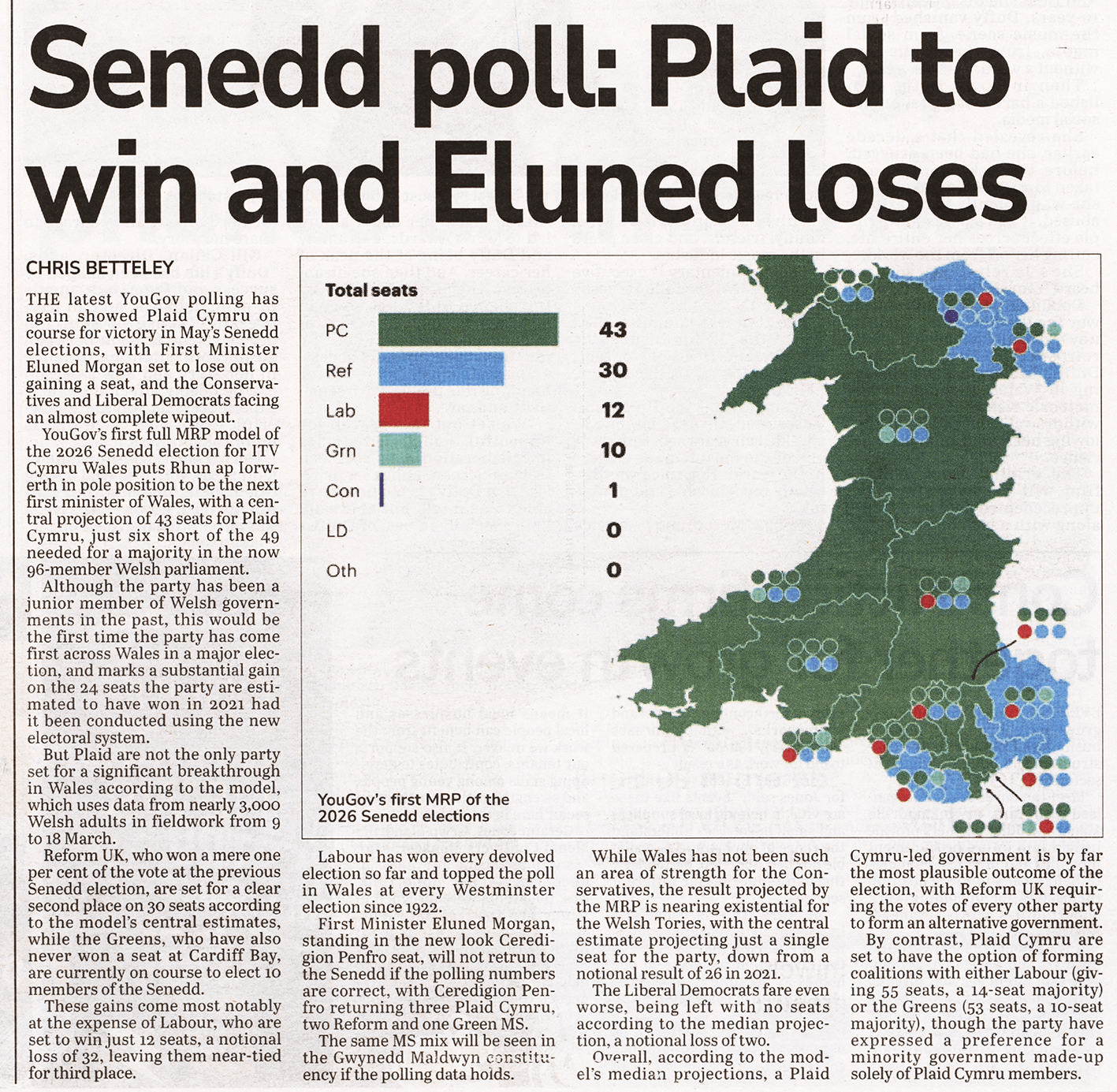
Though I have to say that’s a strange poll, also predicting the Tories will win just one seat. I’m sure it’s wrong. Certainly at variance with the poll I quoted in the previous section.

The fact is that the Liberal party started going downhill after Lloyd George, in the 1920s, which of course coincided with the rise of the Labour party. Though my paternal grandparents were still voting Liberal into the 1950s, because they saw it as the party of the chapel, the ‘Welsh’ party.

The party we know today came about following a merger in 1988 between the Liberals and the Social Democratic Party, formed by four who’d split from Labour a few years earlier. “The Gang of Four“; David Owen, Roy Jenkins, Shirley Williams and Bill Rodgers, were among the smuggest buggers you could ever wish to meet.

NICE TIE, WOY

I was once thrown out of a meeting addressed by ‘Woy’ in the Brangwyn Hall in Swansea, when he was still in Labour. Back in the late ’60s. The great man was on stage telling us that he too was Welsh; so a young Jac, in a flush of patriotic fervour (possibly influenced by beer), jumped up shouting “You’re no Welshman“.

I was then assailed by an old crow sitting behind me, who laid into me with her umbrella. A signal for the heavies to move in: “We knows ew, ew’re a trouble-maker, ew are“. And so young Jac, scarred for life by a gamp bought at Swansea market, was forcibly ejected.

Happy days!

What do the Lib Dems stand for nowadays? Your guess is as good as mine. But they’re ‘progressive’; so If Plaid needs an ally for its popular front against the far-right, Trump, climate deniers, Putin, transphobes, and other demons torturing the Globalist-Woke-left imagination, the Lib Dems will be only too glad to help.

GWLAD

I’ve saved the best ’til last. As you probably know, I had a hand in launching this party, and I’m very proud of that. But why?

Basically because I’m a Welshman, and I’ve always wanted the best for my people, and for me that meant independence. It still does. Yet I’d hoped devolution would at least improve things. But it’s been a total failure. And it’s easy to see why. In fact, I’ve explained why in my assessments of the other parties.

Every successful country needs a functioning, indigenous economy that encourages and rewards hard work, innovation, the entrepreneurial spirit. And thereby creates well-paid jobs. But for 27 years devolution has been ruined by politicians and their hangers-on who did little but make gestures and squander money in slavishly serving agendas that divide us and make us poorer.

By comparison, those running Gwlad include people who’ve started their own companies, given people jobs, and hope, and have worked all over the world. I can’t stress this enough – they come from the real world.

By which I mean they are not professional politicians.

Not like those who did politics in uni, went to work in PR, for a pressure group, or for a politician; then got elected to the Senedd thinking that running a country is nothing more than mixing with others from the same background, having debates informed by ignorance, and choosing to die on hills far away that should have no resonance in Wales.

This political clique, this Corruption Bay bubble, regards the rest of us with contempt. The ‘progressive’ parties want us to believe that about Reform. But they’re no different, not even Plaid Cymru!

Question open borders, or challenge discrimination against the indigenous Welsh, and this makes Wales “the racist capital of the UK“, says a Plaid Cymru candidate.

To believe Elin Hywel we Welsh are an evil people that needs re-educating.

But we’re not. We’re good people ruled by clowns who’ve lied to us and lied about us for too long. So on May 7 vote for candidates who don’t belong to this isolated and self-elevated political class that looks down on the rest of us.

CONCLUSION

The system being used in this election is complicated and corrupt, unlikely to be used again in any country wanting to be considered a democracy.

To start with, ‘we’ shall be electing 96 Senedd Members instead of 60 previously; in 16 huge constituencies, lumping together areas with nothing in common. For example, Swansea docks is in the same constituency as Llandrindod Wells.

Each elector will have one vote. Which means you’ll be expected to blindly vote for a party, while leaving the selection of candidates, and the order in which they’re ranked, to the party machines.

A system designed to benefit Labour and Plaid Cymru, also intended to make it very difficult for small parties and independent candidates to get elected. An affront to democracy.

And it could have been worse, for Labour was hoping to get away with not even naming candidates!

So as you walk to the polling station on May 7 remember 27 years of devolution under Labour, aided by Plaid Cymru or Lib Dems.

Remember net zero (15-minute cities and 20mph): running the NHS into the ground (while ‘decolonising’ midwifery); Covid (Drakeford believing it all and getting drunk on the power it gave him); covering the land with foreign-built wind turbines (also foreign owned and involving massive political corruption); waging war on farmers (to save the planet); welcoming the closure of Port Talbot steelworks (carbon, innit); promoting transgenderism (with the ‘Welsh Government’ being Stonewall’s biggest funder); using a film of 12-year-old girls to welcome migrants; brainwashing kids from shit-hole estates and abandoned post-industrial communities about their white privilege; and a host of other insulting imbecilities, from wanting Welsh schoolgirls to wear hijabs, to ‘decolonising’ the evil Welsh cake.

It would be masochistic to vote for Labour, Plaid Cymru, or Greens. You know what kind of dangerous nonsense bordering on evil you’ll get from them. Tories and Lib Dems are an irrelevance. And don’t vote Reform unless you’re so desperate to avoid the known failures that you’re ready to take a leap in the dark. (Or buy a knocked-off watch.)

When you reach the polling station, say to yourself, “Enough! Wales needs a fresh start, a new direction“. Then take the pencil in your hand and put a cross next to the Gwlad candidate’s name.

♦ end ♦

© Royston Jones 2026

Buy Me A Coffee

Labour And Plaid Cymru Plot To Destroy Welsh Democracy

In this post we’ll look at the proposed Senedd ‘reforms’, focusing on the closed list system, the method of counting the votes, the design of the ballot paper, and then I’ll try to explain it all.

There have been calls for many years for a bigger Senedd so that it can give better ‘scrutiny’. That may have been the original intention, but I believe other considerations came into play. And these account for the deviations from the original proposals made by the Expert Panel in 2017.

At present, we have 60 Senedd Members. One from each of our 40 Westminster constituencies, elected by first past the post; the other 20 from 5 regions, each returning four Members, these elected by the less than perfect d’Hondt system. Explained here by Labour MS Mike Hedges.

Wales’s representation at Westminster is being reduced to 32 MPs. Those controlling Senedd reform have decided to ‘pair’ these seats to give 16 huge and unwieldy constituencies each of which will elect 6 Members by the d’Hondt method.

1/ THE EXPERT PANEL

The process that brought us to this point seems to have begun with the appointment in February 2017 of an Expert Panel (EP) to look into expanding the (then) Assembly.

Click to open enlarged in separate tab

This group reported in November 2017. And among other things, suggested three possible electoral systems (p 129). These were:

Click to open enlarged in separate tab

The system favoured by the Panel was the Single Transferable Vote.

You’ll perhaps note, by it’s absence, any mention of the closed list system that has been decided upon, and is now being widely criticised.

Or rather, the closed list was mentioned, and rejected (p 128).

This EP report was studied by our esteemed tribunes, its recommendations initially accepted, before being cast aside. Not because it wasn’t a fine piece of academic work, but because, as time went on, it could not deliver changed priorities.

Making the whole EP exercise a waste of time. Unless the hope was that the public would think what politicians subsequently came up with had the imprimatur of those experts.

2/ COMMITTEE ON SENEDD ELECTORAL REFORM

The next step was the Committee on Senedd Electoral Reform, which first met in January 2020. The Committee was dissolved following a debate on its report on Wednesday 7 October 2020.

Click to open enlarged in separate tab

Here’s the Committee’s Report from September 2020, and here’s a summary of its recommendations. Note that it agrees with the Expert Panel in recommending the Single Transferable Vote.

Though it also makes a reference to “diversity quotas for protected characteristics other than gender”. I think we can guess where that’s heading.

3/ SPECIAL PURPOSE COMMITTEE ON SENEDD REFORM

Now we move on to October 2021, when a fresh Committee was established to take things forward, with Huw Irranca-Davies providing continuity.

Here are all the members. From what I can see, the only Conservative, Darren Millar, soon distanced himself. I guess he could see the direction of travel.

The remit and the committee. Click to open enlarged in separate tab

The Special Purpose Committee on Senedd Reform published its report ‘Reforming our Senedd: A stronger voice for the people of Wales’ on 30 May 2022. Here’s a link to that report. Let’s pick out a few choice bits.

In the ‘Recommendation’ (pages 9-12) two that caught my eye were . . .

Click to open enlarged in separate tab

In 14 we read that all political parties are to be ‘encouraged’ to publish “a diversity and inclusion strategy”. More ‘diversity’!

I found 17 remarkable in that it says those framing these proposals fear being referred to the Supreme Court. Suggesting that what they’re proposing may be unlawful.

Moving on to ‘Electoral System’, on page 26, where we read, solemnly inscribed: “Electoral systems are one of the fundamental building blocks of democracy”.

Too bloody right, Comrade! Let’s all remember that.

The Expert Panel’s favoured system of the Single Transferable Vote, endorsed by the Committee on Senedd Electoral Reform, was rejected by Huw Irranca-Davies and his new playmates because it, ” . . . was an unfamiliar system in Wales and that the method of translating votes into seats would be seen as complex and difficult to explain”.

In other words, electorates around the world may have got used to STV, but Welsh voters are uniquely stupid.

So why not elect three Members from each of the 32 new constituencies in the same way we elect councillors? It’s a system we twp Taffs are familiar with.

Jane Dodds (Liberal Democrat) favoured STV, so did Siân Gwenllian (Plaid Cymru), but, “in the spirit of achieving the supermajority required to deliver Senedd reform” Siân Gwenllian fell into line.

Not a whimper of dissent was heard from Elin Jones (Plaid Cymru).

So the Committee rejected the Single Transferable Vote, also the other two options  recommended by the Expert Panel. Instead, and for no obvious reason, went for what it calls, “the closed proportional list” system.

Certainly, the current method for electing our regional list MSs is a closed list, but does any country elect all its politicians by the closed list system?

When it comes to working out who gets to go to Corruption Bay the EP looked at two methods. The d’Hondt and Saint-Lagué divisor systems. The latter gives a more proportional outcome, and also gives more of a chance to smaller parties and independents.

Irranca-Davies and his friends of course plumped for the d’Hondt method.

Now we come to the most remarkable and worrying thing I encountered in all 92 pages. Scroll to page 38, and there you’ll see under ‘Ballot Papers’ . . .

Click to open enlarged in separate tab

We would anticipate . . . some of the names . . . of candidates will appear . . . “.

ALL candidates’ names on the ballot paper should be a ‘given’. That it’s even being discussed strengthens my suspicions of the true motives behind this exercise.

So, let’s recap . . .

This Committee not only rejected the voting system recommended by the Expert Panel and accepted by the Committee on Senedd Electoral Reform in favour of the closed list, it also opted for the less proportional system for allocating seats, and finally, it even suggested not naming candidates.

How the hell does this improve democracy in Wales?

Moving on . . .

4/ REFORM BILL COMMITTEE

A Reform Bill Committee was established 12 July 2023. In the panel below you can see the Committee’s remit and its members.

The role of this group was to go through the Bill that resulted from the report of The Special Purpose Committee on Electoral Reform. Making Recommendations where it felt the need.

Click to open enlarged in separate tab

The Reform Bill Committee’s report was published last month, and debated in the Senedd 30 January (No 8).

The motion: ‘To propose that Senedd Cymru in accordance with Standing Order 26.11: Agrees to the general principles of the Senedd Cymru (Members and Elections) Bill.’ was passed by 39 votes to 14. All Conservatives voted against.

It’s a weighty tome, 224 pages, and you can read it if you’re so minded. But I’ll focus on the issues I’ve already discussed, and see what, if anything, has changed.

In his Introduction, the chair, Labour’s David Rees MS, has this to say:

We have not reached consensus on all matters . . . But, we are unanimous in our concerns about the proposed closed list electoral system . . . We believe the link between voters and the Members who represent them is paramount.

We therefore urge all political parties in the Senedd to work together to ensure the electoral system in the Bill provides greater voter choice and improved accountability for future Members to their electorates.

He’s clearly not happy with the closed list. Neither is former Labour minister Lord David Blunkett. But as things stand, we’re stuck with it.

Next, I went to check on the design of the ballot paper, which Huw Irranca-Davies’s Committee had suggested need not carry the names of the candidates.

On page 105 I found what you see below. The ‘Member in charge’ is Mick Antoniw MS, Counsel General and Minister for the Constitution, who defends the recommendations of Huw Irranca-Davies’s group.

Click to open enlarged in separate tab

If the closed list is used in 2026 then it’s unlikely it will ever be changed, because those who’ve benefitted from it, and then control the Senedd, will not vote to change it.

On page 111 Antoniw is pressed as to why the Bill being presented to the Senedd does not state categorically that candidates’ names will appear on the ballot paper. He gives the mealy-mouthed reply that it didn’t need to be set out in the Bill, but the matter will be addressed in “secondary legislation“.

On page 129 David Rees makes it clear that he believes candidates’ names on ballot papers should be stipulated in the Bill itself, not left to secondary legislation . . . which may never happen:

Click to open enlarged in separate tab

In fact, a search of the published Bill for ‘ballot paper’ draws a blank.

I cannot believe that we have got this far in the passage of a ‘reform’ Bill that won’t promise candidates’ names on ballot papers.

But then, Antoniw is Zelensky’s man in Corruption Bay. And Zelensky’s not a big fan of democracy; he’s banned opposition parties and closed churches. But we’re still expected to believe that he’s fighting the Ivans in defence of democracy.

MAKING SENSE OF IT

When this process started, back in early 2017, with the appointment of the Expert Panel, there may have been a genuine intention to ‘improve democracy in Wales’.

Somewhere along the way the focus changed, it became more politicised, more partisan, and less democratic. I believe we can pinpoint when this happened. And also explain it.

It happened some time between the Committee on Senedd Electoral Reform reporting in September 2020 and the Special Purpose Committee on Senedd Reform publishing its report 30 May 2022. A year and a half in the time of Covid.

And here’s why it happened . . .

There’s a phenomenon I’ve reported on more than once and why, last June, I published, Wales: Ruled By Pressure Groups.

Pressure groups and organisations, some global, others organised on a UK-wide basis with a Welsh branch, but all pushing the Globalist holy trinity designed to destabilise and weaken the West:

  1. A climate-nature ‘crisis’ that demands a ruinous drive to net zero
  2. Constantly reminding White people how evil and privileged we are
  3. 101 genders that means men can have babies by ‘chicks with dicks’

This also explains calls to constantly lower the voting age. For children who’ve come through a school system influenced by Stonewall and other groups may be unable to read and write but they’re more likely to be suckered by a charlatan pushing the Globalist agenda.

The so-called ‘Welsh Government’ is now controlled by Agenda-loyal pressure groups. Having just mentioned Stonewall, you can see from this table that the ‘Welsh Government’, whether directly or through bodies it controls, is now that group’s largest single UK funder.

Another worrying feature that I’ve observed recently is the ‘Welsh Government’ taking over various organisations that should be independent. This is invariably achieved through funding, in the form of loans or grants, which is then used to justify ‘appointees’.

We’ve seen it across the board, from the Welsh Rugby Union and the Football Association of Wales to Bannau Brycheiniog National Park. I wrote about this dangerous trend, also last June, in ‘Taking Control, Of Everything‘.

What we see happening with the subverting of the Senedd reform process is a synthesis between the growing power of pressure groups and the increasing control freakery of a Labour party wholly committed to the Globalist agenda.

It will give Labour bosses control over the electoral system, and Senedd seats for pressure group parasitoids. Making the Senedd less representative because it will have more Members for whom the interests of Wales will be largely irrelevant.

It will also give the Senedd a near-permanent left / far left majority.

The only way to achieve a Senedd that works solely in the the interests of Labour and its rural variant (Plaid Cymru) is through a closed and anonymised list system.

Such a system also makes Plaid Cymru more of a hostage than a partner.

CONCLUSION & RECOMMENDATION

Until I started flicking through the various reports and other documentation I hadn’t fully appreciated how corrupted and dangerous the ‘reform’ plan had become.

Ask yourself – would anyone believe that in a European democracy in 2024 politicians could seriously propose closed list elections that are also anonymised?

Try not to laugh. Click to open enlarged in separate tab

Why recruit an Expert Panel and then reject all three of its proposals for organising elections? And then, after comparing the d’Hondt and Saint-Lagué divisor systems, why choose the one that’s less proportional?

The answer is obvious, and so I repeat – these ‘reforms’ are not to make Wales more democratic, or provide ‘greater scrutiny’. They’re intended to give the leftist political class total control through an electoral system that can almost ignore the wishes of the people.

It’s a very obvious power grab. 

Power to serve The Agenda, that will demand the end of farming; 10mph (or no traffic at all to allow for daily Pride parades); 15-minute ghettoes; butchering confused 12-year-olds on the NHS; re-writing history; more foreign-owned wind farms; ‘inclusivity’ that will exclude most Welsh people, etc., etc.

While away from the noise of articulated idiocies and the din of clashing egos, out ‘there’, in the real Wales, people die in ambulances outside hospitals, and kids go hungry.

What has been stitched up by Labour and Plaid Cymru is so obviously anti-democratic, bordering on the dangerous, that it must be fought all the way.

To the Supreme Court, if necessary.

♦ end ♦

© Royston Jones 2024

Wales, Where Democracy Came To Die

If the title strikes you as over-stated, just hold your judgement until you’ve read what I have to say. And if you still disagree with me, then you can claim your refund from the Reimbursements Unit of the Finance Department at Jac Towers.

Seeing as last week’s offering was a little long, at over 3,000 words (and there were complaints!), I’ll try to make up for my previous verbosity with this shorter piece.

TON UP LABOUR

Last year Labour celebrated a century of being the political party sending the most MPs from Wales to Westminster.

Since the advent of devolved government in 1999 it’s been a similar picture in the Senedd (formerly Assembly), with Labour always the largest party.

According to Professor Richard Wyn Jones of Cardiff University this makes Labour in Wales “the most successful party in the democratic world”. But he can only be right if ‘success’ is judged solely on electoral victories.

Because if we gauge success by making life better for people, or by improving a country, then it’s a different story.

Because since we’ve had devolution Wales has fallen behind the other countries of the UK in economic performance and in education; our health service is falling apart, and our standing-room-only, no refreshments, blocked toilets trains would shame a third world country.

On top of which, money is diverted to lunatic schemes while essential services suffer.

At the most recent elections, in May 2021, Labour won 30 of the 60 Senedd seats, all of them in the south and the north east, with 39.9% of the vote, an increase of 5.2% points on 2016.

Click to open enlarged in separate tab

But that was from a turnout of just 46.6% (which was still an increase of 1.2% on 2021.) In 2003 the turnout went as low as 38.2%, and in 2011 it was just 42.2%

Which means that in the 2021 Senedd elections Labour gained the support 18.6% of those eligible to vote. But thanks to an electoral system favouring the largest party Labour took half the seats, and further strengthened its grip through an alliance with Plaid Cymru, a party that has become almost a Labour subsidiary.

A control that Labour now intends to make permanent. Partly through taking over national institutions and other bodies, partly through introducing a new electoral system that will favour Labour even more.

More on the first tactic in the next section, more on the vote rigging later.

TENTACLES

Over the years I’ve explained how Labour holds onto power through the use of lobbyists, a tame media, opposition parties incapable of mounting effective opposition, crony-run third sector organisations and other bodies the ‘Welsh Government’ funds to tell it what it wants to hear.

Recently, I published ‘Wales: Ruled By Pressure Groups‘ (12.06.2023) in which I gave examples of the influence exerted over our tribunes by outfits like Extinction Rebellion, 20’s Plenty for Us, WWF, Friends of the Earth and Sustrans.

The advantage of this relationship for the ‘Welsh Government’ is that it can quote these organisations as “experts“, in order to push on with plans and projects that had already been mutually agreed.

These groups are international in nature, or just English. But they send somebody down to Cardiff, rent a cupboard, stick ‘Cymru’ in the name, and pretend to be Welsh – with our best interests at heart!

I followed up that piece on pressure groups with ‘Taking Control, Of Everything‘ (19.06.2023) where I outlined my observations that the ‘Welsh Government’ also seems to be taking over a number of national institutions and other bodies.

Referring to recent events at the Welsh Rugby Union I wrote:

After creating what was reported by a loyal media as “turmoil” in our sporting bodies the ‘Welsh Government’, with the help of certain individuals ‘on the inside’, was able to engineer a situation that saw people parachuted in who are dependent on ‘Welsh Government’ patronage.

If I had to link the two pieces I would say that this is straight out of the World Economic Forum playbook. The WEF invents or exacerbates problems in order to capitalise on them and offer solutions; then, through this deception, exercise control.

The big WEF threat of recent decades has of course been climate hysteria which, because it’s global, can be used in attempts to control human behaviour around the world. Of course, there is no climate crisis. But it serves its purpose.

When you realise that the WEF grew out of the Club of Rome then this section from a 1991 CoR publication, ‘The First Global Revolution‘, makes perfect sense.

Click to open enlarged in separate tab

Other than partnerships with pressure groups and taking over national bodies the ‘Welsh Government’ tries to extend its reach and enhance its credibility in other ways, too many to list here.

We’ve seen how the ‘Welsh Government’ pretends it’s been ‘advised by pressure groups and other bodies it’s in cahoots with, but this deception extends to bodies it has itself created, such as the Welsh Youth Parliament.

Now don’t get me wrong, I’ve got nothing against listening to kids, I’ve got teenage grandchildren. But how much weight are we supposed to give to the views of children with no experience of life, who’ve been brainwashed by an education system influenced nowadays by people some of whom are unsavoury and some of whom are positively dangerous?

Again, it’s a case of, “I’m listening . . . but only if you tell me what I want to hear”.

The most recent example of controlling the narrative was the announcement that the ‘Welsh Government’ will fund a journalist to cover proceedings in the Senedd. This reporter will of course be totally independent.

Are we really expected to believe that?

Click to open in separate tab

It’s as if those who inhabit the Bay bubble have become so self-engrossed, and so dismissive of opinions outside their little world, that they’ve lost all sense of reality.

FIXING THE ODDS

Since the inception of devolution in 1999 we’ve heard politicians say that with just 60 members the Assembly / Senedd is too small to do its job properly. An argument not without merit.

These voices have got louder as Corruption Bay gained more powers, which admittedly makes the case stronger for having more members.

Things are now coming to a head.

Before I start explaining this, let me say that I can only hope I’ve got all the details right, because the subject is not easy to follow on the ‘Welsh Government’ website, and I don’t think the media has given it the attention it deserves.

I’m referring to the plan to increase the number of Senedd Members, but more importantly, the way it’s proposed this should be done.

Let’s start May 10 last year, with the announcement that first minister Mark Drakeford and Plaid Cymru leader Adam Price had agreed on major changes. These were . . .

The Senedd should have 96 members. Elected from 16 constituencies, these achieved by ‘pairing’ the 32 new Westminster seats; with each one electing 6 MSs by the “closed proportional lists” system. These changes should in place for the 2026 Senedd elections.

The 32 new Westminster constituencies that it’s proposed to ‘pair’ for the 2026 Senedd elections. Click to open enlarged in separate tab

This may have been agreed by Drakeford and Price, but few others were in favour.

For example, even before publication of the report by the Special Purpose Committee on Senedd Reform the body had lost one member in Tory Robin Millar, who’d resigned. As you’ll read, he wasn’t the only one unhappy with what Labour and Plaid had come up with.

The report itself concedes (page 37 [86]) . . .

The Expert Panel previously noted that higher district magnitudes create greater potential for proportionality, and that if constituencies become too big, it can result in ‘hyperproportionality.’35 Hyperproportionality describes the circumstance whereby a party that gained a very low level of public support nevertheless secures seats in the legislature- and thereby the legitimacy of elected platform

But these misgivings were dismissed. Of course they were!

The Electoral Reform Society commented:

While there are positive elements of this deal, there are also those that require further thought . . . concerns remain about the use of closed lists due to the lack of choice voters will have. This system was rejected by the Expert Panel on Assembly Electoral Reform who said it left “No choice for voters between individual candidates” and “No accountability for individual Members directly to voters”.

The decision to use the D’Hondt method of allocating votes also threatens the proportionality of this new system, by creating a high bar for smaller parties to reach to ensure representation and see members elected. The use of D’Hondt is likely to make the end result only as proportional or even slightly less than the current system.

And, finally, Professor Laura McAllister, who is co-chair of the Independent Commission on the Constitutional Future of Wales, and previously chaired the Assembly Expert Panel on Electoral Reform, referred to above.

Her piece on The Constitution Unit Blog was headlined: ‘Wales needs a larger Senedd, but a closed list system is not the best way to achieve it‘.

The concerns are over the “closed proportional lists“, which are not proportional. In each of the 16 mega-constituencies voters will be offered a list of six candidates for each party. You will vote for the party, and get all six candidates.

The Electoral Reform Society warned that the proposed system is, “likely to make the end result only as proportional or even slightly less than the current system”. What this means in practice is that Labour could win a majority of the seats with an even smaller percentage of the vote than it achieved in the 2021 Senedd elections.

A combination of clever pairing coupled with the loss of regional seats could see the Conservatives almost wiped out.

Let’s call it what it is – it’s a stitch-up. I can understand Labour doing it, because this is how Labour has always operated; but Plaid Cymru have done themselves serious damage by going along with this corruption.

I’m dealing with it now because the Senedd is scheduled to vote on the proposals some time between now and September.

UPDATE 08.07.2023: This may be more complicated than I thought. But still designed to benefit Labour. A comment suggests that the six seats can be divided between different parties. Which means that a party winning 50% of the vote would get 3 seats. But what it also means is that there is a 16.6% threshold before a party can win a single seat. Which will of course rule out smaller parties.

UPDATE 09.07.2023: A further comment tells us there is to be an element of proportionality in the proposed system, “Within the super constituency, whichever party tops the poll gets the first seat, their vote then halved and whichever party is then top gets the second etc etc until all six are allocated”.

I begin to understand why we’ve had so little discussion – there may be few people who understand what’s being proposed. (I’m certainly sorry I started down this road.)

CONCLUSION

Devolution was sold to us as “bringing democracy closer to the people of Wales“. And indeed it could have done exactly that. But the Labour party in Wales is not very good at democracy; it never has been.

Labour in Wales has always been about power, patronage, and corruption. And because Labour has controlled devolved politics since 1999 not only have we seen our economy decline, our educational standards drop, and our NHS collapse, we’ve also seen a gradual erosion of democracy and accountability.

Despite what you’ve read some might still think I’m over-egging it by linking the World Economic Form with the Labour party, Extinction Rebellion and the rest, but hear me out.

What we see increasingly in Wales, at every level, and also across the globe, is the implementation of agendas without a democratic mandate or, in most cases, even public consultation.

After decades of grooming and influencing political leaders from across the Western world the WEF may be the most influential body on Earth. But do you remember ever voting for Klaus Schwab and the rest?

Similarly with the World Heath Organisation, an unelected body that has taken on itself the power to impose lock-downs and travel restrictions on individual countries, or the entire world. And this can be done for political as much as health reasons.

Click to open enlarged in separate tab

The ‘Welsh Government’ has an unconvincing mandate at the moment, but it wants to introduce an electoral system that is clearly intended to give the Labour party more power with even less support.

And then we complete the circle with the Green-Woke-Left pressure groups, most of them now funded by leading players at the WEF to ensure administrations follow the WEF agenda.

Where do you figure in all this? Where and when are your views asked for?

For Wales to be a prosperous, healthy country, and progressive in the true sense of the word, the people must have faith in those running the country, and the processes that put them in power, while also believing that the interests of Wales are being served, not those of swivel-eyed strangers imposing their damaging agendas.

That dream can never be realised as long as Labour uses a corrupt electoral system and other tactics to pursue what begins to look like a form of totalitarian control.

♦ end ♦

Elections, May 2021

PLEASE APPRECIATE THAT I GET SENT MORE INFORMATION AND LEADS THAN I CAN USE. I TRY TO RESPOND TO EVERYONE WHO CONTACTS ME BUT I CANNOT POSSIBLY USE EVERY BIT OF INFORMATION I’M SENT. DIOLCH YN FAWR

The next elections for the Welsh Parliament are just over six months away; so this week I’m taking a break from crooks, money-launderers, con men, enviroshysters, third sector leeches to focus on politicians.

Reading that, the cynics among you will say, “So no great change there, then, Jac!”.

How dare you be so disrespectful of our tribunes! Go stand in the corner!

THE 2016 RESULT

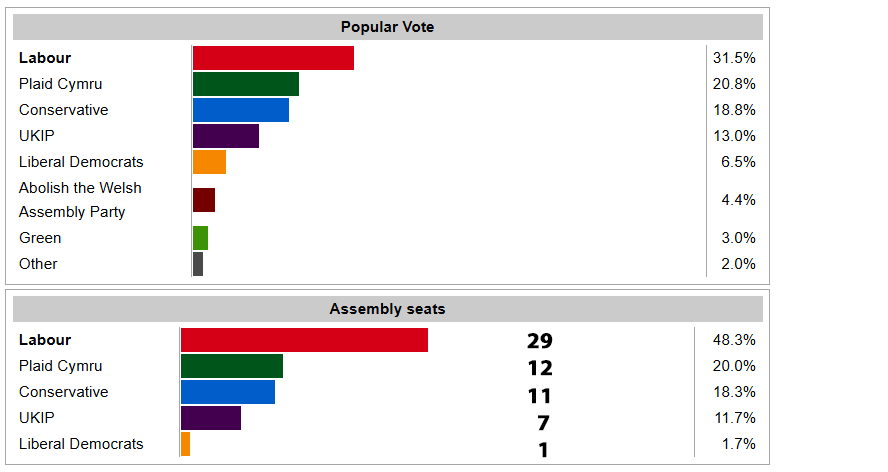
Let’s start by reminding ourselves of the overall result from the previous election in 2016.

‘Abolish the Welsh’ refers to the Abolish the Welsh Assembly Party, a harmless bunch of anti-Welsh cranks not a gang of loonies bent on genocide. Well not yet, anyway. Click to enlarge

The first thing you might notice is that despite these elections being organised under a system of proportional representation the result, certainly for Labour, the biggest party, gives an outcome not a lot different to first past the post.

You’ll also see that the main challengers get seats roughly in line with their share of the vote, with the smaller parties generally losing out. It’s a system designed to protect the Labour-dominated status quo in Wales, while also stifling ‘insurgent’ parties.

This system has worked to perfection in Wales because the Conservatives are unlikely to ever gain a majority of seats. And when Labour fails to get a majority then Plaid Cymru or the Liberal Democrats will always be there to help.

After the 2016 election Labour went into coalition with the sole Liberal Democrat AM. Which meant that parties with a total of 38% of the vote were able to form an administration.

Is this really how PR is supposed to work?

THE LABOUR PARTY

At the risk of sounding uncharitable, the great thing the Labour Party has had going for it is . . . not being the Conservative Party. The advertising campaigns, the policy drafting, the tub-thumping and the sloganising could all have been ignored in favour of the simple message – ‘Vote for us, cos we’re not the Tories’.

And it’s worked, for almost a century.

In England, the decline of traditional industries, and their associated trade unions, have weakened the Labour Party. Labour in Scotland suffered the same problem, exacerbated by the rise of the Scottish National Party to the point where Labour is hanging on for dear life, with just one Westminster MP left.

In Wales, Labour has fared better because we’ve been spared the corrupting influence of prosperity, and also because there is no equivalent of the SNP. Of course, Plaid Cymru likes to view itself as the Welsh SNP but the SNP set out to destroy the Labour Party in Scotland whereas Plaid Cymru seeks to keep its Welsh branch alive and in power.

How Labour will do next May depends to a considerable extent on perceptions of the Conservative government in London. For while Scotland has a vigorous national media allowing elections to be influenced by Scottish issues, the absence of a Welsh media worthy of the name means that here we tend see Englandandwales elections.

The exception being perhaps areas with high numbers of Welsh speakers who are less reliant on news from London.

On issues of the day, there is a general and widespread belief that the self-styled ‘Welsh Government’ has handled the Covid-19 pandemic better than Johnson, Hancock, Jenrick and the rest of the gang up in London.

But then, being seen as less incompetent than that crew is no great achievement.

When we address purely Welsh issues, it’s difficult to think of anything Labour has to crow about. For Wales continues to fall behind other countries in areas like wealth, health, housing and education.

Cardiff seems to be prospering but away from the Lesser Wen the country can be divided into post-industrial areas experiencing managed decline and rural areas undergoing engineered population change from Welsh to English.

Labour leader, Mark Drakeford, is less oleaginous than his predecessor, Carwyn Jones, but still a difficult man to like. Despite the Brownie points gained for Covid-19 there remain plenty of bear traps for him to negotiate between here and next May.

By any criteria one cares to apply, Labour has been a failure since 2016. Labour has failed Wales since the dawn of devolution in 1999. But for the reasons I’ve given, Labour will still emerge as the largest single party, with around 30% of the vote.

But well short of a majority of seats.

If nothing else, such a result should increase calls for more Senedd Members and a system of true proportional representation.

THE CONSERVATIVE AND UNIONIST PARTY (CUP)

The last few years have been a series of peaks and troughs for the CUP, with Brexit almost tearing the party apart under Theresa May. Things took a turn for the better when Boris Johnson became party leader and won a famous victory in December . . . since when it’s been downhill again.

In last December’s election the Tories won a number of seats in the north, most notably, Wrexham, held by Labour since 1931. But the overall vote in Wales only increased by 2.5%. The real story was that Jeremy Corbyn’s Labour Party saw its Welsh vote go down by 8%.

Things have not gone well for the CUP since that December election for all sorts of reasons. Such as a number of the new intake being pretty odious specimens.

The new MP for Ynys Môn, Virginia Crosby, has appeared on this blog a number of times, usually defending her colleague and MP for Rossendale and Darwen, Jake Berry. Berry owns properties around Rhoscolyn and earlier this year people were asking if he was breaking lockdown restrictions to travel between his Welsh properties, his London home, and his constituency.

Then Delyn MP Rob Roberts got into trouble for asking young staffers to “fool around with him”. While Wrexham new girl, Sarah Atherton, wondered why the military weren’t dealing with the refugee/migrant boats crossing from France.

While old favourites like Alun Cairns, the MP for the Vale of Glamorgan, continue to amaze with their talent for finding little sidelines to supplement their meagre incomes.

The situation does not look like improving for the Tories, for two main reasons.

Let’s look first at Covid-19. As I said in the previous section, the Conservative government in London has had a disastrous pandemic: incompetence, lies, contracts to cronies, it’s all there, and this will be remembered next May.

As if that wasn’t bad enough, the Tories seem determined to alienate even more people by insisting that the ‘Welsh Government’ is being anti-English when – for perhaps the first time ever – it prioritises the interests of Wales.

That’s certainly what was said by Secretary of State for Wales, Simon Hart, and Alun Cairns. Which makes them either complete bell-ends or calculating politicians.

I believe it’s the latter, because in spouting this nonsense, the Tories are playing to a particular gallery. I’m thinking now of the anti-Welsh, gammony element that might otherwise be seduced by the growing number of splinter group parties on the BritNat fringe. (I’ll come to them later.)

The other problem of their own making is, again, Brexit. Of course Wales voted for Brexit, but I’m sure very few of us voted for privatising the NHS, chlorinated chicken, and undermining the Welsh farming industry. I certainly didn’t.

But it’s now become clear that a No Deal Brexit was always the favoured option for the CUP leadership in London. Which will mean the City of London remains at the centre of the biggest money-laundering network in the world; the NHS is opened up to US Big Pharma; and we have to get used to food products from the USA, where standards in both hygiene and animal welfare are more ‘relaxed’.

All the Welsh CUP MPs voted for this deal. Which is not clever for people representing constituencies with large numbers of farmers . . . and their extended families . . . and contractors to the industry, and so many others who rely to a greater or lesser degree on agriculture for their livelihoods.

There will be a price to pay next May for the coronavirus cock-ups and the shafting of our farmers. And while the Tories in Corruption Bay weren’t responsible, it’ll be some of them who’ll pay the price.

Other factors working against the Conservatives will be the Englandandwales media/election paradigm and the Vera Lynn Fan Clubs competing for regional votes.

For all these reasons I expect the CUP representation in the Welsh Parliament to fall.

PLAID CYMRU THE PARTY OF WALES

Although Plaid Cymru won 12 seats in 2016 the party is now down to 10. Lord Elis Thomas, the constituency member for Dwyfor Meirionnydd, left to become a Labour-supporting Independent; and Neil McEvoy, the regional AM for South Wales Central, left to sit as an Independent before forming the Welsh National Party (WNP).

A further change since 2016 is that Plaid Cymru also has a new leader in Adam Price. Perhaps the best thing that can be said about him is that he’s not former leader, Leanne Wood.

For most Welsh voters Plaid Cymru is the party of Welsh independence, but as I’ve argued, Plaid Cymru is a party that sought more autonomy for Wales, more funding for Wales, and the creation of a new class of politicians and administrators made up of . . . well, the kind of people who populate the upper echelons of Plaid Cymru.

This was to be a system that created a new class that Djilas would have recognised enjoying prestige and influence without the responsibility of having to fund it. Devolution, with a bit more power, many more sinecures, and lots more money, is the end of the line.

Plaid Cymru was always Cymru Fydd resurrected, not a Welsh Sinn Féin. Until, that is, it moved to the left in the 1980s and really screwed itself up. Enjoying only a brief period of coherence under the leadership of Dafydd Wigley and the first Assembly elections in 1999.

Today we again see a schizophrenic party where Welsh-speaking social conservatives from the rural heartlands mix uncomfortably with some real oddballs and a few with views that should have denied them membership.

Plaid Cymru is today one of those confused leftist parties that is vehemently opposed to intolerance . . . except when it’s those it approves of being intolerant.

As a leftist party Plaid Cymru believes that, thanks to the capitalist system, we’re either going to fry due to global warming, or else we’re going to drown from rising sea levels, so Wales must play its part in trying to avert these outcomes.

In practice, that means supporting wind turbines that create no jobs and simply exploit Wales. Where profits flow to a City hedge fund, or a multinational, or a state-owned energy company from Scandinavia.

Except on issues that are largely irrelevant to Wales – where Plaid Cymru can play gesture politics – the party comes across as weak and indecisive. Take holiday homes. Plaid talks the talk but it won’t walk the walk.

At present Welsh local authorities can impose a council tax surcharge on holiday homes up to 100%. The only council that levies the 100% is Labour-controlled Swansea. (And despite what you might think, there are many holiday homes on the waterfront, in Mumbles, and of course around Gower.)

Independent-run Powys recently voted to impose a surcharge of 75%.

But Gwynedd, where Plaid Cymru is in control, imposes only a 50% surcharge. It’s a similar picture in Ceredigion and Carmarthenshire.

On independence, Plaid Cymru has been outflanked and overtaken by Yes Cymru. While on the party political front there are two new challengers in the form of Gwlad and the Welsh National Party (WNP). Both are unequivocal about prioritising Welsh interests, and are fully committed to achieving independence.

So you really have to wonder what Plaid Cymru stands for nowadays, and where it’s going. That’s certainly what Welsh voters will be doing in May. Many will conclude that Plaid Cymru has hit the buffers.

Which certainly seems to be the case.

For while opinion polls tell us that more and more people are prepared to consider independence, those same polls show little or no increase in support for Plaid Cymru. Recent polls show 51% of Labour voters prepared to consider independence, but only 71% of Plaid Cymru voters!

What’s going wrong for Plaid Cymru?

In a nutshell, Plaid Cymru believes that the only acceptable vision of independence must be well to the left of centre, pro EU, in favour of open borders, anti Trump, and dragging a whole baggage train of ishoo-of-the-month idiocies that turn off most voters.

Dogmatic to the point of being unelectable.

Plaid Cymru always failed to engage with the urban, anglophone population. After the disappointment of Brexit, the success of the Brexit Party (winning the May 2019 EU elections in Wales and the UK), and BoJo’s victory last December, many in Plaid Cymru – like the US Democrats – have given up trying to win over stupid, racist, poor whites.

They find it preferable to retreat into their cocoons of progressive self-righteousness in the echo chamber of social media.

Which is why I believe Plaid Cymru will lose Ceredigion and also end up with fewer Members from the regional lists.

LIBERAL DEMOCRATS

There’s a temptation to be very unkind in this section . . . but it’s not in my nature to put the boot in when somebody’s down. And boy! are the Liberal Democrats down.

Down to a single Member, Kirsty Williams, the constituency MS for Brecon and Radnorshire. After the debacle of 2016 Ms Williams threw in her lot with Labour and became Minister for Education. You probably haven’t noticed.

It’s an amazing decline for the party of David Lloyd George, but entirely predictable when we consider the quality of leaders and representatives in recent years at both Welsh and UK level. I’m not sure if Ms Williams holds group meetings with herself but I’m sure she will have thought the same thing many a time.

And yet, despite currently being down to a solitary representative, the Liberal Democrats could be the big winners in May next year.

As I’ve suggested, the CUP has pissed off a lot of people, and most certainly a lot of farmers. Few will know that better than Kirsty Williams, a farmer’s wife.

Obviously, I’m not privy to what goes on at Welsh Liberal Democrat Party meetings (I can never find the telephone kiosk!) but I’m sure Kirsty Williams has hopes for the seats of Montgomeryshire to the north and Ceredigion to the west. (If the students in Aber’ and Lampeter have forgiven the Lib Dems for reneging on tuition fees.)

So I’m predicting that the Liberal Democrats could double, or even treble, their representation in May 2021. These are the three constituencies mentioned, and there might even be a regional list seat.

VERA LYNN FAN CLUBS

This is where it gets tricky, because the landscape on the BritNat right is forever shifting. Hardly surprising when we look at the personalities involved, and realise how many of them are often described as ‘interesting’, or ‘eccentric’ (code for ‘absolute nutter’).

Back in 2016, the big winner among this section of the electorate was UKIP, with 13% of the vote and seven seats. The Abolish the Welsh Assembly Party did not stand constituency candidates and got just 4.4% of the regional vote (which was still more than the share won by the Green Party of Englandandwales).

Since 2016 UKIP has had eight or nine UK leaders, numerous resignations, and in Corruption Bay is now reduced to the solitary – but dapper – form of Neil Hamilton. In fact, I’m not sure if Neil Hamilton isn’t the current party leader. Or was that last month?

Not so long ago the Abolish lot was the fringe of a fringe, but now it boasts two Members of the Senedd, Gareth Bennett and Mark Reckless. Though you’ve gotta be pretty desperate to boast about those two.

Others who were returned under the banner of British exceptionalism were Nathan Gill, Michelle Brown, David Rowlands and Caroline Jones. Following his resignation in 2018 Gill was replaced by Mandy Jones. Michelle Brown now sits as an Independent.

I would have loved to have been a fly on the wall at those UKIP meetings because by comparison ferrets in a sack are models of harmony and co-existence.

The most recent development is that Rowlands and the Jones women have formed a new group, the Independent Alliance for Reform. And if that name doesn’t stir something deep inside you – other than wind – then you are beyond hope.

It is obviously designed to be interchangeable with or to complement Aux barricades!

And all the while, in the wings, observing, is Nigel Farage. Will his Reform Party put in a late appearance, or will it be the promised relaunch of the Brexit Party? Though with Brexit almost done what would be the platform?

For let us remember that the Assembly elections of May 2016 were held just ahead of the EU referendum and were almost overshadowed by it. This propinquity benefited Ukip.

One thing’s for sure, if all the parties we’ve looked at in this section fight all the seats then we’ll be royally entertained by the stars they’ll recruit from Wetherspoons and other squelchy underfoot salons. A goodly number of whom will have to withdraw before the election after saying or doing something really stupid.

The BritNat right has no hope of a constituency seat, so hopes rest on the regional lists. Which means that a lot will depend on whether they fight each other or come to some arrangement.

I suspect there are still enough “Brexit means Brexit” types out there to win 3 seats.

THE SERIOUS ABOUT WALES PARTIES

Looking around Wales and seeing the mess this country is in is painful enough, but when you realise that none of the existing parties offers any hope of meaningful change, then new parties will be formed.

And that’s exactly what’s happened; and why we have Gwlad and the WNP.

I am a member of Gwlad and played a small part in its creation, but it was easy for me to withdraw to the blogosphere because the party is in such capable hands.

I like to think that Gwlad combines patriotism with pragmatism. For example, in believing that relying on handouts from London, as Labour and Plaid Cymru prefer, only perpetuates the misconception that Wales could never stand on her own two feet economically.

There are radical yet practical proposals across the board. We’ve already touched on Plaid Cymru’s fear of upsetting second home owners – a number in their own ranks – with meaningful levels of council tax; well, Gwlad does not hesitate to demand a 500% council tax surcharge.

It’s all here in the Manifesto for 2021.

Predictably, the criticism levelled against Gwlad by Plaid Cymru is that we shall “split the nationalist vote”. This is nonsense, because Plaid Cymru has already split – or certainly, limited – the nationalist vote by its inflexible and off-putting socialism.

This is borne out in recent elections and in even more so in recent opinion polls.

What Gwlad will do is reach out to those who want, or would be prepared to consider, independence, but could never vote for a hard-line socialist party also lumbered with the tag of still being a party only for Welsh speakers.

Gwlad could come through a crowded field to win a constituency seat and should certainly collect 3 or 4 regional list seats.

Of course, I’ve met Neil McEvoy a few times and we exchange the occasional e-mail, Wales is a small country after all. But I really don’t know much about his new party beyond what I read in the media.

Though I do know a few others involved with the WNP.

Over the years I’ve sunk a few pints with Councillor Keith Parry . . . and I’m still haunted by a car journey one very rainy night as I tried to concentrate on the road ahead while my mate and Keith’s Jewish wife argued over the Israeli-Palestinian conundrum.

I feared it was all going to end in a fight and a fireball car crash. Phew!

Many observers try to say that Neil McEvoy only took the course he did in forming the WNP because he was effectively thrown out of Plaid Cymru. They couldn’t be more wrong.

Neil has been in politics a long time, and he knows what’s wrong with Wales. On one level it’s London’s political, economic and cultural stranglehold, but on the local level it’s the Labour Party and Plaid Cymru.

Labour holds power on local councils and in the Senedd . . . simply to be in power; to stop someone else getting the salaries and the expenses, attending the bun-fights and the jollies. Labour has little intention – and no real incentive – to improve the lives of our people because for a century it has capitalised on Wales’ deprivation.

Plaid Cymru, as I’ve said, is a party of gestures and abstractions. It is the twenty-first century political equivalent of those medieval divines who would argue over how many angels could dance on the head of a pin.

But actually doing anything? Forget it!

But if one of his constituents persuades him they’re getting a raw deal, then Neil McEvoy will take up the case and demand something be done about it. And he sometimes ruffles feathers doing it. But if kids are sharing a bedroom with rats, or there’s water rippling down the kitchen wall . . .

Neil McEvoy is a do-er, a man who believes in the direct approach; and that makes the anguished attitudinisers of Plaid Cymru very nervous. And never more so than when he confronts the Labour Party.

On two major issues, the ‘nuclear mud’ being dumped off Cardiff, and the forged signatures on cladding certificates, Plaid Cymru has behaved abominably. None worse than Llywydd Elin Jones. But she couldn’t have behaved as she did without the backing of Labour and Plaid Cymru.

Sticking it to the man may outrage the sensitive flowers of Plaid Cymru but it goes down well with real people, on the streets of Cardiff, and elsewhere in Wales. People want their problems solved, they do not want to be patronised, or taken for granted, by an aloof and self-serving political class.

The big test will come in the constituency seat of Cardiff West, where McEvoy will be standing against First Minister Drakeford. Plaid Cymru will of course be splitting the nationalist vote in the hope of securing victory for Mark Drakeford.

Neil McEvoy’s street cred and his sheer hard work might win Cardiff West next May, plus a couple of regional list seats.

My very personal belief is that Gwlad and the WNP should not get in each other’s way next May. Neither has the strength yet to fight a full national election so it’s in their interests, and more importantly, it’s in Wales’s interests, for there to be some kind of deal.

FINAL THOUGHTS

I obviously can’t account for all those who might be standing next May, there’s bound to be a wild card or two. But what you’ve just read is how I see it panning out.

Other factors will I’m sure influence voters. Perhaps the UK government’s Internal Markets Bill; supposedly about ‘repatriating’ powers from the EU but which, in reality, gives BoJo’s gang the power to trample all over devolution.

Perhaps it will even be used to challenge the 1707 Act of Union.

More specific to Wales is a growing awareness of and dislike for the chumminess of Cardiff Bay. The air of cronyism and unaccountability exemplified by Labour and Plaid Cymru refusing to bring in a register of lobbyists.

The problem in this area is obvious, but there are always excuses for doing nothing. This is because Labour and Plaid Cymru are too close to those who might be held to account by such legislation.

Another issue that might influence some voters to take a punt on a new party is the widespread perception that Cardiff gets everything. Which doesn’t change when an MS goes to Cardiff promising to speak up for his area . . . only to be sucked into the swamp that is Corruption Bay.

But perhaps we should remember Harold Macmillan’s response when asked what was most likely to influence or derail political plans. Supermac is said to have replied: “Events, dear boy, events.”

In other words, that which cannot be foreseen. Six months is a very long time in politics.

♦ end ♦