Who Ya Gonna Vote For?

Well, we’re almost there. Thank God! Because this has been the most uninspiring and negative election in the history of devolution.

Never have so many deadbeats, activists posing as ‘journalists’, party hacks, and nut-jobs, wasted their time trying to rouse a people who’ve just lost interest.

RUNNERS AND RIDERS IN HEAVY GOING

This election was doomed to be uninspiring and confusing once Labour rigged the voting system. (Almost certainly with the connivance of Plaid Cymru.) It’s a party list system that no one understands, contested in 16 vast and insane constituencies.

An affront to democracy.

I detailed the various stages of the process just over two years ago in Senedd Cymru (Electoral Candidate Lists) Bill, explaining how better and fairer voting systems were rejected in order to arrive at today’s abomination.

For one thing, it’s designed to make life as difficult as possible for smaller parties and independent candidates. Jac Larner of Cardiff University calculates the system imposes a threshold of 14% before a party can hope to win a seat.
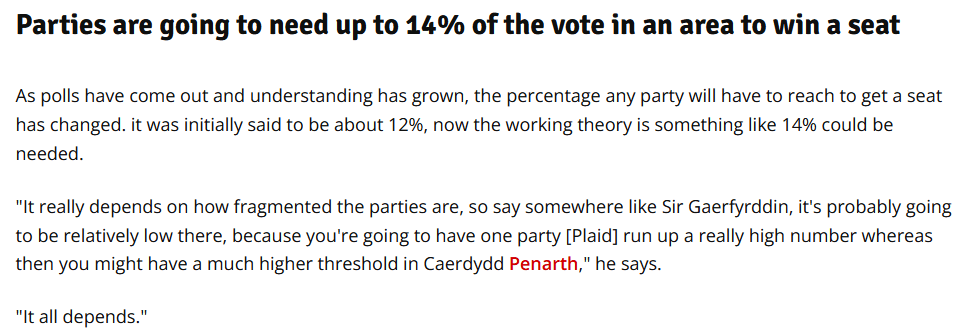
Given the quality of the debate, and the paucity of credible candidates, the election has been uninspiring. But this is to be expected. If a Senedd of just 60 Members attracts only people who’d struggle to run a stall at a village fete, what hope is there of improving the quality when the numbers are increased by over 50%?

And this couples with the negativity I also referred to in the intro. The Globalist Uniparty, the self-styled ‘progressives’, Labour, Plaid Cymru, Greens, Lib Dems, have had little to say beyond – Stop Reform!

There has been nothing positive on offer. Certainly no inspiring vision for the future. But this is only to be expected. Because with the exception of the Greens these are the parties that have failed Wales for 27 years of devolution.

Adding the Greens to the mix – and a potential coalition with Plaid – only offers something worse. While the other components of the Uniparty promise more of the same, the Greens want to double down on the mistakes of the past 27 years, and force on us new ones.

It’s also been a very ‘British’ campaign in that Welsh issues have been crowded out. For the London media has tended to lump the Senedd elections in with the Scottish Parliament and English local authority elections.

Their focus has been London-centric in debating whether Starmer will survive bad results “across the UK“. Treating May 7 almost as a general election, or a vote of confidence in the Labour party in Westminster.

And yet, this neglect of Welsh issues serves the interests of some parties. Plaid Cymru, for example, can blame Labour for the mess Wales is in, while claiming a vote for them is also a vote against the most unpopular PM ever.

Ironically, this is Labour’s old election tactic of urging punters to, “Send a message to London“. Which is what many will be doing, but now it’s working against Labour.

Reform can neglect Wales to focus on the issues that figure with the mainstream media and social media; small boat migrants, net zero, anti-Semitism, high taxes, benefit payments, knife crime, etc. Giving out mixed messages about their attitude towards devolution doesn’t do them any harm either.

The Greens have the advantage of being an unknown quantity, something different. But the Greens are universally and correctly described as ‘the Watermelon Party’. Green on the outside, red on the inside. And now attracting Islamist support.

Plaid Cymru has also been dipping its toe in that toxic oasis pool for some years. Though I’m not sure Mrs Evans in Pencader will take kindly to being told she has to wear a hijab to Capel Sion or else be branded Islamophobic.

As for the Lib Dems, does anybody know what they offer? In Wales it’s that strange Jane Dodds, with the party led at UK level by Ed Davey, who backed the Post Office in persecuting postmasters when UK Postal Affairs Minister from 2010 to 2012.

In short, and Reform excepted, various forms of that curious beast, 21st century Western left-liberalism divorced from any thoughts for the once-idolised working class.

Offering socialism that can only run an economy for as long as other people’s money lasts or – as we’re now learning from Minnesota and elsewhere in the USA – if it can tap in to official funding which taxpayers thought was being properly used.

Few issues lay bare the deceit and duplicity more clearly than race. Here are a couple more things I picked up over the past week on X.
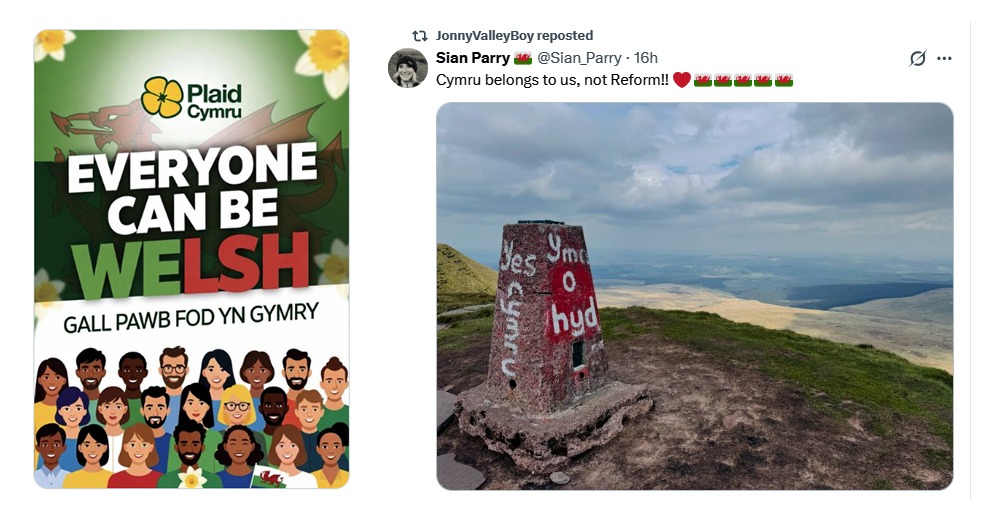
On the left we have Plaid Cymru dreaming of a multicultural Wales in which it seems white people are a minority. On the right, someone claiming that “Cymru belongs to us, not Reform“.

Now I don’t know Siân Parry, so I can’t say for sure that she’s a Plaid supporter, but she’s certainly on the political left. But what is she trying to say? Come to that, what is Plaid Cymru trying to say? Let’s attempt a synthesis.

An illegal immigrant can be Welsh; but someone who is Welsh to their core, speaks the language fluently, ceases to be Welsh – if they support Reform?

How insane, and offensive, that is. And all in the service of some transient Woke nonsense. But too many put socialist dogma and childish obsessions above the interests of Wales.

To continue down this path Plaid risks becoming a full-blown anti-Welsh party.

For that’s the course it seems to have charted, with a Gwynedd councillor suspended for not appreciating that the false god of inclusivity is more important than the Welsh language and the community he was elected to represent.

So sod the Uniparty. And with Reform increasingly looking like controlled opposition, I’d avoid them too.

STUDENT POLITICS AND DYING BIRDS

Twenty-seven years of virtue-signalling, ineptitude, and failure have taken their inevitable toll.

It’s an uphill task for those who’ve run devolution for 27 years to persuade people to forget about bills and hospital appointments, and instead take pride in Wales being the first country to declare a climate emergency, the first to have a Future Generations Commissioner, and to remember that Wales is working to be Anti-racist by 2030.

It’s student politics. And it’s explained very well by a young man named Owain Williams, whose one-minute video I stumbled upon last week.
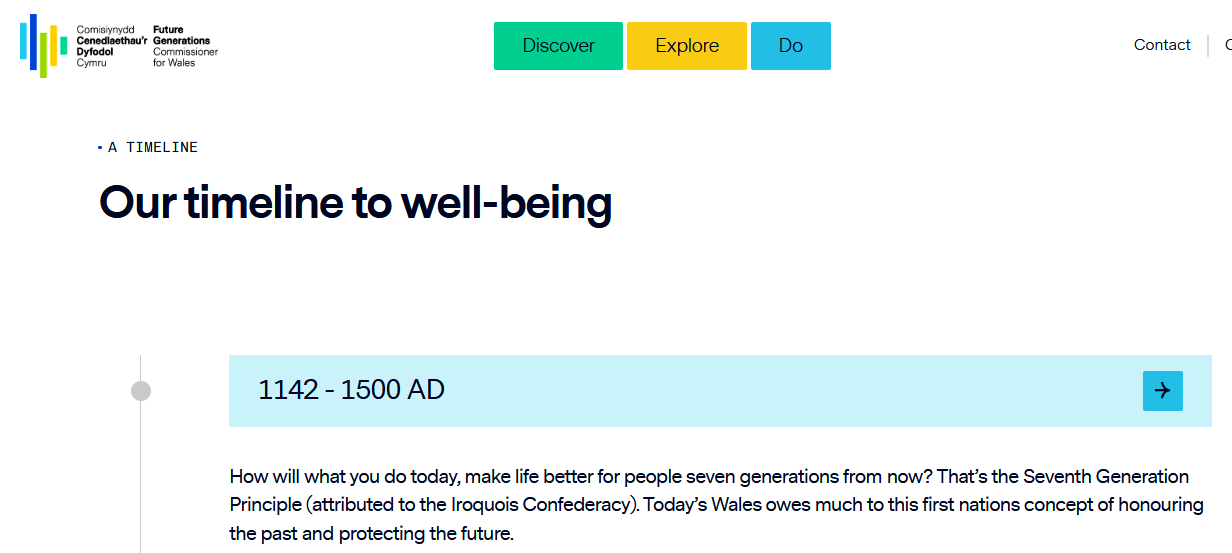
When I saw “Confederacy” my heart soared!

Now student politics is all very well in its place, but the real world is not that place.

Digression alert!

There’s a little quote from Thomas Paine’s Rights of Man that was popular with the left in my younger days. Paine was responding to Edmund Burke’s Reflections on the Revolution in France, in which Burke floridly defended the Ancien Régime. (But still a great read!)

Paine condemned Burke for being more concerned with the pomp of Versailles than with the wretchedness of most French people. It was a radical responding to a conservative, telling him to ignore the ephemeral and focus on the realities.

Paine wrote: “We pity the plumage, but forget the dying bird“.

We can turn this on its head in 21st century Wales; for here it’s the radicals, the progressives, who obsess over the plumage, the ephemeral. But who ignore the dying bird, Wales.

And things won’t get better if we let Plaid Cymru take over. For Plaid, either alone or in alliance with their new wobble-headed pals in the Greens, will only push us harder and faster down Disaster Road.

But on the plus side . . . breast enlargement will be available on the NHS from fully-trained tit whisperers, all accredited by the Zack Polanski School of Woo-Woo.

Let’s be honest, devolution has been a disaster for Wales, and so replacing one bunch of bullshitters with another won’t make a bit of difference. And people know it. This piece from last week’s Western Mail says it all.
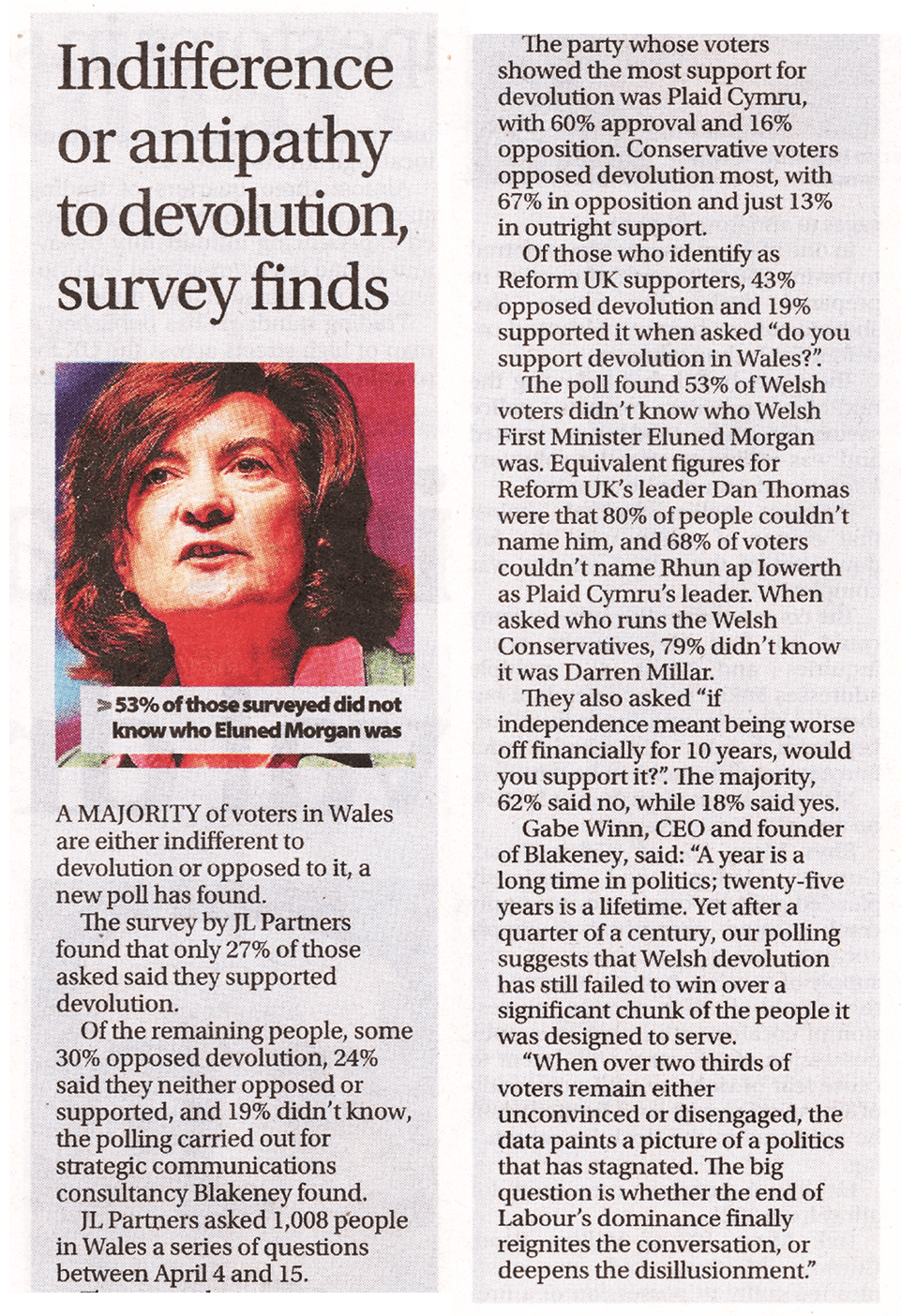
A majority of voters in Wales are either indifferent to devolution or opposed to it . . . only 27 per cent of those asked said they supported devolution“. A majority of those polled couldn’t name the first minister.

But what do you expect after 27 years of failure that has alienated people from the whole idea of devolution, and they see no hope of improvement?

IS DEVOLUTION EVEN DEMOCRATIC?

A fundamental problem of devolution, and the main reason for being subjected to policies for which there is little public support is the hangers-on, the influencers, the pressure groups, the lobbyists, that attach themselves to the politicians, to by-pass and subvert the democratic process.

You vote for a party that promised this that and t’other but you end up suffering legislation that was never in the manifesto and on which you were never consulted.

That’s because most of the Uniparty members in the Senedd went into politics to promote their pet ishoos rather than represent the constituency for which they were elected. Many came from charities, pressure groups, and lobbying organisations.

The aptly-named ‘Swamp’.

Take Lee Waters. Ostensibly the Labour Senedd Member for Llanelli (though he actually lives in Penarth). Waters had worked for cycling charity Sustrans (renamed Walk Wheel Cycle Trust), and was instrumental in bringing in the 20mph legislation.

There was a petition opposing 20mph that raised almost 470,000 signatures – but the self-styled ‘Welsh Government’ ignored it.

While other petitions, with little support, result in legislation – because the issue promoted lines up with the Uniparty agenda. You even get your photo took with some gurning politico in a presentation ceremony!

On the left in the image below is Mike Hedges, Labour SM for Swansea East; on the right, Natalie Buttriss, who’s represented a number of bodies trying to grab Welsh land under various ‘save the planet’/’biodiversity’ guises.
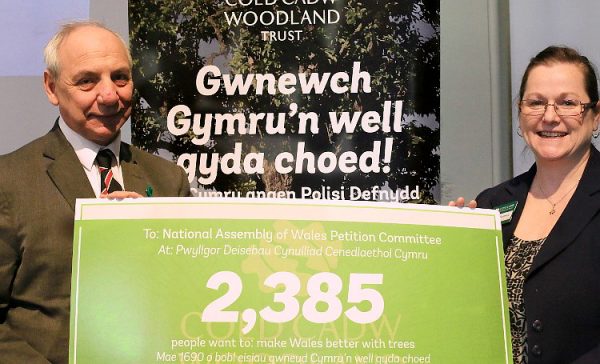
Red carpet treatment – and a chance to meet Mike Hedges! – for just 2,385 signatures!

That’s democracy, folks; the Voice of the People . . . being ignored.

Saying loud and clear that devolution is a sham. But we’re expected to believe it’s going to get better because – just like socialism – it hasn’t been properly tried yet.

Worse, there are those believing Wales could survive as an independent country with the same calibre of politicians pursuing the same policies.

This goes beyond the definition of insanity attributed to Einstein.

At present, all the lunacies we endure from Corruption Bay are funded by the block grant from Westminster. Take that away with independence, and give full powers to politicians who understand nothing about economics, but who will be determined to pursue the same Globalist-Woke agenda, and Wales will go broke within 5 years.

Then it’s into the clutches of the EU and the World Bank; allowing land and other assets to be bought up by BlackRock and the like to give the impression of economic activity, or inward investment.

Socialism has never worked as an economic model. Which explains why the only ones pushing it are either still wet behind the ears or have jobs for life on the public payroll.

CONCLUSION

Plaid Cymru believes that a few years of the party running the Senedd will win people over to the idea of independence. Thinking of Scotland. They’re wrong.

After the SNP took control in 2008 (as a minority government) it increased its popularity under the leadership of Alex Salmond. To the point where it almost won the 2014 referendum on independence.

But Salmond, in addition to being a very astute politician and a great debater, was an economist. You know, the real world economy. He persuaded many Scots, and many economists, that Scotland could be better off as an independent country.

And it almost worked. I was in Scotland for the referendum, and I know that the polls just before the vote were showing a majority for Yes. The London parties panicked and came out with ‘The Vow’, promising Scotland just about everything short of independence.
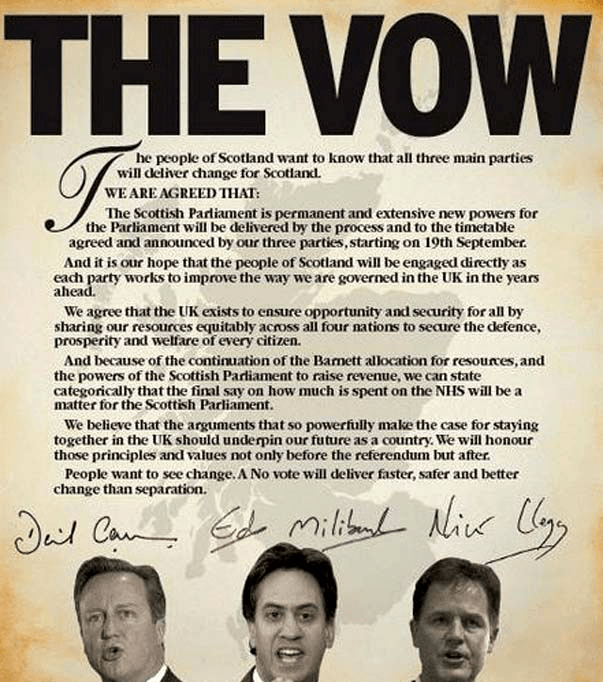
That swung it and the vote was 55 – 45 against independence.

Worth noting that the Labour leader at the time was Ed Miliband. Who – like Cameron and Clegg – understood that a great part of the appeal of independence was the promise of oil and gas revenues staying in Scotland. So maybe him closing down North Sea oil and gas fields isn’t just about saving the planet.

Whatever, and to get back to Wales, Plaid Cymru knows nothing about economics; I think the last genuine economist in their ranks was Dr Phil Williams, a good old stick despite everything, but he died in 2003.

Wales has no oil and gas fields to speak of. And there’s been no attempt to develop an indigenous economy over the 27 years of devolution. Funding cronies and charities to run make-believe ‘businesses’, and allowing carpetbagger companies to exploit Wales, is a third world economy.

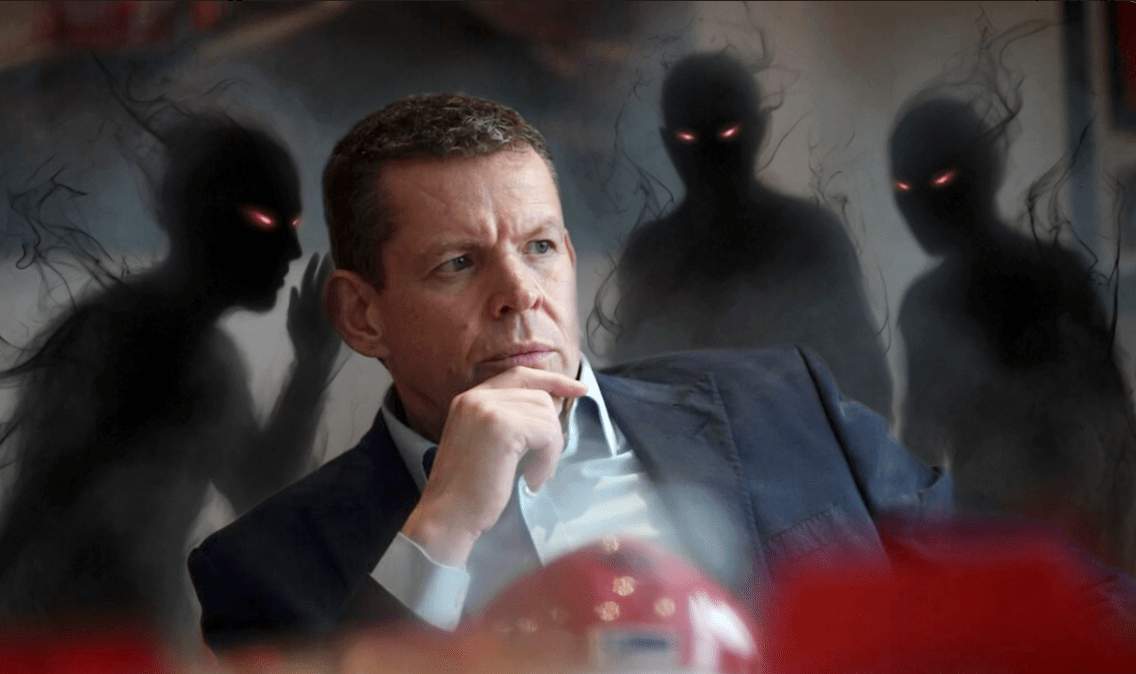
All Plaid Cymru offers is more of the same, with a different spin. Because while Rhun ap Iorwerth may come across as an affable sort of guy, behind the scenes, still running the show, are dark forces from Plaid’s recent past.

And if Plaid gets power, especially in a link-up of some description with the Greens, then even nastier specimens will start popping up.
Wales needs radical change, in the form of a return to the eternal verities and facing up to economic realities. The Uniparty will never be allowed to provide this. Reform gives no thought to Wales beyond getting votes to pursue a different agenda.

Here’s Owain Williams again. I don’t know his politics, but I suspect they’re not a million miles from my own.

The only sensible option is a party that puts Wales first and foremost. One that prioritises the economy we all need. That understands Wales needs real jobs not more gesture politics. That teaches our children to think for themselves rather than brainwashing them. That won’t wage war on the family farm. Or the family unit.

The only party that fits the bill is Gwlad. Of course, Gwlad can’t win this time round, they don’t have the strength yet. But they’ll grow and, with fair media coverage, be back stronger next time. In the meantime, I’m sure Gwlad will be fighting for Wales in council elections and other ways.

The only Welsh party willing to address people’s real world concerns is Gwlad.

♦ end ♦

© Royston Jones 2026

Buy Me A Coffee

Plaid Cymru, Going Nowhere, by Design

In which I try to explain how Plaid Cymru became a serious political party in the 1960s, why it was derailed in the 1980 and 1990s, and how we’ve ended up with a self-emasculating party that sees no role for itself other than as Labour’s little helper.

BLOWN INTO THE LIMELIGHT

I can write about the 1960s with some authority because I was there, I was involved, and I knew many of the players. Most weekends would see a gang of us pile into a hired transit van to attend some rally or protest, and there were real issues for us to focus on; we had Tryweryn (plus the other drownings), Aberfan, the Investiture – how could anyone not believe that Wales would be better off if she was independent?

There was a widespread perception among those I mixed with of there being a broad nationalist front, with Plaid Cymru as the political wing. Many people I knew were members of both Plaid and Cymdeithas yr Iaith Gymraeg (The Welsh Language Society), I even knew people who were members of Plaid, CyIG and the Free Wales Army. There was most definitely ‘overlap’.

Though Plaid’s leadership, Gwynfor Evans especially, attributed the bombing campaigns to MI5 and sought to distance the party from them. Whatever the response, the truth is that in the 1960s Plaid Cymru rode the coat-tails of Mudiad Amddiffyn Cymru and the FWA to became a serious political party, winning Carmarthen in the 1966 by-election and pushing Labour close in subsequent by-elections in the Valleys.

‘That Charles is a lovely boy, Mam . . . I think I’m in love!’

The lesson was clear, get the people to focus on Welsh issues, particularly exploitation and injustice, and Plaid Cymru would reap the electoral reward. Without the reaction to Tryweryn and the protests of Cymdeithas yr Iaith, it’s unlikely that Gwynfor Evans would have beaten Gwilym Prys-Davies in Carmarthen. And Gwynfor’s victory in July 1966 is often cited as the inspiration for Winnie Ewing winning the Hamilton by-election for the SNP in November 1967. Can we go so far as to attribute the impending independence of Scotland to the greed and insensitivity of Liverpool Corporation?

Plaid Cymru’s leaders don’t like being told that the party owes its boost in the 1960s to Owain WilliamsJohn Jenkins and Cayo Evans, but the party certainly lost impetus when MAC and the FWA were broken up. With little to excite and involve the voters Plaid Cymru’s support in the 1970s fell back in the south, but the party entrenched itself in the west and the north, appealing primarily now to Welsh speakers, a trend that damaged its appeal outside the Fro Gymraeg.

Again, I speak from personal experience, having stood as a Plaid Cymru candidate for both Swansea city council and West Glamorgan county council in the mid 1970s. I’d knock on a door, introduce myself as one of the local Plaid Cymru candidates and often get the response, ‘Sorry, love, we don’t speak Welsh’. There was rarely hostility, more the feeling that whatever Plaid Cymru might be (and few knew, or cared), it was definitely a party for Welsh speakers only. Plaid Cymru in the 1970s and 1980s was a national party with a very narrow appeal just bumbling aimlessly along.

PLAID GOES LEFT, AND GREEN, AND DISAPPEARS UP ITS OWN ARSE

Nineteen-seventy-nine was a significant year in Wales for three main reasons.

On March 1st, St David’s Day, Wales rejected the Labour Party’s devolution proposals, with just 20.26% in support. Despite it being a Labour initiative most Labour politicians, led by Neil Kinnock and George Thomas, campaigned vigorously and viciously against devolution.

Then on May 3rd Margaret Thatcher and the Conservatives were elected to power in Westminster, with the party gaining 32.2% of the Welsh vote and eleven of the thirty-six Welsh seats. In the general election of 1983 – and despite the war in the south Atlantic and the losses suffered by the Welsh Guards on the Sir Galahad – the Tories still gained 32% of the Welsh vote. From a high point of 11.5% in the general election of 1970 Plaid Cymru’s share of the vote slipped to 8.1% in 1979 and 7.8% in 1983.

Finally, on December 11th, we saw the first holiday home arson attacks by Meibion Glyndŵr.

Plaid Cymru continued to bumble along, going nowhere. The party was so rudderless, so unattractive to voters outside of the rural west, that the MG campaign was unable to give the boost that MAC and the FWA had done in the 1960s, possibly because holiday homes were not an issue in the areas where Plaid needed to grow. Plaid Cymru was a weak party of dispirited members, ripe for change, or takeover . . . preferably not a takeover by nationalists.

Gwynfor Evans stepped down as president in 1981 and a new generation stepped into his shoes. First, Dafydd Wigley, who’d been elected MP for Caernarfon in 1974, and then, more significantly, from 1984, Dafydd Elis Thomas, who’d been elected in the same year for the neighbouring constituency of Meirionnydd.

Now things begin to get strange. Because although the obvious problem was that Plaid Cymru was not getting enough support from the anglophone Welsh, under Dafydd Elis Thomas the party started reaching out in other directions, primarily to the hairier fringes of the Left, and to even more hirsute elements of the environmental movement. It will be noted that none of these new ‘allies’ had a snowball’s chance in hell of increasing Plaid’s vote in Swansea East or Merthyr or Wrecsam.

Another in Plaid’s hierarchy keen on ‘reaching out’ was Cynog Dafis, who believed there was common ground between Plaid Cymru and the Greens. These Greens were of course overwhelmingly English and many of them were openly dismissive of Welsh identity. As far as they were concerned, they had moved to ‘the country’, not to someone else’s country.

The Plaid-Green Summer Solstice Conference, Pontrhydfendigaid, 1991

This contempt was returned in kind, for most Plaid Cymru supporters had no time for the Greens, and some, especially those involved in farming and other activities, thoroughly detested these arrogant interlopers who threatened their livelihoods. Yet to Cynog Dafis the hippies and the rest were “those who had moved here to live for progressive and enlightened purposes”.

This episode provides us with an example from thirty years ago of Plaid Cymru’s leadership being out of step with the party’s rank and file, and of course the wider population. Guilty of going off on tangents that did nothing to address Plaid Cymru’s fundamental problem. I wrote a few years ago about this rather silly flirtation with the Greens in Plaid Cymru and the Green Party of Englandandwales.

AN AMERICAN FRIEND

When he was Plaid’s head honcho Dafydd El’s consort was an American named Marjorie Thompson. An interesting woman from an impeccably WASP-Republican background who, after a stint as assistant to a Republican Congressman, crossed the Pond and soon joined the Campaign for Nuclear Disarmament, rising to be chair of that body. More remarkably, perhaps, she also served as chair of Scottish CND, though this is not mentioned in her Linkedin profile.

I’m not sure when her relationship with DET began but it lasted some seven years and intrigued observers. Having served her time among the ‘progressives’ in CND and other groups Ms Thompson eventually joined Saatchi & Saatchi, Margaret Thatcher’s favourite ad agency, in 1997, and returned ‘home’, as it were, by joining the Conservative Party in 2009.

I seem to recall that there was interest at the time in a brother of Marjorie Ellis Thompson who, it was alleged, worked for a US intelligence agency. But I could be mistaken, it was all a long time ago. Maybe someone remembers?

By 1992, after all the changes, and all the ‘reaching out’, Plaid Cymru’s percentage of the vote in that year’s general election barely moved. Nevertheless, the party did hold its three seats in the north west and Cynog Dafis added Ceredigion and Pembroke North, almost certainly due to the thousands of bearded ones turning out to vote for him.

Though the only constituency that saw an official Plaid-Green alliance was Monmouth, where the candidate Mel Witherden got 0.8% of the vote, the lowest Plaid vote in the country. Witherden was quite open in stating that many Greens were anti-Welsh in a racist and colonialist way.

Plaid was now firmly located on the political left, it was a ‘welcoming’ party concerned with all manner of ishoos and -isms, and more interested in the opinions of Islington than with what people were thinking in Islwyn.

DESIGNED TO FAIL

Plaid Cymru, the party I joined in the mid-’60s because it – and I – wanted to make Wales a better place for the Welsh people, had become a regional rainbow alliance for which nationhood and independence were dirty words. Wales no longer mattered except for the votes and seats it provided that then allowed the Plaid leadership to rub shoulders with other ‘progressives’.

This party had no chance of winning seats outside of the Welsh-speaking areas, where most of Plaid’s voters supported the party for cultural reasons, and didn’t really care about Plaid’s policies (even if they knew what they were). If this electorate had one concern it was the influx that was breaking up communities and slowly destroying a Welsh way of life.

Plaid Cymru had no intention of making a stand against colonisation; in fact, as we’ve seen, Plaid’s leadership was happy to co-operate with elements of this influx. Never was an electorate taken for granted and treated with such contempt as Plaid Cymru’s rural voters. It’s no exaggeration to say that Meibion Glyndŵr spoke for these people better than Plaid Cymru.

Courtesy of BBC

Plaid Cymru was successfully subverted in the late 1980s and early 1990s into a political party that would never get more than 10-12% of the vote in UK general elections and therefore pose no threat to the integrity of the UK state. It would have been easy to interpret this catastrophic re-alignment to foolishness, were it not for the removal of Dafydd Wigley in 2000.

In the first elections to the new Welsh Assembly in May 1999 Plaid Cymru gained 28.4% of the constituency vote (Labour 37.6%) and 30.5% of the second or regional vote (Labour 35.4%). In addition to predictably winning its western, rural seats the party also won Llanelli, Rhondda and Islwyn. This result sent shock waves way beyond Wales.

In June 2000 an internal plot removed Dafydd Wigley, persuading him to cite health grounds for ‘his’ decision. Seventeen years later he leads a full life travelling up to London regularly to sit in the House of Lords and is actively involved in many other, more worthwhile, activities.

HISTORY REPEATS ITSELF

In my previous post I wrote of the strange case of Plaid Cymru councillor and AM Neil McEvoy, stitched up on a ludicrous ‘bullying’ charge by the Labour corruption machine and then, instead of being supported by his party, he found Plaid’s leadership siding with Labour and assorted organisations on Labour’s Third Sector payroll such as Welsh Women’s Aid.

In that post – and if you haven’t read it then I urge you to do so – I talked of the ‘consensus’, a delusion prevalent among Plaid Cymru’s hierarchy that they and ‘Welsh’ Labour are natural allies in the fight against the forces of darkness. This results in Plaid Cymru refusing to take Labour on in the way that the SNP has so successfully done in Scotland. But it goes deeper than that, and it’s more sinister.

Like all advanced states, the UK has a ‘permanent government’ which may or may not be made up of military brass, top businessmen, intelligence chiefs, senior civil servants and others. Whatever their attitude towards the Labour Party – and this will vary depending on who’s leading Labour – they understand full well that Labour is the bulwark against Welsh nationalism simply because it’s the largest party in Wales.

Equally, those I’m talking about understand that due to its corruption and incompetence, and the quality of its elected representatives, Labour in Wales is highly vulnerable, and must therefore be protected from any threat to its hegemony. The best way of doing this is from within. From within Plaid Cymru.

It’s no coincidence that Dafydd Wigley, Plaid Cymru’s most successful ever leader, was removed when the party he led threatened to dislodge Labour in the Valleys. And no coincidence that it was done with a palace coup.

Now Neil McEvoy, a politician from a different mould to most other Plaid MPs and AMs, is gaining popularity in working class Cardiff, so he is stitched up by Labour and hung out to dry by his own party.

To achieve this control over Plaid Cymru the permanent government doesn’t need many on the inside, just enough, in senior positions, to ensure that the right kind of left-liberal losers are recruited and promoted, and that nationalists, or anyone threatening Labour’s domination, is sidelined.

THE DOG IN THE MANGER

Since the Neil McEvoy affair blew up I have spoken with people I know inside Plaid Cymru and they are surprised, annoyed or outraged by the actions of the party leadership. No one I have spoken to supports the party leadership. The confusion extended to surprising quarters, like Martin Shipton in the Wasting Mule. Plaid’s leadership must know that they’ve got this one badly wrong.

But then, this is exactly how Plaid Cymru has been programmed to react in a situation like this. As I said earlier, Plaid Cymru was “subverted in the late 1980s and early 1990s into a political party that would never get more than 10-12% of the vote in UK general elections”, achieved by the simple expedient of taking the party in directions that made it unattractive to the great majority of Welsh voters.

Update that figure for devolution and we are talking of less than 25% in Assembly elections. Anything higher sets the alarm bells ringing in the marbled corridors of the permanent government. And action is taken.


Plaid Cymru since the bright young things took control has been a party promising everything to everybody . . . and delivering nothing, apart from minor concessions allowed by our masters to delude the rank and file that their leaders can deliver, and that the long-heralded ‘breakthrough’ is just around the corner. The ‘breakthrough’ that never comes . . . and was scuppered from within when it threatened to happen.

But perhaps Plaid Cymru’s most useful role has been as a dog in the manger party, because for as long as Plaid is in place, gaining just enough votes, it blocks the emergence of an alternative that could confront and defeat ‘Welsh’ Labour.

MY MESSAGE TO PLAID CYMRU MEMBERS

Whether you accept my theory or not, you know that your party is going nowhere. Which means that you are probably confused or disappointed by the treatment of Neil McEvoy, your party’s most effective politician.

You know that ‘Welsh’ Labour is there for the taking – so why is Plaid Cymru propping up this stumblebum party?

Or ask yourself why your party is so unattractive that Ukip got more votes in the last general election. And not just in Clwyd, but in Blaenau Gwent, Merthyr Tydfil, Rhymni, Swansea East, etcCome on! wise up!

My belief remains that Plaid Cymru has been compromised. For appearances’ sake, and to block the emergence of a credible alternative, it is allowed a certain level of support, in return for which it must deal with anyone threatening to upset the status quo.

To make Plaid Cymru the party it should be, the party most of you want it to be, you need to give our people the message of hope they want to hear. But to achieve this you must remove the deadwood at the top of the party.

Plaid Cymru needs a new leadership prepared to put the interests of Wales and the Welsh people first, no matter what other parties, the commentariat, or the ‘progressives’ of Islington, may say.

♦ end ♦