Gilestone And Other Developments

For those who don’t know the story, or have chosen to forget, Gilestone farm, near Talybont-on-Usk, was bought in 2022 by the self-styled ‘Welsh Government’ for £4.25m.

The excuse given was that Gilestone was to be a new home for the Green Man Festival, which holds its knees-ups not far away on the Glanusk Estate. They got away with it for a while, but the story was never really convincing.

Then ospreys appeared at Gilestone – the first sighting of these birds in southern Wales for over 200 years! Some said they’d been attracted there to cover the collapsed Green Man deal and justify ‘Welsh Government’ imposing access restrictions.

GILESTONE, WATER, FARMING

As you might have guessed from previous postings on this blog, I soon stopped believing that Gilestone had been bought for the Green Man Festival. Especially after talking to a previous owner who claimed her family had been forced out of Gilestone by the (then) Brecon Beacons National Park Authority, using a solicitor in Swansea who soon after became a Labour Assembly Member.

Another factor for rejecting the Green Man explanation was learning that a new group called the Beacons Water Group (BWG) had been formed (May 2020), and among the directors were the owner of Gilestone, and his neighbour across the River Usk. And that this group had travelled to Upstate New York to study how the Watershed Agricultural Council manages the water supply to the the Big Apple.

Given the regular talk of moving water from Wales to southern England, and the fact that both the River Usk and the Monmouthshire and Brecon Canal flow across Gilestone land, I concluded that the answer to why the farm was purchased lay in water supply.

A suspicion firmed up by learning of another group formed by Dŵr Cymru Welsh Water (DCWW) following the US trip (and a reciprocal visit). This was the Bannau Brycheiniog Mega Catchment group, copying what was found in the USA.

Matters covered in these posts: ‘Green Man, Red Herring?‘; ‘Gilestone Revisited‘; and ‘Gilestone: Thinking Outside The Box‘;

And there was definitely a political dimension to it all.

I say that due to the involvement of ‘Welsh Government’ civil servant David Ashford. He’d been working on “sustainable land management policies to replace the Common Agricultural Policy (CAP) in Wales“, was then seconded to Dŵr Cymru just after the US visits (in the same month the BWG was formed), before returning to WG to work on the Sustainable Farming Scheme (SFS).

Why would a senior civil servant dealing with farming spend two years “Developing new partnerships to improve water quality and a range of other benefits across water catchments within the Brecon Beacons” . . . unless farming was involved?

And of course it was. Those who formed the Beacons Water Group were all farmers. Water quality figures prominently in the SFS (and other) legislation.

The US example contains powers of compulsory purchase (‘Eminent domain’ in the USA) to guarantee water quality. Compulsory purchase is not mentioned in the Welsh SFS legislation but it is covered in the UK government’s Planning and Infrastructure Bill (Part 5), which became law in December last year. The Sustainable Farming Scheme in Wales launched the following month.

And let’s remember that the prominent Globalist, and CEO of JPMorgan Chase, Jamie Dimon was, in April 2023, openly calling for compulsory purchasefor wind and solar builds“.

So while the visit from the Watershed Agricultural Council in March 2018, and the visit to the Catskills in June 2019, followed by the formation of the Beacons Water Group CIC and the Bannau Brycheiniog Mega Catchment group, were ostensibly about water quality, farming was inextricably involved.

LATEST DEVELOPMENTS, ABERGAVENNYSHIRE LINKAGES

A very recent development was the launch last month of Beacons Rural Energy Ltd (BRE). Three of the current seven directors of the Beacons Water Group are found among the nine directors of the new company.

But what’s the purpose of Beacons Rural Energy Ltd? Here’s what the Certificate of Incorporation filed with Companies House tells us:

So it’s “smart renewable energy projects“. But how will they produce, transmit, distribute and trade electricity? Being in a national park rules out large wind turbines and fields filled with solar panels. So what’s left?

Well, “Hydro” is mentioned. Which takes us back to water. And of course, DCWW.

Clearly, there’s a connection between Beacons Water Group and Beacons Rural Energy, and I believe it extends beyond the principals involved in both; Richard James Roderick (of the farm next-door to Gilestone), Keri Howell Davies, and David Stephen Thomas. Other links would be the Brecknockshire Agricultural Society, the National Farmers Union (NFU), and Farming Connect.

In February 2022 the NFU stated it would “do its bestto meet the 2030 net zero target. John Davies, outgoing NFU Cymru president, reminded us, “we were the first farming organisation to set the goal of net zero by 2040“.

The clip below is from the current NFU website. Rowing back a bit?

Our position remains that journeying towards net zero must not compromise food production, farm profitability, or export emissions overseas by replacing British food with imported food produced to lower standards of environmental protection.

As for Farming Connect, this is run by the ‘Welsh Government’ as a kind of club for farmers who go along with Corruption Bay diktats. Either from Ministers, or from civil servants, like David Ashford, answering to their bosses in London.

Maybe some of the ‘good’ farmers from Farming Connect and Beacons Water Group will be helped make some money through renewable energy projects.

But will these projects be economically viable? And will public funding be involved?

One name among the directors of Beacons Rural Energy, Andrew Geoffrey Matthews, was new to me. But I think I found him in this document of the Aberhonddu Lodge of Freemasons. It may be ten years old, but it’s still informative.

In addition to Worshipful Master Bro Andrew G Matthews you’ll see that I’ve also highlighted Steward Richard J Roderick. There may be others involved with the Lodge, it’s not easy to tell with so many common Welsh surnames.

Think about it, here we are in 2026, after 27 years of ‘progressive’ administrations in Wales; and a bunch of men who like to dress up and spout nonsense in a men-only group still have influence with politicians and civil servants.

Then again, in Globalist-left Wales, men in funny outfits spouting bollocks are almost the norm. Certainly accepted. And influential.

Back to the bigger picture.

Abergavennyshire has proved very attractive to left-liberal do-gooders with ideas on how to save the planet – usually with our money. And how to make better human beings of us all – but only if we listen to them.

They’ve been colonising the area for a few decades. Which would be bad enough in itself, but they also have political clout. The results are everywhere. So are the linkages.

A director of BWG is Anthony Hugh Martineau, who has, or had, connections with Coleg Soros in Talgarth. The current chair of the trustees there is Chris Blake. Here’s his Linkedin bio.

One of his current ventures is The Green Valleys (Wales). Below is a clip from the most recent accounts filed with Companies House, for year ending 31.10.2024.

I’m not sure what happened, but it don’t look good. Turnover and profits slumped, and it all seemed to go tits up. Then, the other directors left last month. Among them Grenville Ham, former capo in the Greens, who switched to Plaid Cymru when the Greens refused to set up a Welsh party.

Green Valleys would appear to have folded. Is the recently-launched Beacons Rural Energy some kind of replacement?

CONCLUSION

One of the attractions of the Abergavennyshire and Bannau area is of course its scenic beauty, helped by the absence of wind turbines and vast acreages of solar panels. But this is problematic for the ‘Welsh Government’, which wants every area of Wales to be seen to be saving the planet.

The maps below might help. On the left is the official map showing areas “pre-assessed” for industrial scale wind turbines in southern Wales. On the right, a map produced by the Campaign for the Protection of Rural Wales (CPRW), showing existing or planned windfarms. (In the case of the latter category, those that are known about.)

The red lines on the CPRW map are pylon runs.

Outside and to the east of area 6 there are a number of projects planned. These are in the wild, unspoilt Elenydd. Reminding us that the “pre-assessed” areas are just a rough guideline, but national parks are still off-limits . . . for the time being.

Which must also vex the fanatics who want Wales to have more ‘renewables’. Clearly, something else, a different approach, is needed. Which is where the various outfits mentioned above may give a clue.

Because I still believe water is the key to understanding the developments we’ve seen over the past eight years or so, and that includes buying Gilestone. So with wind turbines and the rest ruled out, are the Bannau to become a hot-spot for hydro schemes?

Another hoped-for advantage of focusing on doing good things with water resources might have been generating good publicity for Dŵr Cymru Welsh Water. Unpopular with the public at large but long defended by the ‘Welsh Government’, Natural Resources Wales, and environmental groups.

Who, for differing reasons, blamed farmers for every discharge or spillage.

If so, then it failed. Because too many recent cases have made everyone aware of what many of us always knew. Here’s a recent case that resulted in a £45m fine.

But then, what’s one more lie added to all the rest? As George Carlin used to say in explaining how shadowy forces control things: “It’s a big club – and you ain’t in it“. (This short video is worth a watch.)

Difficult to believe that was recorded over 20 years ago. He was right then. And it’s a hell of lot worse now. R.I.P. George Carlin.

♦ end ♦

© Royston Jones 2026

Buy Me A Coffee

Gilestone: Thinking Outside The Box

In this post I’ll be setting out my thoughts as to what I believe lies behind the purchase of Gilestone farm. To some extent I’ll be launching a kite, but I believe it flies.

If you disagree, then feel free to tell me. Just click on the ‘Comments’ tab.

QUICK RECAP

Earlier this year the self-styled ‘Welsh Government’ paid £4.25m to buy Gilestone farm, near Talybont-on-Usk, in south Powys. The reason given was to provide a permanent base in Wales for the Green Man Festival.

This music festival currently holds its events on the Glanusk estate, a few miles down the river near Crickhowell, but is said to want a place of its own, to diversify ‘the brand’.

Lacking the finance to buy a place of their own it is also claimed that GM boss Fiona Stewart demanded that her friends in the ‘Welsh Government’ buy a place for her. And she does have many friends in Corruption Bay.

My first post on the subject was, Green Man, Red Herring?, back in May. And as the title suggests, even then, I was not entirely convinced by the official story about the farm being bought for the music festival. Something didn’t add up.

So I did some digging.

And I shall begin this latest post by taking you back to where my earlier digging took me – the Catskills of New York State. The area from where New York City draws its water. I dealt with this relationship in that first Gilestone piece.

This Catskill-Delaware Watershed is supplemented lower down the Hudson River by the smaller Croton Watershed.

Click to open enlarged in separate tab

Following contact by Dŵr Cymru (DC) a visit was made to Wales in March 2018 by representatives of the Watershed Agricultural Council. This visit was reciprocated in October 2019, when a party from the Beacons visited the Catskills.

One result of these trans-Atlantic jollies was the formation in May 2020 of the Beacons Water Group CIC (BWG). That the one was the inspiration for the other is made clear in the company’s Certificate of Incorporation.

Click to open enlarged in separate tab

In the panel above you’ll see mention of ‘BBMC’. This is Dŵr Cymru’s Brecon Beacons Mega Catchment. This Dŵr Cymru video tells a little more.

But it makes little sense. OK, so the Beacons supplies southern Wales with water. That is understood. But what was to be learnt from linking up with the New York City Watershed Agricultural Council?

HANDS ACROSS THE SEA

We are expected to believe that the BWG and BBMC, both inspired by the US link-up, exist solely to ensure cleaner water from the Beacons for DC’s existing customers.

The problem I have with this interpretation is – if true, then what has Dŵr Cymru being doing up until now? And did DC need to go to the USA to learn about water quality?

Which is why I suspect these new bodies might serve some purpose other than simply improving water quality, or some purpose additional to that objective.

Let’s look again at the US exemplar.

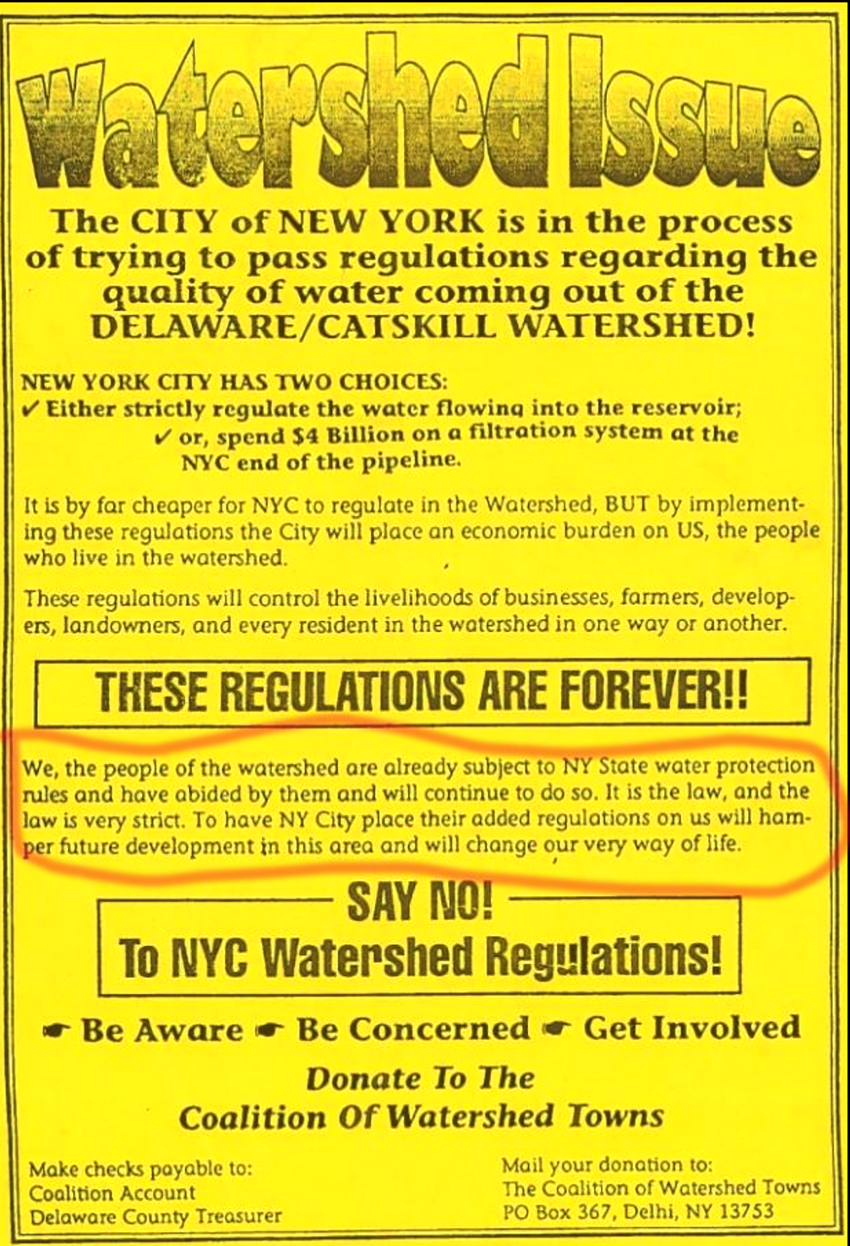
As the pre-internet flyer below makes clear, the reason for introducing the Watershed scheme was to impose stricter regulations on farmers in the Catskills.

Click to open enlarged in separate tab

To some extent, this was understandable, everybody wants clean drinking water. It’s a global human necessity that too many are still going without. Also, irresponsible farmers can be a source of pollution.

That was what lay behind the Watershed Agricultural Council. (Here’s a brief history.) Farmers were cajoled, persuaded, and paid, to keep the water clean. I’ve found nothing to make me suspect there was a hidden agenda.

Click to open enlarged in separate tab

But I do believe that on this side of the Atlantic some looked at the Catskills and saw a model to be replicated; with others welcoming a model that could be adapted to enforce local observance of Globalist diktats.

And so, what we see emerging in the Beacons is, up to a point, about water quality; but also about using water quality to make life difficult for farmers, done in order to facilitate the ‘Welsh Government’s implementation of the UN’s Agenda 2030 and The Great Reset of the World Economic Forum.

Which, among other demands, insist on reducing the numbers of livestock farmers.

But what I believe is planned for the Beacons goes beyond the ‘Welsh Government’s war on farming, and owes more to the principal aim of the Catskills model.

QUI BONO?

As we’ve read, one of the most important aspects of the whole Watershed project is the claim that it enjoys the co-operation of farmers.

In the hope of reprising that bucolic camaraderie the Brecon Beacons Mega Catchment will play the role of the Watershed Agricultural Council, with the Beacons Water Group serving to demonstrate farmer involvement.

I’d like to give you more information about the BBMC but it seems to be pretty sparse. There is a Twitter account, that hasn’t posted for months, and the same applies to the Facebook page.

With very little information on the Dŵr Cymru website.

Though I did turn up this picture, from February, of what is said to be the BBMC steering group. The picture comes from the Twitter account of Dave Ashford.

Click to open enlarged in separate tab

Ashford works for the ‘Welsh Government’ but was, from May 2020 to April 2022, seconded to Dŵr Cymru as ‘Brecon Beacons Mega-Catchment Programme Manager’.

He is now back with the ‘Welsh Government’, as ‘Stakeholder Engagement Manager to help develop a future Sustainable Farming Scheme for Wales’. Here’s his Linkedin page. (Here in pdf format in case you can’t access it.)

Didn’t Dŵr Cymru itself have anyone who could have done this job, for water is its business after all? Couldn’t Natural Resources Wales have provided someone?

Is secondment like this a common practice? Because if nothing else, it gives the impression that the Catchment project is pushing a political objective rather than promoting an environmental agenda.

In the photo above, Dave is fifth from the left. Third from the right is Richard Roderick, of Newton Farm, next door to Gilestone. Richard is a local National Farmers Union chief, and chairman(?) of the Brecknockshire Agricultural Society.

Now the thing about Richard Roderick is that he is also a director of Beacons Water Group CIC. Another director is Keri Howell Davies, who made the trip to the USA with Roderick in October 2019.

Someone else we find among the BWG directors is Charles Weston, the man who sold Gilestone farm to the ‘Welsh Government’. Fancy that!

Talking of whom, I’m going to push the boat out and suggest that . . .

The purchase of Gilestone for a very generous £4.25m might have been a reward for the seller, Charles Weston, as much as, or rather than, a favour for the Green Man Festival. If that’s right, then what did Weston do to deserve such generosity?

Might it have anything to do with Weston’s principle company, CWW Farming Ltd, being previously known as Sharpness and Severn Transport Ltd, a company having nothing to do with farming?

Sharpness being a small town and port on the Severn in Gloucestershire. From where the Gloucester & Sharpness Canal runs to Gloucester docks. Just before reaching Gloucester this canal links with the Thames & Severn Canal which, as the name suggests, connects the Severn with the Thames just west of Oxford.

Click to open enlarged in separate tab

Why am I telling you this? My thinking will be explained in the next section. (If you haven’t already guessed!)

Let’s conclude this section by reiterating that it looks very much to me, and to farmers in contact with me, that the leadership of the NFU, both in Wales and at Englandandwales level, has signed up to Agenda 2030 and The Great Reset.

Here we see Minette Batters, NFU president, proudly wearing her Agenda 2030 badge. And who’s that with her? Why! – it’s the WEF’s new man in No 10!

Click to open enlarged in separate tab

The top brass at the NFU have the sense – and the political nous – to realise that livestock farmers, especially in Wales, are to be culled. They, the chiefs, will look after themselves, and then it’s every ‘Indian’ for himself.

In Wales that means complying with, perhaps even pretending to agree with, the ‘Welsh Government’s hysterical responses to an imaginary climate disaster.

Nothing to do with saving the planet, it’s pure self-interest.

THE BIG PICTURE

Let’s accept that the trans-Atlantic trips make no sense whatsoever if Dŵr Cymru is simply going to look after water in the Brecon Beacons for its existing customers. In other words, the ‘day job’.

There has to be more to it than that. (Now we come to the ‘kite’ I mentioned earlier.)

Let’s start with a few established and incontestable facts.

Due to an expanding population, and rising living standards in recent decades, the demand for water has increased dramatically in southern England, resulting in a growing problem of water shortages.

Water will be have to be brought in from somewhere else.

That ‘somewhere’ is usually identified as Wales. The mayor of London in 2011 – a certain Boris Johnson – suggested it. And in August of this year Conservatives were even pushing the idea of a ‘Great Boris Canal’ to ‘transfer water from Wales to the south of England’, according to Nation.Cymru.

In the same month the GMB trade union was arguing for Welsh water to be pumped to England.

The subject of west to east (and north to south) water transfer has been discussed by various bodies, off and on, for decades. The difference now may be that ‘climate change’ can be used to push on with the proposed ‘national’ water grid.

The extract below comes from a debate in the House of Lords in March 2012.

Click to open enlarged in separate tab

My reading of the situation is that there is already a plan in place to move water to England from the Brecon Beacons.

Not only is it roughly the same distance from London as the Catskill watershed is from New York City but the infrastructure is largely in place, and what’s needed is either under construction or could be done relatively easily.

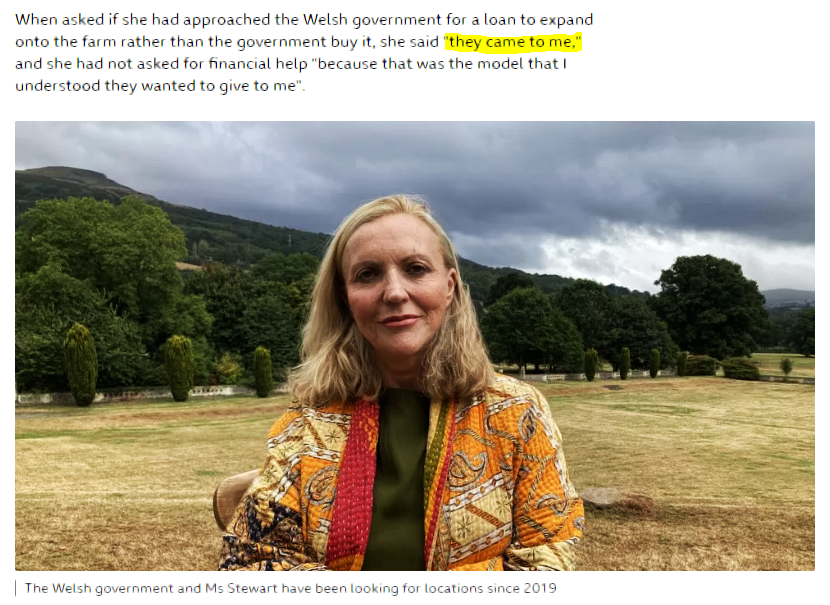
Also remember that Fiona Stewart told the BBC that the Gilestone purchase was the ‘Welsh Government’s idea. Claiming ministers “came to me” with the proposal.

Click to open enlarged in separate tab

As I suggested earlier, Fiona Stewart may have been pressing her friends in Corruption Bay to help her and the Green Man Festival, maybe even buy her a farm; but I don’t think she was asking for, and she didn’t expect, Gilestone.

Let’s now look at the OS map of Gilestone farm. In particular, look at the course of the river Usk and the Monmouthshire & Brecon canal. Nowhere do they come closer to each other than at Gilestone.

Transferring water from the Usk to the canal, and then on to England, would be fairly easy. Given that the Usk regularly floods Gilestone farm such engineering work could even be dressed up as a flood prevention scheme.

Click to open enlarged in separate tab

And the engineering work involved would expose the large and very valuable sand and gravel deposits that lie beneath Gilestone.

Also worth remembering is Gilestone’s proximity to both Llangorse Lake and Talybont reservoir. Shown below in the image from Google Earth.

So many water resources so close to Gilestone: river, canal, lake, reservoir.

Click to open enlarged in separate tab

Llangorse is the largest natural lake in central and southern Wales. Talybont reservoir is the largest stillwater lake in the south, and owned by Dŵr Cymru.

And to end this section, let’s remember the skulduggery that preceded Weston’s purchase of Gilestone.

I have spoken with Gilestone’s previous owners, and I am in no doubt that they were forced out. Instrumental in the campaign to get them to sell to Weston was a solicitor named Julie James. She was elected to the Welsh Assembly in 2011 and is now Minister for Climate Change.

She is still deeply involved with Gilestone.

CONCLUSION

The plan to transfer water from the Brecon Beacons to England has been hatching for a considerable time.

In addition to the River Usk and the Monmouthshire & Brecon Canal it may also involve the River Wye. Which would explain the hysteria from an ever-growing number of conservation groups on these rivers – always blaming Welsh livestock farmers for anything less than crystal-clear water.

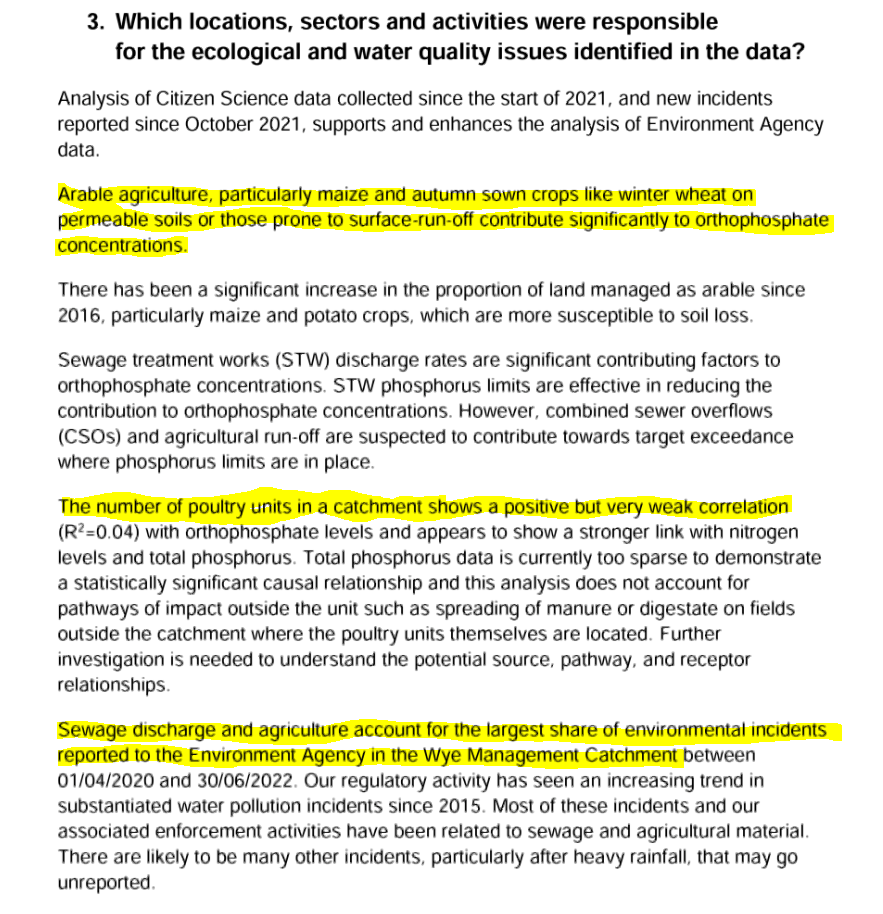
Though the Environment Agency (England’s equivalent of Natural Resources Wales) points the finger at arable farmers, who are almost all on the English side of the border. While poultry units, targeted by colonialist ecowhiners, get an almost clean bill of health.

Click to open enlarged in separate tab 

Charles Weston may have bought Gilestone of his own volition, but I’m inclined to believe there was some agency involved. If so, which agency might that be?

I concede that my theory hinges on various facts being part of a coherent whole rather than just coincidences. Anyway, here are the facts, interpret them as you will:

  • For many years there have been influential voices calling for water to be transferred from Wales to southern England.
  • Charles Weston, has a background in transport and shipping, and long-established links to Sharpness, from where there is a direct waterway to London.
  • For some reason Weston moved to Wales and started buying land, including Gilestone, the previous owners having been hounded out by a campaign involving a lawyer who is now a ‘Welsh Government’ minister.
  • Gilestone seems ideally placed for any scheme for transferring water from Wales to London.
  • For no obvious reason a link was forged between Dŵr Cymru and the Watershed Agricultural Council in New York State. The WAC exists solely to guarantee a regular supply of clean drinking water to New York City.
  • This US link gave us the Brecon Beacons Mega Catchment and the Beacons Water Group. The justification for these two groups has been ‘explained‘ in terms that are risible and vague to the point of being utterly vacuous.
  • The ‘Welsh Government’ bought Gilestone farm from Charles Weston for an inflated sum. We were told the purchase was made for the Green Man Festival’ – but Fiona Stewart says, “They (WG) came to me”!

I believe this kite flies!

And if I’m right, then Gilestone was ‘secured’ for future use when Weston bought it; and now, the ‘Welsh Government’s purchase could signal that things are moving on to the next stage.

Of course the ‘Welsh Government’ might be ignorant of the bigger picture. This would explain why it cannot give a plausible explanation for buying Gilestone farm.

This ignorance could also be attributed to the Drakeford Gang acting under orders. Perhaps the project is managed by civil servants, working in Wales but answering to their bosses in Whitehall.

Though I find it difficult to believe that Julie James is wholly in the dark.

Supplying water to London would certainly explain the Catskills connection, which otherwise makes no sense at all. For it’s the perfect template if the plan is for a hilly and largely agricultural area to supply a city of 9 million people roughly 100 miles away.

With the ‘Welsh Government’ seizing the opportunity presented by the water transfer project to make life even more difficult for our livestock farmers.

Two birds with one stone. And two blows against the interests of the Welsh people.

♦ end ♦


© Royston Jones 2022