Where to start? A truly momentous result. But will it make much difference? Join me as I ramble through the results.
◊
THE VOTING SYSTEM
Let’s start with the widespread and growing feeling that the party list system, in 16 vast constituencies, was a mistake, and one that must not be repeated. But how did we end up with this monstrosity?
It started well enough, in February 2017, when the self-styled ‘Welsh Government’ appointed an ‘expert panel’ of academics to look into various electoral systems and come up with recommendations. Which the panel did. But Labour (possibly also Plaid Cymru) didn’t like those recommendations.

The panel favoured the Single Transferable Vote (STV) system. And it specifically rejected the system used last Thursday. In this piece I put out a couple of years ago, I wrote:
On page 128 of the report we read the ‘closed list proportional representation’ system was rejected. It’s ‘weakness’ spelled out as, “No choice for voters between individual candidates. No accountability for individual Members directly to voters.”
Through a series of further – more political – groups, we arrived at the abomination forced on us last week. Based on the understanding that Labour would be the biggest party, with less than 40% of the vote in a low turnout, propped up by Plaid Cymru.
To put that into context: In 2016 Labour won 30 out of the 60 seats with 34.7% of the vote. Plaid Cymru came third with 11 seats and 20.5%. The turnout was 45.3%.
Never was it imagined that Labour would finish many lengths behind in third.
But it’s happened; and now Plaid Cymru needs to promise something better before the elections of 2031. With Wales now having 32 Westminster constituencies one obvious option is to elect three Members from each.
A simple system that would mean:
1/ Parties putting up three candidates in each constituency. Giving each party a total of 96, the same as we had on May 7.
2/ This system would be far more representative in that it would allow voters to pick and choose from candidates. Even vote for three different parties 1, 2, 3.
3/ It would be fairer for smaller parties and independent candidates.
But will Plaid Cymru want to change the system that gave them victory, at last?
◊
PLAID CYMRU, REFORM, ALSO-RANS
Not for nothing do people say of me: “That bloke’s no curmudgeon“, and now I’m going to prove it . . . without getting carried away, you understand.
The victory last Thursday eclipsed everything Plaid Cymru has achieved in its century-long existence. Without wishing to sound ungracious, I believe Plaid did so well, in part, from negative voting. Because much of the Plaid vote was against other parties.
There’s an irony here. In campaigning ahead of the election Labour and the rest of the ‘progressive’ parties urged us to vote against Reform; but Labour didn’t appreciate just how many people also wanted to vote against them.
Now if people decide to vote against Reform and Labour – where they gonna go?
This can be seen in my home city. Swansea has been a wasteland for Plaid for decades; no councillors, hardly any presence whatsoever. Yet in the Gŵyr Abertawe constituency, corresponding roughly with the old seats of Swansea West and Gower, Plaid Cymru won 3 of the 6 seats, but with just 31.9% of the vote.
Another factor in the Swansea results was the feeling that the city has been short-changed by Cardiff-obsessed Labour governments in Corruption Bay. I’ll return to this aspect of the picture later, when I address what Plaid should do to live up to the hopes of those who voted for the party.
Especially those who voted Plaid for the first time. Hoping for real change.
It might be worth mentioning that of the Plaid intake 27 are women and just 16 are men. Plaid has been pushing ‘equality’ for a long time, but it appears they might have gone too far.
For as George Orwell warned us in 1984:
It was always the women, and above all the young ones, who were the most bigoted adherents of the Party, the swallowers of slogans, the amateur spies and nosers-out of unorthodoxy.
Substitute Globalist-Woke agenda for Party.
Reform UK could have done better. Had they remembered this was an election in Wales, to the Senedd. Not a lot to ask, you might think. But it seems to have been too much for Reform. And many of their candidates.
What Reform offered was the usual England/UK spiel with a few unconvincing tweaks, offered by candidates many of whom seemed unsure where they were.
And yet, Reform got a good vote with 29.3%, and 34 of their candidates elected. With a better campaign Reform might have come out on top. If nothing else, the vote for Reform reminds us that we’re in uncharted territory.
And nothing shows this change more than the collapse of Labour’s vote. But this was long overdue. For too long Labour relied on the ‘hereditary’ vote in post-industrial and urban areas. Appeals to remember Nye Bevan and other emotive distractions from the embarrassing reality of modern Wales.
Throw in ‘Two-tier Keir’, and 27 years of failure from the Bay, and maybe Labour should be thankful they got 11.1% of the vote and 9 seats.
The Conservatives were almost squeezed out of the debate, and this wasn’t helped by the party’s woeful recent performance in Westminster. That said, 10.7% and 7 seats is not to be sniffed at. Just 0.4% behind Labour.
Reminding us that the Tory vote may be low, but it’s always there. Had things worked out differently they could have come third and been the junior partner in a coalition. That may be stretching it a bit, but an arrangement of some sort might have been agreed with Reform.
A month ago the Greens looked set for 7 or 8 seats, but recent revelations about the leader and some of his cronies put paid to those hopes. It’s all very well being weird, but when you’re weird and dangerous, then people will turn away.
The Lib Dems got their one seat with Jane Dodds in that ‘camel’ of a constituency, Brycheiniog Tawe Nedd. Nationally, they managed 4.5% of the vote.
I won’t dwell on the minor parties and independent candidates except to show you this from the Welsh Communist Party statement. It was put out after the election. I show it because it tells us what’s wrong with Wales. (I didn’t know we had a Welsh Communist Party!)

“Fair, green and socialist Wales“. . . “progressive coalition between Plaid Cymru and Welsh Labour” . . . “extra-parliamentary pressure“.
In other words, more of the same. Too many thinking that way explains why Wales is in the mess she’s in.
◊
OUT WITH THE OLD, IN WITH THE NEW?
Plaid Cymru has a golden opportunity – and a popular mandate – to put right the mistakes of the past 27 years.
For the first time Plaid can genuinely claim to be ‘The Party of Wales’, for it now has a better geographical spread in its support than Labour ever enjoyed, having been confined to the south (east of Llanelli) and the north east.
As I mentioned earlier, many in the Swansea area voted Plaid because they feel the city has been neglected by Labour administrations in Cardiff. This feeling is not confined to the city of my dreams.
Because administrations in the Bay have behaved as if they were an extension of Cardiff council. I pointed out a few months ago that five (of six) first ministers had served on the city council. (Carwyn Jones is the only exception.)

The leader of Cardiff’s Labour-controlled council, Huw Thomas, was elected last Thursday, the party’s only successful candidate in Caerdydd Penarth. No doubt he’s being lined up for bigger things. Or he was.
Remembering that they sit in Senedd Cymru not Senedd Caerdydd will be a big test for Plaid Cymru. But it’s essential.
On one of the post-election programmes former Plaid leader Dafydd Wigley was asked what the party should focus on in power. His answer was short and simple: “Economy, economy, economy“.
And as BusinessNewsWales reported on the Monday following the election:
‘Joshua Miles, Head of Wales at the Federation of Small Businesses calls on the new Welsh Government to provide “a clear economic strategy, with achievable targets and genuine accountability”.’
‘Russell Greenslade, Director, CBI Wales, also called on the new government to focus on partnership working, including with business.’
If Plaid Cymru is to honestly focus on building up the Welsh economy then they’d have the support of other parties. Certainly Reform. Or would they reject that to stay on the same path of failure with their soul-mates in Labour and Greens?
In her powerful farewell speech outgoing first minister Eluned Morgan faced her Ceausescu moment by arguing that Labour needs to re-connect with the working class. This is the working class that relies mainly on jobs provided by the business sector.
We need to go back to being the party of the working-class. We need the Labour Government nationally to change course. We need the wealth of this nation to be more equally distributed away from the South East.
Though working with business would be unpalatable to many in ‘progressive’ parties who have neither experience nor knowledge of real world economics. Worse, many believe job provision should be the preserve of the state, local councils, third sector, and nationalised industries.
With workers ‘represented’ by trade unions answerable to the state.
But the real obstacle to fulfilling Eluned Morgan’s vision is that the Labour party, like socialist parties elsewhere in the West, lost a large component of working class support through net zero costing jobs and raising bills; then further alienated the toiling masses with open borders, CRT, self-ID, and all the other ishoos from the Student Activist Toolkit™.
Fundamentally, Plaid needs to distance itself from all the things Labour did wrong.
One worth mentioning is the obsession with Wales saving the planet single-handed which, in practice, meant allowing windfarms and solar complexes, BESSs and pylons just about everywhere, all to benefit foreign companies providing no jobs.
Plaid talks the talk on community ownership of renewable energy projects. Give it a go; but to walk the walk community projects must be more than vehicles for activists to push their political hang-ups and soapboxes for enviro-nut good lifers.
Oh yeah, and make sure there’s a reliable backup supply.
◊
DR DAF GETS ON HIS BIKE
So will Plaid Cymru be an improvement?
Worth asking because Plaid may be more Woke than Labour; and even more in hock to the pressure groups, the lobbyists, and the single-issue fanatics.
Too many of Plaid’s intake view business – and the jobs it provides – as the capitalist enemy. Of the 43 Plaid SMs I doubt if more than a handful have experience of the real world economy.
Telling me that Plaid will follow the same disastrous path as Labour, forcing on us unpopular policies dictated by pressure groups. One such policy will be the war on private transport and the undesirable freedom it gives individuals.
As I pointed out in my previous piece Who Ya Gonna Vote For? Labour SM Lee Waters had worked for cycle group Sustrans (now Walk Wheel Cycle Trust), and he was the driving force behind 20mph speed limits, even on rural A roads.
Waters stood down last week, but he has a successor in newly-elected Plaid SM for Caerdydd Ffynnon Taf, Dr Dafydd Trystan Davies. And it didn’t happen yesterday.

And what a performance Dr Daf put on in his acceptance speech! He talked of the climate emergency, and he promised to go everywhere by bike, train, bus, or else he’d walk. But if it was pouring down and the bus didn’t turn up then he might resort to a car – but he’d record it so everybody would know what a good boy he is.
I’m sure most of the 151,198 registered voters in his constituency wanted to hear something better, hope for the future; but all they got was this sanctimonious little bugger telling them nothing is going to change.
And let’s remember that much of Plaid’s support is still in rural areas. Where there are few trains, sparse bus services, and ageing populations; so how will “on yer bike” be received?
Bad enough; but the whole concept of ‘Active Travel’ has been an expensive failure.
◊
CONCLUSION: PLUS ÇA CHANGE, PLUS C’EST LA MÊME CHOSE
Devolution has failed Wales because for 27 years Labour, either alone or in alliance with Plaid or Lib Dems, has ignored the economy, the NHS, and the real needs of the people. Choosing instead to play student politics; making gestures and taking ‘positions’.
Jo Stevens MP for Cardiff East and Labour’s Secretary of State for Wales, agrees. She also agrees with me that, “Plaid’s victory in this Senedd election was not a reflection of nationalist fervour or a genuine enthusiasm for independence. It was a rebuke of our own performance and a vote to stop Reform in Wales.”
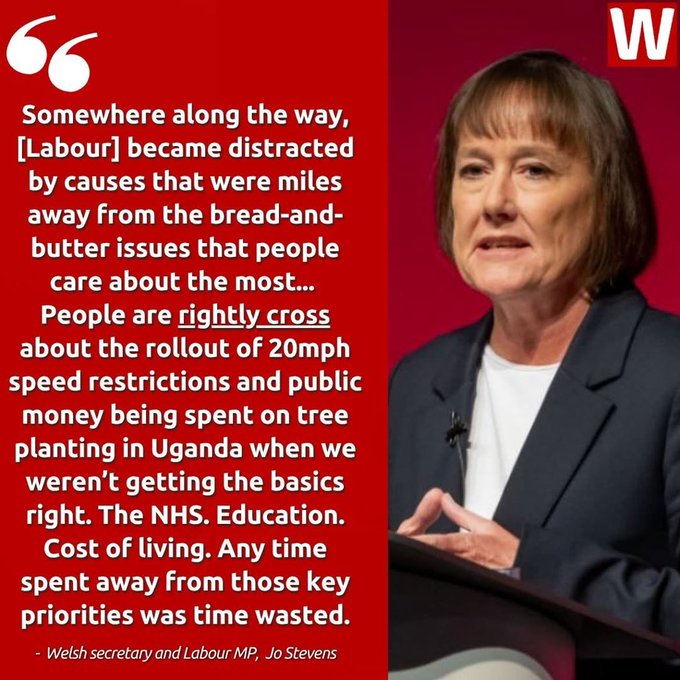
Those responsible for Labour being ‘distracted’, and the only ones to benefit from it, have been gangs of swivel-eyed activists. The “extra-parliamentary pressure” demanded by the Welsh Communist Party.
In the process, this failure created, and is now perpetuated by, a new political class that Djilas would have recognised. Members of this class were brainwashed in school and university. They then got jobs as spads and advisors to politicians. Or they joined lobbying outfits and pressure groups. Maybe they worked in the third sector and for other bodies reliant on the public purse. Some became ‘journalists’.
This political caste, this New Class, is increasingly distanced from the people, and is now entrenched. It’s become generational. It’s self-perpetuating. And it’s concentrated on the left. A very real threat to representative democracy.
Plaid Cymru won because people want change. But if Trystan Davies is any guide they’ll be disappointed, as Plaid will make the same mistakes Labour made.
♦ end ♦
© Royston Jones 2026