Land Of Our Fathers, But Not Our Children

This post is about what’s described as “Wales’ largest rewilding site“. I suspect it’s about more than ‘rewilding’. Because there’s usually big money involved with ‘environmental’ schemes nowadays.

TIR NATUR: WHO’S WHO?

I’ve written about this outfit a few times in recent years. But to get you started, here’s the Tir Natur website, and here’s the Charity Commission entry.

When I first encountered Tir Natur it seemed to be a very amateurish outfit, but now it appears more professional. (That’s not always a compliment.) And there also seems to have been an almost complete change of personnel.

The name I recall from the beginning was Stephen Jenkins. And he gets a mention on the website, telling us he’d left:

The capture above confirms that Tir Natur was formed in 2021. But not actually registered with the Charity Commission until June of 2022.

The only founding member still with Tir Natur might be Gwenan Jenkins-Jones. She’s had training in how to spot money laundering. Which might come in useful at a ‘rewilding’ charity.

These changes are also reflected in the address given.

For the address now shown with the Charity Commission is Moat Farm, Trimsaran, to the west of Llanelli. Though the old address, Y Beudy, Lanlwyd, Pennant, Ceredigion SY23 5JH, also appears on the website.

The Pontyberem address is perhaps where we’ll find the chair of the trustees, Tatatia ‘Tash(a)’ Reilly; for one of the farm owners is a Lindsey Reilly.

Tatatia was the director of a company called Dashtan Ltd. In the business of ‘Residents property management’, which was formed and folded in less than a year. A phenomenon which, as you know, always gets my antennae twitching.

Her co-director was Bogdan Edward Staniaszek. The company address was given as this property not far from Swansea city centre.

Did this in any way link with Tir Natur’s activities?

I suspect those living at Moat Farm are relative newcomers to Wales. ‘Nice little place in the country’ and all that. Same applies to a number of other Tir Natur trustees. I see two smallholders among them.

Definitely getting a whiff of good-lifers here. Though these are the ‘farmers’ Tir Cymru claims to be working with. None are real farmers.

Then there’s a couple of eco loonies who also come from outside of Wales. James Hitchcock, formerly of Montgomeryshire Wildlife Trust, and now Rewilding Britain. And Tim Birch, still looking over his shoulder for the Derbyshire gamekeepers he smeared, and now involved in just about every enviroscam.

Next, Bronwyn Jamie Bunt-Brown, who may be American. And was living in Surrey when she ran this short-lived company. And there was another company that never filed accounts, or seemed to do anything, before being struck off.

Bronwyn became a trustee 25 March, 2025. Someone who joined on the same day was Pamela Louise Noakes. While Bronwyn seems to have moved to Wales Pamela sill lives in London, where she works for M&C Saatchi Group.

This company has worked with Rewilding Britain. Fancy! And is keen to offset its carbon emissions. Noakes’ role is Global Director of Sustainability. Curiously, this day job is not mentioned in her Tir Natur bio. Why would that be, I wonder?

Turning to the ‘Executive Team’, those who run Tir Natur day to day, presents very much the same picture, with the obvious exception of Gwenan Jenkins-Jones. I hope she’s getting well paid, because her mere presence is invaluable to this scam.

To help her provide a Welsh gloss there’s Dr Elen Robert, whose full-time job is as a translator for Natural Resources Wales. Is NRW – that is, us – paying her to do translation work for Tir Natur?

Kilner’s the one on the left, I think

Dan Ward’s day job is with North Star Transition, another interloper organisation.

I could go on, but I’ll just mention David Kilner who, as Development and Programme Lead, might be the top man. Dai is also involved with Climate Cymru, where ‘diversity’ seems to be more important than the climate or the environment.

I say that because you may recall it was the BAME department of Climate Cymru, back in 2024, that called for dogs to be banned from the countryside because they offended a certain group that really should start adapting and integrating.

MONEY, MONEY, MONEY?

With money from somewhere, Tir Nature has bought (or “secured“) 1195 acres of Ceredigion. Here’s a report on the purchase from the County Times.

And here’s a video put out by Tir Natur.

According to an article last week in Nation.Cymru half of the £2.2m has been raised. Farmers Weekly talks of “a philanthropic bridging loan

The Charity Commission website shows that over £900,000 appeared from somewhere before the end of June last year. But where?

Less than two years ago Tir Natur was skint. Though there is now at least one active Crowdfunder page. And there seems to have been an earlier Crowdfunding attempt that closed about a year ago after raising £60,000.

With a sizeable donation in match funding coming from Aviva which, as we know, works with BlackRock. Here’s more information on the Aviva Communities Fund, which has donated £28,264, that we know of.

One of the reasons I’m focussing on the money is because there are many examples of ‘rewilding’ projects and the like that have gone financially awry, perhaps taken on burdens that became too heavy.

One example of overreach would be Highlands Rewilding, which may be the model being followed by Tir Natur. This outfit struggled to pay off the bank loan.

If it’s not overreach then ‘rewilding’ is often a front for milking government schemes.

An example of this would be another case from the Highlands. With Aberdeen Investments being honest about the motives behind the company’s interest in ‘rewilding’.

The estate was acquired by abrdn three years ago for £7.5m as a way to offset carbon emissions from its property portfolio.

The Highlands now are over-run with investment funds and asset managers looking for ‘environmentalists’ to front for them so they can rake in the money from carbon capture and other wheezes.

And there are plenty willing to play the acceptable public face of corporate greed. New groups sprout quicker and better than any fungi they claim to grow.

Just yesterday a good contact drew my attention to Wild Cymru, which is rewilding 210 acres of Ceredigion, at Cefn Garthenor, near Tregaron. The farm is owned by Neil Alistair Hughes of Savoir Beds.

The Chair of Wild Cymru is Daniel Gruffydd Jenkins-Jones. Might he be related to Gwenan Jenkins-Jones of Tir Natur?

A few days earlier a different source told me about another outfit also operating in Ceredigion. This is Oxygen Conservation, which now owns the 300 acres of Esgair Arth.

The guy who seems to own the company, Roy Barry Bedlow, has a string of similar companies. And it’s all about investment, not the environment.

A number of his companies carry the ‘L C’ handle, which stands for ‘low carbon’. One of those companies is L C Energy, which supplies woodchip. But don’t worry, this isn’t shipped across the Atlantic, it’s all “sustainably sourced within the UK“.

Biomass is a scam within a scam. Get big grants to plant native hardwood trees, instead plant quick-growing foreign species, grab the grants and subsidies, chop ’em down, flog off the wood as ‘renewable energy’, sell the land, move on to the next scam.

It should go without saying that Roy Barry Bedlow is based in Jersey.

Finally, a worrying possibility raised by someone who knows about these things, is that this Tir Natur project might qualify for payments under the Sustainable Farming Scheme (SFS), which would not have been the case under the old Basic Payments Scheme.

This would be wrong, and can be avoided if the self-styled ‘Welsh Government’ insists that food must be produced for any land or landowner to qualify for SFS payouts. Otherwise, it’s not farming, is it?

NEIGHBOURS

Let’s take a closer look at the land in question, and its surroundings. Such as the planned windfarms. Didn’t I mention the windfarms! How remiss of me.

The map shows four planned windfarms and the land Tir Natur is claiming. As you can see, they are very, very close. (I am indebted to the group that provided the map.)

The orange access road running south from Bryn Cadwgan goes over National Trust land to the village of Pumsaint. This is the only viable access for the turbine parts and the vast amounts of concrete needed for each turbine base. I covered this issue in November 2023 in The Road To Hell.

Now you might think that the peace and tranquility promised by an area returned to nature doesn’t sit well with an industrial site next door. With work going on for years.

But it doesn’t end there. Word I’m getting from locals says Bute is scouting more land over towards Teifi pools and Pontrhydfendigaid, north east of Tregaron.

And then there are the three farms in the area reportedly bought by the Foresight Group, which has been been busy in recent years buying Welsh farms and planting trees for investors.

But now it gets rather curious. Because I’m told the farms sold to Foresight had not long before been bought by a stranger to the area who’d made his pile in pet cremations! Yes, honestly.

This man, James Uys, is originally from Stroud in Gloucestershire. He played rugby and cricket for the local teams, and is big in sheepdog sales.

His business was almost certainly Limekiln Pet Crematorium, sold to Pet Cremation Services. Pet Cremation Services Ltd is the trading name for Time Right Ltd.

I don’t know how much Uys got for the pet cremation business, but he seems to have sold it in November 2017. And subsequently sold Limekiln Farm in September 2023 for a stated £3,000,000.

Some locals think Uys is a stalking-horse for Foresight, maybe others. Which would be odd, given what he’s on record as saying.

The value of agricultural land is hitting record highs as rich people seek loopholes to avoid inheritance tax, it is being reported.

Wealthy investors who have discovered the legal technicality are snapping up fields – and as a consequence prices are soaring to around £11,000 an acre, making life difficult for farmers. One newspaper reported on the case of a 50-year-old farmer from Gloucestershire who is in the process of selling his hundred-acre estate so he can buy a larger plot elsewhere. James Uys says he hopes to make £3m from the sale.

Did Uys move west, where land is cheaper, to find that “larger plot“. For in addition to what’s discussed here, I’m also told he’s bought a farm near Rhandirmwyn.

Bizarrely, the most recent report I have of Mr Uys is that he is the new tenant of Penlan Farm, Upper Chapel, near Brecon. There were 22 other candidates, including many young locals.

The farm is owned by the Penllergaer Estates in Swansea. Which has an interest in solar farms, as I reported in November 2021. (Scroll to the section ‘Follow the Money’.)

UPDATE: As this section is headed ‘Neighbours’, here’s two of Tir Natur’s supporters talking about the project. One is Jon Moses of Right to Roam. The other is Alasdair Campbell, Executive Director of Somerset Wildlands.

Campbell talks dismissively of “these guys“, who are of course the local farmers. Believing, it would seem, that people like him should have more say about what happens in Wales than local people.

Two arrogant outsiders. Which about sums up ‘rewilding’ in Wales.

CONCLUSION

Whatever Tir Natur may say, I believe they’re fronting for somebody else. Somebody hoping to make lots of money. I say that for a number of reasons.

First, the land Tir Cymru claims to have acquired is, as the video I linked to tells us, already a Site of Special Scientific Interest. It is already protected. For Tir Cymru to want to take it over can only mean they want to make changes.

Perhaps ‘reintroduce’ species like the Eurasian lynx.

‘I’m going to live in Wales’

Second, and in addition to be being an SSSI, the Elenydd is perhaps the last true wilderness in Wales. Consequently, to suggest it needs ‘rewilding’ is absolute bullshit. Like suggesting the Mona Lisa would be improved with a moustache and sunglasses.

Only those with a hidden agenda would insult our intelligence in this way.

But let’s take the claim at face value. If ‘developers’ have their way this ‘rewilded’ area will be surrounded by wind turbines. How will the constant hum and vibration, the flicker, affect wildlife? The lynx and other species will move out.

And the large, slow-moving birds that Tir Natur hopes to attract won’t stand a chance against the blades of the wind turbines.

Going back to the video again, the commentary claims to be “celebrating Welsh history and culture” – while snidely condemning that heritage for the bad farming practices Tir Natur wants to remedy.

Tir Natur promoting themselves as knights in shining green armour coming to save the Welsh environment – from those who have cared for it for over two millennia.

The video talks of bringing in Carneddau ponies. But a contact who knows the farmers that look after these animals says they’ve had no approach from Tir Natur. Which makes me remember a ‘rewilding’ scheme, near Machynlleth, that talked of “reintroducing” Welsh  horses – then they brought in a Polish breed!

Put it all together and you might understand why I’m a wee bit cynical. Why I don’t buy the story that the land Tir Natur has acquired in the Elenydd is just a ‘rewilding’ project, and nothing more.

I believe there’s much more to it.

FOOTNOTE: This week’s piece was to have been in two parts. The second part about a 625 acre farm on the Gwynedd side of Machynlleth bought by Montgomeryshire Wildlife Trust with Aviva-Blackrock money. I’m waiting for further information.

But that’s the state of rural Wales today. Those with roots in this land are being elbowed out by recent arrivals and groups serving the Globalists’ anti-human agenda. With many of them funded and supported by the ‘Welsh Government’ to do the elbowing.

It’s a form of Clearance.

♦ end ♦

© Royston Jones 2026

Buy Me A Coffee

A Case Study In ‘Rewilding’

In a sense, this is a follow-up to last week’s offering, Budget Boost For Rewilders And Globalists. This week, I’m looking at an example of ‘rewilding’ which, on closer inspection, turns out to be a tourism business – receiving funding for posing as a rewilding project.

I’ll fit this into a more general evaluation of ‘rewilding’, and what it really means.

Incidentally, last week’s piece about Tir Natur’s project got a response from ‘Welsh Government’-funded Nation.Cymru and Stephen Price, its Senior Reporter.

Price has a background “working in the third and charity sectors“, and a “voluntary role as a Keep Wales Tidy Litter Champion“. Which gives us another link between that charity and Tir Natur.

SETTING THE SCENE

This week, we’re mid-way between Abergavenny and Monmouth, the region I’ve dubbed ‘Abergavennyshire’ due to an influx of ‘progressives’ from the hell-holes of ‘Metro-Land’ and elsewhere.

(It should go without saying that Stephen Price lives in Abergavennyshire.)

Despite its distance from Corruption Bay, our politicians care more for these recent arrivals than for Welsh people. Certainly, that’s my conclusion when I consider the funding and other patronage bestowed on Abergavennyshire.

Perhaps a reward for this ingress strengthening Labour’s position as the largest party on Monmouthshire county council.

It’s here we find the Abergavenny Food Festival, Coleg Soros, Brecon Jazz Festival, Hay Festival, the many bodies arguing farmers are killing the Wye and the Usk. And of course – Gilestone farm, and the Green Man Festival. Etc., etc.

Map of Abergavennyshire. You’ll see it’s a cross-border unit because many of the new arrivals feel unsafe with thoughts of borders and nations.. Click to open enlarged in separate tab

Our destination today is not easy to reach. There’s no A road in the vicinity. Instead, it’s the B4233, then a track off that road, and after you’ve gone up a-ways, it’s another track to the destination.

This off-road excursion brings us to the The Grange Project. Run by Tom Constable and his wife Chloe, who bought the farm in April last year for £1.875m, without need of a loan or a mortgage.

But as the entry on Rewilding Britain tells us, there’s a lot more going on:

The vision for the site includes developing new nature-based tourism, including log cabins, alongside education and wellbeing programmes hosted in a beautiful converted barn on site. Chloe intends to use her background in clinical psychology to run courses focusing on the systemic resilience required to address the climate and biodiversity crises, while Tom will use his background in business to support ecopreneurs as they set-up and thrive on site.

Those who’ve been brainwashed, worked into a frenzy over a non-existent ‘climate crisis’, will be able to come to The Grange for treatment. At a cost, of course.

The Grange Project also does podcasts – in fact, Tom Constable is a professional – and here we find another link with last week’s piece.

You may remember Dan Ward, one of those involved with Tir Natur, was also working with North Star Transition. North Star was created by Jyoti Banerjee, who starred on the Grange podcast last week.

Small world, innit!

A CLOSER LOOK

Those who’ve given themselves nightmares from reading too much Monbiot won’t be the only visitors, for The Grange also offers corporate away days. Where the IT department of Global Gizmos Inc can come gaze at trees and stuff.

Better still . . . for the trifling sum of £10,000 you can enjoy “two bespoke corporate away days“. Read more in the Corporate Partnership Proposal.

Click to open enlarged in separate tab

I tell you what . . . for half that (in ready cash) you can have two corporate away days in my back garden, There’s flower beds, and a tree, and, er, grass, and if it’s wildlife you’re after then I’ll get our cat to put in an appearance.

If it’s raining you can sit in the conservatory. The missus will lay on a cuppa and biccies. Can’t say fairer than that, squire.

I have no doubt that the companies turning up for these eco-jollies will be claiming tax deductions, which will contribute to the ‘black hole’ in the UK accounts, and be used to justify freezing pensioners this winter.

That’s the ‘circular economy’ you keep hearing about.

Click to open enlarged in separate tab

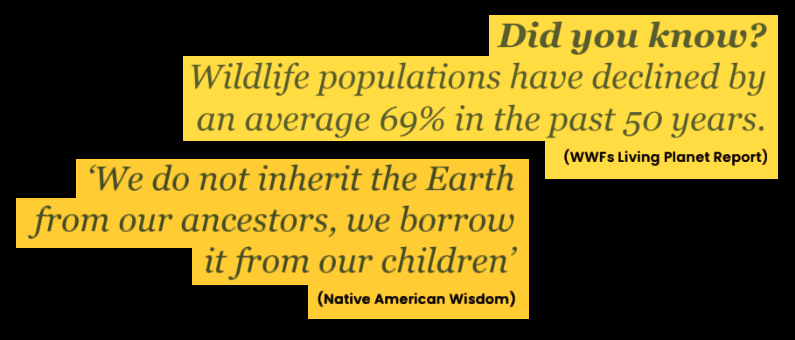
And sure enough, in the Corporate Partnership Proposal we find predictable ‘quotations’.

One from the World Wide Fund for Nature (WWF), that outfit launched by Nazis using environmentalism as the new way to seize power and cull the untermensch.

The other is attributed to ‘Native American Wisdom’. (Are people still falling for that bollocks!) Here’s some wisdom from a source as much Native American as the one quoted: ‘Big Chief Jac-on-Blog say: “Environmentalists speak with forked tongue“‘.

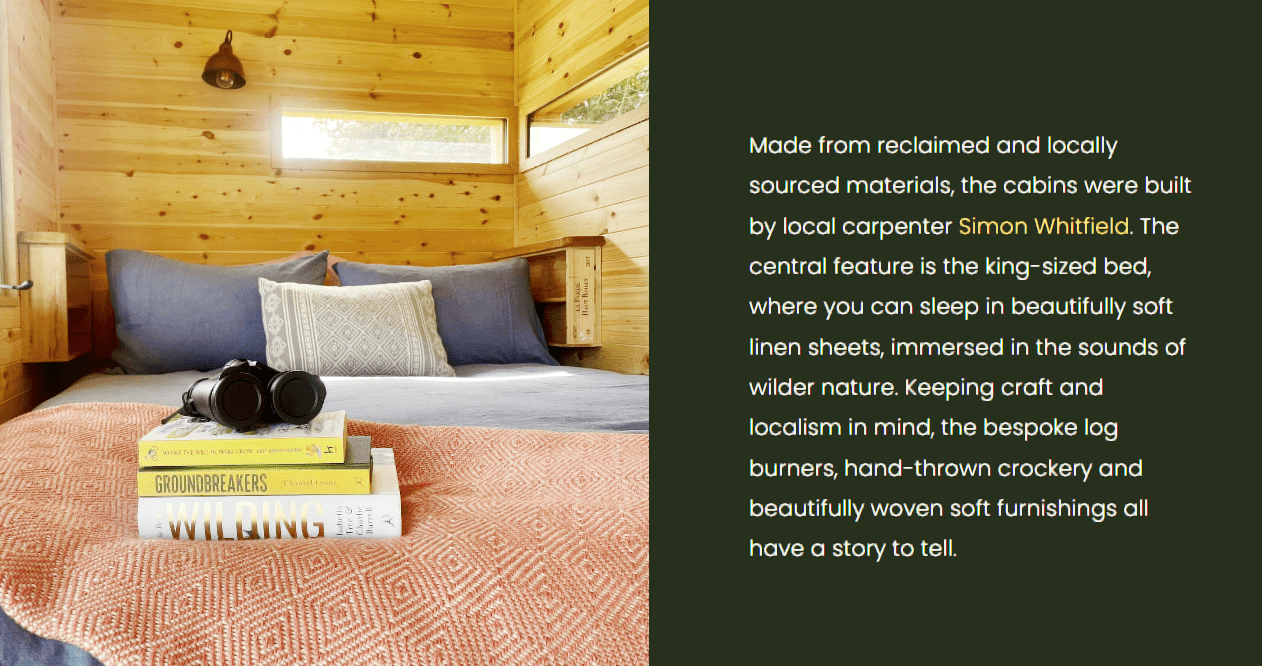
The Grange website also offers, “our own glamping cabins and bespoke bell tents“, and elsewhere, “off grid escapes” in caravan-type structures made by Herefordshire chippie Simon Whitfield.

Click to open enlarged in separate tab

Whitfield runs The Tiny Home Company. When I tried to find it on the Companies House website I drew a blank. So I went back to the website and scrolled down the homepage, where, in the smallest font imaginable, was: “The Tiny Home Company is a trading name of WB Capital Ventures Limited“.

But it was only by copying and posting it into Word that I was able to read that. Why so small? Very odd.

Click to open enlarged in separate tab

WB Capital Ventures Ltd was formed as recently as July, and I assume ‘WB’ stands for Whitfield Brothers, because the two directors are Simon Peter Whitfield and his older brother(?) John Robert Whitfield.

The twelve shares split 8 – 4 in favour of the older brother. Who maybe put up the cash. He has over a million pounds sitting in the bank account of his other company.

And talking of money . . .

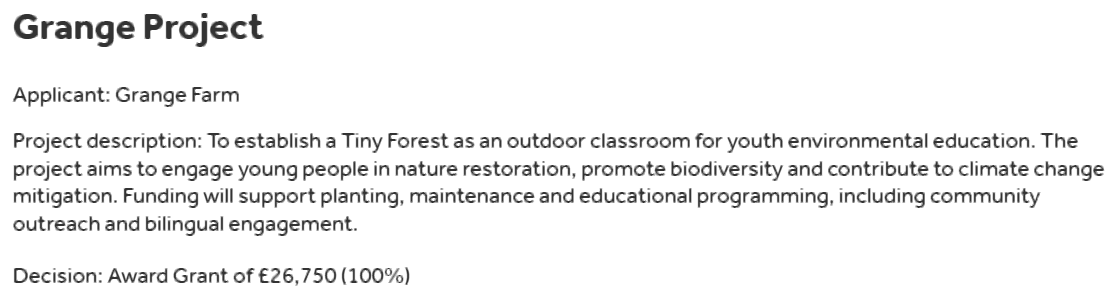
In its short life The Grange Project has already trousered £26,650 from the Coetiroedd Bach scheme. I guarantee there’ll be more grants in future.

Click to open enlarged in separate tab

I’ll end this section with a brief look at what’s registered with Companies House. There are two companies.

One’s Wild Grange Farm Ltd, launched as recently as September 5, with the Constables as the only directors and shareholders.

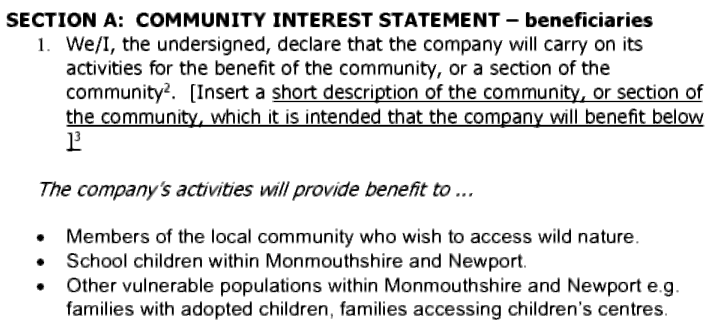
And then there’s the Community Interest Company, formed in August, Wild Grange CIC. Again, Tom and Chloe Constable are the only directors (or members) and shareholders. Which I found odd. Because with a CIC I would expect to see others named, representing the community that will benefit.

This is usually people in the vicinity. So I went to the Companies House website entry for Wild Grange CIC and the Certificate of Incorporation. Most of which is pro forma.

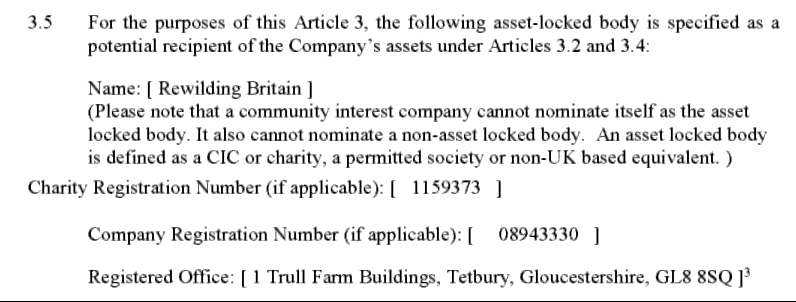
Though towards the end it sets out who might benefit from the CIC:

Click to open enlarged in separate tab

Which is fair enough, and what I expected. But what I read earlier in the document has me thinking. I refer to Rewilding Britain, as the ‘asset locked body‘.

A worst case scenario might be . . . the farm title is transferred to the CIC, which liquidates, and Rewilding Britain takes over The Grange.

Click to open enlarged in separate tab

In the clip above, the Charity number given is that for Rewilding Britain. Whereas the address is for The Trust Partnership (and associated companies), which I assume drew up the arrangement.

The mystery is company number 08943330. For it refers to Mental Mastery Ltd, of Bournemouth, that dissolved 18 months after being formed, without filing anything.

I’ll assume it’s a typo. But if not . . .

THOUGHTS ON REWILDNG

Let me be clear, there might be a role for small-scale rewilding such as we’re asked to see at The Grange.

Thinking again of my back garden . . . if I let it run wild it would sprout plants, flowers; attract butterflies and other insects, some small mammals, maybe a foraging hedgehog.

But once we talk about pine marten, beaver, wild boar, deer, wild ponies, ancient cattle, then we need more land than even the 1,000 acres Tir Natur is hoping to buy.

Because without large areas for these animals to roam and live naturally, problems such as stress, over-grazing, and in-breeding will occur.

Of course, food can be brought in, and fresh bloodlines can be introduced; but if ‘rewilding’ doesn’t create a self-perpetuating ecosystem, as in nature, then that defeats the whole object of the exercise.

One answer might be linking separated projects with ‘corridors’. I mention this because the idea features regularly in rewilding fantasies. Such as one in Cornwall called Tor to Shore. (Does that ring a bell?)

While Helman Tor sits near the top of the Par River, areas downstream are surrounded by farmland, where the project will partner with local farmers to tackle agricultural pollution and create ‘wildlife corridors’ – areas of habitat that . . . connect with other nature-rich sites, allowing wildlife to thrive beyond the reserve’s boundaries.

Rewilding Britain got its ass kicked for its involvement in a similarly-named colonialist land grab. It may be treading more carefully now, yet it’s deeply involved at The Grange, and seems to have been involved from the outset.

But how well do animals understand ‘corridors’? Not well at all; so that would mean mile after mile of fencing . . . which will inevitably get broken.

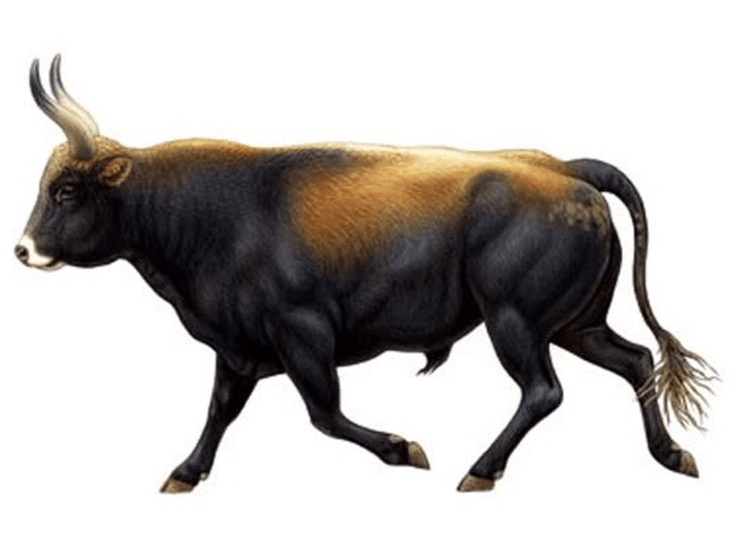
Mrs Jones will wake one morning to find aurochs feasting on her prize geraniums. And, then, when she goes out to shoo them away, and one of the buggers tramples her . . .

Or maybe it’ll be the consolation prize of tauros.

Auroch. Click to open enlarged in separate tab

I haven’t mentioned predators like wild cat, lynx, and wolf. All of which appear in rewilders’ literature. Yet they have to be present, for without the balance created by their natural predators introduced prey animals will need to be regularly culled.

As deer are culled in the Highlands, due to the absence of wolves. While a shortage of prey animals will see predators going elsewhere to get a meal. (‘Look out, Mrs Jones!‘)

Which means that for a rewilding project to be viable it would need 20,000 or more self-contained acres. There would need to be enough food for a range of herbivores and foragers, whose numbers would be kept in check by predators – as in the wild.

In a small country like Wales we just don’t have that land to spare. Not if we; a) want a farming industry and b) let people access the countryside.

Which brings us to a very fundamental question, one confronting us at Grange Farm: ‘What is the real purpose of rewilding?’ This article (February 2023) asks a very similar question, and gives some disturbing answers.

A bit leftist for my tastes but it still makes good points about farms being lost, and corporate investment through middle men, agents, and front organisations.

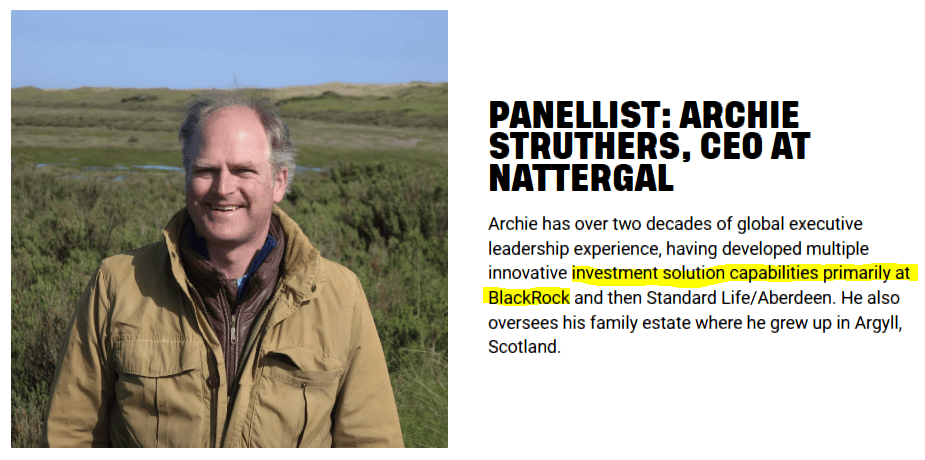
Organisations such as Rewilding Britain, involved with three-year-old Nattergal. Below is Nattergal director and CEO Archie Struthers, panellist at Rewilding Britain’s Blue Earth Summit last month.

Click to open enlarged in separate tab

Nattergal is owned by Lansdowne Developed Markets Master Fund Limited of the Cayman Islands.

One day Archie’s a ruthless investments guru, next day he’s saving the planet. These things happen. After Christmas I’m joining the Socialist Workers Party. (Yes, really!)

Archie’s a busy man for Nattergal, and the company’s mystery owner. Let’s look at three recent ventures. Starting with High Fen Wildland, where we read:

High Fen will offer wellness, eco-tourism, educational and research opportunities to provide opportunities for people as well as wildlife.

Wildlife comes last. Almost an afterthought.

The other two are Boothby Wildland, where, “Nattergal hopes to generate revenues through the sale of ecosystem services (natural capital)“. And Harold’s Park Wildland, that “will generate income from the sale of Biodiversity Net Gain (BNG) units and corporate sponsorship, and will support nature based tourism and recreation“.

Archie also has a couple of relatively new companies of his own, registered in Glasgow. Ardmaddy Ventures Ltd, named for his Argyll estate; and Nature Based Investment Solutions Ltd.

Make no mistake, corporate ‘investors’ are circling Welsh family farms like vultures.

There was an example just last week of farmers being ‘cold called’ by a company named Property Vision. Acting on behalf of anonymous ‘investors’.

Click to open enlarged in separate tab

Rewilding Britain is involved with three projects in Wales in addition to The Grange; they are:

Cefn Garthenor, in Ceredigion. Gilfach, in Powys. Wilder Pentwyn, also in Powys.

They have three things in common:

1/ They were once homes to Welsh families.

2/ They are no longer working farms producing food.

3/ They have received substantial ‘Welsh Government ‘ funding

Always worth remembering when some clown gets all misty-eyed over ‘rewilding’.

CONCLUSION

On a fundamental level, The Grange Project makes no environmental sense due to the increased traffic emissions as engines struggle with gradients and rough tracks to even reach the place.

More environmental damage than the working farm it replaced. Unless of course you want to be really stupid and introduce the threat posed to us all by farting cows. (Fortunately, ‘Dr’ Bill Gates has a solution.)

The Grange Project is clearly a tourism project and a ‘wellness’ retreat for hysterical Guardian readers raking in extra money by presenting itself as a rewilding project. Like those we looked at earlier linked with Archie Struthers.

I believe genuine rewilding is incompatible with daily visits from the public, especially noisy children, and middle management on a raucous day out. Making it all rather phoney.

Especially if there’s ‘natural capital’ and ‘biodiversity net gain’ involved.

And let’s remember that The Grange is less than 100 acres in total. From what I can see, a few trees have been planted and pigs allowed to muddy up some fields. Is that really ‘rewilding’?

If so, then why aren’t we all offered money to let our gardens run wild? A few thousand of us, in Wales alone, could make a big contribution to the environment and biodiversity.

Because, gentle reader, ‘rewilding’, with the involvement of outfits like BlackRock, is not about saving the planet; it complements legislation and other measures intended to undermine farming, thereby freeing up land for acquisition and investment.

‘Rewilding’ is just the prettied-up face of the Globalist land grab.

Once you understand that – everything else makes sense!

♦ end ♦

© Royston Jones 2024