Welsh Labour: One Big, Happy, And Incestuous Family

Two important and encouraging pieces of news today, and both damaging to the Labour Party or, as its local manifestation prefers, ‘Welsh Labour’. I welcome this because all my life I have dreamed of seeing the Labour Party broken, its control over our country destroyed.

It has become evident to me of late that – perhaps due to English politics being so dull – a number of England’s political commentators have begun to look over the border, and they’ve been amazed at what they’ve found. Basically, a third world country on their very doorstep. Not just poor, but also corrupt. In the past few weeks alone, we’ve had Mark Easton of the BBC trek to darkest Blaenau Gwent, his filmed visit followed by a blog posting which in turn prompted a response from Sarah Bees. (Who she?) In addition, there has been increasing notice taken by important bloggers such as Guido Fawkes, most recently with this piece about the Michael dynasty. Then, to fill my my cup to overflowing, today we heard of collars being felt in Caerphilly, a Labour fiefdom again since last year’s elections. Oh happy day!

Without stating it, Mark Easton’s little film was a condemnation of the Labour Party. The party that has controlled the Heads of the Valleys for a century and the Welsh Assembly since 1999. The party that chooses to use Welsh deprivation to blame the Tories and garner votes, then provide funding for its cronies in the Third Sector. In fact, anything but tackle the problem – cos there ain’t no mileage in that for Labour.Alun Michael

Turning to the Michael clan, it might be worth reminding younger readers that once upon a time Alun Michael was top man in the Assembly, before Rhodri Morgan took over. In fact, Alun Michael was pushed into the job by his bosses in London so that Rhodri Morgan couldn’t take over. It may have been this episode that made Michael realise that selection processes and the will of party members could be overridden. (Though it did not work out for him in the Assembly.)

Last year Alun Michael resigned as MP for Cardiff South and Penarth, and ensured he was succeeded by Steven Doughty, the son of a long-time friend. Michael stood down to run for the newly-created post of Police and Crime Commissioner for the South Wales Police area. He was elected. His son, Tal, standing for the North Wales Police area, was not so fortunate. But the boy done bounced back . . . now he is the Labour Party candidate for Anglesey in the August 1 Assembly by-election to replace Ieuan Wyn Jones. Though dark mutterings are being heard from the bruvvers about a stitch-up. Oh, and did I mention that Tal’s wife Mary (Wimbury) is the Labour candidate in Aberconwy for the 2015 elections to the imperial parliament? (Competition at last for the Kinnock clan!)

Alun Michael is the stereotypical Welsh Labour politico. After migrating to the Lesser Wen from the frozen north he worked for a short time as a reporter before becoming a yoof and community worker for 16 years. In 1972, aged 29, he was made a JP. A year later he became a councillor, and in 1987 became MP for Cardiff South and Penarth following the retirement of Jim Callaghan. So he seems never to have done a ‘real’ job. After a lifetime spent climbing the greasy pole he must feel the party owes him a few favours.

Returning to Caerphilly, more fun and games. It emerged a while back that the council, or a small caucus of councillors, had agreed to greatly increase the salaries of the chief executive and 20 other senior officers . . . this done at the suggestion of the chief executive, Anthony O’Sullivan . . . with the decision ‘taken’ at a meeting at which he was present throughout. Now readers outside of Wales might find this way of doing things a little odd, but bear with me, we are talking Welsh Labour here (to help you, just think of those comforting TV programmes about criminals getting caught due to their own stupidity). Then there was the business of the car payment allowances. Anyway, things came to a head today when the already suspended Mr O’Sullivan was arrested, as was his deputy. As yet, no Labour councillor has been arrested. As yet.

Anthony O'SullivanI’ve thought about this case, and tried to visualise what happened, but it’s not easy. O’Sullivan and his gang are all, theoretically, employees of the council, made manifest in the collective and impressive bulk of the ruling Labour group on Caerphilly council. This being so, they should have submitted a request for salary increases and argued their case in the normal way. But no, something totally different happened. Maybe something like this: ‘Me an’ the boys been talking . . . we’ve decided we’re worth more than you are paying us. So you’re gonna make us an offer we can’t refuse. Capice?’ (Or have I watched the Godfather too many times?)

Maybe I’m being too optimistic, but when I put this together with other Labour news from around the country, such as Swansea’s anybody-but-locals council, or the Nazi-Soviet pact running Carmarthenshire, I can’t help but feel a little frisson, for I see the monolith cracking. I see a party unable to find local candidates with IQ higher than waist measurement; a party that ‘controls’ councils that are in fact run by the employees (most from outside Wales); a party that capitalises on Welsh deprivation to ‘send messages to London’ rather than dealing with that deprivation; a party happy to ally itself with closet Tories; a party now further to the Right than it has ever previously been; a party refusing to do what’s best for Wales lest it succeed, and excite nationalist passions; a party reliant for support on the most dispirited and uncritical element of the nation.

It would be tempting to look at the situation now and compare it with the political scene a century ago. Then, the Liberal Party came to the end of its long reign in Wales and was replaced by Labour. Labour today is perhaps in a worse position than the Liberals were a hundred years ago. After all, the Liberals had an up-and-coming David Lloyd George. Labour has no one of that stature, or political cunning. But perhaps the real difference is that today we have a party dead on its feet, devoid of ideas, believing in power for its own sake and nothing more, that can continue to dominate Wales because there is no viable or attractive alternative.

Swansea Labour Party 6: Incest And Sybaritism

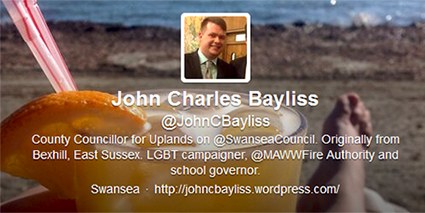
Peraleen Sangha TwitterMore news from the soap opera that is Swansea Labour Party. You will recall that in earlier episodes we met those bright young things Pearleen Sangha (@PearleenSangha), “Big fan of Ray-Ban eyewear”; Mitchell Theaker (@mitchelltheaker), “Labourite and gin lover”; and John Bayliss (@JohnCBayliss), “LGBT campaigner”; all students at Swansea University when they were elected to the council last May. (Click to enlarge images.) These three are devoted to, in order of precedence: 1/ preening and promoting themselves, 2/ helping the good times roll, 3/ student politics, 4/ the internal bitching of the Labour Party (at a ‘national’ level), 5/ assorted rightMitchell Theaker Twitter-on causes, 6/ enriching the shysters of the wind con racket.

Although, nominally, Swansea councillors, these three don’t give a lot of thought to the city and its people. Swansea council merely gives them a platform from which to giggle and gossip with slightly more credibility about what really interests them . . . be that gin, Gay ‘rights’, bars and restaurants, the next yoof commissar of the Labour Party, feminism, name-dropping, recipies, etc., etc. That’s the thing you notice when you look over their tweets, there are virtually no references to the city they’re supposed to be serving, unless it can be used to promote one of their pJohn Bayliss Twitteret causes. Other than that, it’s all about enjoying themselves, but only with ‘their people’, as I’ll explain. Something else I should have mentioned is that they have opinions, on everything. They know nothing, but give out their views on everything. Take Pearleen Sangha, an American, living in Wales, but she has taken sides in the Scottish independence debate. No prizes for guessing . . .

They even use a cash-strapped city’s money to promote those ’causes’, and possibly to promote their friends. For it is rumoured that the soon to be announced GLBT Officer for the city will be a ‘friend’ of John Bayliss. Now of course, our three – and, it must be said, there are others – will argue that this new post is ‘serving Swansea’ . . . leaving us to wonder how the city could possibly have managed in the past without such an appoinSangha caketee.

And they do get about! ThiSangha Scots year alone, Pearleen Sangha has been home to California for a wedSangha weddingding, and was also in Leicester for the conference of Labour Yoof. A busy girl, Pearleen. Too busy to be a councillor on Saturdays, as one of her constituents found out recently – “Do you know what day it is?” the impudent constituent was told. I mean, bothering your globe-trotting councillor as she prepares for dinner with friends! Mitchell Theaker has been to India for a few weeks, empathising and meeting “bigwigs”. While John Bayliss has been home in Sussex for a while helping Labour candidates in the elections there next month. Of course it can be argued that while Bayliss is away the Uplands ward is in the delicate and fragrant hands of comrade Pearleen . . . unless of course anybody wants help on a Saturday. (The large photo of Councillor Bayliss below is taken from his blog. Quite franBayliss Eatbournekly, it’s toe-curlingly embarrassing. He looks like ‘the podgy one’ from a boy band, feigning modesty as Bayliss Ricardohe’s hailed by the total membership of his fan club.)

More thoughtful – cynical? (do I attract cynics?) – readers may at this point be asking themselves, ‘California, Leicester, India, Sussex . . . what the fuck has this got to do with running Swansea?’ A question more and more people are asking, even within the Labour Party.

Another thing you’ll notice by going through their tweets is that the Labour Party isn’t just the political party they belong to, it’s eBayliss Uplandsverything they are. They live on Planet Labour. One tweeter from the Labour Yoof shindig claimed that one third of all the people he knew were at the conference! That’s sad, and worrying. For here we have an organisation that has virtually cut itself off from the rest of society and whose members only mix with ‘their own’. This is New Labour’s gift to us all – a class of professional politicians for whom the talents of being glib and photogenic, being astute at networking and ruthless in back-stabbing, count for more than unBayliss Argentinaderstanding life outside the bubble. As it must, for they know nothing of life outside the bubble. It’s odious; almLuke Youngost incestuous.

Yet these middle-class kids are helping run Swansea. They puff and posture as the defenders of the downtrodden, people they would never mix with socially, but to whom they must pander because that’s where their votes come from. And it’s all feigned, all hypocrisy. All done to justify their hedonistic, gossipy lifestyles which, let me remind you, are being paid for by the citizens of Swansea.

GethingBefore we can achieve indepenTheaker Indiadence from England we must gain independence from a Labour Party that becomes less and less Welsh every year. As the Party fills up with careerists and chancers from outside Wales, and the disconnect between the party apparatus and its captive vote increases year on year, there is no longer any reason for Welsh people to vote Labour. If only we could offer them a viable alternative!


UPDATE 24.04.13: Someone phoned me to ask, ‘Why are they allowed to get away with it?’, meaning why aren’t the lotus eaters being reined in. The leader of the Labour group on Swansea council, and the council itself, is a scouser named David Phillips. I’m using a photo here that I’ve run across more than once. It shows him, steely-eyed, looking into the distance for foes to crush and challenges to overcome. Mussolini liked to be photographed in a similar pose. (I wonder how Phillips would look in a helmet?)David Phillips

You will remember that I wrote about him a while ago, when it was realised he wasn’t allowed to use the letters after his name that he’d been using to impress people since washing up in Swansea. Around the same time I heard that he’d turned up for the funeral of a former Labour councillor in a long, flapping, white trench coat, looking like an extra from a film noir. (Everyone else was in black.) And it should go without saying that his wife, Sybil Crouch, is also on the council, and a cabinet member.

So it would be pointless hoping for intervention from that quarter. Phillips is just another poseur. Swansea Labour Party is full of them now, all trying desperately to impress each other. They can’t pronounce Cwmrhydyceirw or Waunarlwydd, they know nothing of the history of Swansea, they don’t understand its people, but none of that matters. All that matters is that Labour now controls Swansea again. My city reduced to a ‘scalp’.This is ‘Welsh’ Labour 2013.

Swansea Labour Party 5

The leader of the Labour gang now running Swansea council is David Phillips who, despite the name, is English, and from Liverpool. It seems he came to Wales to take a job with Customs and Excise, in Pembrokeshire, some 40 years ago. Leaving after little more than 20 years service he drifted up to Swansea and became an adviser on VAT and similar issues to small businesses. For personal and council purposes Phillips has always signed himself ‘David Phillips AIIT, MInstD’.

The first set of letters stand for Associate of the Institute of Indirect Taxation. Though some unkind souls – even within his own party – questioned whether he should be using this ‘qualification’. Not least because in August last year the Institute of Indirect Taxation merged with the Chartered Institute of Taxation. (You must have seen it on the News!) It was also suggested that his membership of said body hadDavid Phillips lapsed years before the merger.

The Institute of Directors on the other hand is extant and going strong. A global body catering mainly for those on the boards of large companies . . . odd, because Phillips the tax adviser was never much more than a one-man band. There was also the problem that claiming to belong to this organisation, and perhaps having shared a fat cigar with these oppressors of the proletariat, did not go down well on the barricades with the more right-on members of Swansea Labour Party.

Anyway, things came to a head recently when an FoI was lodged asking for clarification of these letters and whether the Great Leader was entitled to flaunt them. The response was swift and Ealing-esque. Staff at the Civic Centre swung into action deleting AIIT and MInstD from all publications, physical and electronic. So we can safely assume that Phillips was not entitled to use these letters.

Leaving me to ask: What sort of man tries to impress people with letters after his name that he is not entitled to use? (And should such a man be a council leader?) Having been responsible for the expense, will Phillips now recompense the council tax payers of Swansea for council staff having to spend time covering up his little ‘oversight’?

STAYING IN SWANSEA . . .

Intelligence reaches me of regular deliveries of wind turbines through the docks, bound for Brechfa Forest, Mynydd y Betws and other sites. These turbines are coming in from, Spain, China, the USA and Denmark. On foreign-crewed and foreign-owned ships that do a quick turnaround, thereby denying the local bars and massage parlours a chance to lighten the sailors’ wallets.

The turbines then cause massive traffic problems as they are transported on specialist haulage units brought in from outside of Wales, to be erected by construction crews also from outside of Wales. Once up, they will be milking the subsidies making massive profits for their foreign owners. Often on land owned by government agencies (Forestry Commission) or English absentee landlords (Duke of Beaufort). And of course, once erected, they will not provide any employment. So who in Wales – dockers apart – benefits from these rapacious, ugly monsters? I link this with the above story because of course Swansea Labour Party is in love with wind turbines, and recently voted to inflict them on Mynydd y Gwair.

Of perhaps greater concern is a rumour circulating locally that not all the wind turbines arriving in Swansea docks and / or being erected in Wales are new. If so, is any agency empowered to monitor these turbines, check that they are up to scratch? And seeing as the effective working life of a new turbine was recently lowered from 25 to 15 or 16 years, what is the life expectancy of a second-hand machine? How could it be calculated? And who’s going to remove them and engage in genuine environmentalism – by repairing the damage done – when they cease to be of use?

LDPs – Yet Another Flaw?

A lot has been written in recent years (some of it by me!) about the flawed reasoning used to justify the Local Development Plans forced on our local authorities by the English Planning Inspectorate; this body allowed to act in the name of the Welsh Government and aided by non-Welsh senior officers in our de-democratised councils.

One regular complaint is that previous, undesirable, levels of English immigration are used to justify more of the same. Or that there has been too much input allowed from those with a vested interest in building more new houses. But whatever the exact complaint, it has tended to centre on interpretation, or presentation, rather than on the raw data used. But there may be problems here as well.

Unable to yet make the emotional break with the City of my Dreams, this afternoon I looked through the ward profiles data used to inform Swansea’s LDP. And I found something that brought back memories . . . memories strong enough to make me realise that someone had dropped a rather large testis.

Those of you older than some of the councillors I have been dealing with lately, and who were – also unlike them – living in Wales at the time, will remember that the 2001 census neglected to provide a Welsh tick box. This led to a campaign, organised by the Independent Wales Party, and supported by many others, to boycott the census. The centrepiece of the protest was a ‘coffin’ that travelled the length of Wales collecting census forms that people had refused to complete. After arriving in Cardiff Bay the coffin containing the forms went missing. (And I honestly don’t know where it went.) As I travelled with the coffin for most of the route I can testify to the anger we encountered.

So I was surprised to read in the ward profiles figures given for “People identifying themselves as Welsh” – with the source for this information being the 2001 census! Which, as you can imagine, gave rather odd ‘statistics’. According to Swansea council, using Office of National Statistics data, in 2001 just 15.29% of Swansea’s population identified as Welsh. The 2011 census, which did allow people to describe themselves as Welsh, found that 70.4% chose one or other form of Welshness. Surely someone at the council should have realised that the 2001 figure is rubbish. So why use it without a health warning?

In fairness, the council does admit, “The Profiles (published in July 2012) are a snapshot based on currently available information. They are published in draft form only, as they will need to be updated when the 2011 Census findings are published and as further information becomes publicly available”. Fair enough, but the 2011 census figures have now been out for a few months, so why haven’t these ward profiles been updated? And wasn’t the Swansea LDP based on these wrong figures?

Which brings me to my real worry. If I can find such obviously incorrect ‘data’ from just a quick glance, how many of the other ‘facts’ used to justify LDPs across Wales can be trusted? Is there any independent assessment or evaluation? What about those LDPs, such as Denbighshire’s, planning thousands of new houses not needed by the local population, were they also compiled on faulty data? Did someone look at the 2001 census and say, ‘Only 12% here are Welsh. Let’s build – everywhere!’

Swansea Council, etc., etc., Part the Fourth

Following on from the previous post I have now written to the Welsh Government asking that the Mynydd y Gwair project be ‘called in’ due to the many irregularities attaching to the February 7th vote and other, linked issues.

For if the Council’s legal officers strongly advised Councillor Ioan Richard (of the affected ward) to absent himself from the debate then there were a number on the other side as obviously predetermined to vote in favour as Councillor Richard was to vote against, so were they given the same advice? And if so, why were they allowed to ignore that advice? All explained in the letter here. A further copy, with a covering letter, has been sent to the Public Services Ombudsman for Wales.

Looking at the wider picture, the Mynydd y Gwair case, and what I’ve learnt about the state of the Swansea Labour Party in the past couple of weeks, it fits in with a wider picture of the Labour Party in Wales. It is a party increasingly reliant upon a regular influx of non-Welsh candidates in order to keep up the appearance of strength. What’s interesting, is how it achieves and maintains that influx.

I began this series of posts with a fit of nostalgia by recalling the Labour Party I knew back in Swansea when I was growing up there in the 1950s and 1960s. Few of our local councillors and activists impressed me in a positive way, but at least I knew them. I knew who they were. Or if I didn’t, then the chances were that my father knew them, or worked with one of the Brother’s brothers. Most Labour councillors of that era started their political careers in the trade unions, blue collar trade unions catering for the working classes.

Despite their many shortcomings no one could argue that our local councillors did not know their patch, and did not want the best for Swansea. Looking back to those days, the Labour Party I knew back then was, through the trade unions and other activities, part and parcel of the lives and experiences of those who supported the party. Not so today.

THE ‘PAINTED SHELL’ PARTY

I have chosen this metaphor because the more I think of today’s Labour Party the more I see an empty but cleverly decorated shell where once there had been something less attractively adorned but with more content. A party today still able to rely on the ‘donkey’ vote, but with the problem that ‘donkey’ voters rarely join the party, let alone become candidates. Thus leaving Labour dependent on other avenues for many of its representatives.

One route for that supply, obvious when we consider Swansea, is higher education. With two universities and a few other colleges the higher education sector is a valuable source of council candidates for Labour in Swansea. This applies elsewhere in Wales and may go some way to explaining why the ‘Welsh’ Government is so keen on giving Wales a higher education sector grotesquely and damagingly in excess of what a small country needs.

Then, when we look at another route, the Third Sector, and strip away all the political correctness and touchy-feely nonsense, what we see is naked politics. An overlarge Third Sector such as we suffer in Wales attracts a steady inflow of individuals to take advantage of sinecures, jobs and funding handed out by the party they belong to or support.

Making the Third Sector a system of political patronage, plain and simple. Nothing more than a party in power with money to disburse rewarding its friends and supporters. This kind of mild corruption is found all over the world, but it’s rare to find it practised so blatantly in Protestant Europe. In return for this largesse the Labour Party has a ready supply of candidates.

Which means that since the first round of EU Objective One funding in 2000 the Welsh economy and the welfare of our people have taken a back seat to the Labour Party’s ‘patronage-results-in-candidates’ system. That’s bad enough, but understandable in a selfish kind of way. What’s unforgivable is that both the Liberal Democrats and Plaid Cymru have supported this corruption . . . and being the unprincipled chancers or deluded ‘socialists’ they are, would do so again, tomorrow, given the opportunity.

Something else that struck me as I trawled through the available information on Swansea’s new intake of Labour councillors was how many of them belonged to trade unions. Or rather, a single trade union, Unite. And how many are members of the Co-operative party. Which provides another stark contrast with the days of my youth.

For I recall horny-handed sons of toil (unless of course they were shop stewards) who belonged to the TGWU or the NUR, and who drank in the Dockers Club. But today’s skinny latte Labour Party, to maintain the pretence of a link with the hoi-polloi, has union representation from a white collar union that has as members people who’ve never done what most people would regard as work! Somehow I can’t see their names being stitched onto the union banner by candlelight prior to the dawn assault on the bastions of capitalist oppression.

This final observation (no, not the candlelight stitching) brings me to the ugly reality of professional politicians; which is where academe, Third Sector and white collar unions inexorably takes us. To the realisation that we now have a class of people – especially within the Labour Party – who got involved in student politics then, on leaving university became an ‘adviser’ to an MP or AM, or worked for a trade union or a grant-guzzling Third Sector body and, then, without venturing into the ‘real world’ inhabited by un-networked mortals like thee and me, go on to ‘represent’ us in our local authority, or else in Cardiff, London or Brussels.

Throw in the loose canon or crank who nevertheless knows how to play the selection process and you can understand how the Labour Party on Swansea City Council is what it is today: a repulsive collection of carpetbaggers, trendies, oddballs and single-issue obsessives exploiting the indigenous ‘donkey’ vote in order to serve constituencies such as the GLBT community.

I leave you all to consider this. Due to the assorted machinations listed above it could be that the Conservative Party is today, for the first time ever, more representative of the Welsh nation than the Labour Party.


UPDATE 27.02.2013: More information has come to light that has resulted in me making another complaint to the Public Services Ombudsman for Wales. To explain.

Just before Christmas all Swansea’s councillors received a copy of a book, The Wind Farm Scam, by Dr. John Etherington. The book was sent by the organisation leading the resistance to the Mynydd y Gwair wind turbines, SOCME (Save Our Common Mountain Environment).

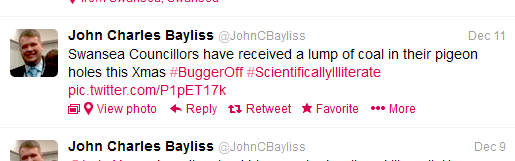
One councillor, young John Charles Bayliss (who has cropped up here quite often of late!) was mightily unimpressed with this Yuletide gift. So unimpressed that he was moved to tweet. My interpretation of this tweet is as follows. The Bayliss, coalreference to “coal” I take to mean that the book should be burned. “#Scientificallyilliterate” is probably his opinion of those who sent the book, or possibly Dr. Etherington. While “#BuggerOff” can only be his response to those who kindly sent him the book. Such ingratitude! (The picture referred to in the tweet is simply the front cover of the book with the SOCME complimentary slip.)

This tweet for me is proof positive that as early as December 11th (and almost certainly long before) Bayliss was predetermined to vote in favour of wind turbines on Mynydd y Gwair. That being so, John Charles Bayliss is another councillor who should not have voted on February 7th.

Swansea Council, English Lords, Swansea Labour Party, German Multinationals, Student Politics, Trots, Wind Turbines, etc., etc: Part the Third

Are you sitting comfortably? Good. Because what follows gets a bit complicated. That said, I believe there is now enough evidence to question the legitimacy of the decision taken by Swansea council on February 7th to allow RWE to erect wind turbines on Mynydd y Gwair, common land owned by the Duke of Beaufort on the city’s northern outskirts. My previous posts this month on Swansea council are, in chronological order, here and here.

Perhaps the first thing to make clear is that the long-serving local councillor, Ioan Richard, was not allowed to vote on February 7th because he had previously shown his opposition to the project. In other words, he’d been open and honest about his position. The same may not be the case for a number of those who voted to grant planning permission.

My attention has been drawn to the fact that RWE’s Renewables Developer for Mynydd y Gwair, Gwenllian Elias, tweets as @gwenll_elias, and among her 59 followers are Councillor Mitchell Theaker (@mitchelltheaker) and Councillor Pearleen Sangha (@PearleenSangha). She reciprocates Sangha 2by following them. (Another Swansea councillor Ms Elias follows is Nick Bradley (@CllrNickBradley) the council’s number one West Bromwich Albion fan.) On the night of (possibly the day after) the Mynydd y Gwair vote, Pearleen Sangha tweeted her joy at the outcome of the council meeting . . . and her tweet was almost immediately retweeted by Gwenllian Elias of RWE! Great minds, eh!

Now this may be harmless enough, perhaps nothing more than contact limited to Twitter. Alternatively, it could suggest that Elias, Sangha and Theaker were known to each other before the vote was taken. In which case it puts a totally different complexion on the matter. For if they knew each other before the vote then, seeing as both Sangha and Theaker voted for the bird and bat mincers, they were as ‘compromised’ as Councillor Richard in that their minds were also made up long before the discussion of the matter, and the vote, on February 7th. If that was the case then they should not have been allowed to vote.

Now let us turn to Llansamlet’s very own advocate of permanent revolution, Councillor Uta Clay, who has come in for a bit of a hammering of late, partly for stoutly defending the Duke of Beaufort’s financial interests, and partly for making silly remarks during the February 7th debate. This letter is just one of a number I am told have appeared in the Evening Post. As the letter suggests, how could this woman, who has only been in Swansea for five minutes, be so silly and insulting as to slur ordinary Welsh protesters as belonging to the “privileged few”. A category to which an English nobleman apparently does not belong! (Is this making sense?)

You also have to ask why, after the local party had the good sense to deselect her, and suspend her and her husband, some unnamed authority representing ‘London’ stepped in to insist the Clays’ suspensions be lifted and she be reinstated as candidate for the May 2012 council elections. What happened to devolution? What happened to ‘Welsh’ Labour?

Someone else who’s only been in Swansea for five minutes is New Zealander Andrew Hore, ‘Elite Performance Director’ at the Ospreys. (Not to be confused with the Andrew Hore who did the dirty on Bradley Davies last autumn) Hore was allowed to speak at the February 7th meeting in favour of the Mynydd y Gwair money machine. RWE sponsors the Ospreys, and a number of councillors are season ticket holders at the Ospreys; others have received ‘hospitality’. Which looks a bit . . . er . . . iffy? Here is a (PDF) link to an interesting exchange between Edwina Hart, a local AM, and Patrick Arran, Head of Legal, Democratic Services and Procurement at Swansea council, in which Ms Hart questions why Hore was allowed to speak at the council meeting. A good question.

Then, today, a letter appeared in the Wasting Mule from a Swansea councillor – one who actually knows the city, and can pronounce Mynydd y Gwair! What Councillor Tyler-Lloyd is (perhaps unwittingly) alluding to is a system now becoming dominant in Welsh political and public life. It begins with civil servants in London or Cardiff issuing diktats. When this is done in London it’s invariably done on the instructions of  politicians; when it’s done in Cardiff it’s too often done on orders from London and presented to the self-styled Welsh Government as a fait accompli. (Well, what do you expect? If Welsh Labour won’t stand up to ‘London’ on matters of internal party discipline do you really think they’re going to challenge Sir Humphrey in Whitehall?) These diktats then become Gospel for senior officers in local government who use them – and the threat of the expense involved in challenging them – to silence debate and stifle opposition. R.I.P. Welsh local democracy.

As it takes hold we see this process leading to situations such as that which has been played out in a London courtroom this week, as Fuehrer James of Carmarthenshire County Council sues – with public money – a blogger who dared criticise his regime. Or the cabinet of Labour-controlled Caerffili council meeting behind closed doors to give whopping pay rises to senior officers . . . at the insistence of the chief executive – i.e. the major beneficiary!

The wider and more worrying picture though is of a Wales in which we have the chimera of devolution while the reality sees us Welsh becoming increasingly marginalised and silenced across the land. In the rural areas the picture is stark, and villages and small towns are taken over by English colonists, but even in the city of Swansea we see it happening.

For one interpretation of that vote on the 7th of this month would be thart it was a victory for those who view our homeland as a resource to exploit, or else the political equivalent of a sandpit, somewhere to start one’s political career. On the one hand we had an English lord whose family has been robbing us for centuries, a German company here to milk the absurd subsidies paid for so-called ‘renewable energy’, a bunch of ex-student politicians that include a GLTB fanatic, a Californian, a West Brom supporter, another with an interest in cadets, then there’s a New Zealander working for the local rugby team (most of whose supporters still don’t understand what his bloody job is), and assorted other drifters, misfits and parasites who know fuck all about the city I love.

All these were allowed to speak, despite many if not all having already made up their minds on the issue or, worse, having a vested financial or other interest in seeing wind turbines on lovely Mynydd y Gwair. Yet, the councillor in whose ward Mynydd y Gwair is to be found, who had no financial or other interest, who had been open and honest in his opposition, and who represented the views of the overwhelming majority of his constituents – that is, those directly affected by the industrialisation of Mynydd y Gwair – was thrown out of the council chamber.

Where does this leave democracy, local or otherwise? And given that virtually all those on the one side of this debate were foreign, and almost all those on the other side were Welsh, what does it tell us about our country today? And our place in it?

UPDATE 23.02.2013: Interesting comments to the post from Jeff Jones and James Dunkley. Both question whether Councillor Ioan Richard was given the correct legal advice by the council officer(s). (Jeff Jones is the former leader of Bridgend Council who now works as a local government consultant.) They aren’t the only ones asking these questions. If Cllr Richard was wrongly told to leave the chamber then it must call into question either the competence or the impartiality of the person who gave that advice. (Patrick Arran. See the link in the post to his exchange with Edwina Hart AM.)       

Gwenllian Elias, the RWE Npower project officer for Mynydd y Gwair’s CV reads: 2007, left Cardiff University with BSc in Geography and Planning. September 2007 to September 2008 Planner with Newport City Council. September 2008 to August 2009 Planner with City and County of Swansea Council. August 2009 to April 2010 Planning Liason Officer with the Environment Agency. April 2010 to present Renewables Developer with RWE Npower Renewables Ltd. Looks like a planned career course: gain the background knowledge and contacts in the public sector before heading into the private sector and the serious money. And all done in less than three years.

The behaviour of certain councillors at the February 7th meeting, the near certainty of them being predetermined to vote in favour of the Mynydd y Gwair development, plus their established links with RWE’s project officer, has been referred to the Local Government Ombudsman for Wales.

THE CHANGING FACE OF THE LABOUR PARTY IN WALES . . . OR MAYBE NOT

When I was growing up in Swansea the Labour Party seemed to be everywhere, through the presence of its members and supporters in just about every organisation in the locality. Not least the local council. Though this influence was not confined to the public sector and local government; for at times it was difficult to determine who controlled some local companies, was it those who, nominally, owned these companies, or was it the trade unions? Whatever the answer, jobs, homes, and other ‘favours’ could be gained by knowing a local foot soldier; while being on friendly terms with a ‘capo’ could open many doors.

As I got to know our local Labour activists I found most of them very unattractive. (Maybe I was too idealistic. Or perhaps my standards of personal hygiene were too high.) But for whatever reason, they came across as grubby little men, drunk on what power they possessed, and determined to show off, or abuse, that power at every opportunity. They could mouth the class war slogans but the lack of deeper political understanding was obvious once the debate moved beyond slogans and rehearsed arguments. Equally obvious was the absence of principle. Most seemed driven by greed and envy. I often thought that they didn’t really want to raise up the masses so much as bring down the ‘nobs’. And if they’d won the football pools, or been left a tidy sum by Auntie Bessie in Chicago, then it would have been a case of, ‘The working class can kiss my arse . . .’. In other words, they were victims of circumstance, unhappy with their lot, looking for easy answers . . . and nothing provides more easily digestible answers for the uncomprehending ‘victims of the system’ than socialism.

These thoughts have come to me a few times recently as my attention has been drawn to the composition of the Labour Party in Swansea today. The most striking thing is the almost total absence of class warriors. Strange, really, when one considers that the gulf between rich and poor is greater today than at any time in recent history. The cloth caps have been replaced with the kind of headgear favoured by Afghans or Andean peasants. At times it seems not so much New Labour as New Age Labour.

The Leader is a Liverpudlian and there are many other councillors from outside Wales, even an Austrian. There are students fresh out of college, one from California. Then there are students who graduated in earlier years, including one who lists among his Interests “my beloved West Bromwich Albion”! There are also academics among the Labour group, making it clear that Swansea’s centres of higher education are a vital source of recruits for the local Labour Party. Another Labour councillor, born in Southend, is glad to be “back by the sea once more”. Ah, that’s nice.

One of the young ex-students, elected last year for a bedsit land ward on the west side of the city seems to be solely interested in Gay, Lesbian, Bisexual, and Trans-sexual (GLBT) matters, if his Twitter account is anything to go by. And this, ‘pet issues’ approach to politics, is found throughout the group. Making the controlling Labour group on Swansea council look like an eclectic collection of individuals held together by a belief that they represent ‘progressive’ elements that only the Labour Party can accommodate. Another interpretation would be that the Swansea Labour Party has lost out in a Faustian pact to people who have now taken over its organisation, structures and soul to promote their own agendas.

Don’t get me wrong, a little outside blood is always beneficial, whether to improve the breeding stock, or to introduce new thinking, but there comes a point beyond which the balance tips and the new element ousts the old. This is what appears to be happening with the Swansea Labour Party. It’s almost as if New Labour’s practice of ‘parachuting’ favourites into safe seats has reached down to ward level. Perhaps it has, for a number of these thrusting, ex-student councillors work for local MPs and AMs. A word in the right ear?

Now of course, even if the Labour group was made up entirely of persons born and bred in Swansea, lifelong Swans fans, etc., etc., these would still have their pet subjects, their hobby-horses, but at least they would know and be committed to the city of Swansea. When there are so many in the ruling group on the city council that a) don’t really know or understand the area and b) are pursuing their own agendas, then we have to ask how well that city can possibly be served by such an administration.

And when we add Swansea Labour’s profile to the well-documented – even award-winning (Private Eye) – troubled councils of Carmarthenshire, Ynys Môn, Caerffili and Wrecsam . . . and when we consider rule by cabinet, or the dictatorship of a chief executive; and when we spread this over the absurd number of twenty-two local authorities in a country of just three million people, then we realise that Welsh local government isn’t just in a mess, it needs to be dismantled and built again from scratch. And among the many changes so desperately needed, why not insist on ten years residence in an area before anyone can stand for the local council?

And yet, knowing Swansea as I do, and Wales, and the origins of the Labour Party, maybe what we see in Swansea today is simply the clock being turned back. Let me explain. I grew up in what amounted to a localised one-party state; yet from my grandparents and people of their generation I came to learn that what I regarded as the established order was, to them, something relatively recent in origin. And not entirely welcome.

In the nineteenth century we Welsh supported the Liberal Party, even when most of us were denied a vote. This loyalty was taken with them by rural immigrants to the industrial areas (like four of my great-grandparents, who came up from Carmarthenshire and Cardiganshire). Inevitably, the ‘human reservoir’ of south west Wales eventually began to dry up; so by the end of the century the workers needed in the southern industries came increasingly from England’s western counties, Ireland, and beyond. This new wave of immigrants found the Liberal Party less attractive than their Welsh workmates; for to them the Liberal Party was part of a ‘package’ that took in the Welsh language and the nonconformist chapels. This new element in Welsh society rejected that ‘package’ and looked for another political party. It arrived with amazingly good timing in the form of the Labour Party.

Which resulted in many of the older Welsh people in the industrial south in the first half of the twentieth century, especially – but not exclusively – those with roots in the Welsh-speaking rural areas, still regarding the Labour Party as something ‘alien’. For it had no Welsh ‘roots’, Labour had merely appropriated the Merthyr Rising, the Chartist Rebellion in Newport, and other specifically Welsh events as heralds of its own Coming. Ignoring the uncomfortable facts that Dic Penderyn may not have spoken English, and that the Newport Chartists called for a Silurian Republic. Labour to many people of my grandparents’ age and background was an English-Irish concoction that had displaced ‘their’ party. Of course this perception had weakened over time, as Welsh people joined the party. Yet even though they themselves may now have voted Labour – due to it having become the only viable opposition to the Tories – they still felt a certain pang of guilt, knowing that their parents and grandparents would have disapproved.

From the other side, due to its non-Welsh roots, and its rejection of the ‘package’, there was always within the Labour Party, particularly in the south east, a lurking suspicion of Welshness, with undisguised anti-Welshness often breaking to the surface. This has persisted to the present day. It goes a long way to explaining why a Welsh Government refuses to manage Wales in the interests of the Welsh. It explains the squandering of precious funding on the Third Sector shysters of the ‘Poverty Industry’. It explains the defeat of devolution in 1979. It goes a long way to explaining why Wales has no financial institutions of her own, few indigenous industries, and a colonial relationship with England. Only a political party with the origins and outlook of ‘Welsh’ Labour could facilitate and celebrate the exploitation of Welsh resources by arguing that to do otherwise would be to give in to ‘narrow nationalism’.

I didn’t intend to give a history lesson here, but maybe Welsh people, inside and outside the Labour Party, should better understand this schizophrenic monster that bestraddles our country. And remember that for every Cledwyn Hughes there was a Neil Kinnock. For every Gwilym Prys Davies a George Thomas. Of course, this will mean nothing to those I started off writing about. Which, I suppose, proves my point.

UPDATE 08.02.13 Last night Swansea council voted to allow wind turbines on Mynydd y Gwair on the northern outskirts of the city. During the debate it was argued that Mynydd y Gwair is a valuable recreation area, where people can walk and enjoy the views looking up towards the Brecon Beacons or out over the Severn Sea. One Labour councillor disagreed. In her Llansamlet ward people can’t afford cars, and so are unable to reach Mynydd y Gwair, which she seemed to think was reserved for rich people with 4 x 4s.

The land in question is owned by the Duke of Beaufort, one of the richest men in England, who owns a great deal of land around Swansea. Four years ago he was paid £280,000 by Swansea council for graciously allowing a new footbridge over the River Tawe, near the Liberty Stadium. The Mynydd y Gwair turbines will be erected – and the subsidies milked – by the massive German company RWE. So to spite the protesting local rich folks – in reality, farmers with old pick-ups grazing sheep on the mountain – the Swansea Labour Party decided to destroy a beauty spot and in so doing further enrich an English lord and a German multinational.

This defeat of the Welsh is doubtless being celebrated today by the brothers and sisters of Swansea’s English Labour Party. They can crack open another bottle of organic llama piss and congratulate themselves on ensuring that in the years ahead vast sums of money will be pumped to such deserving and needy recipients. While those poor souls in Llansamlet, condemned to poverty and public transport, will be paying for it all through rocketing electricity bills.