The Parasites Keep a-Coming

I hadn’t planned this but you’re reading it because it illustrates what’s happening over much of Wales. Though this case is a bit of an oddity in that it’s official but there’s no info beyond the bare bones.

LLANTEG

Our story focuses on the hamlet of Llanteg, Pembrokeshire; pinned in the centre of the map below. The reason for going there is that certain companies are planning a ‘Green Energy Park’ and a ‘400kV substation’.

How do I know? Well, someone sent me various documents from which I’ve extracted the panel you see below. It comes from the latest update of the Transmission Entry Capacity (TEC) register produced by the National Systems Energy Operator (NESO).

If you scroll down to the second sheet of the register you’ll see what I’ve clipped for you below. Both entries link to the – non-existent – ‘Llanteg 400kV Substation’.

The person who sent me this information keeps abreast of these matters, but this was all new to him.

I tried an internet search for this project, but turned up nothing apart from a vague reference to Community Energy in Pembrokeshire (CEP). Here’s the website, and here the Companies House entry.

Here’s the Llanteg village website.

As Llanteg is outside the national park I went to the council website and checked through planning applications. But drew a blank.

Next, I wrote to the council planning department, and here’s part of their reply:

I am having trouble locating any information regarding the two highlighted in your screenshot. Please can you provide a site map for me to investigate further?

Mmm. Clearly, the council knows nothing.

As I say, the only references I found to renewable energy were all small-scale, ‘community’-type ventures. But I suspect what we’re looking at is very commercial. I say that due to the names linked with the projects in the panel above.

So who are the companies named on the NESO document?

LLANTEG GREEN ENERGY PARK

The ‘Green Energy Park’ is in the name of NP SPV30 Ltd. And that outfit’s been registered with Companies House since July 2023. One of a string of numbered companies, now up to 50. (Maybe more by the time you read this.)

One of those companies that converted into a named project was NP SPV 31 Ltd, which is now Gwyddelwern Energy Ltd. This being the name of a village on the A494 between Corwen and Rhuthun. So let’s detour briefly and look into it.

Ultimate ownership of this project is with:

Heading back down to Pembrokeshire, ultimate ownership of NP SPV30 Ltd, the Llanteg Green Energy Park project, rests, via Natpower UK Ltd, with Mr Fabrizio Zago, an Italian living in Monaco.

Looking at the directors for the Llanteg Green Energy Park project, we see two names; a British subject with an Italian name (Sommadossi) who I’m satisfied is an associate of Zago, and an American.

This American, Benjamin Aaron Ben Tre, took up 40 directorships on May 1 this year. All linked with Natpower and all using the same Mayfair address.

More interestingly, perhaps, Ben Tre was involved with Stefano Danilo Massimo Sommadossi in other companies a few years back. I would guess the reason these companies are listed separately is because the name is spelled Ben Tré.

Let’s start with Coincident Energy Ltd (10.02.2016 – 17.09.2019). No money ever went through the books, but then again, this company was controlled from the British Virgin Islands.

Next up in chronological order is Influence Power Ltd (10.02.2016 – 17.09.2019). Another company with nothing in the pot, and controlled by Coincident Energy.

The third company used as its address a flat overlooking the Thames in Wandsworth, presumably leased by Sommadossi, who was then still an Italian citizen.

The company was called QMobility Ltd (03.01.2020 – 21.12.2021). It began life with directors Sommadossi, Ben Tré, another Italian named Stefano Madeddu, and a second American by the name of Jonas Lauren Norr.

This is interesting. Norr seems to be based at Miami Beach. And an internet search suggests he founded a company called Ethos Investments. Which is the company Ben Tré’s Linkedin page says he’s still working for. Here’s Norr’s info from Linkedin.

Anyway, at the end of its brief life, despite filing no accounts, and apparently doing nothing, Sommadossi and Ben Tré had over ten million QMobility shares.

To conclude where we started this section, with Natpower, and after seeing names like Zago, Sommadossi, Madeddu, you will not be surprised to learn that this outfit is, to all intents and purposes, an Italian company.

Building a ‘Green Energy Park’ in Pembrokeshire.

E R PROJECT DEVELOPMENT COMPANY LTD

I couldn’t find a website for this company, the one named in connection with the 400kV substation, but here’s the Companies House entry. It was Incorporated October 14, 2022. Based in Marlborough, Wiltshire

The two named directors are: Harry Marcus George Lopes, who’s British; and American Giovanni Rossario Maruca. When you flip to ‘significant control’ you see the name Eden Devco (UK) LLP.

There are 23 companies registered at this luxury holiday accommodation site, but Eden Devco seems to be the only one with assets. Though nothing in the most recent accounts explains these assets.

This company has Lopes and Maruca as members, with these two now rubbing shoulders with a couple of English aristos and some other interesting names.

Including two US companies, one in Florida, the other in New Jersey. It’s the one in New Jersey I wish to focus on, because a company with that name has cropped up on this blog before.

The name is Belltown Eden Ventures Corp. This company controls the voting rights over Eden Devco (UK) Ltd, and ultimately the Llanteg substation. And although giving a New Jersey address it’s governed by the laws of the State of Delaware. I assume that’s because Delaware is ‘business friendly’.

Belltown is also an investor in land destined for renewable energy projects. We target property with strong fundamentals and proximity to power infrastructure in our core markets.

The other Belltown – in the form of Belltown Power of Bristol – is one of the three companies (we know of) waiting to desecrate the Elenydd, the unspoilt country east of Lampeter, which I wrote about in November 2023, in The Road To Hell.

Where I explained that when you trace back ownership of Belltown Power you reach Blackmead Infrastructure c/o The Foresight Group.

Establishing the ultimate ownership of Blackmead Infrastructure is not straightforward. The first step is easy enough, it’s Averon Park Ltd. But the Companies House entry for Averon Park shows no one with significant control.

Though a hell of a lot of shares have been allotted lately. While the latest confirmation statement from Averon Park (30.06.2025) tells us Foresight Fund Managers is in control.

Is that 1.56 billion shares, am I reading it right?

Foresight has an office in Cardiff, and recently appointed Phil Sampson to manage its £130 million Investment Fund for Wales. Aren’t you grateful?

Anyway, the long and winding road eventually takes us to Guernsey. And once you’re on that island, who knows who owns what?

This is frustrating, but it looks as if there are two companies using the Belltown name. One in Bristol, with a windfarm project in the Elenydd, that traces to the USA; the other in Wiltshire, planning a substation in east Pembrokeshire, linked to the Foresight Group and Guernsey. Both in the ‘renewables’ and ‘natural capital’ rackets.

But there’s no obvious connection. Unless you know different?

CONCLUSION

Once again, I find myself reporting companies from God knows where planning lucrative projects in Wales. What makes Llanteg perhaps unique is that no one seems to know anything about it!

Yet the fact that these entries are on the TEC register tells us an agreement has been reached. But who are the parties to the agreement? Have these companies done a deal with a private landowner? Or with the ‘Welsh Government’?

Are there any more Llantegs in the pipeline?

Whatever the answer to those questions, the map below explains why Llanteg is attractive. The black lines you see are carrying power from Pembroke power station, first to the cities and towns of the south, and then to England.

Which serves to remind us that – if the capacity is there – then any number of new projects can link up to transmission lines.

And that applies to the new lines planned to run through the Tywi and Teifi valleys on their way to Llandyfaelog; also the line north, then north east, and over the border to Lower Frankton in Shropshire.

In fact, I predict these new pylon runs will act as magnets for every eco-shyster between Bristol and the British Virgin Islands, Luxembourg and Lower Manhattan.

To the point where rural Wales, outside of national parks, will resemble a post-apocalyptic wasteland of steel and fibreglass, erratically producing electricity Wales doesn’t need, and providing us with no benefits whatsoever.

Interspersed of course with areas being ‘rewilded’ by charities and environmental groups that took corporate funding as payment for destroying Welsh farming and a way of life.

And all the while, the clown show in Corruption Bay, its propagandists and apologists, promise us ‘local ownership’ and ‘community benefits’.

Those lying bastards that have been selling us down the river for 26 years.

♦ end ♦

© Royston Jones 2025

Bute Energy And Others, A Round-up

I haven’t devoted a full piece to Bute Energy and the rest since August last year. Which is somewhat remiss, seeing as the plans are ongoing and causing great concern to communities across the land.

That said, maybe this offering is directed more at the general reader than those who follow Bute’s activities closely, or are involved with a particular campaign group, of which there are perhaps too many. (More on this later.)

Though I’ve had a gutsful of Bute and the other eco-scammers who’ve taken up more space on this blog than the diamond geezers and career criminals.

Yet they’re lauded in the media, have politicians in their back pocket, and the red carpet is rolled out for these exploitative interlopers.

INTRO, RECAP

After a visit to the cellar, dusting off a few files, I think I’ve found my first reference to Bute. It was back in November 2018. In the piece, Corruption in the wind?

Though Bute first appeared via a connection with someone I’d already written about.

This pathfinder was Steven Radford. He was fronting for a major player named U + I in three wind farm projects: Bryn Blaen, near Llangurig; Rhoscrowther, down on the Haven; and Hendy, a few miles from Llandrindod.

U + I was soon taken over by Landsec; big shareholders in Landsec are BlackRock, Vanguard, Legal & General, Jupiter Asset Management.

In that November 2018 piece I wrote:

In September Radford branched out again with Bute Energy Ltd . . . in the electricity business, the production, transmission, distribution and trade of electricity to be exact.

What I didn’t know at the time was that the boys of Bute had all come from property company Parabola. And that the lead director of Bute, Oliver James Millican, is the son of Parabola boss, Peter John Millican.

The other Bute principals we’ve come to know are: Lawson Douglas Steele and Stuart Allan George. Barry Woods was a fourth departure from Parabola in November 2017. But Woods parted company with the others in September 2019.

Another name that crops up is John Reilly. Like those just named (apart from Millican) he has a company named Windward’ followed by his initials. I can’t be sure if Reilly worked for Parabola, but he is now Project Manager for Bute. Like the others, he lives in Scotland.

These ‘personal’ companies all saw a massive boost in their values recently.

Click to open enlarged in separate tab

These figures might be accounted for by a payout from Grayling Capital LLP, which dissolved around that time. For Millican, Steele and George were Designated Members, and Reilly a Member. Another Member had been SuperSpAd and ‘Welsh’ Labour insider David James Taylor. (Mentioned a few times on this site.)

UPDATE: More plausibly, the windfall is explained here.

But that only throws up another question – where did the money come from that went into Grayling Capital?

Whatever the answer, that’s a lot of money for a group that has yet to put up a single turbine. Ask yourself, how does that ten grand for your village hall from a developer’s ‘community fund’ compare to sums like these?

Taylor also did well for himself. The clip below is from the accounts of Taylor’s company Moblake Ltd. A liquidator was appointed in April 2022 and Taylor rode off into the sunset with the 600k in his saddlebags.

Click to open enlarged in separate tab

The ultimate holding company for all the Bute entities is Windward Global Ltd. The sole director is Millican Jnr. The company was formed in May 2017 as DMWSL 864 Ltd and changed its name six months later, at the exact same time we are expected to believe the boss’s son and his mates turned their backs on Parabola.

Somehow, the Parabola-Bute crew made contact with Radford. Who joined Bute Energy Ltd in September 2018, less than a week after Oliver Millican. (The company changed its name to RSCO 3750 Ltd and folded in September 2023.)

How was this contact made? Why did Parabola turn its attention to wind turbines? And to Wales?

PARABOLA-BUTE DISCOVERS WALES

But how did they ‘discover’ Wales? Were there introductions? To answer these questions I’ll begin with something substantive before flying a kite.

In the first piece, of November 2018, you’d have read a section – ‘Mystery Woman’ – in which I identified Anna McMorrin as a lobbyist for Hendy wind farm. She was then a Labour insider shacked up with a minister in the ‘Welsh Government’, and she went on to become the MP for Cardiff North in the June 2017 general election.

Seventeen months after McMorrin’s performance before Powys councillors, Steven Radford of Hendy wind farm teamed up with Parabola-Bute.

This pattern of Labour party involvement (ahem!) has been repeated in subsequent years. Most recently with Sophie Howe, former Future Generations Commissioner for Wales, who became a director of the new Bute Energy Ltd last month. (It switched names with RSCO 3750 Ltd.)

Labour party troughing is covered in many other posts on this site.

So we have the Labour party helping windfarm developers, but that doesn’t establish a connection for Radford with Millican and his pals. Yet people I’ve spoken with recently are convinced the key lies with Radford and Hendy Wind Farm Ltd.

And what a story of political corruption that was; done to help a project meet an OFGEN funding deadline, with one hurriedly erected turbine – that has never turned!

But even if Hendy is the key, that still doesn’t explain how Radford and the Bute gang met each other.

Here’s one possibility . . .

McMorrin was working for a company, Invicta Public Affairs, with branches in Glasgow and London, but its registered office is on the Gallowgate, not far from St James’ Park in Newcastle-upon-Tyne.

Parabola, despite having offices in Edinburgh and London, began life in Newcastle and still maintains a presence in a building it redeveloped near the Central Station.

I admit the Geordie connection is tenuous; yet while the Labour party link to both Radford and Bute is established, there is still no evidence it was the comrades who brought them together.

Though the Labour party is now so enmeshed with Parabola-Bute it might soon be difficult to disentangle them. What with individual party members involved and then the council pension fund investment. (Controlled by BlackRock.)

Plaid Cymru is also getting in on the climate scam. Sorry! that should read: saving the planet for future generations. In the form of an obscure Plaid loyalist from Ynys Môn named Carmen Smith.

After dabbling in student politics, working for politicos and leftist groups, Smith was given a made-up job with Bute in October 2023 – Advisor on Youth Governance! Her employer is named as Windward Global, the ultimate holding company for the Bute empire.

Next, she made it to the House of Lords when Plaid needed to replace retiring Lord Wigley. The election process was rigged in order to ignore members’ choice of former MP Elfyn Llwyd.

These shenanigans now give Bute a presence in the House of Lords.

KLINGON AND A POSSIBLE RESTORATION TRAGEDY

As is often the case with planning permission – and perhaps especially in Wales – what is originally given consent is often very different to what is eventually built. ‘Changes’ and ‘modifications’ are made, which may or may not go through the planning process.

In the case of Bute Energy these now include, “bigger blades, higher substations, to cracking on before approval of any restoration plans. The local authorities, who told PEDW they have no resources to oversee any planning conditions, appear to be rubber stamping things“.

Never was rubber stamping more obvious than with this amendment submitted by Bute to Caerphilly council regarding Twyn Hywel wind farm. Fortunately, the council accepts correspondence in English, Welsh, and Klingon.

Click to open enlarged in separate tab

For it was indeed accepted.

In the quote I used just now you’ll have seen a reference to “restoration plans“. So let me explain what this is about.

After certain opencast mines came to the end of their working lives in southern Wales it was expected that the companies involved would – as promised – restore the sites to something close to their original state.

But, alas, when the time came for the restoration to begin – the companies involved had relocated to offshore tax havens.

In 2010, a company called Celtic Energy sold its opencast coalmines – with its restoration liabilities – for £1 apiece to a series of shell companies it had set up in the British Virgin Islands. Then the senior executives walked away with millions.

To avoid something similar happening with windfarms a number of people have submitted FoI requests to the ‘Welsh Government’ about site restoration, but I’ve yet to see a response that satisfies anyone.

UPDATE 02.10.2025: Here’s an example that I’ve just received from a reader. Natural Resources Wales says they can’t tell how much they demand for wind farm site restoration, because “this information is commercially sensitive“.

It’s now being suggested that wind turbines in Wales have an operational lifespan of 50 years. Below is a clip from Google AI, and here’s a link to a piece in Solar Power Portal which says, “Manmoel Wind will have an operational life span of 50 years“.

Click to open enlarged in separate tab

Obviously, no turbine lasts 50 years. A turbine is lucky to make 20, or 25. So people who’ve seen that 50 year figure assume the turbines will be replaced at some stage.

Yet the extended lifespan claim appears again in this response from Bute to a question from a concerned local resident:

Click to open enlarged in separate tab

Quite frankly, I believe that ten years from now few new (or replacement) turbines will be going up. People are no longer listening to the Swedish doom goblin and her Globalist masters. Reality is kicking in.

So the question remains: with the bubble soon to burst, why are turbines going up today, or tomorrow, being given operational lifespans of 40 or 50 years?

Could it be because developers have an arrangement with politicians and planners that restoration of a site begins when the agreed operational lifespan is up? Even if the turbines had long ago stopped working. Or had even been removed?

My belief is that restoration costs should be paid up front, before a single turbine is erected, and the money ring-fenced so politicians can’t get their grubby paws on it. Furthermore, the restoration costs must not be limited to the visual. There must be enough money deposited to pay for the removal and disposal of the vast concrete bases in which every turbine stands.

Questions need to be asked about this extended operational lifespan. And whether it will be linked with site restoration.

UPDATE 12.10.2025: I should add that being ‘imaginative’ with a project’s lifespan might encourage hesitant investors. And it will be used by politicians spouting ‘future generations’ bollocks to grant planning permission.

THE PYLON RUNS

Clearly, the hundreds of wind turbines planned for remote upland areas of Wales are a long way from the eventual consumers in England. For that’s where it’s going. (Ignore bullshit like, “powering seven million Welsh homes“.)

Below you’ll see two maps that I hope will help explain the position.

On the left is a map produced by the ‘Welsh Government’ in its Future Wales The National Plan 2040 (update), showing the designated areas for wind power. On the right, a map produced by CPRW (here), adding areas for solar power and associated infrastructure including pylon routes.

Click to open enlarged in separate tab

Because, clearly, there will be a need for pylons and overhead power lines to run from the windfarms to where they can connect with the grid. Though in environmentally sensitive (or politically favoured) sections the cabling might be underground.

In the southern half of the country this means a run from around Aberedw, east of Llandrindod, down to Builth, and then down Dyffryn Tywi to Llandyfaelog, south of Carmarthen. The other southern line runs from the wild country east of Lampeter – projects I covered in this piece – following the Teifi before branching off south from somewhere near Llandysul.

In the northern section, the run starts near Llangurig, then runs north before turning north east to its destination at Lower Frankton in Shropshire. Though for some reason we were originally told it ended in ‘Chirk’.

Perhaps we were supposed to think it would supply Wrecsam and Deeside.

This simple map of the grid in Wales will also help as it shows most of the turbines planned are going up in areas a long way from that grid.

Click to open enlarged in separate tab

Most electricity in Wales is generated by Pembroke power station in the far south west. The line then runs east, supplying much of the urban south, before taking power over the border.

The loop in the north is, I suspect, accounted for by the decommissioned nuclear power stations at Wylfa and Trawsfynydd.

Let’s conclude this section by focusing on an area just mentioned, Twm Siôn Cati country. There’s a very active group opposing the three projects we’ve heard about (there may be more to come), and there was a public meeting last month.

Here’s a report from the Western Mail. Here in pdf format.

Click to open enlarged in separate tab

The meeting was held in Pumsaint because, as I explained in the piece I linked to earlier, the blades and turbines will need to be transported from Pumsaint up country, and over the 2,500 acres of the National Trust’s Dolaucothi estate.

For some reason the NT is coy about giving out information about its involvement with wind farm developers.

To add to the air of mystery, I’m informed that prior to the Pumsaint meeting local Plaid worthies met with Bute representatives at the Falcondale Hotel, just a mile or so north east of Lampeter. Is this true?

If so, what did they discuss? More peerages?

ODDS AND ENDS

I’ve been writing about wind farms for so long, and more keep appearing, that I was almost on the point of giving up. But like I say, as truth dawns, and the costs mount, the bubble will eventually burst.

So I’ll stick with it, and give a few random thoughts. First, something that’s been a stone in my shoe for a while. Maybe someone out there can help.

It’s a company called Storagefolk Ltd. The sole director is Oliver Millican, and ownership traces back to super holding company Windward Global, where all the shares are owned by Millican.

Now, this company was formed September 2017; it seems to do nothing, yet it’s kept alive, so I must assume there’s a reason for its existence. But what?

Answers on a postcard . . .

Returning to electricity transmission . . . in a belated attempt to salvage its reputation the self-styled ‘Welsh Government’ set up Trydan Gwyrdd Cymru. Which, to date, has achieved virtually nothing beyond virtue signalling.

And of course, costing us money.

Those clowns in Corruption Bay had over two decades to ensure that, if we had no alternative but to participate, that at least Wales benefitted from this climate scam. But they did nothing beyond pimping Wales out to any green con artists who slunk into view.

Bute has also set up a distribution company, Green Gen Cymru (GGC). Which is planning the pylon runs we looked at earlier. Though this is a joint venture with Copenhagen Infrastructure Partners, a major funder for Bute.

Click to open enlarged in separate tab

The GCC chairman is Bleddyn Phillips, former chairman of London Welsh Rugby Club, who worked in Russia when his wife, Dame Anne Pringle, was ambassador.

For many year Phillips was Global Head of Oil and Gas for multinational lawyers Clifford Chance LLP. These are not the kind of lawyers you go to if Plod arrests you for hurty words on X. We are talking big, big money here. Billions.

Consequently, Phillips must know many wealthy investors in the energy field from his globetrotting days. I wonder if any of them are interested in Green Gen Cymru?

CONCLUSION

I don’t wish to name groups or individuals, but I believe the fight against these various – but linked – plans is too fragmented. A certain level of unity is needed. Or at the very least, co-operation.

Yet it must also be kept local.

By which I mean, involve local people, farmers and others with a stake in the country. At all costs avoid creating the impression that the only people opposing wind turbines and pylons are well-heeled nimbys who’ve moved into the area.

Selfish buggers who are now, “denying locals thousands of well-paid jobs“.

Because that’s the kind of lie those opposing you – politicians and ‘developers’ – will use to divide and discredit you.

And finally, don’t trust political parties that support Net Zero, wind farms and all the rest. Politicians with constituencies or council areas threatened by the projects of Bute and others are in trouble, and they know it.

So they’re trying to ride two horses. But only succeeding in coming across as more two-faced than usual. It is not a pretty sight.

Say, “Thank you very much for your kind offer of advice and assistance” – then help them through the door. Whether you open the door is entirely up to you.

♦ end ♦

© Royston Jones 2025

Miscellany 18.07.2024

I suppose I could have done a piece on Vaughan Gething’s belated resignation; but I’ve said almost all I want to say on that nice Mr Musk’s platform. He’s moving to Texas, you know. (Musk, not Gething.)

I will just add that Gething’s resignation speech was a classic of ‘Welsh’ Labour. He took no responsibility whatsoever for his fate; the mistakes, the errors of judgement, the lies, being an arrogant prick, no – it was all somebody else’s fault!

And of course, he was the victim of racism. Ideas of victimhood, and exploiting it, are now so embedded in the Labour party in Wales that they direct policy and legislation. As you’ll read in the third section of this offering.

Which is a Miscellany! A section on Woodknowledge Wales, yet another gang of enviro-shysters. Part three is on yet more tinkering by the ‘Welsh Government’ with the democratic process. And finally, some thoughts on wind turbines, and pylons.

WOOD YOU BELIEVE IT!

An outfit that’s been in the news lately is Woodknowledge Wales (WKW). It encourages greater use of wood. I quote: “We champion the development of wood-based industries for increased prosperity and well-being in Wales“.

Well-being‘! That meaningless term used to justify anything and everything.

I have no issue with timber-framed buildings, or even buildings made entirely of wood. The issue is the politics, the funding, the peripheral messages and hidden agendas that always attach to outfits like WKW.

So who runs this show, and where might we find them?

Looking through the early directors of what was originally the Welsh Timber Forum I saw a few names I recognised, in fact, people I know personally. But there seems to have been a kind of takeover in 2016.

Of the six directors at the start of 2017, two have since left. The four remaining directors – of what converted to a Community Benefit Society (CBS) on St Patrick’s Day 2022 – all joined in 2016.

The two departures may even have been connected with the change to a CBS. Strangely, perhaps, of the 36 directors who’ve come and gone since 2001 those two were the only ones to describe themselves on the Companies House listings as ‘Welsh’.

Below you see the current WKW directors from the latest accounts (to 31.03.2023) filed with the Financial Conduct Authority. Also the companies they run or, in the case of Rachel Moxie, the day job. This filing still uses the address of one of the departed.

Click to open enlarged in separate tab

Though I’m unclear on the status of Gary Newman. He was a director when WKW was a company, yet he’s signed the most recent accounts from the FCA as secretary.

But if Newman is now WKW secretary, rather than a director, this would explain why he isn’t listed as being a director of The Foundational Economy Alliance Wales Ltd.

This lot moved in November 2022 from the United Welsh housing association offices in Caerffili to an address in Porthaethwy (Menai Bridge), which is quite a move.

However, the new address for WKW, the one given on the website, is 22 Cathedral Road in Cardiff. (Possibly out back.) Also known as Pentan House, for at this address we also find, Pentan, Rant Media, Moxie PeopleLRM Planning, The Green Business Centre, and who knows who else?

With Woodknowledge Wales we have another outfit serving the ‘Welsh Government’s self-destructive obeisance to the Net Zero cult. With councils and housing associations made to use more wood in their new builds.

Much of which will be from timber grown by foreign corporations on what used to be Welsh family farms. Or wood from monoculture plantations poisoning land and water.

Click to open enlarged in separate tab

The role I suggest for WKW would explain the presence on The Board of Shayne Hembrow of Corruption Bay’s favourite housing association.

Deputy Chief Executive / Commercial Director of Wales and West Housing Association . . .  In addition Shayne is chair of Shelter Cymru and Chair of Woodknowledge Wales.

Hembrow is yet another third sector grifter who came to Wales to help third-rate politicians wreck our country. But I can’t see him listed on the W&W website. Has he gone undercover?

In the FCA filings we see only Hughes, Meade and Moxey named as directors. So does this mean that Godefroy, Healy and Hembrow joined more recently? And why is Godefroy described in her bio as a “trustee“, for WKW isn’t a registered charity?

Finally, and in what seems to be a recurring theme, we have with Woodknowledge Wales a group close to if not controlled by Corruption Bay . . . with one of those involved getting loans from the Development Bank of Wales.

In the case of director Jasper Meade, in January 2020, he landed two loans from DBW Investments (14). One specific to a factory in Buttington, near Welshpool; the other, a more general charge over a number of his companies.

As I say, a recurring theme. Which is why I suggest the Development Bank of Wales needs to be investigated, and then taken away from the control of politicians.

All that said, I could still support this push to use more wood if I thought it would result in a forestry industry employing thousands of people in rural areas, sustaining Welsh communities, complementing farming rather than being used to destroy it.

But that won’t happen. It’ll be like renewable energy, environmentalism, 20mph, and all the other results of politicians buying into the climate cult and the control agenda.

BYE-BYE, PORT TALBOT

Let’s stick with Woodknowledge Wales (WKW) for just a minute. They’ve been pushing a report, ‘Serious About Green?—Building a Welsh wood economy through co-ordination‘.

Click to open enlarged in separate tab

This makes it clear – as I suggested earlier – that WKW is not simply concerned with us using more wood in buildings. The agenda is much bigger.

And while the report itself seems to be the work of WISERD, the quote below is from Woodknowledge Wales, and can be found here.

Wales is a sheep, beef and dairy nation and Wales is a steel nation. These activities are deeply ingrained in our cultural identity.  They may have been rational activities for the past century but are not well-aligned to the low carbon needs of 21st Century Welsh society.

We must give up good-pay steel jobs and the Welsh family farm. And we must do so because a bunch of zealots have decided that we who belong here, working in our own country, in spheres they disapprove of, must lose everything.

UNIVERSAL FRANCHISE . . . AND THEN SOME!

Now we’re going to consider the Elections and Elected Bodies (Wales) Bill. Here’s a shorter summary. And this is how WalesOnline reported it last week.

You’ll see that everyone is to be put on the electoral register whether they want to be on it or not. Speaking for the Electoral Reform Society, chief executive Darren Hughes had this to say:

Automatic voter registration is a win-win for voters as it takes one more thing off their to-do list while also . . . helping to enfranchise the hundreds of thousands of missing voters in Wales.

Which is, as we psephologists are wont to say, and at the risk of sounding technical, utter bollocks.

Takes one more thing off their to-do list“, says Kiwi Darren. But what if it was never on their to-do list? There are thousands of people in Wales who have chosen not to be on the electoral register.

Consequently, to put them on the register, without their permission, will be an infringement of their privacy and an assault on their freedoms.

As well as bulking up the electoral rolls the Bill also references candidates, and inevitably, we find ‘diversity’ mentioned. Here’s what the summary says on page 5.

Click to open enlarged in separate tab

Specific characteristics” is code for trans, as the ‘Welsh Government’ now shies away from using the legally incorrect and deliberately misleading ‘protected’. But it also introduces a new term with “socio-economic circumstances“? Does that mean preference will be given to poor people?

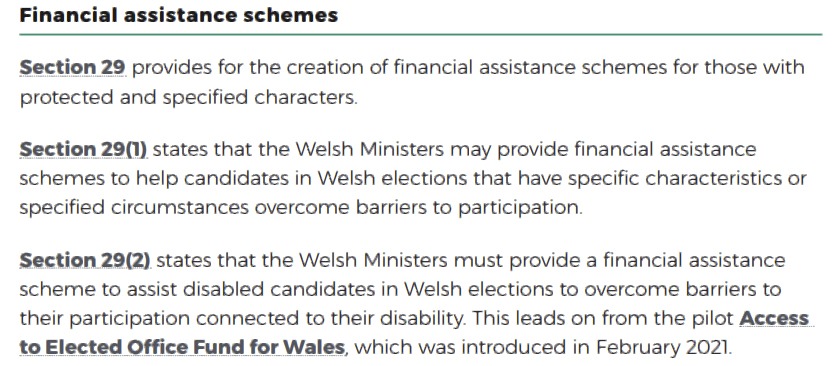
It’s worth asking, because the summary then takes a rather curious twist when it talks of “financial assistance“.

Click to open enlarged in separate tab

(Is Section 29 written correctly, or should it read, ‘specified characteristics’?)

For me, the mention of disability is a distraction, for most beneficiaries of this largesse will in fact come from other groups.

I expect race and a certain religion to figure, but there may be another clue here.

Welsh Ministers may provide financial assistance schemes to help candidates in Welsh elections that have specific characteristics or specified circumstances overcome barriers to participation.

I went to the full version of the Bill in the hope of finding “specified circumstances” explained. But there was nothing. Leaving me to think the Labour party will sponsor candidates from certain categories on whose loyalty it can count.

Putting everyone on the electoral register only makes sense if we have compulsory voting. But we don’t, and I’m not aware of any plans to introduce it. So why put everyone on the electoral register?

Here’s another concern. This legislation might be in place for the 2026 Senedd elections, which means it will complement the Senedd Cymru (Electoral Candidates Lists) Bill. Yes, that’s the one giving us huge constituencies and closed lists.

In the WalesOnline article you’ll see mentioned Mick Antoniw, the Counsel General. Now I have concerns about this man’s role in elections.

Counsel General, Mick Antoniw. Click to open enlarged in separate tab

Mainly because of his involvement in pushing through the closed lists system. I dealt with it in my piece Senedd Cymru (Electoral Candidate Lists) Bill. There I explained that Antoniw was even trying to get away with not naming candidates!

The electoral systems of Wales and the UK are screwed up enough without making things worse.

Consider, Labour has just won a landslide victory in the July 4 general election. But it was only a landslide in terms of seats, and entirely due to the peculiarities of the FPTP system. The turnout was well down on recent elections.

The problem – in addition to the Gething factor and the failure of devolution – is that too many people don’t feel engaged by politics, or feel that politicians don’t speak for them.

The priority should therefore be engaging with those who are already on the electoral registers but don’t vote. Because it makes no sense to register people who have no intention of voting.

One change we’ve already seen was the requirement on July 4 for those wanting to vote to produce photographic ID. Now as we know, from the USA and elsewhere, such a rule is racist, and so would never have been introduced by Labour.

For Labour is far more ‘flexible’ when it comes to rules relating to voting.

Which is why I predict that, in addition to putting everybody’s name on the electoral register, we shall also see moves to make postal and proxy voting easier.

In the 2026 Senedd elections we could see un-named Labour candidates, with “specified characteristics” and “specified circumstances“, benefit from “financial assistance” . . . and be elected in turnouts of 127%.

Try to argue then that democracy’s in trouble!

The truth is that once again we see Labour introducing dangerous divisions and dubious methods to serve its own narrow political interests.

LINKS TO THE OLD NORTH

Many of you must be aware of Bute Energy’s plans for a pylon run some 60 miles long from that company’s wind farms in Powys south through the Tywi valley to Llandyfaelog, south of Carmarthen.

There the line from Powys will connect with the line from Pembroke to England. For of course virtually all the power generated in Wales goes to England. (Thankfully, we get the thousands of excellent jobs provided by ‘renewables’.)

The project is being handled by Bute’s Green Gen Cymru. And it’s explained, sort of, here, and if you scroll down there’s even an interactive map.

As might be expected, there is considerable opposition along the route.

Click to open enlarged in separate tab

And the plan is severely testing the loyalties of some politicians. (Also, their mental dexterity.) For example, Ann Davies, the new Plaid Cymru MP for Caerfyrddin, has said she opposes the pylons . . . but not the wind turbines.

I don’t want to spend too much time on the Tywi valley project because it’s really just the intro to the other elements of this section.

As I say, roughly half of the electricity generated in Wales goes to England, and the amount will increase if all the planned wind farms get built. The situation is similar in Scotland, with electricity generated there having even further to travel to consumers in central and southern England. (With power being lost in transmission.)

And although it’s been reported once or twice, I’m not sure how many people are aware of the planned new Scottish connection. In a nutshell, it’s proposed that electricity generated off south west Scotland will be taken by undersea cable to Pentir, near Bangor, and then overland to Swansea North substation.

I’d like to be able to show you a map of the route, but there isn’t one, all I’ve seen is a vague line from Bangor to Swansea . . . through Eryri. Which obviously isn’t going to happen.

In this CPRW article Dr Jonathan Dean has this to say.

The route of this line is not yet known, despite me asking them numerous times.  As they will not get consent for pylons in Eryri national park they basically have two options:
  • along the north coast to Conwy, up the Conwy valley, past Bala then down to the Tywi valley to Swansea
  • across the top of Pen Llŷn to Porthmadog, subsea to near Aberystwyth then cross country to Swansea

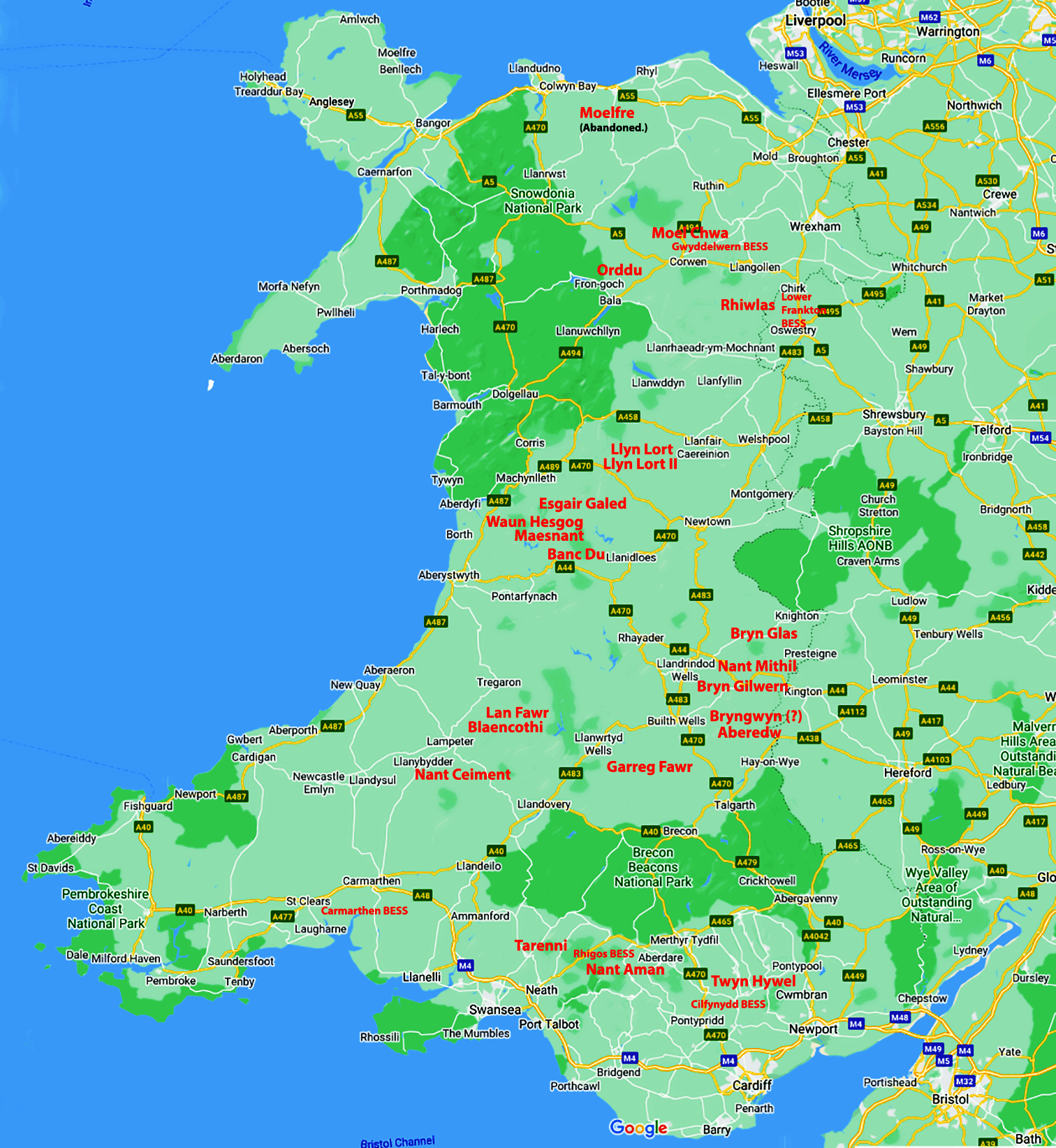
Which could mean the pylons coming down the Teifi valley, where there is already a campaign fighting Bute pylons. This Bute line will carry electricity from Lan Fawr, east of Llanddewi Brefi. I assume it will also serve Blaencothi and Nant Ceiment.

Bute Energy projects in Wales. Click to open enlarged in separate tab

Then the pylons will also run down to Llandyfaelog. But will they share the line coming from Powys, or will there be two pylon runs past Llandeilo? And will they interfere with the route of the planned bypass?

However you look at it, lovely Ystrad Tywi is in for a forest of steel pylons marching for mile after mile over hill and dale. Each one sunk in hundreds of tons of concrete. And all done to save the environment, innit?

The reason that Scotland and Wales have despoiled landscapes in order to generate electricity for England, is partly due to their politicians buying into the climate scam, and partly due to the difficulty of building onshore wind farms in England.

The latter due to different laws that allowed communities affected by such projects to object and, effectively, block them. But the law is changing.

Clearly, if onshore windfarms can in future be built in England, where the power is needed, there’ll be less need to erect windfarms in Wales. In fact, the need might be removed entirely.

It seems obvious to me that many of the mooted projects won’t now be needed. And that might include the pylon runs in the Teifi and Tywi valleys, even the big one from Bangor to Swansea.

And seeing as Bute Energy has yet to erect a single turbine, I think the ‘Welsh Government’ should call a halt to onshore wind projects in order to assess how the new legislation in England might impact on Wales.

We don’t want the ‘Welsh Government’ (via NRW) felling tens of thousands of trees, allowing hundreds of 800ft wind turbines, and hundreds of miles of pylons, if nobody wants to buy the electricity they erratically produce.

We’ll just have to live without the thousands of £70,000 pa jobs they’d have created.

♦ end ♦

© Royston Jones 2024