The Parasites Keep a-Coming

I hadn’t planned this but you’re reading it because it illustrates what’s happening over much of Wales. Though this case is a bit of an oddity in that it’s official but there’s no info beyond the bare bones.

LLANTEG

Our story focuses on the hamlet of Llanteg, Pembrokeshire; pinned in the centre of the map below. The reason for going there is that certain companies are planning a ‘Green Energy Park’ and a ‘400kV substation’.

How do I know? Well, someone sent me various documents from which I’ve extracted the panel you see below. It comes from the latest update of the Transmission Entry Capacity (TEC) register produced by the National Systems Energy Operator (NESO).

If you scroll down to the second sheet of the register you’ll see what I’ve clipped for you below. Both entries link to the – non-existent – ‘Llanteg 400kV Substation’.

The person who sent me this information keeps abreast of these matters, but this was all new to him.

I tried an internet search for this project, but turned up nothing apart from a vague reference to Community Energy in Pembrokeshire (CEP). Here’s the website, and here the Companies House entry.

Here’s the Llanteg village website.

As Llanteg is outside the national park I went to the council website and checked through planning applications. But drew a blank.

Next, I wrote to the council planning department, and here’s part of their reply:

I am having trouble locating any information regarding the two highlighted in your screenshot. Please can you provide a site map for me to investigate further?

Mmm. Clearly, the council knows nothing.

As I say, the only references I found to renewable energy were all small-scale, ‘community’-type ventures. But I suspect what we’re looking at is very commercial. I say that due to the names linked with the projects in the panel above.

So who are the companies named on the NESO document?

LLANTEG GREEN ENERGY PARK

The ‘Green Energy Park’ is in the name of NP SPV30 Ltd. And that outfit’s been registered with Companies House since July 2023. One of a string of numbered companies, now up to 50. (Maybe more by the time you read this.)

One of those companies that converted into a named project was NP SPV 31 Ltd, which is now Gwyddelwern Energy Ltd. This being the name of a village on the A494 between Corwen and Rhuthun. So let’s detour briefly and look into it.

Ultimate ownership of this project is with:

Heading back down to Pembrokeshire, ultimate ownership of NP SPV30 Ltd, the Llanteg Green Energy Park project, rests, via Natpower UK Ltd, with Mr Fabrizio Zago, an Italian living in Monaco.

Looking at the directors for the Llanteg Green Energy Park project, we see two names; a British subject with an Italian name (Sommadossi) who I’m satisfied is an associate of Zago, and an American.

This American, Benjamin Aaron Ben Tre, took up 40 directorships on May 1 this year. All linked with Natpower and all using the same Mayfair address.

More interestingly, perhaps, Ben Tre was involved with Stefano Danilo Massimo Sommadossi in other companies a few years back. I would guess the reason these companies are listed separately is because the name is spelled Ben Tré.

Let’s start with Coincident Energy Ltd (10.02.2016 – 17.09.2019). No money ever went through the books, but then again, this company was controlled from the British Virgin Islands.

Next up in chronological order is Influence Power Ltd (10.02.2016 – 17.09.2019). Another company with nothing in the pot, and controlled by Coincident Energy.

The third company used as its address a flat overlooking the Thames in Wandsworth, presumably leased by Sommadossi, who was then still an Italian citizen.

The company was called QMobility Ltd (03.01.2020 – 21.12.2021). It began life with directors Sommadossi, Ben Tré, another Italian named Stefano Madeddu, and a second American by the name of Jonas Lauren Norr.

This is interesting. Norr seems to be based at Miami Beach. And an internet search suggests he founded a company called Ethos Investments. Which is the company Ben Tré’s Linkedin page says he’s still working for. Here’s Norr’s info from Linkedin.

Anyway, at the end of its brief life, despite filing no accounts, and apparently doing nothing, Sommadossi and Ben Tré had over ten million QMobility shares.

To conclude where we started this section, with Natpower, and after seeing names like Zago, Sommadossi, Madeddu, you will not be surprised to learn that this outfit is, to all intents and purposes, an Italian company.

Building a ‘Green Energy Park’ in Pembrokeshire.

E R PROJECT DEVELOPMENT COMPANY LTD

I couldn’t find a website for this company, the one named in connection with the 400kV substation, but here’s the Companies House entry. It was Incorporated October 14, 2022. Based in Marlborough, Wiltshire

The two named directors are: Harry Marcus George Lopes, who’s British; and American Giovanni Rossario Maruca. When you flip to ‘significant control’ you see the name Eden Devco (UK) LLP.

There are 23 companies registered at this luxury holiday accommodation site, but Eden Devco seems to be the only one with assets. Though nothing in the most recent accounts explains these assets.

This company has Lopes and Maruca as members, with these two now rubbing shoulders with a couple of English aristos and some other interesting names.

Including two US companies, one in Florida, the other in New Jersey. It’s the one in New Jersey I wish to focus on, because a company with that name has cropped up on this blog before.

The name is Belltown Eden Ventures Corp. This company controls the voting rights over Eden Devco (UK) Ltd, and ultimately the Llanteg substation. And although giving a New Jersey address it’s governed by the laws of the State of Delaware. I assume that’s because Delaware is ‘business friendly’.

Belltown is also an investor in land destined for renewable energy projects. We target property with strong fundamentals and proximity to power infrastructure in our core markets.

The other Belltown – in the form of Belltown Power of Bristol – is one of the three companies (we know of) waiting to desecrate the Elenydd, the unspoilt country east of Lampeter, which I wrote about in November 2023, in The Road To Hell.

Where I explained that when you trace back ownership of Belltown Power you reach Blackmead Infrastructure c/o The Foresight Group.

Establishing the ultimate ownership of Blackmead Infrastructure is not straightforward. The first step is easy enough, it’s Averon Park Ltd. But the Companies House entry for Averon Park shows no one with significant control.

Though a hell of a lot of shares have been allotted lately. While the latest confirmation statement from Averon Park (30.06.2025) tells us Foresight Fund Managers is in control.

Is that 1.56 billion shares, am I reading it right?

Foresight has an office in Cardiff, and recently appointed Phil Sampson to manage its £130 million Investment Fund for Wales. Aren’t you grateful?

Anyway, the long and winding road eventually takes us to Guernsey. And once you’re on that island, who knows who owns what?

This is frustrating, but it looks as if there are two companies using the Belltown name. One in Bristol, with a windfarm project in the Elenydd, that traces to the USA; the other in Wiltshire, planning a substation in east Pembrokeshire, linked to the Foresight Group and Guernsey. Both in the ‘renewables’ and ‘natural capital’ rackets.

But there’s no obvious connection. Unless you know different?

CONCLUSION

Once again, I find myself reporting companies from God knows where planning lucrative projects in Wales. What makes Llanteg perhaps unique is that no one seems to know anything about it!

Yet the fact that these entries are on the TEC register tells us an agreement has been reached. But who are the parties to the agreement? Have these companies done a deal with a private landowner? Or with the ‘Welsh Government’?

Are there any more Llantegs in the pipeline?

Whatever the answer to those questions, the map below explains why Llanteg is attractive. The black lines you see are carrying power from Pembroke power station, first to the cities and towns of the south, and then to England.

Which serves to remind us that – if the capacity is there – then any number of new projects can link up to transmission lines.

And that applies to the new lines planned to run through the Tywi and Teifi valleys on their way to Llandyfaelog; also the line north, then north east, and over the border to Lower Frankton in Shropshire.

In fact, I predict these new pylon runs will act as magnets for every eco-shyster between Bristol and the British Virgin Islands, Luxembourg and Lower Manhattan.

To the point where rural Wales, outside of national parks, will resemble a post-apocalyptic wasteland of steel and fibreglass, erratically producing electricity Wales doesn’t need, and providing us with no benefits whatsoever.

Interspersed of course with areas being ‘rewilded’ by charities and environmental groups that took corporate funding as payment for destroying Welsh farming and a way of life.

And all the while, the clown show in Corruption Bay, its propagandists and apologists, promise us ‘local ownership’ and ‘community benefits’.

Those lying bastards that have been selling us down the river for 26 years.

♦ end ♦

© Royston Jones 2025

Merthyr Ski Slope 3

After writing about this project in September 2017 I didn’t think I’d be returning to Rhydycar West. But here we are in 2023 and it’s been resurrected. If you’ve got 3 minutes to spare, there’s even a video.

Though it would definitely help you follow this piece if you read what I put out in 2017. Here are links to Merthyr Ski Slope and Merthyr Ski Slope 2, Slippery Customers.

BACKGROUND

The area we’re talking about is called Rhydycar West because it’s on the west side of the A470 from Rhydycar, and up towards Heolgerrig.

The site of the project is roughly in the centre of the image below; the image itself comes courtesy of Ordnance Survey.

Click to open enlarged in separate tab

I can’t give you much history other than it’s an old industrial site, once owned by the National Coal Board, containing a considerable amount of waste.

The first mention I can find in this century says that in 2001 the 600 acre site was sold by owner Celtic Energy Ltd for £2m to Merthyr Village Ltd, formed in July 2000.

That 2001 report also says: ‘The plans include a 15,000-seater football stadium, more than 300 executive houses, two hotels, a 12-screen multiplex cinema, bowling alley, swimming pool, new leisure centre, 3,000-seater multipurpose hall and shopping units.’

No mention at this stage of skiing, snowboarding, and the like.

The first directors of Merthyr Village Ltd were the family of Wynford Holloway, who had bought the town’s football club a few years before; also local entertainer Lynn Mittell (Owen Money); and ill-starred solicitor William Snowdon.

The central element was clearly the stadium, to be built in the hope that Merthyr Town FC would gain promotion to the professional English leagues. That never happened.

And because Merthyr rejected the Welsh set-up it now plays in the Southern League Premier Division South, going knee to knee with giants of the game like Hartley Wintney and Hanwell Town. (What do you mean, you’ve never heard of them!)

The final blow to the project was the so-called ‘Welsh Government’ calling it in in 2007.

That might have appeared to be the end.

UPDATE 18.01.2023: Merthyr Village Ltd is in liquidation.

A PASSION FOR ISLANDS

Before the Merthyr Village project was called in, and perhaps intended as a consolation prize, a development was announced for the other side of the A470. And the report I’ve linked to tells us Merthyr Borough Council (or someone) awarded the contract to Atlantic Property Developments Plc of Cardiff.

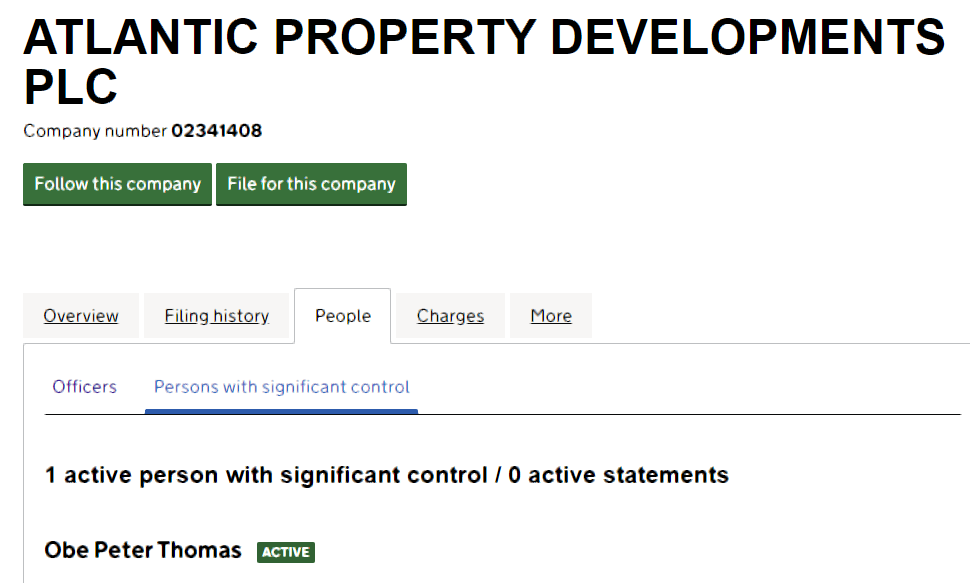
This company is owned by Peter ‘The Pies’ Thomas, a Merthyr boy originally, but now firmly part of the Cardiff establishment, and owner of the Cardiff rugby outfit. (Does it still pretend to be a region?)

I love the Companies House entry that has his name as ‘Obe Peter Thomas’.

Click to open enlarged in separate tab

Did the committee chaired by Carwyn Jones call in the Merthyr Village project to give Peter Thomas’s scheme a clear run? An ungenerous thought, maybe, but this is Wales.

Peter Thomas and brother Stan have prospered mightily in the age of devolution. Do you remember how Stan was able to buy publicly-owned land at knock-down prices thanks to incompetence or corruption at the Regeneration Investment Fund for Wales?

The Thomas brothers had a big stake in Cardiff airport, and then the ‘Welsh Government’ paid an absurdly inflated price for that deathly pale pachyderm when . . . Carwyn Jones was First Minister.

I wrote about the land deals back in March 2016, in Pies, Planes & Property Development, followed up with Pies, Planes & Property Development 2.

‘Merthyr boys, mun’. Click to open enlarged in separate tab

The company, Merthyr Village Ltd, hung on, but the only director since October 30, 2013, has been Richard Frank Arnold of Colchester, Essex. He who now wishes to bring Méribel to Merthyr.

In the first part of this (to date) trilogy I quoted a September 2017 WalesOnline article. It told us that the project was a collaboration between Marvel Ltd, represented by Canadian Leigh Gerald Large; and Snowsport Cymru Wales, represented by Robin Kellen.

I found a number of UK-registered companies with which Large was associated, but Marvel was not one of them. In addition to the companies I’ve just linked to, Large had companies registered in the British Virgin Islands.

But then, Large gets about. He may originally be from Victoria, British Columbia; but he’s also lived in Sweden, England, and has business links with Guernsey, Cyprus, and the Isle of Man.

To cut a long story short, I eventually tracked down Marvel Ltd in Guernsey. (Though it also used the address of a Wimbledon solicitor.) The company was formed 9 September 2013. Though Marvel eventually ‘migrated’ 26 July 2021.

But by an amazing coincidence, there was another company with the same name in the Isle of Man, which was also registered 9 September 2013!

Having companies with the same name in different jurisdictions, or even the same jurisdiction, seems to be the way of doing things for those involved with the Merthyr ski project.

Another example would be ‘Cavendish’, which crops up in various forms. Such as Cavendish Trust Company Ltd, and with an address just a few doors away at 31 – 37 North Quay, is said to be Marvel’s agent.

Though Companies House tells us there is also a Cavendish Trustees Ltd sharing the 34 North Quay address with Marvel. Also at 34 we find Cavendish International Ltd. And Cavendish Secretaries Ltd.

A second entry for Cavendish Secretaries Ltd gives us a few more companies using the 34 North Quay address.

And then, to complicate things even further, there is an entry for Cavendish Secretaries at 31 – 37 North Quay.

I shan’t dig for any more. I’ll only say that so many companies, using the same name in the same or different jurisdictions, should not inspire confidence. How are you supposed to know who you’re dealing with?

And it might be about to get worse.

WHO’S BEHIND IT?

When confronted with the problem I just outlined I often find that it helps avoid complete confusion by seeing who runs or owns those companies.

So let’s look at Cavendish Trustees Ltd of 34 North Quay, Douglas. The ‘Beneficial Owner’ is listed as James Cunningham-David.  But I had trouble finding him.

Click to open enlarged in separate tab

Because his name is really James Nicholas Cunningham-Davis. And with the correct name a few companies appear. One still extant is Infinity Gaming Solutions (UK) Ltd.

And while it too is based at 34 North Quay in Douglas it also uses as an address 66A Reigate Road, Ewell, Epsom, Surrey. A little bungalow looking out over a roundabout and some kind of industrial estate.

There’s nothing in the kitty to bother us with Infinity Gaming Solutions but I’d like to turn your attention to another of the directors, Pritesh Ramesh Desai. Apparently a resident of the Isle of Man Desai is now a director of Pine Fields Private Ltd, which has been involved at Rhydycar West for a few years.

Desai and Cunningham-Davis may have attended the same school. I suggest that because they are the only trustees of the Old Epsomian Club 1952 Trust Fund.

Click to open enlarged in separate tab

Also bringing Desai and Cunningham-Davis together is Inquba Group Holding Company Ltd, which was taken over in October last year by Cavendish Trustees Ltd of 34 North Quay, etc.

This link gives a few of Desai’s older companies.

Here’s Desai’s Linkedin profile. (Here in pdf format.) Though it’s amazing how few of the many, many companies he’s been involved with get a mention.

Desai joined Pine Fields in May last year. And if we scroll down on the company directors page we see that a previous director was Richard Frank Arnold. We met him earlier, he being the only director of Merthyr Village Ltd since October 2013.

And in the recent press release he is the project spokesman.

We also see that Leigh Gerald Large, who fronted the bid back in 2017, was drummed out of Pine Fields in July of that year.

If we check who now exerts control over Pine Fields we see that it’s Cherry Blossom Global Ltd. And although this outfit gives the familiar address on North Quay, and has been registered on the IoM since May 2010, I suspect it’s also berthed in the British Virgin Islands.

We have now established links between Rhydycar West and assorted entities hither and yon . . . but are we any wiser?

It doesn’t end there.

For Pritesh Ramesh Desai and entities with which he’s associated predictably appear more than once in the Offshore Leaks Database. One entry suggests he himself has links with Iran! Perhaps less worryingly, he also has links with Cyprus, Malta and God knows where else.

WHO OWNS WHAT?

Time now to try to figure out who actually owns the site at Rhydycar West.

Originally, of course, it was Merthyr Village Ltd, which bought the site from Celtic Energy. But as we’ve seen, that project got knocked back by the ‘Welsh Government’.

Image courtesy of Google Earth. Click to open enlarged in separate tab

Even so, according to Companies House there are still two charges outstanding against Merthyr Village Ltd. The one that’s relevant to us is, ‘F/H Land at Colliers Row Merthyr Tydfil t/no CYM6191.‘ (It’s actually Upper Colliers’ Row.)

However, the Land Registry title document shows that ownership is now in the hands of Marvel Ltd, of 58 High Street, Wimbledon (though there is no title plan available at the Land Registry). The address given seems to be an office of estate agent Knight Frank.

Marvel may be squatting on Wimbledon High Street due to it being Guernsey registered. Formed on September 9, 2013, just a couple of weeks before taking possession of the land at Colliers’ Row.

Click to open enlarged in separate tab

A later entry on the Land Registry document for CYM6191 tells us that just over a year ago, in December 2021, control of the title was taken by Goco International Ltd. This entity is also incorporated in Guernsey, and also uses an address we’re all familiar with – 34 North Quay, Douglas, Isle of Man.

Which appears to the headquarters for Pritesh Ramesh Desai.

Click to open enlarged in separate tab

I can’t tell you much more about Goco as I can’t afford to buy documents from the Guernsey Registry. Though I turned up nothing in the Offshore Leaks Database for Goco.

Before finishing this section I’d better identify what are probably a few more relevant land titles.

One is ‘Land at Heolgerrig‘ (scroll down for plan). Title in the name of Pine Fields Private Ltd. We met this lot earlier in this sprawling narrative. Although the company has been around since August 2010 we saw that Pritesh Ramesh Desai joined in May 2022.

This land was sold by Merthyr Village Ltd in July 2009 to Crystalrock Ltd, where the only director left is Richard Frank Arnold. It then transferred to Pine Fields Private Ltd in August 2011 for a reported £450,000.

The other title worth considering is ‘Land lying to the North of Upper Colliers’ Row’ Title number: CYM536607 (scroll down for plan). This was transferred in two lots from Merthyr Village Ltd to Crystalrock Ltd, and then passed on to Pine Fields Private Ltd.

Those titles, I think, cover the land involved in the project. Though I’m not 100% certain.

FINAL THOUGHTS

This project can be viewed in three stages.

The first was obviously the initiative linked with the local football club, promoted by Merthyr Village Ltd, that, for reasons we can only guess at, was scotched by the ‘Welsh Government’ in 2007.

That said, Merthyr Village Ltd is still in existence, looks financially healthy, and while Richard Frank Arnold is the only director, ‘significant control’ is exercised by solicitor William Snowdon, who is connected to the original Merthyr Village directors through them all being directors of Merthyr Tydfil Football Club Ltd.

Which is another reason I suspect the directors of Merthyr Village Ltd may retain a financial interest in the ongoing and modified project.

The second attempt was the one reported in 2017. This was promoted by the footloose Canadian, Leigh Gerald Large, representing Marvel, registered in Guernsey.

Click to open enlarged in separate tab

For whatever reason, that project also failed to take off.

Which brings us up to 2023, and the third attempt. Again, it’s Marvel, but this time fronted by Richard Frank Arnold.

My belief is that the real difference this time around is the involvement of Pritesh Ramesh Desai. Plus his partners and contacts in assorted island tax havens around the world.

I now expect our tribunes, at both local and national level, plus our ever-vigilant media, to politely ask of those pushing the snow fantasy who’s really behind the project, to explain the galaxy of companies, and the games of musical chairs.

And then there’s the money – where’s it coming from? Surely not from the fun-loving Ayatollahs to whom Desai might be linked! And how much money, because I’m pretty sure those behind this project anticipate a hefty dollop of Welsh public funding.

So many questions!

FOOTNOTE: After e-mailing Mr Desai on January 5 I had a response late last night from Andy Coleman, signing himself, ‘CFO Rhydycar West’, offering to discuss the project.

Given the choice between delivering this post as promised today and delaying it until after I’d spoken with Mr Coleman I choose the former option.

But as I made clear in my reply to Mr Coleman, now that this post is published, he or anyone representing the project is welcome to comment. I’d welcome it.

But I want straight answers, not a stroll down Flim-flam Lane.

♦ end ♦

© Royston Jones 2023


Why only 10% of Welsh housing should be on the open market Part 2: Suggested answers to the most common questions and concerns

This is a guest post by Gruffydd Meredith. It considers important but overlooked aspects of the housing crisis in Wales.

For while holiday homes get most of the attention the problem of properties being bought for other reasons tends to slip beneath the radar. I’m thinking now of properties bought by those settling permanently in rural and coastal areas.

These will often be retirees (who seem to get younger every year), people making a lifestyle choice, those who’ve bought a local business (most of which are now sold online), and others moving to Wales for a whole range of reasons from white flight to health considerations.

And the effects go beyond housing. All the way from village schools closing to social tensions as newcomers try a little too hard to ‘involve themselves’ in village life, with this being perceived by many locals as ‘taking over’.

Take it away, Gruff . . .

It was good to see the discussion following an article I wrote which was published on Nation.Cymru on November 20th 2021, titled ‘Why only 10% of Welsh housing should be on the open market’. There were a great deal of important questions and comments made in response.

The basic premise of the article is this; that Wales should follow the example of the island of Guernsey (and many other countries such as Switzerland and New Zealand) and that all Welsh housing should be divided into two basic groups; a 90% group for the local / national priority market for the present and long term resident citizens of Wales, and the remaining 10% group for the open market and for anyone to buy – with local authorities across Wales also deciding annually how much of the 90% local/national priority market would be available for citizens within the local authority and how much would be available to citizens from the rest of Wales. The 90% / 10% ratio would be an approximate figure to aim for and would unlikely be arrived at perfectly all the time of course.

Ultimately we’re relying on those elected to come up with decent policies and laws in this and other areas but I’ll use this opportunity here to try and respond to some of the main comments, questions or concerns made in response to the original article in the hope of adding to a constructive discussion.

How would you separate the open market housing from the local/national priority housing? How do you decide which property is in which category?

Like in Guernsey, this plan wouldn’t happen overnight. In Guernsey, these two separate priority and open market groups gradually came in after the Second World War with the Housing Control law 1948, when locals were getting pushed out and priced out of the market after the war – it’s taken them many years to gradually develop the two different markets in a rational and reasoned way so that when people buy and sell property in Guernsey they know what sector they are buying or selling in to. And it has naturally developed that open market housing tends to often be more expensive than those on the local priority market. The same could happen in Wales in my view. And if introduced in Wales there will be a transition period to give people plenty of time to know which group they’re buying or selling in to.

The plan obviously wouldn’t be retroactive, wouldn’t affect existing homes or those already living in Wales whomever they are, and would only come in to action at a pre determined point in the future where both home sellers and buyers in the  local/national priority or open market group would know which market they are in or out of. So if a new housing law was passed stipulating the two different markets, both house sellers and house buyers in the future would know what they were doing. If existing home owners never want to sell their home then nothing would change anyhow.

Guernsey. Click to open enlarged in separate tab

In terms of how do you determine which home goes in to which category, I’d propose this as a starter:

It should be fairly straightforward to create a housing act that ensures that most new homes (although not all of course – some could also be in the open market sector) being built in Wales fit in to the local/national priority housing group – new homes that would then retain this local and national ownership priority clause in perpetuity should they be sold again the future.

When it comes to existing homes I’d propose that as a guide, like in Guernsey, a large amount (although not all) of the existing homes on the open market, would tend to be the more expensive homes above a certain rateable value – homes that are, say, over £400,000 in value (this is a suggested example – this figure could also be lower of course). Four hundred thousand pounds is also the point where the Welsh Transaction Tax changes from 5% to 7.5% which might make this a potentially useful place to introduce a small increase. So this housing law wouldn’t affect most of these homes above a suggested figure such as £400,000 or their owners if they wanted to sell their home at any point, which they could do on the open market as they wished and exempt from any housing controls.

This would mean that most homes generally below this example value of £400,000 (adjusted depending on inflation etc.) would then stay in the local/national priority group in perpetuity – therefore enabling a great deal more people to buy affordable homes within their own areas. A team of experienced valuers and deliberators including appointed estate agents within each local authority could fairly determine a balanced approach to decide on these two markets and to engage positively and constructively with home owners and buyers  – a team that would also be accountable to the democratically elected local authority.

What would be my incentive to take part?

Financial incentives could also be offered to the home sellers taking part in the local/national priority scheme. They could be awarded for selling the homes to the priority market at a more affordable price by being guaranteed an upfront set sum from a pot coming from the extra council tax raised on holiday/second homes for example. This way, sellers wouldn’t be out of pocket and their conscience would be clear (if they had one!).

This incentive could also be made even more appealing if sellers in the priority group could also receive some of the Welsh Transaction Tax paid by buyers for homes above £400,000 in the open market group. This tax could perhaps be slightly and reasonably increased – raised from, say, 7.5% to 9% –  generating more funds for this scheme and further compensating house sellers who are within the local/national priority group – this more than making up and perhaps exceeding any difference between an affordable local price and the potential market price. A similar arrangement could also be made when it comes to capital gains tax although that tax is not yet transferred to the Welsh Government. Welsh estate agents could also receive a reasonable percentage from the pot for each house sold (on top of their normal commissions) for making sure that the two different housing markets are properly regulated and administered.

And it might be reasonable that house sellers in the priority group who haven’t found a buyer after a certain time (perhaps after 1 or 2 years as a suggestion) could then sell on the open market.

How would you decide who is able to live where? What gives you the right to decide? Is this racist/sexist/some other ism or ist?

No, this plan isn’t any of the ists or isms and isn’t anti anyone. Nothing would change for anyone already living in Wales – wherever they are from in the world, whether that be Wales, Poland, Kenya, England or Timbuktu. All people who want to move to Wales after the date of the law being enacted would be treated equally. And whether you consider yourself Welsh, Welsh-British, British, English or any other ethnicity, nationality or identity and already live in Wales, this wouldn’t affect you or your home. The new plan would come in to being at a future date and then gradually develop over time as new homes are built and home sellers and buyers take part if buying or selling.

After that future point in time where the new law will come in, any person not already living in Wales having been offered a full time job in Wales who couldn’t find a house on the open market would also be eligible for a house in the priority market. As would any partner, wife or husband and any children. And as would those giving long term care for a family member or partner in Wales. Self employed people who could demonstrate that their work would benefit and contribute to the Welsh economy specifically could also be eligible.

And, like also happens in Guernsey, anyone could also rent in Wales following the same law as that for house buyers or sellers. And once anyone had rented a place in Wales for ten years they would be considered permanent Welsh resident citizens and therefore eligible to buy on the 90% priority market (unless they’ve already managed to rent or buy a place on the 10% open market).

Click to open enlarged in separate tab

Social housing could also follow similar priority/open market lines. There needs to be emergency social housing for those that really need it of course, but exploitation of this system has to be stopped to ensure that it’s only those that genuinely need emergency housing that are given it and that local authorities from outside of Wales also don’t fail in their own responsibilities and unfairly pass on the buck by sending people to live in social housing in Wales simply because it’s a cheaper or nicer place to live.

Land ownership laws should also follow similar lines in my view, as many countries such as New Zealand are now also instigating. The present situation of global corporations and financial investment firms buying up Welsh land on a large scale is nothing but very disturbing modern colonialism and land grabbing by modern day robber barons that needs urgent stopping.

Buyers and renters from outside of Wales could also be able to buy or rent a more relaxed, higher capped percentage of apartments and condos in apartment blocks etc. in the bigger towns and cities of Wales. The Swiss government for example, have decided that non-Swiss citizens can still own up to 50% percent of units in large, newly built apartment buildings, which are treated in a slightly more relaxed way in comparison to residential or family homes – whilst general residential properties belonging to non Swiss citizens, are limited to 20% of the housing stock in any Swiss community. The same could apply in Wales, giving a fair and balanced opportunity for all that want to live here and those that already live here.

The vast majority of countries and states in the world, including the present UK state, have tight control on housing and who can live there or not. Wales is a country in its own right and with its own legislative parliament and government, and is no different to any other country.

Not sure about a citizen of Wales being someone who had lived here for ten years… What if you were a nurse who didn’t have a Welsh parent but did have a job? Would you be forced to rent for ten years before being allowed to buy a “home for locals”. Seems rather unfair.

As mentioned, if you had a full time job or an offer of one in Wales I believe it would be reasonable that you should be able to buy or rent within both the priority local/national market or open market group regardless of anything else.

Who counts as a citizen of Wales?

Anyone who lives in Wales can be said to be a de facto citizen of Wales and Welsh law will apply to you whether you’re a person who’s lived in Wales for three months, three years or have always lived here and can trace your heritage to Wales since time immemorial. So when the specific date of this proposed law would come in, whether you’ve already lived in Wales for three months or a hundred years (many congratulations on that if so), whether you are Icelandic, Senegalese, Japanese, Scottish or English, nothing would change and no one would be chasing you out of the country with a broomstick or any other implement.

For the purpose of present or future priority housing eligibility after the official start of the proposed policy, the permanent resident citizens of Wales can be defined as people who were either born in Wales and have at least one parent born in Wales or people who have lived in Wales for a total of at least ten years in any given period/s (or have a full time job here or are long term carers for partners/relatives etc.). Those buying on the open market wouldn’t need any eligibility.

Click to open enlarged in separate tab

If you already own your own home in Wales you would keep your existing home and nothing would change. The only thing that would change under this proposal is that your home, if generally under a certain designated value as mentioned, would likely fall within the local/national priority group if you decide to sell in the future, for which you would be compensated to ensure the value would be around the open market price. And, after the law would be enacted, unless otherwise eligible, new people moving to Wales would need to wait ten years for eligibility to buy on the priority market unless they managed to find one on the open market.  If someone had already been living here for 8 years and don’t meet the other eligibility criteria then they would need to wait another two years to become Welsh permanent resident citizens and be able to join the priority market if they want to buy a new place (unless they can find a house on the open market that is).

These points, I’d argue, give a good balance between those who are existing residents and/or have long term connections or family heritage in Wales, and those who have come here more recently and want to make Wales their home – I believe this type of plan would be beneficial to all involved. Stipulating a ten year period or ‘born here with a Welsh born parent’ – similar to the system in Guernsey and Japan as a few examples of many – should stop people exploiting the policy by travelling to Wales to have a child/children here before leaving again knowing that their child would be guaranteed a home in the future. As mentioned, the other 10% of open market housing would stay the same and would have no restrictions whether you are a Welsh permanent resident citizen or not.

Isn’t this kind of bad idea? Imagine the uproar if the English brought in a rule that 90% of homes are allocated only to English people. I can see the headline… “Welsh man trying to buy a home in London due to moving for work not allowed because he is Welsh.”

No, the principle would be fine and fair enough in England as well in my view, although this proposal suggests that people who work or have a full time offer of work in Wales should be able to buy a house or rent in Wales on the priority market (and can buy or rent on the open market without restrictions as well if they want).

Click to open enlarged in separate tab

Housing priority rules such as these are already in place in many parts of England such as the Peak District, the Lake District and the North York Moors, and this type of regulation is seen in most of the world’s countries including the Channel Islands (Jersey also has similar housing rules to Guernsey) and the UK state as a whole of course. This is increasingly becoming a global problem which is being tackled.

Although these proposals aren’t just about England and treat all people wishing to move to Wales equally, these issues are also relevant to England and her citizens. English citizens also have a right to have reasonable policies in place and to not be priced out and driven out of their local areas (including in London). As does Guernsey. As does Wales and any other country. Wales and the Welsh Government should, in my view, support a similar proportionate scheme in England and elsewhere if that is what the people of England or elsewhere want.

Rights of peoples and nations under international law

A final point about rights of peoples and nations under international treaty.

As mentioned, the vast majority of countries and states in the world, including the present UK state, have tight controls on housing and who can live there. Wales is a country in its own right, with its own legislative parliament and government, and is no different to any other country. Colonialism is also a crime as recognised in international law and as seen in The Geneva Convention on the Prevention and Punishment of the Crime of Genocide.

No government needs to constantly apologise or justify why they work to have the interests of the country and the citizens of that country as its main focus. That is supposedly the whole point of a national government and of democracy in the first place and it doesn’t mean that that country is anti anything or anyone or doesn’t care and won’t reach out to others who are in need. We constantly (and rightly) hear protesting against colonialism and imperialism being used against countries and peoples all across the world, many of these seriously marginalised. Yet, according to some it’s perfectly acceptable for this to happen in Wales and if we try and manage the problem then we are somehow the narrow minded extremists.

I would suggest that it is those who strongly oppose any management of this issue and condone mass colonialism are the ones who are pushing narrow minded and dangerous extremism. We the citizens of Wales, whomever and wherever we are in Wales and whatever our background and origin, also have a right not to be colonised or be displaced from our own communities and land.

♦ end ♦

Gwynedd LDP, and Wider Considerations

Everybody seems to have had their say on this subject so I might as well make my contribution.

First, remember that what was passed a week last Friday was the LDP for Gwynedd minus the Snowdonia National Park, which has its own planning authority and its own LDP. Even though the Park covers most of the county, in population terms it accounts for just over a fifth.

This is due to the largest towns being outside the Park, while Blaenau Ffestiniog, Barmouth and Tywyn are surrounded by the Park but form ‘islands’ covered by the Gwynedd LDP. The largest towns within the Snowdonia National Park are Bala and Dolgellau.

I’ve read the arguments on both sides of this debate, thanks in part to Nation.Cymru, where we were offered, ‘Building 8,000 new homes on Gwynedd and Môn is a defeat for Welsh democracy’ by Huw Williams, with the counter argument from Dyfrig Jones in ‘Building fewer houses would drive up prices and drive away our youth’.

In a sense, both are right. But Dyfrig Jones is also wrong. Let me explain.

‘WHERE WILL OUR YOUNG PEOPLE LIVE?’

Once upon a time, when tribunes of a fraternal bent controlled rural councils, Ceredigion was ruled by Dai Lloyd Evans and his crew, one of the most corrupt, self-serving groups ever to run a Welsh council. (And by God that is saying something!) Not for nothing did Paul Flynn MP refer to Ceredigion in some Commons committee as “the Wild West Show” when it came to planning matters.

Because most of these fraternalist councillors were landowners they wanted to build lots of houses to enrich themselves. Dai Lloyd Evans even bought a field – or was it two? – outside of his native Tregaron and then made sure that the settlement boundary was moved to include his field(s). Planning permission was of course granted for said fields.

In defence of this bonanza of housebuilding all sorts of bollocks was trotted out; from Dai Lloyd himself I remember, ‘But without these new houses where will our young people live?’ We were asked to believe that three- and four-bedroom houses selling for £180,000+ (in 2005) were targeting young, local buyers.

Now I’m not comparing Dyfrig Jones to Dai Lloyd Evans, but . . . the ‘young people’ argument does echo the timeless hypocrisy of the former Ceredigion council leader.

For a start, too many of our young people can’t afford to buy a new house – full stop. But these properties are not intended for local buyers anyway, something made clear from where the new developments are located.

click to enlarge

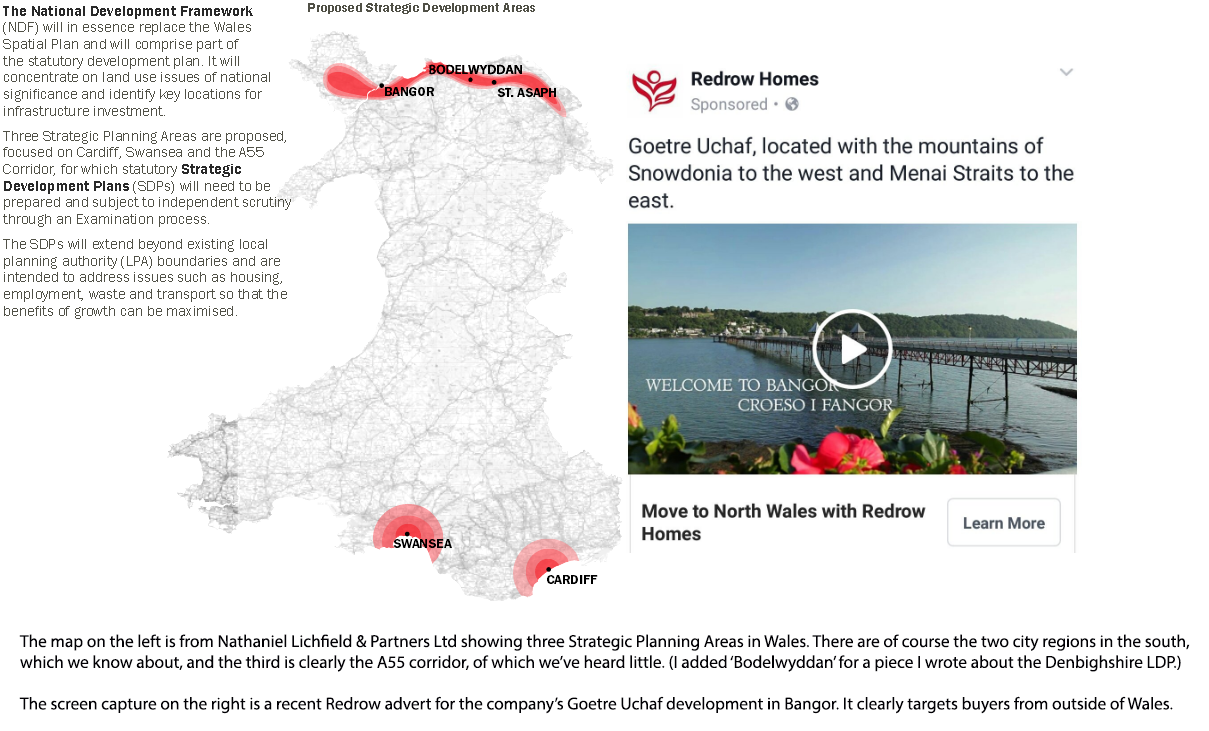
The new housing planned for Gwynedd is mainly in the north of the county (as is the case in Conwy and Denbighshire) and there’s a very good reason for that – the A55 Expressway. What is taking shape before our eyes is a commuter corridor along the A55 that will allow people working in the Merseyside and Manchester conurbations to live ‘in the country’.

OH, GIVE ME A HOME WHERE THE MILLIONAIRES ROAM

Let me start explaining this with a wee digression.

When I was growing up in Swansea, someone who moved out to Gower was usually thought to have ‘made it’, done well for themselves (or maybe knocked over a bank). I suppose the Vale of Glamorgan fulfils a similar function for Cardiff.

On a larger scale, Cheshire entices those who wish to, and can afford to, avoid the urban sprawl of north west England. Some of the communities with the highest property prices outside of London and its ‘stockbroker belt’ are to be found in Cheshire.

Human nature being what it is, if you’ve paid a million or two for your house in Prestbury, Wilmslow or Alderley Edge, then you don’t want your idyll spoilt – and the value of your property lowered – by a new estate full of double-glazing salesmen and Stockport County footballers. It’s ‘Him off the telly’ and Wayne Rooney or nothing. Which results in many of those who’d like to live in leafy Cheshire being moved on. (This also explains why, in the code used by estate agents, Wrecsam is now ‘West Cheshire’.)

But even if giant ‘Sod Off!’ signs were placed at regular intervals on every highway and by-way approaching the Golden Triangle it would do little to stem the flow of the upwardly mobile out of the nearby cities. And as there’s not much of a welcome further west, around Chester, either, they trudge on further.

Another reason for building so many new houses close to the A55 is that politicians, being what they are – lying bastards, generally – can interpret this protection of Cheshire property values as an indicator of a healthy economy along the north coast. It’s nothing of the kind, or course, but politicians will never miss an opportunity to pat themselves on the back.

Just picture it – Guto Bebb, David Jones, Michelle Brown plus Carwyn and his cohorts fighting over the best spot in front of the cameras!

Finally, let us not forget the grand design to assimilate Wales into England. New housing built in Wales for which there is little or no local demand is a vital part of that strategy.

‘STATISTICS, WHAT STATISTICS?’

Huw Williams was right to argue that accepting this LDP was a defeat for Welsh democracy, though not only because Gwynedd council caved in but because of the way in which housing ‘need’ figures are arrived at, or contrived, and the ruthless inflexibility with which they have been enforced.

I’ve dealt with Local Development Plans and the Planning Inspectorate many times before. (Just type Planning Inspectorate into the ‘Search’ box at the top of the sidebar.) Reading ‘Planning Inspectorate: New Gauleiter for Wales’ will help.

The problem with LDPs is that the Planning Inspectorate predicted future need on a combination of population and household size estimates produced before the data from the 2011 Census were available, and using recent demographic trends – i.e. English immigration!

When the Census findings became available, and they showed that population increase from 2001 to 2011 was less than the Inspectorate had predicted, and that household size was greater – combining to mean fewer properties needed – these inconvenient truths were brushed aside to insist on sticking to the original, and now discredited, predictions.

One example is Denbighshire. The council there argued that in light of new figures the county now needed far fewer properties than had been called for by the ‘Welsh’ Government’s projections, which argued for 8,500 new units between 2008 and 2023. For what the Census and the ONS’ predictions told us was that the projected population increase for Denbighshire in that period was now 4,134.

The Planning Inspectorate accepted the council’s argument (how could they contradict the Census and the Office for National Statistics?) but insisted on sticking with the original – and now discredited – projection! The clip below is from the Inspectors’ report.

click to enlarge

So, for a predicted population increase of just 4,134, and a household size of 2.31 reducing to 2.23 in 2026 Denbighshire must still build 8,500 units.

Of course, it helps to understand all this when you realise that the Planning Inspectorate is an Englandandwales body answering to the Department for Communities and Local Government in London . . . though the ‘Welsh’ Government is allowed to pretend that it has control of the Inspectorate in Wales. It doesn’t.

As might be predicted with such a body, the Welsh language is a vital concern. The recommendation for Denbighshire being . . . bilingual signage.

click to enlarge

A SYSTEM TO SERVE WALES

Where Dyfrig Jones is right is in arguing that building fewer houses will drive up prices . . . but to follow that argument to its illogical conclusion is to believe that house prices will start falling, will come within the reach of Welsh people, only when the external demand is sated – but the external demand is insatiable.

With Local Development Plans we are dealing with a broken system, certainly one that does not work for Wales. There are a number of reasons for this.

First, and as I hope I’ve explained, is the role of the Planning Inspectorate, an Englandandwales body working within an Englandandwales strategic framework that sees Wales helping meet England’s need for housing. There is no way that such a body can serve Wales.

Second, when it comes to strategic planning, the ‘Welsh’ Government has willingly subordinated itself to the UK government to the detriment of Wales’ best interests. So much for devolution!

Third, as Huw Williams suggested on Nation.Cymru, the whole system is a negation of democracy that sees those we elect bullied by persons sent into Wales to serve a dubious agenda. That is bad enough, but too often the Planning Inspectorate finds ready accomplices in the higher ranks of council employees.

Radical change is needed.

It should go without saying that Wales needs a planning system that serves Welsh needs, not the interests of those who can’t afford to buy the property they’d like in Wilmslow. This must be a priority. No more imposed LDPs.

To build fewer houses yet ensure that Welsh people are not excluded we need legislation to guarantee that a majority of the housing stock is restricted to those with strong local connections. To those born and educated in the area, perhaps those who have lived locally for a given period.

It might be worth considering the models that operate in the Channel Islands.

On the largest island, Jersey, there are four categories of resident: ‘Entitled’, ‘Licensed’, ‘Entitled to Work’ and ‘Registered’. As the website tells us, “The “Entitled” category is attributed to those who are Jersey born and have reached the required aggregate residency period.  This category also applies to people who have lived in Jersey for a continuous period of 10 years.”

Jersey

On the second largest island, Guernsey, the system is even simpler. There they have a Local Market and an Open Market, which is almost self-explanatory. The Open Market covers larger, more expensive properties (some 7% of the housing stock), and while locals can buy in the Open Market the Local Market is reserved for them.

‘Ah, but Jac’, I hear you protest, ‘to implement such a policy in Wales would be decried in the English media as ‘racist’. Really! How could it be racist in Wales yet no one complains about the Channel Islands using these methods?

Might the silence have something to do with so many English newspaper proprietors and others having money hidden business interests on the islands, with the Barclay brothers, owners of the Telegraph, actually owning one of the smaller islands, Brecqhou?

CONCLUSION

As someone who has been involved in nationalist politics – often on the ‘hairier’ fringes . . . sometimes very hairy – I know that for fifty years our masters have carefully avoided gifting us another Tryweryn, or another Investiture, anything that might mobilise armchair patriots and produce converts.

Instead, the strategy employed since the 1960s has been to chip away at what makes Wales different. The most effective tactic being demographic change; reduced to its crudest expression – ‘Welsh out, English in’.

The beauty of this strategy is that no single blow ever rouses enough people to challenge the strategy . . . so on it goes . . . chip, chip, chip. The Gwynedd LDP, the managed decline of the Valleys, turning our countryside into a recreational and retirement area for England . . . all these are chipping away at the distinctiveness of Wales, and the survival of Welsh identity.

This strategy is succeeding; soon there will be little left at which to chip. If we don’t wake up soon and grasp that we are in a struggle for national survival, one that must transcend politics and take precedence over everything else, then we might as well stop kidding ourselves and call it a day.

A national struggle against English colonialism is our only hope. No party politics. No divisive ideologies. A national struggle.

♦ end ♦