
 Last week the UK government issued a report on natural capital and ecosystem services. It was produced jointly by the Department for Business, Innovation, Science and Trade and the Office for Investment. (Though the report was described as ‘Independent’.)
I’m going to explain what I think this means, paying particular attention to Wales. In fact, we get quite a mention. I’ll also look at things happening here. And then make a few connections.
◊
INTRODUCTION
In a nutshell, what’s proposed is to monetise everything; land, trees, water. And as the title of the report (after the colon), says, what’s planned is: “a pathway to at-scale investment capital flows“.
“At-scale” makes clear it’s designed to benefit big players who’ll pump money into major ‘renewables’ projects, and big, even national, rewilding or environmental schemes. For which they’ll expect handsome profits for carbon capture or some other scam.
The money will be described as ‘investment’, with the money-making projects dressed up as being good for the planet and nature. What’s proposed will see asset managers like BlackRock working even more closely with ‘environmentalists’ than we’ve seen thus far. For as the report tells us:
Nature underpins the UK’s food security, water systems, infrastructure resilience and long‑term productivity, yet has been systematically underinvested for decades.
Don’t tell the pine martens – but the little buggers are doomed without investment!
But this is what ‘natural capital’ is all about. Dream up ‘problems’, come up with the ‘solutions’ – and make lots and lots of money!
In fact, it could serve as a definition of Globalism itself.
◊
BIOSPHERES
These figure big in the overall plan. And we have one in Wales, the Dyfi Biosphere. Clearly a successor to the colonialist land grab known as Summit to Sea, which threatened roughly the same area. Remember it? I covered it on this blog. (Just type Summit to Sea in the Search box on the right.)

In its revamped form it promises to consult locals, even listen. Though how many farmers still feel their unions represent them may be a question for another day.
Our Partnership includes local authorities, wildlife organisations, the Welsh Government and Natural Resources Wales, the farming unions, business and voluntary groups.
The Dyfi is one of seven UNESCO Biospheres in the UK. It was designated a biosphere in 1977 (though it didn’t receive UNESCO status until 2007). Does the original date connect with the launch of the Centre for Alternative Technology (CAT) in November 1973?
For CAT, in Corris, is certainly within the Dyfi Biosphere. And now, for reasons I can’t quite figure out, the area covered juts south to take in the town of Aberystwyth.
But there’s also a Smart Biosphere, in north Devon. And it’s there we meet Dr Robin Charles Daniels as a trustee. Most of its funding comes from the UK government.
(Daniels is often a Welsh name, and something I read somewhere suggested Dr Daniels may live in or near Haverfordwest.)
◊
‘DARWIN VANTAGE AND REDPILL GROUP’
This section of the report may take us to the core of the matter, but it’s complex; or rather, layered. The one consistent feature is Dr Robin Charles Daniels, who seems to be involved in lots of things, on both sides of the Atlantic.
Here’s what the relevant section in the report linked to at the start says:
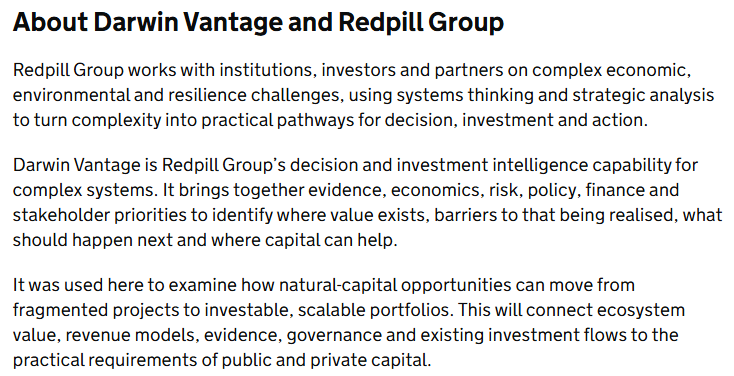
Let’s begin with Redpill. Companies House tells us it’s a very small operation, based in Plymouth, with most of the shares held by Dr Daniels. The only other shareholder is Jill Monica Sinclair. I can’t tell you anything about her.
Redpill links with Darwin Vantage. Here’s what Google AI told me:
- The Darwin Fund. Redpill Group co-founded the Darwin Fund, a blended-finance platform that uses Darwin Vantage to identify and structure nature-positive investments across global forests, mangroves, and river systems
- UK Natural Capital & Clean Infrastructure. In the UK, the framework has been utilized by entities like North Devon Biosphere Enterprises and initiatives in Wales to transition fragmented environmental projects into scalable, investable clean infrastructure portfolios
On the Darwin Vantage site you’ll see that Wales gets a mention, sandwiched between California and Nepal. No surprise then that the Darwin Fund takes us to California, where Dr Daniels is listed as co-founder and CEO. The website says of the Darwin Fund’s purpose (my underlining):
Darwin was established as a blended-finance platform and an on-ramp for institutional investment in nature.
I suspect the key here may be the Darwin Fund, because this could be the conduit for the investment money.
Going back to the three running the Darwin Fund we see, flanking Dr Daniels, Terry Tamminen and Kristina Haddad. Tamminen and Haddad also run 7th Generation Advisors. And something else I turned up told me Terry Tamminen is an “operating advisor” to Pegasus Capital Advisors.

Redpill’s links in Wales are with Net Zero Industry Wales, and NatureFinance.
The first is a crew of people almost all of whom are unknown to me (scroll down). Net Zero Industry’s raison d’être is stated as providing “guidance and support to Welsh industries on their transition to delivering net zero“.
The CEO, Ben Burggraaf, is Dutch. He spent a few years working for Corus, perhaps in Newport (Llanwern). Followed by time with Tata Steel. So I suppose Ben’s presence in Wales is explained by this:
The British Steel Corporation was privatised in 1988, became Corus in 1999 (after a merger with Dutch firm Hoogovens), and was bought by Tata Steel in 2007
Closing the steelworks at Llanwern and Port Talbot may have lost thousands of jobs, but it helped the suicidal drive to net zero.
NatureFinance is in the business of “Aligning finance with nature, climate, and people“. And it’s based in Geneva. But again, finance. Though I can’t find NatureFinance involved in Wales, despite AI telling me:
The Redpill Group works in Wales on environmental and climate finance initiatives, notably partnering with Net Zero Industry Wales (NZIW) and NatureFinance
Is it in fact a reference to the self-styled ‘Welsh Government’ currently ‘consulting’ on its own Nature Finance Strategy Wales? This consultation is online, and you’ll need to email Nature.Finance@gov.wales to be allowed to participate.
-
- Friday 6 November 2026, 11:30am to 12:30pm
- Thursday 26 November 2026, 3:00pm to 4:00pm
- Thursday 17 December 2026, 2:00pm to 3:00pm
- Tuesday 5 January 2027, 10:00am to 11:00am
- Monday 25 January 2027, 1:30pm to 2:30pm
Did any readers know about this? It looks to me like a closed loop. The only people the politicians want to ‘consult’ are those who’ll tell them what they want to hear.
This is the system that for 27 years has seen Wales run by pressure groups, third sector covens, PR companies, wildlife trusts, and bodies like the National Trust. Politicians listening to anybody and everybody – except the Welsh people.
Standing back for a minute (and calming down) there are clearly links here.
Dr Daniels published his seven-page paper on Wales in April. Check out the links at the bottom of this post. Wales Pension Partnership is included!
The ‘Welsh Government’ launched its Nature Finance Strategy consultation process on October 26.
The UK government put out its report (an updated version of this) on Natural Capital and Ecosystem Services on November 6. It mentions Redpill, Darwin Vantage, North Devon Biosphere (all Dr Daniels), with Redpill also mentioned in the section on Wales. No surprise then that Dr Daniels was at the Bristol launch of that report last week.
And now it all makes sense!
The UK government report was written by Daniels and his mate Rob Jordan of North Devon Biosphere. Which explains why it was described as ‘independent’. But obviously in line with government thinking.
And he has big plans for Wales.
◊
‘MINI CASE STUDY, WALES: NATURE WITH CLEAN INFRASTRUCTURE’
This section is small enough to be reproduced in full.
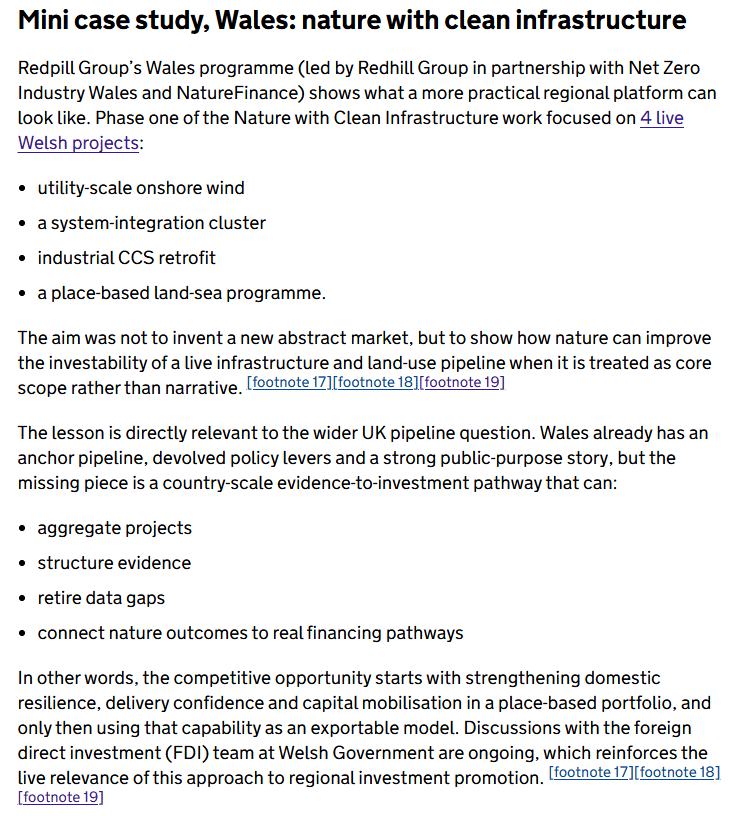
Note the reference to “utility-scale onshore wind“. This means large-scale energy generation, storage, or infrastructure projects producing power or services directly for the electrical grid.
So no change from what’s happening now – big, foreign-owned projects.
Which rules out small landowners and farmers and, presumably, community-owned projects. Yet I thought the ‘Welsh Government’ was pushing smaller projects providing tangible local benefits. Also, moving from onshore wind to offshore.
But is ‘Welsh Government’ serious about local projects? This publication from just this week tells us the total budget for community energy projects is a paltry £1.3m, with a maximum grant of £99,000. This is less than was spent on trees in Africa.
◊
RANDOM THOUGHTS AND VARIOUS DEVELOPMENTS
What we’ve looked at is the monetisation of the natural environment: land, water, trees and, ultimately, the air we breathe. This will be achieved by banks, corporations and others persuading (or bribing) politicians to introduce the necessary legislation.
Legislation that preaches big is beautiful. The clues are found throughout the UK government’s natural capital report, authored by Dr Daniels, with terms like “at-scale“, “scalable use” and “utility-scale“. Small landowners, such as farmers, will only benefit if they allow their land to be part of a big project . . . or if they sell up.
(You may feel I lay too much stress on farming, but some 80% of Wales is farmland, and the people I’m writing about want that land. So they’ll get their politicians and activists to make life as difficult as possible for farmers.)
The same applies to other infrastructure and linked businesses. Between Abercynon and Ystrad Mynach sits the Cilfynydd substation. This encourages considerable activity nearby. Being built now is . . .
A synchronous condenser that provides inertia to the grid. They are being built to stabilise the grid as wind and solar provide no inertia
Cilfynydd Grid Services was a company owned by employees of Welsh Power Group in Cardiff. But it was taken over by Net Zero Grid Services of Savile Row in London, a company formed for the purpose; while Welsh Power Group itself is now owned by Carron Energy. The new condenser is being built by Quinbrook. Which owns Net Zero Grid Services.
AI provides more information:
Rhondda Cynon Taf Council’s planning committee recently approved a new 200MW battery energy storage facility by Pegasus Energy Group near National Road, which will connect underground to the Cilfynydd Substation
We saw the name Pegasus in connection with Terry Tamminen, co-founder of the Darwin Fund with Dr Robin Daniels. Just a coincidence, no doubt.
Around the time of the changes at Cilfynydd the ‘Welsh Government’ gave planning consent for Bute Energy’s Twyn Hywel Energy Park, which will connect to the substation. Twyn Hywel is the only Bute project with planning permission.
Was the timing just coincidence?
After being upgraded, and despite local opposition, the substation will stabilise supply between Scotland and England. Linking with Walham, north of Gloucester. Alongside will be an ‘Energy Centre’, run by Innova, another company from outside of Wales.
Innova is also big in data centres, with one planned for Swansea. And not far away, is Carn Nicholas Solar Parc, and Lletyscilp Farm Energy System. All taking advantage of the Swansea North substation.
Wales is being used as a route for power generated in Scotland to reach consumers in England! (Mustn’t spoil the English countryside with ugly pylons.)
Politicians in Wales have co-operated all the way. First, there was the Future Generations legislation (2015); and then being the first country to declare a climate emergency (2019). Virtue signalling self-harm.
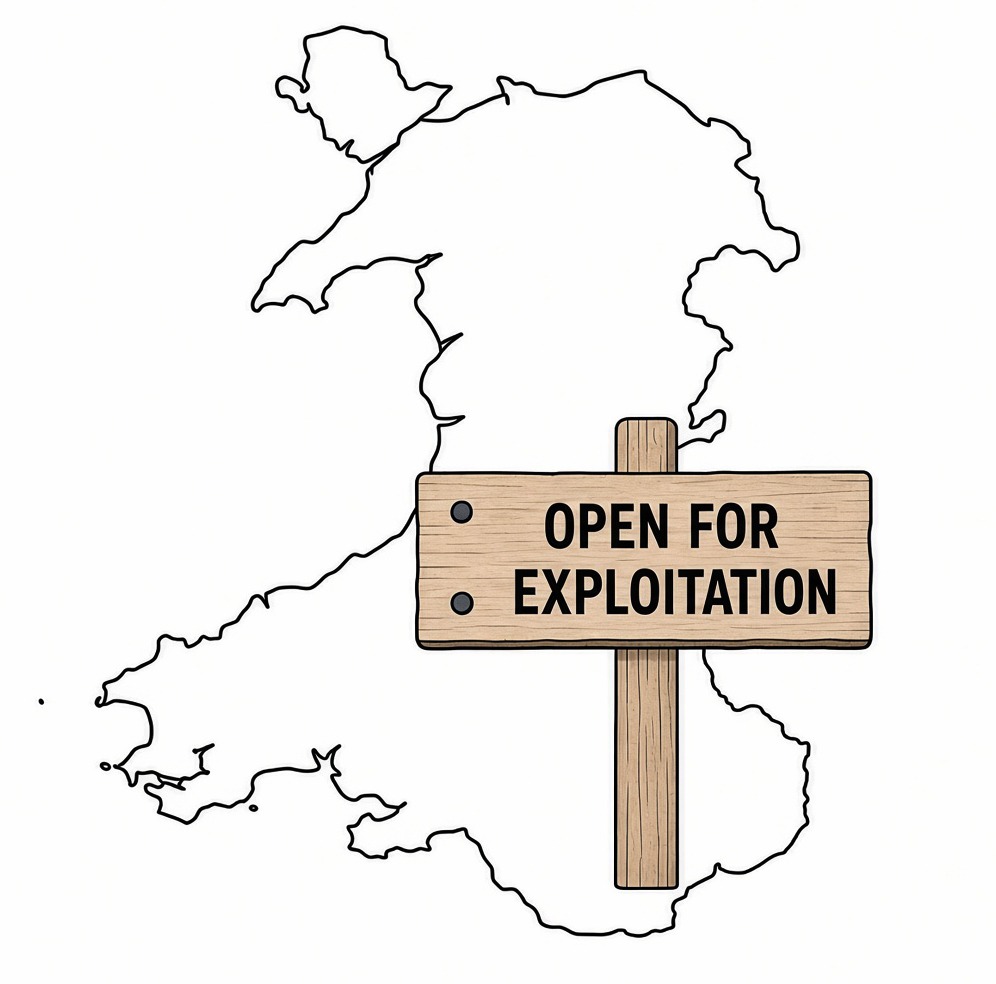
Why not just put up a big sign?
And now, just this year, starting work on the Climate and Nature Action Plan. The title serves to remind us that a big change in the past decade or so is that, as Greta was exposed as the rather sad and dangerous little creature she is, and climate hysteria lost its bogeyman appeal, ‘nature’ was added to the mix.
Which saw increasing influence for wildlife trusts and ‘environmental’ campaigners. (The natural habitat for both is close to the public funding trough.)
◊
CONCLUSION
Dr Robin Charles Daniels is clearly well thought of by the UK government, and he’s got the right connections in Wales. Dr Daniels, and those he might represent, in the USA and elsewhere, now want to invest in “at-scale” projects in Wales.
The timing of the Climate and Nature Action Plan in Wales fits with Dr Daniels’ work with the UK government and his linking up with Net Zero Industry Wales. (To be more honest, it should be ‘Zero Industry Wales’.)
Wales is just the right size to be used as a testbed. The UK government makes the decisions, the civil service passes the orders to its people here who then get politicians to make the right noises and push through the desired legislation.
This faux devolution can only work by having politicians cocooned in a make-believe world where slogans and childish insults replace rational argument; and if that fails, then feigned outrage, or walking off in a huff, is the nuclear option.
So stupid, or so brainwashed, that they believe they’re doing the right thing. These fools enact the dictated legislation and then soak up praise from the Guardian, assorted Bluehairs and – the very ones who are ripping us off!
So they get a pat on the head for allowing Wales to be ripped off. Again and again.
♦ end ♦
© Royston Jones 2026
