A couple of people have contacted me, suggesting I take a look at an outfit operating in Carmarthen. A town close to my heart. Many’s the pint I sank there when I was younger.
Have a skinful in the old Ceffyl Du, and if we couldn’t find a party, or no student fell for my manifest charms, then it was the milk train back to Swansea High Street in the early hours and the long walk home. Happy Days!
This piece wasn’t really planned, and so it’s quite short, around 1,100 words.
If we go to the main website – HQ, as it were – we find, explaining the genesis of LocalMotion, the first example of a word salad. Translations are invited. Though I doubt if it makes sense in any language.
It’s all there: “collective . . . funders . . . collaborating . . . deep-rooted challenges . . . communities . . . shift power . . . decision-making . . . transformative change . . . “. If I wanted to take the piss out of a bunch of chancers looking to squeeze money from charities or the public purse I’d use exactly the same words and phrases.
But these people are being serious!
When I look at a crew like this I always check how and where it’s registered. Is it a company? A charity? Or what? Also, when it was registered.
First stop was the Companies House (CH) website, where I turned this up. You’ll see that CH directs us to the Charity Commission, where the registration is very recent – December 2024 – and what’s listed is ‘LocalMotion Enfield‘.
All rather confusing. Especially as an organisation named LocalMotion seems to have been operating in Carmarthen as early as May 2020. Certainly, according to this piece put out in 2022 by the Carmarthenshire Association of Voluntary Services (CAVS).
How could that be?
And if the charity registered is LocalMotion Enfield, and it tells the Charity Commission it operates only in Enfield, why the hell is it in Carmarthen?
There’s clearly something not right about LocalMotion.
But let’s finish this section with a bit more information on CAVS. Most of its funding comes from the ‘Welsh Government’. And half of this income goes in salaries, expenses and pensions. The woman with the biggest lanyard is on £60,000+ per year.
So was LocalMotion operating previously as Combining Opinions to Generate Solutions CIC? If not, then how do we explain the reference to an organisation operating in 2020 that didn’t officially exist until December 2024?
On the ground, in Carmarthen, we find Owen Griffiths, described as ‘Carmarthen Coordinator’. Griffiths is local to the area, and a recognised artist, having led the project to re-purpose the old Vetch Field in Swansea. (Such memories!)
There is, inevitably, a Corruption Bay connection on the Peak Board. Two, at least. There’s Sarah Dickens, former BBC journalist and communications advisor to the first minister. And Jenny McConnel, “Sustainable Development Advisor at the Office of the Future Generations Commissioner for Wales“.
Together we shape a creative programme that addresses social, environmental and racial justice in the context of South Wales
“Racial justice” for South Wales. Yeah, I lose sleep over it. People in the Heads of the Valleys worry about nothing else. I’m told there was a BLM march in the Gurnos last weekend.
Owen Griffiths’ link to the Centre for Alternative Technology is interesting. If you were sitting next to me now I’d be tempted to go: “Nudge nudge, wink wink, say no more, squire”. Because in recent decades few money pits have had more dosh thrown into them by the ‘Welsh Government’ than this one.
Owen Griffiths is there to give the scam a Welsh gloss. And provide connections.
Two others are named in connection with LocalMotion in Carmarthen. The first is Project Coordinator Mariana Lopez Rojas, from Mexico.
It seems that Mariana’s full-time job is in Swansea, helping “asylum seekers, refugees, and migrants“, with The Centre for African Entrepreneurship (CAE). Though the website failed to provide any evidence of entrepreneurship. Unless milking the public purse is now seen as a legitimate business.
I’m so surprised to see “wellbeing” mentioned below! And as for “The Welsh Dream“? Shouldn’t that read, ‘nightmare’?
When she’s not helping asylum seekers, refugees, and migrants at CAE in Swansea, you might find Mariana at the Make and Mend Workshop CIC in Carmarthen.
The other named principal at LocalMotion Carmarthen is Ali Franks. Who seems to work as The Reconnection Coach. Is that on the NHS?
◊
CONCLUSION
Apart from Owen Griffiths, who may be no more than a figurehead, there is clearly nothing local about LocalMotion.
It’s just another gimme gimme bunch, demanding funding to spew out word salads that mean fuck all to real people. Money to organise one conference after another, workshops without end, seminars stretching into the distant future.
But most importantly from their perspective, is the promise of being allowed into schools, where they can lecture kids from sink estates about their white privilege destroying the planet, and their farm labourer ancestors’ responsibility for slavery.
LocalMotion uses a mission statement so hackneyed, and a template so well worn, that it’s clear they’ll simply duplicate the work (work!) of dozens if not hundreds of other groups already operating in Wales.
I would be very disappointed to see these buggers get a penny from Corruption Bay or County Hall. If they do, I’ll be digging deeper and writing about them again.
Let them sod off back to Enfield with their word salads and their insulting bullshit.
First, a brief look at the new Plaid Cymru administration. Then an analysis of ‘Well-being’. Before looking at the looming threat of AI data centers.
This piece is bigger than usual, some 2,700 words. But you know it’ll be worth it!
◊
PLAID CYMRU IN POWER
Plaid Cymru emerged from the May 7 Senedd elections as the largest party, winning 43 out of the 96 seats contested. So we have a minority government that will almost certainly need support from Labour (which won 9 seats) to run things.
And even though the Guardian might view Plaid as “centre-left“, I see a far-left party. Which might not be too bad, if it was an old-fashioned left wing party intent on improving the condition of the working class and governing in the interests of a majority of the population.
But the working class, normal people, level-headed people, are now the enemy for the Antifa Irregulars and the Hamas Support Brigade so influential in Plaid.
Let’s start by looking at the cabinet selected by new first minister Rhun ap Iorwerth.
OMG! Where’s the diversity?
Perhaps the only one in whom I might have confidence is Llŷr Gruffydd who, if nothing else, seems to understand rural issues. But then I curb my enthusiasm by remembering that before May 7 he was the SM for the largely rural North Wales region; whereas he now represents the smaller Clwyd constituency, dominated by the urban fleshpots of Rhyl, Prestatyn, and Colwyn Bay.
And then we must consider the description of his ministerial role: Cabinet Minister for Rural Resilience and Sustainability.
‘Sustainability’ for Plaid Cymru, Labour, Greens and the Globalist left generally means: net zero, Agenda 2030, wind turbines and solar panels everywhere; while promoting veganism and using various deceits to get farmers off the land for the benefit of corporate investors.
But what the hell is ‘Rural Resilience‘? Does anybody know?
Even just skimming over the rest of the bunch is really depressing.
For example, in newly-elected Mark Hooper, Deputy Minister for Transport, we have a man on record as saying that “private car travel is a massive problem“. His colleague, also new, Dr Dafydd Trystan Davies, Cabinet Minister for Government Effectiveness(?) and the Constitution, is equally if not more hostile to the freedom bestowed on us peasants by private transport.
For Davies is a sanctimonious planet saver; determined to punish those going to work, dropping the kids off at school, or running granny to her chiropodist appointment.
If these sinners paused for a moment in their attempts to make ends meet, or hold the family together, and instead gaze up to the moral high ground (just above the sunlit uplands), they’d see Dr Daf, wagging his finger admonishingly.
This saintly individual has for some time been a big wheel (spoked, and fully pumped) in the 20mph Sustrans outfit, now renamed Walk Wheel Cycle Trust.
And don’t get me started on Sioned Williams and some of the wimmin. If former Plaid leader Leanne Wood was Medusa they’d be the snakes. One of the new intake, Sarah Rees, admits to being “a campaigner at heart“, perhaps to explain why she’s never done a real job. Perfect for the Senedd!
Despite the widespread ‘optimism’, Plaid Cymru seems as much in thrall to pressure groups and ishoo pedlars as Labour. The useful idiots of Globalism, a form of capitalism so ruthless, so anti-human and authoritarian, that it would repulse the most heartless 19th century ironmaster or coal owner.
◊
BEING TOLD TO FEEL GOOD ABOUT BEING POORER. AND THE ENDGAME
Now I’m going to focus on something I’ve mentioned in connection with other topics. It’s the vast superstructure built on the Well-being of Future Generations Act 2015.
Everything done in Wales since then must follow the stipulations of the Act. It’s used to influence everything. I’ve seen planning applications contain phrases like, ‘This development accords with Future Generations legislation’.
Nicola’s work is impressive, and extensively researched. So I won’t go over the ground she’s covered; but it’s worth noting her references to the usual suspects: Club of Rome, WEF, EU, WHO, and others.
The way I see it . . . national and individual wealth has traditionally been gauged by metrics such as GDP, disposable income, home ownership, number of private cars per head of population and other determinants.
But by following the Globalist agenda we in the West are becoming poorer by those traditional ways of assessing wealth. Consequently, something was needed to hide the reality and change the focus. This is where Well-being enters the frame.
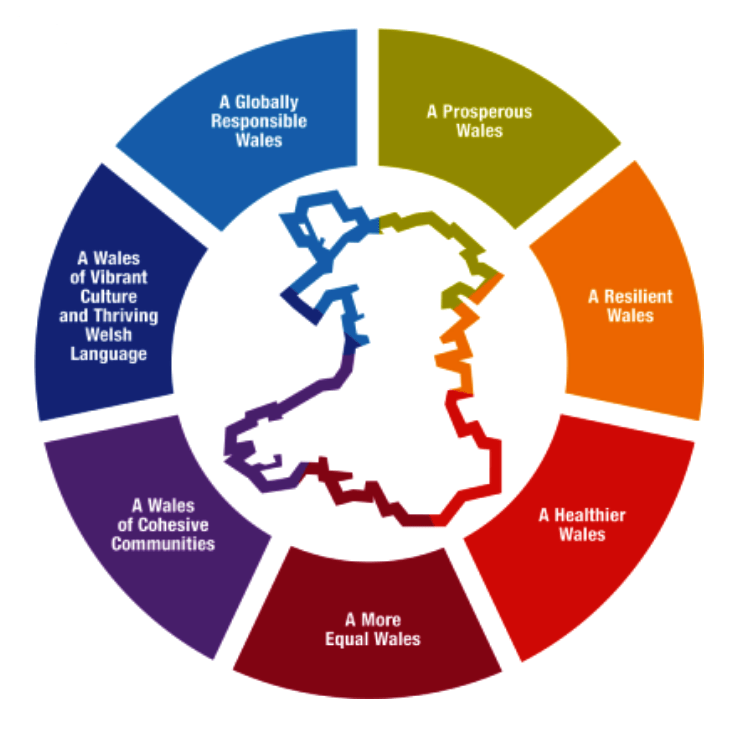
Let’s go through the ‘Welsh Government’ graphic you see above.
Starting with, at the top, ‘A Prosperous Wales’. So vague as to be meaningless. And how does a country de-industrialising while simultaneously being trampled on by the new robber-barons of the ‘renewables’ racket and the digital age become prosperous?
‘A Resilient Wales’. That word again. But what does it mean? Taking all the crap forced on us without complaining?
‘A Healthier Wales’. Yeah – with the NHS on its knees.
‘A More Equal Wales’. Which means what, DEI and anti-white discrimination?
‘A Wales of Cohesive Communities’. Impossible when you destroy the economic foundations that made communities cohesive. And how does welcoming illegal immigrants to the Nation of Sanctuary aid community cohesion? This is delusional.
‘A Wales of Vibrant Culture and Thriving Welsh Language’. I suspect ‘vibrant’ here means diversity. Again. As for the language, no one who’s destroying farming, a bastion of the language and the economy in so many areas, should be taken seriously.
‘A Globally Responsible Wales’. Probably means student politics and virtue signalling. More bollocks. The sole responsibility of any ‘Welsh Government is Wales.
“Forget about the kids going hungry, Mrs Evans – improve your well-being by thinking about the non-binary lynx we’ve released in the area. Look, there’s one now, making off with little Carys’s rabbit!”.
Once you accept the fundamental lie of the ‘climate crisis’, and agree to the sacrifices demanded, then you’ll accept the resultant decline. But it’ll be you making the sacrifices, not those asking you to make them.
And because the threat is global it must be tackled globally. Which inevitably means trans-national bodies taking control. The next step will be a kind of world government. But you’ll have no say in electing this world government. For elections will be things of the past.
We’re already on our way to an unelected world government with what masquerades as electoral politics in the West today. At a stage where it matters little who you vote for; as most politicians – the Uniparty – sing from the Globalist hymn sheet.
Another feature of such systems is the ‘Chosen One’. Often a graduate of the World Economic Forum’s Young Global Leaders programme.
Back in 2024, in Canada, when it became clear that Justin Trudeau had been rumbled by the electorate, Mark Carney, former Governor of the Bank of England and arch Globalist, appeared from nowhere. Carney wasn’t even a sitting MP, but it had been decided, somewhere, by someone, that he would be the next prime minister of Canada.
First, he was made leader of the ruling Liberal Party, then a seat was found for him and he was elected for Nepean, Ontario, in the general election of April 2025.
Over here, Starmer’s a dead man walking. And so a suitable replacement had to be found. The one chosen is mayor of Manchester Andy Burnham. But like Carney, he’s not even an MP. So a Labour MP has stood down and now there’s a by-election in Makerfield on June 18.
If Burnham is elected he’ll become party leader and therefore prime minister. He might be worse than Starmer, but he’ll be a fresh face to fool the plebs for a bit longer.
What I’m describing is not old-fashioned party intrigue, or political jockeying. Because Carney and Burnham were not chosen by their respective parties. (Let alone the members of those parties.) They were chosen by people you’re not supposed to know about; and the role and power of these oligarchs will never be discussed in the media they control and want you to rely on.
To implement their agenda of wealth and asset transfer, Digital ID, Central Bank Digital Currency, and Universal Basic Income, you must be brainwashed into believing that not only are the sacrifices you’re making unavoidable, but also that you should feel good about making them.
Which is all you need to know about the Well-being scam.
One facility matches a city of 50,000’s water consumption, straining drought-hit valleys and jacking up Dŵr Cymru rates for everyone else.
What’s clear, and what no one denies, is that data centres consume vast amounts of water and electricity. So let’s consider water first. For as David Powell tells us, “One facility matches a city of 50,000’s water consumption“?
Though Google AI suggests the demand will be even higher:
A typical large data centre consumes between 11 million and 19 million litres of water per day—roughly equivalent to the daily usage of a town of 30,000 to 50,000 people. Facilities dedicated to Artificial Intelligence (AI) demand even higher volumes.
Do we have that much water to spare? The answer is obviously no, so it’ll be existing consumers, in the urban south, that’ll find themselves going without. And paying Dŵr Cymru more for less.
But what’s the purpose of these date centers? Listen to Sam Altman, founder of OpenAI, speaking at the BlackRock US Infrastructure Summit.
But we see a future where intelligence is a utility, like electricity or water, and people buy it from us on a meter.
Clearly, AI data centers will need vast amounts of water that the current system will struggle to supply. But electricity will perhaps be even more of an issue.
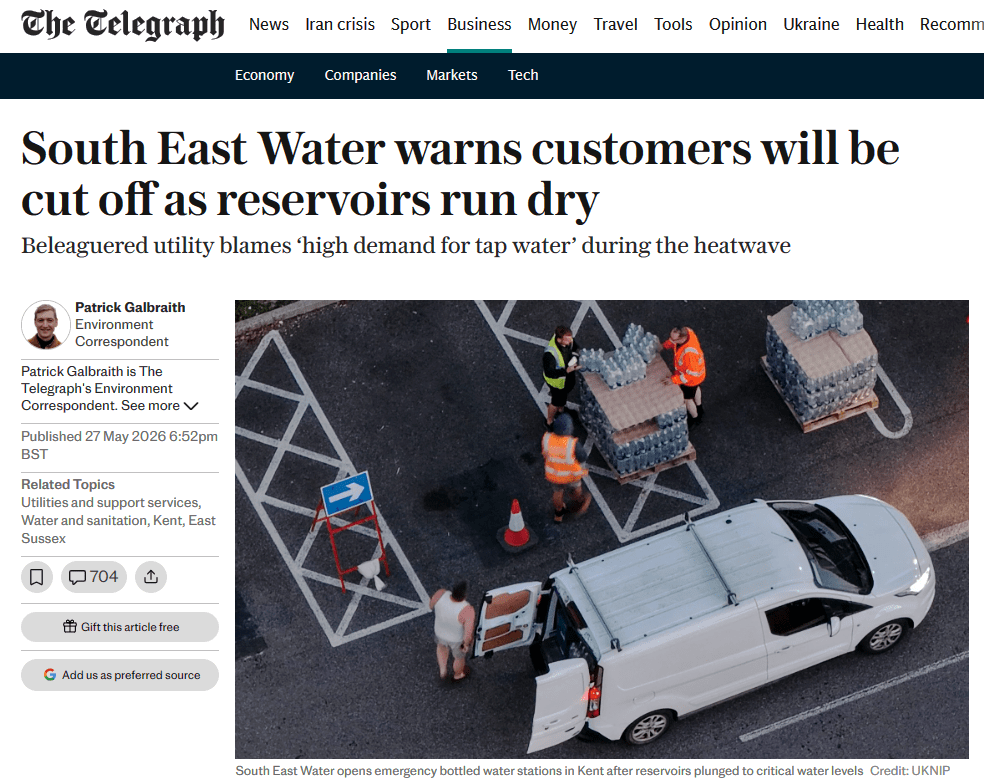
Parts of England ran dry last week
Those who support ‘renewables’ argue wind and solar will make a huge contribution to supplying AI data centers. That’s wishful thinking; an intermittent supply from wind farms and solar installations, even with their unreliability mitigated by Battery Energy Storage Systems (BESS), isn’t going to cut it.
There are many other projects, including those planned by ‘Welsh’ Labour’s favourite company, Bute Energy. Additional to the BESS installations incorporated into the various ‘Energy Parks’ (windfarms & solar soil destroyers) Bute’s formed BESS companies that specifically name; Cilfynydd, Rhigos, Carmarthen.
But BESS are springing up everywhere. One I’m just hearing about is Castell Llwyd, just west of Ystrad Mynach. The company behind it, Qair, is French owned.
No doubt there are others in the pipeline. For as Google AI tells us:
Wales is rapidly developing into a major UK hub for AI and cloud computing, driven by billions in inward investment, massive hyperscale data center construction, and official AI Growth Zone designations by the UK and Welsh governments
Yes, of course there’s a National Grid. But AI data centers are springing up in England, too, increasing the demand on a system that, like the water supply, will struggle to cope. And will struggle even worse the more it relies on ‘renewables’, the price of which is set to double by 2030.
Then there’s the impact on health. Data centers emit a continuous noise. Here’s David Powell again:
Vantage’s Cardiff operations clock 46-48 decibels at the doors – officially “minor adverse” per standards, but stack multiple facilities in clusters and it becomes a symphony of sleepless nights and shattered quality of life.
Google AI suggests it’s even worse:
AI data centers are notoriously loud. Driven by the need to cool thousands of dense servers, they produce constant, 24/7 noise pollution that can reach 55 to 85 decibels—and sometimes up to 100dB right next to the facility.
A problem exacerbated by the back-up generators:
On-site diesel generators or natural gas turbines used during power grid shortages sound like low-flying planes
All this can affect property values close to the centers.
But do AI data centers have a purpose over and above that outlined by Sam Altman?
Fundamentally, AI data centers are being built so someone, somewhere, can collect as much information as possible on as many people as possible: So as to know what they do. And what they buy. Their reading and viewing preferences. What they think. And what they say.
Information is power.
And this power, in a world where oligarchs are trying to take control through making a sham of democratic politics, will not only know your views and your preferences; for when combined with Digital ID, CBDC, and UBI it will be able to control you.
You’ll find that expressing certain views not only loses you your internet connection, it will also mean you’re unable to access your money. (Cash will already be outlawed.)
You’ll become a non-person except to those you can interact with on a physical level. But you’ll find that few will want to be seen talking to you due to the ubiquitous cameras.
◊
CONCLUSION
‘Well-being’ is obviously a deceit. A form of manipulation that expects people to put up with less or worse for a noble objective that, when analysed, itself turns out to be a lie.
Now let’s have a few final thoughts on AI data centers. Because powerful voices are coming out against them, and even those behind them are getting nervous.
Some of the Pope’s strongest imagery in the document related to slavery, warning parallels between the historical tragedy of traditional slavery and the emerging threats of “new digital slaveries”.
It should be noted that Leo XIV is the first Pope from the USA. I mention that because another American is worth quoting in this context – Larry Fink, BlackRock CEO and Interim Co-Chair of the World Economic Forum.
As you might guess, Larry and his multitudinous investment arms have put a whole lot of money into AI data centers. But Larry fears the peasants will rise up, and attack the data centres with cheap drones! (An update to pitchforks and blazing torches?)
Here’s Neil Oliver’s take on it. It’s worth watching.
Neil also reminds us that the power and reach of “Caesar” Fink’s empire is built on the savings and pensions of millions of little people. Which means that Joe Schmuck in Ohio and Dai Williams in Ponty pay for their own “digital slavery“.
Will the new Plaid Cymru administration stand up for Wales, and humanity, and against the proliferation of AI data centres and the misery they’ll inflict?
And what about the inconsistency – many might say hypocrisy – of allowing AI data centers to drain the electricity grid and monopolise water supplies while constantly hectoring us mere mortals into consuming less of everything?
Wales can’t continue in a cartoon world created by brainwashed or unhinged useful idiots where cows are a threat to the planet and Welsh cakes must be decolonised.
Wales has more than enough real problems. Plaid Cymru must tackle them.
This piece is totally unplanned; but I want to get it out because I see so many misinterpreting the result and failing – or refusing to understand – what lies behind it.
◊
PLAID CYMRU AND LABOUR, LABOUR AND PLAID CYMRU
Let me begin by congratulating Plaid Cymru on a great victory. As I’ve mentioned more than once, I was a member of the party for many years and, back in the 1970s, a candidate for both Swansea council and the old West Glamorgan county council.
But it was a different party back then. Though the victor in Caerffili, Lindsay Whittle, seems in some ways closer to the party I belonged to than the modern party. We shall see.
The Plaid campaign was strange in that it seemed to be more about stopping Reform than offering any policies of its own. And so it was reduced to a two-horse race; portraying Reform as the agents of Putin, Trump, and English nationalism (get your head around that!), with Plaid as the standard bearer for Wales, decency, and ‘progress’.
Which was bollocks. The election was really about voters’ rejection of Labour. Everything else flowed from that.
The people of Caerffili were justifiably pissed off with Labour for two reasons.
First, 26 years of abject failure by the Labour party managing Wales from Corruption Bay. From which Plaid and Reform profited.
But let’s remember that Plaid was in coalition with Labour between 2007 and 2011, and the two are currently in some ill-defined ‘agreement’. Furthermore, and just like Labour, Plaid supports the Globalist-Woke agenda on climate, gender, race, etc., and would go further.
Second, there was Keir Starmer factor: cancelling winter fuel allowance, rocketing electricity bills thanks to ‘clean green energy’, rising taxes, rent boys, immigration, Chinese Communist Party influence, rape gangs, Digital ID. A tower of betrayals and lies that will soon topple and destroy Starmer.
So Plaid profited because they were seen by many as being a change from Labour. An improvement. And marginally preferable to Reform. With a strong local candidate, in Lindsay Whittle.
But in addition to the shared outlook I just listed, and since Plaid abandoned independence the difference between Labour and the Party of Wales is, well . . . anybody got a fag paper? Don’t bother – there’d be nowhere to fit it.
Here’s what they both really want: More political power for the Senedd and more funding from London; then they can make California Democrats look like Confederate flag-waving rednecks buck dancing by their likker stills.
And as someone has pointed out to me, the constituency itself needs to be understood.
His take is that the northern part of the constituency probably went to Reform.
But the southern part, which touches Cardiff’s northern suburbs, is home to many ‘progressives’ who realised Labour is cooked and switched to Plaid.
◊
ATTITUDES, REACTIONS, RESPONSES
One of the more puzzling outlooks came from those claiming to want independence but attacking Reform, and using choice language, for being “English nationalists“. Which exposed, yet again, that the modern nationalist movement is home to some very strange, and stupid, people.
I love to see the England flag. I want the English people to reclaim England. I want three independent countries on this island respectful of each other. The threat is not England or the English, the threat is a form of Unionism that has little respect for us and is subservient to supranational bodies and the Globalist agenda.
Yet most of those who attack Reform as English nationalists want independence in order to rejoin a bankrupt and increasingly authoritarian EU pushing for war with Russia to distract from its internal collapse. This is insane.
Reform may be Unionist – but looking at the bigger threat, to which independence under those now promoting it would sacrifice us – Reform appears to want the same things I want.
There was a post-election piece by Martin Shipton in Nation.Cymru today. Here’s one of the comments. Who’d have thought the president of Russia could be worked into a small comment on a Welsh by-election.
Though I’m at a loss as to why proximity to Cardiff should matter. Unless it links with my earlier reference to the nature of the Caerffili constituency, and the dread thought of hairy-arsed ‘flag-shaggers’ encroaching on those leafy northern suburbs.
Knowing the political sentiments of some of those commenting to this piece (even the writer), I was struck by how easy it’s been for them – and others I’ve read today – to switch from Labour to Plaid.
For them, it’s clearly the agenda that matters, not which party pushes it.
Yet we might still see Labour go for broke, and try to out-Woke Plaid before next May’s Senedd elections. That’s what Paul Embery might have suggested today in this tweet.
Did a Labour Senedd member really say that on the Home Service?
If so, how will Labour go about it? Just imagine . . . “We have set up a taskforce, with a budget of £20m, to tackle the problem of transphobia in Llanfair Caereinion“.
◊
LOSERS, WINNERS, CONCLUSION
The party I support, Gwlad made little impression; hardly surprising if you lack rich backers and the media ignores you.
But then, I remember it took Plaid Cymru 40 years before Gwynfor Evans won the Carmarthen by-election in 1966. So maybe it’s time to put Plaid’s victory in perspective.
First, Caerffili was a by-election; strange things can happen at by-elections. I recall the Orpington by-election of 1962. But it didn’t lead to a Liberal revival.
And Plaid has been here before, winning seats in the Valleys. In the first Assembly elections (of 1999) Plaid took Islwyn, and Rhondda, also Llanelli. Plus of course the usual seats further west and north.
More recently, Leanne Wood won, then lost, Rhondda.
I can even remember Plaid briefly taking control of Merthyr council.
So Plaid winning a seat in this area is not unprecedented, but they tend to be flashes in the pan. Will Caerffili prove to be any different?
The big difference now of course is that Labour is in real trouble. Is it terminal? Is Labour’s century of dominance in Wales over, just as the 1920s marked the end of Liberal hegemony?
It’s too early to say, because as I said earlier, Labour paid the price in Caerffili for both its own record in Wales, and the unpopularity of a Labour administration in London. A change of government in London would almost certainly help Labour here, but only so much.
Because I think Labour in Wales was on the skids before Starmer got elected. In the Senedd elections of 2021 Labour got 46% of the vote in Caerphilly. In last year’s UK general election, it was down to 38%.
And we may never see a majority Labour government in London again. Many younger voters, and middle class voters, will desert to the Liberal Democrats and the Greens.
And where are the Conservatives? Remember them!
Looking ahead to the Senedd elections next May, and unless something dramatic happens between now and then, we’ll see Reform with most seats, but Wales run by a Plaid-Labour coalition.
Which means that the big winner last night in Caerffili was, and the big winner next May will be, the Globalist agenda.
∼
The punters looked from Labour to Plaid, and from Plaid to Labour, and from Labour to Plaid again; but it was already impossible to say which was which.
Plaid Cymru’s relationship with the Green Party has ranged from what appeared to be full coalition through local understandings to what at other times appeared to be no linkage whatsoever. The prime mover of co-operation between the two parties was Cynog Dafis, who was elected as the Plaid-Green MP for Ceredigion in 1992. His majority was 3,193. But the results from neighbouring constituencies made it clear that the Green vote – had the parties stood separately – would have been far less than that majority. To the north, in Meirionnydd Nant Conwy, Bill Pritchard got just 471 votes; whereas to the south, in Carmarthen, the Greens couldn’t even find a candidate! Making it clear who was benefitting from this alliance. Not only did Plaid Cymru not need the Green vote, what this misalliance taught us was that many or most Greens refused to vote for a joint candidate. I shall explain why in a moment.
Now I hear of another local alliance forming, this time in the area that used to be covered by Lliw Valley District Council, those communities to the north and west of what might be termed Swansea ‘proper’: Clydach, Pontarddulais, Gowerton, Gorseinon, Pontardawe, etc. The threat of Underground Coal Gasification in the Burry Inlet or Loughor Estuary has aroused some local residents to voice their protests, but few of these seem to be, well . . . genuinely local. This has somehow got linked with protests against new housing planned for the area.
The flyer below (click to enlarge) was handed out at the recent Pontaddulais Show by local members of Plaid Cymru, advertising a new “coalition of individuals and organisations under the Greenspace Cymru banner”. Ok, so we know Plaid is involved, but who else is part of this ‘coalition’? Greenspace Cymru is said to have a Facebook page but I can’t find it. So let me hazard a guess that the local Plaidistas have jumped into bed with a bunch of English nimbys and a shower of Greens, again. So why am I writing about this obscure local issue? Partly because it’s on my old home patch, but also because it has wider ramifications.
Let’s start with the housing. This not Ceredigion or Denbighshire; few of these homes will be bought by retirees, good-lifers, or commuters to English cities. What’s proposed is just more infilling between Swansea and Llanelli. The majority of these houses will be bought by people already living in the region. That being so, for Plaid Cymru to become part of this ‘alliance’ is weird. Then there’s the gas. With oil supplies finite, the Middle East in constant turmoil, the example of falling gas prices in the USA, and wind power and other ‘green’ energy exposed as a waste of money, shale gas, or whatever you want to call it, is going to happen. I have argued that we should fight to have control of this resource devolved to Cardiff Bay, but if this proves impossible then we have to make the best of it, we must ensure that Wales, and Welsh people, get the maximum benefits.
So why do I hate the Greens? In Scotland there is a genuine Scottish Green Party, and it supports full independence. Here in Wales, we have a rag-bag collection of hippies, good-lifers and other zealots forever dictating to us, thinking they can grant themselves planning permission – even in a National Park. They don’t like to be reminded that they’re in a country other than their own. (This is why so many of them were hostile to the electoral link-up with Plaid Cymru.) Yet for some perverse reason many in Plaid Cymru still view the Greens as kindred spirits. Which often results, as we see today in Lliw Valley, in the party supposedly representing the interests of the Welsh people lining up with Greens who don’t give a damn about us Welsh, and nimbys who want to see zero development in Wales lest it interfere with their comfortable lives. The kind of Fleece Jacket Fascists I dealt with a while back.
Tilting at windmills is all very well in its place – God knows I’ve done enough of it! – but if Plaid Cymru wants to be taken seriously as a political party it should choose its friends more carefully and remember whose interests it’s supposedly serving. Going overboard for wind turbines and other renewables was a mistake. One doesn’t need to be a Mail or Telegraph reader to know they’re expensive and they don’t deliver. That mistake is starting to be remedied. Rhun ap Iorwerth’s support for Wylfa B was another step in the right direction. A further positive is Helen Mary Jones stepping down as party chair. But if Plaid Cymru is going to oppose the new homes that Welsh people need, and the jobs that building them will create; plus cheaper gas prices and the jobs extracting the gas will provide, then the party will take yet another wrong turning.

 A couple of people have contacted me, suggesting I take a look at an outfit operating in Carmarthen. A town close to my heart. Many’s the pint I sank there when I was younger.